

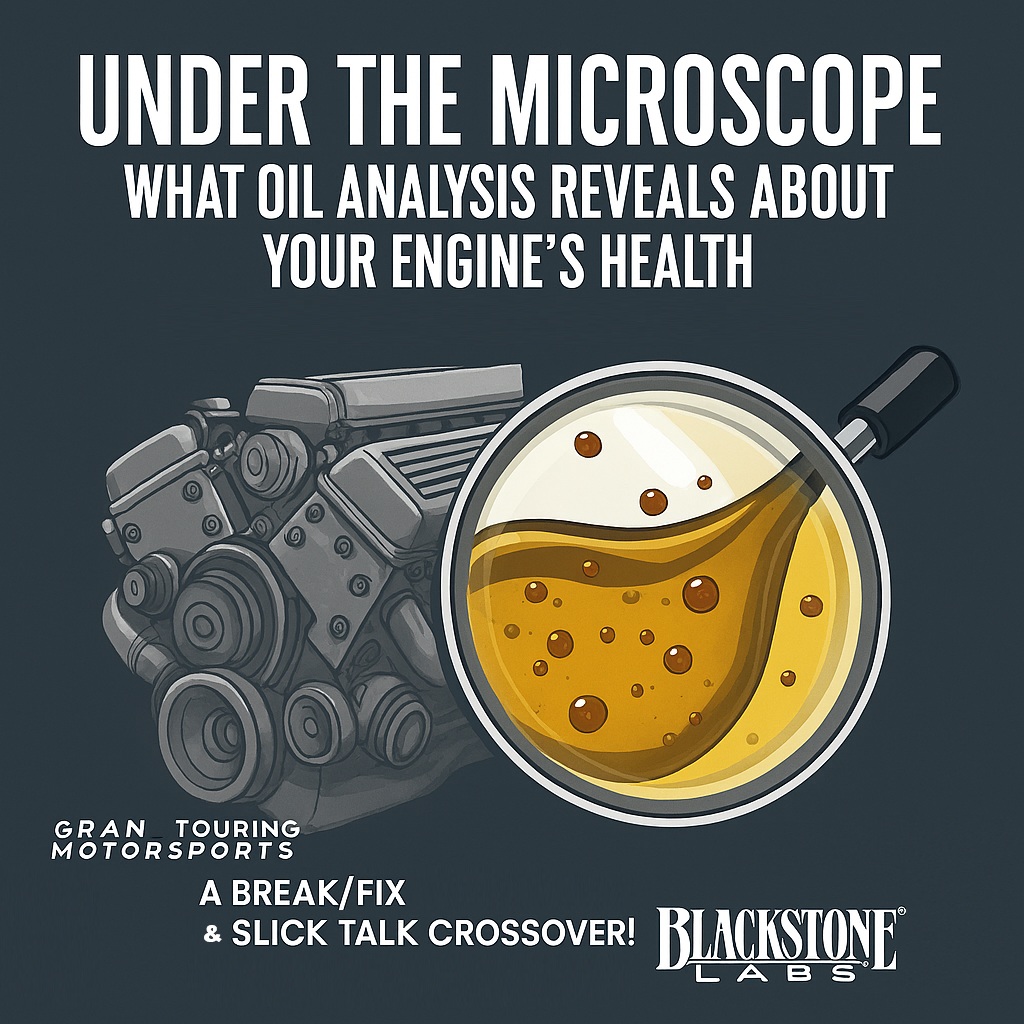
When it comes to motorsports, performance is everything – and that includes what’s happening beneath the surface. In this special crossover episode of Break/Fix from Gran Touring Motorsports, we team up with “Blackstone Joe” Adams from Slick Talk Podcast to demystify the science of oil analysis and why it’s one of the most powerful diagnostic tools in your garage.
Tune in everywhere you stream, download or listen!



Blackstone Labs has been decoding engine health since 1985, starting with heavy-duty diesel engines and expanding into everything from aircraft to race cars. Their secret? A personalized approach. Every oil sample gets a human analyst – not a computer-generated report – who interprets the data and offers tailored insights.
Joe, who began as a data analyst and now runs Blackstone’s social media and podcast, explains that oil analysis is like reading your engine’s diary. It reveals wear patterns, contamination, and even the presence of additives or foreign substances. Think of it as preventive medicine for your motor.
Spotlight
Joe Adams - Analyst and Podcast Host for BlackStone Laboratories

Every oil has a story, especially oils that come from engines, transmissions, and even machinery used for industrial applications. At Blackstone Laboratories, we test it all. With the show Slick Talk our host Joe Adams offers you a look (or listen) behind the curtain.
Contact: Joe Adams at joea@blackstone-labs.com | N/A | Visit Online!


Notes
- Blackstone Labs (BSL) origin Story
- Explain the oil testing process: How does a new customer engage with BSL; What does the service cost? Explain expectations and how to interpret results for a first timer?
- How does BSL pin-point issues with engines?
- Oil change intervals? 3K / 5K / 10K, more?
- Are additives all they are marketed to be?
- From the data you see what would you say are the Top-5 performing brands?
and much, much more!
Transcript
Crew Chief Brad: [00:00:00] Grand Touring Motorsport started as a social group of car enthusiasts, but we’ve expanded into all sorts of motor sports disciplines and we want to share our stories with you. Years of racing wrenching and motorsports experience brings together a topnotch collection of knowledge and information through our podcast.
Break Fix.
Blackstone Joe Adams: Hello and welcome back to the show. This is Blackstone Joe, and you’re listening to the Slick Talk Break Fix crossover episode with our friends at Grand Touring Motorsports.
Crew Chief Eric: And as a follow-up to the episode we did a couple weeks back, you’ll remember that we spoke to one of the major oil providers in the Motorsports world and Blackstone Labs was mentioned on that episode.
And we thought, what a great way to introduce people to the idea of oil analysis. So with Joe’s help, we’re gonna unpack all of that and with us tonight, as a bonus filling in for Brad as our co-host from the drive-through, you’ll recognize her as [00:01:00] Tanya.
Executive Producer Tania: Hi, thanks for having me, and welcome to Break Fix, Joe, we’re excited to have you on the show tonight.
So without further ado, let’s just get rolling. So first up, the origin story. Tell us about Blackstone Labs.
Blackstone Joe Adams: So it begins in 1985 and that year is very easy for me to remember ’cause that’s the last time the Bears won the Super Bowl. So it starts off in 1985, Fort Wayne, Indiana, founder by the name of Jim Stark Oil Analysis.
You know, if it seems like a niche thing now, uh, you go back in the eighties, you know, even more so Jim’s approach, you know, the customers that were out there largely were just talking about big diesel engine owners, factory machinery, aircraft. In the years since then, and we’ve really grown into pretty much any area where oil is needed to do its job.
We’re there Blackstone laps. Through the years, we’ve just tried to maintain a personalized approach to every customer having a comment specific. To each customer, [00:02:00] their sample written by an analyst, no computer generated nonsense. It’s a personalized approach that’s really been ingrained into our success.
Crew Chief Eric: So, Joe, why don’t you explain for our audience what your role is at Blackstone?
Blackstone Joe Adams: So recently I was kind of grappling with answering this just in daily conversation ’cause it’s not as simple as it used to be. So I, I came on board. As a data analyst strictly. So I was one of the people who would look at the results and I would summarize what looked like a problem, what looked great.
But in the years since I joined the company, I’ve started to wear quite a few hats. So now I run social media. I started the podcast Slick Talk for Blackstone, so I’m really basically communicating the good news of oil analysis in pretty much any way I can. So it’s grown from writing to social media, to podcasting, and who knows where we’ll go next.
Crew Chief Eric: In listening to some slick talk episodes, you go into great detail on individual subjects that we’re kind of covering at a higher level [00:03:00] to, you know, kind of get everybody a broad brush approach to the whole idea of oil analysis. And one of the things that you bring up on multiple episodes is pinpointing issues with particular types of vehicles or engines and and oils, et cetera.
How do you guys make that determination? How do you figure out that a certain engine is doing a certain thing or this is a bad thing versus isn’t all twin cam four cylinders basically the same? If they were designed out of the same, you know, let’s say Cosworth mold, let’s take the four A GE Toyota versus the 20 valve Volkswagen.
How do you know the difference?
Blackstone Joe Adams: So what we see in general, you can see a typical wear profile where you have a balance, you have a shape of metals as I like to refer to it. And when you see metals that get out that typical shape, we know say let’s just take a a particular B-M-W-I-I always. I wanna go back to the S 65.
For some reason, we know that it will have about the same amount of, for the engines with leaded bearings, it’ll have about the same amount [00:04:00] of lead and iron in a sample. And then you’ll see copper behind that, and then you’ll see aluminum behind that and then crumb. So we can see what’s typically dominant and what’s not.
So one key giveaway for me is seeing an unusual balance. We see maybe a, a, a, an odd amount of chrome. From piston rings, for example, let’s say it’s way outta line relative to piston wear and, and iron from steel parts like cylinder liners. That can be a, a, a giveaway that something is obviously wrong.
Mechanically, it’s generating more metal in certain areas that normally does outweighing other metals. That’s a concern. There are certain levels that no matter how you slice them, they just are problematic. When you talk about, when you get metals up towards like the thousands of parts per million, say if we’re looking at like any gasoline or diesel engine, there simply is not a healthy wear profile that would involve that amount of metal.
But then when you, when you go between these areas, you do [00:05:00] have a little bit of gray where you have metals that are typically when they’re about twice average. That’s when we wanna start paying attention to them. But again. We can start earlier if you have a very unusual balance, regardless of the levels, but typically when they start reading about twice average, that’s when we wanna keep an eye on them and over trends.
If we see a steady increase. That often is a key indicator of a problem. An increase where you’re sampling 3000 mile oil change interval after 3000 mile change interval, and you just see the steady climb. That’s another way to tell there’s something not right mechanically. And then obviously there are very, I would say, concrete results where no matter what something is wrong, the presence of antifreeze, the presence of fuel that is so significant, it’s thinning the viscosity, it’s diluting oil additives.
There’s no good way for that to be going on. Running into excess dirt where you see a silicon level that’s coinciding with so much excess [00:06:00] wear. You do have to play a waiting game sometimes where you have levels that don’t match up perfectly with average, but maybe that’s due to hard use mods, et cetera.
We’ll wanna see how trends build. And then obviously you have those times where there’s no reason for, you know, once you start getting north of like a thousand parts per million and then you start getting to the point where that also involves. Visible metal coinciding with high level, there’s a delicate way of handling trends, and then there are the screaming stop signs.
Something is wrong.
Executive Producer Tania: And I guess in terms of, you know, really pinpointing down, I guess another example, could you provide guidance or give a recommendation to someone? Can you tell for them that they’re running the wrong. Motor oil for their engine. Perhaps they’ve got something that’s too thin, they’ve got an older engine with high mileage, they should be running something thicker because they do already have wear.
Is that something that too specific?
Blackstone Joe Adams: Well, what it often comes down to is folks will stray if, if they do stray [00:07:00] from the manufacturer guidance. Usually it’s just not the case that someone can outthink the manufacturer that often comes into play. So if someone is running like a 10 60 an engine that’s designed to run a zero 16, it obviously is not what’s supposed to be in there.
And it doesn’t take us to, to know that. Usually I think folks will try and doctor it in such a way where they think, well, okay, yeah, exactly. Your, your example of a high mileage motor. They’ll try and outthink whatever the manufacturer says because of mileage, because of other parameters. And we find that.
What the manufacturer’s telling you to run is the right choice. Managing a problem though, you can’t put a bandaid on it with, okay, run a different oil, put this additive in a problem is a problem. The nice thing is you can view the manufacturer guidance as a safe bet, and when we find a problem, you can’t really fix it with the oil, with an additive, so it doesn’t [00:08:00] become an area of recommendation for us.
Crew Chief Eric: So that actually brings up a really good point. We’re gonna talk about additives a little bit more here in a minute, but can you actually detect in the analysis whether somebody has bought, you know, let’s say off the shelf, I’m gonna name names, just because people are familiar, you know, a bottle of Lucas or a bottle of sea foam or whatever it might be, or maybe a can of Coke, and they poured it down into the system.
Can you detect what someone has done if they didn’t report it to you on the slip?
Blackstone Joe Adams: Some of them do have dead giveaways, not all of them. What can get tricky is a lot of oil additives. Oil treatments will contain elements that are already present in engine oil to begin with. So some of those can hide, but a few of them, a lot of the popular ones stick out like a sore thumbs.
Think turbo max, arch Oil, RevX, um, restore. These are additives that stand out because they use elements that generally are not present already. Turbo max, arch Oil, RevX, I group them together [00:09:00] because they all three will contribute a lot of potassium to the oil. Um, they’ll also influence the boron level, which boron is present in oils to begin with.
A lot of them, but arch oil and RevX have a level far, far higher than what you will ordinarily start out with. So those stand out. Um, as does restore, restore for different reasons. It has a very high concentration of copper and lead. So if you’re interested in how your engine’s wearing at brass bronze parts.
Probably don’t use Restore before you send in a sample. And if you’re worried about a coolant leak in your engine, please don’t put Arch Oil and RevX in there before. I mean, we can suss out what looks typical for the additive and what doesn’t, but it can’t help your cause if you’re worried about that particular problem.
Lucas. We know what to expect. It’s gonna raise that viscosity, so it’s gonna raise it above spec generally, depending on how much you use. So if we see a slightly high viscosity and nothing else is out of line, that [00:10:00] generally is just a result of using Lucas, a harmless one at that. Not all of them stand out like C foam.
That will generally burn up as the engine reaches operating temp. It’s not gonna leave unusual, uh, elements behind. Yeah, we definitely know a few just by looking at the numbers
Crew Chief Eric: to include Coca-Cola. Yeah, I get it. So it sounds like you guys have come up with a way of, you know, putting this jigsaw puzzle together and pinpointing certain parts.
I mean, I listened to those other episodes and it’s like, hey, we can pinpoint exactly when it seems like the oil pump is gonna die on that S 65, you know, certain parts because of their composition. So are you guys taking apart these engines in order to figure out how they’re constructed? Are you getting the information from the manufacturers?
And I bring that up because a lot of older motors, and this doesn’t have to be like, you know, the Packard era of cars like the 1930s and forties, we’re going back to even the early Porsches where they used unique and precious metals. Like how do you catalog all that stuff and half your splits where the case was magnesium at one [00:11:00] point and then they switched to aluminum.
You know, so how are you getting all of that information or discerning it?
Blackstone Joe Adams: So we do get hands on in in certain instances, especially when we want to learn more about what’s causing particular problems. Like we had a, a Nissan CBT transmission, um, in the garage at one point. We see so many of those because that is one where if you’re using the wrong oil, that thing will fail and fail fast.
And so we wanted to learn more about like what the oil passages look like in this thing. Let’s take some swabs and find out metallurgy during training, taking apart 22 liter ecotech. Um, but yeah, not all of them are going to come our way. So we’re going to have to rely on the samples that come in, in a lot of cases to learn what to expect.
So it all comes down to getting that used oil and seeing what elements are present, what’s typical. So there are cases where it might be our first go at a particular engine, a a vintage motor like you’ve mentioned before, and we’re just going to [00:12:00] have to feel as we go. But I’ve never run into a situation where there wasn’t a similar model that we did have decent beta for.
So even if it’s our first go at motor, I can feel pretty confident that I can dive into our history and find at least something adjacent. It is going to be close in terms of design metallurgy, the time it was manufactured. Not a guarantee, but I feel very good about finding a reliable comparison somehow.
Some way.
Crew Chief Eric: We’ve spent a lot of time focusing on engines, but you know, you also mentioned that you can do transmission and differential analysis or oil analysis as well. What are the things that you guys discover or are able to discover when you’re looking at those types of components?
Blackstone Joe Adams: So when we’re looking at transmissions, obviously transmissions or differentials.
There’s not as much going on in terms of what parts are generating what metal. They’re, they’re very simple relative to engines. Like a differential, it’s going to be iron and a lot of iron because it’s pretty much [00:13:00] steel gears. There’s just, there’s not very much happening. And likewise with transmissions, parts that are major contributors.
I mean, if you’re looking at like an automatic, the oil pump manuals are just very simplistic in terms of their metallurgy. Again, it comes down to looking at what parts are generating what metal, how much are we seeing relative to a healthy version of that particular model. And just going off from there, if, if, if it’s a, if it’s a transmission designed to run a very particular kind of oil, we can obviously let you know if the additives of the viscosity appear to be correct, because that’s.
I would say when it comes down to transmissions, that’s the most common thing. People are inquiring about A CVT or a similar transmission where they’re like, Hey, I took it for an oil change. Now it’s not shifting. Right? Can you see if this appears to be Toyota Ws? Does this look like Nissan and S two and S3 and so on?
So we can help folks [00:14:00] out and let them know if this appears to be the wrong oil or not. But yeah, similar to engines, we’re going to tell you what parts appear to be wearing excessively, how things generally stack up compared to what we see on average.
Crew Chief Eric: But no luck for those guys hoping for, you know, the great car neck, ESP to say your second gear synchro is about to explode.
Blackstone Joe Adams: Right, exactly. We, we can’t go too far into the ether, but we will do our very best.
Crew Chief Eric: There’s other things you guys can pick up in the analysis you, you mentioned insoluble traces of lead, you know, other things like that. So do you wanna just elaborate on what that might mean for folks that are unfamiliar?
Blackstone Joe Adams: As far as insoluble and what they mean.
Crew Chief Eric: Yeah. And where lead traces come from. ’cause people are like lead, you know, lead is, lead is poison. Right. We don’t, we don’t do things with lead anymore.
Blackstone Joe Adams: So That’s a good point. So engines that do not have lead bearings, which I don’t know if there’s a model that will come out today or in the past 10 years, is gonna have lead bearings from the factory.
So there are other sources though. Lead can come from octane boosters. It can, [00:15:00] you know, if you’re using any non pump gas, even race fuels that will say unleaded will tend to have some present and that will manifest in the spectral exam, will see a lead level. And a good way to tell that’s not a problem is if the engines.
Normally make zero, none. And, and we see a, a high level it, it generally means that’s blow by of some form. It, it’s something related to fuel. It’s something related to an additive that you put in the fuel. If we see manganese present and a high lead level, that’s a good clue. I’m looking at octane booster.
So yeah, just be aware of stuff like that. If you’re using it, it’s not going to be problematic, but is a good way to explain an unusually high lead level. And as far as in solubles, we rely on those to tell us about oil filtration because if you have excess, and solubles usually means the oil filter was used up and that solid material was no longer being filtered out, so it was floating around in the crank case.
[00:16:00] Now these can also come by way of not poor oil filtration or the oil filter being used up. They can also form. Very quickly if the oil’s exposed to excess heat and it just starts to oxidize rapidly, so insoluble come from the oil itself. That’s one thing that people generally, they’ll say, what? What are these insoluble coming from?
It’s the oil oxidizing and becoming solid in solubles. We wanna see a low level, just to give some perspective, a high level is anything over 0.6% of the sample. So if you have a level above that, even it can start to turn the oil abrasive, and then you’ll wind up with excess wear as a result.
Crew Chief Eric: Not all oil filters are created equal, but then there’s some wives tails around, you know, don’t buy the white brand, don’t buy the orange brand.
I’ll only buy the black ones. You know? And is, is that really true? Because, I mean, if you bust open an oil filter. Aren’t they just a cartridge inside? It’s a paper filter. Like anything else, are there different, you know, micron levels there that, uh, a [00:17:00] filtration? Is there one that’s really better than the other?
Blackstone Joe Adams: Here’s the issue with that and it, and it comes down to what info we have. Folks very rarely will tell us what filter they’re using or, or describe even, you know, maybe we’ll get a brand name, but we won’t get anything beyond that. Maybe we’ll see Wix may, maybe we’ll see Motorcraft, but often they won’t.
So what we’ll have to do is we’ll just have to see where in Solubles land and then build trends for them and then see, okay, you use this Wix filter, you’re in Solubles, we’re about this level. Then you switch to a different kind. It’s hard to deliver recommendations without folks telling us exactly what they used.
If you are mentioning what you’re running and, and you mention that you want to compare your filters and how they performed, we’ll absolutely take that approach in the comment, we’ll let you know how it looks on our end, but tricky to develop a database just due to folks not thinking it matters and they won’t wanna describe it to us.
I would also [00:18:00] say that your inclination about filters just being very simple, is also true. There’s not much going on, but yeah, in general, folks don’t want to tell us that, but if they do, we’ll be happy to go into detail about how we think it’s working relative to what they’ve ran before.
Crew Chief Eric: Yeah, so don’t be embarrassed that you bought your oil filters at Walmart, right?
They’re just as good as the ones from the dealers. They’re.
Executive Producer Tania: Around oil filters. The historical standard kind of guidance that we’ve all had is every time you do an oil change, change, oil filter, right now with oil change intervals getting longer, and these quote lifetime oil fills, how long can your oil filter go?
Should you still be going in there and changing it? You know, every 3000 miles, or if you’re on a 5,000 interval, that’s fine. Or if you’re on a lifetime, is it, where is your interval?
Blackstone Joe Adams: Yeah, so it’s a common misconception. Well, not so much, you know, I don’t wanna make folks ever feel bad for changing the filter every time, but you don’t have to.
3000 mile intervals have gone by the [00:19:00] wayside for engine oil, pretty much with filters similar to that. You don’t have to change it every time. Now, if you want to have confidence in how it performed, the only way to know is taking a sample and seeing how much solids are present. But I will say that it’s a rare day where I see a sample.
Folks have not even tried to surpass like the, the manufacturer recommended interval for the oil. It’s a pretty rare day that I see in soluble so high that I’m like, oh goodness. It’s, it’s, thank goodness you changed that filter as well. Generally, folks can go longer than they currently are, but when it comes down to throwing out a specific number, that’s all relative to what your engine, how your engine’s doing.
So if you take a sample after 5,000 miles, I see a low in solubles level, then it’s within reason for you to go another five on that filter. I would also say that when we talk about building trends, it’s not that folks have to sample every single time. Once we get a good trend established, you can get a little bit more liberal with how [00:20:00] often you sample.
So it’s not as if I’m saying. Give us all your money, develop a trend, see how things are consistently, and then you can spread things out. But yeah, in general, and I think more manufacturers are saying this, I just came across Honda, um, the other day advising that you could do it every other oil change.
And for most of their engines, we’re talking about seven to 10,000 mile recommended intervals. They’re saying you can do it every other. Generally that’s what I’m seeing as well. And folks can if not go longer, especially if they have like a bypass setup.
Crew Chief Eric: That actually brings up a really good question in terms of when you’re doing the testing, ’cause there’s so many variables in all of this.
What things do you recommend that people keep consistent? Is it keep using the same oil filter for a while and then do your oil testing? You know, is the Castrol better than the mobile, better than the Valvoline or the Havelin or whatever it is you’re trying and leave all the other variables the same.
Obviously your driving is gonna be different. Maybe you’re towing, maybe you’re racing, maybe you’re just Dr. In [00:21:00] bumper to bumper traffic. What things would you recommend? Just keep them the same or the opposite. Leave the oil the same and change the filters. Right? Don’t make too many changes.
Blackstone Joe Adams: Not making too many changes.
Also, my biggest guideline is don’t overreact to one bad sample or don’t overreact to one less than ideal result. Folks will have a high wear level, or they’ll have less than ideal, you know, shift in wear, and then they wanna change everything. They wanna change the oil, the filter choice. They wanna start running the engine differently.
They’ll change the oil change in the hole, and then we’ll see pretty dramatic shifts maybe. And then they’ll say, ah, I knew Rotella T six was crap. And it’s like, no. I mean, what happened was you had a sample from a car that you just bought. You didn’t know anything about it. You didn’t know what the last toor was doing, how long the oil was in.
We found some excess metal. Then you switch to red line and then you have like better results. That doesn’t say that the last oil was bad. This is so superior. Make sure we know [00:22:00] what’s going on. As far as how long was the oil in use, what was. You know, what were the driving habits? So I would say the key thing is never overreact, throw the baby out with the bath water, so to speak.
You want to, I would say make slight adjustments, go slow with it, and then we can account for the variables one by one. But yeah, if you have a less than ideal result, unless we say, Hey, this is obviously you need to go look into this. As far as repairs, anything invasive. If it’s not that sort of scenario, I think it’s best to let the trend play out with what you’re already doing.
Keep the oil change interval, go ahead, run the same oil, same filter. Let’s just see if this changes over time, for better or for worse.
Crew Chief Eric: So with these oil change intervals, you know, in the old days people used to say, put a magnetic drain plug in. Look at what comes off on the drain plug. Does that skew the oil analysis?
Is that something you would still recommend doing just to help kind of maybe boost or augment what the oil filter isn’t capable of catching?
Blackstone Joe Adams: So fortunately that [00:23:00] doesn’t skew our results because metals on the level that we test for are too small to be impacted by a magnetic drain plug. So when you’re talking about levels and parts per million versus the visible pieces that will get captured, you can still count on a problem manifesting on a microscopic level with or without a magnetic plug.
So you can use that feel free. It’s not going to prevent us from looking at a problem. It will catch the visible stuff That is good to check for though, because if you’re seeing visible metal and you have that magnetic plug and place, you know what you typically see after you change the oil, then you see, oh, well wait.
This is clearly an increase. I have more metal on the plug, and then we see a sample with high levels on a microscopic basis. Those are two valuable data points to have together, so feel free to use one. It’s not gonna throw us off, and you can get a feel for what’s typical for you. On a visible basis,
Crew Chief Eric: still staying with this whole, the analysis and the oil changes.
I [00:24:00] mean, it’s all really related. One thing we haven’t talked about yet, you know, we, I think we’ve been primarily focused on gas motors, is going back to the origin of Blackstone, which is diesels. And I’m bringing this up because diesels have more and more now to be more, and let’s say clean. Thanks Volkswagen, but uh, ain’t that fine?
Yeah, yeah, yeah. Right. But they’re doing a lot of recirculation, right. Putting particulates. Back into the system, especially through the intake, right? It’s getting either burned. Sometimes if there’s enough blow by, it’s getting sucked into the oil. There’s all sorts of things going on there. You’re adding soot, other, you know, carbon deposits, et cetera, and creating some sludge.
Now you’re starting to see gas motors try to adopt some of that technology as well to help with the emissions and keep the carbon footprint down and all that. How does that then change, you know, what you guys are seeing and how you’re analyzing it?
Blackstone Joe Adams: I would say with, with with diesel engine oil, the main thing that we come across is folks will just be concerned at the very appearance of soot.
It’s like they don’t [00:25:00] understand sometimes that they normally generate soot, so due to the blackened color, they’ll assume the oil’s not working properly or going off from that. They’ll think if it’s their first diesel, they’ll struggle to, to see what’s typical because they’ve been used to gasoline engines all their lives.
But really with the advances in diesel engine oil. Technology as far as the engines themselves, I mean, we’re still treating them the same way as far as looking for problems, doesn’t cause any sort of different analytical approach. But I will say that it’s, it’s not uncommon to see diesel engine oil samples now, where, you know, when we look at the insoluble tube that will contain soot, you know, the visible appearance of soot.
It’s not unusual to see pretty clean tubes where it’ll be a a, a large diesel that’s been running the oil 30,000 miles and the tube may not even be all that dark. So it’s not unusual to see them cleaner to see diesel engine oils that don’t even have a significant appearance of soot. I would say that might be a credit to the advancements they’re making.[00:26:00]
Um, but except for
Crew Chief Eric: it’s coming out the tailpipe, right?
Blackstone Joe Adams: Yeah. Yes. But, uh, yeah, in general, it, it’s interesting watching folks react to it. The darker the oil, they, the more concern is generated about it, not doing its job about the engine having a problem. That’s the main difference is taking that soot factor into account.
Crew Chief Eric: You know, there’s a lot of folks that subscribe to the, as you mentioned, the Rotella philosophy, right? I’m gonna do my best Mountain Manan impression, now I’m gonna head on down to tractor Supply by myself, five gallons of Rotella, and I’m putting it in everything, whether it’s gas, diesel, hybrid, it doesn’t matter.
When you’re doing your analysis, can you see if there’s side effects between using a diesel oil, which is generally very high in zinc in a gas motor, and maybe it’s causing some sorts of problems? You were talking about pinpointing issues. Is that something that shows up? Is that prevalent? Is that something you know, people should stray away from?
This actually leads me into a conversation about spec oils as well, so let’s kind of gear up on that.
Blackstone Joe Adams: Well, when you’re running these oils, literally the wrong [00:27:00] oil, you’re putting a diesel engine oil and a gasoline engine. Obviously you can have adverse effects on the wear profile. That’s very possible to occur, but there’s also other issues that aren’t necessarily going to register and testing, like clogging up a catalytic converter.
It’s something that can absolutely have an impact on where. It can be hard at times to suss out. Okay. What’s related to you using diesel engine oil and gasoline motor. And what else could have been a preexisting problem? What could have been, you know, unique to the engine’s wear profile anyway. So there absolutely can be adverse effects, can have other issues that won’t show up in testing.
By and large, I, I think folks really just can run the wrong direction by trying to outsmart whatever’s in the manual.
Crew Chief Eric: Yeah.
Blackstone Joe Adams: And, and, and buying. And buying the opposite. But,
Crew Chief Eric: and the same could be true for using, let’s say, gasoline engine oils in a diesel as well, right? Because they’re gonna have different chemical compositions that maybe are, may or may not be beneficial for that particular motor.[00:28:00]
Blackstone Joe Adams: Yeah. Diesel engine oils. Are fairly easy to spot compared to their gasoline counterparts because yeah, the added levels are much higher. You’re going to see more calcium, you’re going to see more phosphorus, more zinc, you know, levels that are more so approaching the thousands and above, whereas. Gasoline engine oil, you might have to buy like AMS oil to get a, a calcium level close to like 3000 or you know, levels that are higher.
There are specialized racing oils that pack more additive in there. It’s different formulations. A lot goes into that design. Yeah. So I, I think folks sometimes forget that.
Crew Chief Eric: I don’t subscribe to that. I only did it once because my engine builder had told me, Hey, when we’re breaking in this new race engine, I need you to start out on break-in for X amount of time, dump it, then go get yourself some synthetic diesel oil ’cause it’s high in zinc.
I wanna seat these rings, run this for 300 miles and trash it. Right. And then because you have to build a motor up to tolerance as well. And so I wanna talk about that in a minute too, about the different [00:29:00] types of oils and spec oil and et cetera. But I mentioned this on, on another episode as well, that you know, you really need to look into these different types of oils.
They do provide some benefit, but the longer term effects won’t show themselves until you do some sort of oil analysis.
Blackstone Joe Adams: Yeah. You’re going to want to see. How things have progressed from that break-in period. And obviously some folks will go about different ways. There’s, there’s more than one way to skin a cat.
If you want to boost that zinc, that phosphorus level, people will just buy ZDDP additive and they won’t even worry about going about another way. They’ll get that zinc and phosphorus from an additive in addition to the additive that’s present in the engine oil. So folks are gonna go about it to get that number higher.
Fortunately, we don’t see that cause a problem putting more additive in there. It’s something where people will have a number in mind and generally it’s okay when you’re talking about shifts in these additives. We’re gonna keep an eye on the wear levels and see what trends are showing as far as [00:30:00] healthy break in, or if we see what looks to be, you know, a ring that hasn’t seened properly, so on, so forth.
Crew Chief Eric: So Joe, there’s a lot of confusion when people walk into a big box store and they’re looking at a shelf of oils in front of them, right? So we mentioned some brands, not to call out any specifically, but there’s also different types of oil, right? You’ve got conventional, you’ve got Mineral, you’ve got Synthetic, you’ve got Mineral, synthetic, you’ve got Esther, you’ve got Diesel.
There’s so many different kinds, but what does that all mean? How do you know what to choose?
Blackstone Joe Adams: So folks can generally follow their manual. As far as seeking out a couple key things here, viscosity and finding an API certified product. If you have the appropriate viscosity and you have an API certified product, then what you’re mainly getting into between the various brands and blends are differences in manufacturing process, but they’re achieving the same goal.
Folks will get lost in worrying about ruining their engine by switching from like say, one [00:31:00] brand to another, one blend to another. And we don’t see the adverse effects and wear levels that come as a result of, oh I, I went from Semisynthetic to a full synthetic. Did I ruin the engine? That’s just not a scenario that we see play out.
It’s simpler than a lot of folks think in that you can rely on a product that meets certification that has the appropriate viscosity, guiding them the right way. In general, when you wanna switch from, you have an engine that’s been running conventional dyno oil, its whole life, and then they’ll worry that semisynthetic went in there.
It’s simply not going to cause the engine to suddenly forget it’s an engine.
Crew Chief Eric: It takes a couple oil changes to flush out the old oil completely. Or is that a wives tale as well?
Blackstone Joe Adams: So no, there, there’s definite truth to that and a good rule of thumb is about 20% generally carries over from one fill to the next.
So we’re always going to have carry over we and we, and we expect [00:32:00] that especially in instances where folks are sampling and oil that hasn’t had very much use on it. Most, if not all of the metal in those instances is just going to be whatever was in there before. You can count on that being a factor.
And we certainly do, especially in low mileage, low use samples, where most of it’s just residual. You haven’t, the motor hasn’t had time to generate much new wear, so what we have is what was in there before. So yeah, it’s gonna take a couple of oil changes to get a previous product out completely. And sometimes it’s hard to tell when it’s gone, depending on the add of package.
But if you have very distinctive products, you have like a royal purple that starts off with a very high sodium level and then you switch to a product like Castrol that doesn’t use any significant sodium. You can use elements like that to track and see, okay, here’s a fill that had carry over from that royal purple.
Now I have, okay, this is a very typical ad of lineup for Castro.
Crew Chief Eric: Refer [00:33:00] to the owner’s manual, all that stuff for the viscosity and the amount of oil and the service intervals and all that kind of thing. But in a lot of European cars especially, and we’re starting to see this more on Asian cars and American cars, some of the high end sub corvettes, et cetera, there’s the idea of spec oils, right?
Volkswagen is famous for this, right? You have to have the 5 0 5 0 1 for the diesels, and then they came out with the 5 0 5 0 2 and all this other stuff and it, you know, thou shalt not use any other oil, but this one, and there’s some people that say, well, I got a bucket of Rotella. I’m just gonna use that.
And I don’t feel like paying three times as much for this particular spec oil. In your experience, does using or switching away or back and forth from a spec oil to something else show any sorts of damage? Is that, is it something people should just stick with their spec oil or can you take a little bit of risk and say, Hey, I’m going to use this other thing that I, I know very well and I’m comfortable with.
Blackstone Joe Adams: It’s, it’s not a death sentence. Switching away from the spec. I mean, there, there are obvious formulations going into that spec. [00:34:00] There’s manufacturer reasons for that spec existing. But yeah, it’s a situation where folks will call in and they’ll say, well, I know they released a new spec by having oil that is, if not the exact same viscosity, very close.
And I’ve looked at the additives look like the same stuff in testing. It looks to be, you know, they’ve sent in say, a virgin sample for comparison and they’ve done a, a, a compare and contrast in those cases. I don’t expect to see anything. Catastrophic or even really adverse. Yeah. If you have a similar enough product, generally I don’t have a reason to tell folks Absolutely don’t do that.
Obviously you never have to lose sleep at night going by the book, but hey, if you need to complete the oil change and you had a court of Rotella and it’s similar in every physical way that we know how to measure, I don’t have a good way to tell you that you’re gonna ruin anything. Yeah.
Crew Chief Eric: Well, and I bring that up because I, I went through this, I have a [00:35:00] Jeep Grand Cherokee diesel right, that I used for towing.
And so there was a technical service bolt that came out and Chrysler actually changed their mind on the oil that was supposed to be used in that particular engine. They made it extremely difficult to find the new weight spec oil that was for the TSB. And I said, you know what? To heck with this. So I tried a French oil that was very similar to the original weight and whatever.
And you know, without doing the empirical evidence thing of going through a Blackstone test, I was like, it comes out clean. It doesn’t smell burnt, you know, I’m seeing the same oil temperatures. ’cause for me that’s a big indicator as to whether the, the health of the motor is where I want it to be. And then I discovered another brand that happens to be based out of, let’s say Texas.
And I switched that and I saw a 20 degree decrease in oil temperatures. And I was like, that’s what I’m sticking to. That’s the new weight. It might not be speck. So, you know, I, maybe I’m a candidate for a Blackstone Labs test. But you know, there’s certain things like that to me that resonate with how the engine is doing, how the oil is [00:36:00] doing.
But I think that leads us into a question that Tanya has about race cars.
Executive Producer Tania: All of your customers, are you seeing longevity differences? If, if you, if you’re out there pounding the asphalt in your race car every weekend, got a whatever, Corvette, straight outta the showroom or whatever, you know, an everyday car that someone might drive to work at groceries in maybe, and then you track it, the manufacturer would say, your oil change interval is however many miles.
Should the enthusiast weekend warrior be changing that oil on a more frequent basis because they’re running harder or the manufacturer has kind of taken into account their high performance engine and, and you can still follow the everyday guidance.
Blackstone Joe Adams: So you wanna rely on how much metal is being generated and how that oil bill is holding up.
Because sometimes we’ll come across, you know, it could be a Corvette. I, I believe it might have been just the other day I was looking at a sample where they had, I wanna say four track days on it. About 3000 miles total. A good mix of daily [00:37:00] driving and track use. It was a sample with excellent low wear, uh, an oil that had its viscosity in check.
It had no issue with, you know, excess solids, anything. They wanna run longer, and I had no reason not to suggest a longer interval. So it’s gonna come down to how much metal’s being generated. If metals are accumulating at a quick enough rate that looks like it’s probably good for you, good for the car to change it out, then I’ll tailor my recommendations based on how quickly that metal seems to be accumulating, how the oil’s holding up.
But really it’s is a case by case basis because one person’s track day is different from someone else’s, is different from the mods they put on their car. They’re demanding more power, resulting in more metal. It’s a case where you can build your own trend, you can tailor your own oil change interval because I might see a WRX that is busting out more power than God ever intended, and it’s making so much metal [00:38:00] as a result.
That they’re going need to change the oil more often than someone who is asking less.
Crew Chief Eric: And the motor I here. Yeah. Can you determine the expiration date of that boxer or what?
Blackstone Joe Adams: Well, when we see a situation where the metals are only going one direction, we can’t look into a crystal ball and give you a date.
But we can tell you there’s been a number of times where I’ve looked at a sample and I, I’m surprised the engine’s running. So I’ll just say that.
Crew Chief Eric: Do you have a big, do you have a big red ru rubber stamped that says, please stop driving? Now
Blackstone Joe Adams: my version of a rubber stamp is, I’ll say a couple times. I’ve said, if this engine hasn’t failed yet, it will soon.
Crew Chief Eric: So. Well, and that leads, that leads into a really great segue with respect to the Motorsport community because I think oftentimes. As Tanya said, people get excited, you know, they bought this sports car, they wanna go to the track. And what they don’t realize across the board, whether it’s the motor, whether it’s the tires, whether it’s the brake pads, [00:39:00] you know, we talk about this all the time.
Heat is the enemy. And so when we’re talking about oils, heat is definitely enemy oil coolers may not always be the solution because not every car is equipped to do that. But would you say that, you know, keeping the heat down, especially with respect to oil increases its longevity, keeps it from breaking down, having these insoluble, all this extra metal, these things we’re talking about, how important is oil temperature at the end of the day?
Blackstone Joe Adams: If it’s excessive and it’s excessive consistently, then yeah, it’s, it’s going to take a widespread effect. Boy, if you, you know, take it away from the ground and you go to the air and you talk about aircraft, I mean, even more so, temps are key. Just because if heat’s excessive consistently, the oil’s going to generally lose viscosity, solidify quicker.
Metals will be higher. You’ll have, you know, abrasive material causing excess square. It just touches everything. So it is worth putting a very high priority [00:40:00] on making sure that, you know, excess heat is not a reoccurring issue because Yeah, I mean, you’re right, it’s, it’s going to impact so much. It’s hard to see an area that won’t be impacted.
Crew Chief Eric: Now, another thing that people may not realize, and not every new car is equipped with gauges. I mean, the inside of my car looks like an airplane. You know, I’ve added everything I can think of. Oil pressure as well is indicative of changes within the engine. Do you wanna describe maybe some of the use cases or scenarios where fluctuations and oil pressure would be indicative of something that’s going on?
The main thing, whenever
Blackstone Joe Adams: I hear oil pressure, especially mainly folks will tell us when it’s low and that’s going to generally coincide if it’s wear related. It’s generally bearings and a bearing problem. Also can have other symptoms as as well, you know, oil pressure when low. Often that’s related to a bearing issue.
But what I always want folks to do, if we don’t see a high wear level, if we don’t see anything that looks to be excessive on that standpoint. Rule out other things like a problem [00:41:00] with the sending unit or, or any possible way for that reading to be off. It’s tricky for folks who don’t have that gauge handy right there, but if they do, and if oil pressure’s low, obviously that can coincide with a bearing problem.
But there’s other less nefarious reasons for that. So rule out things first, especially if you do end up sending a sample, we don’t see excess square to go along with it.
Crew Chief Eric: So I heard that oil thickens as it heats up. Is that true?
Blackstone Joe Adams: It it, it will definitely not. Thin it, he can raise the viscosity. The only time I see an oil that will thin is if you’re talking about like a TF, because yeah, difference in formulation in physical properties.
But yeah, motor oil is not going to thin as a result of,
Executive Producer Tania: yeah, they’re designed, the viscosity, the viscosity. Is kind of that gauge. And basically you create a flat profile for the oil. So you want the widest temperature range where essentially the [00:42:00] viscosity stays the same because you don’t want, you know, you started your morning at one temperature and then as the engine heats up, you don’t want the oil to change lubricity it, it’s viscosity.
So they’re designed to actually have a, a rather even viscosity range across a very wide temperature. But as, as Joe said, you get too hot, you literally break the oil down, you start thermal cracking it, you break it down into to non lubricant quality molecules, which is bad. You can get evaporation losses that way too.
Crew Chief Eric: So that makes it really confusing because we all go to the store, like I mentioned, and we stare at that wall of oil and you see 10 W 40 and you’re like. Five W 30 zero W 20. What the hell am I looking at? What does that mean? So if oil technically thickens as it gets hot. So this all concept of viscosity, people think as, you know, like if you think about it in, in a pan in the kitchen, you pour olive oil in a pan, it thins out as a heat, as a heats up.
It’s very different. So your oil pressure gauge, this all, I’m coming all full circle here guys. Your [00:43:00] oil pressure gauge, your pressure goes down as the oil heats up. So it’s like this inverse effect. So how does somebody that’s like. Not comfortable or familiar with this really makes sense of what’s going on.
Executive Producer Tania: The, the oil has to be designed in such that when, when it’s very cold, think you’re, you know, in the middle of winter you, you know, God forbidden Northern Canada, where you know it’s just you and a moose and you’re gonna start up your car one morning when it’s like negative degrees. If the oil is like molasses.
It’s really difficult to push through all the engine components, right? It’s gonna have a very hard time and nothing’s gonna wanna spin. So the oil’s designed to be a certain thinness, if you will, for simplicity’s sake at that very cold temperature. But at the same time, you don’t want when the motor heats up and.
You know, suddenly it’s 60 degrees outside or or hotter. You don’t want the oil to be like water because now you’re gonna have nothing to prevent metal on metal. There’s no barrier there for the friction. That’s [00:44:00] dangerous. So that’s why the oil then is designed in such a way that it’s thin enough for cold weather and still thick enough when the motor is up to temperature, so it’s not too thin.
Crew Chief Eric: Going back, you know, we’ve been kind of circling around this, what’s the danger in running a weight? We’ll just call it that. That is not necessarily within the parameters or the specifications, right? So let’s say your car’s designed for five W 30 and you say, you know what? I picked up 1550 ’cause that’s all they had.
And I was three quarts low and I had to put something in it. Is there, is there a danger there? Are you gonna see that on the oil analysis too with the improper oil weight in there? Is that gonna have a SI adverse side effect?
Blackstone Joe Adams: Well, if you’re, if you say that you’re running a 1550 and it measures like a 1550, then that won’t be out of line.
But as for what’s going on within the motor. Obviously, you know, you, you have a difference in how that would circulate at various temperatures, how that would lubricate at certain temperatures as the oil, as the engine’s getting warmer. So if you say you’re running a 1515 and measures like [00:45:00] one, we aren’t going to say out of line, but we do know what typically goes in there.
So if we see a weight that’s just unusually low, we’ll be sure to point that out. If I see a BMW that’s almost always running at 10 60 and you’ve got zero 20, and I’m gonna say this is interesting, we aren’t in a position to, uh, slap folks on the wrist as it were, and say people will believe how the engine runs, how it feels on their end.
That will be their gospel nine times out of 10. So we’re in a awkward position of saying, well, we know what’s what’s called for and surely you do too if you bought this car. So going from there and, and, and saying, the only time where I catch myself directly telling people not to do it because it’s kind of a matter of life and death is with aircraft.
If they’re running the wrong oil, a non aslu dispersant oil, I will directly tell ’em that this looks like you’re running the wrong [00:46:00] oil, because that can lead to detonation and you have an aircraft engine and detonation falling out in the
Crew Chief Eric: sky. You know, stuff like that. Yeah, nothing really important.
Blackstone Joe Adams: But yeah.
With motors, folks often have their truth. It’s, it’s awfully hard to tell them what to do, but with aircraft, I will.
Crew Chief Eric: You mentioned something really interesting and I picked up on it, which you said if it measures out of what it says on the bottle. So do you see a large variance in those weights, in those viscosity numbers?
Is there a certain margin or should you believe what’s on the label? Is it close to or,
Blackstone Joe Adams: yeah, there, there, there’s a range. We won’t see a, just due to variation. When the oil is tested, when it’s in the ter, you’re going to have some variation. As far as you know, it’s not going to be a certain set of stoke every time out of the bottle as it heats up, there’s a range for each particular weight.
So we’re going to see if we’re measuring an SUS. You know, a a a [00:47:00] 2050 or, or 10 60 say, just ’cause I have that one end off the top of my head, a 10 60 is typically gonna be between 80 and a hundred SUS. So we’ll see some variation in there, but a reading in that range would agree with it, meeting a 10 60 spec.
Gotcha. So you’re gonna have some variation as it reaches operating temperature.
Crew Chief Eric: So before we switch to the next geek out session, there’s one more engine related question I have to ask, and it’s for, for one of our members in particular. Is there anything that you can discern or that’s different or unique about a rotary versus a regular internal combustion or pitchin based engine?
Blackstone Joe Adams: Uh, metallurgy is definitely different than what you typically see Chrome from the rotor housing, for example, Chrome in almost any other engine we’re looking at exclusively as ring wear. So you have to be mindful when you’re looking at a rotary engine that that’s not the same metallurgy at all. So we expect a difference in wear [00:48:00] profile.
We expect a difference in shape of metal, but much like any other engine, we can detect a wear related problem. We can go into other areas with contamination, how the oil’s holding up, but we do keep in mind the design, the fact that metallurgy is different and that you’re going to see. Different sources, but yeah, Chrome is definitely a focal point, a difference from most engines out there.
As far as what’s coming from,
Crew Chief Eric: are apex seals considered an insoluble? No,
no. That’s right. They go out the exhaust valve. My, my bad. But we could, you know, we could nerd out about, you know, Atkinson cranks and all these different types of engines and whatnot. But I think we’ve covered the bases and this is really cool. So,
Executive Producer Tania: so, yeah. So moving on to the next topic. And we were kind of already, you know, going there with the conversation we were having right before the Rotary Fund around engine oil weight and, and the temperature effect.
So, circling back to that, you know, real quick, it’s not [00:49:00] inaccurate. Your thought that as the temperature goes up, I’m cooking on the stove, my oil bins. Pure oil, that’s what happens. But additives are what help make the oil quote unquote be thick at higher temperature. Basically, it’s preventing the oil from thinning.
So let’s talk about additives. Do I even, when do I, which do I, these are some of the key questions here, and you, Joe alluded a little bit in the beginning of the, the conversation here that, you know, the, the major oil brands or even all the oil brands, really the final formulation of the engine oils already includes additive packages.
I mean, that’s what really differentiates the Rotella from a cash flow from a mobile one, et cetera. And those include the viscosity modifiers, which are keeping your oil at the right viscosity at high temperature versus is low temperature, corrosion inhibitors, stabilizers, detergents, the list goes on and on.
How does everyday Joe and Jane. Know which, or even [00:50:00] if they should be adding any more additives than what their, their oil already has in them.
Blackstone Joe Adams: So here’s a good thing to keep in mind. There are very many secrets in this industry, uh, when it comes to oils and, and what goes into them, what additives, et cetera.
When you talk about stuff in addition to what’s in the oil already, if there was this just magnificent aftermarket additive. It saves motors. It prevents terrible things. It, it, it stops contamination from worrying anything the oil companies would know and, and they would put it in their oil. There just isn’t going to be a product out there that shell hasn’t found exists.
And you did. So you can rest easy with the additives that come with the oil. That’s because I think folks sometimes don’t keep in mind is what all is in. I mean, you have detergent, dispersing additives, you have anti-friction, you have anti-wear. I mean, there’s a lot going into these products. So when you get beyond what’s in that [00:51:00] bottle, sure there’s going to be different ingredients, you know, Lucas and Restore and are, all these additives have things that make them unique, but they are all the same elements, physical properties that I think the oil that’s in the bottle already is gonna cover your bases.
Crew Chief Eric: So that brings up an interesting question, kind of going back to the other episode we did about oil where I think it kind of works like a system though to kind of dovetail off of what you’re saying. So you mentioned AM Oil as an example, also Liqui Molly. Right? They have a whole line of additives. I would view it as.
I don’t know how I feel about taking Sero Tech, let’s say from Liqui Moley and combining it with Mobil One, was it really designed to work together? And to your point, the additives in Mobil one may contrast with or magnify the additive you’re putting in. So obviously if Liqui moly designed their additive, it should be designed to work with their oil, whatever their formulation is, and then it’s the missing link, right?
It’s that piece that you’re adding to the oil to make it that much better. You know, the [00:52:00] magical mystery there that we’re trying to solve. I guess the only way to solve this, and I’m kind of not really giving you a question, but making a statement is to then send the sample to you and say, Hey. Is this benefiting me?
Am I just throwing money away by pouring in this additive?
Blackstone Joe Adams: Exactly. And, and here’s the thing too, I, I’d like to add on, you’re not going to hurt anything by experimenting with these oil treatments. I, if you want to see. Go, you know? Absolutely. I mean, we look at hundreds of samples a day that might have ssec in them.
That’s, that’s very, very common. Feel free to run them. See for yourself how the wear levels shake out, because while we hold that, the oil has what you need. At the same time, we don’t see that these additives are going to bring harm. Feel free to run them. Obviously an oil company will probably tell you that an additive might mess with what their oil is doing.
But the thing is, is that these additives we’re talking about in general, they contain elements that. [00:53:00] Often are present in that oil to begin with, so it’s not gonna harm anything. Feel free to experiment. It’s just generally we don’t see that key difference in wear pattern that is a direct result of the additive.
But folks, you know, I mentioned on, on, on my podcast, they will list benefits that they’re noticing something in terms of may, maybe it’s temperature related, maybe it’s, uh, maybe it’s, it’s quieter. Maybe the engine runs quieter, so on and so forth. Stuff that I might not be able to pinpoint, um, in analysis.
So if that’s a benefit, you’re seeing all the better.
Crew Chief Eric: But at the same token, like you said, if you have stuff coming across your desk in particular, you go, Hey man, your zinc levels and your phosphorus are off the chart. You just created Rotella. By adding this additive, you would you recommend and say, Hey, you should really consider removing this additive.
You’re making it worse
Blackstone Joe Adams: if we see a change. And the only thing we can account for it is what you’re running then that’s certainly something, I mean, we have to work as detectives every day as far as looking at, [00:54:00] alright, what might have caused this spike? Or what might have brought about, you know, you had healthy wear levels and then all of a sudden.
Things really took a turn. We want to know the answer, so we’ll, we’ll go back and look at your file and see, okay, you were running this for each oil change and then metal spiked and we don’t see that you did any work, any modifications, you didn’t race, you didn’t do anything. Okay, so let’s go the next step.
So we will absolutely, you know, we will want to comb through the file and see what might be responsible and, and if it does appear to be that, and that’s our only answer. Then there you have,
Executive Producer Tania: I think you kind of answered the, the second question, when do I, it sounds like if the curiosity cat starts scratching at your door, you know, go for it.
Add the additive cocktail and see what happens. But then obviously, you know, the right answer might be. If you’re concerned that you should be adding these additives, perhaps the first step should be send a sample to you guys, see what it’s saying, and then determine, you know, well, you know, my, [00:55:00] my car does have, you know, 250,000 miles and it’s from 19, you know, 85, so, so maybe I should be using X, Y, Z additive over here.
’cause we’re seeing this in the results. But at the same time, if you just decide, well I’ve got 250,000 on the clock, I think I should throw in this additive, it’s probably not gonna hurt anything.
Blackstone Joe Adams: Exactly. And the thing is too, I wouldn’t say frustrating is the right word, but I’m left wondering why often when I see.
An engine that’s been doing perfectly fine and then they’ll say, well, I have to start doing something right. I I, I surely I, I need to start doctoring it somehow. And I, and I, I always wanna bring folks back to the idea that we will be sure to mention like, if, if I see a, any sign of trouble, I, I will let you know, and I will also let you know before we even start throwing words around like excessive or problem.
And that’s the whole point of oil analysis is you get a look before that point. Folks will have excellent results through and through and then, and then they’ll think they have [00:56:00] to do something to improve on that. And that just usually isn’t the case.
Crew Chief Eric: So can you tell if an additive is breaking down or has been basically depleted between those oil intervals that we were talking about earlier?
Blackstone Joe Adams: So active additives, absolutely. The ones that are meant to keep. From accumulating in the crank case that’s directly tied into our TBN test, the total base number. So when we measure the TBN, this is a separate test. It’s $10 on top of the, uh, standard analysis. So folks will request that usually if they’re interested in going longer between oil changes and they already are, or maybe they just plain wanna see how that oil’s holding up.
They wanna add that nuance. A TBN will let you know if those active additives are still doing their job or if they are used up. So that’s something valuable. I would say, not necessity for everybody, especially if you’ve had great report after great report and you really aren’t the type to change something that isn’t broken.
[00:57:00] But it is valuable, especially when you wanna extend those intervals or you’re asking a lot of the engine and you wanna make sure that those active A are still strong, still present in that way. You don’t have to worry about assets going unchecked.
Executive Producer Tania: So for the last question, which do I, you know, which additive do I choose as I’m walking down the AutoZone aisle and I see, you know, 30 of them staring at me in the face.
Presumably you follow what you know, the manufacturer of that additive says in terms of quantity that you add at whatever interval and, and no harm is being done. But have you seen anything where there’s too much of a good thing?
Blackstone Joe Adams: I saw a sample one day where a customer ran an entire sump of Marvel Mystery Oil.
It was all they had in there, and they ran the engine for about five minutes, and then they dumped out the Marvel Mystery Oil and sent it to us.
Crew Chief Eric: How’d
Blackstone Joe Adams: that turn out? So that was a situation where I, in a roundabout way, said, what are you doing? [00:58:00] So, yeah, I mean it’s, it just plain doesn’t make sense. I’ll mention that.
I’m like, Hey. Motor oil comes with things that are there to help you, you know, so, so, so absolutely run a sump of primarily engine oil. But yeah, I mean, people will adjust their concentrations, but at the same time, if I see a heavier dose of arch oil or RevX than what they’re using previously, generally it’s all just gravy.
And, and it’s, and it’s not going to. Result in any discernible change in wear pattern or how the oil’s holding up. So it’s an expensive way to go about it when you keep adding it in there. It just generally doesn’t manifest as a material benefit or net negative.
Crew Chief Eric: So, you know, as track rats, we don’t normally count calories during the weekend.
You know, you look at the nutrition label in the back of the gummy bears and the monster cans and stuff. But when you’re in the big box store and you’re looking at these additives. There isn’t the equivalent nutrition label there, [00:59:00] read all the ingredients, but are there certain keywords on that label that a consumer should be aware of and say maybe stay away from?
Is there anything, in your opinion to note there?
Blackstone Joe Adams: Not in terms of the additive elements, what’s coming in that bottle specifically? Like there’s not gonna be a scenario where you went from running an oil that happens to start with say, 90 parts per million of molybdenum and, and then you bought another one off the shelf that comes with 150.
It’s not going to result in any sort of worrisome change. You mainly wanna rely on that starburst symbol that indicates the API certification. And then from there, with the correct viscosity, you can live with these changes in additives. You can live with a, a balance of boron to molybdenum to calcium that is different between the various brands and blends.
It all comes out in the wash usually when you’re talking about these differences. So yeah, fortunately. It’s easy for the consumer in that they don’t have to worry about. Going too in depth as [01:00:00] far as the label.
Crew Chief Eric: Crack it open, pour it in.
Blackstone Joe Adams: Couldn’t say it there myself.
Crew Chief Eric: It’s like a beer right down the hatch.
Blackstone Joe Adams: We’re, we’re gonna get a little more of a debate if we’re going down that, that one.
Executive Producer Tania: So we have a number of folks in our club that actually use Blackstone Labs on a routine basis. And it’s actually gotten me recently thinking, well, maybe I should, uh, set a few samples in myself just outta curiosity sake.
I’ve got a high mileage car, I’ve got a diesel car. If I was interested in, you know, finally taking that leap. How do I engage with Blackstone Labs? What’s that process look like?
Blackstone Joe Adams: So my favorite way to go about it, honestly, is the most direct way possible, which is calling our office. The, the thing is, sure, you can go to our website, blackstone labs.com, you can order a free test kit.
You can do everything online if you need to. You can also email us and go the indirect way as well. But phone call. Here’s the thing, anyone in the building is able to help set you [01:01:00] up with an account. I might field the call if I’m not writing a report. It might be someone in shipping and receiving. It might be, uh, someone who helps log in our samples.
Everyone’s equipped to describe what we do to create an account for you. Get samples sent your way. And the best thing too is if you have any questions about, okay, uh, here’s who I own. Do you have averages for this engine type? Here’s the oil I’m curious about. Then you can go from the account setup to speaking with an analyst.
Just like that. So my favorite way, if I were in the shoes of a customer, I would just give us, give our offices a call, connect with us, and you can get every question you have answered. You can get your account going, get kits coming your way, but of course, going right to the website works too, if that’s more.
Your style.
Crew Chief Eric: So these kits, this is akin to not like, you know, some science fair kit where you’re gonna go home with litmus paper and test it yourself. This is more like the ancestry.com, you know, spit in the tube and send it off to the lab to be tested, right? And people
Blackstone Joe Adams: have sent stranger things [01:02:00] to us than that.
So
it gets pretty crazy, uh, what people see the word laboratory and, uh, it can extend pretty far. But yeah, what you’re going to get as a kit and it’s, it’s very simple, but still people can be a little thrown off because it’s, it’s outta element. What’s going to arrive to you is a black mailing container with prepaid postage on the side and obviously instructions provided.
So, and again, that’s something where if you have any questions, don’t hesitate to reach out. But yeah, then you’re going to have the bottle, the oil goes into, you’re going to have the slip that you fill out. The slip is very important. Please do not send us a kit without any information because. A, we might not be able to get ahold of you.
B. It’s just going to be a runaround process of finding out, okay, well what engine did you sample? That way we can tell you more about it. Very simple, easy to use kit
Crew Chief Eric: and catching the oil as it’s coming out of the oil pan. You don’t wanna be digging it back out of your dirty, reused a million times oil drum.
Right?
Blackstone Joe Adams: Not [01:03:00] optimal. Not optimal, but there’s a lot of ways you can go about it, you know, in, in a valid manner. You can either do it straight from the drain, you can retrieve it from the dipstick if that’s possible for you. And if it’s a situation where you had to scoop it out a dirty pan, okay? We will have to factor in that.
Some elements can be skewed by what was in there already. Nevertheless, if it’s a situation where, you know, there’s a very specific thing you’re looking for, like antifreeze or, or some other contaminant. You can still send it in. We just will have to take the results with a grain of salt. Gotcha.
Crew Chief Eric: So you’re not talking a ton of oil here.
You’re not talking ounces of it. You’re talking maybe a small vial. If you said get it off the dipstick, that’s not very much that you need in order to perform the test. Well,
Blackstone Joe Adams: you can get out of the dipstick tube, but you’re still looking for three and a half ounces. And again, it’s a situation where I’ve had folks send in like literal, like sludge off the dipstick that has happened.
You know, you can’t do too much with it. But yeah, so you can go [01:04:00] through the dipstick tube using a hand pump and draw up a three and a half ounce sample. Obviously you can fudge that amount a little bit, but at the end of the day, you want that amount to ensure that we can do every test that you’re interested in.
Crew Chief Eric: You said that Blackstone started out with diesels specifically doing oil analysis for that, and obviously it’s grown into other things. There’s. All walks of the automotive world from the motorsports guys distill the diesel trucks and everything in between that are interested in getting their oil analyzed.
The big question on a lot of people’s minds is how many samples does Blackstone process in a year? So
Blackstone Joe Adams: that’s a tough one to answer. I don’t have a great answer for you because it has changed every year. I’ve been there in the right direction. It has grown exponentially. So like I can’t even give a good firm answer.
But let’s just take it to me and, and, and what I look at in a day, I’m going to look at at least 50. Myself, myself, and I’m one person in the building. So it, it’s [01:05:00] grown every year. It’s hard to put a number on it, but it’s been great to see the outreach just steadily grow and grow. So, um, I would say another way to think about it, we’re packed to the gills, um, with samples.
So we, we have hardly any room in the building. Hardly so too many to count. Just off the top of my head.
Executive Producer Tania: How much does the service cost? You know, how much does it cost to get a, a sample analyzed?
Blackstone Joe Adams: So you’re looking at $30 right now for a standard analysis, and people hear the word standard. They kind of think that means it’s limited, it’s not, uh, standard.
It covers all your bases as far as wear levels, contaminants, viscosity, you know, the physical properties as a whole nine, that’s $30. And then if you want to add on different tests, then you’re typically looking at about $10 a pop, specialized tests that folks might be interested in if they want extended oil use intervals.
They wanna know acidity, particle count, but for the lion’s share of folks, [01:06:00] you’re looking at $30. And then we might add on a special test here or there if you’re interested.
Executive Producer Tania: While you were talking, I was, uh, on the website real quick and right on the homepage, get a free test kit. And so I, so I clicked it.
So I’m just scrolling down. And as you were talking, you know, it does list there on the side and cost per analysis. And then there’s an interesting note here, just for clarification. It says, once you send your first sample, we automatically send two kits with your info printed on them. I ordered my first kit, I filled it with three and a half ounces of dirty oil.
I send it back and then you guys send me another two fresh kits. Take samples.
Blackstone Joe Adams: That’s right. And that way you have the kits right there to follow up. And the thing is, is you can hang onto these however long you need to. Prepaid postage, but feel free to hang onto them if you’re not doing an oil change for a while.
But having two on hand is nice because that way if you wanna check the transmission, you wanna check a diff, you wanna check something else in that vehicle. You have that other kit on hand.
Crew Chief Eric: When samples are sent in, are they [01:07:00] being tested against the baseline metrics that you have? You, like you mentioned, engine and oil type and things like that.
Or are they being based on me and my profile and my car? And then obviously you need those subsequent tests afterwards and, and my second part of that question, even though that’s like part A and part B of part one is. How do you go about interpreting these results as a first time customer to Blackstone?
Blackstone Joe Adams: So, first time customer, we wanna start with the baseline that is universal averages. Don’t let universal make you think it’s too generic. And as long as we know what you sample, the universal average will be tailored to the specific make and model of what you sent in. So we’re going to dial it into the exact engine type.
And also we’ll even tailor it to vintage as well, if that applies. Like for example, BMWs, if you have an S 65 that’s made from 2011 on, that’s gonna have a different bearing metallurgy. Then S 60 fives [01:08:00] made prior to that. So we will get you the most direct comparison possible as your baseline comparing to other engines of that type that we’ve seen.
But going forward, we will track your samples and keep your data in what’s called the unit location column. So that way whenever you have a report, you can look at your history in that column and see, okay, well my engine generally makes a bit more copper than most 5.0 liter coyotes. So. I know that based on my own averages, even if it’s a little higher than Blackstone’s Universal, I know that’s not terribly concerning.
That’s the baseline, is our universal, which is based on every other engine of that type that we’ve seen. But going forward, we definitely want to look at your data and get more of a wear pattern that’s individual to you.
Crew Chief Eric: So almost like bracket racing, as you guys get more and more data points in there, it actually shifts, right?
So those metrics continue to move as the sample [01:09:00] set for that particular engine, uh, increases.
Blackstone Joe Adams: Exactly. Exactly. I mean, and that’s what we want to do, is get a feel for what’s unique to you. You know, if you’re racing and if you have mods and if you, okay, I have this tune, I have all these different aftermarket parts, what have you.
We wanna take that into account. We don’t wanna look at your results. To say, well, this is different from our universal. You are so screwed, you know, know what’s typical for you. So that’s important to us.
Executive Producer Tania: That’s wonderful. We’re looking at how is my engine performing against itself, measuring the wear, et cetera.
What about the oil itself that I’m using? Is there any baseline that I’m using, you know. Just to throw out a name, Castrol, whatever weight am I in line with, what Castrol would say certain properties of the oil should be over time? Are you guys looking at that as well?
Blackstone Joe Adams: So yes. Physical properties. Now this is gonna be different than any sort of average.
These are parameters that you either meet or you [01:10:00] don’t. So we’re going to look at a viscosity in the expected range. Often this will begin with whatever’s in the MSDS from the given uh, manufacturer. And then we will see if you meet those specs. Do you have a viscosity in the 10 w? 60 range. Do you have a flashpoint that is at the desired temperature?
Obviously there are some things that should never be present like water coolants. We’re also going to look at solid material, which is quantified in the insoluble test. And then we’re gonna see what percent of your sample is insoluble material. Lets you know how oil filtration’s working. So those values are all, you either fit the bill or you don’t averages your wear levels, your oil additives.
That’s more so tailored to whatever becomes typical for you.
Executive Producer Tania: Oh, I mean, I don’t know if you’re able to comment based on the data you’ve seen, do you have any trends on, you know, what you would call the top five performing brands?
Crew Chief Eric: What are those top [01:11:00] performing brands?
Blackstone Joe Adams: So at one point, you know, after all these times of saying, you know, we don’t see a difference.
We don’t see a difference. We had to put our money where our mouth was and we had to actually do. A study where we compared, I believe we had AMS oil, we had, um, Royal Purple Super Tech in the mix. We had, I, I know for a fact there was some Castro products in there. We, we cast a wide net and then we went ahead and compared these oils and various engine types and we dialed in the oil change intervals.
We tried to rule out things like mods, you know, anything that might alter the wear profile. This is all in a newsletter, by the way, on our website. So anyone can go ahead and access this data breakdown and look at the differences in wear levels and all that. So we made sure to actually give that detailed breakdown.
From there. We saw so little change in the wear levels, which that’s what [01:12:00] matters to us. So I guess here’s why. I would say, when we talk about not having a favorite brand or blend, if it’s not manifesting and how that engine is wearing, how it’s actually producing metal, if it doesn’t appear to be wearing at a quicker rate, we’re hard pressed to rank them otherwise.
So until we see that, we struggle to see the benefit of such a ranking. So folks will wanna base that on color, on appearance when they change it. On, you know, these sensory benefits, but really we had to go ahead and, and do the actual data mining and after all that, we just didn’t see the difference to provide that sort of ranking.
Folks will still try and do that with, with, with other means, but boy, if it’s not resulting in that engine wearing better than it was, I’m hard pressed to, to play favorites.
Executive Producer Tania: Have you seen a difference in your trend analysis between say, a major, like a mobile one versus Walmart brand or something lesser [01:13:00] known?
Right.
Blackstone Joe Adams: It surprises people, but. Super tech oils are accessing the same ingredient lineup that you’re going to get with the bigger oils, and that also kind of comes down to who’s making cereal and it’s all in the same factory. You know, like they’re accessing the same ingredient list, they’re accessing the same.
Physical parameters. So really a super tech product. Like you can get a Super Tech product that looks in testing indiscernible from say, like a mobile one as far as the, the element breakdown, the levels, it’s not like, uh, you’ll see a situation where it’s mobile one, and then because it’s super tech, it will have like 500 fewer parts per million of calcium strictly because it’s, it’s the Walmart brand.
Often if you want, you can dial in a comparison where you can be really hard pressed to tell the two apart as far as the elements that we will find in the [01:14:00] spectral exam. It’s not that rare for them to be hard to tell apart on that level.
Executive Producer Tania: All right. Well this was a very good conversation. Thank you Joe.
And for all our listeners, if you wanna learn more about Blackstone Labs, be sure to visit their website@ww.blackstonelabs.com or you can follow them on Facebook and Instagram at Blackstone Labor. And be sure to check out Joe’s podcast, slick Talk on all the majors where he gets more in depth on all sorts of oil and vehicle related questions.
Blackstone Joe Adams: Yeah, so Anne, if anyone wants to check out Slick Talk, you can access it on every major podcast platform. If there’s one I don’t know that we’re on, I mean I’m pretty sure we’re everywhere. Please don’t hate me if you happen to find the one platform that we’re not on. But you can find Slick Talk powered by Blackstone Laboratories on every major platform.
You can also find it on YouTube if that’s your route. And if you have any sort of questions about this talk we did today, anything you’d like us to follow up on. We’d be happy to take any topic [01:15:00] suggestions on our social media channels.
Crew Chief Eric: Very cool. Well, thank you again, Joe, for coming on the show. It’s been an absolute blast and we look forward to catching up on your show and all the episodes you’re doing and we’ll get together again soon.
Blackstone Joe Adams: Yeah, absolutely. And that, and that goes too for you guys. If, um, if anyone had a particular point they want us to go. More in depth on, on a, uh, different episode. That’d be cool if I had someone reach, reach out and said they wanted to just contribute all of their cars data to us to study and then, and then feature on the show.
So I don’t know if they’ll go that far, but if anyone reaches out and wants to follow up on, on our talk, that’d be cool with me.
Crew Chief Eric: I got a couple blown up VW Motors you can take apart. So
Blackstone Joe Adams: hey, send, send them. Thank you so much for having me guys.
Crew Chief Eric: That’s right. Listeners, if you enjoyed this episode, be sure to check out our Patreon for a follow on pit stop mini. So check that out on [01:16:00] www.patreon.com/gt motorsports and get access to all sorts of behind the scenes content from this episode and more.
Crew Chief Brad: If you like what you’ve heard and want to learn more about GTM, be sure to check us out on www.gt motorsports.org.
You can also find us on Instagram at Grand Tour Motorsports. Also, if you want to get involved or have suggestions for future shows, you can call or text us at (202) 630-1770 or send us an email at Crew chief@gtmotorsports.org. We’d love to hear from you.
Crew Chief Eric: Hey everybody, crew Chief Eric here. We really hope you enjoyed this episode of Break Fix, and we wanted to remind you that GTM remains a no annual FEES organization, and our goal is to continue to bring you quality episodes like this one at no charge.
As a loyal listener, please consider subscribing to our Patreon for bonus and behind the scenes content, extra goodies and GTM swag. For as little as $2 and [01:17:00] 50 cents a month, you can keep our developers, writers, editors, casters, and other volunteers fed on their strict diet of Fig Newton’s, gummy bears and monster.
Consider signing up for Patreon today at www.patreon.com/gt motorsports. And remember, without fans, supporters, and members like you, none of this would be possible.
Highlights
Skip ahead if you must… Here’s the highlights from this episode you might be most interested in and their corresponding time stamps.
- 00:00:00 Welcome to the Slick Talk + Break/Fix Crossover
- 00:01:09 The Origin Story of Blackstone Labs
- 00:02:08 Understanding Oil Analysis
- 00:03:05 Pinpointing Engine Issues Through Oil Analysis
- 00:08:04 Detecting Additives in Oil Samples
- 00:12:28 Transmission and Differential Oil Analysis
- 00:16:40 Oil Filters and Their Impact on Oil Analysis
- 00:24:01 Diesel Engines and Oil Analysis
- 00:30:06 Choosing the Right Oil for Your Engine
- 00:39:33 Aircraft and Heat Management
- 00:40:18 Understanding Oil Pressure
- 00:41:24 Oil Viscosity and Temperature
- 00:44:08 Choosing the Right Oil Weight
- 00:49:18 Additives in Motor Oil
- 01:00:13 Blackstone Labs: How It Works
- 01:14:04 Conclusion and Contact Information
Learn More
To learn more about Blackstone Labs be sure to visit https://www.blackstone-labs.com/ or follow them on FB/IG @blackstonelaboratories and be sure to check out Joe’s podcast “Slick Talk” on all the majors where he gets more in-depth on all sorts of Oil and Vehicle related questions.

Each engine has a “typical wear profile” – a balance of metals like iron, copper, aluminum, and chromium. When those ratios shift, it’s a red flag. For example, if iron from cylinder liners spikes while aluminum stays low, it could indicate abnormal piston ring wear. Joe shares that even subtle changes, like a steady increase in metal content over multiple oil changes, can signal trouble long before it becomes catastrophic.
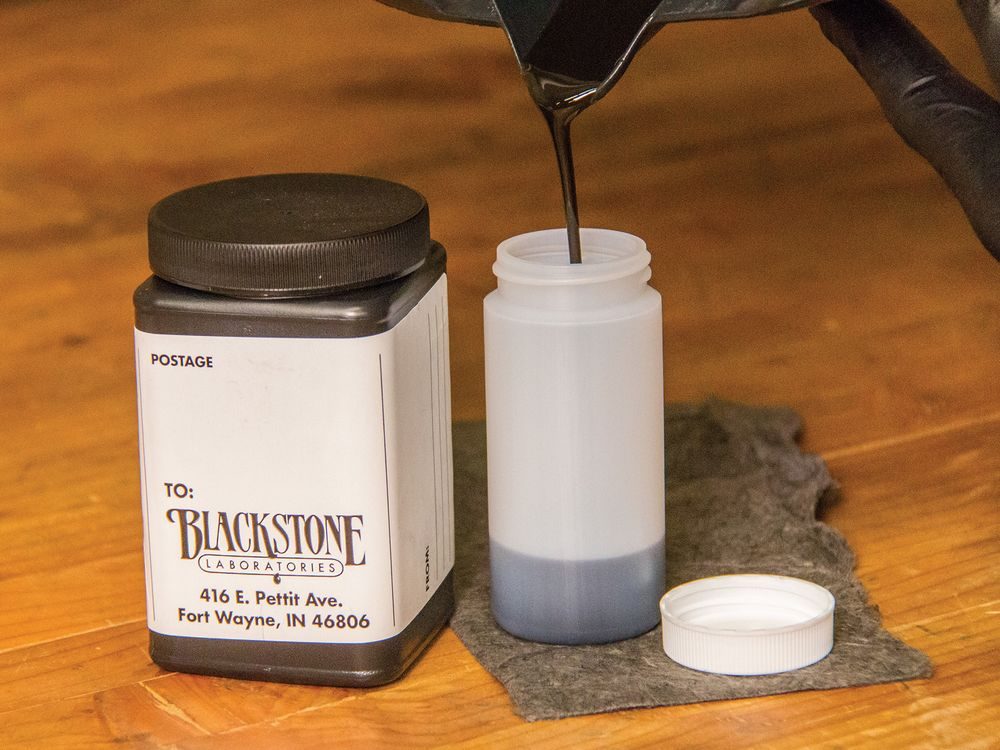
And yes, there are “screaming stop signs” too – like thousands of parts per million of metal or the presence of antifreeze or fuel dilution. These are clear indicators that something’s gone seriously wrong.
- Can You Use Oil Analysis to Pick the Right Oil?: While some enthusiasts try to outsmart manufacturer recommendations – opting for thicker oils in high-mileage engines or adding aftermarket treatments – Joe cautions against it. “You can’t fix a mechanical problem with a different oil,” he says. Blackstone’s data consistently shows that sticking with factory specs is the safest bet.
- Additives: Helpful or Harmful?: Blackstone can often detect popular additives like Turbo Max, Arch Oil, RevX, and Restore because they contain unusual elements like potassium, boron, copper, or lead. While some are harmless, others can mask serious issues or interfere with accurate diagnostics. Joe’s advice? If you’re worried about a coolant leak or bearing wear, skip the additives before sending in your sample.
- How Do They Know What’s Normal?: Blackstone doesn’t tear down every engine – they rely on thousands of samples to build a database of expected wear patterns. Even with rare or vintage engines, they can usually find a close match to compare against. And when they do get hands-on, like with a Nissan CVT or Ecotec teardown, it’s to deepen their understanding of specific failure modes.
- Beyond Engines: Transmissions and Differentials: Oil analysis isn’t just for engines. Transmissions and differentials have simpler metallurgy, but Blackstone can still detect excessive wear or incorrect fluids. This is especially useful when a vehicle starts shifting poorly after a fluid change – Blackstone can confirm whether the right spec oil was used.
- What About Oil Filters and Solids?: Insolubles – tiny solid particles formed when oil oxidizes – can indicate poor filtration or excessive heat. While most filters perform adequately, Joe notes that few customers report which brand they use, making it hard to compare. Still, Blackstone can help you track how your filter performs over time, especially if you’re experimenting with different brands or intervals.
- How Often Should You Sample?: Joe recommends building a trend before making big changes. Don’t switch oils, filters, and driving habits all at once based on a single bad sample. Instead, keep variables consistent and let the data tell the story. Once you’ve established a baseline, you can sample less frequently and still catch problems early.
- Do Magnetic Drain Plugs Help?: Yes – and no. Magnetic plugs catch visible metal, but oil analysis detects microscopic particles that magnets miss. Used together, they offer a fuller picture of engine health.
- Diesel vs. Gasoline Engines: Diesel engines naturally produce soot, which can darken oil and alarm first-time diesel owners. But modern diesel oils are cleaner than ever, and Blackstone’s tests can distinguish between normal soot and problematic contamination. They also spot issues when diesel oils are mistakenly used in gasoline engines (or vice versa), which can lead to wear or emissions problems.
Oil analysis is more than a lab test – it’s a window into your engine’s soul. Whether you’re racing, towing, or commuting, understanding what’s happening inside your motor can save you time, money, and heartache. And thanks to Blackstone Labs, you don’t need to be an engineer to get the insights. So next time you change your oil, consider sending in a sample. Your engine might be trying to tell you something – and Blackstone Joe is ready to listen.
There’s more to this story…
Some stories are just too good for the main episode… Check out this Behind the Scenes Pit Stop Minisode! Available exclusively on our Patreon.