

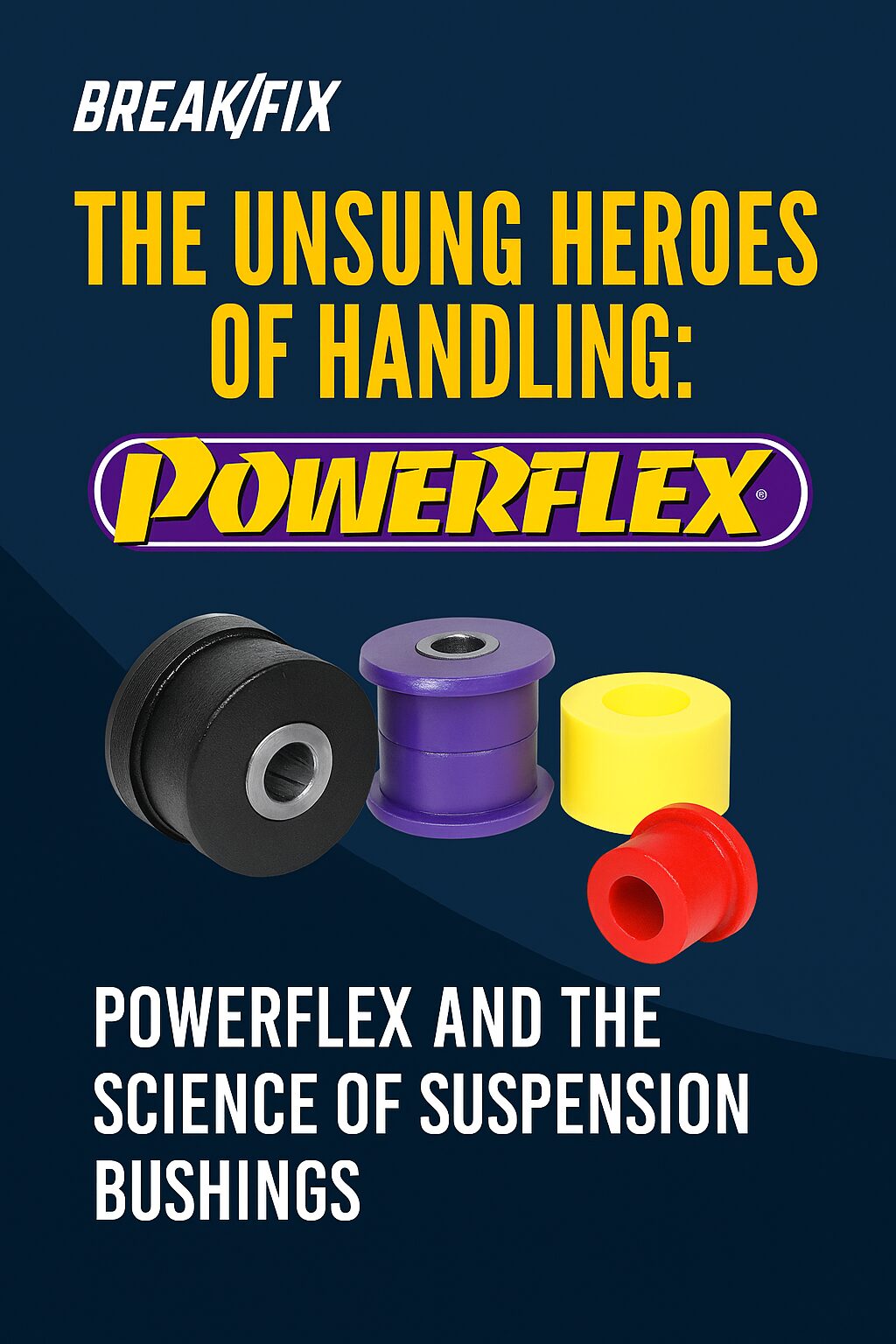
When it comes to performance upgrades, suspension bushings rarely get the spotlight. Yet these small, often-overlooked components are among the most stressed parts of any vehicle. They endure relentless strain without maintenance or lubrication – and when they fail, they can wreak havoc on your ride quality, handling, and tire wear.
In this episode of the Break/Fix podcast, we dive deep into the world of bushings with Jake Palladini from Powerflex USA and James Clay, owner of Powerflex USA and president of BimmerWorld. Together, they unpack the engineering, evolution, and performance benefits of Powerflex bushings – and why they might be the smartest upgrade you’re not thinking about.
Tune in everywhere you stream, download or listen!



Powerflex’s journey into the U.S. market began in the early 2000s when James Clay, then a rising force in the BMW tuning world, discovered the brand through his work at BimmerWorld. Impressed by the quality and performance of Powerflex bushings, Clay began using them in his builds and selling them through his shop. Demand quickly outpaced supply, and before long, Powerflex UK offered him the U.S. distributorship.
What started as a niche solution for BMW enthusiasts has grown into a comprehensive catalog of over 10,000 SKUs covering everything from Porsches and Audis to Ford Focuses, Mustangs, and even Toyota off-roaders like the FJ Cruiser and Tacoma.
Spotlight
Powerflex USA - Powerflex USA
From PowerFlex USA is Jake Palladini from sales and customer service – as well as Powerflex owner James Clay – who some of you might also recognize as the President of BimmerWorld! to discuss these crucial components of your vehicle.

Contact: Powerflex USA at Visit Online!



Notes
- In suspension tuning there is a rule of 3, that being: CAMBER, CASTER and TOE. Let’s address them all!
- How do these settings affect UNDER and OVER steer?
- Alignment 101 by Powerflex!
- So when we talk about “Suspension Tuning” what does that mean? Are we just talking about an “alignment”?
- Proper 4-wheel (versus 2 wheel alignment), ie: Thrust Angle, Bump, Squat, Roll-Center, etc.
Transcript
Crew Chief Brad: [00:00:00] Grand Touring Motorsport started as a social group of car enthusiasts, but we’ve expanded into all sorts of motor sports disciplines and we want to share our stories with you. Years of racing wrenching and motorsports experience brings together a topnotch collection of knowledge and information through our podcast.
Break Fix.
Suspension bushings are some of the most highly stressed components fitted to a vehicle and the least talked about. They undergo enormous strains in the most arduous of conditions with no maintenance or lubrication. Having old, tired, broken bushings or even bushings made of poor quality materials can cause excessive tire wear, breaking instability, and poor handling.
This is the single biggest reason you can instantly tell the difference. Between driving a 3-year-old car and a new one.
Crew Chief Eric: That’s right, Brad. However, even new cars will benefit from upgraded components, especially bushings. Enter Powerflex, an engineering company with an [00:01:00] arsenal of innovative solutions for failure prone and poorly performing stock parts.
And because of their superior design, they offer much more effective control of your suspension components to a much greater extent than the OE items. And with us tonight from Powerflex, USA is Jake Palini from the Sales and Customer Service Department, as well as Powerflex owner James Clay, who some of you might also recognize as the president of Bimmer World to discuss all these crucial components of your vehicle.
So welcome to the show, James and Jake.
James Clay: Awesome. Thanks for having us.
Crew Chief Eric: Thanks for having us. There’s many of us, at least in our world, that already might use Powerflex components, especially on the German cars. They’ve kind of become the staple that we run to, but a lot of us don’t know where Powerflex came from.
So let’s kick off this episode like a lot of our other ones, talking about the origin story of Powerflex.
James Clay: Yeah, it’s, it’s funny you say German cars, which must [00:02:00] mean that we did our job, right? Because Powerflex, or our version of Powerflex, our term at the helm started with our sales of BMW bushings. This was super early on in my career as a Bimmer world guy, and so this would put it around early two thousands or something like that.
I had found power flake bushings. I loved the parts. Uh, I used them on on my cars. On cars. We were building, which, you know, small workshop, we weren’t building a ton of cars and we had started selling parts as bier world at that point. So we were selling some of these things. I just absolutely loved them.
They started to become more popular in that, in the BMW world became popular enough that we were selling so many that they said, Hey, you know, we have a US distributor, but their sales are 90% your sales, so. Would you like to be the US distributor? So we, we raised our hand, said, sure. And, and basically that was just a way to get more product because we were just really struggling to get enough of this stuff.
It was well received. People loved it in the, [00:03:00] in the BMW world, having a powerflex bushing with a lifetime warranty, which is one of our hallmarks, I suppose. But having that lifetime warranty was pretty awesome, especially when urethane was. Starting to be a thing, but not really universally a great thing in the automotive world.
So the early urethane, I remember some of the guys were taking stock bushings and of course stock bushings made to a price point, usually outta rubber U usually with a lot of voids to kind of reduce the NVH noise vibration harshness, which is something I’m sure we’ll talk about a bit. People were taking those stock parts and filling them with urethane.
And so I remember it’s like two part stuff you buy at McMaster car and it comes out red. And if you do it at the right temperature, maybe it works out okay. And if it’s not quite right, it crystallizes. And a lot of the solutions in the market were kind of made of that material or something real close to it that wasn’t so great.
So to have a company like Powerflex with a product with a lifetime warranty, and then again, not just a product that fills a hole, but. A [00:04:00] well-engineered product with specific voids, specific hardware, you know, all this stuff. We’ve done this for a bunch of years, uh, so that was early two thousands.
Crew Chief Eric: But the parent company, Powerflex is a UK based company.
So were they building these components for British cars first or did they start with BMWs as well?
James Clay: So they started with European cars and now we’re seeing it more in the us. I, I assume Jake would say that we’ve, we see a lot of BMW, but we also see Porsche, Volkswagen, Audi is a, is a big thing for us.
Jake Palladini: Yeah, they’re, they’re huge as well as some domestic stuff is getting pretty big too. Like the Ford Focus, uh, we’re seeing some stuff for the S five 50 Mustangs. We’ve actually just recently seen stuff released for the FJ Cruiser, the forerunner. Tacoma. That’s new stuff for us. ’cause that’s sort of almost kind of breaking into the off-road market, which has potential to be huge.
James Clay: So, you know, interesting. But even though we’re kind of on Ford Focus, Ford Focus is a European car. Right? That’s a, that’s a European market car that now we get in the us [00:05:00] And kind of same thing on the, on the Mustang that the reason that we started being on the Mustang is because that became a global car instead of just a US car.
Powerflex in the UK was absolutely focused on European cars, had good adoption from those drivers of those major marks, the BMW, the Volkswagen, Audi, Porsche, et cetera. And then just based on where they’re located, based on the cars that they could get for development. Then of course we had. Volvo Saab.
Yeah, it just, it European manufacturer. So that’s really why the focus became that, I suppose, as, as they started
Crew Chief Eric: out. So was the focus the first car they developed something for, or was there something else?
James Clay: And I’d say the focus, the attention focus. Ah, yeah. Yeah. Okay. So let’s
Crew Chief Eric: play, who wants to be a Millionaire?
What was the first car that Powerflex developed something for?
James Clay: You know, that’s funny. I don’t even know that. And, and so Powerflex uk, their company started about two years before I started Bimmer World, which is our umbrella company for Powerflex, USA, I believe that. It started with BMW, [00:06:00] Volkswagen, Audi, and then some, some oddball stuff.
And I say oddball, gosh odd for us, alpha Triumph. Some of those, you know, we would call ’em historic cars, but at, at the time they were certainly more active cars and, and cars that people were modifying and, and wanted a, a quality bushing for
Jake Palladini: yeah, some other obscure stuff like Lotus. We, we offer pretty much an entire range of bushings for the Lotus Lease, the Agora, uh, some for the Esprit, I believe.
It’s a lot of weird stuff in there. Read stuff
James Clay: that the UK guys love, right?
Jake Palladini: Yeah,
Crew Chief Eric: so to your point, James, you know, back in the day, even when you looked at motor mounts, which were a big deal, going to urethane motor mounts, now you have companies, BFI, you have ECS putting out their own. And back in the early days for the Volkswagens, we’re talking early days is in the two thousands.
VF engineering was a big name making urethane motor mounts. There’s probably, you know, other. Bunch of others. So there’s different durometers of urethane, right? Which means the strength and the density of the urethane. What it can [00:07:00] withstand. It’s interesting when you dig into that stuff, because not all urethane components are created equal.
Does Powerflex have its own proprietary formula, their own like standards? I know there’s a purple series and a black series and different things. Do you want to kind of expand upon that and, and just talk about, you know, what makes them special?
James Clay: So you’re going right to one component of our parts, the, the urethane itself, taking a step back out of that.
Powerflex is an engineering company. I mentioned earlier that at, at the time there was a, there was a bit of whatever fits a hole, we need to pour this thing in a hole and basically take up the same space as a stock bushing. And that’s, that’s your urethane part. Powerflex approaches this differently.
Every part we do is engineered some of the basic urethane bushings. We, we would call a top half bushing. It’s a two pieces go in from either side and then a stainless steel sleeve in the middle. And it’s just a, a real general approach to a bushing. But we have a lot of more unique bushings up to some of these things that are mono ball.
Urethane mono ball, which is pretty super cool. We, we [00:08:00] also have mono balls encased in urethane. We have all kinds of tools at our disposal from the engineering standpoint to make something that is going to last well, et cetera. But the urethane specifically, yes. What we do is proprietary. In fact, it’s, we just got a surprise for one of the, one of the components that only we use in our urethane A as well.
It’s used in another industry, clothing industry for your Lycra and spandex. Interesting. It’s a small component in that, but that’s unique to us and we know that because all of a sudden in the world material shortage, it’s gotten kind of wild and hard to find that stuff. So we have a unique urethane.
It’s part of the reason we can offer a lifetime warranty because we do things a little bit differently beyond the control process and so forth in the actual manufacturing of it. The formula is unique. And then you mentioned we have different durometers, so we do have. You said a black series, which we, we have the Power Flakes black series, which is our 95 Durometer, pretty stiff stuff for a more track focused car.
If you have a track car, if it’s really hopped up, you’ll get all black series stuff. [00:09:00] And then our other series, our, our primary series is just. The Powerflex series. So it’s not that it’s purple. It could be purple, it could also be yellow, purple. Would being an 80 durometer, yellow being a 70. Durometer could be red, which is a 65, 65.
It could be black if black happens to be the right durometer for the application. So it could be that 90. So we have that full range, but again, it’s an engineered product and we need to decide per car, per location what the correct urethane. To use what, how much, um, you need. So in, in my history, early on in those, in the BMWs, the old five series, six series, these for us big heavy cars, not, you know, they’ve, they’ve added another thousand pounds to ’em in modern times, but big heavy cars and all the braking load is carried by this one bushing in a thrust arm in the front.
That thing has to be a black bushing because the amount of load you’re throwing in this thing, and, and you know, guys were modifying different series parts. There was a big [00:10:00] scramble early on when I was getting into BM BMW stuff of, well it’s gonna live in this location. Turns out Powerflex does. But in that location.
Needs to be a black 90 durometer bushing.
Crew Chief Eric: Makes sense. That leads me to another question in some other industries related to the performance side of, of the automotive world that we all live in. When there isn’t a part available, I’m sure the catalog is extremely large for Powerflex, but when there isn’t a part available, is there the ability to send it in and say, Hey, can you create this for my, you know, 70 8:00 AM C Rambler or whatever, you know, I’m just making this up.
Is that an available option with Powerflex or is it gotta be on the shelf? It’s gotta be something that everybody wants.
Jake Palladini: It’s not a lot of custom work being done, but if there’s enough demand, we’ve seen it in the past where they’ve actually taken that into consideration. Say, Hey, nobody else offers this solution for this.
It might as well be us. I don’t remember exactly which model Porsche, but it’s a uh, Porsche rear trailing arm bushing that you cannot buy by [00:11:00] itself from the factory. You have to buy the entire trailing arm, which will cost you upwards of a thousand something dollars. When you could just now come through us, replace the bushing, which is 99% of the time, the only thing that goes bad, and save yourself a lot of money and have a way better product with a lifetime warranty, which is something you’re also not gonna get out of an OEM product.
If there’s enough demand for something like that, then, then yeah, they’ll uh, certainly look into it.
James Clay: We have some one-off parts like that. We have, we have something for a Jeep Grand Wagoner that’s, or a Grand Cherokee. That’s, that’s a little bit odd for us in general. We got over 10,000 SKUs, so if we don’t have the part for your car, I’d be surprised if it fits our model.
So, you know, your example was a MC Rambler. That’s probably not a Powerflex car, so probably for you, unless you had a hundred other buddies that thought that was a really good idea, we’re not in the business of. Custom solutions. We’re in the business of production and we have to be, to be able to produce at the quality we do.
We have to have some [00:12:00] volume to be able to make molds that we can spend as much money as we spend on molds to be able to produce the level of product that we produce. So there, you know, I’d love to say we do everything, but we certainly, the market we serve, we cover it extremely well. And if there’s something we don’t cover, that’s a surprise to us.
We picked up 2000 twos, BM bmw, 2000 twos. We, we got a lot of requests for those and we said, you know, it is a whatever, 50-year-old car, 60-year-old car. Sure if there’s enough interest, we will do that for you.
Crew Chief Eric: You got me really excited there because you said Jeep Grand Cherokee, which is what I was actually hinting towards because I need some bushing upgrades on my Jeep Grand Cherokee.
So now that I know you got something, I’m definitely gonna be looking in the catalog to see what’s there. So you gotta
James Clay: make sure it’s the right one though.
Crew Chief Eric: That’s true. That’s true.
James Clay: It’s weird that Jeep Grand Cherokee does stick out. I mean, we make one part for one series of that vehicle one production series and stuff like that happens with Powerflex because nobody else makes a part that will hold up.
So the fact that we can engineer a solution that we have a lifetime [00:13:00] warranty, but it doesn’t matter about the warranty. We have the lifetime warranty because we make a part that’s a lifetime part. So our ability to make a true lifetime part for some applications, and if nobody in the aftermarket has been able to do it, then sometimes we raise our hand and say, sure, we’ll knock that out.
Jake and I were talking a little bit before this, I don’t know if you’ve ever been to London, or I think this was more prevalent maybe 10, 15 years ago, when they had all those black London taxi cabs, because they had about a hundred thousand of them out on the road. They had a power steering rack bushing that failed about every six to eight months.
And given the number of those things out on the road, and of course the, you know, the constantly running around, that was a huge expense. So they called Powerflex and said, we can’t solve this problem. Can you make a bushing for us? So we made exactly one run of bushings to cover all the cars and never had to make ’em again.
So again, if you happen to have a London taxi cab, we would have that unique one bushing for you because we are the guys. In the world that can solve a problem.
Crew Chief Eric: Nice. So, you know, that’s really awesome to get the background of the [00:14:00] company and you know, for those of you that are listening, that are using Powerflex, you know, it’s good stuff.
I mean, I highly recommend it. It’s in our Volkswagen, BMW and Miata builds. If you go to our website, it’s always listed on our buildout sheets, especially for the Volkswagens struck mounts on those cars are notoriously terrible in the fourth generations. And the same is true of the real trailing on bushings.
Now, I’m probably throwing out for the new listener a bunch of terms that they don’t understand. All of this stuff is related. To suspension. And what’s really cool about the Powerflex website is they have an what they call an alignment one oh one page where they kind of go through all of the terminology and, and different pieces and, and parts of how your suspension works.
And so we wanted to spend some time with Jake and James and talk about this so you guys could learn more about the dark art and kind of black magic of setting up a car and what’s involved in that and how those powerflex components play into that. So I think we really need to start off with, you know, that classic rule of three, the three big things we always hear about in suspension and alignment, which is camber, [00:15:00] castor, and tow.
And you’ve probably heard about Canberra the most. So let’s start with that and unpack that idea and then dive into the other two and then learn about how they relate to each other.
James Clay: Alright. I feel like I can talk about this stuff and, and my, uh, viewpoint is more from track, car, race, car point of view, and certainly, and I, and I can relate that back to street stuff, but that’s, that’s my foundation or that’s my expertise is in the, really in the racing world.
So, you know, it’s simply put, camber is the angle of your wheel, tire to the ground or, or how it is related perpendicularly to the ground. Um, and basically defines what your contact patch is on your tire when it’s loaded, when your car is loaded in a turn. So I suppose that’s when it matters the most. So if I had a car with zero camber, that means that my tire is standing straight up in the air.
That means that I have a perfectly even contact patch left to right when I’m driving in a straight line or when I’m braking in a straight line or putting power down in a [00:16:00] straight line. So if I’m a drag guy, I wanna have all that contact patch in a straight line. If I wanna stop my best. Zero camera is fantastic because I have all my contact patch when I’m in a straight line.
But if I’m driving this thing on the track, autocross, whatever it is, and I plan to turn a little bit, once the suspension starts loading and moving, then the whole thing changes a little bit. I need negative camera so that I basically can roll my car, my platform, up onto that camera. So maybe a number that rings in my head is three degrees or so.
Three degrees up front. Negative camber. That means the top of the tire’s tilted towards the center of the car. And if I, if I had a protractor, I guess that’s the tool I would use in. School, I could measure three degrees between where the tire is now leaned inward to where it would otherwise be vertical.
When I load the car, when I turn, then that loads the car essentially to straight, which is how I think about what maybe an optimum camra is. Of course, that’s tire dependent. It’s car chassis dependent. It’s suspension design, of course, but once, [00:17:00] once, we’re talking about aftermarket parts here, which certainly is one aspect of Powerflex.
When I’m thinking about aftermarket parts on a car. If I have soft springs or Stockish Springs, then. My car’s gonna roll a lot more, and so I need more camber for it to roll up onto, versus if I have stiff springs, I, I reduce that roll a fair amount. And then I’m thinking more about the tire flex and so forth.
Crew Chief Eric: Yeah. And then every bushing in the suspension, whether it be a struct mount, a control arm, a sway bar, bushing, all adds deflection. Now I think a lot of people probably don’t realize there’s also deflection in the wheel bearing, depending on the setup. Right? Front wheel drives notorious for the hub and wheel bearings, you know, flexing during hard cornering and things like that.
All of these things affect the camber of the vehicle, and that offsets your contact match.
Crew Chief Brad: Now, we’ve talked a lot about negative camber, and I, I’m seeing on the site, you, you wanna dial in some negative camera for better cornering, uh, capabilities. But is there ever an instance where you would want to have positive camera
Crew Chief Eric: clown car?
Crew Chief Brad: There’s a specific reason why I’m asking too, but I, I’ll [00:18:00] wait to hear the answer
James Clay: from my foundation, uh, which is modern cars. There’s one minor instance. Well, I say in my world, there’s one minor instance. For some reason in old cars, and I don’t know the, the suspension geometry in those older vehicles, but positive camra used to be a thing positive.
Camra used to be in a thing in like the whatever, twenties, thirties, that era car maybe. But again, don’t hold me to that because I don’t really know those cars. But when I think about positive camra and I say, well, Camra is needed so that when your car loads in a turn, that it, it can roll up on it. And, and a, a lot of times that means that I’m thinking about that outside tire, but if I’m only turning one direction.
Then it also matters what the inside I, I don’t have to optimize for left turns and right turns. I can just think about optimizing more for one direction turn. So certainly our friends in na, NASCAR and the dirt world and all, all that who are always turning left have a fair amount of negative camera in their, in their right side.
They have positive camera in their [00:19:00] left side because when that car loads, again, it’s, it’s loading up now. That’s the NASCAR world. But there’s also this little track up in Connecticut that we go to Limerock Park, which has one left hand turn and then everything else is right. So we would sometimes, um, sacrifice our setup or consider like a zero camera or maybe a little bit.
More of a positive camera on that, on that right side. Again, just because we’re, we’re gonna sacrifice one turn to be faster in seven others at that specific track. Yeah.
Crew Chief Eric: And what you said about vintage cars is absolutely correct. And it has to do with the geometry of the suspension and the springs that they used to use and the real, real early cars.
I mean, you were talking about, you know, opposed leaf springs where they went perpendicular to the body line of the, of the center line of the car. So they almost acted like a sway bar, and then they decided, oh, let’s rotate them. So they’re parallel to the body. You know, you really didn’t see the changeover until, I’d say the late fifties, early sixties, especially out of Lotus, because, you know, uh, Colin Chapman stole the design for McPherson and modified it and call it his own.
But [00:20:00] until the McPherson suspension was created, you had these. Odd positions in suspension geometries because we were still figuring it out. And then the McPherson setup became standard front and rear on a lot of cars. And then, you know, now double wishbones, it’s, it’s kind of changed the dynamic again, you know, all these kinds of things.
So to your point, I think it goes along with the evolution and as we’ve progressed and we’ve made giant changes in suspension, geometry and, and the mechanics of it, we’ve gone more and more negative Canberra now. Not stance, bro. Negative camber, no offense. So those guys are listening. Know, eight, nine degrees of Camra looks cool when you’re parked, but doesn’t really work too well on the track.
What do you think about that, James? Well,
James Clay: I’ll tell you, we, anything anybody does with a car is our thing. So that’s, that’s, uh, you know, while I don’t currently drive a stance car, honestly, I appreciate what people do. I appreciate what, uh, what limits people push. So, you know, a stance car isn’t necessarily my thing, but.
Guys, I mean, stylistically,
Crew Chief Eric: stylistically they look cool, the wheels tucked up [00:21:00] under whatever. But we often find it really funny when the Stan Pro guys, you know, we use that term lovingly. Alright, let’s just put it that way. You know, when they do come to an autocross or a track for the first time, they start to realize cam’s gotta start to come way more positive.
To get that car to actually turn and do something on track that is, let’s say, amenable to the result we’re looking for.
James Clay: I’ll, I’ll tell you though, and it’s interesting, I, I think about oddball exceptions to certain rules. We were racing, touring cars in, uh, the early two thousands and those touring cars with the specific tire that we were on, which is, which was a street drive tire, not a, not a true racing slick.
We consistently had six plus degrees of Canberra, and that’s in a rear wheel drive car. And some of the front wheel guys had. Eight to 10 super odd situation where we had a, a tire with a very soft sidewall, which gave, so it, you know, the, you had to support that with more camra, you know, and maybe that’s how all this stuff derived.
Anyway, you used to see these touring cars with tons of cam. So that’s the race look. And that’s what, that’s how [00:22:00] I want my car look,
Crew Chief Eric: might be outside of Camra. You got two more components to our rule of three, right? You’ve got castor and tow and they’re all actually related to each other. So let’s talk about Castor for a minute.
James Clay: I didn’t write this part of the Powerflex website, I don’t think. Maybe I chimed in on it, but, and I can be wrong on this stuff. I, and I’m, I’m pretty content being wrong. I am lots of days, lots of times. So, um, so castor, I, I would call castor. Whenever I say castor, the next thing I always say is. Dynamic Camber.
So I, I think McPherson struck car because that’s, that’s what I deal with for the castor can be in other types of suspension design, but basically it’s, well, I’ll take the suspension out of it. It’s how much camber is gained when you turn your wheel tire package left or right off of center. And so, and, and why I say it’s dynamic, camber castor is awesome because if I have a car with enough built-in castor, first of all, it self centers when it go, when it drives down the road.
So that’s, that’s kind of nice. The, a nice thing, a nice streetcar thing about. Caster, but also it [00:23:00] gives me the ability to have that straight line acceleration, tire loading contact patch, that straight line braking where I’d like less camber, maybe I don’t want have so much camber built in because I want that better when my wheel is straight contact patch.
But then when I turn the wheel, if I have a lot of cam in the car, then I’m adding the camber that I didn’t have when my wheel was straight to when I need it the most when my wheel is turned. So for BMWs, we like a ton of caster in the front and that is kind of. What helps us fight some of the problems inherent with the McPherson strut design, or in my opinion, inherent with a McPherson design where you, you don’t gain camera, if anything, you often lose it, uh mm-hmm When you, when you load your car.
Crew Chief Eric: And that’s ’cause of the, well, let’s call it what it is, a single point of failure and that strut bearing, right, that the power flex bushings try to overcome because you have a massive amount of torque load being put on a single point at the top of that strut tower. If you had a double wishbone, you have three points to mount to.
So it’s a much sturdier design, but it takes up a lot more space. And you kind of see it on the [00:24:00] more exotic cars that are built, you know, around tube frame. You’re not gonna see that around, or a tube frame or mono cock design. You’re not gonna see that on your typical front wheel drive Honda. They’re just, that takes up way too much space.
You know, it would also be 12 feet wide to make it all work. So I get your point. So how does tow play into the equation,
James Clay: man? What to say about tow to tow is where your. Tire is pointed, left to right, independently of what is going on on the other side of the axle. So if I have my steering wheel centered and my car is going straight.
If I have tow out, that means that both of my tires are now pointing out. They’re almost fighting each other given that they’re pointing out if I have tow in. Both front tires are pointed in towards each other, so a car with tow out to me can be a bit nervous because you have both front tires initiating a turn, and so your car is kind of telling.
Which way you want me to go? Which way? Which way, which way? And it’s, it is just kind of nervous as you drive it along when it’s taken to an extreme. But of course sometimes [00:25:00] we want something that’s nervous or in a better word, or a, or a more compelling word, agile, ready to perform. And so I like tow out because tow out is a tool that gets your car pointed for you.
Tow in is in, in strictest sense, tow in neither tire’s, really excited about doing anything. And so it’s, it’s a little bit more benign. Your, your car with tow in is pretty content to just go in a straight line. ’cause both tires are, are kind of working that way. Now that said, in my street world, and especially when we start talking about all these things that are related, right?
So if I have a car that I set up for street use that has more camra in it, because I want that, I want it, I want it to perform. One of the bad things about tow is that because your tires aren’t rolling straight unloaded, they’re kind of pointed a direction that’s fighting each other. You start to lose some rubber, right?
If your tires are working against each other, something’s gotta take that hit, and so it’s tire wear, and so you start killing tires. So a lot of times I think about [00:26:00] zero in my toe for a street car, just so I’m not beating up my tires so much. When I think about tow on the racetrack, I said earlier, maybe tow out makes the car more eager and ready to perform more.
Eager to go into a turn.
Crew Chief Eric: I call it. I call it dirty.
James Clay: Yeah, there you go. It’s, yeah, it can be, and again, we’re, we’re talking powerflex, right? So Powerflex bushings. Go on, streetcar. So we’re, we’re talking about streetcar stuff or streetcar based stuff. Sedans, we’re not talking about formula cars or, or things that are more exotic.
There are some absolute truths in sedans that aren’t absolute in the automotive world or the racing world, but some, some absolute truths in sedans. There’s always a compromise. It’s never optimized for track performance. There’s so many things, whether it be using a McPherson strep because it’s cost and packaging, and that’s the reason to do that.
Or if we’re taking some sacrifices for the street drivability, how do I want this thing to perform on the street? Because, you know, us people that are, that are out there flogging these things on the track. We’re the, we’re the strong minority. We’re not who they designed the car for necessarily. They might give us [00:27:00] some good stuff, but they didn’t say, let’s make this thing a track killer.
So one of the compromises, if you ever park your car in a parking lot and you like to make those tight turns, you probably want a little Ackerman built into the, to the steering. So. Ackerman is dynamic tow. So based on steering rack placement, um, I wouldn’t expect my inside tire and outside tire to necessarily turn at the same rate or same amount of angle.
So because of that Ackerman that’s built into the car, there aren’t absolute rules for what tow should be on the track or in a performance application. And sometimes a specific tire is going to want a specific thing also. So whether it’s the Ackerman of the car or what the tire wants. And so there is, to me, there is no rule on what I want for tow.
I, I can say, yeah. For sure I’m gonna want negative camra and I’m gonna want about this much Every time I test a, a new race, car and tire, we have to figure out whether it likes to tow out or tow in. Probably tow out. That’s probably the, the slight nod, but sometimes tires like to tow in.
Crew Chief Eric: So I’ve heard that there’s [00:28:00] always different instances and, and to your point, setups for different tracks.
Like you were talking about lime rock and whatever, but maybe they’re wives tales. Maybe it’s, you know, unproven science, I don’t know. But I’ve also heard that tow out helps the car turn in quicker. And tow in is designed for stability, especially high horsepower rear world drive cars or nine elevens, I’m gonna say that again.
Or nine elevens keeping them under control. So a little bit of tow in, in the rear helps stabilize the rear end of the car, whereas tow out in the front gives you quicker turn in and like you said, sacrificing the opposite side of the car because it’s also trying to go, you know, turn the other way a little bit going into the corner.
James Clay: Yeah, I think that’s generally correct and that’s, you know, that’s, that’s kind of what I would default to for setting up a street car. If I wasn’t zeroing the front. I always add a little bit of tow in on the rear of a car because I, I do want that stability if I’m at the racetrack, I have to start making choices, right?
I’ve, I’ve got a box of tools and depending on what type of car I’m driving, I could have a big toolbox or a small toolbox. If I have a, a [00:29:00] pure stock car, I don’t have a lot of tools in my toolbox. I have tire pressure. For the most part, if I have a race car, I may have a bunch of spring adjustments, height adjustments, shock adjustments, geometry adjustments.
My toolbox is a lot bigger. Yes, tow in in the rear can stabilize the car. When I’m thinking about racetrack as well, we talked about tow in, tow out the, the less of either that there is, the faster the thing rolls in a straight line. So I’m also careful, especially on a track with long straits, I consider how much I’m willing to drag the tires down those straits and how much speed I’m sacrificing.
But then there’s also situations, you know, I’ve been at the racetrack in. No matter how big my toolbox is, I can’t get this stupid car not to initiate the turn necessarily. That’s, that’s a front end job, right? The front end. You turn the wheel, it’s initiating the turn, but once I’m in the turn and loaded, I can’t get the car to rotate.
Is the tow in that I have in the rear to stabilize the car, the thing I want or would a little tow out or a little less of that toe in whatever, and we’ve run tow out in the rear. Sometimes you just have to have [00:30:00] that tool to turn the car. Same thing, and, and you’re, you’re dead on in the front. Yeah, sure.
I think that the, the tow out typically makes a car a little bit more darty or a little bit more active right at that initial turn initiation point, but I can usually. Get my car to initiate the turn. And again, I have other tools in the toolbox. I have a sway bar, a, a shock and some other things often on a hand hand brake.
You know, we,
Crew Chief Eric: we got those two. Yeah. Rip that hand brake. Go
James Clay: for it. Yeah. There’s, there’s other tools in the toolbox to get that immediate initial turn in. And a lot of times what I’m thinking about is how do I make this car get all the way through the corner, right? And then I’m starting to think about balance a car.
So I really think about tow, personally. I think about tow more about what’s happening mid corner and steady state once things are loaded up. And that’s why it comes to that Ackerman question. What, what’s the Ackerman built into the car? What does the tire want? And then therefore, what maximizes grip midterm.
Crew Chief Eric: No, and that’s a really good point you bring up. And I think what many people may not realize is the three, you know, the triumvirate we’ve been talking to here, Canberra, castor and [00:31:00] tow apply to the rear as much as they do to the front. But the other thing that’s important to realize is that, you know, you mentioned about adjustability of suspensions and people will go out and buy all it’s really cool components, whether it be dual reservoir olins or muons or whatever they are.
Or you know, it’s a guy with a set of coney oranges, you know, you know, it’s all over the map. Progressive springs, coil overs, you know, dual coil overs and all this kind of stuff. But the one thing that’s always funny is the guy that’s like, well, I’m gonna go change the ride height of the car. And doesn’t do.
The rest of the math doesn’t realize that changing the height even, uh, the smallest amount actually changes. Those other three things we’ve been talking about, the caster, the camra and the tow are suddenly outta whack. And unless you have the ability to realign the car on the spot, the change you just made probably made your car worse.
James Clay: Yeah. Ride height is a good tuning tool. It’s great on the protein when we, we have a setup pad and we, okay, we change the height, throw the car on the pad. See, you know, get the, get everything else right. How much things change, [00:32:00] of course, depends on the suspension design. It also depends on what window you’re working in within that suspension design.
I can tell you on A BMW, one of my favorite tuning tools, and this is when I’m dragging a car to the track myself, it’s a race car. I’m gonna get under the, it was a street car. I wouldn’t get under it. I’d just say, ah, well I’ll just drive it differently. But given that I’m gonna do a little bit of work here, but I’m doing the work, I don’t have the guys on the team doing the work.
I’m not gonna do a lot of work. Raising and lowering the rear works out pretty well for us because given that suspension design, there’s pretty much no camber change and pretty much no tow change within the window that I’m working in. Right. And height adjustments, which is, you know, five mil, 10 mil max, something like that.
10 mil would be super big. However, on the front of that car, totally wouldn’t touch it. You know, I don’t know if it’s gonna mess with a cam that much. Definitely gonna mess with my toe. Yeah, it’s, it’s one of the things that I consider for sure, we talked a lot about these three things, the triumvirate, but we’re, we’re also talking when I have my powerflex hat on, when I think Well, and how does [00:33:00] Powerflex relate to this?
I think a lot of times people consider these as. Measured numbers, they are right. You, you measure camra, that’s super simple. You measure castor a little bit more complicated process, but you, but it’s a measurable thing. But what you’re doing is measuring these things and optimizing your car while it’s sitting still.
That’s not the real world or not the one that we live in, right? Because we don’t care what the car does when it’s sitting still. We we’re men of action. We wanna see what this thing does when we’re flogging it, when it’s fully loaded, et cetera. So that’s a different set of numbers. Sure. We we’re using what it does, sitting still on a setup pad or an alignment rack as a baseline for what that is.
That’s not really what we’re seeing on track. You know, if I make a camera change, I’ll note the difference on track. The easiest way to, to note that or to, to keep record of that is what it’s doing statically. But what I care about is what it’s doing on track from the powerflex side of things, we do have adjustable bushings.
We have a range of some pretty cool parts to, to add. Canberra, take away cam. You know, add, add a full range of adjustment. I, I say Canberra, [00:34:00] but more things, role center, things we haven’t even gotten into. We do have that range of bushings, but more importantly, and in every bushing we make, when you have a bushing that is stiffer than stock.
That has more control than stock. When you’re in that loaded up operation of the car, you keep the suspension from moving and flexing as much. If it was a race car, I’d be mono ball. I’d be straight up solid, and it would be exactly what I wanted it to be, not. I’ve, I’ve done this as a guy that also engineers and designs things.
I sometimes get put in odd situations. One of these was riding on top of a motor in a car as it drove around the parking lot at some decent speed. So I could sit there and watch things move and so forth. I probably could have done that with a GoPro, but it was
Crew Chief Eric: more fun the way you did
James Clay: it. It was more fun.
It, yeah, the, the guy driving the car loved it. But you know, in parking lot speed. So we’re talking like 10, 15 miles an hour. If I’m really working hard, you can see the top of a McPherson strep, for example. You can see that thing move a quarter inch plus, which is a huge amount of movement. So if I think [00:35:00] about, well, I’m gonna add 0.3 degrees of cam, and that’s maybe an eighth of an inch or something like that of movement to get that angle change and this thing’s moving around a quarter inch while it’s being loaded at 15 miles an hour.
You know it’s gonna be max load when you’re on the racetrack. The Camra is who knows what. So not ideal. So having bushings that are stiffer, we’re a street track product, so they’re stiff. If they’re black series, they’re, they’re all stiffer. But in the regular series, we add as much stiffness as is reasonable within some clever tricks to make it so that this thing doesn’t beat me to death.
Right? That’s why road cars aren’t made to be the stiffest things possible. They’re made to fit this nice balance and maybe be your Porsche is gonna be a stiffer balance than your whatever your Audi, S-U-V-S-A-V, whatever, whatever that is. It’s made for a little bit different target market. Either way, they’re not made to be super, super stiff, which is what we would want for performance.
So we can achieve those balances sometimes with a properly designed part. And one that we’re willing to spend a little bit more money [00:36:00] for. So that’s, you know, we’re also not making $5 OEM bushings. Our stuff may be 10 x the cost, but it’s worth it. You get kind of more of everything.
Crew Chief Eric: Absolutely. And there’s give and take in all of this.
And I think it, it funnels up into the concept of suspension tuning everybody. I think they do it by feel more than anything. Right. And to your point, it’s very hard to say, how much is my strut mount deflecting at 15 mile an hour versus 60 mile an hour versus 80 mile an hour, or whatever it might be. So I wish there were more sensors, I wish there was more empirical data that we could collect as a, you know, kind of a layman versus what the pros have available to them.
You know, all the type of telemetry that they’re able to collect from every corner of the car. So some of it is, is black magic. Right. In in some respects, would you say, is there a formula to follow certain things that guys and gals should be doing versus other upgrades to the suspension to. Get to that tuning stage before we kind of get into the deeper talks about, you know, alignments and, and, and [00:37:00] bump and squat and all these other kinds of kind of advanced features.
James Clay: In the introduction, we talked about, you know, a three-year-old car drives way differently than a new car because things have already started to break in, settle in. I think what a lot of people, as, as a pure starting point, make sure you know what you’re starting with and I think people automatically make some assumptions that, Hey, I have this car and it’s, it’s like black box.
This, this car is always this thing. You start with basic maintenance, right? If you’re, if you’re gonna take a car out on a track, you at least know what oil you have in the engine, right? You’re, yeah, you’re doing some basic maintenance to stabilize your platform. The same for the suspension. You need to first just make sure that the stuff that stock, if you plan to keep it stock.
It’s still working like it was intended or some reasonably close version of bushings. Do wear fast powerflex lifetime warranty? Well, it’s because we’re spending a lot more to make a bushing than the factory is when they, when they’re making 30,000 car sets for a year of whatever model car those pennies add up.
So they’re saving some money here and [00:38:00] there where they can, even if you have a Porsche, they’re saving some money and there’s an accountant involved in building your car like it or not knowing that you have parts that are working properly. And then really it depends on car model as far as what your weak parts are, what parts you need to address specifically on A BMW.
I know that the front control arm bushing is a real problem for us because it takes a lot of that load. Or depending on, on design, I speak a lot of times towards three series stuff just ’cause it’s so common. So maybe a front thrust arm bushing, again that’s taking that braking load. We’ve done GoPros on these things and you can check us out on YouTube or I think they’re link linked to our website and you can see some of that GoPro footage if there’s a bushing like those.
That has a void from the factory so that it, it’s nice and cushy for that luxury car market buyer. When you look at our GoPro video of that thing in action and see it moving a half inch plus, that’s probably one of those that you should have on your list, especially at the time of purchase of a, like a coil over suspension.
Like a powerflex bushing is a great addition to a purchase of other suspension parts. When you’re replacing your control arms that are worn [00:39:00] out, Hey, let’s replace the bushing too. When you’re upgrading the performance of the car, you’re doing coilers, you’re doing sway bars. Gosh, let’s make sure the stock stuff or the stock type stuff is working like it should, or let’s optimize it a hundred dollars in bushings for the wheel and tire to be where thought it was or where it’s supposed to be.
Totally worth the investment. Especially when you compare it to like a thousand, a 5,000, what, you know, whatever dollar coil over that you’re comparing it to.
Crew Chief Eric: Yeah. And you know, I bring it up because we had this come across our desk recently. There’s different contingents within GTM. There’s some of us that are very intimate with, you know, Volkswagens and whatnot, and we had a guy, you know, ask us, Hey, I wanna get rid of the body roll on my, you know, 2005 Jetta diesel.
And I’m like, well first things first. What is it you want to do with the car? Is it your daily? Is it gonna be parked? Are you, he’s obviously not gonna track it or autocross it, but the thing is, what do you want to get out of the experience? Right? Going back to that tuning of the suspension, and I was like, I can recommend different things, but to your point, I’ll recommend new bushings, control arms, things like [00:40:00] that.
If you’re not ready for a car that’s about to be lowered two inches, that’s gonna ride really, really stiff. It might not be what’s best for you and for, you know, your style of driving. So. Drive other people’s cars, get a feel for what’s out there and what those combinations are like because no two cars are, are put together the same to your point.
But I think what’s interesting about this part of the conversation is for the diy, just like this guy who’s trying to put his kit together, you know, what should I buy? What should’t I buy. Some of the questions that, that I even look at from my perspective having done this for years now is what can I buy that has powerflex already in it?
Or if I’m going to do let’s say control arms, which are some of the worst jobs depending on how they’re designed, are there special tools for pressing the bushings in? ’cause it is a kind of a pain in the butt. So what’s some advice there and what are some of the components that, you know, we should be looking out for that may have Powerflex OEMed in them and we don’t know that, you know, they’re just rebranded
James Clay: a a couple of points.
[00:41:00] First of all, specific to your question, a lot of our dealers package parts together. So as Powerflex. We generally are a bushing seller, or we have, we have some pieces that are a bushing in a bracket and, and are a little bit more extensive, but our dealers who are experts in their specific mark will offer the powerflex bushing with the control arm that you need and sell it as, as a, you know, an FCP or a package or, or whatever that is.
That’s, that’s great. Those, you know, that’s, that’s why we love our dealer network. Speaking from me as a bimmer world guy and a BM BMW standpoint, we have a lot of arms with bushings available and I can provide a, a complete solution for a purchaser instead of, you know, from Powerflex. Again, we’re bushings only, you won’t find us unadvertised.
We don’t do a lot of things. We we’re proud of our brand. We, we do good work. People pay money for our brand, right? We we’re not the cheapest guys on the block. So I don’t think you find us snuck in places that nobody said, Hey, this is a powerflex part. So if you’re looking at how [00:42:00] do you get powerflex kits, get it from Powerflex, I say, we’re not the cheapest.
One thing that people should consider, and I think is so rarely considered you, you talked about control arms being a bear of a job. How many times do you wanna do that job? You know, in the BM BMW world, your control arm failed prematurely. That’s how that works. On an E 46, it failed early. If you left it long enough, it took the tie rod with it.
It all started because you’ve got this stock built to a budget control arm bushing that wore out and then allowed so much slot that it started wearing everything else out in the system. Instead of replacing that with the same OEM part and having to do it every 60,000 miles, spend the money on the Powerflex with a lifetime warranty, again, it’s not, it’s not about the warranty, it’s about the fact that we produce a lifetime part, put that powerflex part in the car, and then you won’t have to do that greasy, messy job again.
Or if you’re paying somebody to do it, you’re not gonna have to pay the 400 bucks or whatever it is for front control, just for the labor. For a front control arm, front control arm bushing, whatever else you have [00:43:00] to do there. And let’s not forget the alignment that you have to do every time you replace suspension bushings.
Jake Palladini: To that point, we do offer some kits, like he mentioned with a bracket around it that’s already been been engineered by Powerflex. Like for, uh, mark five, mark six, mark seven golf. The front control arm bushings, we offer a standard bushing that’s a standard geometry replacement. We also offer a kit with anti lift properties and castor offset.
It’s like a degree of castor offset that already comes with its own bracket, that power flex in the UK machines in-house, um, and anodize and everything like that. We offer a similar kit for an R 35 GTR that they developed with Litchfield Motors over there. And we also offer other kits that come with their own brackets and such.
So you don’t have to do. As much work. Another good BMW related thing, E 36 and I believe E 30, front control arm bushings. Although our bushing does not come pressed into the bracket there, it doesn’t require a press to install. Once you get the old [00:44:00] bushing out, you can push that thing in with your hands.
I’ve done it a hundred times. It takes 10 seconds to do once you get the old bushing out.
Crew Chief Eric: I wish they were all that way. Let me tell you, don’t we all. I have done so many fourth gen Volkswagen control arms. I don’t even want to talk about it. It’s a nightmare every time I do ’em.
Jake Palladini: Yeah, a lot of our bushings are like that.
The, he mentioned the top hat bushings earlier. A two piece design that you push one half in from one side. Yep. You push the other half in from the other side and you just jam a sleeve in the middle of it for the bolt. That doesn’t require a press to do at most. It might require a vice or a C clamp, but you don’t have to take that thing somewhere with a hydraulic press and, and hope that it’s enough to jam it in there.
It’s something that just about anybody can do.
James Clay: You don’t have to use the special factory tool that you don’t have. You’re gonna have to rent or buy or whatever. You don’t have to use that because of the design of a lot of our bushings, you also don’t need that tool to get the old stuff out, which would be the other use of it.
Right. If I have a rear subframe that I really don’t want to take off the car and take over to the press, et cetera. ’cause [00:45:00] all the other stuff I, you know, that makes that a 10 hour job instead of a, you know, a two hour job. You know, I just drop it some inches, four inches or whatever, find the trustee Sawzall and just get out there and cut out the bushings.
And then if there’s a sleeve, you just take a hammer and a chisel, pop the sleeve out. And then the powerflex bushings just go in so easily in most situations. Of course, there’s, there’s ones that, unfortunately the design of the car means that we can’t make them like that. But certainly if ease of install is a potential factor, we nail that.
Jake Palladini: Another interesting thing, I, I just wanna throw this in here, ’cause he mentioned that you don’t have to be super careful if you don’t have to have that tool to, to put the bushing back in. I’ve seen a lot of people that set them on fire and let them burn out, which is amazing to me. Whoever thought of doing that first, I just wanna give them a salute.
Crew Chief Eric: It’s better than the approach I take, which is keeping Schwab in tools of business. Right. All those,
James Clay: yeah. We, we don’t tell people to set things on fire, but there’s obvious risk to that. And gosh, the [00:46:00] plume of black smoke is, yeah, no, no. Horrific, but.
Jake Palladini: Effective. I’m sure it smells really bad and I would never recommend doing it, but I’ve seen videos of people doing it and it’s kind of funny to watch.
Crew Chief Eric: You know, as we go back to talking about the dark art of suspension tuning, you mentioned a couple times already, you gotta get an alignment. You gotta get an alignment and you know, most of us are probably used to, well I can go to the local shop and get an alignment for 30, 70, a hundred bucks. But is that really the alignment that we want after we’ve done, let’s say a full bushing redo on the car, let’s talk about the differences between a, like a standard two-wheel alignment versus doing a full fledged four-wheel alignment.
And what doing that type of work would give us or, or yield us in the, in the long run.
James Clay: I’ll tell you fir, first of all, even when we don’t replace parts, you should do an alignment. It’s crazy if on a typical car with a few links, and I’m thinking like BMW five link rear, if I loosened all those bolts. Then re-tighten them.
My settings are gonna be obviously different just because there’s enough slop and multiply it by all the bolts [00:47:00] that you have. Things change when you have your car apart and put it back together. Absolutely. Do an alignment. I, I think it’s a super common error. People don’t think about that. I just lowered my car, put on some lowering springs.
Wow. 500 miles later I wore my tires out. Why is that? Well, every time you, you do any sort of suspension, work on your car, get an alignment. It’s worth the money. Now I say it’s worth the money, but sometimes I question that and it based and, and not as a general principle based on what you’re getting.
Right? If I think about it, you know, this is a little bit foreign to me, so I’m sure you’re gonna be more experienced than I am, but if I take my car to an alignment shop and get a two wheel alignment, my, my front end a line, I think all they do on most cars, because most cars don’t have that camera adjustment, most cars don’t have castor adjustment.
Maybe there’s, we call ’em crash mounts, crash parts that the factory offers to change ’em, you know, 0.5 degrees or something like that. But there’s really no adjustment available. Powerflex has some options there, so you can add that certainly. So what are they doing on that front end alignment? They’re changing the [00:48:00] length of my tie rods and getting my toes straightened out, and they’re gonna call it a front end alignment and say, this is what the computer says about your car.
Good to go. To be fair, that tow is what’s gonna kill your tires. If you lower your car and you know, 500 miles later you won’t be disappointed. But, you know, I don’t think you get much from that when you go for a full four wheel alignment. A, a car is four tires to the ground, right? It matters what all four tires do.
I don’t, I don’t think thinking about just what my front end is doing is a super smart, systematic approach because we’re dealing with the system a lot of times. I don’t necessarily see even a four wheel alignment from just a standard alignment rack again. Unless you have those adjustable bushings and adjustable parts really doing much, you’re often, and again, depending on the suspension design, you may not even have no adjustments.
You may have no adjustments in the rear of the car other than just give a read out of what this is because you don’t have a tie rod, you, you don’t. That’s a tie. Rod by definition is, is gonna be a tow adjustment in the front. So is a four wheel alignment worth it if you don’t have any adjustable suspension?
[00:49:00] Parts either from the aftermarket or built in this to the suspension of your car. You know,
Crew Chief Eric: I think you’ve hit something that that’s really interesting there. To your point, the general alignment shops are gonna make your car go straight, let’s, let’s boil it down to that, right? And, and you’re on your merry way and you paid for this alignment and you’re like, cool.
The car goes straight and the steering wheel is straight and it’s, I can let go of the, you know, I can let go 60 mile an hour, no problem. But I think one thing in all of that, in the four wheel alignment, if a guy really knows what he’s doing, and this goes back to another thing, you know, the guys with the front wheel drives, oh, the, the back is just with the car.
It keeps the rear end from dragging the ground. The one important thing that they can do on those machines in a general alignment shop is they can. Check the thrust angle, which most people don’t realize is the distance of the front wheels to the back wheels and how straight they are in a square shape.
Like you said, you’re back there tooling around, maybe you just change trailing arm bushings. Your rear end could be cocked. So you’re right, your camra adjustment, your caster adjustment can’t [00:50:00] change. The tow is fixed by the factory because maybe there’s no tie rod to your point, but now your thrust angle is off.
So actually the car is, is wiggling, you know, kind of walking down the road and, and the classic is those old pickup trucks that you see, the bed is straight and the wheels are totally, you know, cocked to the side and you’re like, how is this thing even going down the road? Because nobody checked the thrust angle.
And it’s something you should ask for when you’re in alignment Shop is please check this because they can do it on those machines. Yeah. At least you get your money’s worth if you know what to ask for.
James Clay: Fair enough. And I, I think as enthusiasts, which we all are, right, we wouldn’t be listening to all of us Yammer on if we didn’t care about what we were doing here.
But as enthusiasts, we, you know, the machines have the capability you need to ask for it to your point, but you also need a technician with the capability and the, and the care. Yes. Who’s also an enthusiast. So I think it’s awesome when people do their own work. We, you know, huge numbers of our customers do their own work.
But even if you’re gonna do your own work, and if this is outside of the scope, right? Everybody has their threshold. Am I gonna get into my [00:51:00] engine? Well, that’s beyond me. Am I gonna. Align my car. Well, it’s beyond the tools that I have. What you know, whatever the reason that you’ve passed your threshold of what you’re personally gonna do.
Having a shop that’s a knowledgeable shop, that’s a capable shop. Does performance work, race work, cares more than just sending this thing down the road straight or not crabbing or, you know what, with to the thrust alignment. That’s a, that’s an important resource and certainly a good relationship to have.
Crew Chief Eric: You do get to a point though, as you advance as a driver and, and your technical skills, and if you are working on your own car, you know, going back to these suspension tuning and these alignments, I got to the point myself where a, I got tired of loading the car up, finding a shop that would take it, put it up on the machine, and here I’m gonna blow another a hundred bucks.
’cause I made another change to the suspension is to learn how to do a string alignment and getting the appropriate stuff to do it yourself. I’ve done plenty of string alignments at the track for my buddies when it’s like, Hey, car’s outta whack doesn’t seem right. All right, let’s throw it on the, you know, the slip plates, let’s get it measured out and you know, 15, 20 minutes later, the car’s tracking the way they want it to and you go [00:52:00] about your business.
So yeah, I just saved them a hundred bucks. But on the same token, it’s making those minute changes. That you can do and you can learn. And there’s a lot of really great tips. I actually learned how to do string alignment from an E 30 pro solo autocrosser. He is like, this is how I do it. I set my car up at every event and it was some neat little tricks to make it fast and efficient, and that was, you know, worthwhile and I’ll, I’ll try to remember to share that video as part of this, this episode.
I’ll go dig that up. But you know, it’s things like that that you can learn. Now, doing thrust angle, you’re not gonna be able to do that yourself. You should put it up a machine. You have to have a baseline. And that’s what I guess I’m getting at is you gotta pay for it at least once. And like you were saying, James is having that ledger, having those numbers, you know, going back to the pit and knowing where your baseline is supposed to be.
You can always work from that and you can always adjust from that. So make that part of your build and part of the resume of the car is what are those numbers? And when I tell other guys with similar cars, this is what you need to start with. Then adjust for your driving style. Right. And tune the suspension to how you drive.
Not how I drive, but [00:53:00] at least start with my base numbers.
James Clay: Yep. Absolutely. Makes sense.
Crew Chief Eric: You know, there’s some other things that we could talk about, you know, bump and squat and all those kind of things. But there’s one I really wanna touch on and it’s roll center because I think it’s something that people don’t sometimes totally understand, but we argue about it a lot.
So I’m gonna get your take on roll center and maybe we’ll bat this one back and forth a little bit.
James Clay: Hmm.
Crew Chief Eric: Roll center.
Jake Palladini: We have um, we have a roll center adjustment kit for R 53 Mini Cooper. It’s, it just. Pushes your roll center, I think it adjusts it by like 10, 15 millimeters or something.
James Clay: And I imagine we have pieces that are like adjust to anti dive or something like that.
So I, that has to have an effect on roll center. So to me, roll center is, is most typically adjusted by ride height, changing, you know, if you have a coil over spring set up, you can change the height of the car, which changes the, the angle of the arms as they, you know, relative to the ground. And then it changes your, changes your role center in the racing world.
We also, we can add parts and, [00:54:00] uh, that change role center, typically we’re always going in one direction, right? We, if I think about it, we’re, um, in, in the powerflex world, which again is sedans that we’re designed for street use that we’re now using at the track, et cetera, we’re usually lowering the cars and then we’re coming to correct the role center back to before it was lowered.
Two inches, three inches, you know, whatever, whatever the number is to get the look we want, et cetera.
Crew Chief Eric: Does it apply equally to all cars or is it all based on the setup? And I know this is kind of a leading question, but I I just want to go there.
James Clay: What do you mean? Does it apply equally to all cars?
Crew Chief Eric: So, okay, I’ll, I’ll put it this way.
I’ve gone back and forth with people on this about, especially front wheel drives, because it’s not the most common thing in racing. You know, we always wanna go with that front engine rear drive or nine 11 platform. Rear wheel drive is the king of racing, right? But there’s plenty of argument to say front wheel drives are equally as competitive, you know, touring car and whatever.
And they can be made to go very fast. But a lot of the techniques that are used are counterintuitive to what everybody uses on a, on a standard platform, let’s [00:55:00] call it that. Mm-hmm. You know, I’ve gotten into debates with people about the role center. It’s like, oh, your role center is, is basically under the pavement.
And I’m like, well, okay. Theoretically, yes. However, let’s talk about front wheel drive specifically, or fun wheel drive is we like to call them on the show. If you want to induce lift throttle over steer, where should your roll center be? Mm, below the ground. Why? Because I need my car level under acceleration, but I need it to dive under load to pick the rear end up so it can rotate because again, the rear tires are just keeping me from dragging on the pavement.
So there’s some opposite techniques there, but I think it could be true even of a rear wheel drive where I, I had an E 36 track car and you set the ride height so that it squatted a certain way so that under breaking the car was level and it didn’t get light. So you were trying to create the opposite effect and keep the car stable.
So there’s a lot to setting up that balance front to rear and where you position your roll center. So I guess what I’m getting at here with a long-winded explanation is it’s not [00:56:00] always about the position of the control arm so much as what you’re trying to achieve with the balance of the vehicle,
James Clay: right?
Totally. Powerflex world, which means we’re talking about sedans going from street use to track use. It’s another tool in your toolbox. And, and it’s not about having a textbook perfect. It’s about being able to make the change that you need and have that role center correction or role center adjustment as a tuning tool.
So when I talked earlier about one of my favorite adjustments on the BMW being, raising and lowering the rear of the car, and, and that was within a range of reasonable. So I’m not really affecting camber. I’m not really affecting tow, I’m really not affecting corner weight. Right. Like does, does raising the rear of the car a quarter inch.
If I think about, you know, my buddy, the Ian, what does that do to corner way to the car? Really nothing. What I’ve done, I’ve changed the rake a little bit, but I’ve changed my role center. And so that’s, that’s why that change is so effective. And I don’t necessarily care slash know where the role center is when I start.
I just know that I’m making a change in a [00:57:00] direction that’s, that does what I need. Um, with that adjustment on that specific platform, we do a lot of role center changes. For example, in, uh, in a Specky 46 car. So it’s a, it’s a race car. It has defined spring rates front and rear, and so I can’t change those, but I can change my effectiveness of the rates by changing my role center.
It’s not an arrow car. So I’m not thinking about like, maybe I am on some of our GT four stuff, like how close to the ground am I getting the splitter? I don’t care about that. I want to either make the spring act more like a spring or lower it to the point that my spring is less effective because it’s a tuning tool.
It’s a tuning tool for the balance front to rear the of the car. We have this monster Pikes Peak car that we, that we’re building, which is, it’s less of a, less of a road car. It started out as an E 36, but it’s, it’s a tube frame, or, you know, it’s a tube frame. I, I’m not gonna lie to myself, it’s a tube frame.
So we’ve got dual arm fronts and we’ve got lots of racy parts, but we kept that, uh, E 36, uh, E 46 rear suspension, [00:58:00] kept those trailing arms, et cetera. So we initially set that thing up. With a roll center in the rear approximately like we use on the street cars. And again, that’s a great tuning tool. It works, you know, it works so well.
It has, this thing has massive arrow, but it’s, it’s, it’s with tunnels so it’s, it’s not really affected by our, our, uh, ride height so much. But, so it’s set up like a street car. Like, man, this thing is just fallen over on its face when we go into a turn. This is not working. So we changed the role center on the car 10 inches, which is a pretty big change for a, you know, we did, we did it with arm mounts.
Yeah. But you know, in the grand scheme of things, pretty big change. Basically we, we took it from street car geometry to, if we ignored that, this thing started as a street car and we just wanted to make it like a prototype. That’s typical prototype role center. And arm geometry and suddenly the car works like it’s supposed to.
So, you know, granted that’s a massive change. That was such an eye-opening thing about how it really made the spring work and allowed us to come down significantly on spring rate because it made the spring do its work instead of [00:59:00] being a improper bandaid for it.
Crew Chief Eric: Absolutely, and, and there’s a lot to all of this.
I mean, we could go down a whole, probably another episode about how sway bars play into the spring rate and every millimeter that you increase the sway bar adds X amount of, you know, spring rate and all these kind of things. It’s all tied together. And then you have end links between the sway bars and the control arms and the suspension components and there’s bushings there, right?
You replace those with Powerflex as well, or you know, whatever you have available for that whole application. But every one of those deflection points. Is another variable in this, this larger equation to suspension tuning. Right. But I think if we boil this back to basics, one of the things that people always wanna address is, what’s the quickest way for me to eliminate under steer or over steer using Powerflex catalog there?
What would be some of the things that people would leverage to help mitigate just some of the basic unwanted characteristics of a vehicle?
James Clay: I would say before you, you say unwanted characteristics of the vehicle you have to make the car work like it’s supposed to work. That’s the foundation. Whether, [01:00:00] whether it’s like we discussed earlier, replacing old stuff that’s worn out or not functioning like it used to, or just replacing road car stuff, you know, that’s fine for a road car and meets whatever balance the, the engineers were trying for there.
But if you want a track car, you, you want your car to do very specific things. So getting rid of that slot and making the car work, all the, all this suspension flex, et cetera, is free amped movement. If I have an optimized race car, everything is solid, things are moving exactly how they’re supposed to move.
They’re set exactly the way I wanted them, and I have springs and sway bars and shocks controlling it. A lot of other tuning features, et cetera. But those, those are my control devices in motion. If I go back to that stock bushing example, but I still have my fancy racing springs and shocks and all that stuff.
I’ll, you know, we talked about dampers early. I’ll, I’ll throw MCs four ways, which is what we have on the, on the Pikes car. 10 grand worth of dampers. Amazing [01:01:00] if I do that, but they’re controlling whatever amount of, of motion roll, et cetera, that’s, that’s compressing that spring through the shock, et cetera.
But then I’ve got it all mounted on arms that are just doing kind of whatever they want to do. I, I have zero control. Why am I paying 10 grand for dampers on a suspension that’s compressing and, and rebounding two, two and a half inches when I’ve got over a half inch of movement on my geometry of the whole thing.
So I, I think a lot of people go immediately to the shocks and springs and Sure that, that makes sense. Lower the car on springs. That’s a nice thing. It’s aesthetically pleasing. I get that. But if I’m thinking about it from purely a performance standpoint, the first thing I do. Is to make sure that those parts are actually working like they’re supposed to.
By controlling the movement on the stuff that’s not supposed to be moving around, which is the bushings of the car.
Crew Chief Eric: I can’t agree more with that because you know, as I was thinking about what you were saying, I think if I was gonna recommend, you know, going back to the gentleman we talked about earlier with this Jetta who’s looking to get rid of body roll and [01:02:00] things like that, I would tell ’em target the control arms and the trailing arm bushings.
Leave the suspension alone, clean that car up. It’s 15 years old, if not older at this point. So those bushings have gotta be worn out. They weren’t great to begin with. Target that, and it’s way cheaper. You’re gonna, to your point, you do a set of conies and, and h and r or you know, bill Steins or Newsfeed Springs or something like that.
It’s gonna set you back a thousand bucks. And what’s a set of bushings right? At the end of the day? So, to your point, Powerflex might be expensive, a hundred bucks for, for a set of, you know, strut mounts. Is not a thousand dollars for suspension. Now, I’m not saying if you want to go hell low and do all that kind of stuff.
Aesthetics aside, it’s awesome point. You drove home is start with the easy stuff. It’s actually cheaper in the long run and you’re gonna bring back better than new car feel, probably eliminate some of that body roll and under steer and over steer if you’re experiencing that instead of, you know, just throwing more money and not really solving the, you know, the initial problem.
James Clay: Think about it like, you know, when I’m working on [01:03:00] my car, right? You know, everybody listening here probably, probably does some level of work on their car. Imagine performing, whatever that job is. Let’s, you know, we’re talking about suspension, okay, I’m gonna install some control arms, so if I’m gonna install some control arms, I wear gloves when I work, I don’t want stuff under my fingernails, et cetera.
I like to, I like. Keep it kind of clean. I’ve got little, uh, you know, latex or nitrile gloves that I’m gonna use, right? Because I wanna be able to feel things and so forth. If I did that same job with my ski gloves, I’d have absolutely no feel, I’d have no control. I couldn’t do the job I was supposed to do.
That’s what your bushings do on the car. If you have the right components on the car, doing the right work, springs, shocks, et cetera. But it’s doing it through this translation of, I can’t feel what my, my fingertips are doing. ’cause I’ve got these big, big fat heavy gloves on you. Just, it, it gives you no control.
So, you know, we have a lot of customers that. We’ll do the springs, the shocks, the all the, the stuff that makes sense. First, it will work, it’ll perform fairly well, but what makes it really [01:04:00] work? You know, so it’s, it’s like you’ve spent five grand, whatever for, you know, for a nice racing setup. You’ve, you’ve spent a good chunk of money and you’re getting like 75% of the performance of it, and then that’s a real number, like 75, 80% something, which is way off, you know, because you could have spent a grand 1500 bucks and gotten that same amount of performance if you were allowing those parts to do their work with the rest of the full package.
Again, it’s systematic. Your suspension is not your spring, your suspension is not your spring and shock. Your suspension is the whole system of all the arms, all the bushings, and all the thing that make this whole car work in concert.
Crew Chief Eric: You know, and it’s funny you, the way you said that, it, the one word popped out in my head.
And it’s dexterity. And people often talk about road feel, to your point. It is translated through the suspension, through those bushings. The bushings are the contact points for all of your suspension components. Good on you. You got a tubular control arm. Doesn’t mean anything if you’ve got a soft bushing, but if you got a hind joint, it’s gonna feel [01:05:00] completely different.
Right? And so all of that I think translates to dexterity. It’s the dexterity of the vehicle, how you’re communicating through it and feeling the road. And so all of this is super important. It all plays together. And you’re right, it is a system. And we’ve had other episodes where we discussed safety as a system.
You know how all the harnesses and seats work together. All of this stuff in the automotive world really is designed to work together. And if you have one point that you kind of skipped out on, or if you put the cart well in front of the horse, the system doesn’t work the right way. So starting with small steps, starting with bushings as an example, is a great way to really build up to what you were maybe trying to achieve.
And maybe in the case of this guy with a Jetta, he needs to throw the 14 inch wheels away, go to a lower profile, and it might feel a little different on the road, you know, a little less squidgy, but I’m just gonna leave that on the side, you know, leave that where we found it
James Clay: to, to your point, you, it only works as well as the weakest part of the system.
Right? If it’s a system, the weakest one is gonna define the performance potential.
Jake Palladini: Absolutely. [01:06:00] I like to think about the, the bushings. Like, you know, your car is, it’s like the, the human body, you know. Uh, you got all these bones and everything, but what holds ’em all together? You got your joints, and that’s what your bushings do.
It, it’s exactly what they do. They’re the joint for everything in your suspension. It’s, it’s all put together like that. You can have strong bones, you can drink your milk and have great bones, but if your joints aren’t working right, then you’re not gonna feel good. So. That’s right, that’s right.
Crew Chief Eric: That’s sage advice there.
So let’s just kind of switch gears here into, you know, our final segment. Let’s talk about other products and offerings that Powerflex has that we might not be aware of. Like, we’re very intimate with the, you know, the bushing side and, and strut mounts and things like that, but the catalog is probably deeper than that.
So, you know, tell us a little bit about the other stuff that you guys offer.
Jake Palladini: So we’ve got some stuff, like, we have a universal bushings that some people use. Uh, a lot of them are modeled for, for different, I believe like carts and UTVs or whatnot. They’ve developed over in the uk we offer a. Pretty large range [01:07:00] of exhaust mounts that are made of our 65 a polyurethane as a replacement to the standard rubber ones that you always see destroyed under people’s cars, and those are meant to last way longer and they handle heat really well.
So you don’t have to worry about that being an issue either. We also offer a few kind of obscure things. We have our own camra gauge that’s not really advertised on our site that much It, it is just a camra gauge. It’s pretty cool. It says Powerflex on it. It comes in a really nice case. Um, we offer some, some pretty neat stuff aside from the bushings.
Nothing really too crazy that you won’t find on our website, but those are a few good things like the exhaust mounts and whatnot.
James Clay: We are a specialist. You know, we’re very clear that what we are, what we are good at is your thing. We have proprietary urethane that nobody else in the world has. It’s, you know, we haven’t really talked about it much on this show because it’s not necessarily your audience, but NBH, noise Vibration harshness our urethane.
Specifically is engineered to smooth out [01:08:00] some of the rough edges. Urethane has a bad name from some of the subpar urethane suppliers out there from some of the subpar urethane formulas. So we are very good at what we do, our production process, et cetera, you know, to have a part that that truly does last a lifetime.
So we haven’t, like some other companies in the suspension world, we haven’t taken urethane as an anchor point and jumped off to make whatever we decided to make. Um, you know, Jake mentions the camera gauge, you know. There’s nothing special about our camera gauge other than has our name on it, but what we’re, I still want one,
Crew Chief Eric: but, you know, Hey, well,
James Clay: well, I appreciate that.
We’re awesome at making urethane. And so we, we have expanded, we have over in the UK 25 30 cncs running, running around the clock, and they, you know, we, so we’ve expanded to making things that do have aluminum housings, et cetera, but there’s almost always a urethane foundation and component. We didn’t make engine mounts for a long period of time, and that’s something you mentioned early on, which we’ve now started doing.
But our engine mounts are, again, an engineered product, [01:09:00] includes machined aluminum. They’re made to act in a specific way. I, I know the ones that we make for the BM BMW are actually tunable with urethane rods. So you can tune your stiffness of how much vibration am I willing to accept for my engine? If I want it to stay more in place, more solid, and I can take a little bit more vibration, I’m gonna add more of those rods in and stiffen that up.
Again, especially
Crew Chief Eric: important if you’ve ever tried to put a urethane motor mount on a diesel. Let me tell you
James Clay: that’s, and, and again, you know, if I, if I look at other urethane suspension companies, I have red brand suspension company, I have yellow brand suspension company. You know, they have their urethane.
It’s the one thing we offer four durometers of urethane plus. We have metallic components specifically to your engine mounts and engine mount inserts, which we use a lot of times because it’s easy to just drop an insert in, fill those factory voids. We have a special one for diesels with a softer urethane because we know that the guys with diesels don’t wanna be vibrated to death and will be.
So [01:10:00] we have it, that one for those guys. We have a purple for a standard gasoline car. And of course we always have the black series if you just want this thing to be as stiff as possible. You get a black series.
Jake Palladini: In fact, mark vi and Mark VII golf are engine mount inserts as well as our hybrid mounts.
Because those dog bones have like the two pucks. They have the one in the bottom and the one on the top. We have a hybrid mount that is an insert up top and then a complete poly replacement for the bottom puck. But in those particular product lines, we offer those inserts and hybrid mounts in every durometer that we, that we sell, we offer ’em for the diesel.
We offer them for the lower end performance slash street driven car, uh, which is our yellow, the 70 a durometer. We offer those for more. Spirited drivers slash occasional track guy who wants the a DA in there. And then we offer the 95 A for the dedicated track cars. You probably wouldn’t want that in a streetcar.
Crew Chief Eric: You know, James, you brought up several times the [01:11:00] lifetime warranty of the Powerflex bushing or the Powerflex product itself. So let’s expand upon that a little bit. We get it. It’s lifetime. It’s built to last. However, say something fails. Something definitely goes pear shaped. What’s the process in which, you know, you get it RMA or, or replaced or whatever.
What, what do we have to do to get a replacement?
James Clay: We make it super easy. Like I’ve said, the, the lifetime warranty isn’t just the stamp we throw on there. It means something. We don’t expect a bushing to fail, but if it does, and certainly there’s, you know, there’s environments that you will fail bushings, and we get it.
And there’s instances that you will fail, bushings, if you’re in a wreck, there’s a fair chance that something might be affected negatively and, and your bushing is certainly one of those pieces that could go as well. We make it easy. There’s a lifetime warranty button on our website. You just fill out the form, we send you new stuff.
You’ve gotta provide pictures of your failed part. You’ve gotta provide a receipt that you’re actually the purchaser or the part, and then we send you a new part.
Crew Chief Eric: So interesting. So if I bought [01:12:00] a vehicle that had powerflex components on it, and maybe they were installed improperly and that caused it to fail, not my fault, but I would love to have them replaced, then I’m stuck buying new ones.
Or is there still an avenue for me to pursue?
Jake Palladini: So yes, the warranty does only apply to the original purchaser. And if the bushings are installed improperly to begin with, that’s a whole other thing. Our warranty does cover defects in our bushings and bushing failure after, you know, you’ve installed the bushings properly, it doesn’t cover user error.
It does not carry on to any other, anybody else other than the Yeah, it’s
Crew Chief Eric: non-transferable. I get that.
Jake Palladini: Yeah,
Crew Chief Eric: yeah,
James Clay: yeah. We’re an enthusiast company. We, we care about our customers. Not everything is a. Firm, hard rule. But by the same token, we expect people to be fair with us. I mean, you, you put our part on, you don’t do it.
Right. You, you don’t, you don’t read the instructions, which, gosh, those things are minimal anyway. It’s not that tough to install our stuff. Yeah. If you’re not doing it right and you destroy our part, you know, you guys ought to buy another one. That’s, that’s fair. [01:13:00] So in, in general with, with anything we do, fairness is an important part of it.
And so it, you know, give us your best sob story. Tell us why we’re wrong. Tell, you know, give us, give us an opportunity to help you, but we’ve gotta have some opportunity. Why it’s our fault or why it’s our. Why it’s our issue. But I’ll tell you, you know, this lifetime warranty, we, we do wave that flag around and we’re, we’re big on it because we want to service our customers.
We want our parts to be on there for a lifetime, and our customers do too. That’s why they’re paying more for our parts and not heated labor bill. It’s, it’s an upfront investment with that. And as easy as we make it for people to cash in on that if needed. Our warranty stats are something in the range of a 0.0 x percent per year for the 20 years we’ve been doing this and for all the stuff we have out there.
So it’s, um, it’s our badge of honor, but by the same token, it, we do provide a lifetime part and used properly. And I’m not even saying used in the right environment, right. If you race on the part, if you beat it up or whatever, if it fails, then that’s on us installed properly, given its chance to perform [01:14:00] like we designed it to.
Pretty good chance that you’ll never need that lifetime warranty.
Jake Palladini: And occasionally parts do go through redesign. So if we, there’s a design that’s not working to the best standards, then they’ll go through and they’ll redesign the part. And if you happen to find yourself with a set of bushings that is not current, it’s not the new design, you can let us know and we’ll be happy to replace that.
We’ll be happy to send you that like a upgrade program. I like that. That’s pretty cool. Yeah. We want our customers to have the best version of, of what we’ve got. If you’ve got something that’s outdated, we don’t want that. We want you to have what’s now.
Crew Chief Eric: Speaking of the, now, let’s talk about the future. Is there anything coming down the pike that you’d like to share?
Maybe something that’s new and upcoming for 2021 or maybe 2022 coming from Powerflex that our listeners should be aware of?
James Clay: We do an excellent job of covering car models. I don’t envision us deciding to make powerflex exhausts anytime in the near future, right? We’re gonna stick with things that are urethane.
So of the things that we do that are urethane, we keep adding [01:15:00] CNC machines. Um, you’re starting to see more of these complete powerflex solutions that include CNC aluminum blocks and housings, and there’s one with a Volvo so that you don’t have to harvest the pin out of the factory part, which is just a, a real pain in the butt to do.
So. You’ll see more complete solutions like that. Our big focus is making sure that we cover our full cars, so we, we have clear marks that we focus on. We’re European, we get that. We do some Japanese as well, but we have clear car marks that we supply parts for. Then we just wanna have everything. And it’s, you know, sometimes it’s a, it’s a little tough for us.
I mentioned having over 10,000 SKUs, you know, we have to keep a large volume of those, of each of those SKUs in stock. So the inventory requirement is heavy for us sometimes to have parts for cars that are still under warranty, which is just wild. But we are gonna do the engineering, we are gonna have the part available.
And, you know, for your, for your new model BMW, even if it’s only three years old, we’ll have the opportunity to upgrade or replace with better stuff, even if you could just go to the dealer and [01:16:00] get it replaced with the stock stuff. So yeah, that’s what we’re doing. Just making sure that we have everything you need.
Crew Chief Eric: Well guys, it’s been awesome to really kind of dig into suspensions and bushings and whatnot. But you know, for our listeners out there, if you wanna learn more about polyurethane poly bushings, powerflex, aligning your street or track car, be sure to visit powerflex usa.com or follow them on Facebook and Instagram at powerflex bushes.
Or Powerflex, USA, so you can always reach out to Jake for additional information. You know, use the contact us form on the website. But, you know, I gotta say, guys, this has been super informative. I think this has been a great segment that we did here. You know, getting down and dirty with suspensions, learning more about Powerflex.
I can’t thank you guys enough for coming on the show.
Jake Palladini: Thank you for having us. It’s, it’s been a pleasure talking with you guys. And, uh,
James Clay: great. Yeah, it’s, uh, you know, I love, I love talking suspension. That’s my favorite part of the car. As a, as a driver, that’s, you know, that’s my best tuning tool to be able to, to make the car go fast.
And so to be able to chat for an hour [01:17:00] about suspension. Good stuff. Thanks for the opportunity.
Crew Chief Eric: No worries.
That’s right. Listeners. If you enjoyed this episode, be sure to check out our Patreon for a follow on pit stop mini episode. So check that out on www.patreon.com/gt motorsports and get access to all sorts of behind the scenes content from this episode and more.
Crew Chief Brad: If you like what you’ve heard and want to learn more about gtm, be sure to check us out on www.gt motorsports.org.
You can also find us on Instagram at grantor motorsports. Also, if you want to get involved or have suggestions for future shows, you can call or text us at (202) 630-1770 or send us an email at crew chief@gtmotorsports.org. We’d love to hear from you.
Crew Chief Eric: Hey everybody, crew Chief Eric here. We really hope you enjoyed this episode of Break [01:18:00] Fix, and we wanted to remind you that GTM remains a no annual FEES organization, and our goal is to continue to bring you quality episodes like this one at no charge.
As a loyal listener, please consider subscribing to our Patreon for bonus and behind the scenes content, extra goodies and GTM swag. For as little as $2 and 50 cents a month, you can keep our developers, writers, editors, casters, and other volunteers fed on their strict diet of Fig Newton’s, gummy bears and monster.
Consider signing up for Patreon today at www.patreon.com/gt motorsports. And remember, without fans, supporters, and members like you, none of this would be possible.
Highlights
Skip ahead if you must… Here’s the highlights from this episode you might be most interested in and their corresponding time stamps.
- 00:00:00 The Importance of Suspension Bushings
- 00:00:57 Introducing Powerflex and Its Innovations
- 00:01:49 Powerflex’s Journey and Market Expansion
- 00:14:39 Understanding Suspension and Alignment Basics: Diving Deep into Camber, Castor, and Tow
- 00:32:49 The Role of Powerflex in Suspension Tuning
- 00:37:03 Practical Advice for DIY Enthusiasts
- 00:40:48 Introduction to Powerflex and Dealer Networks
- 00:42:04 The Importance of Quality Control Arms and Bushings; Powerflex Kits and Installation Tips
- 00:46:10 Alignment Essentials for Optimal Performance
- 00:51:23 Advanced Alignment Techniques and Tools
- 00:59:33 The Role of Bushings in Suspension Systems
- 01:06:31 Powerflex Product Range and Innovations
- 01:10:57 Lifetime Warranty and Customer Support
- 01:14:35 Future Developments and Conclusion
Bonus Content
 Bonus content available as a #PITSTOP mini-sode.
Consider becoming a GTM Patreon Supporter and get behind the scenes content and schwag!
Do you like what you've seen, heard and read? - Don't forget, GTM is fueled by volunteers and remains a no-annual-fee organization, but we still need help to pay to keep the lights on... For as little as $2.50/month you can help us keep the momentum going so we can continue to record, write, edit and broadcast your favorite content. Support GTM today! or make a One Time Donation.

If you enjoyed this episode, please go to Apple Podcasts and leave us a review. That would help us beat the algorithms and help spread the enthusiasm to others by way of Break/Fix and GTM. Subscribe to Break/Fix using your favorite Podcast App:
Unlike early urethane solutions – often DIY concoctions poured into stock bushings – Powerflex takes a fully engineered approach. Each bushing is designed with specific voids, hardware, and materials tailored to its application. The result? A product that not only fits but performs better and lasts longer.
Powerflex’s proprietary urethane formula is a key differentiator. It’s so unique that one of its components is also used in the clothing industry for spandex and lycra. This advanced material allows Powerflex to offer a lifetime warranty – because they’re confident the parts will outlast the car.
The bushings come in different durometers (a measure of hardness), color-coded by application:
- 🟣 Purple (80A): Ideal for street performance
- 🟡 Yellow (70A): Softer for comfort-focused applications
- 🔴 Red (65A): Used in specific low-load areas
- ⚫ Black (95A): Track-focused, high-performance applications
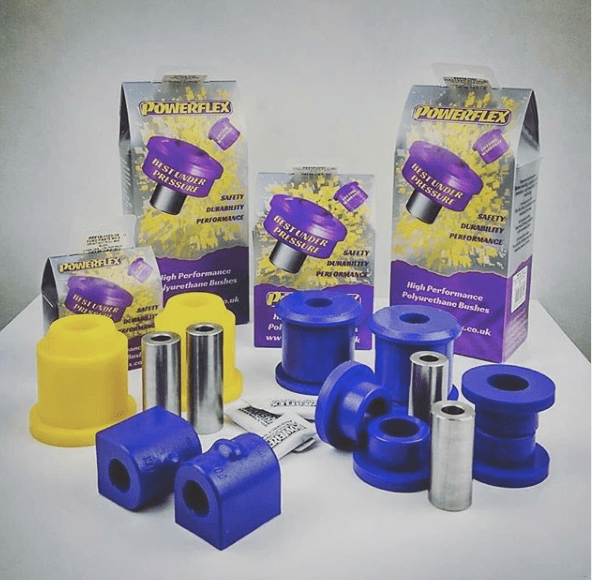
While Powerflex doesn’t typically do one-off custom work, they do respond to market demand. If enough enthusiasts request a solution – like they did for the BMW 2002 or a specific Porsche trailing arm bushing – Powerflex will invest in the tooling to make it happen. Their catalog even includes a one-time run of bushings for London’s iconic black cabs, solving a chronic failure point in their steering racks.
The Suspension Trinity: Camber, Caster, and Toe
To understand how bushings affect your car’s behavior, you need to understand the holy trinity of suspension geometry: camber, caster, and toe.
- Camber is the tilt of the wheel relative to vertical. Negative camber (top of the tire tilted inward) improves grip in corners by maximizing the contact patch under load. Too much, however, can lead to uneven tire wear.
- Caster is the angle of the steering axis when viewed from the side. More caster increases straight-line stability and adds dynamic camber during cornering—especially important in McPherson strut setups.
- Toe refers to whether the wheels point inward (toe-in) or outward (toe-out) when viewed from above. Toe-out can make a car feel more responsive or “darty,” while toe-in promotes stability.
As mentioned on the episode: Quick & Easy String Alignments!
Powerflex bushings reduce unwanted deflection in all these areas, helping maintain alignment settings under load and improving both performance and tire longevity.
Whether you’re chasing lap times or just want your daily driver to feel tighter and more responsive, upgrading your bushings can transform your car’s behavior. And with Powerflex’s lifetime warranty and engineering-first approach, it’s a mod that pays dividends for years to come.
So next time you’re planning your build – or just trying to fix that vague steering feel – don’t overlook the humble bushing. It might just be the upgrade your suspension has been waiting for.
There’s more to this story…
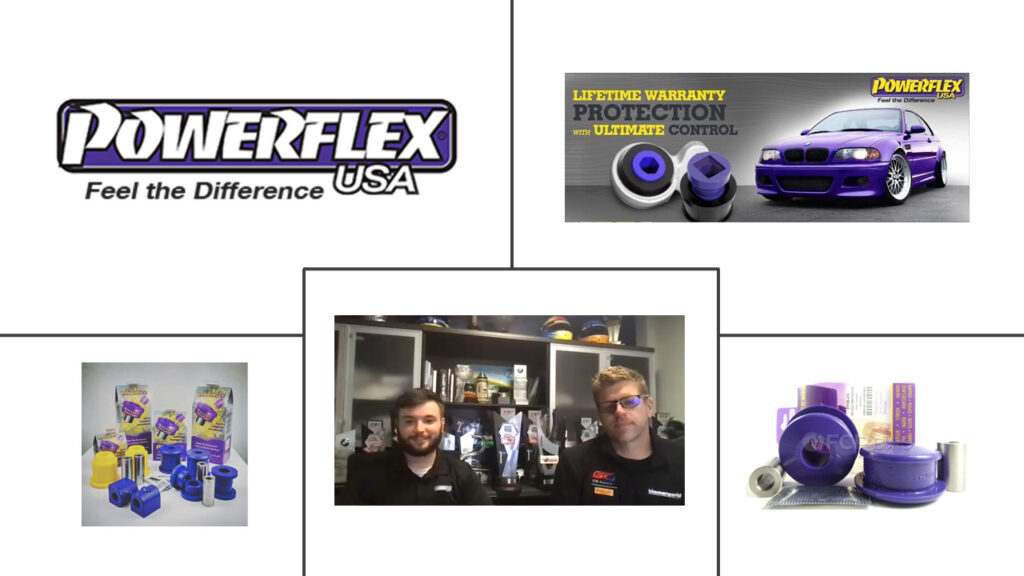
Some stories are just too good for the main episode… Check out this Behind the Scenes Pit Stop Minisode! Available exclusively on our Patreon.