

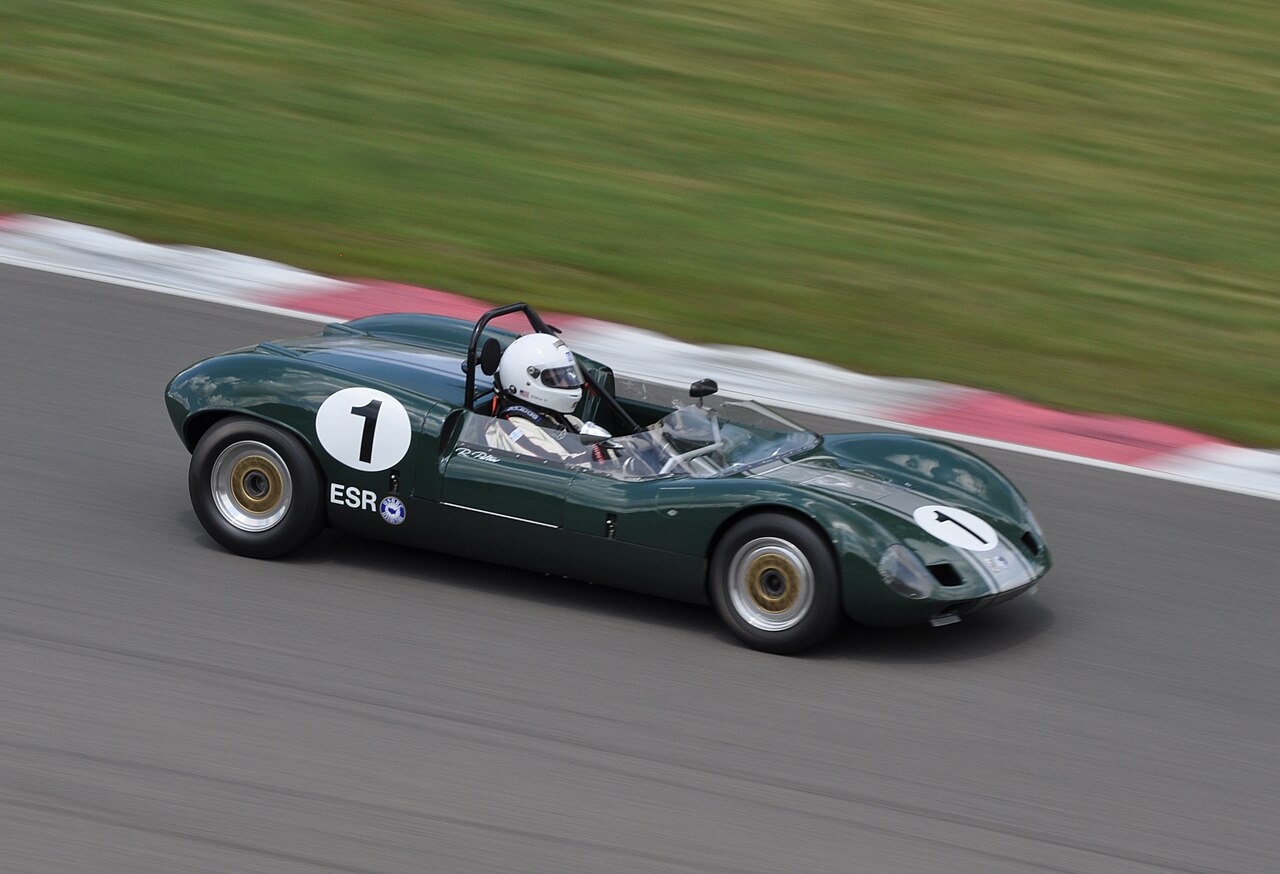
Founded by Frank Nichols in 1955, ELVA quickly became a staple of British club racing, known for its lightweight, cost-effective sports racers and Formula Junior cars. During the IMRRC’s “Center Conversation” that accompanies this article, Janos Wimpffen’s keynote traced Elva’s evolution from humble beginnings – chalk outlines on garage floors – o international racing acclaim. Janos is also the author of the definitive book on ELVA, and celebrated for his meticulous research and storytelling.
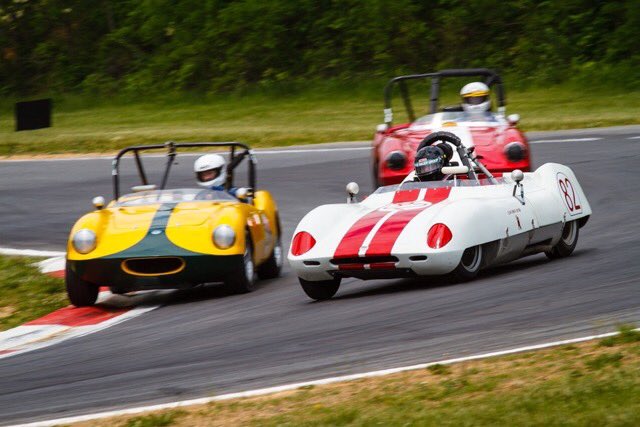
Burdette “Birdie” Martin’s stories added color to ELVA’s stateside journey. As the Original ELVA distributor in the U.S., longtime steward of Trans-Am and Can-Am – and former FIA Vice President – he spoke about racing MG TCs to importing Coventry Climax engines, and how his Chicago-based operation helped ELVA thrive in the American club racing scene.
Tune in everywhere you stream, download or listen!



ELVA’s historical highlights include:
- Frank Nichols’ ingenuity: A grocer’s son turned wartime mechanic, Nichols built ELVA around affordability and accessibility. “I only make the cars—I don’t set them up,” Nichols once quipped.
- Early innovations: The use of fiberglass bodies and inlet-over-exhaust valve kits helped ELVA stand out from brands like Lotus and Cooper.
- Export-driven success: With limited domestic demand, ELVA found eager buyers in the U.S., including Chuck Dietrich and Birdie Martin.
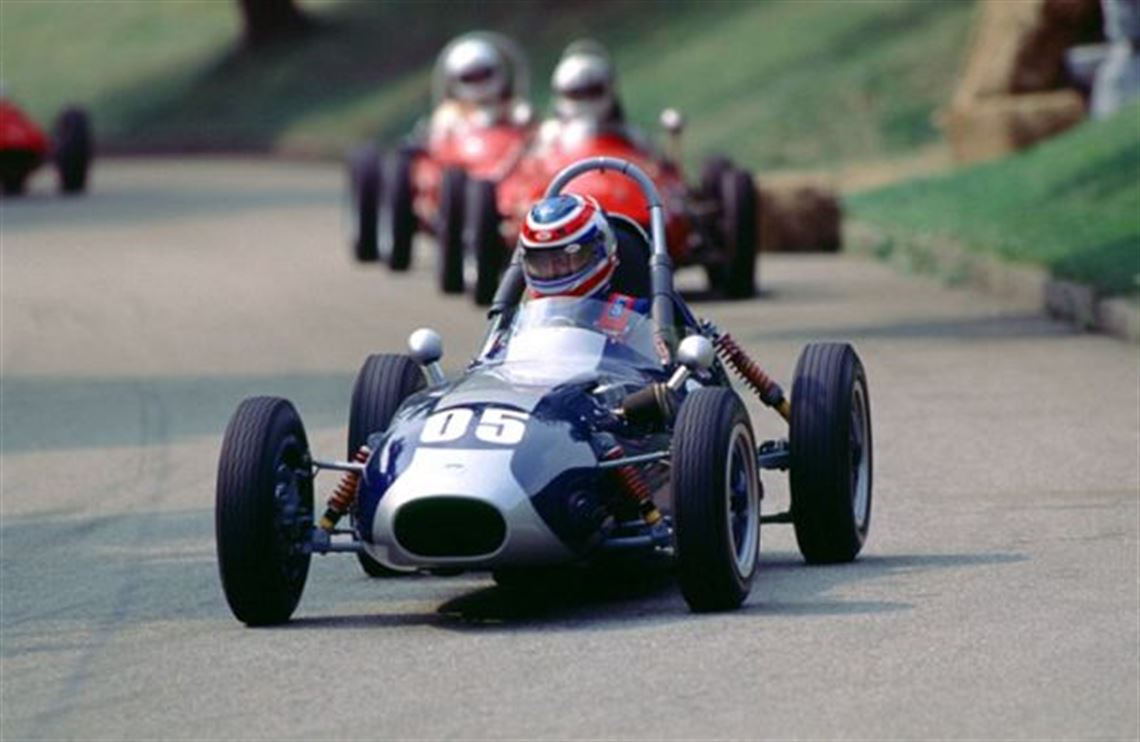
- The rise of Formula Junior: Inspired by amusement park midgets and Italian innovation, ELVA’s Formula Junior cars became a gateway for future stars like Mark Donohue and Peter Revson.
Spotlight
The International Motor Racing Research Center, hosted the ELVA reunion at Watkins Glen, celebrating the historic connection between ELVA cars and the famous racetrack. The event features various speakers, including Janos Wimpffen who authored a definitive book on ELVA, and Burdette “Birdie” Martin, regarded as a leading ambassador for automobile racing and the original ELVA distributor for the United States. Both presenters delve into the intricacies of ELVA’s history from the inception by Frank Nichols in 1955 to its evolution and key milestones in racing history. Various key figures such as Chuck Dietrich, Carl Haas, and Mark Donahue’s early career with ELVA are highlighted. This Center Conversation includes personal anecdotes from racing experiences, descriptions of ELVA’s marketing influence, challenges, innovations, and its esteemed status in vintage car racing today.
This episode was originally recorded in 2012 at International Motor Racing Research Center and has been remastered for Break/Fix podcast.
Synopsis
This Logbook episode covers a conversation hosted by the International Motor Racing Research Center celebrating the Elva reunion at Watkins Glen. This event commemorates the historic bond between Elva cars and the racetrack, featuring speakers like Janos Wimpffen, author of a definitive book on Elva, and Burdette “Birdie” Martin, a leading ambassador for automobile racing. The speakers explore Elva’s history from its inception by Frank Nichols in 1955, emphasizing its evolution, key milestones, and the significance of figures such as Chuck Dietrich, Carl Haas, and Mark Donahue. The conversation includes personal anecdotes, Elva’s marketing influence, challenges, innovations, and the car’s status in vintage motorsports. The event also spotlights notable Elva models and the individuals who have contributed to its storied legacy. The script concludes with a Q&A session, highlighting the irreplaceable role of enthusiasts and historians in preserving motorsport history.
Transcript
Crew Chief Brad: [00:00:00] Break Fix’s History of Motorsports Series is brought to you in part by the International Motor Racing Research Center, as well as the Society of Automotive Historians, the Watkins Glen Area Chamber of Commerce, and the Argo Singer family.
Crew Chief Eric: In this remastered centered conversation, the International Motor Racing Research Center hosts the Elva reunion at Watkins Glen, celebrating the historic connection between Elva cars and the famous racetrack.
The event featured various speakers, including Yanos Wien, who authored a definitive book on Elva and Burette Birdie Martin, regarded as a leading ambassador for automobile racing and the original Elva distributor for the United States. Both presenters delve into the intricacies of Elvis’s history from the inception by Frank Nichols in 1955, to its evolution and key milestones in racing history.
Various key figures such as Chuck Dietrich, Carl Haass, and Mark Donahue’s early career with Elva are highlighted. This center conversation includes personal anecdotes from racing experiences, [00:01:00] descriptions of Elvis’s marketing influence, challenges, innovations, and its esteem status in vintage motor sports.
Today
J.C. Argetsinger: I’m JC Argetsinger, president of the International Motor Racing Research Center, and we are thrilled to have the Elva reunion, Elvis’s and Watkins Glen go back a long time. Perhaps we can get my brother Michael, who’s gonna be coming to the podium to tell you a little story that he had 1958 with an Elva.
We have a number of Elva owners, and I’m gonna introduce them in a moment. Now I know the Elva owners are going to be going up to the track a little later on. Thank you for being here. I’ve said we have two wonderful speakers here, Giannis Wien, who’s our major speaker who has written the definitive book on the Elva, and we were able to coax Birdie Martin to come out.
Birdie, as you know, probably the greatest living ambassador for automobile racing. Delighted he’s here. Birdie is the original EL owner. You know, he was the original Elva distributor. And if you saw our last newsletter or saw Jonas’s book, there’s a spectacular picture of Birdie with the Elva up [00:02:00] on two wheels.
And maybe he’ll tell us what happened. It’s frozen in in time and you wonder, did he write it back or did he roll it over? But thank you Birdie. And maybe, maybe you’ll comment on that. Anyway, we have this wonderful speaker in this just incredible book. I didn’t know that there could be so much material about Elvis’s.
It was so informative and so well researched. The photographs are just terrific, Jonathan. I’m thrilled to see it, but I’m not going to say much about these two gentlemen here because, um, Michael Argetsinger, the good looking Argo singer and the racing Argo singer, I’m, uh, unfortunately the Argo singer who was, had the black sheep of the family who was had a nine to five job.
My brothers, Michael and Peter have raced extensively. Michael has raced, I probably shouldn’t say this anymore because it dates you, but he started when he was nine. He’s raced for four and a half decades and think he’s raced at something like seven different countries, 54 tracks, and over 400 races. Not only is he good looking and he’s a great driver, but he has, uh, produced four wonderful [00:03:00] books on this sport, starting with the Walt Hanskin book, which really brings the story of road racing from its inception here in Watkins Glen after the war.
And then he picks up with his two books on Mark Donahue. Mark was a protege of Walt Hanskin and Michael brings the story further. Now. Our latest book from Michael, which he and David Bull Publishing, have given up any profit on it, and it’s all for the profit of the Motor Racing Research Center. It is the, uh, story of the US Grand Prix here at Watkins Glen from 1960 to 20 years.
Through 1980. So without further ado, I’m going to turn the program over to Michael r ar Singer.
Michael Argetsinger: Well, it’s great to have a big brother who says nice things about you. That’s a nice introduction. Indeed. I. I want to tell you what we’re going to talk about today, and then I’m going to introduce the speakers and before I tell you about the program, I want to thank someone who isn’t with us, but has been really helpful, extraordinarily helpful in putting this [00:04:00] together.
And that’s Roger Dunbar from the uk. No one to most of you. I believe he really worked a lot behind the scenes and he almost was able to make the trip. Yano Schwimm. Finn is going to talk a little more specifically about Roger, but Roger, thank you very much.
Now the program today I is really exciting and I just feel terrifically honored to be introducing these two people who I admire so much. Our keynote speaker is Yosh Wien, who has come from Seattle and Bette Martin. Brady Martin, as he is known all over the world, came out from Chicago. Yosh will keynote it.
Bri’s going to come in a couple of times into the middle of the program, talk about, uh, some of his involvement. Birdie also was, in addition to having been the original Elva importer to this country, wore so many other hats in American racing. He was the series chief steward for the CCAs TransAm in its golden days.
The 1970, which was the seminal year for that later, [00:05:00] was then the uh, series Chief Steward for the Can-Am, which we all dearly recall. This only touches on birdie’s life from 1983 actually to 2006. Birdie was the President of AKIs. AKIs is an acronym for Automobile Competition Committee of the United States.
It’s a tremendous honor to hold that position, but it’s a really difficult job to maintain. The AKIs is the American Delegate to the FIA. The FIA. As you know, doles out the international dates, makes all the rules. It’s where it all emanates from, and America has many competing sanctioning bodies, but where they come together is in AKIs.
They’re all on the board. And with a man like Bernie Martin there to keep them all talking to one another, the international dates and so many other things are doled out. Birdie’s position with his much loved Anne, who we dearly miss, ran AKIs. And so many of you, if you applied for an international license during that period, or you worked with Anne and, and Birdie, but Birdie was chief [00:06:00] steward at many of the World Grand Prix around the world.
He was active in Paris on the FIA itself. He was vice president of FIA, in addition to being president of the American delegation. And he was in fact the longest serving vice president, uh, that the FIA has ever had. He also headed up the International Records Commission and the FIA is the ultimate verifier, if you will, of land speed records, uh, speed records in general, and Birdie was president of that commission.
Again, he was one of the founding members of the FIA Trust. Now we say Chief Steward in Europe, they say clerk of the course. But as I mentioned, many, many of the World Formula One Grand PRIs and of course, birdie operated during that period when Formula One was in a dynamic period. It was a, it was a time of great change, of great controversy.
We were so fortunate as Americans to have someone who has the wit, the charm and the negotiating abilities to keep these very difficult groups of people all agreeing to do the right thing. [00:07:00] So we’re gonna hear from Birdie in just a few minutes and it’s gonna be a delight. Our keynote speaker will be an equal delight.
Yosh Wien is one of America’s great researchers and writers in the world of Motorsport. He has been a prolific writer, and that’s really something to have published as many books as Yosh has published, because his books are incredibly well researched, they’re in depth, they’re respected worldwide. His background is, uh, is a PhD and he’s, he’s an academic, but really, he’s a, he’s a racer at heart, and, uh, he is known and and admired around the world.
He’s a third generation car guy, a member of a historic Austro-Hungarian family. Yanos came here at about age four. So he is in addition to his love of motor sports, he’s a real baseball nut. Yanos has been to more minor league ballparks around America, and I think all but maybe one or two major league parks.
And even on this trip, he’s already got to the Syracuse Stadium and the, uh, Buffalo one. So he, he never [00:08:00] misses a chance. He loves minor leagues equally with the majors. Interesting family. His grandfather held the Austrian driver’s license, number one, and in fact, in taking the test, he had to give the instructions to the Vienna policemen because they had no idea what they were examining.
He learned great engineering skills from his father, mechanical aptitude from his brother, and he did some club racing and he says that taught him he didn’t have driving skills of Austrian such as LADA and rent, but we could all say that we didn’t have talents like LADA and Rent. He has been consulting all over the country.
In addition to his writing, he’s a consultant regularly in, in Naples, Florida for the Collier Museum, for the Bruce McCaw collection and others. And he is sought after by car owners and historians, literally all over the world. I am very proud to, uh, be a friend of Jan OSHA’s, as well as fellow author, and we share the same publisher, David Bull Publishing, and we were together in Beverly Hills this past December at the Peterson Museum for the Motor Press Guilds Award, the [00:09:00] Dean Bachelor Award and David Bull, to his great credit had two of the three finalists, and the winner was Yosh.
I really have so much more to say about both of these men, but you really want to hear them. So I am going to ask Yosh to come to the podium.
Janos Wimpffen: Thank you very much both to Michael and jc. In fact, jcs a little issue there with having additional elbow owners. I’m so familiar with that syndrome that you work hard on something and then when it’s actually out there, all of a sudden more information comes your way. It’s always actually a pleasure rather than a problem.
In fact, of course, here, it’s a pleasure that we have additional Elva owners. I found that from the very first book that I did, which is called Time in Two Seats, that once I finished that and people started coming forward, well, you either got this wrong or you forgot about this, or. Here’s some additional information on this or that race.
First time that happened to me, I was kinda a little [00:10:00] discouraged, like, oh, did I drop the ball here? Or something like that. More often than not, I would be comforted by other people saying, no, no, no, you got it. All right. But next time around, here’s a little extra added information and, and that’s interestingly part of this whole process, process of discovery, I call it.
I get asked a lot about sort of the writing process and the creative process publishing process. All these have a lot of little nuances to them, which I can go on for hours. It, this maybe a separate topic altogether, but I think at the four of this. Is really the joy of learning. Just like those little tidbits that come to you after the fact.
I’ve learned that what really is the joy of that is you learn something new. There’s no such thing as an old dog doesn’t learn new tricks. That’s how we enjoy getting older, is learning more each day, and hopefully that gets incorporated into these books. It certainly is the case with Elva. I didn’t know much about Elva to start with.
I know a lot more now. There’s still [00:11:00] a lot more to know about this morning. People were coming up to me and giving me extra little bits, whether it was about their car or interesting tidbits they accumulated that I didn’t know about. Always a process of learning. The other maybe issue of why do we do what we do that is have an interest in motor sport history and is it really worthwhile after all?
It’s not rocket science. We’re not discovering a cure for some disease. Something like that. How important is it to society? Well, true. It doesn’t rank up with. Some of those other very valuable enterprises that people undertake, but this is important when you think that the automobile is the 20th century’s most significant technological achievement.
It changed everything from the 19th century or 20th century. It was a sea change. Most of that came about because of the automobile. Not all of it. Good. Mind you, there are utopias and dystopias created at the same time and in some small way, that’s what we’re looking at. We’re looking at that history, that 20th century and the most significant part of it we’re [00:12:00] looking at from a motor sports point of view, particularly from the recreational element of it, which is a major part of automotive history, was how it was used as a recreational tool.
That’s not insignificant, but it’s also important to have fun while we’re doing it. And of course we’re all having fun while we’re doing it. This is, by the way, a conversation I often have with a friend of mine in the uk, Doug Nye, who you may know of his books. He’s also a very well known historian, Motorsport historian.
Whenever we sometimes share a podium and talk about these sorts of things and his sort of thing is, well, we in in England don’t do this kind of naval gazing. We just get on with it. Have a lot of fun and he’s got a a really good point about that. Just one other comment about the creative process in general, and we’ll get to the meat of the talk here.
That, and this is again, because I periodically get asked this sort of thing about, well, how do you do these things anyway, I don’t know if this would apply to Michael as well, his creative process. And just like in any enterprise that you undertake any kinda work, you hit roadblocks, you hit problems, you go, how do I [00:13:00] write this next paragraph, this next chapter, in my case, it’s usually the next caption to a photo.
Those are, to me, are always challenging and you hit roadblocks. And sometimes you want to practice iron discipline. I’m gonna sit here at the keyboard until I get this right. Just like you practice sometimes iron discipline at fixing the leak in the, uh, kitchen sink, and you’re gonna get it done now no matter what happens.
And what often happens is you break the nut or whatever it is, or you’re working on the car, you break the nut off rather than accomplish it. So you have to sort of step back from that. And I kind of call it the pleasure principle of creativity. I’ve only lately learned that there’s actually a neuroscientific aspect to this.
I don’t know all the details of that, but you have to step back and do something that’s ultimately very pleasurable, that doesn’t involve a lot of brain activity, necessarily. Relax and let the creative process flow through You. Let the two things connected have never connected before. [00:14:00] My personal preference is a morning shower.
Think of how many times in the shower in the morning you might be dwelling on what you have to do that day, but it’s a very pleasurable moment. Nobody’s bothering you. You’re by yourself. You get to think about what you’re doing during the day, and you inevitably connect two dots that never been connected before about your particular problem of the day.
I use that a lot in the creative process day before I’m stuck on some paragraph the next morning in a shower. Go, oh, that’s a solution to that. Sometimes by the time I get to pad of paper, I’ve forgotten what it was, but, but that’s very much part of the creative process. And like I say, I understand from neuroscientists that there’s actually a part of the brain that goes into play at those times and works on connecting those dots.
The publishing process is a different sort of thing because that involves a lot of give and take. Michael mentioned he and I are really, truly privileged to share what I consider absolutely the best publisher in the world as far as motor racing, motor sports books, and that’s David Bull. I think Michael has maybe a little different [00:15:00] relationship with him than I do.
David is very exacting and he and I have had years and years of debates, just hours and hours worth of debates about how to do sometimes literally a particular sentence, position of photographs, something like that. And there’s a lot of give and take on that. But the end of the day, the product wouldn’t be the product without somebody like David Bone.
A lot of tribute to him. Quick tribute to a couple people that I’ve gotten to know, particularly here in the center, because this is not the first time I’ve been to the center. I think there’s people like Bill Green who has just been a marvelous in terms of helping me put together a lot of the data that goes into this.
Been privileged to meet people like Max Nisha, Randy, Kevin, Josh, Glenda, all the other people involved in the center. You have a treasure here. That’s amazing. A treasure not only in the facilities, but a treasure in terms of the people that are here. There are a marvelous group of people that do really committed and do a good job.
That people thing is [00:16:00] also, by the way, something that I think drives a lot of this history. Yes. The history of motor sports and automotive history in general is one about lug nuts and torque settings and carburetors and the like, but it’s really about the people on all of this, the histories of the people involved, people like Birdie, Martin sitting here, and characters left and right are really what this history is ultimately about.
That’s what we carry on the next generation to tell the stories of the people who were involved there were. Good people, not so good people, characters of all sorts. And in all the work that I’ve done, I’ve discovered I go into it with sort of a nuts and bolts approach, and at the end of the day, come out of it.
The respect is really for the people. As for Elva, why Elva? Well, maybe a little bit of an introduction to Elva for those of you. I know there are many Elva owners here who know of many cases better than I do. But for those of you who may not be familiar with the Elva, mark Elva was a British mark [00:17:00] that existed for a very short period of time, from roughly 1955 to roughly 1965, although there’s a little bit of fading in and fading out for and after that, but really for a short period of time, it was a contemporary of other makes, such as Cooper Lotus, Lola, particularly those and a few others rival to those.
It came out of a particular muu of the early fifties British scene. The economy in Britain wasn’t that strong, but the technology was there. And again, in terms of the people, there was a lot of expertise into how to go about things. And we’ll see a little bit about that. And that’s just a very, very short overview of what Elva is as a mark.
It’s a unique mark in many ways. It’s both unique and it’s also typical. It’s typical of that time in England. Different automobile constructors won’t really call it manufacturer, but it’s also unique ’cause it has its own particular peculiarities. [00:18:00] I came into this project actually somewhat later down the line.
I didn’t originate the project. A project was originated by two Falls, one of which mentioned before Roger Dunbar in in England and Jeff Allison in Colorado. They had undertaken to produce the history of Elva and did an amazing amount of legwork. They interviewed many of the key people. Thankfully, they interviewed some of the key people who were no longer with us and passed away before I got involved in the project.
They did a lot of the nuts and bolts work involved in getting the information, but they never got around to actually writing it. So I came in, I was asked to do the writing of the book, which of course then as I said before, got me involved in learning as to what Elva was. I mean, I had a rough idea before, but to learning the real nuts and bolts of Elva and sort of took it over from there.
There’s really one person behind Elva more than anybody else, and that’s Frank Nichols. Frank grew up in Sussex County, south of England. [00:19:00] He was a son of a grocer. He was in the army in World War ii, served in Al Maine, was injured Al Maine and gained a lot of mechanical skills during the war. Brought those back to England after he mustered out.
So he’s in the south of England, Becks Hills, the name of the village, which is very close to Hastings, where William the Conquer landed in 10 66 of kind of a historic area. Also historic Automotively. That’s where the, one of the very first automotive competitions took place in England in 1903. So he mustered out of the, uh, military, out of the army, and quickly developed an interest in automotive things because as I say, he developed the skill.
He opened up a garage repairing cars, called the London Road Garage on London Road in Beville. And quickly became interested in racing, and this was where I would say Elva, this is a common occurrence that time in England. Young men develop mechanical aptitude during the war. Now have a little bit of spending money, maybe develop some [00:20:00] kind of an enterprise related to automobiles and get interested in motor racing.
Frank did that. He drove a Ford 10, which is a very common car of that era in racing. He also drove a Lotus Six, A Lotus six, with a Ford 10 engine in it. Modest success. His driving skills were never that particularly great, but he quickly became involved with a fall named wits and also indirectly with Harry Westlake, who you may know of the name from a lot of automotive development.
In the 1960s, they developed a very unique part of the power plant. In addition to the Ford 10, a hop up kit, if you will, an inlet over exhaust valve kit that you could put on the top of the Ford engine. Increase his power a little bit. As a result of this, he also decided, well, I should really commission a car to go with this inlet over outlet head, and that was called the CSM, the Chapman Sports Motor Car.
This is a one-off car and the [00:21:00] CSM special was quite fast again because of his driving. Didn’t necessarily win a lot of races, but. It was lightning fast attracted a lot of attention. People wanna know, well, how can we get the same thing? So he ended up going to business selling those kits that you saw, the inlet over exhaust kits, and those actually became a mainstay of the company for a number of years.
They were sold up until roughly 19 60, 61, about the time that that engine, the Ford 10 was really, became obsolete, no longer used, but they were popular, sold all over the world. Not yet Elva. The term Elva really wasn’t born yet at this point. But of course people liked this concept and they wonder, well, where can we get one of these?
So you decided to go into production actually producing what became known as the Elva. Well, the Elva name, initially it was just gonna be the LRG car for London Road Garage. Not a very pleasant
Michael Argetsinger: name.
Janos Wimpffen: At one point he had this friend Bill Murphy, Bill’s brother. Jim looked at the [00:22:00] car one day and said, Elva the French, for she goes, and the.
It was contracted to ELVA and thus we’re forever have the name Elva. Fairly crude, almost cycle fender car. It was very much, again, the image of that era, kind of a kit car, but now becoming a little bit more sophisticated. Orders came in fairly quick on this. This was indeed a very successful car, successful at this point, no longer for Frank Nichols because he was out of driving himself.
He was taken over by people such as Richard Maning fellow who was tragically killed in the tourist trophy. In an elbow is actually the first of, I believe four fatalities ever occur in an Elva. Now the orders began to expand. There’s another innovation here on this car, and that is a fiberglass body. Not all of the early elves have fiberglass.
Many of them were aluminum. But that was, uh, again, kind of an innovative concept. At the time, Frank wasn’t trying to be [00:23:00] technically advanced. He was always looking at everything from a price point of view. And that’s actually one of the things that sets Elva apart from some of his contemporaries, Lola Lotus Cooper and the like.
Frank was this kind of a stingy sort of fellow, and he liked to build things to cost the others. Lotus typically would be going for speed, and consequently, the Lotus cars were famous for being difficult to drive. All those were something easy that you could get into right away, but because of this kind of stinginess, there were several factors about this.
One of them was that there were no ever any Elva factory racing teams, or really nothing that you could really directly point to an Elva factory racing team. There was adequate servicing. In fact, he was known for being very good with communicating with the purchasers out there. The technical advances were kind of slow and coming.
It was many, many years before he would introduce things such as disc brakes, but everything was always focused on this price point, point of [00:24:00] view. There was also another important element, and this is more external matters than internal home market in England was never particularly strong, or at least not strong in the early years.
This has also coincided with the Suez Canal crisis when there was particularly a clamp on the English economy, so it became a period of export or parish. In order for any small manufacturer, small constructor like Elva to survive. They really had to export quickly. Looked at the American market. Well, one of the benefits is that the car got really good reviews in the English press, and of course the English press was fairly widely read, at least read as a cult matter in the us and one of the people that picked up on that was a fellow named Chuck Dietrich out of Sandusky, Ohio.
Chuck bought one of the first elvas into the us. No one. Necessarily the very first one, but one of the first to North America at least, and he became quickly one of the champions of Elva for years and years. He was one of the main importers and there were actually many importers and dealers and like, it’s a [00:25:00] very convoluted story in that regard.
Became one of the many people involved at this early stage. One of the key people, Chuck actually stayed with the mark for many, many years in most cases. He was actually the imported, the very first of each of the successive models. He did later on, sort of veer away and took a little vacation and drove a bobsy for a while, then returned again to Elva in later years.
He was a very key figure in the early part of this. Another key figure who you’ll meet in a moment here will be Birdie Martin. But before Birdie there’s also Frank Bike and he had a very unusual car. This was a car that had a Chevy VA crammed into this. My understanding is the car went great in the straight line, but not much else.
And that was another thing about Elvis. There are always all kinds of experimentation that went on. We’re moving now kind of into the Mark two era of the Elva, and as you can see, it’s starting to get a little bit more streamlined, a little bit more sophisticated. Didion suspension comes [00:26:00] into play. You’ll see shots of these very distinctive Elva black mag wheels that remain distinctive for Elva for years to come.
Another thing about these cars is that when we talk about these changes in design and all that, all this was done in a very, very kind of intuitive way. Keith Marsden was the main designer you saw in that earlier shot. He basically just drew chalk lines on the floor and that’s what the chassis was built around.
There were no drawings, certainly no computer aid design kind of thing in those days. Nothing of anything from more modern period. In fact, Keith Marsden’s kind of interesting character in and of himself because he really enjoyed this kind of work. And in later years when a company called Trojan came into play and took over some of the Elva production and it became more of a corporate environment, didn’t suit Keith Mars in particularly well, and he left at the company at that point.
But he was a critical factor in these early days. To give you a little bit of a flavor of what this is like, a fell out of [00:27:00] Washington dc Walter Dixon becomes involved with the Elva enterprise and with somewhat chaotic results at that point. But when he became involved, he sent one of his people over Arthur Tweeddale, who himself was an expatriate Brit.
Back over at England to have a look at the Elva factory and report back as to what it was like. Tweeddale goes over there and comes back and reports to his boss Dixon, and said, well, you know, there’s a couple welding torches over there and there’s a couple guys assembling things over here and there’s a radiator guy over here and engine guy pulling in the engines over here.
And somehow in the middle of this, the cars just happened. And that’s very typical of this. And sort of another side is, which is also so typically English. Uh, when Michael and I were in Los Angeles back in December, we were very happy to be interviewed by Jay Leno and his website, not on his TV show, but on his website.
And part of that, Jay had a lot of comments. In fact, in the segment where he interviews me, these comments didn’t quite make it [00:28:00] into the final cut. But it’s funny because Jay started telling stories as only Jay Leno could about his own experiences with English manufacturers. And he said he understood when I would point out these things about how quirky the English are about things.
He goes, oh yeah, well one time I had to call over there for some parts for one of his cars. They said over there we’re kind of busy right now. Could you call back later? And he’s thinking, oh, like Thursday or Tuesday or something like that. And he said, well, when should I call back? He says, well, maybe next November.
And that’s so typically English. And then he would go over and visit and he goes, yeah, there’s a tea kettle here. And they’re too busy having tea to bother with. Things like getting to your part right away. Another instance like that where he called over for some part and they said, oh no, we don’t make that part anymore.
I says, why not? I says, we are getting so many orders for that. It was such a bother that we just we to stop making the part. And I thought, what could be more English than this? And this, this suffuses so much of Elva history. So the mark two things are getting a little bit more [00:29:00] sophisticated, but it’s still very much the intuitive chalk marks kind of thing.
One of the things here is the engine types. I mentioned earlier on that the Ford engine was kind of commonly used on the very early. That changed fairly quickly because really the engine to have in those days was the Coventry climax, FWA featherweight 1100 cc engine. That was really the thing to have.
So for a while, these mark twos and the like, most of them came with the Coventry climax engine. There were all kinds of variants in there as a couple people at a Maserati and a few Alpha Rome males and like. But the Coventry climax became sort of the most common thing. Well, one of the problems with the Coventry climax was that at that point, Lotus is also becoming a big power.
Lotus was a competitor to Elva, and they were trying to put the Gabo on Elva getting, and anybody else getting the Coventry climax. So Frank Nichols had to look around for other suppliers, and one of the people he came to talk to is a fellow by the name of Archie Butterworth. He was one of the most colorful [00:30:00] characters in this whole story.
Archie also, by the way, learned many of his skills during the war. He was in a very unusual way during World War ii. He was in charge of inventorying and studying, captured material from the enemy. So by studying these, you of course then be able to give information back to his superiors as to how to better improve the British armaments.
And at one point there he was sifting through some of the material and a German bomber came over and started strafing that area. And in typical British fashion, he goes, oh, this is so bloody annoying. And he scrambling around, reaches down, picks up this Luger that’s lying on the ground points the Luger up at the belly of the plane, boom, shoots it, and down comes the plane.
And for which he won several awards for that. So that’s the kind of character he was. Later on when he became involved in automotive things, he had good mechanical abilities. He built a really interesting car with an interesting engine handle like garbage. [00:31:00] He ended up selling that car to Bill Milliken, who heard about before revered Bill Milliken here.
Bill basically bought that car as a good study of what not to do. So he learned that from Archie Butterworth. Archie also had a, was known for carrying a fully stocked bar and the boot of his Jaguar. And first thing he’d do when he had arrived at a race circuit would be to, of course, open that up. So at this point now, we’re still kind of early in the Elva history.
They’ve really only produced a few hundred cars. Many of them now are coming to the US though that’s a big, big part of the market. So there’s still very few cars, but now we’ve got a couple of Americans have become deeply involved in this. I mentioned Chuck Dietrich. Another fellow was Carl Haas. Very, very major player in this.
He came an importer in the uh, Midwest, and another fellow was Birdie Martin. And since Birdie is here, I’ll let Birdie talk about his particular era as far as Elva goes.[00:32:00]
Burdette “Birdie” Martin: Yano talk here was so interesting. I’d like to rush through what I’m gonna say to hear more about what he has to tell about. I’ve got a few little comments I have to make and I was reminded today of something that Chris Komack, he told me one time when he was hired to do one of his first major race events.
He was looking forward to it and he’d studied, you know, what talk about and so forth. So as they came on the air, the other man that he was working with, I don’t recall which one it was, but he was a well-known sports announcer and play by play man and so forth. And they started off and this other fellow said, Chris, tell me what are we gonna see here today?
He went into the study he had done. He said, well, you’re gonna see they’ve just changed the ride height on these cars. They’ve done some other things here to allow less fuel consumption. He said, we’ve got some [00:33:00] new drivers here. He went on and named a number of things that would happen. All of a sudden the uh, technical people said.
Cut. Cut. Chris said, what’s that? He said, well, that we, we are just doing a preview of the opening. That was just it. But we’re now ready to go on live, so let’s go back and start again. So the fellow comes on who’s the network announcer, didn’t know very much about Motorsport, but he said, well, ladies and gentlemen we’re here today and we’re gonna see these cars are running with new fuel rules on it, and they’ve got this and they’ve got that and they’ve got everything.
And he repeated everything that Chris Conac he had said in the warmup. And then he turned to Chris and he said, now Chris, what do you think Chris told me? I didn’t know what to say at all. That’s kind of the way I feel right now. I think Yanos, you’ve told a lot of good stories here that I might have been counting on, but with Elva and Nichols and so forth, there’s a lot of.
Also, I have to say, uh, after I heard Michael introduce us and jc, I thought, geez, I wish I could go and listen to those two [00:34:00] guys. They must know what they’re talking about. I was very fortunate. I lived in a great era. I was 21 years old in a great era and a great time to be living in Motorsport and so forth.
I look out and I think these are Elva people. I don’t remember Elva people looking this old, you know? ’cause we dealt with guys that couldn’t afford a lotus at the time and maybe they could get a, uh, elbow or something. And they were all pretty much younger guys just starting out. Many of ’em went a long way too.
Unfortunately, we’ve lost many of them recent years. I have the excuse that couple months here, I’m gonna be 83 years old.
Fortunately, uh, I feel very good. I feel my health feels very good. My doctors tell me I’m pretty good and so forth. I hope to be around a good bit more because I really have had a wonderful period in my life here. Not many people can spend every day working on their passion, which is motor sport and [00:35:00] cars and people.
And that gets to another important part of it, people, and that’s what it’s all about. And the Elva people were very unique. They were quite different than people that bought Lotus’s and that, and a few of the people that bought Lotus’s swung over and bought Elvis, and that they didn’t have the same engineering and the same background as Lotus might have had.
But it was interesting. I have to touch a bit on Frank Nichols too. Uh, you went into his youth and so forth. But I was over in, uh, England in 1953. Right after, uh, the war was over, I visited some of the people over there. In fact, I bought an engine in Italy for a friend and did a few things, and I visited with John Cooper.
At that time. I met John, and I believe I met Frank at that time, but I didn’t make a big impression. He didn’t have an Elva name on him or anything, but we referred back to that time. I did remember though, at that time, that John Cooper said to me, I wanna show you something. We just got the [00:36:00] first one, and it was the FWA Coventry Climax Engine, and he just had gotten the first one.
And as most of you all know, that was really a variation from a water pump that was developed during the war, during the Battle of Britain and so forth. And it was a very light engine for a pump that could really put out some water, and it was very effective. And that’s why they built an overhead cam type engine for it.
He showed me that engine, and little did I know how much that would be a part of my life in a few more years because I ended up being a distributor for not only the elbow, but for Coventry climax parts and so forth. Even had Weber carburetors at one time too. I started my own racing actually in the 1947 in the very early years right after the war, Andy Gran Elli in Chicago where I lived in that era.
Andy uh, formed a group called the Hurricane Hot Rod Association. I had one of the first hot rods in Chicago, 32 High Boy Ford. So I joined that [00:37:00] and Andy was a great politician. He got us an opportunity to run a soldier field in Chicago and even got us a thousand dollars purse to run there. It turned out that this hot rod racing really caught on and that first race at Soldiers Field, we had 40,000 people attend and they probably paid a dollar and a quarter or something to get in, but the promoter made an awful lot of money and I can tell you that the second time we raced there, we got 40% of the gate.
Andy learned that very quickly and that was kind of an interesting thing. I went off to college and first they got got down in Albuquerque. I was going to the University of New Mexico. I walked down the street. I went by a garage and it had a midget racer inside there. Well, I went in and I told ’em that I was a great hot rod racer from Chicago and so forth.
I found out these fellas had just bought this midget and they didn’t have a driver yet. So I got a job driving. While I was in college there, drove for them for about a year or so. I remember the [00:38:00] first time we went out to test, I knew that you held the brake on on a midget and they pushed you off and your wheels were locked up.
And once it got moving a bit, you take the brake off. And I knew all that so that it looked like I knew what I was doing. I made about two laps and spun. I came in and they said, what happened? And I said, well, you know, I’m used to driving on blacktop. I’m not a dirt driver really. And so I got by that had a lot of fun.
I made some money while I was going to college. And of course I couldn’t tell my parents that I was making this kind of money because they wouldn’t like the idea that I was driving race cars. And I hadn’t told them that yet. Anyhow, they eventually accepted it all. In fact, they went to one of my first races in a sports car.
I bought an MG dc, went to a race up at Wilmont Hills, which was a brand new facility they had just bought or had ran and leased it for. Number of years I drove the TC in the race. I think I finished back about fourth or fifth or something. I broke my tail driving that car as hard [00:39:00] as I could. And I got home and my father said to me, he said, Sonny, he said, I like the way you drive.
You’re very consistent and you’re not rushing at all. And I thought, there’s something wrong about this because I was trying awful hard. Anyhow, Frank Bike was one of my very good friends. We went to high school together and so forth, and uh, he was a very close friend. Frank was very mechanically inclined and very handy in the shop.
And he did machining, he did designing and everything else. He came from a family that produced candy and, and they were a very famous family in Chicago area, maybe around the country in those days. The Wiz Bar, which was a chocolate marshmallow candy and that. But he was very good at things and he had picked up an Austin engine, I think it was an A 40 or something like that, Austin engine, and he was doing a complete job on it, porting it and everything else.
Frank, what you gonna do with it? He said, well, I’ve seen an ad or a little [00:40:00] article in a magazine, a British magazine, and there’s an Elva car there. And he said, I think maybe that’s something I could use to put it into, in fact, I’m not sure it even had the name Elva yet. I said, geez, that sounds interesting.
I said, let me go. I’ll write a letter back to them and gimme the address. And he did. And so I wrote back and wrote to Frank Nichols and he sent me some stuff and on the car. I said, why don’t we buy that and then we’ll buy another complete car with an engine in it. And so I wrote back to Frank Nichols and Frank said, listen, we just got a first of these Coventry climax engines.
And he said, this is the hot setup. Are you still interested in two cars? I said, yeah, but one of them we don’t need an engine for. We just need the one. And he said, but you’re gonna buy two. I said, yes, most days. We sent telegrams too, you know, he came back and he said, you’re buying two, so you’re now the dealer for that area.
Michael Argetsinger: So.
Burdette “Birdie” Martin: But he told me that he had dealt with Chuck Dietrich, and I knew Chuck because I had raced [00:41:00] Mgs against him and Susie, his wife, and that I said, that’s great. We will work together on this and I’ll help and we’re gonna get some parts and stuff in and so forth. And Chuck was a good friend and, and a very accomplished driver.
Very, very good. The market area in Chicago at that point, economy was pretty good and so forth was a lot better than it was in Sandusky, Ohio, where Chuck was located. So I think we sold a lot more cars and he did a lot more racing. The problem for me was when these two cars came over. And you saw the one that Frank Bike ended up putting the Chevrolet engine in and took five years to finish it.
And the other one, when it arrived, Frank Nichols came over at the same time to the United States and he was gonna visit us and visit somebody in Texas that had been riding to him. So we arranged to meet Frank at the airport in, uh, New York when it arrived. And we picked up the car the night or so before and got it loaded and on a trailer and so forth.
We went and we met [00:42:00] him at the airport and he said, I’m going to Texas and then I’m gonna come back to you all because you’ll be on the road going back to Chicago with this. So he said, could you take me over to Newark Airport? And I said, sure. That’s no problem. We can do that. So we went over to Newark Airport and we were asking a lot of questions about what was happening in the racing scene.
And believe me, in in England, the uh, 1100 G modified we called here in the United States. Was a hot class over there. I mean, they had the future race drivers driving in that. So, uh, we were talking about the racing and waitress comes back and brings breakfast that we had and Frank got his grapefruit and it had a sparkler sticking in it and it was glowing like this.
And I always remember that ’cause Frank said, I really don’t know. He said, is this how you eat grapefruit over here? Other than his war ventures, which I don’t think got him to very many nice restaurants. He hadn’t really been in a place that was a little fancy. So anyhow, we did that. [00:43:00] Frank came back from Texas.
I don’t think he was terribly successful with that venture. But anyhow, he came back and we met him in Chicago. We had a great time with Frank. We talk about what he was able to do and what he did. He wasn’t really a great engineer, but he was capable. But he didn’t reckon that he was an engineer anyhow.
He figured that somebody, they, you’ll have to hire or use who he already has. But there was something about Frank that you had confidence in him that he could do what he was saying he was gonna do and he had plans. He wanted to run right up there with Lotus and with Cooper and so forth. And I have to tell you, even in his greatest success, well, Colin Chapman, I, he died.
I actually talked to him a few hours before he died. I was in Paris at the time and he was coming out of a meeting of the, uh, what was the Foca at that time? The Formula One people? I was with Max Mosley and a couple other people I knew Max from Watkins Glen here in that. Chapman was never very accommodating to anybody.
I mean, [00:44:00] he, he really, he almost thought you had to have a slot where you could put a quarter in and then he would talk to you or something. Years later when Lola was first coming along and started to win all the races in England, I remember I asked him at Sebring that year, what do you think about this Lola car?
He said, oh, it’s fly by night. They just built a couple cars and they’re not gonna matter. They’re not gonna mean very much. Which was interesting because a third friend that I went to school with at that time was a fellow by the name of Al Ross, who was my mechanic. And he wasn’t a very good mechanic, but he was a good worker, which you really need at that point.
And he imported the very first Lola into the United States. I, he didn’t tell me, in fact, until after it was well on the way and I went with him. In fact, when he cleared it through customs in Chicago, it was a super car. But I always thought of what Chapman had said earlier that year when I talked to him about it.
Frank was always very good about people, but. He re recognized he was working his way up in the [00:45:00] pecking order of motorsport, but he did very well. He impressed a lot of the journalists. I don’t know, he got some really good write-ups on his things and that did very well with that. It was an interesting time and I started to say when these cars came over, it seemed like Frank Nichols would always come over ’cause he knew he’d get another order from me when he came over and.
I would generally take that new car that I just got, which was like the mark one that we ordered complete with an engine. And I would sell that car because I wanted the later one, and then I’d get the later one and then I would sell that one because somebody else would buy it and I would get the newer one all the time.
But I did squeeze a few races in on some of them when they were new. And I was very fortunate and it did pretty well. And the truth of the matter is, the success of of Velva was the fact that the people that got ’em were people that were willing to work on them, willing to learn how to set it up. Frank really delivered you a car that was complete in all the pieces, and they [00:46:00] were all bolted together one way or another.
He didn’t really do an awful lot. Most of the guys that were driving Elvis in, in England even were guys that were doing all their own work, and that there were no big factory teams as s just said. It brings back an instant later on after the Dixon era when, uh, we were gonna run an actual team at Sebring and Dixon arranged everything.
He arranged the rooms for the cars and the mechanics and everything, and I sold two of those cars to two people that each were gonna drive them at Sebring and as part of the Lola team. Another interesting point, Frank was a really good public relations man too, from those first cars we bought when he shipped them over here.
They had our names on the doors, all written by a sign painter. Really done nicely, which was kind of neat. It really thought that was nice. You might have liked to have done it, but in those days you probably wouldn’t do that on your own. People would make a big issue. But when they came on an Elva with your name [00:47:00] on them generally was pretty nice.
And if you got one that you didn’t buy ahead of time, but you bought it from the dealer, you would also get somebody’s put their name on the same way because it was pretty common on the, uh, Elvis at that time. I had a mark two that I drove. I had a mark three that I drove. I had a, one of the first Mark fours.
Generally he would send Chuck and I the first cars that that would come out until he got Dixon involved and then Dixon would get the first cars there. But I got a Mark four that year and that was 1959. And I got it earlier in the year, I believe, because I raced it several times. Actually, it’s the one I sold to Bill Jordan at the time.
That was the Sebring car that Mark four. When I saw it, I knew exactly where he got the design for it that I had. And Abarth 2 0 7, I had that. And when Frank first came over, he saw that car. He really liked the looks of it. That is where Frank got the idea for the knife edge on the, uh, bodies of the, uh, [00:48:00] marked IV cars.
And it so happened in 59 that those were the cars that we were gonna race that uh, Sebring. And you could always tell those ’cause they had an extra set of headlights built into the, uh, bonnet of it. We picked up, ours went with Bill Jordan and I and his wife, and we went to, uh, Washington to pick up the Mark iv.
We were gonna drive at Sebring. They were bringing down the other one that I had sold and one that was gonna be driven by, uh, Frank Batista, who was the national champion in G Modified, was a very good Lotus driver, very good. Arthur Tweeddale was gonna be the other one who worked for Dixon also. They were bringing those cars down.
We went to, uh, Dixon’s place there in, in Washington and or Baltimore, I guess it was. And got the car and that we got down there and first time we took the car out it, it handled terrible. It was awful. And Frank was there, had arrived and got down to Seabring Fellow that I knew very well, who was a Lotus driver, who was very good mechanically, was down at [00:49:00] Seabring and he wanted to help us set up the car.
And he was very good in setting up the front end of the car. But I always remember his name was JC Kilburn. He was from Rockford, later moved down to at Dallas, Texas. And that. Still races at Monterey and that and uh, junior, I guess he told me that, he said to Frank, what kind of camera setting do you set up on the front end?
And Frank said, how the hell should I know? I only make the cars. I don’t set ’em up. And that was typical of him. Listen, I’ll skip on and come back a little later. Sorry to take up.
Janos Wimpffen: Delightful indeed. And you know, birdie has touched on, of course, the name Walter Dixon, who’s a, a major player in this. Not always in the best [00:50:00] way. One of the key things that happened, Walter Dixon, as Birdie mentioned, he was, he’s actually a Washington area. I’m a Baltimore Washington area dealer of a number of different cars.
In an early meeting with Frank Nichols suggested to him that you ever thought of something like an MGA MGAs were quite popular at the time, very successful car, and that you might want to consider building something like an MGA. And Frank thought that a really good idea. That’s what became then the courier.
So the courier was really born out of a discussion between the two, and that became the production car that later actually to some extent led to a temporary downfall for Elva. Continuing on with the story here. I just wanted to quickly mention Archie Butterworth and there’s another key person in in that particular period, and that’s Archie Scott Brown.
So the Tale of two, Archie Archie, Scott Brown was one of the real iconic English drivers of that era, and he was, as far as the Elvis saga goes, he drove several elves of the more particular Mark gre [00:51:00] and he also one of the few who could drive this Butterworth engine car. Archie was born with only a stub of one hand.
Left hand was fine, right hand was just AUB, and yet drove in ear along before political correctness and all that. He was a very successful handicapped driver. Very few people even knew that, that he was handicapped. Quite a success story during that period. I’ll talk more here about the couriers. The courier was, in some ways was an MGA, if you used an MGA engine originally.
Later on the MGB, it was Nichols’s big move into being a proper producer of road cars. And ultimately though, these weren’t really road cars, they were road cars meant for racing. Again, there was this element of no compromise. They weren’t particularly comfortable for creature comforts. They were famous for the engine being located somewhat further back.
So the cockpit was rather cramped. So the courier was quite a cramped [00:52:00] car, but it had a really good advantage. The power to weight ratio was spectacular. Even though it was cost a little more than the competing cars like the MGA, like the Triumph, TR three, it became quite popular among people who wanted this kind of no nonsense race car, something they could drive to the track, race, and drive home in the production categories.
In many ways, the design of the courier presage the Spitfire many. In fact, somebody who came up to me this morning said, yes. A friend of mine sent me this photo, says, oh, look at this interesting spitfire that ran at violin in New Jersey, but it wasn’t spitfire. It was a courier. They were often mistaken for that.
When the courier came online, there was a kind of a problem with Elva because they weren’t really equipped to remember. They were just drawing chalk lines on the floor. Now they actually had to do actual drawings and they had to move to a bigger facility. It was no longer they were behind a fish and chip shop.
Initially they had to move to a bigger facility. Initially they moved to facility in a drill hall that rented out, eventually [00:53:00] moved to Hastings itself. I mentioned. That’s where the Battle of Hastings took place. Later on, production would move on to Croyden near to London and be taken over by a company called Trojan.
Frank Nickles had, I think, kind of an ambivalent relationship with the courier. Hoped that they would be a cash cow. They never turned out that way. He never really wanted, I mean, he expected people to race them, but wasn’t really there to support the racing activity. This is a period now, 1959 to 61 that the courier was built.
So it was a period of rapid growth for Elva. The couriers themselves were built on later on, 62, 65 in different stages, and they were raced for many years after that. In fact, uh, as recently as 2002, a courier won the e production National Championship with SCCA. One of the key things about the courier are some of the drivers involved.
And we talked earlier about drivers such as Chuck Dietrich, can’t forget Susie Dietrich, who was in that rare sorority of really fine women drivers of there is Susie Dietrich, Denise McCluggage, pinky, [00:54:00] Rollo, Donna May Mims, Margaret Wiley would be another one. Her husband, doc Wiley was also Major Elva driver of that era.
A few others of that era, but now we’re Mo we’re moving on to the courier. The courier also was a great starting point for a number of drivers. People like John Quartz, John Cannon, Peter Revson, Jim Downing, who became a big more recently and and Insa racing, got a start with a courier. John Osteen, another IMSA driver much later.
Gotta start with courier. Nobody bigger than Mark Donahue, of course. If Michael has written quite a bit about Mark Donahue, got his start in courier, this very kind of brutish car, and which he won a national championship with. Couriers weren’t, of course, the only thing going on. In fact, this became a very, very busy time for Elva.
They were producing couriers stole the sports racers, and they would slowly, surely move into Formula Junior as well. They produced and Birdie touched on it, the, um, later sports racers. And these became actually the last of the front [00:55:00] engine Elvis sports racers, which were the Mark four and the Mark V.
This is really where Frank Nichols’s passion remained, was still with the sports racers. The Mark IV was first independent rear suspension car that Elva built. It was actually a competitor to the Lotus 11. The Lotus 11 was, in terms of mass members, was the most common car as Birdie mentioned. That class of racing was particularly popular in England and the Mark IV was to some degree, a competition with the Lotus 11.
Mark IV was a more aerodynamic version of the earlier Elvis. Most of them were now fiberglass. Not all of them. Most of ’em were fiberglass. Very low built. Again, mostly climax engines, few alpha males, even one Buick engine, in fact, that spoke with the fellow here who, uh, has that car with the Buick engine.
Bernie Keller was the original owner of that. One of the differences though, with say the Mark four, the Elva, mark Fours and the Lotus, is that the Elva was always considered a true club racer. As [00:56:00] Birdie mentioned, you had to know what you’re doing with an Elva. You had to tinker with, you had to work with it.
It was meant as a club racer, not really as a stepping stone kind of car. The Mark IV was also important. That was the first car that Carl Haas really got involved with. If I’m not mistaken, uh, birdie mentioned that that car won its class at Sebring in 1959. Second place to that car was the car driven by Birdie.
That was driven with Carl Haas and was managed by none other than Tex Hopkins. Also, another famous figure here at Watkins Glen. One of the interesting comments, I think always about these early elvas, as Birdie mentioned, that they were kind of just put together, but even so, Chuck Dietrich was one that always thought that the Elvas were better than the Lotus’s.
Lotus’s would have to be welded together between qualifying in the race, Elvas at least held together a little bit better than that. After the Mark IV came to the Mark five, the LA very last of the front engines, it was even [00:57:00] lower than the Mark IV had arched wheels because it still retained the old 15 inch wheels.
One of the things was that, again, Nichols and his conservative way didn’t move to the smaller wheels that were common at that time. The 13 inch wheels, as I mentioned, that there was really three different kinds of production going on. Here we have these couriers. They’re really gearing up, talked about the sports racers, and then there’s Formula Junior.
Remember in motorsports there’s always this kind of tension between cost and competition. You try to keep the cost down, people develop new technologies, be more competitive, the cost goes back up. So it’s always this kind of battle back and forth to try to keep costs down. And there were a number of formulas already existing in the 1950s that were intended to keep costs down, but they were usually basic used motorcycle engines.
500 cc would be one such classy early Formula three was such. Johnny Ani from Italy came up with this [00:58:00] idea of the formula Junior. Essentially, why not build more or less spec cars? It’ll be a thousand cc cars later, 1100 cc. Use production components, have them as single seater cars, have the races on a kind of a national championship basis, get this approved by the FIA and spread it around the world.
The idea really caught on and from about 1959 to 63 Formula Junior was the stepping stone. Of motor sports in that era, stepping stone. Also, a lot of club racers, it was, you could be a junior fungi or scar or what have you in your formula. Junior, they looked like race cars. Italian cars typically had one liter fiats in them were garage built.
Around that. There were French cars with DB pan hards. There were German cars with D three cylinder, uh, two stroke D kws. And then the English cars typically use BMC Austins. Nobody really jumped to the fore right away and built them in England. In fact, none of the countries had really constructors of formula juniors.
But [00:59:00] then Frank Nichols jumped in and I believe some of the early conversations with that actually took place in Birdie’s kitchen, where Frank saw a midget that Ed Crawford had brought over from the west coast, a small midget racer from amusement park. And that kinda gave frank some ideas that later germinated in becoming the formula Junior.
Frank Nichols. Elva was the first to produce Formula Juniors in any kind of significant quantity and beat Cooper and Lotus Cooper and Lotus at that time were very busy with their Formula One programs and really didn’t pay much attention to Formula Junior. Also, the Formula Junior that Frank Nichols developed had an advantage when it came over to the US ’cause the US caught on to Formula Junior right away.
They were a little bit larger. Cockpit area was a little larger. Americans tend to be a little larger people than most Europeans, and it was very comfortable and convenient for that.
Burdette “Birdie” Martin: I would like to go back to one moment there. Sure. Because you were talking about the, uh, there he is again. I’m back again.
Oh, there he is again. Oh, this was, [01:00:00] that was where the Mark four too, but that was my own one there. That’s one I did with the Lolas at that time. But the thing that happened was we had a number of friends in Chicago, in the Chicago region. Eddie Crawford lived quite close to me, and he was one of my best friends.
We used to go over there and it started out in his yard. He had five acres there and the people had raised horses and that, and so they had jumps in their yard in when he bought it, well, he left them there and we laid out a race course around those jumps in his yard. And we started out because somebody bought a Henkel uh, moped and somebody else had something.
And we started racing in those mopeds. And one Sunday we were going up to Milwaukee, about six of us in the car to a champ car race up there. And we were saying, wouldn’t it be nice if we had some little cars we could race? And I said, wait a minute. I know I saw an ad in the paper for a company that makes these things for a carnivals and for, uh, off-road racing.
They have a little [01:01:00] Wisconsin engine in them and so forth. And so at that moment we said, well, who would buy one? And I said, I’ll order ’em if you, you know, get enough guys. Well we got six guys together. We ordered six of them. I mean, we even included Wacky Arnold who was the MG distributor in Chicago without telling them.
’cause we knew he’d buy anything, you know? And anyhow, we bought those and they came and we had started racing in his yard with these things and we had a ball with it. And then we actually even went on and had the fellow who built Meadowdale, Leonard Binger, who was a really a housing builder at that time.
And he built a, a shopping center and he invited us out to race at his shopping center on Sundays. And he would get a great big crowd of people coming out there. And we were using up all of the wheelbarrow tires that we could find. And because they’d only last a couple races or that, and that’s how we got into, uh, that Frank Nichols was coming over.
So I took Frank [01:02:00] over to Eddie’s house. And we had a little race there, and Frank drove one of those little cars. He thought this was a lot of fun. And we said, Frank, what we need now is we need one with a shifter in it and we need a car. And at that time, the van wall was the hot setup in Grand Prix racing.
So we said, Frank, I said, I’ve got a picture of a van wall. We just want to shrink that down and have it look like a van wall. You put some kind of a motorcycle. Any, any motorcycle engine that’s got a five speed gearbox or something. We don’t want a big one. We want, we said two 50 and we said, go ahead and do this.
This was kind of in the spring. Well, he started work on that car and I remember the time he sent a letter to me and said I was down to, uh, Italy and Johnny Ani has this new program down there for Formula Junior. He said, I’m gonna make the car a little bit bigger, because then they can use it for Formula Junior.
Also, when we got the first ones in, we said, my God, this is the biggest little car we ever saw in our life. [01:03:00] But it was neat and they drove nice. When I said I was an owner, I still own the first one I got, and I still own that. It’s at my son’s race shop and that, and he’s been going to restore it all. It’s probably only run in about 10 races.
Major thing was I drove it in the first US Grand Prix at Sebring. I drove it in the preliminary race that morning for the uh, formula Juniors. Which was the first big formula, junior race, I shouldn’t get into going further, so I’ll stop right now. But the thing was, it was about that time I decided I really wasn’t gonna do that much more racing.
I’d just been married and my wife was pregnant and I thought I, I’ll just stop for a while. And Carl was anxious and this is something I should have talked about before, how Carl got involved. Carl was a good friend of mine. We raced together and so forth. He was driving a Porsche and he came down to Nassau with us one year.
You know, in those days Nassau would give you two rooms. So Al Ross and I had, were sleeping in mine, but Carl [01:04:00] didn’t have anybody. With him, and so he had an empty bed in his room at the hotel. Frank Nichols came over. We didn’t know for sure that he was coming, but Frank came over. He said, Carl, can you put up Frank in your bedroom?
He said, sure. Well, they got talking at night when they were laying in the bed, start talking, and Frank Nichols sold Carl a car at that time.
Michael Argetsinger: He
Burdette “Birdie” Martin: had a Porsche and he sold him a car, and Frank told him about this wonderful thing. He had been to Massachusetts, the fella Candy Pool was his name up there, who had designed a four emo carburetor manifold for the Coventry climax engine, and he was sure that that would give you 15 horsepower more than you were getting out of the stock one.
Carl wanted the car like that with the candy pool manifold on it. Well, when it came, it wasn’t that much faster, if it was any faster at all, and that was in a Mark three body. But Carl got very interested in this thing and he wanted to get involved in the sale of those cars. At the time, [01:05:00] he was working for the Ford Motor Company in a, uh, training program for middle line people.
Carl came to me and he said, I wanna get involved. I said, okay, Carl, you now work for me. You’re a salesman and you get a commission when you sell ’em. We didn’t make much money on the cars anyhow. We made more money really on the parts in those days. So Carl came, at this time, Nichols was having a bit of a problem.
He had some cars that had been ordered by a dealer to Houston Game rhymes with Dixon. They were sitting on a, uh, dock down in Florida and I said, Carl, here’s your first assignment. You go down there and you see if you can’t sell those cars down there somewhere. And he did. And he went over because he knew Jim Hall pretty well.
He went over to Texas and he sold Jim Hall one and one of Jim’s other friends, not Sharp, but another fellow that he sold two juniors that were sitting there. So that’s how Carl got involved. When he came back, I said, Carl, I’m gonna step out of the sale of the cars. Why don’t you just take it on? You can pay me whatever you want out of [01:06:00] it.
Whatever you make something. I don’t know. He did give me some money, believe it or not, but it was pretty informal. But I said, I want to keep the Coventry Climax business and that, and so I did that for quite a while before I sold that part of it to him too. So that’s how Carl got involved. Sorry. Oh, I love it.
I, we didn’t ever get enough time to really spend time to get together. Right.
Janos Wimpffen: No, that’s great. I I, I never knew the end of that story as to what happened with that car. Just outta the phone. I know it became an ad for Johnny Walker. B Bourbon though. Yeah, that was Well, we’ve alluded to these problems with Walt Dixon and basically issue there is, remember you got a shoestring operation, Elva, it’s basically living hand to mouth.
Nichol have been living hand to mouth. So for that matter was Walt Dixon and with his dealership in the DC area. And in fact he started playing quite a shell game with his cars. And his deal with Nichols is he was gonna prepay for this big order of couriers, but after a while the checks weren’t coming or they were bouncing.
Well, the same thing was happening with the creditors that Dixon had, that he wasn’t paying them. And [01:07:00] after a while he was doing shell games where he would to get more loans to get, increase his letter of credit with the bank. He would do these games where he would use the cars as collateral and then have his customers come back with the cars to do servicing.
And then when the bank came around to make sure that the cars were actually there as inventory, there they were, but they had already been sold. So he had all sorts of ways to do this. Well, eventually that caught up with him. And in December of. 59. He was visited by a certain team of US Marshals and that closed the Dixon Enterprise.
And that had immediate repercussions on Frank Nichols and Elva back in England. He was basically left holding the bag, no more income coming, and it was the worst possible time. ’cause the production was ramping up with all the couriers, formula juniors, the various sports racers was at the end of Elva.
Well, of course not. It was really just kind of the in, in some ways, the midpoint. Elva recovered quite quickly, really thanks to three different people or three different organizations. [01:08:00] One is we heard Carl Haas. Carl Haas stepped to the plate and invested a lot in the restructured Elva, which is called Elva Cars, 1961 Limited.
Another fellow was a guy named Frank Webb, who ran a company called R Tune Engineering. He stepped to the plate and built some of those last of the front engine formula. Junior cars, as you saw, those were called Scorpions. They were built out of the, uh, the Elva plant. But because of this liquidation process, they couldn’t be called Elvis.
They were somewhat different actually than the original Elva one hundreds, as they were called. Juniors. And then the other company that came into play was Trojan. Trojan had been around since something like 1910, involved in a variety of automotive enterprises. Most recently at that time was the importer of Lambretta Scooter from Italy.
And they also, in fact, were involved with a big go-karting operation in the United States. Sold many, many go-karts. They took on the production of the couriers. So essentially all the post 1961 couriers [01:09:00] were actually built by Trojan, which is located in Croydon near London. Pretty soon now, Elvis’s back on its feet and they’re producing cars again.
They’re producing another round of formula junior cars. And you kind of quickly saw some of those. These were the rear engine formula junior cars, because by that time, front engines were obsolete. And Formula Junior, as they were. In Formula One, the rear engine formula Juniors called the 200 later the 300 200 ones with the, that vertical fin, the three hundreds with the very, very low boxy ones.
The thing about all the formula Junior cars is they came to be driven by some significant people, particularly in the United States. Bob Bonderant drove one at one point. Charlie Kob won a championship with the Formula Juniors. The later the rear engine formula Junior, one of those was driven by Mark Donna.
You didn’t have as much success with that as he did with the courier, but it was a major, major stepping stone for Donahue that carried forward later into a single seater career. It also kind of [01:10:00] coincided with more or less a general fading of formula. Junior Formula Junior suffered this fate of a lot of these low cost formulas.
Basically, somebody got in there and took it all over. In this case, it was Lotus Lotus 18, and not only was it the Lotus 18 more successful VAR or anybody else and dominated the formula, but they also brought in factory teams. Jimmy Clark, a number of others, drove Formula Junior Cars. So it really defeated the very purpose of that.
Now we have this shift to the rear for, uh, Elva. Very significant time to join the modern age. You have the engine in the rear. So there were now two things going on. The formula Junior era was over. Trojan is taking over the production of the couriers. Elva, meaning Frank Nichols, Keith Marsden themselves can focus a little more again, what they really love, which is two seater sports racers, and now they’re all rear engine from here on out the mark, six being the first one.
The Mark VI is, again, very often climax engines. They were [01:11:00] successful pretty much from the onset. One of Elvis’s heydays came at Boxing Day. That’s day after Christmas in 1961 when Chris Ashmore almost defeated Graham Hill’s, Testa Rosa at Brands Hatch, and this is a real high point, it really made people take notice again, just like they did very early on with the Elva potential.
The Elva and Elva got a lot of orders as a result of that. Also, a lot of characters, again, though endlessly stories of characters and all this, you’ll see in the moment Dan Blocker. But before Dan Blocker, there was a fellow Tony Land, Frankie in the uk, who was another one of these characters. He came to Frank Nichols and boldly said, I want to be the your factory driver.
Frank Nichols said, no, I don’t do that land. Frankie went out to the casino down the road, won a bunch of money that night, and came back the next day and bought his car with all the coins and all, and went racing. At one point his transporter broke. He’s on his way to an international race in the uk and his transporter broke down along the way, so he did the only sensible thing.
He [01:12:00] pulled his Elva out of the back of the transporter and started driving through the circuit. Un muffled and all. Well, the local constabulary didn’t take kindly to this. Stopped him. He convinced the policeman that rather than book him, it would really be best interest of England in this major international race if he would receive a police escort to the race.
He did. So that’s shows you a kind of talking point. It could be another character. A whole story of Elva here is, is as you can see, Dan Blocker, I believe that’s Linda Vaughn with him and Dan Blocker, of course, the Bonanza actor who became involved with the Elvin Mark vi. He had a couple of Mark Sixes, one of ’em, which he put a Maserati engine into it.
And in fact, both of Hi his cars featured in this particular film, Viva Las Vegas with Elvis and Ann Margaret. Uh, so we have Elvis and Elva tied together conveniently enough. In fact, it’s interesting because Blocker’s Maserati engine never ran particularly well. So for the film, they actually had these two [01:13:00] identically painted Elvis, this one with I believe, a Coventry climax that was actually used in the action sequences in the film.
And the other one, which was only in the garage. And you see the engine lifted outta that, which is the Maserati, which is very appropriate because that’s usually the condition that that particular car was in. Another thing about Dan Blocker’s team is he very often used the driver by the name of Bill Harris.
Bill Harris was actually a stunt man from the Hollywood area, but you know, Dan Blacker, of course, knew him from his professional connections. And if any of you have read. Sylvia Wilkinson’s, great book. The stainless steel carrot, which is pretty much mostly about John Morton, but there’s this great little vignette in there about Bill Harris and Bill Harris would organize these stunts for the movies.
And he had this one particular stunt, and I think it might’ve been a Daytona, where he had to catapult the car over the rail. So he arrange us all with a catapult and put a dummy in the car and all that. And the film crew ready in the car got vaulted over the the rail. And then he went out in his pickup truck to go retrieve [01:14:00] this car.
Well, as he went outside the track, he noticed that a crowd had kinda gathered around civilians from driving around the area. They thought that, oh, you know, here’s this terrible racing accident that just has happened. Of course, bill Harris saw, figured out what’s going on here. He runs up to this car, this crash, pulls out this lifeless driver and starts punching.
This says, you dirty so and so, look what you did to my race car. So there all these characters, this, this particular album, mark six that you see here, nothing particularly significant historically about. This is actually driven in a series in the Midwest Midwestern Council Sports Car Clubs. You might have noticed in some of these shots, it has kind of a, almost a Ferrari esque rebo to it that was designed by these two brothers, Dave and Dean Cozy in the late 1960s.
And the Coys were known where they jumped into the big doune buggy craze that was going on at that period. Wanted to make a lot of money on dune buggies, so they built a bunch of dune buggies. The only problem is that their source of the chassis for these [01:15:00] dune buggies were stolen VW beetles. They just go out in the street, steal VW beetles, convert ’em into dune buggies and sell them.
They quickly graduated into manufacturing license plates after that so that they, that was a short, I love these particular sequence of shots because this is now the courier marks three and four that were built by Trojan, and it shows you some of the advertising that was used. Don’t ask me why they did this particular pose, but there are all these, these shots.
They’re also, I think some, maybe some shots I don’t have in there of bathing beauties in the English winter holes on some of these cars. As you can see, not all the couriers are Roadsters. Couriers had a very unique, this reversed rake coop that they developed. Very few of those were built and they are among the most sought after cars right now in the courier collector market.
Couriers were also somewhat similar in concept to the sports racers that virtually no two were alike. There were constant variations of the suspension [01:16:00] types. So there were two plus two seating arrangements. There were the coops or the Roadsters, all these constant variants. ’cause I was never quite sure, is this a road car?
Is this a race car? Is it primarily a road car? Primarily a race car? Nobody ever quite came to grips with that, which was actually, in many ways it’s failing, if you might say. And in fact, it’s something that frustrated Carl Hala because he was the principal importer of the couriers to the US and he was really frustrated by this idea that was constantly switching back and forth.
There was one last courier that was kind of a, an interesting story that this is a Lama courier coup. There was two American expats in France, one military, one non-military who raced couriers with each other and they had a really good time. And over uh, some Van Rouge. One night they decided they were gonna enter Lamont.
Ron Lu, Dick Goldstein. And they hatched this idea over napkins. But this one sort of worked unlike most napkin hatched ideas that we have. They ordered a car from, well, that [01:17:00] point, Peter Ag from Trojan came as more or less a bag of bits. They got a local technical college to put it all together. Found when they got to LA Ma, that windscreen cracked right away.
They got a renewal windscreen to replace it. The problem, and still was that the windshield wipers wouldn’t even touch the screen, but they kind of solved these things one by one. They also had the interesting things that went on that day that they had a problem with a badge shimmy in the alignment. So they took it to a local shop.
That was just kind of the beginnings of electronic alignment for wheels. Didn’t help at all. And there was this guy in the next paddock stall over, heard all this going on and said, I think I can fix it. As a Dunlop technician, I think he just got, picked up the wheel, put on a stand, rolled it, took a weight off here, put a weight on there, gave it back to him.
They expected the worst, and the car handled brilliantly. After that, they still failed. They still didn’t make the start, and it was kind of the last, one of the last times that Elva tried to run at Lamont. The last of the rear engine [01:18:00] series that were pure elvas were the Mark Vi’s and the Mark eights.
These were now thoroughly modern cars. At this point, they were much more professional. They were lightweight, very, very lightweight, really designed from scratch as rear engine cars. Whereas the Mark Vi was more or less a front engine car turned around. They were dealt with actually problems such as grip.
And the like, which was a new concept at that time. They still use primarily Climax and Ford engines. In fact, it’s interesting ’cause later on in history of many of these cars, they got Hondas, Dotson, VWs installed in them. But what really became interesting is when the sevens became the mark seven S’s, this is about 1963 or so, again, there was an engine supply issue.
So Nichols at that point opted for BMW engines, A BMW, which is not yet a household name in the us. It was considered to be a very reliable, very easy to fit in the car. It was quite easy to reconfigure the car for the BMW engine. It [01:19:00] was a two liter dry sump engine that they used. Tony Le Frankie again comes into play.
He was a champion with this particular BMW engine here. The BMW engine also is about that same time that Ali Schmidt, who was the Porsche importer to the us, watched an Elva race of Puerto Rico along with Ska Van Stein of Porsche. They were quite impressed by that. They thought, Hmm, maybe we should adopt some of these concepts to the Porsche, because at that time, the Porsche spiders as sports racing spiders were a little long in the tooth.
They were reliable, but they were heavy. They were not doing particularly well. So they took this idea, actually back to Ferry Porsche, about maybe doing something together with Elva. Porsche was always very conservative about any other constructor using their engines. But they thought, well, maybe this is a good idea, and thus was born the Elva Porsche.
The Elva Porsche became actually sort of the last great highlight of Elva history, came with the Elva Porsche developed partly by Herbert [01:20:00] Linga. The very famous Porsche test driver helped a lot in setting this up. There’s a lot of reconfiguring of the chassis that had to go on to fit Porsche engine into it.
It was brought over in August of 1963 to the US just in time for the Road America 500, which at that stage was one of the major endurance races in the us and it was now waged against big Bo cars, cobras, Ferraris, and the like. Were running in this race. Bill Woff, great American driver from the Midwest started the race.
Frank Nichols was there, one of his many, but still sporadic visits to the us. Immediately. This was a success from the start of the race, actually from qualifying on on. It was fast, and more importantly, it was very, very fuel efficient. There was a problem with a co-driver. They didn’t have a co-driver nominee.
Carl Haas at one point was going to drive, but he and Westoff are so different in physical size that Carl didn’t quite fit in the [01:21:00] car. They ended up at the end of the day deciding on Augie PS as a co-driver. Augie had never driven the car before. He stepped out of Roger Penske’s Ferrari and when Bill Westoff came in halfway through the race in the lead, handed the car over to Augie.
Augie had never driven the car before, spun off at the first lap, slowly gained confidence and ended up winning the race. It was one of the great moments of Elva first, big two liter win for a car in a major endurance race like that. And it was a win for Elva immediately led to a large order of Elva, Porsches.
And it’s actually in interesting because in terms of Porsche history. It’s maybe the only non Porsche built chassis that is accepted as a Porsche. Lessons that Porsche learned from that were put to use later on when they built the other space frame. Porsches, the 9 0 8, the nine seventeens, and the like.
Kinda last of the true elves as it were, was the GT one 60, and this is a very [01:22:00] special, not one off, but three off built on a marked seven s chassis, but with a coop body, a very nicely styled coop body, designed by a guy, call him two names out there, Trevor Frost. Trevor Fiori. He just thought that Trevor Fiori di Torino sounds better than Trevor Frost of latent buzzard.
And so he just went with this kind of Italianate name that he created and designed this car called the GT one 60, which only three were built. And again, in sort of typical fashion for small constructors of this type, they misjudged some of the calculations on the weights and misjudged some the calculations on cost.
And as a result, the car never went into production. All three of those cars do survive. One of them went on and raced at Lamar the following year, not with a whole lot of success, but it was always a very attractive car. Elvis story doesn’t quite end there because it really ends with McLaren. Bruce McLaren when he first was thinking about starting his own [01:23:00] race team and was actually thinking of constructing sports racers, thought I can construct the basic idea, but I can’t make customer cars.
So he came to the group now led by Peter Ag, which was the uh, CEO of Trojan, and asked them and worked out an arrangement with them to build the original McLaren, which became known as the McLaren Elvis’s, the M1 a. At a time. This is now 65, 66 when Group seven racing big boar sports racing is becoming popular, not just in the US but also in Europe.
Build a series of 25 customer cars from me, Bruce McLaren saying, and this became sort of the last, this real story of Elva kind of ends there with the McLaren Elva. There were a series of other McLaren elves built that usually never were called McLaren Elves usually only went by the name of McLaren.
They were the kind of the last chapter of the Elva story. Elva does live on in a number of different ways. Frank Nichols himself went on, became part of a partnership [01:24:00] with Len Terry and Carl Haas called Transatlantic Consultants. They helped develop some of the BMS of the late 1960s of King Crowborough in the late 1960s.
So he kept his hand in with other automotive concerns, although later he really moved into boat building, built boats that were used for various rescue and fishing services in Britain. Nichols became very active in sort of the next phase of Elva, which was its afterlife, if you will. Elva became and remains today one of the most popular cars in vintage and historic racing.
One of the nice things about most of the elvas that you’ve seen in this, and almost all of these still exist. Very few were destroyed, almost all still exist, and almost all can be found in vintage racing. One kind or another, one of the first people who really stoked this flame was Sterling Moss.
Sterling Moss’s first vintage racing car when he got back in the sport in the 1980s was indeed an Elva Mark seven s. And he to this day, remains a real champion of Elva in the history of Elva, which is one of the reasons [01:25:00] he wrote the forward to the book. Another key player in this kind of late stage of Elva, and he’s mentioned at the beginning was Roger Dunbar.
Roger Dunbar owns the Elva name, supplies the spares. As many of you deal with, Elvas know he’s actually involved in the project in bringing Elva back again. The recreation of Elva and brand new Elva courier remains to be seen if that’s gonna be done, if the investment is there for it. Roger is also involved in restoring, he restored a a mark two recently that now resides in the museum at Beckville.
But if you were to go over to that McLaren sitting over in the lobby, in the, in the research center, if you look at the cellular level, there might be a little bit of the DNA of a little shop that began behind a hotel, began a fish and chip shop. There were the chalk lines on the floor that McLaren in there.
Its Origins due date back to the shop in Beil on Sea. So with that, thank you very much.[01:26:00]
Michael Argetsinger: Stay up here.
What a wonderful presentation led by Yosh and augmented by Birdie. What a treat for all of us. Yos is such a pro. He brought it in right on time. We are gonna do some q and a. We’re gonna bring Birdie up for that as well. We’re gonna take a few questions and answers. And by the way, that wonderful photo of Birdie up on Two wheels is by Ron Nelson, who has been a big supporter here of the research center.
So I wanted to get his name in there, but Birdie, I’ll start it out. How did you, uh, manage to get along with, simultaneously with Bernie Eckles Stone, Jean Beer, blessed Max Mosley, Colin Chapman, and all the other, uh, Remicades of Motorsport? That’s a good
Burdette “Birdie” Martin: question. I’m not sure how I did it myself, but I. I like people and, and that’s one of the reasons I like Elva, because Elva had the nicest people to work with and it was always fun to have a guy call and that was what problem somebody wanted to Pistons or something.
[01:27:00] We’d spend more time talking about different things and what was going on and that, no, I, I really meant to bring that into this. The Elva people were just turned out to be great people to work with and it’s continued to those of who have bought ’em in recent years and that it’s the same kind of group of people.
It’s really fun to be with and talk about the cars. So any questions from the floor? Rumor,
Janos Wimpffen: original Elva that Mark had as a tour? Is that a bathroom?
Michael Argetsinger: That it’s what the, well, he owned it as a
Janos Wimpffen: tour. He just liked it as personal and he had an he on his, well, I’m aware of the Elva. You mean the courier that he.
Raced or a different courier. I know one that he drove on the road
Michael Argetsinger: as his biographer. That may be true, but I missed it if it’s so sorry.
Janos Wimpffen: Don’t know of his race car, which I saw some photographs earlier. Somebody had of one that was painted up as [01:28:00] Mark’s original car, but I don’t believe that is actually the chassis that he had because my understanding is his race courier, and I’m not sure about nothing, about a road courier, but his race courier sort of disappeared into the overall fabric of American racing as, as years went on before people realized that it was marked on his car.
I know. Passed on to a fellow’s surname is Gaunt, G-A-N-U-T. I think Robert Gaunt, who raced it for a while, but then it disappeared after that.
Burdette “Birdie” Martin: That would be, uh, he’s from Fort Wayne, Indiana. Yeah, Harry Gaunt. Harry. Harry Gaunt. He’s the
Janos Wimpffen: fact, he was my wife’s jeweler. Oh, okay. By the way, just one administrative note I was gonna mention.
There were some films here we didn’t have a chance to show them. Primarily show Susie Dietrich. They’re from the Susie Dietrich Archive. And there’s one actually that shows the British Racing Show of 1960. Kinda a nice period piece. And I wanna put in a plug, another book to get is Michael’s book, because you want, again, this idea of people and racing, the Formula one at Watkins Glen, 19 61, 81 [01:29:00] is a real treasure in that regards.
So thank you.
Michael Argetsinger: I don’t see any questions coming from the audience. I will say this about that courier. Let me just finish this point, Tim, and I want to get your question. That may be true that it went into the miss that courier, but there are people who believe that car did exist. And when we had the Mark Donahue reunion here three years ago, that car was there.
His son Michael drove it. That car then was sold to uh, Johannes, Willem Park who took it to Austria. And Johannes has an interesting hobby. In addition to a lot of great classic race cars, he also collects the first race cars of famous race car drivers. If you can imagine that. Tim,
Dave Wilde: the records were lost in a fire.
Probably finding out
Janos Wimpffen: about some of this, just the estimates, like what the total number of sports racers, carriers, and junior early, right. I think the records lost in the fire might be somewhat there. It seems like that happens a lot. The records are lost in fires, you know, and you’re looking for, so I got, yeah, I [01:30:00] can probably write a chapter about records lost in fires.
I think it was more records lost because we don’t want, Hm, revenue to find out what really went on. That was probably more what really happened. But the records are really confusing with Elva production and the really, the number one reason for that is not because of any skullduggery, but because of unfinished kits coming out the door.
You have finished cars coming out the door, you have some that were supposed to go out, kits came back in the door and were finished sent out. So because of the nature of this kind of hodgepodge, industry, records weren’t kept that closely. And then add to that, these issues with the Dixon Saga, the Dixon problem recovery.
After that Trojan coming into play, you have all kinds of opportunities for things to go awry and record keeping. That had a lot to do. But to answer your question about numbers. As best we can tell, there were about seven, 800 couriers built of all stripes, and [01:31:00] this includes actually a, a handful that were built way after the Trojan era because Trojan then handed it off to a fellow named Ken Shepherd, then handed off to fellow named Tony S, and they built the few cars after just a handful.
But the number 800 fits juniors, that’s actually the, I don’t know the number into my head, but the juniors happen to be the one that we’re pretty well documented on, and it’s right around 100 in total of the three different kinds of juniors, actually four, if it includes Scorpion. I don’t have that in my head, but I know that number is pretty concrete.
The sports racers in the neighborhood of three to 400, some of those with the later ones, 6, 7, 8, we know the numbers exactly. Earlier ones. No, that’s where we get into this kit. Car problems.
J.C. Argetsinger: You raise a a point there and I’m gonna ask both of you. Are you aware that there is a controversy that maybe there is someone in England or somewhere else who is manufacturing historic race cars and passing them off as Sterling Moss’s car?
And is [01:32:00] anyone doing this with Elva? Is any clever mechanic who had built Elvis at one time, are they manufacturing new ones that they’re passing off?
Janos Wimpffen: No, because Elvis’s aren’t that valuable. After all, we, you know, we have this, this wonderful cult following of Elvis, but they’re not Ferraris. That problem exists with Ferrari.
Cobras, Ford, gts. Coopers. Coopers, yeah. Yeah. Coopers, some Lolas, it happens with a number of, some of ’em actually are licensed. Some in some cases, like Lola for example, now is licensed, what they call continuation license. Somebody to build it. So those are legit. But then you get in this problem of, okay, they’re built just like the old cars, are they the same as the old cars?
They’re built with modern techniques and all gets into all these issues. There’s a couple different problems with that. One is there is the fraud aspect where people try to pass off a car as having this and this provenance and it really doesn’t, and that happens over and over again. I’ve been involved in some of those cases, in fact.
And then there is the [01:33:00] other kind of aspect, which is, well, we want to build this continuation, but now where are you gonna race these things? Because the different vintage and historic sanctioning bodies, they have a wide variety of rules. Some are very, very strict. This particular car you raced, the car itself must have documented history of having done X, Y, and Z.
Other sanctioning bodies are much looser. They’ll say, we’ll accept cars that have been modified, modernized in some way. We’ll also accept cars that have been built as a continuation. So those, those, there’s the issue too of what you can do with these cars besides this, what their particular provenance.
Burdette “Birdie” Martin: I got involved in a lot of this just recently because after I retired, my wife had done most of the, uh, papers for historic cars for the FIA in the United States.
She wanted to continue doing that ’cause she enjoyed talking with the people and so forth. And so when we retired, my successor Nick Crawl asked if we wouldn’t continue doing [01:34:00] that. And I said yes, but I didn’t want to do inspections because I didn’t want to travel. And we used Jeremy Hall who was the, uh, FIA inspector that inspected all the cars for us, and we got involved in a number of those.
We didn’t have any problems that I can recall on any elvas at all. But we did have a lot of them on other cars and the FIA had a procedure, they started out doing it for a, uh, historic papers called Heritage Program. And it was fairly expensive because it required the car to be, regardless of where the car was located, you had to have an inspector go out to it, had it go back.
And generally it took a couple times to do it and if there was any other car or any other person that claimed the Providence car that you had, they would not accept either one of them until it was resolved and it got kind of difficult. I actually have a Cooper still that I’m the only owner of the car.
I bought it from Reg Parnell and he was the original [01:35:00] buyer of the car. It was a race team and I bought it from him and it’s been in my garage almost completely since that time. Yet we know of one in England that has claiming the same numbers on it. You know the sad part, when these were first built, we didn’t look into the things that you all look into now.
We knew the cars because we knew it. It was a red Elva so and so owned it, and if he put a blue stripe on it, it was the red Elva with a blue stripe. Nobody ever asked about a serial number or anything. It’s really a shame that we didn’t do more. But I think on the first Elvis, we get, I remember the only thing I saw that had a number on it, and I’m not sure it looked like a little tin strip that you’d get at a arcade for a quarter where you could print your name on a piece of metal or something, and I think Frank would go down to the arcade and get ’em made when he needed them.
And it was really kind of funny. It’s sad, but it makes it interesting too. If it was all cut and dried and we knew where everyone was and [01:36:00] everything that had done, it’d be different. But it’s fun. You know, there are people that collect cars just to do that sort of thing. They don’t care about racing them or anything.
They like to look at ’em and they love enjoying the, uh, history of them. And it’s kind of fun when you find out your car had some kind of providence do it.
Janos Wimpffen: Comment on that. It’s interesting about how, yeah, this thing about chassis numbers and so forth is, is of issue now because of the cars that become valuable.
And then we, when you do dig through the history, there are all these problems come about for a variety of reasons that, that Birdie had mentioned. And many of ’em had to do with legal issues back in the day. Because particularly before the onset of the European Union crossing every border in Europe, you had to show that the car has, yeah, left and entered the country.
And so the documentation had to match the chassis number. But if you crashed a car, that means you still had to export that car. So you take the plate off and put it onto another car. That kind of switching went on all the time. And it goes on today, like probably [01:37:00] current racing quite a bit. ’cause I. The writing that I do, and I was, there was a particular car in the A LMS race that was crashed at Lime Rock, and a week later, the next race of mid Ohio, I was there and the team had this brand new car, and I went up to him, I said, oh, I want to get the chassis number of your new car.
And the guy tells me the chassis number and I said, no, no, that’s the one you crashed last week. He goes, no, no, that’s this one. And I said, no, that can’t be. You’ve got a new car here. He goes, no, we repaired it. And I said, wait a minute, couldn’t I? It was there at Limerock. It was badly damaged. It was destroyed.
You didn’t repair that car. It said, no, we repaired it. And I said, no, this. And I looked and sure enough had the same chassis number I saw a week earlier, and I said, well, how can I have the same chassis number? He says, well, we sent it back to Germany. They repaired it, they sent it back to us. It’s a repaired car.
No customs duties paid. I
Burdette “Birdie” Martin: got that Juergen Barth. Let me just tell you. Tell you, Juergen Barth told me that Porsche. Even did the same thing. They [01:38:00] built a lot of race cars, team cars, and none of them have plates of their own. They just would move them from whatever they were taking them with, and that’s the company as big as Porsche.
We have a question back here.
Michael Argetsinger: Yes. Did you really know anything about Gas?
Janos Wimpffen: Yes. The name, name shows up Trust
Burdette “Birdie” Martin: was 5,000 Drive. Well, he drove, I know he drove very successfully in the Continental series at one time and that I don’t ever remember him in a courier and,
well, there were quite a few of them down in Atlanta and it may be some place he worked or somebody he knew or something, but it’s possible.
Janos Wimpffen: The name very much rings a bell and I believe he’s in my database that comes. With the books, we can probably take one here. Just
Michael Argetsinger: Dave, introduce yourself.
Dave Wilde: I’m Dave Wild.
We have an Elva courier that I [01:39:00] started racing after racing at MGTD for quite a few years. The courier, we were racing, uh, early sixties into mid sixties. Anyway. This is a story that I never shared with my wife until many years later. It had been raining for oh, three days down here at Watkins Glen. That time we’re still doing standing starts.
False grid was mud at that time. Curious mix of Watkins Glen, clay, and. The oil leaks of a thousand British cars that had gone before. It was kind of a sticky mess at that time. They slowly put us out on the grid and when the flag fell, I pulled a good starting position in the second row, staggered just behind a Porsche 3 56.
As the flag fell, the 3 56 spun its tires unloaded its load of mud directly in my face because we’re sitting kind of exposed in an [01:40:00] Elva courier. Initially, I let off on the gas almost immediately, then instantaneously, easily got back on it. Because I realized there were a hundred cars behind me at a hundred miles an hour.
We had to get moving, so I put my foot back down. I could not see a thing trying to get enough water off the cow of the car to clear the mud off my visor, and was unsuccessful for a while. But just on instinct alone and experience running the course there, I managed to. Come up from the old start, finish line up the hill through the S and out onto the strait before I could see again.
Michael Argetsinger: Great story, great story. It was hairy
Dave Wilde: one other time. I was up on the back straight and somehow or another it collided with a bird. It must have been a crow ’cause all I could see was black feathers. It spun the helmet sideways to cover one eye, and [01:41:00] it felt like a pterodactyl, not a crow. But thank you.
Michael Argetsinger: Well, with that, I’m gonna say very special thanks to Burette Martin to Y win, and to all of you for being here today. Thank you today for a great.
IMRRC/SAH Promo: This episode is brought to you in part by the International Motor Racing Research Center. Its charter is to collect, share, and preserve the history of motor sports spanning continents, eras, and race series. The Center’s collection embodies the speed, drama and camaraderie of amateur and professional motor racing throughout the world.
The center welcomes serious researchers and casual fans alike. To share stories of race drivers [01:42:00] race series, and race cars captured on their shelves and walls, and brought to life through a regular calendar of public lectures and special events. To learn more about the center, visit www.racing archives.org.
This episode is also brought to you by the Society of Automotive Historians. They encourage research into any aspect of automotive history. The SAH actively supports the compilation and preservation of papers, organizational records, print ephemera, and images to safeguard, as well as to broaden and deepen the understanding of motorized wheeled land transportation through the modern age and into the future.
For more information about the SAH, visit www.auto history.org.
Crew Chief Eric: We hope you enjoyed another awesome episode of Break Fix Podcasts, brought to you [01:43:00] by Grand Tour Motorsports. If you’d like to be a guest on the show or get involved, be sure to follow us on all social media platforms at Grand Touring Motorsports.
And if you’d like to learn more about the content of this episode, be sure to check out the follow on article@gtmotorsports.org. We remain a commercial free and no annual fees organization through our sponsors, but also through the generous support of our fans, families, and friends through Patreon. For as little as $2 and 50 cents a month, you can get access to more behind the scenes action, additional pit Stop, mini sos and other VIP goodies, as well as keeping our team of creators fed on their strict diet of Fig Newton’s, Gumby bears, and Monster.
So consider signing up for Patreon today at www.patreon.com/gt motorsports. And remember, without you, none of this would be [01:44:00] possible.
Highlights
Skip ahead if you must… Here’s the highlights from this episode you might be most interested in and their corresponding time stamps.
- 00:00:00 Elva Reunion at Watkins Glen; Welcome by JC Argetsinger
- 00:02:39 Michael Argetsinger’s Program Overview and Acknowledgements
- 00:04:27 Keynote Speaker: Janos Wimpffen
- 00:11:11 Elva’s Historical Significance
- 00:18:49 Frank Nichols and the Birth of Elva
- 00:24:27 Elva’s Expansion and Key Figures
- 00:32:06 Birdie Martin’s Personal Stories
- 00:51:25 The Courier and Production Challenges
- 00:53:23 Elva’s Rapid Growth and Racing Success
- 00:53:44 Key Drivers and Racing Achievements
- 00:57:26 Formula Junior and Elva’s Innovations
- 01:06:27 Challenges and Recovery for Elva
- 01:19:46 The Elva Porsche and McLaren
- 01:22:51 Elva’s Legacy and Modern Impact
- 01:26:17 Q&A Session and Closing Remarks
Livestream (Part 1)
Livestream (Part 2)
Learn More
 If you enjoyed this History of Motorsports Series episode, please go to Apple Podcasts and leave us a review. That would help us beat the algorithms and help spread the enthusiasm to others. Subscribe to Break/Fix using your favorite Podcast App:
Consider becoming a Patreon VIP and get behind the scenes content and schwag from the Motoring Podcast Network
Do you like what you've seen, heard and read? - Don't forget, GTM is fueled by volunteers and remains a no-annual-fee organization, but we still need help to pay to keep the lights on... For as little as $2.50/month you can help us keep the momentum going so we can continue to record, write, edit and broadcast your favorite content. Support GTM today! or make a One Time Donation.
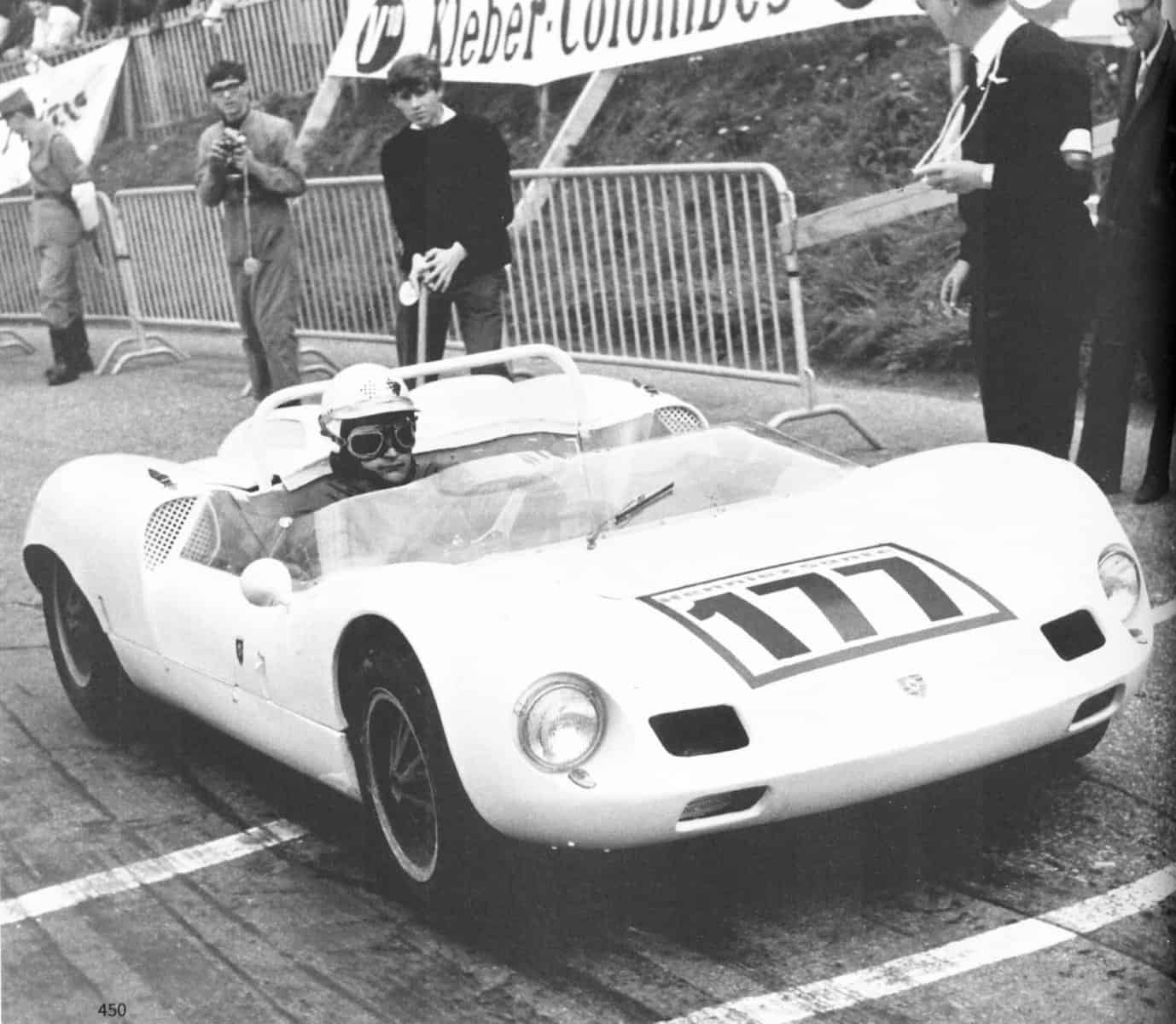
ELVAs remain popular in (vintage) historic racing, with many original cars still active. The McLaren-Elva M1A marked the final chapter of ELVA’s production legacy; and it’s connections to Porsche and BMW also cement its legacy in the sports car world. And even today enthusiasts like Roger Dunbar, steward of the ELVA name, continues to support restorations and parts supply.
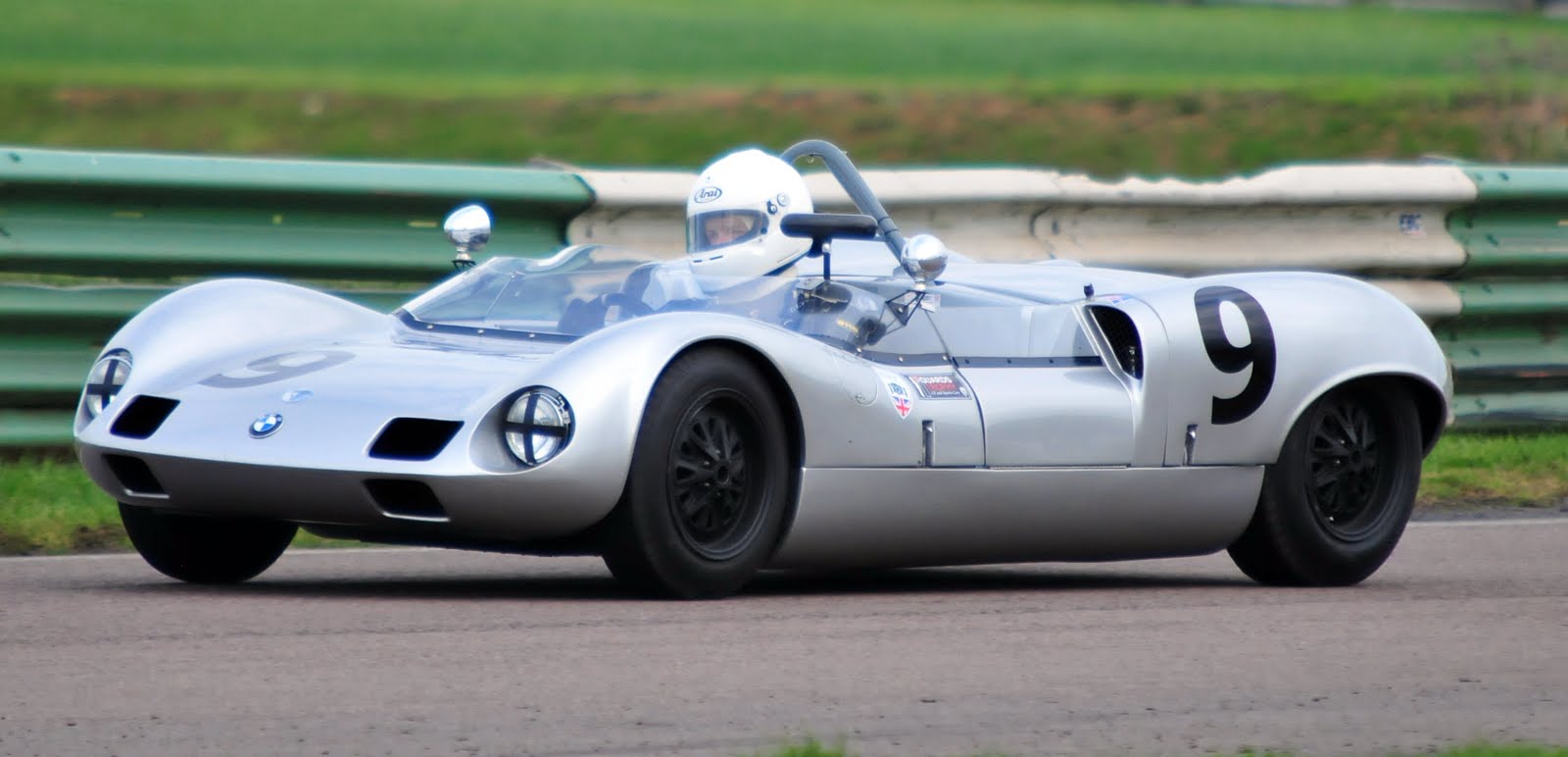
This episode is sponsored in part by: The International Motor Racing Research Center (IMRRC), The Society of Automotive Historians (SAH), The Watkins Glen Area Chamber of Commerce, and the Argetsinger Family – and was recorded in front of a live studio audience.
Other episodes you might enjoy
Michael R. Argetsinger Symposium on International Motor Racing History
 The International Motor Racing Research Center (IMRRC), partnering with the Society of Automotive Historians (SAH), presents the annual Michael R. Argetsinger Symposium on International Motor Racing History. The Symposium established itself as a unique and respected scholarly forum and has gained a growing audience of students and enthusiasts. It provides an opportunity for scholars, researchers and writers to present their work related to the history of automotive competition and the cultural impact of motor racing. Papers are presented by faculty members, graduate students and independent researchers.The history of international automotive competition falls within several realms, all of which are welcomed as topics for presentations, including, but not limited to: sports history, cultural studies, public history, political history, the history of technology, sports geography and gender studies, as well as archival studies.
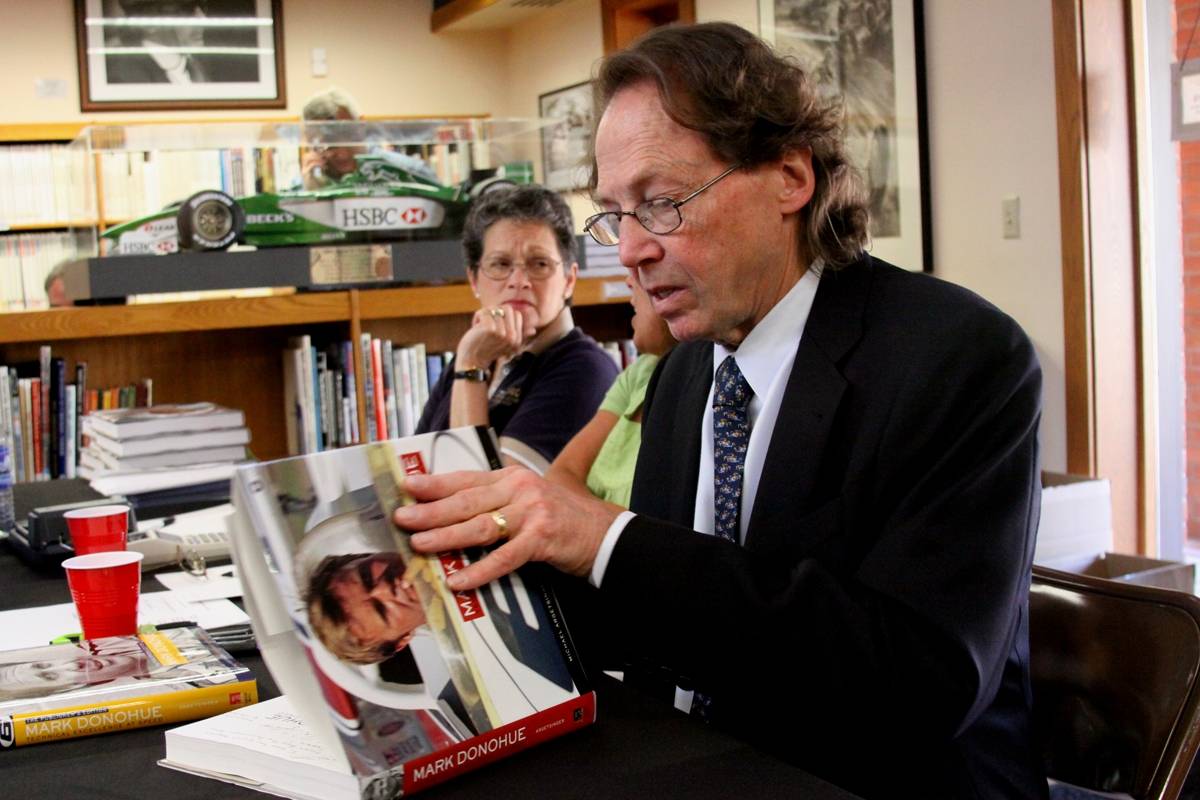 The symposium is named in honor of Michael R. Argetsinger (1944-2015), an award-winning motorsports author and longtime member of the Center's Governing Council. Michael's work on motorsports includes:
- Walt Hansgen: His Life and the History of Post-war American Road Racing (2006)
- Mark Donohue: Technical Excellence at Speed (2009)
- Formula One at Watkins Glen: 20 Years of the United States Grand Prix, 1961-1980 (2011)
- An American Racer: Bobby Marshman and the Indianapolis 500 (2019)

This content has been brought to you in-part by support through...