


On this crisp Veteran’s Day evening, we want to welcome listeners to a special installment of “Evening With a Legend,” a series dedicated to icons of the 24 Hours of Le Mans. This time, the spotlight fell on 91-year-old William S. Jackson – co-founder of the Society of Automotive Historians, Cold War draftee, and motorsports veteran whose life reads like a screenplay written by fate and fueled by octane.
Bill’s journey to Le Mans began not with a checkered flag, but a college flunk-out. Twice. Industrial engineering gave way to business management, which gave way to Thursday-night departures for weekend races. His academic advisor didn’t mince words: “You’re not stupid, you’re racing those damn cars.” And with that, Bill was out – and soon drafted into the U.S. Army.
At Fort Riley, Kansas, Bill’s military training and Boy Scout instincts earned him the role of acting master sergeant, responsible for 44 men. During a brutal winter maneuver, while other platoons froze around bonfires, Bill led his men into a dry stream bed, dug fire pits, and insulated tents with buffalo grass. The next morning, while other units suffered frostbite, Bill’s platoon emerged warm and intact. “Where’d you learn to do this?” asked the colonel. “Boy Scout Troop Seven, Clearfield, Pennsylvania, sir.”
In 1957, Bill was tapped as a relief driver for AC Bristol’s Sebring entries. Though he never raced, he practiced alongside legends – Mike Hawthorn, Stirling Moss, Juan Fangio – and earned his FIA license in record time.
Tune in everywhere you stream, download or listen!



Bill’s military service in Germany was no less dramatic. Assigned to Company A of the 8th Infantry Regiment, his unit was tasked with holding the Folda Gap for two hours if the Soviets ever crossed the border. He ran patrols near East Germany, even waving to Russian soldiers in guard towers.
During a live-fire exercise at a former SS training camp, Bill was ordered to fire tracer rounds at a pillbox while his company advanced. Suddenly, he heard the distinct bark of a BAR – aimed at him. A fellow soldier had stepped in a rabbit hole, locked on the trigger, and fired a full clip just ten feet away. Miraculously, Bill survived.
That close call led him to a desk job in the Public Information Office, writing hometown news releases and sports stories for the 8th Division’s newspaper, The Arrow. His knack for storytelling earned him a promotion to sports editor – no KP, no guard duty, and weekend passes galore.
Bio
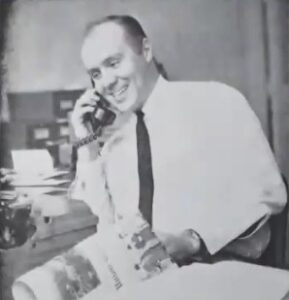
Like most of us, William S. Jackson, became involved with automobiles at an early age. During the early 1950’s, he was a member Penn State University’s hot rod club, and in the mid-50’s he was racing in SCCA events with a Jaguar 120-M and some Morgans. After his military service, he completed his degree at Penn State and began a lifelong career in journalism. His editorship of major vintage car clubs magazines during the 1960’s and 70’s gives Bill credit as one the founders who launched the then-fledgling “old car hobby” turning it into the vibrant community and economic powerhouse that it is today.
Bill is a charter member of the Society of Automotive Historians, founded in October of 1969. And during the Annual SAH Awards Banquet in 2023 in Hershey, Pennsylvania, Bill presented his Auto-Biography to the banquet audience, including his recollections of the early days of the SAH; and the following recording was made by Bill, from that same script, in 2024.
Transcript
Crew Chief Brad: [00:00:00] Evening With a Legend is a series of presentations exclusive to legends of the famous 24 hours of Le Mans giving us an opportunity to bring a piece of Le Mans to you. By sharing stories and highlights of the big event, you get a chance to become part of the Legend of Le Mans with guests from different eras of over 100 years of racing.
Crew Chief Eric: Tonight we have an opportunity to bring a piece of Le Mans to you sharing in the Legend of Le Mans with guests from different eras of over 100 years of racing. And as your host, I’m delighted to introduce 91-year-old William S. Jackson, one of the co-founders of the Society of Automotive Historians, who isn’t just a veteran of motor sports from being drafted during the Cold War to racing alongside legends like Carol Shelby and Sterling Moss.
[00:01:00] Bill’s journey to LeMans is a tale of grit, ingenuity, and unexpected grace. Today we’re taking you back to 1958 to a time when racing was raw, personal, and deeply intertwined with the world’s shifting tides. You’ll hear how a flunked college career turned into a military path that led him to Germany, where a chance friendship with a former Lifa pilot changed his view of war.
Peace and humanity, and you’ll ride shotgun as Bill recounts his time behind the wheel of a 1935 BMW three 15 restored with reverence and raced with heart on the hallowed grounds of Le Mans. And with that, I’m your host Kru Chief Erick from the Motoring Podcast Network, welcoming everyone to this very special Veteran’s Day evening with a legend.
Alright, bill, so we’re gonna talk about your experience at Le Mans. A very special experience at Le Mans 1958, right? So that’s Le Mans retrospective. A lot of our members probably don’t even know what that is. And so to lay that out, it’s a precursor to what we know [00:02:00] today as the Le Mans Classic. So let’s talk about your journey.
Getting to Europe, your road to Le Mans.
William S. Jackson: Okay. Well you know, it’s kind of an interesting story. I was a Cold War soldier and not many people know much about what it was like being a draftee during the Cold War years. And this is a kind of a humorous personal story. I’d flunked out of industrial engineering into business management and that flunk out of business management.
’cause I was racing sports cars. I was leaving Thursday night and getting back Sunday night and that just didn’t work well. The assistant dean of the College of Business called me in and just chewed me up one side and down the other Bill, you’re not stupid. You’re racing those damn cars and you’re not applying yourself, and you could succeed if you just get away from that.
And he said, you’re outta here now. And he said, I’m sure the draft is going to get you pretty soon. And he said, but after you’re in and out of the army, if you’ve decided what you want to do with your life, I’ll get you back into Penn State. If you could [00:03:00] show me something. And as I’m getting ready to go out of his office, I’m thinking, does he do this with every student?
Flunking out? Anyway, I, I was drafted roughly, uh, June of, uh, 1957, sent to Fort Riley, Kansas as a member of the first Infantry division. I was a graduate of Valley Ford’s Military Academy, so I wouldn’t say that basic training was easy, but I already knew how to play the game. What that got me is I ended up being named Outstanding trainee of the first division for the year of 1957.
After we had a two week vacation after basic training and came back to start advanced infantry training, right. My company commander called me in the office and he gave me a master sergeant’s armband. And he said, you are to wear this and on base you are a master sergeant and you are assistant platoon leader for the fourth platoon, which was 44 men.
And I’m just coming out of basic training and I [00:04:00] all of a sudden, bam, I’m an acting master sergeant with a responsibility for 44 guys. We went out on a winter maneuver in December. We were supposed to be out for three days. What they called in Kansas, a blue northerner blew in it, dropped to about 20 above with wind.
They canceled the operation, but they couldn’t get us trucks out to pick us up till the next day. So the company commander says to each of us platoon leaders, you take care of your guys tonight and when we’ll get outta here tomorrow. Well, most of the platoons built a gigantic bonfire and gathered around it and cooked their front and froze their rear.
I took my guys down into a dry stream bed and we dug fire pits into the sides of the stream outta the wind. I had them put their pup tents up. Two pegs high instead of three pegs high. So they would cut the wind and as per usual, put dirt around the edges so it wouldn’t blow away. Fill ’em full of buffalo grass and then get their sleeping bags out.
And I went [00:05:00] around and checked every one of ’em to be sure they took their boots off where they got into the sleeping bags. Well, the first Sergeant comes around, Jackson, what is all this non reg stuff? You are not allowed to do this. Put those tents up properly and yes, sergeant. As soon as he left, I told the guys, I said, just leave everything the way it is.
Well, the next morning the colonel of the regiment comes around with the company commander and the first sergeant. They suffered 11% frostbite. They came down into to the sunken Stream bed. My guys are gathered around the fire pits in the side of the stream and, and, uh, they’d all had a good night’s sleep and I hadn’t lost a man.
Colonel looks around. Says, who’s in charge here? And the first Sergeant is smiling. You know, he says he is. So I’m standing there at attention and the colonel says, Sergeant, what is all this? Where’d you learn to do this? Boy Scout Troop seven Clearfield, Pennsylvania, sir. Got a big grid on his face that says, carry on Sergeant.
And they went away. [00:06:00] And the first Sergeant is kind of behind him going, credible. But, uh, anyway, that was one of the most interesting experiences I had as a platoon sergeant right out of basic trading. Well, I, when I went over to Germany, of course I was back as a PFC. Again, I went over, I think probably been September or October or something like that.
Crew Chief Eric: So before you got deployed in Germany, you were racing here in the States?
William S. Jackson: Oh yeah. My very first event was the Breakneck Hill climb outside of Cumberland, Maryland. Because I had just finished my 21 hours of observed practice and were required to get your SECA license and they liked you to run two or three hill climbs before they cut you loose for road racing.
So I started racing with a 54 Jag xk, one 20 modified Roadster, and it was soft sprung. You know, you could bottom out and take out $300 worth of mufflers. So I had made a set of straight pipes, came out under the driver’s door. So, like I say, this is my [00:07:00] very first event. I’m under the car putting the straight pipes on.
Somebody starts kicking my foot. I look out from underneath and I see the bottom of farmer bib overalls. Thought some stupid farmer’s going to ask me a bunch of dumb questions. So I yelled out from under the car, what the hell do you want? And there’s silence. And then he all got, if Jack, having lived in Texas, I recognized that the accent.
And I’m thinking, there’s this guy from Texas that had been racing on the west coast. They said it’s coming east. That races in farmer bi overalls named Carol Shelby. So I rolled out from under my car and sure as hell, it’s Carol. Yes, Mr. Shelby. I have a jack. He was driving for some millionaire who had bought one of the last front engine Ferrari Grand Prix cars and hired Carol to drive it and they was going after the SECA unlimited Class Hill Climb Championship.
So. I go with Carol up to the Ferrari pit and Eric sits with a flat left rear trier and somebody forgot the jack. [00:08:00] Anyway, that was the beginning of, of a relationship with Carol ’cause he had come east and was running some of the same courses I was back up to, to, uh, January 57th. Driven for the Morgan Factory team.
I they read in the spring sprints at Upper Marlborough. The AC Bristol Importers had run a big article in the Washington Post. That they were coming to Upper Marlborough for the SCCA spring sprints, and they were gonna show the locals how it was done. So long story short, I beat the top AC Bristol driver for new production in the spring sprints at Mar Gra.
So afterwards, I’m down in the pits, we ru run what you brung, and I’m putting a windshield back on and taking the racing screen off and all. And these two suits commit coats and ties and they walk up to my Morgan. Bag over the hood. The guy said, is this belong to you? And I said, yes. He said, if you can be our top driver with this piece of shit, you gotta [00:09:00] drive for us.
How’d you like to go to br? Well, ACS plan was to have four cars at Seabring, but they only gave him three interest, so I ended up as a relief driver of the other three. I’ll be honest with you, I never got in the race. Mm. I got to practice, you know, I was on a track with Mike Hawthorne and Sterling Moss.
Juan fgi and I mean, but you still had to get your license, right? That’s where I got my license. You had to have an FIA license to run sibr. And I had got, you know, real quick, I mean I had about a month and a half. I got my FIA license based on my SECA license.
Crew Chief Eric: For a US race you need an international license.
Yeah, you had to have
William S. Jackson: the international license. ’cause apparently Sebring was on the international calendar. But anyway, fast forward, Sebring, Carol Shelby and Roy Salvador, the British driver are driving a Maserati for the fact. And they did something 62 laps in and were disqualified. So Carol is just walking the pits and he comes over the AC Bristol pit and our practice [00:10:00] car, which I ended up buying from the factory incidentally for $3,500 is sitting in the back of the pits.
And Carol says, bill, would you mind opening that hood and Annette, and let me look in that engine bay. So I go back and, you know. I put the stick in it to hold it up, and he’s back there for about 20 minutes practically climbing into the engine bay in that AC Bristol. So I finally, I went back just to see what he’s doing, you know, and he, he’s checking out the front suspension and the steering and everything, and he said, man, you could fit a big American V eight in here and you’d really have something.
This is March, 1957, first Cobra of 64. He was thinking about it even then, and of course. AC Bristol quit making engines. So they’re sitting there with that beautiful Roadster with nothing in it. And Carol had already been talking to Fort and he brought ’em together and, and voila, we had the Cobra. But, uh, [00:11:00] I was side to company a of the Eighth Infantry Regiment of the eighth Infantry Division in Mikes Heim, Germany.
Our mission, we had pre-planned positions in the folded gap for World War ii. It’s where the Germans came through, uh, when they attacked France. And our mission was if, as we called it, if the balloon never went up, then the East Germans and the Russians came across. We were to dig in and hold in those pre-planned positions for two hours till they got reinforcements up.
Initially, I was a BAR man, but then when the company commander found out about what I had done in basic and advanced infantry training, I became company guide, what they call a Pathfinder now, and I used to run patrols up near the East German board. Even right up at the border, they, they, uh, I don’t know whether it was these Germans or the Russians that built ’em, but they had built some guard towers.
I even got close enough one day to wave at the Russians up in the guard tower. One of our maneuvers or training was a live fire [00:12:00] exercise at a, uh, what had been a German SS training camp in World War II at Wild Flick. At. I’m company guide. The range Officer brings me aside and he hands me full tracer ammunition and he says, private, I want you to go down the hill, cross that little stream, start up that hill, and when I blow my whistle, once you hit the ground and start firing with your tracer ammo, it was an old German World War II pill box up on top of the hill, and I was the direct fire at that pill box.
And he said The company will then be firing and advancing by platoon. And when they get up to you, you fall in with ’em and going up the end, top of the hill, and that’ll be the end of the exercise. So I go down the hill, cross the creek, start up the hill, he blows his whistle, I hit the ground, I start firing, and then all hell breaks loose over my head as they start advancing by platoon, live fire, live ammo.
Anyway, they come down across the creek, start up the hill, and. All of a sudden [00:13:00] I recognized the BAR being fired at me. ’cause they do sound different. I rolled over and looked off to my left and here they’re coming at me. Boom, boom, boom, boom, boom. And I just, I froze and he put the clip through it 10 feet from me.
Story was, he didn’t do anything wrong. Even matter of fact, he was doing everything right, clutched his BAR heart into his side and looked ahead to watch where he was firing. And stepped in a rabbit hole and destroyed his knee and went down and locked on the trigger and had it pointed at me. Well, I went looking for a desk job.
Fortunately, my best buddy from basic training was in regimental headquarters. He was able to get me a job in PIO, public Information Office. Writing hometown news releases. Johnny Jones is in Mines Germany, driving into two and a half ton truck, da, da da da da. Sending him the hometown papers. But we had a lot of sports teams, you know, to keep us active and keep us out of the bars.
And had, having been sports [00:14:00] editor, my paper at Valley Forge, I started writing sports stories for the eighth division newspaper, the Arrow. I got a call about two months later from a major Grady. Who was head of the eighth Division newspaper and he said, private Jackson. He said, I like what you’ve been doing.
I just lost my sports editor. Would you be interested in a job transfer to division headquarters, general Smith? No kp, no guard duty, weekend pass every weekend. Oh, I don’t want that job. So I became sports editor of the eighth Division’s newspaper. Well, while all this was going on. My hope was when I went to Germany to find a Bugatti and bring it home.
Well, I had no idea how to go about it. You know, I didn’t speak German, but shortly after I got there, inexpensive, 35 millimeter cameras were just coming in and. They made arrangements through John Gutenberg University and Mines, and [00:15:00] they sent a photojournalism prof out to the base to teach us film speed, F setting shutter speed.
We had to know all that and taught us how and as as we were buying through the PX at the time, mostly East German 35 millimeter cameras. And then they carried it a step further and built a dark room, and he taught us how to develop, film and make prints well in conversation, we discovered he was a car guy.
Ernst Char was this man’s name. He had raced Formula two right after the war with a BMW 3 28 based car. I, I don’t think it was a Veritas, it was a special. Anyway, he was also a race photographer for the Frankfurter ung and the Rhine Zeitung newspapers. I became his gungadin. I started carrying his camera bags to the races.
Grand Pia Holland, grand Prix Europe in Belgium. I mean, just, I got to go to up to the thousand Kilometers and Berg ert. [00:16:00] Well, among other things, he became my chairman editor when I was editor of Anti Automobile. Anyway. When I went to Germany in the Army, I hated every German that walked the earth ’cause my father is buried in Belgium.
He was killed February 23rd, 45 as an infantry man crossing the rural ROER River in Germany to a capture town of Duren. When I met and got to know Earnst, you know, he pretty soon picked up my story and he was a really sharp guy and he started diffusing me. You know, we would go somewhere and he would say, oh, you see that over here?
Well, you know, that was the town church that you guys came in and just bombed it flat, you know, I mean, the one that I remember most, we were going to a race and we were on the Audubon. You know, there were no rest stops in the Audubon, but the Germans were very casual, so we just had stopped to get out and pee.
And I looked down in this valley and there’s the remains of a village, pretty obviously unoccupied. And I said to Ernst, I said, I wonder what story is there, why that? And [00:17:00] he says, I’ll tell you what the story is. I mean, he had very carefully planned this. He said the American infantry was coming up that valley, and he said this.
This was near the end of the war. At that point in time, the American Army and the Army Air Corps had worked out where the ground units had a ground air radio, and there were media bombers just flying around waiting for assignments. Anyway, this infantry unit started taking artillery fire. And they thought the spotter was in the steeple of the church in this little village.
So they called in media bombers and they flattened this town. You know, T is telling me this story said that when the infantry unit occupied the town, there was no artillery spotter in the church steeple. And I said, you certainly seem to know a lot about this earth. And he said, yes, my grandfather was one of the ones that was killed.
But he very carefully did this. And diffused me. I mean, I came home [00:18:00] at peace, but the thing that was the biggest shocker with Ernst, after he got to know me about six months, he invited me over to his house and I walked into his living room and framed over the fireplace, the dual controls, out of some kind of an airplane.
And I said, Ernest, what? What is that? That’s the dashboard out of a B 24 liberator. I said, where the hell did you get that? He said, I shot it down. He said, as a matter of fact, I shot down five of them. He says, bill, I flew a Falk Wolf one 90 in the Li wfa. I hated Hitler. I hated the Nazis for what they’ve done to our country.
But if you said anything against them, they took you out and shot you. And he says, but Bill, I am a German and you were kicking hell out of my country. ’cause you know what he had showed me. Was where we had unnecessarily killed civilians. Mm-hmm. And, uh, I mean it’s just like the Russians now Yeah. In Ukraine.
And he said, so he said, please don’t ask me to apologize. And I got it. [00:19:00] And like I say, I came home in peace. I thought about it in retrospect. I became the son. He wished he’d had ERs and I really bonded. I had told him about wanting to Bugatti. Well, he knew his way around. And then we found two Bugattis in a bombed out garage in V spot at the end of a bombed out alley.
We couldn’t find out who owned them, and Ernst said, bill, we’re gonna hack our way in that alley and hack our way into that garage, and somebody’s gonna show up and say thank you very much. He said, let’s keep looking. So it wasn’t too long after that that he said, I found a car for you. I said, what is it, Bugatti?
No, it’s not a Bugatti. What is it? Well, you’ve gotta see it. So we went down into the old part of M’S to an old home and to the horse stable in the back and in the horse stable. And he whips the tar pole off that beautiful 35 BMW, which I knew nothing about. I wasn’t up to speed on. [00:20:00] Vintage BMWs, so he told me about the car.
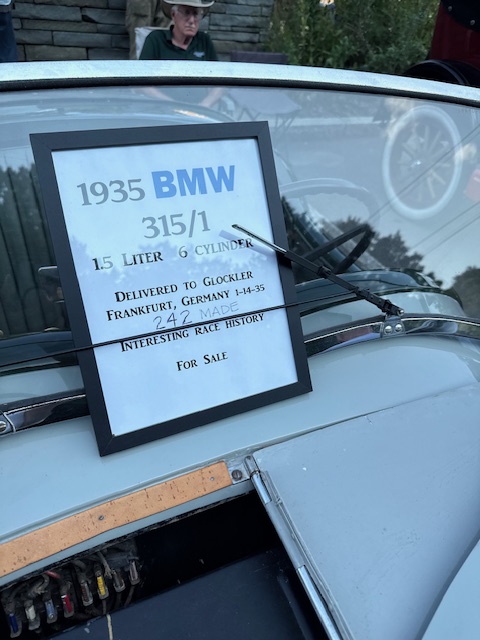
It had originally been delivered to helm, HELM, Kler, K-L-O-C-K-L-A-R, the main BMW dealer in Frankfurt in 1935, and he had hill climbed with it. Ernst and I, we were told that he had won the 1500 cc German Hill Climb Championship in 35 with it. BMW would not verify this. Hel clerk was a Nazi and they would not talk about anything Nazis did with their cars.
So whether it’s true or not, I don’t know. But anyway, I said to Ernst, ’cause I said, who owns this? And he says, I do. I said, you know, we’ve been looking for a car. Why didn’t you tell me you had this? And he said, U gis. He said, you come over here, you buy these vintage German cars, you run ’em into the ground and then you just go home and leave them there to rot.
And he said, that can’t happen to this car. But he said, he says, I’ve gotten to know you and I’ll sell it to you. I had to pay $1,750 for it. And he said, [00:21:00] you can do this. We’ll do this one of two ways. He says, you gimme $1,750 and you can do it what you want. He says, or you give me the 1,750, I’ll keep 1400 and I’ll use the rest to restore it under my supervision.
’cause he wanted it done right and he had the context. Now, the one reason my car is only worth 120,000 instead of over 200,000, like the two for sale in Germany is. When they got the car to a garage, it had one of the earliest hurt roller bearing crankshaft engines, and nobody knew how to work on that. So what we did, we found a stock 35 type three 15, and we took the lower end, took everything from the head down.
And rebuilt that and put the racing head with three carburetors on it. So that’s why, you know, mine does not have the proper serial number on the engine to go with the VIN number,
Crew Chief Eric: but it’s a little bit more of a hot [00:22:00] rod.
William S. Jackson: Yeah, I mean, for a purist, that’s a death. No. Was it
Crew Chief Eric: difficult to find parts for a nearly 30-year-old BMW at
William S. Jackson: that point?
Not at that time. There was a vintage BMW Club and ERT had connections there and we were able to get enough parts to rebuild it, get it on a road, and it became my everyday driver. I mean, everybody in the eighth infantry regiment knew my car.
Crew Chief Eric: You wanted a Bugatti because obviously it’s racing pedigree is known around the world, so was it always your intent to go racing in Europe?
No,
William S. Jackson: I figured my racing career at least, was temporarily over until I got out of the army. But anyway, I’d gone to Europe with no plans really to race. I mean, I had my AC Bristol at home in the garage. I bought our practice card from Seabring from the company afterwards, and I had to pay $3,500 for it.
It’s big money in the 1950s, but it was sitting at home in the garage, you know? So I didn’t have money to, you know, to really buy a exotic new race car. But [00:23:00] anyway, Ernst and I, we would take my BMW and go to the races and that. I’ve never forgotten. We were going to the thousand kilometers up at the Nu Burn ring.
I was worried about parking that car just in the parking lot, but as we got close to the Nu Burn ring, the police just kept motioning me through right up to the race. And when I got into the paddock. There are at least a hundred Bugattis. It was the annual gathering of the Bugatti Clubs of Europe and the Bugatti Club of Deutsche Lawn was the host that year.
And of course, the police didn’t know the difference between A BMW and a Bugatti. They just knew it was an old race car. So I pulled into, into that paddock area with all these Bugattis, you know, and all these guys are looking. And I got US forces plates on it and they started to come over and look at it.
T was with me and of course, and I [00:24:00] noticed three guys talking with their heads together. Then they came over, shook my hand and explained to me in German with Ernst Telling, you know, what they were saying. And what they said was, we really appreciate your appreciation of a German engineering of a car and.
In appreciation for what you have done. We are making you a lifetime member of the Bugatti Club of Delan, and they presented me with a beautiful car badge, which is on the side of the hood of the BMW still. So, I mean, that was one of the thrills I had with a. I joined the Hess E-H-E-S-S-E Motor Sports Club, which was like saying the Pennsylvania Motor Sports Club.
Mm-hmm. Did some not serious airport racing, but some fun racing with the German guys. You know, they really liked the fact, again, that I had had this work done on this [00:25:00] car.
Crew Chief Eric: So how did you hear about the Le Mans’s retrospective? I mean, was Le Mans’s ever? Well, with her
William S. Jackson: connections, he came to me and he said, bill.
How’d you like to run the La Man’s retrospective race? I thought he meant the 24 hour, and I said, I can’t run, run the BMW for 24 hours. He said, no, no, no, no. He says, the day before the 24 hour, there’s a one hour race called the Le Mansn Retro Retrospective for cars that raced there prior to World War ii, prior to 1939.
He says, your BMW qualifies and I can get you an entry. So PFC Jackson goes to his company commander in the Eighth Infantry Company, A of the Eighth Infantry Regiment. And I said, I, everybody knew my car on base Captain I, I said, I have an opportunity to run my BMW in the La Man’s retrospective race to explain to him what it was.
And he said, Jackson, that’s above my pay grade. I can’t give you permission to do that. You’re gonna have to go see the colonel. So I go up to headquarters, the eighth infantry [00:26:00] regiment to the colonel’s office, and I go in and I. Make a same presentation and he says the same thing I, that’s above my pay grade Jackson.
You’re gonna have to go to division headquarters and talk to somebody up there. So I drive up the division headquarters in Bud Krono bark in the general’s parking lot next to an Austin Healey. Somebody’s a car guy. PFC Jackson just walks in cold into the commanding General’s office and there’s a major sitting there at the desk.
You know, what the hell do you want private? And I said, well, sir, I, I was told I have to come see the Commanding General. I have an opportunity to run my 1935 BMW in the La Man’s retrospective race. You what? Let me get the general guess who the car guy was. So he comes rushing out of his office, you know, and I told him the whole story and, and he says, of course you can, private Jackson.
He says, but you damn well better tell him you’re in the eighth Infantry Division. Yes, sir. [00:27:00] So me and my best Army buddy, Jack Gobel, hop in the car at the time. You know, the easiest way to go to La Mans was to go to Paris and go south. Well, Paris was off limits to GIS at the time, so we went south through, I can’t think of it.
We went south and almost straight across at LeMans, we hit some towns that we were the first GIS there since World War ii. I mean, it was a relatively quiet area. Anyway, we got to LeMans and uh,
Crew Chief Eric: were you well received by the French?
William S. Jackson: Oh yeah. They loved the car and the fact that we were GIS and they, like I say, these towns that we hit, you know, like we were the first American GIS back since they’d been liberated, you know, they were very happy to see us.
Crew Chief Eric: So what did you think of Le Mans at that time?
William S. Jackson: Well, of course coming from the States, that was one of the. Golden wishes for anybody racing cars was to go to the mall, you know, with some factory team. It just blew me away to, [00:28:00] to be there, to be on that track with vintage Bentleys and Rolls Royces, a Buggati and Al Alpha Romeos, Andela Hayes, and the Lodges, and all the beautiful vintage cars.
I think we had a LA mall start. With our cars angled.
CAR SOUNDS: Mm-hmm.
William S. Jackson: You were allowed to have a passenger, you know, if you had a two man sports car. And so Jack, my best buddy on the Army, Jack Gobel, got the ride the whole hour with me.
Crew Chief Eric: Let’s unpack that a little bit more. So driving Le Mans, did it live up to all the hype?
Did it live up to your expectations?
William S. Jackson: Oh yeah. I mean, I had seen some film of previous Le Mansr races. Forgive me, I still call it Little Mans. That’s
CAR SOUNDS: fine.
William S. Jackson: But you know, it was just a thrill to be on that track. I mean, it would’ve been the same way if I’d had gotten to run in the Indianapolis 500. I just, it was that kind of a thrill for me to, you know, to get to go down the Ong straight, wide open.
And I had one [00:29:00] experience during the race. My boomer had mechanical breaks, and I had one that started locking up, so I’m sure you’re familiar with the laud course. Mm-hmm. At the end of the Mosam Strait, you turn, literally turn, right?
CAR SOUNDS: Mm-hmm.
William S. Jackson: My top speed was probably 80, 85, and when I’d start the break, that break would catch and I’d kind of skidder through the turn.
And by the third lap, when I would come through the Frenches were getting up on the hay bills and clapping, and I made it through the turn.
Crew Chief Eric: So since you spent an hour going around the circuit, obviously the Mosan always has, its appealed because you can just go flat out and you can really test the limits of your card.
Yeah. But was there a section of the track that you really liked past the pits you went
William S. Jackson: through semester? Mm-hmm. And I liked that.
Crew Chief Eric: And the Dunlop Bridge was there at that time. Yeah, yeah.
William S. Jackson: Yes. Gimme a break. How many years ago This is, and I’m 91 years old. [00:30:00] But, uh, yeah, that was the other part I liked when we hit those S turns, the Dunlop Bridge, but you know, everywhere, all the way around.
The course of people were standing up and clapping when we went by, and they loved the cars as much as we did.
Crew Chief Eric: If you watch any of the old videos of Le Mans from the fifties, it’s all black and white footage and there’s some classic scenes of some of the pro drivers in like D type jaguars and things like that.
And you see women literally walking down the road with grocery bags because it’s old farm roads, right? Oh yeah. At that time. Yeah. So is that what you encountered when you were driving? Obviously it was in full color for you, you were there, but for those of us that saw the old footage, what was it
William S. Jackson: really like?
One of the thrills of of my life as far as racing. I mean, even though it wasn’t really a race, it was more than anything else, a one hour continually running around the la long course for people to look at all the beautiful old race cars. I mean, it, it was just a thrill, you know, to be on that track. Well, we, [00:31:00] we took, had taken along our sleeping bags and one of our pup tents and we just set up a pup tent in the, in the pit area and slump in our sleeping bags.
But you know, there was plenty of food and drink available and uh, what became big time drivers were there for the 24 hour to see some of them. I talked to Phil Hill again and I don’t know if Carol Shelby was there. Yeah,
Crew Chief Eric: 59 would’ve been the year he was there with at the Aston DBR nine, so that would’ve been the next year.
William S. Jackson: I’ll be honest with you, I don’t remember the guys, but there were some of the guys that I’d raced with in the states that were there. So, you know, it was a great, I think we were there about three days total. Back to mine, Scott.
Crew Chief Eric: So to continue to talk about the Le Mans experience a little bit, one of the questions we asked the pro drivers that come on and talk about their experiences at Le Mans, one of the things is, what did Le Mans teach you?
’cause a lot of people will take what they learned from that experience and bring it back to their [00:32:00] racing when they come home. Uh, so what do you think Le Mans taught? You
William S. Jackson: Don’t do anything crazy in showing off. As I said, our race wasn’t really a competition. Mm-hmm. So there was no reason. To press it. I can remember a couple times hitting a turn with, say, a vintage Bentley.
I would just kind of, after you, my dear Alfonso, you know, let him, let him go. There was no reason to turn it into a pitch battle. Uh, there was nothing to be gained. And, and very honestly, I was looking at the cars as much as anybody else thinking. Here I am on the track with a vintage eight liter Bentley.
Uh, it just blew me away. And then of course, seeing the cars in the pits, you know, before the, before the race. It was kind of like a dream come through for a young guy like me.
Crew Chief Eric: Did you ever race anywhere else in Europe after that?
William S. Jackson: With our Hesse boat sports club? We did. Like I said, we did some fun competitions on a couple of airports.
[00:33:00] Nothing really serious. Okay, I got to drive the Berg ring and that was fun.
Crew Chief Eric: Did you ever return to Le Mans after that one time? Never had the chance. Did you keep up with it? Many decades of racing now have evolved at Le Mans. Yeah. You still keep up with the 24?
William S. Jackson: Not really. I, when I came home, I, I was getting on with my life.
I had the AC Bristol, but I was going back to college. My major Grady, we became friends when I was sports editor of the eighth division of Paper. And you know, he sat me down early on and says, what are you gonna do when you get outta the Army Bill? And I said, I don’t really know. And he said, did you ever consider journalism as a career?
And I said, no, I hadn’t. And he said, well, you should. He said, we have the University of Maryland overseas program right here on our base. And he said, I’ll bet if you took a couple of courses and got good grades in them, you could go back and show them that, and you’d get back in. And that’s exactly what I did.
I, I went back and, of course, knew what I was doing. Finished my degree in business management, took my master’s in journalism. The
Crew Chief Eric: [00:34:00] retrospective the year you did it? 1958. That wasn’t the first time they had run it. Do you know how many more times the retrospective ran after you did it?
William S. Jackson: I have no idea. Were you able to find, was I the first,
Crew Chief Eric: so right now you are the.
Earliest person we’ve ever interviewed that has turned a lap at Leba, whether it was in anger or whether it was for fun, like you said, Shelby would’ve been the year after you, Andretti, who we’ve interviewed, didn’t race until the sixties, Uhhuh mid to late sixties. So that’s almost 10 years after you. So right now, yeah, there’s nobody else that we’ve talked to that has run it that far back.
Which is pretty cool.
William S. Jackson: And yeah, I’ll say, I mean you, you know, you mentioned you thought I was mm-hmm. When we first talked
Crew Chief Eric: and our goal with this whole program is to talk to people that have turned a lap at Le Mansr or been involved that came from the state. Right. Because it is such, like you said, it’s such hallowed ground for a lot of people.
Mm-hmm. It’s that bucket list I wanna get there one day sort of thing. And so it’s pretty amazing to hear the stories. Would it surprise you to know that? And it’s [00:35:00] not a direct correlation that that has morphed into something that is now known as Le Mans Classic. Do they still run it? They are now running it starting this year, every year from now on alongside of the 24.
24. Well, that’s what they did then, right? So now they do it two weeks later and they run three days. Oh, they don’t? And it’s a full competition. Would you like to guess how many people attended this year’s Le Mans Classic?
William S. Jackson: I have no idea.
Crew Chief Eric: 220,000 people. Wow. We’re in attendance. It’s the biggest vintage race of the year.
Well, people like old cars. Yeah, right. What people don’t know unless they’ve looked into it, is there is a class for your BMW to continue to run.
William S. Jackson: Oh, really?
Crew Chief Eric: Even today at Le Mans, which is really, really cool. So yeah, that’d be kind of neat, right? Yeah. Maybe it’ll find its way home one day and run Le Mans again.
Well, on that note, bill, appreciate you spending your afternoon with me and Oh, sharing some stories and some memories. Well, I
William S. Jackson: love, you know, I mean, somebody that’s interested, you know, I’m nine one, how much longer am I going to be around? Or this is all going to be lost.
Crew Chief Eric: Well, good [00:36:00] memories, right?
William S. Jackson: Oh yeah.
Crew Chief Eric: And a once in a lifetime opportunity. Absolutely. Absolutely. Fantastic. Absolutely. As we cross the finish line on today’s episode, we are left with more than just the echoes of engines and the scent of old leather and gasoline. Bill Jackson’s journey reminds us that racing isn’t just about speed. It’s about memory, meaning, and the quiet moments between laps from Cold War barracks to the paddocks of Le Mans.
Bill’s story is a testament to resilience, craftsmanship, and the human connections that outlast even the fiercest competition. His friendship with Ernst, his reverence for the machines he restored and his reflections on time and legacy. Invite us to consider what we’re really racing towards. We hope you enjoyed this presentation to look forward to more evening with a legend throughout the season.
And on behalf of everyone here and those listening at home, thank you Bill for sharing your stories with us.[00:37:00]
SAH PROMO: This episode is brought to you in part by the Society of Automotive Historians. They encourage research into any aspect of automotive history. The SAH actively supports the compilation and preservation of papers, organizational records, print ephemera, and images to safeguard, as well as to broaden and deepen the understanding of motorized wheeled land transportation.
Through the modern age and into the future. For more information about the SAH, visit www.auto history.org.
Crew Chief Eric: This episode has been brought to you by the Automobile Club of the West and the A-C-O-U-S-A from the awe-inspiring speed demons that have graced the track to the courageous drivers who have pushed the limits of endurance.
The 24 hours of the Le Mans is an automotive spectacle like no other for over a century. The 24 hours Le Mans has urged manufacturers to innovate for the benefit of future motorists, and it’s a [00:38:00] celebration of the relentless pursuit of speed and excellence in the world of motor sports. To learn more about or to become a member of the A-C-O-U-S-A look no further than www do Le Mansn org.
Click on English in the upper right corner, and then click on the a CO members tab for club offers. Once you’ve become a member, you can follow all the action on the Facebook group, ACO USA Members Club, and become part of the Legend with Future Evening with the legend meetups.
This episode has been brought to you by Grand Touring Motorsports as part of our Motoring Podcast network. For more episodes like this, tune in each week for more exciting and educational content from organizations like The Exotic Car Marketplace, the Motoring Historian, break Fix, and many others. If you’d like to support Grand Touring Motorsport and the Motoring Podcast Network, sign up for one of our many sponsorship tiers at [00:39:00] www.patreon.com/gt Motorsports.
Please note that the content, opinions and materials presented and expressed in this episode are those of its creator, and this episode has been published with their consent. If you have any inquiries about this program, please contact the creators of this episode via email or social media as mentioned in the episode.
Highlights
Skip ahead if you must… Here’s the highlights from this episode you might be most interested in and their corresponding time stamps.
- 00:00 Meet William S. Jackson
- 02:06 Bill’s Early Life and Military Draft
- 03:08 Cold War Soldier Stories
- 06:22 Racing Beginnings in the USA
- 10:58 Racing Adventures in Europe & Finding Peace in Germany
- 19:09 The Search for a Bugatti
- 20:37 The Vintage German Car Dilemma … Restoring the BMW
- 22:22 Racing Aspirations in Europe
- 25:00 The Le Mans Retrospective Opportunity; Experiencing Le Mans
- 32:49 Reflections on Racing and Life
- 35:47 Concluding Thoughts and Legacy
Learn More
Evening With A Legend (EWAL)
We hope you enjoyed this presentation and look forward to more Evening With A Legend throughout this season. Sign up for the next EWAL TODAY!
Evening With A Legend is a series of presentations exclusive to Legends of the famous 24 Hours of Le Mans giving us an opportunity to bring a piece of Le Mans to you. By sharing stories and highlights of the big event, you get a chance to become part of the Legend of Le Mans with guests from different eras of over 100 years of racing.
Bill arrived in Germany hoping to find and restore a Bugatti. Instead, he found Ernst – a photojournalism professor, race photographer, and former Formula 2 driver. Ernst taught Bill photography, darkroom skills, and introduced him to the European racing circuit. Bill became his assistant, traveling to Grand Prix events across Holland, Belgium, and Germany.
But Ernst offered more than motorsports access. He offered healing. Bill’s father had been killed in WWII, and he carried deep resentment toward Germans. Ernst, a former Luftwaffe pilot who had shot down five B-24 Liberators, slowly dismantled Bill’s anger – not with apologies, but with perspective. “Please don’t ask me to apologize,” Ernst said. Bill understood. “I came home in peace,” he recalled.
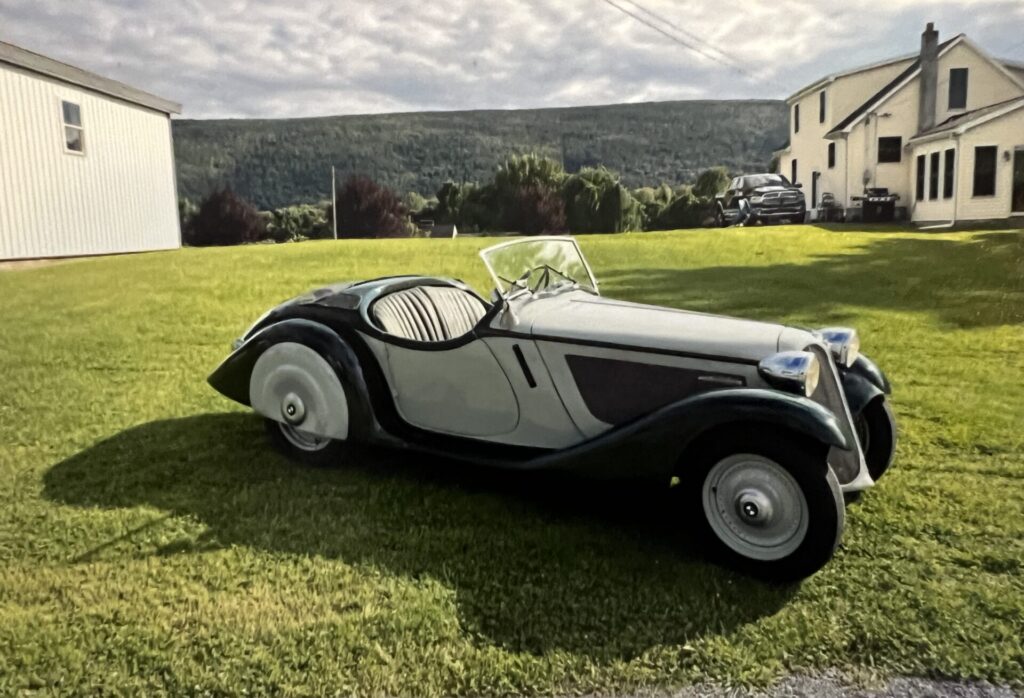
The BMW That Became a Legend
Ernst eventually led Bill to a horse stable in old Mainz, where a tarp concealed a 1935 BMW 315. It wasn’t a Bugatti, but it was beautiful. The car had hillclimb pedigree, possibly a 1500cc German champion, though BMW wouldn’t confirm it due to the owner’s Nazi ties. Ernst offered Bill two options: buy it outright or let him restore it under strict supervision. Bill chose the latter.
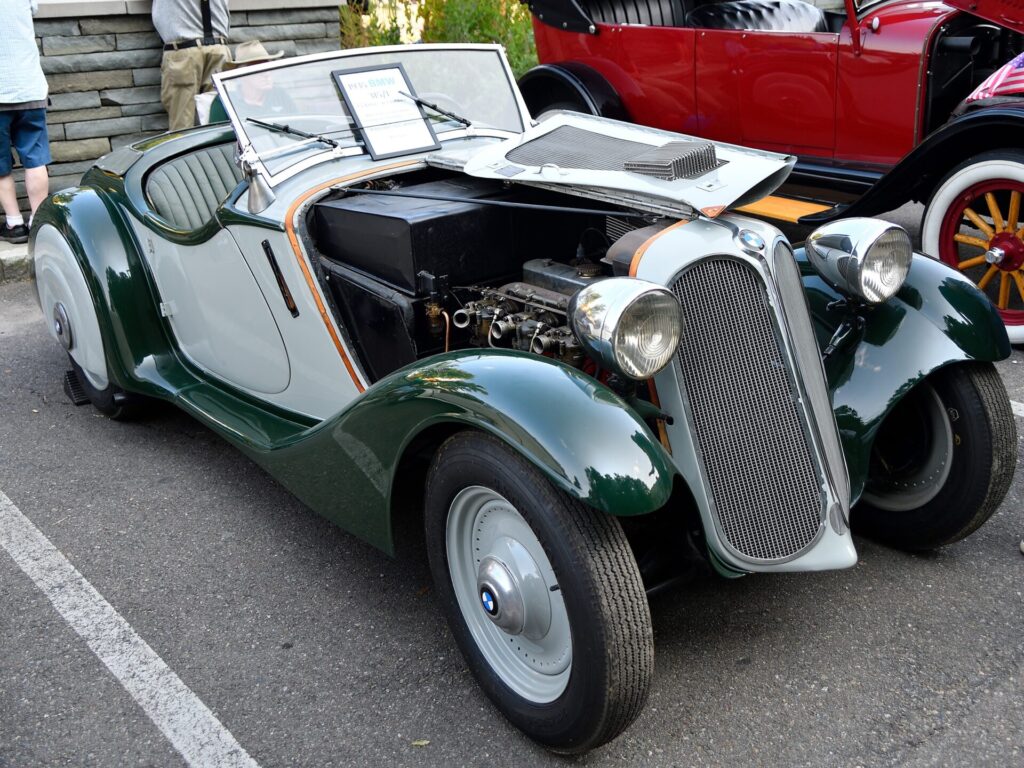
The car’s engine was replaced with a rebuilt lower end and a racing head – making it a hot rod by purist standards, but a driver’s dream nonetheless. It became Bill’s daily driver, known across the 8th Infantry Regiment.
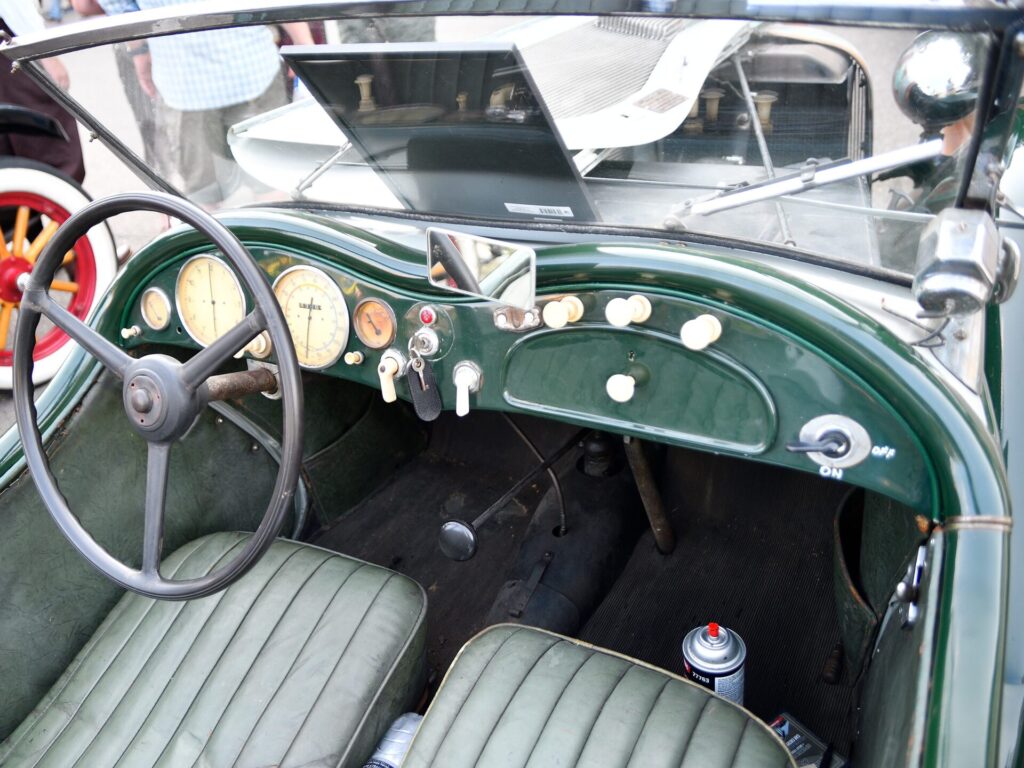
Le Mans Retrospective
In 1958, Ernst asked, “How’d you like to run the Le Mans retrospective?” Bill thought he meant the 24-hour race. Instead, it was a one-hour event for pre-WWII cars held the day before the main race. His BMW qualified.
Bill climbed the military chain of command – from his company commander to the colonel, then to division headquarters. At the general’s office, a major barked, “What the hell do you want, private?” But the general – clearly a car guy – emerged, heard the story, and said, “Of course you can, Private Jackson. But you damn well better tell them you’re in the 8th Infantry Division.”
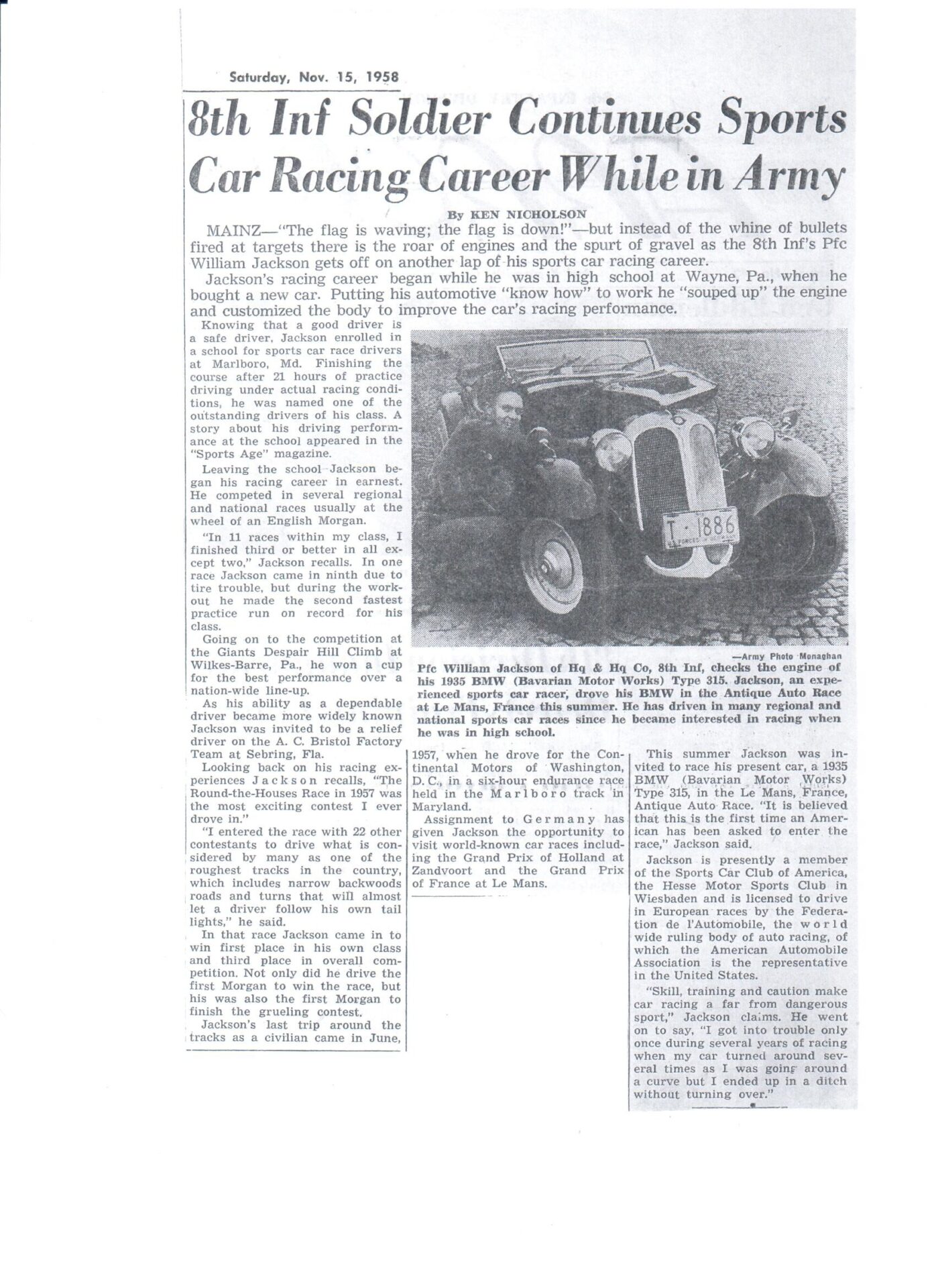
Bill and his buddy Jack Gobel drove to Le Mans, passing through towns where they were the first American soldiers seen since WWII. The French welcomed them warmly, especially the car.
The Track, the Crowd, the Moment
With cars angled for a classic Le Mans start and Jack riding shotgun, Bill took to the track not for glory, but for memory. Mechanical brakes gave him a scare – one locked up and sent him skittering through a turn – but by the third lap, French spectators were cheering him on from the hay bales.
The track was alive with vintage Bentleys, Bugattis, Alfas, and Delahayes. Bill didn’t race them – he admired them. “After you, my dear Alfonso,” he’d say, letting a Bentley pass. It wasn’t about competition. It was about reverence.
After Germany, Bill returned to racing stateside. His first event? The Breakneck Hill Climb near Cumberland, Maryland, behind the wheel of a soft-sprung ’54 Jaguar XK120 Roadster. While fitting straight pipes under the car, a pair of farmer’s bib overalls kicked his foot. “What the hell do you want?” Bill barked – only to roll out and find himself face-to-face with Carroll Shelby.
Yes, that Carroll Shelby. The Texan legend was chasing the SCCA Unlimited Class Hill Climb Championship in a front-engine Ferrari Grand Prix car. Bill lent him a jack, and a friendship was born. One moment stands out: Shelby, fresh off a disqualification, wandered into the AC Bristol pit and asked to inspect Bill’s practice car. “You could fit a big American V8 in here,” he mused. The first Cobra would roar to life in 1964 – but the spark had already ignited.
What LeMans Taught Him
“Don’t do anything crazy showing off,” Bill said. “There was nothing to be gained.” He was just a young man on hallowed ground, surrounded by legends. Though he never raced at Le Mans again, his lap in 1958 made history.
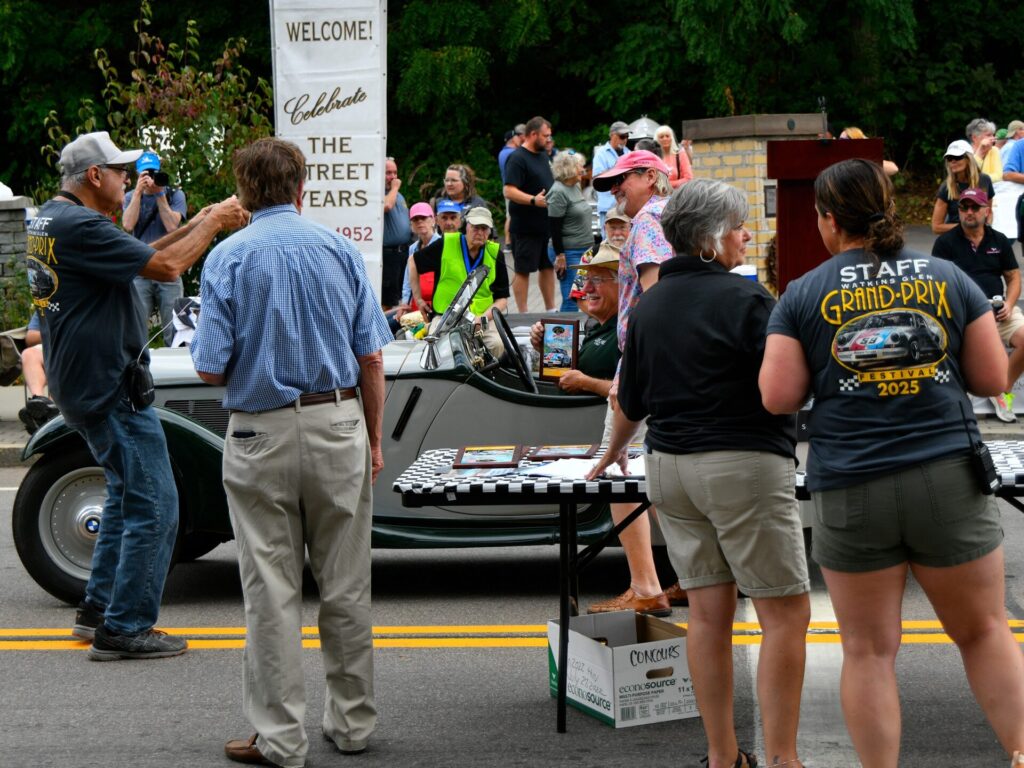
Today, the Le Mans Retrospective has evolved into the Le Mans Classic, a three-day vintage race drawing over 220,000 spectators. Bill’s BMW still qualifies to run. “Maybe it’ll find its way home one day,” he mused.
ACO USA

To learn more about or to become a member of the ACO USA, look no further than www.lemans.org, Click on English in the upper right corner and then click on the ACO members tab for Club Offers. Once you become a Member you can follow all the action on the Facebook group ACOUSAMembersClub; and become part of the Legend with future Evening With A Legend meet ups.
This content has been brought to you in-part by support through...