


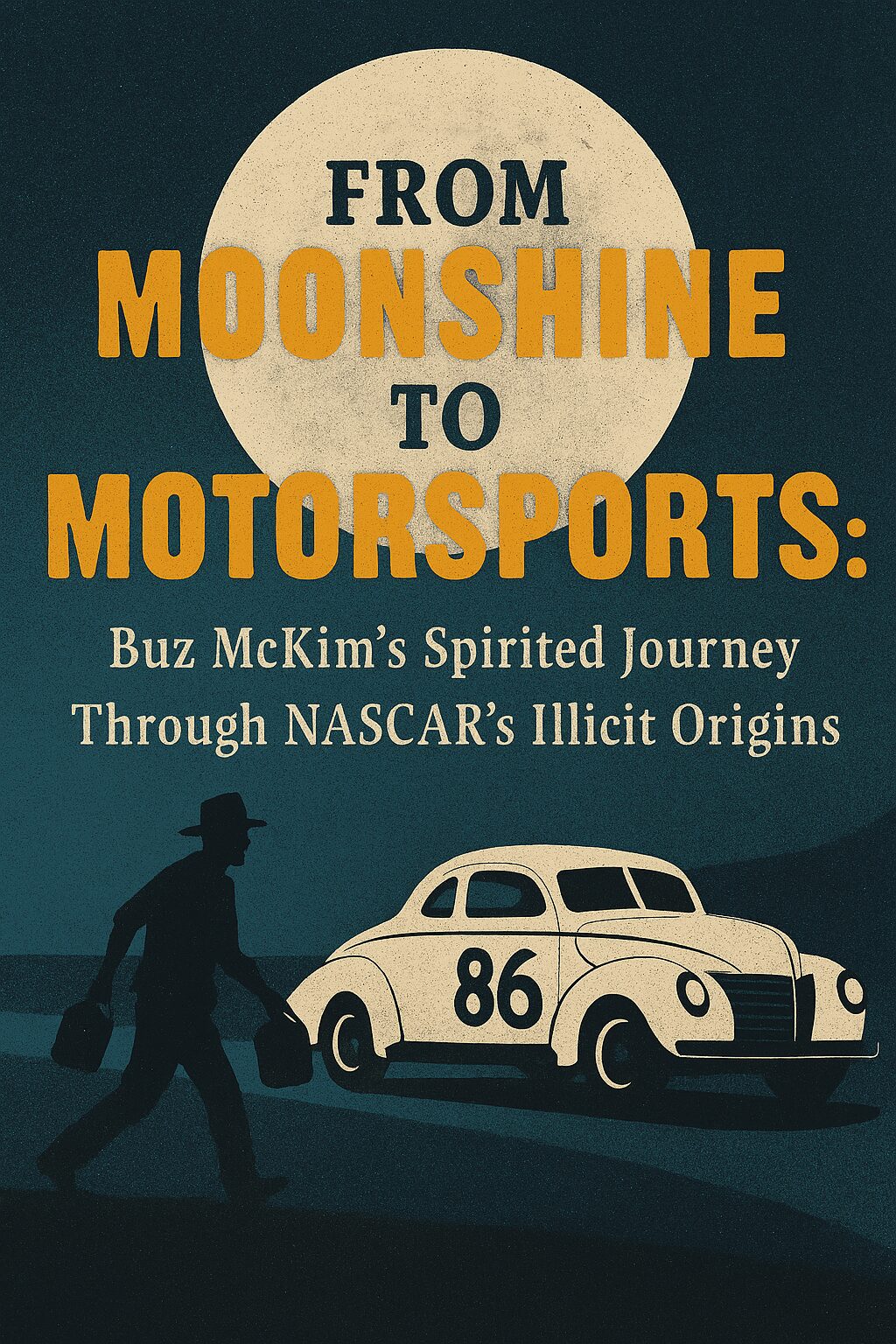
What do a school bus, a hearse, and a three-piece suit have in common? If you ask Buz McKim, the answer is simple: moonshine. In a rollicking keynote delivered at the Argetsinger History of Motorsports Symposium, NASCAR historian Buz McKim traced the bootleg roots of stock car racing, revealing how outlaw ingenuity laid the foundation for American automotive innovation.
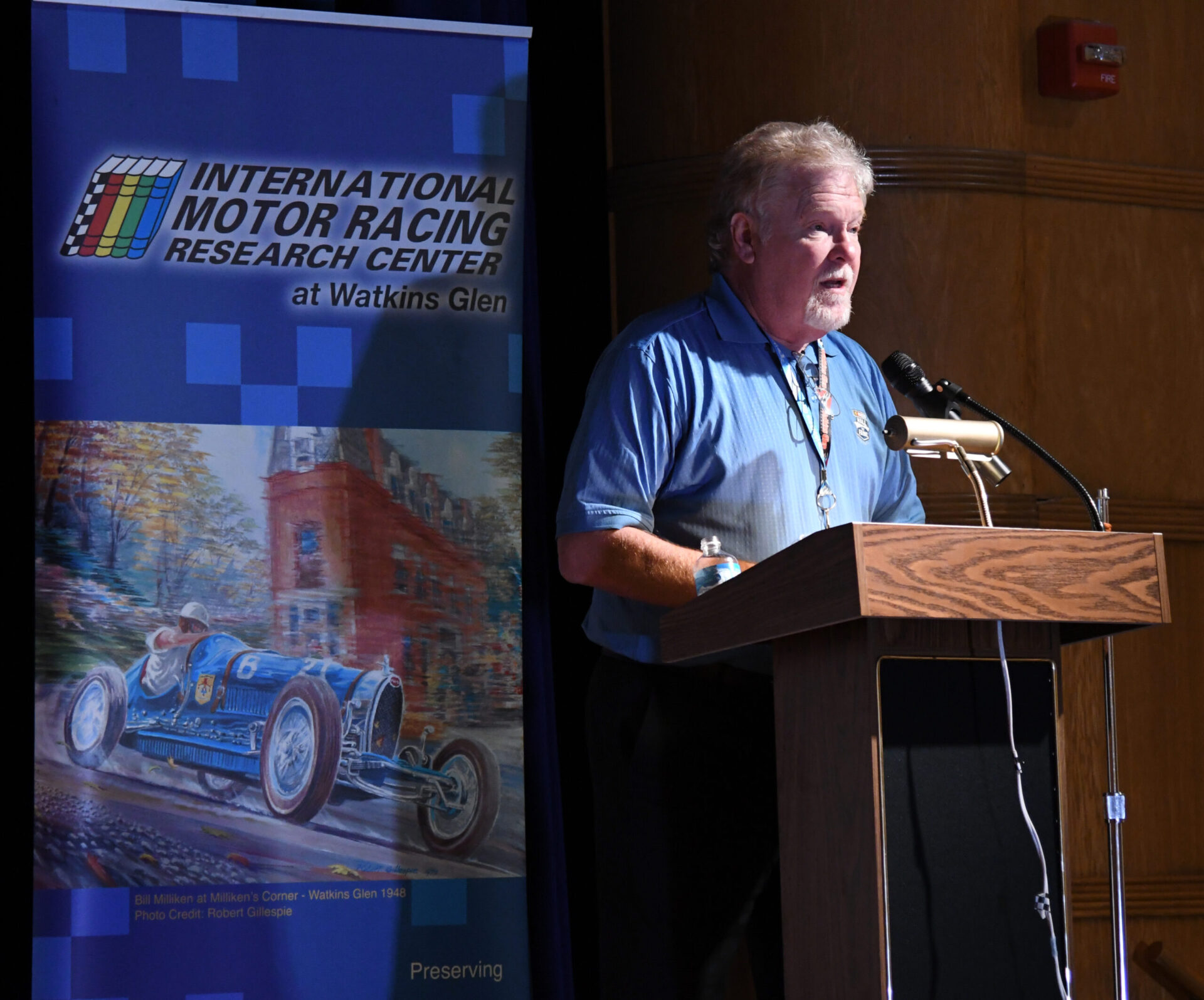
Before NASCAR was a household name, it was a backwoods battleground. Scotch-Irish distillers in the Carolinas and Georgia brewed illegal spirits under cover of night—hence the name “moonshine” – and relied on modified cars to outrun federal revenuers. These “trippers” weren’t just thrill-seekers; they were engineers in denim, tweaking suspensions, souping up engines, and pioneering performance upgrades that would later shape the sport.
Tune in everywhere you stream, download or listen!



Junior Johnson, perhaps the most legendary of all moonshiners, epitomized this dual legacy. Known for driving faster on moonshine runs than on the racetrack, Johnson was never caught on the road but did serve time for operating a still. His presidential pardon from Ronald Reagan became his most prized possession – illuminated 24/7 in his home and even loaned to the NASCAR Hall of Fame.
Spotlight

Buz McKim, formerly historian at the NASCAR Hall of Fame in Charlotte, N.C., is a distinguished figure in the motorsports world and a much sought-after speaker at motorsports gatherings. Mr. Kim served as director of archives for International Speedway Corporation and as coordinator of statistical services for NASCAR. He is the author of The NASCAR Vault: An Official History Featuring Rare Collectables from Motorsports Images and Archives.
Synopsis
This episode of The Logbook backgrounds the history of motorsports, particularly focusing on the connection between moonshine running and the birth of NASCAR. Delivered by Buz McKim, a prominent NASCAR historian, the talk details how the illegal distribution of moonshine led to the development of modified stock car racing. Key figures such as Junior Johnson, Lloyd Seay, and Raymond Parks are highlighted, showcasing their contributions to both moonshine running and stock car racing. It explains the early techniques and modifications made to cars to evade law enforcement, which later laid the foundation for modern NASCAR engineering and safety standards. The script captures anecdotal stories, technological advances, and the evolution of motorsports from its illicit beginnings to its present-day status, stressing the significant impact of moonshine trippers on American automotive history.
NO SLIDES WITH THIS PRESENTATION.
Transcript
[00:00:00] Break Fix’s History of Motorsports Series is brought to you in part by the International Motor Racing Research Center, as well as the Society of Automotive Historians, the Watkins Glen Area Chamber of Commerce, and the Argo Singer family Moonshine and its connection to the American auto industry by Buzz McKim.
Buzz McKim, formerly historian at the NASCAR Hall of Fame in Charlotte, North Carolina is a distinguished figure in the motorsports world and a much sought after speaker at Motorsports gatherings. Mr. McKim served as director of Archives for the International Speedway Corporation and is coordinator of strategical services for nascar.
He is the author of the NASCAR Vault, an Official History featuring Rare Collectibles from Motor Sports Images and Archives. Mr. MCs presentation explores the origins of modified stock car racing in the illegal distribution of untaxed adult beverages or moonshine. He recounts the development of NASCAR in 1949 and its evolution in the [00:01:00] 1950s from a truly stock competition to a manufacturer supported testing ground for the advances in engineering and design of American automobiles.
Mr. Mc Kim’s talk describes the irony of how the automotive engineering modifications inspired by wild country boys led to all around improvements in automotive technology. It’s our very good fortune to have as our keynote speaker this year. The renowned NASCAR historian and original wild country boy Buzz McKim Buzz is well known throughout the racing world.
Uh, his radio show is a staple for Motorsports fans. He’s a much sought after speaker. He’s appreciated for his, uh, insightful and original sparkling charming presentations. And as indicated in the program, buzz was director of Archives for the International Speedway Corporation. Coordinator of statistics for NASCAR and author of the seminal work, the NASCAR Vault.
Let’s welcome Buzz. [00:02:00] We’re sure pleased to hit that. He made it to be here with us. Buzz. Alright, thank you.
Wow. I sure appreciate that. Thank you so much Duke. And I, uh, I thank the members of Symposium for allowing me to do my thing here, and I’m honored to be associated with the name Arge. This is, uh, the moonshine and its connection to the American automotive industry. First of all, you got moonshine. Now it’s a homemade untaxed adult beverage.
It’s illegal and brewed mainly at night. Hence the name Moonshine trippers, those who transported the moonshine, the whiskey, tripper, and revenues spelled with two O’S revenue. Federal revenue agents who chased the trippers. The act of distilling homemade whiskey came primarily from the fiercely independent scotch Irish citizens across the nation, but primarily for this paper, it’s the Carolinas and Georgia.
The business of illegal whiskey in America reached its peak in the 1920s and thirties [00:03:00] due to the fact that transportation and distribution of liquor was easily attained thanks to the automobile. It caused nightly jousting between the whiskey trippers and the revenuers with two O’s in a cat and mouse game of Catch Me if you can.
In order to keep one step ahead of the law, the whiskey men had to develop equipment and modify their cars in order to outrun the federal men. This coincided with the birth of what we know now as stock car racing, and now several tripper had their own way of transporting their wares. Junior Johnson, who’s perhaps the king of all moonshiners, believed that running full bore down a gravel and dirt road was the foremost way to move the hooch.
He, uh, often said that he never drove a car on the track as fast as he drove on a moonshine run. He said that if you lost a race on the track, it was no big deal, but if you lost to the revenues, you was going to jail in the, uh, southern vernacular. Johnson was never caught on the road, but he got his need for speed as a young boy.
He said I was plowing the field barefoot behind a mule, and I must have been about 13 at the time. The North Wilkesboro [00:04:00] Speedway was opening and my brother Fred came by. And asked him if I wanted to go to the races, and I told him yes, but we had to stop by the house first to get me some shoes. Now you just don’t get much more country than plowing a field behind a mule in your bare feet.
That’s the quintessential southern, uh, that’s for sure. So he said I was hooked that day. In 1957, junior Johnson was caught setting a fire under his father still, and spent nearly a year in federal prison at Chillicothe, Ohio in the mid 1980s. His conviction was overturned by President Ronald Reagan, and he was given a pardon.
For the rest of Johnson’s life. He called the document his most prized possession and displayed it in a place of honor in his home. And it was illuminated by a 24 hour light that he was pretty proud of that. Pardon? In fact, he loaned it to us for the NASCAR Hall of Fame and he said, don’t let anything happen to that.
He said, that’s my number one prize possession. And he said, okay. Uh, in fact, we were looking to see if he could build us a model of a moonshine. Still, we had a little area in the pre NASCAR section of the Hall of Fame. And we thought we’d put a shelf there and a little model of a moonshine steel. So we called [00:05:00] Junior to see if he’d be interested and he said, well, I’ll build you a real one.
So we said, man, we can’t beat a deal like that. So we went ahead and went back to the architect and cleared out an area to fit the dimensions of the steel. And just a few months later he shows up with a big trailer full of parts and pieces and he said, I got your still for you. We said, well, junior, we’re still about a year away from setting that area up.
He said, well, we’ll just put in storage. So it came time to put it together and me and my associate who was uh. A Yankee two college ated Yankee. We figured how tough could it possibly be? I mean, these hillbillies would do this all day long, you know? So after about a half hour, we realized we didn’t have a clue.
So we called Junior asking for little advice and he said, well, you know, I knew that you city boys were never gonna get it right. He said, I’ll just do it myself. So he shows up about a half hour later with a pair of bib overalls on, and he had the biggest pair of channel locks I’d ever seen. And he had a wrench that looked like you could build the Golden Gate bridge.
And so he goes ahead and he lays the pieces out. And he starts cranking away on these wrenches. And about half hour later we had us a moonshine still and he said it’s just like the one that his father used [00:06:00] back in the thirties. And he said, it will work, but we’ve not been able to, uh, convince the fire marshal would be a great science project for the kids.
We thought, yeah, here kids, lemme show you how to make some moonshine. But anyway, junior was great. He was just a wonderful person and a real fan of the hall and he was very, very kind to us. Johnson experienced some unusual situations while on his runs. Once he was on a, a run one night. Revenues were hot on his tail.
He noticed he was almost outta gas. So he went ahead and he shot down this side road and lost the, uh, the revenues. And then he saw tractors sitting out in the middle of the field. So he went ahead and stopped and checked it out. Sure enough, it was full of gas, so he got out his Georgia credit card or the siphon hose and he went ahead and siphoned the gas out.
And uh, he took a $5 bill and laid it on the seat of the tractor and put a rock on it. And a few days later, he was back in the same area and he saw the farmer. So he stopped by and told him what happened, and the farmer said, yeah, I wonder what that was all about. He said, hell, you gave me too much money, and the guy gave me $2 back.
That was fantastic. Junior’s heritage involved illegal liquor with [00:07:00] the largest moonshine hall in this nation’s history. Coming at the Johnson homestead back when Junior was a young boy, his father spent a third of his life in jail due to the manufacturer of booze. Now, junior tells a story that he was about seven and his brother Fred was about five, and one of the federal agents come by the house and they said, boys, where’s your daddy?
And Junior said, I think he’s up on the hill there somewhere. He said, well, you want me to, you wanna take me up there so I can talk to him? He said, no, sir. He says no. He said, I’ll tell you what. He said, I’ll give you boys each a dollar a piece if you take me up there and I can talk to ’em. Junior said, we want the money up front.
He said, why is that? He said, if we take you up there, you probably ain’t coming back. It’s a 7-year-old kid. He’s great. So another whiskey tripper that believed in going flat out was a young cheric looking Lloyd C. He believed in going flat out. It was said that he could cause a model A to climb a pine tree.
He was uptown behind the wheel. He, uh, was coming through Dawsonville, Georgia one night and he was pulled over, not for H moonshine, but for speeding. And the cop told him to find would be [00:08:00] 10 bucks. So Lloyd gave him 20. And he said, I’ll be coming through here in a few hours. You think you can look the other way when I come by?
And he was known as the greatest driver of his day, and none other than nascar founder and teammate of seas. Bill Fran Senior said he was the best driver he ever saw. Sea was shot to death at the age of 21 by a cousin over a load of sugar meant for moonshine product. Between 19 38, 19 41, Lloyd won most of the major races at places like Atlanta’s, Lakewood, Speedway, known as the Indianapolis of the South, as well as many events on the sans of Daytona Beach.
Now his cousin was a fellow named Roy Hall and he was the direct opposite of Lloyd C. He was Hollywood handsome, and he was the ultimate flashy dresser and the bravest driver among the brave and unlike his cousin, hall, had no regard for the law or the wellbeing of those around him. He drove with reckless abandon while C was calculated and almost scientific in his driving style.
Paul spent much of his life in prison, but his car owner, Raymond Parks, had a lot of pull in the Atlanta area. And frequently was able to get hall out of jail on a weekend pass in order to go race. That’s what you call [00:09:00] heaven pull. Once Hall arrived in Daytona Beach for the races and found there were no rooms available in town, so he decided that he’d start drag racing up and down Main Street.
So the cops caught him, hauled him into jail, and his plan was for free lodging. It worked real well until he started complaining about no bedsheets upon which the police chief turned hall back onto the cold hard streets of Daytona. So his plan didn’t work. He got arrested for drag racing, but uh, he wasn’t able to stay in the jail, so we had to go find another place to stay and like C Hall took up for C left off, but winning all the major races up and down the Eastern US and his career was cut short due to a head injury.
Suffered in the late 1940s, studious looking. Raymond Parks came outta North Georgia Mountains at the age of 14 when he ran away from his abusive father. Moved in with an uncle in Atlanta who owned a gas station, and by the time Raymond was 21, he had bought his uncle out, took over his moonshine business and was a millionaire.
He was brilliant. He’s now flush with cash. He turned to stock car racing with drivers C and Hall. They were related to Raymond. Somehow the team quickly became the most successful, the thirties and during parks tripping days, he had [00:10:00] another way of transporting his whiskey. The other guys were breakneck, you know, out there just running wide open.
Raymond would come outta the mountains early in the morning and stop by a preselected bridge where he hit a bucket, rags and items for cleaning his car, which would’ve been dirty from traveling the red dirt roads of North Georgia. After washing the car, he would change into a three piece suit, put on his fedora and his pinched nose glasses, and blend in with the morning traffic into Atlanta.
He looked more like a doctor than a felon, but he was never caught on the road In the 1930s for his moonshine efforts. Parks like Junior Johnson, spent a year in Chillicothe. Enoch Stanley, this is a trip. Yeah, there’s a lot of news about North Wilkesboro Speedway reopening, and Enoch was the guy who built North Wilkesboro.
He was a NASCAR pioneer, and he probably had the most unique way of transportation. He used a school bus. For haul and alcohol, the alcohol was loaded into special compartments in the floor of the bus on the North Carolina side of a local mountain. And on the Tennessee side, there was a fairground with a large cattle barn, which had massive doors at either end of the building, and a predetermined time was set up for the dumping of the load.
[00:11:00] And as the bus came onto the fairground, the one door was opened and the bus entered the building. The door was closed, the contents were unloaded, and the door to the other side of the building was open. The whole operation only took a few minutes and the bus was on its way back to North Carolina.
That’s pretty slick. Who would’ve ever thought of Holland Moonshine and a school bus? I thought that was pretty neat. And it’s been said that there were even a few early NASCAR stars addressed like undertakers and transported their load in a hearse. Their run would start in South Georgia and usually end up somewhere around central Florida area.
And the storage are endless. A large still was found under the Georgia race. In late 1960s, the middle Georgia Raceway in Macon, Georgia, a major NASCAR venue in the fifties and sixties was a site of the ingenious moonshine manufacturing operation. According to prolific NASCAR historian, Greg Fielden, quote, the federal and state officers located a huge moonshine, steel chuck neatly under the 0.534.
It was a half mile track is what it was. Yeah, under the facility. Peach County Sheriff Reggie Mulli called it one of the most well-built still [00:12:00] operations ever. Officials said that the still was located under the speedway to get these dimensions. Alright. The guy was in it for more than a hobby. The only dimension through the ticket booth at the north end of the track.
Mulli said that the agents climb down to 35 foot ladder. Uh, so you’re ground level. You go through the ticket office, you go down 35 feet from a trap door there. They found a 125 foot tunnel where the still was located. So they had to dig back another 125 feet. This is one of the most clearly run moonshine operations I’ve ever seen, said one federal agent.
Following an investigation, it was discovered that the steel was capable of producing 200 gallons of actual whiskey every five days. At the end of the tunnel was a 2000 gallon cooker, a 1200 gallon box fermenter, and a 750 gallon gas tank. And the operators had even installed yellow lights to keep the bugs outta the mash.
So I guess that’s not a good thing if you get bugs in your mash. So they put the yellow lights up there to keep everything copacetic. Authorities put the still outta business a couple weeks before the race, which was held on November 12th, 1967. Most of the 6,800 [00:13:00] spectators who attended the race were unaware that still was ever located at their hometown track.
Track President h Lamar Brown Jr. Was charged with possession of apparatus for the distillery of illegal liquor. What do you think? I’d say they got, they got him dead to rights, right? Well, the case came to trial on December 12th, 1968 with Brown being found not guilty after a two hour deliberation by the jury.
You think he had friends on the bench? Geez. 25 feet. 35 feet. 125 feet. Geez. Among the changes made to the tripper cars were several to the engine, multiple carburetors, aluminum cylinder heads, high lift, camshafts, special valves, and lightweight flywheels. For some of them, the cars of choice were 1938 to 1944 coop.
They were well balanced, had hydraulic brakes and were relatively inexpensive and had a large trunk area for carrying. Parts were also very easy to acquire, so it was the perfect car for running moonshine back in those days, most of the chases were held on dirt and gravel roads, and very few paved roads existed in the back country in those days.
And the [00:14:00] suspensions of the cars needed to be modified. Heavy duty shocks, oversized brakes. Modified springs reinforced wheels, multiply tires were incorporated into the whiskey tripping cars. The federal cars were stocked for the most part, with no high performance engine parts or suspension parts, and there was no budget to add the needed parts to their cars anyway.
As former NASCAR Hall of Fame curator, Dan Simone often pointed out many of NASCAR’s earliest stars were road racers, whether they realized it or not. They all had to learn how to turn right for the back. Roads of Appalachia were never exclusively counterclockwise. Unfortunately, NASCAR’s first road race in 1954 occurred when most of the stars had retired and were winding down their careers.
But it’s tempted to wonder how they would’ve fared at the inaugural Watkins Glen Street race in 1948 if they were put in high performance car. ’cause they probably could have outrun most of the quote unquote, stock car drivers of their day in the 1930s and forties, read votes. Shockingly not in the NASCAR Hall of fame, yet the first superstar [00:15:00] mechanic of NASCAR in the man who gave NASCAR its name had a shop in Atlanta where he worked on whiskey cars and federal cars.
He was asked. Whose car he did a better job and votes said The whiskey boys paid in cash and the government paid 90 days. You figure it out. Besides, I couldn’t make any money off of anybody in jail, so he supplemented his income by building and maintaining Raymond Park’s fleet of stock cars. When NASCAR was formed in 1947, the first series that competed was known as the modified ’cause.
They were highly modified. These cars were very similar to the whiskey trippers cars with their big engines and heavy suspension. The series we know now today as the Cup Series began in 1949 as the strictly stock division with the featured cars being totally stocked right off the showroom, no changes were allowed whatsoever.
Bill France, the founder of nascar, wanted fans to totally associate with the cars on the tracks. And the first race in the new division was run on a three-quarter mile dirt track in Charlotte, North Carolina on June 19th, 1949. Ironically, the winner, Glen Dunaway, was disqualified for adding helper springs to the rear of the car.
His [00:16:00] mount had been used as a whiskey tripper car. This was the first time Bill France had used his iron fist to run his show. The wind was given to a runner up Kansan, Jim Roper, who totally. Disassembled his car for inspection and all looked legal, but Roper was left with a big pile of parts and the locals were not happy that this outta Towner had won a big race.
And it was a classic case of Gotcha. So, uh, Roper’s car owner was a close friend of local Lincoln dealer who owned Roper car to get back home on the winning car was eventually reassembled. They didn’t like the outta town or taking all their money home. So they, uh, they had him disassemble his whole car and they say, oh, you’re okay.
Within a few years it became apparent that changes needed to be made as cars were faster. And the tracks were longer in length. NASCAR looked to the modifies for suggestions on how to fix this situation. Any part used in, uh, the Cup Series, then known as the strictly stock division, was to have factory part number attached to it.
The first example of this was the rear axle of the Hudson Hornet. These axles were likely to break with the rear wheel being caught under the low wheel opening on the rear quarter [00:17:00] section. The car would flip, causing injury to the driver, and in some cases death. Hudson developed a new, stronger axle as part of its severe usage package, and NASCAR allowed it to be substituted in place of the stock item.
It was not a performance item, but rather a safety item. Manufacturers realized through the exploits of the early trippers how heavy duty parts and components were viable to the total performance of their products. So they were already starting to look at the modified, and this is in the early fifties.
Carl King Kafer car owner of the mid 1960s. Was a brilliant engineer and his team was associated with the Chrysler Corporation and dominated NASCAR competition in 1955 and 1956. In order to get around the NASCAR rule about parts Indian manufacturing parts number, he kafer would design a part that he felt he needed for greater performance.
He would then give Chrysler the part which they would then bestow an official number and include it in their parts catalog. Pretty sharp way of getting around those pesky rules, you know. So he would say, here, you can just have this part, but I want one for my race car. And if they had a parts number on it, NASCAR couldn’t say anything about it.
The opening of the uh, mile [00:18:00] and a quarter asphalt, Darlington Raceway in 1950 speeds escalated, causing concern for safety. California and Johnny Mattz, who won that first race at Darlington, beat all those southern boys. He was the slowest car in qualifying, but he made no changes. Of tires, while other competitors used anywhere from 30 to 40 tires for the race.
Some of the teams even quote unquote, borrowed tires from spectators cars in the parking lots. By the mid 1950s, a four point roll cage was implemented for protection around the driver and heavy duty spindles, which were originally developed by the trippers, were picked up by the factories. In this case, Ford Motor Company, which used heavy duty spindles on their Lincolns.
It was one of the first examples of the factory using modified parts of their own design. These parts came about when Ford sent a team of Lincolns to the 1954 Mexican road race. In the mid 1950s, Ford and Chevrolet unveiled their overhead VA engines, which greatly jumped the speeds on the longer tracks.
With the increase in speeds, NASCAR had to ease the engine and suspension restrictions for what [00:19:00] became known as the Grand National Division. As heavy duty shocks, anti-sway bars, and improved brakes became common, they were incorporated into the manufacturer of the American automobile. Manufacturers had been using NASCAR as a research and development platform for several years.
Many of NASCAR’s greatest innovators came from the tripper days. Junior Johnson was one of the craftiest car builders, and some of his mysteries had never been found or explained. Ray Fox, just like his name was Sly in the NASCAR forest. He was years ahead of his time and when it came to innovation. His background was in the whiskey business in New Hampshire.
The great smokey eunuch was by far the slickest of all innovators. He usually read between the lines and the NASCAR rule book. Now, once he built a Chevelle that was declared illegal in 1968 at Daytona upset, he drove his car back to the shop some five miles away. And the one small detail was fact that the car had no fuel cell in it.
According to the rules, there was no restriction on how large the fuel line had to be. Uh, Euch installed a two inch line and he stated, I could have driven the son of a bitch to Jacksonville, which was 90 miles away. [00:20:00] Euch worked closely in the 1960s with John DeLorean when Eunuch and Fireball Roberts and their Pontiacs were tearing up the NASCAR circuit.
DeLorean was the father of the Pontiac muscle car. So to recap this paper number one, 1930s forties, whiskey trippers were modifying their cars to gain more performance to outrun federal agents. Number two, late forties, fifties, NASCAR’s first race cars were known as modifies using many of the parts and ideas incorporated into the whiskey cars.
Number three, early, mid 1950s. NASCAR’s top series was not allowed to use these parts for several years as the cars had to be strictly stock number four, mid 1950s and sixties, as the American automobile manufacturers began to produce higher powered products, the need for reliable high performance and suspension parts became necessary.
So through the early days of tripping. In the years of NASCAR development, today’s automobile have improved suspension parts and brakes, stronger and lighter metals, advanced tire technology, better aerodynamics, increased gas mileage, seat belts and [00:21:00] shoulder harnesses, and a rudimentary roll cage on many models.
And even today, the manufacturers turn to NASCAR for their RD program. And it all started out with the moonshine trippers. There we are about that. Thank you very much.
I appreciate that. Anybody got any questions? The Moonshiners Hall of Fame is part of the Georgia Racing Museum. Dawsonville? Yes, sir. Are you familiar with the administration? I mean, is that a legit hall of fame? Do they have a committee? Do you know how that works? Oh yeah. They’re a good bunch of people for sure.
It’s the unofficial official Georgia Racing Hall of Fame, and I think, uh, the city took it over, if I’m not mistaken, and they used it for their city offices, but it’s a really neat deal. They got great cars there, good administration and. Are you familiar with the administration of that Hall of Fame? No. No, I’m not.
Of course, NASCAR denied all of this for many years. Yes, they did. They did everything they could to suppress the idea that these [00:22:00] guys were a bunch of, uh, rumrunners. But I’m wondering if anybody has any sense of how much of this business still goes on. I would doubt that any of the, uh, professional drivers or teams are involved.
But is Moonshining still a, a major industry? Georgia and well the south. Would you have any knowledge of that data? Yeah, I think there’s still a little bit going on. There was a guy named Dean Combs who was the several time goodies Dash series champion. And it wasn’t too many years ago where he was nailed for moonshining within the last 10 years.
So there’s still some of those rugged individualists out there, you know? Yes, sir. Well, I, I think I add to that, um, in my dealings with moonshiners, a lot of them have gone now to growing marijuana. Oh yeah. And they’re using the same. Security techniques. Mm-hmm. To protect their crops that the bootleggers did to protect their stills.
Yeah. And they’re even getting into some more advanced things. I know one fellow told me that his family employed trip wires Oh. Around the [00:23:00] perimeter of their property, so that it was an added layer of protection. Interesting. But I just have kind of a comment. You’re talking about Junior Johnson. I had the good fortune in 1992 to spend a a day at Junior’s shop, and I didn’t realize I was, I was gonna spend a day with the team.
I ended up spending most of the day with Junior, oh boy. Uh, came in the office wearing overalls and a t-shirt and I just said, hello. And he said, well, if you’re gonna talk with me, he said, come help me. And he had two quarts of strawberries that he had just picked. Mm. So we went in the bathroom at the offices at his shop and we washed strawberries and we talked and he said that.
Most of the phone calls that he ever received came at this time he was running Fords, was from engineers in Dearborn at the Ford Motor Company. Mm-hmm. When they had a problem with something they were trying to develop, if they couldn’t figure it out, they would call him. Oh yeah. And say, can you have your people work on this?
Mm-hmm. So the guys in the shop would, they were actually doing [00:24:00] some like r and d work and design work for the Ford Motor Company. Yeah. So, yeah, junior was brilliant. And very little school education, you know, very little formal education, but he was just brilliant. He was a smart guy. Yes, sir. Buzz, we’ve all seen the movies of the moonshine chases and all that sort of thing.
Did they ever actually have things to dump oil on the road behind them or, yeah. Smoke or things like that? Or is that all Hollywood? Yeah, no, there, there was some truth to that. They had some moon generators, like when they did Thunder Road. They had some local moonshiners up there as technical assistance, and they showed ’em all the little tricks that they had.
Some of the, uh, moonshiners got killed too. Some of the federal agents too. Interesting. The, the agents and the trippers were usually away from the cat and mouse game. They were good friends. They would spend Christmas at each other’s house, you know, they knew the kids’ names and all this kind of stuff. And it was a like a little fraternity.
You know the one story I read, you know, it was in a life magazine back in the early sixties. [00:25:00] It said that they laid in, wait for this one guy they knew was coming and they shot out his radiator. Well, the only problem was the car just kept right on going because he’d installed the radiator in the backseat.
Oh yeah, yeah. There you go. There was a guy that came to North Wilkesboro, North Carolina. And he’s looking for moonshine. I, I guess it’s probably not too hard to find. He’s looking around and he sees somebody that looks like might know what’s going on and he said, uh, I’d, I’d like to find me some moonshine around here.
And the guy said, well, you see that building over there on the corner? He said, yeah. He said, well, that’s the post office. He said, that’s probably the only place in town you won’t find moonshine.
Yes, I have it on good authority from unnamed relatives that during the depression there was a couple of fairly high quality distillers in Elmira area. Oh, you could get good grain alcohol at a, at a reasonable price. Oh no. We darnt. I have two. Really for one of the facilities. No kidding. [00:26:00] Yeah. My mother and her siblings, they lived down in Swyers, Pennsylvania.
Mm-hmm. And to get out of the coal region in the summertime, two of my uncles would get kind of farmed out to whoever it was outside of Elmira. Mm-hmm. And their job was to sit out by the front of the road, and essentially they were like. Security guards, I’ll be done or something. But they had something to do with this operation.
Isn’t that something? Unfortunately, all everyone’s gone now. I can’t track down the specifics, but Yeah. Yeah. But they were right outside of Elmira, so. Oh, that’s cool. Yeah, I guess there’s no, no place around that. But there wasn’t moonshine. I will be talking about Vicki Wood here a little bit. And, uh, she was a lady race driver.
She set the fastest time through the measured mile on the beach at Daytona in, uh, a new Pontiac. And she was amazing. Lived to be over a hundred years old and her father and her five brothers were involved in moonshine up in Michigan. And she was a lookout. She’d get up in the, uh, attic when she was a little girl and she’d watch out for the cops, but I don’t think there’s any area that wasn’t touched by moonshine.
It seems like the better stories come out of the south though. Yeah. Or the, maybe the people are [00:27:00] crazier in the south. I don’t really know. Buzz. Can you fill us in on what was the overall response to when the hall of fame was getting going? Right. And you were starting to do, you know, the origins of the sport, right?
Was there any kind of pushback from any of the, like CVRA or any the towns fathers and leadership that kind of frowned upon? We want to downplay that part of it. No, not really. In fact, Winston Kelly, who was my boss, he’s still the director there. They really wanted him for the job. And he went to NASCAR and said This moonshine thing we’re gonna have to put to rest right now.
He said if we try to sweep it under the rug, we as a facility will never have any credibility. So he said, you know, make your mind up now because if you’re not gonna go along with it, I’m not gonna take the job. And that’s where we got a hold of junior and we got the still. And you know, it’s a big part of, uh, what NASCAR’s history is, and I think if anything, to see where it is today.
Coming outta those bare roots, I think it makes the story even more interesting. Oh, this has been a joy. I thank you so very much everybody. Thank you Buzz.[00:28:00]
This episode is brought to you in part by the International Motor Racing Research Center. Its charter is to collect, share, and preserve the history of motor sports spanning continents, eras, and race series. The Center’s collection embodies the speed, drama and camaraderie of amateur and professional motor racing throughout the world.
The Center welcome serious researchers and casual fans alike to share stories of race drivers race series, and race cars captured on their shelves and walls, and brought to life through a regular calendar of public lectures and special events. To learn more about the center, visit www.racing archives.org.
This episode is also brought to you by the Society of Automotive Historians. They encourage research into any aspect of automotive history. The SAH actively supports the compilation and preservation of papers. Organizational records, print ephemera and images to safeguard, as well as to broaden and deepen the understanding of motorized wheeled land transportation through the modern age and [00:29:00] into the future.
For more information about the SAH, visit www.auto history.org.
If you like what you’ve heard and want to learn more about GTM, be sure to check us out on www.gt motorsports.org. You can also find us on Instagram at Grand Tour Motorsports. Also, if you want to get involved or have suggestions for future shows, you can call or text us at (202) 630-1770 or send us an email at Crew chief@gtmotorsports.org.
We’d love to hear from you. Hey everybody, crew Chief Eric here. We really hope you enjoyed this episode of Break Fix, and we wanted to remind you that GTM remains a no annual fees organization, and our goal is to continue to bring you quality episodes like this one at no charge. As a loyal listener, please consider subscribing to our Patreon for bonus and behind the scenes content, extra goodies and GTM swag.[00:30:00]
For as little as $2 and 50 cents a month, you can keep our developers, writers, editors, casters, and other volunteers fed on their strict diet of fig Newton’s, gummy bears, and monster. Consider signing up for Patreon today at www.patreon.com/gt motorsports. And remember, without fans, supporters, and members like you, none of this would be possible.
Highlights
Skip ahead if you must… Here’s the highlights from this episode you might be most interested in and their corresponding time stamps.
- 00:00 Meet Buzz McKim: NASCAR Historian
- 02:20 The Origins of Moonshine and Stock Car Racing
- 03:28 Junior Johnson: The King of Moonshiners
- 06:15 Moonshine Stories and NASCAR Legends
- 13:28 The Evolution of NASCAR and Car Modifications
- 19:13 Modern NASCAR and Its Roots in Moonshine
- 21:18 Q&A Session with Buzz McKim
- 28:03 Closing Remarks and Sponsor Messages
Livestream
Learn More
 If you enjoyed this History of Motorsports Series episode, please go to Apple Podcasts and leave us a review. That would help us beat the algorithms and help spread the enthusiasm to others. Subscribe to Break/Fix using your favorite Podcast App:
Consider becoming a Patreon VIP and get behind the scenes content and schwag from the Motoring Podcast Network
Do you like what you've seen, heard and read? - Don't forget, GTM is fueled by volunteers and remains a no-annual-fee organization, but we still need help to pay to keep the lights on... For as little as $2.50/month you can help us keep the momentum going so we can continue to record, write, edit and broadcast your favorite content. Support GTM today! or make a One Time Donation.
McKim’s storytelling painted vivid portraits of other moonshine-era legends:
- Lloyd Seay, a driver so daring he was said to make a Model A climb a pine tree, paid speeding fines in advance to ensure smooth passage on future runs. Tragically, he was shot at 21 over a sugar dispute.
- Roy Hall, Seay’s cousin and polar opposite, was a flashy dresser with a reckless streak. He often raced on weekend furloughs from prison, thanks to the influence of car owner Raymond Parks.
- Raymond Parks, a millionaire by 21, disguised his whiskey runs with a suit and fedora, blending into Atlanta’s morning traffic like a gentleman outlaw.
Even Enoch Stanley, builder of North Wilkesboro Speedway, got creative—hauling moonshine in a school bus with hidden compartments and orchestrating drop-offs through cattle barns.
Engineering the Future
The moonshine trippers didn’t just evade the law—they engineered the future of racing. Their cars featured:
- Multiple carburetors
- Aluminum cylinder heads
- High-lift camshafts
- Reinforced suspensions and hydraulic brakes
These innovations transitioned into NASCAR’s early modified series and eventually into the Cup Series. Manufacturers like Hudson, Ford, and Chrysler took notes, integrating heavy-duty parts into production vehicles. Engineers like Carl “King” Kiekhafer and Smokey Yunick blurred the lines between rulebook and racecraft, pushing performance boundaries with clever loopholes and unorthodox designs.
Legacy in the Fast Lane
McKim’s talk wasn’t just a nostalgic romp – it was a reminder that NASCAR’s DNA is steeped in rebellion, resourcefulness, and rural grit. From the dirt roads of Appalachia to the high banks of Daytona, the moonshiners’ legacy lives on in every roll cage, sway bar, and horsepower upgrade.
As McKim quipped, “It all started out with the moonshine trippers.” And thanks to their outlaw spirit, American motorsports found its fuel.
This episode is sponsored in part by: The International Motor Racing Research Center (IMRRC), The Society of Automotive Historians (SAH), The Watkins Glen Area Chamber of Commerce, and the Argetsinger Family – and was recorded in front of a live studio audience.
Other episodes you might enjoy
Michael R. Argetsinger Symposium on International Motor Racing History
 The International Motor Racing Research Center (IMRRC), partnering with the Society of Automotive Historians (SAH), presents the annual Michael R. Argetsinger Symposium on International Motor Racing History. The Symposium established itself as a unique and respected scholarly forum and has gained a growing audience of students and enthusiasts. It provides an opportunity for scholars, researchers and writers to present their work related to the history of automotive competition and the cultural impact of motor racing. Papers are presented by faculty members, graduate students and independent researchers.The history of international automotive competition falls within several realms, all of which are welcomed as topics for presentations, including, but not limited to: sports history, cultural studies, public history, political history, the history of technology, sports geography and gender studies, as well as archival studies.
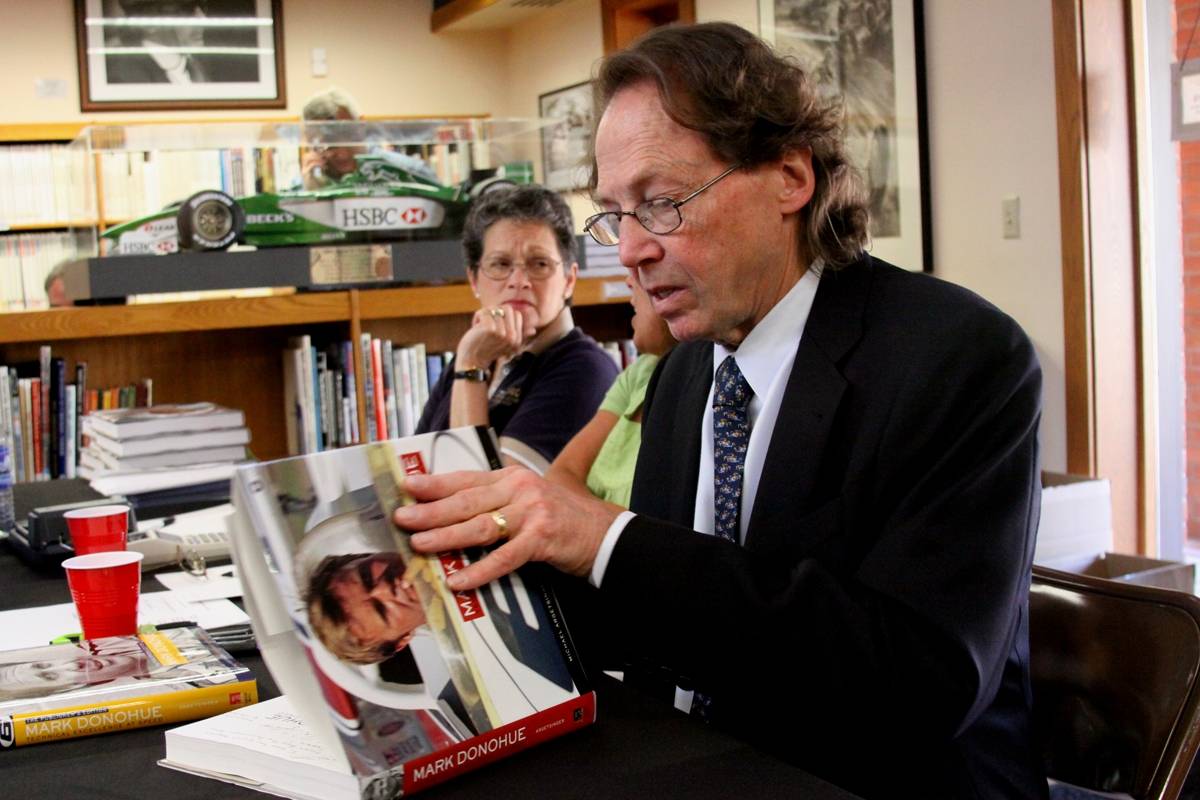 The symposium is named in honor of Michael R. Argetsinger (1944-2015), an award-winning motorsports author and longtime member of the Center's Governing Council. Michael's work on motorsports includes:
- Walt Hansgen: His Life and the History of Post-war American Road Racing (2006)
- Mark Donohue: Technical Excellence at Speed (2009)
- Formula One at Watkins Glen: 20 Years of the United States Grand Prix, 1961-1980 (2011)
- An American Racer: Bobby Marshman and the Indianapolis 500 (2019)

This content has been brought to you in-part by support through...



















I am not sure where you’re getting your info, but good topic.