There’s so many different racing disciplines out there… you could be a fan of NASCAR, IndyCar, Formula-1, Outlaws, MotoGP – the list just goes on and on. And I know that I’m one of the few in GTM that is even remotely interested in Rally, and I’m in an even smaller circle of die-hard WRC fans. That being said, I’ve been following World Rally since the ’80s. My dad signed us up for cable for the explicit reason of watching Grouppe-B Rally and Trans-AM races – mostly because of Audi. Later on his interests changed to Formula-1 and MotoGP, but I was always a Rally fan – and it’s still a dream to one day race in a Rally Car. But state-side that’s a lot harder than it sounds, its just not part of our racing culture. So I’ve found that over the years, the way I could escape this bleak reality was to immerse myself in the virtual world. And there is one name in virtual Motorsports that has always been on top when it comes to Rally (Formula-1 and Touring Car), and that’s: CODEMASTERS.
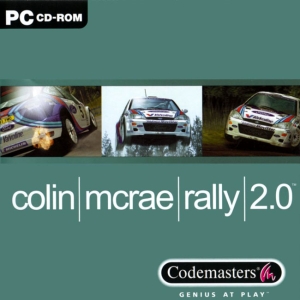
My first Codemasters games were: Micro Machines and Ultimate Stuntman for the NES. And for many of you it might be the “F1” games or TOCA. But my first foray into Rally was in 1998 with the debut of Colin McRae Rally (CMR) for the PC. While everyone else was playing Madden or FIFA, I was tearing up the Finnish country side in a Ford Escort!
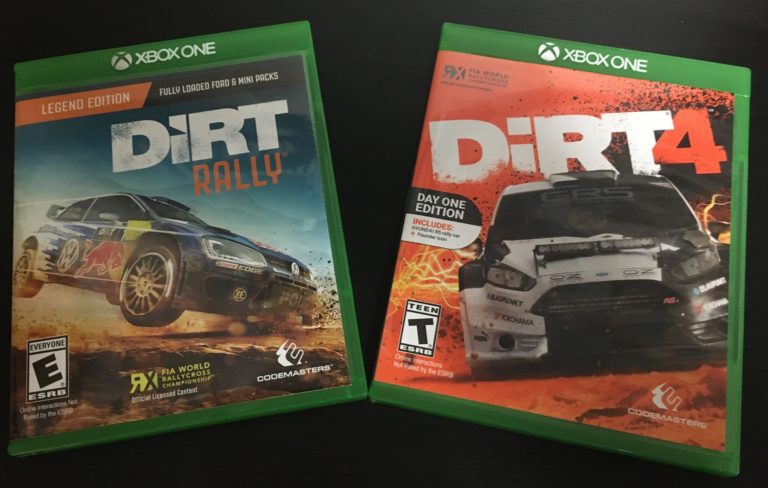
Codemasters carried the “Colin McRae” name on its rally series up until his death in 2007. The transition titles were called “Colin McRae: Dirt” until finally dropping to just “DIRT.” For those keeping count: Codemasters has put out 22 versions of Rally games since 1998. I haven’t kept up with all 22 variants, but I’ve had the pleasure of owing/playing the bigger titles like: CMR, CMR 2.0, DIRT 1-4, DIRT Showdown, DIRT Rally, etc. And even though DIRT Rally (2015) and DIRT 4 (2017) have been out for quite a while now they were the two titles most closely released to one another** in the franchise.
My wife knows when another “rousing round of rally” is coming. Usually when times are slow or the weather is bitter cold, I turn to these sorts of games, because they make me happy. And with Soooooo much extra time these days it only makes sense that I head to my comfort zone. Which got me thinking… new games release every week, and much like any other “critic based” industry, reviews are conducted independently and on individual titles. Not a lot of seat time is spent with the games because of writing deadlines and most of them read like book reports. Why not step back and setup a “Rally Special Stage” and compare these two titles side-by-side!
Ready… Steady… GO!
DIRT RALLY
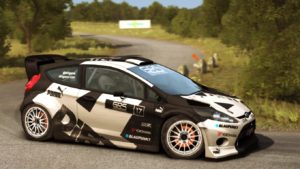
DIRT 4
So what’s it like to play?
I could use 1000 words to try and describe what its like to play each game, but figured it might be easier if I just recorded a session from each for review. As much as each game would allow, I choose the same location, course length, weather conditions, and car type: Sweden, Varmland, about 4 miles, Afternoon – Snowing, Grouppe-B Audi Sport Quattro. I run without any assists, and manual transmission. I also tried to save time by cutting out all of the loads times, which can be upwards of 30+ seconds. Sit back, and experience virtual Rally for yourself (below).
In lane-1: DIRT RALLY
After the release of DIRT Showdown the team at Codemasters emphasized a desire to create a “proper simulation” with Dirt Rally. They started by prototyping a handling model and creating tracks based on previous map data. The game employs a different physics model from previous titles, rebuilt from zero.
DIRT Rally offers 3 styles of play: Classic point-to-point Rally Stages, RallyCross and Hillclimb. Courses/Maps are based on actual WRC rally stages, but the system does allow for random map generation. Course lengths are long (and narrow) and present a challenge for most players.
DIRT Rally won all sorts of accolades like “Best Rally Sim” – which isn’t hard to achieve when you’re the only one in the market. But what is true of DIRT Rally is that its ultra realistic. Cars break, radiators explode, tires burst, the surface and weather conditions are extremely variable and the “speed” feels real (aka “slower than you expect”).
The downside to all this realism is an unforgiving game. Don’t get me wrong, its visually stunning, the sound quality amazing, the attention to detail is unmatched. But much like other “sims” its probably better played with a Steering Wheel + Pedal combo.
When I first got DIRT Rally, I was disappointed and felt like they ruined DIRT for me. It was virtually unplayable. Once my disappointment (which manifested itself in frustration and anger) subsided, I forced myself to spend more time with the game, and realized its was a lot like Colin McRae Rally 2.0 – it took patience, restraint, and and overall ability to be SMOOOOOTH, to go fast and win.
So far the standard DIRT titles have all been very good. DIRT 2 and 3 being my favorites overall. They were to rally what Forza is to track days. Jump in, have fun, be fast, win races. What many of you might not know is that Playground Games (the folks behind Forza Horizon) is a joint venture between Turn-10 and Codemasters. And DIRT-4 feels like the folks at Codemasters have spent too much time working on Horizon.
Visuals are clean, but softer when compared to DIRT Rally. The DIRT-4 soundtrack doesn’t disappoint, but it is starting to feel a bit more euro-trash rave-mix (horizon festival) compared to previous games, but it does help break up the endless amounts of “Press (A) to Continue” you have to navigate through to get to race.
DIRT-4 has the same play-ability as previous titles, it almost feels like the (EGO) physics engine is just a carry over from DIRT-3. But here’s where things fall apart, what made previous titles fun like: T1 Raid, Point-to-Point landrush races and RallyCross have all been “summarized.” Courses are repetitive and dropped to less than 1 mile, the career tree is short, and somewhat boring. You have to slog through these races to in order to gain licenses and unlock more cars. I was happy that DIRT-4 dropped the Ken Block inspired Gymkanna races from DIRT-3.
Having put in enough time to unlock the Grouppe-B cars, it let me test the game in a proper rally format. Rally stages (maps) can be randomized, which is fun, but the lengths are kept on the shorter side compared to DIRT Rally. It really feels like they left “all the good rally stuff” in DIRT Rally and made DIRT-4 an arcade racer.
DIRT-4 introduces a whole “manage the team” concept which seems to be borrowed from the “F1” franchise. If you’re not into that, its OK, but the game doesn’t progress unless you give your team some attention.
If you took the time to review the videos above, you can see that the games are same-same but different. Graphically DIRT Rally is crisper and more detailed. You have to be very concentrated to have a “perfect lap” – its stressful, and you can loose control very easily. Resetting the car is annoying unless you have a reset key mapped (but you’ll take a +15 sec penalty). The cars are “twitchier and darty” and walls seem to magnetize the vehicle if you miss your apex.
DIRT-4 on the other hand… is much more playable. #sendit. You can carry more speed, throttle steer more easily and track widths are slightly wider making the run more enjoyable. And more importantly, the cars are somewhat indestructible! The menu system in DIRT-4 doesn’t follow the “2-clicks max” rule, and you spend as much time clicking through screens as you do waiting for the sessions to load.
Both DIRT Rally and DIRT-4 have highs and lows, but if they were somehow merged, you could make ONE awesome game, because where one lacks the other excels. Sadly there is no talk about a DIRT-5 yet, but I am still hopeful! Overall, if you’re looking to try something new, and Rally is of interest… start with DIRT-3 #wink-wink.
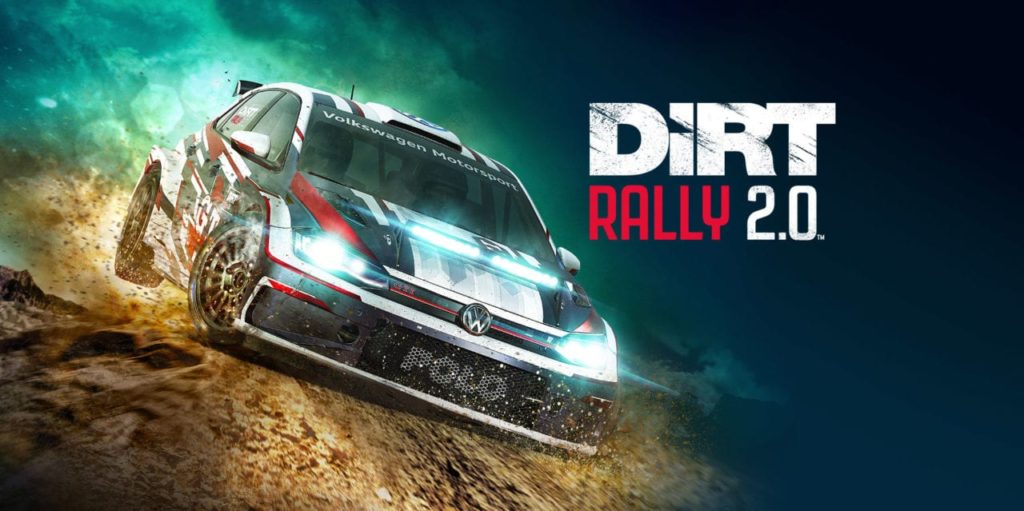
**Although DIRT Rally 2.0 released in 2019, I haven’t picked up a copy to see if they’ve corrected some of the challenges the original version presented. More to come.
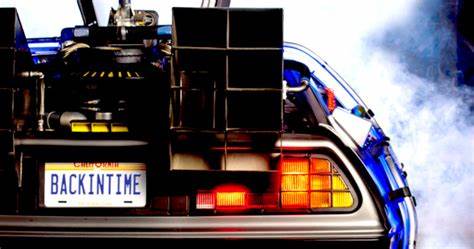
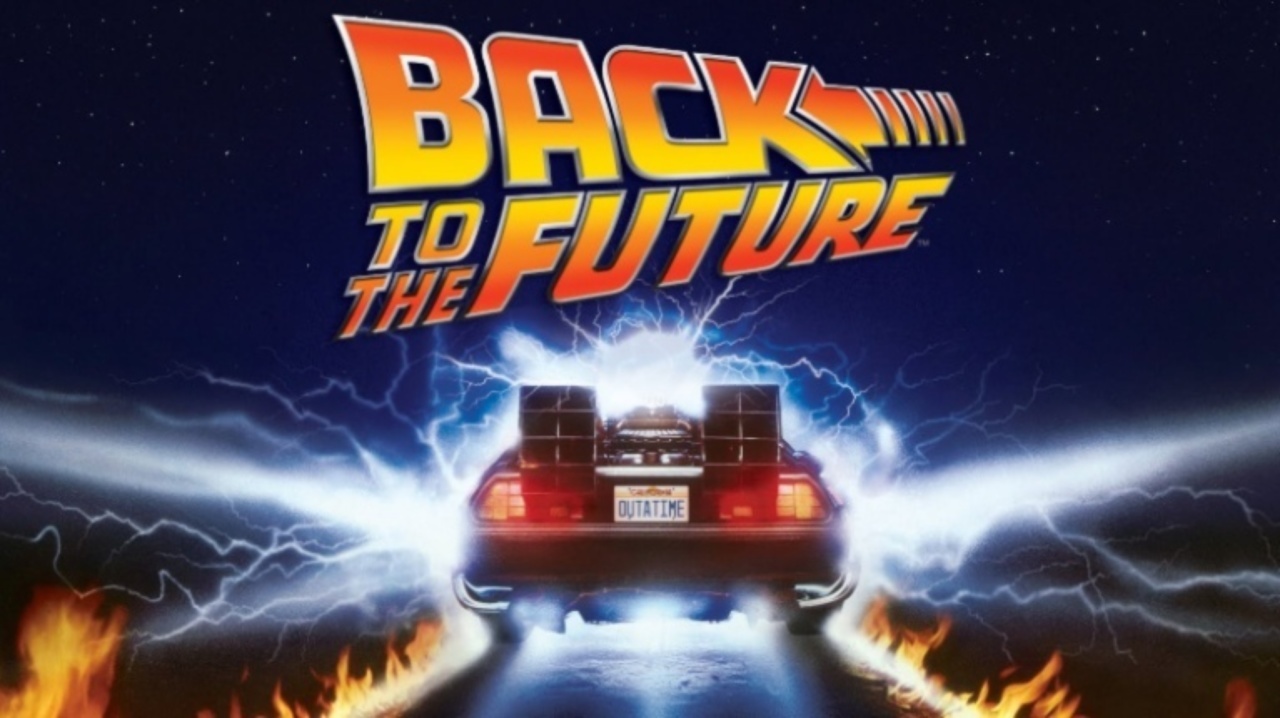
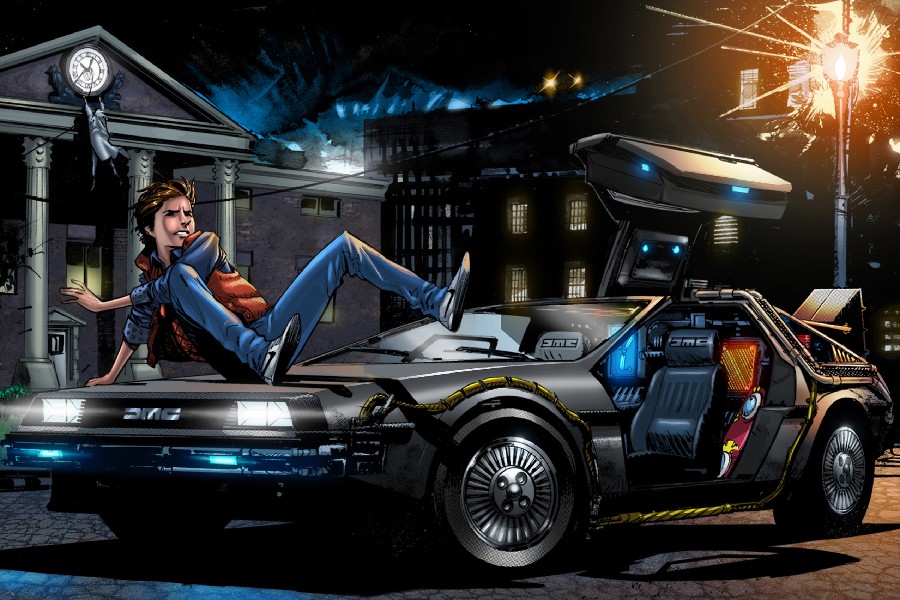
Normally my “One Offs” articles have focused on the history and uniqueness of a certain vehicle or brand, but with all this recent talk about documentaries and John Z. Delorean (JZD), it got my spidey-senses tingling. While researching my original One Offs: Delorean article, I happened to stumble across a film called “Back in Time” from 2015, which recounts the creation of the ’80s cult classic movie “Back to the Future.“ Everyone who’s seen it knows why the film was “awesome” but I was hoping to find out more about WHY the movie producers chose the DeLorean, a car with a sorted past, to be a major co-star in the film. A role which would redefine the car, and propel it forever as an “icon.”
“After seeing the film, I wanted to buy a DeLorean…I betcha everybody did!” – Martin Sanchez
The Man
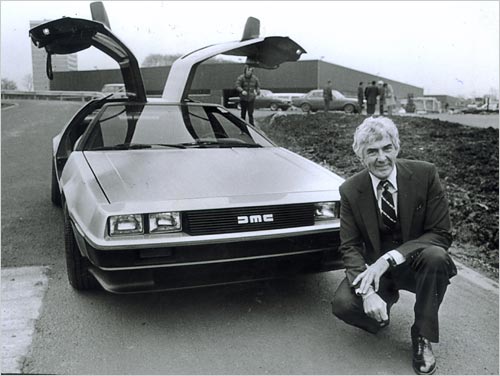
When people hear the name John Zachary DeLorean (JZD) whether they are a car enthusiast or not, they will tend to associate it with the DMC-12 automobile made famous by the Back to the Future franchise. Most people don’t realize how much of an influence JZD had on the automotive industry as a whole. His level of vision and talent exceeded many. John Z. DeLorean was the oldest of four sons to Romanian and Hungarian immigrant factory workers in Detroit. His father worked for Ford and his mother for General Electric. Jumping into the future… 1943 took JZD on a hiatus from education when he was drafted to serve in the Army during World War II. Upon his return, he returned to school and worked part time for Chrysler and a local body shop. He obtained his master’s from the Chrysler Institute and later an M.B.A. in automotive engineering from the University of Michigan.
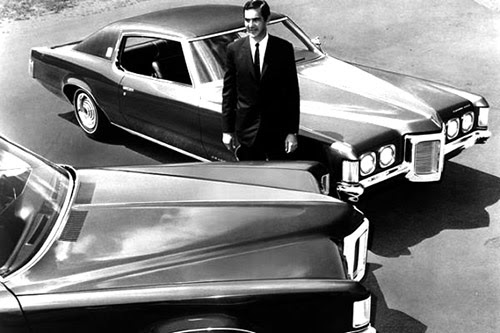
In 1952, he began working as part of the research and development team for the Packard Motor Company. During his employment with Packard he grew to have a strong sense of attention to engineering and detail in his designs – which carried on with him. JZD left Packard and went to General Motors as an engineer in the Pontiac Division in 1956. When he joined Pontiac they were not considered the “excitement platform” for which GM would later be known. They made cars for older adults and didn’t relate to the youth of the time. Unlike most of John’s fellow engineers, he realized that customers cared about the style of the vehicle and chose not to ignore that.
In 1961 he became the chief engineer for Pontiac and convinced his team to put the 389 cubic-inch engine from the larger Bonneville into the smaller midsize Tempest, re-badging it: the Pontiac Tempest LeMans Gran Touring Omologato (aka “the GTO”). Unfortunately as GM had a strict mandate to not put large engines into smaller cars, it would not be offered until 1964 (as a $295 option package) on the Tempest. The GTO package sold an amazing 32,450 in its first year of production. DeLorean’s creation was the beginning of “the muscle car” and would later become renowned and highly sought after. This success got him promoted ahead of several more senior engineers in 1965 to become Pontiac’s youngest General Manager at the age of 40.
JZD moved to Chevrolet’s division General Manger position in 1969. While with Chevrolet, he was involved in designing the Camaro, Corvette, Nova, and Vega. But after some rocky years with an aging board of directors, JZD was quoted as saying “there’s no forward response at General Motors to what the public wants today… A car should make people’s eyes light up when they step in the showroom. Rebates are merely a way of convincing customers to buy bland cars they’re not interested in.” – That being said, he was promoted again, becoming the youngest Vice President to head up GM’s North American car and truck operations. But this promotion did not sit well with many of the other GM executives and on April 2, 1973 John announced that he would be leaving the company. When leaving GM, JZD is quoted as saying, “Even at $650,000 a year, if the job is not satisfying, you do something else.”That something else led to the birth of DMC.
Around this same time he began toying with his next venture, the “DeLorean Motor Company” (DMC) in 1975. With full control, John was able to work on any concepts without restrictions. His first and only creation would be the DMC-12 … now, best known as “the Time Machine” from the Back to the Future franchise.
“If you’re going to build a time machine into a car, why not do it with some style!” – Dr. Emmett Brown
The Myth
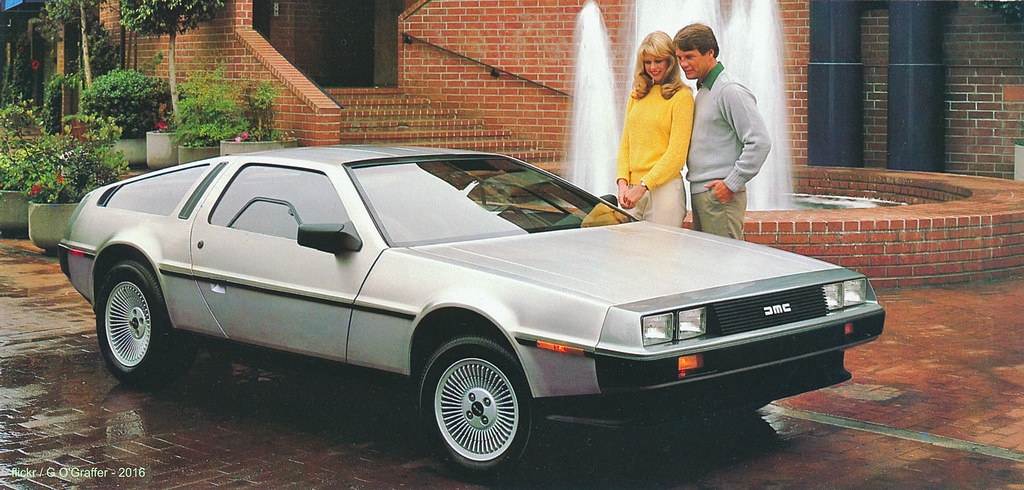
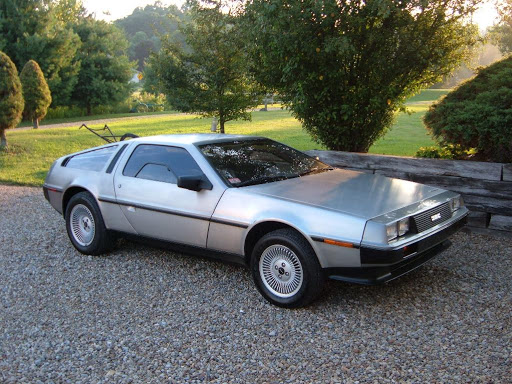
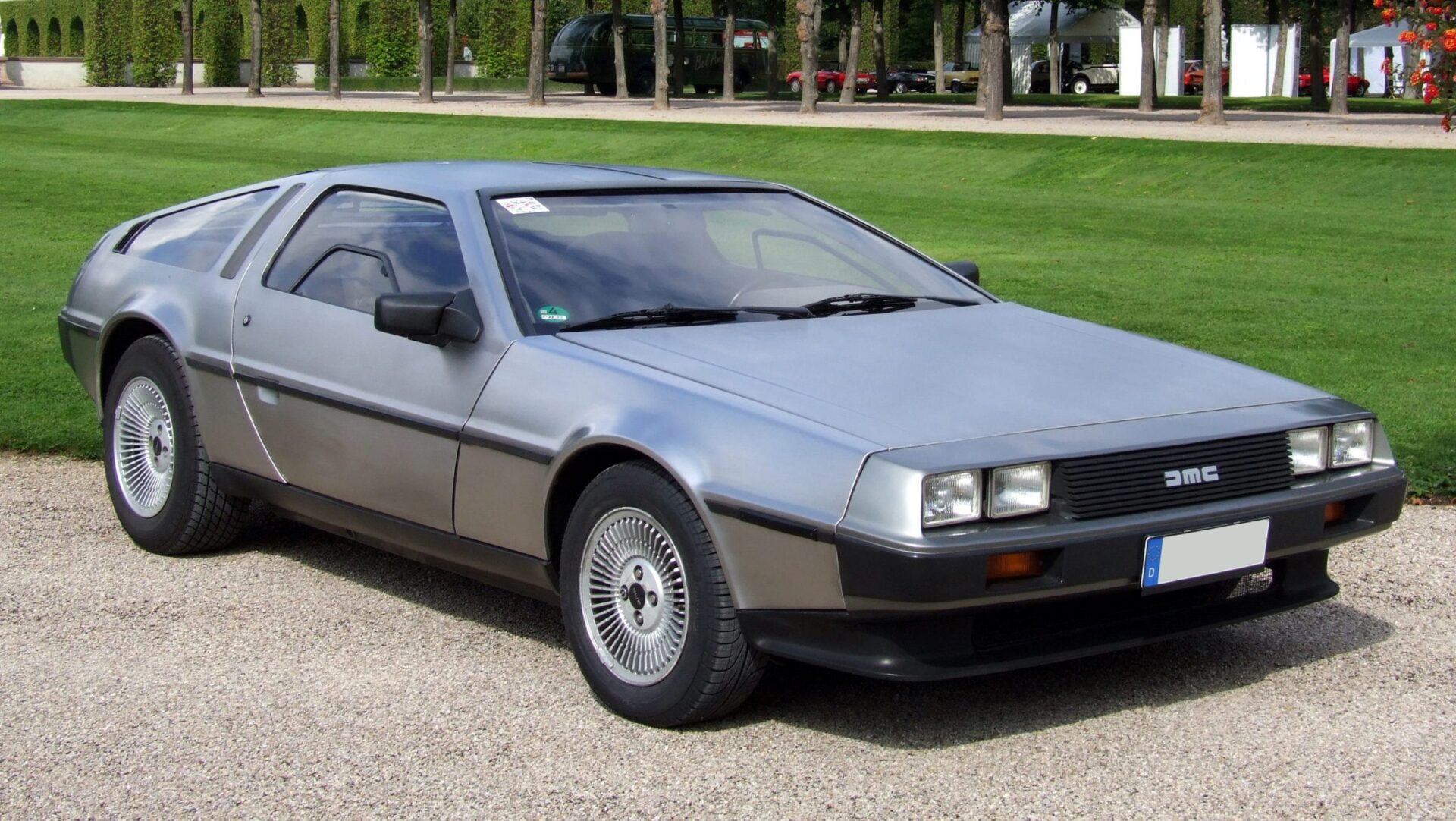
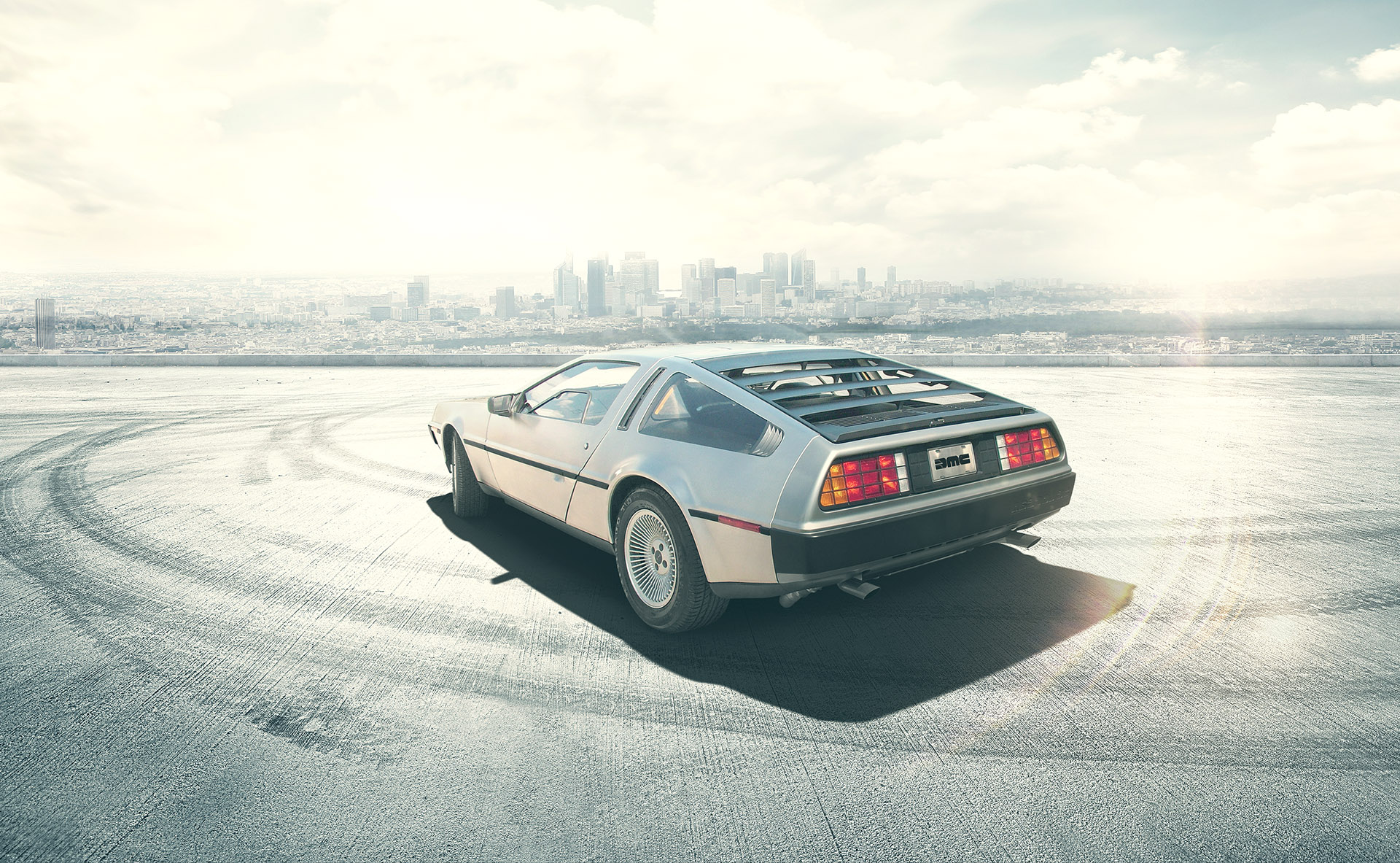
The DeLorean Motor Company (DMC) was headquartered in Belfast, Ireland and was a short lived venture ending in 1982 after only producing the DMC-12 (known just as “The DeLorean” or “A DeLorean”) with a sales run from 1981-1983. The DMC-12 is defined as a rear engine, rear wheel drive “sports car” that was much different than many other cars available at that time.
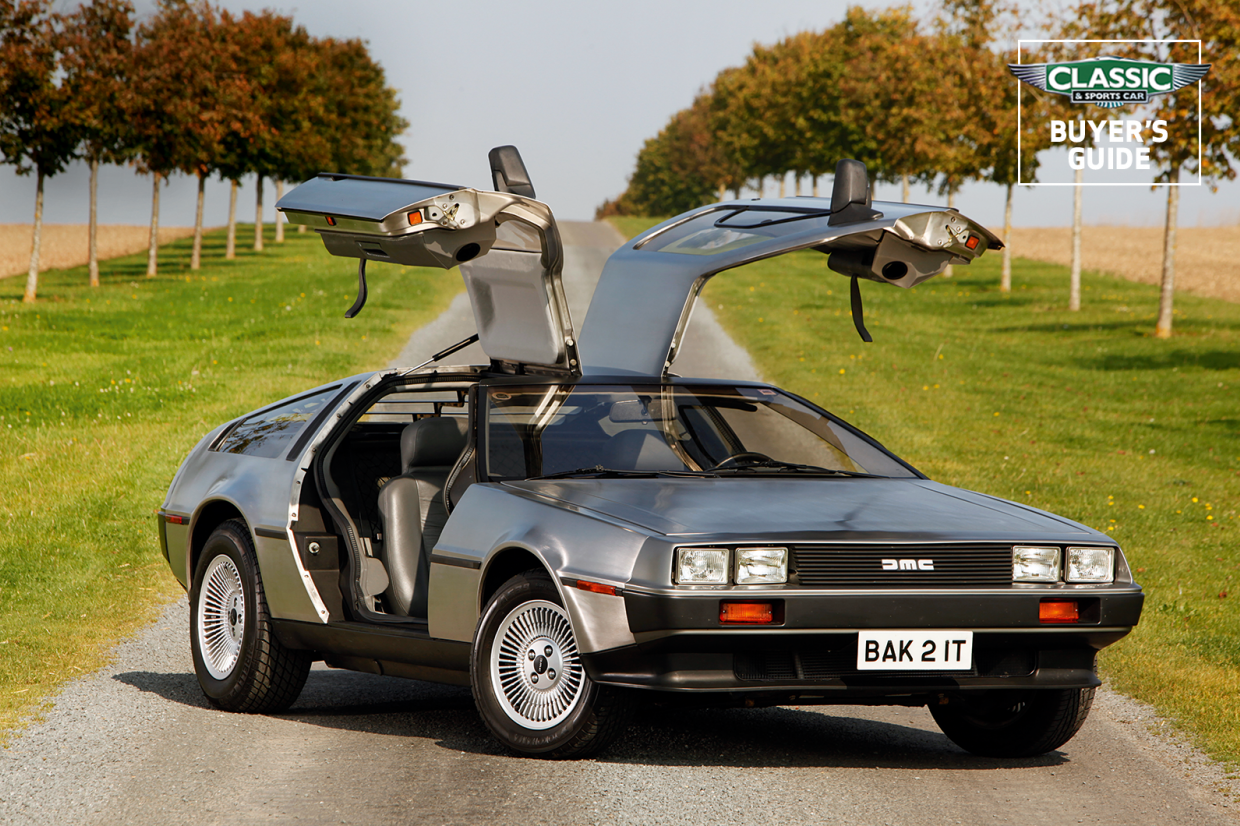
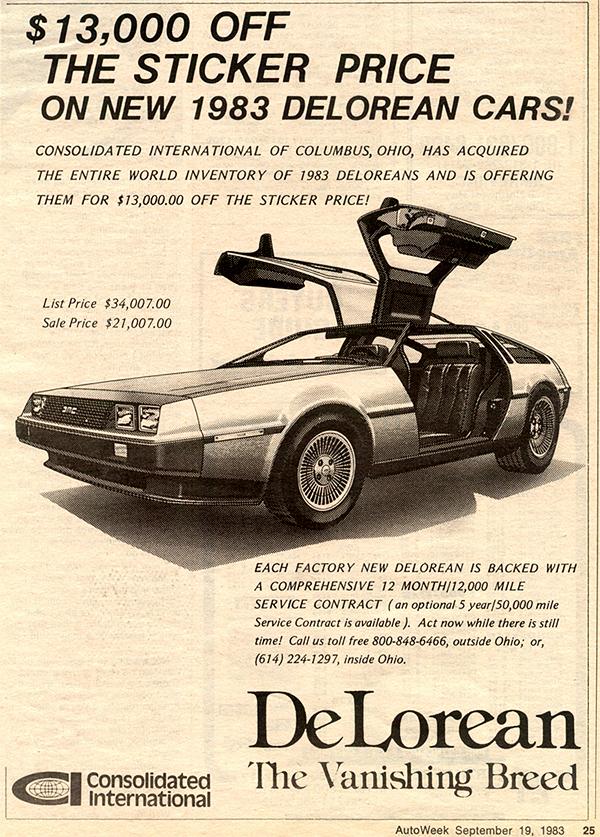
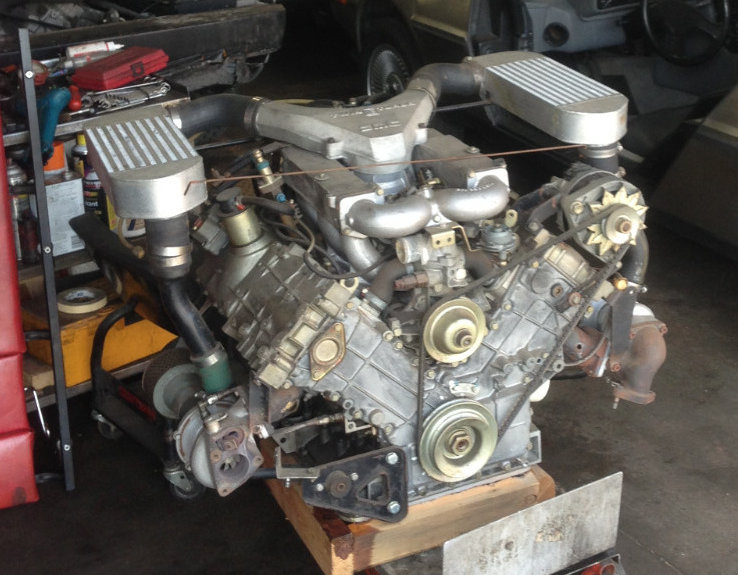
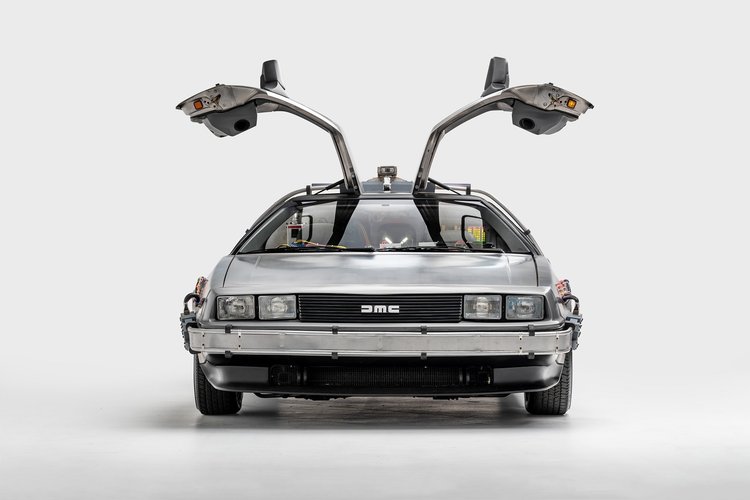
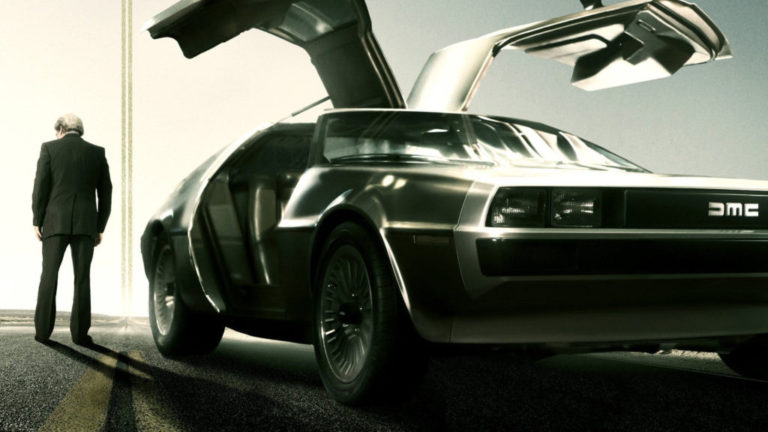
The gull-wing doors alone made it stand out from the pack. Not many production cars had them, and those that did were generally out of the average man’s price range (Mercedes 300SL, as an example). The DMC-12 came with a 5 speed manual or optional 3 speed automatic transmission. The DeLorean was originally intended to be powered by a Wankel (rotary engine) but a less costly option of using a Peugeot/Renault/Volvo 2.5L fuel injected V6 was settled on instead. The V6 put out a claimed 130 HP @5500 rpm and 153-ft.lb of torque @2750 rpm. Advertising literature claims it could reach 0-60mph at 8.8 seconds with the manual or 10.5 seconds with the automatic. The top speed for the car was only 109 mph. Luckily Doc Brown and Marty only had to reach 88 mph to travel through time!
For a sports car of this era, these numbers are not the most impressive but it was guaranteed to catch attention as you drove down the road. Suspension was developed by Lotus and included 4-wheel independent suspension, coil springs, and telescopic shocks. The rear was a multi-link setup while the front end used a double wishbone design. The steering rack in these cars had a 14.9:1 ratio requiring only 2.65 turns of the steering wheel from lock to lock. The turning radius of the DMC-12 was an impressive 35 foot circle!
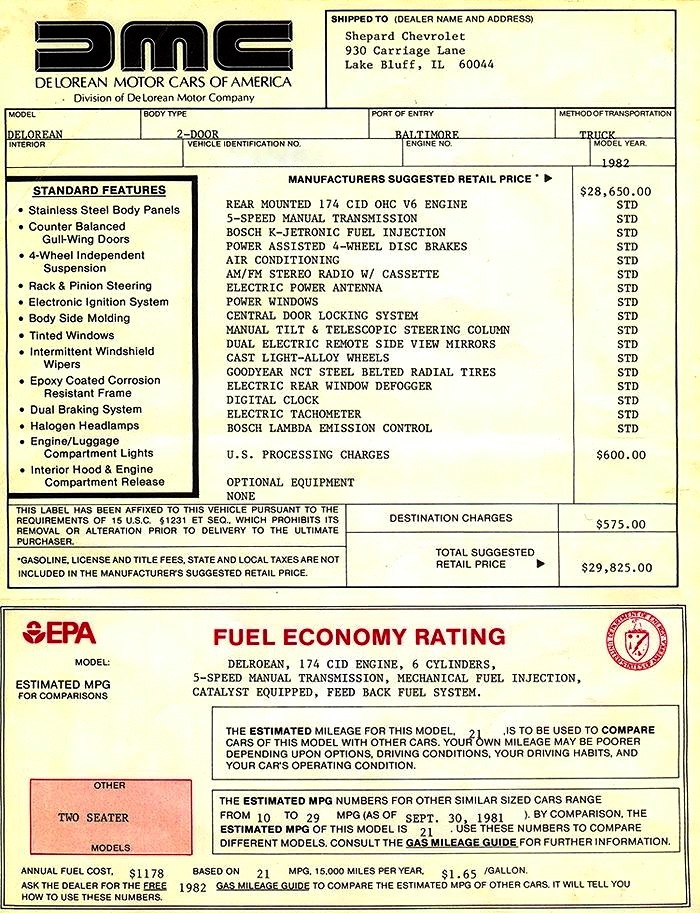
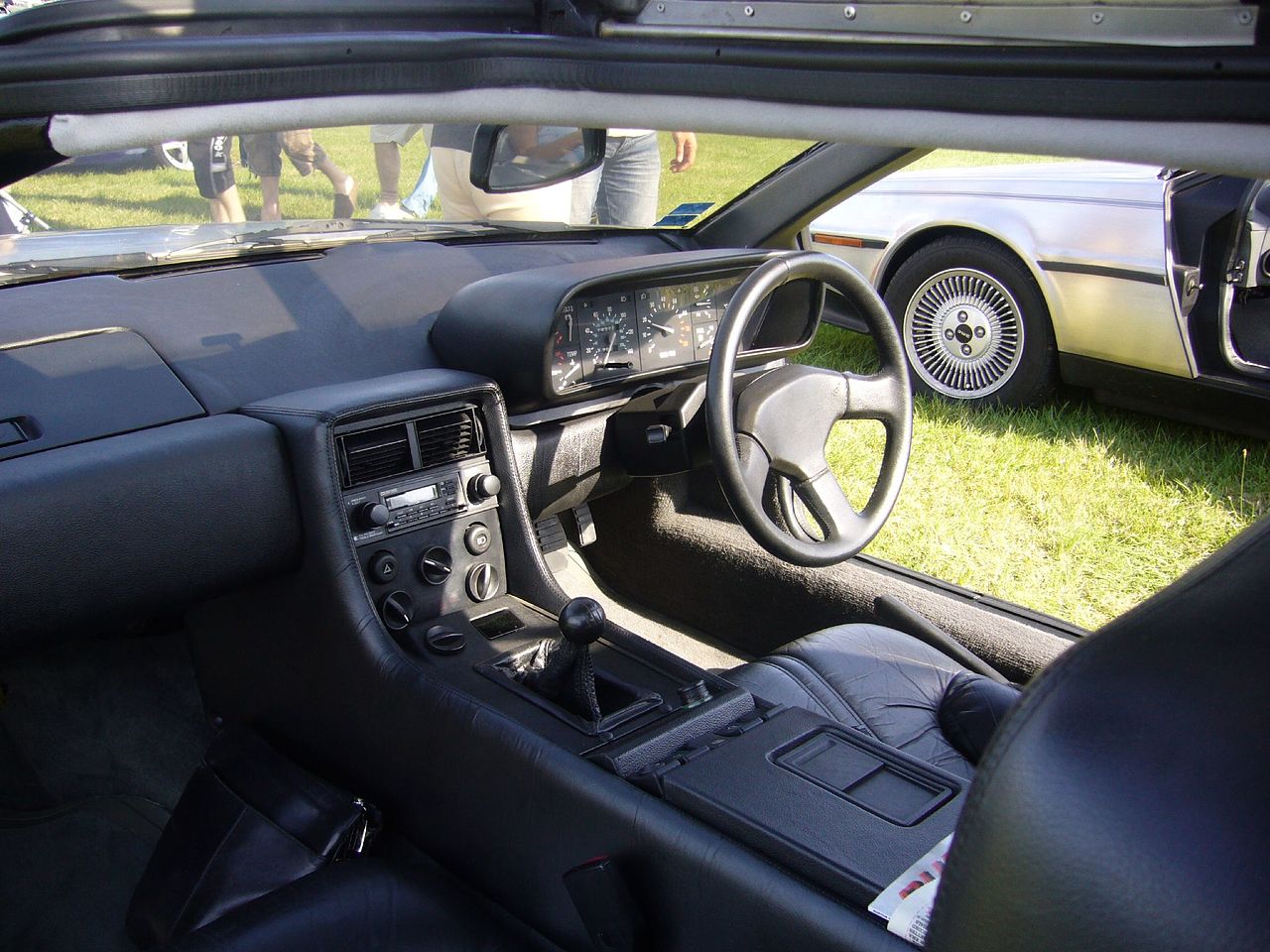
Being a rear engine design, the car had 35/65 front-to-rear weight distribution. Staggered cast alloy wheels on the DMC were 14×6 in the front and 15×8 in the rear. As for standard features, it came with items such as: stainless steel body panels; gull-wing doors with cryogenically treated torsion bars; 4-wheel power assist disc brakes; air conditioning; an AM/FM cassette stereo system, leather seats, power windows, mirrors, and locks; telescopic and tilt steering wheel; tinted glass and electric rear window defogger. There was an additional cost for the automatic transmission and dealer options such as floor mats, sheep skin seat covers, a car cleaning kit, accent stripes, and a luggage or ski rack. Despite being built in the UK, getting a right-hand drive (RHD) DeLorean required an aftermarket team to produce.
In total, roughly 9,000 DMC-12s were built during its short production run. Of those, 6,500 are believed to still exist!
The Legend
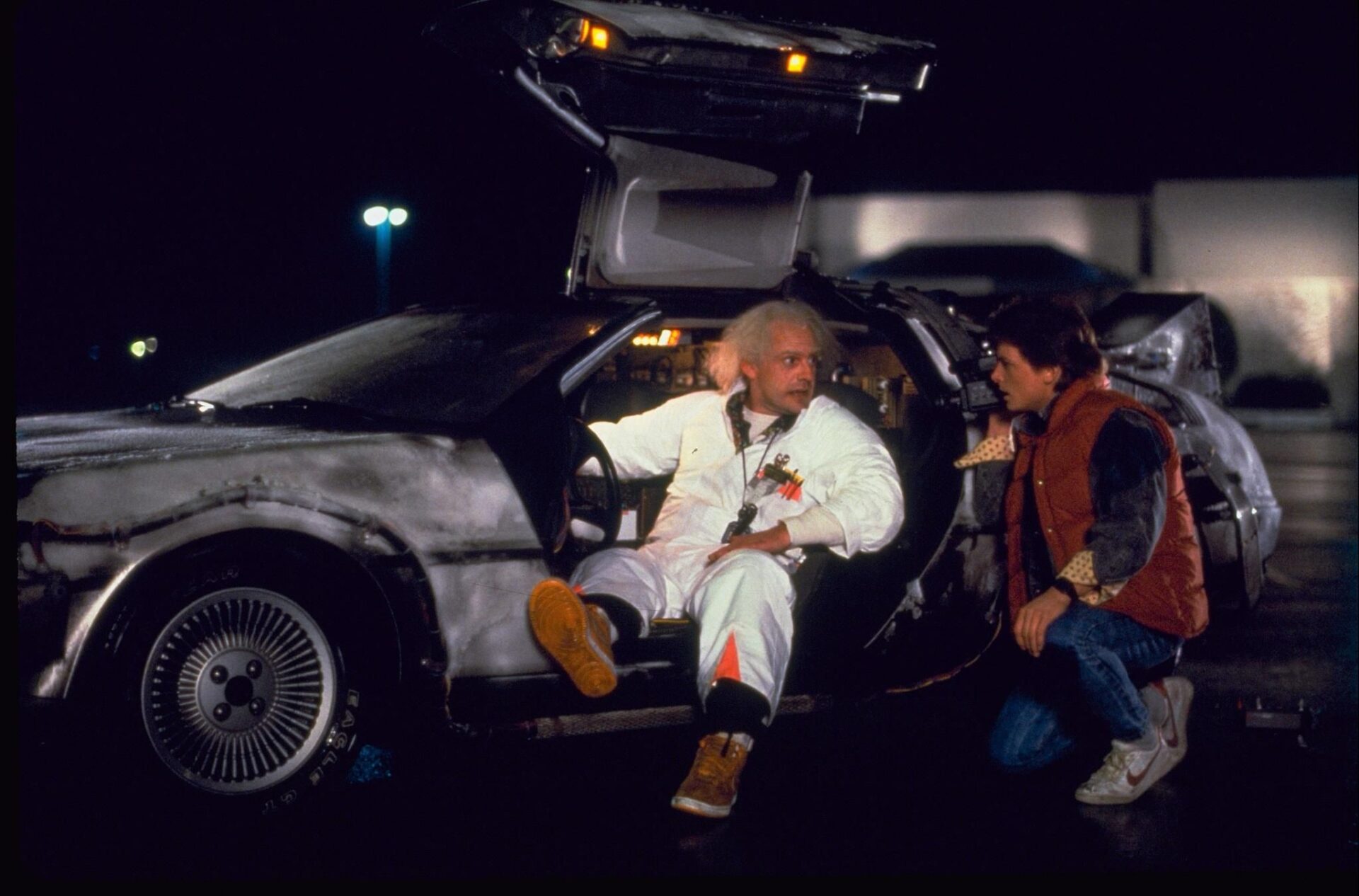
It turns out that in the first two drafts of Back to the Future (BTTF), the time machine wasn’t even a vehicle, it wasn’t even mobile, it was a ray that shot out and grabbed the person. Think… “Honey I Shrunk the Kids.” Realizing this wouldn’t appeal to most movie watchers, Robert Zemeckis decided that it made better sense to make the time machine into a vehicle so they could move it around during the scenes more easily. He said in his interview: “We chose the DeLorean, simply because it had Gullwing Doors. And we had this joke … [scene from the movie where: kid hands father a comic ‘tales from space’] in the ’50s when the kid goes into the barn, and thinks a martian has landed, we thought what kind of a car looks like a space ship? A DeLorean, because of the Gullwing doors.”
“It was one of those bucket list things in life… some people want a Rolex watch by a certain age, because it’s a sign of success. You know what, I wanted a DeLorean Time Machine. That’s not too much to ask? And I did it.” – Martin Sanchez
The crew credits the DeLorean Motor Company’s failure to the DMC-12’s success. Had the car not been a One Off it would have just been “another car” – but its own mystique, controversy, and baggage made it unique. In the end, the movie really helped propel its long lasting success. I found it interesting that after many attempts to make the time machine you see in the film, they had to enlist the help of Michael Scheffe – who was known for developing another famous automotive TV-star: KITT. One of my favorite lines from the documentary, is when BTTF writer Bob Gale describes how the team was approached by Ford (by way of Universal Studios) offering up to $75,000 to switch from using the DeLorean, to which he firmly replied: “Richard… Doc Brown doesn’t drive a (bleeping) Mustang!”
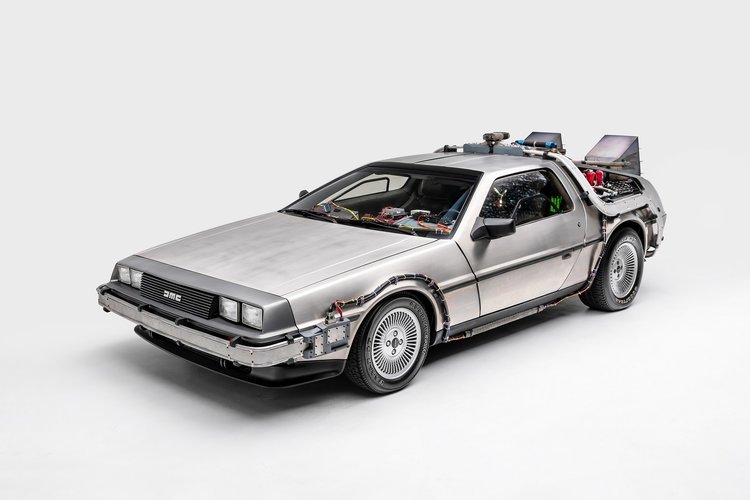
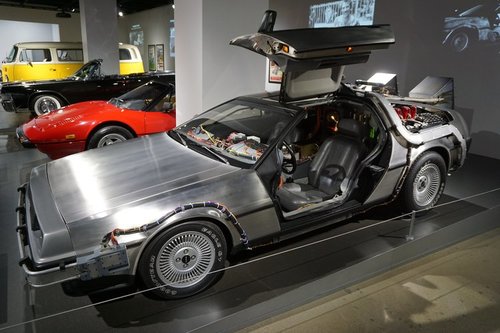
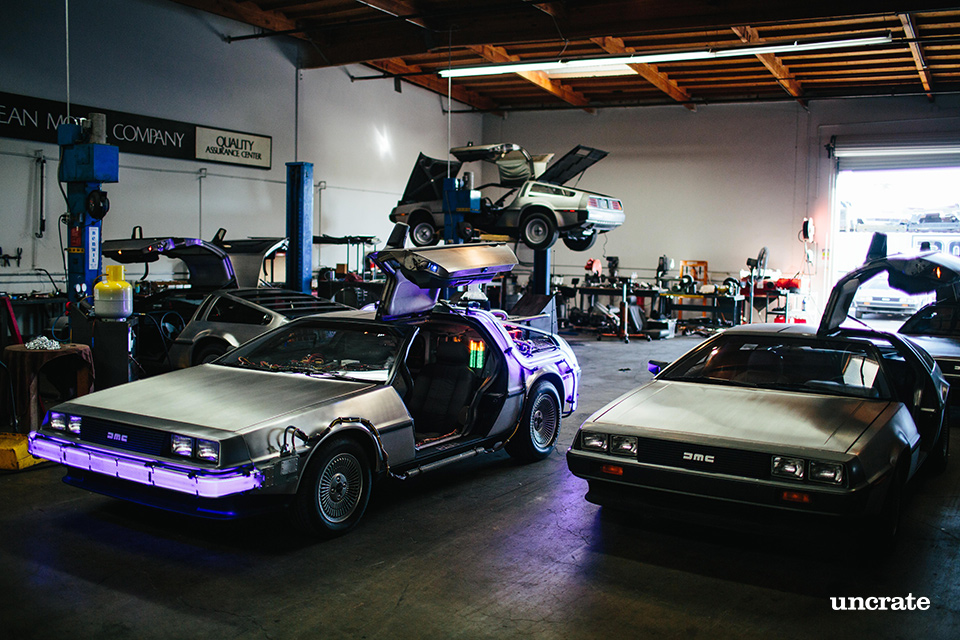
According to the film, 7 DeLoreans were used throughout the trilogy: 3 still exist, 2 of them are owned by Universal, and 1 is in private hands. The middle part of the 94 minute film, talks a lot about “restoring” the original DeLorean Time Machine (known as “Time Machine A”), which unfortunately had been removed from the Universal Studio Tour and left to rot (but not rust) on a back part of the lot. Sadly the car was left mostly unguarded and people were actually taking pieces from the iconic movie-star. With the help of fans and DMC enthusiasts, this lead to a blossoming industry of “time machine replicas” and “new parts and support” for DeLorean collectors. Picking up a “new” DeLorean (replica) will set you back an estimated $100,000 through a Texas based DMC company. Each of the remaining BTTF DeLoreans are valued at nearly $530k and can be seen at the Peterson Automotive Museum in Los Angeles.
If you wanted any of the sports car power and speed, you would need to find the one Legend Turbo VIN 530 DMC-12 that was done when DeLorean contracted Legend Industries of Hauppauge, NY. They put twin IHI RHB52 turbos with twin intercoolers reaching full boost at 2500rpm on the engine to bring it to life. The result of this was a top speed of 150mph, a 0-60 in 5.8 seconds and a 1/4 mile time of 14.7 seconds. In 1981 during a test run at Bridgehampton Raceway this DeLorean was quicker than a Ferrari 308 and a Porsche 928. John DeLorean committed to ordering 5,000 of the twin turbo setups but unfortunately DMC declared bankruptcy before they went into production.
They even had right hand drive conversions done by Wooler-Hodec Ltd. based in Hampshire, England. Only 16 of the right hand drive DMC-12s were ever produced.
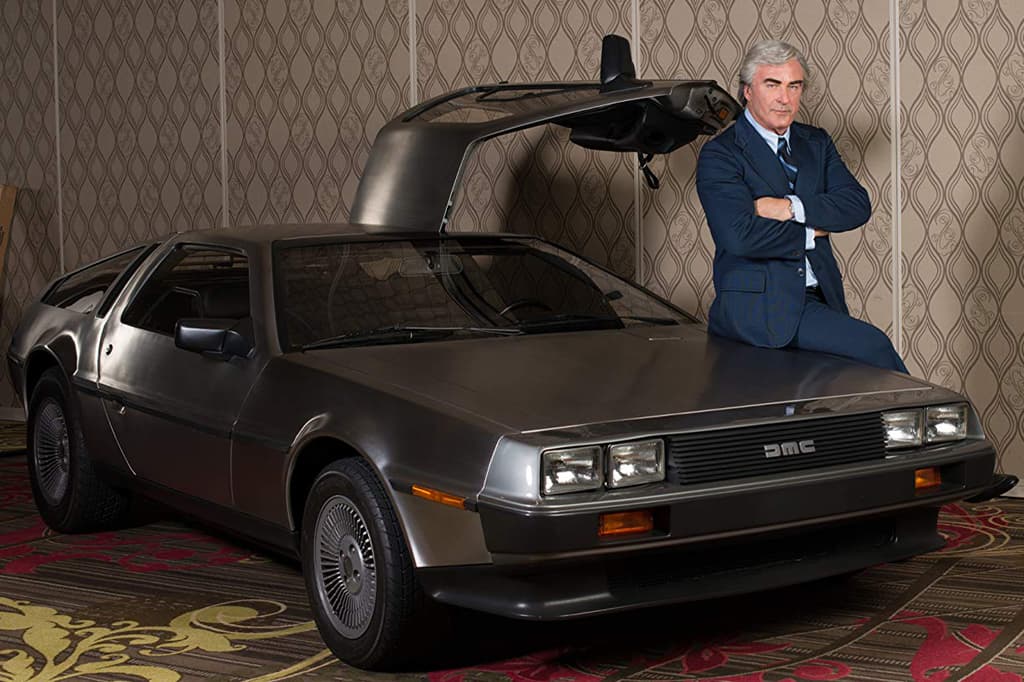
Alec Balwin playing JZD in the film "Framing John DeLorean" on HULU.
As for the seven chassis' used three are said to still exist. Two of them were abandoned, one was destroyed at the end of Back to the Future Part III, Universal Studios still own two that they still put on display occasionally, and one is part of a private collection.
Of all of the remaining DMC's from the Movies can be seen at the Peterson Automotive Museum in California
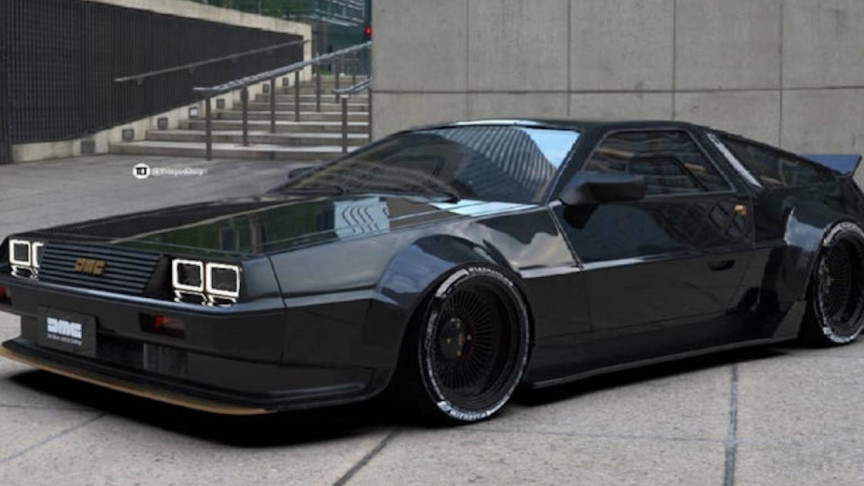
Artists have even created renderings that they think make the car have more appeal.
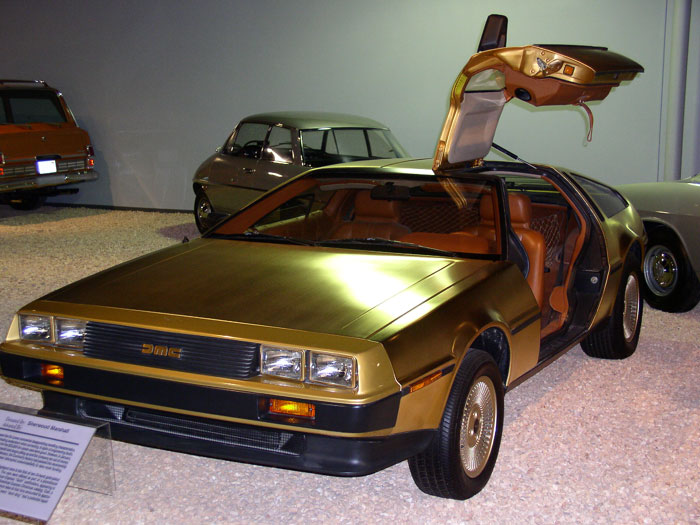
There were even 3 done as a promotion where DMC had them plated in 24k GOLD! One can be see at the Petersen Auto Museum in CA, the second can be seen at the National Automobile Museum in NV, and the third that was built form spare gold plated parts in the event one of the first two got damaged is in the possession of a private owner in La Vale, MD and has been seen online for sale for a meager $250,000 over the years.
In 1995 a gentleman from Liverpool named Stephen Wynne acquired the trademark of the stylized DMC logo and remaining parts inventory of the original DMC and created DMC Texas located in Humble, Texas. An announcement in 2007 from DMC Texas stated they would begin to produce roughly 20 DMC-12s a year. Unfortunately this originally was more of a restoration and upgrade of the original cars with NOS and custom ordered parts rather than production of new cars. The price of this refurbish in 2009 was $57,500 with optional extras such as a stage 2 engine or GPS. In 2011 DMC Texas announced a plan to have an all electric version for sale in 2013.
DMC TEXAS have since announced that they plan to build replica DMC-12s with production to begin in 2021. The expected price tag is estimated to be at $100,000 for a new replica. Replica or not, the DeLorean DMC-12 will always catch your eye and is possibly the most famous one off there is.
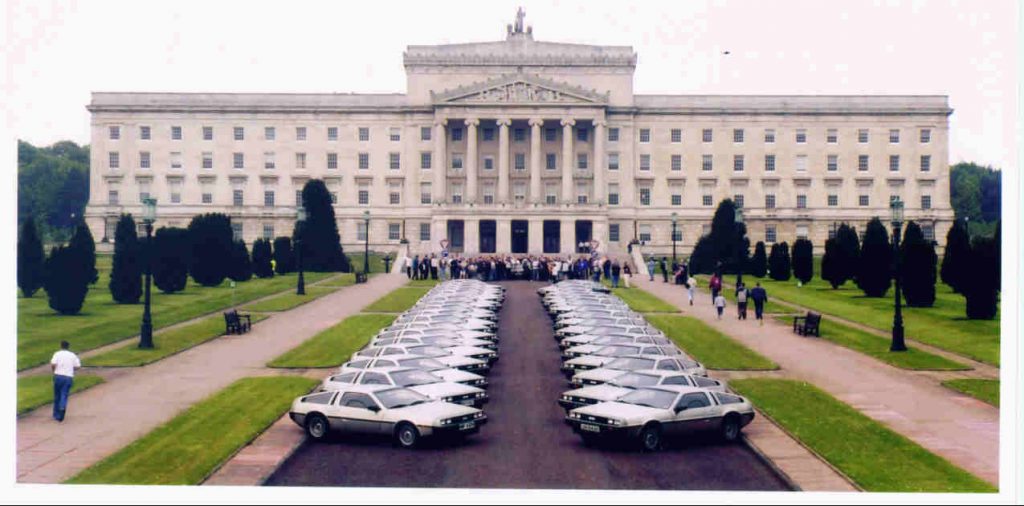
There are owner groups/clubs/associations and even events globally surrounding the car. DeLorean Eurofest 2021 registration opens in May 2020 if anyone would be interested in attending.
For a list of DMC-12 associated clubs see the link below. https://www.deloreandirectory.com/clubs/ For an interesting exhibit of automobiles you can check out the Peterson Automotive Museum or the National Automobile Museum at the links below. https://www.petersen.org/ https://www.automuseum.org/ Interested in a replica DMC-12? Check out DMC Texas at the link below. https://www.delorean.com/
Roads!, where we’re going… we don’t need roads.
When people speak of One Off vehicles, I’ll always be sure to mention the DeLorean and rightfully so, since it might be one of the most popular one off cars to ever exist – especially if you grew up in the ’80s. This car was undoubtedly made famous by the Back to the Future franchise. Despite its technical specs, the futuristic look, stainless steel body panels and gull-wing doors keeps it securely on the sports car list next to cars like the Ferrari 308, Porsche 930 Turbo, and others. The DeLorean might have a dark past, but it has an even brighter future. #gottawearshades. In many of our hearts, the DMC-12 takes the spotlight! And many more of us still want one, even if it couldn’t actually travel through time. #because.
This #TBT we selected some “greatest hits” from our stash of articles to help you get caught up. (Swipe through the carousel, or click on the image to be taken to the article). #staysafe #stayathomechallenge … ENJOY!
Check out more articles from your favorite bloggers: The Viking Line, HazMatt Racing, The Mountain View, DR!V3R, The Crew Chief or Use the site navigation, article meta tags (found at the bottom of the post), search bar, or subscribe to the site via RSS (using apps like Feedly) to get all your GTM news — Interested in writing for GTM? – Check out this page, for more information.
The 3 amigos… The 3 Musketeers… the Heart & Soul of TopGear. Who would you have a beer with?
Jeremy Clarkson (below, center), started with small local newspapers writing car reviews and editorials during the ’80s, until becoming part of TopGear (the Magazine). Clarkson was also part of the original TopGear (TG) TV program, the equivalent of our MotorWeek, which aired mostly in Britain from 1977-2001. Clarkson was featured on “old TopGear” periodically during the 1988-2000 seasons. Once TopGear established its “new format” (the reboot we’ve all come to appreciate over the years) in 2002 at Dunsfold Aerodrome, Clarkson was promoted from segment narrator to the shows host. Clarkson alongside producer Andy Wilman are credited with “with turning TopGear into the most-watched TV show on BBC Two – rebroadcast to over 100 countries around the world.” Clarkson portrays the hard charging – more POWA! – leader in the group, who’s solution to most problems is finding a larger hammer.
Richard Hammond (above, left), started his entertainment career in radio and was pushed by a friend to audition for TG in 2002, quickly landing the spot alongside Clarkson. Richard is often referred to as “The Hampster” because of his relative height versus Clarkson and May, and ability to fit into vehicles they cannot #ifitsisits, and adds some comic relief. James May (above, right) on the other hand, aka “Captain Slow” joined TG during the 2003 season and provides the grounded “Professor and Historian” role on the show. But, did you know? – he was featured in several segments of the 1999 season of “old TopGear?” – In any case, all three of these now well known TV presenters were all on the writing staff at TopGear (magazine) at some time between 1993 and 2015.
3 names in the automotive world synonymous with a legacy most people point back to the early ’00s. For 18 years, these friends have been adventurers, met stars, driven and reviewed all sorts of cars, while MacGyver-ing any and every experiment they could dream up!
The enthusiasm, ingenuity, originality and comedy the team brought transformed the automotive show genre all while keeping peoples interests high. Top Gear was great at inviting both petrol-heads and “lay people” to tune in each week. A car show, for all people. The TG:UK format was definitely a winning format, making shows like #1 competitor “Fifth Gear” with names like Tiff Needell (formerly of “old TopGear”) just seem blasé. With all the momentum TG had, it makes sense that they needed to expand to much more specific/local audiences than just the UK and its english-speaking anglophiles around the world. There are versions of TG targeting countries like: Italy, France, Russia, Korea and China with their own casts and not just dub-overs or subtitles. Search forTop Gear + Country and you’ll be surprised what turns up. TG:UK spun off its formula to: TopGear Australia (2008-2012) and TopGear America (2010-2016) being the most popular of its derivatives.
TG Australia was the first official spin-off of TG. It aired from 2008-2012, and followed the TG format with an Aussie twist. I was very fortunate to be able to get a hold of a majority of the seasons of TG:Australia. After review, I found it amusing and not nearly as polished as its British counterpart. But thats OK! Because it was full of UTEs, Off-roading, Bathurst, and many segments TG:UK could only dream of dipping into. Some of the “how hard could it be?!?” segments are just as memorable when stack-ranked against others, especially things like “using a Smart Car as a Hearse.” or the “ALL WILL DRIVE” subaru. #classictopgear.
Bruce v Nigel – The British and Australian Cricket rivalry (“the ashes“) is pretty well known, even if you’re not a fan. Therefore, it seemed appropriate that TG put together a cross-over special (example below) with both teams to introduce the world to TG:Australia. Little known, is that there is an episode of TG:Australia where the UK team comes to them for a rematch.
TopGear: America on the other hand…I can’t speak for everyone, so I won’t speak. But will say that much like the Aussie version, it catered to our audience here at home directly. Partnered with the History channel, it brought in aspects of shows like “Ice Road Truckers“ and other automotive properties that History already owned. That means TG:America was packed for full of big trucks and big muscle. TG:America took a break, and was rebooted in 2017. Take a look at this segment from Season-1 for glimpse into what TopGear: America was like.
The best of the Best!
We might not all agree on which TG:UK episodes are “the best” – but we’ve put together a sample for you anyway – ENJOY!
These are just *some* of the episodes (shorts) that made TopGear, what it is… AWESOME … in case you forgot, or have been living under a rock for 20 years.
The Grand Tour & Beyond
Unfortunately, in 2015, TopGear went on hiatus after serious allegations against Clarkson and some of his behavior off screen. This inevitably led to Clarkson’s contract with the BBC being terminated. Instead of staying behind to continue the show, Hammond and May followed their compatriot to whatever adventure awaited them next. Co-creator of “new TopGear” Andy Wilman also followed Clarkson to their next project. Fast forward to November of 2016, the trio return with a new show called “The Grand Tour” on Amazon Prime. The notion was to capitalize on the style of the “TopGear Specials” – which after many years of watching, was what many of us tuned in for. The show started off “same-same but different” to the classic TG style, until the lawyers got involved, and for once that wasn’t a bad thing! Forced to change during Season-2 (2017); the show began to find its footing, loosing some of the segments which didn’t resonate well with audiences as carry overs from TG. By the 3rd season (2018-2019) the Grand Tour was really gaining momentum.
#spoileralert – during the last episode of season 3, alongside a touching piece of documentary surrounding the production end for the Ford Mondeo (a British Automotive staple), the trio announced that they were (in effect) retiring from TV. It was an emotional moment for the viewers as well as the cast. 18 years … 18 exciting years… and for many of us at GTM that have been die-hard fans of Clarkson, Hammond and May, we we’re immediately crushed. Meanwhile, trying to go back to BBC’s TopGear continues to difficult, it’s the “same old format” with several cast revisions featuring names like: LeBlanc, Evans, Harris, Schmidt, and others. #thethrillisgone #nomoremagic
A few months later… Clarkson announced the team would be “back” with periodic specials, in the form of 90-120 minute movies. The most recent one released just before Christmas of 2019 titled “The Grand Tour: Seamen” (official trailer, below).
After reviewing “The Grand Tour: Seamen” – it was hard to provide a stellar review, it doesn’t earn the honor of “amazing” because it still has to stack up against the trios previous adventures like: Bolivia, Argentina, the North Pole, Mongolia, and countless other exotic places. And other than the cars they used to get to the docks, its just about boats. #sadpanda. As Motorsports enthusiasts we can appreciate anything with an engine. The teams chemistry hasn’t changed and its enjoyable to say the least. But this particular episode just doesn’t seem to float as it were #punintended. But like any new endeavor, it has to start somewhere and might not always be perfect right out of the gate.
and on that utter disappointment… I mean, bombshell…
we’ll just have to see that comes next. GOOD NIGHT!
I’ve been asked on more than one occasion “Have you seen the documentary about X?” and my answer was always regrettably “no, not yet, haven’t had time” – thanks to the recent pandemic, our calendar suddenly opened up and I found myself without any more excuses. The 3 documentaries in question are: “Framing John Delorean” (Hulu); “A life of speed: the Juan Manuel Fangio Story”(Netflix) and “Shelby American” (Netflix). WOW! There’s a lot to unpack there, and it became very obvious that if my spouse had to endure watching 6 hours of automotive history, she got to choose the viewing order, right? Up first…
Framing John DeLorean
“Framing John DeLorean” uses the same Hulu documentary style as “Becoming Bond” (The George Laserby Story) where interviews and real footage are interleaved with reenacted scenes by well known actors (Alec Baldwin as John Z. DeLorean (JZD), Morena Baccarin as Christina Ferrare and Josh Charles as Bill Collins) to help fill in the gaps between the archive footage. “Framing John DeLorean” takes it a step further by adding behind-the-scenes interviews with the actors, providing an interesting personal insight to the story.
Verdict: With a running time of 1hr, 50 min – “Framing John DeLorean” rushes through JZD‘s early accomplishments at GM, which are many, in the first 30 minutes. There is a heavy focus on the government sponsored “drug sting and entrapment case” for which JZD was acquitted. JZD‘s daughter Kathryn summarizes this part of the film by implying “DMC = Destroyed My Childhood.”
The big reveal came late in the film as an expose into the alleged “embezzlement scheme” between JZD and Colin Chapman of Lotus who partnered on the DMC-12’s development by way of a shell company known as “GDP.” Many might not remember, but JZD didn’t go jail for the cocaine, but he certainly served time for tax evasion. We found the interviews with JZD‘s son Zach DeLorean to be brutally honest but also an appropriate amount of unintended comic relief. Unlike many other Automotive documentaries, “Framing John DeLorean” did an excellent job of engaging petrol-heads and non-car-folk alike, with a focus more on the man than the car, making it an excellent “sharable” experience.
Shelby American
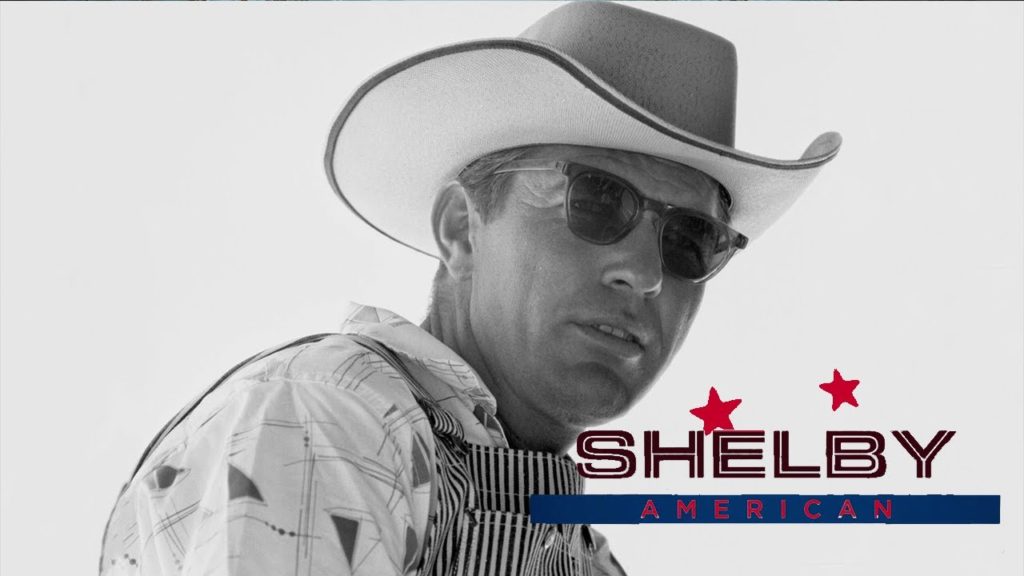
With a subtle nudge, I convinced my wife that she shouldn’t see “Ford v Ferrari” until she’s learned more about Carroll Shelby‘s legendary past. Carrying with that a strong recommendation from member Don C to also watch the documentary first, he said, “Shelby American fills in all the gaps the movie didn’t cover, you need to watch it!” – “Shelby American” covers the entirety of Shelby’s life from birth-to-death: his early days of racing, wins & losses, chicken farming, LeMans, development of the Cobra, entanglements with Ford and Ferrari, chili cook-offs, Vipers, his 7-10 wives, and the return to Ford. #texas #murica #becauseracecar.
Verdict: Don C was right! – “Shelby American” does follow a very typical documentary format, it’s 1hr, 58 min of archive footage + eyewitness accounts used to tell the entire story. But one key difference is that it also featured Carroll as the narrator throughout the film. My wife asked at one point, “How come we hear him, but never see him? When was this recorded?” A valid question considering the film debuted in 2019, and Shelby took the checkered flag in 2012 at the age of 89. The film does focus heavily and specifically on the events between 1962-1967, which is perfect if your next jaunt is (re)watching “Ford v Ferrari.” Overall, the film was a perfect retelling and homage to a great racer, and a greater man.
A life of speed: the Juan Manuel Fangio Story
Leaving “Fangio” as our last film was no coincidence. Even though my wife was a “Foreign Languages Major” in college, once she realized a good portion of the film was in Spanish (with English Subtitles) she said “let’s save this for when I can really pay attention.” – Unlike the other 2 films, there is no narrator or guide, it opens with a reenactment of Fangio driving his Chervolet Coupe during the Gran Premio del Norte (a race that runs from Argentina to Peru) while Sir. Jackie Stewart (Formula 1 champ ’69, ’71 and ’73) covers Fangio‘s early days. The film then switches to archive footage of Fangio (most likely recorded in the ’80s) recounting his rise to become a 5x Formula-1 Champion, during 1949-1957.
Verdict: Of the three, “Fangio” is the shortest film with a running time of 1hr, 32 min and keeps with a more traditional documentary format where the archive footage is our only way of moving the story forward. There are good portions of the footage that are still in black and white, or low quality, and others you could tell were filmed in the early days of color or carefully remastered. Peppered throughout the film you could feel Sir. Jackie Stewart’s influence as he continues to advocate for driver safety and how racing has evolved over the years. The producers help transition the content by breaking up Fangio‘s story telling with interviews with people like: Alain Prost, Mika Hakkinen, Nico Rosberg and other F1 champs. Most of this modern footage was used to create a “then vs now” and “what if” arguements, but in the end the consensus was always the same: Who is the best driver in F1 history? … Fangio.
With ample time on our hands, it definitely makes for some long days and even longer nights. But with films like DeLorean, Shelby and Fangio to break up the evening, it was a much needed respite from “the normal shows” we’d usually watch. Admittedly, documentaries aren’t everyone’s cup-of-tea. In part, because of the content but also because of the way they are assembled. However, the newer style documentaries come off as “part news and part movie” making the overall viewing experience better, keeping the audience engaged and even incorporating some laughs. All three of the films mentioned here were a great way to share some time and Motorsports history with the family as well as spawning some great Q&A discussion. #movienight.
Tune in everywhere you stream, download or listen!
If you recall, Season-1 ended with the sale of the ’54 International COE and ’55 Lincoln Futura for a whopping $170k! That allowed Mark Towle and the Gotham Team: Shawn (the wheeler-dealer), Tony (the machinist), Caveman (the mechanic) and Constance (the engine builder) to expand Gotham Garage to a second shop (also located in Temecula, CA) to help give them more space to work and grow their projects – “double the room, double the efficiency” as Mark says.
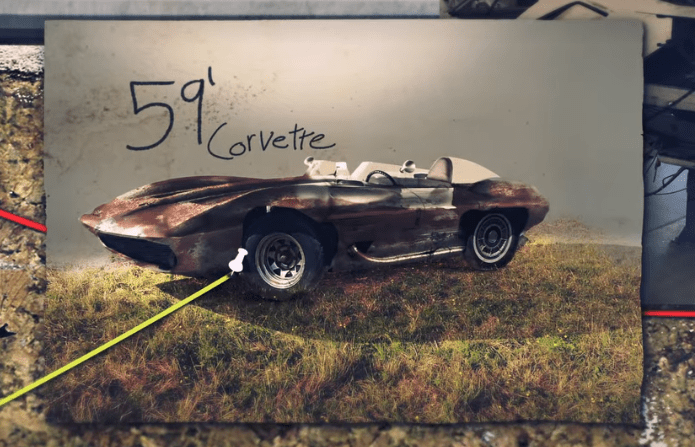
Season-2 ditches the “red paper clip” idea from Season-1, and goes for a straightforward “upgrade and trade” approach. Car Masters packs the entire season into eight easy to digest 30 minute episodes. The season kicks off with ’53 Buick “sleeper” Specialand a goal of obtaining “the big pay day” with a ‘59 Corvette Concept, but plans are quickly derailed by a series of unfortunate events starting with a wreck and a couple deals gone wrong.
Electrified
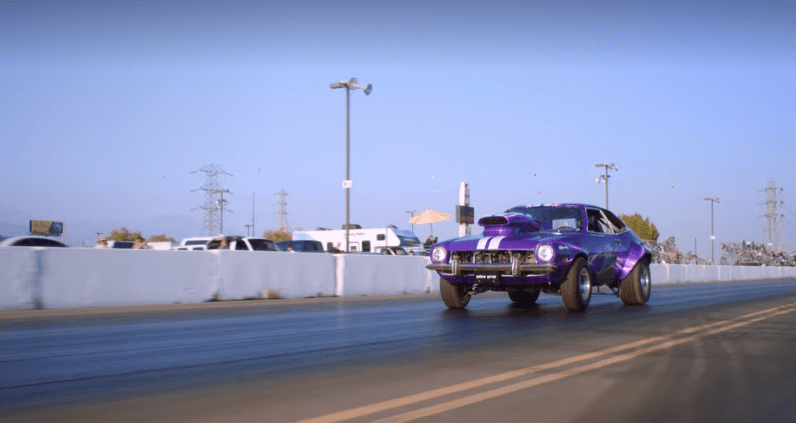
Much like Mark, I’m not the biggest fan (yet) of electric vehicles – and when he was presented with the challenge to build an all-electric drag race car, encased in the shell of a ’73 Ford Pinto for famed Indy-car team owner and Roadster Hall of Fame winner Gil Losi (below), how could he say no, right?
With a budget of $50k and a time to beat of less than 9 sec in the 1/8th mile, the team got to work. Despite being a Pinto, and despite being electric… the build was probably one of the most fascinating of the season including things like: tandem-motors, tesla batteries, electro-luminescent paint, and more. In the end, the “eRacer+” as it was badged by the team, put down an astounding and silent 1/8th mile run of 7.80 sec on its FIRST PASS! The team handed over the keys to Gil for $75k and rolled their profit onto the next set of projects including:
Custom Harley “Bagger”
’69 Ford Mustang Mach-1 “wide-body”
Custom T-bucket “Wedding Coach”
Bob Anziano’s, Viper powered 1948 Buick Roadmaster “Chop-top”
Retro-inspired Chevy Astro “band-conversion” Van
35′ twin-engine “Corvette Boat”
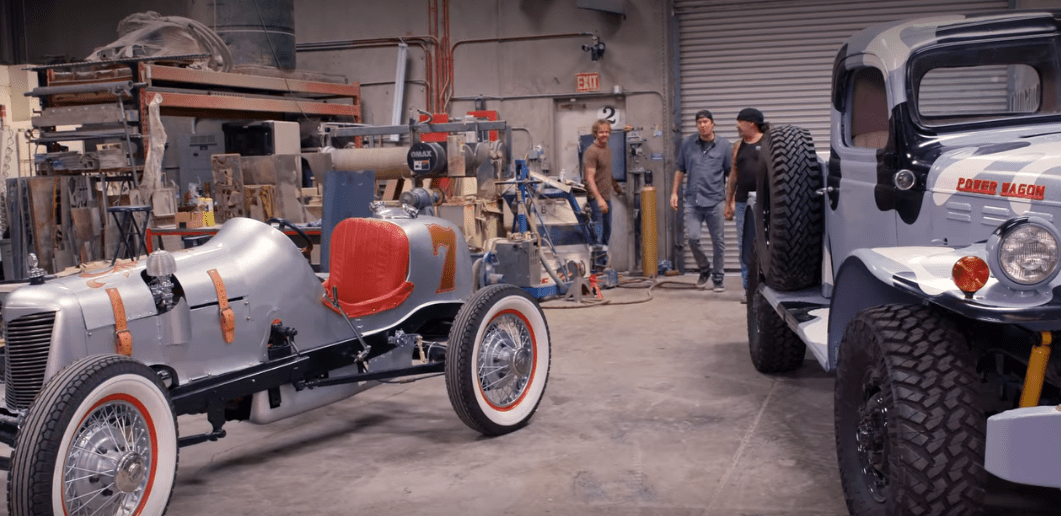
1930s Ranger-powered Ford sprint-racer
24 hrs of Lemons Chrysler Sebring “shark car”
Reskinned
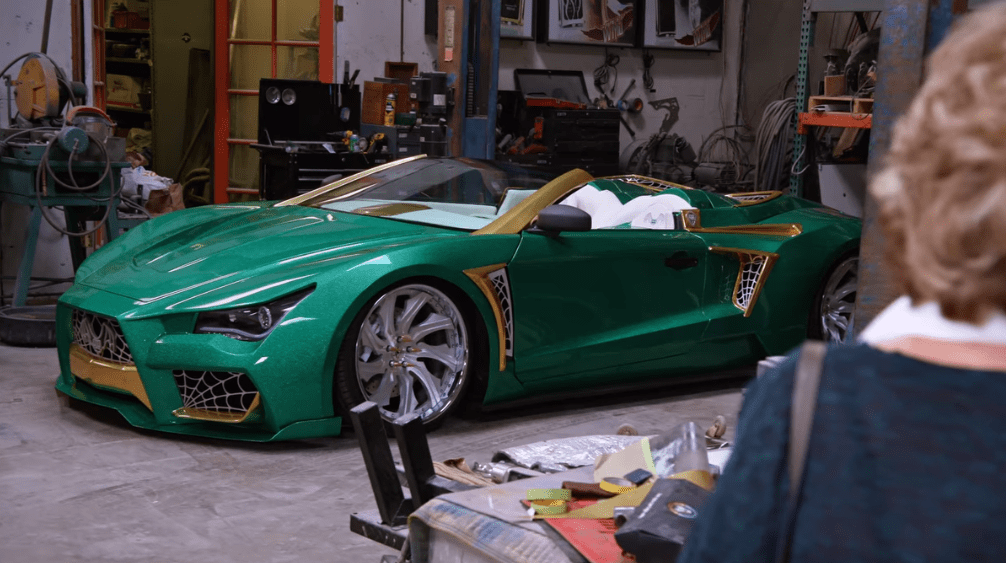
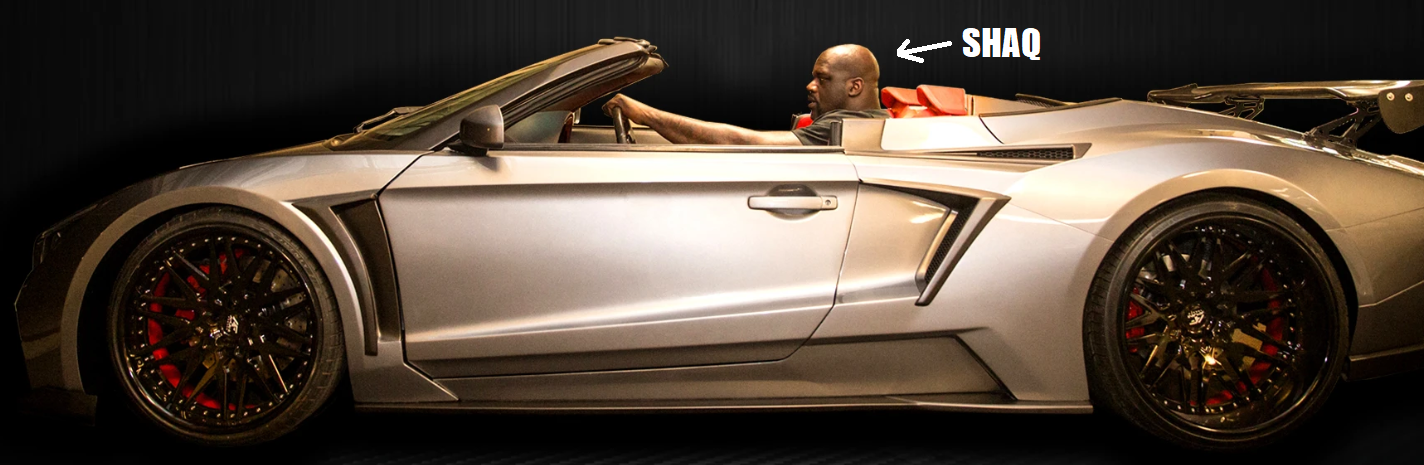
Although not my first choice in color schemes, the “VAYDOR” kit-car** (above) which the team acquired after selling the Corvette-boat was another complicated but engaging build. The Vaydor is designed as a “reskinning kit” and lays over top of a mid-2000s Infiniti-G35. I found this fascinating because my assumption was that all kit cars, were just that… a kit you turned into a car – everything you need in ONE box – like a Caterham!
In the case of the Vaydor: you buy yourself a running G35 for about $8k and the Vaydor kit for $11k, and spend the next 6 months or so carefully removing everything outside of the drive-train, suspension and framework. Then jigsaw puzzle all the pieces together (with no instructions, because you lost them) from the shrink-wrapped pallet until you end up with what looks like a European hyper-car and sell it for $80k. #howhardcoulditbe **for more details on the Vaydor, check out their website vaydorsupercar.com #shaqsgotone – LOL.
Package Deal
As I mentioned earlier, a series of unfortunate events, and deals gone wrong set the season on an entirely different trajectory than originally intended. The ’59 Corvette Concept, was no more, but in a way that wasn’t necessarily a bad thing. There was a new “big pay day car” on the horizon but it was a long reach to get there. A reach that included setting up a 2:1 trade. In order to get to their final project the team simultaneously restored a Pre-war (1930s) Sprint Racer and a 1947 Dodge Power Wagon (seen above) using both shops. Unlike other builds both vehicles where kept quite austere. It was good to see that not everything had to include skulls and spiderwebs, as these vehicles were tasteful remixes of their original forms.
The XNR
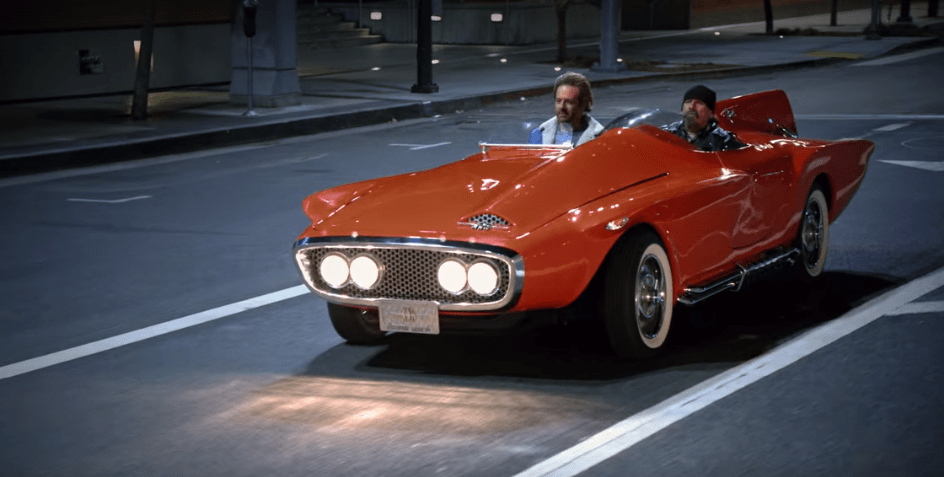
Its OK if you’ve NEVER heard of the 1960 Plymouth Valiant based “XNR” Concept Car, because not many other people have either. The original XNR was built by Virgil Exner (see also: Stutz Blackhawk) as a one-of-a-kind asymmetrical roadster. It was moving art, designed to show-case the abilities and the future of Plymouth. If you look at it with one eye closed and off to the side, you can start to appreciate some of the XNR’s unique qualities. And at first glance, you might even recognize that it’s really a single-seater with a side-car… on a 106.5″ wheel base.
Why the XNR? Just like the end of Season-1 with the Lincoln Futura build, this XNR was a build no one else had ever been successful at attempting let alone completing, until the team at Gotham came across a gentleman named “Adam” from Vermont. He claimed to have obtained the original blueprints for the XNR, recreated the molds, and fabricated exact replica body panels laying them on top of a 1960 Valiant, just like the original. Adam, unfortunately, didn’t have the resources to continue the project any further and agreed to trade the XNR to Gotham in exchange for the Ford Sprint Racer and Dodge Power Wagon mentioned earlier.
The team made quick work of getting the XNR completed. Now they were faced with a larger dilemma: Sell the car to any number of private collectors for nearly $200k -OR- donate the car to the Peterson Auto Museum in Los Angeles for all the world to see?
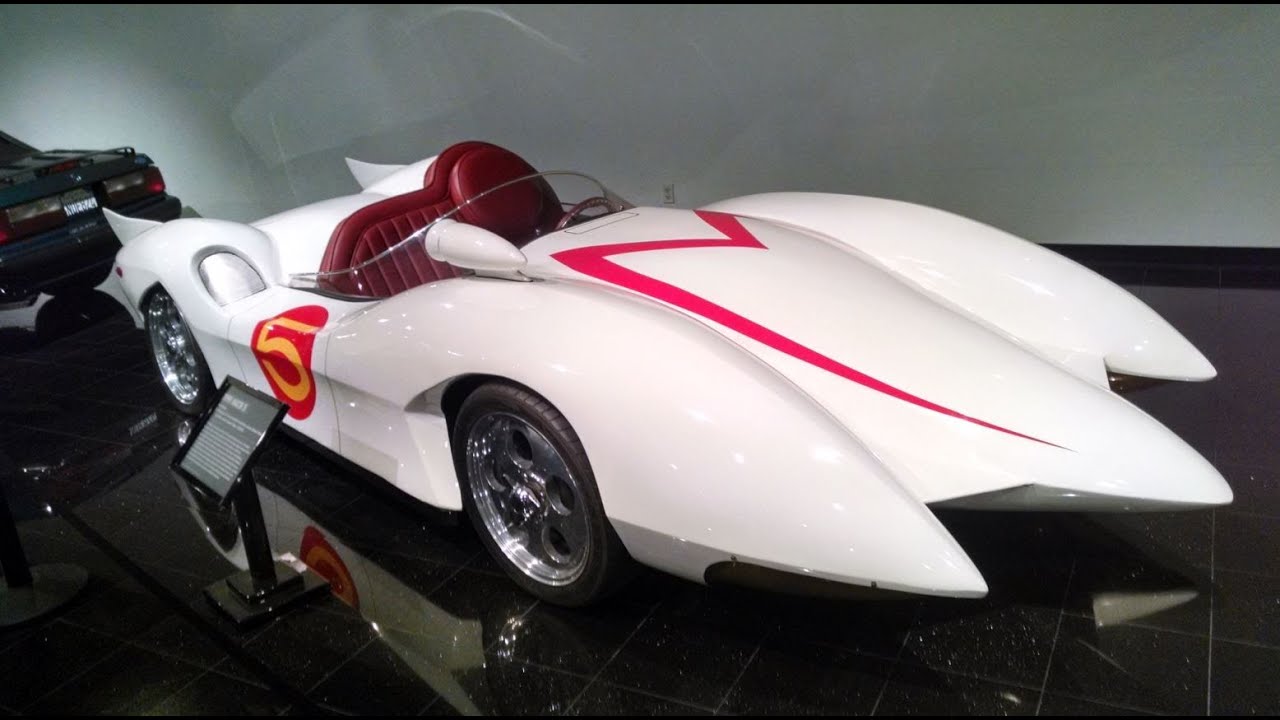
Amidst all that drama the team ultimately decides to bring their XNR build up to “museum quality” and park it alongside Mark Towle’s other entrant from 20 years ago: the C4 Corvette based Speed Racer “Mach 5” replica (above). This would make Mark part of an elite group of car builders to have more than 1 vehicle featured at the Peterson. #congrats
I’ve said it before, I’m not a huge fan of reality television, but my affinity for Car Masters and many well crafted RUST-oration shows in the last few years has grown significantly. I anxiously awaited the return of Car Masters, and even though Season-2 felt a little more produced (at times), it didn’t loose its overall charm or appeal. I was really happy to see the team still together, and their work is nothing if not engaging and top-shelf quality. In the end, the Gotham team didn’t get “the big pay day” they originally hoped for, but I actually think they got something more. The notoriety that is going to come from the XNR build, along with having a vehicle in the Peterson, moves them way up the ranks. I’m really curious to see how this will effect Season-3 of Car Masters… But let’s not wait until 2022 to find out,ok – Netflix?
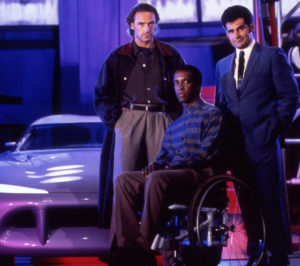
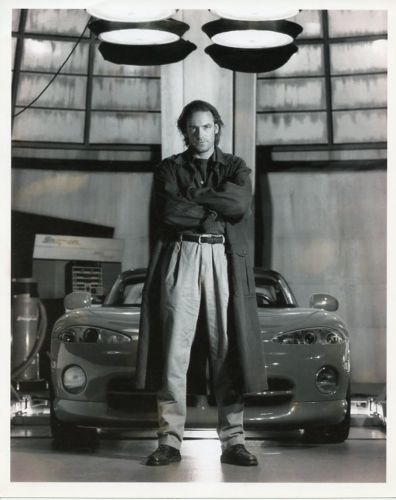
Thomas Magnum solves mysteries in a Ferrari 308, Doc Brown time travels in a DeLorean DMC-12, The Duke brothers outrun Roscoe daily in a Dodge Charger, Colt Seavers soars to new heights in his Chevy C10… the list of iconic “boys and their toys” from the late ’70s through the early ’90s is extensive and memorable. But did you know that Joe Aster had a Viper? Probably not.
I can just imagine the board room discussions at the Chrysler Corporation, Lee Iacocca behind his desk, saying something to the tune of “Ok folks, this is my 2nd time at bat here at Chrysler, I’ve green lit the skunkworks project with my dear friend Carroll Shelby to build the Viper, but we need a way to launch it with a bang!” – The early ’90s economically, wasn’t the best time to introduce a sports car into the domestic automotive landscape. America was still recovering from a recession and people weren’t really interested in “a muscle car” anymore. As many of you all will recall, most of the offerings from the ’90s were just mobius blob-like shapes that barely outperformed their ’80s sub/compact cousins. The cars were heavy, bland and generally under performers – the automotive equivalent to a vanilla ice cream cone melting in the summer. Until the Viper.
Back to the board room… post-meeting an intern walks up to the CEO and says something like: “Mr. Iacocca sir (voice cracking)… What if we created a show around the VIPER? … I was always a big fan you know… of cop dramas, maybe something along the lines of Knight Rider? And we can use all the new products as extras on the show. It worked for GM, right?” – a complete fabrication, but the origins of the partnership between NBC and Chrysler to create VIPER (the show) are still a mystery, but one thing is clear: Chrysler was sponsoring the project in a big way.
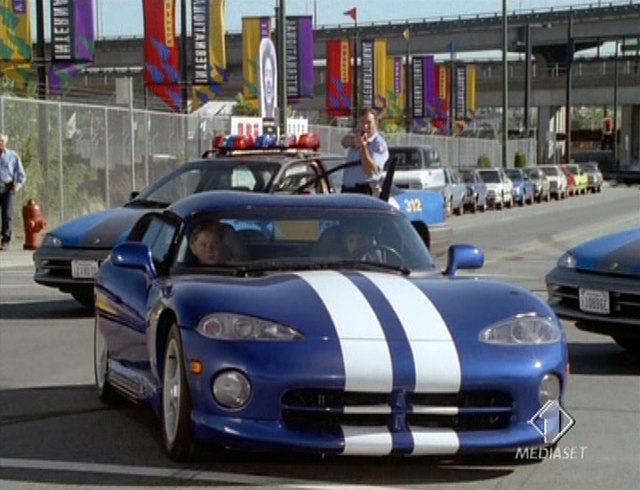
I distinctly remember when this show piloted -on air- in 1994 on NBC. That night, sitting around the family room with my parents watching the 2-part premiere, is when I fell in love with the Viper (the car). Seeing it for the first time and hearing that distinct V10 engine note, it was the coolest thing to come out of the Big-3 in a what seemed like ages. Posters immediately went up on the wall, model cars were purchased, it became a passion.
So what about the show? – Unfortunately, because VIPER aired in the evenings – unlike Magnum PI which I’d watched religiously after school at 4pm – I wasn’t able to catch the show on the regular, but I tuned in when I could. After the show ended in 1999 it all but vanished, not even the bargain bin at Blockbuster or FYE had any trace of the show. For decades now, I’ve been trying to find a copy, rekindle that spark, and more importantly… see how the story ended! I managed to get my hands on a poorly digitized VHS version of the pilot episode from a friend and have hung on to it like a prized jewel. With more modern technology, I’d set up google and amazon alerts to ping me about any new mentions of the show. Outside of some bootleg German voice-over copies, nothing official has ever surfaced, until a couple weeks ago…
You bet I overnight prime shipped that bundle and couldn’t wait to dive in!
After binge watching all 80 episodes, I can honestly report that VIPER went through several serious evolutions. Looking back it was quite unclear that the show would make it past the pilot. But NBC was able to squeeze out another 10 episodes in Season-1. Where our hero “Joe Aster” formerly known as Michael Payton struggled with forced memory loss and went from high profile criminal wheel man for “the syndicate” to justice crusader overnight, now working for “metro city’s metropol special projects division” code-named: Project VIPER.
The plot of Season-1 was much like that of Knight Rider, almost to a “T” (as in Targa Top). Though the Viper doesn’t talk to Joe like KITT, he does have a guardian angel in the form of the vehicles developer Julian Wilkes that speaks to him through satellite uplink. Julian can be easily compared to a combination of KITT and Devon. Frankie X. Waters the “comic relief” is brought in to play the equivalent to Bonnie (KITTs technician). Unlike KITT, the VIPER can “transform into an armored assault vehicle” known as The Defender (seen further below). Disappointingly, by episode 3, Joe/Michael had regained more than half of his memory, and used his stash of cash from his previous life to buy an abandoned power station, stole the Viper and setup a new HQ for the recently“disavowed” VIPER project. This gave VIPER a very “Batman-like” quality as Joe would drive in/out of the basement of the station, usually in the evening, and head into town to save the day.
The Defender
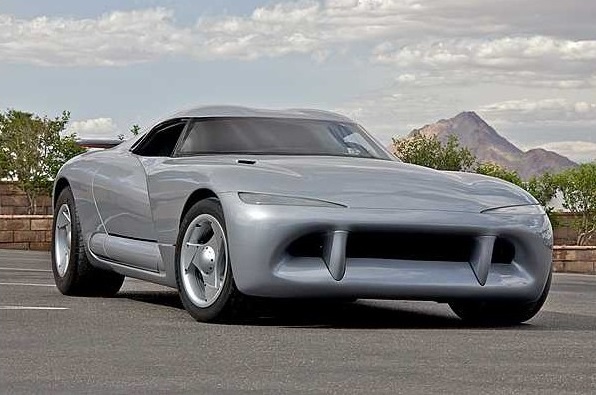
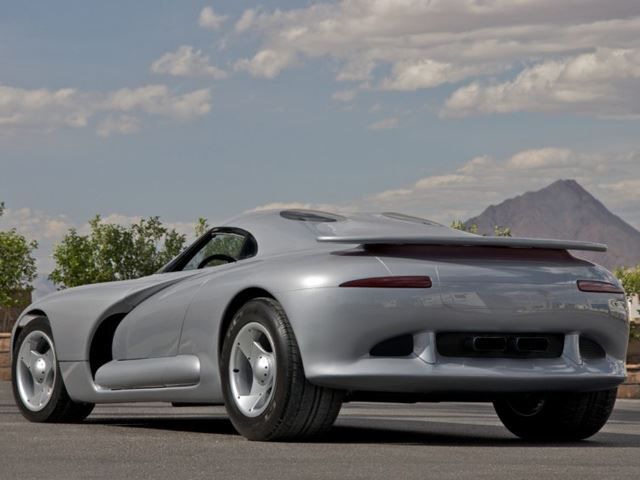
In real life, the Defender is one of the last “specialty built” vehicles for TV not unlike the Lincoln Futura based Batmobile, the Coyote from Hardcastle & McCormick or the AC-cobra powered stretch T-bucket called “the Munster-mobile”, and others. The exterior design of the Defender was created by Mike Sciortino (and the team at Unique Movie Cars, Hollywood, CA), though fans at the time believed that the Chrysler company built the Defender concept. ***7/2022 – NEW INFORMATION AVAILABLE!***
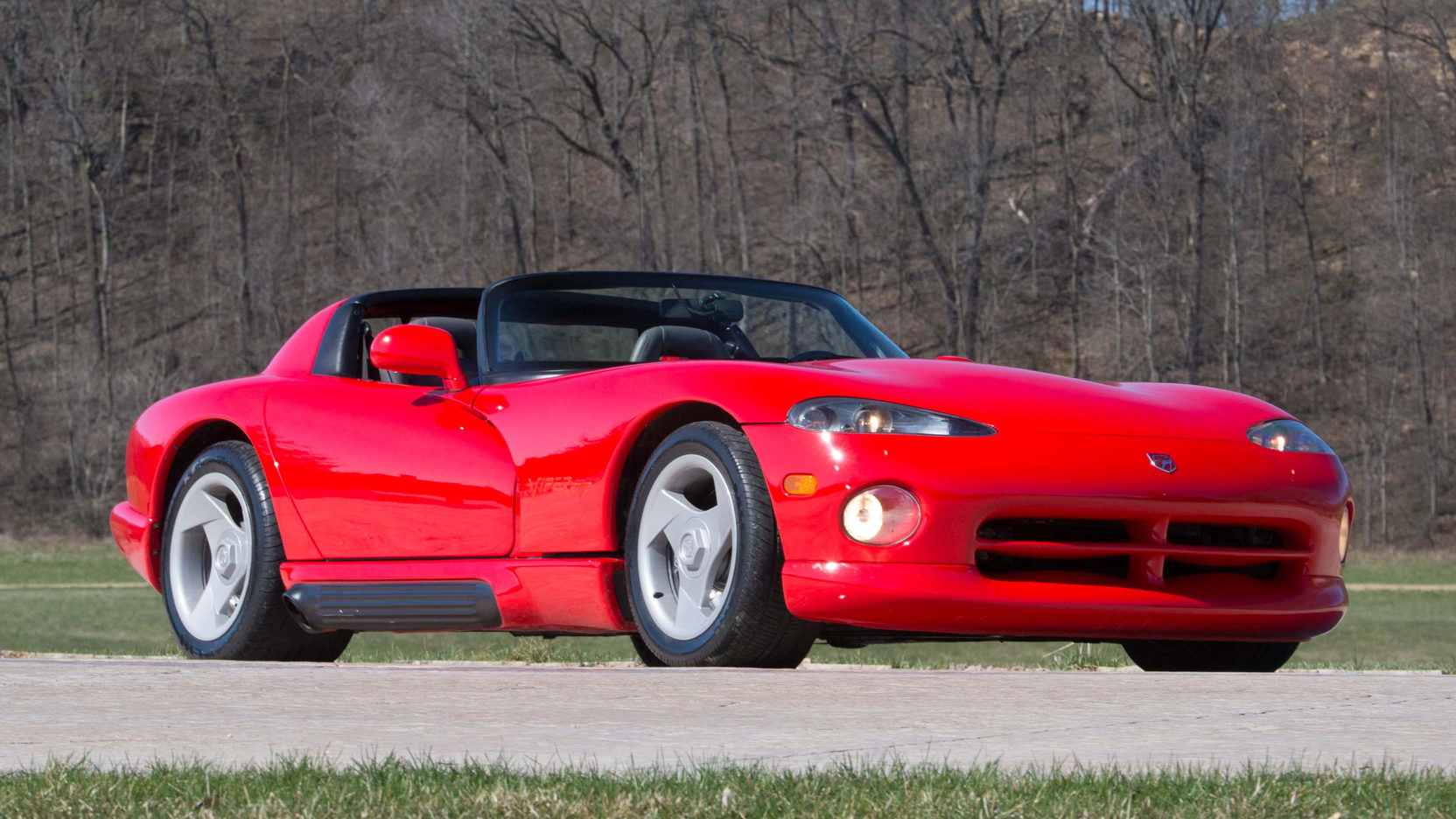
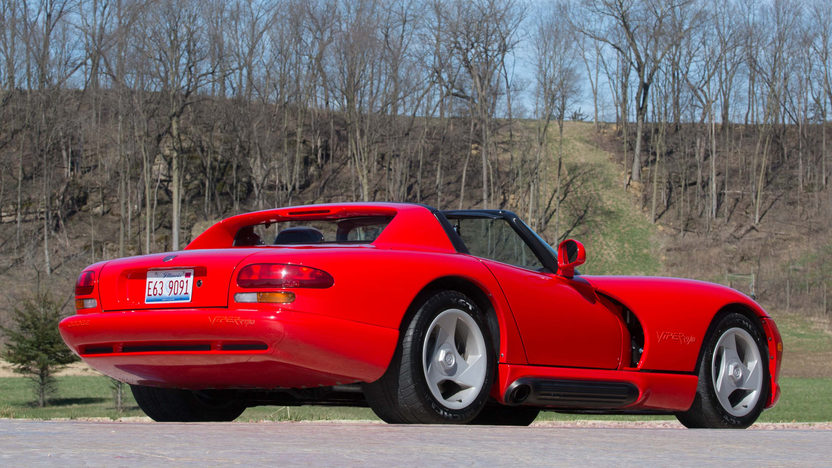
That being said, the Defender IS a re-skinned version of a production Viper RT/10 and its design queues seem to have foreshadowed the idea of the “Viper GTS Coupe” which didn’t make production for another 2 years (1996). To make the Defender feasible as a KITT replacement means that the show is packed with CGI-magic that was on par with NBC’s other SciFi offering at the time: SeaQuest DSV. The “transformation” sequences between Viper & Defender-mode were revolutionary for the time, with the Season-1 special effects reported to cost $50k each time the car morphed. (later seasons utilized CGI more heavily which reduced cost). More importantly, the “remote activated drones” as seen coming out of the trunk were ahead of their time by about 20 years.
When seen side-by-side, the Defender design is actually shorter than the production Viper, and also wider in the rear giving the car an even more aggressive and staggered look. The overall height of the Defender is lower, with a shorter windshield and the added hardtop which gives the impression of being a “smaller vehicle”. The Defender retains the signature door shape of the base Viper while most other aspects of the car were changed. You’ll also notice that the Defender comes with a staggered tire package as well, where the rear tires have a much higher aspect ratio than the front. Designers needed to modify the Vipers handling characteristics to better meet the needs of the many pursuit scenes in the show.
Defender mode includes:
Poly-morphic hexagonal armor plating
Bullet proof glass
Body armor is “fire resistant”
Remote control drone with video surveillance, infrared, talons and laser cutting tool
Side mounted multi-purpose “cannon” including small round machine gun, flamethrower, EMP, and miniature tactical missile (Season 1)
Satellite communications with “hands free” speech.
On-board computer system tied into Viper HQ mainframe
Off-road mode with instant 8+ inch lift and transformable tires (knobbies)
EMP fed “boost mode” added in Season 2
Rocket propelled Grappling Hook adding to side-mount cannon in Season 2
Projectile Netting, Lasers, Rubber bullets (expanding to the size of Tennis balls) and Spider-bombs added to side-mount cannon in Season 3
Hovercraft mode (Season 4)
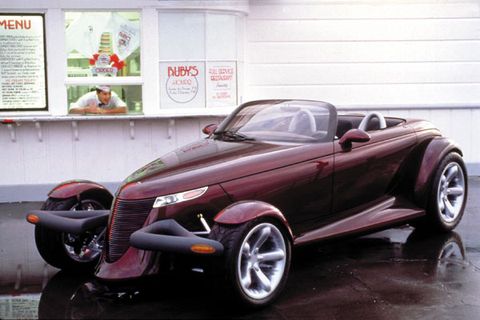
Vehicles seen in VIPER spanned the Chrysler line including models from Jeep, Eagle, Dodge, etc. Common cars included the Cirrus/Stratus, the Mitsubishi 3000 GT based Stealth and the Avenger. Chrysler did a stellar job of also including older Chrysler products in the show. Frankie’s daily is a “Plum-Crazy” HEMI Barracuda (which is later replaced with a purple Challenger R/T). Many of the “disgruntled youths” in Metro City are seen driving around in modified Plymouth Furies, Chargers, etc. Season-1 included all sorts of running/driving Chrysler prototypes as well as debuts of new models (like the Prowler, and first glimpses of the Viper GTS coupe). Paying close attention you’ll see that there is a Chrysler product: new, old and future somewhere in every shot. #productplacement #marketinggenius. Below are just some of the vehicles you might see during Season-1 of VIPER.
Metro City’s mayor drives a Chrysler Thunderbolt
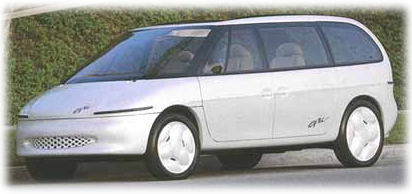
Julian Wilkes drives an All electric Chrysler TE-van
Dodge Aviat Concept
Chrysler Espresso
Chrysler Chronos
Chrysler DX
Chrysler 300 Concept
Plymouth Prowler
Viper GTS Coupe w/ Eagle Premiere (aka Dodge Intrepid Metropol cars in background)
Season 2 & Beyond
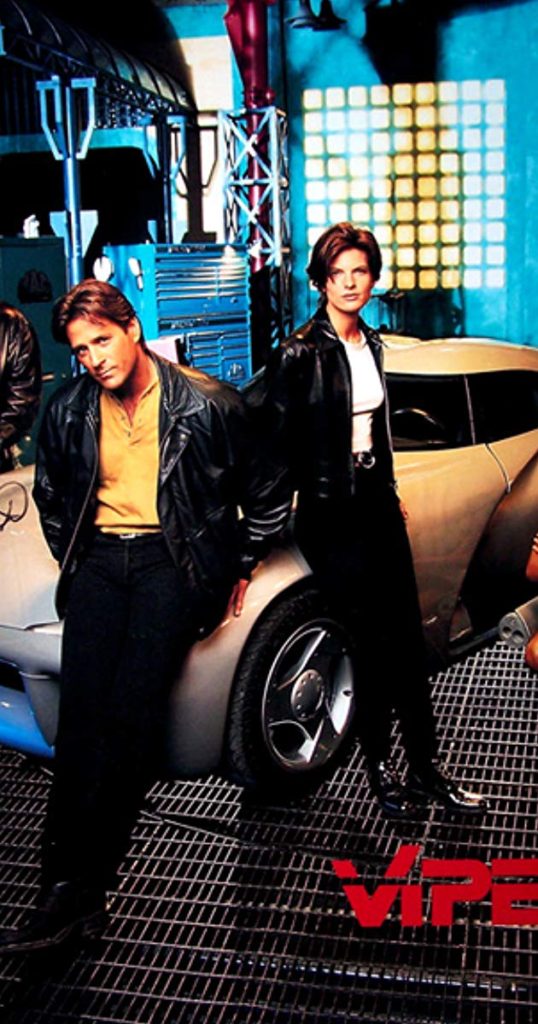
Just as the story of Joe Aster was unfolding, Season-1 ends abruptly – NBC cancelled the project and sold it to Paramount Studios who picked it up for the 1996 UPN season. VIPER resurfaced with a new premise and a new team (seen in the clip above). During the first episode “the Feds” explain away Season-1 as an “earlier attempt” and Julian’s role by saying he was transferred to Washington to work on another special project for the government “of the utmost national security.” While Joe Aster’s disappearance was completely glazed over, he is referred to once as “the former driver” in that episode. Limited information about the show’s history tends to highlight disagreements with the actors, studio… typical Hollywood. #highlander2. Meanwhile, the all-male cast was replaced, except for Frankie who was retained and promoted to VIPER mechanic. VIPER HQ was moved to an underground subway facility controlled by “The Feds” (Agent Catlett) with a batcave-esque turn table and tunnels quickly leading to all parts of Metro City.
Joe Aster was replaced by Thomas Cole, former CIA agent and Secret Service “driver.” More importantly Season-2 introduced two female leads. Instead of being a team of one, Tom was quickly partnered with Det. Cameron Westlake after a traumatic downtown shootout involving an attempt to create some “arch-enemies” that would have longer story arks in the series (but ended up being a bust and never went anywhere). Julian was replaced by Dr. Alley Farrow, taking over the VIPER project and introducing new “Inspector Gadget” levels of tech to the Defender.
Season-2 was a bit of a reboot, and a let down.The show filmed in Canada as a backdrop for the neo-futuristic post-apocalyptic California-based “Metro-City” but more often than not, it was raining which made shooting action scenes with the Viper more challenging than expected. It was amusing to see the stunt drivers trying to keep the car constantly under control, and there are even a few “J-turns” that don’t end well. There is definitely more than one driving scene that was chopped up and left on the cutting room floor. The show also recycled actors from Season-1 and reintroduced them as “new villains” while incorporating some lesser Hollywood stars as victims, making cameos while attempting to boost the shows ratings.
The VIPER formula became super simple: Get a report of a criminal activity, set off in pursuit, use the Defender and it’s plethora of gadgets to stop said baddy, fight/argue with “The Feds” about how the mission was carried out. Go back to HQ. Lather-Rinse-Repeat. – Still sounds like Knight Rider, right?
After a rather flat 22 episode Season-2, VIPER was surprisingly renewed for a 3rd season. And as you can see from the intro more of the same, but the team was downsized. Alley was removed with little explanation, and now Frankie was completely in charge of the vehicle and it’s gadgets. By this point the VIPER projects progress had plateaued which meant nothing new in the way mods to the Defender – because Alley had sorted all that out in Season-2, right? To combat the lack of imagination, the writers took on more of the “global terrorist and corporate espionage” vibe instead of focusing on saving Metro City and its citizens “from evil.” VIPER was moving deeper into “Fed control” with Agent Catlett taking on a larger role and handing out the missions the VIPER team would pursue. Season-3 introduced characters like Billy Denver “the rookie cop,” who had a crotch-rocket motorcycle version of the VIPER that he used to create chaos for the VIPER team and temporarily play that “Robin-style” sidekick. (sigh)20 more episodes…
The prodigal son returns…
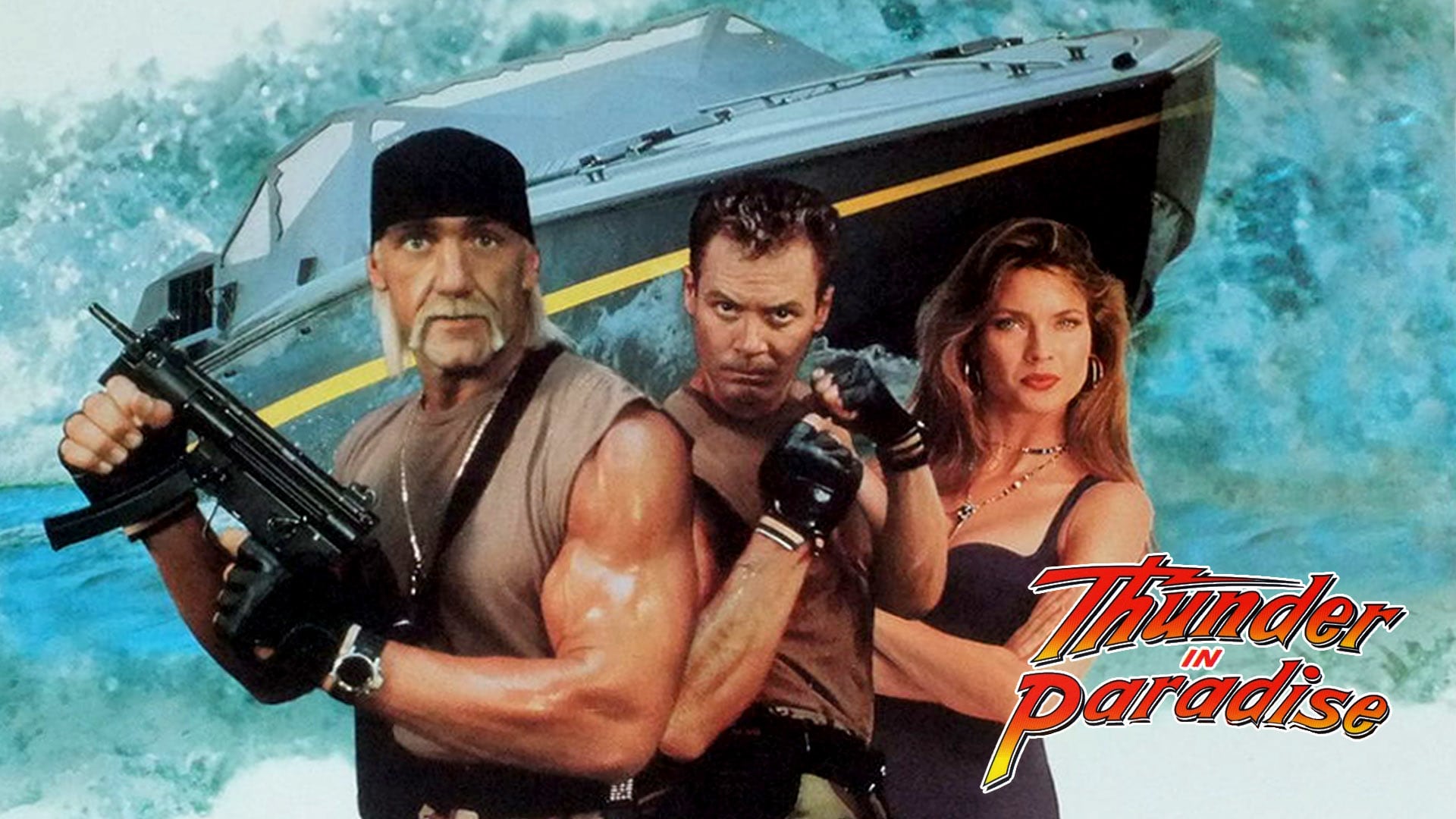
It’s obvious from the Season-4 intro (above)… that the writers went #FULLSEND and must have been working on Terry ‘the Hulk’ Hogans “Thunder in Paradise” at the same time (below). But in reality, UPN sold VIPER back to NBC in 1998 and tried to pick up where they left off. Brothhhherrrrrrr! the Defender can jump like Fall Guy and swim like the Bat-boat. #hulkamania #crazyness. OMG. LOL.
“Alright, who blew up MY car!?!” – exclaims Joe Aster as he reemerges to lead Season-4 of VIPER –woot!- and along with Joe came the return of Julian Wilkes to introduce the replacement for the classic red Viper targa. The new VIPER is a blue GTS Coupe with the signature 3-spoke targa wheels swapped on for consistency when it transforms into the same Defender shape we’ve come to appreciate. Thomas Cole was out (“permanently reassigned to the CIA” was the explanation used in S4:E1), and the team retained Cameron and Frankie for the final hoorah. Sadly, in order to justify keeping Cameron on the team, they changed Joe’s character from lone-wolf crime-fighting vigilante to a bumbling Luddite incapable of understanding the VIPERs advanced systems for the entirety of the Season. #justadriver#fail.
Outside of the Season-4 premiere, the only episode(s) that really mattered was the 2-part Series finale titled “Split Decision” where the writers decided that a 90 minute – “bottle episode” – recycling much of the original footage from the pilot was an appropriate way to end the Series. In the end, all of Joe’s memories of being Michael Payton are painfully restored, and he’s faced with a decision “which man does he want to be: Michael or Joe?” – If you couldn’t have guessed it, he rides off into the sunset with Cameron who asks in the final bits of dialogue: “I can’t believe Catlett let you take the car?!?…” to which Joe replies “He didn’t, I stole it.”#exitstageleft #takeabow #rollcredits.
Now that I’ve carefully studied the show, the complete story, and removed my long-time rose-colored nostalgia blinders. I can honestly say, VIPER is period appropriate, it has all the troupes and cliches of the era. But it also *had* tons of potential. Unfortunately, that potential was lost somewhere at the end of Season-1 when the show suddenly pivoted on its heels, softened its suspension, and it was never really ever able to recover.
“Remembrance of things past is not necessarily the remembrance of things as they were.” – Marcel Proust
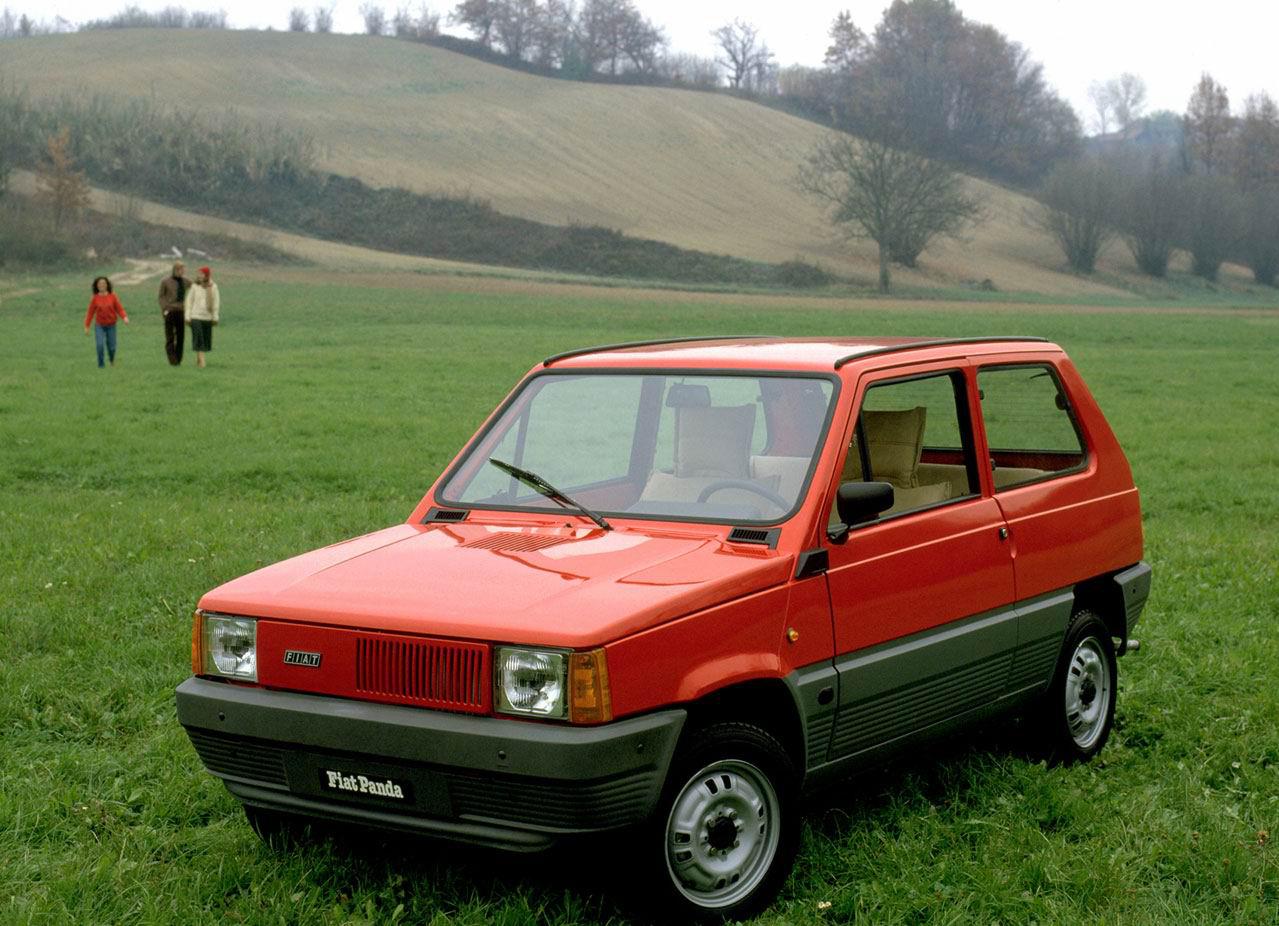
The Viper (the car) on the other hand, I will continue to argue is one of those designs that can’t be dated. Coming from an period in Automotive design full of cookie cutter, plain-yogurt styling, seeing a 1st-Gen Viper in person… it’s intimidating and gorgeous at the same time, much like the original Cobra that inspired it. It really was Shelby’s swansong, a true masterwork. And much like Tania M’s article on the Fiat Panda, I want one. BECAUSE.
If you’re in for a good laugh, countless burn-outs, and a retro scifi-esque cop-drama, then I can’t recommend VIPER enough.
So many burn-outs! #killsallthetires #merrymotoring.
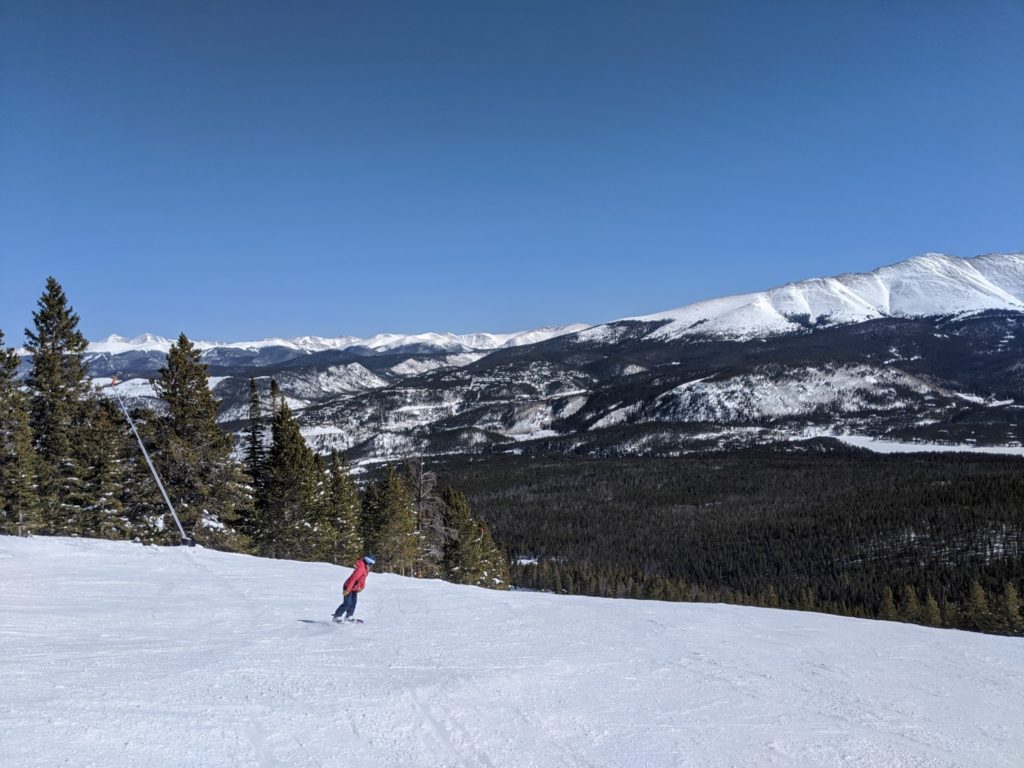
The mountains called, and of course I picked up the phone. Destination: the Centennial State – Colorado, to partake in some recreational snow sport – aka skiing! #skiclub.
Its been many years since I’ve returned to Colorado, especially for skiing, it eventually had to happen. What always seemed to be off-putting is the distance from Denver to the resorts. 2-3 hours isn’t really that big of a deal… as long as the atmospheric conditions are favorable. The first trip I ever took fared pretty well on the drive in. It was a late arrival which meant rental car choices were scarce, and all the four wheel drives were gone. The only vehicle left was actually a 2014-ish VW Jetta wagon (at least it had plenty of space for 4 passengers + multiple skis in the trunk). Car in hand, the group headed to the mountain arriving in the wee morning hours with a smooth ride. My ignorance was bliss at the time. The ride back to the airport several days later in the middle of the afternoon? Complete 180. Having left the mountain base which was a sunny 70 degrees, it seemed like the drive back would be a breeze.
Unfortunately, Colorado weather can be highly variable across the passes.And a breeze it was not. In fact, there was a bit of a snow storm raging, which closed the highway and diverted drivers (not uncommon) until conditions improved. Luckily I did not have to deal with exiting the highway and sitting in some random rest stop parking lot. However, the drive was a bit grueling, crawling along the highway in several inches of snow and slush climbing up and down grades of 5-6%, in a front wheel drive. Thankfully the hefty VW wagon did quite well and we never got stuck, even having to stop and start on steep hills – the same couldn’t be said for some other FWDs.
>> Fast forward 6 years!
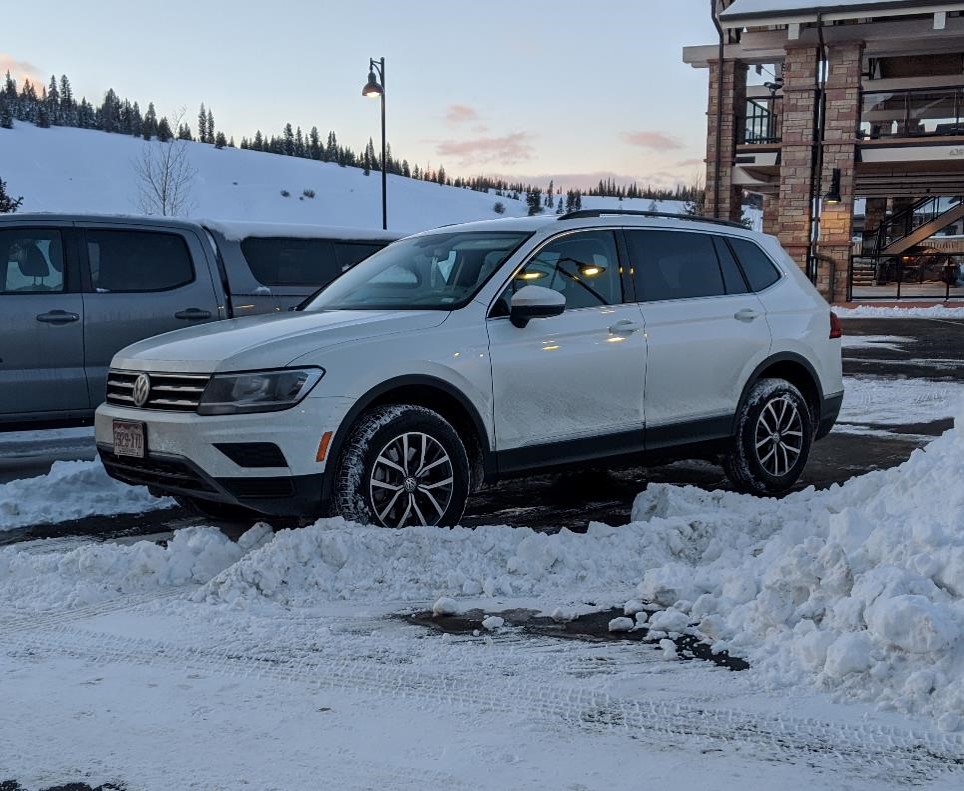
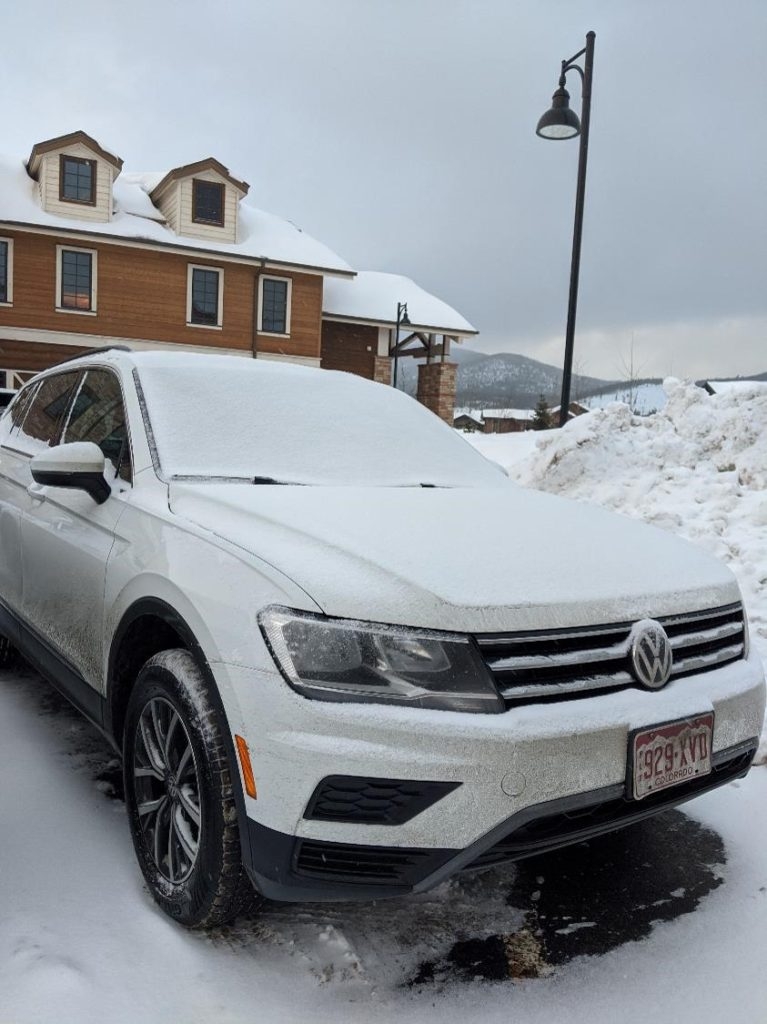
I hemmed and hawed a bit about going to Colorado for this trip and whether to rent a car or use the shuttle system from the airport to the mountain. In the end, I opted for a rental given where I was lodging and my flight times, I wanted the flexibility to be on my own time. Not unlike the last trip, I arrived at the rental car facility hoping for a four wheel drive! Only to be disappointed to see my choices were Dodge Caravan, Dodge Caravan, Dodge Caravan, Nissan Altima… oh wait! – there was a VW Passat! Which I debated for a second, until another traveler swooped it up. Looking at my choices, I was probably going to go with the mini-van figuring “big and heavy” would probably be more helpful in the snow. Disappointed, I stood around waiting for my friends to meet me before completely claiming the burgundy Dodge Caravan. Taking what seemed like an exorbitant amount of time, my friends finally meandered over. We all looked around the lot, shrugged, and said: alright (sigh). Just as I was about to start loading my skis into the van, I took one last look over my shoulder, and “aaahhhhhhh” what a site to behold! A VW Tiguan!? Can it be??
As it passed by to pull into an adjacent spot, the beautiful badge in the back right corner displaying “4Motion” was a siren call. And for those that don’t know, 4Motion is VW speak for “AWD.” I quickly skipped over to the car, pouncing on the employee driving it – “is this available!?!” Indeed it was, and I quickly staked my claim. #emeraldaisle. Beep beep! Let the trip begin!
Before I get straight to the heart of the matter – the good and not so good of the 2020 VW Tiguan 4Motion…
Let me interject a disclaimer. As I’ve mentioned in other articles – I do not daily an SUV, my experiences are all short-term drives by way of rentals, and my current position in life does not necessitate me needing one. I’m quite accustomed and prefer “smaller” hatchbacks for daily use. Can I understand and respect the utility an SUV can bring? Sure.
Its exactly that utility which I coveted for potential snowy conditions in Colorado – heavy, raised off the ground, all-wheel drive. Having said all that, the Tiguan is not actually an SUV, but a compact crossover, known as a CUV. I never really cared for this distinction until driving the Tiguan. It’s a large vehicle – a CUV is still an SUV in my eyes. But, what is the difference you might ask? Quite simply – an SUV uses a truck chassis, while the more compact CUV is based off a car platform.(“Body on frame” vs “unibody.”) What this means is that the compact crossover will perform more like a car and less like a Conestoga wagon. (I kid.)
This differentiation stood out to me – finally – after driving the Tiguan, it really felt more like a car – a large car – and for me, I like that car feel very much. It was comfortable and stable. Cruising around highway bends at 70 mph didn’t feel like you were piloting a water bed ready to hurl you into the adjacent lane. The steering was surprisingly responsive and heavy. The overall ride was not overly soft, nor overly rigid – though, I drive very stiff cars so my tolerance is quite high in this regard.
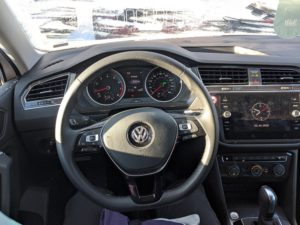
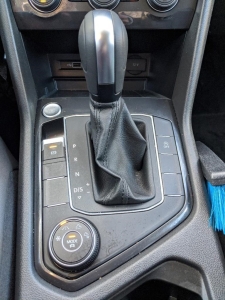
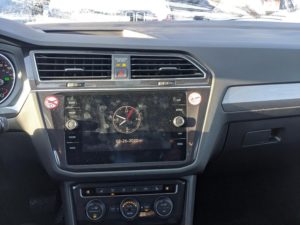
The interior was standard VW layout – simple, but functional.
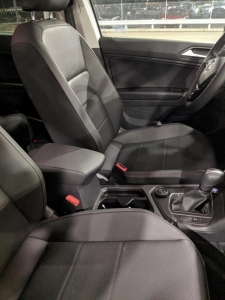
Knobs and buttons were in their “appropriate places” as the VW engineers would say, as well as accessible and familiar – if you’re used to VWs. This particular model was upgraded with faux-leather seats, a nice upgrade from the standard cloth. The cabin space was a perfect size for a person of my stature. I didn’t feel as though I was swimming around. I had just enough room to be comfortable, but not too little to feel cramped. The seats had just enough bolster to gently hug you, giving more of that “car-like” feel.
Visibility was quite excellent whichever way your head turned. Huge blind spots created by poorly designed A, B, or C pillars were non-existent; and the roof-line doesn’t allow for oddly shaped glass serving no purpose other than reducing visibility like you see on many other CUVs.
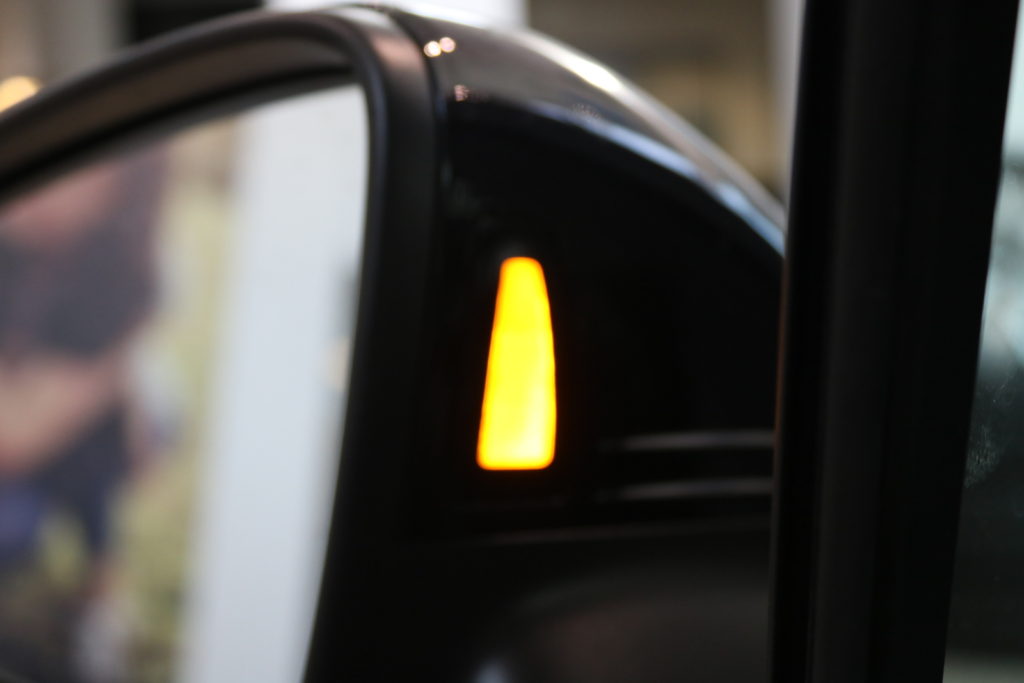
One feature that I thought was well designed were the blind spot monitors. A lot of cars I’ve ridden in situate the tiny indicator light in the side mirror at the end farthest way from the driver. I find myself easily able to filter this light out, at which point, it might as well not be there. Which is fine because none of my cars have this fancy new age technology, so I do not rely on it. However, the engineers positioned the indicator light on the Tiguan on the mirror housing itself and the light is quite a bit larger than what you might be accustomed to on your SUV. I actually found the light to be better positioned for my peripheral vision while managing to not be a nuisance. I would market it as: a subtle glow that catches your attention without eliciting an overt reaction.
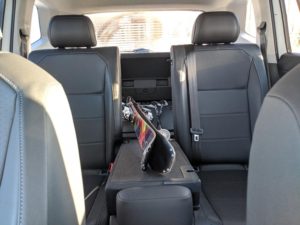
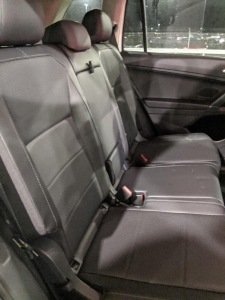
Cargo space was quite good and I was able to take advantage of the folding center section of the back seat to lay my skis nicely in the trunk (below, right) without infringing much on any backseat passengers. What this really means is the Tiguan is designed with a flexible interior, instead of a classic 60/40 split, allowing you to choose which second row seats get folded down – 1, 2, or all 3. For additional passenger comfort, the second-row seats are adjustable forwards and backwards, which is a unique carry over from the original (smaller) Tiguan. The Tiguan also has “third row seating” making it a 7-seater, if need be. Since this would have been 4 more seats than needed on my trip, I never raised the row, and can’t comment on how cramped a passenger may feel back there. All of these interior aspects actually set the Tiguan apart from other compact crossovers which don’t have such flexibility.
The Tiguan handled the snow quite well … even though it may have only been several inches deep.
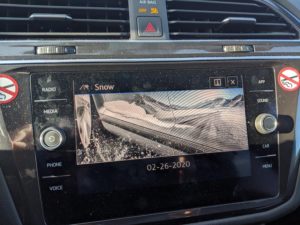
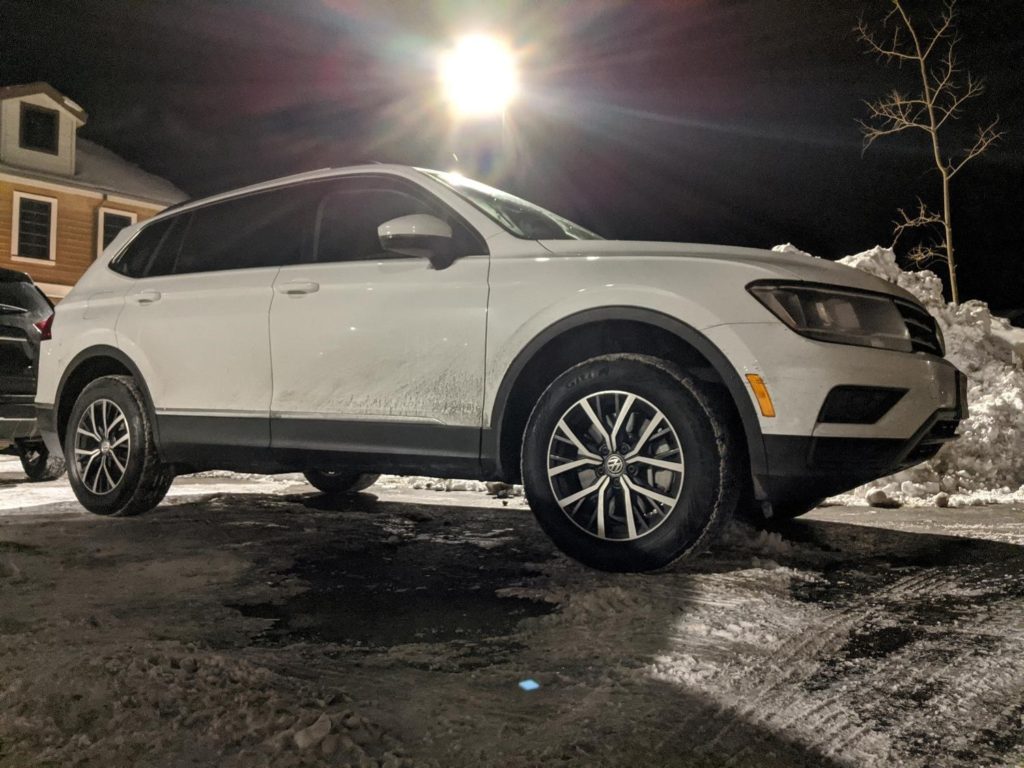
Forward motion was immediate with no slippage. Out of curiosity I did turn the traction dial to “snow” while driving around a bit. As expected, it dials back the application of throttle attempting to save the driver from themselves. Good traction could also be attributed to tires, however, until now I hadn’t heard of the Singaporean brand “Giti Tire,” so I can’t make too many judgments on quality and performance. Overall they felt adequate, however, I never put them through any of “GTM’s type of rigorous testing.” #tracktrucks.
Car & Driver claims fuel economy of 32-33 mpg (highway) for the Tiguan, while EPA puts it around 29 mpg. Apparently, that’s good and beats out rivals in its class. I didn’t track my mileage religiously, but a rough calculation of routes and how many gallons I refilled the tank with, put me at just over 27 mpg. A little down from the stated economy, but then again the “real-worldtest” and EPA testing probably doesn’t account for 5-6% road grades across mountains. So perhaps the big-little Tiguan didn’t do so bad. What surprised me at the pump was that the fuel lid specified a minimum of mid-grade gasoline! Given today’s fancy fuel injection and knock sensors, I was completely expecting regular to be the minimum. But for a small turbo-charged engine, this is better than requiring Premium like in the older VWs I’m accustomed to.
A bit disappointing was the lack of pep in the Tiguan’s step, noticeable through sluggish takeoffs. I never really tried to take off (hard) in the Tiguan, as the sense under normal acceleration was that it just wasn’t going to be that exciting. There’s still plenty to get you up and over posted speed limits, should you so choose. Though the ride was quite smooth and steering felt responsive under highway cruising and in-town meandering, my suspicion is that the body roll would rear its unwanted head with more spirited driving. One could argue “why are you trying to drive it like a GTI?” – That’s not what its meant for.
All in all the car felt like unpretentious luxury. Its not aiming to be a luxury car, but manages to say “I could be if I wanted to be, but let’s keep it real.”
Overall, I rather enjoyed my brief time with the Tiguan. If I were to ever be in the market for a CUV/SUV, the Tiguan would definitely be on my list of considerations. If only it had a towing capacity greater than 1500 lbs… oh well.As tested, price tag for SE 4Motion edition: $28K starting price, Specs: 2.0L turbo charged 4-cylinder engine capable of 184 HP, 221 lb-ft of torque. 8 speed automatic transmission. 3847 pound curb weight.
We’ve all had that something or someone for which or to which we are inexplicably drawn, and when asked “why?” we are stopped in our tracks racking our brain for an answer to that question. At the end of the day, that answer is often simply and beautifully – “because.”Because I am. Because I can be. Because, well I don’t know why, just because!
And that’s my exact answer to why I’m enthralled by the Fiat Panda. “Because.”
Because… of my Italian heritage?
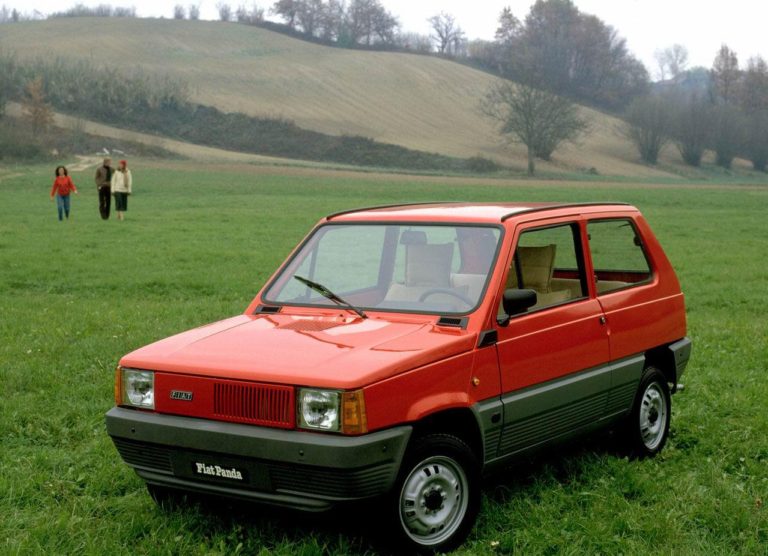
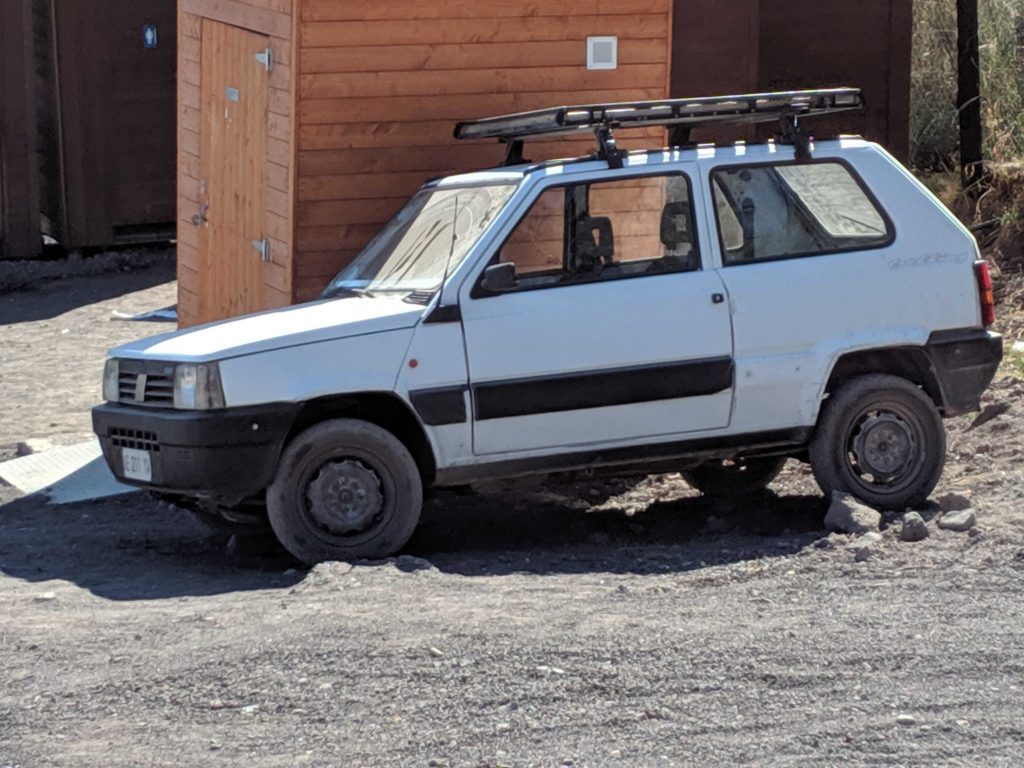
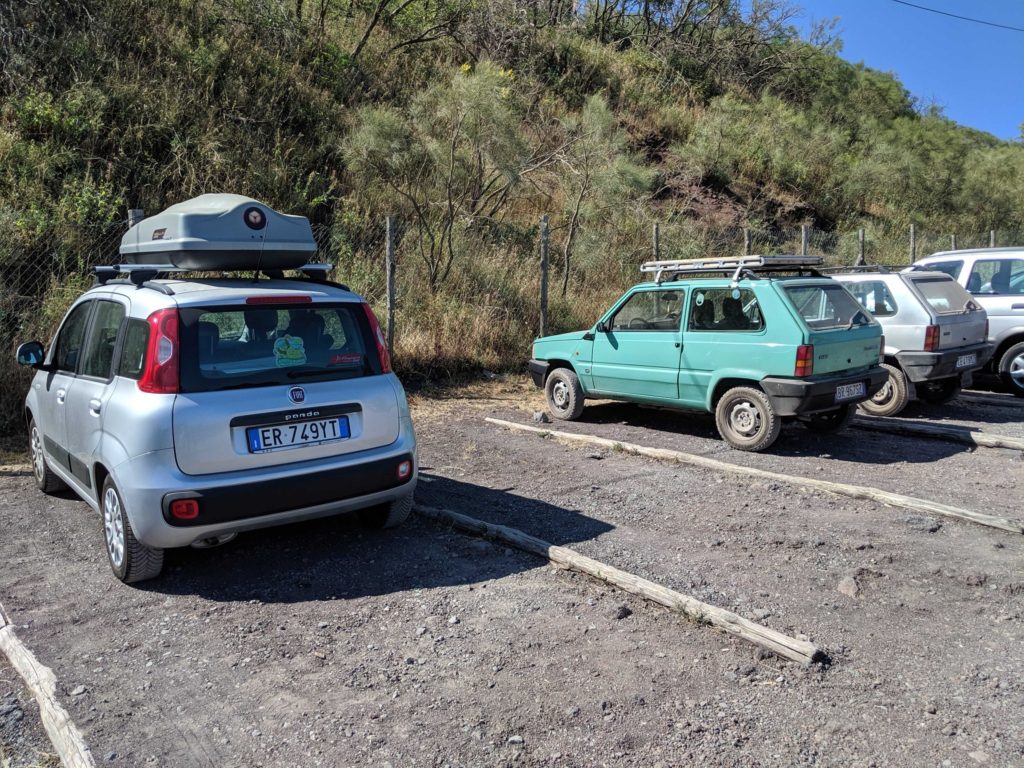
I’d probably be remiss if this teeny car didn’t garage itself in a small corner of my heart. Let’s set the record straight, I’m specifically referring to the First generation (Gen-1) Panda, built from 1980-1986. “The Panda” as we’ve come to know it, whose official moniker is “The Fiat Tipo 141” was designed as an inexpensive, easy to use and maintain, no-frills utility vehicle, positioned in Fiat’s range between the 126 and 127. The first Panda was designed by Giorgetto Giugiaro of Italdesign. More on that later.
Any time I travel to Italy I’m always on the look out for Gen-1 Pandas. I’ve yet to be disappointed, always spotting one 30 minutes into arriving and hitting the road, and one could argue that they are probably the second most popular car in Italy, to the Cinquecento (Fiat 500). You could get quite the bruised arm playing “punch panda,” as these cars are everywhere! The Fiat 500 may be the more iconic symbol of Italian automotive history (Ferrari aside), but the Gen-1 Panda is right there with it. This clip from Paul Hollywood’s Big Continental Road Trip does a great job of summarizing why the Panda became such a staple.
As I mentioned, production of the Gen-1 Panda started in 1980 but didn’t actually end until May of 2003! A 23 year production run which resulted in just shy of 4.5 million cars sold! Well, no wonder they are everywhere dotting the Italian landscape.
Because… it’s a super nimble and fast sports car?
Throwing down some stats: the Panda weighs anywhere from 1500-1700 lbs depending on trim and makes a whopping 55 hp (in max trim) capable of propelling the car to a neck breaking 80-85 mph (depending on grade). With specifications like that, I’m sure I’m getting the “she’s crazy” stare. But stay with me. If you’ve ever traveled through Italy, the majority of roads are of the “country” variety that tend to twist and climb through mountains. I’m sure you’re saying — there are highways too, and I wouldn’t want to take such a vehicle on one of those. Yes, there are… but one of the beauties of Italy is that you never actually ever have to get on large highways (autostradas) if you don’t want to. Besides, max speed on Italian highways varies from 110-130 kph (~70-80 mph) – so you’d be fine #mustdriveflatout.
In all seriousness, the Gen-1 Panda was not meant to be a highway cruiser, it was intended to be a utility vehicle destined for the small country and mountain roads. And in a way, “abetter version” of the 500, a car that was designed for “all of Italy.” And that’s where it flourishes. Available in both 4×2 (FWD) and 4×4 (AWD) configurations, the Panda will easily take you where you need to go. The 4×4 system was no slouch, designed and supplied by Steyr-Daimler-Puch — which happens to be the same system used in the well known Mercedes G-class. #minigwagon.Want to learn more about all the Panda variants over the years? – Check out this link.
Despite the Panda being a bit lacking on horsepower, this has not deterred enthusiasts from modding them for motorsports use. Unlike the US where race tracks are grand, spacious and lend themselves to high horsepower fire breathing V8s. The Motorsports world in Europe is primarily comprised of smaller road courses and rally. The dominating forces in those arenas are small, lightweight and largely FWD cars. And like any vehicle, there is always some sort of cult following, here is some solid evidence of people taking Panda’s to the extreme. Can you imagine seeing a Panda at your next AutoCross? … Oh wait…
Because… its got sleek and sexy styling?
I’ll call a box a box. But isn’t a Panda just a Black & White bear?
Full disclaimer… I am biased and partial to square boxy cars! My first car was an Audi Coupe GT, and I still own one! I guess this leads me to being partial to car designs by Giorgetto Giugiaro, who as mentioned earlier designed the Fiat Panda (and the Audi Coupe GT!). To take a short tangent, Giugiaro is credited with designing for nearly every major car manufacturer whether it was production vehicles (Mk I Golf, Scirocco, Delorean, various Alfas, Lancias, and even Mazdas) or concept cars like the 2006 Mustang, and various BMWs. (Learn more about Giugiaro, his company Italdesign and his cars via this website). Back to the Panda… its not curvy like its namesake, but its cute and unconventional nonetheless. I won’t go on-and-on about its styling, like I said — I’ll call a box a box. Sometimes there’s beauty in simplicity.
Because… Just because!
So after all that, why am I fascinated by the Fiat Panda? Because of everything its not, everything it is, and everything it could be. If you’re still unconvinced check out this video of a Panda taking some laps around the track.
Can you imagine having to give a point-by to a Panda? I can, LOL. In the end, I want one. BECAUSE.
A few months back while putting together our article on “RUST-oration Shows You Should Watch“ we stumbled across a program on MotorTrend TV called “Autobiography.” Being an amateur historian I was intrigued by the shows premise and… it’s always good to have something on in the background while you’re working, right? Progress was unfortunately halted when we hit Episode 3:“The Case of the Hidden Race Cars” as seen below. (Our apologies if you don’t have access to MotorTrend TV or the MotorTrend-Go! App, but definitely worth the watch.)
#spoileralert – The Shelby Daytona Coupe & Bugatti 57G Tank
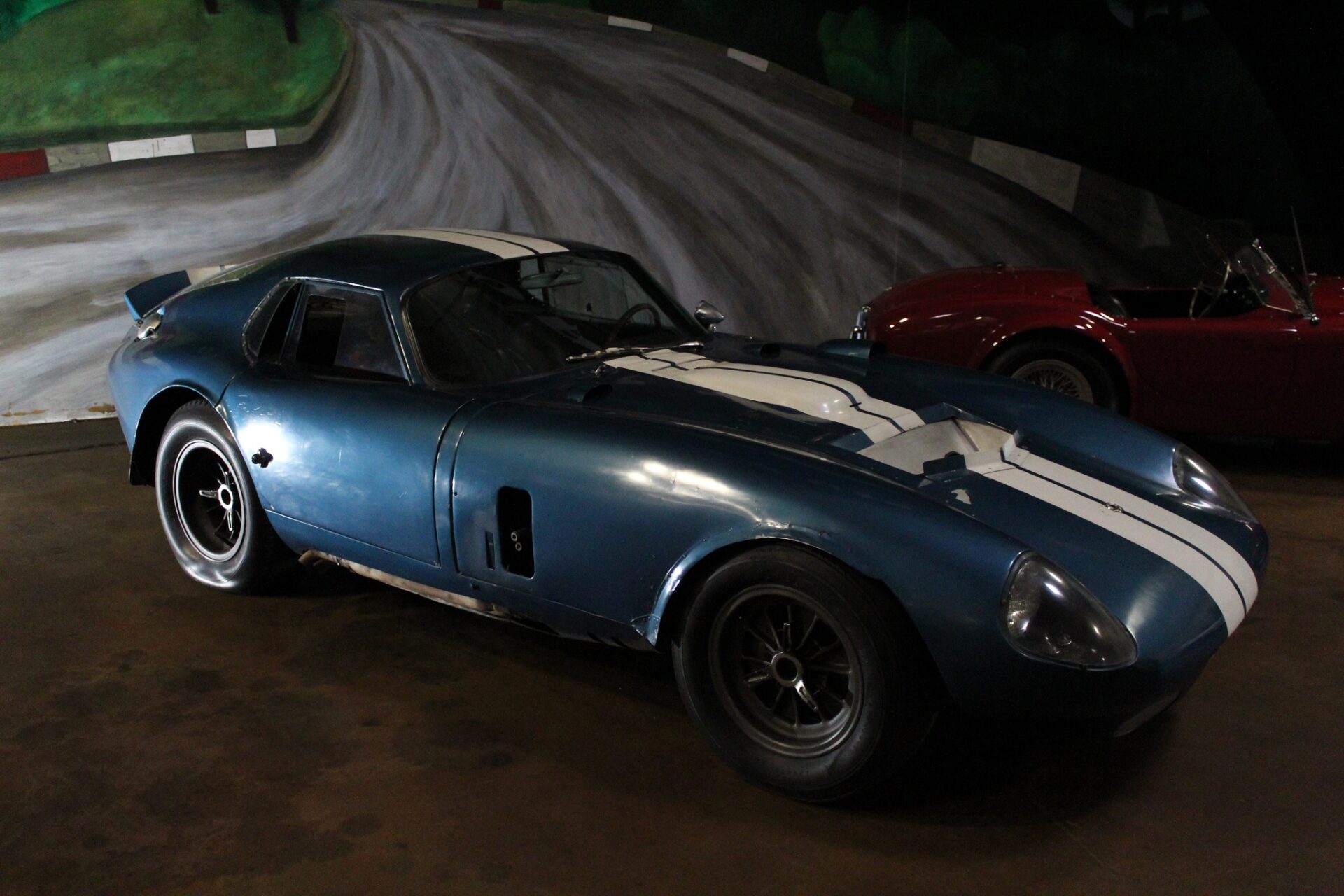
The episode starts off talking about the 1964 Shelby Daytona Coupe (Prototype #1) and is filled with “REDRUM and Mystique” in a very Unsolved Mysteries of James Dean sort of way. Naturally, we were immediately hooked! The Daytona Coupe saw time at the Bonneville salt flats, changed owners a few times, including becoming the daily-driver of the famous music icon: Phil Spector. This Daytona Coupe may-or-may-not have been “the getaway car” in some alleged nefarious activities, was given away to “the bodyguard & his daughter” and then disappeared for over 30 years in an undisclosed warehouse in Los Angeles. Admittedly, there is more to this Shelby’s sorted past, but we don’t want to spoil everything. #morethanmeetstheeye #theplotthickens #thegameisafoot.
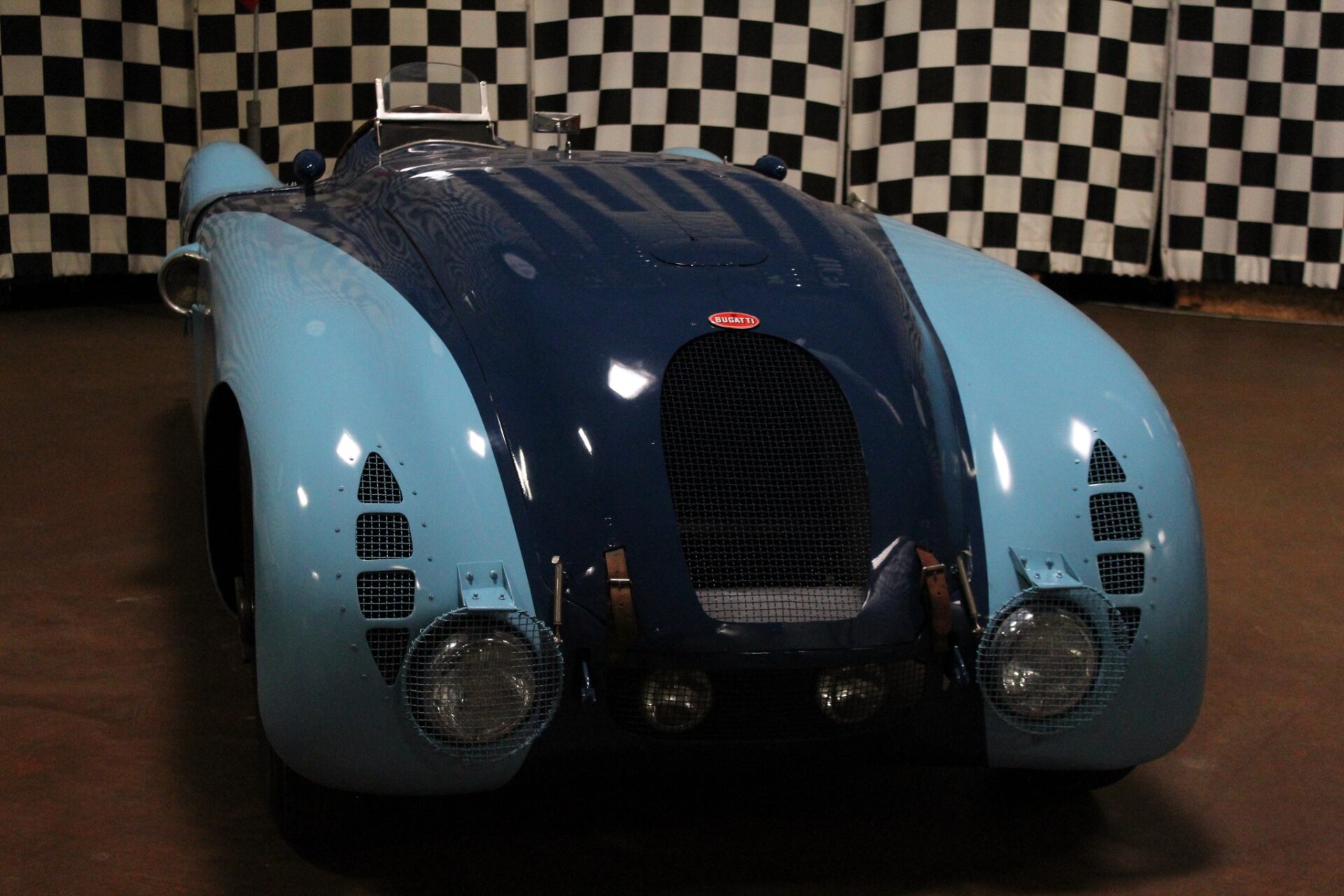
Featured alongside the infamous Shelby, was the recount of the Bugatti 57-G “tank” (seen above) – though, not shrouded in as much intrigue and espionage as the Shelby, its back story is also quite remarkable. During the early days of WW2, as German occupation of France was imminent, Ettore Bugatti decided that in order for “Bugatti to survive the war” some of his vehicles needed to be protected. Literally burying them underground in a secret location that only a select few people knew, it was a huge gamble that the 57G – let alone anyone knowing its whereabouts – might survive the war and be exhumed later. Many years passed, and the car was eventually pulled from it’s coffin, making this particular Bugatti a one-of-a-kind war-veteran.
The episode concludes with the hosts revealing that both of these vehicles found homes together at the Simeone Foundation / Museum in Philadelphia, PA. Followed by an interview with retired neuro-surgeon Dr. Frederick “Fred” Simeone talking about both cars and his museum.
The Museum
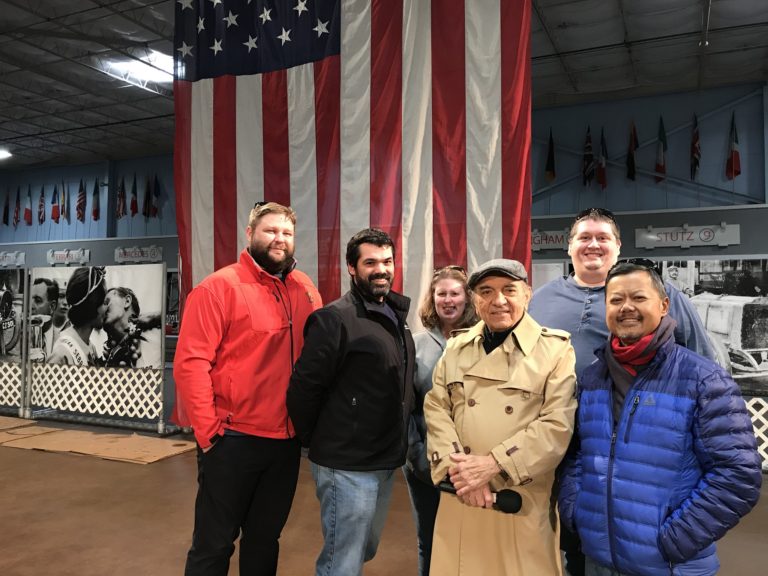
>Eureka!< A faint recollection of someone mentioning this venue in past conversations immediately came to mind. A couple calls and texts later to confirm… we found a few of our members had been to Simeone before – Sounds like it’s time to schedule a field trip! – After re-watching the Autobiography episode, it quickly became our mission to fire up the Mystery-Bus to go see the Shelby and the Bugatti in person.
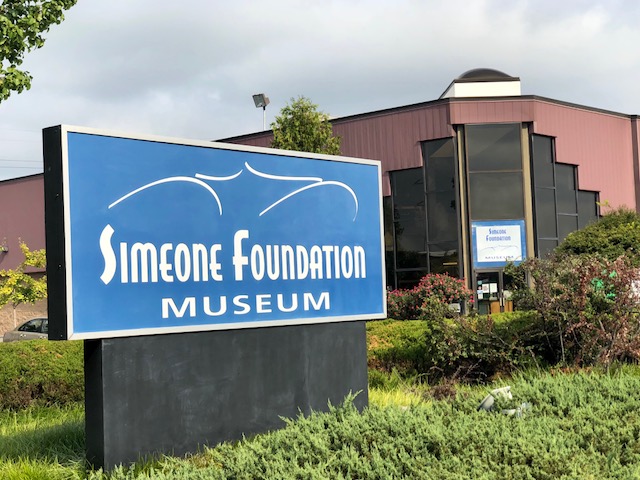
The museum is nestled in an industrial park between the Philadelphia Airport and the Central Post Office which is only a couple hours away from GTM HQ. The museum itself is a rather non-descript building right off I-95 that looks to be a former factory, and you’d probably drive right past it if it wasn’t for the large blue signs out front.
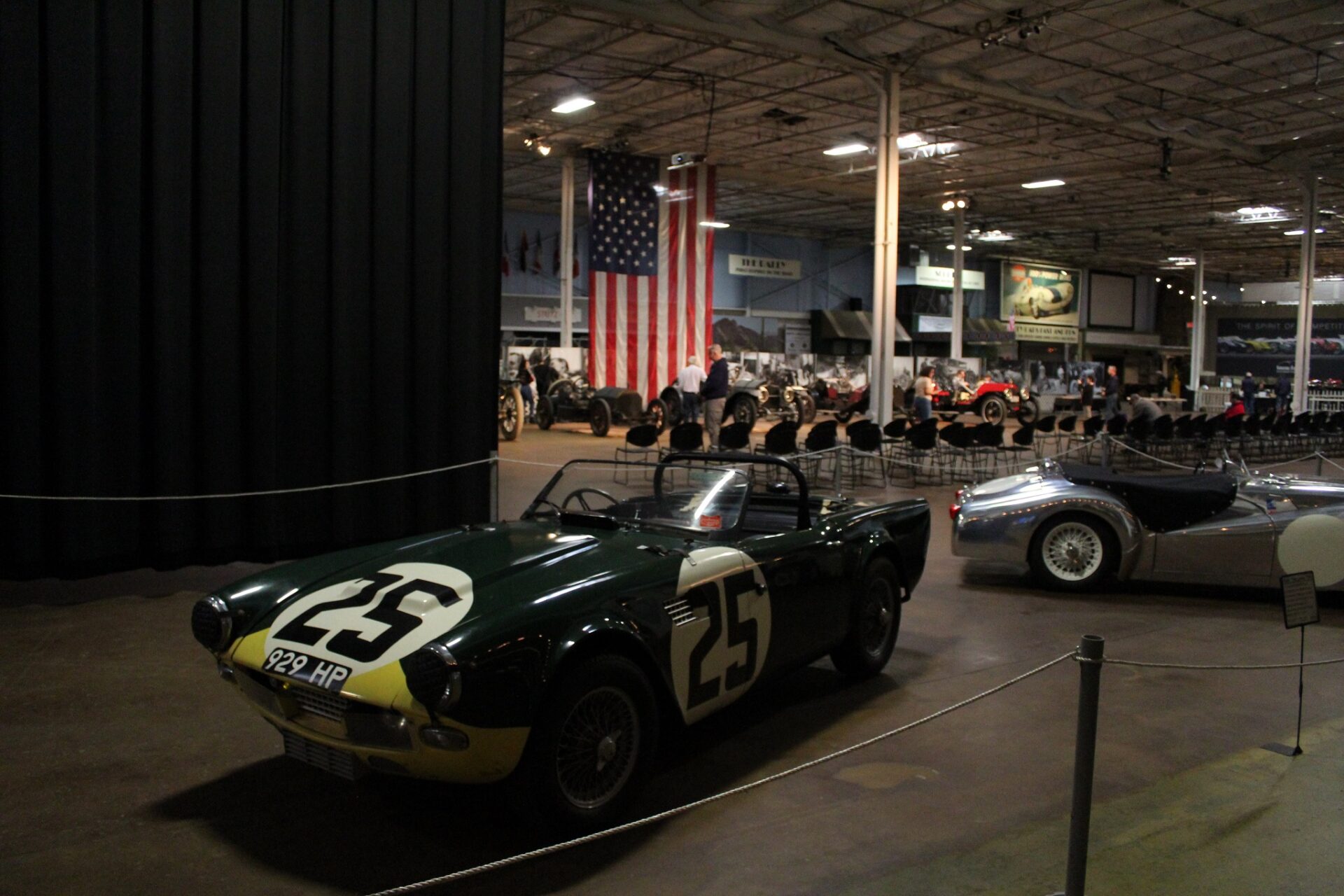
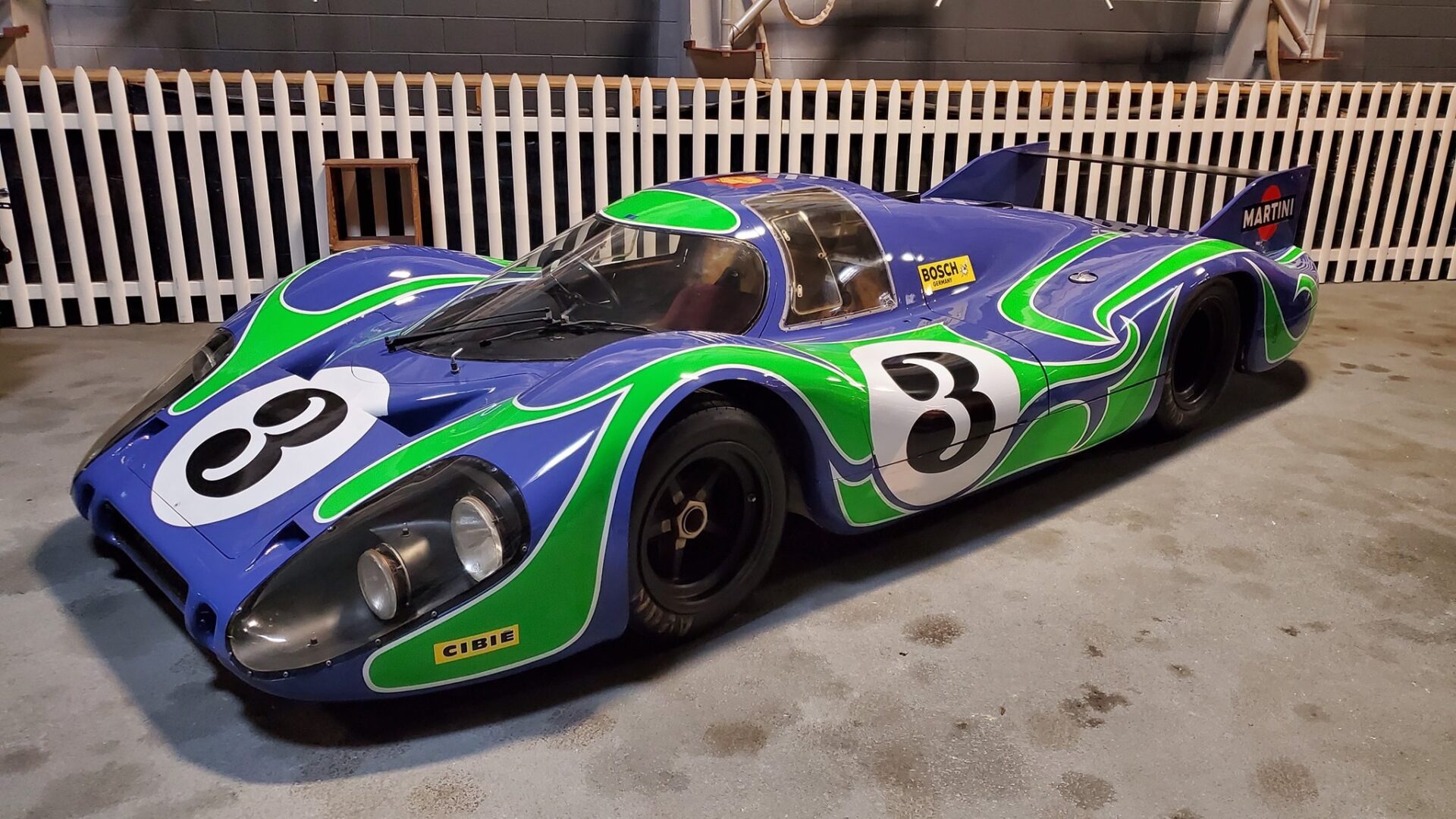
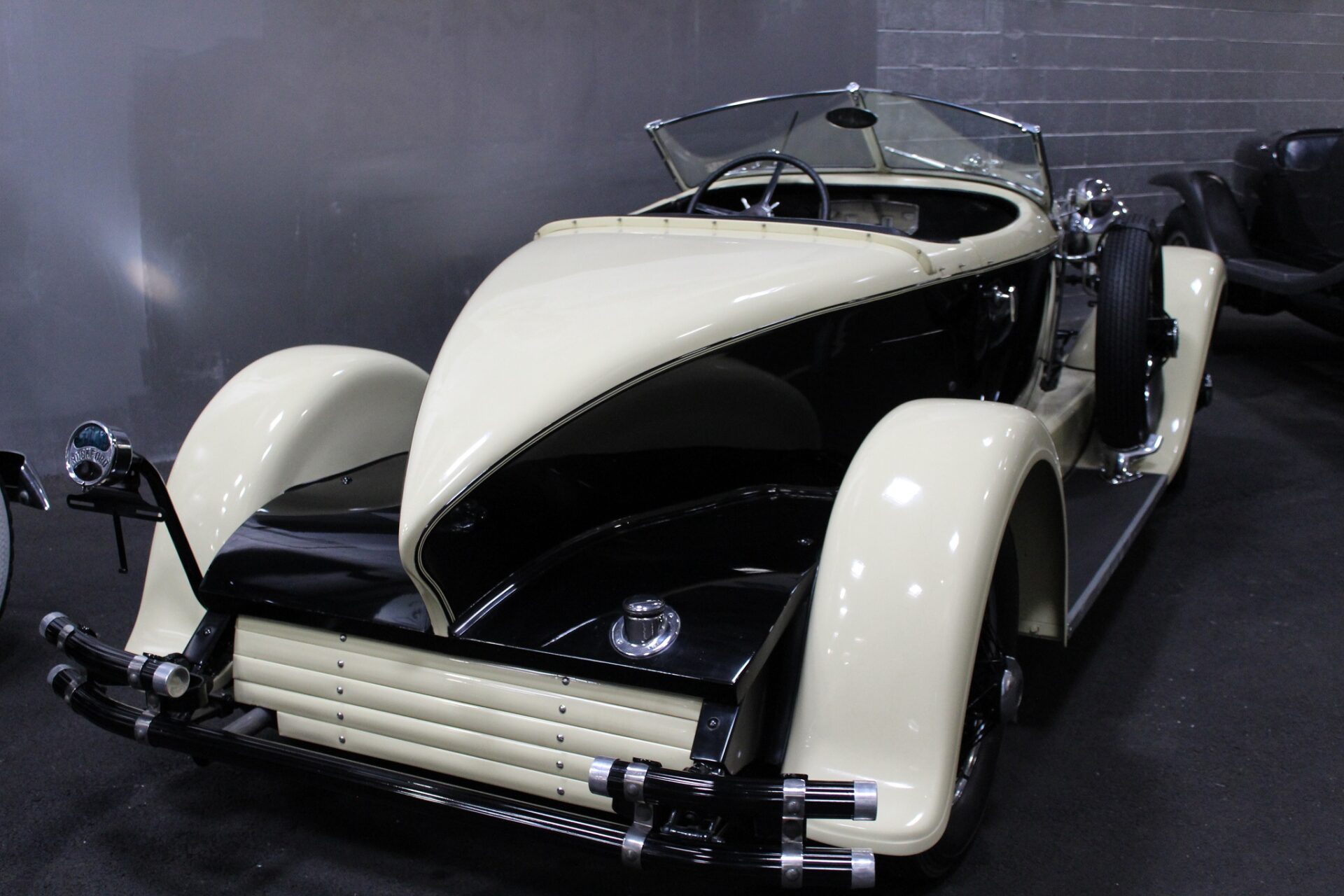
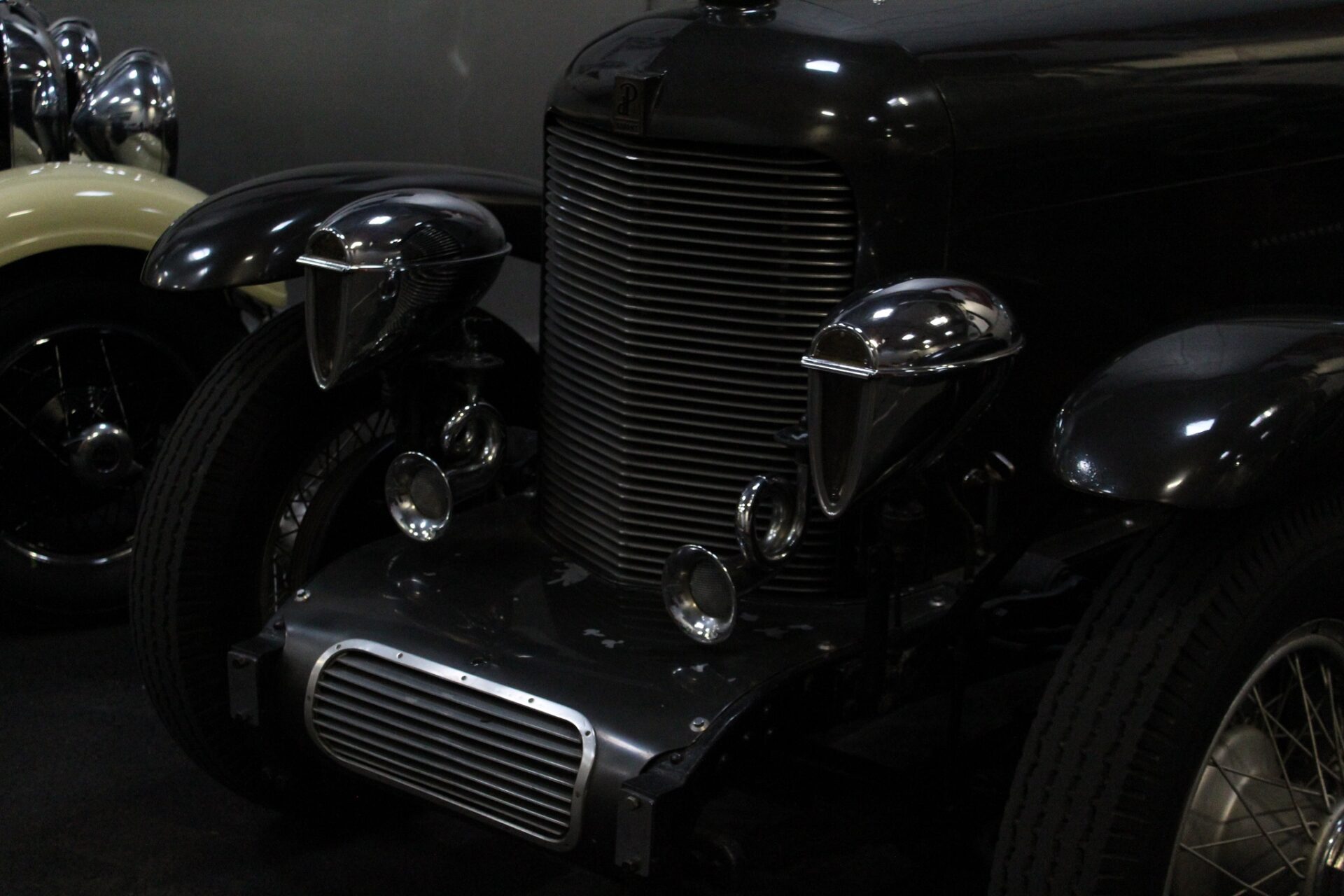
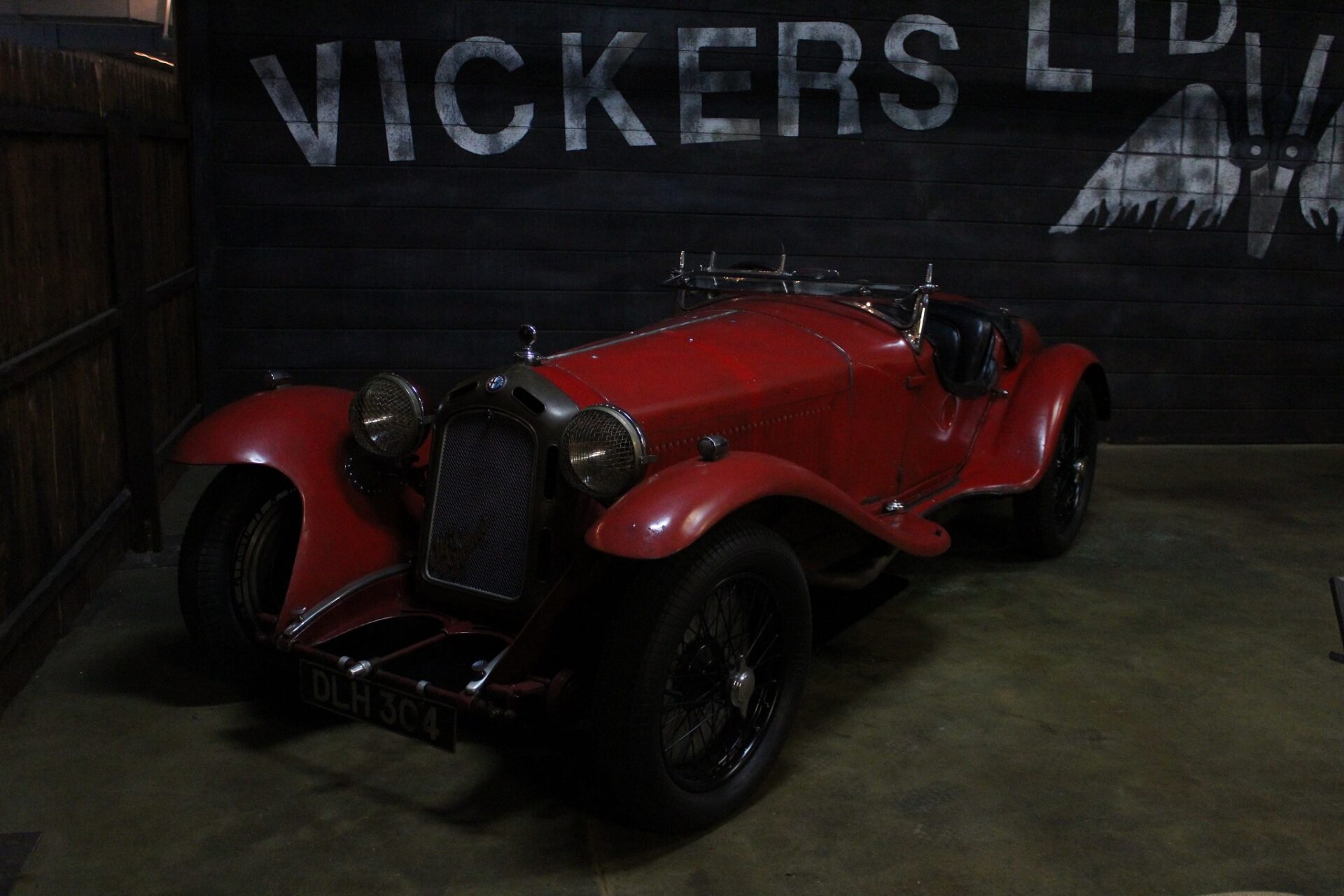
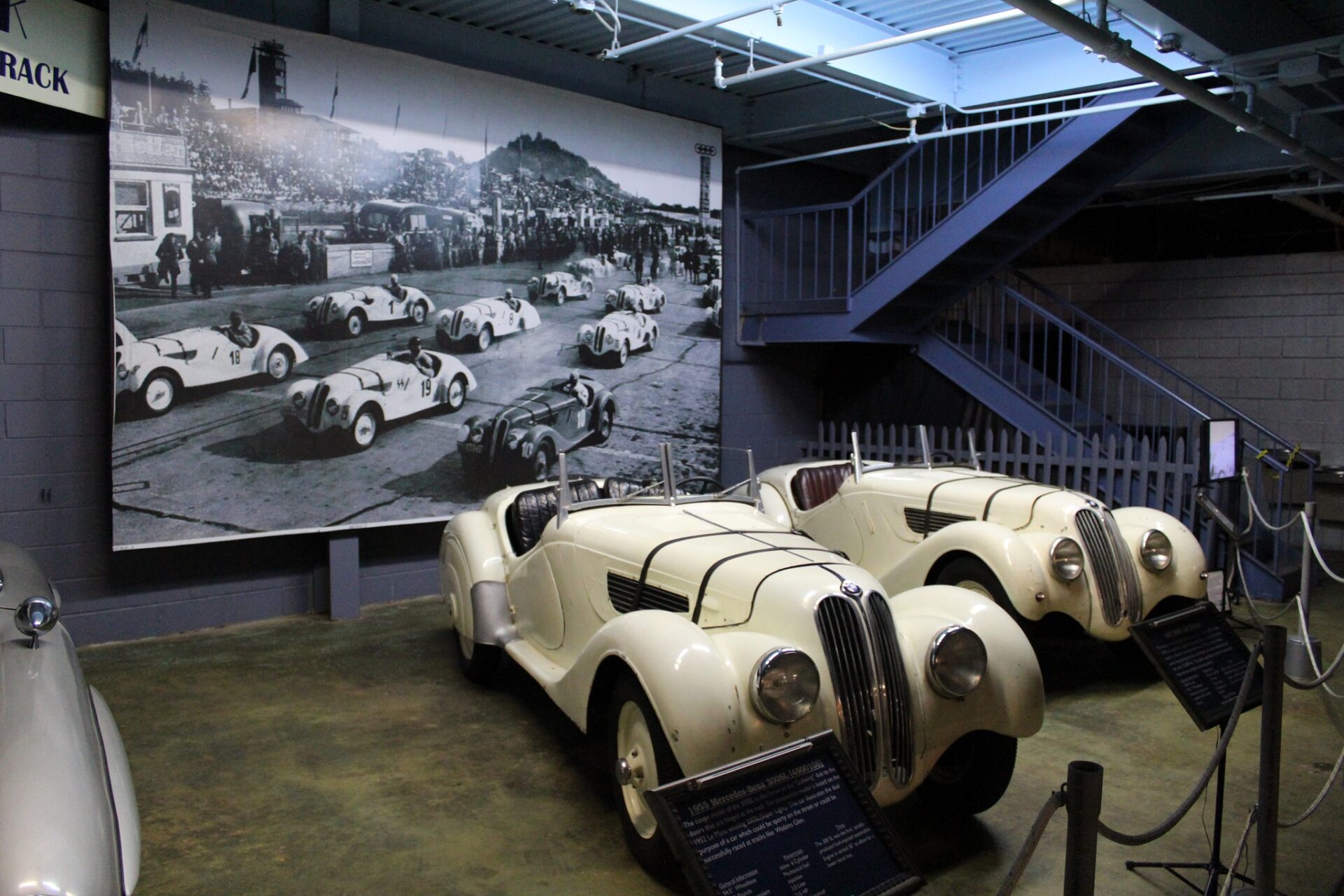
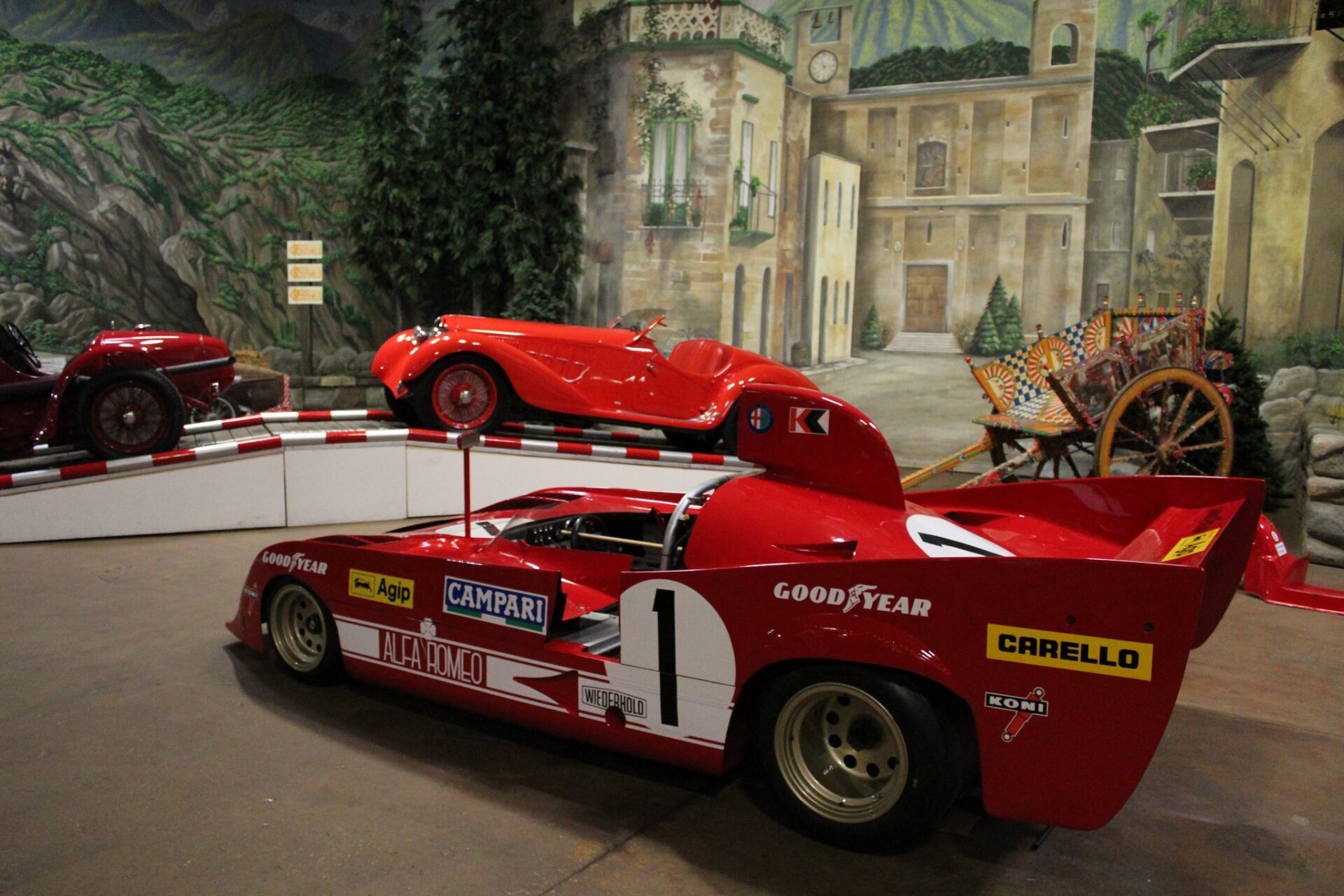
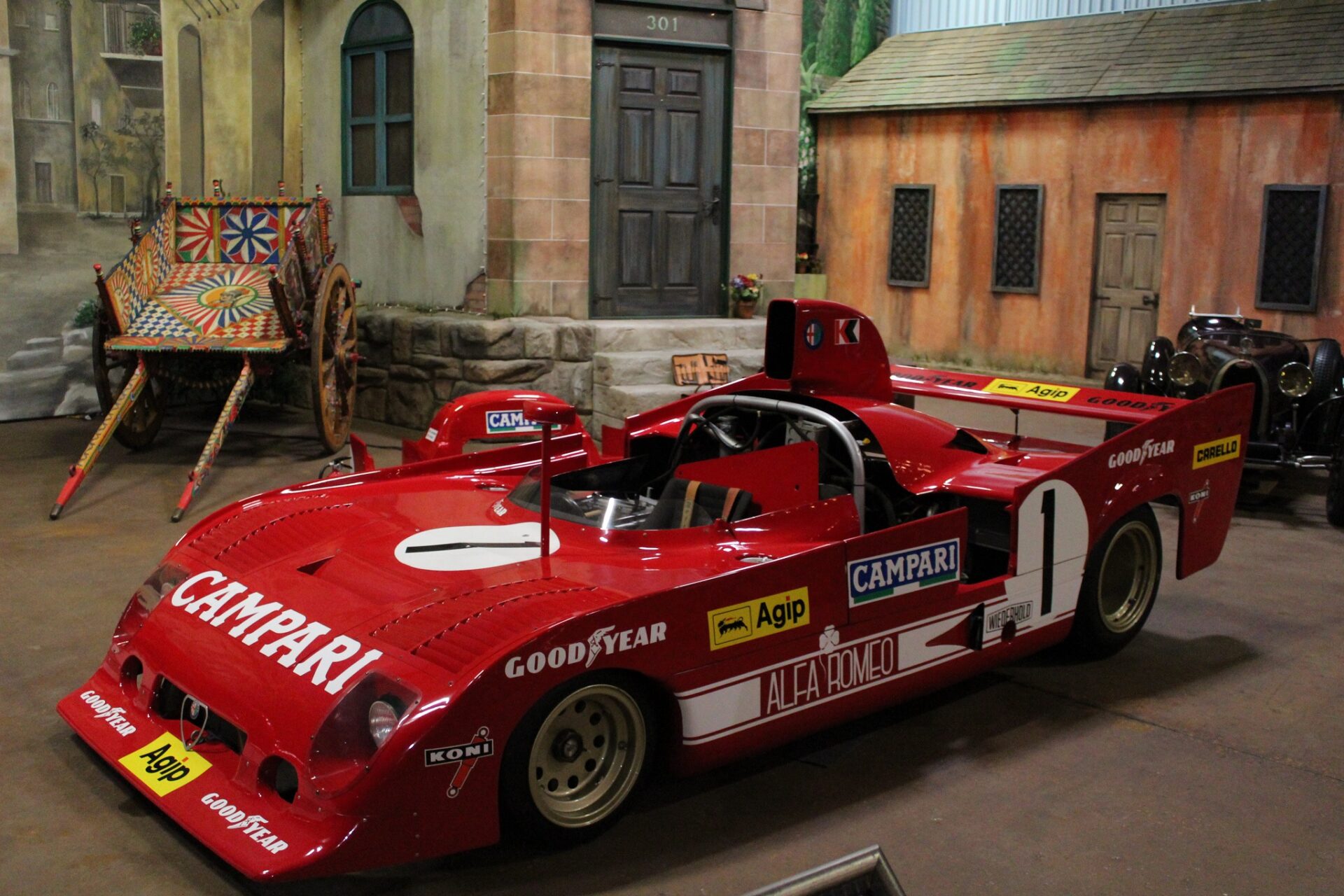
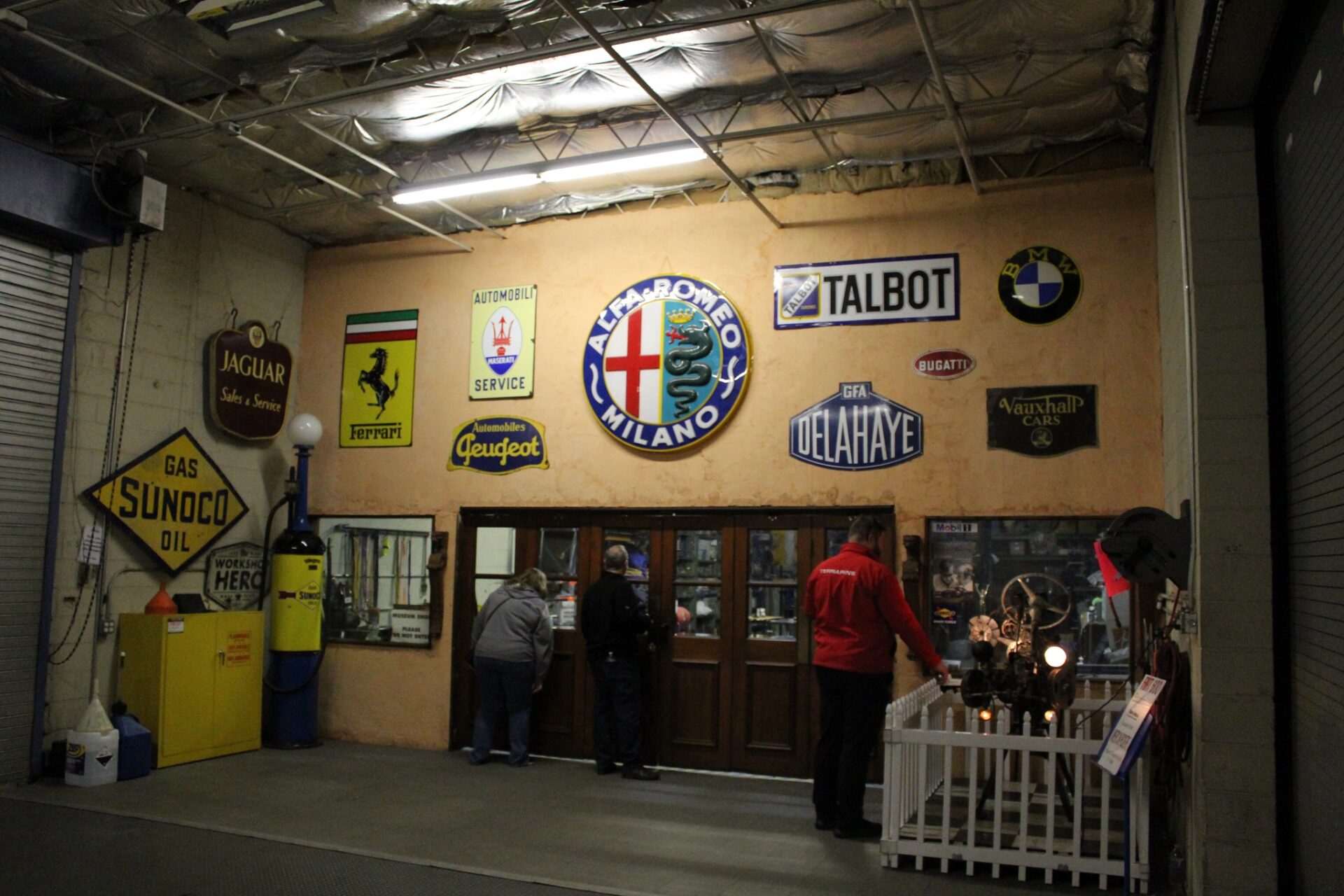
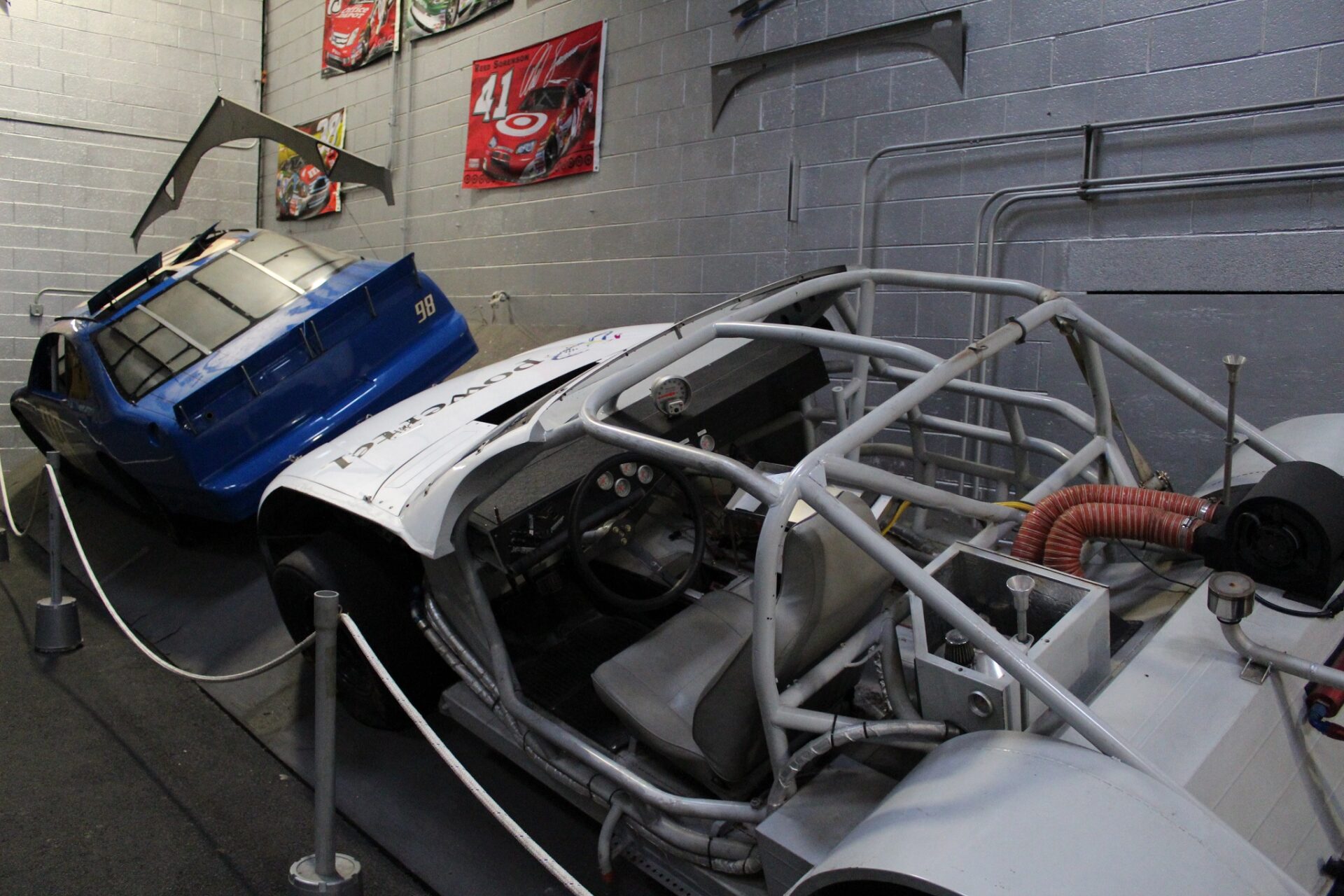
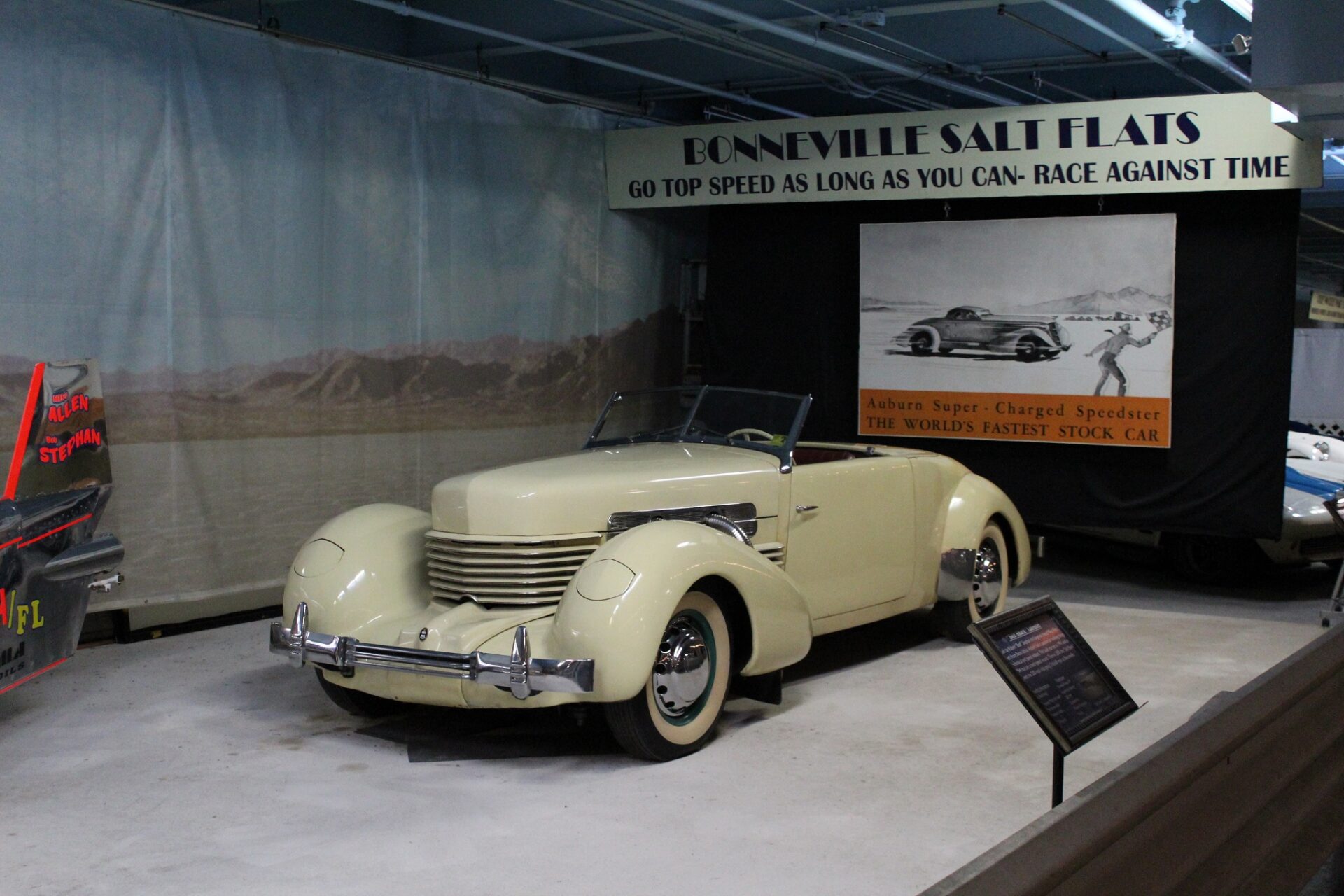
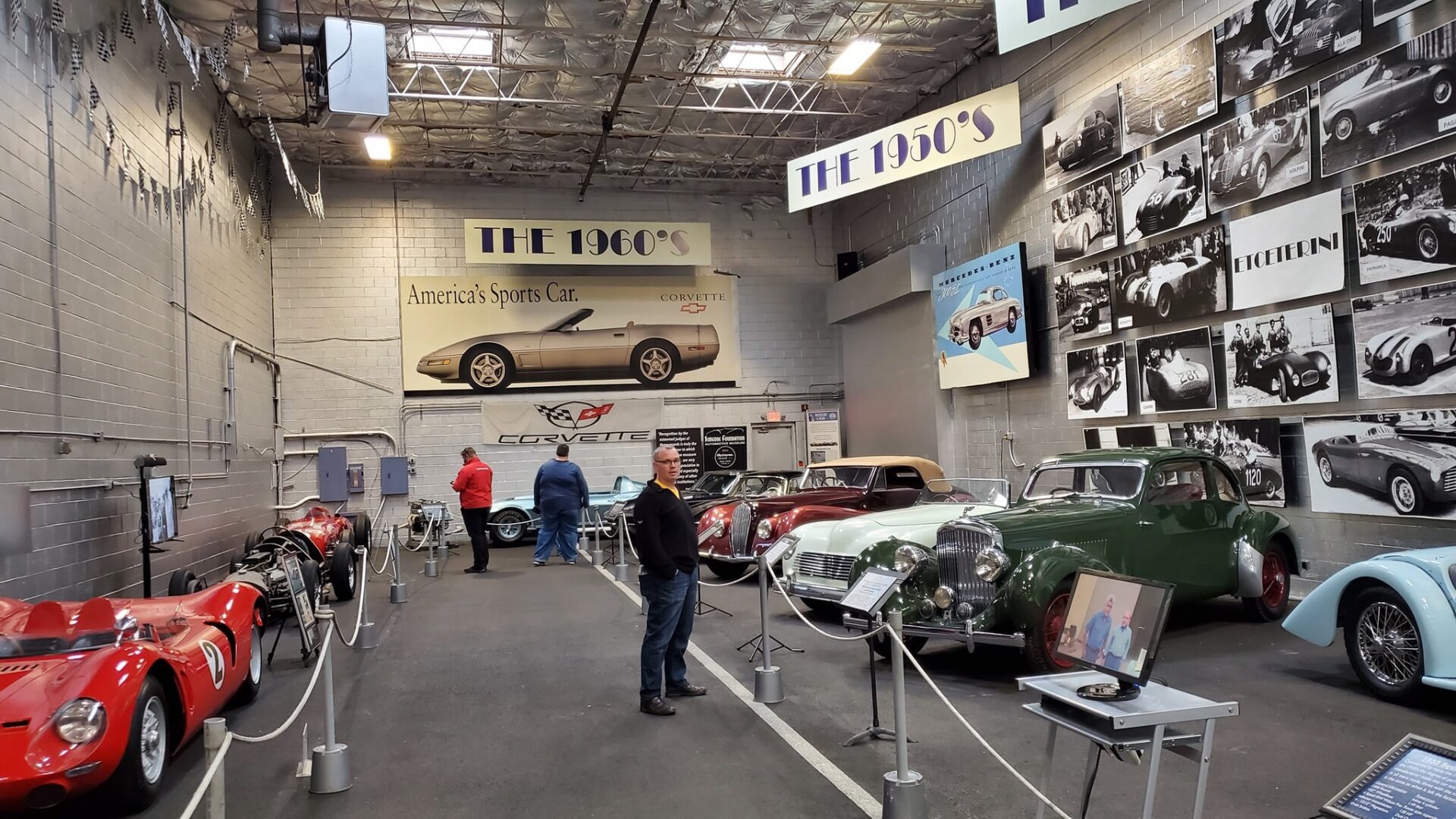
Simeone’s collection took over 50 years to get to this point and contains over 75 cars, many of which are un-restored. Inside the museum, you’ll find that it’s a large open space, that has been cut up into themed areas like: Pre-war Racers, the Bonneville Salt-flats, Brooklands, an Italian Piazza, a working Garage, LeMans & Sebring Pit Stalls, and it’s own version of Gasoline Alley. Even though this museum might not be at the same level as something like the Barber Motorsports Museum we visited last year, its special in that its not only a private collection but also only focuses on “RACE CARS” – more specifically race cars with a pedigree, and a story to tell.
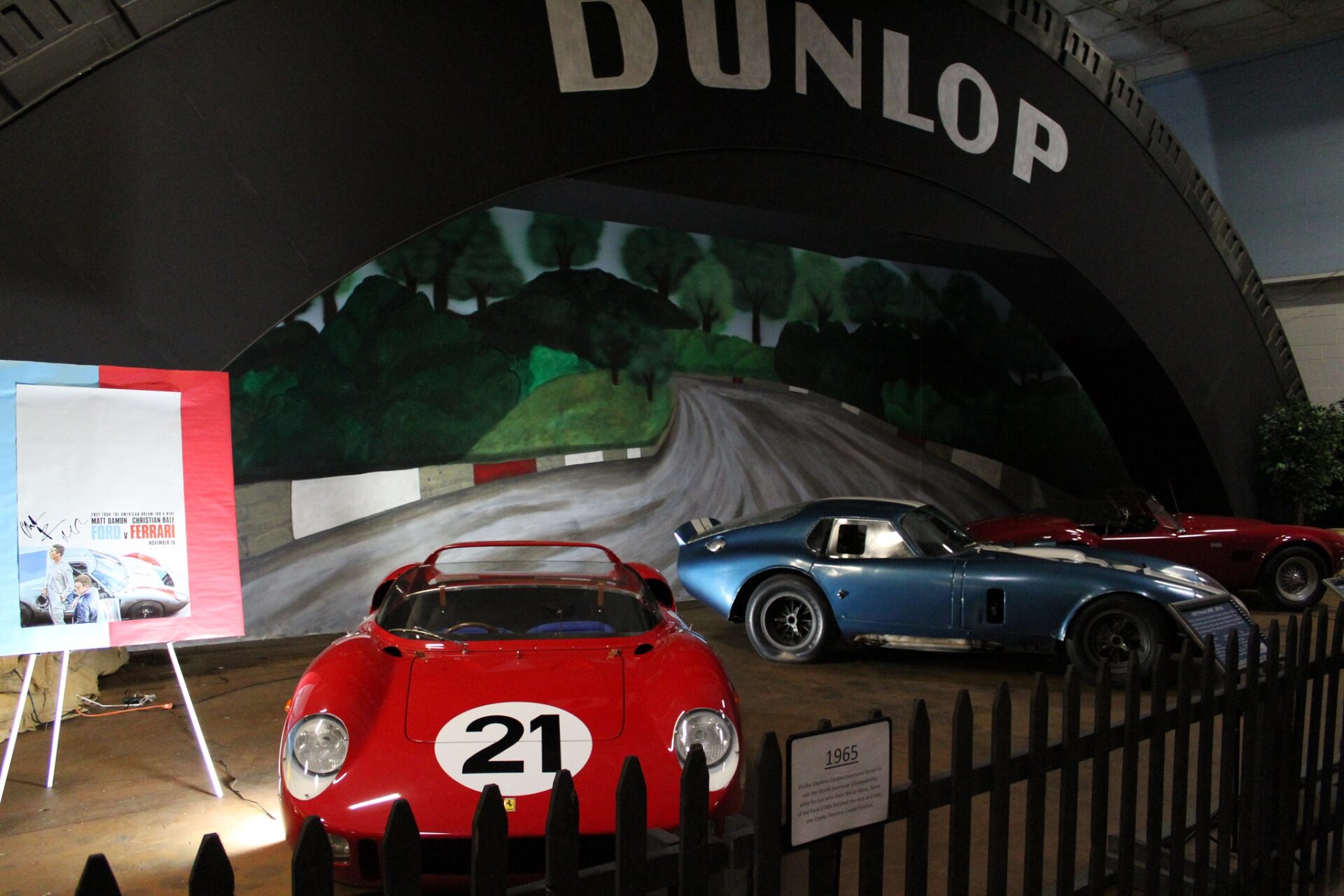
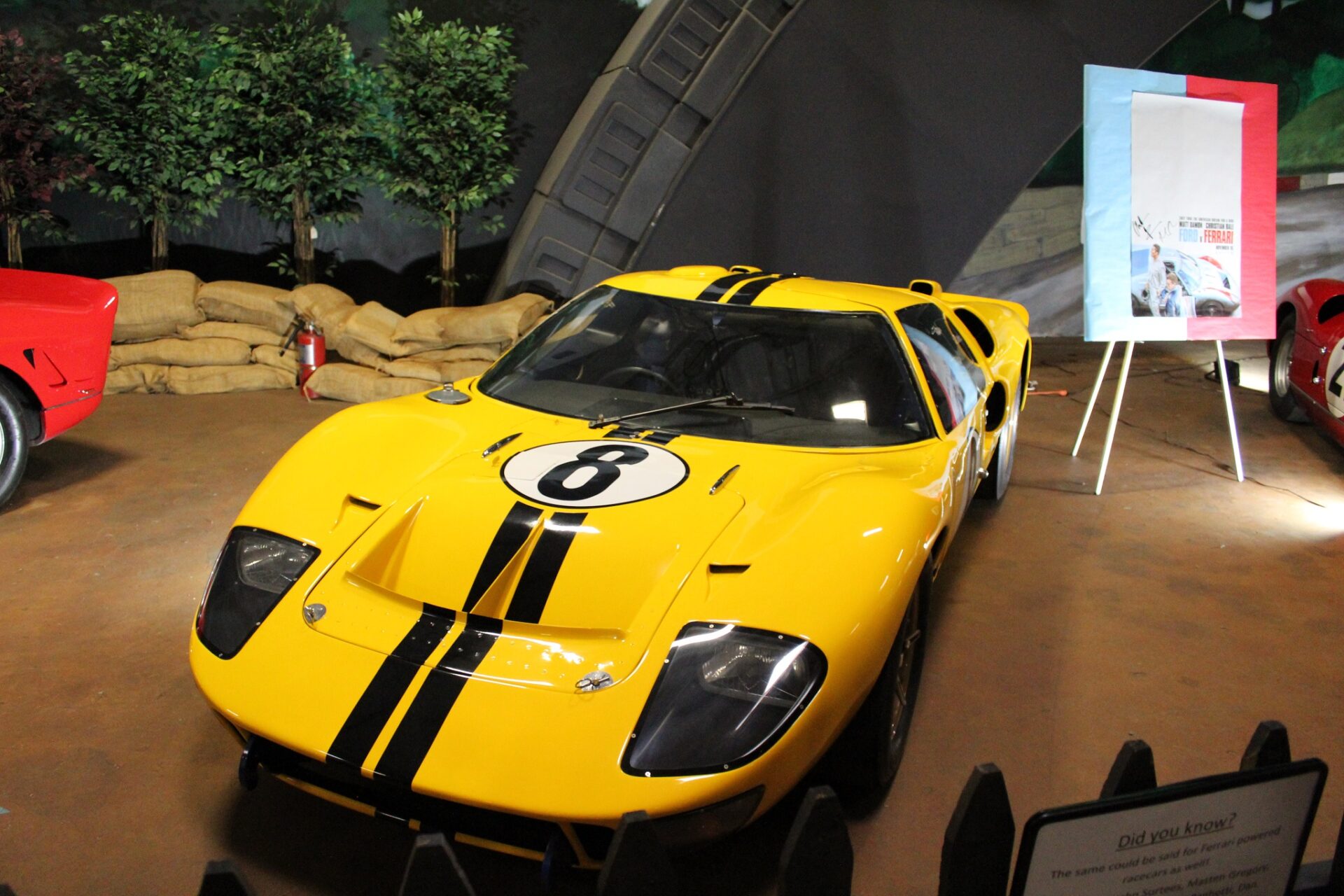
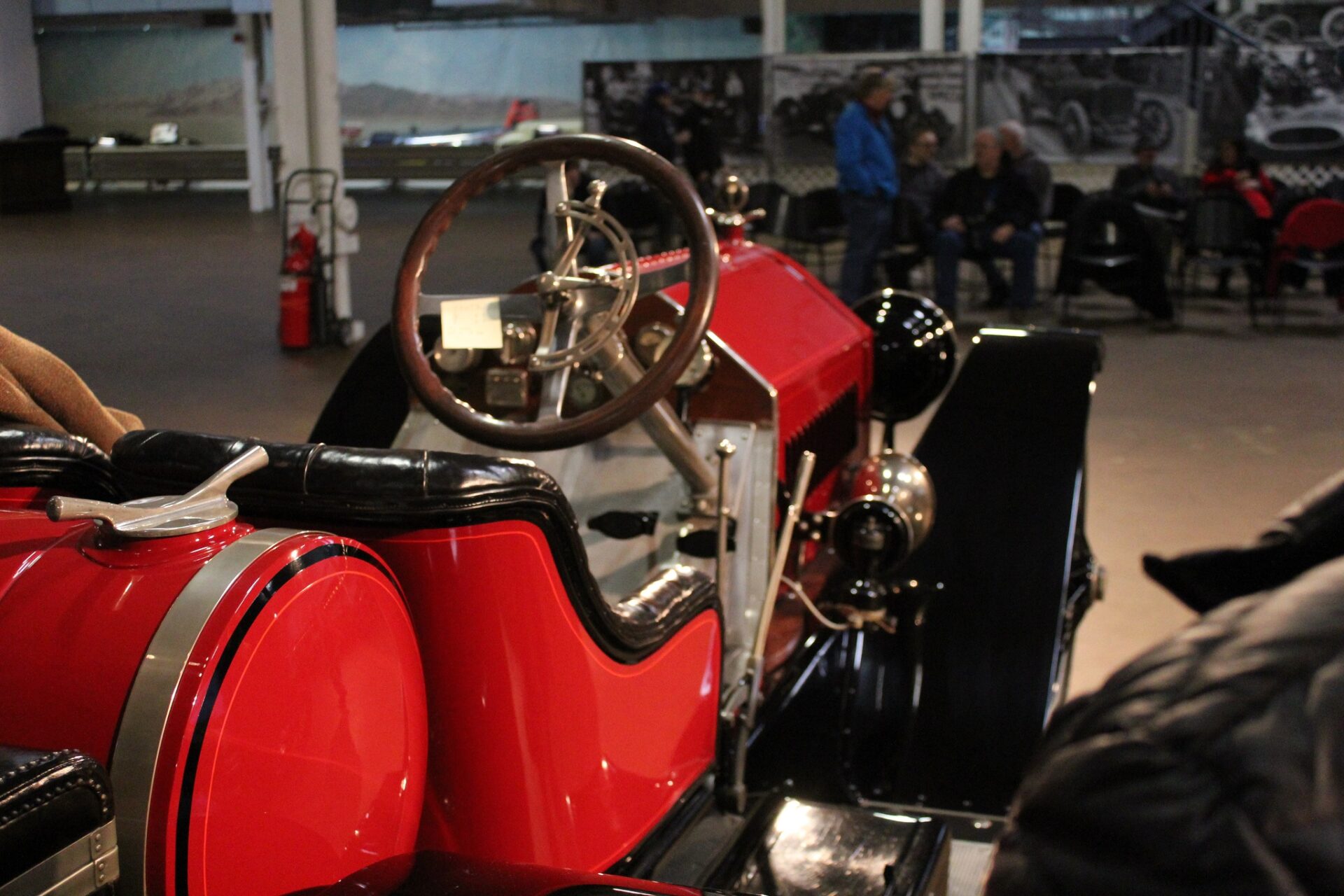
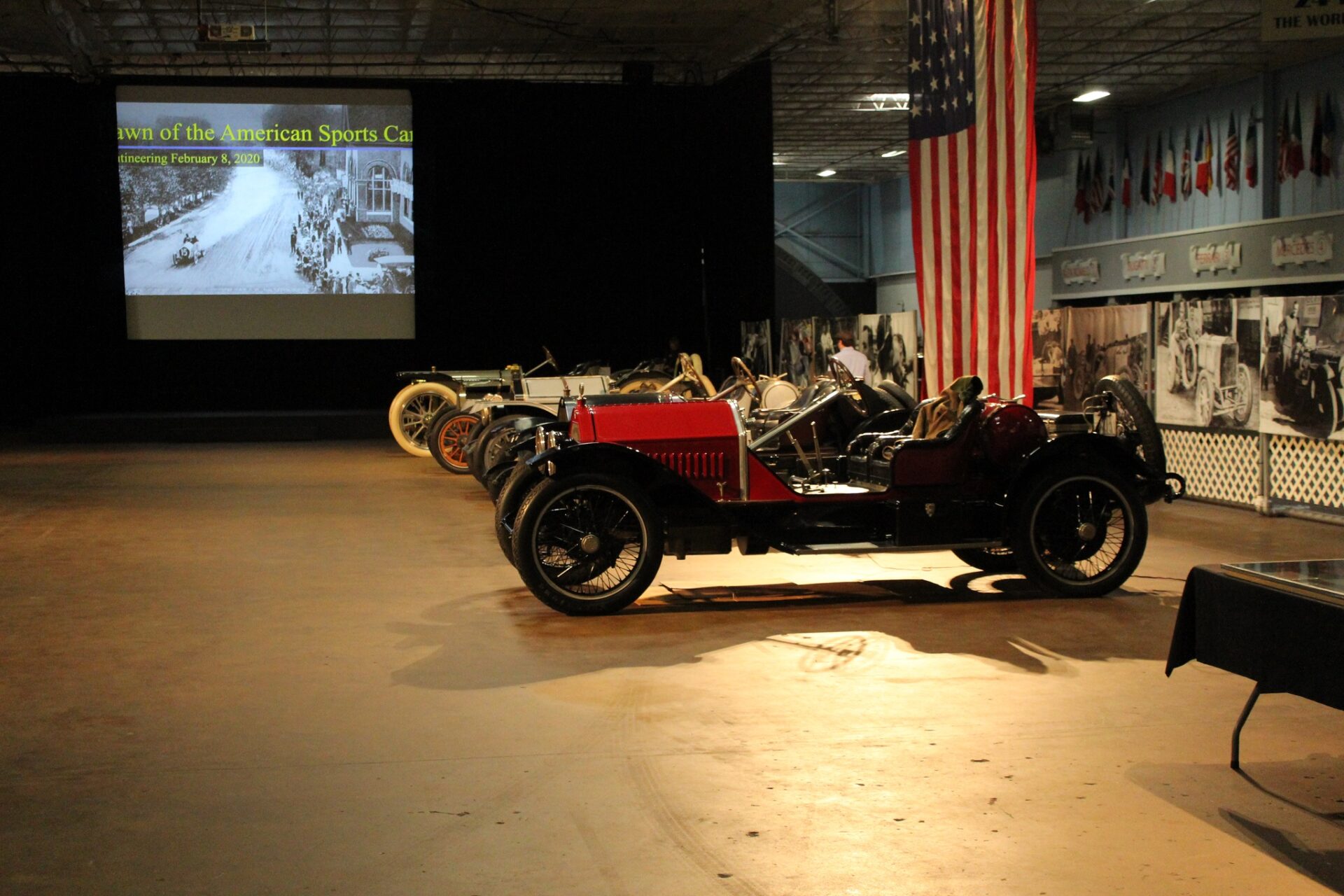
The museum seems to have the ability to change its front stage theme around easily and often. It complements the more static displays with two “demo days” per month. Our field trip organizers made it a point to schedule this trip around a demo-day weekend making this an extraordinary visit. The primary theme of the month held strong with the latest car-related pop culture craze of “Ford vs Ferrari.” While the demo-day centered around “The Dawn of the American Sports Car” which featured pre-World War 1 racers. Words simply can’t do justice to the exhibits, so we’ve put together a brief slideshow (below) with over 400 more pictures available through our Shutterfly Vault.
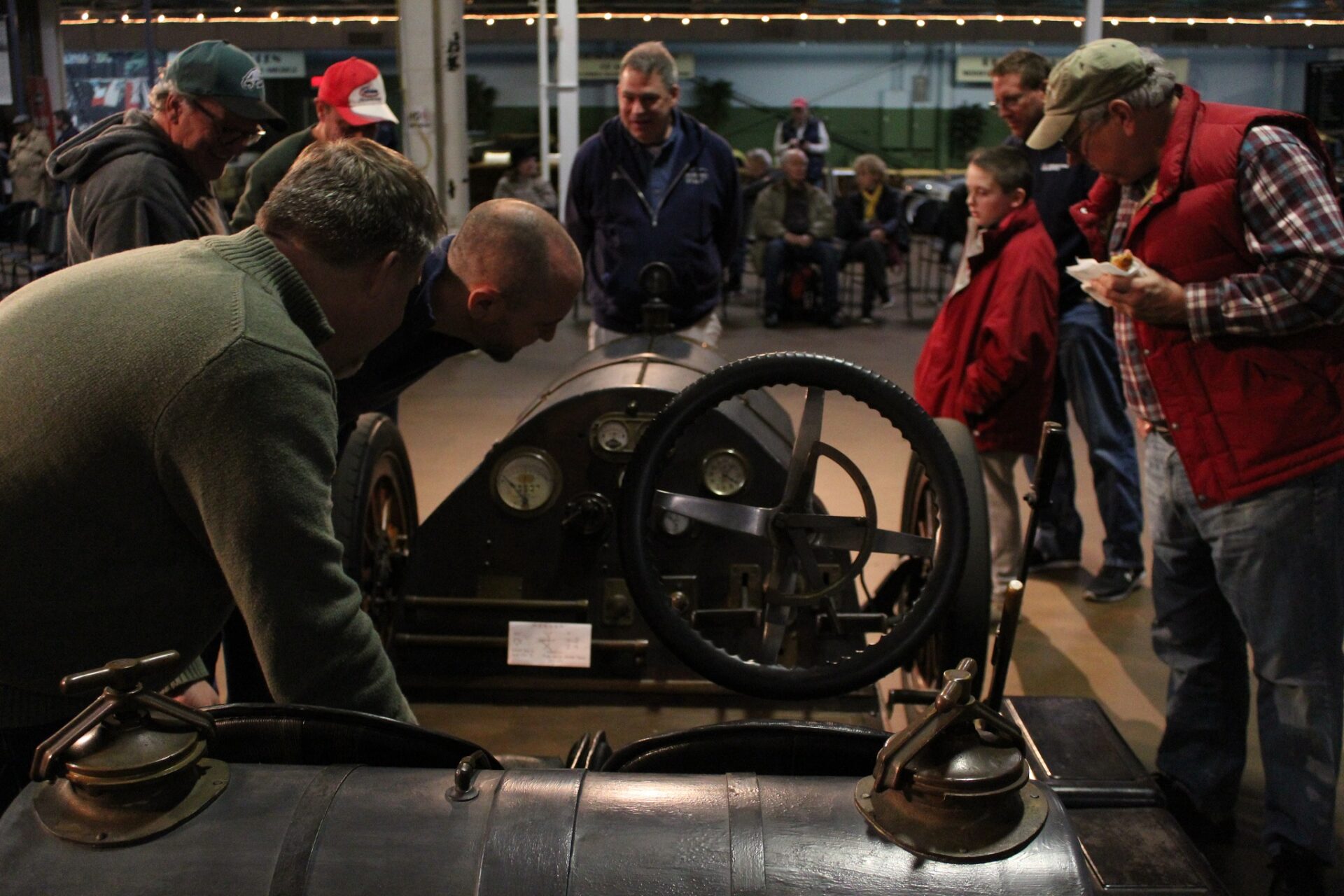
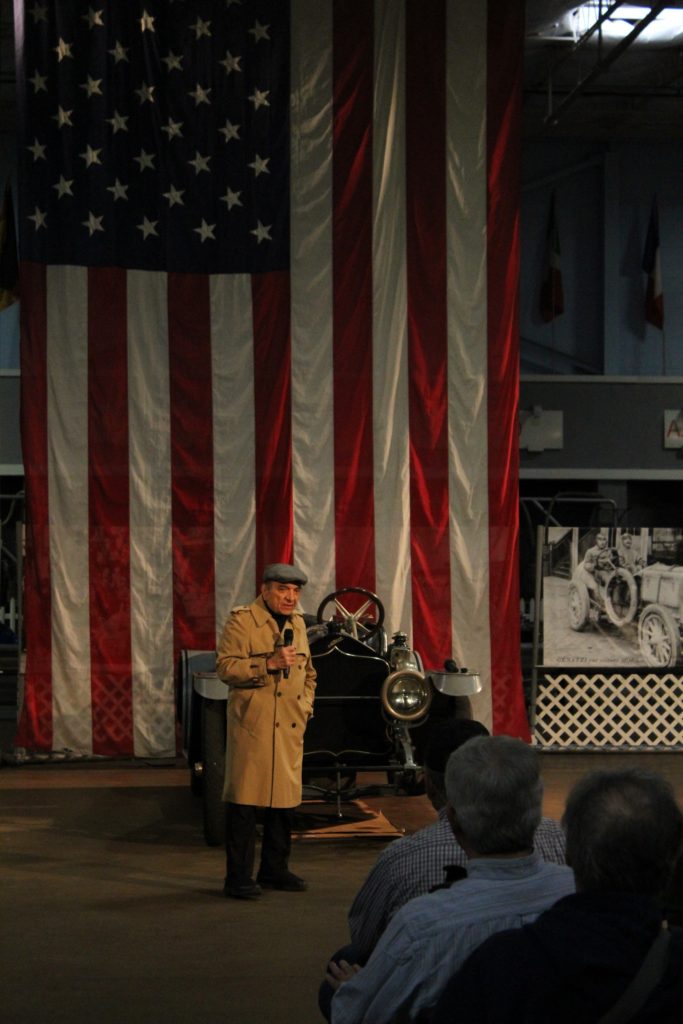
As we mentioned, Demo Day is a special “twice a month” event, held on Saturday’s between 11am and 1pm. A portion of the vehicles from various exhibits are selected for review and starts with a technical demonstration surrounding the theme of the day. Since this was pre-WW1 era vehicles there was a lot of talk about Magneto Coils, “Flat vs T-shaped” cylinder heads and other period appropriate race car engineering.
Guests were then invited to get up-close-and-personal with the vehicles. Unlike most museums where the mantra is “look but don’t touch” this rare opportunity makes the experience more like “spending time in Fred’s garage” than just strolling along doing “the museum walk.” Being able to ask questions of Simeone’s very knowledgeable staff made the experience that much more impressive.
After about a 20 minute lecture, the national anthem was played (Members Brett S and Brad N seen above, left), and then Dr. Simeone took the stage (above, right) to talk about each vehicle individually before they were moved to the large parking lot behind the museum for their parade laps. Take a moment to review the full length video below for the live demonstration portion of the event.
As we all know – and you can see from the video – Race Cars, like all older cars, need to be driven and can be quite persnickety and temperamental. Unlike other museums where you don’t know whether or not the items you’re looking at are just life size models, all of the vehicles at Simeone RUN! And because of the demo days, they make it a point to exercise all of the cars throughout the year. And much like our weekends… not all race cars are willing participants (Stutz, below right), and others often have issues (Mercer, below left). #becauseracecar.
Clocking in at a modest $12 admission fee for adults, this is a great place to take the family for a day-trip. Simeone supports educators and offers free admissions to Teachers and their families (up-to-4 people). The museum also offers several week long summer camps for children ages 6-10 and 11-15, concentrating on racing history and race car engineering. Hands on displays like the “motorized Fiat 600 cut-away model” was insightful and thought provoking for seasoned wrench-turners and newbies alike (Brad N seen below, trying it out).
We were really pleased that we got to meet Dr. Simeone in person (cover photo) and share in his passion. He’s a very knowledgeable car enthusiast, a real aficionado, and it shows. The consensus between the 8 folks from GTM (representing 3 of our regions) that made the trip was that it was well worth the price of admission! Many of us agreed that we are definitely going to make it a point to return for some of the summer demo days like “Le Mans 1959 – Simeone’s 24 Minutes of Le Mans!” –or- “Living to Race, Racing to Live! – Bugatti, Maserati, Ferrari, Shelby” – because who doesn’t want to hear a fire breathing Flat-12 Porsche running around a parking lot? – We hope you can join us on the return trip.