
spot_img
Home Blog Page 54

Hidden Gems – Private Collections

A friend from the now defunct National Capital Area Volkswagen Club sent an announcement for an Open House featuring the collections of Randy & Susan Denchfield as well as Jack & Cher Gallagher. The directions to the event read like a James Bond novel involving finding an innocuous parking garage in Van Ness, taking a special parking token and driving to the bottom level! As it turned out, the collection is ferreted away in a corner of the parking garage that houses a Giant food as well as apartments and offices – There is a walled-off, secure parking area for about 15 cars. The rest are parked under covers in adjoining spaces.

Virtually all the cars in these collections are American classics. Too many of today’s collections are filled with over-restored cars that will never see the light of day because they’re too pretty. But this collection is quite the opposite, some are restored but a fair number are either unrestored or older restorations which was a nice change. Several of the cars are fairly mundane but increasingly uncommon. In particular were the mid-’70s Oldsmobile Delta 88 convertible and a mid-’70s Oldsmobile Cutlass convertible.

The majority of the cars were from the ’40s and ’50s and DeSoto was a popular marque in the collection. For those unfamiliar with the brand, DeSoto was the mid-range offering from the Chrysler Corporation, slotted below Dodge but above Plymouth. Among the DeSotos in this collection two of the most interesting were a mid-’30s fire-engine red convertible and a beautiful ’56 Sportsman – the ’56 had the same color scheme but not the massive tail fins of the ’57 that was the basis for the notorious “Christine“.

Of particular interest was a rather unassuming 1938 Plymouth Express (pickup truck). These trucks were only produced from 1937 to 1942 and in fairly limited numbers because of WW2. Time and neglect adds up to very few survivors while keeping their history virtually unknown. Even though it’s not flashy, the Plymouth Express is likely the rarest vehicle in the entire collection. Adding to the utility vehicles featured in this collection was a ’47 Ford Sedan Delivery. Another well preserved example of a vehicle that typically did NOT survive due to hard use.

Some of the more interesting cars were the unrestored ’69 Oldsmobile Toronado and the ’64 Cadillac Eldorado convertible (example below). Both were excellent examples of American cars in their heyday, filled with technology and gadgetry that remains largely today. This includes such items as automatic headlamps, automatic dimming headlamps and cruise control.

Given the number of Cadillacs in the collection, this allowed for a very unique opportunity to view a ’48 and ’49 Cadillac convertible side-by-side. This was during a time when auto makers updated the appearance of their vehicles annually to stimulate sales by quickly out-dating the prior year’s styling. It’s interesting to see just how far the manufacturers would go to make last year’s model look old.

You may recall that old adage “stop and smell the roses” … As GTM members, and as car enthusiasts, it’s important that we take any and all opportunities to view Private Collections. The vehicles may not be YOUR favorites BUT these vehicles aren’t on display for the general public. The owners/families take joy in people taking interest in their cars and I’ll guarantee you’ll be surprised at what is “hidden” from the public. True that some of them might be mundane but sitting right beside those cars might be passion stirring exotics. Much like this collection I visited in Van Ness … not very modern, nothing overly exotic or incredibly well restored BUT mixed in… a Plymouth Express, who knew?!? – and for me, that alone was worth the price of admission!

Until next time. ~Matthew.

**Note: All pictures above are from previous tours of private collections in 2019. Check out earlier articles or shutterfly for additional information**

Striving & Driving to Enjoy Life

3

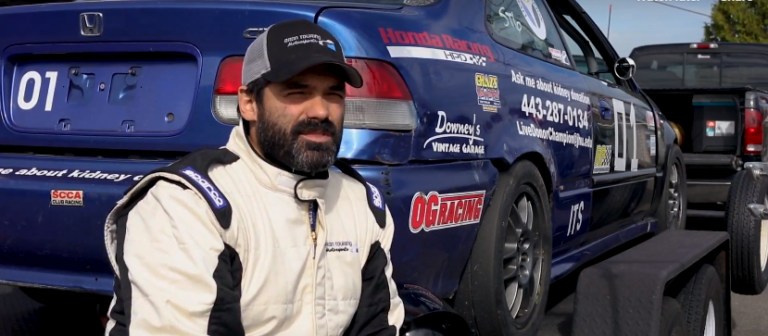
As a group we can push upwards of 100 days on track every year and the most invested among us drive 25+ days just by themselves. As a result we’ve driven nearly every track in the eastern timezone of the United States and every year we organize big events at new or distant tracks. We’re dreaming big and have our sights set on making it all the way to the west coast, but this past weekend at PittRace we met someone who puts us all to shame. Meet Kona Bob… 


>Excerpt Below< as seen on Track Mustangs, Online Forum [as of April 2019]

… I purchased my car in Houston in May of last year and went straight to COTA the next morning and ran with the [NASA] Texas Group. I was the second owner and the car had 3,200 miles on it when I purchased it. Running 4 times for 20 minutes 36 hrs after purchase was outstanding, thank you Texas Region. I then took the car to San Pedro, California where I have a unit in a controlled indoor facility. I started off this year February 2nd-3rd at a two day VARA event at Buttonwillow Raceway then onto Chuckwalla, Sonoma, Phoenix Wild Horse Pass, Utah Motorsports Park and finally Pueblo this weekend, all with NASA. My next event is COTA then NOLA, Barber Motorsports Park, Road Atlanta then Sebring on June 22nd. I have yet to finalize my Eastern Seaboard adventure after June 22nd. I will return to Kona for Marlin and Big Ahi Fishing during the month of July. (It is typically one of our best months) I will be back on the Tour August. There are many good tracks on the Eastern Seaboard so I am doing my research. I plan on my last event being Watkins Glen on October 5th and 6th, weather permitting.

This adventure was conceived by my wife Dianne and I two years ago after selling our business to our children and our manager. We were going to buy a large RV, a purpose built car and trailer and race it across the country on the same format. I officially was scheduled and did retire on January, 1st 2019. Prior to my retiring in July of 2017 my wife and partner of 47 years peacefully passed away in her sleep alongside me. I was inches away and did not feel her pass. Myself and my children (two sons and a daughter with spouses) were devastated … I have been on this adventure solo, seeing people, family and friends along the way. 

The Shelby GT350 was my alternate choice to the Big RV, trailer and another car. I am keeping it simple and really enjoying driving the car from event to event. It is a great touring car and track car with a fantastic warranty. I am an avid golfer so the 1st and most important item in the trunk was my set of golf clubs. All my clothes and support tools, jack, jack stands, etc, etc, etc had to fit in after the golf clubs.

There it is, my dream adventure I am on is to honor my wife and my passion. I am not waiting to chase my bucket list. Life can change in minutes. My children and relatives are backing me 100% so it is a family affair. I have always attacked life with a positive attitude. I would appreciate any advice for tracks to visit on the East Coast, Central Region, Lime Rock, VIR and Watkins Glen are on the list already. I hope all of us can pursue our passion racing wherever and whenever we can. Looking forward to meeting all of our fellow Mustang track addicts. If I can help anyone in anyway let me know.
See you at the track!!! Aloha, Kona Bob


WHOA!

We met Bob Tremain, a laid-back 35-year Hawaiian resident on a mission to drive his 2017 GT350 on as many tracks in North America (including Canada) as possible this year, at PittRace with HookedOnDriving (August 2019). As you read (above), he picked his car up in Los Angeles and has driven nearly 15,000 miles to over 14 tracks across California, Texas (COTA), Nevada, Arizona, Utah, Louisiana (NOLA), Kentucky (NCM), Florida (Sebring), Alabama (Barber MSP), North Carolina, Pennsylvania (PittRACE), Maine, and has more lined up before the season ends. If my math is correct that’s already two times more tracks than One Lap of America in one season. 🤯 How does he do it?!

Managing your consumables is important for any track day let alone as many as Bob is attempting back to back. Bob’s been building his own network of Ford dealerships closest to each track and uses them for any service the car needs after each event. He also works with them to order new brake pads and tires before the next event. Selecting a tire that can survive long road trips, rain, and abuse on track required some investigating. After a few calls with the engineers at Nitto, Bob settled on the NT-05 as his “all around” tire. A fresh set is already waiting for him at his next service stop. 

Kohalo volcano and mountain range

It’s not just a regular ol’ epic journey around the country. Bob is working on his own special project in Hawaii – a brand new 2-to-3 mile racetrack on a 450 acre plot on the main island of Kona carved out of the extinct Kohala volcano. 🤯🤯 Throughout this trip he’s been meeting with and interviewing the owners of the tracks he visits to know exactly how to build, run, and maintain a top notch facility! He has the support of the local county government and is looking for investors to fund the project to get the ball rolling. When it officially opens the track will be able to host road races, track days, autocross, and drag racing at minimum.

We’re super excited to see new courses being developed and can’t wait to drive it ourselves when it opens! More importantly, Bob has another GT350 waiting for him at home and will be using it to test “the feel” of his new course as development progresses. And the question you all might be asking yourselves at this point: What happens to Bob’s mustang when this is all over? Well … he plans to return to California to sell it. And maybe one of us will be lucky enough to snatch up his “track proven” mustang. I know I would. #fullsend.

Even though Bob says “he’s solo” on this adventure, the love and support of his family keep him going, and communities like ours are here to make sure he feels welcomed and help fuel the excitement and enthusiasm of Motorsport across this great nation. Many of us got to run in the same sessions as Bob and it was a lot fun dicing it up with him on track and the conversations afterwards have definitely made a long lasting impression. If you happen to see Bob and his mustang at your next track day, don’t be shy 👋, he definitely isn’t and ask him how the adventure is going! Next up, Chapter 15: VIRginia International Raceway – followed by Lime Rock, NJMP, Mid-Ohio, Calabogie (Ontario, Canada) and more!


“I am humbled and can only hope that my story spreads the fever of our passion for road course racing to others who want to chase that same dream. It seems like everywhere I go when people want to talk about the Mustang I am recruiting another future road courser if they haven’t done it already. Nothing better than seeing the look on someone’s face when they get out of the car after their first 20+ minute session at 120+ mph!!! ” – Bob. 

From all of us at GTM HQ – Bob… we wish you the best of luck! Get to that final checkered flag where ever that might be… and leave us comments below! If you need any help while traveling the east coast, don’t hesitate to reach out. Because at GTM, “you never go to an event alone.” – Aloha! 

The C8 is NOT the first mid-engine Vette!

0

Some might argue that the first “mid-engine Corvette” was actually a ship dating back as far as the 1700s. All jokes aside… the sports car whose namesake is a ship, has actually had several mid-engine prototypes over the years. Let’s take a quick dive into the mid-engine ‘Vette evolution!

Picture it… Bowling Green, 1964.

With the sudden end to the Corvair production (thanks to some bad publicity) the engineers at Chevrolet decided to attempt to modify and graft a “C3-like” body to the Corvair rear-engine, rear-drive layout code named: the XP-819 prototype (below).

Reportedly, the handling of the XP-819 was an utter disappointment and the vehicle suffered a crash during tests. Officials ordered its immediate disassembly. Decades later, the remaining pieces were found, reassembled and restored by a dedicated Corvette enthusiast.


Project Astro

No, not the Chevy Astro vans we became familiar with in the ’80s… but rather two more Corvair-based prototypes built in 1967. Both the Astro I and II were powered by V8 “big blocks” mated to a Pontiac Tempest drive-train. Officially designated XP-880, the Astro II (above) was unveiled at the 1968 New York Auto Show. With its now center-oriented engine, backbone chassis design and two-speed automatic, the Astro wasn’t especially road-friendly and Chevrolet engineers returned to the drawing board.


The Aerovette

Refusing to give up, the engineers at Chevrolet pushed for a solution to this mid-engine ‘Vette problem and by 1969, they thought they’d nailed it. The XP-882 “Aerovette”  (above) like its predecessor was powered by a big-block V8 but this time mounted transversely and mated to an Oldsmobile Toronado transmission behind the driver.


A mid-engine Vette for the Disco Era

By 1973, attempting to push the innovation envelope even further, the Aerovette was equipped with a 4-rotor GM Wankel (rotary power-plant). Unfortunately, GM’s Wankel program” was abandoned and therefore the final iteration of the Aerovette received a small-block LT1 V8. Although the Aerovette was sexy and seemingly popular, it never came into production. That didn’t stop the engineers from trying again.

An all-new prototype called the XP-895 was being designed alongside the XP-882 (Aerovette) in 1972. Two mid-engine Vettes? No way!  The brilliance behind the XP-895 was to take the Aerovette’s slightly overweight chassis and put it on a diet. And who better to take on the task than GM’s superstar designer John Z. DeLorean. Using something known as “the Reynolds Aluminium Concept”  he developed aluminum bodies that reportedly weighed 450 lbs less than the original design. The 895 proved to be a rather expensive endeavor because of the welding and bonding techniques necessary to render the chassis components, and therefore the project was closed. (Note: If you would like to get up-close-and-personal with an Aerovette today, visit the GM Heritage Center in suburban Detroit or the National Corvette Museum (NCM) in Bowling Green, Kentucky).


The Digital Age: Corvette Indy

If you don’t succeed, wait a while and try again. The Indy first appeared at the 1986  Detroit Auto Show as a rolling chassis. It boasted features like a one-piece passenger canopy, carbon bodywork, and an early version of the “Northstar” 32-valve DOHC V8 found in later Cadillacs. While the Corvette Indy (below left) never made it past the show floor, it did spawn the 1988 Pontiac Banshee IV (below right) and 1990 CERV III concepts as well. (Note: In a prior article we covered the evolution of some prototypes in a “where are they now” fashion – check out the similarities between all the Banshees and the Vettes mentioned here).


The Forgotten and Misunderstood – the ’90s.

Even though there was no mid-engine Corvette prototype specifically for the mid-’90s and early-2000s, we shouldn’t forget that GM did produce a mid-engine sports car for the masses, under the name “FIERO.” The Fiero came in a 2M4 and 2M6 option, with a transversely mid-mounted 2.5-litre 4 or 2.8-litre 6 cylinder engine. #nothingtoseehere


Fast Forward >> 2019.

It’s been about 30 years since the last mid-engine Corvette concept, so that’s enough time for people to have forgotten all the trials and failures, right?

The question bears repeating: Is the C8 the first mid-engine Vette? Technically… it IS the first PRODUCTION mid-engine Corvette. But is it the absolute first? #hardno. We know there has been a lot of controversy about this radical shift from the “classic Corvette” design we’ve come to adore, but it does seem like this is an idea that has been a long time coming. And if, maybe just IF, the engineers had found a way to “make it work” all those years ago… a Front-Engine, Rear-Drive Corvette would seem odd to us today. #foodforthought. Overall, we’re still excited to see what develops for this new model and how it’s going to feel on track. And to GM… (after 55 years) we’re glad you finally “figured it out.”

What are your thoughts on the new C8? Leave your comments below, we’d love to hear them… good, bad or indifferent. #neverstoplearning.

Silver Arrows: What’s in a Name?

Maybe it’s hubris, or just human nature, but most auto manufacturers have their founders name plastered proudly across their vehicles for the world to see. The backstory for the majority of these brand names are taken for granted, they seem so obvious: person wants to build a car, builds car, turmoil-hardship-success, slaps name on the car, end of story. Names like Ferdinand Porsche, Henry Ford, Walter Chrysler, Louis Renault, Preston Tucker and many more fit this equation. And why not… if you made a car, wouldn’t you want someone proudly say “I drive a Smith! … I drive a Johnson!” – I would too. But there are two names in automotive history, that I feel get overlooked the most.

Continuing with our “What’s in a Name?” series – we wanted to spend some time covering two companies whose stories briefly overlap and are forever linked together in epic Motorsports history. Those brands being: Mercedes and Audi.


Origin Story: Mercedes

The “Mercedes-Benz” we all currently recognize can most easily trace it’s roots to Daimler-Motoren-Gesellschaft (DMG) and Karl Benz‘s 1886 Benz Patent-Motorwagen. But that’s not the whole story. Daimler and Benz were actually two separate coach-works that collaborated by didn’t officially merge until 1926, finally becoming Diamler-Benz. Diamler was founded by Gottlieb Daimler and Wilhelm Maybach in 1890, and Benz was founded by Karl Benz in 1880.

Fast forward to 1900 and Diamler-Benz hires Emil Jellinek as one its leaders and is credited with ordering a small number of motor racing cars built to his specifications to kick off the Diamler-Benz racing program. And like any good racing director, he had his terms and stipulated that they must be called “Mercedes” – but Why?

The Mercedes name was derived from the daughter of Emil Jellinek (above) Adrienne Ramona Manuela Jellinek, who’s nickname was “Mercédès#thanksmom. The name “Mercedes” was to be used as a honorary name for the most important series of DMG automobiles: “the Mercedes series”, which were designed and built by Wilhelm Maybach and thanks to Jellinek is now a name synonymous with Motorsports history.

As companies grow and evolve over time, they acquire, split, re-brand, reorganize, etc. And Daimler has had its fair share of mergers and acquisitions over its 100+ years of operation. In the early years Daimler had country specific subsidiaries like: Austro-Daimler until finally merging them into one company for logistical reasons. Today Daimler AG also owns and operates the following brands: Mercedes-Benz, Mercedes-AMG, Smart Automobile, Detroit Diesel, Freightliner, Western Star, Thomas Built Buses, Setra, Bharat-Benz, Mitsubishi Fuso, MV Agusta and others! Additionally, Mercedes-AMG was founded as a racing engine division of Daimler in 1967 under the name AMG Motorenbau und Entwicklungsgesellschaft mbH (AMG Engine Production and Development, Ltd.) ultimately shortened to just “AMG.”

Thanks to Jellinek, Daimler carried the unique Mercedes name from very early on.  When you continue to dig into the backstory of the company is a bit of a jigsaw puzzle involving famous names like Porsche, Stuck, Mayback and many others. But even more mysterious is the decision behind the “Tri-Star”  logo. According to my findings, the three-pronged star surrounded by a laurel represents Daimler’s drive toward universal motorization with its engines dominating the land, sea, and air (i.e: three points) – looking back, it definitely paints a “world domination” vibe. #carofthepeople #worldcar #globalization

Today, Mercedes continues to be known for world class luxury as well as cutting-edge and refined engineering, a trend that has thrived at Diamler since the early days.

Even though we don’t see as many Mercedes entries in Motorsports any more, that doesn’t mean AMG-powered cars aren’t out there winning! #formula1


Origin Story: Audi

Audi’s origin like Daimler is quite complicated. In 1899, August Horch founded August Horch & Cie. Motorwagenwerke AG which moved several times before settling in Zwickau, Germany in 1915. Because of some complicated financial politics between Horch and his business partners he was sued and forced to resign from the company and banned from using the name “Horch” on any future vehicles. #lawyers. In 1910, Horch was scrambling for names for his new company and with some friendly family assistance settled on “Audi”  by way of a rather convoluted translation. “Horch” in German means “Hark!” or “Hear”, which converts to “Audi” in the singular imperative form of “audire” – “to listen” – in Latin. #thirdperiodlatinclass

But that isn’t the entire back story for Audi. Like Daimler, there is even more hidden history buried in the company insignia. How was Audi eventually tied to the famed “Auto Union” and it’s 4-rings insignia? – In 1932, Audi (owned and operated by August Horch) and 3 other manufacturers DKW, Wanderer and Horch (the car company) co-founded a foundation called “the Auto Union.” The 4-rings originally held miniature versions of each parent companies logo inside the rings and the overlap symbolized the collaboration between the partners (below). 

Post-WW2, the Auto Union and NSU would be absorbed by Volkswagen. Production within DKW, Wanderer and NSU had basically withered to nothing, but Audi continued to thrive on its own. The Audi brand was kept as a wholly owned subsidiary of VW, with co-branded projects and engineering labeled “VW-Audi” (as well as “VW-Porsche” and “Porsche-Audi”) to signify the joint ventures.

The modern Audi AG cars we’ve come to appreciate really began to take shape in the 1960s, but it wasn’t until 1985, that Audi was officially absorbed into the new Volkswagen-Audi Group (VAG). Leadership and Stock ownership between VW, Porsche and Audi has changed relatives, families, and hands so many times it’s rather amusing. Today, VAG is partially owned by the German-state and controlled by the Porsche-Piech family.

But wait… there’s more!much like Daimler with it’s sub-companies (AMG, etc) Quattro”  is actually a licensed term for the beloved all-wheel-drive system equipped on most Audi’s, but it’s actually a privately owned subsidiary of Audi spun off to handle all of their specific Motorsports research and development efforts known as Quattro GmbH (renamed to Audi Sport GmbH in 2016). Additionally, VAG absorbed Cosworth Engineering (famed Lotus partners) in 1998 and also combined that with Audi Sport. Not to mention other VAG acquisitions like: Ducati, Lamborghini, Bugatti, Seat, Skoda, Bentley and even Scania and MAN trucks!

Audi is no longer considered just an offshoot of the VW brand, but rather the height of engineering excellence in the company. Pride in their research, development and engineering has allowed Audi to pull forward in the luxury/sports car markets and compete with Mercedes and BMW. #vorspringdurchtechnik #progressthroughtechnology


So… What is a Silver Arrows?

Daimler developed 4 “silver arrows” cars: The Type-D, W154, W165 and W125.

First and foremost, the term “silver arrows” really refers to a “body style” of vehicle produced from 1932-39 by Mercedes and Auto Union. However, there is controversy, legends, myths and doubts around the actual origin of the name “silver arrows”. The very first reference to this style of vehicle was seen as a streamlined all-aluminum bodied entry from Daimler as called the “Mercedes SSKL” for the Avusrennen (AVUS) race in 1932.

After further development, both Daimler and Auto Union entered similar shaped/bodied cars borrowing from techniques used to build stressed-skin aircraft fuselages (a style that Colin Champan would also come to emulate). Both manufacturers felt they would be more streamlined and lighter if the body panels remained unpainted and polished.

Auto Union developed 6 “silver arrows” cars: A-Type, B-Type, C-Type and D-Type including variants.

The battle for supremacy pushed these cars to produce 500…600… and nearly 700 hp! with top speeds reaching 186 mph during the next few years of racing. Considering this was the mid-1930’s, the capability of these cars was impressive to say the least. Live radio commentators during the 1934 AVUS race began to refer to these incredibly fast cars as “silver arrows.” – and so the legend was born.

Skip to the mid-late ’90s through the better part of the 2000s, and we saw “the return of the arrows” with LeMans winning entries from both Mercedes (CLK-LM GTR) and Audi (Audi R8 LMP), setting all new records in prototype racing. Audi even went so far as to build a special Rosemeyer Concept car based on the R8 in honor of the Silver Arrows (below).

Although often complicated, diving into the histories of these manufactures makes for some interesting and inspiring reading and we hope that we’ve been able to clear up or maybe add to your Motorsports knowledge-base!

Additionally, I have to give credit for the inspiration for this article to John Warner IV, whom I met on the CCCA Spring Tour earlier this year. I am currently reading his book titled “Little Anton” (to be reviewed in a future article) which covers these early days of Motorsports in Europe. Many thanks John! 

#neverstoplearning

Journey behind the Wall

On this lazy summer day but instead, I am stuck in my office daydreaming back to a few weekends ago when a large group of us from GTM ventured north to watch the IMSA Sahlen’s 6 Hours race at Watkins Glen. As that was my bachelor party weekend I am not going recap that part of the adventure, because what happens at the Glen, stays at the Glen. I will say however, that there were: unicorns, mustaches, pizza, steaks, beer, JAGER, iRacing, Neverwinter, football, breweries, distilleries, and several hundred Wal-Mart runs. If you want any more than that, well, you should’ve been there (AHEM… Andrew B.) — but you can always catch up via instagram. With that being said, one of my bachelor party surprises was an opportunity to hang out behind the pit wall during the Tioga Downs GT4 race on Saturday.

It all started Friday afternoon as we were walking around the track looking for things to do. After having just set the first place lap time (Eric M.) and the 4th place lap time (Brad N.) on the iRacing simulator at the Mazda Motorsports booth, a small group from “the Unicorn Squad” were looking at all the cars in their respective makeshift garages when we suddenly spotted GTM sponsors and friends Mike and Mona Arrigo from HOD.

During our chat I found out that they had “arranged”  for me to meet up with their pal, and mechanic for the Automatic Racing team, Capt. Slow (let’s keep the innocent, innocent), and he would take me behind the scenes during the Tioga Downs GT4 race the following day.


As you can imagine, I was shocked, excited, and a bit nervous. By a stroke of pure coincidence, Capt. Slow and other members of the team were staying in the airBnB suite next to us at the animal house” – small world, right?. So, later that evening Capt. Slow came over for some grub and while we talked he explained “the arrangement” — which was nothing short of a sitcom bank heist. The devised “plan”  was to meet up and “sneak me” – a 6’4″ viking – behind the pit wall. Easier said than done… during the grid walk but before the race we were to walk down to the Acura pit stall that Automatic Racing was sharing with other teams, meet up with Capt. Slow, and as security started clearing out spectators I was to be handed credentials and allowed to stay with the team. What could possibly go wrong?

As the Saturday festivities ensued, we finally made our way down to the pre-race grid. Here we ran into our first problem, we saw the car (Invisible Glass Aston Martin #97) surrounded by a few team members, we also saw the Acura pit stall, but we didn’t see Capt. Slow. It turns out, there was more than one Acura pit stall (I mean, of course there was) and we went to the wrong one. Oops!  GTM member John C did some investigating (aka “talking to people standing by the car”) and we found out the actual pit stall was further down the lane. However, as we started walking, security started turning people away to clear the grid… they did have a race to start after all.

It was at this point that we thought our plan was ruined. “This is never going to happen,” I said to myself. As we started leaving the grid we had a little rebellious idea, while security was busy clearing the actual grid, there wasn’t anyone watching the lane behind the pit stalls. Eric M, John C, and I mustered up some courage and walked down the road behind the pit stalls with a level of confidence that screamed “we really have no business being here but, fake it ’til you make it!”  We quickly found Capt. Slow, and Eric M. and John C. exited stage right to enjoy the race from various areas of the track.

The man, the myth, the legend – Capt. Slow

About 20 minutes before the race, Capt. Slow found me a spot just behind the team managers. There were numerous television screens and computer monitors showing all kinds of data! Ooo-Aaah… Everyone was focused on one screen in particular, the weather.

There was a nasty storm rolling in and the officials were trying to figure out whether to start the race or hold off. Listening to the teams bicker about the racing officials was quite comical. The officials weren’t being very forthcoming with information and the teams were trying to figure out whether to pull the drivers from the cars, stock up on their rain tires or their slicks, etc. Eventually the call came down, “We got lightning, race delayed, 30 minutes”. The drivers exited their cars, returned to their pits and we all waited out the storm. While they waited, the team walked around, joking and talking with each other, having a quick snack and loading up on water. It was like hanging out in the stands with my friends, except once the race started they had a job to do.


Fast forward 30 minutes and the race was back on. The drivers were in their cars, the teams were all back together in the pits and we were ready to go. The national anthem was sung, the cars were on track for their formation laps, and the pace car was ready to release them.

Once the race started, things got way more interesting. As I mentioned earlier, my seat for the race was situated behind the team managers. I was up high and close enough that I could actually see all the activity with the neighboring team as well (it’s good to be tall). During the first part of the race, it was mostly chatter with the driver: checking in to see how he was doing, how the car was handling, getting updates on how the tires felt and then giving updates on his lap and sector times compared to the drivers around him. Plans were already brewing for the first pit stop.

If you have ever been to Watkins Glen, you know that a section of the track can be completely dry and fast and it could also be storming and soaked on the other. As important as the conditions are, I also realized that an added wrinkle in the whole race strategy is caution flags. It seemed like every time the team managers decided it was time to bring the driver in or they had a set lap they were going to ask him to pit, there was a caution flag and the pits would close.

Red Light, Pits Closed!

The team manually tracked fuel consumption based on a spreadsheet with historical data such as time between fills, lap times, tire wear, etc. Being a numbers guy, I thought it was cool watching them perform the calculations and trying to figure out when they could bring him in for a fuel stop. All the while, trying to predict the weather.

The moment it all went sideways

Within the first hour, the Automatic Racing Aston Martin found itself in first place at one point. Woot! – However, this was short lived because as they were heading into turn 1, the 3rd place car attempted to overtake the 2nd place car (both Mercedes AMG GTs) on the inside of the corner, overshot it, and plowed directly into the Aston. The Aston spun around and was pushed off track… and the Mercedes? – just kept on going! I couldn’t hear exactly what was being said by the driver, but it sounded something like %$@$^!needless to say, he wasn’t pleased. For the next 5 minutes the team managers focused on calming the driver down and getting him back into the race. The Aston was now back near it’s original starting position.


Back at the ranch… the crew probably switched tires at the wall about 3-4 times between “slicks” and “rains” trying to figure out what to put on the car for the upcoming stop. Eventually they were able to pit, twice actually, once for a fuel top off and once for a full stop (tires, driver, fuel).

During the race they had to refill the fuel canister from a larger fuel cart (below). Any time they touched the fuel assembly/system there was a person near by with a fire extinguisher, serious business. Racing is high tech, right?  And, their scientific way of measuring how much fuel was in the filling tank? A large stick with measurement markings, LOL, sometimes the simplest idea is the best and quickest!

I not only witnessed the Automatic Racing car’s pit stops but I also saw the neighboring team do a stop with a tire change as well. This one wasn’t quite as smooth as the right front tire tech grabbed a wheel that didn’t have any nuts and when he went to put the wheel on he frantically searched around and yelled “Where are my nuts!?!”LOL. (below).

Eventually he grabbed the ones that had just come off the car and the stop was done. To make it even more entertaining, the driver stalled the car and had to restart it. I know it wasn’t the stop they wanted but it was exciting to see from my vantage point. And still faster than I could fuel and swap tires on my car 😉 But after the second pit stop which was well into the race, I had to leave as I needed a pit stop!


Overall my experience behind the wall was very exciting and interesting. I recommend it to anyone that gets a chance, don’t be shy, jump in there and get a whole new vantage point of racing. It helped me appreciate the teams and staff and the amount of work that goes into this sport. I would like to thank Capt. Slow for his hospitality, Mike and Mona from HOD for giving up their spot behind the wall, and Eric M, John C, John R, Sam H, Kerwin W, Matt Y, Andrew M, Harry B, Doug T, for the best damn “Softest Bachelor Party Ever!” #letterkenny – You all are the best and I can’t think of a better way to close out the single chapter of my life.

And to member Andrew B., you missed it brah!

Memories of the VW Beetle

When I was 3, my parents realized that they needed a second car so my Mom could take me to school and various activities such as visiting the museums on the National Mall. Not wanting a big car, my Dad decided on a brand new 1969 VW Beetle with virtually every option. Our little “Herby” defined the “lap of luxury” in toga white with a sunroof, package tray, bumper overriders and an AM/FM radio!!

Example: 1969 VW Beetle, Source: google images.

My Mom, not an incredibly confident driver accepted the challenge of driving the tiny car in Washington DC traffic. Every morning she would bundle me off to Montessori school until I was old enough for kindergarten. Once in kindergarten, my Mom would run her daily errands while I was in school. In the afternoons, she took the role of chauffeur for my various music lessons.

When school recessed for the summer, we would routinely drive to the National Mall. Arriving before 10 am, the time that parking was allowed, we spent what seemed like an eternity in the car waiting to avoid a ticket. Then we would spend the better part of the day in the wonderful Smithsonian Museums, using the Beetle as our home base.

The best summer days were PayDay – my Mom and I would drive to meet my Dad at his office at the FDA. He would drive us to their bank, Arlington Trust to deposit his check and then take us to lunch. Long before seat belt laws, my favorite place to sit was in the luggage compartment BEHIND the rear seat – I would climb back there and watch the cars following us.

Example: 1969 Beetle interior, Source: thesamba.com

When I turned 12, my Mom secretly taught me how to drive the Beetle in our driveway. She patiently showed me how to release the clutch and start smoothly without stalling. Once I mastered this, she proudly told my Dad who was much less impressed. From that day forward, I no longer had to trouble my parents to move the car when I was mowing or washing the cars.

We kept our Beetle for almost 20 years. It suffered the ravages of time including an accident when my Mom knocked down a road sign when another car refused to yield on a one-lane bridge. The color changed from Toga White to Metallic Blue as a result of the accident and my pleading – unfortunately the paint was poorly applied and the sleek blue finish quickly became a mottled mess.

Example: 1969 Beetle in Metallic Blue, Source: google images

Our Beetle was eventually sold to our neighbors, fellow Beetle owners with 7 kids. The 6 boys were mechanically inclined and they immediately started playing with the car. By that time, I was off to college and more interested in my GTi than a noisy, slow antique. (sigh) shame, since I’d love to have a Beetle again for the nostalgia… ~Matthew

Do you have memories of time spent with a VW Beetle? They could be good, bad or indifferent. We want to know, share your stories by leaving your comments below.


[EDITORS UPDATE: 1/1/2020] ; This touching video was shown during New Years eve 2019/20 celebrating “the Last Mile” of the VW Beetle. auf Wiedersehen.

Hurley: the best kept secret in Auto Racing

Flying for business is often an excuse for me to catch up on some reading, Motorsports news, or get lost in my own thoughts. On this shorter than normal trip, I happened to be casually browsing the movie offerings on a local Delta Airlines flight and came across this…

“American racing legend Hurley Haywood speaks for the first time about being gay in the 1970’s world of motor sports, setting the record straight.” (IMDB) – Wait, what…? – My attention peaked and a sucker for Motorsports history as well as documentaries, I hoped this already delayed flight would let me capture the entirety of the film.

The film isn’t a militant political piece but rather a mild-manner soft-spoken and emotional retelling of IMSA in the ’70s as told from Hurley’s perspective. I thought the overall mood, use of archive footage, interviews and music used in the film were brilliant. The combination really conveyed Hurley’s personality in an unspoken way, and it was a very intimate experience. Within the 90 minute running time the producers were also able to add back stories about the Brumos Porsche Team, Hurley’s relationship with Peter “Peter Perfect” Gregg, and other maybe not so well known Motorsports stories of the time. Did you know Hurley started as an AutoCrosser?

Having recently been to the Sahlen’s 6-hrs race at Watkins Glen and seeing the Brumos No.911 and No.912 Porsches up close, with their Red/Blue No.58/No.59 livery, now makes 100% sense.

I never paid attention before… but those were Peter and Hurley’s numbers!  I always knew Hurley as “a Porsche guy” but have always had more of an attachment to him as “the other guy” driving along-side Hans J. Stuck and Walter Rohrl for Audi Sport in the late ’80s and early ’90s.

I found the entire movie to be engaging but also gentle; but more importantly I feel I walked away from it with some closure. I feel that I now know Hurley Haywood better and respect him for his wins (ie: 5 times Rolex-24 & 3 times Le Mans overall winner) along with all his sacrifices. Hurley is a racing legend and definitely changed the way we look at, and still evaluate, Motorsports today.

I don’t want to elaborate too much more on the film itself, as I think it’s something you have to experience on a personal level and I would prefer not to color the waters or give any spoilers. But I highly recommend checking it out! – If you’re not flying Delta Airlines anytime soon, Hurley” is currently available on Amazon Prime.

Me paying my respects to Hurley’s Grouppe-44 Audi GTO at The Auto Collection in was what the Imperial Palace (now the Quad), Las Vegas in 2013.

Biggest Little Car Museum in the World

With the hot and humid Texas weather making me long for cold days with snow, there is no better time to reminisce on a little winter field trip I took 4 months ago. To clarify, the purpose of my March trip was not to fly to the “biggest little city in the world” and do sight-seeing, but to ski the glorious mountains around Lake Tahoe, and glorious they were with record breaking snow falls this past season! For the geographically unaware, Lake Tahoe is split across the California-Nevada state line, therefore flying into Reno is the easiest way to get to the Lake Tahoe area – a mere 45 min drive! After three days of fantastic skiing, it was time to head home, but my flight wasn’t until late afternoon in Reno… slot machines not being my scene… I was scratching my head asking myself how does one kill some time in Reno? Some quick Googling – “things to do in Reno” –  turned up the National Automobile Museum (NAM) as the top attraction on Trip Advisor. Needless to say, I was sold at “automobile museum.”

First things first, you may have noticed this museum is marked as the “Harrah collection.” – Let me interrupt your scrunched face and wondering – yes, it’s that Harrah, famous founder of Harrah’s Hotels and Casinos. Who knew he was an avid car collector?! – “Few material things have been as important to America as the automobile. The manufacture of the automobile was the root of our industrial growth… We are all tied to the automobile by history, by business, by emotion. The automobile deserved to be preserved and remembered.” Bill Harrah, 1911-1978

According to the museum history, Bill amassed a collection of around 1400 cars of which “only one was built or only one remained in existence, the first and last of a series, and cars that had notable engineering features, history, or owners.” All the cars were stored in warehouses in the city of Sparks, Nevada – a whole 4 miles from Reno if you were curious. Not having days of time to spend in the museum, viewing 1400 cars would have been a daunting task, but the NAM actually only has over 200 cars on display.

What happened to the 1200 or so other cars in the collection? – Sadly, with the passing of Bill Harrah in 1978, Holiday Inn acquired the Harrah hotel-casino company and with it, Bill Harrah’s entire automobile collection. A mere three years later in 1981, presumably since Holiday Inn is not known for curating cars… the company decided to sell the collection! This decision was not met with public approval, but outrage, and repeated efforts to save the collection were for naught, until a non-profit group formed which eventually built the NAM in 1989. As a result, the Holiday Inn donated a portion of the collection to the museum… a whopping 175 cars… the rest were sold to auction. Another 60 cars were donated to the NAM by private collectors. Roughly 1400 down to ~200… still quite the collection including cars built as far back as the 1890s. Marques ranged from the obscure (Mercer, KRIT) to the known (Fiat, Ford, Porsche, Renault). Let’s take a moment now to highlight some of the more “unique” finds.


1902 Capitol

A chariot steamer developed by Frank Goodwin and produced by the Capitol Auto Company in Washington, DC. “Powered by a two-cylinder engine, it generated six horsepower through a chain drive to the rear axle. The boiler, located under the small front seat, developed 160 pounds per square inch and was supplied from a 34 gallon water tank.” #zeroemissions


1914 Detroit Electric by Anderson Electric Car Company

Fun fact: 13,000 of these cars were made between 1907 and 1939. They had huge appeal among women and doctors who didn’t want the hassle and difficulty of hand cranking an engine to start the car, these electric cars were “instant” on. The Detroit Electric’s 68 batteries only had a 50-85 mile range per charge with a speed of about 20 mph. #noludicrousmode


1921 Rolls-Royce Silver Ghost

I’m not sure “silver” was the correct element off the periodic table to select as this car’s namesake being that it is pretty much entirely made of copper. “This Rolls-Royce, with a body from Brockman Coachbuilders, was assembled using full sheets of solid copper 0.065 thick in order to avoid welded seams and rivets on the body and fenders. Its 454 cubic inch, six cylinder engine moves the car along at modern speeds with the same smooth, silent performance of years gone by.” #copperallthethings.


1931 Lewis Airomobile by Lewis American Airways, Inc.

Fun facts: “the prototype was driven more than 45,000 miles throughout the United States in a promotional effort to raise production capital. While the Airomobile proved itself a technical success by performing creditably at speeds of up to 80 mph and averaging 43.6 mph of fuel, it failed to attract financial backing.” This prototype was the only Airomobile built. #flightlessbird


1977 Jerrari

A 4WD Wagoneer with a 4.4L V12 engine and 5 speed manual transmission swap from a Ferrari 365 GT. Fun fact: this was the second Jerrari built. The first was a 1969 Jerrari that was a complete mishmash of a Wagoneer and 365 GT. Not only was the engine and trans swapped into the Wagoneer, but an entire 365 GT front end was mated to the Wagoneer chassis. Why were these cars even built? Well, when Enzo Ferrari refused to build a 4WD Ferrari by request from Bill Harrah, Bill commissioned the ultimate “project car” to be built (boy was he ahead of his time! Ferrari would finally build its 4WD vehicle around 40 years later, the Ferrari FF). You can do anything with a little money… #butshouldyou

1977 Jerrari

And here are some additional “honorable mentions” and favorites …

I’m glad I made the pitstop to the NAM. It showcases a very unique collection of vehicles while offering an interesting glimpse into the evolution of the automobile. Viewer be warned though – the majority of cars on display are pre-1950s. Don’t let this deter you. If you are into the historics and find yourself in the Reno area, this is definitely a must-see museum, but even if you are just a general car enthusiast its still worth a visit. For these any many more photos of cars on display at the NAM, checkout The GTM Photo Vault.

Dayton Wire Wheels

I recently took a trip to Dayton Wire Wheels (DWW), in where else… Dayton, Ohio!, to collect 6 wheels for Allen R’s 1931 Packard LeBaron-bodied cabriolet. Unfortunately DWW doesn’t allow photography inside their facility but I was fortunate to get the “nickel tour”.  The company has been producing wire wheels since 1916 – a time when virtually all cars used them!!  Today, their market is significantly smaller but very specialized, producing everything from wheels for antiques to the modern “dubs” that can be attached as bolt-on or knock-off styles.  They also produce motorcycle wheels – very similar to automobile wheels but usually a bit narrower.  Perhaps the most amazing product offered by DWW is their Plating Process – more specifically the lost art of chrome plating.

The shop is enormous with stations for punching holes in wheel centers and outer rims, spoke creation, plating, polishing, truing, and packaging.  Wheel centers and outer rims are purchase as solid pieces then holes are punched to make room for spokes.  The spokes arrive in large round bundles of “wire” – most are stainless steel for strength and longevity.  These are custom cut depending on the number of spokes and the wheel diameter.  Some of the “dubs” use thinner spokes in higher number as opposed to older cars such as Allen’s Packard. The job was to replace the spokes with stainless steel and to chrome the wheels as well as the outer trim rings.

The plating process is a myriad of liquid baths to remove dirt, grease and even old chrome plating in order to provide a smooth surface.  The plating process itself involves using electrolysis to attract the nickle plating to whatever is being plated.  The biggest difference in the quality of the plating is relative to the time that the object spends immersed in the plating solution – the longer the better! A downside is that the work is neither fast nor inexpensive.  This particular restoration and repairs took 3 months!!!

Before imageAfter image

Until Next Time…

Matthew – 

One Offs: The Stutz Blackhawk

The Blackhawk, carries the legendary brand name of the early 1900s manufacturer: Stutz Motor Company, but it’s more of a concoction than an “official Stutz.” The Stutz Motor Company ran its production line in Indianapolis, Indiana from 1911 until 1935. They are best known as “America’s first sports car” and even set a land speed record of 160.1 mph in 1928.

The body styling for the Blackhawk was prototyped by Carrozzeria Ghia in Turin, Italy in 1970, and sold to GM with the intention of being placed on a G-body chassis (i.e. the Monte Carlo, Grand Prix, Grand National, Regal, Cutlass and others). #badgeengineering. This reborn company was brought back to life by a partnership between James O’Donnell (a New York banker) and Virgil Exner (auto designer who had worked with Studebaker and Chrysler). Exner who helped design the Blackhawk, passed away 2 years after the launch of the Blackhawk in 1971.


Assembly of the Blackhawk was actually performed in Modena and Torino, Italy from 1971 to 1987 using the Pontiac Grand Prix as its parts bin, later borrowing from the Bonneville, Delta 88 and LeSabre models. The Blackhawk was offered with a variety of engines, not all of them GM, including: the Ford 302, 351 Windsor, 429 Cobra Jet, or 460 Big Block or you could select from: the 307 Oldsmobile, 350 Small Block, Pontiac 6.6 liter 400, the Big Block 454, Pontiac 455, Cadillac 425, 472, or 500 and more. #toomanyoptions. Being hand-built meant that total time to complete a Blackhawk would require about 1,500 labor hours. Imagining how to make all those different parts and configurations interchangeable in a G-body is quite the challenge. That being said, less than 600 Blackhawks were completed. 

Unlike the original Stutz’s, the reincarnated Stutz Blackhawk was by no means a sports car but was intended to be a high-end luxury car. Although the Blackhawk shared parts from many other manufacturers it had some key things that made it stand out including: freestanding headlights, side exit exhaust, and a spare tire protruding through the trunk lid. Inside it had: leather seats, gold plated trim, bird’s eye or burled wood trim. Uncommon features for the era included in the Blackhawk build were items like: central locking, bi-level automatic air conditioning, burglar alarm, twilight sensing automatic headlight controls, cruise control and even 17 inch run-flat tires. Passengers also enjoyed the cigar (not cigarette) lighter, built-in liquor cabinet and quadraphonic sound system, similar to what you would find on a Lear Jet! – This car definitely made a statement for the elite few who could afford to own them.


The MSRP of a Blackhawk reached as much as $84,500 with options and many celebrities owned them. Elvis Presley purchased the first one made available to the public for $26,500 on October 9th, 1970. Frank Sinatra wanted that same car but refused to allow it to be shown at the L.A. Auto Show or take publicity photos with it like Elvis who agreed to those terms in order to get the first purchase. Other celebrities you might have heard of that owned one or more Blackhawks would include: Lucille Ball, Dick Martin, Sammy Davis Jr., Dean Martin, Johnny Cash, Jerry Lewis, Willie Nelson, Isaac Hayes, Erik Estrada, Muhammad Ali, George Foreman,  Barry White, Al Pacino, Billy Joel, Tom Jones, Paul McCartney, and Elton John. Ownership is easily verifiable because all Blackhawks included a dash plaque with its original owners name on it! #johnvoightslebaron.

It is said that the Shah of Iran owned 12 Blackhawks!  With such celebrity and notoriety, the Blackhawk was now famous. Famous enough to make its way onto the big screen… code named “Karen” in the original “Gone in 60 Seconds” (1974) movie. Another Blackhawk appeared in the movie “8MM” (1999) starring James Gandolfini. Another Blackhawk was used in the 2004 film “Never Die Alone” where DMX’s character is driving a Blackhawk prior to his untimely death. The Blackhawk played lesser roles in episodes of Columbo, and its “likeness” was used in the anime series Dragonball GT. The most recent appearance of a Blackhawk was just this year (2019) in the Netflix biopic “The Dirt” which tells the story of Motley Crue, and driven by the Nikki Sixx.

I have never seen one of these cars in person but the times I have seen them on screen I always wondered what they were. After all my research, I wasn’t sure if I was disappointed or surprised to find that it wasn’t a modified car, kit car, or hot-rod-custom but designed using many existing parts that were available at that time. I can respect the Blackhawk, in a way its a symbol of America, it’s a melting-pot, and very fitting of our culture and the luxury of its era. #murica. Despite its initial backing and celebrity appeal, I think we all knew it was destined not to last, but I applaud the effort just the same.

Until the next time, #neverstoplearning.