

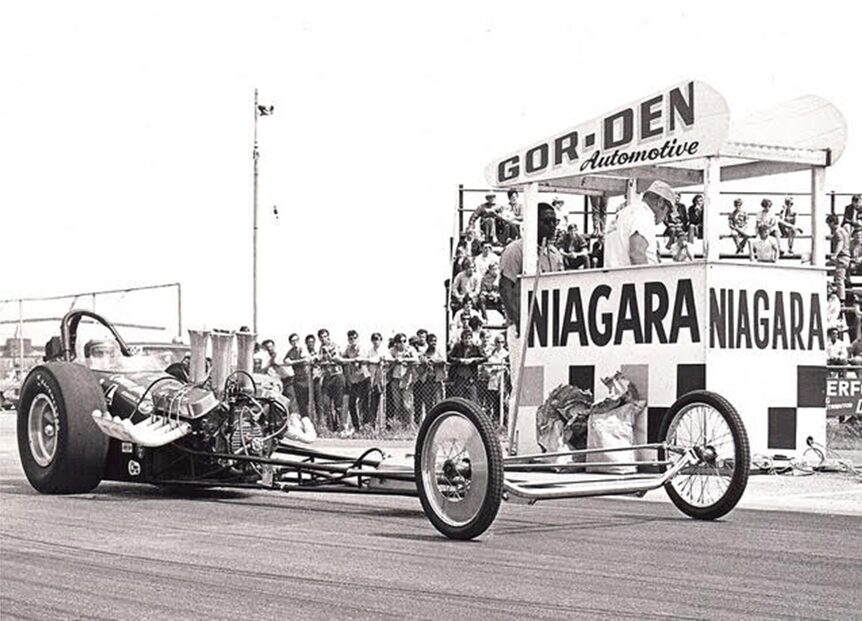
In the heart of New York State, just north of the Niagara Falls Airport, a stretch of asphalt once roared with horsepower, tire smoke, and the cheers of thousands. From the early 1960s through 1974, Niagara Dragway wasn’t just a racetrack – it was a cultural landmark, a proving ground, and a Sunday ritual.
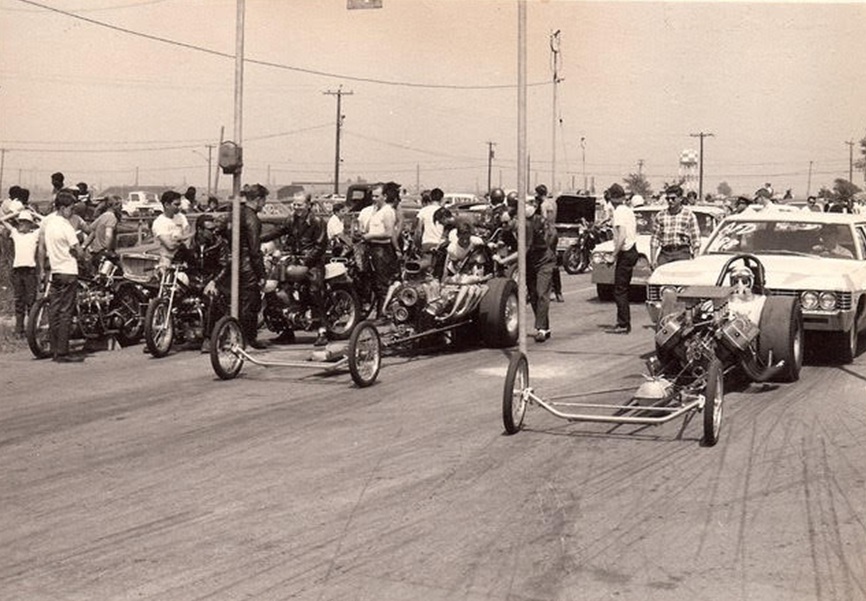
This post revisits the golden age of drag racing through the voices of Dean Johnson, longtime promoter of Niagara, and Jim Oddy, a celebrated competitor and Hall of Fame inductee. Their stories, shared during a presentation hosted by the International Motor Racing Research Center, paint a vivid portrait of a bygone era.
Tune in everywhere you stream, download or listen!



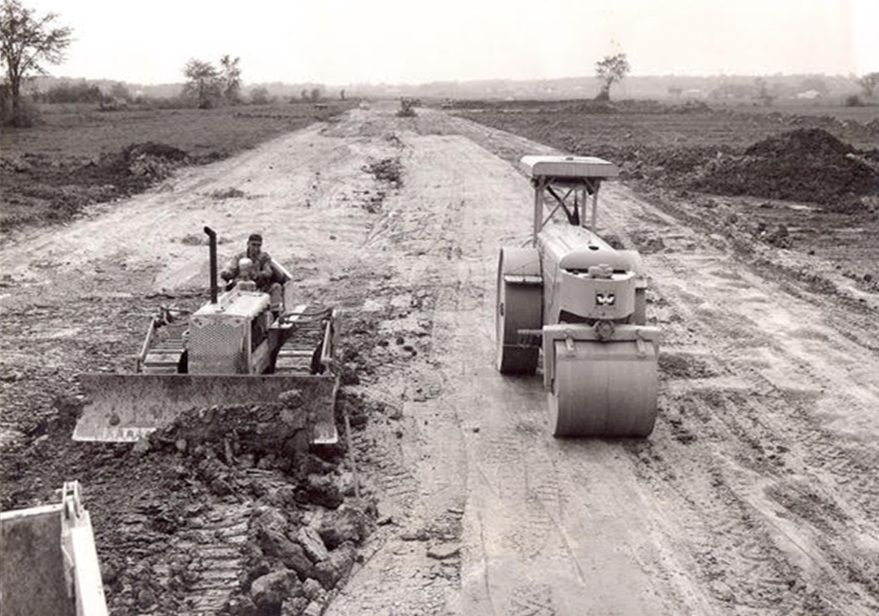
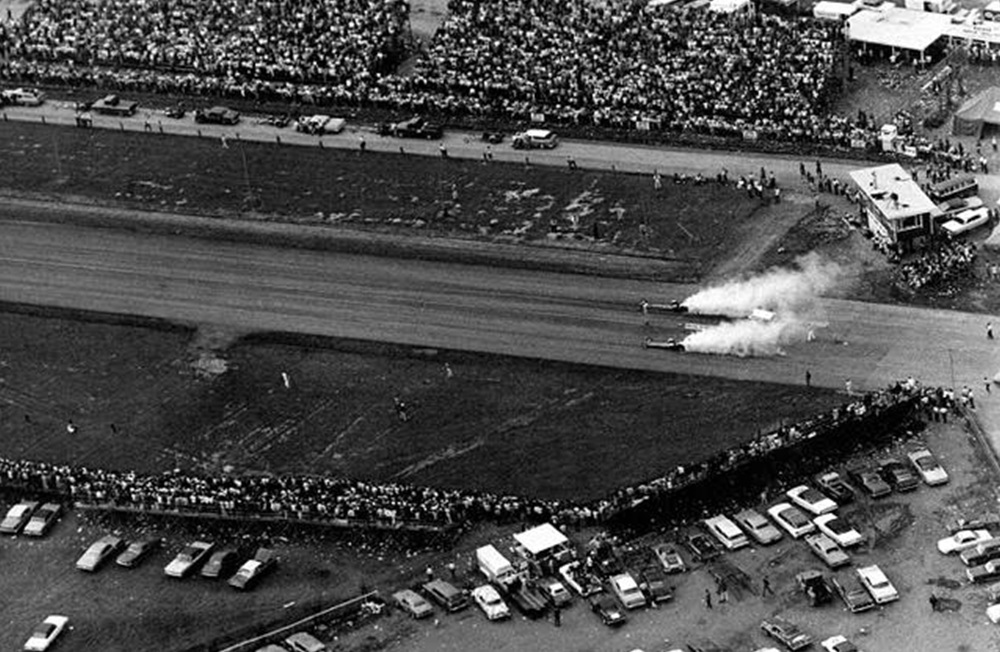
Niagara Dragway began with a simple idea: get street racers off the road and onto a safe, sanctioned strip. Dean Johnson’s father, concerned about his son’s street testing, partnered with Jerry Hammond, a local speed shop owner, to build a dragstrip on 197 acres of land. The construction was as grassroots as it gets – no stakes, no surveyors, just a bulldozer and a tree in the distance marking the finish line (below).
The first race in 1961 tore up the starting line, prompting a quick repave and a clever fix: Portland cement broomed and wetted into the asphalt, creating a durable concrete launch pad that lasted for years.
Slideshow
This is a collection of photographs courtesy of Dean Johnson and the Niagara Dragway collection that is now part of the IMRRC.
Transcript
Crew Chief Brad: [00:00:00] Break Fix’s History of Motorsports series is brought to you in part by the International Motor Racing Research Center, as well as the Society of Automotive Historians, the Watkins Glen Area Chamber of Commerce, and the Argo Singer family.
Crew Chief Eric: Niagara Dragway was one of the most popular and iconic drag strips in New York State from the early 1960s through 1974.
The Sunday Niagara commercials boom from Superstation WKBW during that period, making Niagara the place to be for maximum automotive excitement during Niagara’s tenure, icons of the sport, Gar Muldowney, Perdome Ewen, and many others rocketed down the Niagara quarter mile. And this presentation features Track promoter Dean Johnson and longtime competitor at Niagara Jim Otti, who is a member of both the NHRA Division one and International Drag Racing Hall of Fame.
So sit back as we relive that history with stories, photos, and memories of those wild Sundays at Niagara.
Kip Zeiter: My name’s Kip Zider. I’m the Visitor [00:01:00] Services coordinator for the Motor Racing Research Center. We are very excited about this presentation. I’m gonna start this off by thanking everybody involved in this because inevitably at the end of it, I forget to thank people.
So the first people I want to thank obviously are are stars here, Mr. Dean Johnson and Mr. Jim odi. Hold your applause. Not at the end, but hold your applause right now. I wanna thank Jen who’s flitting around here as our high school. AV person who’s here. I wanna thank Jim Galbrath, my good friend who Jim and I have spent weeks trying to call 3000 slides down into the 250 that we’ll be seeing this afternoon.
It’s been a very difficult task, only because of the fact that there’s just so much good stuff that we’ve seen there. I wanna thank Eric technical wiz who’s taping this and all this good stuff. I want to thank Alison Kreitzer from the Easter Museum of Motor Racing, Les the photographer. We’ll have one gentleman that will speak for just a couple minutes after our formal presentation is done here.
His name is Jim and he represents Skyline [00:02:00] Dragway. We had a couple cars that these guys were gracious enough to bring in this morning. Parked outside Skyline is located in Tioga Center. It’s the eighth mile drag strip and then the old Shangrila two on the bottom. Very, very cool place and I wanna thank Jason.
Who brought in the Christmas tree short of the interesting cars that we bring in from time to time, the Christmas tree’s, the coolest damn thing we’ve had in the center in a long time. I wish I could keep it there. I wish I could take it home actually, but my wife would get upset about that. So I wanna thank all these people without this, without all of their help and, and Jim’s especially, this just would not have come to place.
So, brief background on the collection, Dean actually stopped at our place probably three years ago with a couple different scrapbooks, and Bill Green and myself started looking through the scrapbooks and were literally just jumping up and down because this is my era of drag racing. I knew all these guys and the archivists that we had at the time, for whatever reason, just wasn’t particularly interested in the collection.
So Dean left, fortunately to come back to us again about a year and a half ago with multiple boxes, [00:03:00] multiple scrapbooks, all kinds of memorabilia about Niagara. We advertise ourselves as International Motor Racing Research Center, and that means we touch on everything. But this is the first program we’ve ever done on drag racing.
I kind of consider this the golden age of drag racing. We wanted to get some of this collection out into the public view, so that’s why we’re here today. So Dean, thank you very much for bringing this. Without further ado, I think let’s roll.
NIAGARA PROMO: Y We open this weekend, Sunday.
It’s opening day. Look at the lineup. The incredible line bill and its wheel standing LA dark. Plus the spectacular supercharge supercharger Azar Bunny Fido, side by side against Omo zone. Jimmy Ti. You’re gonna see it and next time you roll up that stuff, like Buddy, you stop. Think of us and save it for
the Racers Place in New York State out on Lock Foot Road just north of Niagara Falls Airport in Niagara Falls, New York. See you at two. [00:04:00]
Kip Zeiter: I have played that so many times that the people I work with, I mean, they have lots of reasons to hate me, but they have hated me because I just love those commercials.
Those commercials were iconic. And we’ll touch on the commercials in a second, but before I turn the microphone over to Dean, I just have a couple questions before we get into your component and involvement with the track. When did Niagara first open up? Who opened it up? Do you have any idea what the acreage was or any of the monetary, the price.
What did it cost to buy the land, all that stuff, and how and when did you become involved in it? And the final question on that I have on that is we’re gonna see several slides here where it’s called Niagara Airport Drag Strip. It’s called Niagara International, it’s called Niagara Dragway. Were you just trying to keep ahead of the feds or was there some reason why it was.
Called a number of different names.
Dean Johnson: In 1961, Niagara was started by my father and a fellow by the name of Jerry Hammond. [00:05:00] And my father was, I guess he was concerned about me doing some, uh, testing on the street. He became interested, he, he wanted to know if there was any way it was possible to get us street racers off the street.
And I put him onto a P by the name of Jerry Hammond, who had a dragster and a speed shop in Niagara Falls. And between the two of them, they figured out that they needed a certain amount of Anchorage, and they put together a, a program where my father was actually able to put two pieces of property together, totaling 197 acres.
They decided that they could run a racetrack and maybe make a couple of bucks too. So in 1961, I was with my father and the bulldozer on a tractor trailer came up and they unloaded it, and the fellow said, uh. What do you want me to do? And there were no stakes or anything and we were at one end, we were at the airport end of the what was to become the drag strip.
And my father said. You see that tree way down there at the other end of the property. And the fellow said yes. [00:06:00] And he said, well, that’s from here to there is where I want the track. There were no stakes, no nothing. So away they went and the fellow said, uh, how much do we want? And he said, 60 feet wide. I want it cleaned out.
And uh, that was the deal. No stakes, no nothing. And they did have a permit to build a drag strip. Heaven knows what that meant, but that’s what it said. You have a permit to build a drag strip. Uh, there was a lot of rain and they finally got it where it was running late in the year in 1961. And the first.
Race that they had. The cars tore up the starting line and they had to repave it between the races and the, and the following race. And my father was pretty smart. After they had repaved it, we put down Portland cement and broomed it in and then wet it and then poured more Portland cement in and broomed and wet it.
And in effect, it gave us a concrete drag strip, the start and that lasted. So it worked out pretty well.
Kip Zeiter: There were various names for the Strip, Niagara Airport, Niagara Dragway, Niagara International.
Dean Johnson: Originally it was named Niagara Airport Drag Strip because we were immediately [00:07:00] adjacent to the Niagara Airport drag strip, and we thought that would make it easier to find.
And over the years, whatever was fashionable, we used that name and it was Niagara this or Niagara International or whatever it was, but it was always Niagara and it became Sunday Niagara. Everything seems to have been tagged Sunday Niagara, but it was always Niagara. No matter what was fashionable, it was still Niagara.
This is the NASCAR summer nationals to be 67. If you look. At the very center, the return road there, and that’s all dragsters. And we would put them out at the quarter mile and that’s when we push started them. So they would come out at the quarter mile and push start up the track. And there’s, there’s a lot of people there.
There’s probably 10, 15,000 people there in the track. The airplane, the wing, that’s my father. He’s checking up on us. But it’s really a gorgeous picture. There’s one more in there, which probably we’ll see where there’s two dragsters leaving this starring line, which is probably one of my favorite pictures.
The towers to the left of center. And just past that, you can see the [00:08:00] road. And that road is full of dragsters, which in this area that’s pretty good. We, we just, we’re not a track known for a lot of dragsters. Most of the cars we ran were a competition car or a Gasser or super stock, stock, that type thing.
But this is quite a good picture because it, it, it, there’s a lot of people here. This is the hot car staging lane. Tended to put our motorcycles on the far side and then we would tell the whatever class we were trying to run, they would come in and line up. Uh, you can’t see the signs, but there were numbers one through eight or 10.
And we’d say, okay, such and such a class, we need you to get in lane one or lane two, whatever. And then we had another section of staging that we ran the stock cars out of. And so we were able to run the cars pretty good. Uh, on our biggest race, we ran about 610 cars. We would run them about every 30 seconds.
We’d run a pair of cars. You have to, because we just didn’t have the time to do anything else. We ran a lot of cars and we ran ’em pretty hard. If they were running them too slow, they tended to get an earful from me and I’d be [00:09:00] shouting, run ’em, run ’em. And they’d say, well, there’s cars on the track. And I’d say that they ought to know by now, they better be off to the right or left because I’m sending another pair down on ’em.
And the dragster guys would have to stuff their shoots in their cars and all that, and they’d say, you know, you ran cars down of me. And I said, I told you you only had a few seconds to get the heck out of the way. And they believed me after a while.
Kip Zeiter: You mentioned that you had a lot of dragsters. How many different other drag strips were you guys competing against in Western New York during your time there and was there a reason why you guys drew more top fuelers than maybe most?
Dean Johnson: Well, a lot of the top fuel cars were, uh, booked in stage shows where we’d book in a couple of cars and we’d match race, ’em two outta three. Sometimes we would run open competition, but as a rule, the bigger cars tended to go to where there would be a show. Like the car here, I don’t recognize the top car, but the car on the bottom is from, uh, London, Ontario, and it’s old style.
Nowadays, the cars don’t smoke the tires like this anymore. To me, I like this kind of racing. I thought when they lost the smoke [00:10:00] and the noise and everything, in my opinion it lost. Its a lot of appeal. But these guys would be turning these tires and they would, a lot of them would smoke them right through the finish lights.
They had a lot of horsepower and I don’t know what kind of horsepower they had back then. Probably six, 700. Jim,
Jim Oddy: I, I told I had 3000, 2000.
Dean Johnson: Okay. But now they have 10,000 or 11,000 horsepower. It changed quite a bit. There’s the picture that I like in the top, you can see the spectators and then you can see the row of dragsters that they, they’re going down and then they’re gonna, after this pair clears, they’re gonna come out on the track and push start coming up to the track.
I got so aggravated that it took so long to push start these cars. We built a set of roller starters and used a little Chevrolet motor, and we would start one car at a time and, uh, we could start them so quick. It just saved so much time. And about a week or so after we got our starter system installed, NHRA came out and said, you need to have self starting cars.
So all my work was for Naugh, but it was pretty exciting to see a car come down [00:11:00] with a, another car pushing it and the car would be absolutely outta control. And it, it was really something to see these cars being pushed. It was not the safest thing to do, but with a roller star boy, it speeded things up a lot.
And when you had a lot of cars, you need to keep the program moving. And that’s what we did. And that’s just a picture looking down track and you can see where the tire marks are kind of all over the place. And uh, that’s a little bit exciting, especially for the driver. We had a good photographer when we were taking pictures.
I wanted to see crowds and I wanted to see our name. Les Glenn is here with his wife. His father was a track photographer for a number of years, so he has a lot of these pictures. The thing that I wish we had done more was I wish we had taken more pictures in the pits with the car and the driver because the cars are nice, but it’s pretty interesting to see the drivers too.
Kip Zeiter: I was gonna bring this up a little bit later in the discussion, but regarding sponsorship, I see Gord there and we have Gordon in several of these slides I actually talked to, I think it’s the son of. The gentleman that started [00:12:00] that years ago, they seem to be one of your major sponsors, or at least there for a number of years.
So I was wondering how did you attract sponsors? How did you keep sponsors? Happy? Racing now is nothing but keeping sponsors happy and keeping sponsors and the money still has to keep rolling in. So I’m just wondering what it was like back in your days.
Dean Johnson: All of the speech back then were really good people.
I think I traded that sign for a set of bags for one of my cars. I don’t think they ever did anything else. We left the sign up ’cause I didn’t have anything else to put. That’s the truth. The, there was signage down on the pit side and I charged nothing for that. We wanted people to see names to make it look more exciting, so it was like pulling teeth to get people to put a sign up.
It isn’t like today, we sold all those signs over the years and they now they have great
Kip Zeiter: value. So you’ve made more money selling the sponsorship signs than you did talking to the people to get them to put their names on the sign. We
Dean Johnson: might basically gone $25 for a [00:13:00] couple of signs on the pit sign, and that would’ve been it.
And we never took ’em down. We just left them up. They paid $25 and it went for eight or 10 years. We didn’t care because it made the place look busy. People make people, if, if you have people and they, and they have a good time, they’re gonna tell somebody. Oh, for sure. It’s important that people are with people.
This is the kind of stuff I like, ’cause it the, it’s got a known car and it’s got lots of people. This fellow here, the last time I looked, he was very ill. It’s Larry Downs, but it’s got him putting things together. We’re in, as you can see, the tower, you can see the car. It is an exciting picture because it shows a lot of the way things were.
And the top one on the right, we used to do a parade. If we were doing exhibition cars, we would do a parade. And then if you look in the left side of that top right picture, you could see yellow and that is rosin. And when we were match racing, we would put Rosin on the track and they would do burnouts and it would improve the traction and it, it would be part of the show where you’d be running a Ford against the [00:14:00] Chevrolet or against the something or other, and they would put the rosin down and it became quite a show.
And the announcer would get who’s for Chevrolet and who’s for Dodge. And it got to be a lot of fun. And the announcer was a great portion of what people saw because if he was good, people saw a good show. This is a rain out, not a total rain out. We’re trying to drive the track. So we’re driving the cars down the left side and back up the right and, and a lot of times we get comments of people’s memories and I just read one where a guy said I was 14 and I got to drive my father’s car down the left and up the right, down the left and up the right we did that to drive the track.
And the girl on the left, she’s putting the numbers back on the cars because the rain has knocked the, uh, we used shoe polish. They had to replace the shoe polish, but that’s what we did to dry the track. And that’s me looking slightly dejected. This is out the window in my, uh, office. And it’s a great picture because you could see the funny cars, and I don’t see Jim here, but he’s probably here somewhere.
This is a big race. And you could see the [00:15:00] rain and of course the forecast would predict rain. And we worked hard to get the stuff in, but boy, it, it’s hard to do. You can see it’s a big race. You can see the flip top cars and the mud and the water. It, it was just brutal. It hurt your headcount terribly. But we were able to get the race in.
We didn’t care who you brought as long as you paid 50 cents for your kid.
Kip Zeiter: Was this bring a chimp to the race stage? We,
Dean Johnson: we don’t care. We got our 50 cents. We were happy. A lot of the stuff I never saw, I didn’t see this particular thing. And there’s a lot of pictures where there’s some really pretty girls and I think where the heck was I?
’cause I never saw that end of things. But I never saw the chip or, or this fellow. But like I say, if you paid 50 cents, I’m for it. Is that what the admission charge was back then? Huh. Jim and I were talking about what we paid. When the track opened, it was a dollar general admission and it was a dollar to race, and it was a dollar to get in the pits.
Kip Zeiter: Well, that’s just outrageous. I don’t know how I [00:16:00] agree.
Dean Johnson: It’s much like today it’s, it is. Places are about the same. On our last race, we charged $6 general admission and $1 to race, and $1 to get in the pits. And we were frightened to death that the $6 would have turned people away because we thought $6 was really pretty dangerous.
Hard to believe.
Kip Zeiter: That’s amazing. Regardless of today’s economy or back then, that’s just. So we’re touching now kind of on our local hero segment. We’ve got three slides here of Jim Zaia. Is Jim in the audience? No, I guess not. His wife is not. Okay. I’m sorry about that.
Dean Johnson: No, she’s not doing so hot. Jim’s a good guy.
Kip Zeiter: Well, yeah, if you could comment a little bit on Jim. Now we’ve got slides that we’re gonna leave till the end for Mr. Otti here, who again is a, a very, very much of a local hero and actually kind of a national hero. But if you could speak a little bit to Jim here, and then we’ve got a bunch of other slides that we just kind of called local folks.
So if you could speak to that.
Dean Johnson: Well, Jim Zs from [00:17:00] Niagara Falls. I don’t think I’ve ever seen a car of his. It wasn’t gorgeous. The car that I like the most is the one on upper right. That’s one that was my favorite. Uh, he’s campaigning a car very similar to the one you see on the upper left, but it’s a, it is totally changed an awful lot.
There’s a lot of work been done on it, but he, he would run these cars here. He was very successful. He took a lot of my money and he’s always got a, Hey, I never, you, you, you forgot to give me a check. And so I, I had a check left over for when we were running NASCAR and I gave him a blank and I told him, fill it out, whatever you want.
He still has that.
Kip Zeiter: So Mr. Adi, did you ever run against Jim? Did Jim run against Jim?
Jim Oddy: Actually, we were pretty good friends. We hung out a lot together, but actually Jim ran his cars in, uh, what they called modified illuminator. And all my cars were competition eliminator cars. We never actually raced each other, but we hung out a lot and took a bunch of Dean’s money, so we were pretty happy.
Kip Zeiter: When you say you took a bunch of Dean’s money, what would it have meant on a regular basis? [00:18:00] Let’s, let’s exclude the big events for the moment, but on a week to week basis, what would winning your class put in your pocket?
Jim Oddy: Well, I remember the days like competition limited to win with, we got $400, which was pretty good money, and back in the day I kind of did that full time.
All I did was race, so it was really important that we did well.
Kip Zeiter: Did you pay simply the guy that won or did you pay a second? I mean, I know how drag racing works, but if you get knocked out in the first round, you probably go home, say Thanks, we’ll see you next week. But how did you structure the prize money?
Dean Johnson: Normally we paid four places and at different races we paid round money against the winnings. And this is Jim Za again, and this is Jim with his whole family on the left. And this is one of my favorite pictures here. Jim broke an axle or a drive shaft. We have time to fill, so we let him push a car for ways and uh, it was good exercise for him.
And whenever he gets mouthy, I bring that picture up and say how much I love it. He has a fit and can’t breathe and everything. It’s just wonderful. But that’s the car that I like. And he didn’t do much braking. His cars [00:19:00] were pretty complete and they spent very little time like this. This is Bob Sullivan and that’s me on the left before my first wife.
That would be the one woman to the right. We got married, and this is Shirley and Bob Sullivan, this car. And they also had a top fuel car and they call pandemonium and it’s appropriate. And good friends. And now they’re, they are both gone, but wonderful, wonderful people. Larry Downs on the left side, that’s Larry again.
And I’m in this picture on the right. Larry Downs and Paul Ack. Anyway, he had a Buick Dragster and Paul blew his motor or he had a big motor and he put the big motor into uh, Larry Downs’ car. And uh, I think he drove it and they, they were relatively successful on it. But Paul crashed a car one time, uh, on one of our big races.
All that was left was the cage of the car and he was upside down on the finish line. And uh, we didn’t wanna turn it over ’cause we knew he was dead. And so we’re discussing what we should do with the body. And finally he said, Hey, uh, can you get me the heck outta [00:20:00] here? And we said, well, he is alive. I guess we can turn it over.
So he broke his finger. Good thing he landed on his head, which didn’t hurt him a bit. So this is, um, Chippewa and it’s a Satan’s car club, but he was a, a wonderful striping and stripping and made a good living at it. And he also drove Fran ADA’s car, and that, I think is an Oldsmobile engine in that, if I’m not mistaken.
And you can see the tires dragster with what? Six inch tires. They, they don’t do that anymore. They’re big tires now. The car on the left and on the car on the right originally was Tommy iVOS car. Ivo was an actor who got into drag racing and he had a car called the Buick Master. It had four Buick motors in it, and uh, they put a part of a car to make it look like a car on the rear of it, but it was four wheel drive and it was very impressive.
There’d probably be pictures in here coming along. It wasn’t particularly fast, but it made a lot of smoke. And when we were doing promotions it was pretty exciting. I, I like the odd cars and I think most of the people did too. So this is a [00:21:00] clutch artist, dragsters, this little sea dragster. There’s a club in Buffalo that’s been around forever and uh, even some of the, the members are still around, but the, this is their little sea dragster and it’s a good little car.
You know who Station wagon that is? Uh, yes, I saw it. I can’t remember who it was, but Dan Cini. Okay. Dan Cini was a member of the Clutch Artist and he was a business manager probably for the clutch artist. That was a killer car. Hard to beat that car. Yeah, the station wagon in the back. This is Jerry Hamam Hammond ran the track 1961 and part of 1962 and the car he’s got there is a, a little Mustang with a 2 89 cubic inches blown and it’s a nitro.
And this is the car stopping and I don’t know who’s running on, on the far side, but that’s how they stop them.
Kip Zeiter: Obviously you have a full body car against a, a rail. Is that some kind of like a competition eliminator thing or a match race or what? What would
Dean Johnson: do is there were national records for all of these cars and so Jerry’s car was called a double B alter and this, this car here would probably be an [00:22:00] a gas dragster.
So whatever the record was, they, they would run each other using their records. So one car would get a later start than the other handicap’s called.
Kip Zeiter: Oh, okay. Alright. Not bracket racing. No,
Dean Johnson: no. Bracket
Kip Zeiter: racing came
Dean Johnson: along
Kip Zeiter: later.
Dean Johnson: Much later, yeah, much later. Okay, this, this is early because you can see the tower in the picture on the, on the left the tower was pretty shaky.
And uh, I have a picture of a very famous announcer and he is standing and you had to stand on the floor, Jo. ’cause if you didn’t, you go through to the first floor, the ceiling’s falling down and it’s just the way it was back in the day. And, and you, we ran it that way and nobody thought a thing about it.
That’s just the way it was. We were glad to run. Well it was all that
Kip Zeiter: sponsorship money that you
Dean Johnson: collected that Oh yeah. I don’t, I don’t know what I did with that $72. Alright. This was our first snow out on the left and these fellows that come in from Massachusetts to go racing and uh, we got snowed out.
This little dragster here, I believe the fellow on the left is [00:23:00] Rick Johnson. He runs Johnson Building Company now. Now this is Val Port on the bottom right. And I was his crew probably in 67. I was his crew, which is pretty frightening in Florida when we won the Florida Internationals. This car on the right is Tommy iVOS, wagon Master.
This is Summer Nationals. This little car on the, on the left is a fellow that came from, uh, big North of Barry, Ontario. And he would come every week and he was not a winner, but he was a good guy and he, he liked to go racing and so they, they.
Kip Zeiter: Well, one of the reasons we wanted to use this slide was you see the NHRA in the left and you see the NASCAR summer nationals on the right.
So what I’d like you to speak about, and Jim, if you have some thoughts on this, everybody knows NHRA, it’s been around since parks started it years ago. Was the track NHRA sanction when you opened it up? And how did you become a NASCAR sanctioned track?
Dean Johnson: We, we ran in 1965, we ran [00:24:00] NHRA regional meet and we had, uh, 9,007 people in that.
And Dal was a divisional director for the division one, which we were in, and he called the race. It rained for a couple of minutes and quit. We had 9,007 people in the place. The rain quit, the sun came out. So we had all these people, Dominic called the race without asking me, and I was fit to be tied. So we had people coming in and people going out.
Ultimately the race was called and we ran the race a month later, so they took a quarter of that. ’cause that was NHRA they, for this race. They took one quarter of the money for them and they rescheduled the race for a month later. And so they took a quarter of that. Also. There was a riot over the money and it was really a bad deal and he should never have done that.
Kip Zeiter: Is that what precipitated, how did you become a NASCAR section track?
Dean Johnson: Well, when we ran this event in 1965, they had a meeting of Division one on the east coast, and all the operators and managers were there and dial and dah was telling us the changes and who [00:25:00] got what races and when they announced the races, we didn’t get one.
And I got up and it like 150 people and I said, what’s going on here? We, we didn’t get a race diamond Choice. You had one last year. So I went to, uh, the fellow that was my promotional fellow, Ian Michel, he and I walked out and we had a quick discussion about what we should do. We decided we were gonna call NASCAR Drag Race Division and see if we can run over there Pittsburgh and ask him, we wanna.
Wanna run under the sanction, and we wanted to, uh, uh, run some of their big events. We called up Ed Berger, who was the head of NASCAR drag racing, and, uh, he said, come on over. And so we walked back in and, and I was just going, I left Ian gotta run his big mouth. He opened the door and, and a place like this.
And Darwin’s up talking. He shouted about everything. He said, Hey, Darwin. And Darwin says what? And Ian said, I don’t care where you put your races, but if you put your race one against one of our big races, we will kill you. And we slammed the door and [00:26:00] walked out. That’s pretty subtle. I got you have in your records Western Union note that Dow and sent to me, Dean, you’re no longer sanctioned with the NHRE.
And I said, Dowen, you already knew that. We told you we quit. So we went over and talked to Ed Berger and he said, well, what do you want? And we said, oh, we’d like to run the NASCAR summer nationals. He said, okay.
Kip Zeiter: How many years did NASCAR. I sanction drag racing. We
Dean Johnson: ran a couple years with nascar. Okay. And we ran a lot of their big meets.
They were cheap compared to everything else. We had the ability to get a lot of interesting cars. They, they, they ran a Coca-Cola Cade of cars, which was, it toured mostly in the, uh, central to the eastern part of the world. And, uh, the great shows great, great, great shows, but they weren’t the very biggest of the big.
But they were big. They did all of the great shows. They didn’t break a lot, the good people. So we ran them a couple of times. We were very satisfied. We ran a lot of, uh. Record runs for nascar and we did a lot of stuff with nascar.
Kip Zeiter: [00:27:00] Jim, did you run NASCAR sanctioned races and, and was there any difference short of whose name is on the tower at a cost of what, 15 bucks or whatever we have established for that?
Was there any difference running NHRA versus nascar?
Jim Oddy: Well, everything was pretty much the same. I did run that event and we were pretty happy. We set the record in the double leg gas super for nascar, which made a pretty good day. I think we won the event. So it was all good for us.
Kip Zeiter: It was sort of a different sanctioning.
Everything else basically was the same in terms of Yeah, you couldn’t
Jim Oddy: tell the difference. Okay. Other than, other than the signage.
Kip Zeiter: Okay. Alright. So now we’re entering kind of what we call our cars and stars thing. Exhibition cars. Exhibition cars. I mean, I don’t mean to harp on this. This was kind of my era, the Hemi Under Glass, the LA Dart Wheel standards like this.
So we’ve got a fair number of slides. If you could just kind of comment on the names, and maybe we can get in this later. I’m interested in. We’re gonna see Gars, we’re gonna see Shirley, we’re gonna see McCue, and we’re gonna see all these people in a couple seconds here. Can you [00:28:00] comment on who was great to work with, who maybe was a little bit difficult to work with?
Just kind of stuff like that?
Dean Johnson: I would say there were only two cars that I was unhappy with over the years. I had a couple of cars that didn’t show, but for the most part everybody showed. This is Bill Schuberg in the La Dart on the far side in the hand under glass, which would be Bob Riggle. Bob Riggle was the driver when, uh, Jay Leno went on his head had a roundy round race strike not too long ago.
Bob Riggle. Died shortly after that. Not related, but he just, he died. But these were a lot of fun and they were scary as heck when they ran. I would go in the tower. I couldn’t watch ’em because when they started, they didn’t spend a lot of time on the track. We never had to cut the grass. They were off in the ding weeds.
And, uh, I had a deal one time where Bill called me in the middle of the Saturday night and he said, I wrecked my car. And I said, okay. And I said, well, I still want you to come. And he said, well, there’s nothing left. And I said, well, I advertise you. I want people to know why you’re not here. And I said, who did you get to replace you?
And he said, I [00:29:00] didn’t get anybody. And I said, well, surprise me. And, and we’ll have, so there’s two cars here. So he got somebody up and they got another wheel stander. And they showed up. And when Bill showed up, I don’t think there was anything in his car that was worth anything. There was just total garbage.
It was just totally wrecked. But he was parked outside, so the people had to walk by him to see why he wasn’t on the track. He wrecked that car. He wrecked a lot of cars. All these, all these wheel standard guys. They wrecked a lot of cars, and a lot of times they’d go down the track and they’d, they’d wanna get a better track.
So they’d come back there. That’s what the car looked like. And that was parked outside the, the entrance. But, uh, the, the cars would go down the track and if they weren’t happy, they’d turn around, they’d come back up the track and you don’t know if they’re gonna stop. And I lost a Christmas tree once to, uh, a fellow that had the car was called a mystery mover.
And I, I was booking cars for Reunion, and he was saying, well, I, I had the mystery mover. And I said, I, I don’t remember the car. And he was, he described the car. And I said, I, I don’t remember the car. And he said, I ran over your tree. And I said, now I know who you are. [00:30:00] So he ran over brand new tree. I hadn’t had the tree for a week and he ran the tree over.
Kip Zeiter: So these guys all came to do match races, right? Am I correct in that? Well, we,
Dean Johnson: they didn’t start out match racing, but we match raced them. You, you’re gonna come, we’re gonna give you as much grief as you can. So if your car doesn’t run, you’re gonna get beat by somebody better. So we, we ran them, we ran them all.
But you paid these guys to come. Yeah. Right? Yeah.
Kip Zeiter: Okay. Berry and the, how much did you pay like the wheel standard
Dean Johnson: guys? 700, 750. Now I, that car there, I own half that car. He borrowed $5,000 for me and signed a paper that said I owned half the car. I was with a group of people at one time and there were, I don’t know, 15 or 20 people and everybody in that group owned half that car.
He sold that car to everybody. I said, yeah, I don’t half that car. They said, yeah, we do too. This is Nicole Moran. The fellow on the right is Brutus Lou Arrington. Tell the California guys ’cause their hair is just perfect. And uh, the [00:31:00] girl, Nicole was from Montreal. But yeah, back to cars, it’s just match racing.
This is, uh, Peewee Wallace on the left, Phil Cast Nova and the Virginian. You could see the signs and so I have like 20 or $30 worth of signs. But we left them up because it made things look busy. This is TACA four. This is 1965 when we had the 9,007 people and we had not enough seating and the people were lined up along the drag strip and we couldn’t control, but we just ran the race.
They were five feet from the race car.
Kip Zeiter: I thought the interesting thing about this shot is that Taca is still multi-generational ’cause task is still a funny car guy. Yep. And still getting the job done. So I don’t know what generation Taska this would be, but they were New England based, I think. Right?
Rhode Island or Massachusetts, something like that. I’m a little confused on a gas and comp gas and all the rest of that stuff. Is this a car you would’ve run against?
Jim Oddy: Well, a FX car, it would fit in comp preliminary, but it was actually a separate [00:32:00] class. I’m pretty sure where the A FX just raced against a FX cars.
That was kind of the beginning of the funny car.
Dean Johnson: But we did a deal once where car broke or didn’t show or something. Yeah. And we ran Jim against one of these cars, handicapped probably.
Jim Oddy: That was a fill. How’d you do? If I remember right, I’m pretty sure it was Bruce Larson with a Cobra.
Dean Johnson: But you, you could lie because nobody could remember.
Jim Oddy: Well, and I don’t, and, and I don’t remember, but I didn’t even know what I was doing. I just went there to race. The next thing you know I’m doing a match race with Bruce Larson, who was a pretty famous individual at that point. Sure. It was an a sports car. It was a Cobra. Really ran fast. I’m sure I didn’t win or maybe I would’ve remembered it.
Kip Zeiter: No, we think you won. Right? Didn’t he win? Yeah, he won every, everybody knew he won. Okay.
Dean Johnson: Okay. This is Jungle Jim, and I think this is Nu Jungle Jim. Number two car, when these guys got going, they would have an a car or a number one car, number two car. If I couldn’t get the number one car, we would buy the number two [00:33:00] car and nobody would know the difference anyway.
Oh yeah.
Jim Oddy: Yeah. They would.
Dean Johnson: Most of the inspectors wouldn’t have a clue. Oh yeah. If Jungle Pam wasn’t with him, but Jungle Pam never was at Niagara, and I wish I could open a racetrack just to have her show up. So
NIAGARA PROMO: she was the show,
Dean Johnson: and the nice thing about her is it never seemed to have gone to her head. She always seemed to be pretty level-headed and she just never seemed to have changed.
Love that to death because she didn’t get nutty. She worked in the car, did she? Oh yeah. She was part of the crew. And, and I’ve seen some stuff where she said, yeah, you see all of the fancy dresses and the low cut this and the short that, and she said, it doesn’t show the time when they’re traveling between places and you’re sleeping in the back of a truck and they’re bouncing around and no food, and you don’t see any of that.
You just see a skimpy outfit and, and a car making a lot of tire smoke. She said, you didn’t see the, the work that went into this stuff. So I, I, I always liked her and I, most men do, but she just seemed to be very [00:34:00] levelheaded and it never seemed to go to her head. And she still around and makes appearances and that would be on my bucket list to meet her.
I, I just think she’s the best thing. This is, it is just another race. You could see the weather’s really shaky here on the right, and this is one of the few pictures on the very right is Ian Mickel, who does my promotion. Mr. Cosmopolitan, I ran the racetrack, he ran the promotion. He didn’t have much to do.
We ran a good show. He just put the people in. I did the rest. I had a good crew. I, I’m so fortunate when I hired everybody, there wasn’t anybody that didn’t love the racing and there wasn’t anybody that wasn’t honest. There was no favorites and somebody got a favor and, and there was none of that, which is very important because you don’t want people to think that, Hey, Jim’s here, he is gonna get a treat.
We didn’t give Jim any treats. We, we made it as life as impossible as we possibly could. Him and Zeke.
Kip Zeiter: Well, on the subject of promotion, let’s, let’s talk about that for just a second. We’re all familiar with the radio ad. How did, how did that actually. Come
Dean Johnson: [00:35:00] about. We were in WKBW in the recording lab and Ian was saying, I want this different sound.
He wanted this Sunday Niagara, everybody’s in there screaming Sunday Niagara. It was like a nutcase. And finally one of the tech guys said, you know, do you want this sound? And he screamed the Sunday Niagara Ian said, that’s the sound I want. And that’s the sound that it, we used it on all of our ads. So
Kip Zeiter: that was
Dean Johnson: just
Kip Zeiter: a tech guy from
Dean Johnson: the radio Yep.
That did that? Yep. He wasn’t supposed to be doing any recording. Oh, okay. But he got listened to all of us arguing back and forth and he said, is this the sound you want? And he did it and Ian said, yeah. Why did you do that sooner? Okay. So apart from the famous radio ads, how else did
Kip Zeiter: you
Dean Johnson: promote the track?
We, we did mailers and uh, we would mail out. I remember one time we mailed out. 33,000 pieces of mailing, 33,000. Everything had to be by zip code or in Canada Postal Code. Everything had to be in order. And uh, we had to call a post office and say [00:36:00] we’re coming. And it would normally take probably two van loads to do this stuff.
So to do 33,000, I might have 20 people in my house. Somebody be stamping and somebody be licking and somebody be sorting. And I wish we had taken pictures because when people say, oh, it’s really hard to promote now. Yeah, you go and you tap in something and it pops up on somebody’s screen and they go, wow, that was a lot of work.
You ain’t seen nothing until you’ve seen 33,000 pieces of literature. More match races, stone, woods and Cook. They ran early Gassers and very famous. This is Connie Colletta and that’s Miss NASCAR on the far right. And uh, there’s some pictures of him with a trophy and, and he’s all dirty and he’s been working on his car and there’s a pretty girl and he is got around a girl and I don’t think the girl wants anybody touching, ’cause everybody in that group was not very clean.
We’ve been working hard and he’s holding this trophy. He didn’t win. But the Kendall people did the promotion, and so they’ve got the [00:37:00] Kendall’s got a big trophy and he’s holding the trophy. Well, he didn’t win, but
Kip Zeiter: nobody knew. I must admit, I didn’t realize till we saw the slide. I didn’t realize Colletta drove a funny car.
Did he drive a funny car before he got into a top few car? No, drags
Dean Johnson: dragster first.
Kip Zeiter: Oh, really?
Dean Johnson: Okay.
Kip Zeiter: I didn’t realize that.
Dean Johnson: Yeah. Now the other car is Caleta also. That’s a little bit later. And then he went back to Dragsters. This is Tommy Ivo. He’s quite the showman. That’s his car, his trailer, and I think he had a Corvette in there somewhere.
Kip Zeiter: I’m sure everybody’s been over to the center. But the top fuel car that we have on the floor was actually built by Tommy Ivo in 1963. The records that we have indicate that he built somewhere between 10 and 12 chassis. He became known as I’m sure most of you know as tv, Tommy Ivo. He appeared in numerous TV shows and a couple movies, I think in the sixties.
But he competed at Niagara on more than one occasion. Yes. I think it’s pretty cool that we’ve got one of his cars next door and here he is and
Dean Johnson: he’s a good guy. Okay. Gars, really not much you can say [00:38:00] about him. He’s been there. He is done that he is done. Everything. Innovator, old guy he is. Gotta be 93.
Very successful. Worked hard at it. I don’t know how. He ghost as many things as he does, and people like me would go up and say, Don, you remember me in a, he says, oh, certainly I remember. Yeah. Right. But he, he, he’s a good guy and he’s paid his dues. He, he is the king. Well, he
Kip Zeiter: was the innovator when the motor blew up and tore off half of his right foot.
Yeah. My understanding is that’s when he said, maybe it’s a little safer if I put all this hardware behind my head instead of in front of my face. And so he was the innovator of the rear engine.
Dean Johnson: There had been some rear engine dragsters around. We had Steven Piper brothers had a dragster that was a short wheel based car that very innovative.
Everything was behind the driver, which is kind of what you wanted. It was a lower class car than top fuel. It was like a B dragster, something like that. But it very innovative.
Kip Zeiter: Jim just, did you ever have any desire to go top fuel, funny car or anything?
Jim Oddy: No, [00:39:00] not really. I was pretty busy what I was doing. I did crew on some fuel funny cars and kind of got.
Itching to do it, but it was back in the days when we’re hurting a lot of drivers. I didn’t wanna be responsible for someone getting hurt or burn up. I had a lot of friends that were getting burnt and killed and so I kind of stayed away from
Dean Johnson: it. This is Don Pdo on the far left and then the fellow in the center on the left is
Kip Zeiter: rolling Leon?
Rolling
Dean Johnson: Leon now. He died a couple of years ago, but PDO is still around. Tough card to beat. This is Jeannie Pru and, and uh, that’s Bill Berry on the top left. Uh, and these are just race pictures, that’s all.
Kip Zeiter: Isn’t that McCune on the lower right. PDO and McCune became famous Match Racers. The Mongoose and the snake.
Dean Johnson: Yes. And they worked hard to promote it. They good for them. They worked hard at it. Uh, this car on the lower right I think is Shirley owing before she was famous. Yeah. These are all Shirley’s. Yep. And I like Shirley. Shirley’s always been nice to me. And what I like [00:40:00] about Shirley is she spent the time with the youngsters.
They’d come up and they’d ask her questions and she didn’t go buzz off. She spent the time with these people and I like that. And I know my daughter was somewhere where, where Shirley was and she said, uh, do you know my dad? You know, I’m Dean Johnson. She said, oh, absolutely, and blah, blah, blah. And she was so nice to my daughter and she didn’t have to be.
So I like that. This is Paula Murphy. On the left, I had published a picture of a fellow underneath a. One of her cars and I had said, I wonder who’s under the car. And I got this email and all you can see is from the waist down. I say bare feet. And the fellow said, uh, that was me and it was her son.
Somehow I got their phone number and I called him up and I was asking him how everybody was doing, and I said, how was your mother? And he said, here, you ask her and handed the phone over to Paula and I got to talk to her and I thought, well, how lucky am I, all these people that were out and about and all these experiences?
And, uh, so I got to speak to her and I thought, boy, I’m so [00:41:00] lucky. And she has died since. But I just thought she was so nice. Pretty lucky for me. Blue Max. Nice crowd too, by the way. And it’s cold. Look at the all the heavy clothing and uh, we had a photo cell go out and if a photo cell goes out, you can’t get a elapsed time on the car.
And so I was down adjusting the photo cell and they turned that car loose, which is why I have no hearing today. Probably that picture will show up in here somewhere. But when I had my head down on the track, all of the dust, there was nothing on the ground. Anything, any dust was picked up by the exhaust noise.
And I would’ve known that if I hadn’t have reset this stupid photo cell. But I had my face right down on the ground and all this dirt and dust was held off the ground by the noise on this car.
Kip Zeiter: Speaking of the, uh, coats in the background, when did Niagara Open and how long was your normal season? When would you, you’d, you’d run through when?
September, October.
Dean Johnson: It was difficult to make ends meet after Labor Day. We would tend to pack it in by Labor Day, and we would open as soon as we could. Did I, I remember we [00:42:00] opened one time, it was probably Mother’s Day and, and uh, we went, oh boy, how are we gonna get around this? So we went out and bought a gazillion roses and every woman that came in got a rose.
So we kind of got off the hook a little bit. But, uh, it is tough to run race on Mother’s Day when mother’s not happy about you going drag racing. This is, uh, Arnie Beswick. Arnie Beswick just had a birthday. I think he’s 95. I have a friend that lives down near him. I said, I have this photo. Would you please ask Arnie to sign it?
So Arnie signed it and he said, that’s not me in the photo. So I have, I have a photo signed by Arnie Beswick. That’s not Arnie Beswick. So this photo that we’re looking at? Yep. That’s not, Nope. I don’t know who it is. Well, I guess we didn’t vet that very good, did we? Wow. But he said I signed it. That’s interesting.
He said, I signed it, but it’s not me, Jim. We were so proud of that. Who knew. So I sent a bunch of stuff to Arnie to be signed. He’s a farmer. They called him the farmer. And the stuff never came. And I waited a month or [00:43:00] so and I called him and he said, oh, I had the back of my car open and the wind blew it out and I about had a hernia and I had so other stuff and I, I sent him the other stuff and I said, please be careful.
I got a call. He said, you aren’t gonna believe this. He said There was a farmer up Paul in his field and he found all your pictures. So he signed everything that I sent to him. So if you need something signed by Arnold Beswick, I probably have a hundred or so pieces. He had a major fire at his barn. It burned all of his memorabilia and all of his old cars up.
He had nothing left. And he’s probably one of the nicest people you’ll ever meet. Aside from that not being him. Uh, I don’t know who the dragster is. Uh, the bottom one, it’s a Ford engine, which is kind of rare. And it’s Herbie Rogers out of London, Ontario. And it’s an ejected Ford, which is, uh, they call it a camera.
Herbie has been gone for a long time, but it was, it was a good running car. This car here, I don’t know what it is. I just like the picture here. That’s kind of behind us. I don’t know who that is. Hard to tell. On the [00:44:00] dragsters,
Kip Zeiter: we put the ed pink car in because he was a master engine builder and Mr. Pink just passed away.
Did he just die? Yeah. Yeah. Very, very recently.
Dean Johnson: But he was very old. He was, he was 93. Oh, I thought he was a bit older than that. Well known. If you had one of his engines, you had a good. Uh, these are just cars that paid to get in and go racing.
Kip Zeiter: We’re segueing into not fuels, not funny cars, but just all the other classes that you ran.
And maybe you could speak to this, and Jim could certainly speak to this about the various other classes that ran. And without getting overly technical, just the differences between, I’m assuming that’s a Gasser and honestly I don’t know what the, what you would consider the car on the right. So can you speak to that a little bit, Jim?
Jim Oddy: Yeah. Well the Gassers are generally like full body coops. Back in the day, they ran in modified eliminator, uh, a gas through F gas with different size motors and weight brakes. And then the Royal T car here, that’s a. Let’s see, that would be an A altered car. It’s not supercharged. And that would run in [00:45:00] competition eliminator.
And that’s where you were? Yeah. Yeah. We raised him a lot. Can’t think of his name, but he was good. Yeah, more alters. Double a fuel altered. And a double a al Altered Charlie, he one with the Canada flag. Yep. Yeah.
Kip Zeiter: Now were most of these guys from the western New York area? Canada.
Dean Johnson: Well, the car here on the right, on the upper part is Charlie Havelin.
His son is still racing and he was from a cow farm. And his father, he said, I’m, I’m going racing. And his father said, not till the chores are done, and then he’d have to get home in time to milk. The cows father said, no, no, no, you’re not leaving until all the chores are done. And uh, I spoken quite a bit to his son and they’re all campaigning the same car.
Believe it or not, this is a rear engine car built by Steven Piper. This was before Don Gar was doing rear engine, but you see everything here is behind the driver. This is a sidewinder. A sidewinder, yeah. The engine’s about a across lots. Very innovative. We ran a lot of Dragsters. This fellow on the bottom, probably EJ [00:46:00] Potter, I’m not sure.
There were two. There was a Ford and there was EJ Potter, and this may be the Ford that’s Potter there. I toured Australia with him and, uh, bury and, and uh, just Tyree, this one here is a fuel bike, I believe. Top Fuel. This is a good show. I, I, I don’t think that’s ej, I think that’s, there’s another, another group and, and that’s not ej.
Were the bikes part of the weekly show. None of us particularly cared about bikes. And, and so as a result, we did them dirt and we didn’t care. And, and finally I had a little tiny girl come up to me and she said, I, I don’t like the way you’re running the bikes. And she ran a bike and she probably weighed 95 pounds soaking wet.
And I said, if you don’t like the way we run the bikes, you run the damn things. I said, we’re, we’re not interested. I said, when you’re done, give me a list of who gets what. And leave me alone. So the next week she ran the bikes. They never ran any better and the guy said, we don’t know what you did, but we love the way you do it.
And I said, go see that little itty bitty girl over there. He ran the bikes, she did a wonderful [00:47:00] job. And the bikes weren’t second class anymore. We ran a few jets and these were our Arons jets. They were okay. They were better at night. And most of the people like Jim don’t like them because they claim they oiled the track.
We didn’t care.
Kip Zeiter: Maybe
Dean Johnson: I didn’t notice in the photographs. Did the track have lights? Did you run at night? I got permission to put lights up. We put ’em up. I spent, uh, probably 120, $125,000. We ran a couple of races and the town said, we don’t like them. Take them down. So where did they go? They went to, uh, it was called Empire at the time.
Empire Drag Strip. Oh, another
Kip Zeiter: drag strip. Okay. Yeah.
Dean Johnson: And they, uh, forgot to pay me. Well, perhaps they’ll see this.
Kip Zeiter: Well,
Dean Johnson: if you’re in the audience, anybody. I sued them and, um, they offered me, uh, $3,500 for the a hundred thousand dollars lights. And I, I was not happy. And my lawyer said, take the money. And I said, I don’t think so.
And he said, take the money. And I said, why would I want the money? And he said, because [00:48:00] if you don’t take the money, they probably will kill you. And I said, what are you talking about? And he said, well. They were kind of from the underworld and they, they would be offended at you. So I said, send me that $3,500.
So I paid the lawyer. I ended up with about $2,700, $2,500 for the a hundred thousand dollars I wanted. Hell on wheels was a real standard. It was interesting. It was just another wheel standard. A lot of people liked them. Little Red Wagon. Always a good one. The two cars here, the, the one is um, the Volkswagen, I can’t think of the name.
And this, this is stage called West, the one in nearest us. And the other bug I saw, I was at Norwalk one time when this car on the behind hit the rail and got turned around and upside down and the motor went out of the car and sailed. They had an ambulance there and it went over the ambulance and went over a light pole and landed out where nobody was standing.
Fortunately. But it was pretty exciting ’cause it was still running high LPM when it went by me. [00:49:00] These are wanna be, these are brothers, believe it or not. They were okay. They never oppressed me and I don’t think we ever paid them. They weren’t good enough that, but I should have paid them. But they
Kip Zeiter: had to learn somewhere, so that’s why they were there.
Well, we put these in because Jim was just fascinated by the bugs. So this is our ode to Jim Galbrath. We put these slides in, well.
NIAGARA PROMO: Uh,
Kip Zeiter: they were
Dean Johnson: free and it was, the sixties and seventies were very innovative, and we had people on bicycles with rockets strapped to the back, and there was a lot of strange stuff out there.
This was a Corvette wheel stander, and it got upside down, no big deal. They run over and flipped it on his feet and he was good to go. This was a car called Double Trouble. It crashed at Niagara before I was there, and I, I don’t know any of the details other than nobody was hurt, I guess, or killed. That’s all I know.
Two Chevrolet Motors. This is, uh, the Hearst Harry Olds. I like this car. And we had run it one time and we booked it again. They had a problem with it. Tower to pull to the right or pull to the left. And finally some kid [00:50:00] came up and he, he said, well, why don’t you just put the steering so that it steers in the opposite direction so it’ll go straight.
So they did that up here. One of the engines quit or something, and he got off track. Joe Beck tested our, uh, barrier. We had, uh, telephone poles in the ground with big, heavy cables, and the telephone pole was right next to where he was sitting. If it would’ve been older, a bit more, Joe Beck wouldn’t be Joe Beck.
So that was the last run of the Hearst Harry Olds. I loved it. Uh, there’s the picture where, uh, Kendall’s giving this trophy to, to kind col letter for no reason, which is great. I, I thought it was wonderful. You know, it’s group motion. This was the car that ran and won the NASCAR summer nationals. It’s
Kip Zeiter: called the Probe.
I like the photo on the right where you have the sole eliminator. Oh yeah. I thought that was pretty cool. Stupid
Dean Johnson: stuff. We could get away with it back then, and it was no big deal. We didn’t think anything ever. We just thought of the radio station would like it. And so we did a soul [00:51:00]
Kip Zeiter: show. We had a good time.
This was our winners slide, obviously. So that lets me ask the question, what was the most money you would’ve paid to win a Top Fuel or a funny car for a big show? And then on a regular, I think you already said you paid like $400. Jim, did you become rich winning your class week after week at Niagara?
Jim Oddy: Ask Jim what I did to him in a later years when you won a week.
Then he got tired of me one Sunday afternoon. I had won comp eliminator and I’d go up to get paid and he says, you can’t come back next week. I said, oh no, I I I’ll, I’ll be, yeah, I’ll be back. No, no, no, you won’t. You’re gonna take a break. He says. That lasted a a while and uh, we finally came to an agreement.
I’m pretty sure we raised the following week.
Kip Zeiter: What would’ve been the most money you would’ve won? And did you pay in cash when everybody went up to the payout window or was it cash?
Jim Oddy: No, Dean was all checks, no cash.
Kip Zeiter: Did, do you hustle off to the bank right away? Yeah, there was no rubber
Jim Oddy: [00:52:00] there. It was all good.
NIAGARA PROMO: That’s good.
Jim Oddy: Yeah. Um, some of the bigger events, there’ll be some contingency stuff where different people kick in for when accomplishment or a real good Sunday to go home a thousand dollars, which is pretty good money. Back in the day
Kip Zeiter: when you ran the NASCAR Summer Nationals Dean, how much top prize money at that?
Dean Johnson: Well, there would’ve been a lot of contingency money, and I tell you the truth, I don’t remember, but it would, it probably would’ve been 500, $800,000 plus contingency money. Couldn’t live on it unless you were really pretty competitive. Back to what Jim said about me telling him not to, we told him if you ran an eliminator.
What happens? There were some cars that killed the eliminators. He happened to own one. And so they say, oh, DY Iss gonna be at Niagara. I’m gonna go somewhere else. And so I fixed it. So Dy wasn’t at Niagara every week, so they knew Dy was out somewhere and they had to figure out where he was, but they knew he wasn’t gonna be at Niagara.
So we always had a good car count when he was elsewhere. And I, I did that for quite a while, but the [00:53:00] cars are so good. They killed the class. Say, well, I can’t win, but I’ll be runner up. I said, take a break and go race and bother somebody else.
Kip Zeiter: When you weren’t at Niagara,
Jim Oddy: where else did you run? We raced a lot back in the day.
Back in the day. Lancaster, they’d run on Thursday nights, so we’d run there on Thursday night and then, uh, Friday night’s, uh, empire was running and Saturday night we’d go to Gregory Park, Yuga, and then Sunday, if anything left, we’d go race at Niagara. We were busy.
Kip Zeiter: Okay. So theoretically you could run four nights a week?
Jim Oddy: Correct.
Kip Zeiter: Okay. Well that’s And if you would win
Jim Oddy: Yeah.
Kip Zeiter: Every four nights, that probably helped out quite a bit.
Jim Oddy: I was kind of doing that for a living for quite a while. So it was worth doing, oh
Kip Zeiter: boy. Sorry, we had to throw a couple of these in. What is a racetrack without beauty Queens? So we have two of these, Dean, if you would care to comment on any of this or care to not comment on any of this.
Dean Johnson: I, during the summer months, it was tough to make ends meet and we were doing a lot of silly stuff to try and put people in. [00:54:00] I wouldn’t ever do this again because I hired a model once and I don’t ever wanna do that again. It’s like going to a meat market. I don’t know how the women could do that. And uh, I wrote about this process of hiring a woman and I wrote at the start, my apologies to, and it was Audrey Hagan, who was very smart and she’s very good looking.
I had to interview her and I don’t ever wanna do that again. I’m a farm kid. I am not from the city. Anything to do with, it was like going to a meat market. It was terrible. It was just terrible.
Jim Oddy: Who numbered? I don’t know. And what did that mean?
Dean Johnson: I don’t know. I don’t know. I see pictures in here and there’s some really, really pretty girls.
And I never saw these girls. All I did was run a racetrack and I was not interested in anything else. And I look back and I go, I can’t believe I didn’t see that girl. And I see these pictures and I go, on the other hand, she’s probably as old as me right now, so no more interest in me than I have in her.
But these girls were pretty good sports. Look [00:55:00] at you. Oh yeah. That’s why you wanna talk about a nerd. That’s me. Look at you. The, the best part about this, this girl. Paul Zago, who was, is a racer, took her for his senior prom or her senior prom. Really? Yep. Unbelievable. And she’s sitting on, uh, Bob Sullivan’s dragster on the Wheel and that you can see Sullivan name on it.
That was Paul Skoda’s girlfriend. Who’d have thought. That’s me and all my splendor on the left. My wife, I had a friend that painted this thing with trust me on it. And this is me and my wife after our reunion, which we were gonna make a lot of money and we didn’t. And, uh, I, I had to work for another 10 years to get out of debt.
But I had a lot of t-shirts, two or 3000 extra t-shirts at the end of it. This is Dizzy Dean on the left. I didn’t know that. Dizzy Dean published Wheelspin Magazine in Canada. And then this is John Lundberg. It was John, what was his nickname? Iron Long or something? Yeah. To that effect, John Lundberg. Right?
Is it [00:56:00] wonderful to announce her in a wonderful person. They took this girl who was running around in this bathing suit, and they put her in Bill Berry’s wheel stander. So Bill Rebury has got a fire suit. He’s strapped into a seat, he’s got a fire suit, a helmet and goggles and all that. And they put this girl in without a helmet in a bathing suit.
And they told her to hang on to the, uh, cross members. And she said, there can’t be anything wrong with that. And Bill went out and the car goes up so high, it gets on the skid plates. Well, when it gets up that high, it stops. But she didn’t. And so she, so when the car goes. And so she’s going up and the car stopped going up.
So she’s banging her head on the roof of the thing and then of course the car quits and she comes down and then he goes back up again. And I can’t imagine what she was thinking. And this was all nascar. They put her into this. This was somebody’s girlfriend and I think they were trying to get rid of her, but, but they have [00:57:00] pictures of her.
It was wonderful. I’m glad NASCAR did it ’cause I wouldn’t
Kip Zeiter: have had the
Dean Johnson: brass.
Kip Zeiter: So we thought we’d throw a couple of these in. This is basically the people that made the place run? Yeah. Okay. All the people that helped you out. This is my, uh,
Dean Johnson: secretary short sherry. And then this is Ray Jones, who’s now gone.
This is Paul Schneider. And he’s gone, and I don’t know who this is, but she was reading the clocks clock reader on the left top. This, this was
Kip Zeiter: why you had to work another 10 years, right? Wasn’t because of the reunion 96. And it didn’t come out quite as well as you had
Dean Johnson: hoped. Yeah. It’s another statement didn’t turn out well.
The track had closed, this is a one or two years ago. There’s Bobby Pine on there. I thought Bob would be here today and then Randy’s there. Bob Kelman on the second from the right. This is a Christmas tree that we built. We spent like $33,000 on it because we were stupid and we could, and uh, I sold it for $2,000 each light, there were five spotlights in it to [00:58:00] make it work.
And it was like 35 feet tall. This is a magazine that we put out. This is at Lancaster. My wife, myself, dude, Jim Zaki on the right, the picture on the right on the bottom is a Christmas tree working. It was a working Christmas tree. It went out to a speed shop in on the East Coast Sunday.
NIAGARA PROMO: This Sunday reasoning Challenge 72 Auto racing’s. Big go September. Fabulous Sunday. Niagara, this is it. The race racers are talking about Challenge 72, where you’re gonna see some of the roughest, toughest wheel to wheel competition racing. Never stations in Dagara. And without a doubt, just one of the unreal drivers.
They all gotta get by his Bob Belows. An incredible Jimmy Ti, the man who went in the summer national just two weeks ago and blew the doors off the finest comp cars in the country. Yeah, the word is out baby. This Sunday everyone’s heading Niagara and the Giant Challenge 72 1 sensational day only, no reserve seats.
Gates open at 10:00 AM championships at 3:00 PM sharp, free overnight caming for fans and drivers towing in for the big beat. And don’t forget, once again, as promised, the track will be spray coated before the race [00:59:00] time with amazing revolutionary world breaking VHT Track lock. This is it with 3 72 Niagara Racers yearbooks to the first thousand fans of the pits.
That’s Sunday Niagara. This Sunday, the championship of championships, the fabulous challenge 72. Don’t miss it. We’ll see you now.
Kip Zeiter: Oh boy. So we did that just because we could and we had to hear Sunday Niagara again. But this is our very subtle way of segueing into the great Mr. Jim ti, who we are honored to have here along with Dean. And we’ve got three slides here with multiple cars. So Jim, if you could start out what got you into drag racing?
How did you rank Niagara as opposed to maybe some of the other places? I know you won India at least once. I’m not sure if you want it more than that, but that’s the big time. That’s India and Labor Day weekend. That’s where the greats are made. So if you could just spend a few minutes commenting on your career, we’d appreciate that.
Jim Oddy: This is a 65 year journey. You know,
Kip Zeiter: we’ve got time.
Jim Oddy: Yeah. [01:00:00] Actually a lot of people agree. This guy over here, he changed a lot of our lives with the snag or drag strip thing. We started out racing on abandoned drag strips, and I belonged to a custom car club in South Buffalo, and we had a Sunday where we went to this Kohler Air Force base, which is Dragway Parka.
All these cars are running e, G, and F, G and GG. So I just started asking question, what’s all this G stuff about? Well, it’s a gas class, right? At that point in time had a 36 Chevy coop. Me and my dad put it together and I had a 57 Chevy six cylinder motor in it, and went to dunker a couple times a watch, and I thought, well, I’m gonna enter, I’m gonna enter this deal and see what goes on, right?
So I entered a car, was like an EGAs F gas car. What happens is I won a trophy, right? I won a class, won a trophy. Well, that was the worst thing that ever happened. Because then we just got more interested in it. And this Anglia Hill was actually the first actual race car I built. A bunch of us Motorheads were hanging around your host one night, and it was a [01:01:00] weekend of the Indy Nationals, which was a big deal, right?
So there was three or four of us. So let’s go to Indy. One guy had a nice, fairly new Pontiac, so he said, well, you got the best car. We’ll take that. We’ll go to Indy. We’re just going for Saturday and we’re gonna come back. It was 1964. Jack Chrisman, the first funny car. We were blown away so we couldn’t leave.
So I spent the night in the trunk of a Pontiac and we stayed there. I liked all these Ang, all these gas cuts, these, I kind of really liked these Anglia cars. Pull the wheels up in pretty cool car. So winter of 64 when I found that Anglia up in Canada, we drug it 25 hours. They drug it out of Canada, spent a winter bowling it.
Dean kind of just got the track going. It was a pretty good racetrack and he would’ve these Gasser meets so you could kind of tell that bunch of guys, Ohio was famous for the Gasser cars. Joe call all these guys with great gassers and they come, he would have a special Gasser day and, and we’d have a couple hundred great gassers so you could judge what you were doing with the rest of these Ohio guys.
So in 64 I got [01:02:00] pretty competitive. I could run close to the record and stuff. So 65, you know, we just had a old Chevy I towed around, I had a tow bar. So I tow bared the car to Indy to see if I could run it Indy in 65. Well I ended up, we got the thing going pretty good. Had a lot of good help. We ended up winning.
Final round around BGA at Indy went eleven twenty, a hundred eighteen. I’ll never forget that. Bob Riffle, which that was the rod shop car, which at that point in time was a pretty big deal, right? So we, we won the class and, and the next day, oh, I’m, I’m getting ready to go home and no, you gotta stay, you gotta race street eliminator, all the winners, the gas classes, they all faced off what they call little eliminator.
So, okay, we’re gonna do that. So I get out there and I gotta race this black Willie’s coop from California, some stone woods and cook guy. I don’t, I don’t know who they were. So I’m, I’m running down the race track, I’m shifting on hanging, I get about two feet forward, the finish line, man, I got this deal, this black car comes running by, [01:03:00] blew me off the racetrack.
So I really got interested in that and I went back to the pits and I hung out the rest of the day and the stone was in crooked pit area. So I thought, well, this looks cool. I’m gonna go and put a boiler on Miami Lee and run this super charge gas deal. Well and its race says you can’t do it. Because it’s only got a 90 inch wheel base.
To have a bull, you gotta have 92 inch wheel base. So I sold that car to a guy in, in, uh, Indy at a Chevrolet dealer and he wanted that car to display in his dealership. So I had sold him a car back, well actually Grand Island, I found an Austin, which was 92 inch wheel base. So I’m gonna build me a double leg gas car.
I have no idea what I’m doing, but I went to junk car, got old 3 92, got a set of cylinder heads and I’ll never forget it. I’m building this car and it’s about the middle of the winter and I’m out in the garage and a potbelly stove and a bunch of guys helping and comes Dean Johnson. I’m like, what’s going on?
He said, well, I’m checking to see how your car’s coming ’cause you got a match race May 10th with Stone Woods and crook and, and Ks Pitman. [01:04:00] I said, what are you talking about? That really kicked us in the butt and we, and we got the thing done and sure enough, the Saturday before it snowed, but the Sunday was great.
We went and raced and KS had a little trouble with his car and I ended up beating him, which that really set the hook. So that really got us going with that car from racing at Niagara and with Ks and, uh, Doug Cook, when they would come to the East coast, they needed more cars. So I would tour around them in the summer with them guys.
And they, I mean, Ks put me, he kind of took me under his wing and taught me really how to run these cars. I didn’t have a clue, but first few years they’d fight over, who’d get to run me, right? I’d go in the stadium lanes and they’d be a battle line who got behind me to race? To race me. ’cause I wasn’t very good.
But through the years, come, let’s see, it was 1968. There was such a big discussion over the double A gas cars, ’cause George Montgomery built a Mustang. Joe [01:05:00] built a Camaro, they started letting turbo cars in and there was just nothing but arguments. So any Ray abolished double a gas class, I went to double B gas and I got pretty good at that.
And in 68 we won the NHRA Division one Points Championship and I was the first one to ever be elected by the division one to be driver and mechanic of the year. That was a pretty cool deal with the Austin and like I said, we went Indy with the Anglia, won the point championship with the Austin and then it got where the big old car was kind of obsolete.
Everybody started building these Opal GT cars, which is top left and it was a, it was early seventies and them cars were just being new. So I looked around junk yard junk. I couldn’t find one wreck. So one of the guys that was helping me on the car, Mikey, he was a body man, he worked for Jack Stevens Buick.
So he, he said to me one day, he says, the boss wants to talk to you about building this opal deal. So I go in, I talk to Jack Stevens and I asked him, I can’t [01:06:00] find a car. He said, well, we can get you all the panels for a car, quarter panels roof, trunk doors. Would that work? I said, well, yeah, yeah, that would, that would be great.
So I ended up, they got me all the panels to build a car. I said, well, you know, what’s this all gonna cost? He says, well, all you gotta do is on the back of the tail of the car, but wouldn’t you really rather have a Buick? That was, that was all deal. That was early seventies and 72. We ran competition limited at Indy.
We won the double B gas class and then they ended up winning competition limit there with that car, which was, I mean, that was a 10 or $12,000 payday back then was, was really good. And two weeks later they had what they call the national dragster open at Columbus, Ohio, and we went and won that deal. So I, I was rich, we won two big events in a row and I had people knocking down the door to buy that car.
So. They talked me into it, selling it and built some funny cars and did okay with [01:07:00] that. But that thing tried to kill me a couple of times. So we had toured the country with the gas cars and it kind of dried up and everybody wanted to have funny cars. So I got hooked up with Smoker Smith’s funny car, and I went to a couple races.
First race I went to actually was in Dragway Park. The cars were really fast compared to what had been driving. So when more sun down through there in the first run, a nice car, custom auto body painted a beautiful car. I got to the finish line and let up on the throttle and the windshield had come down and wrapped around the injector and held the throttle wide open.
So I thought, oh, okay, I’m going 180. There’s a bunch of corn fields so that that don’t look too bad. So I remember I couldn’t get a stop, did a shootout, burned the brakes out of it. I said, well, you know what I’ll do, I’ll put it in neutral. So I put it in neutral and it threw the rods out and I still wasn’t stopping.
So I put it in reverse and that kicked the bottom out the tra. It was okay. Got out the car, I thought, well, we still got the car. We’re good shape. ’cause we had a lot of races lined up. So I got the bodies up on poles and [01:08:00] we’re going down the return road and the guy told him, he starts going pretty fast.
So I’m trying to put the brake on, but I got no brakes. Next thing you know, the body flies over the back of the car, tore the back of the car off, and ripped both parachutes off it. So then I jam on the brake and the body comes. Now the poles go up through the front of the body. So I ran in a couple more times.
We had a good race in Pittsburgh and I run the car and it was like 20 pounds heavy. So I said, oh, I’ll take the wheelie bars off, we’ll be okay. So I’m going down two and the car wheels staying a little bit. It’s all right. So I get down with that finish line thing’s driving left. I’m correcting correct man.
Not this thing’s crazy won. Don’t correct. So we get back in the pitch and the guy comes down with a picture, he says, tells me this picture. I said, I carries the wheels on this by the start line. He says, no, no, this was the finish line. So I went home and I didn’t like that deal. I had a good friend that helped me through a lot of these cars, big John Elli.
I told him, John, I don’t like this funny car thing. I’m going back to [01:09:00] competition eliminator. If I can find a fiat body, we’ll cut it all up and put it on this funny car chassis. ’cause there’s a points race at Drag Park Yuga in two weeks. Me and John find a guy in Ohio and he’s got a fiat body. So we buy the body and I got my pickup truck with a cap on it and the body won’t fit in the truck.
So we asked the guy if he’s got a saw. So we saw the thing in four pieces and put it in a truck, but we had modified, we lengthened it and chopped it and we had modified it quite a bit. Long story short, we put that thing together, went up to drag Park, Huga, division One Points race, and we won that race and I had missed the first Division one points race.
But there was four left. I went to the rest of ’em and I won all four of them, and the final race was in aco, New Jersey division director. So we finished the day. We thought we won the point championship, and the point champ, he gets to go to Ontario, California, and $5,000. Well, you collect the [01:10:00] money at the pay window in Ontario.
So we’re all loaded up, heading out, and here comes Darwin doll running out the track entry. Whoa, whoa, whoa. I, I said, Don, what’s the matter? He said, well, we just did all the points and you and the Zo brothers are tied for points. He went to all five. You went to four. But he was the car to beat. Really? He says, you wanna go to Tyson?
Says, yeah, I wanna go to Ontario, California, man. Absolutely. He said, well, they wanna go too. How are we gonna do it? I said, oh, you want flip a coin? What do you wanna do? Tarzi wants to race you for. Now it’s midnight, right? Everybody’s gone cold, no Christmas tree. How are we gonna do this? That one says, I’ll get out there and flag you.
I’ll have a guy at the finish line. Whoever wins the race goes to California and the Zi car was called the Italian Way. They were out of New York City. I was pretty scared of these dudes when I beat ’em. I got out of, I got out of there in a hurry. They were really good guys, but they were, you know, we run [01:11:00] the race nighttime.
I don’t know who wins. It’s so close, right? And at the end of the racetrack it’s a big bang and fire and everybody come down and says, oh you, you blew the thing up, right? I go, not really. I says, run great. Right through the lights. He said, well, there was a big bang at, and the end of the finish line, meanwhile, the guy comes walking up.
That was at the end of the finish line. He says, man, I can’t believe you made it through that. I said, what are you talking about? He said, well, there was a guy in the bleachers with a shotgun trying to shoot your front tire route. I just, I wonder who that was. Right. So I’m like, there’s no way, whatever. And we got down and sure enough there’s a bullet hole right through the headers.
They went for the front tire, but they got the headers. Guy was related to the guys who were running. I’m just guessing. But anyway, we towed the car right out of the track to get out of there. When we come back to return, we just kept going. Another guy grabbed the trailer, we went out in the road and loaded the car and went home.
We didn’t wanna get no power [01:12:00] of that deal, but we went to Ontario and it was was 74, 75. Carlos set the ET record if it was good for like eight years. I mean, it was just an incredible race. So
Kip Zeiter: did you ever race those guys again?
Jim Oddy: No. No, I did not. Oh. No, that was kind of the end. My, I was lucky enough they had twin boys and they, they were born and I kind of took a break racing and opened up a shop and started engine shop and Chasis shop and I was busy for quite a while with that deal.
I didn’t race much for about 10 years.
Kip Zeiter: Are you racing now?
Jim Oddy: Yeah, that’s actually was the funny car tried to kill me. Oh, okay. Gotcha. See how close the windshield is to the injector. Yeah. You don’t wanna do that. It’s not a good deal. So where do you race now? Took a break for, oh, like I say, probably eight or 10 years.
I built, I built a little Vete Street car just kinda running around the street, but. I ended up getting crazy with that deal. Lancaster one, I put alcohol in it and put on its roof. There was no door car that ever had run a four second ET so, and this was a street car where I had a blown big black Chevrolet in it and it was [01:13:00] pretty nice on gas, but I wanna be the first guy in the floors with a door car, so I put alcohol in it.
First run went 5 0 8. Oh man, I’m gonna wait till about nine, 10 o’clock and the air comes in, we’re gonna have our first four. So I went out to said, well I gotta get a real good burnout going here. Get the tires real. How about half track? It flipped up on its roof. That was the end of my chevette and, and then we, like I said, we took a break for a while and then IHR came up with this top sportsman quick eight thing.
It was a deal where you had have a door car and they didn’t really care what was in it. You just, as long as it was a door car, the doors had open and closed and the driver had to sit on the left. That was the only rules there were. So me and Big John Terelli, again, he got me in a lot of his trouble. He said, you know what, we’re gonna kind of build like an alcohol, fine car torsion bar, front sour rearer.
I said, well, where are we gonna put the driver? He said, well, we’ll build a driver’s pod like a jet car has, right? So I said, well, okay John, we will do [01:14:00] this. So we get an old Corvette body. We stretched it and built this car. At that point in time, everybody was trying to run a six second ET and 200 mile an hour with a door car.
So we ran this couple race and ran some seven O’s and. I, I thought, well, they got a nice race coming up at Bristol, Tennessee, and like, I got some new stuff I wanna try. We go to Bristol, Tennessee, and this was a top sportsman bracket race, right? You had to dial in what you want. So we had run a couple times and didn’t run the full quarter.
Fred says, man, this thing’s really good. Fred Ho is driving for me, really good driver. He said, whatcha gonna dial? I said, well, what do you think? He said, I, he says this thing’s gonna go well into the sixes. I said, well, how about 6 75? He said, I think it’s gonna go better than that. I go, can’t. There’s no way.
No one’s ever ran a six. How can we do this? So, sure enough, he gets in, goes out there, makes a great run. It goes 6 68 A 2 0 8. The owner I trade said it was the worst day of his lifetime. Because everybody just went berserk and [01:15:00] everything in the car got for the next season with was the beginning of pro mod.
Whatever was in that car was outlawed. No straight front axles, no sour rear, you know, no driver pot on the left. Had to make it more like a pro stock car and stuff. And I thought, well, the car was done. I said, no, John. No. John says, no, we’ll just put a backup on the chicken and we’ll put a suspension in the front, suspension in the back.
He was really clever at doing this stuff. I was the welder. He was a fabricator. I was the welder. So whatever he made, he’d make something all day and I’d be there all night welding it. But then following year we brought that car back with the way they wanted it, and we won like three straight events with that car.
They had promised everybody that was gone, but we ended up winning some IHRA championships and NHRA championships and we ran pull out for 15 years and, uh, I was inducted in the Northeast Hall of Fame, the East Coast Hall of Fame. I got a call one day from Don Garla after I had kind of quit the pro [01:16:00] mod deal, sold everything off, moved to North Carolina.
He said, we wanna induct you into the International Drag Racing Hall of Fame. And I’m thinking it’s a joke, right? Yeah. You have one of my buddies joking around and I said, no, you don’t ever, you don’t ever bring somebody from the east. It’s always West Coast, Perol and McEwen. It’s all West Coast guy. No East Coast guys ever get in Hall of Fame, right?
I didn’t believe it. He actually had, the next day he had a secretary call me back. That was probably the biggest and best thing that you could accomplish. Oh yeah. I would think so for sure. In the drag racing world. And one of the biggest and best things. Was, is I had my twin boys for all the years of promo, right?
Which they were such a big part of it. It was when the data logger start coming along and I didn’t need a data logger. I, I looked clutch, disc rod bearings. I knew what I wanted to do. I didn’t need a data logger, but we got in some trouble a couple times and couldn’t figure out what was wrong. But when I got the data logger, that’s when my, both my boys, mechanical [01:17:00] engineers, I think they interpreted most of this information a lot better than other people did.
And it was, Hey dad, we need to do this. Hey dad, we need to do that. Like, eh, nah, rods look good, cuts. This are good. We’re going, no, no, we need to do that. We need to. And, and that’s when you get inducted in the garbage deal. You gotta find somebody to induct you. Right? So this was like, holy moly, what do I do now?
I had some great, some incredible people help me whenever we got in trouble, for some reason, I, I just got in Florida and I got the wheels back. Wheels on fire. Front wheels are two feet in the air. Over we walked Bob Newburn, like he used to call me, Joe Otie. Go, Joe Otie, you can’t win this race in 60 feet.
And he’d teach me things and Kenney and some chassis guys. We got to a point where I would just keep throwing horsepower at pretty soon the car wouldn’t go on the racetrack. Good shock guys would come up and just wanna help. And I just, I was so lucky from the beginning with Ks Pittman, he was the first guy to start to help me, but I was just always lucky to have [01:18:00] Big John.
Thriller was a big part early of what we did. So anyway, we ran a lot of circuits. Pull my car. We would run 30 events in the summer and all of us worked full-time jobs. The boys, Fred worked at a plant and I had a shop. So I go, well, Brett Keppner, he was at the United States Super Circuit, I-H-R-N-H-R-A, super Chevy.
He was the announcer ’em all. I I I, I’d like to call him up. And he said, yeah. So I asked him if he went and, oh yeah, I’d be glad to gotta go to Florida and get him fixed up. So he called me one day and he. How long have you run Pro Mod? I said, I don’t. He said, well, you ran 15 years. He said, you got any idea how many championships you won?
I said, he, I said, I, I don’t. ’cause we, like I said, we on so many stories. He informed me that in 15 years we won 12 championships, which I went to. There was no way, well, he’s a drag racing historian, or he had every one and named every one of them. But you’re so busy when you’re doing it. I don’t think any of us had any idea,
Kip Zeiter: you know how
Jim Oddy: [01:19:00] much
Kip Zeiter: you know?
Yeah. So he’s the guy that inducted you into the Yeah, Brett Kepner. That’s great. That’s great.
Jim Oddy: Fabulous announcer. He’s still, to this day, a drag race story, and he would go to tracks that were closed and he, you know, they’d be trailer parks, but here’s where this guy set this record and that record, and it’s just perfect
Kip Zeiter: authority.
Well, that’s quite a story. That’s quite a career. There you go. And you blame it all on this guy. He was instrumental. Uh, we,
Jim Oddy: there’s a lot of people, oh, this guy, a lot of thanks for what he did. I mean, he stuck his neck out there and built a drag strip. And run a drag strip when I’m sure when he started out he wasn’t thinking he was gonna end up being rich, but it was something that he wanted to do, and that’s what,
Kip Zeiter: that’s what makes the difference.
Yeah, for sure. Well, thank you for sharing all that. Dean, we’re somewhat coming to the, where we need to wrap this up and we’re gonna throw it open for questions, but I was just wondering if you got anything else you’d wanna throw in, or you don’t have 37 pages there, do you? No, I do have that.
Dean Johnson: Me personally, I was done with drag racing when I had a fellow come up and they wanted to get [01:20:00] some of the signage that I had in my hangar, and we found all of this stuff that I had no idea I was too lazy to throw away.
What happened is people from the sixties and seventies that, that I knew and for the most part were my friends, I got to see them again. And so from 1960 to and 60 and 70 till now. To see people that were such a big part of my life, you just can’t believe how fortunate I have been. So I met some awful good people and most of the people now have forgotten all of the fighting that we did.
And we did a lot. We’ve become friends and, and breakfast and sers and different meetings and it’s been a treat to have been a part of this phenomenon, drag racing. And we got in on the, on the first part of it. So all of the people, or many of the people that started that were basically nobody where they were forced to build stuff and they became very famous for products that were involved in drag racing and, and we.
Basically we were nobody with just an [01:21:00] interest in, in the sport and we became part of history, I guess.
Kip Zeiter: Yeah, I would say so. Very definitely. We’d like to open this up for some questions.
Audience Q&A: A lot of my friends have been asking me why did the Greg Strip close and how come
Dean Johnson: we closed in, uh, 19, 19 74 was the last year we ran.
The, we had been restricted, it ends up about 21 days a year. We had one or two Saturdays we could run. We couldn’t start till one. We had to be done by dusk. We basically got, uh, regulated out of business. You can’t run a business 21 days a year. And so we just couldn’t keep up. We couldn’t make ends meet, couldn’t pay her bills.
The woman that owned the, there was 129 acres, two sections of property, and she owned the bottom end 129 acres. And, uh, I had just paid her a four or $5,000 Christmas time, but I was still behind. We had been going on like that forever. So she took my money and the next day she said, my son is gonna run the track.
And, uh, there wasn’t anything I could do. She [01:22:00] was right. We owed her the money and I couldn’t pay it. And so the next day I went down with an ax. I was pretty sure I couldn’t run the track and I cut absolutely. Every wire that I could find, I cut in the track or chopped with an ax. We took all the bleacher boards out and I threw my keys in the tower.
They seemed to keep coming back to me. She went down there and saw what was going on and she said, well, how am I gonna run the track? And I said, well, you’ve got pavement and you’ve got the frame for the drag strip. You’re on your own. Well, she didn’t have it and she put us outta business, but it was our fault.
We were late. And she was right. But the town of Niagara had seen to it that we just couldn’t You, you can’t run a business 21 days a year. You just can’t. And you’re gonna lose some of them to rain. Or bad weather. So we were done.
Bruce Mehlenbacher: I’m Bruce Mellenbach and this is Bill Mellenbach. And, uh, we ran Dragway Park in the, uh, seventies and eighties.
To give you a little background on Kaga, our grandfather LB Mellenbach bought the training base in Kohler, Ontario in 1948. [01:23:00] In 1954 is when they started drag racing with the piston pushers car club outta Branford. I’ve talked to Jim once in a while and Jim is a hundred percent correct. I mean, the cars ran at Lancaster, then they ran at Empire, then they come to cga and then they went to, uh, Niagara Sunday, Niagara.
I mean, Jim did it and Zia did it. FJ Smith did it. And, and there’s a long line of storm along guys and, uh, on and on and on. So the reason I came up here is I wanted to thank Dean. For what he’s done, because folks, there’s gonna be a time come and it’s not that far away where there’s gonna be no Dean Johnson’s and no Jim Mati and no Bruce Melba.
And somehow you gotta pass the knowledge along because it’s, it’s history of our sport and it’s very, very important that we do things like this. And, you know, people talk about Facebook and how goofy Facebook is, but you know what? I wouldn’t keep in touch with Dean and Jim’s wife and, and so many more of you that are in here.
If it wasn’t for Facebook, it seemed to have got us all back [01:24:00] together again. And, and talking about history. I just wanted to thank you guys for having this. It was a pleasure coming and, and hopefully we can do it again someday.
We signed a lot of checks for.
Jim Oddy: I’m so glad to see you guys here, man, it’s, it’s great seeing you again. I had such a great time at Dragway Park, Cuba and your mom and dad. I will never to my best day forget Bruce and Joan Millen Barker. They were the happiest, luckiest, just, they were great people to be there. I remember one time he must have had eight, 10 floor funny cars, dragsters, and it’s pouring rain out and I’m like, oh my God.
He got outta business paying all these guys rain money. There’s Bruce. He’s talking to everybody, laughing and joking. I’m like, man, how you gonna get out of this one? He goes, he said, I’m okay. We got rain insurance. I’ll never forget that. But he, he, [01:25:00] he had some of the big events that I told us at Bruce before they had Thresh Muller was big in the day and they had a, a Can-Am national at Drag Park Cuba.
And it was a big, big deal. I mean, it was again, probably 15, 20,000 people there. And I had Austin and it was an deal. And I had reset the double big ass super record and I won the deal and I still have that trophy on my mandle to this day. And that was 68, 69, something like that. And when Bruce and Joan were gone, that place was never the same.
I mean, it’s okay. It’s a good racetrack, but what they brought. And they, you could just see both of ’em. They put their heart and soul into, and I don’t know why they ever did this, but they really, really enjoyed themself immensely. The fact that they just loved to do it. They talked to every racer, every race, car win, loser draw.
They were just roaming the pits. And that’s just stuff I’ll never, ever forget. It was, [01:26:00] it was great. And I’ll never thank him enough. Thank you for coming. Appreciate it Bruce. And Bill, thanks very much for
Kip Zeiter: coming. I think before we formally wrap this up, so Jim Holder slide the last two slides. Let me, let me, uh, have Jim from, uh, skyline come up for just a couple seconds.
If you saw the cars out front, skyline drags down to Tioga Center is about ready to open their season and we thought we’d invite them over and let’s keep this drag racing deal going. So if you can take a couple minutes to just tell people what you’re doing.
James “Robbo” Robinson: Yeah. My name is James Robinson, also known as Rabo in the, uh, drag racing world.
Spent most of my career at Empire. Did a lot of work with the IHA travel with them up and down the East Coast and recently with Lancaster and always wanted my own place or my own track since mid twenties. Thought about it and, uh, you know, lifeguard ahead of me. And so recently, um, I was able to take my re retirement money out.
An opportunity came up with Skyline. But I did wanna mention, by the way, the [01:27:00] honor it is to stand up here with these two gentlemen. They’re awesome, awesome guys. I interviewed. Dean at Lancaster two years ago. It was a great interview. I was at the Empire Nationals and watched Freddy win, uh, what was that like at midnight, the marathon of a race.
It was crazy. The last time I walked, I was at Niagara, was about 2003, and I, it was a nice, warm, you know, Sunday afternoon in July, and I walked all the way down, all the way down the shutdown area, walked up the return road, you know, mother Nature was slowly taking over. And I got back up to the starting line and I was met by an MP from the local military base in the Niagara County Sheriff.
And they were asking me what I was doing there, what was going on, and I explained what I, you know, who I, you know how it’s that empire at the time and feeling nostalgic. And they said, okay, very good. Get in your car, get out here and never return. So that’s my naive story. So, anyways. I’m here to, um, talk about Skyline and one of my friends from Empire and Lancaster found out that I was gonna talk.
They said say something nice about our track. There’s five operating drag [01:28:00] strips in Western New York and they’re nice. That was supposed to be a joke. Ha ha ha. They’re Lancaster by Buffalo Races on Friday night. I was actually working there last night. It was a good night. Empire. Donald Lester. Still operates as a quarter mile on Friday nights.
So if you wanna go quarter mile passes, go out there on Friday night, a little no drag strip in South Butler called South Butler, nostalgia, Dragway. And it’s truly nostalgic. They run older cars. There’s a grass median in between the two lanes. It’s the middle of a corn field. Empire State Timers Association, leveling, known as Esta and Cicero, New York.
And then the one that makes my eye sparkle is Skyline. It was called Skyview years ago. It’s part of Skyline Motor Sports Park where Shangla two is. And last year, um, it went up for sale. And, um, I’m thinking to myself, well, I, I work for New York State, um, there’s no way I can afford the three and a half million dollar price tag unless, you know somebody wants to help us out.
There’s two gentlemen back there, uh, Dave, Jeanette and [01:29:00] George Coleman who stepped up, talked to the guy who actually owns a track, and we met in December and, uh, he agreed to lease. And so I, um, took some retirement savings and I’m an expert now. If you ever wanna make your retirement savings go poof, just come see me.
We, uh, signed the lease, the multiple year lease, signed on with the World Drag Racing Alliance, one of the newer sanctioning bodies, and, um, spent the winter just getting together, talking, doing stuff, and opening day was April 12th. Poured. But the good thing about April 12th is Dave and George worked with Daddy Dave from Street Outlaws on a no prep race and no prep racing.
We could talk about, there’s two no prep cars outside. It’s a different type of racing that I’m not used to. And what we did have a race a few weeks later. I think I had 10 heart attacks within 20 passes because I’m a bracket guy and everything I like is usually straight and through. But we do have once a month, it’s called the Upstate Outlaw Bill Prep series, and it’s put on [01:30:00] with Daddy, Dave, and the group.
Every Friday night we do testing and tuning so you can come out and just run down the track and then have a good time. Saturdays we are doing the no prep. We’re gonna have a junior drag shoot out, you know, it’s basically reserved for um, shows and stuff. And then Sundays are bracket racing and points.
What we also started on Wednesday nights, one Wednesday night, a month, we might go to two where you pay $5 at the gate and $5 per pass. Anybody can come out. Anybody in this room could go drag racing. Right now, if you didn’t know, one of the nice things about your racing is the car you drive to work, school, wherever you could take to, to drag strip, and.
Race it. You don’t have to go and make something purpose built to see if you like it, which is really nice. By the way, I do want to, uh, mention Bruce. He puts on races over at Empire. I was there last year and he is the most detailed oriented guy I’ve ever worked with. It. He puts on a great show. So quick, three, two Sportsman series and what, uh, June, July, August of September at Empire and it’s, it’s a great race and, uh, it’s well ran.
So, but come see us at Skyline. Uh, I don’t know if [01:31:00] everybody realize that from Locktons Glen, it’s less than 15 minutes. It’s off of Route 17 C in between Tioga Center and, uh, oligo right up, there’s a sign out the road and it’s really nice because it’s called Skyline Drive. It’s, you see a sign for Skyline Drive called Mel Road, and that’s where we’re at.
We also have a half mile concrete oval there, leased out to a guy who has track down in Pennsylvania called Evergreen. And so the place is up and running it, it laid dormant for I think eight years. And, uh, now it’s back up and running and the whole crew that we have is a hundred percent behind the track.
We wanna make it work. We want to bring back the name, well bring back the, the excitement, push Skyview off to the side, but Skyline, so please come and join us. The other tracks that I mentioned, go to them too because, um, the drag racing community is pretty tight. You could go to a national event and walk right up to the driver and talk to the driver who just went 300 miles per hour, or you could, you know, go into local pits and this together kind of thing.
It’s, it’s [01:32:00] awesome sport. I’ve been loving it since 1987. But yes, please come see us. Like I said, thank you Kipp, for asking me to join. This is awesome.
Kip Zeiter: Great. Thank you. Thank you. Thank you both for taking the time. Thank all of you for coming down to see this. Let’s wrap it up and go back to the center
NIAGARA PROMO: Sunday.
Kip Zeiter: Just because we could. Thanks everybody.
Audience Q&A: This episode is brought to you in part by the International Motor Racing Research Center. Its charter is to collect, share, and preserve the history of motor sports. Spanning Continents, eras, and race series. The Center’s collection embodies the speed, drama and camaraderie of amateur and professional motor [01:33:00] racing throughout the world.
The center welcomes serious researchers and casual fans alike. To share stories of race drivers race series, and race cars captured on their shelves and walls, and brought to life through a regular calendar of public lectures and special events. To learn more about the center, visit www.racing archives.org.
This episode is also brought to you by the Society of Automotive Historians. They encourage research into any aspect of automotive history. The SAH actively supports the compilation and preservation of papers, organizational records, print ephemera, and images to safeguard, as well as to broaden and deepen the understanding of motorized wheeled land transportation through the modern age and into the future.
For more information about the SAH, visit [01:34:00] www.auto history.org.
Crew Chief Eric: We hope you enjoyed another awesome episode of Break Fix Podcasts, brought to you by Grand Tour Motorsports. If you’d like to be a guest on the show or get involved, be sure to follow us on all social media platforms at Grand Touring Motorsports.
And if you’d like to learn more about the content of this episode, be sure to check out the follow on article@gtmotorsports.org. We remain a commercial free and no annual fees organization through our sponsors, but also through the generous support of our fans, families, and friends through Patreon. For as little as $2 and 50 cents a month, you can get access to more behind the scenes action, additional Pit Stop Minisodes and other VIP goodies, as well as keeping our team of creators fed on their strict diet of Fig Newton’s, Gumby Bears, and Monster.
So consider signing up for Patreon today at www.patreon.com/gt motorsports. And [01:35:00] remember, without you. None of this would be possible.
Highlights
Skip ahead if you must… Here’s the highlights from this episode you might be most interested in and their corresponding time stamps.
- 00:00:00 The Birth of Niagara Dragway
- 00:04:52 Early Days and Challenges
- 00:07:23 Memorable Races and Innovations
- 00:11:49 Sponsorship and Community Involvement
- 00:23:48 NASCAR and NHRA Sanctioning
- 00:34:52 The Art of Promotion
- 00:38:22 Innovations and Safety in Racing
- 00:44:25 Drag Racing Classes and Competitions
- 00:51:04 The Business Side of Racing
- 00:57:08 The Legacy of Niagara Drag Racing
- 00:59:47 Jim Oddy: The Beginning of a Racing Journey
- 01:00:43 First Taste of Victory
- 01:00:56 The Indy Nationals Experience
- 01:01:30 Building and Racing the Anglia
- 01:05:04 Transition to Double B Gas Class & The Opel GT Era
- 01:06:55 Challenges with Funny Cars
- 01:09:01 Return to Competition Eliminator
- 01:15:39 Pro Mod Success and Hall of Fame Induction
- 01:19:43 Reflecting on the Drag Racing Community
- 01:26:16 Skyline Drag Racing Revival
- 01:32:10 Closing Remarks and Acknowledgements
Livestream
Learn More
 If you enjoyed this History of Motorsports Series episode, please go to Apple Podcasts and leave us a review. That would help us beat the algorithms and help spread the enthusiasm to others. Subscribe to Break/Fix using your favorite Podcast App:
Consider becoming a Patreon VIP and get behind the scenes content and schwag from the Motoring Podcast Network
Do you like what you've seen, heard and read? - Don't forget, GTM is fueled by volunteers and remains a no-annual-fee organization, but we still need help to pay to keep the lights on... For as little as $2.50/month you can help us keep the momentum going so we can continue to record, write, edit and broadcast your favorite content. Support GTM today! or make a One Time Donation.
Niagara went by many names – Niagara Airport Drag Strip, Niagara International – but it was always “Sunday Niagara!” to its fans. Iconic commercials on WKBW Superstation made it the place to be. How could you resist the booming voice promising wheel-standing dragsters and supercharged match races?
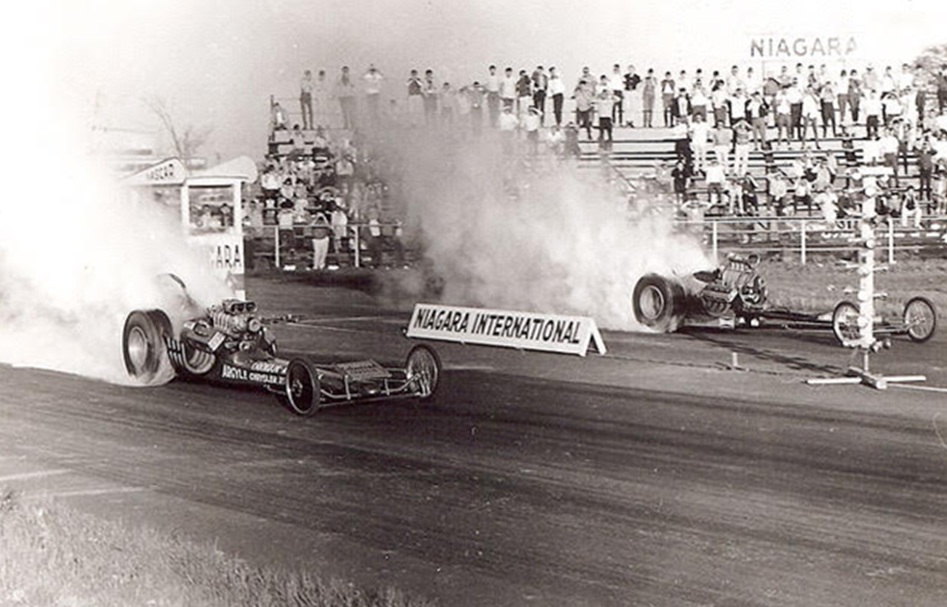
In its heyday, Niagara ran up to 610 cars in a single event, sending pairs down the track every 30 seconds. Push-starting dragsters was a spectacle in itself – cars careening down the return road, out of control and full of fury. Still, the show went on… Rosin burnouts, match races, and announcers rallying the crowd – “Who’s for Chevrolet? Who’s for Dodge?” – turning every Sunday into a celebration.
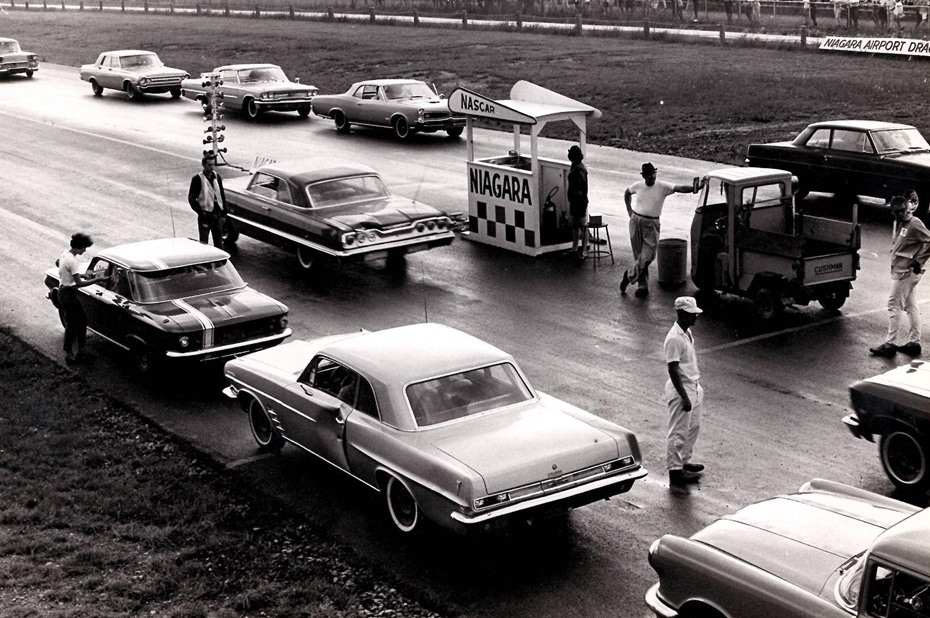
Sponsorship at Niagara was more about community than commerce. Dean traded signage for car parts and left sponsor signs up for years, even if they only paid once. Admission was a dollar – whether you were racing, spectating, or heading into the pits. By the final race, they nervously raised it to $6, fearing it might drive fans away. It didn’t. “We didn’t care who you brought,” Dean said. “As long as you paid 50 cents for your kid.”
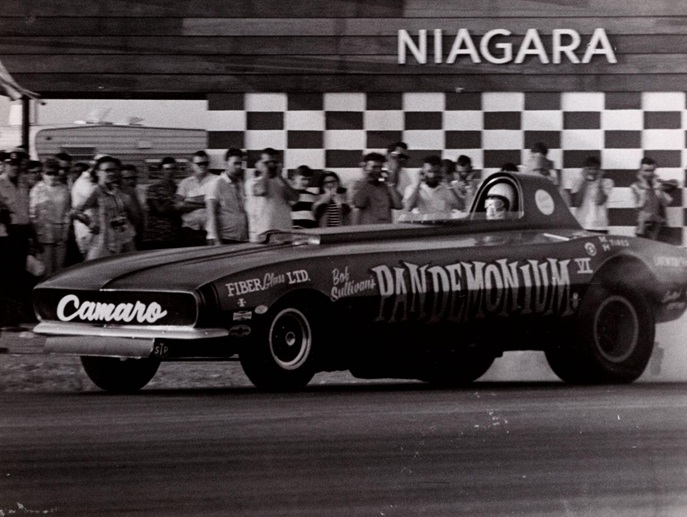
Jim Oddy (below) was among the local legends who made Niagara unforgettable. Oddy’s competition eliminator machines took home serious prize money – $400 for a win, which was no small feat in the 1960s. Their camaraderie was as strong as their engines. “We hung out a lot and took a bunch of Dean’s money,” Oddy joked. Dean confirmed it with a laugh, recalling how he once gave a competitor a blank check and told him to fill it out.
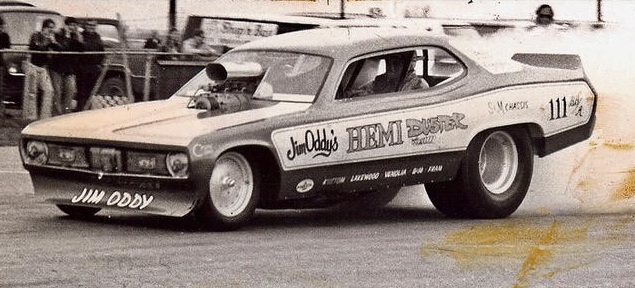
Niagara’s relationship with NHRA soured (below; left) after a controversial race cancellation. Dean and his team pivoted to NASCAR’s drag racing division (below; right), securing the Summer Nationals and running record-setting events. The switch was bold, but it paid off – bringing in Coca-Cola-sponsored cars and fresh energy to the strip.
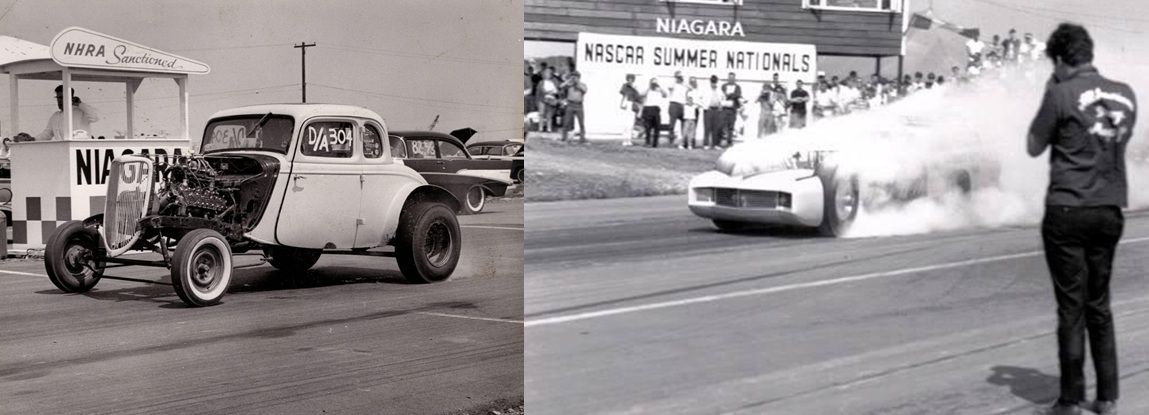
From snowouts to flip-top funny cars, from clutch artists to four-engine Buicks, Niagara Dragway was a mosaic of innovation, grit, and joy. It wasn’t just about speed – it was about community, creativity, and the thrill of the unknown.
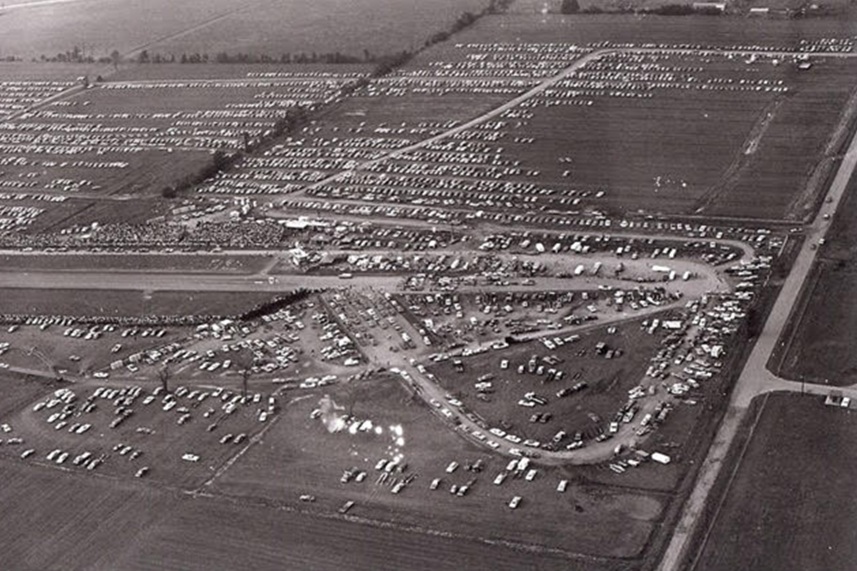
This episode is sponsored in part by: The International Motor Racing Research Center (IMRRC) and was recorded in front of a live studio audience. To learn more about upcoming Center Conversations, be sure to check out the IMRRC’s Website for details.
Other episodes you might enjoy
This content has been brought to you in-part by support through...