

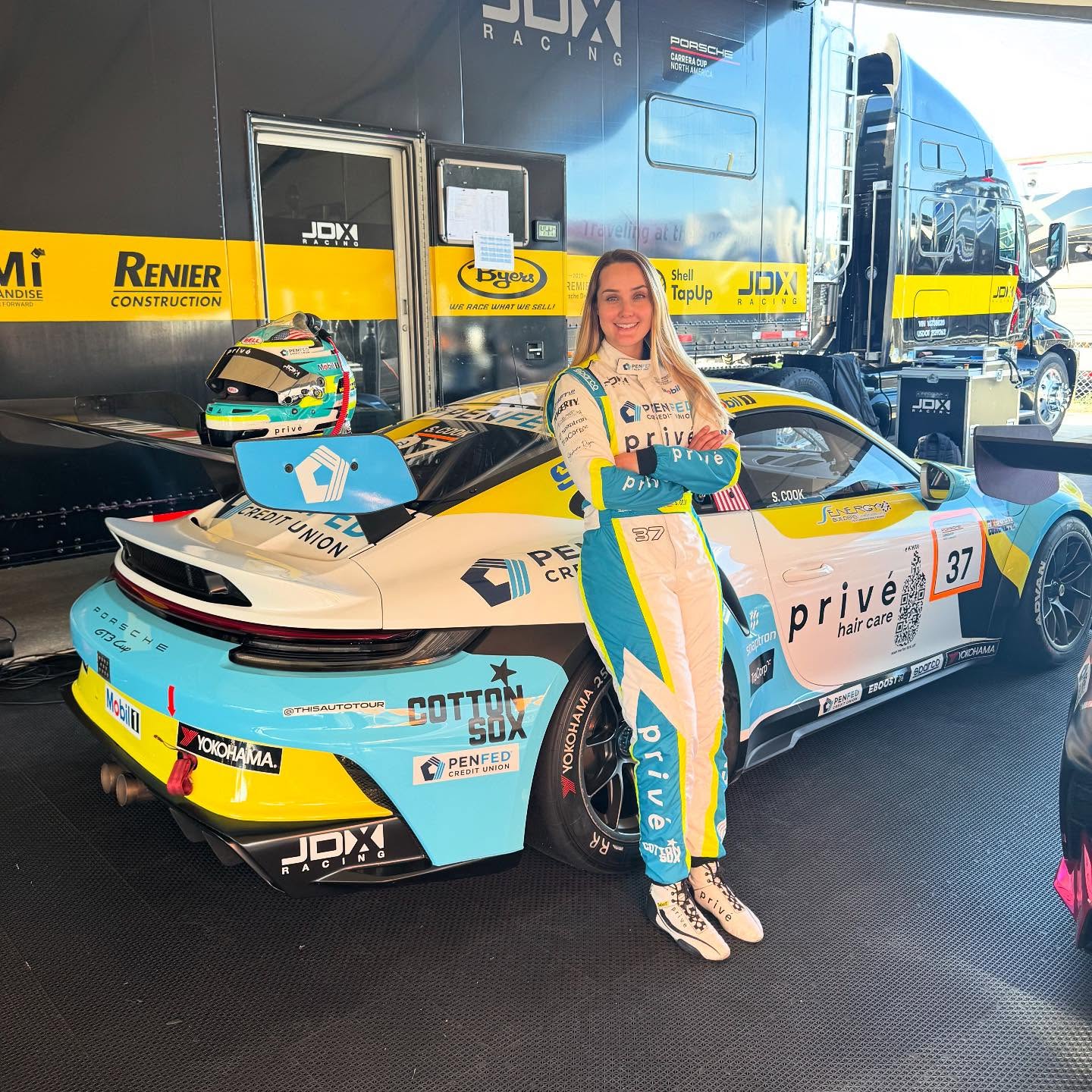
From karting in Colorado to racing on global stages like the W Series and Porsche Carrera Cup, Sabre’s journey is a masterclass in grit, grace, and gear-driven ambition.
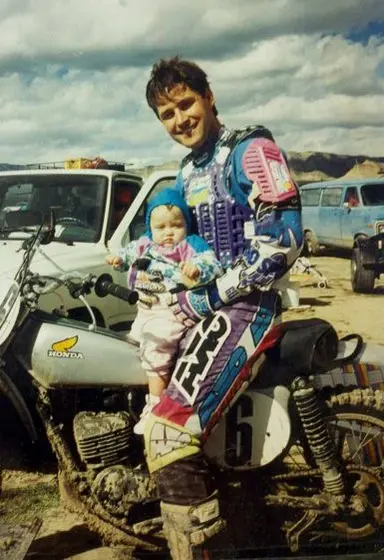
Sabre’s story begins with motocross roots – her father raced professionally in the ’80s, and her birth coincided with a Supercross Sunday. Racing wasn’t just in her blood; it was in her bones. At eight, she swapped two wheels for four and dove into karting, quickly discovering that motorsport wasn’t just a hobby – it was her calling.
Tune in everywhere you stream, download or listen!



But Sabre didn’t stop at the track. She pursued a mechanical engineering degree, becoming a first-generation college student and proving that speed and smarts aren’t mutually exclusive. Her analytical mind now fuels her performance, from detailed debriefs to data-driven race strategies.
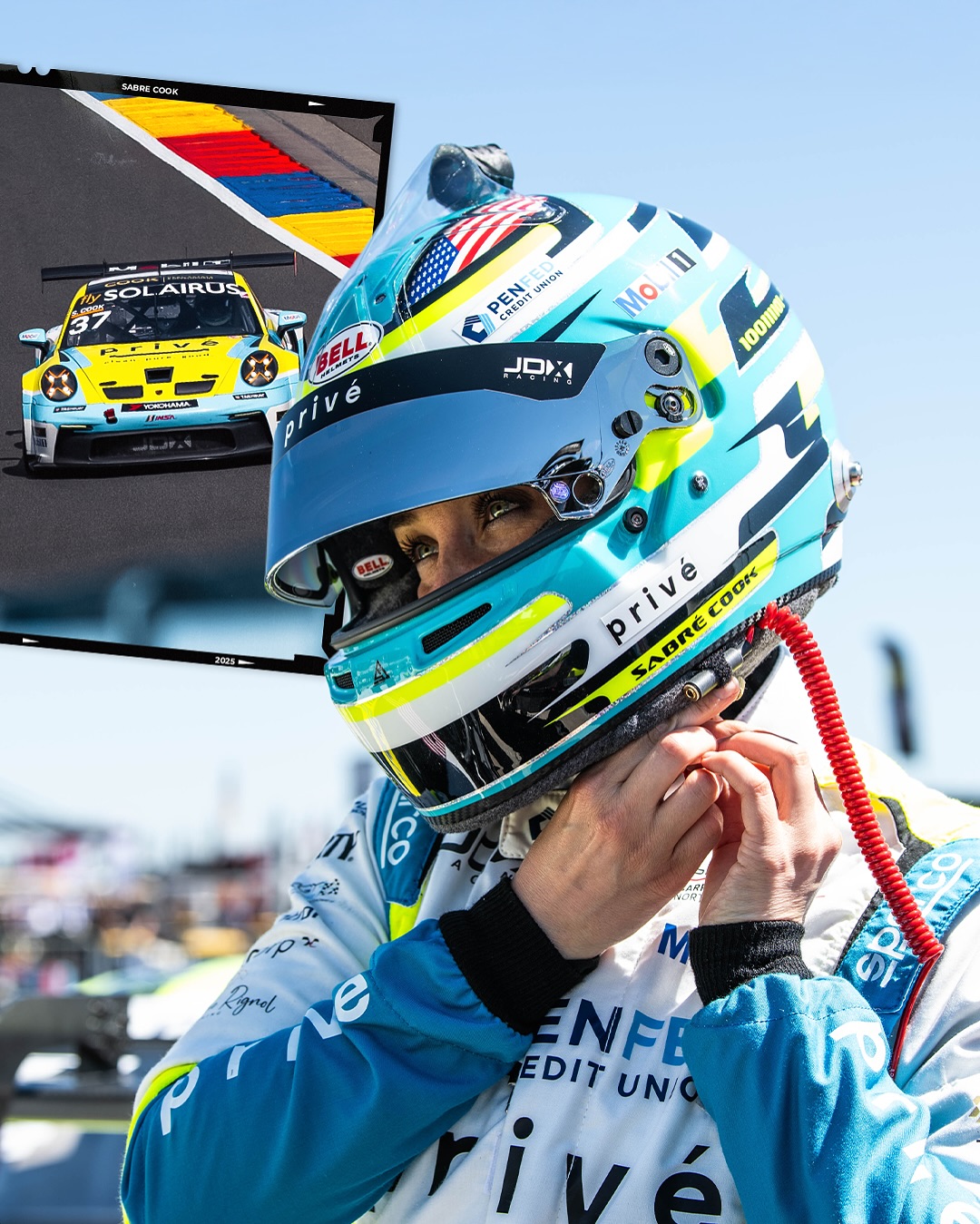
As one of the few women in open-wheel racing, Sabre faced the challenge of carving out space in a male-dominated arena. “You learn to create your own seat,” she says. Her journey through USF2000, Indy Pro 2000, and the W Series wasn’t just about lap times – it was about resilience, representation, and rewriting the rules.
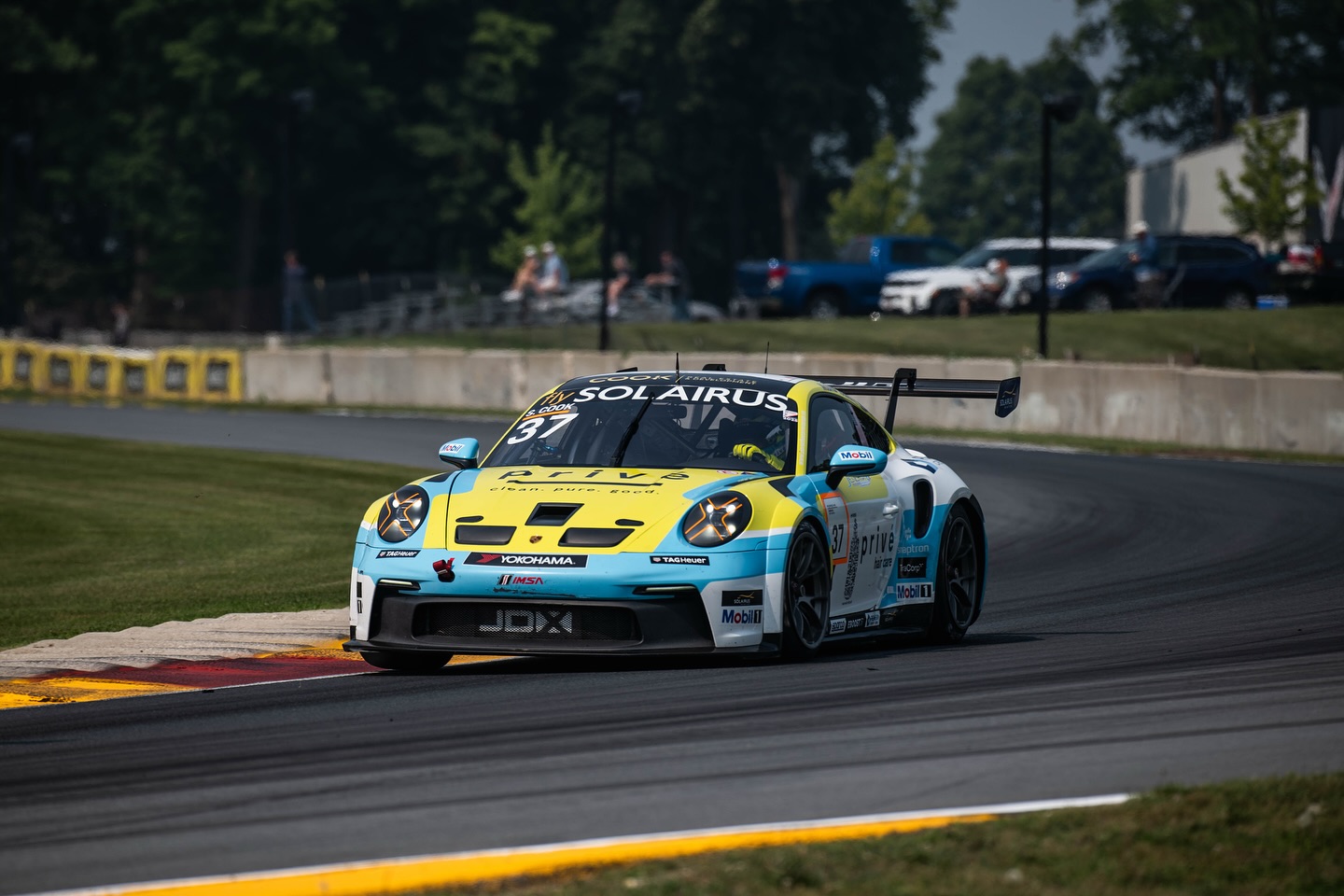
Sabre’s engineering background gives her a unique edge. She logs every test session with precision, balancing her technical insights with the instinctive feel required to drive at the limit. “You have to let your subconscious take over,” she explains. “The conscious mind is always slower.”
Spotlight
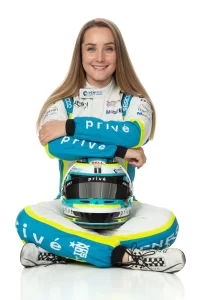
- 2023 – First Female to Race in Porsche Carrera Cup North America
- 2022 Kelly-Moss Porsche Carrera Cup Scholarship Winner
- 2021 & 2022 IMSA Diverse Driver Development Scholarship Runner Up
- 2021 Only Female to Podium in Porsche Sprint Challenge
- 2021 1st Place NLS 8 Nürburgring Cup 5 Class Win
- 2020-2021 The only American to qualify for W Series
- 2019-2021 Qualified for and Competed in W Series
- 2019 3rd Place & Fast Lap in W Series Assen Reverse Grid Race
- 2017 Team USA Scholarship Finalist- First Female
- 2016 US Open Shifter Elite National Champion
- 2015 3rd Place US Open Shifter Elite National Championship
- 2015 Member of Team USA for the Rotax Grand Finals
- 2015 Challenge of the Americas DD2 International Champion
- 2014 Maxspeed & Mazda Road to Indy Scholarship Winner
- 2014 First Female to Qualify for a KZ World Championship Main Event
- 2013 Women in Sports Foundation Project Podium Grant Recipient
- 2012 SKUSA S2 National Champion- First Female
- 3x TAG USA World Champion
- 8x Colorado State Karting Champion
Synopsis
This episode of Break/Fix features Sabre Cook, a trailblazing figure in motorsports, discussing her journey from karting in Colorado to competing in elite racing series like the W Series and USF 2000. Sabre’s background in mechanical engineering has complemented her racing career, allowing her to analyze and enhance her performance. Despite motorsports being a male-dominated field, Sabre has successfully navigated its challenges, backed by strong family support and her own perseverance. The episode also highlights her involvement in programs like the Porsche Motorsports North America Female Driver Development Program, emphasizing the importance of sponsorship and mentorship. Sabre shares insights on balancing racing with engineering, her support system, and advice for aspiring female drivers. The show underscores the evolving landscape for women in motorsports and Sabre’s role in inspiring the next generation.
- Can you take us back to your earliest memories of karting in Colorado and what first sparked your passion for racing?
- Why Mechanical Engineering? How did your background in mechanical engineering influence your approach to competing on the track?
- How do you see technology and engineering continuing to shape the future of motorsports?
- Moving from karting to lower formula racing requires a big jump in financial commitment. What’s the most challenging part of putting together sponsorships? Do you think sponsors still hesitate to fund women drivers at the same level as men?
- Competing in the W Series put you on a global stage—what was that experience like both personally and professionally? Was it a matter of dialing up the intensity, or was it a completely different beast?
- Now that you’ve switched to the Porsche Cup series in the last few season; what has that transition been like from open-wheel to production based racing?
- Who are you watching right now in karting and the lower series? Who should we be keeping an eye on?
- So what’s next for Sabre? What are your goals? Endurance Racing, possible Le Mans?
Transcript
Lauren Goodman: [00:00:00] Welcome to Women of the Autos Sphere. On Break Fix, we dive into the stories of trailblazers, engineers, racers, designers, and disruptors who are shaping the automotive and motor sports industries. From the pit lane to the boardroom, from concept sketches to championship podiums, these women are driving change breaking barriers, and inspiring the next generation.
Whether you’re a lifelong gearhead, a curious newcomer, or someone who simply loves a good story. You are in the right place. This is more than a podcast. It’s a movement.
Crew Chief Eric: On this episode of Break Fixes Women of the Auto Sphere series. We’re thrilled to welcome Sabra Cook, a true force in Motorsports whose journey is as inspiring as it is impressive
Lauren Goodman: from her early days.
Karting a Colorado to breaking barriers in open wheel racing. Sabre has proven herself both on and off the track. She’s not only competed in Elite series like the W Series USF 2000 Entity Pro 2000, but she’s [00:01:00] also balanced her racing career with a background in mechanical engineering, working with some of the biggest names in the automotive industry, in a sport where talent, tenacity and technical skill must work in perfect harmony.
Sabra embodies the full package paving the way for the next generation of women in racing, and we’ll dive into her path, her perseverance, and her vision for the future of motor sports.
Crew Chief Eric: And joining me tonight is returning co-host Lauren Goodman, associate curator of exhibitions at the Revs Institute, and one of the many personalities here at the Motor Inc Podcast Network.
So welcome back. Good to be here. And with that, let’s welcome Sabra officially to break fix.
Sabre Cook: Hi guys. I feel so inspired and like so good after that introduction. Like you guys should just come be my pep talk team before I get in the race car. Like that was great. Well be the flavor. Flave. The fla, the Flavor Flav.
You gotta wear the giant clock though.
Crew Chief Eric: Well Sabra like all break Fixx stories. There’s a super heroine origin story out there. So take us back to your. Earliest memories of carting in Colorado. And what first sparked your passion for racing? Did you come from a racing family? [00:02:00]
Sabre Cook: I did. I was super lucky to have a pretty cool dad.
He used to race motocross and Supercross professionally back in the eighties, and he and my mom did not want me racing motorcycles. So compromised with four wheels ’cause it’s much safer. So I appreciate that. Now I have a lot less broken bones than I probably would have otherwise. That’s how we got started.
Got into carting just as far, I was eight years old, so I guess the heroine story started with my dad being my hero and just loving racing and wanting to get involved in that. And I was also born on Supercross Sunday, so my parents, they used to host like a local Supercross events in our hometown. And my mom went into labor the morning of the big race.
So she went to the hospital instead of to, to the racetrack. It was kind of, uh, it was inevitable
Crew Chief Eric: carting at a young age, especially a young lady in carting, you know, and motorsport, as we know, is a male dominated sport, but that is changing. We’re seeing parody in multiple disciplines of motorsport throughout the world.
What was it like for you competing at that level and then moving [00:03:00] up further and further into racing?
Sabre Cook: It was challenging at times, being either the only woman or one of a couple. It definitely made you have a different experience growing up than maybe your peers that would be involved in a space that had more women or more representation.
But I think I learned so much from being in those spaces and I had to learn how to kind of create my own s. In a place that wasn’t traditionally expecting me to be there. So, and I, and I really loved the fact that I got to do a lot of my younger years with my dad and he was a great mentor for me and helped me kind of, you know, navigate the challenges and that anybody goes through in racing, right.
Male or female, just the challenges and you know, the mental and physical struggles that you go through as an athlete and finding your way through and and moving up towards the top. So yeah, it was challenging, but it was, it was great.
Crew Chief Eric: So we talked to a lot of younger drivers who came up in a similar way that you did.
Maybe they started in carting or they went into junior dragsters or midgets or something like that. And there’s always this balance [00:04:00] that has to be struck. Not only just. Within the family, like, Hey, how far are your parents going to support you and push you? But with schooling, so you started carting at eight years old and what we tend to find is kids that young do racing in fits and spurts because as you move to middle school and high school and schooling gets in the way, we’re gonna talk about.
Your mechanical engineering degree as the punchline here, but how did that work for you as you continued to follow your passion but also go into a field like mechanical engineering?
Sabre Cook: Definitely. It wasn’t easy, and I’m still honestly transparently, I tried to do too many things. Like I was the kid that, I can’t remember how old I was.
I had like a complete meltdown to my mom. ’cause I was like, I just wanna do everything. Like I don’t wanna have to choose. So that, that was a problem I had very early on in my life. But I guess I just. Tried to lean into, you know, my teachers and peers around me to say, Hey, this is something I really wanna do, and this is like a passion for me.
But obviously I really care about school, like I love learning. That’s like one of the biggest things for me, is I’m [00:05:00] always like really eager to learn and continue to get better at whatever it is or learn about new things. So I just leaned into my peers, my professors, my family to say, how can I optimize this situation to be able to chase both of them?
And it was definitely some sleepless nights for sure, too many times, especially as I got older and you know, in high school and then into college. But when I was young, it definitely, it did have those little spurts where there was maybe more racing and then there was more school and I didn’t get to drive or drive as much as I would’ve liked to or wanted to or should have been driving because there is that balance and you have to learn also, like as a young sports person, you start to learn like what it really takes the level of commitment that you have to have to start to perform at that high level.
How much it really means that you need to be consistent, and how much it really means that you need to commit time to that. That was something that everybody I feel like you go through when you’re younger is, you know, you don’t get the results that you want. And the hard reality is, okay, well you’ve gotta [00:06:00] commit the time that those top, top people are committing.
And that’s really the only way around it is you’ve gotta be there and you’ve gotta be willing to put in those, you know, the 10,000 hour rule. You’ve gotta be willing to put in the time to get there.
Crew Chief Eric: So did you have one of those awkward conversations with your guidance counselor? That was, Hey, I wanna be a race car driver.
And then they said, you should find a career. To back that up. Did the race car driving beget becoming a mechanical engineer? Was the engineering always there for you?
Sabre Cook: Actually, I was one of those weird kids that I liked school, I liked math and I liked science, and there was never a question in my mind at any point.
Oh, I don’t wanna do school. I don’t wanna pursue like going and getting a degree. It was always a plan of mine and my parents obviously heavily encouraged it ’cause it was important for them. Nobody else in my family up until that point had ever gone to college. So I was the first generation student and had to kind of go through the, the learning curve of that.
Right? ’cause nobody had been through it, but. For them. It was such an important goal to be able to put their kids into [00:07:00] college and have that degree in something that you can go and take and build a life on. It was never a matter of if it was gonna happen, it was just like when and what it was gonna be.
And pretty quickly I decided it was gonna be something that was. STEM oriented. That was pretty clear, honestly, probably from the third grade on. And then it just became more clear later in my high school when I took a mechanical engineering class. And then I was like, you know what, this makes sense. And we have a really great engineering school in Colorado that’s one of the top engineering universities in the us.
So in-state tuition was all about that, save the money. So it became, uh, an easy choice to apply there. And actually, I don’t know if this was a dumb thing or just a bold thing, but I only applied there. I didn’t have any backups. I was like, I’m going here. This is what’s happening.
Crew Chief Eric: Have you been able to apply what you learned from your mechanical engineering degree in your racing, or do you see avenues for potential to exercise your degree in motor sport at some point?
Sabre Cook: So, I mean, I’ve worked. For teams [00:08:00] in a design capacity in motorsports. So I’ve, I have used it. But as far as like you mean using it specifically as a driver,
Crew Chief Eric: like those scientific principles and practices and the way you analyze and break things down. As an engineer, how do you apply that to your driving?
Sabre Cook: I am definitely much more analytical in my approach to things. I have very structured and rigorous. Debrief sheets and like the way that I log, like say a testing event, I have a workbook that I haven’t really seen a lot of other drivers have, and so I have like an an Excel workbook where I have multiple tabs and I log as much tangible data as I can without.
Making my engineer brain overthink. Like when you get in the race car, you’ve gotta be totally free. Like you need to not overthink things. It needs to be more natural, like it needs to just sort of happen and you’ve gotta be allowing your body to take over and the muscle memory to take over. Because if you drive with your conscious mind, it’s always gonna be slower than driving with your subconscious, [00:09:00] really making sure that the analytical engineering brain stays in its lane.
But it is very beneficial when I get out of the car to look. At video and data and try to narrow down what are the big things that we need to be focused on? What’s me, what’s the car? And just being able to have like a clear debrief and logging system, that then allows me to look back on trends and past experiences to then move forward more quickly.
Lauren Goodman: This reminds me a lot of Mark Donahue. The great Porsche driver, that’s who it reminds me of, who also had an engineering degree. And we have, at the museum, we have his notebooks that he kept where he kept all, he logged every single note about every single lab, about the cars. He was testing for Roger Penske.
So I think you, you would’ve been two Ps in a pod, you and Mark Donahue, it sounds like. And they’re all the graph paper notebooks, and it’s all like very, very lined up and very organized. Not like my handwriting at all. So I think the two of you. Would’ve gone on like gangbusters. But I’m also thinking [00:10:00] you’re talking about having to turn off the conscious mind and just feel and engage with the car.
Do you find it harder to do that when you understand how cars are designed and engineered, or do you trust the car more now that you understand the tolerances?
Sabre Cook: No, I think it’s harder if you understand because it just gives you a bigger range to think about. Like first thing that comes to mind is like Adam and Eve, right?
You don’t know what you don’t know till you bite the apple and then all of a sudden you like think about all these things. So in some ways I think it definitely. It gives you just a different perspective, different range to think about when you’re driving. And I definitely have to check myself and I, I always go in and preface whenever I start working with an engineer, like I’m like, look, I don’t wanna do your job.
I’m going to try to like keep myself in my lane. Definitely let me know, like if you’re like. Sabra, like, let me take this over. Like, you don’t need to worry about engineering the car right now. Like actually this just happened in, in a test that we just had, my engineer had to remind me. He’s like, Hey, your job is to just give me feedback [00:11:00] about balance of the car in this moment.
I don’t want you to stress and feel like you need to help me solve the problem. And that’s also like. Typical, I feel like girl, like people pleasing, like I always wanna help, like I wanna contribute kind of thing. So it’s, it’s definitely, I’ve very helpful to have like my engineer that I, I work with this year, I work with very well and he’s also has a driving background.
So I think that’s also why we work really well together. ’cause he understands what I’m going through. It is a challenge sometimes to keep them. In the right lanes.
Crew Chief Eric: And I’m glad you brought that up because Motorsport has been at the forefront of technology. I mean, we can make arguments about planes, trains, and automobiles being the things that drive technology forward, but racing, especially Formula One, and then you kind of counter that with the hypercar at Lamont, things like that are always cutting edge technology.
And so as we wrap up this thought on mechanical engineering and keeping that lens on for just a little bit longer, when you look at the modern cars. You’re in sports car and endurance racing, which is gonna be a little bit different because you’re based on production cars. But when you [00:12:00] look at the technology that’s out there, is there much more to give?
Is it all just finesse and fine tuning? Unlike the old days where it was like these radical inventions and the Formula One used to be at the height of experimentation, where now it’s a little bit more like a spec series. So if you look at it not as a driver. But as an engineer, what’s the technology look like out there right now on the race field?
Sabre Cook: Obviously, like you said in the series that I’m in with Horse Career Cup and like the INS hepatic, it is a little bit more rained in except for maybe the GTP side of things. But as far as like anything that has to do with GT three cars, LMP two a little bit, at the end of the day, it comes from a production or an OEM car.
It has to be within reason. Like it can’t be this like. Craziness because the factories need to justify like why are we putting an investment and research into racing if we’re not even gonna put it in our road cars? ’cause at the end of the day, that’s ultimately how they justify racing all the time is this is supposed to help push our road car technology forward with Formula One though, I feel like the reason why, maybe [00:13:00] like back in the day when you referenced you had all these crazy monster machines and everything.
The engineering field was still very much developing. There was like this big growth of things like they were learning really. Like it got to the point where there was like so much horsepower, right? But then they realized, oh, it doesn’t really matter if you can go really fast if we can’t harness that, you know, with the brakes and the suspension and like optimizing the package as a whole.
So once those two kind of like caught up to each other, there became kind of this like, it’s almost like an exponential growth and now it’s kind of like flat lining a little bit. And now where the big innovations are happening is in efficiency and sustainability. So like a lot of the new rules that are happening in Formula One is I think it’s a gas that has to be made from food waste.
Lauren Goodman: Yeah.
Sabre Cook: All the teams need to be able to create their own fuel and utilize that. I can’t remember what year it starts implementing. Maybe 20, 29. So like that’s a big thing. Obviously the hybrid system, like all the energy recovery systems, stuff like that to make the cars unfortunately quieter, but more sustainable.
It’s important because it [00:14:00] helps us. Yes. Obviously F1 is a big show and it does have like its own carbon footprint to be this big show, but they are realizing that they need to take into account what current global needs are, and so I feel like it’s another way for racing to justify to be racing, right?
It’s like, okay, well if this is the current technology and the issues that are important to people right now is sustainability and all these things, so we need to utilize this racing platform to be able to push that technology if that’s where it’s at. Right?
Crew Chief Eric: Alright, now I’m gonna ask you to take that mechanical engineering fedora off your head and just fling it across the room like a Frisbee and talk to me like a race car driver.
And what I’m driving to here is balance of performance. ’cause the argument is the balance of performance isn’t about engineering, it’s about rules. And putting on a good show, as you said, right? So your thoughts on BOP,
Sabre Cook: I mean, it’s necessary so that way all manufacturers can essentially compete in a level playing field, but it, it’s always hard.
Not everyone is gonna always be happy, right? There’s always gonna be checks and balances [00:15:00] and that’s how endurance. Racing is going to be until you make it like a spec series like Porsche Career Cup where there is a, a such a smaller window, it’s all the same cars. So it’s unfortunately part of it, it’s how it works, so that way more players can stay in the game in which we don’t wanna eliminate that.
Right? Like it’s important to have that many manufacturers, as many as possible in the world of racing. ’cause it’s just better for the sport, it’s better for the fans and it’s better for, for us as race car drivers.
Lauren Goodman: Switching gears from the engineering side to the money side. The other thing that fuels racing.
Sabre Cook: The main thing that fuels the main thing
Lauren Goodman: since time immemorial. If it ain’t daddy’s money, it’s somebody else’s money that’s fueling the racing. Exactly. So when you move from carting to the lower formula, that was requiring a step up in terms of the financial commitment from your family, from sponsors, what’s the most challenging part of putting together sponsorships?
Sabre Cook: So, so many areas. For reference, I didn’t start racing cars until I was [00:16:00] almost 23 years old because I had an amazing family that was very supportive, and they did help quite a bit with my carting side of things. But it got to the point where I had to sustain that through sponsorships and support from the factory teams, even in carting.
And so jumping up to that next level of budget in car racing. Was outta the question, so I didn’t go to cars until very late, like 23 is like way old to start your car career comparatively to, you know, people starting at 14, 15 years old. Now, going into car racing, I didn’t have that opportunity until I found a sponsor that was willing to put me in their car.
So I had to very quickly and haphazardly figure out how to put. A much larger corporate sponsorship program together very quickly because without me putting the corporate sponsorship together, there was no racing, there was no family money. There was not like it wasn’t gonna happen. It was either figure it out like baptism by fire, or uh, go back and go be an engineer and forget about your racing dreams.
I obviously made a lot of mistakes. I tried to figure it [00:17:00] out, but I would say the the biggest thing to understand about sponsorship is at the end of the day, it’s about telling your story, building a story that resonates with people, and getting people to buy into that story and using that story to help someone meet.
Some need. And if you’re able to marry those together, you can make a very powerful partnership that will last longer. Like it’s a business, right? But ultimately businesses are made of people and people just need a emotional justification to choose to be a part of your. Program. So yes, it’s important to show a return on investment, but at the end of the day, it is about them liking you as a person and believing in you and your story and wanting to become a part of that story.
I think that’s the biggest thing that I’ve realized about sponsorship.
Lauren Goodman: We got a chance to meet at the Women with Drive Summit. Sponsored by wna had a great time and I, I love how they emphasize the coaching of young women drivers and to do [00:18:00] things like sponsorships, how to go out and put together their sponsorships and their package in order to fund their careers.
And one of the things they talked about, it is still a discussion about sponsors still hesitated to fund women drivers. At the same rate they fund male drivers. Have you seen that change just in the time you’ve been driving? Do you think there’s been some movement or not enough movement, but some movement?
Sabre Cook: Absolutely. I think women in sport in general are, uh, getting more sponsorship dollars if we just look at the data ’cause. I like to just look at the data. In the past, traditionally, women globally have received less than 1% of sports sponsorship dollars. That was a few years ago, and now I think we’re maybe up between four to 6%.
So that’s like a big jump. It’s still like extremely skewed, but that is progress and I’ve definitely seen it in more tangible ways. Like by me being involved in W Series and now being a part of the Porsche Mobile one female driver development program. [00:19:00] There are definitely things that are moving and shifting.
It’s just gonna take time to reach more of an equality level.
Lauren Goodman: Which brings me to W Series. I’d love to know more about your experience moving into that, and I just realized that I saw you drive at Coda in W series in 2021. Yeah, there were two, two races that year. Moving on to what really is a global stage like that.
Did it feel like they were just dialing up the intensity or did it feel like a completely different beast altogether
Sabre Cook: before WS series, I’d actually raced on a Formula one weekend previously with U SF four. So I did race at code like oh. I’d been part of a an F1 weekend in that respect. But obviously WS series was kind of the next step up.
We were very much in the public eye, became, you know, this new thing that everyone’s like, how’s this gonna go? Like, what’s going on? And kind of the first of its kind. It was incredible because. Yes, I know a lot of people had their opinions about it and they have their opinions on F1 Academy, but as a racer, as we just talked about, corporate sponsorship is my bread and butter, and the only way I can [00:20:00] chase my goals.
So to have WS series come in and say, Hey, here’s an opportunity to race an F three car on a global stage. You don’t have to pay. Any of it, and you will get paid. All you have to do is qualify and be one of the fastest drivers. Like you say that to any race car driver. They’re like, oh, okay, let’s go. Where do I sign up?
So for me it was, yes, I don’t love the idea of the all women’s thing because at the end of the day, we wanna be fighting just to be the top full stop, no gender involved. But until WS series, I’d never had a full season of car racing. So that became my first. Opportunity to actually have my first full season.
So without that, no matter what your opinion is on it, it was so revitalizing for myself and so many other women that were a part of it, who otherwise were going to be on the sidelines.
Lauren Goodman: A huge step in terms of visibility, if nothing else. Absolutely. So I’ve been following along with the Academy as well.
Do you think the Academy model is an improvement on the W Series model?
Sabre Cook: I think that it has [00:21:00] definitely engaged the F1 fan base more, and that has been helpful, that it is branded with the Formula One brand and it has that giant behind it that has been positive because it’s given it more reach. The only thing that is, I don’t wanna say a step backwards, but it’s not as beneficial to the drivers, is that it’s not as much based off of qualifying to be one of the fastest in the seats.
You still have to bring money. Not like W Series where it’s like you show up as a pro, you get paid to drive and you don’t have to bring any money. F1 Academy is a little bit of a different structure, and it’s also F four cars, so the cars are slower as well. It’s like kind of give and take, but I think ultimately, like in the long run, I hope that it’s going to create this ladder to having more women performing at the top in the road to F1.
Lauren Goodman: Tell us about the Porsche development program and how you got involved with that.
Sabre Cook: Porsche Motor PORs, north America didn’t have a female driver development program until [00:22:00] 2023 when I became the founding member and the only member in 2023 when I became the first female to race in the Porsche Career Cup North America series.
So it was really actually super cool of Porsche to be intuitive and they are paying so much more attention than you realize. Like when I was first looking at the idea of going into Porsche Kera Cup, who, by the way, the reason why this happened was because of Lynn St. James, who is one of the co-founders of wna.
She said, Hey, you know, this looks like a great series. Like it’s super competitive. It has a lot of potential to put you in a good spot to then build into stuff long term in the sports car world. And so I was like, okay, like let’s. Take a look at it. Let’s see what it is. We wouldn’t announce anything.
There was nothing public going on, but OSHA just paying attention to what was happening. They realized, Hey, what’s going on? You wanna race in the series? And so the fact that they just like, were paying so much attention to realize that without any sort of formal [00:23:00] conversation and say, Hey, okay, you wanna do this?
How can we help you do this? And then even bringing their own corporate partners in to make it happen. What other OEM is really actually doing something like that. So I felt like incredibly thankful and grateful for them to want to create that space and then not just stop with me being in the series, you know, and be like, oh, that box checked done right.
Like every year with the help of mobile one, they’ve expanded the program and now I think there’s like seven of us. Now total in the Porsche Motorsports North America ladder. So it’s grown so much and it’s growing every year. They’re just getting better about providing us with new things to learn more resources or workshops.
It’s been an awesome thing to be a part of.
Crew Chief Eric: After doing a couple of seasons of Open Wheel and making the switch to Porsche Cup racing, what was that transition like? Do you like production based racing or sports car racing over the open wheel, or do you still kinda long for the days of being in an open wheel car
Sabre Cook: as a driver?
Right. Sports car racing. Ultimately it’s a street [00:24:00] car that gets kind of turned into a race car. And a formula car is a purpose built, born bred race car. So it’s meant to do all the all the right things, right? So it is very challenging to jump into a sports car world after being in the open world world and coming into a car that you have to think your way around more because a nine 11, especially it’s engineered wrong, the engine is buying the rear wheels.
Crew Chief Eric: I’m, I’m glad you said it, not me.
Sabre Cook: It’s fine. They know it. It’s the legacy, right? Like it is what made Porsche. Porsche. So it is a very challenging car, but it makes drivers, it gives them a bigger toolbox to pull from. Because it is challenging and you do have to really be in tune with using your tools in the car and driving the car with your feet, using your driver tools to really help the balance.
Like I feel like there’s not a lot of production cars that are at the same level of Porsche Car Cup, where it really pushes the driver to evolve and develop in the same [00:25:00] way. That’s why, you know, they say if you can be fast in a nine 11. You can be fast in anything. After my experience being in the career cup, going back and driving anything that I would’ve driven before, like open wheel, I’m a hundred percent faster.
So like it’s made me a better driver because it’s given me a larger range of tools to utilize. It’s been challenging, but it has definitely made me grow.
Crew Chief Eric: Coming off of the GT three based nine elevens, the modern era stuff, nine. Nine ones nine, nine twos and things like that, have you been able to get behind the seat of a classic analog nine 11 and kind of compare and contrast what the new cars are like versus what some of your heroes have driven in the past?
Sabre Cook: The first Porsche I ever drove. It’s kind of analog, maybe like it still has some, like in theory it has like a blip, but it’s like a mechanical blip where it has, actually, the thing that pushes the gas pedal down is the UH, 9, 9 7. So that was the first GT three cup car I’d ever driven. The sponsor that I mentioned that put me in my first race car, it was his.
So I was destined, I guess, to find my way into a [00:26:00] Porsche eventually, one way or another. But that was my first experience in a Porsche TT three Cup car. And I loved it because it’s super raw. Like the 9, 9 7 is a shorter wheel base. We’ve really aggressive with it. And I, most of my carting background was in shifter cards, so getting in one of those was like, ah, this is like, this is awesome.
So much, like, so similar. So it was a great introduction.
Lauren Goodman: I read on your Wikipedia page about, as part of the development program, you got coaching from Patrick Long, who is a friend of the museum and a very cool guy.
Sabre Cook: Yeah, pat has been awesome, like such a great resource for me and he’s a really cool guy.
Like just so, so accessible, so chill, and I feel like I can, you know, message him or call him and just be like, Hey, this is what’s going on. Like, how do you think I should handle it? Like, what should I do? Like, do you have advice? He is always like there to make sure that you as a driver and an athlete are getting what you need.
Like he’s going to always put you first and want the best for [00:27:00] you as a person regardless of all the other things that lie out there. Because you know, at the end of the day, he’s a race car driver. He knows what we’re going through and he just wants to be like. That mentor and give us advice that, you know, he wished that he would’ve had at the time when he was going through all of this.
So he’s been a incredible resource and it was super cool to see him in the F1 movie. I thought that was, that was a nice, uh, nice little cameo. He did a great job. And, uh, yeah, we just had him as well at, we have a Porsche driver combine every year. Um, it’s been the last couple years it’s been at Penske in, uh, Charlotte and he came this year and kind of gave us a, an impromptu inspirational speech and it was just great to have him there and I really appreciate all of the advice and, uh, mentorship that he’s provided.
Lauren Goodman: And there’s someone you wanna talk to about driving Porsches. He’s the guy, right?
Sabre Cook: Yes.
Crew Chief Eric: Yeah. Well, Lauren, if we’re name dropping, Patrick was on Evening with the legend, along with another one of Sabras heroines out there, and that’s Margie Smith. Ha. And you guys did a [00:28:00] video together about generations of Porsche drivers.
You wanna talk about that a little bit? What that video was about for the folks that haven’t seen it before?
Sabre Cook: That was a super fun project that Porsche USA came to me and Margie with and said, Hey. This is such a powerful story, like we’re gonna bring in, you know, the current driver and the one that started blazing the trail and then has this story with the Porsche family.
And we’d love to tell your stories together, introduce both of you to our Porsche community together and just share this awesome story that’s kind of evolved through the years and see how the growth has happened for women in motor sports. So it was actually really cool. The director had this fun idea that she didn’t want us to meet.
Until they could capture it on camera. So Margie and I were actually kept totally separate in the hair and makeup rooms. Like I didn’t see her, I didn’t get to talk to her like we went to dinner separately the night before. They were like, no, we don’t want you guys to meet because we wanna capture this moment.
On camera. So they kept us separate. We’d started shooting in the morning and then I was in the [00:29:00] car and they brought Margie out onto the track on the side of the track, and they captured the moment of us meeting for the first time. And it was so awesome. Like I’d never met Margie before, obviously, and it was great to just.
Meet her and see like how much awesome experiences she had to share. Just how much she still like loved and appreciated the motor sports experience she’s had, and then the shared the love of the Porsche family and how many great things she’s gotten to experience being involved in such a strong community and like.
The support she receives and the great things that she has to say about the Porsche Club of America community and just all the cool things that she got to experience back in the day and how different it was and like, you know, the challenges, things that she dealt with too, that are much better today, but were, we do see some of the similar trends, but it was an incredible time to get to spend with her and uh, I think the video turned out great as well.
So, props to the Porsche, USA and their production team, ’cause it turned out really well.
Crew Chief Eric: Do you plan to follow in Margie’s footsteps? And be one of the very few [00:30:00] American women to race at Lamont.
Sabre Cook: That’s the plan. That’s always the dream, right? So we’ll see how, uh, how and when we can make that happen.
Lauren Goodman: Okay, so quick pit stop before we transition.
What are your top three tracks to drive?
Sabre Cook: Now it’s kind of a tie, but Brands, hatch, gp, circuit, and spa. For sure for a third one. Um, I would say either,
Crew Chief Eric: did I hear Watkins Glen? Is
Sabre Cook: that what she said? I mean, I like Watkins Glen, but I don’t know. I’ve never raced on Laguna Seca, so I don’t know if I can fully say that yet.
I would, I’ve, I’ve driven there but never raced. So like, I liked ASIN in the Netherlands and I actually really enjoy Coda. So I don’t know. Those are kind of like. All time for
Lauren Goodman: third, you like having a nice steep incline. Apparently that’s what you really like between Coda and Spa, that’s what you really like.
Apparently.
Sabre Cook: Well, I’m a Colorado girl at heart. That’s right. I’m like, I need my mountains. I need, you know, I gotta have some elevation changes.
Crew Chief Eric: So if she could drive road Atlanta backwards, it’d be [00:31:00] perfect.
Sabre Cook: Oh, true. Yeah.
Crew Chief Eric: Well, since Lauren opened the door for a pit stop, I got one for you. We haven’t asked this one.
Of one of our guests in quite a long time. But since you have a mechanical engineering degree, Sabra, you are at the head of the boardroom table, and two blueprints are slid to you to decide on by your team. One is the space forward 9 59, and the other one is the fire breathing F 40. Which one do you pick?
Sabre Cook: Hmm. F 40
Crew Chief Eric: wins again, so, okay. Explain why
Sabre Cook: I feel like it’s more overall balanced and I appreciate the arrow elements more. Does that make sense? It does.
Crew Chief Eric: We get a lot of different answers for this, and it tends to be about the passion in F 40.
Sabre Cook: Yeah.
Crew Chief Eric: Clinically, the 9 59 is better on paper, but as a driver, the F 40 is the car you want.
Sabre Cook: It makes you excited to think about driving it.
Crew Chief Eric: Exactly. Yeah.
Sabre Cook: I guess my driver ultimately took over instead of the engineer brain, [00:32:00] but
Crew Chief Eric: it’s okay. The score is way off into Ferrari’s corner for that one. But anyway.
Lauren Goodman: Well, I wanted to know a little more about getting ready for a typical race weekend. What your life looks like as a racing driver.
What does the week up to the race look like? What are you doing to get physically, mentally prepared? What kind of sponsorship commitments do you have? And if you feel like you’re a driver who actually kind of. Gets juiced up by those kind of event commitments or you find them draining and distracting.
Sabre Cook: I am naturally introverted.
I appreciate my, uh, recharge time, but I definitely appreciate the fact that I get the chance and I want to feel grateful for those opportunities. You know, before a race weekend where. We’re living in a space right now and you know, it could change tomorrow, but the fact that I have the chance to create an event that people are excited to show up at and meet me and see the car like that is something special.
And so I, I really try to be grateful for those opportunities, but I will admit, like it does wear you out. So you just [00:33:00] have to kind of manage your energy going into a race weekend, kind of as we talked about earlier, I try to do too many things pretty often. I’m definitely the overcommitment type, so I’ve been working on doing a little bit less or like a little less stress going into race weekends, creating a better tapering mental and physical load going into a race weekend.
It is challenging ’cause as a race car driver, like you wanna do a great job for your partners on and off the track. And so having those, creating those events. Doing those activations before a race weekend is really important to continue to build not only my brand, but also connect my sponsors to more people.
So it’s definitely a fine line that you have to walk to have balance.
Lauren Goodman: What’s something about a career as a driver that would surprise most people who have regular nine to five jobs?
Sabre Cook: Well, I think most people don’t realize that we don’t get paid to race except for, unless you’re some of the elite few, right?
Like you have to bring, whether that’s. Family money, uh, which is often the case, or you bring corporate [00:34:00] sponsorship to the team to race, like you’re not sending in your resume. There is obviously those situations where that does happen, but the majority of racing happens by bringing funding to the team and you have to work on getting paid outside of that, whether that’s coming from an extra amount that you have in sponsorship dollars or that.
Mostly come from me from coaching, engineering, work, media, work, sim coaching, all that extra stuff. That’s where you actually get paid, not necessarily from a team paying. You
Crew Chief Eric: talked about following in the footsteps of people like Margie and others that have come before you. Taking this information in mind, a lot of people probably haven’t thought of before.
What advice would you give to young drivers? Especially young ladies that wanna follow in your footsteps.
Sabre Cook: For anybody, it’s just really important to understand that motorsports is a lifestyle. It’s not just a job. It’s not just about doing cool things and going to cool places as much as like we do get to do that.
But it’s important to, I think, to understand like [00:35:00] the level of commitment that it takes to be successful in motor sports and the sacrifices that you’re going to have to make to make your goals. What, and that’s not just as a driver, that’s, you know, whether you’re an engineer or a mechanic, like those guys do not get enough appreciation for the hours and blood, sweat, and tears that have to be put in to make our race cars go fast.
So I would just say be prepared to, to work hard to. To make it your lifestyle, but also the other thing that I would say is really important is to build a really good team around you. Trying to do it all by yourself does not work no matter what industry you’re in, having the people that you know are gonna be there in your corner and able to direct you in the right path.
I mean, it’s instrumental for anybody, but especially for anybody that’s, you know, an athlete trying to make their way in their sport.
Lauren Goodman: In watching some of the lower series or even some of the, the people still in carting, are there any young people you have your eye on that you think we should also be watching at this time?
Sabre Cook: I will be honest, it’s been a long time since I’ve been to a go-kart race. I, I think the last time I was [00:36:00] maybe coaching at one last year, but it’s been a while, so I don’t know if I have the best inside scoop as far as carting goes. But car-wise. I would say, actually somebody that’s really impressed me, her name is Anna Sini.
I’m gonna, I don’t know how to say her last name, but she just started racing and she’s in Porsche Sprint Challenge first year in the GT four cars. I think this is like maybe her first competitive or like really actual, like more pro season in racing ever. She didn’t do carting nothing like, did like a track day with her dad, and her and her dad are like, let’s do this together.
This will be fun. And then she quickly became faster than her dad. I think maybe they did like a WL race or something like that, like the year before, and now they’re full on in enforce Sprint challenge. She’s winning consistently in the GT four cars in Porsche Spring Challenge. To have no background and to be going in and doing that, I feel like that’s pretty impressive.
The other people that I would definitely say impress me is the Hannah’s. If you don’t know them, they’re teammates in [00:37:00] SRO, traditionally, Hannah Greenmeyer and Hannah Grisha. Hannah Greenmeyer, I have known for a long time. She’s a local Colorado girl as well. Maybe a little bit of Colorado pride going on there, but she’s always been really, really fast.
Works really hard. Her and Hannah Grisham are doing a really great job in the GT four cars and have gotten some really, really solid results lately. So I would say definitely, probably those are my top ones. If you wanna think about over the pond though, I would probably say the two latest F1 Academy winners, Marta Garcia and Abby Polling.
I race with them in W series and they’re both wicked fast. Abby has Alice Powell as a mentor and I think she could do some, some great things if given the right opportunities.
Crew Chief Eric: What’s next for you?
Sabre Cook: What’s next? Well, immediately we have our Indianapolis race coming up. Event-wise, I will be doing an event at my alma Mater, Colorado School of Mines, so I’m really looking forward to that.
But as far as overarching for next year, I actually can’t give you an answer because there’s some, uh, interesting things in the works. We’ll [00:38:00] see what comes to fruition, but I will be staying in the Porsche family, but I just can’t tell you where yet.
Crew Chief Eric: No spoilers.
Sabre Cook: No spoilers yet.
Crew Chief Eric: Well, Sabra, we’ve reached that part of the episode where I like to invite our guests to share any shout outs, promotions.
Thank you. Is there anything else that we haven’t covered thus far?
Sabre Cook: All of my social media and anything you wanna learn about me and my partners@sabracookracing.com. And, uh, you can subscribe to my newsletter and go check out my YouTube channel. Whatever you wanna see is all found in that one convenient location.
Lauren Goodman: And that’s wrap our conversation with the incredible Sapr Cook. An inspiring force in motor sports who proves that talent determination and technical expertise are a winning combination, both on and off the track from her early days in karting to competing on the global stage. Sabre’s story is one of resilience, innovation, and relentless passion for racing.
If you wanna keep up with Saber’s journey, be sure to follow her on Instagram at Saber Cook, Twitter at Sabra Cook and Facebook at Sabra Cook Racing, or find at mor website, saber cook [00:39:00] racing.com.
Crew Chief Eric: With that Sabra, I can’t thank you enough for coming on Break Fix. I have to say you’re making all the right moves.
You are a great role model for aspiring drivers, and hopefully they will heed your advice. From this episode, and we wish you continued success in the Porsche Cup series or whatever’s going on with Porsche. And let’s manifest it right now, shall we? One day Lama. And when that comes to be, we hope to have you back here for an evening with a legend episode so you can talk about your experiences at lama.
Sabre Cook: I look forward to it. It’s gonna happen. I’m gonna see you guys. We’ll, we’ll, we’ll make it happen one day at a time.
WIMNA Promo: Women in Motorsports, north America is a not-for-profit organization that began in 2022, known as WIM A. It is a community that focuses on advancing, connecting, and enabling. Its many partners, including industry executives, drivers, team members, OEM, sponsors, tracks, and more. MNAs Women and Drive [00:40:00] Summit continues its mission to bring together motor sports professionals.
This unique event offers new pathways for individuals to explore career opportunities, discuss current industry challenges, and provides mentorship and resources for future growth in the industry. Wi Imna welcomes all who share their passion for Motorsports. And if you’d like to stay informed about Wi Imna and the Women and Drive Summit, be sure to log on to www.womeninmotorsportsna.com or follow them on social media at Women in Motorsports Na on Instagram and Facebook.
Crew Chief Eric: We hope you enjoyed another awesome episode of Break Fix Podcasts, brought to you by Grand Tour Motorsports. If you’d like to be a guest on the show or get involved, be sure to follow us on all social media platforms at Grand Touring Motorsports. And if you’d like to learn more about the content of this episode, be sure to check out the follow on article@gtmotorsports.org.
We remain a commercial free and no annual fees organization through our sponsors, but also [00:41:00] through the generous support of our fans, families, and friends through Patreon. For as little as $2 and 50 cents a month, you can get access to more behind the scenes action, additional pit stop, minisodes and other VIP goodies, as well as keeping our team of creators.
Fed on their strict diet of fig Newton’s, Gumby bears, and monster. So consider signing up for Patreon today at www.patreon.com/gt motorsports. And remember, without you, none of this would be possible.
Episode Highlights
Skip ahead if you must… Here’s the highlights from this episode you might be most interested in and their corresponding time stamps.
- 00:00 Meet Sabre Cook: A Force in Motorsports
- 01:50 Sabre’s Early Racing Journey
- 04:05 Balancing Racing and Education
- 07:46 Applying Engineering to Racing
- 15:43 Sponsorship Challenges and Successes
- 18:05 Women in Motorsport: Progress and Challenges
- 19:07 Comparing F1 Academy and W Series
- 21:50 Joining Porsche Cup Racing & Development Program
- 27:49 Generations of Porsche Drivers
- 32:04 Advice for Aspiring Drivers
- 37:40 Future Plans and Shoutouts
- 40:32 Closing Remarks
Bonus Content
All of our BEHIND THE SCENES (BTS) Break/Fix episodes are raw and unedited, and expressly shared with the permission and consent of our guests.There's more to this story!
Be sure to check out the behind the scenes for this episode, filled with extras, bloopers, and other great moments not found in the final version. Become a Break/Fix VIP today by joining our Patreon.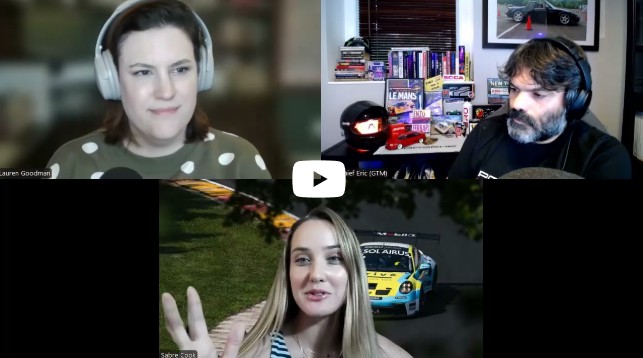
Learn More
Porsche brought Sabré Cook and Margie Smith-Haas together
Sabre became the first woman to race in Porsche Carrera Cup North America in 2023, launching Porsche’s female development initiative. With support from legends like Lyn St. James and Patrick Long, she’s thriving in the world of production-based racing. “If you can be fast in a 911, you can be fast in anything,” she says.
As mentioned on the episode, check out this video from Porsche featuring Sabre Cook and Margie Smith-Haas. Porsche most recently did a YouTube and Instagram ‘Taking the Wheel with Sabre” Cook and Margie Smith-Haas (March 2024) as part of Women’s History month, check out “Legacy takes a lap: inspiring the next generation of women racers.“
Her transition from formula cars to the famously rear-engined 911 was challenging – but transformative. “It’s engineered wrong,” she jokes, “but it makes you a better driver.”
About this Series
Break/Fix’s “Women of the Autosphere” Series
Truly remarkable work being done by gifted and talented women in so many different careers and we’re dedicated to celebrating all of the diverse women in the Automotive and Motorsports Industries. Be sure to check out more episodes from this series!
Hosted by Lauren Goodman – the Associate Curator of Exhibitions at Revs Institute in Naples, Florida. She is passionate about the history of women in motorsport and the preservation of historic cars.
Sabre didn’t start racing cars until she was nearly 23 – a late start by industry standards. Without family funding, she had to master the art of sponsorship, learning that success off the track is just as critical. Her advice? “It’s about telling your story and helping someone meet a need. Business is made of people, and people need emotional justification to support you.”
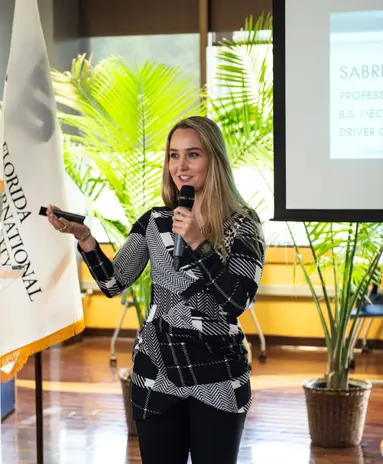
She’s seen progress in gender equity, too. Women now receive 4–6% of global sports sponsorship dollars – up from less than 1% just a few years ago. Programs like the W Series and Porsche’s Female Driver Development Program are helping shift the narrative.
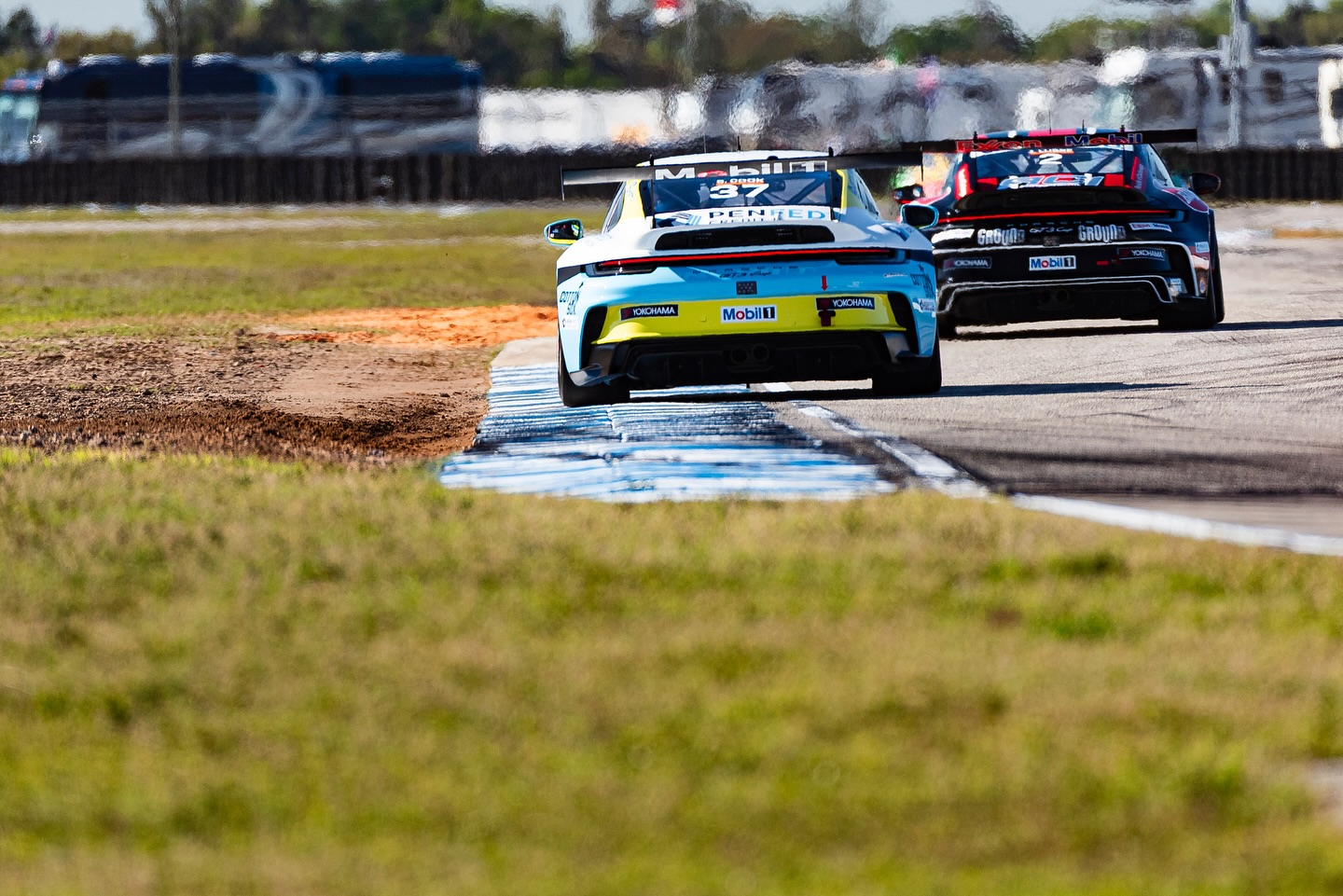
Sabre’s advice for aspiring female racers? Know that motorsports is a lifestyle, not just a job. Build a strong team, commit fully, and be ready to work harder than you ever imagined. “Trying to do it all alone doesn’t work,” she says. “Surround yourself with people who believe in you.”
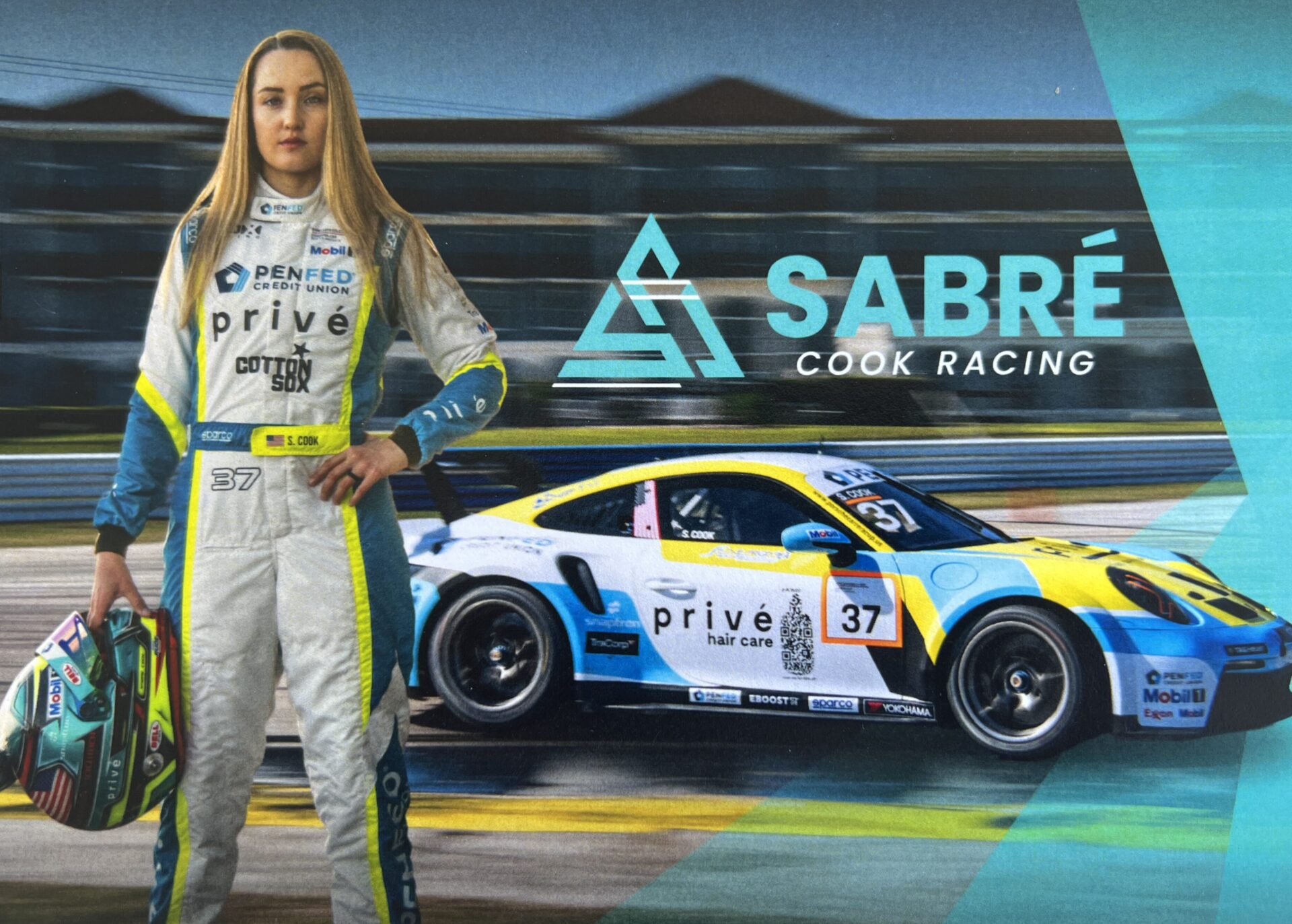
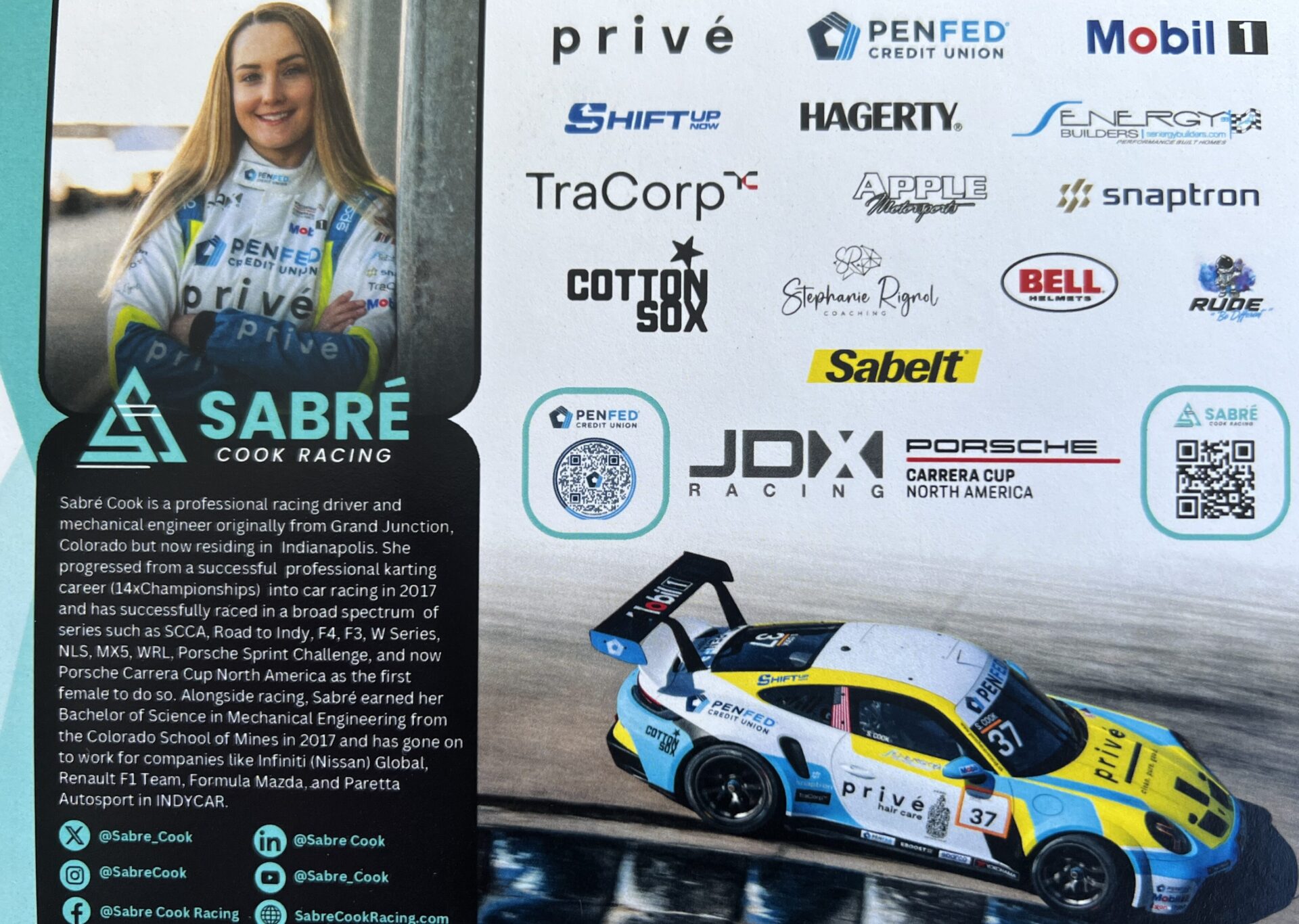
Sabre’s future is still under wraps, but she promises to stay in the Porsche family. Her ultimate dream? Racing at Le Mans. And if her track record is any indication, she’s well on her way.
Support Women in Motorsports North America
The following episode is brought to you in part by Women in Motorsports North America, a community of professional women and men devoted to supporting opportunities for women across all disciplines of motorsport by creating an inclusive, resourceful environment to foster mentorship, advocacy, education, and growth, thereby ensuring the continued strength and successful future of our sport.
Women in Motorsports North America is a not-for-profit organization that began in 2022. Known as “WMNA,” it is a community that focuses on Advancing, Connecting, and Enabling with its many partners, including industry executives, drivers, team members, OEM sponsors, racetracks, and more.
The Women with Drive summit continues its mission to bring together motorsports professionals. This unique event offers new pathways for individuals to explore career opportunities, discuss current industry challenges, and provides mentorship and resources for future growth in the industry.
If you’d like to stay informed about WIMNA and the Women with Drive Summit, be sure to log on to www.womeninmotorsportsna.com or follow them on social media @womeninmotorsportsna on Instagram and Facebook.
Guest Co-Host: Lauren Goodman
In case you missed it... be sure to check out the Break/Fix episode with our co-host.This content has been brought to you in-part by support through...