

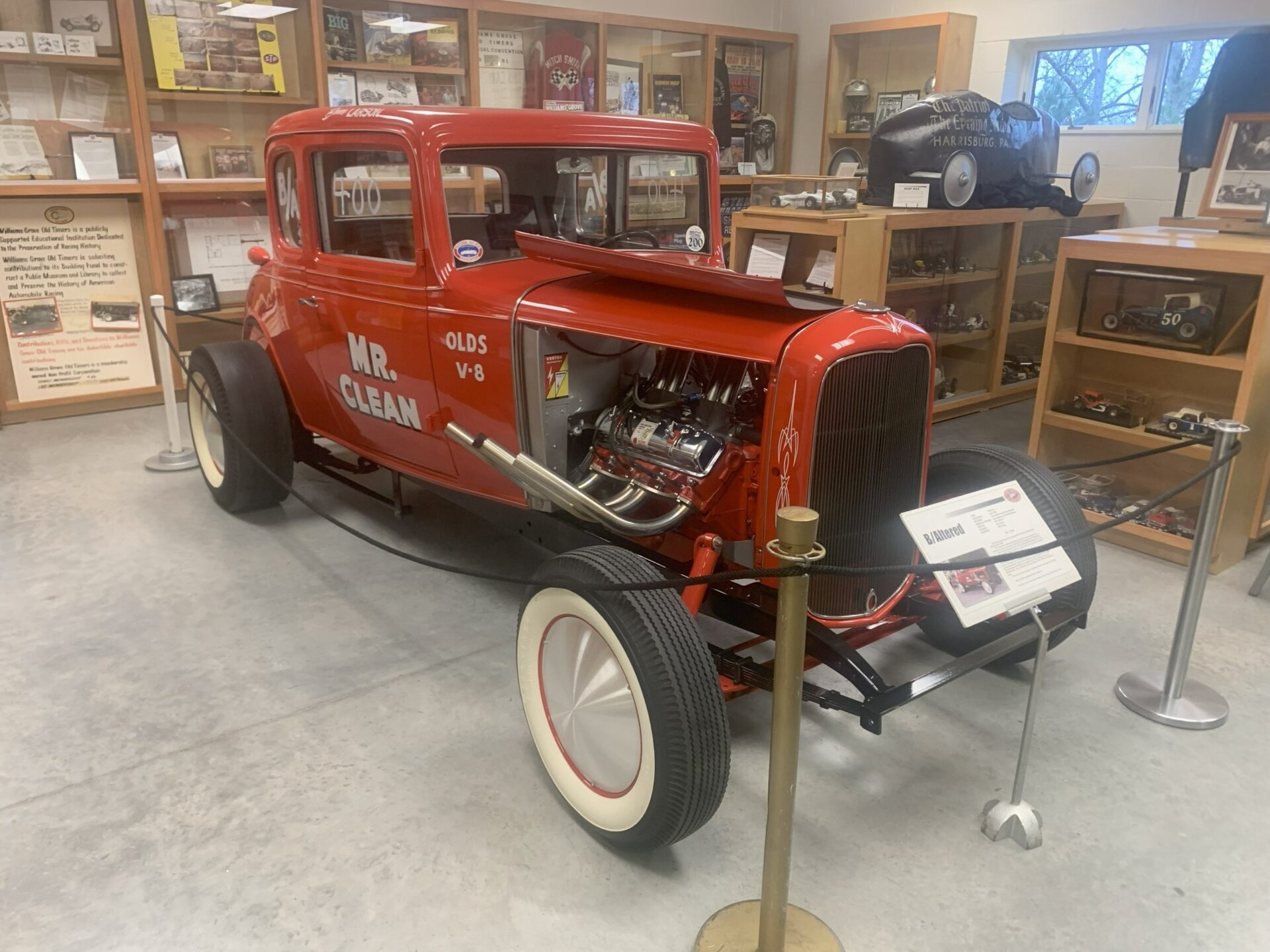
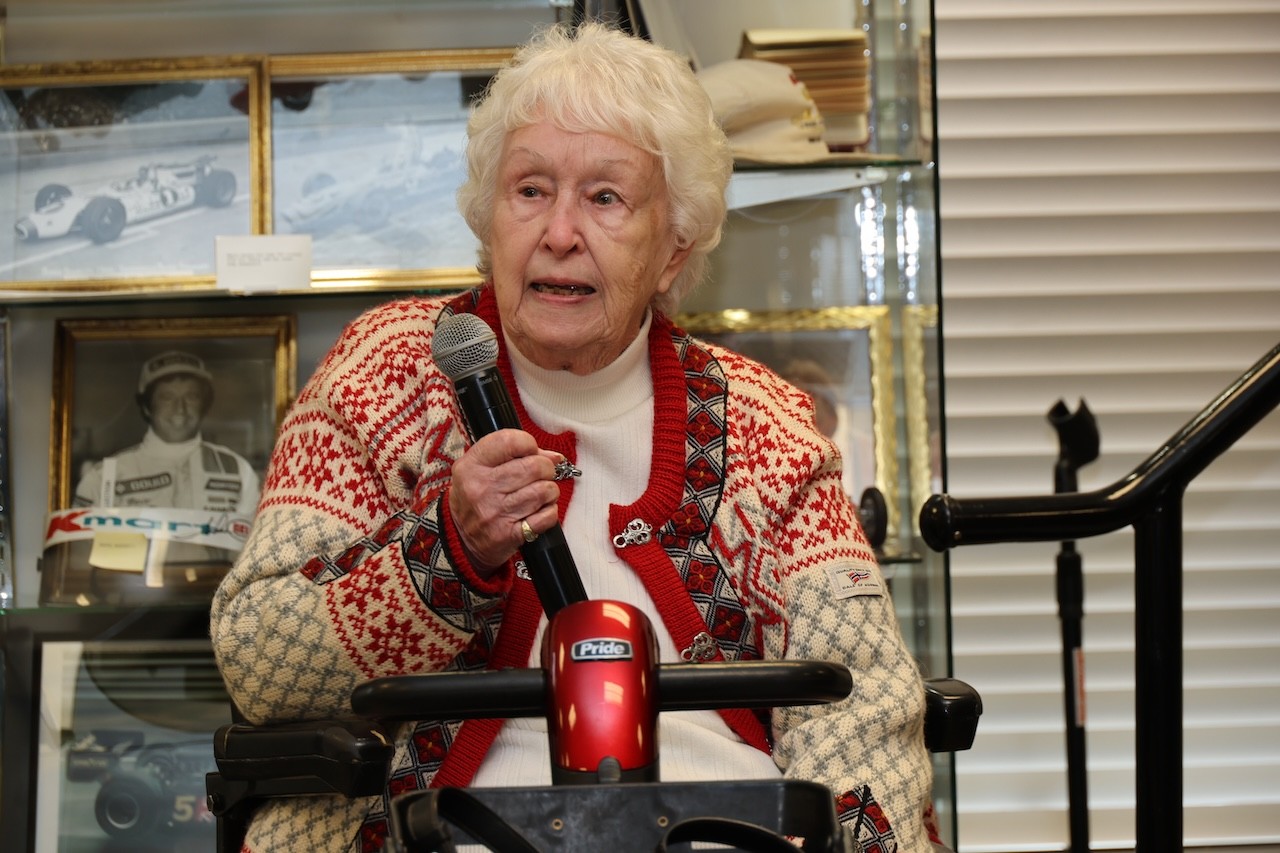
This episode of The Racers Roundtable continues where our Sunday Niagara! Center Conversation left off, and kicked things off with a panel of familiar faces, each with stories that stretch across decades and asphalt. From Thelma Hall’s recollections of the “good old days” to Fred Bear’s encyclopedic knowledge of the Gasser class, the room was thick with laughter, gratitude, and the unmistakable hum of shared legacy.
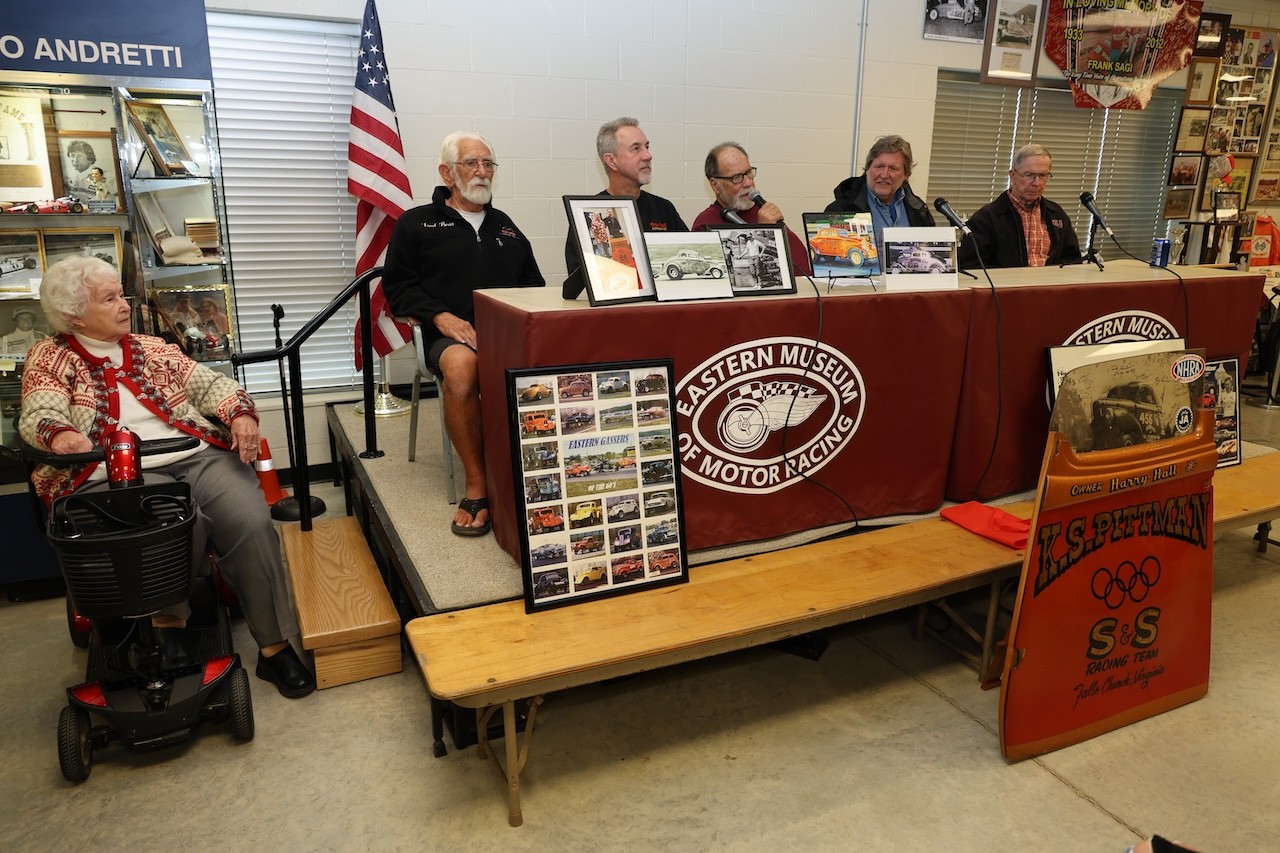
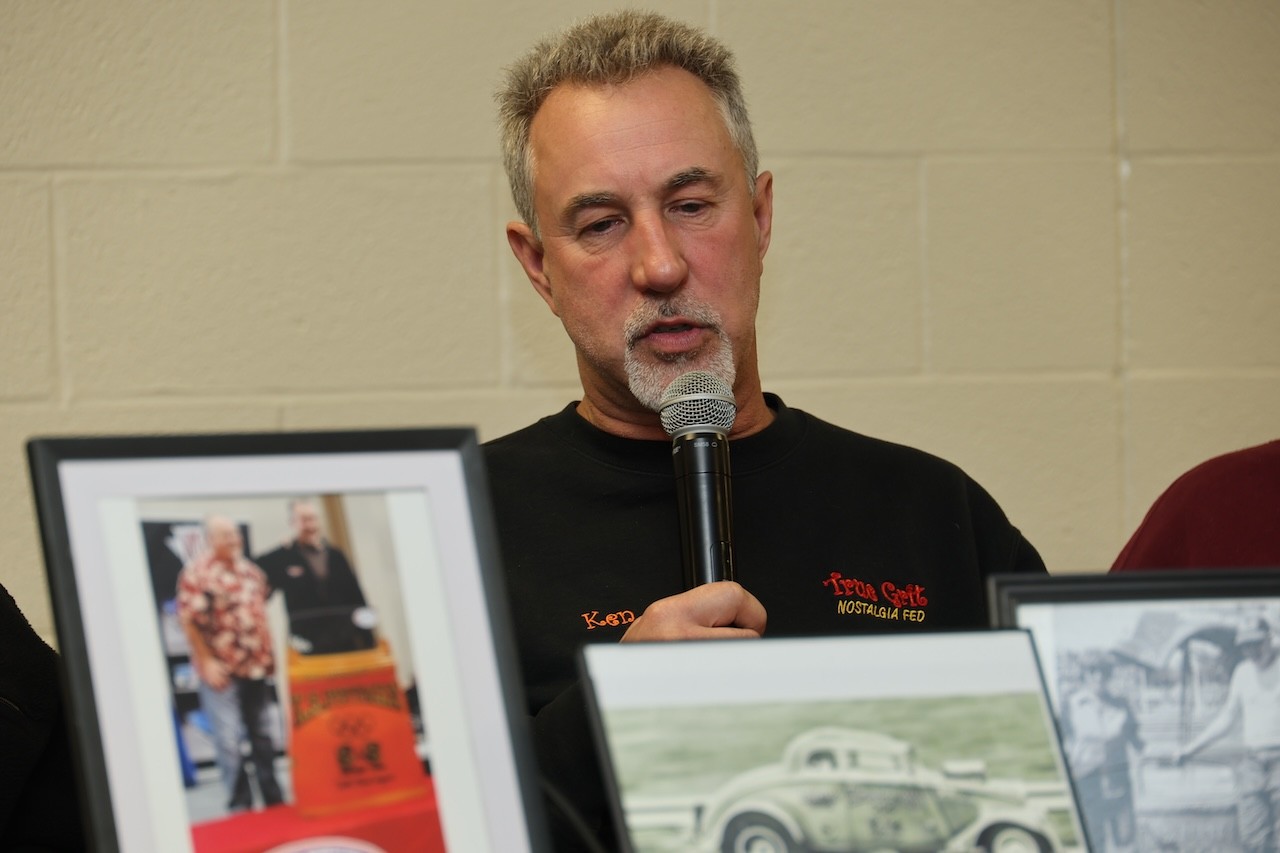
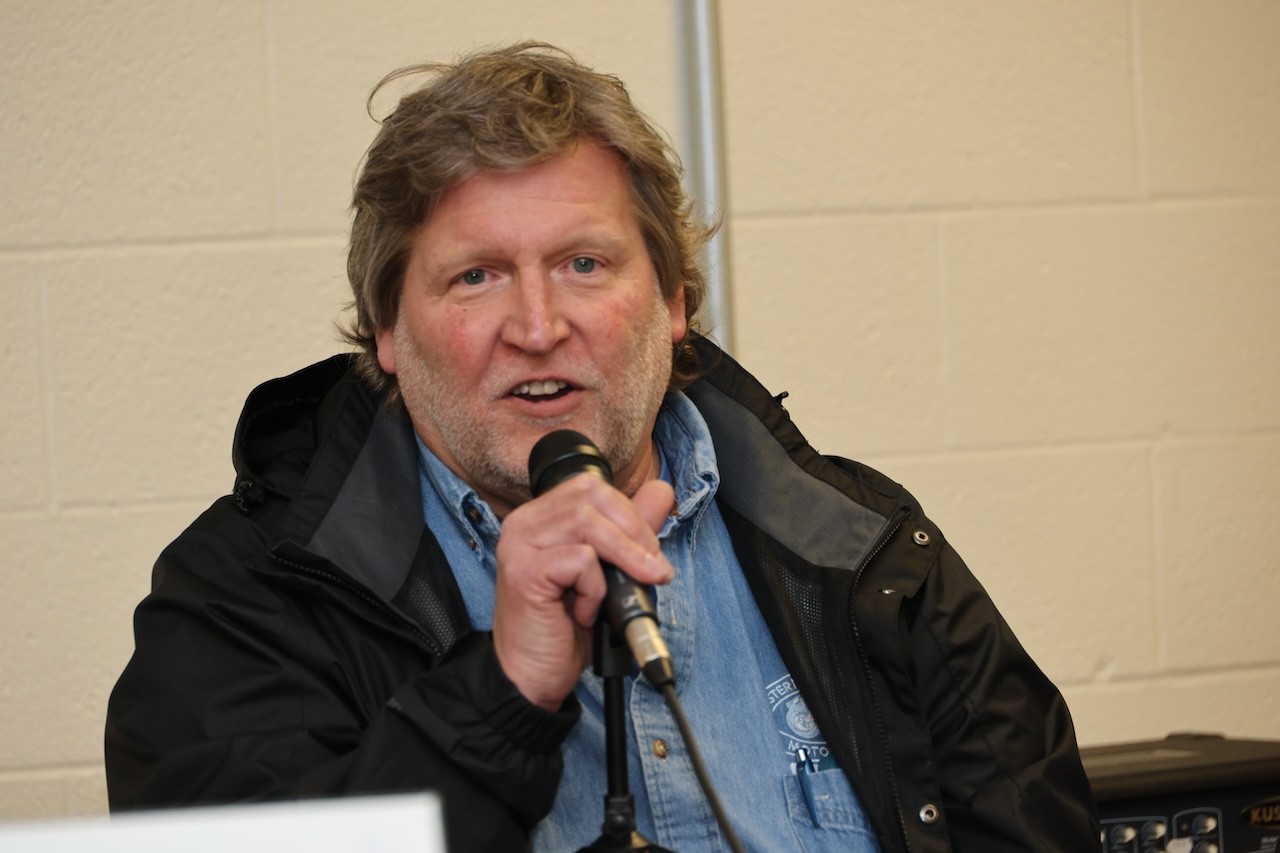
The panel hosted by Jeff Golden, included local racers Greg (and his twin brother Gary) Swenson, Ken Bingham and was rounded out by Ken Hall, son of legendary racer Harry Hall, who shared the bittersweet memory of his father’s crash at Englishtown when Ken was just two years old.
Tune in everywhere you stream, download or listen!



But this wasn’t just your ordinary panel, it was a celebration of the people who built the sport, preserved its stories, and still show up with cars, memories, and heart. Honoring legends like Harry Hall, Jack Culp, K.S. Pittman, and the unsung heroes who tuned engines, hauled trailers, and painted dreams in tangerine.
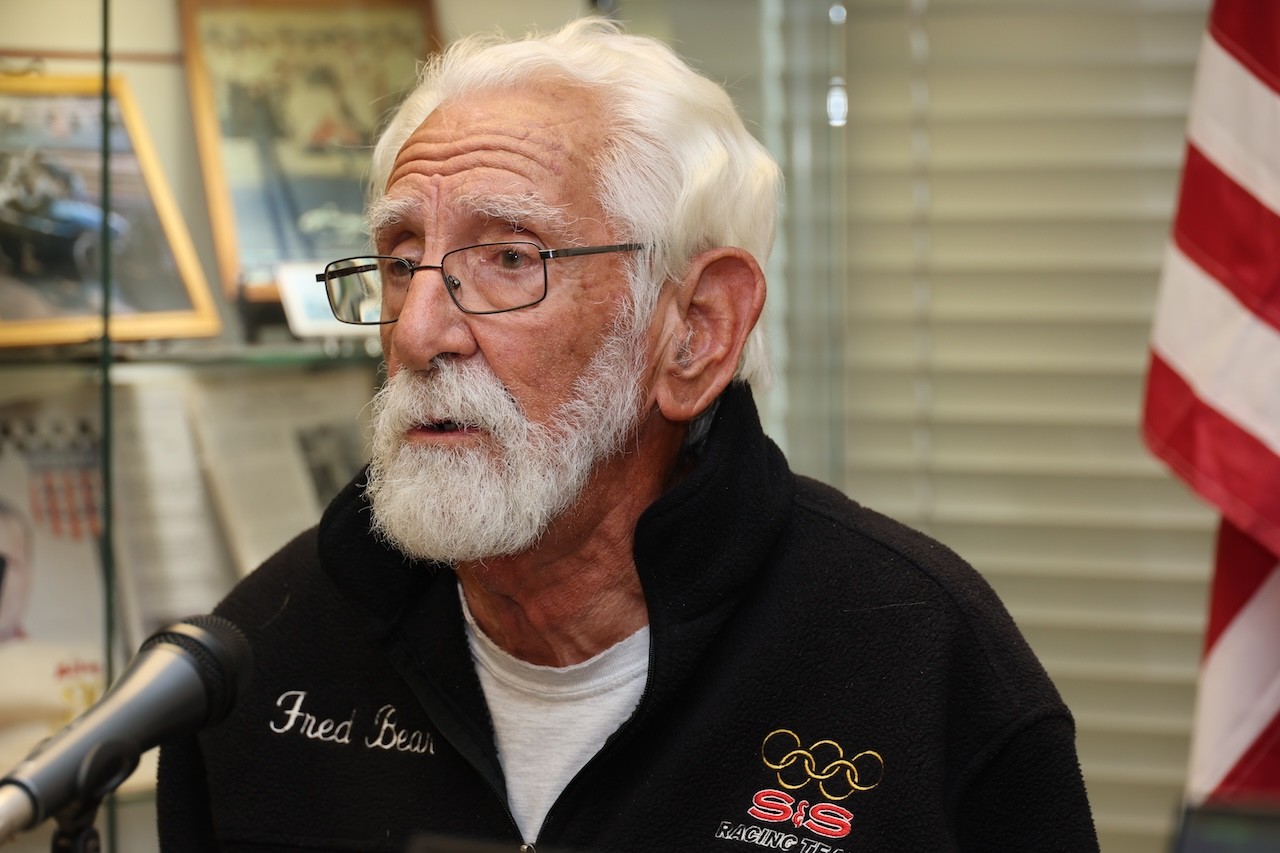
 Fred Bear
Highlights
Skip ahead if you must… Here’s the highlights from this episode you might be most interested in and their corresponding time stamps.
- 00:00:00 Meet the Panelists & Introductions
- 00:07:13 Ken Hall’s Racing Legacy
- 00:20:21 Greg Swenson’s Bracket Racing & Gasser History
- 00:36:26 Racing Adventures at Beaver Springs
- 00:39:26 The SNS Team and The Five Rings Story
- 00:43:52 Memories of Malcolm Durham
- 00:52:29 The Evolution of Safety in Racing
- 01:00:51 The Return of the Door
- 01:07:12 Building Race Cars from Orphaned Foreign Cars
- 01:14:04 The Surf Brothers’ Racing Journey
- 01:14:46 The Importance of Friendships in Racing
- 01:21:12 Bracket Racing and Its Challenges
- 01:26:32 Pork’s IRS Career and Musical Sons
- 01:31:14 The Bad News Car and Its Legacy
- 01:35:55 Closing Remarks and Thanks
Transcript
Crew Chief Brad: [00:00:00] Welcome to The Racers Roundtable, a podcast sponsored by the Eastern Museum of Motor Racing where history meets horsepower and legends live on each episode brings together voices from across the motor sports world, from grassroots heroes to seasoned veterans as they share stories, insights, and behind the scenes tales that shaped their racing journeys.
Whether you’re a diehard fan of dirt tracks, drag strips, or open wheel icons, the racer’s round table is your seat at the table for candid conversations and timeless memories from those who lived it. Strap in tight because it’s time to talk. Racing history, one lap at a time.
Jeff Golden: I wanna introduce our panel here. I guess I’ll start to the right here. Thelma Hall, and she’s gonna tell us stories about the good old days. Then we got Fred Baird. Now everybody knows Freddy because he’s old as dirt, and next to next to him [00:01:00] is Thelma’s son Ken. Now Ken is a twin, the Michael and Ken. But Michael couldn’t come today because of work issues next to me is none other than Greg Swenson.
He’s a local guy. He’s got the car out there, and on the end is another old guy like me. That’s Ken Bingham. We’re gonna start this way and then I’m gonna have the guys talk about the cars where they got ’em and the history album. I just want you to all know I talked to Fred at Bruce Larson’s drag Fest.
He said, you ought to have Gene Ty’s car up in the museum. I said, yeah, ought to. And he said, well, I have it. He said, so over the course of the end of the year and the beginning, we talked back and forth. And decide. We had room for it. We wanted to do it. We were gonna go with this theme or topic, and I want you to all know that Fred brought the car from Florida.
Give him a hand. He hauled it up. And when we originally made the, made the arrangements, he was gonna bring [00:02:00] it up last week and then light come on. I said, well, why don’t you bring it up like the Friday before our open house and then you can hang around and talk on the panel. So that’s what we did. So we got Fred to thank for that car being here, which was a very, very famous car in the East Coast and I’m just so tickled to have it.
In the meantime, I wanna thank you all for coming out and sticking around. This is gonna be exciting. Fred, tell us about the origin of the Gasser class.
Fred Bear: It kind of evolved as the sport evolved in the early fifties, and it became obvious that some cars. We’re completely stuck. Some of us weren’t, so it really wasn’t fair as everything was heads up.
A Christmas tree was something that showed up in your house once a year. So they started a modified class, which suddenly [00:03:00] people like, what’s that guy from Florida
Doug Wood: Garbage.
Fred Bear: He started, couldn’t afford a whole car, so he started building little teeny things then that wasn’t fair to run against him. So they started classes and they got refined.
When did we start modified production? I think early sixties. Early sixties? Yeah, early sixties. I
Jeff Golden: still miss it
Fred Bear: because now the Gassers were race cars. They’d started out to be pass their
Jeff Golden: own
Fred Bear: modified street cars. Now they weren’t. So there was a void now between Gassers, which were really race cars and strictly stocks.
So they did in modified production and depending on the track, but it was limited to one four barrel battery ignition engine make for the body style. And it was fair rules. Boy, there was some badass cars at York in the highway [00:04:00] classes back then.
Jeff Golden: I always came on, I’m a little younger than you. I came on Honda, little behind.
But of course I looked at my hot rod magazine. To me, if you took the front bumper off, it became a guesser. Is that that Pretty true?
Fred Bear: And a threequarter cam, whatever a threequarter cam is, means nobody
Jeff Golden: had, nobody ever
Fred Bear: explained that because it seems like in a V eight, only 12 valves would open and close if you had a three quarter cam anyway.
Yeah, you. Did that and it just evolved, you know? Yeah. Something about drag rushes have always wanted to go faster. It’s part of the sport and you take weight off the front end, it puts more traction on the rear tires and, and then somebody figured out, well, let’s move the engine back a little bit. Yeah. So that for the wait over that came to a new rule called 10%.
So it all evolved. Thank God for gentleman named Wiley Parks. It [00:05:00] had the foresight to organize it. If
Jeff Golden: you only be there now, I don’t know
Fred Bear: where it would’ve gone. I don’t know where. NASCAR would never probably existed if it hadn’t have been for Mr. Bill France. I have the most respect in the world for those two gentlemen.
Jeff Golden: Gene Ty’s car that Fred hauled up from Florida. It’s down in our drag racing area. Behind it is a showcase with some of gene’s, race pictures and some of things. The intake down there, he was the first one to divine that and figure it out and everybody copied it because he didn’t have time to patent it, so everybody else copied him.
But it’s, it was a one off deal down there, so it’s in the showcase behind, so when you get done, you get intermission or something, be sure to go down and check that stuff because it’s really neat and I’m just so proud to have it and have the car here. I wish we could have Gene here, but he has health problems and he couldn’t make the drip.
Bill Klein brought us the archive stuff down there. He, uh, from his [00:06:00] collection, which I didn’t know, Fred actually owns the car and maintains the car for Gene, so
Fred Bear: the car wouldn’t be here without Judy’s help. She is. The best help that I’ve ever had and works for less pay than anybody I’ve ever had. And he needs a lot of help and puts up with me.
The only person that’s put up with me more than she has with my mother. May she rest in peace and I think she died to get some rest. So thank you all for the applause for Judy. And if the car sparkles, you have to thank her because I don’t clean cars, I paint ’em. She does a beautiful job. She spent two days cleaning jean’s car inside, underneath in the trunk.
She cleaned everything in that car [00:07:00] because it’s going to the museum. I want it to look nice. And
Jeff Golden: when it arrived, we were down there trying to get his position and set the stanchions up and she was still polishing.
Sitting next to me is Ken Hall. He’s one of the twins maybe
Fred Bear: on my phone.
Jeff Golden: I can’t tell him, but he said he’s Ken. The only way I know is I called Ken’s phone number. So I think I got Ken. I’m gonna let him talk a little bit. His mother’s sitting down here, they weren’t involved with the Ks Pittman card and I’m gonna let let him tell the whole story in the background and include
Ken Hall: your mother.
My father was Harry Hall. I was too young to be a part of that car. I was only two years old when he crashed that car in Englishtown. So it really doesn’t have many memories in my mind except probably my dad cursing that, you know, he crashed his car. My father started out, well, he had his own cars. He was through Pontiac, worked for a dealership, and they gave him a car to race.
Then he bought a 41 Willies and had a blown Oldsmobile in it. And he had help from a gentleman, uh, [00:08:00] Bristol area named Jack Culp. I’m sure maybe Bruce had heard of him. I remember Jack, yeah. You remember Jack? Well, Jack was very famous with, with engines very good with Chryslers and Oldsmobiles. In fact, Ks would credit Jack Culp for teaching him how to tune those engines because Jack was a master with those engines.
So my father started hanging around Culp’s garage and then started driving Jack’s. He had a Willy’s also and then the bread truck that had a 3 92 in it. Yeah. Or Oldsmobile. Then it went to 92. So my father had his start through Jack Culp when he got put into the, uh, hall of Fame down in Carolina. He credited Jack Col to a lot of it.
I wish my dad was still here to see this and be a part of this. It was a big part of his life growing up. Then he became, he met Ks. Ks came east, had his opal? No, that was op opiate. He sold a 33. The steel one.
Fred Bear: Steel 33. The steel 33 64.
Ken Hall: Yeah. And my father met Ks then and started hanging out with ’em, helping him.
And they ran their cars together, a lot of races. And then Ks was selling the 33 Willies that the doors off of down here. And my [00:09:00] father bought the Ks car from him. And I, I still don’t know the year I, I asked my mom and she didn’t remember, we’re guessing around 68, somewhere in there. Maybe Fred seven
Fred Bear: or, well, the car was new in seven.
Yeah, I think that was 68. 68 that Y all bought it. Okay.
Ken Hall: And then Ks built the Opal. Right. And then he had also the Austin, which was the
Fred Bear: football
Ken Hall: car. Yeah, the football, which was Mazmanian car.
Fred Bear: Mazmanian bought it.
Ken Hall: Yep. So Ks bought that. So they had a couple cars there floating around, driving. But my dad primarily drove the Ks car, which was.
So the day he died said it was his favorite car. He loved that car. It was beautiful. And the gentleman who painted that car was a great story. He told me that, which I laughed at every time he told me. Him and Ks, when the car was brand new, brought out to Molly.
Fred Bear: Yeah,
Ken Hall: Molly was in Los Angeles and Molly used to paint all the Hell’s Angels motorcycle.
So my dad said, him and Ks brought the car there. It’s in gel coat. And they said, you know, Molly came out and he was just hippie, like long hair, crazy looking, you know, since the sixties. And this was just him painted Hell’s Angels bike. So he looked like a Hell’s Angel. So he said, what do you want K? I said, I want it [00:10:00] orange tangerine after that and my name on it.
You do what you want. So he said, come back in a week. They told me he was, Molly would push the car in his little garage. He had this one car garage and he would get stoned out of his mind smoking pot. And he would paint these cars and they looked incredible. So they said they went to his house. A week later they opened the garage door.
This smoke rolled outta the door. Out comes Molly. He could hardly even see straight. And dad said it was the most beautiful thing you’d ever seen. But that was Anita story. I thought, man, it’s so well I have the nose piece of the car. I couldn’t bring it. Today. It looks like a caveman coming at you. And it says Paint by Molly.
And that’s how they got the car. But my dad drove the car for four years or so. He crashed it in Englishtown in 72 at the Summer Nationals. And I learned this after Doug Wood. There’s a old story behind that as well. But Doug is the reason why I have this. My family has a door today, but Brian was there at the track and was one of the first guys to my father when the car crashed at the end of the track, which I didn’t know, I just learned last year.
Fred Bear: I bet he can’t run that fast.
Ken Hall: I said, well, [00:11:00] what happened when? When he got to my dad and he says, I’ve never heard such foul language in my life. And he says, not ’cause he was hurt, because the battery behind the seat was dripping ass asshole over. And he was telling me, just get me the hell out of this car.
So I thought it was on fire. He said, no, it was no fire. Just your dad. And there cursing up a storm trying to get outta that car. Anyway, the front wheel broke off. He crashed the car. The door had gone out in the weeds. We got the door back a couple years ago. Doug was a big ambassador. Getting that back for is a big story.
But dad ran the 33, he ran against Ks for years and he was his teammate Up until he crashed that car, he built a Vega and that was blown 3 92 on gasoline. And to this day my dad ran, I, I think it was Georgia, he ran and set the national record in blown gas and funny car and a week later they switched into alcohol.
So in my mind, my dad still has the record.
Fred Bear: That makes sense.
Ken Hall: You know, I, that’s just how I look at it. Then he had the vaga and we bought brand Anderson’s Dodge Dart and Cup of cars from there. But just growing up, I know this car is, the pictures you can see of my dad in the [00:12:00] car and driving it and getting into her back in Englishtown back in around 82.
That car was his pride and joy. And to be a teammate with Ks meant the world to him. Ks was just one of the most flamboyant, fun, seemed calm, but Dad said he was just a piece of work. Ks was hell with fireworks. He’d throw mates at everything. Didn’t matter where you’re at, going through the Baltimore Harbor Tunnel, he still throw a handful out the window at one time.
Or Dad told me, throw one time, he says, Ks had a real southern draw. He was from Texas. And he said to my dad, they were walking through India at the Nationals in like 68, 69. They run the cars there and he walked by my dad. He says, Harry, how fast can you run? Dad said, I okay. That’s how fast you know. I wanna test you now.
Dad says, all right, well let’s go. He’s, there was a guy that Ks hated. And he walked into one of the porta johns there at the racetrack. So Ks takes up two amens outta his pocket, twists the fuse together, lights him in the cigar, and drops in the vent tube. My dad said I couldn’t run any fats than I was.
Get the hell outta there. He says, all I hear is this fud. This guy come outta his sink, cover head to toe toilet paper, and he says [00:13:00] Ks. He says, I don’t know who’s gonna kill your worst, me or him. Let’s get the hell outta here. But he says, we laughed so hard, but my mom could tell you stories too about his daughter and she’s gone up, oh yeah, we’re gonna pass the mom now, because she was there more than I was, you know?
But the stories that I got from my dad were just awesome with Ks. And like I said, that car was his favorite. He loved it. Built 33, backing around 95, 96. With my family. It wasn’t the same. It was a little lower. Wasn’t like an old Gasser. I wish we have done it different, but. He said the same later, the 30 threes were his thing, and Rocky Perone owns series of Gassers.
He owns replica of the Ks car, which is in museum in California, and he owns the Big John Mazmanian 40 that’s out there as well. And also a replica of his father’s boss, hydro 33. Home yet, which isn’t home yet. Yep. So I was fortunate enough to, I drove the Big John MAs Manini car. In fact, I drove it against Freddie Bear in the Ks car at Bud’s Creek the first time I ever drove the car.
And, uh, Rocky’s father-in-law had set the wheelie bars [00:14:00] up a little higher, not thinking about it. When I left the line, the thing was really carrying the wheels out and I didn’t know any better. Just like driving a Super Bowl down the track, I’m like, well, I guess this is how it’s supposed to leave. I didn’t know they stayed in it.
And then these guys came back to all applaud going crazy. Well, we got the on the track and you’re sitting here now and, and, uh, you’ll agree with me. Fred Bear and I walked up each other and we both had tears in our eyes and I said, man, that was for Ks and my dad. And that was one of the greatest experiences of my life.
I was honored. Race against Fred
Fred Bear: Barr.
Ken Hall: I was a hundred. Oh, it meant the world to me.
I haven’t driven the Ks car yet. And Rocky says, before I die, he’s gonna let me make a pass in the Ks car. My brother driven many times, Fred’s driven it. We all, I I think we all, it’s like luggage. We just passed that thing around.
Fred Bear: Yeah. Prostitutes.
Ken Hall: Yeah. Yeah. It’s bad. Anyway, uh, so, uh, I’ve gotten a chance to drive these old cars and my father was there when I drove a couple of ’em and he told me the same thing.
He says, they’re just like, they were back in the day. He says, be ready. They’re a handful somewhere. I have a picture of my dad of the Ks [00:15:00] car going through the lights at Maple Grove with a front wheels, a foot in the air.
Fred Bear: I’ve seen that picture. Yep.
Ken Hall: And he used to tell me, he says, did no matter what you were doing straight, it’ll be straight as an narrow, but you just pick the front up outta nowhere, half track or finish line or whatever.
And he said that thing was a lot of fun to drive. We were fortunate to go through it, to have Ks in our life and, and to have Freddy and everybody, and my mother got to be a part of that. I’m gonna give her the microphone for a minute. I’m sure she’ll have something to interject here and tell me where I screwed up and did something wrong.
But thank you all for letting me come out and ramble on for a few minutes. And, um, I’m now, wait a minute. I got a
Fred Bear: Ken and Thelma story. We’re at Beaver Springs and I’m running you, I think you were in the Ks car. Maybe the balls that I was Mike. I was Mike. Was that Mike? Okay. Well, how they look alike. I’m driving the Ks car and this is bj.
That’s before Judy and, uh, get ready to make a run. And I [00:16:00] said, Harry, how about turn me up with a nomad? And he goes, what? And I says, I need somebody to turn me the nomad and bring me back after the run. You know what I’m talking about? And he goes, you want me to? Yeah. Well Harry was a big man. And it took a shoehorn to get him in the nomad.
And Thelma got in the right side and they towed me up. And as well as I remember, I won. Uh, because the other end here, it comes down the return road. He’s got a smile that you couldn’t get out of the nomad with him. You had to take the two out individually. Next run, he says, can I please tell you it was my car?
But that is my last good story of you. And Harry together. I’ll never [00:17:00] forget it.
Audience Q&A: That was wonderful.
Ken Hall: Thank you Fred. Well, mom, what do you, I know you’ve got probably something you could add to about the Ks days or
Thelma Hall: Oh, the Ks days. They were fantastic. The one incident I remember very, very well, if Ks was gonna be running at English town and Harry racing as well, he would normally stay at our home.
And the one time when he was with us, he had brought his two daughters, Tammy and Debbie. Tammy was a her set with Linda Vaughn. And I can remember we were getting ready to go to Englishtown. Tammy was still in the house trying to get ready to be her set tall boots up to her knees, was part of her outfit.
And we’re all outside waiting for Tammy. NKS is going, Tammy, get out here. We’re gonna be late. Let’s go. Let’s go. Tammy still wasn’t coming out. He’s still in Tammy. We gotta go. Here comes Tammy. Running out of [00:18:00] the house had her tall boots on. They had laces that were unbelievable. Didn’t have time to lace her shoes.
So she’s running across the lawn, holding onto her shoe laces her feet, trying to run across the lawn. Well, we were rolling in stitches, laughing at her, trying to come across the lawn, but it was just so funny to see her. We had a lot of good times with Kay. His daughters. And with drag racing, the many friends that were like family to us we’re so thankful for.
And today I also wanna thank, being that Mike could not be here today, his beautiful daughter Tori, who is a successful dirt track racer, and also Allison, Ken’s girlfriend. Thank you for being with us. Thank you.
Jeff Golden: Thank you, Thelma. I, I [00:19:00] just wanted to throw a little word in here. From my point of view, many years ago, I guess 10, 12 years ago, before Ken’s dad died, they had the race up at Beaver Springs, after the York Mussel of Armenia, and they raced kind of as a booked in circuit. His dad, I was really impressed when they staged the cars, the two crew people with their dad at the time, pull the cars up, look at each other and go like that before they went down with a race that I thought that is true.
Sportsmanship one didn’t take off without the other or try to burn the other one down. They made sure they were ready to go and away they went. Well, what
Ken Hall: you didn’t hear is my dad would be in the car before we’d stage and he’d always gimme words of advice, like, don’t be a dumb ass, or turn a fuel pump this crap.
Better come home in one piece, or I’m gonna beat you with senseless. You know? So he always had some encouraging stories from my dad. As I’m staging the car.
Jeff Golden: I only got to talk to Kay one time in my life. And that was up in Carlisle. And I think the good guys were up there, which was probably 20 years ago.
And he [00:20:00] was there as a featured car and speaker and stuff. And I was listening to him. He said, police said we were really nuts driving cars with wheel bases in 90 inches. Just untamable. But you know, that’s what they did. That’s the way it was. Stock frames. Stock frames, yeah. Uhhuh. Yeah, that was a stock frame car.
Incredible. I mean, they were men, you know, so Well now I’m gonna turn the microphone over to Greg here. Greg is a local guy and I never ever can remember the name of his car. What’s it called? Hale.
Greg Swenson: No, actually this car is Mickey Hale’s, old Gasser, and he raced in the Ohio Outlaw Gasser circuit, which was sponsored by Scott Rods.
And I’m gonna tell you a little bit about the history of the car, how I came to own it. But before I do any of that, I just want to make a shout out to, uh, gene Alizer. And just to say that way back when, when Darwin Dahl had his events out there at the York Fairgrounds, gene was at a couple of those events.
And I remember [00:21:00] his car was parked not too far from where we were parked at the time. I was racing a little tube frame car. It was a 1987 Dodge Charger body sitting on a, uh, Alston Pro Gas chassis. And it was basically just looked like an old supergas car, fun little car to drive. We were asked to come and join the show, got a chance to meet and spend a good bit of time talking with Gene Atheer while we were there.
A wonderful, wonderful person. And certainly he was, you know, one of my heroes growing up. Certainly remember when he ran the Weasel at the first drag race I ever went to, which was the 1969 Super Stock Nationals. They had that out at York and he had the corvee at that point in time. You know, he certainly became foremost in my attention just getting a chance to, uh, see him as one of my heroes growing up, along with, uh, a guy sitting in the back of the room with that on there, Mr.
Bruce Larson. Alright. My brother and I, I have a twin brother [00:22:00] Gary, and, uh, we both became sort of partners in crime with all this stuff. See, I can’t keep ’em straight. They’re twins. It was an interesting story that I’ll just sort of share with you guys ’cause it’s sort of funny. But my brother and I, when we were about 10 years old, we were basically both really into like dinosaurs and snakes.
And my father was an old machinist. He started his career as a, uh, tool and die maker. And he worked his way through manufacturing as the years went on. But when we were about 10 years old, we were on vacation and my father was so sick and tired of hearing about dinosaurs and snakes that he walked into a magazine rack at a shopping center that we were at, and he picked out a, a uh, copy of popular hot rotting.
It had gas, Rhonda on the cover, an old funny car, and he basically said, I think it was a 1967 issue. And he gave it to my brother and I and he said, here, read this. And we never stopped much to his dismay, I think in later years. But basically [00:23:00] that’s how we really got interested in cars. And we both have continued in that vein ever since.
Primarily started as spectators and then eventually got to get into collecting cars and racing and stuff like that. But I am just a local bracket racer that’s really, you know, what I do. But I got into collecting some cars along the way and, and had a chance to drive a few of these things, which are very interesting.
But again, I’d like to, you know, shout out to Gene Alizer and say that if he remembers a guy that had a black pro gas looking charger way back when, I certainly remember the time that he spent with me. And a wonderful, wonderful person. But as an interesting point since we’re talking about Gassers, a few years ago we bought a 1950 Chevrolet and it was built by a fellow by the name of Harry Logan.
We purchased it from Harry and Carol, Logan and Harry happened to say, you know, when I wound up building this car, there’s a friend of mine who [00:24:00] was into racing and he raced an old Gasser. And in fact, I was at his wedding and he became my best man at my wedding. And his name is Harry Zaner. And so interestingly, you guys probably remember a green 32 5 window Ford coop.
There’s a picture of it downstairs. So there’s a little bit of a connection with that. 1950 Chevrolet with Harry Lou Zader through Harry Logan. But basically what wound up happening with me over the years is back around 2019, right before I retired from Harley Davidson, I wound up getting an interest in the, certainly over the years, I always had an interest in the older style cars, even though I was driving a more modern style car at the track.
One of the cars that piqued my interest was this 1948 Austin Gasser. It was advertised in racing junk. And you know, my brother being my partner in crime is the one that alerted me to it. Mm-hmm. And said, you ought to look at [00:25:00] this. And so I did. And I wound up calling the owner who was Mickey Hale. And Mickey Hale was looking to sell the Gasser at the time.
Like I said, he had had it probably since around 2010. And he was racing in the Ohio Outlaw Gassers. And I’m guessing that you guys probably ran against Mickey Hal in the early days. But at any rate, working with Mickey, we sort of put together some of the history of the car, and I have some pictures of it here, which will sort of show you what it went through.
So basically up in the upper left is how it started life. It was a car that was put together out on the West Coast. And a fellow by the name of Jeff Wright put it together and he built it with a lone 3 92 with a torque flat transmission, and he raced it to a best time of about eight 40. Basically, he kept it for a number of years it was called, of all things fat boys Folly.
After some time he wound up selling it and he sold it to a guy by the name of Don [00:26:00] Wilson and Don was from British Columbia. And this is the way it looked when Jeff Wright built it. I can’t say that I’m real happy with the paint job, but it was still cool for back in the day. But when Don Wilson bought it, he turned it into a bracket car.
And this is a picture of what it looked like when he had it and he was running around 10 seventies. He had a small block Chevrolet in it with a single four arrow and he was, like I said, from British Columbia and ran up around that neck of the woods. And then at some point in time, Mickey Hale bought the car and when he first bought it, it looked pretty much like this.
Right now you can see the car is sitting outside. It’s got some striping along the side, and he has a graphic in the front, which he had put on it pretty much right before I bought the car. But basically he was running in the Ohio Outlaw Gassers. His best time he told me was eight 20, running at about 156 miles an hour.
Had some real good success with it. Here’s a picture of him when he was [00:27:00] running the floor wide down at Zm Max. In, uh, North Carolina. He also was up there at Beaver Springs, at the Gasa reunion there and at Thompson Dragway out in Ohio. He actually won a number of times at the events. Apparently, I guess he won Bowling Green twice with the Ohio Outlaw Gassers.
There’s a, a Night of Fire that’s held out in Ohio with right at the Summer Motorsports Park, and he won that apparently two times. He also raced at Indy, at the US Nationals. I guess there was some displays, you guys did some exhibition stuff out there. And he told me he won that in 2013 and 2015. I
Fred Bear: won it in 12.
Greg Swenson: You did?
Fred Bear: I won it in 12 and I think he won it in 13.
Greg Swenson: And you guys might have some stories to share about racing against Mickey Hal. Yeah, we did a lot. Yeah. And I still keep in touch with him.
Fred Bear: Where’d we see Mickey? Was that the Gators? Yeah, we just saw him at the Gators [00:28:00] this year. Okay. Spent some time with him
Greg Swenson: and he’s a good guy.
Oh, great guy. And uh, and I wound up buying it from him. And actually, you know what wound up happening is I bought the car and I had not put a motor in it or done any changes to it after I first bought it. And he was building a Willy’s, he was gonna compete in the Ohio Outlaw Gassers. And he basically said, well, I got this Willy’s that I’m working on, and we would keep in touch back and forth.
And he said, well, you know, I said, how’s the Willy’s coming? Well, it’s not done. He said, I gotta get this thing done because I got a couple of dates that I have to make happen. And I finally got to a point I said, listen, Mickey, I said, I still have the Austin. I haven’t done anything with it yet. And if you want, I’ll loan you the car back.
You can put your motor and trans back in it and make the dates that you had committed to with that car. And we actually bid that.
Fred Bear: No charge. No charge.
I’ll take it for you. [00:29:00]
Greg Swenson: I promised win. We’ll talk Fred. So basically that is, you know what we wound up doing. Mickey had it for the better part of a year, raced it, and then he delivered it back to me, minus engine of trans. And at that point in time, I took the car over to John. Little John wound up updating a few things on the chassis.
One thing that Mickey had never done with it was he basically said, I always wanted to put the gas pedal on the driver’s side instead of having to swing his leg over the transmission tunnel. And also I wanted to go to a foot break rather than having the hand brake. And we accomplished all that stuff, working with John Little to do that and redid some of the interior of the car.
Actually move the motor slightly forward. We have a small block in it and the mounting tabs for the small block are the same as the original front mounting tabs for the big block. So that gave us a little extra room in the transmission tunnel area to be able to put the power Glide in there, which is the [00:30:00] same as what Mickey ran.
It’s a different transmission than the actual one that he ran, but he ran a Power Glide. We have a Power Glide in it. The rear is exactly as Mickey ran it. And we did lift the front end up a little bit and change the wheels. But other than that, you know, it’s a fun car to drive every time I get in and I got a smile on my face.
But I can tell you that the way I always term it to people who ask about, you know, what’s it like to drive one of these things? And I basically can’t see back. I, I would tell them the tube frame car that I used to drive. Basically I would put my mother in it and she would be able to drive a 10. Oh, I would not put my mother in the Austin.
They are fun to drive, but they have a short wheel base. It’s a straight axle. Takes a little more attention.
Fred Bear: Yes.
Greg Swenson: But it is fun. Every time I get in it, like I say, I got a smile on my face.
Jeff Golden: The car’s out on the porch. We parked it yesterday. He has to bring over it. So we brought head cable, the weather, but [00:31:00] he drove it.
He started and drove it there and of course he could resist stomping on a little bit. I knew that was gonna happen. I told him maybe he could just stomp on off the porch and we lay some rubber out there and you know, get his ER on. I don’t think he’ll do it.
Greg Swenson: It
Jeff Golden: depends how
Greg Swenson: much you wanna see on the,
Jeff Golden: alright. Okay. Well I just wanna say Greg and his brother Gary are any sister, are really signed supporters of the museum and helped me out a lot of times and it’s really neat. They have several cars. So when I get a in a bind and we need a car for a display for a certain class, he’s got one of ’em. So he does bring that car and get that car and, and he was the poster child up at Bruce’s Drag Fest back in October.
So I certainly appreciate that.
Greg Swenson: Do wanna thank very much all the interaction I’ve had with Bruce Larson and his crew, bill and Dave back there. Bruce has been a tremendous influence in my life. It’s just been a [00:32:00] absolute pleasure for me to get to know him and the fellows who work with him. It’s like a dream come true for me to get to know some of the folks that are up here.
Again, I’m just the local bracket racer, but it is an honor, the honor of my life.
Jeff Golden: There again, there’s Bruce Larson and he’s probably one of the biggest contributors to the drag racing area of the museum. Well, next we gotta move over to another. Supporter of the museum is Ken Bingham. He comes over and, and helps us fix the museum on Fridays and stuff.
That’s the old farts day when, you know, retirees come over on Friday, they’re supposed to be fixing stuff and we wind up bullshitting. So I’m gonna turn it over to him and let him tell about the car out on the patio also.
Ken Bigham: Okay. It’s the, uh, orange 37 Ford Coop. It’s the, uh, old Nash Collodion, YOC car. I guess I should say it.
It’s, uh, Nash and Yoc. They were the main guys behind it. They originally had what they called the BUN band. That, which was a, I think a [00:33:00] 27 or 28. Model a pickup that they campaigned very successfully. They started with that and then they added the 37 into their collection in 1961 when they took it off the street and turned it into a pure drag car.
I bought the car out of an ad in the auto ator, probably in about, I’m guessing maybe 85, I guess 83. 84, 85 is where I bought the car, and I actually bought it to flip. I was, didn’t really know much about the car, I just thought it was a neat car. And uh, I bought it and it just happened to be the week before fall, Carlisle, from the very beginning, I had been a flea marketer at, uh, Carlisle events.
So, uh, I told my wife, I said, we’ll, pick the car up the day before Carlisle and we’ll just take it down to the flea market and put it up for sale. When I took it in that day, from the minute I entered the grounds till I got it to my space, it was kind of like a big magnet. I mean, it drew a lot of attention, and like I said, this is in like 83.
He and I was like, I couldn’t [00:34:00] figure it out ’cause it basically, it was a huge drag car. When we got on the spot, my wife said, well, what are you gonna ask for it? I said, well, I don’t think I’m gonna sell the car. And she said, well, I said, well, there’s something going on here that I can’t quite figure out.
Why is it? So many people interested in the car. So I said simply just, we’ll put a sign on. It says Wanted, ’cause I always wanted an early funny car or an A FX car. So I put a sign on it, wanted a FX or early funny car. Of course, through the process of the weekend being there, I did get some guys who were familiar with the car that knew a history about the car.
At the time it was painted black and it had kid’s toy written on it for Kid Rear who is the gentleman who bought it from them originally. So the few people knew about it. But in the process of this car sitting there, I think it was on probably the Thursday or Friday, that weekend, a young kid walked into my display and said, I know where there’s a funny car I think you’d be interested in.
So I said, okay. So he describes the 66 Chevelle that’s sitting downstairs. Funny car. I [00:35:00] honestly hadn’t heard of the car, so I didn’t, you know, he was explaining this car to me. He’s a fairly young fell. He was too young to have known the car from back in the day. And I eventually said to him, well, how do you know that this is actually a funny car?
He goes, well, he said, it’s a centerfold in 1966 Car Craft Magazine. I was like, really? Okay. So in the process, he says, when I get, he said, it’s, it’s just down the street from where I live. I’ll, uh, get the guy’s name and address and I’ll let you know about it. I listened to her cell phones. So anyhow, when I went home that night, I wanted my attic and dug out my magazines, and there it is.
June, 1966. Centerfold and I was like, oh my God. Mm-hmm This is unbelievable. How did I not get this guy’s name and address? So it went probably, I’m thinking maybe November of that year, I finally get a letter back from him that was very apologetic. He was sorry that he hadn’t gotten back to me, but the guy had moved and he tracked him down and found his new address and gave me the new address [00:36:00] for me to go.
Of course I went out and bought the car and brought that car home and kept it. But in the process, the car that I bought, the flip, I still have it. Never left it go. And of course I learned more about the car. Uh, these guys were very, very active in the sixties in the local area. Raced it extensively in the mid-state area.
I know they were at York, they were to Hagerstown. Uh, I’m not sure about South Mountain Beaver Springs. They were there an awful lot. I have an interesting story for Beaver Springs. When we first got the car back together, we joined the East Coast Gassers. First race we went to attend was at Beaver Springs.
I had never been to Beaver Springs because I quit drag racing in I think 71, and that’s when Beaver Ball opened up. Sohow. We get to the track that day with this car. We were a little bit late as usual, and I’m in there and this guy comes riding down the the aisle with a scooter and he’s going, oh my God.
Oh my God, that’s the original car. I said, yeah, it’s the original Knick Nash car. And he goes, they’re lining up in the line. You [00:37:00] gotta get that car up there right away. And I said, well, I’ve gotta get it checked in first. And he looks at me. He said, well, where’s your card? So I went in and got my tech card and I handed it to him.
He scribbled someone and he said, you’re ready. Get up up in the line.
Jeff Golden: That’s Beaver Bob.
Ken Bigham: He takes off. I turned around and some guy said, who is that? He goes, well, he owns the track, so if he says you’re good to go. So we raced it several times up there and then followed the circle around. I think it was a year or so later.
Again, we’re back at Beaver Springs and my son was driving the car that day. Well, he blew the engine going through the lights and that was the last run, last time we ran the car. When we got back that night, I was like, you know, this was a lot of fun when I was a kid, but this stuff was staying up light and building new engines.
I said, no, I wasn’t cut out for that. So we basically took the car and parked it in the back of the barn and left it set for a few more years. And then one day my son said, you know, we really ought to put that car back together. So he bought a motor and that’s the motor’s in it now. And [00:38:00] I just haven’t gotten around to finishing final details so we can start it up running some more.
But the real history belongs to Nick Nash and, uh, Jimmy Ock because they were the instigators and the main operators back in the day. And, and as far as a, a nice original local East coast car, it’s, I personally feel it’s one of the better guessers, you know, because, uh, it’s just a neat, and I kept it as original as I could.
I didn’t, the motor I had in it back in the day was a correct motor with the right heads and all that nonsense. Son bought this motor. It’s a newer motor. It’s a three 50 motor, but we just like, okay, just for the sake of having something that runs. But it’s just a nice, neat piece of original history. I’m glad I never flipped it.
Glad I kept it. I’m not very successful at flipping, as you can see. Fortunately.
Jeff Golden: Thank God for that many
Ken Bigham: stay.
Jeff Golden: Oh, thank you guys for your cards. I just wanted to say something in case you haven’t noticed. These guys raced each other, [00:39:00] but it actually was a big family. ’cause everybody knew everybody and they all traveled together.
They, some of ’em slept together and
Fred Bear: that’s a whole different story. Okay, that’s different.
Jeff Golden: It was really united. It was. It was really neat. You don’t have that today. Everybody’s out for each other, but they really mentored each other. They helped each other and it was great. It was just true sportsmanship.
So with that being said, I wanted to ask. We’re gonna turn this into a question and answer period. We’re gonna sort of angle off onto the SNS Speech office. Of course, this was before my time, but I remember, and I think Fred was what said probably Beaver Springs. You know, the three circle things that they have for the Olympics.
Well on his car, all the cars, there was five rings. You’ll see it down on Gene Izer and
Fred Bear: the Olympics is five rings,
Jeff Golden: is the Olympics, five rings? Well, he said that stands for a five ring circus, and I thought that was pretty probably appropriate because you guys were fun to watch. [00:40:00]
Fred Bear: A little history on that.
Five rings at the start of the 64 season, Chuck Stolte, who owned s and s parts in that time was sponsoring. Five Gassers, of which I was fortunate to be one. And he came out with that design and it became our emblem and our T-shirts and everything. A few years later, the US Olympic Committee who up until that time, if you order enough to remember the Olympic symbol, was like a US roadside, whatever shape, and they went to the five rings.
And so what, well, it turns out years later, the s and s team is selected to be. Some of the top 50 guessers in the nation, and we were honored at the US Nationals that year. And David Hales, one of our teammates, sent in pictures that NHRA requested to do promotion. And he gets a letter back that we can’t use any of the pictures with the Olympic symbols on [00:41:00] him.
David calls me and he says, what do you remember about this? And I said, well, ZY said that he copyrighted it and sued him and they wound up settling. So we did some research and it turns out, and he had copyrighted it to change a copyright 15% is not an infringement. Well, the copyright committee decided, and I think Chuck agreed with them, that the five colors in the Olympic Committee said they had picked five colors for the rings to represent the five continents, which made sense to me and it was all settled.
And we go, wow. David sent all of this back to NHRA. Three days later, David got a letter or email from NHRA and says, we have checked your information. You are correct, right? We can use all of your pictures. And that’s the end of that story. Now, footnote is. A few years ago, we’re doing a reunion race at [00:42:00] Old Dominion Speedway, which is where David and Jean and I grew up, made our first passes and I think probably most rooms have somebody else that made their first passes at Old Dominion.
We got Chuck’s son to bring Chuck out there. He become very recluse. He enjoyed himself. We put him on a golf cart and tow me back up to Return Road and all, and he came back the next year with his son, brought him and he gave me an envelope to Charles h Stal and he says, here, I think you’d like to have this.
I open it up and it was that year’s. Olympic flag dated and I go, oh, this is cool. What’s this? And he says, every year they send me all kinds of stuff. And I thought maybe you’d like to have this. And I still have it. It’s an hundred possession. Wow. But the Olympic five rings, when you see ’em, change the colors to yellow and think of the SNST.[00:43:00]
Jeff Golden: Okay. While you’re on the mic, tell us about the SNS organization. I should mention first, Dave Hales. Who lives in Florida and I thought he lived close to Fred, but they on the other side of the continent, I guess down there. Dave Ha was very instrumental in getting Gene’s car here because he’s more or less the, what do I wanna say?
He takes care of legal work and Fred does the, the gopher work, but he called me and, and was very receptive to us having the car and wanted to check it all out. His car is in Speedway? Yes.
Fred Bear: David’s. Willies is the only SNS car that survived all the rest of them got.
Jeff Golden: He was a better driver.
Fred Bear: Crashed, killed, shot, buried, whatever happened to all of them.
And that includes a person that wasn’t one of our original five. But Rapid, right at that time became an SNS member, and that was Malcolm Durham. I know Bruce raced against [00:44:00] Malcolm and I knew some other, knew him. Malcolm was one of the finest gentlemen I’ve ever known in my life. He was a good racer. He was a good friend.
He was outgoing. He would help you if you had a problem. Am I right Bruce? Absolutely.
Jeff Golden: And he, we have him in the showcase down there. He was Annet team member. Over towards the anchor. We have the strip blazer. We have a picture of these 63, 4 0 9, I think C3, 4 0 9. Then he is later cars. We had a little tribute to him 10 years ago, and his wife and son were here.
Swell guy. I only ever met him one time. Baltimore, Maryland. He was basically close and he raced at Cecil quite often. He came to York often too when he wasn’t.
Fred Bear: Now you started to ask me something
Ken Hall: question I wanna ask you is what were the first original members of the SNST? Which cars? Good question.
Fred Bear: Close to you all’s heart.
The Halls Hearts was Ks Petman, Chuck Dozi owned it. The SNS 33 Willies all are steel bodied with a Zeel Hemi [00:45:00] Gene Ties and the AGAs Anglia that’s, uh, living downstairs. And we, we are very proud to have put it on loan here for the world to see much better than being covered in a garage somewhere. Very garage.
So, uh, we’re honored that it’s here and I, I hope everybody enjoys the car. I was the big Gasser in my willies. Charlie Hill and Port Artman were the seagas with the Filthy 40, which was the only car out of s and s, the original fact that was not s and s Red. And then, uh, Dave Hales was the DGA as Willies and Charlie refused to paint his car and he refused to let ’em wash it.
And Bruce probably remembers this. They came out with 90 10 up block shock. Tremendous invention. Zi was warehouse distributor or SNS for almost all the manufacturers. ’cause he got in on the ground floor of it. We each got a [00:46:00] pair of em and they were chrome plated. Well that was the only chrome on David’s and mine.
And Gene’s Car course. K’s car, which Zi and had Chrome axle and Chrome rear. And Jim Clinton’s old car, but it was beautiful. Gave him to Charlie. Charlie took him home and spray painted them black and put him on his car.
So, which is a little insight in how we became the first successful racing team. Others were owned by the same company or the same person, but they were competitors. We were as NS racing team, but we were competitors to our competitors. Gene would not adjust the valves and change the plugs on his car to help put a clutch in my car to make next round, and then I might beat him for a little eliminator, and it worked every way.
But years later, in nascar, a very successful team came outta Alabama, known as the [00:47:00] Alabama gang, which I was fortunate enough during that time to work with and for those people, the Allisons knew through me of the success that we had had. And when the Alabama gang showed up at your track, you knew you had to have your act together.
’cause it wasn’t one car you had to beat, you had to beat ’em all. And we traveled together, the s and s team, when we got there, you had to go through all of us and we all had fun doing it. We loved traveling together. I got a bunch of stories in the early sixties of traveling through the South and Malcolm Durham that I guess I could tell some of y’all here, but some of ’em are signs of the progress that our country has made, and I was proud to be a part of it.
Ken Hall: You were talking about the shocks and, you know, and he’d given you a pair of shocks at the time that Ks had the, [00:48:00] the Austin. He had to go race matre somewhere and he was staying in Jersey around our area with my dad. I think my dad had the 33. He just bought the 33 and Ks had the Austin. Yeah. He says to my dad, Hey Harry, I got a mat race Virginia this weekend.
I wanna give you the Austin and I’m gonna take a 33. ’cause it was a better handling car that Austin. My dad said that thing they used to call the football and he said that thing would switch lanes. It
Fred Bear: acted like a football. Yeah, it would
Ken Hall: just all never went straight. Never went straight. So that’s all right.
Well I’m gonna take Austin and we have a, we’re gonna race it at test that Maple Grove or something. My dad took the car home. They do unload it and the shocks, he said, it’s something to be shot. I can’t figure it out. They don’t work for crap. They took the shocks apart and the oil in ’em was like WD 40.
It was so thin. So my dad said, well, we got laying around here. It’s thick. So he said, well, a buddy, it was Kenny Coons used to help him with the car. Kenny said, I got some of his rear grease over here. Let’s dump some of that. They dumped in it. They went out the Maple Grove, not at the time. And a gas double.
A gas. The record was eight 40. At the time. So my dad says they go out and run it and [00:49:00] it went at 8 52. So they came back and my dad said, don’t say a word to Ks so that we, next weekend, dad had a match race Ks at like Cecil County or something. So Ks comes back from his race for 33. Sorry Harry, give my car back.
Dad says, nah, I’ll run this. I’m used to driving it right now. You run it for 33 and we will run it at Cecil County. So they have the first pass and dad said, I want an 8 54 Cashman, 8 68 or something. He said, I cleaned his clock and the K walks over and he says, Harry, what’d you do to my car? He says, I you telling you Tiger.
He said, I’m running it the rest of the year. He said, you can keep that 33, said, oh Harry, I want my car back. That was the greatest thing that Ks had the Opal GT at the time and dad had the 33 and they used to match race a lot, maple Grove, and they tore around the East Coast, up and down and I have articles of match racing these cars.
Dad says he had just made a run by himself, a single and chaos came down with somebody and on the opal. And if you ever sat, see an opal gt, little cadet, your feet are really, [00:50:00] even ca was a short guy. You’re really crammed in his car. Well, K’s foot, like you talked about moving the foot pedal was up on the trans tunnel.
And he said, now Ks, if you didn’t know Ks, he always smoked cigars, always had a cigar in his mouth. He even rolled a hole in his fire mask and had a cigar sticking out his fire mask. Yeah. So dad says, we’re down the track. I see the car coast and smoke’s come outta it. I’m wondering what happened to him.
And he comes to a stop and his foot is out of the windshield and had blown the transmission up and blew his foot out the windshield. What
Fred Bear: happened?
Ken Hall: So my dad was walking open his door and he did, he says, tire you okay? And he says he’s dripping with transmission fluid all over him. And he says, his cigars out and he says, I dunno if I’m more upset about my foot hanging out the window or my cigars bad.
He says, Harry, would you push my foot outta the windshield? So I get outta this dang thing. I heard more great stories and I, it’s a shame. I was born in 70. So I missed that era. And I have to say to my dad, helped said it was, I missed being a part of that era back then when they ran these [00:51:00] cars. Because the stories I heard the crazy crap it did.
They were staying at an indie and my dad was in a, one of the hotels and he was talking, I forget the guy’s name, who was one of the master tuners back then as someone who’s an engine builder, but they were in a hotel of a mile down the road. So my dad was in the parking lot and Ks and MAs, Manian and, and Junior Thompson, all these guys just there talking and they were tuning someone’s car.
So my dad said, I just can’t get his barrel of out to go right? And I have a problem with it. So the guy said to my dad, where’s your car at? Dad’s up at the hotel here. Why don’t you bring it down? We’ll look at it. So dad went up, unloaded it off the trailer and drove it down the highway to the hotel. The guy says, what are you doing?
He says, you told me to bring it down. The guy says, yeah, on the trailer. But that was back in the day when you get away with that a little bit more, you know, you weren’t getting in trouble for it. I have pictures at home that I, I cherish this day of like my dad. There’s a picture of him at Island Dragway the first time ever.
He first met K being towed down the track in K is all steel high roof 33 when he first met him.
Fred Bear: Yeah, the
Ken Hall: steel car. Steel car. And that’s when he crashed, I think in Texas or something like [00:52:00] that. No, Noel. Yeah. Where he was born. Where he was born, yeah. Where he was born. More great stories of those cars, of what they did and what you guys went through.
I mean, like I said, dad told me that that KS car was an original 33 frame rails. That they would just beef up a little bit and do stuff to ’em to, you know, to make ’em legal. And I, I look inside the cars, then the pictures of ’em and I think, how did you guys live? You guys were insane back then. Oh
Fred Bear: good. That young we could deliver.
That’s it, you know,
Ken Hall: but like my dad used to say, that’s all we knew. You know? That’s what you, we race in. I see the helmets that down on display here in these rooms. The helmets that you guys wore and the fire suits that you wore. I look at today with what we have at technology, and I think you guys were outta your mind.
Fred Bear: They got the job done,
Ken Hall: they got the job
Fred Bear: done. One of gene old’s early helmets. Is downstairs in the display case. Bill Cline brought it up. I mean, I knew Gene had had a long time before Gene mother talked him into not racing motorcycles anymore because it was dangerous. So [00:53:00] he went drag racing, but he had that helmet from there and he wore that helmet into his funny car career.
Bill says there’s new manufacturers, there’s no tags, there’s no date. It’s almost as old as dirt. But it was all we knew and it was all we had. Thank you Lord for taking care of us. You’re still here to tell the story, right? Yeah, yeah. But uh, you’re right. I mean, look at some of these helmets and Yeah, and the things that, and look at the roll bars, a lot of these sprint cars, every picture you see.
The helmet is this far above a robbar. Now where is the safety in that one? Folks who passed that protect, right? Everybody did it. All of them were the same.
Ken Hall: And that’s why I say I have my father’s fire suit downstairs on display. That was probably from around 74 or five, I’m guessing. The blue fire suit.
Mom and I look at that today, the fire suits that we have now, like Bruce that you wore and stuff. And I think it’s amazing the helmet that’s down there. I mean, I’m afraid to drop it from my waist high. It’s on a crack in half. And I think you guys felt [00:54:00] safe in these things. But it’s funny we say that I drove for almost 20 years a jet car for the Hannah Hell.
For El Hannah did a hell of a job. Thank you. I appreciate it very much, bud. I really did. I closed my eyes ’cause speed scares the hell outta me. Only wait
Fred Bear: a minute, folks. Not only did he do a hell of a job of driving stupid jet, I know my dad said that. Yeah. My
Ken Hall: dad, when I first drove it, he said, why do you wanna drive that weed burner?
What do you thinking?
Fred Bear: But he. Made probably thousands and thousands of friends for himself and drag racing. This gentleman was so good with the crowd, with the public that even if he’d been bad, Al Hannah would’ve kept him on. I
Ken Hall: paid him to hang out. That’s all it was. Yeah.
Fred Bear: Well, thank you. Al was good people.
Yes, he was. Al was good people
Ken Hall: and we just lost Al Hannah a few months ago. Uh, he was my boss for years with the jet cars. We go on story about that. We’re not here for the, for that, but he will be missed. He was a good guy. [00:55:00] He, yeah, he’s the one that hired me and took me to another level. My mother and my father took me to a level of racing and I was fortunate them to build cars with us and let me and my twin brother drive the willies and the, the T buck and everything else.
So thank you mom for that. We’re very fortunate to have family who did it
Fred Bear: way back when, and I don’t know who made the rule, whether it was the NHRA or Old Dominion or Costco or what. But the new rules for that year were that you had to take your jacket and soak it in boar rats tire and hang it up to dry.
Yeah. To fireproof your jacket. Well, thank God none of ’em ever caught on fire that I know because I can’t imagine it helping. But felt nice and they were stiffer than, uh, they would stand by themselves. I trustee, they like canvas.
Ken Hall: It’s funny you say about Old Dominion Manassas Dragway. I drove Rocky’s one Gasser down there at Manassas Dragway
Fred Bear: [00:56:00] reunion.
Yeah. Three reunion. We ran each,
Ken Hall: we ran each other. I think when I staged, I remember going up to the pre looking over for Freddy and I could have reached over and touched his door handle. I thought, please go straight. For you and me both. Oh yeah. Yeah. And we left the line, I, we went 300 feet and it was smoke in the tires.
I only had a half throttle and it was, I mean, from guardrail to center line. And then I’m going, now if I’m doing this, what’s Fred doing? So I kept looking for Fred, is he in his lane? Where are we at now? And we had better tires and better that point.
Fred Bear: When that first race there, it was no wider, but there were no guardrails.
And this is in the late fifties, you’d be getting ready for the flagman and the crowd would be down about three or 400 feet. And you took off. And as you got there, they backed up and still on the edge of the track. I don’t think we ever ran over anybody. You don’t think so, right? I don’t. I never heard stories, but, well, it didn’t happen when I was there, thank goodness.
But it was the way it was. It [00:57:00] was accepted and we were being as safe as we could. I mean, we had a paper thin helmet and four ax jacket and a seatbelt. Cost a dollar 98 at Pep Boys.
That was probably down with sheet metal screws and Thank you Wiley Parks and Bill French for making safety rules. And everybody that contributed, because we’re sure we’re still having fun, huh? Bruce? Yeah. And Bruce. Bruce can share stories too on all that? Yeah. Oh
Ken Hall: boy. Yeah. What kind of fire suit did you have when you drove that car?
Do you remember? T-shirt.
Fred Bear: No fire suit.
Ken Hall: No. Fire suit?
Fred Bear: No. No.
Ken Hall: Well, you had a helmet though, right?
Fred Bear: Jeans and a no Gloves.
Ken Hall: Jeans and a t. T-shirt, no gloves. Well, I remember pictures somewhere. I, who it was driving a funny car and they had gardening gloves on. I thought, who are they Right behind past that. But I, I guess I thought maybe they were soaked in, uh, borax.
Whatever. They, [00:58:00] they were safe. Yeah, they were like brand new. Yeah.
Fred Bear: They never got his hand around the steering.
Ken Hall: Nope. Never, never once. Guys, I apologize ’cause Fred and I could sit here for hours, just keep telling stories and I’m just remembering stories as you guys were saying about the shocks and stuff and it was, we’re the entertainment department.
You all are serious. Yeah, really. I sit and tell the funny stories. These guys are telling the historical facts that I’m like, well, I fucking idiot sitting here telling these goofy stories. But as my mom would say, I’m sure we all said we were lucky enough to have my dad and Ks and yeah, Freddy and all these guys that contributed to what my dad got to do.
And um, we were fortunate to do it. The cars that were still around today, unfortunately a lot of those cars aren’t here anymore. The Ks, the 33 Act crashed, like you said, a lot of the, uh, original s and s guys that earth cars are all crashed. Or
Fred Bear: Charlie’s the filthy 40, the filthy for crashed. Uh, my car got crashed.
A guy who became real good drag racer in New York. Bob Chipper. Oh yeah, chipper Bob Chipper. Bought my car and raced it with a blown small block in it with a four speed [00:59:00] set the mile an hour record. For big ass super in that car with a blown small block with a four speed. Wow. He was in a buildup area and a Mopar Super stocker went to do a burnout and was in reverse and slammed into the driver’s door.
Today we fixed it. Yeah. He scrapped it and put everything in a 33 Willies and then he went to funny cars. You we ran with him. Yeah. Yeah. I thought you probably ran him with him for years. Yeah, but that was the end of mine. All ties. First Anglia, the stock top one that won the nationals. It was just on an Anglia chassis and after one year it was war slam out, so we cut the car up ’cause he built his car, single car garage under his parents’ house.
So we started a new car and I started bracing and
Greg Swenson: more
Fred Bear: roll cage, no them more rollbar, but strengthening the frame, [01:00:00] gussets and plating and stuff that we all learned as time went on. And then that car sold and sold and disappeared. So we don’t know what happened to that. David’s car made the rounds and he bought it back a few years ago, restored it.
In fact, the person that painted it 29 years later painted it again. He was a friend of ours. He painted my, all my stock cars. He painted ’em my, and I said, uh, this paint job is under warranty, isn’t it? So, uh, that’s the one in the museum. Malcolm’s Corver became Allie’s, Corver, he bought it from Malcolm before he went to the Loki cars.
Now you crash your car and you fix it back. Then you just got another one.
Ken Hall: They were still prevalent. Yeah, you can still get ’em. Well, I’m gonna pass it down to you guys, but I always wanted to This a one thing. Jeff, thank you so much and the museum for letting us put my dad’s door in the museum. And Doug Wood, this all would’ve been possible [01:01:00] without you, my honor.
Believe me, that door had been long gone for years. And if you were at the uh, Lebanon car show last year, Doug presented the doors. A picture over here of him, presented the door to our family on stage, and that door had been missing for years and years and years. Doug bought it at an auction. And we’ll learn the story of how we were looking for it, which we didn’t know Doug until this time.
And he so graciously donated it to our family. I had talked to Jeff and said,
Fred Bear: wait a minute. He said he was giving it to me and but you outbid me now you say he gave it to you. What steal here? Uh, I read, you forgot.
Ken Hall: I don’t wanna hear it.
Fred Bear: The
Ken Hall: dinner. And Doug, we still owe you dinner. We keep trying to get this planned.
And anyway, uh, the Dohan came back to us last year. I believe it was at, at the, uh, Lebanon Drag Fest. So I talked to Jeff and I said, instead of it sitting in our home, you know, and doing nothing, it would be an honor to have my dad and Ks remembered [01:02:00] and put here on display with my dad’s fire suit and a couple other items, Jeff and the whole staff here.
Thank you so much. It means the world to my family.
Jeff Golden: We’re really proud to have
Ken Hall: it. And I also wanna say something,
Jeff Golden: Doug also donated K S’s toolbox, what would you call it? It is a big box that he kept his suit and stuff and traveled with him. Yeah, it’s downstairs with full pictures. It’s a box. It’s a box. A wooden box.
Okay. Unfortunately I don’t have enough room to put it on the floor. I’m figured. Maybe we can hang it from the ceiling or something. That was Lynn’s thing. Well, we’ll hang it from the ceiling. Well, thank God the snow load’s high. I just wanted to know it’s there when we get done with our inventory, I’ll get it out to be seen.
But
Doug Wood: do you want the CliffNotes version of how I came into all this stuff? Yeah. So a friend of mine is in the business of helping people sell cars on the internet and stuff like that. Howard Rackey apparently was a friend of Ks Pitman’s. Oh yes. Also. And when Ks would come into town, if he wasn’t staying with the halls, he would stay with Howard.
When [01:03:00] Howard passed away several years ago, my buddy JD was contacted to help liquidate Howard’s car collection. He took care of the cars, but he said, Hey, Doug, look, I’ve got all this KS Pitman stuff. Do you want any of it? Of course, I had no idea the pole story that was going on, so I said, yeah, I’ll take anything of kss that you’ve got.
So I paid whatever the estate wanted for the goodies. You know, I was just gonna hang on to it, but then I got to thinking that, you know, I don’t know that it’s sitting in my basement’s doing anybody any good. So I was gonna give it to Rocky to go out to Lions with the tribute car and the year before I gave the door to you guys.
Rocky told me the story that the hall family had been trying to get ahold of that door from Howard for years, years and years. I don’t know the backstory, but there was some bad blood I think that was going on. He, he said, no, there’s no way you’re getting it from me, but I, I’ll buy that grill shell from you.
Something like that. [01:04:00] When I heard the story, Rocky took me over to meet Ken and Mike. Mom wasn’t there that day. And I just knew that that’s where the door needed to live. So I decided at that time that I was gonna gift it to them. And I had a friend of mine make the cherry stand that it’s sitting on, and I gifted it to ’em at Drag Fest.
Honestly, it has been, my honor, really has
Ken Hall: what we’ve, we’ve looked for that door for a long time. I knew where it was, and my dad had, actually, years ago, probably in the early eighties, mid eighties, had given the door to a guy that worked at Vargo, was Dick Long, Dick did tech there and things like that. It was just a, everybody knew Dick at Vargo, so he gave him the hang in his barn.
He had a big display in his barn of all kinds of memorabilia. It was a really cool thing, like Bruce Larson’s, it was a beautiful display and everybody, it was just a lot of memorabilia. Well, when Dick had passed, his son sold the door to Howard. And we didn’t know anything about it. We didn’t know what had happened.
I just heard that Dick had passed and I thought, okay, [01:05:00] well let me reach out and talk to, I tried to call his wife, no one to answer the phone and I was trying to get the door back. I said, you know, if things are gonna start getting just gone, or I want the door back, ’cause it was never theirs to sell. So when it got sold to Howard, I, I found out Howard had it and I had met Howard through Ks and my dad, I had said, Howard, I understand that you have the door.
I’d like to get it back. It was my dad’s, you know. And he said, well, I bought it, it’s mine. And I said, well, it wasn’t for sale. I want it back. My dad gave it a dick just to display in his barn and it was never meant to be sold. It was his loan to him. So it became a sort of a heated argument on the phone.
And I just said, I hung up and I’m calling him back. I said, listen, I don’t wanna fight with you. I just wanna say in writing, let’s do something of some kind of contract that I get the door back before it gets sold again to someone who we have no idea where it is. So he pretty much didn’t agree with that and hung the phone up on me and, and it was never to be seen again.
And this is where you came in, you purchased the door years later. At that point I give up on it. I thought it was just gone. It was who knows where. So when you approached me and my brother at the car show with. [01:06:00] And told us you had the door. It was like the Easter bunny. He had just delivered Santa Claus to me.
So that’s where the whole story came from. So that’s where you have been such an instrumental part of getting this back. You and your family. So our family, thanks you so much, Doug. Thank you. And Howard,
Fred Bear: thank Harry. Thanks. You and the Howard in this story, some of you may know among his car collection was a clone of K’S 56 Ford pickup that he had in numerous shows all over this area.
The York shows, Lebanon Valley. He built that truck in honor of his friend Ks and that may TA together for some of y’all. Yeah, that’s cool. That is.
Jeff Golden: I just wanna mention, I contacted Rocky Perone when we decided to get this all together a few months ago. Told him what we were doing and he, I, I can almost hear him bawling on the phone.
He said, I gotta go to Texas. We’re having a match race with the funny cars. I can’t come.
Fred Bear: And you didn’t hear [01:07:00] it canceled? Yeah,
Jeff Golden: but his cars were here on display three years ago, I guess for a couple years, two, three years ago. So his dad’s car was here and the, the new car that they reincarnated was here.
So we’ll get it back. So now I wanna know why you guys built your race cars. Out of the orphaned foreign car, back lot special cars where you just cheap. You don’t wanna spend the money for a good car like Ken’s cars. At least it’s a Ford. All the offbeat stuff is what you put these cars out of. What was that all about?
The wheelies was cheap. Austin, that was a foreign car, wasn’t that? What are you
Fred Bear: talking about? Why were you, wait a minute. Alright, here you go. Here we go. Story. David paid $20 for his Willies. It still has it and still has it. Well, it paid more for it the second time, by the way. Uh, and he worked for Fort Motor Company.
Oh yeah. Well not at that time. We looked for a long time after David’s car got wrecked on a towing [01:08:00] accident. Coming back from SCO for Willies. A lot of funny stories with those trips, but we finally found David’s Willies. In a guy’s yard who was a hoarder. Didn’t know it at the time, there was a word like that, but there is now, they had school buses packed up to the windows and the doors with stuff, refrigerators, everything.
And he had this willers, I don’t wanna sell it. We wound up making a deal because we didn’t want the engine to transmission the rear end, the tires and wheels, the seats. And so he got it for $20, but we had to give him a $20 deposit. And then we brought all of those parts back. Put ’em in a pile. Got the $20 deposit back.
Now, a year later, all ties wants to build an Anglia. Hey, the guy TB in near Brandywine, Maryland had an Anglia. So we go over there, all ties. Bought the Anglia for the total of $15, but he had to give a $20 deposit until he brought the engine to trade. Oh, [01:09:00] and when we went over to get the Anglia, all the David’s stuff was still in the same pile.
And when we took all the Anglia parts back, got the $20 deposit back, my will is the one that I have now. I bought in 67 before we found David in Mont, Maryland, which we just came through. We found this, and the gentleman had this willie’s and a Willie’s pickup truck. Well this Willie’s was his parts. His pickup truck was his farm truck when Willie’s had been sitting there.
And it was a sapling about that big had grown up between the front bumper and the front end. And we made a deal for it. And I don’t remember how much. 20 bucks, $25 in my memory. And there are no tires and wheels on it. So we go back the next weekend and the old man’s not farmer is not there, but his son is.
So we tell the [01:10:00] son, we’re gonna give you a hundred dollars deposit. We’re gonna jack up the pickup truck, take the tires and wheels off of it, put it on the wheelies. And while we’re making this, I saw the sapling down and the boy. Yeah. Okay. Well the sapling had to be cut down. Took the bumper off. You still couldn’t get the car out.
It was in the woods. We got the tires and wheels on the car, hooking up a tow bar, and he comes home and goes ballistic. Yelling at his kid, yelling at David and I by cutting his tree out. Hell, man, you got hundreds of ’em. David gets mad at it. Well, David didn’t even get mad at anybody, but he’s got his money back and we left.
That was 62, 63. David built a car. Now I’m going to college in DC at night trying to get smarter. It didn’t work. One of my classmates says, friend of mine’s got a Willie’s guy he’s gonna build and he’s [01:11:00] lost interest and he’s paying rent on his garage. You wanna buy it? I said, oh, yeah. Said, when can I look at it?
How about Saturday? Okay, so I go over, walk in this garage. I’m looking at the car, I look inside. And here’s this giant slash where somebody has taken an ax to the sail area and I go, this car came from Mont, Maryland. And this guy goes, yeah, how did you know? I said, David Ha and I. Oh yeah, he doesn’t like you guys.
Well, I still own that little girl. Or we now own it. I have a partner. We own it and we love it. She’s raced it. I’ve raced it a whole lot. The original frame from under that car is under the KS Pitman Rocky Perone car. Kidding. Tell us about that. That’s my 33 Willy frame. Frame. Underneath of our Willys is under the Big John MAs Manian car.
Wow.
Jeff Golden: Talk about incest man. [01:12:00] And what was the other frame? You were telling me the story the other day. Who’s, whose other frames where
Fred Bear: the 33 frame came with one of the Lias Rex Red Throat. Some of y’all know him from Florida. Four door pre effect. Crazy man. Very involved with our nascar hot rod reunions.
Friend of his had an Anglia. We were looking to build a new izer car. I go down, I look at it and I go, ah. And they wanted to on him at the time. I don’t know. Rick says, what, what about the frame fork? And I said Frame. ’cause it was just a body in the garage. So go out behind a shed and here is an Anglia frame.
And it turns out Rex had boxed it, Rex professional welder. He had boxed it or to look at it. When we dig it up out the weeds, there’s another frame. Really in the dirt. But I look at it, I crave it, stand it up, and I go, uh, this is a Willy’s frame. And he goes, yeah, about that [01:13:00] years ago. And I never have done anything with it.
And I go, well, does all this go with the body? He said, yeah, I could do that. I’m driving outta his driveway. I didn’t even get to the main highway ’cause we were building the Ks car. But going by the 67 rules, it had to be on a manufactured frame. It couldn’t be on a 68, you could put ’em on a tube chassis.
But we built that in 67 Ks did. So that’s what Rocky wanted. I wasn’t a hundred yards outta their yard loading the car up. I call Rocky and I go, I got a 33 frame.
So
Jeff Golden: you probably thought you were elucidating at that point, right?
Fred Bear: The whole family stays together. And that’s what all forms of racing are. And all of you that are racers know exactly what I’m talking about. You got a family that’s your blood to, but it’s nowhere near as good or big as the family you got [01:14:00] racing.
Amen. And that’s how I see it. Yeah,
Greg Swenson: that’s very true. I’ll just say that earlier I talked about my partnering crime being my twin brother, and so I just wanted to let y’all know he just walked in the door. So the guy in the back there over the years, best friends growing up and basically had a lot of the same interests and we both went down the same path doing the car stuff and collecting and racing, and he’s here in attendance.
Fred Bear: Well, you guys call yourselves the surf brothers. The surf brothers. Yeah. First thing is he’s told five or six stories about you. I want to know which one of ’em are true.
Greg Swenson: They’re all lies. Yeah. Gary and I, like I said, our father was the one who’s responsible for us both getting into this probably way more than he ever had thought we would just, over the years we’ve, you know, we’ve had the pleasure to be a part of all of [01:15:00] this and to make some great friends.
And really, you know, despite the fact that we all have a tendency to focus on the hardware, I have to say that it’s really the friendships that we make that make this whole car seem as important to us as it really is. The hardware is the means to an end, but it’s the friendships that make the most difference.
I just wanna
Jeff Golden: say something Greg said about his dad getting him a magazine. In 1963, when I was 10, we went out to Western Canada where my father was born. Now, that was a about a three week trip because we drove out, drove around there and came back. So of course, 10 years old. Back in those days, they didn’t have phones and computers and stuff, so I got bored.
Well, we stopped in the grocery store and my dad bought me a Hot Rod magazine. It was the Argus issue of 1963. And I read that thing 30 times over that I still have it. The, it’s torn, it’s frayed and everything. And that hooked me.
Gary Swenson: Yeah, actually my [01:16:00] brother and I, uh, I don’t know what he said here. I hope it’s not all bad.
Greg Swenson: You’re probably gonna tell the same story.
Gary Swenson: I’m not going to. Anyway. Yeah, my brother and I had gotten into it years and years ago as kids. We just loved getting Super Stock magazine, seeing all the cars that were in there and what have you. Years passed, I ended up, I got married and I had done just a little bit of drag racing, just a couple of shots down the track, and I was talking to my wife and she said, well, you’ve been talking about going racing.
Why don’t you just go do it? And she probably regrets that to this day because we started out, I bought a 1955 Chevy, which I still have. And in fact, I’ve run it up at South Mountain Driveway. It’s been at some of the car shows. I don’t know if we had it in museum. I think it was, but it, it’s bright orange and started with one engine.
Actually, I bought it and I remember when we looked at it down in Maryland and I was with a friend of mine who’s passed away, and I turned to him and I said, do you think this thing is safe? He [01:17:00] said, well, I think safe enough. Anyway, we ran it for a while, took it up to Beaver Springs and ran it out of 4 0 6 in it at that 0.406 small block and two speed glide set of five 13 gears in back.
We thought they were four 80 eights, but then we counted teeth and I think it was five thirteens. Anyway, ran it at Beaver, ran it at South Mountain, it was running down around 10. Oh, and we said, well, you know, I think I should get this thing certified. There was a certification up at South Mountain one day, and so I ran up there with the car.
Kurt Leho was inspecting, and he looked at the car and he said, well, this isn’t gonna pass. This isn’t gonna pass, this isn’t gonna pass, and this isn’t gonna. So I turned to him and said, so you’re telling me if I stay above 10, oh, I can be safe. This is fine. He looked up very slowly and purposefully and said, well, have you got a wife?
You got kids and I, and at that point I parked the [01:18:00] car and luckily I had another car to run. After we got married, I bought a 63 Corvette two frame car, ran that for about a year and fixed the 55 Chevy. So we completely redid the frame on it. We did all the aluminum work and then ran the car after that and it did certify at that point and that’s the way the car is today with the exception that I changed the motor.
We ended up, we put a 4 21 small block in it and I think it’s run a best up at South Mountain 6 25 or something like that up there. So it’s a fun car reminiscent to the Gassers, although I would call it more, it’s a bracket car at this point. It started life as a Gasser and the history on it was that we went back far enough to find out it had been pulled out of a junk yard.
Similar to what happened with your cars. Fred had a tree growing out of the center of it and a friend of mine had pulled it out, you know, restored it as a race car and it went through several iterations and then finally it, it is where it is today. In fact, we just had it at the [01:19:00] Lebanon inch show this past January.
Had a real nice time up there. It’s a great show. So I’m honored to be here. It’s far from what I expected when I walked in the door, but, or desperate. But, uh, nevertheless, you know, I have to echo what has been said before, which is really a, racing is a community. Everybody looks out for each other and it really, it’s a testament to a group of people that really have the same interests and care for each other.
Now,
Jeff Golden: I guess at this point, I got one more question.
Fred Bear: I got two answers, and you’re not gonna like one of them.
Jeff Golden: How did they designate now you ran, when you ran outta s and s you all ran different classes. Yes. What was the difference between A and B? Was it cubic inches or horsepower? What made, how did they classify it?
Fred Bear: At that time? The rules were cubic inches. To weight B was 11 pounds to the cubic inch. C was 13, D [01:20:00] was I think 15 A was maybe seven. So if you had a 3 0 1 Chevy your car and run B is that weigh 2,709 pounds. Makes sense. And they had a p and g to check cubic inches award they made before they invented pg.
You had to pull ahead if you got protested or you could set the record. Or cheating. Huh? Or cheating. What? Cheating.
Gary Swenson: Never heard that word. What rules
Jeff Golden: cheating? They heard. Do they know what you’re talking about? You know, it’s, it’s, you know, NHRA. This was told me, excuse me sir. This is America. We like to speak English.
NHA had the rule block and I think they started in 1958. I’ll never forget, George N, who was the announcer at York said, yeah, NHRA tells you what you can’t do, but they don’t tell you what you can do. So everybody cheated, and then the guy that cheated the best one, okay, it [01:21:00] wasn’t
Fred Bear: cheating until you got caught.
Jeff Golden: There you go. That innovation, that’s the second part of the slogan. It wasn’t cheap until you got caught. Ah, okay. That was before they went horsepower, because Jimmy
Fred Bear: ditches to wait. It was that way until they went to bracket racing, which made it so much easier for everybody but the racers because then
Jeff Golden: double-edged sword, then
Fred Bear: you run 10 seconds flat.
And if you run quicker than that,
Jeff Golden: you’re out.
Fred Bear: You’re outta here. And that’s why I quit drag racing.
Jeff Golden: And if the guy beats you, you’re out because you’re racing yourself.
Fred Bear: When they made the rule, people started getting ahead of the other car, hitting the brakes,
Jeff Golden: sandbagging to
Fred Bear: go across the finish line. Well, in reality, that creates negative caster,
Jeff Golden: runs the car outta control, most applies
Fred Bear: the incorrect steering.
And a lot of cars crash. And I said, I really like racing to the finish line. And that’s when I went, stock cars fastest
Jeff Golden: car that, you know, it’s very hard for people to understand bracket racing. They have.
Fred Bear: [01:22:00] With delay boxes and blah, blah, blah, blah, and what all that is. It used to be the
Jeff Golden: fastest car won and then, but the fastest car don’t win.
Fred Bear: Absolutely.
Jeff Golden: The the audience, the spectators don’t get. We had
Fred Bear: more fun, didn’t we?
Jeff Golden: I had heard stories, but then I actually saw picture someplace when they raced at York and I think this was at the, uh, the big super stock, first super stock nationals. Of course, York was a long track with a big shutdown area.
People were lined the whole way up. They would come out on the track, the cars would leave the line and they’d watch ’em come and they’d spread off the track. Yeah. And then they’d go past, back on the track, next pair come down through. And that’s how it was. Talk about safety now. Wasn’t that safe,
Fred Bear: huh? Yeah.
That was at York. Yeah. Yeah. When they ran four wide. Yeah, four. Yeah. I remember ran people all over, but I’d already experienced that. Believe.
Jeff Golden: No, I got that was, there’s a picture of it downstairs. A four car wide deal. But I just want you to all know, I mean, I worked there, but this was before I did that.
The only two cars. That [01:23:00] actually worked off. The TAing was the center of two cars. The normal two cars, when they took off, the two outer cars took off. So it really wasn’t four, it was four wide, but it was only two lanes working the clock. So
Fred Bear: they ran four wide.
Jeff Golden: Yeah, but they all looked off Christmas tree and then only the two.
Oh yeah. And the two in the middle were the ones that were,
Fred Bear: it was all one. They were the ones that got, they were the ones that got the time slip,
Jeff Golden: the two outer cars. There was no time slip.
Fred Bear: Yes.
Jeff Golden: Let’s throw it open. Do you guys out in the audience? Anybody wanna ask these guys questions?
Fred Bear: Yeah. Would the twins loan me some money?
I don’t have any left. Got good answer. It’s in my car. Good of cars. How about loaning me a car to race for a year? That’d be, work that out.
I think you’ve
Jeff Golden: got this, you break it, you fix it. Isn’t that the, isn’t that the guarantee? You break it, you fix it.
Fred Bear: That’s it. And don’t ever lose.
Jeff Golden: That happened to me one time, but play breaks. Camaro over I Macquarie running. Right. That’s took it out and blew [01:24:00] it up. So I wound up fixing it, but I, I did find out what was wrong with it, but it cost a little time and money.
Yeah, that’s the way it goes.
Audience Q&A: Curious Fred, did you ever get interviewed by the wide World of Sports Fellow? What’s the fla? No, Chris?
Fred Bear: No, but they interviewed Porky and it was quite entertaining. He had a big black wide brim Amy hat on, and of course a cigarette part of it is on a movie. What year would it, but I would have
Jeff Golden: Amy’s eyeballs.
Fred Bear: No. Now, uh, the first national televise drag race was the 1963 Nationals. It was on Wild World of Sports and it was delayed for them to edit, and it was on, I think in October. And it turns out a b, CY World of sports showed up and they knew nothing about drag racing. [01:25:00] Here was this guy with media or something who turned out to be Monk Reynolds, who some of you people know.
Yeah. He went on to do super stock magazines and drag illustrated.
Jeff Golden: He was also the promoter of the topless thing at York, US 30, which never happened because it rained out that weekend.
Fred Bear: Oh. He was quite a promoter. He was a mailman in Alexandria. His name was Monk Reynolds and one of the ram rod show he raffled off.
His street Rod pickup. Street Rod wasn’t a term then, but that’s what it was. Luckily his brother-in-law won it. That was the bankroll for Monk. And he started Eastern Drag News, which morphed into magazines, stock car and super stock, drag illustrated and various other things. But he was there with Eastern drag news wide world of sports.
Guys, what are we doing? And in East Coast, car would come to the start line. Oh, this will be a good run. And then a [01:26:00] California car. Come to the start line. Now you want this. So if you ever watch that and it’s available, everything’s available on the internet, but if you ever watch it. The vast majority of it.
Every run is an East coast car. And, uh, pork got interviewed and, uh, quite a few others.
Jeff Golden: Pork lived right here in Hanover, just
Fred Bear: 10 miles from here. 2 56 Baltimore Street. There you go. I slept on the couch. Many.
Jeff Golden: I bet that was a party, but, uh, yeah. How about that? It’s amazing how everything’s all related, you know, it’s, it’s really neat, you know,
Fred Bear: and Port grew up and became an IRS. Agent. No kidding. I never knew that. That’s after drag racing and Len’s Artman fiberglass at a guitar shop. He finished college mid to late 20.
He interviewed for an FBI job and was accepted and he asked for duty station, no, we [01:27:00] assign you duty stations. Well now he told me a few years ago the FBI finally dropped that program, but then. He went and interviewed with IRS and they wanted to hire him, and he asked for a duty station and they said, where do you want to go?
And he said, York, Pennsylvania. And they says, no problem. And he was an IRS agent out of the York, Pennsylvania office and lived at 2 56 Baltimore Street in Hanover from the time he got married until he died.
Jeff Golden: I never knew that
Fred Bear: I stick around. I got a thousand.
Jeff Golden: And he did. He didn’t fit the mold. You never thought he, that’s the way he’d have been.
Ken Bigham: He,
Fred Bear: he knew all the things, the ins and outs all. Oh, I bet. Okay. See, that was before my time. To the extent that. He did tax returns for his friends and one of his friends is a Harlow dealer. Well, he is on 30.
Jeff Golden: It went logger, but loggers.
Fred Bear: Well, every time [01:28:00] pork wanted to go to Sturgis, guess who loaned him a motorcycle?
So there is benefits, right? Oh, there is benefit. How about that? Uh,
Jeff Golden: what a small world. Wow.
Fred Bear: How many of you knew pork? Yeah. Did he look I in later life, did he look like Wilford Brumley?
Jeff Golden: Yes.
Fred Bear: The TV
Jeff Golden: actor, the mustache. Okay.
Fred Bear: He and David and I in an airport somewhere on a connection, I think we we’re going to hot rod reunion, California.
We’re sitting there pork treating his USA today. Every day read that paper and we’re sitting there and these two women. David and I are looking at each other portrait. Finally, they stop and they go, excuse me. Do you know who you look like? Yes, Paul Newman,
these poor ladies, looked at each other. Looked at David, and I looked at pork again and walked away. But that was [01:29:00] poor sense of humor.
Jeff Golden: Yeah.
Fred Bear: He was the most straight faced, hilarious comedian. But you had to pay attention even if you were poor or you missed the punchline. Yep. He was just that good at it, and I’d have loved to have sat in.
On an I interview with somebody that when he was doing an audit for him,
Jeff Golden: I grew up less than half a mile. The crow flies from Charlie Hills garage in Wrightsville. I was back in road. I mean, if I walked down it was, it was less than half a mile, but I used to hear him fire the engine up. This is when I was still a kid.
I used to ride a bicycle down there and stuff. And then when I got to B 15, I bought my first car, my old 41 Ford. For a hundred dollars.
Fred Bear: It was a lot of money.
Jeff Golden: You better believe it. I, I mowed grass all summer to buy that son of a bitch. I still got it. And uh, you know, and I’d ride down and got to know Charlie and actually Charlie and Bob Palmer, who raised Drove bad habit, drove bad habit.
He was a welder stuff. They actually [01:30:00] made some parts ’cause you couldn’t buy speed equipment for stuff like that. But he made some parts. I still have ’em on the car yet, you know, and he’s gone. But it’s just sentimental. It’s kind of neat, you know, to have that. God, that was 55 years ago. Holy
Crew Chief Brad: shit.
Jeff Golden: Where’d it go?
But I just wanna throw that in. Pork has two sons, right?
Fred Bear: Yeah, Greg. And I’m not good with names. What’s her name?
Greg Swenson: My understanding is, huh. And my brother and I in a previous life used to play in a metal band. And Gary was a guitar player, very good guitar player. And I was the drummer and their sons. Were also playing in a band around the same time.
It was Pork Sons.
Fred Bear: Yeah.
Greg Swenson: Both of those guys played in a rock band. I forget what instrument each one of them played, but they were on the circuit at the same time we were.
Fred Bear: Pork had a guitar shop
Greg Swenson: in Hanover. What was the name of the guitar shop that you remember?
Fred Bear: I’m doing good remembering his name.
Greg Swenson: I’m doing good.
Remembering that I played drums,
Fred Bear: pork was, was [01:31:00] musical and mm-hmm. So it rubbed off on his voice. Yes. And he and Robin were good parents.
Greg Swenson: I don’t know that they ever got into cars, but they were good musicians.
Fred Bear: The only race car that pork ever owned. He and Larry Roberts, who Larry wound up driving the filthy 40 some, had a 32 Chevrolet that was named the Bad News.
They built the car but didn’t have a motor and transmission for it. And the US nationals in Detroit in 59 was coming up and Larry had a new 57 Chevrolet 2 74 speed and he was about a year into the payments on it when they pulled the engine and transmission out and rolled it up beside parents’ garage and put the motor in, transmission in the bad news car and went to Detroit and won C altered, I think they put the motor back in.
Larry’s 57 and sold the car to Bruce [01:32:00] Larson. That’s the car over there.
Greg Swenson: That was the original Mr. The original. The original
Fred Bear: and it didn’t look that good. Then
Greg Swenson: I remember seeing pictures of it when it was called bad news. Yeah, I guess it was some of Jim Amos’s. Videos to be on video and he has some pictures of it from way back.
Fred Bear: And then Charlie did a fuel alt alter. That was a bad news car. Bad habit. Bad habit. Bad habit, bad. A bad habit. Yeah, bad habit. First it was a dirty 30. Yeah. And then that was, then it became, Dick Smith had, well
Greg Swenson: actually, yes. Scott Hoof Magel now has that car. That’s the one
Fred Bear: Bob Palmer drove. Right. And uh, the, see I remember the
Greg Swenson: Dirty 30, that one is actually being restored by Scott Hoof.
Magel. And it’s really, you know, when Smitty had it, it became more of a bracket car and it, it still looks like more of a bracket car. It’s lowered, it doesn’t have a straight axle or anything like that. But it’s around
Fred Bear: a few years ago. Yep. Yes it was.
Greg Swenson: In fact, I was parked right next to him in [01:33:00] my tube frame car.
Oh, okay. Years ago it was, Smitty was in one, you know, it had us lined up almost like we were racing. But the bad Habit is owned by Bill Leininger and that’s. Car is currently in St. Mary’s, Ohio, and it was restored. Mike Guffey had it for a while, and he bought it from Mike Guffey. So let it still around.
And actually, before the York Show was finished, when Darwin started moving it up here, bill Leininger brought bad habit into that show before the last show or two that they had in York.
Jeff Golden: Dick Gerber, who’s from Lancaster, he’s a vor. He does upholstery work and stuff. And when that car showed up in York. He came into the guy got some, once somebody got Dick and went over and Dick confirmed that the upholstery in that car, which like snapped in the comic cover snaps, was the original upholstery that he made for that car.
Fred Bear: Really?
Jeff Golden: Yes.
Fred Bear: Wow. So
Jeff Golden: that car was definitely authentic, but Dick said, yeah, that’s, I did that. So that’s really neat. Why’d you [01:34:00] guys
Greg Swenson: buy that? I’m first in line from Bill, so Bill basically said if he ever decides to sell it, he is calling me first.
Jeff Golden: It belongs back here. Not out there. Damn it. It was an east coast car.
It should be here, you know, but that’s what happens. They get passed around, moved around, but it’s amazing how they resurface over years and stuff and it’s put away in a garage someplace and somebody dies or gets married or something and it’s for sale. Hopefully. Maybe we’ll get back here someday.
Alright, well I’m getting singles. I’m running out of time here. I mean, this has been a blast and a half. Uh, not bored of a second, but does anybody have any question for the guys? Here we go.
Audience Q&A: Yeah. I just wanted to know all the gentlemen on the diet today. How many of you have worn spandex pants, or are wearing, I think I did.
Greg Swenson: I’ll answer that. How many
Ken Bigham: more spandex pants? He doesn’t even know what it. [01:35:00]
Greg Swenson: Way back when in the eighties,
we all did some pretty crazy things and part of being in a heavy metal band was to look, I’m sure you, I don’t
Fred Bear: wear any, so,
Greg Swenson: so, but back then there was a look that everybody was after. And so in our previous life, you know, we basically, we would go on stage. We had fog machines, we had bombs going off and everything else. And, and yes, we wore some pretty bizarre stuff and I’ll just leave it at that. But I had a pair of red and black tiger striped spand deck pants that, thank God I sat behind a drum set.
And I don’t know where they are anymore, but I do know one thing I’d never fit in them.
Jeff Golden: Okay. Well, I wanna thank all you guys for coming up here and putting up with [01:36:00] me. And Fred
Greg Swenson: also like to thank Jeff for doing a great job as the mc for this thing. Also gonna pass one other word of thanks out to EJ Kowalski and his.
Gang over there. One of the things that EJ has been very much involved in is the vintage eliminator, and I think that that is such a return to the original days of racing, and it is chance for us all to really relive the past, the way that it really was a chance to sort of get back to that golden age of drag racing, you know, even before it was a golden age.
Again, I think what brings most of us here is the nostalgic value. And that’s got a heck of a lot of nostalgic values. So thank you ej.
Fred Bear: Yeah, thank you all for coming and laughing at the appropriate moments. We really all appreciate that.
Jeff Golden: Once again, I wanna thank Fred for bringing the car up. I mean, that is just, thank you. That is, [01:37:00] and then, and then having him as a, whatever you wanna call him, it’s just a riot, you know, so pick up a schedule over here for the rest of the events for the rest of the year.
I want to thank you for all coming, and please come back again and, uh, anytime we’re open, Friday and Saturday. 10 to four. Thanks again.
Crew Chief Brad: We hope you enjoyed this journey through racing history and the personal stories that keep the spirit of motorsports alive. The Eastern Museum of Motor Racing is a premier destination for motor racing enthusiasts, showcasing a vast collection of historic racing cars, artifacts, and memorabilia.
To learn more about the EMMR or to be a part of the next in-person Racers Roundtable, you can plan your visit or support the museum’s mission to preserve and celebrate the legacy of racing by heading to www dotr.org. Follow them on social media for the latest news, upcoming events, and exclusive content.
Until next time, keep [01:38:00] the engines running and the memories alive.
Crew Chief Eric: This episode has been brought to you by Grand Touring Motorsports as part of our Motoring Podcast network. For more episodes like this, tune in each week for more exciting and educational content from organizations like The Exotic Car Marketplace, the Motoring Historian, break Fix, and many others. If you’d like to support Grand Touring Motor Sports and the Motoring Podcast Network, sign up for one of our many sponsorship tiers at www.patreon.com/gt motorsports.
Please note that the content, opinions and materials presented and expressed in this episode are those of its creator, and this episode has been published with their consent. If you have any inquiries about this program, please contact the creators of this episode via email or social media as mentioned in the episode.
What a ride through memory lane – from the roar of the Gassers to the quiet grit of the people who built, drove, and preserved these machines. We’ve heard stories that stretch from Englishtown to Florida (and everywhere in between), from the early days of modified production to the EMMR’s museum floor where cars like Garlits’ “Swamp Rat III” and Gene Altizer’s car now gleams thanks to tireless work.
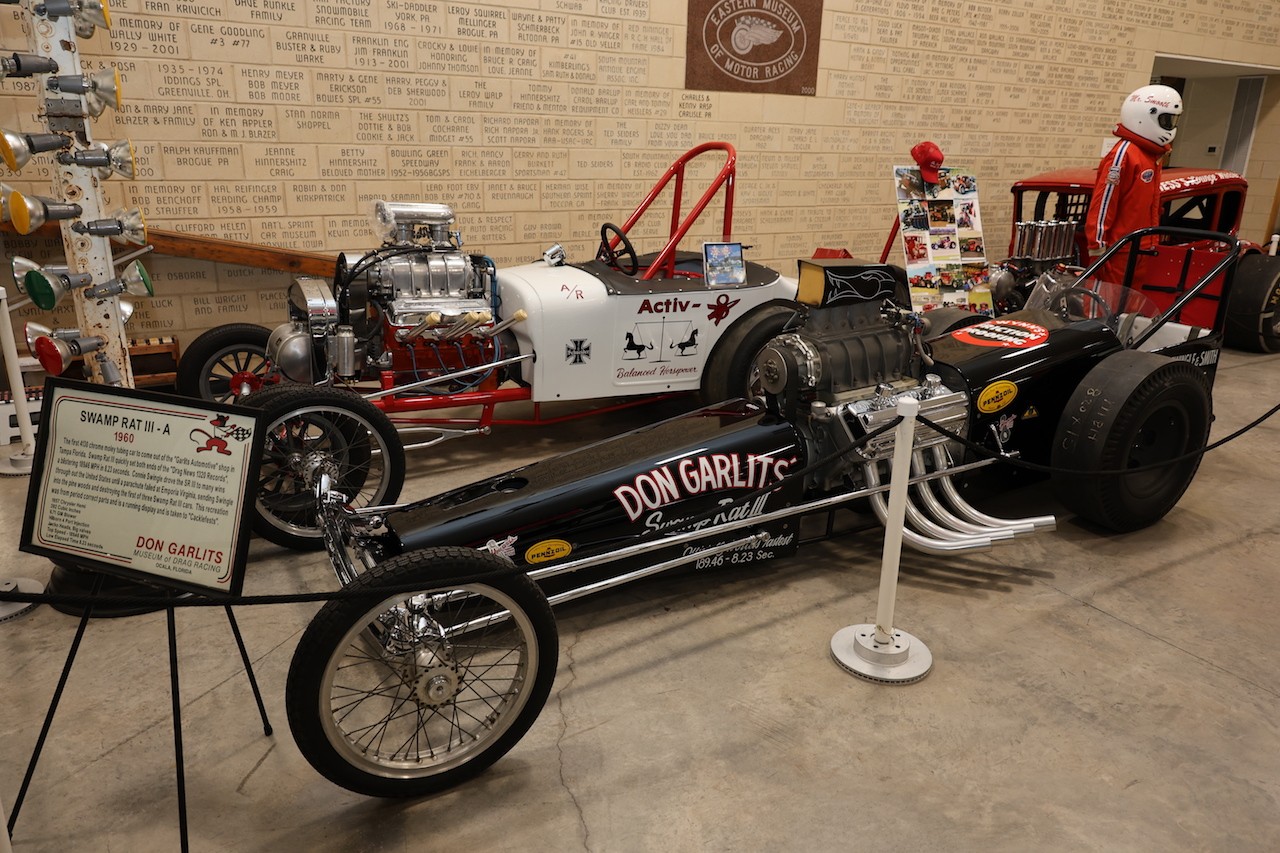
Fred, brought more than stories – he actually hauled a Gene Altizer’s legendary drag car (below) all the way from Florida for this event. That car, now proudly displayed in the EMMR’s drag racing area, is a piece of history that once tore down tracks and turned heads. Behind it sits a showcase of Gene’s race photos and innovations, including the one-off intake he designed but never patented – an idea so good, everyone copied it.
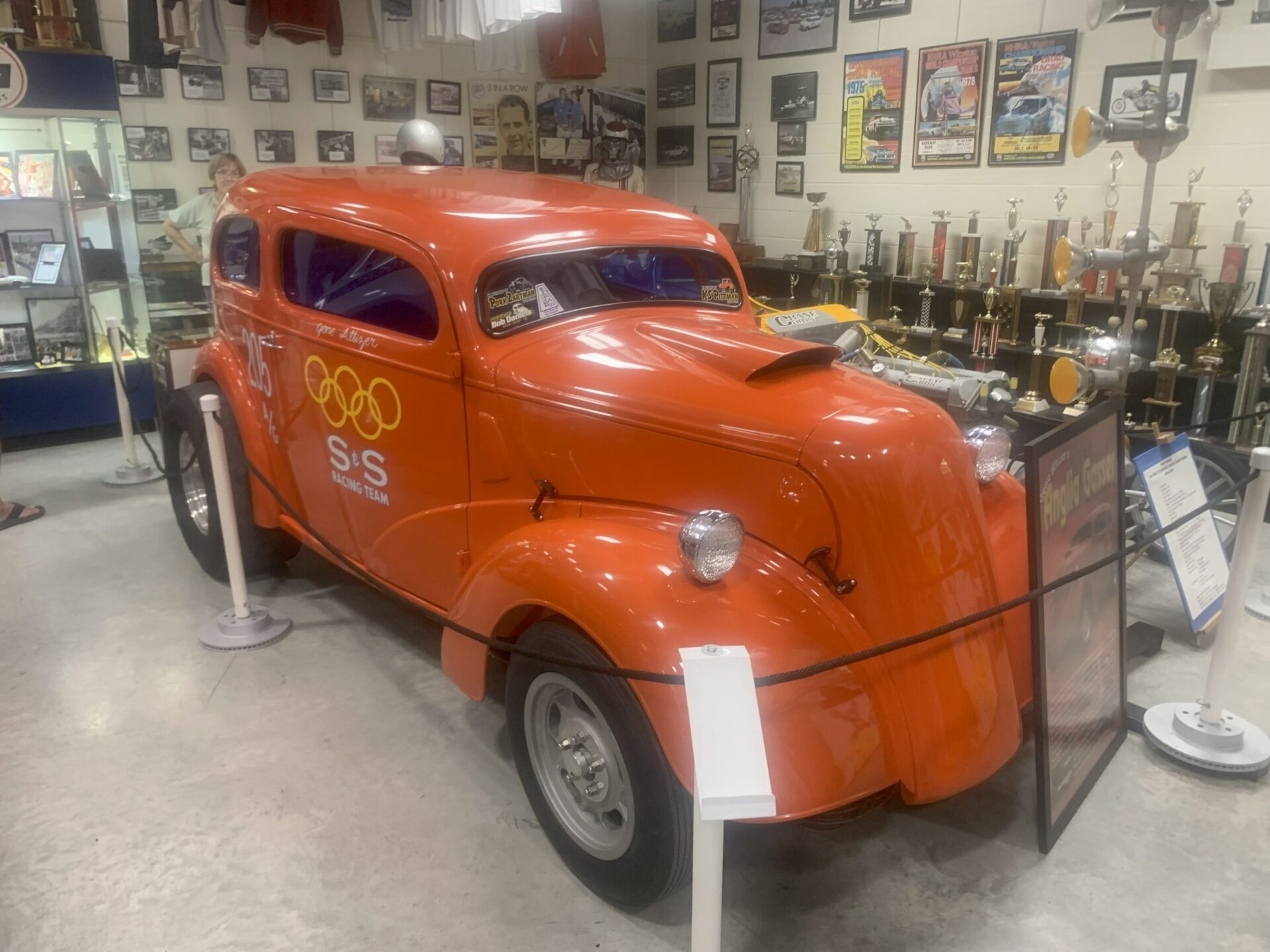
To our panel – Ken & Thelma, Fred, Greg, and Ken Bingham – thank you for bringing history to life. And to everyone who came out, stuck around, and shared in this celebration of speed, spirit, and storytelling: you’re part of the legacy now. And as we learned: the stories, the drivers, and especially the cars, are more than metal and rubber – it’s a tribute to ingenuity, community, and the relentless pursuit of speed.
About the EMMR
The Eastern Museum of Motor Racing is a premiere destination for motor racing enthusiasts, showcasing a vast collection of historic racing cars, artifacts and memorabilia.
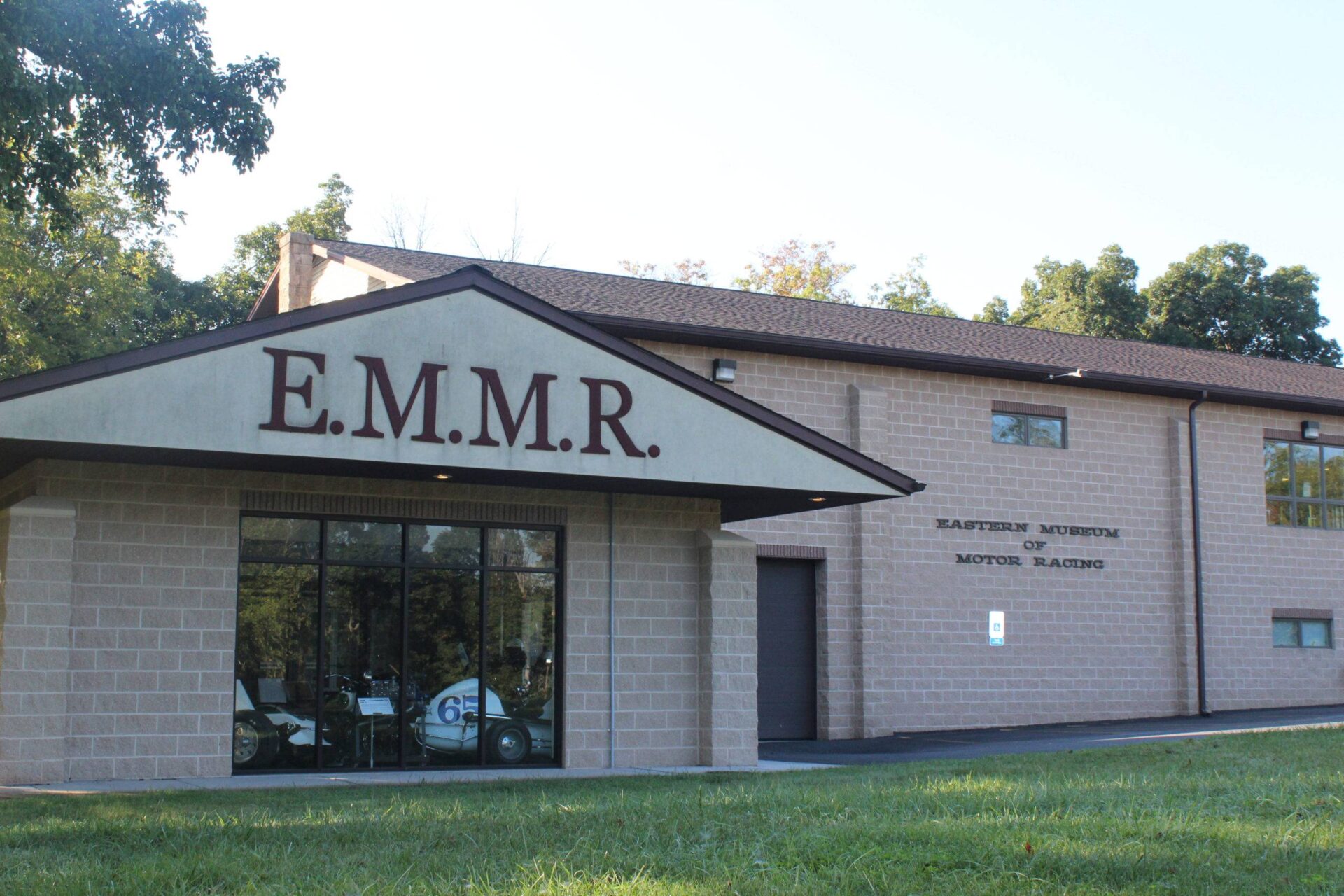
Each roundtable brings together voices from across the motorsports world, from grassroots heroes to seasoned veterans, as they share stories, insights, and behind-the-scenes tales that shaped their racing journeys. Whether you’re a die-hard fan of dirt tracks, drag strips, or open-wheel icons, the Racers Roundtable is your seat at the table for candid conversations and timeless memories from those who lived it.
To learn more about the EMMR, or to take part of the next in-person Racers Roundtable, you can plan your visit, or support the museum’s mission to preserve and celebrate the legacy of racing by heading to www.EMMR.org. Follow them on social media for the latest news, upcoming events, and exclusive content.
Tune in everywhere you stream, download or listen!
 Copyright Eastern Museum of Motor Racing. This episode was recorded in front of a live audience at the Eastern Museum of Motor Racing. This content in this episode has been remastered and published with the EMMRs consent; and has been reproduced as part of the Motoring Podcast Network and can be found everywhere you stream, download or listen to podcasts!