

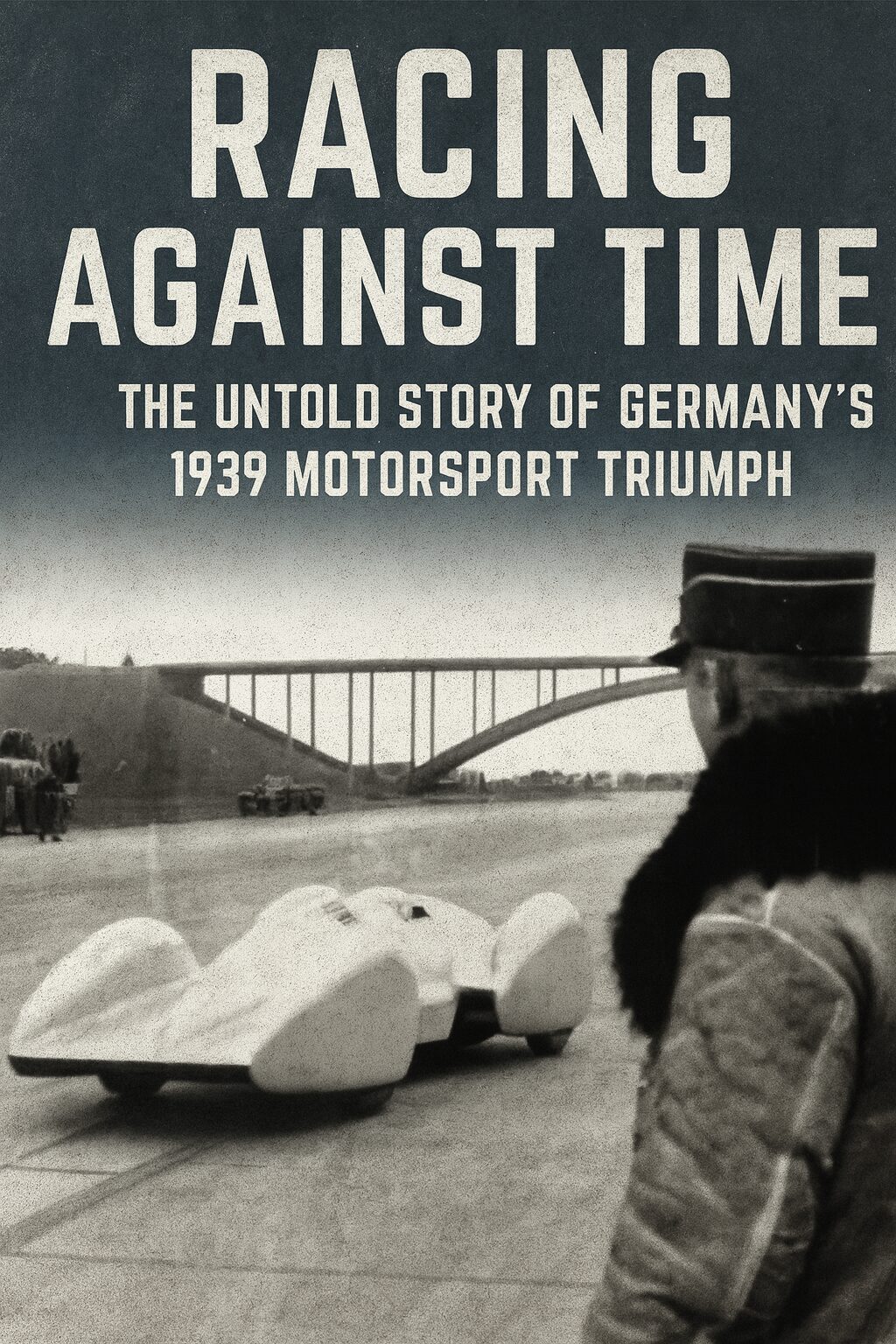
In the waning months before World War II, Germany staged one final act of automotive bravado: the 1939 Record Week. This was not merely a motorsports event – it was a meticulously orchestrated display of technological supremacy, national pride, and propaganda. Held on a purpose-built stretch of autobahn near Leipzig, the event showcased the pinnacle of German engineering, with Mercedes-Benz leading the charge in a bid to dominate land speed records.
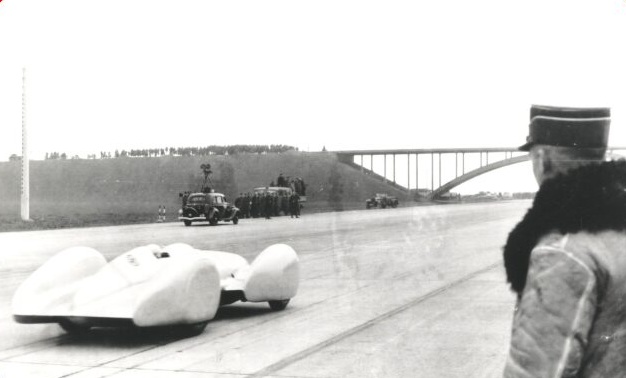
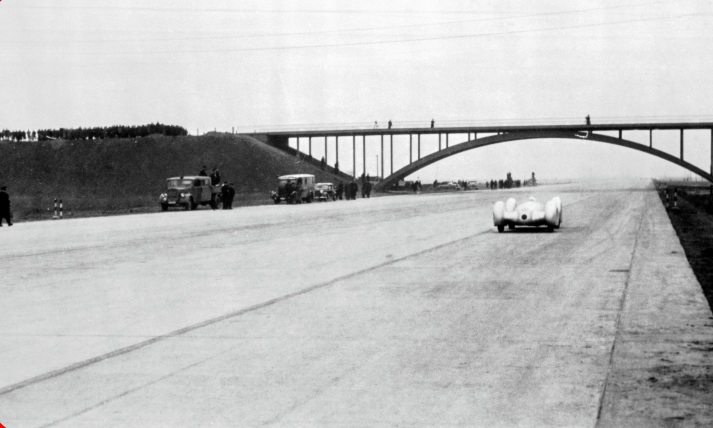
The 9.4 km stretch of autobahn selected for the 1939 Record Week was no ordinary road. Designed with precision, it featured:
- A wide, flat, arrow-straight surface
- Gentle curves at each end for acceleration and braking
- Overpasses built with single arches to eliminate central pillars – minimizing risk at high speeds
- A concrete-paved median to extend usable width
This infrastructure was a deliberate evolution from earlier record attempts on the Frankfurt-Darmstadt autobahn, which had proven perilous due to narrow lanes and obstructive bridge supports.
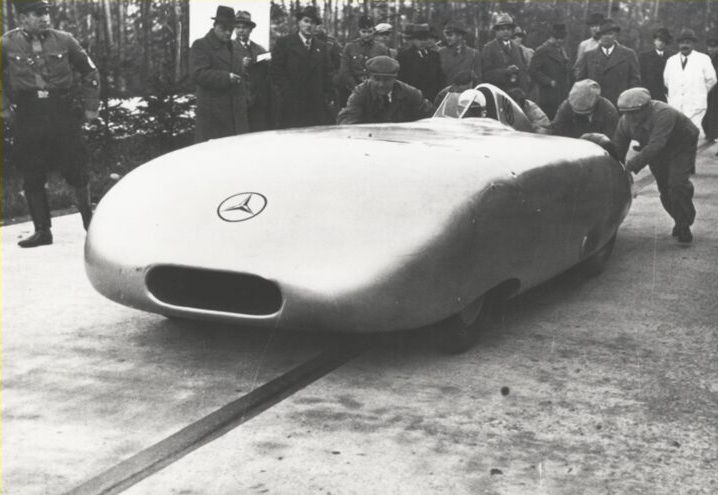
Aldo Zana, the Italian historian presenting the lecture (featured below), unearthed archival evidence suggesting that two distinct Mercedes record cars were present—one Class D and one Class B. Subtle differences in exhaust placement and bodywork confirmed this, despite Daimler-Benz’s official records omitting the second car. The Class B car, likely a W125/3, had been quietly retired due to engine unreliability.
Tune in everywhere you stream, download or listen!



With Auto Union absent – still reeling from the loss of Bernd Rosemeyer and internal technical setbacks – Mercedes-Benz stood alone. To avoid the optics of a one-horse race, organizers invited a diesel-powered experimental car and motorcycles to fill the roster. But the spotlight remained on Mercedes.
Key technical highlights:
- The W154 Grand Prix car, fitted with a 3.0L M154 engine, was adapted for a standing-start Class D record attempt.
- A fully streamlined variant of the 1938 car was also deployed, achieving a flying-start speed of 406 km/h—an unprecedented feat for a 3.0L engine.
Driver Rudolf Caracciola, already a record holder, piloted the W154 to new benchmarks:
- 1 km: 165.89 km/h
- 1 mile: 204.02 km/h
These figures represented significant improvements over previous records set by Italian driver Emilio Materassi in 1936.
Spotlight

Aldo Zana is an Italian motor historian and journalist. He started writing articles for motor magazines in the mid-sixties as a freelance editor of Autosprint and Rombo weeklies, developing an inclination towards history and historic cars and races. Since the late Eighties, he has become a regular contributor to Italian and foreign historic car magazines; his recent automotive books include a history of the Sports-Prototype FIA World Championship; the lives and races of Italian drivers; the motor racing scenario of the Fifties; and the story of the forgotten Milano car shows 1901-1947. Zana is a long-time member of SAH and Aisa (Italian Association of Motor Historians), former member of the History and Museum Commission of ASI (Italian National Historic Car and Bike Association) and Ugis, the Italian guild of science journalists.
Synopsis
This episode of The Logbook, our History of Motorsports series, delves into the history of Nazi Germany’s efforts to dominate the realm of motorsports through the ‘Record Week’ events held from 1936 to 1939. Presented by motor historian and journalist Aldo Zana, the script details the strategic integration of high-speed automobile achievements into Nazi propaganda, highlighting key vehicles, records, and drivers of the era. The focus is specifically on the last edition of ‘Record Week’ in 1939, illustrating Germany’s efforts to claim the world land speed record and analyzing the cars and technical challenges faced. Additionally, it reflects on Zana’s extensive career and his contributions to automotive history.
Follow along using the video version of the Slide Deck from this Presentation
Transcript
Crew Chief Brad: [00:00:00] Break Fix’s History of Motorsports series is brought to you in part by the International Motor Racing Research Center, as well as the Society of Automotive Historians, the Watkins Glen Area Chamber of Commerce, and the Argo Singer family.
Crew Chief Eric: The Nazi record walkin for record weeks 1939, the final act of an automobile speed folly. Alana Nazi Germany turned the automobile’s high speed into a propaganda tool for its technical and industrial supremacy with its domestic motor industry having fallen behind the US and France. The political establishment pushed for dominance in Grand Prix racing, launched an automobile for the masses and developed a wide network of motorways.
Connecting racing cars, high speed, and the motorways was the record walk. An annual event launched in 1936 to conquer the highest speeds on a motorway. The last edition in 1939 was a relatively low key event shadowed by the prior year’s sensational Mercedes-Benz speed record, and Bernard Rose Meyer’s death.
[00:01:00] Nevertheless, the propaganda machine aptly broadcast the speeds reached on an arrow straight. Level and wide. 10 kilometer motorway stretched north of leap Zg purposefully built for the record weeks and the conquest of the world. Land speed record by a German driver on a German car, on German soil. After a quick recap of the 1936 through 1938 editions, Aldo discusses cars shown in the 1939 Daimler, Benzs and Haag, as well as clear some mysteries left unsolved through the decades.
This presentation will also cover the records established by Italian and British drivers three months before World War II began. Alana is an Italian motor historian and journalist after a PhD in theoretical physics at the Milan University and at the cern, the European Physics Research Center in Geneva.
He switched to a managerial career in corporate communications while continuing with motor journalism. Zana started writing articles for motor magazines in the mid sixties as a freelance editor of Auto Sprint and Romble Weeklys developing an inclination towards [00:02:00] history and historic cars and races.
Since the late eighties, he has become a regular contributor to Italian and foreign historic car magazines. His recent automotive books include a History of the Sports Prototype, FIA World Championship. The lives and races of Italian drivers, the motor racing scenario of the fifties, and the story of the forgotten Milano car shows from 1901 to 1947.
Aldo is a longtime member of the SAH and the Italian Association of Motor Historians, former member of the History and the Museum Commission of the Italian National Historic Car and Bike Association, and the Italian Guild of Science Journalists. Our next presentation
Kip Zeiter: is a Zoom
Crew Chief Eric: presentation
Kip Zeiter: done by Aldo Zana.
Aldo Zana: Okay, good evening ladies and gentlemen. I’m here talking hopefully in, in a understandable English. I apologize for my heavy Italian accent, but I will talk about something relating to Germany, so it will be a bit difficult understand an Italian [00:03:00] speaking about something German. But anyway, I will try to do my best.
I will talk about the record week organized by the Nazi of a governmental state in 1939. In 1939, German racing car and the drivers dominated Grand Prix racing. So the dominant started with Mercedes Band in 1935 by Rose Meyer. The new auto Union star driver won the European Championship 1936. In 1936, the Nazi organization for motor racing launched a special event in order to concur.
The total superiority of the German racing car and promoted ban the highway. The new, so the first record or speed of the record was in 1936 on a flat, and they are they straight section on, on this, uh, ban or highway [00:04:00] between Frankfurt. Airport and there was 25 kilometers, and it was carefully, uh, arranged, organized for having all, all the record for the five kilometer and five miles on this, uh, stretch of ban.
The record was held for three years. You can see from this slide how difficult it was to drive very fast on this motorway because it was a two lane quite more than for the time, but with some grass median and bridges crossing the highway with a central pillar. So that was very dangerous. And in 38 they held a special event only on one day long in 1930.
By Mercedes Benz in order to correct the failure they had in the record, the record week on 1937 [00:05:00] in that, that morning, the cold morning, January 28th, Mercedes, the new W 25, or, I’m not sure because there are. Definite document about the name of the chais of the car. So I think it was 1925 R, but someone written that it was W 1 25, number 11.
So anyway, car driving this Mercedes Benz, which the astonishing speed of 432.69 KPM. That is 268 80 street MPH. In the same morning, the auto union was on the motorway or the highway with, with a special model of from line backhand, they call it. So the, the record car. That was modified in 1937. Rosa Mayer [00:06:00] had a accident and the car destroyed after having lost ground effect, and so it was a beautiful day for Mercedes.
Was a tragic day for the German, uh, motor of fault. After that, we came to the 39 record walk. That was the final end of the record walk. And the site chosen for the record walk was a new stretch of, uh, the auto band under trash between lighting and Berlin. It was a 9.4 kilometer long tri, that’s right. And that’s flat.
And they decided to pay over, in other words, to put concrete on the center of the medial center. So the, the usual truck white or 27 meter that is 88.6 feet. Overpasses, very laboratory build in a single arch [00:07:00] without a central pillar in order to avoid any danger for the the driver. The length of 9.4 kilometer was very strange, but was forced by the presence at one end of an an YVIP, uh, land, and they didn’t want to destroy or two.
Disturb the poor lazy whip. So there were two small gentle bands at the end of, uh, the flat and the strip section in order to have some more space for, uh, breaking and acceleration, but with 1.5 kilometers, slightly less than one mile for breaking was too short. But anyhow, they went there. So, uh, the new record walk was scheduled for October 28th, but the highway was not ready.
So they, they postponed it to February 29 and that was the, the, the record week [00:08:00] of 29. And the only player available was Mercedes Band. Because Alion having lost Rosa Mayor in 1938 and lacking the wisdom of Professor P who left the company at the end, 1937. Alto refused to participate in such, uh, gamble of, uh, no speeds that em to share l.
Only Mercedes were available to avoid the embarrassment of a single player, single category event, and was called at the very last moment with a diesel engine car, which in order to try for a new record, something absolutely unknown until now. Uh, diesel, can you imagine a diesel engine record car was not so fast, like a normal high speed car available on the street.
There was also a BMW Motorbike Fisher Station in order to [00:09:00] conquer the record of liter class. Record decided by Mercedes Band was a standing start, class D like Delta record. So was something completely different from the 38 a period record. And they used, uh, grand card W 1 5 4, number 11, with a special semi lined body.
Already decided for the three Polygram pri. So the engine was a three liter M1 54.1 14. The driver was, Carla was holding the record of the previous year. He was forced to do the same record for a limited speech. So, uh, not car started starting start. You can see the wide of the highway, but Carola chose to run on one [00:10:00] side because it thought that the center line was too difficult to drive because of too many dirt.
So the record was on the kilometer, 1 65 0.89, and on the mile 200 0 4 2 0 4. It was a kind of easy triumph, auer, very happy, welcoming, Chala coming back. The all record was already set in 1936 by, uh, an Italian driver with the German sound in name of full manic, and he did the record on the Luca motorway, uh, near Florence in Italy.
It was an, an easy improvement of one 16.6% on the kilometer, and 23.6% on the mile. And on, uh, February 14th, the final day of the record, car drove again the three liter [00:11:00] car W 1 54 to improve by, uh, 1% your record. Then on February nine, the second day of the record walk, Mercedes used their fully streamline car of 1938, but with three liter engine for the Class D Delta flying star record and car achieve.
On the return run a speed of 400 or six kilometer per hour. So it was an, an astonishing result because first time that a three liter car went beyond 400 kilometers per hour. So you can see the equivalent of kilometers for Israel in miles in MPH doesn’t mean anything. But for European, for German especially, 400 kilometer per hour mean something.
So the press was very keen on the [00:12:00] record. Uh, there are many, many articles about the new record claiming that 400 KPM uh, record. While the pr, uh, department of Mercedes Bank while record by Ann was nearly owned by the people, only the, the officials and the, the record with the 1.9 liter diesel engine 35 BHP was very low.
Nothing. The aerodynamic was very fine and the driver was a company engineer, was a producer of agricultural tractor. Use the record the 96.9 MPH to claim the quality of the engine. Then there is a final act after the record. Okay. On June 2nd, 1938, the final, there were two recommended. One was [00:13:00] Italian Count Ani, and another was an Englishman Goldie Gardner.
And they choose the So Ban to establish the record for small classes. So Goldie Gardner was a very famous British recommend in in his career. He had 1 52 National, international, and overall Records and noted that Go Gardner was limping due to round inflicted by the German force during the grading rate war, but he didn’t care to head again to Germany to satisfy his first for the record.
Noted that in less than two months, UK and Germany will be at war again one day or other. So Gordon Gardner was there and he went with a small engine and 1.1 liter engine for cylinder engine supercharge. Of course the [00:14:00] MG EX 1 35, he went to 3 29 KPH record on the mile. So. Was astonishing speed that was noted that he choose to try to run on the central band.
They other Recomme man was called Jovani. Joi would drove a small 370 CC G motorcycle with a special trainline body that was like an next shell, and he reached 1 72 KPM for the kilometer. He also did the 10 kilometers record and he, he told later that there was difficulty keeping him awake during the, about 20 minutes of driving back and forth on that highway across a flat and fifth refinery.[00:15:00]
So that was it for the 1939 record and for the south section of the highway. But there is a small mystery about the Mercedes car. First of all, in the South, that February 8th, there were two record cards, not only one, not only the Class D record card. But there were two, the photos of both car were mixed up in, in the Daimler Band Archive, and I found these photos, which clearly show two record cars, not only one.
I iLIGHT the exhaust on the car, and this is quite different from the Class DW 1 54 car. There are different small differences, very subtle, but you can note the difference. And on the left you have the old, the W 1 52 [00:16:00] slash three car, so the plus B Bravo cars. On the right you have the Class D Delta car.
So you, you, you notice there whole difference, but there are different, there were two cars, but the problem that Diamond Bank decided to cancel W 1 25 car because with a fellow, because it didn’t work, the engine was very out and refuse it. So in, in Germany, er was not a consider in. Now if you allow me, I will tell you the real story.
So it’s this car. This car, the Mercedes. The 80, 19 39 was the car designed for the absolute land speed record. And at that point, held by the by, by the British. The car was decided by Professor Porsche 13, 19 37 and, uh, the, the [00:17:00] shape of, uh, the body with the long tail in order to have the center of pressure behind the center of gravity, the two winglets at the side, on the, on the center of gravity.
And the engine was supposed to be a IRO engine, Daim Band 6 0 0 1 or 6 0 3, and the car by full 1939 was up completely, but it never run a single centimeter, a single feet. On its own power. You can see on this photo that, uh, the engine is on site, but it was only tried once on a test bed and it was, uh, a disaster.
So they did, they stopped any progress on, on that car. The original, uh, drawing by Porsche was very interesting. That was the first one in 1937. In order to obtain [00:18:00] downfalls, they used to have, uh, a wing, an inverted profile wing under the two real wheels. But the solution was too difficult, so they did opted for the two winglet.
The two winglet on the center of gravity was absolutely useless, but it took 30 years and the formula one 40 years to understand the real reason why the winglet very used it. And the wing above the, the rear wheel were effective. So more or less the, the so straight was billed for this car. Which was absolutely impossible to run on it because it was too short and not the, the car would’ve, the brakes in 1.5 kilometer to stop from 600 kilometer per hour was absolutely impossible.
But anyway, they did it. And they obtain money from the [00:19:00] state for this car and which is still exist while the frame is somewhere in the LER factory of Mercedes. The body displayed in the Mercedes Benz Museum is the last item of the speed section is on the wall after the accident. Looked above the cafeteria.
A very sad end for a car whose existence was raised by heating the heater himself and issued the order to win the land speed record for German. He wanted a German car, a German driver on German soil. This is the reason why the de access was built. It explained the IT 39 record walk was the dress rehearsal for the future long speed record comp.
That’s it, sir. I thank you and we’ll we’ll open to question if any.
Kip Zeiter: Take a few minutes, stretch your legs and we’ll see you in a few minutes. Thank you.[00:20:00]
IMRRC/SAH Promo: This episode is brought to you in part by the International Motor Racing Research Center. Its charter is to collect, share, and preserve the history of motor sports spanning continence, eras, and race series. The Center’s collection embodies the speed, drama and camaraderie of amateur and professional motor racing throughout the world.
The Center welcomes serious researchers and casual fans alike to share stories of race drivers race series, and race cars captured on their shelves and walls, and brought to life through a regular calendar of public lectures and special events. To learn more about the center, visit www.racing archives.org.
This episode is also brought to you by the Society of Automotive Historians. They encourage research into any aspect of [00:21:00] automotive history. The SAH actively supports the compilation and preservation of papers, organizational records, print ephemera, and images. To safeguard as well as to broaden and deepen the understanding of motorized wheeled land transportation through the modern age and into the future.
For more information about the SAH, visit www.auto history.org.
Crew Chief Eric: We hope you enjoyed another awesome episode of Break Fix Podcasts, brought to you by Grand Tour Motorsports. If you’d like to be a guest on the show or get involved, be sure to follow us on all social media platforms at Grand Touring Motorsports. And if you’d like to learn more about the content of this episode, be sure to check out the follow on article@gtmotorsports.org.
We remain a commercial free and no annual fees organization through our sponsors, but also through the generous support of our fans, [00:22:00] families, and friends through Patreon. For as little as $2 and 50 cents a month, you can get access to more behind the scenes action, additional pit stop, minisodes and other VIP goodies, as well as keeping our team of creators.
Fed on their strict diet of fig Newton’s, Gumby bears, and monster. So consider signing up for Patreon today at www.patreon.com/gt motorsports. And remember, without you, none of this would be possible.
Highlights
Skip ahead if you must… Here’s the highlights from this episode you might be most interested in and their corresponding time stamps.
- 00:00 Nazi Germany’s Speed Propaganda
- 01:17 Overview of Record Weeks (1936-1938)
- 03:04 The 1939 Record Week
- 04:50 Mercedes-Benz and Auto Union Rivalry
- 06:14 The Final Record Week
- 15:07 Mysteries and Technical Details
- 19:46 Conclusion and Q&A; Closing Remarks and Credits
Livestream
Learn More
 If you enjoyed this History of Motorsports Series episode, please go to Apple Podcasts and leave us a review. That would help us beat the algorithms and help spread the enthusiasm to others. Subscribe to Break/Fix using your favorite Podcast App:
Consider becoming a Patreon VIP and get behind the scenes content and schwag from the Motoring Podcast Network
Do you like what you've seen, heard and read? - Don't forget, GTM is fueled by volunteers and remains a no-annual-fee organization, but we still need help to pay to keep the lights on... For as little as $2.50/month you can help us keep the momentum going so we can continue to record, write, edit and broadcast your favorite content. Support GTM today! or make a One Time Donation.
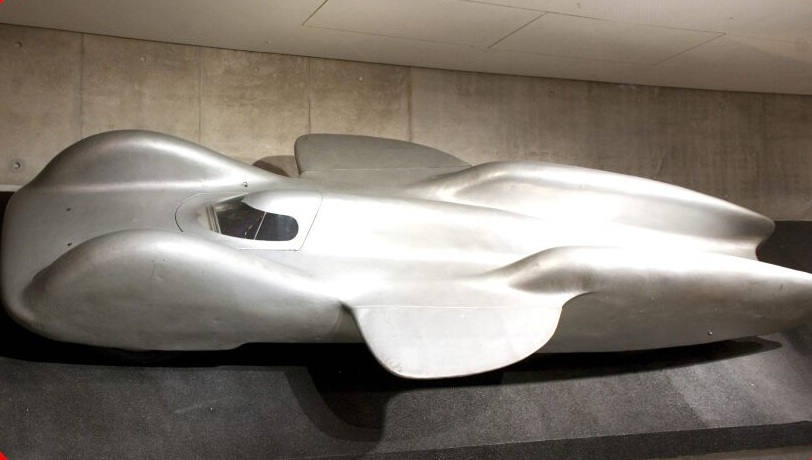
Perhaps the most ambitious project was the never-raced Mercedes-Benz land speed record car, designed by Ferdinand Porsche in 1937. Intended to break the absolute land speed record, it featured:
- A long-tail body for aerodynamic stability
- Twin winglets near the center of gravity
- A proposed Daimler-Benz V12 aero engine (DB 600 series)
Despite its advanced design, the car never ran under its own power. Engine testing was unsuccessful, and the project was shelved. The autobahn stretch built for its attempt proved too short to safely decelerate from projected speeds of 600 km/h.
In June 1939, just weeks before war erupted, British and Italian drivers returned to the autobahn for final record attempts:
- Goldie Gardner, a decorated British veteran, achieved 329 km/h in an MG EX135 with a 1.1L supercharged engine.
- A 1.9L diesel-powered car producing just 35 bhp – produced a modest top speed of 96.9 mph – however, the aerodynamic design was notable, and the record attempt served as a proof of concept for diesel viability in performance contexts.
- Count Giovanni Lurani added diversity to the technical showcase by reaching 172 km/h over 1 km on a streamlined 370cc Guzzi motorcycle, noting the surreal monotony of the flat, industrial landscape.
These records, set in the shadow of impending conflict, marked the end of an era where speed was both a technical pursuit and a political statement.
This episode is sponsored in part by: The International Motor Racing Research Center (IMRRC), The Society of Automotive Historians (SAH), The Watkins Glen Area Chamber of Commerce, and the Argetsinger Family – and was recorded in front of a live studio audience.
Other episodes you might enjoy
Michael R. Argetsinger Symposium on International Motor Racing History
 The International Motor Racing Research Center (IMRRC), partnering with the Society of Automotive Historians (SAH), presents the annual Michael R. Argetsinger Symposium on International Motor Racing History. The Symposium established itself as a unique and respected scholarly forum and has gained a growing audience of students and enthusiasts. It provides an opportunity for scholars, researchers and writers to present their work related to the history of automotive competition and the cultural impact of motor racing. Papers are presented by faculty members, graduate students and independent researchers.The history of international automotive competition falls within several realms, all of which are welcomed as topics for presentations, including, but not limited to: sports history, cultural studies, public history, political history, the history of technology, sports geography and gender studies, as well as archival studies.
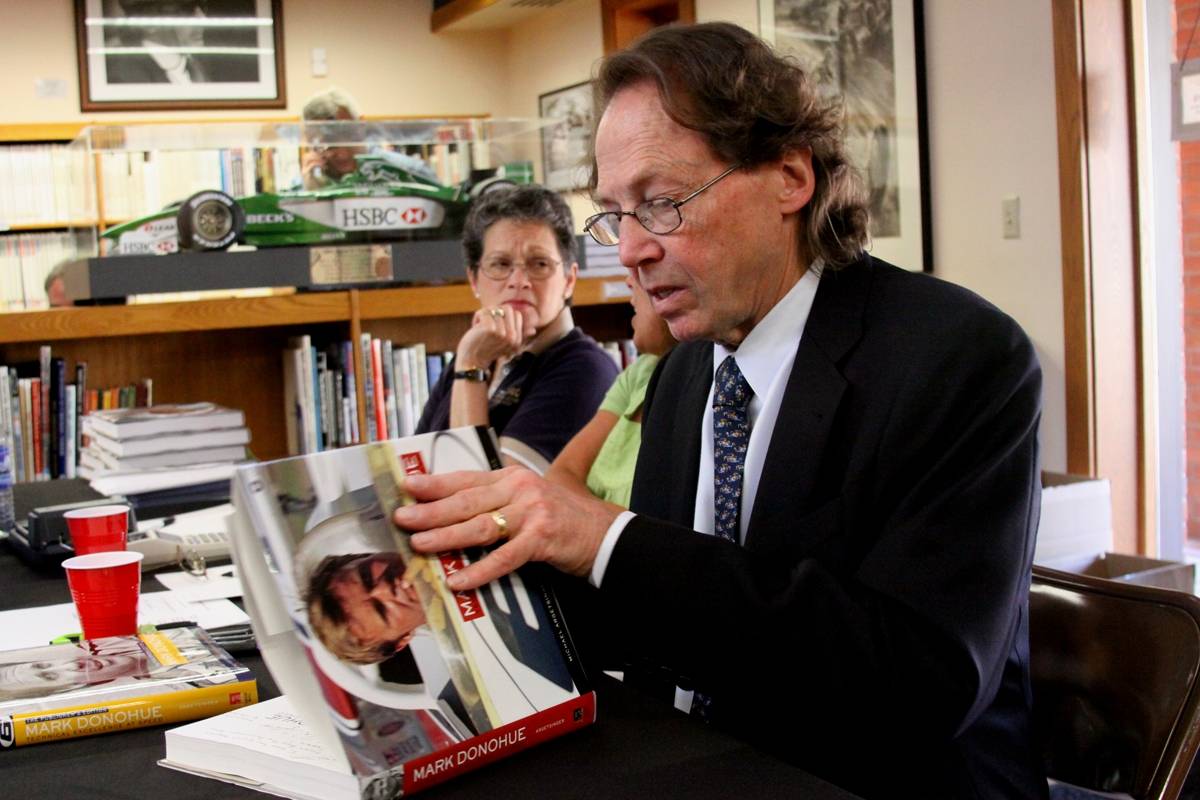 The symposium is named in honor of Michael R. Argetsinger (1944-2015), an award-winning motorsports author and longtime member of the Center's Governing Council. Michael's work on motorsports includes:
- Walt Hansgen: His Life and the History of Post-war American Road Racing (2006)
- Mark Donohue: Technical Excellence at Speed (2009)
- Formula One at Watkins Glen: 20 Years of the United States Grand Prix, 1961-1980 (2011)
- An American Racer: Bobby Marshman and the Indianapolis 500 (2019)
This content has been brought to you in-part by support through...