
spot_img
Home Blog Page 11

B/F: The Drive Thru #54

0

In the season finale of The Drive Thru, various topics are covered including a recap of the Bike Expo and the host’s new bicycle purchases. The episode also dives deep into car-related news, discussing the impact of big displays in BMWs, Mercedes and BMW’s current industry standings, and the future of V8 engines. The hosts humorously critique recent BMW and Mercedes models, highlighting their flaws. Motorsports news focuses on Formula One updates and the Rolex 24 Hours results. The episode concludes with amusing stories involving Florida Man, BMW, and Mercedes enthusiasts, and a reflection on five successful seasons of the podcast.

Tune in everywhere you stream, download or listen!

Listen on Apple
Listen on YouTube
Listen on Spotify

Showcase: Bimmers & Benz

BMW’s M3 CS Touring Is Shaping Up As The Ultimate Family Hauler

Production of the BMW M3 CS Touring may be limited to as few as 2,000 examples ... [READ MORE]

2025 BMW iX electric car facelift revealed with 700km claimed driving range

BMW's flagship electric SUV has been updated with driving ranges of up to 700km, accompanied by more power. ... [READ MORE]

BMW M5 Getting A Neue Klasse Facelift

Even though it launched in 2024, BMW is already working on an update to bring the M5 into the Neue Klasse era ... [READ MORE]

BMW Will Keep the V-8 Engine Because Americans Love It

Buyers appreciate the V-8 for its smoothness.  ... [READ MORE]

BMW’s New X5 To Offer Hydrogen Model Developed With Toyota

BMW has been testing hydrogen-powered X5s for years and apparently the next model will enter normal production ... [READ MORE]

Mercedes V-Class Electric Minivan Is Like A VW ID.Buzz Minus The Fun Factor

Passenger version of Mercedes new EV vans promises over 311 miles of electric range and Level 3 autonomy by 2030  ... [READ MORE]

Wait, what? Mercedes-AMG is cooking up a next-generation V8 engine

Merc’s performance division confirms a hybrid eight-pot is coming ... [READ MORE]

**All photos and articles are dynamically aggregated from the source; click on the image or link to be taken to the original article. GTM makes no claims to this material and is not responsible for any claims made by the original authors, publishers or their sponsoring organizations. All rights to original content remain with authors/publishers.


Shownotes & Supporting Stories

For a list of all the articles and events referenced on this episode check out the show notes below.

EVs & Concepts

Formula One

Lost & Found

Lower Saxony

Lowered Expectations

Motorsports

Rich People Thangs!

TRANSCRIPT

Executive Producer Tania: [00:00:00] The Drive Thru is our monthly news episode and is sponsored in part by organizations like CollectorCarGuide. net, Project Motoring, Garage Style Magazine, The Exotic Car Marketplace, and many others. If you are interested in becoming a sponsor of The Drive Thru, look no further than www. MotoringPodcast.

net. Click about and then advertising. Thank you again to everyone that supports the Motoring Podcast Network, Grand Touring Motorsports, our podcast, Brake Fix, and all the other services we provide.

Crew Chief Eric: This is it. This is the end of season five. Can you believe it? The end of the season as we know it.

Crew Chief Brad: That’s a good REM pull there, Tanya.

Crew Chief Eric: Might be the end of Tanya’s voice before we get through this. We’ll see how long it lasts. All right. Well, let’s rock and roll. Bring us in, Brad.

Crew Chief Brad: Cue the intro music. Welcome to drive through episode number 54. This is our monthly recap where we put together a menu of automotive, motorsport, and entertaining.[00:01:00]

Quote unquote car Jason news. Now, let’s pull up to window number one for some automotive news Are you drinking the dew? Are you not feeling well?

Executive Producer Tania: I have been fighting a plague fire all week. Oh, I’m sorry

Crew Chief Brad: to hear that.

Executive Producer Tania: I don’t know whose bad air I breathed in. It was the bike expo that we went to. Maybe

Crew Chief Eric: it could have been the bike expo, yeah.

That was a dangerous thing. Tanya invited me to go with her to a bicycle expo. I’d never been, I figured that’s like a swap meet, right, like anything else. I’ve been to car swap meets before and other stuff, you know, craft fairs and whatnot, but bicycles? Sounds cool. I was a bad boy.

Crew Chief Brad: What did you buy?

Crew Chief Eric: I bought a French bike.

Crew Chief Brad: You bought a Peugeot?

Crew Chief Eric: I bought a 72 Peugeot. One owner, the guy’s son was selling it dirt cheap, all original with patina and everything, gorgeous bike. It’s all white. So I finally own a Peugeot. And then I bought a Bianchi as well. Frame. And it’s an 81. And I’m going to actually turn that into a street bike to pedal around on.

And I bought a frame for one of my daughters. It’s a [00:02:00] clone to my wife’s old bike. She had a cyclocross by giant. And so the guy was selling the frame for 40 bucks with the stem and the headpiece and everything. I was like, for 40 bucks, I mean, just in case the other one cracks, I’ll take it. You know what I mean?

I walked away with. Two frames and a complete bike for not a ton of money. And I’m like, Oh man, I guess I’m getting back into biking now a little bit. So this will be fun.

Crew Chief Brad: It’s good for your health. So, so at the, tell me about this bike expo. Was it literally just a swap meet or was there a combination of like new manufacturers, kind of like a SEMA meet swap meet kind of thing?

Crew Chief Eric: There was more carbon fiber there than there was probably in a formula one paddock. It was impressive.

Crew Chief Brad: Was there anything in, from like the BMX world?

Crew Chief Eric: There was everything you could think of. Absolutely. Tandems.

Crew Chief Brad: Cause I used to be really big in the, the BMX bikes and stuff like that. They’ve

Crew Chief Eric: got some bikes now that would look normal for you based on your size. They got these tires that are like six inches wide, like a motorcycle.

And they’re like the size of a horse.

Crew Chief Brad: When I bought my truck, I almost bought one of those [00:03:00] instead, but it was just, it looked like a beachcomber. Yeah, they’re crazy. It was not like a mountain bike or anything like that. It was just a cruiser with these big fat tires for like 2, 500 bucks. And I was like, no, not going to do it.

Not going to do it.

Crew Chief Eric: Although we’re rambling on about this bike expo, it is car related.

Crew Chief Brad: Car Jason.

Crew Chief Eric: Yeah, the car manufacturer Peugeot made bicycles and sewing machines and a million other things. And then Bianchi. As in Alto Bianchi also related to Piaggio who makes the Vespas and the Apes and all that stuff.

So both of those bicycles come from car manufacturers. I think that’s pretty cool.

Crew Chief Brad: You realize none of our listeners could translate what you just said. We’re Americans.

Crew Chief Eric: I Americanized my pronunciation.

Crew Chief Brad: Yes, you’re going to be kicked out of the press conference if you don’t clean it up there, mister. Eric, I can’t talk about any of these articles right now because all I can do is see your hair and it looks like an early 2000s emo singer.

I swear. Are you a singer for the cult? Were you in the band The Cure? Do you have [00:04:00] black painted fingernails? What’s going on? What is up with your hair? You can’t see it, man. Because tonight’ll be the night that

Executive Producer Tania: I devour the night! I think it’s the sweep that’s happening.

Crew Chief Brad: It’s the sweep. Yes. It’s starting to sweep.

Sweep it back. Please. I cannot concentrate. I’m getting hot over here. I’m getting turned on. I want to go listen to Depeche Mode. Come on guys. Fix it for me. Please. All the stuff that’s

Crew Chief Eric: on my playlist. It’s all good. Yes. I know. I know. I know. Good Lord. Well, continuing with our banter here before we head into our normally scheduled ranting and raving.

As with tradition in the February episode, we got to talk about the Super Bowls. It’s plural Super Bowl as in football and the Rolex 24 hours. So let’s quickly talk about the extremely disappointing Super Bowl commercials this year.

Crew Chief Brad: Let’s not, I don’t care about those. Let’s talk about that GNX during the Kendrick Lamar concert.

Now that, that was a thing of beauty.

Crew Chief Eric: Was it real though? Or was it just a Monte Carlo with the grill painted [00:05:00] black because they came up. through the trap door. That couldn’t have been a real GNX. There’s only a handful of GNXs.

Crew Chief Brad: There’s videos of him doing interviews with like actors and stuff in a GNX like driving around.

I think that was his car. I think that was his car.

Executive Producer Tania: But I would imagine whatever was on stage in the Super Bowl. Obviously it was not his car, but probably a replica shell because people were coming up from underneath the stage and through the car.

Crew Chief Eric: Yeah, it was like a clown car. That was a rep. That was a Monte Carlo with a grill.

I guess I missed that part that they were actually coming up through the car. I

Crew Chief Brad: was focused on him.

Crew Chief Eric: So it had the wheels that had the grill and they painted it black. I mean, you can buy any of those G bodies and make it look like a G and X.

Crew Chief Brad: Yeah, you can buy them like you can buy, like, Vitos.

Crew Chief Eric: Now, one of our neighbors has a GNX, and he was telling me at one of the block parties, you know, these car guys get together, and we don’t want to talk to anybody else.

So he said they only made a couple hundred of those cars, and these days, it’s a six figure plus car if you were to sell it, like, at Mecum, [00:06:00] or something like that, because they’re pretty rare.

Crew Chief Brad: So you’re trying to tell me that the Showcase performer at the Super Bowl can’t afford a six figure GNX car,

Executive Producer Tania: according to the interwebs.

Crew Chief Brad: Yes, Tonya, break it down for us.

Executive Producer Tania: He does in fact own a 1987 GNX and as one of our members pointed out, it is also the album name for his most recent album and it’s featured in the artwork and obviously it was featured in the Super Bowl performance. The reason he has the GNX, as the story goes, was because when he was born in 1987, his father brought him home from the hospital in the Buick Regal.

The base model.

Crew Chief Eric: Okay, yep.

Executive Producer Tania: So there’s some sort of homage thing going there. Who would want the Buick Regal if you could have a GNX and you can afford it? Of course.

Crew Chief Brad: Yep, yep, yep.

Crew Chief Eric: And then there’s the one in the middle. There’s the Grand National because they’re not the same thing, right? There’s the Grand National package.

Then there was the GNX, which was even [00:07:00] more. It was more. It was even more. It was more. Just more.

Executive Producer Tania: Would he really stand on the hood of his

Crew Chief Eric: Six figure car. It’s a rare car. I mean it might not seem like much but it is

Crew Chief Brad: I’ve seen tick tockers Stand on the front of their Rolls Royces and their Lambos.

Executive Producer Tania: I guess so people are dumb AF

Crew Chief Brad: It’s something tells me he’s probably got a couple of spare hoods and fenders, you know in his garage somewhere Maybe you can afford it.

He is a multi, you know million dollar multi platinum Grammy winning Rapper. Uh huh. And he hates Drake. Oh my God. And apparently everybody at the Super Bowl hates Drake. Including Samuel L. Jackson. Including Drake. Drake hates Drake. You know, this just

Crew Chief Eric: in.

Executive Producer Tania: He also is a Pulitzer Prize winner. What?

Crew Chief Eric: Oh yeah?

Executive Producer Tania: That’s awesome.

Crew Chief Eric: There were three commercials that stuck out to me in the Super Bowl. They redid the Bruce Springsteen America Jeep, Jeep is America commercial. It was Henry Ford or Harrison, it was [00:08:00] Harrison Ford who’s just as old driving a new Wrangler four XE. And so it was a pretty long commercial. I thought it was really funny at the end.

It was a little tongue in cheek. He said, you know, I really love Jeeps, even though my last name is. Ford, and he kind of whispers it. So I was like, that’s cute. It was a little too long, but basically it was a redo of the Springsteen commercial. The WeatherTech Grandmas, I got tired of seeing that commercial.

That just got old. Let the word go. There was WeatherTech Grandmas? In that old lowrider Buick that they were in, like a 50s, whatever the heck it was, and they were like, oh, yeah, it was like the party car. And then the only other one was, and it was so cringey. There’s two versions of it. Right now, they’re playing the short version, the edited, you know, for radio version on TV.

And it’s the, the Haagen Dazs, not fast, not furious with Michelle Rodriguez and Vin Diesel. And in the long version, the Super Bowl version, Ludacris shows up. He’s like, what are y’all doing? And it’s like, it’s so stupid. But, I got excited [00:09:00] because that means it’s sort of like, Hey, there’s another movie coming, Fast and Furious 27 or whatever’s coming out next, which I’m going to watch, regardless of the fact that it’s not going to be good, but I’m going to watch it anyway.

That’s trash.

Executive Producer Tania: Wait. So that, that’s it, that’s the Those were the big

Crew Chief Eric: three.

Executive Producer Tania: Those

Crew Chief Eric: were, that was it. You’re forgetting one! What, the one where the lady drives backwards in the Kia down the off ramp? I mean, that was dumb. No,

Executive Producer Tania: but that had nothing to do with cars, actually. That was like a TurboTax commercial, I think.

Stupid! No! Did you not see the Ram truck one?

Crew Chief Brad: Which one was that one?

Executive Producer Tania: With Glenn Powell?

Crew Chief Brad: Oh, I see Goldilocks and the three trucks. Yeah,

Executive Producer Tania: he was like three different versions of himself and three different Ram trucks.

Crew Chief Eric: Yeah, yeah, I remember that one, yeah. I mean, it was Glenn Powell. Yet another Stellantis.

Marketing effort,

Crew Chief Brad: at least it’s not imported from Detroit. That’s true.

Crew Chief Eric: But again, compared to previous years where the car commercials are usually pretty epic, like Audi does something or Nissan with a 400 Z all the ones that we’ve talked about in the past this year, it just felt kind of like wah, wah,

Crew Chief Brad: all Audi’s money is going into trying [00:10:00] to get a formula one.

Yeah. Well,

Executive Producer Tania: there weren’t even any like Kia commercials. I thought. There were some pretty big Kia ones last year, too, like going through the snow and the mountain and all this crap. Yeah. Like the Telluride and stuff like that. I mean, honestly, in general, car commercial or not, all of the commercials were pretty lame.

And to hear that, like, people were paid 8 million for the spots, I’m like, these weren’t 8 million worthy commercials. I’m like, y’all got Taken.

Crew Chief Brad: They spent all their money on the spots. They couldn’t afford to have a good commercial.

Crew Chief Eric: They could have funded a race team. There were no beer commercials, which was surprising.

Was there any? I didn’t see the Anheuser Busch horses and all that stuff that they normally do. There was one. Was there? You’re right.

Crew Chief Brad: There was one about the horse. It was a pony. It was a colt.

Executive Producer Tania: It showed up on its own or something.

Crew Chief Brad: Yeah, he was left behind when they were doing a delivery, but a keg fell off the wagon.

Yeah. He took the keg all the way across. It was like a

Executive Producer Tania: weird commercial where it was like, we’re not doing this. This, this time. And then it was, [00:11:00] it’s like we did and it was with the pony or something.

Crew Chief Eric: Whatever. All right. Let’s talk about the other Superbowl, the Superbowl of racing, the Rolex 24 hours, kicking off the racing season.

Always in style. Who won?

Executive Producer Tania: Couldn’t tell you. Didn’t watch a minute of it. I have no idea. Well, there you go. The

Crew Chief Brad: most entertaining part of that race was the point by Eric knows what I’m talking about. I know

Executive Producer Tania: exactly what you’re talking about. I have seen the photos of that. Please explain the genesis of that moment.

Crew Chief Brad: So there’s two BMWs in a Corvette. One of the BMWs in front happens to be a back marker and he pulls some like Fernando Alonso move blocking the Corvette so that the other BMW can get around them. And the Corvette, I think it was Tommy Milner. Was driving the Corvette. He was so mad at this BMW guy.

First of all, he ran into the other BMW when he was trying to pass. And then when he got up next to the guy who was blocking him, he gave him a nice, friendly wave, a [00:12:00] single finger salute, the way we all do point buys when we’re on track together. I mean, I’ve given Eric that point by before too. So we all, we all get it.

He was very upset and he gave the, he gave the salute. Then went about his way and blip shift, turned it into a t shirt. You know, there’s memes about it. It was awesome. It’s probably the most epic thing that’s happened at Rolex this year.

Crew Chief Eric: Are there no repercussions in the world? Oh, you got to find like 10 grand or something.

I’m sure

Crew Chief Brad: who cares if he gets any proceeds from the sales of anything. I mean, it’s worth it.

Crew Chief Eric: It’s Pratt and Miller. I mean, they’re running the Corvette program. I mean, they always have been. So, I mean, is anybody going to stand in their way, Matt?

Crew Chief Brad: It was awesome.

Crew Chief Eric: It was awesome.

Crew Chief Brad: But if it was Max Verstappen, he’d have been fine.

Crew Chief Eric: So to Tanya’s point, who won? Who cares? Why don’t we talk about torque sensors? Cause that’s all they talked about for the first like six hours of the race is these freaking torque sensors. And I’m like, ah, another nanny. Half baked, half [00:13:00] implemented, and then you got Mercedes coming late to the game, going torque centered?

Wait a minute. What’s that?

Crew Chief Brad: Mercedes? Who’s Mercedes? Did we talk about them on this show?

Crew Chief Eric: Yeah, yeah, yeah. We’ll get more into that as we go along here. But let me give you the rundown, alright? So, GTP, which is LMP1, if you’re of our generation. So the LMP cars, it was Porsche, Acura, Porsche. 1, 2, 3, boom, boom, boom.

That’s how it finished. LMP2. Who cares? It’s a spec race. Setboarding, one, yay. And then GTD Pro. This is where the action is. So despite the single finger salute and all the Corvette stuff, and now GM is backing Pratt Miller and the privateers, so there’s more Corvettes on track than there’s ever been, which is absolutely epic.

And Mustang comes out and says, Oh, my beer Corvette. They took them to town. And it was awesome that finally, I guess they got the balance of power, right? Because the Mustang in previous season was terrible. It was slow. And it was just, but you could tell the Mustang had the legs on the vet. [00:14:00] And I was like, that’s a front engine V8 going back at it.

Like the old school days and Corvette sitting here. I got space age, mid engine, blah, blah, blah. It’s like, yeah. Okay. Have a nice day.

Crew Chief Brad: And what is it? Flat plane, crank, flat plane, crank. Yeah, yeah,

Crew Chief Eric: yeah. All that nonsense. So I am super proud for Ford. And then that wasn’t enough. They got done kicking button GTD pro.

And then they said, it’s what we’re coming back to Lamar. With an LMP GTP car, the highest level of racing and the biggest race of the year boards coming out with a prototype. We’re going back GT 40 days. They haven’t done stuff like that. You know what I mean? Racing in the biggest class that’s out there.

Crew Chief Brad: I feel like they’re like a sleeping giant. A hundred percent. And like Ferrari has been on top the last couple of years, right? Didn’t they win last year or they won the year before. I feel like Ford just like sits in the wings and they got this shit developed already and they’re just ready to go.

They’re sitting there, they’re sleeping, you know, they’re making money over here and doing this and Ferrari, they do their own thing. Then Ferrari puts the car out and Ferrari starts winning [00:15:00] and Ford’s like, nah, not on my watch. They go out, they kick Ferrari’s ass and then they shut it down again. Yep.

Another 50 years will go by Ferrari. He’ll come out with a car for Ari. He’ll be on top again. I’m waiting for Ford to put out an F1 car. They’re waiting for Ferrari to win an F1 championship. I guarantee you Ferrari wins an F1 championship board, not Cadillac. Ford is going to be the American team and they’re going to wipe the floor with them.

Crew Chief Eric: A hundred percent. I agree with that wholeheartedly. That’s awesome. Well, I’m super proud of Ford. I’m really excited to have another brand that’s coming to the big stage to compete against Porsche and Ferrari and Peugeot and BMW and all the big cars that are now showing up year after year at Le Mans.

I’m like, this is great. And I said it two years ago now, Toyota. It was theirs to lose and they keep campaigning the same car. It’s like, guys, evolve or die. And at this point you’re dead. Like I’d be surprised if Toyota doesn’t pack it up because of their move to formula [00:16:00] one, they can’t run both WEC and formula one at the same time.

So they’re going to have to pick that battle. But it’s again, if Toyota stepping down and Ford can move in, that’s going to be pretty awesome. So pretty excited about that. And then obviously there’s one more class in the series and that’s GTD AM, which is the amateurs. And I’m like, Do these guys even count?

I didn’t even really pay attention.

Crew Chief Brad: There’s usually some good racing in there too. Especially when like in prior years where GTD pro got kind of boring. Yeah. Oh, because in GTDM that’s where like the iron dames run and like some of the other pretty cool, like small teams. If you go to an IMSA race, these are the people that are usually pretty outgoing and pretty like friendly with fans and taking pictures and just doing the marketing thing.

So there’s some cool people driving around in GTD AM. Speaking of, did

Crew Chief Eric: you guys catch this year’s pace car? Nope. No, I didn’t watch him into the race. Oh, well you can go look it up. 2025 Rolex pace car. I thought it was an SUV because seeing it amongst the race [00:17:00] cars, you’re like, what the hell is that? And so they kept saying, Oh, the Acura pace car, the Acura pace car.

It was exactly that. It was the new Integra. And it is huge. You know, it’s big. But then when you put it with the race cars, it is massive. Like I really thought it was the new MDX. It’s so big. And it was this really goofy gold Rolex color or whatever. So it made it look even bigger and reflective and all this kind of like, Oh man, Acura, what are you doing?

I think it must’ve been

Executive Producer Tania: an optical illusion. No, go look. It’s no, because I’ve been on the road with one of them and it. Doesn’t look like an SUV. I mean, it looks like a Honda, but it doesn’t seem like an SUV. With the race cars. It was

Crew Chief Eric: just like, it’s a school

Crew Chief Brad: bus. Everything looks

Crew Chief Eric: bigger next to a race car, especially the BMW M8s.

Remember those? I look

Crew Chief Brad: like an SUV when I’m standing next to a race car.

Crew Chief Eric: Well, that said, that was short, sweet, and to the point. So we need to get back to our regularly scheduled ranting and raving. And [00:18:00] Brad, you made a comment last month, threw some shade my way. You called me out

Crew Chief Brad: for good reason. For good reason

Crew Chief Eric: said we never ever talk about BMW and Mercedes.

It’s sort of like Ford 50 years goes by before we talk about them again, 50 years before they’re relevant. So since you threw the gauntlet down and challenged us to find something. Interesting to talk about with respect to Mercedes and or BMW. Guess what? LFGO baby. That’s all we’re going to talk about.

We are going to talk about Mercedes BMW for the next hour. That’s it. So get ready, buckle up, buddy. I’m here for it. Let’s do it. This is the wiener schnitzel celebration. This is the super bratwurst special. This is everything lower Saxony you can think of. Bimmers and bends. Here we go. You ready?

Crew Chief Brad: Before we start, you’ll have to make sure you tell me the metrics of this episode and how many people tune out at this point.

Exactly. Exactly.

Crew Chief Eric: So we’re going to go through our segments. So here we go. VW [00:19:00] Porsche Audi news. Nope. Bye Felicia. So meanwhile, get this. You know, I am a member of the Long Roof Society. I love me a good station wagon. And I have always said, and I will admit, BMW station wagons are notorious for being extremely good looking.

They know how to build a wagon. And this latest one The M3 CS Touring has been spied at the Nürburgring, as one does in Germany. That’s where you go to show off your wares. It’s sort of like the jewelry district in Florence, right? It’s the ultimate family hauler that we won’t get. You wonder why we don’t talk about BMW, they do shit like this.

Crew Chief Brad: I was just about to say it’s because they don’t sell the cool shit here in the, in the States. Yeah, we get the crap.

Crew Chief Eric: 550 hrsprs and tons and tons of carbon fiber and big wheels and flares. And it wants to be an Audi RS6 Avant and it’s not. And it’s got that little round bell on it. It’s a BMW. It does all the right things.

It [00:20:00] checks all the right boxes. And they’re only going to make 2000 of them that we’re never going to get. So who cares?

Crew Chief Brad: Is it coming in a manual?

Crew Chief Eric: BMW flip flops on that quite a bit.

Crew Chief Brad: They do! They say, We’re

Crew Chief Eric: never making manuals again. And then they say, Oh, just

Crew Chief Brad: kidding.

Crew Chief Eric: And then they say, We’re going to be the last ones with a manual on the planet.

Everybody else is going to stop making. We’re still going to have them. And then they brought manuals back for a while. And then I think they’re gone again. They’re doing the hokey pokey on the manual thing. I would assume a car like this. If they want to beat Audi, the RS6 Avant is freaking amazing, but that’s flappy paddle gearbox and all that crazy stuff that it’s got going on.

This should, I’m not going to say is, it should come with a six speed manual because then everybody’s going to go in that direction. And to add to that, since we skipped over Porsche, Porsche has said the 911 will continue to come with a manual transmission. They’ve seen the light. Aha! Enthusiasts want manuals!

They don’t care if the car shifts in 2 milliseconds! It’s useless on the street. You want to have that connection to your [00:21:00] car, that visceral experience. You want to be part of the fun. If the computer does everything, it’s a freaking Johnny Cab. Like, who cares?

Crew Chief Brad: So, further down in the article, they do say that the next M3 Touring might make it to America.

But what they’re trying to do is see how well the M5 Touring does first. Why does that matter? So tell me about the M5 Touring. That’s what I want to know. And so the M3 Touring is out of my grasp. The M5 Touring is so far out of my grasp. I shouldn’t even be talking about it, but yet here we are.

Crew Chief Eric: Well, not only that.

And in the old days, like when the E36 E39 platform was out, what’s the difference between 39 about three inches outside of the outward sheet metal looking different. But realistically in terms of like leg room, it wasn’t any much of a bigger car. Yeah,

Crew Chief Brad: it was a bigger motor.

Crew Chief Eric: Yeah, bigger motor. That’s for sure.

A

Crew Chief Brad: lot bigger motor.

Crew Chief Eric: Comes with some whiz bang stuff. But yeah, to your point, this is going to be a hundred thousand dollar car

Crew Chief Brad: on a three series. Easily. It’s going to be 120. Or so I think [00:22:00] nowadays you can get a BMW CS like an M3 CS non touring. Obviously here in the States, they’re like upwards of a hundred, hundred and 510 optioned out because they’ve got 15 million different option packages for BMWs.

Crew Chief Eric: Do they include different size kidney grills or we’ll get into that too, but

Crew Chief Brad: different size wheels. They’ve got the cold weather package. Start package, the tickle your butthole package. I mean, they’ve got all that. That

Crew Chief Eric: only comes in the Teslas, but we’re not talking about them this month. You know,

Crew Chief Brad: sure.

Yeah. We’re not Tesla doesn’t exist in this episode.

Crew Chief Eric: So Mercedes, oh, Mercedes. I want to remind our audience. They literally invented the car. Mercedes Benz is the oldest car company

Crew Chief Brad: in the

Crew Chief Eric: world. And they build some of the most boring stuff you have ever put your eyes on. Right. It’s just like. So hot news this month, 2026, the E class is going to get a stretch version, be a limousine, because limousines are cool.

No one said [00:23:00] ever. Limousines stopped being cool in the 80s. Why do we still make limos?

Executive Producer Tania: Because there’s a lot of rich people. That’s still riding them.

Crew Chief Brad: Well, don’t they ride in my box though?

Executive Producer Tania: That’s just it. Like what’s the point?

Crew Chief Brad: Well, this isn’t Mercedes making it though. Oh, it’s awful. This is an aftermarket company though.

That’s making this still

Executive Producer Tania: Mercedes related.

Crew Chief Brad: It is.

Executive Producer Tania: Yeah, but it’s not Mercedes themself doing it. They’re not choosing it. Yeah. But look at the E class that it starts with. It’s a boring, ugly saloon.

Crew Chief Brad: It is. It’s a taxi cab. It’s a German taxi cab. It’s

Crew Chief Eric: awful. That’s supposed to get me excited

Executive Producer Tania: about Mercedes? No, but this isn’t sanctioned by Mercedes.

No, I’m talking about

Crew Chief Eric: the E Class. Just look at the E Class that it’s based on. That is a boring car.

Crew Chief Brad: It’s a Crown Vic.

Crew Chief Eric: Yeah, who buys that?

Crew Chief Brad: People that think they’re getting something special when they buy a Mercedes, but they can’t afford an S Class. That’s enough of that.

Crew Chief Eric: Yeah, exactly. That’s all we need to say about that.

Next hotness. The BMW iX has gotten a facelift. I’ve never seen one on the road to begin with, so I didn’t know what it looked like. I think I’ve seen a [00:24:00] couple of these. I see a lot of weird shit down here. This is why we don’t talk about BMWs. Did Black and Decker design this? Like, this should have like a handle on it and just be an appliance.

You know, what kills me about these designs? I noticed the other day, I was looking at an older car on the road. And you remember how, when we were younger, you used to salivate over, man, I’m going to get fenders on my car. I’m going to stretch my fenders. And you know, even the cars in the two thousands, like the Mark four Volkswagen, you had those lips that went over the wheels, those lip fenders.

Now all the cars look like they were cut with a putty knife. Somebody was doing joint compound on the wall. All the fenders are like squared off. It looks weird and it’s really obvious and it’s become really annoying that every car is sort of the same now. And there’s no definition to it. And that’s where that M3 Touring and the RS6 Six because they actually have hips and they have a shape to them, jackknife flares and all.

And you’re like, Oh, that looks really cool because it’s so different than all this other Tamagotchi stuff we’re looking at.

Crew Chief Brad: Those flattened off [00:25:00] fenders are the basic white girl of the car industry.

Crew Chief Eric: This is so vanilla latte at Starbucks. These

Crew Chief Brad: are all

Crew Chief Eric: pumpkin spice, pumpkin spice and hugs. And that grill.

Is that the biggest one yet? That might be bigger than the X7. The

Executive Producer Tania: problem I have

Crew Chief Eric: Oh, here we go.

Executive Producer Tania: is with the new BMWs, or what they’re doing now, what they’ve done over the last, I don’t know, however many years, there is something iconic about the way the front of a BMW looks. Notably, their headlights. The double round headlights.

are quintessentially BMW recognized easily if all you saw were the headlights you go BMW. Whatever the hell is on that thing, whose headlights are those? And they’ve slowly been morphing away in terms of, they’ve made them a little bit more geometric, but they have kept the double. So there’s still that, but there’s some newer models that are going to this, just this like light bar.

The kidney grill is the other well known BMW trait, right, when they’ve [00:26:00] ruined that, and now they’re ruining the headlights, and it’s like, well, what do you have anymore?

Crew Chief Brad: I think it’s a perfect metaphor, talking about the weird shape of the kidneys now, and the headlights, like BMW, it’s like they’re losing their identity.

BMW has lost its identity of what it used to be. Like even back to like the early two thousands, the Bengal period. Yeah, it was, they have lost their way.

Crew Chief Eric: They’ve lost their identity. I think the turning point for BMW was after the Bengal period when Chris Bengal left, and then we got all the like proliferation of BMW models where it was.

Like an ask for every seat, basically there was a design for everybody. You want the four, you want the four GT, you want the four long. Oh, you want the three, the five, the seven, the 10, like they had all these variants and then the sport back and then the hatchback and then the X one. And it’s like, ah, they

Crew Chief Brad: were at their best when they had the three series, like in the U S I know they had other series.

They had other series over in Europe, I get it, but in the U. S. when they had the 3 series, the 5 series, and the [00:27:00] 7 series, to a smaller degree when they came out with the first X5, I think that was their perfect period. That was, I wanted a BMW so bad then. And then they came out with the weird,

Crew Chief Eric: let’s talk about the six 50, right?

With that rear end. It looks like a badger.

Crew Chief Brad: Yeah, that originally came on the seven series, like the seven 45 before they brought the six series out. Now I know like before my time, they had the six series before they had the eight series. I used to want an eight 50 CSI. So bad scoured the internet trying to buy.

You know, I never had the money, of course, because I was poor, but I know that those cars came out. But like when I was growing up and I was becoming an enthusiast, three series, five series, seven series and the X, that was it. And that was all they needed. They were killing it. I feel then. And they lost their way.

And Mercedes did the exact same thing. And Audi too. All three of them like started doing the same shit. They went full GM. Like you never go full GM. And Ford lurking in the

Crew Chief Eric: background, waiting to [00:28:00] pounce.

Crew Chief Brad: Ford is waiting for Ferrari to win something so they can come and kick their ass again.

Crew Chief Eric: You know, to Tanya’s point about the designs are morphing, and you mentioned it, the new M5 is coming.

Look at these spy photos of the new M5. This is the ugliest BMW to date. This is even uglier than the 7 Series. With the triple headlights. Remember that one? If you slapped a Dacia badge on this, I’d believe you. Or a Skoda badge. Sure. It looks like something that is from Eurasia that we would never get here in the States.

I don’t know what that is. It’s a Honda, I think. All right. Let’s move on to our next alien, which would normally be Stellantis. And in the old days. Before it was Stellantis, it was Daimler Benz, Chrysler, right? Well, all that stuff was 20 years ago, so we got nothing to talk about there. So we’re going to move on to domestic news.

And the reason it’s domestic news is the headline reads,

Crew Chief Brad: BMW will keep the V8 engine. Because Americans love it. Yeah, love a good VA.

Crew Chief Eric: [00:29:00] Yeah.

Crew Chief Brad: I

Crew Chief Eric: mean, I have no problem with this. That’s perfectly fine. Give

Crew Chief Brad: me all the V8, all the power. Give me all the sounds. Just amazing.

Crew Chief Eric: Since we’re talking about BMW and Mercedes, which sounds better?

BMW V8 or AMG

Crew Chief Brad: V8? Oh, AMG. 1 million percent, hands down. Not even a contest.

Crew Chief Eric: Yes,

just the

Crew Chief Brad: AMG sounds like it’s literally trying to destroy the world. It’s trying to rip the pavement apart underneath it. That’s how AMG V8 sounds.

Crew Chief Eric: I will never forget that Rolex where you and I stayed up all night and you could just feel the bends coming around the bowl in your chest.

It was awesome. There awesome. Oh God, that was absolute ground pounder.

Crew Chief Brad: That’s the way the

Crew Chief Eric: C7R sounded too. I

Crew Chief Brad: mean, it was just. Earth shattering. It’s trying to rip the world apart. I love it.

Crew Chief Eric: Let’s put a turbo four in the next M3. I think that’s the way to go. Oh god. Tanya gave us some news here. It looks like BMW is not the only one that’s going to be focusing on keeping big motors around.

Executive Producer Tania: You know, apparently [00:30:00] Mercedes AMG Is cooking up a next gen V8 engine. And we don’t fully know what that means yet. Cause they say an electrified V8 is that a plug in hybrid? Is that self charging hybrid? What are we talking about here? But there’s going to be some sort of new V8 coming.

Crew Chief Brad: I’m guessing hybrid, like a performance hybrid.

Cause didn’t Porsche come out with like a performance hybrid or something.

Crew Chief Eric: But both Honda and Audi. Developed an electric turbo as well. So that’s an option too.

Crew Chief Brad: Yeah, I don’t think they’re just going to slap a tornado on it. That’s what they’re going to say.

Crew Chief Eric: Compressor with the K on the

Crew Chief Brad: compressor. Yes.

Crew Chief Eric: All right. Well, good on Mercedes. I think Mercedes is going to be one of those. Sort of like Chrysler where the V8 will never really go away for them because it is a staple for both of those brands.

Crew Chief Brad: Yeah, but so is the diesel. The Mercedes and diesel was like, you know, didn’t

Crew Chief Eric: Rudolph diesel work for Mercedes or something like that at one point?

I think that’s where he might’ve invented it or something. Now

Crew Chief Brad: you’re [00:31:00] above my pay grade. I

Crew Chief Eric: gotta go back in my history books to remember that because like Porsche old man, Ferdinand Porsche, not fairy, his son. He worked for Mercedes as well. Back in the days of like the silver arrows, he was part of that whole racing pedigree that they started 120 years ago in Germany.

I want to, I want to say it’s a small country. It’s, it’s sort of a incestuous world in the auto making space. So there’s a lot of crossover there.

Crew Chief Brad: Not that we’re talking about these brands, but kind of the same in Italy too, but it’s like the opposite, the inverse. Ferrari didn’t want to hire a tractor maker.

So Lamborghini made his own car and then Lamborghini didn’t want to hire somebody. So Pagani made his own car. And it’s like, it’s like the opposite of what you’re describing, where they all worked together in Germany for the greater good, you know, for those that we won’t talk about in, in Italy, it’s the opposite.

They’re like, no, no, no, no. You’re not good enough for us. You can’t come work with me. To

Crew Chief Eric: hell with you. I’ll prove

Crew Chief Brad: you wrong. I make my own car.

Crew Chief Eric: Yeah. And then at the end of the day, Fiat owns everything. So it’s like, whatever.

Crew Chief Brad: Yeah, exactly. Fiat owns them all.

Crew Chief Eric: Well, moving along to Japanese domestic and Asian car news.

What the [00:32:00] hell does that have to do with BMW and Mercedes? Two things. As a matter of fact, BYD is beating out Mercedes in Chinese sales because Mercedes was one of those brands that had always had a strong foothold in East Asia. And so now BYD is taking sales away from them and from BMW as well. So that’s pretty interesting because that’s a hot new brand.

Taken down the big dogs.

Crew Chief Brad: I’ve actually never heard of BYD. I mean, I’m not surprised. I’m a stupid American.

Crew Chief Eric: Where have you been? Oh, we’ve talked about them before. Yeah.

Crew Chief Brad: We probably have. I go to sleep during the episodes. I take micro naps.

Crew Chief Eric: With his eyes open. It’s like clockwork orange.

Crew Chief Brad: God, your hair. That should be the podcast cover.

It’s just you and your hair, some eye makeup. We need Jess to help you out with some eye makeup. If

Executive Producer Tania: I recall correctly, he was recently offered

Crew Chief Eric: a haircut, but declined. Did, I’m growing it out. It’s all good. I cut it in April.

Crew Chief Brad: You’re so dreamy.

Crew Chief Eric: Meanwhile, we thought the Supra was going to [00:33:00] be the only crossover.

Between BMW and Toyota. Well, guess what? You were

Crew Chief Brad: wrong. No, I don’t think we ever thought it was. I thought they were like establishing a relationship, like a long term relationship.

Crew Chief Eric: It’s like this weird on again, off again, dating thing that BMW and Toyota have, but they’re getting together again, because they’re really the only two auto manufacturers outside of like Ligier that is doing any sort of research into hydrogen for the commercial market.

So BMW a SUV, a new next generation X5 together that it’s going to be hydrogen powered or whatever it is. So I thought that was kind of interesting.

Crew Chief Brad: Didn’t Chevy do a lot with hydrogen power back in like the early 2000s? Weren’t they trying to do that too?

Crew Chief Eric: They tried propane. They had that weird flex fuel Tahoe thing that didn’t work out.

Crew Chief Brad: Remember that? They tried coal in the back of a pickup truck. Steam engine. And

Crew Chief Eric: then they bought into Nikola and that went under. No, that’s going under now, right? Isn’t that what the news is? Yes, apparently they’re

Executive Producer Tania: filing for [00:34:00] bankruptcy. However, I thought they already were filed for bankruptcy, so I’m slightly confused by this headline.

Crew Chief Eric: That’s like, whatever, moving on.

Executive Producer Tania: Interesting though, BMW and Toyota are not the only hydrogen developers because Hyundai has been quietly sort of a big player in the hydrogen fuel cell arena for some time now. So it’s interesting, I guess, that there’s no partnership with them. I will say

Crew Chief Eric: Hyundai is the dark horse that everybody should be paying attention to.

Because I think. They are going to slowly eclipse a lot of other brands that we’re used to being enthusiastic about. I’ve said it before, you’re looking for that GTI experience. Where do you go? You don’t go to Volkswagen anymore because the new mark, whatever the hell it is. Golf is the size of a Tiguan.

You go to Hyundai.

Executive Producer Tania: And remember that our gorgeous never to see the light of day. Envision 74. Oh my. God is actually hydrogen. Now that’s

Crew Chief Eric: right. You’re right. They did do that. I thought it was electric. It’s boogie. Okay. [00:35:00]

Crew Chief Brad: My only grape or my only criticism of what you’re saying about Hyundai kind of eclipsing, and especially in the enthusiast side of the house.

Any Hyundai I’ve ever driven, they put up great numbers on paper, but they do not feel good to drive. And I’ve driven a few. I’ve never had a good experience driving a Hyundai. I was

Executive Producer Tania: not impressed by my rental Sonata.

Crew Chief Eric: They have to have an N badge.

Executive Producer Tania: I recall it had this Allegedly weird eco mode. I think I was in Arizona and I swear to God that I got worse mileage in the eco mode than just leaving it in regular.

Crew Chief Brad: Was it 120 degrees?

Executive Producer Tania: No, it was actually quite chilly where I, where I was, but.

Crew Chief Brad: 95.

Crew Chief Eric: All right, we have another section and I wanted to see if we could fill that. Sometimes, sometimes. We talk about two wheeled vehicles. We talk about bikes and BMW to make a bikes since bikes were new. [00:36:00] And I couldn’t find anything.

There is nothing exciting going on on that side of the world. So that was pretty sad. One of their motorcycles

Crew Chief Brad: is like one of the fastest bikes out right now,

Crew Chief Eric: but it didn’t hit the news. It didn’t make the news because

Crew Chief Brad: it’s been around for a couple of years now. So you’re, I guess you’re right.

Crew Chief Eric: It’s got to be newsworthy, really newsworthy.

Now we need to step into EVs and concepts, which is Tanya’s territory. And I’m going to take this one, Tanya, because van life and Mercedes. So we all know how exciting the mattress is. You know, we’re all going to really miss. It’s that bread box and it’s not to be confused with the Ram van, right? That we have here, this printer, all of these really, really exciting Mercedes products.

No, no. You remember the R class? Do you remember that abomination that Mercedes made that was like a truck slash SUV slash station wagon? Thing that nobody understood.

Crew Chief Brad: You mean the minivan?

Crew Chief Eric: That thing was ugly. It was like a routine. It was horrible.

Crew Chief Brad: They put a V8 in it. You could get an AMG version.

Crew Chief Eric: That doesn’t make it better.

Crew Chief Brad: Yes, it does. That [00:37:00] wakes a hundred cent better. It’s like a Hellcat. It’s like a Hellcat minivan. A Hellcat town and country. It’s

Crew Chief Eric: more like a cat that you stepped on its tail.

Crew Chief Brad: That’s what it is.

Crew Chief Eric: Hey, this is

Crew Chief Brad: not a Hellcat. It’s a screamy cat.

Crew Chief Eric: All right. So Mercedes decided get rid of the mattress. You’re not the R class anymore.

We need a van. Introducing. The V Class! It’s an all electric minivan that’s just like the ID Buzz, but doesn’t have any fun at all. This has to be the most boring thing I’ve ever seen.

Crew Chief Brad: Oh, before you move on, I actually saw an ID Buzz. I know we’re not talking about Volkswagen. I saw an ID buzz on the road the other day in my area with the white roof.

Did you like it? It was bigger than I expected it to be. So everybody says it did not look like 60, 000 though. It looked like 35, 000. That’s what I keep saying, but Hey, whatever. But this one wrapped in, in wrapping paper looks pretty cool though.

Crew Chief Eric: That reminded me of the Plymouth truck.

Crew Chief Brad: It’s missing a big red bow.

Crew Chief Eric: This is the kind of crap that Mercedes [00:38:00] is making to your point. German taxi cabs. Because where are we going to see this? It’s going to have a lot of tons of livery on it and it’s going to be moving people around Frankfurt airport because what else would you use this for?

Crew Chief Brad: I swear if it was a different color, I’m seeing the vans from demolition man, murder, death, kill, murder, death, kill.

Crew Chief Eric: All right, Tanya. Well, we’ve got some other exciting EV and concept news. Exciting? It’s Tesla related. We can’t talk about Tesla in this episode, but it’s sort of Tesla adjacent. I love that. What are we talking about? Well, it says here that the new BMW i5 that we were talking about earlier, it has been spotted with a native NAX port.

This could be the first brand to adopt the Maxport, which is the Tesla charging thing.

Executive Producer Tania: That’s not true. I thought somebody else already did. That’s

Crew Chief Eric: right. Lucid was first to market on that one, which I think is interesting because Lucid, to Brad’s point about the Italians earlier, was literally people defecting from Tesla.

Saying we can do better and go build our own tractor over there. And we’ll call [00:39:00] it lucid more than even lucid uses it because I thought Ford had already switched. No, I think they were all selling little adapters to go from the 1752 to the Max Porter or whatever, but Tesla’s proprietary, not proprietary anymore, charging network, more brands are adopting so that you can use the charging network.

Now there’s no description in this. Well, okay, great. It’s got the port. Now, how do I, as a BMW owner sign up for the Tesla charging network? It doesn’t make any sense to me, or maybe they got a back convert. They’ll go to a charge point, America, do a Tesla. And then like, you stupid,

Crew Chief Brad: like trying to put diesel on your unleaded.

Crew Chief Eric: Meanwhile, there’s more dev and hydrogen options coming from BMW. This one’s even uglier than the last one. I think this is a render. What is

Crew Chief Brad: it? So they went from the giant, giant kidney grills.

Executive Producer Tania: To the smallest grills possible. Jelly beans.

Crew Chief Brad: They took these grills apparently from a one series and slapped them on the front of this big ol SUV.

That has to be photoshopped. It

Crew Chief Eric: looks fake.

Executive Producer Tania: And hey, you [00:40:00] know, I was complaining about double headlights and, you know, there are two X’s here. This looks like

Crew Chief Eric: Skeletor. Like I’m waiting for He Man to rush out and kill this thing any minute. It

Crew Chief Brad: looks like the masks from the movie The Purge. The light up masks that the killers wear, that’s, that’s what this is trying to be.

Executive Producer Tania: Now that you say it’s Skeletor’s car, I like it a little bit better. If it was the blue

Crew Chief Eric: of Skeletor, I think I would enjoy it much more. Like, and it’s got a match, you know what I mean? Isn’t Skeletor like purple and gray? Whatever.

Crew Chief Brad: Is the dress black and blue or is it white and gold?

Executive Producer Tania: That

That

Crew Chief Eric: about sums that up. All

Executive Producer Tania: right. That debate is still raging. I don’t

Crew Chief Eric: know why. Raging debate. Speaking of raging debates, Brad, I found you a do doy moment. Just read the headline for us, please.

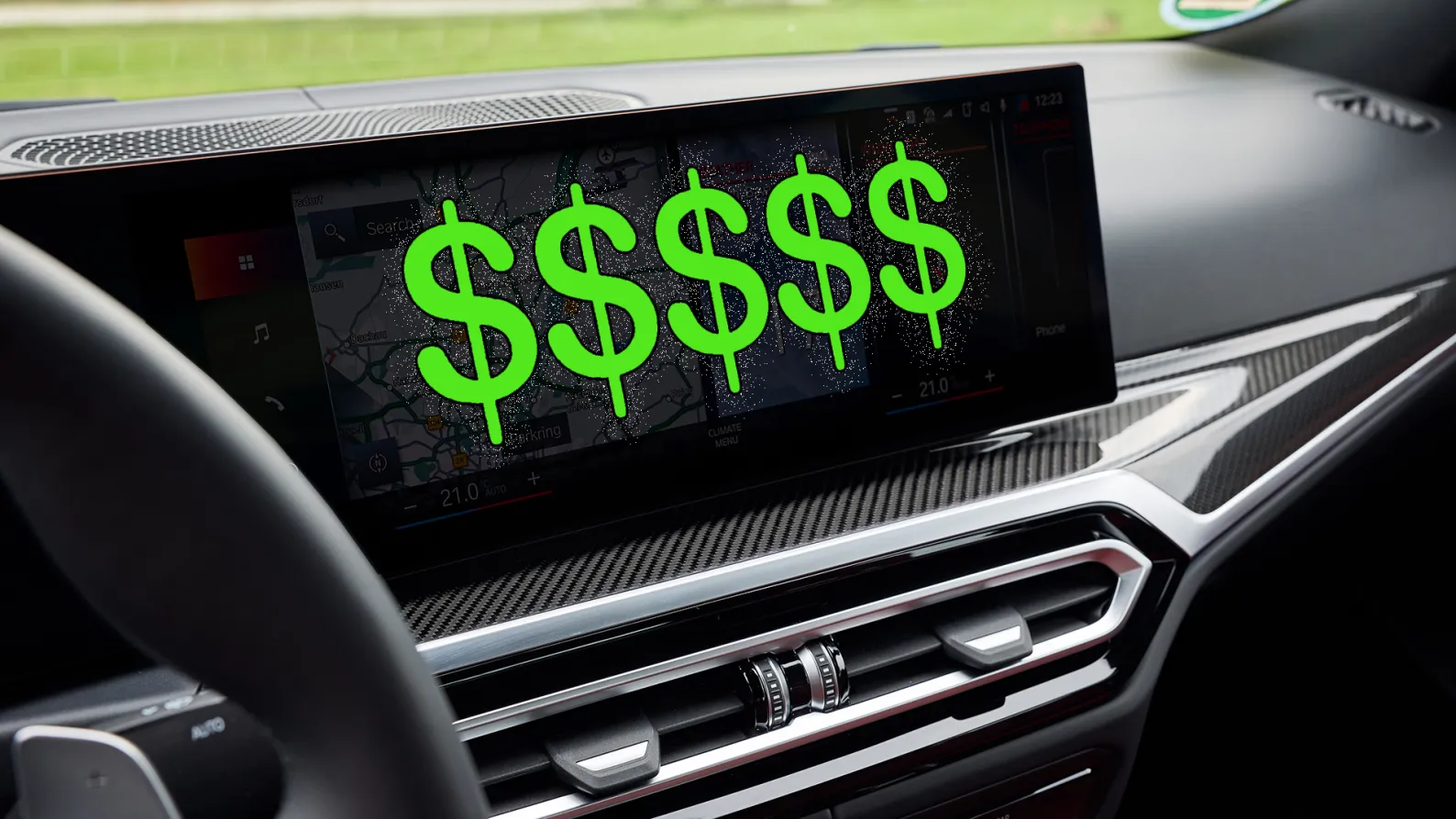
Executive Producer Tania: BMW says big displays, quote, disconnect drivers from the road. No shit, [00:41:00] who would have thought a TV screen in the middle of your dashboard would be anything but distracting.

Crew Chief Brad: Watching Netflix, chilling while you’re going down the road. Tesla’s you can play video games on your screen. Yeah, cup man.

Crew Chief Eric: Butt man. So when you look at the picture of this dashboard, please. Tell me that that steering wheel is not mounted upside down, you know, it looks like it’s upside down. I don’t understand any of this interior really ugly.

And then it’s got the Honda prelude. If you remember like Brian’s prelude, the second gen, it’s got the whole dash all the way across the windshield.

Crew Chief Brad: Well, the next article, like if you read hyperlink BMW’s panoramic eye drive brings pillar to pillar display to future models. But it eliminates knob,

Executive Producer Tania: which everyone says they want to bring back.

Yes.

Crew Chief Brad: Well, the knob is the person behind the wheel. That person’s a knob. They’re talking

Crew Chief Eric: physical knobs.

Crew Chief Brad: I know.

Crew Chief Eric: Did you notice there’s an actual picture of what we think is the Photoshop Skeletor car it’s further down in this article that [00:42:00] looks like a real picture of this thing,

Crew Chief Brad: but there are no X’s,

Crew Chief Eric: but yeah, there’s no X.

Crew Chief Brad: It looks like that Nissan Oh,

Crew Chief Eric: yeah, yeah, yeah, yeah.

Crew Chief Brad: You know what I’m talking about? The one from like Gran Turismo or something? The Nismo. It was like the Nismo something or other.

Crew Chief Eric: Yeah, it was supposed to be the ID something or other. It had an ID name because it was supposed to be like the new Dotson 510 or whatever, they never made it, but again, it looks like Skeletor.

Is this a half steering wheel? Something is wrong with this.

Executive Producer Tania: Okay, so if you click the pillar to pillar future models thing, it shows you the steering wheel sitting on a table. It’s a half steering wheel. It’s horrible. You are right. If you flipped it upside down, it looks like the bottom half of the steering wheel.

Crew Chief Eric: Awful. All right, Brad, it’s time we moved to your favorite section of the drive thru lost and found.

Crew Chief Brad: Now, before we get into, cause we’re having such an enlightening, uplifting.

Crew Chief Eric: You wanted this. That’s all I’m saying is you wanted this.

Crew Chief Brad: You know, and I am thoroughly enjoying it. I’m having a lot of fun.

[00:43:00] Regretting it

Crew Chief Eric: is what you mean.

Crew Chief Brad: It was amazing. Website cars and bids that was founded by Doug DeMuro, the writer and journalist from what was it? Jalopnik layoffs, hit cars and bids is the enthusiast car market comes back down to earth. And because DeMuro cashed out, right? They took a significant investment, 37 million, but that’s at the worst end of the market for car sales.

I mean, used cars were going through the roof and now everything’s kind of come back down to earth and people that have these cars. Are trying not to sell them. Fewer cars are selling for what they were selling were no reserve and they weren’t meeting their reserve. It’s, it’s just tons of issues. Not a good look for the industry.

Not a good look for cars and bids.

Crew Chief Eric: Well, it should have never gone off the rails the way it did. Covid is what made the used car market go nuts because people were bored and we all had

Crew Chief Brad: that stimulus money. We all had that stimulus money. That stimulus money. We couldn’t go

Crew Chief Eric: out and drink anymore. We were all spending our money on cards.

Yeah, we’re getting stimuli for all of 11 bucks. [00:44:00] That we got from that after taxes

Crew Chief Brad: stimulated stimulus. But this brings up a question, is something similar in the cards for sites like bring a trailer?

Crew Chief Eric: I think so. I really do. I’ve been saying that for a while.

Crew Chief Brad: Will we finally be able to see. And air cooled nine 11 sell for less than 50 gajillion dollars.

Crew Chief Eric: I mean, if that happens, I might buy one. I thought about it actually, like a 76 to 85, like in the period where nobody really wants them three liter or 3. 2. And you’re just sort of like, yeah, I’ll do that. That wouldn’t be too horrible.

Crew Chief Brad: I’d love a cabrio. 9

Crew Chief Eric: 11 without the top might be a lot of fun. I mean, it doesn’t really lose a lot of structural rigidity.

So that’d be kind of cool.

Crew Chief Brad: I don’t know if you saw California occasion. Yeah, I would go. I would go. Full just the black, dusty, dirty, broken headlight, nine 11 cabriolet. I would totally rock one, but

Crew Chief Eric: we can’t, we have to buy BMWs. We’re talking about BMWs and Mercedes doesn’t make any, well, if you bought a Mercedes convertible, it’d be that SL 55 from like 1988, the V 12 [00:45:00] monstrosity.

That is a money pit to maintain. Although they’re gorgeous.

Crew Chief Brad: No, you get the AMG SL 55, the V8 from like 2000,

Crew Chief Eric: the later ones. Yeah.

Crew Chief Brad: Were 2005. The one that they used to always put up against the Terminator Mustangs.

Crew Chief Eric: Tanya would buy the Mercedes that they used in Magnum PI that Rick drove.

Executive Producer Tania: Yeah, he had that silver one.

The same one that the lady in Once Upon a Time had, right? Yes, that’s right. Yes,

Crew Chief Eric: I would totally buy one of those. Yeah, late 70s SL, that screams Tanya right there. Like 460 SL, like one of those, that’d be good. So circle back to what you were talking about, about how the market has softened. I found this.

Particular 2016 M4 that we’re about to talk about. It was on bring a trailer and it was picked up by car scoops because they were like, Oh my God, M4 GTS competition, blah, blah, blah. It only has 500 miles on it. Okay, great. I don’t care. Here’s the point. Brand new MSRP sticker off the lot before destination taxes, tags, fees, and all the other nonsense that [00:46:00] goes with that 134, 000 for this BMW.

It sold on bring a trailer. This is how soft the market is right now. Okay. It’s still expensive, but it’s sold on bring a trailer 95 grand. So whoever sold this car dealership privateer, they lost money. 50 grand in the shorts easily. That’s a sign of the times right there, folks. That’s actually good. If the market softens enough, the depreciation is real.

It always has been. You can get into some of these cars. Now, granted, am I going to run out and spend a hundred grand on a BMW. No, I’m not going to do that,

Crew Chief Brad: but it’s got scaffolding.

Crew Chief Eric: It’s got a lot of things

Crew Chief Brad: Clarkson would call it scaffolding in the back.

Crew Chief Eric: And I like these and I coached one of these at VIR.

It was amazing. It is a very smart vehicle. It can do a lot of really cool things and it’s very fast. It’s not a hundred thousand dollars for me. There’s

Executive Producer Tania: a competition version, right? Yeah. I had one, I mean, granted, what I was driving, but when it passed me on Koda, it came out of the final turn at Koda onto the back [00:47:00] straight.

Holy crap. Oh yeah, afterburners. I already saw he was coming. I had my arm out the window before I even went to turn.

Crew Chief Eric: Which way was your finger pointing? Up.

Executive Producer Tania: I was just like, go around, like, I know you’re coming. Just go. I don’t care. He came up to me after when we were done the session. He was like, wow, thanks for like giving me the point so early.

I was like, how was I going to slow you up?

Crew Chief Eric: He was doing warp seven. He

Executive Producer Tania: closed on me so fast.

Crew Chief Eric: It was ridiculous. And that’s part of the problem with some of these new cars. You know, we could devolve this into a conversation about coaching, which is not worth it, but The new cars are so good. They are so fast, but there’s nothing quite like driving an old car fast.

You know what I mean? That’s just whatever it is. What’s interesting is there to me are even more shocking

Crew Chief Brad: is because this was a special edition car. They only made 700 worldwide

Crew Chief Eric: and he still lost money on it.

Crew Chief Brad: Like I would have expected him to sell it for double.

Crew Chief Eric: Exactly. That’s the shocking part. Since we’re talking [00:48:00] about markets and trends and buying and you know, where BMW and Mercedes are kicking butt.

Maybe it’s because this continent slash country, I joke and have joked that they’re 20 years behind the time. And so they’re just now crossing into the 2000s. And BMW and AMG are kicking ass in Australia right now. The sales are just ridiculous. That also could be a result of the fact that Holden is no more.

So you can’t buy a Commodore HSV plus GT, blah, blah, blah, blah, blah, blah. Chevy SS, whatever you want to call it. Or a Holden Monaro, which is a GTO, all that kind of stuff. So what do you have left? If you want a ground pounding V8 sports saloon sedan, then I guess you buy an AMG or you buy a BMW. Cause you can’t buy a Ford or a Holden anymore.

Crew Chief Brad: C 63. I know

Crew Chief Eric: I was trying to avoid that.

Crew Chief Brad: So basically if you want a ground pounding V8 move to America,

Crew Chief Eric: cause we like them V8s. Yeah.

Crew Chief Brad: We like them [00:49:00] V8s and BMW. You’re going to keep bringing them here.

Crew Chief Eric: Hoping you wouldn’t pick up on the fact that that was the fact

Crew Chief Brad: that spelled out the title of the article.

Nope. I would, I would have missed it. I wouldn’t have seen it.

Crew Chief Eric: Mr. Ben’s must be rolling over in his grave, like a drill at full tilt because four cylinder. AMG. I mean, seriously, I don’t want to say those words in the sentence and I just did. And now I need to go wash my mouth out. It’s like disgusting.

Crew Chief Brad: I mean, we’ve talked about it before in other cars.

I think it makes sense in the C Class.

Crew Chief Eric: No!

Crew Chief Brad: Because you can get a ton of power out of

Crew Chief Eric: No, it’s a bullshit cop out because everybody else went four cylinder turbo. So somehow Mercedes decided that they needed to do that too. That AMG should have had a 3. 2 liter naturally aspirated motor that they had in the earlier cars, which made close to 300 horsepower.

And probably gets the same gas mileage as this stupid four cylinder. So

Crew Chief Brad: here is where AMG and Mercedes screwed [00:50:00] themselves for a while. They did have the 3. 2 liter compressor. Yes. The early two thousands. They screwed themselves when they put the V8 in those little cars, because it was not sustainable.

And now they’ve got to go back to something that personally if that V8 never existed in those cars, this would be totally acceptable. But because that V8 existed in those cars, everybody’s like, no, go back to the V8, go back to the V8. Where’s the V8? Had it never been in those cars, you wouldn’t care about this.

You’d be like, okay, cool. How much power does it make? 400 some odd horsepower?

Crew Chief Eric: Great. Sounds awesome. Sign me up. I have said this before, after driving a CLK Black, It’s really hard to say you want a Mercedes that doesn’t come with a V8. I

Crew Chief Brad: understand.

Crew Chief Eric: And the 3. 2 is a compromise, but the 3. 2 was a good motor.

They put it in a lot of stuff and including, ugh, the Chrysler Crossfire and some other garbage because they owned Chrysler at that point. Realistically, that 3. 2 is a good engine and I feel that it’s a better solution than this [00:51:00] four cylinder turbo. Like it’s just ugh. And I’ve seen some of these A series.

Mercedes as well. And it’s like, you hear it before you see it. And you’re like, Oh my God, is that a GTI? You know, it’s got that, like all the four cylinders have now because they dump a little extra fuel and you get the little backfire. And if you like that, that’s fine. The boy racer in me graduated a long time ago.

And so there’s no replacement for displacement sometimes, especially in some of these cars where you’re paying this kind of money. Like that’s the other thing. AMG C 63, you’re going to pay 60, 70, 000. And you get a four cylinder like really, but it’s got a turbo

Crew Chief Brad: and it’s hybrid.

Crew Chief Eric: Keep all that crap. I don’t care.

Crew Chief Brad: So here’s my problem. It’s 190, 000

Crew Chief Eric: and it’s got a four cylinder.

Crew Chief Brad: Well, it’s a, it’s 190, 000 Australian. I don’t know what that translates to. I mean,

Crew Chief Eric: it’s

Crew Chief Brad: like rupees

Crew Chief Eric: and pesos.

I don’t think the conversion’s that

Crew Chief Brad: bad.

Crew Chief Eric: [00:52:00] Let me look, let’s consult the, you Googly 190, 000, wait, I put 1. 9 million. That’s too many. All right. 122, 000 us dollars. That’s still a lot of money. That

Crew Chief Brad: is a lot of money

Crew Chief Eric: for a four cylinder.

Crew Chief Brad: And this is what we had. We discussed on the last episode, or maybe it was two episodes ago when they were going to bring out the AMG GT with the four cylinder.

That is stupid. In a C class it makes sense to me, even in, maybe even in an E class to a lower degree. In an AMG GT, no, that’s dumb.

Crew Chief Eric: This next one, this is a fine Brad, dirt cheap. This wins the title, titles.

Executive Producer Tania: Who has used the word goob recently? Thank you. When was the last time someone A

Crew Chief Eric: goob for goober.

That’s what I wanted to talk about. Everything else here really doesn’t matter because to your point, what was the last time you saw the word goob in print, let alone used. So I chuckled when I saw this on my newsfeed and [00:53:00] I was like, all right, whatever. So what are we on about what it’s time to talk about?

Super rare V12 BMW Alpina. And the rest of the headline goes was stupid cheap because some goob swapped it to propane.

Crew Chief Brad: Anybody realize the license plate on the car too?

Crew Chief Eric: We can’t say that on air. Just thought I would point that out there. That’s one of Carlin’s like seven words. You can’t say on the air. That’s for sure. Gorgeous. E 30. 8, 7 series. This is like the transporter. I mean, this is the car we all salivate over with a V12, which is even better than the 740.

Obviously it’s a 750 base car, but

Crew Chief Brad: what a goob.

Crew Chief Eric: It looks like a goob.

Crew Chief Brad: Well, this is the guy that bought it, isn’t it? Isn’t this the guy that bought it to

Crew Chief Eric: fix it?

Executive Producer Tania: So that’s not

Crew Chief Eric: the goob.

Crew Chief Brad: No,

Crew Chief Eric: there’s a lot of goob in this.

Crew Chief Brad: There’s so much goob. But the license plate is my favorite part of the

Crew Chief Eric: thing. It’s just, the whole thing is delicious.

Crew Chief Brad: Sticking with Alpena, I did actually see a newer Mangle [00:54:00] era, Alpena 7 series on the road the other day. There’s a lot of like interesting shit in my like area.

Crew Chief Eric: Well, there’s nothing interesting in this news, so we’ll just keep going. So we got nothing for the uncool wall and we could probably nominate a lot of really ugly BMWs.

Same

Crew Chief Brad: with Mercedes. I think

Crew Chief Eric: we have already. Like, how about the iX? Oh my god. The new

Crew Chief Brad: M5. I mean, they all go on the uncool wall. Everything this

Crew Chief Eric: month could go on the uncool wall. So, I guess, Tanya, you’re not remiss. Because New Year’s resolution achieved. We’re not gonna talk about Tesla. You know, this could start a precedent.

Maybe we’re done with those jokers. I don’t know. We’ll see. We have to move on, though.

Crew Chief Brad: Lowered expectations.

Crew Chief Eric: This whole thing has lowered my expectations at this point, but Brad, this one, this one is for you because this is the kind of stuff that I associate with Mercedes and Mercedes ownership and just the whole ethos.

Executive Producer Tania: Hey, this is the car and I would appreciate a new knob if [00:55:00] that was my car, because I bet the original one would be falling apart.

Crew Chief Brad: This is a very James May article, I

Crew Chief Eric: gotta say. I saw this and I just started laughing because I was like, This is Mercedes stuff. So it’s an R107 SL, you know, W116 S class late seventies.

Like we’re talking about Magnum PI, you know, the mayor from once upon a time, all that kind of stuff, drove one of these, you know, on TV, gorgeous car. I’ve always liked these. My dad’s boss had one of these. It was a light blue, really nice car. All I have to do is read the headline Mercedes. Spent two years, two years, reproducing a vintage parking brake knob.

Seriously? Oops. You’ve been in business for this long, you just, you’re on top of the world, you’re like, nobody’s going to take it away from us. So we’ll spend two years building a part that was made in 1975. Because it probably took them

Executive Producer Tania: 18 months to find

Crew Chief Eric: a blueprint, a

Executive Producer Tania: schematic of it. It’s a freaking knob!

Maybe [00:56:00] they had to source the same materials from 1975.

Crew Chief Brad: First, they built a time machine. Then they got a knob from their normal production process and then brought it back.

Crew Chief Eric: This also sheds interesting light on this particular car. Why is this so funny, though, outside of the word knob followed by the license plate that we saw earlier that you’ll see in the show notes?

This is the parking brake! You pull this lever out of the dashboard with this knob that looks like it came from a kitchen cabinet out of my grandmother’s house. Like, what is this? Who thought this was a good idea?

Crew Chief Brad: It’s like a choke.

Crew Chief Eric: It’s got all the little ribs on the outside. Yes, there’s so much detail.

It’s even got chrome inlay. I can understand why it took two years to make something out of ABS plastic. Brad, this is the news. This is Mercedes news. We got the V class. We got this. We got four cylinders in Australia going for 125 grand. That’s what they’ve got going on. This is why we don’t talk about them.

But

Crew Chief Brad: look at how much fun we’re having. Making

Crew Chief Eric: fun

Crew Chief Brad: of them. Exactly. That’s what we do. Do we not make fun of [00:57:00] all the car manufacturers that we talk about on this show? That is the show. That’s what we do.

Crew Chief Eric: All right. Well, we got to talk about rich people thing. Sponsored by Garage Stop Magazine. Because after all, what doesn’t belong in your garage?

Well, this should belong in your garage. I do like. These, this one’s a little extra special because here’s Johnny’s 1988 Mercedes Benz 560 2 door up for grabs. What do we think? How much? Why don’t you guys guess? How much do you think it’s sold for? I always liked this game. Too much?

Crew Chief Brad: With the people who can appreciate this.

Are they still alive? I mean, Johnny Carson, who the hell cares about Johnny Carson these days?

Executive Producer Tania: We need two prices then. We need the Johnny Carson associated price uplift. And then if this was just. Johnny

Crew Chief Eric: Randoson’s car. The obscure reference to the gray one that was on the Raven spin off series of Highlander, because she drove one of these, a beautiful pewter color.

No one knows what you’re talking about. I know, but it was a gray 560 SEC, gorgeous car. But anyway, moving on. This

Executive Producer Tania: thing should be like 30 grand. Oh. Oh. [00:58:00] Oh. The non Carson version.

Crew Chief Brad: I can’t guess because I’ve clicked further through and saw the price. And Tanya, you. Hit it on the money.

Crew Chief Eric: 32, five.

Crew Chief Brad: Because the person that bought it doesn’t give a crap about Johnny

Crew Chief Eric: Carson.

This is the German equivalent to John Boyce LeBaron. It’s just like that Seinfeld episode.

Crew Chief Brad: Oh my God. Can you get ass man on the license plate?

Executive Producer Tania: That was the goob. Why would you want that when you could have

Crew Chief Brad: a GR Corolla,

Executive Producer Tania: a variety of other better two door Mercedes that came. Later than that or earlier than that if we go back to the SL

Crew Chief Eric: because it’s Johnny Carson’s so it smells like cheap cologne and cigars.

I mean, that’s what you want, right?

Crew Chief Brad: Probably hookers.

Crew Chief Eric: You hit the radio. It’s Ed McMahon. He’s like, Man, look at that car phone. That was 500 bucks extra for that.

Crew Chief Brad: But is Mercedes going to need to make extra knobs for it? It’s going to take them two years if you need one of them. True, true. It’s super [00:59:00] clean though.

Crew Chief Eric: I mean for 32 grand, that’s a super clean car.

Crew Chief Brad: It’s just not very good looking.

Crew Chief Eric: No, the white is not nice. I would repeat that. No, I would get an

Crew Chief Brad: early 2000 CL.

Crew Chief Eric: So moving on with rich people thangs. Did everybody forget that BMW bought up some British auto manufacturers? You know, BMW owns Mini, BMW owns Rolls Royce.

A bunch of other stuff.

Crew Chief Brad: I didn’t know they own Morgan.

Crew Chief Eric: Well, they run BMW power plants in the Morgans and there’s a new one coming. I don’t hate it. I don’t hate it either. It’s kind of cool actually. It’s probably still got a wooden frame too. So it’s their plus six models running a straight BMW six cylinder, making 335 horsepower in a turbocharged three liter.

Here’s the clincher. I know we weren’t going to talk about Tesla, but you know how the Cybertruck has like one wiper blade? This has no wiper blades.

Crew Chief Brad: Did they perfect the lasers?

Crew Chief Eric: No, it has three wipers. In the front! Three? Three! How does that work? Look at it! It has three wiper blades. Oh, you’re right. I didn’t pay attention.

Three little teeny wiper blades. Look at that. The

Crew Chief Brad: question is, with BMW involved, how many turn signals does it have? [01:00:00]

Crew Chief Eric: Zero! Look at it! There are none to be found.

Executive Producer Tania: You know what? They had to do it that way because the height of the

Crew Chief Eric: glass is too short. Yes, but you see, they figured it out, and then the opposite end of the spectrum, when the glass is too big

Crew Chief Brad: One white us who ruled them all.

Crew Chief Eric: We all know that this is gonna be a $200,000 card that we can’t afford, but Morgans are cool. They’re very boutique, they’re very niche. I love

Crew Chief Brad: the three wheeler, the Morgan three wheeler,

Crew Chief Eric: they’re super cool, but if you ever been around one or getting a chance to ride in one, they’re quirky and they. And it’s that old school, nostalgic British roadster stuff.

And it’s like, if that’s what you’re into, I’ll never forget that episode of Top Gear where they slid out the Arrow 8 from underneath of that 4 bus that they were transporting it in. I mean, that’s so cool. And that’s to talk to the scale of the Morgans too. They’re really small. So again, if you like that British roadster and you want that bit of classic driving and you want something very modern at the same time, it’s definitely something to look at going back to what [01:01:00] we talked about last month with like Hamilton talking about, you know, hyper cars are dumb.

You should buy a classic car. I honestly think this checks the box in both cases, you’re getting a new car that is fast and reliable. I’m going to put air quotes around that. But you get that classic feel, right? So you don’t have to put up with the classic car maintenance if you don’t want to.

Crew Chief Brad: I love the Morgan three wheeler, uh, just cause I think it’s like very unique and the motorcycle motor up front and everything’s really super cool.

These remind me too much of like Cruella de Vil or League of Extraordinary Gentlemen. It’s just, it’s not my style.

Crew Chief Eric: Little bit, yeah. It looks like the Nautilus in a way. Yeah, I feel you there. Well, that wraps that up. So what’s next? Oh! Have they come out of hibernation? Do we have anything going on down south?

Down in Florida? We got some alligators and beer?[01:02:00]

Executive Producer Tania: I have not only procured you some Florida men out of hibernation. I have also added a Mercedes man to the mix. So we have both a BMW man, a Mercedes man, and a delightful side order of Florida man. Let’s go.

Crew Chief Eric: I

Executive Producer Tania: always

Crew Chief Eric: look forward to this.

Executive Producer Tania: We will start with BMW man. This could have very easily been Cars and Coffee Mustang man.

Very expensive M850i BMW man who decided he was going to do some sort of launch mode stunt in his 523 horsepower luxury vehicle in a shopping parking lot in California. Suffice it to say he ends up nearly taking out what looked like to be a transformer, some greenery, and three other vehicles that were parked in the parking lot.

Obliterating one of them in the rear. That is epic. I’m not even sure how you do that much damage. Did he hit an Ultima? Is that what that is? Thought maybe it was a Lexus. It’s got turn signals at work. It can’t be a BMW. But it’s [01:03:00] really unrecognizable. Oh, that’s really bad. That one clearly took the brunt of it, and then he must have ricocheted off and then hit the other two poor unsuspecting vehicles.

Public service announcement. Don’t do stupid crap like this. Durability test in the parking lot. I would love to see what the front of the BMW looks like.

Crew Chief Brad: It’s giant grills. Ain’t two pedestrians.

Executive Producer Tania: Now, this next one, I have to warn people. There’s graphic content here. Uh oh. It’s disturbing and it’s uncalled for.

And I think this man needs to have his Mercedes tested. So this is British man whose dash cam, while he left his car at whatever the service shop, they took it into what is a very disgusting looking car wash that looks like it’s a urinal from a bad gas station. Needless to say, the dash cam, and there’s video of this, thankfully it’s blurred.

You should watch it because it’s horrific when it gets to the end. The mechanic, or whoever this technician person was, decided to urinate [01:04:00] on this man’s A35 Mercedes.

What possessed these people? Who does this? Apparently this guy

Crew Chief Eric: does.

Crew Chief Brad: You gotta go, you gotta go. I mean, come on.

Crew Chief Eric: Obviously he’s been pissing on these walls the whole time and he went, Oh

Executive Producer Tania: look, something new to be on. I mean, it looks like the walls have been pissed on. I know it’s green algae, but still.

Crew Chief Brad: Working his territory.

Executive Producer Tania: I think the car needs to have some testing done on it to make sure it’s clean. Ha ha ha

Crew Chief Eric: ha ha ha ha! That’s unreal!

Executive Producer Tania: Alright, then we’ll come back across the pond and we’re gonna go to Florida. Yeah! Cause the Florida men Have woken. Oh boy. And we got Florida man drive bizarre chop car for no good reason.

Crew Chief Eric: This looks like something Daniel would make.

Crew Chief Brad: This is, this is nothing new. This is what the Volkswagen people did with their diesel gig cars. This isn’t new. Is this a neon?

Executive Producer Tania: No, it’s a Chevy [01:05:00] Aveo.

Crew Chief Brad: This is bad.

Executive Producer Tania: The genesis of this was it’s involved in some sort of side collision and I guess you can kind of see that from the passenger side because it does look damaged there.

The handrail? Hey man, you can’t fall out of the, it’s probably there to keep you from falling out of the car. That’s probably makes it legal. I mean, look, he put that, he put that half cage in there too. The half cage that’s below his neck. What does that even serve the purpose? This is bad. Apparently, allegedly, the guy had some thought that, you know, he was going to turn this thing.

Don’t say a race car. It’d be lightweight. It’d be a game changer. Unfortunately, sadly, it tops out at 95 miles an hour. Regardless of what it weighs. That’s it. Whoopsies.

Crew Chief Brad: You need to tune. Wake those ponies up.

Crew Chief Eric: I think I’ve seen less bars in a handicapped shower. This thing is so bad.

Executive Producer Tania: To your

Crew Chief Brad: point, I think I’ve seen this parked on Daniel’s property.

Executive Producer Tania: All [01:06:00] right, don’t click the next link.

Crew Chief Brad: Oh boy.

Executive Producer Tania: Okay. Cause we’re gonna play a guessing game, but you can’t, you can’t flick the link before you guess.

Okay.

Executive Producer Tania: So we got a Florida man arrested after a 100 mile an hour chase through Kennedy Space Center. But we haven’t had a good 100 mile an hour chase in a while.

Now the real question is.

Crew Chief Eric: What was he driving?

Executive Producer Tania: I will give you a hit.

Crew Chief Eric: It wasn’t a BMW or

Executive Producer Tania: Mercedes. When we do the lost and found section, who’s the guy that Brad’s always looking for the new old car? Uh, Chuck LaDuck. Chuck LaDuck. That’s your hit. Car was this guy driving over a hundred miles an hour in Florida

Crew Chief Brad: chocolate duck sold jeeps and rams

Executive Producer Tania: No, but that’s not the car you’re usually looking for.

No Is he driving a dart click the link baby and tell me what that car

Crew Chief Eric: is That’s awesome, that’s awesome

Executive Producer Tania: That was your first mistake, boy. Second mistake was doing cocaine and getting in the car, but hey, whatever.

Crew Chief Brad: Yes, [01:07:00] obviously. Where are his shoes?

Executive Producer Tania: Cocaine, do we need to say anymore? Not at all.

Crew Chief Brad: I love this from the sheriff’s office.

If you try to run from us in Brevard County, we promise you’ll only go to jail tired.

Executive Producer Tania: All right. I saved the best for last. Here we go. There’s a video. Oh no. Because we haven’t had one of these in a while either. But caught on camera, Florida man riding a lawnmower, crashes into mailboxes. And he’s good.

He’s good.

Crew Chief Brad: There’s a lot, there’s a lot of mowing lawn in Florida. I gotta say.

How did he flip over the front of it?

Ice over tea kettle! I watch that all day! Oh my god,

Crew Chief Eric: that’s so good! [01:08:00] I love how the sea comes up and just whacks him. Like, make sure he goes all the way over. And then he’s stumbling down through that gullet. This is so awesome! You know, it’s an awesome day. I know we all were like, Ugh, everybody’s got ring cameras.

But this is great. This is the reason why you should have a ring camera on your house. It’s to capture

Executive Producer Tania: stuff like this. He flipped over the lawnmower, stumbled through the drain ditch, and then got back on the lawnmower like nothing happened. Did you see what he hit? The mailbox was encased in stone. And that’s why people do it.

That’s so good.

Crew Chief Brad: Whew. Oh, I needed that. Florida man’s

Executive Producer Tania: back, baby.

Crew Chief Brad: With a vengeance.

Crew Chief Eric: Stop, bless. Woohoohoo! Only in Florida. All right, well, it’s time we go behind the pit wall, talk about motorsports news. And all there is to talk about is Formula One, because BMW, ah. We [01:09:00] talked about BMW and Rolex. We did. Well, we’ll kind of close that loop to say that BMW did qualify on the pole at Rolex with Vanthor behind the wheel.

But then he, the same driver that put BMW on the pole, threw it all away in the last hour of the race. By being too aggressive. So goodbye, BMW that gave Porsche the win and everything else. So all there is left to really talk about is torque sensors and formula one. Formula

one season hasn’t started yet. Russell is the senior driver at Mercedes now. Yep. Yeah. Is there anything else

Executive Producer Tania: to say? He thinks it’s going to launch a new era for himself or a new chapter or whatever, but he has no team support because he’s got forget who now is the dude, but he’s a complete rookie [01:10:00] green, green, green and F1.

Oh, that’s Antonelli.

Crew Chief Brad: Antonelli.

Executive Producer Tania: So that’s great, but it’s also helpful when you have a teammate that at least is marginally competitive alongside you that can do things like. Help block or fend off the approach of everyone else. But I, I see him being mostly alone and he’s probably going to struggle.

Antonelli

Crew Chief Eric: is what, how old is he now? Well, I don’t know what he’s 19. I think he’s like the youngest formula one driver on the grid. I don’t think he’s the youngest to start a formula one race. But he’s the youngest in Formula One and right now. And it’s just like, apparently Mercedes hand picked him when he was 11 back when he was go karting and stuff.

And so I don’t know, they, I guess they’ve invested a lot of money in him and time and resources over the last eight years. So they’re hoping he’s going to be the next prodigy. Didn’t he have like a big, massive, unnecessary wreck one of his first races? I believe so. Yeah. I don’t see good things for Mercedes this year.

Yeah. But there is rumor that your [01:11:00] boy Botas.

Executive Producer Tania: He’s a reserve driver again for them. Yeah, which honestly would mean if Antonelli doesn’t deliver maybe there’s a chance they kick him out and put Botas back in the seat. But then Botas would be the senior driver. Would he though? Or does he got to take team orders from Russell?

I guess it would

Crew Chief Eric: depend on uh, what the performance looks like. Botas is faster than Russell. We already know that, right? So what is he going to do? Just sandbag the whole time?

Crew Chief Brad: And are we just saying senior driver as like, as a product of their age, or do we mean like their seniority, the lead driver, like the driver one and driver two

Executive Producer Tania: by senior, we’d mean the lead for the team, which generally should be dictated by experience

Crew Chief Brad: or it should be dictated by wins, whoever’s performing the best,

Executive Producer Tania: which would then be Botas.

Crew Chief Eric: I was going to say, because Russell has none and Antonelli has none.

Executive Producer Tania: No, Russell’s won, I don’t know, three,

Crew Chief Brad: four. There’s more that goes into it, obviously, than wins and stuff like that and experience and everything, but it’s who they’re hanging their future on.

Executive Producer Tania: Which probably [01:12:00] wouldn’t be

Crew Chief Brad: Botas. Because Botas is towards the end of his career.

But Russell is still very much in the middle of his career. He’s like reaching his peak or his prime. Antonelli is starting, you know, what they’re hoping is a really good career. But. To talk about something Mercedes adjacent, who is the quote unquote senior driver now at Ferrari? Is it Hamilton or is Leclerc still driver one?

Executive Producer Tania: It’s

Crew Chief Eric: gotta be Hamilton.

Executive Producer Tania: That is something I’ve been wondering because that is a very ugly political drama that they are now in.

Crew Chief Brad: Because Leclerc was driver one when Sainz was there, right?

Executive Producer Tania: Correct. Supposed to be.

Crew Chief Brad: Yeah.

Executive Producer Tania: But how do you bring the seven time world champion onto your team and say you are number two?

Crew Chief Eric: And this goes back to what I said last time about Lewis Hamilton, not being able to do jack of all at Ferrari, because if they play Ferrari politics, like they always have. Just like the opportunities when Barrichello had to win over Shumi. And they said, get out of the [01:13:00] way, Rubens. Michael’s coming through.

If LeClaire is senior driver, Hamilton has to follow team orders. Cause that’s the way it works. And he’s not going to amount to Jack at the end of the year, because he’s always going to be in second place to LeClaire.

Executive Producer Tania: Unless he’s outperforming LeClaire,

Crew Chief Eric: then they’re going to tell him. Depends on how his contract is written.

If his contract is written, that he is the number two driver. He’s done.

Executive Producer Tania: There is no way his contract is written. He’s a number two driver. He is going for eighth world champion. There’s so there’s no way he’s going to sign something that’s going to prevent him from being an eight time champion. Then that answers your question.

Crew Chief Brad: Yeah, I guess it does.

Executive Producer Tania: But if he’s not performing, I don’t think they’re just going to be like LeClair sandbag and make sure, you know, you let Lewis win. Right. But if he actually is a contender, there’s no way they’re going to tell LeClair. Yeah,

Crew Chief Brad: that’s true. And to Eric’s point in previous episodes, They have to actually be in a position to win a race before any of this comes in question anyway.

So they’ve still got a lot of work to do. This

Crew Chief Eric: is all posturing [01:14:00] now because we don’t know what’s going to happen. The only thing we do know is they revealed the new cars, which to me look exactly like the cars from last year.

Crew Chief Brad: They always do like a couple of years ago, I got super excited about all the car reveals and I looked at them and like, sometimes they release them in like really cool colors or something really unique and then comes race day.

And it’s like, it’s the exact same cars before. What did you change? What is this? I don’t care.

Crew Chief Eric: I’ve been saying that and everybody makes fun of me, but whatever. It’s fine. And the Mercedes especially looks the same as it did the W 16, whatever the hell, whatever cares, same cars last year with suckier drivers.

Crew Chief Brad: When does your album come out?

Executive Producer Tania: What do we call my album? Bimmers and Benz. If I may digress for a moment, just tangentially, I finally started watching the Netflix docudrama Senna. Oh,

Crew Chief Eric: did you?

Executive Producer Tania: I am on the final episode. Of course, I know how it ends. It’s like Titanic. [01:15:00] No spoilers. Unfortunately, I know how it ends.

Wow. That’s interesting.

Crew Chief Eric: Yeah, yeah, yeah. You got to listen to the podcast episode we did with John Summers and Will Ross.

Executive Producer Tania: And I have not because I’ve wanted to experience the series for myself. You’ll have to come back and tell us if we were right. Well, I will say, and you don’t have to confirm or deny anything, there is definitely a sense of, this is Jesus Christ.

Crew Chief Eric: So the word the motoring historian John Summers likes to use is beatification. That is the official word he uses to summarize that sentiment that Senna is God.

Executive Producer Tania: Yeah. Very interesting.

Crew Chief Eric: And Prost is Darth Vader, but you know, whatever, it’s all good.

Executive Producer Tania: Is that completely untrue?

Crew Chief Eric: Well, you need to listen to the episode for sure, because we get into all that.

So that being said, last little bit of Formula One stuff. Your boy, Toto, Mr. Mercedes, highest paid player in Formula One. This is why Mercedes can’t win anything. They’re too busy [01:16:00] paying Toto’s salary. He had a response to Hamilton’s iconic recreation of Schumacher’s photograph at Maranello. What do we think?

I don’t actually know what his response was. The article is clickbait.

Crew Chief Brad: No, they, they have it down there. It’s a little bit like you divorce amicably and it’s all good. Then you see your ex partner for the first time with a new friend. I’m really

Executive Producer Tania: happy for him. And I told him that those pictures were iconic.

that he made. It was so well curated and no surprise with Lewis. So it’s all good fun. He’s fine.

Crew Chief Eric: Do people not realize it is literally a copy of something that Schumacher did 30 years ago? Literally everybody realizes that, yes. It’s nothing new or iconic. It was already done and it was iconic then. It’s weird.

Am I wrong?

Crew Chief Brad: Well, he’s trying to tap into his inner Schumacher.

Crew Chief Eric: This is my problem with Hamilton. If you remember him when he was really young and he showed up on Top Gear and he was like the last one to drive the old piece of junk celebrity car that they had and he was like super fast and he blew everybody out of the water and he was just a young [01:17:00] guy.

That was the last time I think I saw Hamilton. Like. Be himself. He turned into this machine of the media kind of thing. And he’s like a little Ken doll that they dress up. I feel like he never gets to be who he was then when he was up and coming in racing. And he was fast and he was good and not saying he isn’t good today, but he’s older.

He’s more mature now. And I think he’s part of the machine rather than just being himself.

Crew Chief Brad: So that brings up a good point. You think this photo was put together by Ferrari and it wasn’t Hamilton’s idea.

Crew Chief Eric: I do think that yes, he’s like a little dress up toy. He’s a puppet.

Crew Chief Brad: See that Ferrari’s

Crew Chief Eric: trying to make a statement.

You got to remember Ferrari too. You don’t go to Ferrari and give them an idea. They tell you what needs to be done. That’s what they wanted. And maybe in their eyes, they see Hamilton as Schumacher’s replacement. Schumacher never got. The 8th, he left after his 7th, right? He went to Mercedes. Speaking of Mercedes, never accomplished anything there.

And then [01:18:00] obviously the tragedy of the accident and all that kind of stuff. And now they have Hamilton and they’re like, we can be part of the 8th that we never had with Shumi. So let’s sort of pick up where Schumacher left off. But it’s not just let him be who he’s going to be. And I guess, I don’t know.

That’s what turns me off about it versus like, I know that Alonzo is the elder statesman. I’m not a huge Alonzo fan, but Alonzo has always been Alonzo. When he was in WEC, when he was in Formula One, when he won the IndyCar, it’s like, Hey, you just kind of follow him around. You’re glad it’s Alonzo. You know, he is who he is.

But there’s been, for me, this transformation with Lewis that I. I don’t understand, but I’m glad to see Botas back. He’s the Finn that’s going to be an Australian soon, right? Like that’s, he’s making his own transformation, but in a good way.

Executive Producer Tania: We won’t belabor it, but I think he is being who he is and who he is, is a person that evolved from where he was when he was younger.

And whether we like what that evolution is, it’s an evolution for him. That’s fair.

Crew Chief Eric: That’s fair. Well, on that depressing bit of food for thought[01:19:00]

Our Motorsports News is brought to you in partnership with the International Motor Racing Research Center. Just to let everybody know, we’ve been on this Interesting campaign that is going to kick off publicly in the month of March. We’ve done a mini series of four virtual center conversations, panel episodes with celebrities from all over the motor sports world, and they all happen to be female drivers.

We got names. Like Amy Ruman, Erika Enders, Erin Everham, Tatiana Calderon. I mean, you’re talking names from all over the autosphere, all over motorsports that have been in Formula W and Trans Am and in sim racing, in drag racing, all over. And so we encourage you guys to tune in, in the month of March for some really, really exciting and in depth conversations with these celebrities of motorsports and in celebration of International Women’s Month.

Look forward to more. Center conversations live in person at Watkins Glen [01:20:00] and more virtual center conversations throughout the season. And so if you’re not familiar with those, they’re going to be run very similar to our evening with a legend. So you can actually sign up and be part of the live audience and get your questions answered while we’re there interviewing the guests in person.

So it’s going to be, it’s going to be a lot of fun. And with that, Brad, I think we got to wrap this thing up.

Crew Chief Brad: Yeah, as a reminder, you can find tons of upcoming local shows and events at the ultimate reference for car enthusiasts, collector car guide. net.

Crew Chief Eric: It’s time for the Grand Touring Motorsports Trackside report.

I went and looked at the BMW CCA, that’s the BMW Car Club of America website for any track events, since we’ve been talking about BMW and Benz. And I found a video and some words and no events. There is a link bmwcca. org slash events slash hbde and you’ll find plenty of bmws at your next track day so check out our motorsports calendar on club.

gtmotorsports. org or on motorsports reg because they don’t have anything listed on the bmw website meanwhile the mercedes benz club [01:21:00] of america is hosting a series of hbde 101 zoom sessions this month and then throughout the rest of the year So you can find those on the Mercedes Benz Club of America website.

Even there, they don’t have any track days listed. So again, if you want to run your Mercedes or your BMW on track, check out our calendar for upcoming events at your local track or check out Motorsports Reg for that updated information.

Crew Chief Brad: And don’t forget, if you’re looking for that special BMW or Mercedes automobilia to make your garage, office, den, or man cave just a little bit extra, be sure to check out garage style magazine.

com for a list of upcoming auctions and events, along with a curated list of items going up for sale all over the country, because after all, what doesn’t belong in your garage?

Executive Producer Tania: And this concludes our fifth season of 54 drive throughs and 485 episodes on the motoring podcast network. So if you’re just hearing us for the first time, be sure to check out other programs like Screen to Speed, The Ferrari Marketplace, The Motoring Historian, Evening with a [01:22:00] Legend, The Logbook, Brake Fix, and of course, The Drive

Crew Chief Eric: Thru.

And if you can’t get enough BMW Talk, be sure to queue up Brake Fix, Season 2, Episode 87, which aired in November of 2020. When we had James Clay, the founder of Bimmerworld on the show, co hosted by fellow BMW enthusiasts Donovan Lara from Garage Riot. We actually had a pretty serious conversation about BMWs during season two, so be sure to jump back into our catalog and check out that episode.

Executive Producer Tania: And we’ll be back in March, kicking off season six with a celebration of International Women’s Month programming, with all sorts of celebrities joining us from all kinds of different disciplines of racing. So stay tuned.

Crew Chief Brad: And we’ve also got lots of great extras and bonuses to explore on our expanded Patreon page.

So if you’d like to learn more about our bonus. And behind the scenes content and get early access to upcoming episodes. Consider becoming a brake fix VIP by clicking the blue join for free button in the middle of the page. When you visit patreon. com slash GT motor sports. [01:23:00]

Executive Producer Tania: And remember for everything we talked about on this episode and more, be sure to check out the follow on article and show notes available at gtmotorsports.

org.

Crew Chief Brad: And the thank you, of course, always to our cohost and executive producer, Tanya, and to all the fans, friends, and family who support grand touring and the motoring podcast network without you, none of this would be possible.

Crew Chief Eric: And on that guys, I have to thank you both. And I have to thank everybody out there for sticking with us after.

Five years of doing this and five very long seasons and almost 500 episodes. So we are getting geared up for an awesome 2025 season. So stay with us. We appreciate it. And we’ll see you soon. Thank you.

Crew Chief Brad: And we’re sorry, Mike Crutchfield. We ran out of time. We’ll have you on the next episode.

Crew Chief Eric: Is he a Florida man when he goes to Florida?

I thought

Crew Chief Brad: he was a New Zealand man.

Crew Chief Eric: Did you know he lived in Germany and he drove a BMW? I’m going to hit record because we always lose the good stuff if we don’t hit record.

Crew Chief Brad: Yeah. The rest of the, the rest of the discussion is crap. It’s the good stuff always [01:24:00] happens that 10 minutes before and that two minutes after that’s the bet that’s gold.

That’s gold, Jerry. It’s

Crew Chief Eric: gold. Well, that’s when the red lights off. That’s how the good stuff comes out.

Crew Chief Brad: Yeah, I don’t pay any attention to the red light.

Crew Chief Eric: Yeah, they made it so small now you can’t even tell that it’s there.

Crew Chief Brad: Out there, you gotta, you gotta hover over something to see it come up. I know, I know.

Crew Chief Eric: And like we say in the Virtual Center Conversations, keep the wheels turning and the throttle wide open.

We hope you enjoyed another awesome episode of Brake Fix Podcast brought to you [01:25:00] by Grand Touring Motorsports. If you’d like to be a guest on the show or get involved, be sure to follow us on all social media platforms at GrandTouringMotorsports. And if you’d like to learn more about the content of this episode, be sure to check out the follow on article at GTMotorsports.

org. We remain a commercial free and no annual fees organization through our sponsors, but also through the generous support of our fans, families, and friends through Patreon. For as little as 2. 50 a month, you can get access to more behind the scenes action, additional Pit Stop minisodes, and other VIP goodies, as well as keeping our team of creators Fed on their strict diet of Fig Newtons, Gumby Bears, and Monster.

So consider signing up for Patreon today at www. patreon. com forward slash GT Motorsports. And remember, without you, none of this would be [01:26:00] possible.

Highlights

Skip ahead if you must… Here’s the highlights from this episode you might be most interested in and their corresponding time stamps.

  • 00:00 Season Five Finale Kickoff
  • 01:16 Bicycle Expo Adventures
  • 04:34 Super Bowl Commercials Review
  • 11:04 Rolex 24 Hours Recap
  • 17:56 BMW and Mercedes Spotlight
  • 31:55 Hydrogen and EV Innovations
  • 40:04 Skeletor’s Car and Debating BMW’s Big Displays
  • 43:02 The Rise and Fall of Cars & Bids
  • 45:31 The Softening Car Market
  • 49:09 Mercedes and the Four-Cylinder Controversy
  • 01:01:37 Florida Man is out of Hibernation!
  • 01:08:50 Motorsports News and Formula One
  • 01:20:17 Wrapping Up and Looking Ahead

Would you like fries with that?


There's more to this story!

Be sure to check out the behind the scenes for this episode, filled with extras, bloopers, and other great moments not found in the final version. Become a Break/Fix VIP today by joining our Patreon.

All of our BEHIND THE SCENES (BTS) Break/Fix episodes are raw and unedited, and expressly shared with the permission and consent of our guests.


UnCOOL-wall! 

The Cyber Truck has been on our Uncool Wall since before it was released. Weigh in and cast your vote against 60+ other cars. Has the Cyber Truck cemented a place in “pop-culture coolness” or will it always be “meh.” You decide. 

Now is your chance to rate some of the best of the worst from our Drive Thru NewsParking Lot Gold and What Should I Buy? series. Vote early and often!


This content has been brought to you in-part by sponsorship through...

Motoring Podcast Network

Screen to Speed: Racer to Commentator, Mike Nause!

0

Mike Nause is a professional sim racing commentator who has been in motorsports his whole life. Starting commentary at TRACKILICIOUS and from there started working with SRO, AK Esports, Williams Esports, and other platforms building his character and friends along the way.

In this episode, Mike talks about his history with motorsport, sim racing, his pathway into commentary, and being the newest INIT Esports Admin. Also a bonus interview with Stefy Bau and her journey from the start to being a 3x Motocross champion and an inspiration for women across the globe.

Watch the livestream

Tune in everywhere you stream, download or listen!

Listen on Apple
Listen on YouTube
Listen on Spotify

Highlights

Skip ahead if you must… Here’s the highlights from this episode you might be most interested in and their corresponding time stamps.

  • 00:00 Meet the Hosts: Mike Nause and Stefy Bau
  • 01:35 Upcoming Events and Calendar Highlights
  • 02:58 Sim Racing Pathways and Opportunities
  • 05:09 Mike’s Journey in Motorsports
  • 08:39 Sim Racing as a Pathway to Real Racing
  • 16:02 Women in Sim Racing and the Dream Team
  • 20:26 Commentary and Personal Growth
  • 23:56 Community and Industry Insights
  • 26:35 Dirt Rally and WRC Discussion
  • 27:40 Encouraging Female Participation in Sim Racing
  • 28:29 Screen to Speed and STEM Programs
  • 30:23 Role Models in Sim Racing
  • 31:36 Future Plans and Events
  • 32:43 INIT Talk Podcast Announcement
  • 36:06 Steffi’s Racing Journey
  • 40:26 Motorsports Career Challenges
  • 43:32 Encouragement for Aspiring Racers
  • 45:16 Upcoming Drifting Event
  • 48:34 Motocross Game Announcement
  • 49:20 Final Thoughts and Wrap-Up

Transcript

Crew Chief Brad: [00:00:00] Welcome to Screen to Speed powered by INIT Esports. In this podcast, we dive into the journeys of remarkable individuals, making waves in sim racing, and bridging the virtual with the real. From the thrill of digital circuits to the roar of real life racetracks, we explore the passion, Dedication and innovation that drives the world of motor sports.

We’ll hear from athletes, creators, and pioneers sharing their stories, insights, and the powerful ways sim racing is connecting communities and creating pathways into motorsports. So buckle up. Screen to speed starts now.

Mike Nause: Hello and welcome everybody back once again to the in it talks. It’s episode 42 and it is interviewee tonight. Me myself, Mike Nas interviewed by none [00:01:00] other than the Steffi Baus. Steffi, how are you doing tonight?

Stefy Bau: I’m doing fantastic. Mike, tonight we’ve been putting on the spot to think it didn’t work out that we were planned.

You were supposed to be the interviewer. We don’t have the also so I jumped in and we’re going to make it all work. It’s going to be very easy, you know, fireside chat. And we’re going to just tell all of you a few information and hopefully get you to know Mike a little more.

Mike Nause: Yes, indeed. Get to know myself, the new in it admin, of course, such a happy pleasure to be, of course, representing that, representing women in e sports and representing all of the new and upcoming events that we have.

Speaking of upcoming events, Stephie, I don’t know. Might as well bring it up at the beginning here. Why don’t we talk a little bit about the calendar that we have coming up? The screen to speed calendar, the 2025 International Women’s Day, March 8th event is going to be coming up and it’s going to be stock cars at Charlotte.

Signups are available. I’ll be posting the link here in chat as we speak. And if that is something that interests you, do head. On over. Of course, [00:02:00] we also have our team USA talent scout events. So this is going to be open to everybody, both males and females alike and everyone in between, of course, open on March 29th.

That’s going to be round one at sea. Bring the team at USA qualifiers in the GT threes for iRacing. All of these events are going to be iRacing and Steffi. They are going to be absolutely awesome.

Stefy Bau: Yeah, this is so fun. Like it’s the 2025 season is started. We’re just into February, you know, releasing all our calendar.

We have very good events, um, um, for the year for the screen to speed serious. So this year we are changing things up a little bit. It’s going to be more like. So instead of doing a complete the full on championship style, we’re just doing single special event and high racing is promoting them. We’re gonna we are very happy and proud to be partners with them and we look forward to have a lot of girls, you know, to show up.

You know, and compete in those events. And then we have, as you [00:03:00] said, the Team USA events. So this is something actually new for some of you. Um, maybe you don’t know this yet, but, uh, you need to kind of like being awarded to be able to create and find the roster for it. America, so to be able to, um, put up front that people to compete in international event, including the Esports Olympics.

So we this year is a year of scouting. So if you want to get have a chance to be able to be selected to represent the United States at the Esports Olympics and international event. You better get busy because those are the events that we’re going to look for you. So those are all based on the iRacing and, um, as you said, Mike, there are going to be two categories, like an open category and a women’s category, just because it’s the spirit of the Olympics, right?

You know, it wants to be inclusive. We wanted to have, you know, both, um, opportunities on the table and everybody can participate. [00:04:00] So links are up. They’re going to be on the chat to sign up, have fun and. Go team USA.

Mike Nause: Yes, indeed. Go team USA. And of course, Albert there in chat saying you wish you could have made the qualifiers.

Well, this is your chance. Albert, get on in, get signed up. And a big thank you as well to everyone joining us in the chat. I see we have Mr rolling on the ropes, David Christie, one of my idols to be completely honest, David, I know putting you on the spot for this one, but, uh, somebody that in the motorsport community, I can truly call one of my friends as well as a coworker, colleague, whatever you want to call it, uh, a truly amazing person and a big motivator all the way throughout both the David and Paul Jeffrey alike are two, uh, two of the powerhouses that kind of push me along behind the scenes and David, maybe take it a little seriously in chat.

Stefy Bau: Well, you know what, you know, like it’s important you guys make the show, you know, like, so I know David, you know, you, Mike, you know, now being more and more involved with winning it. I mean. Without you, it would be boring. You know, we just see cars go around, but you make it fun and interesting. So without you, it [00:05:00] would not be the same for sure.

So thank you. Thank you, David. Thank you. Everybody that does this to continue to promote sim racing globally and having fun doing it.

Mike Nause: Yeah, absolutely. And it’s truly an incredible passion to get in sim race. I know we’re going to talk a little bit about it here. Uh, how I got into sim racing myself and just how I got into racing as a whole.

And maybe we could just, I guess, segue, uh, over to that now, Stephanie, I suppose.

Stefy Bau: Yes, that sounds perfect. I want to know a little bit more about you. Well, I know, but you know, the public out there wants to know. So, and there are a couple, um, information there that they’re really, really are dear to me. So go Mike.

Yes, of

Mike Nause: course. Steffi, a three time motocross champion or a moto moto. Sorry, not motocross. What is the, uh, the series? I want to make sure I get it right. It was motocross.

Stefy Bau: Motocross, motocross. It was motocross. Okay,

Mike Nause: I want to make sure I got it right. So, okay, perfect. Uh, three time champion. And I started off my career in motocross as well at the age of three years old.

I used to, uh, ride quads and then eventually got into motorcycles. I have some pictures here from when I was younger. [00:06:00] This is young mini Mike, uh, or Mikey, as I used to go by down then, uh, you could see. Flying around on my little 50 scrambler that we modified into an 80 and I raced against the big kids and in 2006 when I was six years old.

Yeah, I’m a 2000s baby. So whatever year it is is how old I am So six years old in that actually five years old in that photo because my birthday is in March So actually not even six yet for the little motorcycle one. That’s my 50 my Honda Uh, and then those were some trophies that I had won from quadding and motorcycling.

And one of those was bigger than me at the time. So that was always fun to have a comparison, especially when I won that and having a trophy that was larger than myself.

Stefy Bau: That is so cool. That happens though. Like I have compete, it happens in the U S I have to say in Europe and like in racing, the trophy are a little bit smaller.

They tend to be by here, you know, I had the same experience, you know, when I came and here in the United States. States. A couple of times I got trophy and I was [00:07:00] already an adult and they were bigger than me. So it’s crazy, crazy, crazy, but I make you feel good for sure. But congratulations on all your background in motorcycle.

That’s why we like each other so much, right? You know, we live the same type of life and experiences.

Mike Nause: Yep. And uh, eventually I got into a crash on my motorcycle and that’s when I decided that enough was enough. I think Steffi had a, a similar, although she didn’t decide enough was enough. Unfortunately she was rather.

Forced into the matter, but uh, yeah, I decided that after face planting into the dirt I remember every single second of my crash up until my face hit the ground and then I only remember waking up and you know What that was good for me. That was enough I uh, I found out that was enough for the the four wheels was better than two and then eventually I got into carting Which you know was Because then you get to sit down in a seat rather than have to worry about being thrown off a machine.

But even to this day, I don’t actually, I didn’t include any photos of my current quad, which is. Whoops. I should have probably done that, but, uh, I can pull one up. Maybe my phone will have one, but, uh, yeah, I [00:08:00] currently, I still ride quads to this day. We go down to the Oregon sand dunes every year. And, uh, I make little videos on my drone and with the GoPro.

So it’s my little side,

Stefy Bau: super fun, super fun. And, but you know, like there is a lesson there, you know, like meaning that you crash and you can crash one under time, but the important thing is that you get it back up at one under. And. One.

Mike Nause: Yes.

Stefy Bau: So you’re done that, you know, everybody has been in sport that knows that and they do that.

And then you keep going. So happy to see you continue to have fun with the quads. Although I do prefer the two wheels than the four, you know, in the dirt, but, um, it’s all good. It’s all motorsport. We love it. We are passionate about it. So, um, it’s very good, but Mike, tell us a little bit more how you got involved in sim racing.

So from real four wheels. Though it was motorcycle four with a car, uh, quad and then go karting, you know, like So what about sim?

Mike Nause: Yeah, so carting sort of rolled into simulation. So I was, uh, around [00:09:00] the age of like 15 is when I started getting into carting and sort of when I started getting out of, uh, motocross because all the tracks around me closed down, so I couldn’t really race anymore.

That’s the unfortunate. Nature of living in the Pacific Northwest is, motorsport, especially that type, is not the most popular around where I live, and so all the tracks became miles away, and I couldn’t go anymore, uh, so I ended up going to karting instead, and, cause, you know, you can’t take the race out of the dude that wants to be a professional racing driver for his entire life, uh, So I went over to karting and then started working at a go kart track around 18, 19, uh, and teaching a racing school for eight to 16 year olds, which was one of the most fun jobs, even to this day that I’ve ever had, even compared to commentary, uh, started teaching that for a while, got, uh, Not enough pay.

So eventually moved on to construction, but that around that time was 2020. So that’s about when I was, uh, like I say, around 2020 when COVID hit and the world shut down, uh, around 2018, 19, I started getting into just racing on a [00:10:00] controller with F1 2018. I got it on sale one day and so started on the Sim Katie EA title and then eventually was like, ah, I’m getting pretty good at this.

Why not get a wheel? Because I can’t race at my local track anymore because now it’s closed down as well. So, uh, because thanks COVID. And then, of course, uh, ended up getting a sim wheel, got a 920, Logitech G920. Uh, started racing for a while. Eventually upgraded to a Fanatec CSL Elite. The old one with a belt, not the new one.

Uh, and a. Fanatec CS, or uh, duh, what is it? Fanatec V2 pedals and V2 wheel as well. So that’s my current setup of the Playseat 3, even though I don’t race anymore, but, um, Yeah, that’s kind of how I got into sim racing, and then eventually, obviously, went on to the commentary side at a certain point. But I was league racing for a long time, and still was trying to pursue the dream of becoming a professional racing driver.

Stefy Bau: It’s so fun. You know, like the beauty versus saying that you discovered by your experience is that it is a true pathway, right? You know, like [00:11:00] with sim racing, you can get involved a little bit at a time, you know, like with some equipment and better equipment and then you get better and then you can be then really grind it.

You know, like and be behind the wheel and have a lot of fun. Um, the difference, I guess, you know, me to coming from a real motorsport is that, uh, you know, real motorsport, you get the potential that track closes or the weather impact your training or your racing and, uh, you know, finance it because it costs a little bit more, you know, like then sim racing.

But, you know, Yet again, you know, now, you know, with the scene racing and all of the evolution that we have in the industry, it is a complete pathway and you are showing it that you took that, you know, after the, in real life experience and just started to get involved more and more. But in this note, I wanted to show how cool was the, um, um, what is the, the name of the guy that won the 500, there is a sim racer, and then he won the.

And I don’t have 500 [00:12:00] last year and they wanted again this year. That is so good. You know, like from our world to be able to show days. It is a complete pathway, you know, to participation. And yeah, I know there are a lot of you there listening that they feel the same. And screen to speed does exactly that, right?

You know, like we do that for women, like be able to try to find talent and potentially put them into the real. A real team on a real race car. So it’s so good to see a validated over and over and over and with the wind and the 500, you know,

Mike Nause: Yeah. Byron that was will Byron is, yeah, that’s so, uh, I honestly, I forgot about that completely that we’ll buy.

He’s such a good driver at this point that I honestly forgot that he had gone from the simulator to real life. And then, of course, as well as for, um, into GT racing with, um, why are the names slipping? As soon as we go live, of course, that’s when everything slips the brain. But, um, everyone in chat knows who I’m talking about and we’re about to get it lit up.

David Christie will [00:13:00] definitely point us out. But, uh, Oh, it’s on the tip of my tongue. Anyways, it’ll someone here is knows exactly what I’m talking about with GT3 racing, getting out on a track, but no, absolutely creating that pathway. And of course, Stephie, you being involved as well with the, uh, Simfers STEM for STEM movement as well, which.

Personally, like I say, I taught a racing school for eight to 16 year olds. I think that the, what that program is trying to do, getting involved with the younger children and younger, especially, you know, being, uh, with the Indiana girl scouts or central Indiana girl scouts society, I think currently, uh, but also branching out into more and more is getting.

People to drive at younger ages and getting them to learn how to drive, which is the most important in America. I know, barring, you know, in Europe, in other countries, public transportation is a little bit more popular, but in, uh, in America, We’re a really big country and the car is the most important form of transport.

And if you’ve driven on the roads in America, You know that there are some people that maybe need some time behind a simulator. I’ll put that, uh, that’s the nicest way I think to put it. So getting them [00:14:00] involved as early as possible. I mean, that’s one of the reasons I pride myself on being a good driver is it’s just in my blood.

Stefy Bau: Yeah, for sure. I mean, like, again, it’s all about creating this pathway and this touch points, you know, like within a people’s life and by entering schools, you know, with the. Sim for STEM program. Not only we get the kids to be behind the wheel of a simulator, so enjoying that, but we use STEM. So we are able to teach mathematics during it.

So now we keep having, you know, principal and teacher say, Oh my God, you know, I can’t believe it. We get it. The kids are to come at school and wanted to do math and racing. If you’re here and listen is because you have a passion for it, you know, there’s all based about mathematics. So like to be able to transform that and get to the kids to understand it.

It’s, it’s a way to create an open doors, you know, create a pathway, open doors and show them what real life really is in racing and using SIM. You know, it gets them to do practice more and more. [00:15:00] And like you were saying, Mike, you know, if they can spend two, three, four years before getting behind a real car with a driving license, they’re going to be way better off than just trying it right off the bat in a real car.

Mike Nause: Yeah. And it’s just, it’s all about muscle memory at the end of the day. David Christie also bringing up a couple other, uh, drivers that went from sim to real life and real life to sim because we’re also seeing that now as well too nowadays, which is just awesome to see, uh, but Ash Sutton from British touring cars, uh, Max Verstappen, obviously driving in the, uh, the formula or from formula one driving in the, uh, various iRacing Endurance races, the 24 hours of Daytona, which I even got to commentate on myself, which was super awesome, big shout out there, RaceSpotTV, of course, for putting me on for that one.

Uh, Daniel Morad is not who I was talking about, but that’s a great example, but it’s the British, uh, the British dude. Who’s the British sim racer that went from sim to real life? Still, there’s even more, like I said, there’s so many these days that we can’t even name them all. Uh, which is absolutely awesome to see Dave Perel as well.

James Baldwin. Thank you. [00:16:00] James Baldwin. It was on the tip of my tongue

Stefy Bau: But I do I do have to bring in the girls though, you know, we always talk about the boys And sometimes we forget about the girls and you know In it e sport is all about that to create a safe space and opportunities for women and minority So on that note, you know, like I wanted to bring out the name of She’s part of our dream team.

She’s a Formula Formula one Academy racer, and now she does all of this, um, competition in Sims, and it’s part of our dream team. So I’ll just take a second to talk about the dream team because it’s another very great initiative. Uh, what we do with the dream team is the fact that we pick from the screen to speed roster.

We pick the best driver and we are putting them together. To be the only female team in, uh, endurance racing at digital, of course, and I racing and they participated in participate at the Daytona 24 hour and they go forth. [00:17:00] So once stop off the podium. So it is continuing proving, you know, the even women belongs here, you know, and we continue to push for it.

So that’s why. When we are talking about athlete, I always have to bring out the girls.

Mike Nause: Yeah, absolutely. Alongside, of course, Nina Han as Merelda, as well as, um, Emma, Emma. Yes. It was the final Sarah, Sarah. Yes. Excuse me. Sorry. Yes, Sarah, Sarah Dove being the final driver. They’re the four drivers for the screen to speed dream team.

And yeah, finishing fourth in the Daytona, despite having a couple misfortunes. Of course, if you do want to go back on the previous edit talks, they, uh, they talked all about their race after that. I think that was episode, uh, 40, if I’m not mistaken, episode 39 or 40. I do go back. In the playlist, of course, and check out those episodes for, uh, for a little more insight if that is something that interests you for sure, because it was a absolute hoot of a time and hearing them talk about it and watching them live as well was, uh, was quite the experience.

Stefy Bau: Yeah, it’s, it’s always good. And, uh, Um, I just want to touch base on [00:18:00] another thing that we have going on that this year that we didn’t put it out in the chat here in the video, but it would be released very soon, which we are creating one event to start by school day in it open. So what we do with that one is the same model of extreme E.

So we wanted to have a male and a female create a team and compete in this competition. This is all attached to the idea to continue to feed in the requirement for the Olympics because they wanted to have countries that bring, you know, like, um, different representation to the, um, To to the to the Olympics, but it’s also like a very cool way to continue to create that equity and equality, you know, to be able to have that team dynamic going on so we can wait for that one too.

It’s going to be released very soon. We’re going to try. Hopefully a lot of you are going to sign up. I wanted to if you had a guy, you know, to bring a girl, girlfriend, your mom, your daughter. Let’s do [00:19:00] it. It’s all for him. You know, like it’s all about, you know, tight Creating and grow the c the community and, and show like where sim racing is and that we belong here.

So I just wanted to, to toss this one in there also, .

Mike Nause: Yeah, absolutely. It was Lindsay James as well that said, uh, Lindsay James being the IndyCar or youngest IndyCar or female, VIP or the, uh, driver of the year. I’m going off of memory on this one, so I can’t remember all of our awards, but the quote is the most important factor, of course, the point that I’m getting to, uh, but it’s not, the car does not care whether you’re male or female of.

It only cares whether you hit your breaking points. And at the end of the day, that’s all that matters in racing. So again, whether you’re male or female do head on over to the signups and get involved because we have so much going on for absolutely everybody here in it, screen to speed and various other platforms as well.

Stefy Bau: Yeah, for sure. And Mike is gonna be on the spot. He’s gonna be the one telling the stories, be on around, uh, behind the microphone and try to, uh, get everybody excited to, [00:20:00] to compete. And I can’t wait for, to see whatever is gonna come up with, because we were talking offline earlier and we were just like, oh, some ideas are gonna be super fun.

So I can wait for all of you to tune in, watch and support the, the services.

Mike Nause: Absolutely. It’s gonna be an absolute hoot of a time and, uh. Absolutely, just all the way around. Again, a massive thank you to Steffi in general for taking me under the wing here at Innit in general and, uh, just throughout everything here.

Uh, but it’s just been a pleasure. Like I say, going back to the commentary sphere in general is, I never, myself being kind of a more socially awkward kid growing up, I never would have Pictured myself in this sort of platform. So even going from, like you had mentioned, being a real life or going from sim to real life and driving is there’s other ways in the world as well.

Going from sim to real life and commentary. That’s, of course, my goal at the end of the day from. What I never thought would be a thing, again, being the socially awkward kid and eventually trying out commentary because I was a driver in a league at Trackalicious, big shout out there to Eric, and of [00:21:00] course, eventually got, uh, just kind of people liked me, I liked it, and I just kept doing it.

I can’t even listen to my commentary from over six months ago, really, to be completely honest, but, uh, but, you know, it’s been a heck of a trip all the way throughout. I

Stefy Bau: have a question. I’m going to put you on the spot. Do you remember your first time?

Mike Nause: Uh, my first time? No, but I remember the first time that I thought that this is what I wanted to do.

So my first time I have, it’s jumbled in with all of the other, there’s a couple of clips from some old commentary that I did and I had no idea what I was doing. I basically just got into ACC as a spectator, so had no clue what I was looking at, but it was not great. Um, but with the moment that like really caught my, What made me think this is what I want to do as a voice, as a commentator, is working with Trackalicious for about five months, six months as a commentator.

Eventually, Eric kind of reached out to the SRO guys and along with the AK [00:22:00] team, so Steve Proudly, Mike Yao, and them, and introduced me over to them, which I still work with them today, so shout out to them as well. But of course, they put me on for the SRO community Cup, I think it was at the time when I was commentating with Joe peak and we were on the front page of twitch and we Had 12, 000 viewers at the time and that was it wasn’t a nervous experience I didn’t feel like the pressure But I just felt this is what I want to do when I looked over at that number It was it was scary, but I was like nah, this is it.

This is home

Stefy Bau: It’s so good Like when you have the chance to follow your passion is the best thing ever and I always say A lot of time, you know, I ended up doing a, um, speaking engagement and whatnot. And this is one of the things I always say at the end of it, like, just follow your passion. If you follow what you really like, you know, like, uh, you’re just going to continue to get up every day and just don’t even feel it, you know, like you just want to do it and then continue to improve [00:23:00] the word.

And it seems like, Micah, you are falling into that rut. And, uh, It’s good, you know, and I can’t wait to, to build a good future for single racing with you and everybody out there that, um, believe in this and have the passion for it.

Mike Nause: Indeed. No. And for North America as well, because this is a, a scene that is still in the works, right?

Where the European scene is pretty set in stone. The vents that are over there have been there for. 10 plus years at this point in North America, really starting to dip its toe in the water in 2025 and being, uh, I think going to be the year. This is going to be the year that sim racing sort of takes off in America.

And I want to be, like I said, I want to be there for it. This is absolutely what I love to do. And in any way possible, of course, we’re going to be doing that to push that forward.

Stefy Bau: That is so good. Like we are trying to put in it in the front for the front from this, you know, thanks to all of the connection that we have within, you know, the different verticals.

So can’t wait. Can’t wait. You know, like to make it all happen. I do have another question. I know that you live in the Pacific Northwest [00:24:00] and there is a very good friend of mine, Jodi, that has a question. Dirt fish up there. So for the one of you that they don’t know what dirt fish is, it’s like one of the best school, if not the best school for rally, you know, in the world.

So have you gotten a chance to go and do some rally?

Mike Nause: I’ve never had a chance to go there. So I know exactly where they’re at. I went to high school, literally down the road from them, believe it or not. So I know I’m very familiar with the area, uh, Snoqualmie in general. This is, that’s where I just love to hike in that whole, that area is beautiful.

Uh, I take my drone and fly out there and like to watch the cars sometimes, but no, I’ve never actually, uh, taken, I’ve never driven any of the cars before from Dirt Fish. I saw them when I was down in Sonoma and I was talking with, I can’t remember who it was, uh, but we, uh, just, you know, I guess I was just chatting with them casually, but no, I’ve never actually had the experience of driving a, uh, a real life dirt car.

So I’ve been on four wheels on dirt, but no. Never in a car.

Stefy Bau: Well, maybe we can make that, uh, that different now and then give you a chance [00:25:00] to do that.

Mike Nause: I would love nothing more than, again, you’re talking to a guy who wanted to be a professional racing driver his whole life until eventually becoming a commentator.

And then I was like, ah, I’m better at this than driving. So might as well just dedicate myself to the commentary instead. And that’s kind of what I ended up doing.

Stefy Bau: Yeah, fantastic. But, um, yeah, you know, like I love every kind of racing, you know, of course, my heart is in the two wheels because that’s how I grew up.

But, you know, like I’ve been fortunate enough to be involved in this industry and therefore knowing. So many good people, you know, like I’m working together and a lot of the names that you put out there, our friends at AK, you know, it’s a family. We are all working together, you know, try to, to make, you know, sim racing more and more popular and everybody has their own kind of like vertical.

And if there is a way to help each other, we’re always there for each other. So it’s a very, very good industry to be involved with for sure. And I’m knowing fantastic people. So [00:26:00] yeah.

Mike Nause: Very small family at the top too, which is what I’ve come to learn from, uh, from the years is you start talking with one person and then you were talking with this person and say, Oh, I’ll put you in touch with the, wait, what are you?

I already know. Huh? Everyone just, everybody knows everybody. It seems like, and it’s, uh, it’s really cool to see at the end of the day. And it’s very small, like you say, kind of a tight knit family at the top, uh, in terms of, especially, I mean, the e sports in general, but like you say, always willing to help out

Stefy Bau: for sure.

For sure. Do we have any questions that comes in, in the chat?

Mike Nause: I haven’t seen too many yet. I don’t think we have, we haven’t posted, uh, but yeah, if you guys do have any, uh, any questions, do let us know. I know Albert here chatting along saying that he wanted to go to Dirtfish as well at some point in time.

He’s a WRC fan. I absolutely love our competing for WRC. Yes, for Dirt Rally, my apologies. Uh, yes, Dirt Rally 2. 0 is a super fun game. That was one of the first, uh, simulators that I got on with a wheel. So, just, yeah, I, like I say, if I could get out there on Dirt Fish and actually go throw a little sedan around a dirt track, that’s [00:27:00] just, what else would you want to do on a, any day?

I don’t care when, do it right now, I’ll go. Right,

Stefy Bau: let’s go now, but you brought up a good point about like a day, um, uh, Dirt Rally 2 or the WRC game. So we have not done anything with that yet, but you know, maybe in the future, you know, we’re going to have to put out on our discord and maybe a little bit of a call to action and see who wants to do rally.

And maybe we can just to get involved with that. And maybe, maybe just maybe, you know, with the spirit of screen to speed, we can do an event and then have the winner to go Dirt Fish. You know,

Mike Nause: so we do have a question here, uh, from David Christie. I’m sorry to cut you off there, Stephanie, but, uh, we, uh, David Christie is, so what can we do obviously with the, uh, along with the screen to speed movement and everything like that.

Uh, but what can you guys do to foster and encourage more females into sim racing?

Stefy Bau: Well, I answer and then you can answer Mike from my side. It’s like we we are creating the [00:28:00] movement, you know, and we have a quite a bit of people now sign up, you know, and be part of our community. The community live on our discord.

We really need to pay attention to make it a safe space. So like when the girls is in, actually, we have a safe area where it’s just girls only. You know, like where they can communicate and and be in touch and and and and share their experiences. So we just have to continue to do events. You know, like I put the word out now.

The fact that we are bringing the same for stem program in schools. You know, hopefully we stimulate, you know, the young kids because when they’re younger, they don’t. Think about anything different, right? Like they see the school like, Oh, I want to do it. And also, you know, for us, what we really see that is very effective is that they will lead with women.

So, you know, like every time we do events is for women by women and it makes a tons of a difference. So we are open, you know, to help anybody, you know, that I wanted to. Get involved or to, to [00:29:00] create, create events. We did that as a movement because that’s what we wanna try to, to do, you know, like to really continue to grow, you know, this community and, and get them the opportunity to enter the motorsport world as a whole.

You know, like, uh, last year we put a couple girls into an interesting program in Cora. For instance, you know, like it just because I come from the motorsport world, you know, uh, part of my team come from the motorsport world. So we have all of this kind of connection, right? And then we have actually with a simple stem program.

We got a couple of girls. They ended up with to go university like in Indiana. For motorsport motorsport engineering, so they work. We just have to continue to tell people, you know, like and say, hey, if you want to try to get your feet wet into this industry, there is a space for you, which is called screen to speed, you know, seen for stem, you know, they are all under the unit umbrella and just sign up and have fun.

Mike Nause: And I think [00:30:00] you really hit it on the head there. And along with the community element, we’re trying to build, I put up quotes. I don’t know why I put quotes. The community is community. There’s no quotes around that. But around the community element here, of course, that we’re trying to build is, you know, harboring a very solid roster of female drivers that we already have.

And of course, Of course, branching out from there, using them. I don’t want to say use, I can’t, you got to pick the words carefully, of course. Uh, but having them sort of be more role models at the end of the day, right? Kind of like Nina Han, for example, is a great driver to look up to Victoria Thomas, other drivers, you know, as Merelda, um, all the way throughout.

These are some very, very nice people to look up. to as for younger drivers. But on top of that, of course, building a community in which that we can have them have their friends reach out, right? And they can message their friends and say, Hey, you’re a great driver. Why don’t we get involved here as well?

Uh, and sort of develop a little bit more along those lines. And that of course comes along with building a more. In depth community, which is part of me coming on to in it what I’ve been trying to do here is make that discord a little bit more [00:31:00] community like make it a little more friendly and Bringing on some moderators as well with that and trying to just keep everything like I say more in Wraps more in tunes and also just better information spread and some updated rules coming soon as well of course, I know that was one of the The, the complaints that some of the drivers have had, but we are, of course, addressing that for all the various different championships that we have coming up, some new rules as well.

Stefy Bau: Well, you know, like it takes a village, you know, and we’ll take it all the help that we can get, but the foundation is there, you know, and, uh, it’s good that we see the growth. You know, like, and with all of these other, as I say, early touch point, you know, from the people that they never heard about sim racing, that they might get disposed of with sim for STEM in schools, to who is fan of the sport that they say, Hey, I want to try this.

It might be good. We have the screen to speed movement. Then we have the opportunity to open the doors, you know, for, uh, for the industry as a whole. But [00:32:00] also this, what we are doing today, the init talk. So that was an idea that came up to continue to show You know, like faces of the industry and give a space to be seen because the key is really if you can see her, you can be her.

So for us is incredibly important to put out individual that can be a role model because you never know who you’re going to inspire. And we run this with positivity and inclusivity. So it’s very important to us to continue to do this. Any talk and don’t be shy if you want to be on one of them. Just reach out, you know, like we always have, you know, opportunity to do it.

Yeah. And we’re going to find the right spot for you to come and tell your story. Um, one last thing about the talks today is very cool. We, um, gather their attention also to, uh, from Motoring Podcast, I think is the name. Uh, our, our friend Eric. So, every talks now becomes a podcast. So, you don’t have to watch it live, you know, when it happens.

You don’t have to watch it necessarily just [00:33:00] on YouTube. You can even listen. To it when you’re driving your car and going to work. So it’s all like a little things that we are continuing to put in place. So to be able to show that, you know, the reality is here, you know, women in same race in easier and but not just women to, you know, like we were saying early because we took on the project for I’m Foster, you know, talent for the team USA.

Now it’s going to be also the guys, you know, like to come in and be involved. So altogether it takes a village, but we can do this.

Mike Nause: Yeah. And that’s even, I mean, sort of why I’ve, you know, come onto the podcast as the first male guest as well, right. As being an honor, that a nice honor, a privilege for that to be the case, of course, more to come in the future.

So again, if you are looking to get involved, reach out to either myself, Sophie, Steffi, anyone here, of course, we’ll be able to, uh, to point you in the right direction for that. That, uh, getting onto the talks and yeah, it’s, it’s absolutely awesome what we’re going to be building here in the future. And I, again, I’m so honored to be a part of it and I [00:34:00] genuinely cannot wait to see what the next three months, four months, five months is going to hold because it’s going to be, I think, a, a nice boom year.

Stefy Bau: Yeah, for sure. It’s, uh, it’s exciting and it’s, uh, it’s nicer to have had a vision, you know, like, and then I surround myself with incredible people and continue to build something that is very meaningful. And, uh, so far, you know, like, seems like we are right in doing it in this way, because even with the same first time program, we got picked up by NBC news.

Oh my God. I mean, Same racing event going on NBC News. I think that’s a pretty good market that we can put, you know, like on our, on our, uh, um, um, belt, I would say. So, you know, like little by little again, you know, we are all a family. It’s all about building and all dividing. So, you know, like all together, we can definitely make a big change and.

You know, have fun doing it.

Mike Nause: Indeed. And, you know, and down to it as well. I keep wanting to bring this up and it keeps slipping my mind, but [00:35:00] you mentioned it just briefly or not briefly, but the fact that of course we have more than just driver spots available, right? Just because you are a woman trying to get involved in motorsports doesn’t mean that you need to become a driver, right?

You can become engineers. You can become a commentator as well. Of course, there are other routes available, broadcasting behind the scenes, organization, you name it. There are so many crucial women in motorsports. Already. I mean, go look at Susie Wolf and what she’s doing, managing everything with F1 Academy and everything along those lines as well, of course.

Uh, just incre some incredible figures out there to look up to.

Stefy Bau: Yeah, but not only that, actually, we, through any talk in our community, we are able to really create even job opportunities and that’s another thing. You know, it’s not just like, Oh yes, this is cool. You know, like actually we can create job.

Opportunity for women to get involved. So that’s another very cool thing. You know, like they all of this together, you know, like we can come up and never and never ways to show how beautiful [00:36:00] this industry is in real life and digitally and give a chance to everybody to be part of it.

Mike Nause: Absolutely, it is a truly incredible world, and as often people say, the bug of motorsports, it exists, it’s real, once you catch it, it’s really hard to get rid of it, and I know, Steffi, you’ve been involved your whole life, which honestly, speaking of, have you ever been on an In It talk before?

That’s one thing I actually don’t know if I’ve ever seen.

Stefy Bau: You know, I don’t even remember, I think I did maybe the very first one just because of course, you know, I wear different hats in the company because we are still a startup. So like we just said, let’s do one and like, OK, I mean, you know, kind of like it tonight.

You know that took over for the little me shop that we had, but we are here. We are having a blast and I was happy to help the team you know that we are creating. So this has been super fun and I love it.

Mike Nause: And did they know so I wanted to ask you that if that’s the case, then we got to get a little bit more about Steffi, right?

We got a little bit and learn a more about you. Obviously, I know that you [00:37:00] had your motocrosser, but how did you get involved? I know you got it involved at a very very young age with motorcycles But why don’t you tell everybody else a little bit more about that?

Stefy Bau: Yes. So just like you, you know, I started racing very young.

So I was four years old when I asked my mom and dad to buy me a dirt bike. And probably you have heard that I have an accent. So I was born in Italy. I was born in Italy and, uh, you know, at my time, you know, a little girl wanted to race motorcycle. It was a big no no for everybody. So the entire family was against my mom and dad, but they always, you know, let me do whatever I wanted to do, you know, and they always support it.

Again, it goes back to the concept of the passion that we were saying, and they bought me the motorcycle. And then, you know, two years later, when I was. So, uh, my dad, and it’s a very fun story because my dad, at that time, had bought a dirt bike for himself, and then he decided to go and do a, um, trail riding.

So he was in the [00:38:00] woods, you know, he went to trail riding, and then all of a sudden he saw that there was a small racetrack where kids were, um, uh, uh, riding in there, not racing, riding in there with the supervision of the parents. So he immediately comes home and he’s like, Oh, you have no idea what I just discovered.

Get ready, get dressed and let’s go. And here I am. I still remember like it was yesterday, you know, following my father, you know, through this trail just to go to this small little track. There was about like five, six miles away from the house. And my dad say, going there you see is a track, you know, like just follow it and have fun.

In about one hour time. I was the fastest one in the track, so all of the parents of these other kiddos, you know, they came to my father and said, what, what are you guys coming from? And my dad said, well, we live five miles down the field over that way. And then they, my parents didn’t know about racing, you know, the only concept that they had, there was like, um, Go watch the World [00:39:00] Championship when it was coming to Italy.

World Championship has rounds, you know, around the world, and the time they were coming to Italy, they were going watching, they were just fan of the sport. So they had no idea that they were racing for kids. But, you know, through that experience, you know, of course, we go back home, we ask mom, Hey, you know, can we go racing?

And mom like, Oh, I don’t know. Well, okay, let’s try. Moral of the story, the first race I did in my life, I finished third with all the little boys. I was the only little girl. And then that year I won every races we entered. So then it was like bringing on trophy upon trophy. So that’s what I wanted to do in life.

And I have to say though, I’ve been incredibly lucky to have two parents that help me, you know, and support me to do this. So, um, That’s kind of like my story on the two wheels and then you probably if you ever did any kind of racing, you know, once you’re in it, you can get out. That’s how I’m doing it with my life.

You know, I’m being involved since when I was very [00:40:00] little and I consider myself very fortunate and lucky to be able to do what I want in life and meet wonderful people around the way.

Mike Nause: That is, that is such an incredible story to hear. What was it at the point that, uh, obviously there had to be a point that you started, you thought that you were going to become professional, but there was going to be a point that you started to become professional.

What was that like? What was that feeling? And, uh, and sort of how did that come into a culmination?

Stefy Bau: So we go down a very slippery slope here that if it is over here as somebody that has been a professional athlete at a young age, they will relate to what I’m about to say. So what happened, the big turning point was actually when the team I was racing for, you know, Wanted to have more control on what I was going to be doing for the team than my parents, and that’s the time, you know, the switch so that everybody may include and consider.

Wait a second. I can really be professional at this. So that’s kind of [00:41:00] like was the turning point. It was not happy time at the moment when they all think started to happen simply because when you have your parents, you know, do all the sacrifices to be able it. You To push their kids to do whatever they want in life and then kind of like needed to take a step back.

It’s not easy, you know, like, but every bird out of the nest

Mike Nause: sort of,

Stefy Bau: yes, at a very young age, people that being athletes, a professional at a young age has to go through this, you know, like, but that was the moment really the turning point to me. It happened when I was 17 years old, you know, that I started to get very good attention, you know, from my, my skills and my results.

And then was the time that does need to happen that kind of separation. So it’s not more like a fun, fun thing that you go and do with your family. Now it’s more like you’re going to do this for a living and you’re going to make money out of it.

Mike Nause: Yeah. And that was the, did that take away the fun or did that add to the fun?

Stefy Bau: [00:42:00] Um, I think it, I mean, again, for me, it was a young age. So, you know, like 17, you’re a teenager, you know, like, so there is a lot of things happening at that time in your life. So a lot of time was fun. A lot of time was. It’s not simple because sometimes, you know, I saw my schoolmate go and have fun during the weekend and I was going racing, not that I did not want to go race racing, but it was always like, oh, you know, like, but my friends are having fun, you know, like doing this and I gotta go racing.

But like, again, the racing always won over. You know, as my result proven and I would not do anything different, you know, if I had to do it once again,

Mike Nause: yeah, for me, I was fortunate enough. I mean, obviously, I never went into the professional sphere myself when it comes to the motor sport. I kind of had to bow out a certain point.

But yeah, having that. Your parents push you along and for me, it was not just my parents still very fortunate, of course, to have them even supporting me to this day, both my mom and my dad, but my uncle Jim as well. Of course, he’s the [00:43:00] one that bought me my first quad at the age of three and just showed up one day in my driveway with it.

They didn’t tell me about it. They surprised me and I got on it for the first time and then cried my eyes out when they told me that I had to get off. So, I mean, it’s just a, uh, yeah. It’s a crazy world and especially when you get into the like you say the professional scene and now for myself, I guess relating more to the professional commentary side of things is it’s a surreal feeling when you have, uh, start to kind of make your way into it and you start making money doing the thing that you actually enjoy doing, which is awesome.

Yeah. It feels good, right?

Stefy Bau: Yeah, for sure. But also, you know, I want to say that, uh, no, everybody is as lucky as us to have parents, you know, that can support, you know, like, and, and push, you know, like that. So what I would like to say is like, don’t give up because even though like there is a lot of thinking that could be potentially stack up.

Uh, against you, don’t give up and follow your passion because there is other people out there that have your same passion. So even if you might not have a family supporting you, just keep [00:44:00] going, find your people and you’re going to find a way through it, you know, because in racing, it’s all a big family.

So don’t be scared. Don’t be shy, you know, just keep going and push for what you love. And, uh, you know, it’s, it’s a good thing. It’s a good family. It is.

Mike Nause: It’s, we’re a bunch of crazy people and we love what we do. So, you know, that’s at the end of the day, uh, none of us are really, I think, sane, like I say, at the end.

We’re, uh, we’re, we’re speed demons, we’re all enjoying, uh, an absolute crazy sport and we’re all having a great time doing it. So why not have it, like I say, have fun with each other and not take it as seriously as a lot of people do because that can be it. But yeah, don’t give up. That’s the biggest thing, of course.

Do not give up for your dreams. If you have a dream, Stick with it, get through it and try to find any way that you can push through. As long as you work hard enough, you can really make anything happen. And especially with the outlets that we have today, with the internet developing and with the amount of resources that are out there now, uh, screen to speed, for example, stem for stem, they’re two [00:45:00] perfect examples of ways forward in the, in this sort of sphere, this little micro sphere of the world.

Stefy Bau: Yeah, for sure. And then back on on the comment on try to continue to involve as many category of racing as possible. We forgot to say, so I’m going to say here, we’re going to be doing a drifting event, a drifting event. So we had never done this before. We’re going to work with our Very good friend at the, um, yes, the a and I I can’t wait to see what is going to come out of that.

You know, like we have put this in our discord that we’re going to have a bunch of like the girls to try it out again for the sense of the community. We’re saying we already find coaches. They wanted to teach the girls, you know, how to do drifting. So that is going to be a fun one. I can’t wait to see that one.

Mike Nause: Yeah, that one’s going to be incredible for myself. Even, uh, just went to the formula drift event that happened here in Seattle. So that was super cool. The tire [00:46:00] smoke, the sound, the noise, the, the racing, which is such a different form of motorsport from what you or I, Steph, you’re used to for the most part, obviously, you know, from two wheels, especially, you cannot really even compare it even on four wheels.

It is a, yeah. Uh, noisy, uh, uh, it’s very flashy, uh, and a pretty awesome sport all the way around.

Stefy Bau: Yeah, for sure. And I have a, my very good friend Z, she is one of the best at this and I can’t wait to tell her like, uh, and, and see if she can come in in the digital version and maybe teach a thing. So too. So I mean, it’s.

It’s just exciting, but I get to show you once more that everything is together, you know, it doesn’t matter if you like Formula One or you like NASCAR or you like GT cars or drifting cars, you know, like the beauty of it is like it’s transferable in a way that we are all together here and try to have a passion and.

Absolutely. [00:47:00]

Mike Nause: At the end of the day, it’s all just hitting a pedal and a break and turning a wheel. It’s just a matter of what type of wheel you’re turning, what type of break you’re hitting, how hard you’re hitting it, and how quickly you’re getting on the throttle, uh, all the way around the basics they transfer.

And that’s again, why we go looping all the way background to getting people involved very early, which I am so passionate with. Get your kids driving, get them into karting, get them into sim racing. That’s why I always tell parents, especially at events when they’re thinking, Oh, do I want to let my kid try the simulator?

Yes. Yes. The reason you don’t is because they’re going to like it. That’s why you don’t want to spend the money on it. No, get them involved. It is such a fun and, uh, and just all the way around a way of life now, especially again, in this modern world and how big racing is getting with formula one, with GT, with motors cross with.

Every single sport growing and growing and growing. It is such a amazing world that we live in. And to be in this small little world, as it is again, get involved.

Stefy Bau: Yeah, for sure. And also another thing I wanted to touch base on is [00:48:00] like, if you ever need any equipment, reach out to, because we are reseller to all the measure brands, you know, in the, in the world.

So if you need equipment, just ask. And if we can pass along savings to you, we will do it. So, you know, like, um, It’s it’s again it’s every little thing help so like if you need product you know just come over and we can help you on that

Mike Nause: and some other potential set up chances steffi that are in the wings as well i don’t know if we can talk about that.

Stefy Bau: Well, we do have one thing that I can kind of like a mention right now. It is the fact that we are working very hard with this very good friend of mine that his name is Nicole, you know, that has made is in the way of processing the most It’s a game. It’s a game. It’s a simulation. Super fun. Motocross game and to me that comes like right here is called Motocross the game and, uh, is working through it is so cool.

[00:49:00] It’s going to be ready for the public on at this fall and then watch this space because we’re going to start to make a very

Mike Nause: I cannot wait to see that again, back to my grass roots for that or my dirt roots. I guess I should say at the end of the day, uh, but Steffi, it looks like we’re getting kind of close here on the time.

I mean, is there anything else that we would like to, uh, to bring up here at the end to wrap up any questions in chat here before we do kind of get down to the conclusion? It’s been a very nice chat.

Stefy Bau: Yeah, I love it. I think we need to talk a little bit more about you. You are supposed to be the interviewed

Mike Nause: fair.

That’s fair. I think everybody

Stefy Bau: can shoot, shoot some, a question for Mike in the, please do.

Mike Nause: I covered all of the talking points that I had in my notes here. So, uh, for anything else that you guys would like to know for, I guess, uh, I didn’t cover any hobbies or anything, I guess. So, like I said, I briefly did them into some, uh, some filmography and some other stuff when it comes to drones.

I love flying drones. getting an FPV drone soon. So that’ll be sick. Um, got a couple of [00:50:00] GoPros. I like to film some, like I say, POV shots with my quad, with, uh, with cars and just all the way around. Like I said, I’m a bit of a nerd when it comes to that sort of thing. I love hiking, like long, I like long walks in the woods, my guess would be the way to look at that.

And I like the snow growing up in the Pacific Northwest. We get a lot of that in the mountains, so it’s nice. Um, yeah, I enjoy hiking. I just hiked up Mt. Sai not too long ago and fed some birds up at the summit. That was awesome. Flew the drone up there. And, uh, all the way around, like I say, just kind of, uh Oh, here we go, we do have a question.

How do you engage? This is, um No comments. Thank you, I guess. Not sure that’s much of a question. But, uh, no, honestly, like I say, I’m just, uh I’m just kind of a guy, you know? I’m just a guy that likes motorsports, at the end of the day, when it comes down to it. I just love racing, I love watching racing. Uh, my buddy’s been getting me into [00:51:00] anime recently, so that’s a thing that’s happened, you know, uh, when it comes down, I’m still not, like, into it, so calm down, chat, calm down before anybody starts bringing that stuff up, uh, we’re, we’re definitely, we’re definitely not quite deep into it just yet, uh, but yeah, I don’t know, that’s, um, I’m trying to think if there’s anything else very deep.

Interesting, I guess, about myself.

Nothing that comes to mind. No, I don’t know. Chat, not either. No, no questions in chat either. So I think, uh, I don’t know. Anything else, Steffi?

Stefy Bau: No, I think we’re ready to wrap it up. Thank you everybody for being, you know, in this, uh, in this in e talk. You know, it’s always a pleasure if I get the chance, you know, like, to show my face and talk with everybody.

So, but again, take away, you know, for me, it’s always like, follow your passion, you know, just reach out if you need anything, you know, like, uh, and, um, let’s keep doing this is fun.

Mike Nause: Yes, absolutely. This is, uh, we’re going to be here for a long time folks, so we’re not going to be [00:52:00] going anywhere. And on that note, I hope everybody has a lovely evening, afternoon, or morning wherever you are in this fine world.

Thank you. And good night.

Crew Chief Brad: Innate eSports focuses on sim racing events and digital tournaments. They bring eSports content to fans and sponsorship opportunities to brands while maximizing audience reach across multiple sports, industries, and platforms. eSports is a woman-led company where diversity, equity, inclusion, and accessibility is in their DNA and their platform aims to combat bullying and cheating to help make the eSports world as safe and fair as possible To learn more, be sure to log on to www.initesports.gg or follow them on social media at init eSports.

Join their discord, check out their YouTube channel, or follow their live content via switch.

Crew Chief Eric: This episode [00:53:00] has been brought to you by Grand Touring Motorsports as part of our Motoring Podcast Network. For more episodes like this, tune in each week for more exciting and educational content from organizations like The Exotic Car Marketplace, The Motoring Historian, Brake Fix, and many others.

If you’d like to support Grand Touring Motorsports and the Motoring Podcast Network, sign up for one of our many sponsorship tiers at www. patreon. com forward slash GT Motorsports. Please note that the content, opinions, and materials presented and expressed in this episode are those of its creator, and this episode has been published with their consent.

If you have any inquiries about this program, please contact the creators of this episode via email or social media as mentioned in the episode.

Copyright INIT eSports. This podcast is now produced as part of the Motoring Podcast Network and can be found everywhere you stream, download or listen! 


More Screen to Speed…

Dive into the journeys of remarkable individuals making waves in sim racing and bridging the virtual with the real. From the thrill of digital circuits to the roar of real-life racetracks, they explore the passion, dedication, and innovation that drives the world of motorsports. They hear from athletes, creators, and pioneers sharing their stories, insights, and the powerful ways sim racing is connecting communities and creating pathways into motorsports.

INIT eSports focuses on sim racing events and digital tournaments. They bring eSports content to fans and sponsorship opportunities to brands, while maximizing audience reach across multiple sports, industries, and platforms. INIT eSports is a woman-led company where Diversity, Equity, Inclusion and Accessibility is in their DNA, and their platform aims to combat bullying and cheating to help make the eSports world as safe and fair as possible. To learn more, be sure to logon to www.initesports.gg today or follow them on social media @initesports, join their discord, check out their YouTube Channel, or follow their live content via Twitch.

At INIT eSports, founder and CEO Stefy Bau doesn’t just settle for the ordinary. She creates extraordinary experiences by producing thrilling online competitions and real-life events that transcend the boundaries of the eSports universe. And she’s here with us on Break/Fix to share her story, and help you understand why you need to get more involved in the world of eSports. 

Tune in everywhere you stream, download or listen!

Listen on Apple
Listen on YouTube
Listen on Spotify

Pole Position Politics: NASCAR’s Long Ride Through American Ideology

In the high-octane world of stock car racing, few things seem as far removed from the roar of V8s and the smell of burnt rubber as Capitol Hill. But as Dr. Mark Howell’s riveting presentation reveals, NASCAR and national politics have been drafting off each other for decades – sometimes in tandem, often in tension, and always with high stakes.

Photo provided by Mark Howell

The roots of NASCAR are soaked in rebellion. Born from the bootlegging traditions of Scots-Irish immigrants who distilled corn into moonshine and outran federal agents in souped-up sedans, stock car racing has always been a celebration of rugged individualism. That same spirit—defiant, self-reliant, and wary of government overreach – has long resonated with a particular strain of American conservatism.

Tune in everywhere you stream, download or listen!

Listen on Apple
Listen on YouTube
Listen on Spotify

Dr. Howell traces this ethos back to the Whiskey Rebellion of the 1790s, when frontier distillers resisted federal taxation. Fast forward to the 20th century, and that same anti-establishment streak found a new home on the high banks of Daytona.

NASCAR founder Big Bill France wasn’t just a racing visionary – he was a political operator. In 1972, he helped deliver Florida to segregationist presidential candidate George Wallace, repaying Wallace’s support for building the Alabama International Motor Speedway. Later, during the 1974 oil crisis, France aligned with President Nixon to reduce race distances and conserve fuel, earning NASCAR a White House commendation.

Photo provided by Mark Howell

Ronald Reagan took it further. In 1984, he became the first sitting president to attend a NASCAR race, watching Richard Petty win his 200th race while sharing a bucket of KFC with the King himself. The photo of Petty’s car streaking down Daytona’s backstretch as Air Force One descends in the background? Iconic.

Spotlight

Dr. Mark D. Howell has been involved with motorsports his entire life (thus far). He earned a BA in English in 1987 and an MA in American Studies in 1990 from Penn State, then earned a Ph.D. in American Culture Studies from Bowling Green State University in 1995. His dissertation evolved into From Moonshine to Madison Avenue: A Cultural History of the NASCAR Winston Cup Series, published in 1997. In 2014, Howell co-edited (with Dr. John Miller of Longwood University) Motorsports and American Culture: From Demolition Derbies to NASCAR.

Howell’s full-time job since August of 1997 has been as a Professor of Communications at Northwestern Michigan College in Traverse City. He spent two years before NMC as a Visiting Assistant Professor in the Department of American Thought and Language at Michigan State University. Mark has also taught advanced courses for Tiffin University, Oakland University, Ferris State University, and Davenport University.

Synopsis

This episode of The Logbook, our History of Motorsports series, features Dr. Mark Howell discussing the intricate relationship between NASCAR and American politics. The presentation delves into NASCAR’s historical and ongoing connections with political figures and ideologies. From its beginnings with bootlegging and individualism to its modern-day political endorsements and issues like the ‘Let’s go Brandon’ incident, NASCAR’s influence on and reflection of American conservative values are highlighted. The discussion also touches on NASCAR’s evolving demographics, sociopolitical ideologies, and the growing debate over the future of electric vehicles within the sport. Key events, such as support from political figures like George Wallace, Richard Nixon, and Ronald Reagan, and the impact of controversial moments like the Capitol Riot involving a former NASCAR driver, are explored to demonstrate NASCAR’s significant role in American political culture.

Follow along using the video version of the Slide Deck from this Presentation

Transcript

Crew Chief Brad: [00:00:00] Brake Fix’s History of Motorsports series is brought to you in part by the International Motor Racing Research Center, as well as the Society of Automotive Historians, the Watkins Glen Area Chamber of Commerce, and the Argettsinger family.

Crew Chief Eric: Pole position. NASCAR Nation and National Politics by Mark Howell.

This presentation, part of an ongoing larger body of research, explores the long, complicated, and often controversial relationship between NASCAR, the National Association for Stock Car Automobile Racing, and the American political system. From NASCAR founder Big Bill France’s campaign support of then presidential candidate George Wallace, to former NASCAR Grand National driver Ty Scott’s arrest for allegedly attacking police officers during the Capitol riot on January 6, 2021, the road to Washington, D.

C. has often taken a detour, usually a hard right, through Daytona Beach. Part of this paper looks at NASCAR’s connection to various political candidates, both during campaigns and after votes have been counted. [00:01:00] And certified another section of this presentation examines the use of race cars as campaign promotional vehicles over the years.

This paper explores the very public and very strategic alliance between political candidates and NASCAR Nation. From Jimmy Carter welcoming Grand National Drivers to the White House, to Ronald Reagan sharing Kentucky Fried Chicken with Richard Petty, the relationship between stock car racing and politics presents itself as a calculated combination of regional identity and popular culture driven stereotypes.

Dr. Mark D. Howell has been involved with motorsports his entire life. He earned a BA in English in 1987 and an MA in American Studies in 1990 from Penn State, then earned a PhD in American Culture Studies from Bowling Green State University in 1995. His dissertation evolved into From Moonshine to Madison Avenue, a Cultural History of the NASCAR Winston Cup Series, which was published in 1997.

In 2014, Dr. Howell co edited with Dr. John Miller of Longwood University, Motorsports and American Culture, from Demolition Derbies to NASCAR. Dr. Howell’s full time job since August [00:02:00] of 1997 has been a professor of communications at Northwestern Michigan College in Traverse City. He spent two years before NMC as a visiting assistant professor in the Department of American Thought and Language at Michigan State University.

Mark has also taught advanced courses for Tiffin University, Oakland University, Ferris State University, and Davenport University.

Dr. Mark D. Howell: There are two events that prompted today’s presentation. The first was back in October of 2021, when Brandon Brown, a young NASCAR XFINITY Series driver, won his first career race at Talladega Super Speedway in Alabama.

NBC’s Kelly Stavast was interviewing Brown track side on live television when nearby fans began a very loud, very profane chant about President Joe Biden. Stavast trying to shift the narrative. Told viewers the crowd was actually [00:03:00] shouting, Let’s go Brandon! In celebration of Brown’s inaugural career win.

Within days, all sorts of MAGA marketed Let’s go Brandon merchandise appeared. From shirts and decals to flags and yard signs. The derogatory slogan embarrassed both Brown and NASCAR executives, all of whom publicly distanced themselves from the explicit chant that spread quickly among Trump’s faithful followers.

The second was just this past June, when I learned that a friend of mine, a gentleman I’ve known for a long time, For almost 30 years, former NASCAR Cup Series driver, Ty Scott, Ty drove during the mid 1970s through the late 1970s for Walter Ballard, who sadly, Walter just passed away last weekend. But Ty was arrested for his involvement in the January 6th attack on the United States Capitol.

Ty and [00:04:00] his son were both formally charged with assaulting and injuring police officers. These events prompted me to explore the relationship between NASCAR nation and national politics. We can spend the rest of our lives debating current events or talking about political science, but my focus here is on the role that NASCAR has played in the evolution of nationally recognized political ideologies.

American society can be a bit guarded when it comes to the federal government. People are sometimes suspicious of big, in quotation marks, government oversight and excessive taxation, an attitude that’s commonly linked to a politically conservative mindset as one might see within the Republican Party, let’s say.

It’s very much a hands off or laissez faire philosophy. An attitude driven by America’s sociocultural history, the unique relationship between American politics and motorsports originates from this traditional value we commonly [00:05:00] call rugged individualism or self reliance. As I suggested in my first book, the origins of stock car racing were closely tied to the heavily agrarian economies of the American mid Atlantic and Southeast.

Scots Irish immigrants brought to America their practice of fermenting and distilling grass crops like barley, rye, and corn into forms that were easier to preserve, transport, and store. These alcoholic byproducts could also be used to barter for goods and services. When the newly formed federal government tried levying taxes on these fruits of rural frontier labor, the settlers who tended the land, grew the crops, and distilled the liquor as a form of both currency and curative asserted their autonomy and stood in defiance of federal interference.

This revenue stream led to the passage of a national whiskey tax in 1791. The hard working, predominantly Scots [00:06:00] Irish frontiersmen intimidated federal tax collectors until 1794, when newly elected President George Washington sent 13, 000 federal and state militia. The militia came from Pennsylvania, Virginia, New Jersey, and Maryland.

He sent them to western Pennsylvania, the region near what is now Pittsburgh, around the Alleghenies. The idea was to enforce the new tax and bring the disgruntled farmers into line. Washington ordered commissioners to begin negotiations with the the frontiersman while at the same time leading the aforementioned troops toward possible confrontation.

The Whiskey Rebellion played a role in the ongoing formation of political parties in the United States, but it also reflected the qualities of rugged individualism or self reliance that eventually brought us to the high banked asphalt at Daytona International Speedway. It was hardscrabble subsistence farming that [00:07:00] sustained the frontier tradition of fermenting and distilling grass crops.

Throughout Appalachia, the primary crop turned into liquid currency was corn. With corn mash, sugar, water, a heat source, and the proper equipment, people throughout the American South could provide for their communities by, once again, standing in defiance, of federal legislation. The cottage industries of moonshining and bootlegging grew from the public’s disdain for the 18th Amendment, which was intended to control the manufacture, transportation, and sale of alcohol, with an emphasis on federal taxation.

This disdain sustained the rebellious attitudes and activities that eventually caught the attention of the Bureau of Alcohol, Tobacco, and Firearms. Now, from a folkloristic and romanticized perspective, bootleggers with heavy feet and modified sedans brought a much more individualistic [00:08:00] quality to the sport of stock car racing.

NASCAR founder William Getty, Big Bill, France, recognized the public’s fascination with these outlaw personalities. Many of NASCAR’s earliest stars earned money by bootlegging moonshine. Drivers like Junior Johnson, the last American hero according to Tom Wolfe’s 1965 Esquire article, who did jail time in Chillicothe, Ohio in 1956 after getting arrested at his family’s still in North Carolina.

This outlaw mythos has been part of NASCAR ever since. Race teams operate as independent contractors. As such, teams have a somewhat antagonistic relationship with their sanctioning bodies, disagreements between racers and those who govern the series in which they compete. Sometimes this antagonism is driven by dedicated race fans who embody the perceived values of the sport, and sometimes the antagonism is more [00:09:00] playful.

Like when Roger Penske or Dan Gurney were nominated as presidential candidates who’d support motor racing interests. But if we look at the history of motorsports, we see connections linking racers to real life political structures and or ideologies dating back to the earliest days of competition. In 1909, Barney Oldfield told the media that his national racer, nicknamed Old Glory, would make sure that, and this is a direct quote, the foreigners that crosses my path with Old Glory as my colors is going to find a Boston tea party brewing before the dust and smoke clears away.

In 1910, Barney Oldfield received a telegram from Kaiser Wilhelm of Germany, praising America’s speed king for setting a land speed record in the Blitzenbends at Ormond Beach in Florida. In the late 1930s, the Auto Union Silver Arrow Racing Program, also the [00:10:00] Mercedes Racing Program, was supported both emotionally and financially by Adolf Hitler and the Nazi Party as a symbol of the movement’s technological and competitive strength.

Resulting in cars that dominated most of the races in which they ran, as we have heard in a couple of programs and presentations over the years. In 1972, Texan Lloyd Ruby drove the Silent Majority Special at Indianapolis in honor of that emerging sociopolitical philosophy and the Americans who believed in its emphasis on traditional, more conservative values.

In 2001, American values were emblazoned across NASCAR following 9 11, with cars carrying paint schemes and language in response to the event. In 2013, Texas Motor Speedway hosted the NRA 500 NASCAR Cup Series event, with the full support of Republican Governor Greg Abbott. And in 2015, [00:11:00] Republican interests increased voter turnout in Florida with the Rev the Vote Sponsorship Program of teams in both the Xfinity and the Cup Series.

Now motorsports are at the mercy of their respective collective economies. NASCAR Nation has been affected by the cost of competition for race teams and by the cost of consumption for race fans. In NASCAR Nation, as we often say in the study of popular culture, you pay for the privilege of taking part in the event.

Big Bell France understood this all too well. He knew that stock car racing was a viable way to grab people’s attention, and he knew that politicians would most likely want to get their names and causes in front of an audience. In 1972, France used his influence to win the state of Florida for presidential candidate George Wallace.

France helped guide Wallace’s campaign because [00:12:00] Wallace, as governor of Alabama, allowed for the construction of the Alabama International Motor Speedway in 1968. Wallace’s campaign ended, however, after he was paralyzed in 1972 in an assassination attempt. That said, NASCAR slowly grew into a viable political force, its influence wielded by the France family and extending to the White House.

NASCAR was a conduit for capitalizing on and exploiting the sociocultural attitudes and interests of its fan base. During the oil embargo of 1974, NASCAR came to the aid of President Richard Nixon and shortened the distance of that year’s Daytona 500 and select other races by 50 miles. To the federal government’s surprise, NASCAR wound up consuming 30 percent less fuel in 1974 than it did in 1973, and the restrictions were summarily dropped in [00:13:00] 1975.

In gratitude, President Nixon held a gathering at the White House to commemorate race teams for their achievement and for their civic duty. Junior Johnson’s official pardon by President Ronald Reagan in 1986 reflected the long and ideological relationship between NASCAR Nation and national politics.

As a sport with significant corporate ties, NASCAR promotes consumerism, and as a characteristically American sport with a discernibly Caucasian, Christian, family oriented, working class audience, NASCAR became a safe haven for conservative causes. In 1984, Reagan flew to Daytona International Speedway to watch the Firecracker 400 on July 4th.

It turned out to be the day that Richard Petty won his 200th career NASCAR Cup Series race. To honor Petty’s accomplishment, the president sat down with NASCAR teams to enjoy a picnic of Kentucky Fried Chicken and Pepsi Cola, [00:14:00] both companies being loyal NASCAR sponsors. The day resulted in some of the most recognized photographs in auto racing history, not entirely because of Petty’s milestone victory.

In fact, one of the most famous photographs is the one of Petty running down the backstretch at Daytona while Air Force One is coming in for a landing at the nearby airport, and it’s a picture that became sort of famous and kind of synonymous of this connection between politics and NASCAR. Richard Petty is NASCAR’s most famous or most recognized Republican.

His family’s roots in racing go back to the bootlegging days when his father, Lee, hauled Moonshine in North Carolina. Despite his political leanings, Richard Petty was a founding member of the Professional Drivers Association that boycotted the inaugural NASCAR Grand National Race at Talladega because of safety concerns.

Richard also won the 1979 Daytona 500 that, number one, put NASCAR on the [00:15:00] national radar, and number two, leveled financial penalties on Cale Yarborough and the Allison brothers for their televised post race fight. As Bobby Allison once told me, the punishment that cost his family income ended up earning tens of millions of dollars.

For NASCAR, because NASCAR used a lot of that footage in promotional materials. Such hypocrisy puts NASCAR in an uncomfortable position. Every event on the NASCAR Cup Series schedule is televised, and such coverage provides extensive optics for the enterprises that put their names on cars each week.

Such optics can, unfortunately, rile the ideological emotions of NASCAR Nation. We saw this when NASCAR decided to ban the confederate flag in the wake of the Black Lives Matter movement a few years ago. We also saw it as well in the backlash from fans and from Jimmy Spencer, who disagreed with the [00:16:00] inclusion of Toyota as a NASCAR approved manufacturer.

These same optics can celebrate the ideals promoted by NASCAR itself, such as the customary pre race flyovers featuring military aircraft. If a politician wants to align themselves with the estimated 75 million citizens, quote unquote, of NASCAR Nation, all they have to do is find a place to fit in.

Georgia Governor Jimmy Carter was a friend of stock car racing. As president in 1978, Carter invited NASCAR stars and cars to the White House, despite him holding a Mideast Peace Summit at Camp David when NASCAR came calling. That didn’t matter because it was First Lady Rosalyn Carter who took charge and made Gail Yarborough and David Pearson and Benny Parsons and car owner Bud Moore, among others, feel at home.

Democratic politicians like Jimmy Carter recognized the influence of NASCAR, but responses from [00:17:00] fans have been a blend of apathy and anger. When Bill Clinton was running for president in 1992, he was booed. By fans at Darlington Speedway in South Carolina. Despite this, several less vocal attendees, including NASCAR team members and drivers, according to South Carolina news writer Kathleen Decker, believe that Clinton would indeed make a good president.

In 2011, then First Lady Michelle Obama and Second Lady Jill Biden attended the NASCAR season finale at Homestead Miami Speedway in recognition of veterans families. They too were enthusiastically booed. A writer from Great Britain posited that NASCAR fans perhaps were threatened by intelligent, independent women.

Perhaps that was true. NASCAR Nation was somewhat indifferent and almost critical when Janet Guthrie, an aerospace engineer and experienced SCCA [00:18:00] competitor, tried to qualify for the 1976 World 600 at Charlotte Motor Speedway. Even though Sarah Christian and Louise Smith, drove in NASCAR events during the 1940s and 1950s.

In 2004, I did a radio show with NASCAR executive Herb Branham and Sears Point Raceway president at the time, Steve Page, regarding this phenomenon called NASCAR dads, the term coined by political pollster Celinda Lake in response to swing voting soccer moms who were part of our popular culture at the time.

President George W. Bush was campaigning for re election and looking to connect with voters. Of the two major sporting events he could attend that February, either the Super Bowl or the Daytona 500, he opted for Daytona. His decision was politically motivated. Fan favorite Dale Earnhardt Jr. had financial support from the National Guard, and the United States was at war in the Middle East.

[00:19:00] Public radio listeners in the Pacific Northwest openly criticized the NASCAR National Guard relationship, yet no one mentioned President Bush’s very visible campaign visit to the Daytona 500. And Jimmy Carter was not the only Democratic president to host NASCAR at the White House. Barack Obama had Cup Series champions Jimmy Johnson, Kevin Harvick, Brad Keselowski, and Kyle Busch to Washington during his time in office.

And visits to the White House during that time included drivers like Clint Boyer, Denny Hamlin, and four time NASCAR Cup Series champion Jeff Gordon. At a rally in Georgia in 2016, then NASCAR CEO Brian France enthusiastically endorsed GOP presidential candidate Donald Trump, who stood next to drivers Mark Martin, Ryan Newman, Bill Elliott, and Bill’s son, Chase.

Each driver made a brief, rather generic stump [00:20:00] speech, and it was widely speculated throughout the racing community that the drivers were actually ordered by NASCAR executives to make an appearance. It was clear to the Republican Party that Donald Trump’s road to the White House went straight through NASCAR Nation.

Teams signed deals to promote Trump on cars in all three of the Turing Series. In return, President Trump welcomed NASCAR champions to Washington in what were now very customary media events and photo opportunities. And those opportunities aren’t just for racers. We see this all the time with Super Bowl champions, college sports champions, the World Series.

I mean, the Los Angeles Dodgers will probably go to the White House at some point here. So that idea has become part of our national tradition. When the seemingly more culturally inclusive NASCAR that banned Confederate flags publicly supported the cause of Cup Series driver Bubba Wallace, who openly championed the Black Lives Matter movement, [00:21:00] then President Donald Trump criticized the sanctioning body for giving in to liberal pressure, for going woke, as he put it, and for blatantly insulting the stereotyped good ol boy audience.

Such political prejudice is curious when you examine the statistical realities of NASCAR’s quite diverse fan based demographics. NASCAR fans typically skew younger in age. The majority are male, as we would most likely predict, but 44 percent live in urban environments. Half have gone to college, at least for some time.

The average income is 1, 000. Pretty healthy 72, 000 and notice that the fastest growing demographics are African Americans and Hispanics. So the idea of NASCAR being that good old boy sport that is changing as our culture changes. More importantly, NASCAR Nation is revered for fan loyalty to sponsors. As we know, the sport consistently [00:22:00] ranks number one among all other professional sports.

In 2020, Donald Trump became the second sitting president in history to attend the Daytona 500, and this past May, he attended the World 600 Cup Series race at Charlotte Motor Speedway as the guest of car owner Richard Childress. Who then hosted a political rally for Trump in the Charlotte area. Trump’s running mate, J.

D. Vance, attended the Cup Series event at the Charlotte Roval. He was a special guest at the driver’s meeting. He got to spend time with Richard and Kyle Petty, and he left nine laps into the post season elimination race. NASCAR has wrestled with sociopolitical ideologies throughout its 76 year history.

The days of Johnny Reb at Darlington, South Carolina eventually gave way to an open expression of national identity. Today’s NASCAR is now [00:23:00] currently facing a federal antitrust lawsuit brought on by a Cup Series team owner who is also one of the most famous and beloved African American athletes of all time.

For more information visit www. fema. gov This is the liminal space NASCAR occupies in 2024, a space where the sport’s current fan base reflects a growing and changing diverse and inclusive society, while the sport itself reflects on its sociocultural heritage and tries to balance its relationship to national politics with the evolving opinions and attitudes of its fans.

And with that, I thank you for your time and your attention.

Kip Zeiter: Mark is always very interesting and obviously very appropriate. Are there any Democrats that drive a NASCAR?

Dr. Mark D. Howell: Not that I have seen or come across. I’m sure there are people, and I guess that there are folks who have liberal sensibilities, but for them to come out [00:24:00] publicly and to admit that, I think in some cases might be not career suicide, but at least career possibly damaging.

And again, it has to do with that. Who are you as the individual? Are you part of this team and what they espouse? Or do you stand out and stand out for yourself? I’m guessing probably Bubba Wallace, the most liberal of the drivers and whether some of the guys in his posse. I mean, you’ve got Ryan Blaney and some of the younger drivers there, Chase Elliott.

I don’t know where they would skew. And that goes back to the idea of the rally in Georgia. Bill Elliott and Chase were there because they’re state superstars. But I think there was some question as to just how devoted Chase was to the cause. If you look at photographs of him speaking at that event, he looks like he’d rather be getting a root canal.

So, but I’m not sure I can’t say for sure.

H. Donald Capps: How much more exploration do you think we should be taking in this ideological? We tend to be focused on, you know, Paul Bach has done with fascism, Uyghur has done with the National Socialists [00:25:00] in Germany. When I first saw this topic, it was like, how much has there really been done on this?

This has seemed like a very unique approach you’re taking.

Dr. Mark D. Howell: Just from the American standpoint, this idea of self reliance, those of us who teach literature, we kind of lump that into Ralph Waldo Emerson and all of his addresses about self reliance. But, you know, you can go back to de Tocqueville and go back to those very early days of the new country, the emerging country of the United States, and you see that idea.

One of the things de Tocqueville wrote about Was seeing this independent spirit. Americans didn’t have to answer to a king. They didn’t have to answer really to anybody. And that’s kind of where that thread became part of our collective fabric. I think there’s really not a lot that’s been done looking at this connection.

There’s more work to be done, certainly.

Don Capps (2): With the push for electric cars in motorsports, um, I know the NHRA has attempted it. I believe they’ve tested some out in [00:26:00] NASCAR, but I think that’s another issue that could clearly divide the country because one side is really pushing it with a close deadline, and the other side is more relaxed.

Going with the person’s choice. So how do you feel that will come down in the future?

Dr. Mark D. Howell: That’s a good observation to make because the next gen car, which is the direct descendant of the car of tomorrow, the next gen car has been designed to contain regenerative Equipment, the idea that they could make those cars hybrids very easily.

They have the room under the hood and around the chassis to put that regenerative equipment. NASCAR tested an electric vehicle out at Chicago during the summer. Again, it was all about optics. It was getting that particular car in front of an urban, probably a little more liberal audience. I think the fan feedback was pretty exciting, but that’s going to be a direct sort of assault.

To those traditional sensibilities of the internal combustion motor, fossil [00:27:00] fuels, you know, the roots of what made automobiling automobiling, even though electric cars, as we know, go back to the turn of the 20th century, the electric cars were on the streets back in the early 1900s. But I think it’s going to create a real divide within NASCAR nation because you’re going to have the younger audience.

That’s leaning toward that more environmentally conscious idea. NASCAR went that way. NASCAR has a very active green sort of environmentally conscious aspect to it. They encourage recycling of oil. They encourage recycling of products, plant trees at all the different venues around the country. NASCAR is trying to lean in that more environmentally conscious direction.

But again, you’re going to get that pushback from that traditional, this is the way NASCAR has been don’t change it. And I think we’re already starting to see rumbles of that with the next gen car. When people start complaining about how many lug nuts are on a wheel, that tells you that there’s a difference of opinion out [00:28:00] there that’s just bubbling beneath the surface.

Executive Producer Tania: Just to build on that, I think there’s a safety concern that still needs to be addressed. If you went full EV, the battery situation, you have the massive, you know, wreck, and you have five cars piling up and they all become an inferno blaze, that’s a serious risk to the drivers, and a lot of tracks aren’t built for that.

Equipped to support how to extinguish an EV fire. We have Formula E, so obviously they’re doing something. I don’t know enough about what’s going on in that realm, and how they address incidents and crashes. I think something like Formula Series tends to wreck a little less spectacularly than NASCAR does, so I don’t know if we’re there yet to go full EV.

Maybe there is that middle ground of hybrid where you, you have both and you have less risk to the drivers, to the track, to the vehicles themselves.

Dr. Mark D. Howell: Yeah, just the idea of how to deal with an accident with an EV. Rescue crews wouldn’t be able to necessarily use the jaws of life because there have been cases where the jaws of life can actually risks of electrocution.

Emergency crews have to learn [00:29:00] specifically how to deal with EV incidents. And, I hate to say it, from the optics perspective Two or three EVs colliding at Talladega will not have the same kind of, harden the language here, explosive effect of cars that are running internal combustion gasoline powered motors.

We see all those photographs of the cars that are on fire and sliding down the wall and down the banking. That’s not going to be as readily visible with an EV. There are so many different factors playing into that. But, The culture is going that way. It’s something that NASCAR is going to have to confront here.

Seriously, very soon.

Kip Zeiter: I just like the sound of 40 V8 motors going around Talladega. I don’t think I could get used to EVs going around Talladega. It just wouldn’t sound the same.

Dr. Mark D. Howell: In an interview with Bloomberg. back over the summer and the writer was talking about how Dodge was ceasing manufacture of gasoline powered internal combustion muscle cars, chargers, and some of their sort of [00:30:00] higher end products.

And this idea that I guess you can actually flip a switch in the car and make it sound like an internal combustion motor so that if you really miss the sound of big iron under the hood, burning gasoline, you can essentially Tweak the sound of the car so that it copies that particular kind of resonance as opposed to just this kind of whoosh going by you on the highway

Ben Huntley: world.

Rally Cross went in that direction. They switched to full EV back in 22, 21, and the pushback from the fans were the racing’s. Very exciting, but it doesn’t. Sound as exciting anymore and also if they have a crash they do this in endurance racing as well There’ll be a red light will flash on and that will say something is damaged in the electrics It is now dangerous.

This car must stop immediately But based on what you were saying about cultures going EV way and so on and so forth Would you argue that NASCAR? Pushes society forward, or does it more react to what’s going on?

Dr. Mark D. Howell: There’s that push and pull of tradition. [00:31:00] You get those fans who don’t want anything to change.

They want the NASCAR of 1960, 1970 to be the NASCAR of 2025. And that’s just not going to be the case. And what some fans tend to forget is that those good old days weren’t really all that good. I mean, when you had races where the winning driver was one or two laps ahead of the second place driver, that’s what people are saying, you know, we want that kind of racing.

Well, I don’t think they do, you know, you’re not going to see finishes like that, where you have a car that’s a lap ahead of everybody else. On the evening news or on ESPN Sports Center, you’re going to see the photo finishes where you’ve got three cars crossing the line within literally inches of each other.

That’s where the excitement comes in, and that’s where a lot of new fans are becoming interested in the sport, but it’s that old traditional guard, that kind of old school NASCAR nation. They don’t want the new technology. They don’t want. The new [00:32:00] rules, people have been complaining about this playoff system and you got to win to get in and it’s all about points.

That wasn’t like it used to be. Yeah. Well, it used to be that Dale Earnhardt would win the national championship two weeks before the last race of the season. So I guess it becomes this idea of how do you define what good competition is? How do you define what excitement is? And that changes with our culture.

We become desensitized to certain things over time. Okay. But the EV question, it’s going to require fundamental change throughout the sport. It’s going to change the way teams operate. It’s going to change the way drivers think about their on track behavior. What do you do when you have to change a battery?

Like right now, I guess, Formula E, you have two cars, at least you used to, and you would just simply swap cars. Are they going to do that in NASCAR? It’s still uncharted territory. The sanctioning body, I think, is trying to sort of think in that direction, start moving in that direction. But again, there’s going to be some real criticism coming back from those [00:33:00] old school fans who they don’t want to see that big brother control mechanism coming in, even though that’s what NASCAR has been since 1948.

Bill France was a benevolent dictator. That’s the way he operated. It was his show. So those two attitudes probably aren’t going to play well together over time.

Kip Zeiter: Mark, that was terrific as always. Thank you so much.

Dr. Mark D. Howell: Thank you, Ken. Thank you, everyone.

Crew Chief Eric: This episode is brought to you in part by the International Motor Racing Research Center.

Its charter is to collect, share, and preserve the history of motorsports, spanning continents, eras, and race series. The center’s collection embodies the speed, drama, and camaraderie of amateur and professional motor racing throughout the world. The Center welcomes serious researchers and casual fans alike to share stories of race drivers, race series, and race cars captured on their shelves and walls and brought to life through a regular calendar of public lectures and special events.

To learn more about the Center, visit www. [00:34:00] racingarchives. org. This episode is also brought to you by the Society of Automotive Historians. They encourage research into any aspect of automotive history. The SAH actively supports the compilation and preservation of papers. Organizational records, print ephemera, and images to safeguard, as well as to broaden and deepen the understanding of motorized, wheeled land transportation through the modern age and into the future.

For more information about the SAH, visit www. autohistory. org.

We hope you enjoyed another awesome episode of Brake Fix Podcast brought to you by Grand Touring Motorsports. If you’d like to be a guest on the show or get involved, be sure to follow us on all social media platforms at GrandTouringMotorsports. And if you’d like to learn more about the content of this episode, be sure to check out the follow on article at GTMotorsports.

org. We remain a commercial free and no annual fees organization through our sponsors, but also [00:35:00] through the generous support of our fans, families, and friends through Patreon. For as little as 2. 50 a month, you can get access to more behind the scenes action, additional Pit Stop minisodes, and other VIP goodies, as well as keeping our team of creators Fed on their strict diet of fig Newtons, gummy bears, and monster.

So consider signing up for Patreon today at www. patreon. com forward slash GT motorsports, and remember without you, none of this would be possible.

Highlights

Skip ahead if you must… Here’s the highlights from this episode you might be most interested in and their corresponding time stamps.

  • 00:00 Introduction and Sponsors
  • 00:21 NASCAR and Politics: An Overview
  • 01:27 Historical Political Connections
  • 02:20 Recent Events and Controversies
  • 04:11 NASCAR’s Cultural and Political Influence
  • 05:03 Origins of NASCAR and Political Ideologies
  • 09:09 NASCAR’s Evolution and Political Ties
  • 16:04 Modern Political Engagements
  • 21:12 NASCAR’s Demographics and Future Challenges
  • 25:51 Electric Vehicles and NASCAR’s Future
  • 33:18 Conclusion and Final Thoughts

Livestream

Learn More

If you enjoyed this History of Motorsports Series episode, please go to Apple Podcasts and leave us a review. That would help us beat the algorithms and help spread the enthusiasm to others. Subscribe to Break/Fix using your favorite Podcast App:
Listen on Apple
Listen on YouTube
Listen on Spotify

Consider becoming a Patreon VIP and get behind the scenes content and schwag from the Motoring Podcast Network

Do you like what you've seen, heard and read? - Don't forget, GTM is fueled by volunteers and remains a no-annual-fee organization, but we still need help to pay to keep the lights on... For as little as $2.50/month you can help us keep the momentum going so we can continue to record, write, edit and broadcast your favorite content. Support GTM today! or make a One Time Donation.

But NASCAR’s political entanglements haven’t always been celebratory. From the booing of Bill Clinton at Darlington to the jeers aimed at Michelle Obama and Jill Biden at Homestead, the grandstands have often echoed with partisan fervor. The “Let’s Go Brandon” saga – born from a Talladega interview gone sideways – only deepened the divide, embarrassing both driver Brandon Brown and NASCAR leadership.

Photo provided by Mark Howell

Even within the garage, ideological lines are drawn in tire smoke. Bubba Wallace’s vocal support for Black Lives Matter and NASCAR’s ban on the Confederate flag marked a cultural shift. Yet backlash from fans and figures like Jimmy Spencer revealed just how fraught that evolution remains.


The EV Dilemma: Tradition vs. Transition

As NASCAR flirts with electrification – testing EVs in urban markets like Chicago and designing the Next Gen car for hybrid adaptability – it faces a new ideological speed bump. For some fans, the whir of electric motors can’t replace the thunder of 40 V8s at Talladega. Others see the shift as inevitable, even necessary.

Dr. Howell notes that NASCAR’s environmental initiatives – oil recycling, tree planting, and more – signal a willingness to evolve. But the cultural optics of EVs, especially in a sport so steeped in fossil-fueled tradition, could spark another identity crisis.


Who’s in the Driver’s Seat?

Despite its conservative reputation, NASCAR’s fan base is more diverse than stereotypes suggest. Nearly half live in urban areas, many have college experience, and African American and Hispanic audiences are its fastest-growing segments. Yet, as Howell points out, few drivers openly identify as liberal – perhaps wary of alienating sponsors or fans.

Still, the sport’s political relevance is undeniable. From campaign cars to White House visits, from the “Silent Majority Special” to “Rev the Vote” initiatives, NASCAR remains a potent symbol of American identity—one that politicians across the spectrum continue to court.

Photo provided by Mark Howell

As NASCAR barrels toward its future, it must navigate a complex track: honoring its rebellious past while embracing a more inclusive, environmentally conscious present. Whether it leads or follows the cultural pack remains to be seen. But one thing’s for sure – when it comes to the intersection of racing and politics, the caution flag is always just a heartbeat away.

This episode is sponsored in part by: The International Motor Racing Research Center (IMRRC), The Society of Automotive Historians (SAH), The Watkins Glen Area Chamber of Commerce, and the Argetsinger Family – and was recorded in front of a live studio audience.


Other episodes you might enjoy

Michael R. Argetsinger Symposium on International Motor Racing History

The International Motor Racing Research Center (IMRRC), partnering with the Society of Automotive Historians (SAH), presents the annual Michael R. Argetsinger Symposium on International Motor Racing History. The Symposium established itself as a unique and respected scholarly forum and has gained a growing audience of students and enthusiasts. It provides an opportunity for scholars, researchers and writers to present their work related to the history of automotive competition and the cultural impact of motor racing. Papers are presented by faculty members, graduate students and independent researchers.The history of international automotive competition falls within several realms, all of which are welcomed as topics for presentations, including, but not limited to: sports history, cultural studies, public history, political history, the history of technology, sports geography and gender studies, as well as archival studies.

The symposium is named in honor of Michael R. Argetsinger (1944-2015), an award-winning motorsports author and longtime member of the Center's Governing Council. Michael's work on motorsports includes:
  • Walt Hansgen: His Life and the History of Post-war American Road Racing (2006)
  • Mark Donohue: Technical Excellence at Speed (2009)
  • Formula One at Watkins Glen: 20 Years of the United States Grand Prix, 1961-1980 (2011)
  • An American Racer: Bobby Marshman and the Indianapolis 500 (2019)

This content has been brought to you in-part by support through...

Motoring Podcast Network

Screen to Speed: Emma Galasso debuts as new Host!

This episode of Screen to Speed is the debut episode for its new host Emma Galasso (@bullissemma). Emma and her guest Axe, explore the dynamic world of sim racing. They discuss Axe’s journey from playing Gran Turismo on a PS2 to competing in sim racing events with a custom-built sim rig. Axe shares personal stories, highlighting the role of sim racing as an escape from bullying, as well as the technical progression from using a controller to a Logitech G29 wheel.

CHECK OUT EMMA’S PREVIOUS EPISODE

They dive into the design and significance behind liveries, particularly Axe’s use of colors from the androgyny flag. Axe details his involvement in competitive sim racing, including the Winter and Spring Cups, and his future aspirations that blend his passion for driving and videography, inspired by figures like Larry Chen. The conversation also touches on the challenges women face in motorsports and sim racing, with Axe expressing a desire to support female drivers through photography and media. Additionally, Axe discusses their broadcasting studies and on-track photography experiences, aiming to integrate these skills into a career. The episode concludes with a call for more eSports organizations in the U.S. and an appreciation for communities that promote diversity and inclusion.

Watch the livestream

Tune in everywhere you stream, download or listen!

Listen on Apple
Listen on YouTube
Listen on Spotify

Highlights

Skip ahead if you must… Here’s the highlights from this episode you might be most interested in and their corresponding time stamps.

  • 00:00 Introduction to Screen to Speed, Meet the new Host: Emma Galasso!
  • 01:07 Axe’s Journey in Sim Racing
  • 03:17 From Controller to Wheel: Axe’s Setup Evolution
  • 06:02 First Competitions and Memorable Races
  • 11:15 Future Goals in Sim Racing and Broadcasting
  • 15:08 Experiences at Real-Life Races
  • 16:51 Photography and Videography in Motorsports
  • 19:47 Supporting Female Drivers in Motorsports
  • 24:48 Community and League Racing
  • 25:56 The Importance of Racecraft in Sim Racing
  • 27:12 Learning Through Mentorship and Drills; Joining a Development Program
  • 30:13 Experiences with Harassment in Sim Racing
  • 32:16 Balancing Sim Racing with Other Hobbies
  • 34:55 Improving Driving Skills and Techniques
  • 37:18 Memorable Moments in Sim Racing
  • 39:18 Future Goals and Aspirations in Sim Racing
  • 43:01 Challenges and Strategies in Sim Racing
  • 49:03 The Need for More Women in Esports

Transcript

Crew Chief Brad: [00:00:00] Welcome to Screen to Speed powered by Ennit Esports. In this podcast, we dive into the journeys of remarkable individuals, making waves in sim racing, and bridging the virtual with the real. From the thrill of digital circuits to the roar of real life racetracks, we explore the passion, Dedication and innovation that drives the world of motorsports.

We’ll hear from athletes, creators, and pioneers sharing their stories, insights, and the powerful ways sim racing is connecting communities and creating pathways into motorsports. So buckle up, Screen to Speed starts now.

Emma Galasso: Hey everybody! Welcome to InnoTalks. I’m Emma Glassa. This is my first time hosting InnoTalks. I was a guest twice. Um, and I have Axe here with me. It’s going to be a great [00:01:00] talk, but please bear with me as this is my first one. So, we’re going to see how this goes. Um, alright, so. Uh, Axe, talk a little bit about, um, you know, kind of your journey in sim racing so we can get an idea.

Of who you are, um, what you bring to Inox, what you do in your day to day, and also being that we’re both in the us, um, what’s your experience been in the us?

Maddie O’Connell (Axe): Yeah, so my first experience with eSports and racing in general was when my dad, when I used to play grants remote two on the PS two at school. Um, I would just do that ’cause I didn’t really have many friends in school, so it was something I could do on my own.

I just kind of would just sit down and I would just set the fastest lap every single time. And then, I think like 2011, when the PS3 came out, my dad bought Gran Turismo, uh, 5. Because that track had [00:02:00] the top gear circuit on it. And at the time, I was really into top gear, top gear and that sort of thing. Um, because I just I love the way that they presented the show.

It was just so visually stunning. Um, yeah. And then since then I’ve been playing more like lots and lots of grinds, Gran Turismo, and it’s kind of the way I kind of, when I come home from school, it’s kind of the way I relax a little bit. Um, sim racing has kind of been a bit of a escape for me from some of the bullying that I’ve kind of faced, uh, in the real world.

And it kind of gave me something to kind of work towards in that sort of thing.

Emma Galasso: Well, I totally can understand how that can kind of help you as an escape kind of thing. I remember when I was in middle school and high school, I mean, for me, it was playing Pokemon. People did not think that Pokemon was cool back in those days.

But, you know, when you practice things like that or do things that really [00:03:00] Excite you and are really cool. Um, in your opinion, sometimes, you know, Now Pokemon is really cool and everyone’s Everyone’s all about it. And you’ve had all this time to kind of catch up. So thanks, thanks for sharing that. Um, I did have a question for, so for Gran Turismo, were you using controller or did you have a wheel?

Yeah.

Maddie O’Connell (Axe): Yeah. So I started out on controller, uh, with the PS2 and the PS3. Um, and then like through the PS4 when I eventually upgraded to the PS4, uh, I raised on controller and actually recently this year, 2023 is when I got my first wheel. Uh, it’s a Logitech G29, pretty basic. Um, I got it on sale through B& H for 250.

Emma Galasso: Um, and

Maddie O’Connell (Axe): I, at the time, I had a kitchen table back there, uh, which I hooked the wheel up to the table, and I had the pedals on the floor. But the problem was I was using this chair, and so every time I’d hit the, I’d hit the brake, my chair would slide out. And so that was, uh, [00:04:00] I had to do a lot of, uh, gear rigging with it.

But, yeah, that’s kind of how I kind of got more serious with it.

Emma Galasso: Nice. Yeah, I started with a G29 as well. Um, I was lucky enough to be gifted my current setup as a Fanatec setup. Otherwise, I would still be using a G29. I really feel like it’s, it’s underrated. Um, I know a bunch of people who are super fast just using a G29, but totally get the, uh, chair situation.

I kind of had the opposite problem. I, I bought, like, a stand on Amazon to hold my wheel, and every time I, Pushed on the wheel because I apparently pushed on the wheel it knocked the whole thing forward

Oh, no,

Emma Galasso: we had a a good time with that So you do are you’re still on the ps4 now, or do you do any PC? I

Maddie O’Connell (Axe): just upgraded to a ps5 this year and my dad actually custom built me a sim rig Awesome.

Oh, yeah, he built it out of PVC piping. My dad used to be a carpenter [00:05:00] And he’s a firefighter, so he’s pretty handy. Uh, so he literally custom built it to my size. So he has, I put a, he put a jeg seat in there, um, a wooden base plate for the wheels, for the wheel and the pedals. So it’s really steady, and it’s nice because I can just recline my seat back when I’m playing other games, and it’s like I’m laying down.

Emma Galasso: Awesome. That’s super nice. It’s really nice. Sometimes I sit in my, my Uh,

Maddie O’Connell (Axe): stand by.

Emma Galasso: Oh, yeah.

Maddie O’Connell (Axe): Mom, I’m on the, I’m doing the internet. I’m doing the interview. Go.

Emma Galasso: Sorry, that’s my mom. It’s all good, hey mom. I was doing a live stream for, I did the Ferrari Esports Challenge this year, and my dad, I told my dad, I was like, Please dad, don’t walk behind me while I’m in the middle of my race, and Jesse walked behind me in the But it’s all part of the fun.

That’s what, you know, stream reads all about. Um, okay. So on the PS5 now, that’s pretty cool. I actually, I still only have a PS4, but mine is basically a Netflix machine at this point. [00:06:00] Sorry to PlayStation. Um, so let’s talk about, have you done any competitions, um, either through in it or screen to screen that you’d like to talk about?

Maddie O’Connell (Axe): Yeah. My first like really big one was the winter was the winter cup. Um, which I didn’t place very well because my 1st time doing that, but the spring cup is where I kind of picked up where I kind of picked up momentum and I finished 10th. So, that was. That was kind of like my first big kind of entrance into large scale sim racing.

So can you tell us

Emma Galasso: really quick what game that was on and what car you drove, just so people have like an idea? Yeah,

Maddie O’Connell (Axe): so that was the, that was in Gran Turismo 7, and I was driving a Porsche 911 RSR, which is kind of my go to car. Nice. Um, all my cars look exactly the, look pretty much the same. They all have a purple livery on them.

Nice. Um,

Maddie O’Connell (Axe): yeah, it was kind of my first time really, [00:07:00] Like really thinking through Like kind of what my identity is for my cars and stuff.

Emma Galasso: Awesome Yeah, livery design is one of my favorite things about sim racing. Um Are all your liveries just that same purple or is there anything you’ve custom designed like artwork wise?

Maddie O’Connell (Axe): Uh, yeah, so what i’d like to do is I like to play a lot with like the fair carbon look too Um a lot of times I like to put a lot of um film making related stuff on there. So like different brands My, kind of my signature is every car has the color bar somewhere on the car and the PBS logo because I currently work for PBS, PBS Milwaukee, um, so it’s kind of like a little nod to like film and also kind of my station and stuff like that.

Emma Galasso: Could you explain to people who might not know what a color bar is, what that is and what the significance is?

Maddie O’Connell (Axe): Yeah, so a car, a color bars is like if you ever seen like comedy and they cut to. It’s basically like, [00:08:00] it basically looks like a bunch of colorful lines on the screen. Uh, that’s called a color bar, and it usually has what’s called tone.

And it’s that really annoying high pitched, like, screech. Um, and so I put that on there because it’s kind of, it’s kind of a joke, um, where it’s like, uh, speeding, where you’d say speeding if you’re rolling tape or something like that. Uh, so it’s kind of like a play on words a little bit.

Emma Galasso: Nice. Yeah, they still use, um, so for anyone watching who might not know.

Um, both of us have worked in the film industry. I don’t work in the film industry anymore, but they still say speeding every time they’re about to start a take when they’re rolling sound. So that’s a really clever, uh, thing. So yeah, and I’m honestly, uh, as you can see behind me, I’m, I’m a Portia fan. I also work for them, so it’s pretty, it’s pretty cool to see those scars in real life.

But if you’ve seen, um, There’s Purple Sky Metallic is a color on Porsche’s, um, particularly the Taycan Turbo [00:09:00] GT, and Purple Sky Metallic is pretty cool if you haven’t seen that car before. Um, okay, so the Spring Cup, you said Spring Cup and Winter Cup was your first, or was the That

Maddie O’Connell (Axe): was my, those, the winter was my first and the spring was my second.

Emma Galasso: Okay. Do you have a memorable race from either season that really stuck out to you?

Maddie O’Connell (Axe): Yeah. Oh my God. Uh, Suzuka in the rain, man. That was the, I think that was in the winter. I’m not sure, but it was either winter or spring. And that was a crazy race because I was driving the Porsche 911, which of course is rear wheel drive rear engine.

So I was. just fighting that car through the corners. And this was before I had my actual rig. So I was in this chair and I was just trying to opposite lock this car through 130R because all of a sudden, of course, telephony physics, uh, decided it’s time to go drifting. And so I slid that through the corner, but I somehow [00:10:00] saved it just, just in time to get behind fifth place.

And so that was a really memorable race. And also of course, um, of course, uh, Of course, Red Bull Ring in the rain as well. Um, they really like rain races during the split. I

Emma Galasso: was gonna say, there’s a lot of rain. I don’t think I’ve ever Well, I have done a couple of rain races in iRacing, but I don’t think I’ve ever done it in Gran Turismo before.

Maddie O’Connell (Axe): Yeah, it’s pretty crazy in Gran Turismo, because especially at the time I was using a PS4, and the weather system between PS4 and PS5 is pretty different. So, like, the conditions for the rain when I was practicing were way different than the actual race. And so I was like, okay, I got this in practice and then the race started and everything I had in my brain melted.

Emma Galasso: Yeah, I would say I did the Global Esports Games Qualifier in ACC within it. And I had kind of the same thing. I’ve been practicing at CODA. [00:11:00] And I was, I felt like, you know, really, really good and then qualifying, I was three seconds off the pace that I’d done, and I even tried to replicate the weather conditions and everything and it just didn’t, didn’t bode well for me, so I totally understand that.

Um, so let’s talk about what your goals are for the future in sim racing. Is it driving? Is it making liveries? Is it both of them? Videography? What is it?

Maddie O’Connell (Axe): Yeah, so, uh, for those who don’t know, I am currently studying broadcasting at a local tech college and, um, my plan is I want to somehow combine driving with videography.

So I’m thinking like I’ll do races and then on the side, I’ll work as like a camera operator or something like that. Because I love anytime I can get behind the wheel is awesome for me. Larry Chen is a big inspiration for me, uh, because he does both driving and also photography and videography as well.

So [00:12:00] anything that involves, like, driving and filming at the same time is really cool. I thought about maybe becoming, like, um, a technocrane driver. So if you’ve ever seen behind the scenes films, it’s a car and then it has, like, a big arm on the end of it with a camera on it. Um, I thought about getting training with that.

Eventually, um, but yeah, currently I’m kind of trying to figure out kind of which direction I want to go, whether narrative or broadcast. But yeah, that’s kind of what I was thinking about doing in the future.

Emma Galasso: Awesome. That’s super cool. Yeah, Technocrane operators have a very interesting job. Actually, um, the movie that just came out, oh my gosh, I should know.

Oh, Den of Thieves. Um, Den of Thieves actually has a, the first all electric car chase scene that was filmed. They outfitted some Porsches with, uh, cranes and shot as like the drivers were going through the actual kind [00:13:00] of chase. Um, it’s a cool thing because it’s so innovative. All of that stuff is custom built and you really just have to know your rig and help build it.

So there’s a lot of creativity in that role, even from kind of an engineering perspective and stuff like that. Um, so yeah, talk to us a little bit about what you currently do in broadcasting and, um, like what your kind of day to day looks like in that.

Maddie O’Connell (Axe): Yeah, so I’m currently in a broadcasting engineering program at college.

So my day to day is, uh, so usually, uh, Wednesdays and Thursdays, Mondays, Wednesdays, and Thursdays. Um, I mean, Mondays, Wednesdays, and Fridays, I have what’s called workshops. So, my college is partnered up with the local TV station in my, in my city. And so what I do is I go in and they rotate me through different positions.

So, like, for example, one day I’ll be running a teleprompter. The next day I’ll be [00:14:00] running a camera. The next day I’ll be like a floor assistant. And then the third day I’ll be working as like a, a switcher or a CG operator. Um, and then I have my normal classes, which are lecture based. And lab based, uh, so I get hands on experience with cameras, um, lighting, audio equipment, etc.

Um, and then I go home and sleep.

Emma Galasso: Nice. Yeah, that sounds like the typical film life. You work, then you’re home and sleep. Um, but you have lectures in there too, and it’s definitely, uh

Maddie O’Connell (Axe): Yeah, it’s a really cool program because, um, it’s It’s very designed to get people like hands on and get you jobs and stuff like that.

And I recently learned that one of my professors was a camera operator at a local racetrack. So I’m hopefully going to talk to him about that.

Emma Galasso: Yeah, that’s definitely the way to go. I mean, they always talk about film being a networking game, but honestly, so is motorsports. [00:15:00] Um, a lot of opportunities happen just because you happen to meet someone at the right time and the right place and some really cool things can happen.

Um, so speaking of motor sport, have you ever been to any races in the U. S. or abroad? Tell us about that.

Maddie O’Connell (Axe): Yeah, so I, like, a thing that kind of attrition to me my dad had is we always go to the fall and spring vintage races up at Road America, which for those who don’t know is a road circuit in Elkhart Lake, Wisconsin.

And so me and my dad, we always try to go up there at least once or twice a year. Um, I usually bring up my camera with me and I bring like, my dad usually brings like some snacks or whatever to eat and we just drive around the, we just drive around and we just, I like to take photos. Um, that’s good practice for me.

And my first like overseas race I ever went to was the Le Mans 24 hours in France. Yeah, it was a special gift [00:16:00] that mom gave me. Uh, And we went there and we visited a friend and then we went to Le Mans 24 hours and that was, that was a crazy experience because the place where we stayed was right by Mulsanne Street.

Wow.

Maddie O’Connell (Axe): And so, like, as I went to sleep, I just would just hear the cars racing by me and it was, it was so cool. And, uh, I really hope I can go back there again.

Emma Galasso: Yeah, I honestly, my

Maddie O’Connell (Axe): actual proper gear.

Emma Galasso: Yeah, I was gonna say I don’t actually know of anyone who’s, who’s actually been to that race in person. So could just see it.

That’s a really, a really cool race to have gone to. Um, and I, if you like hearing cars when you go to sleep, I also recommend going to Daytona 24. It’s a lot of

fun.

Emma Galasso: Definitely, uh, sorry, Daytona, but it’s not as cool as Le Mans, that’s kind of the OG, um, wow, that’s awesome. And so, I have a couple friends who like to photograph cars, and when you’re at the racetrack, it is a lot more difficult [00:17:00] than people make it out to be to photograph those cars, and even taking videos, um, Is that something that you’ve just had to learn through trial and error?

Is there any resources you’ve used to learn how to photograph cars and stuff like that?

Maddie O’Connell (Axe): Yeah. So a lot of it is kind of a mixture of trial and error. And also, um, I like to use Gran Turismo to practice because I can kind of go between cameras on the track and like, I can like say like, Oh, I want this track side camera.

Uh, and so I could literally just practice the shutter speed and the aperture, uh, and just kind of figure that out. And I usually will, like, write it down on my phone. And then when I go up to, like, a circuit where I’ve got to run America, I will just plug that into my camera and then see if it actually works or not.

Um, and the thing is, I am not, like, an official press person. So I don’t have credentials to get to, like, the best spots on track. But the nice thing, though, is, uh, Run [00:18:00] America is You can get really, really close to the circuit and get really clean pictures. Um, you can go like right up to the fence almost.

And I’ve gotten some really, really cool shots of like this mini Cooper driving over the curb. And you can see it’s little tiny wheels lifting up. Awesome. Um, yeah, it’s, it’s definitely, I would say it’s definitely trial and error and also just kind of looking things up and. Kind of asking questions on forums and just practicing.

Emma Galasso: Wow. That’s awesome. Yeah. I, uh, and definitely not a photographer, but when the few times that I’ve, I’ve wanted to try to get into it, all that stuff kind of, I’m like, well, I don’t even know how to look at this and think about aperture and shutter speed and stuff like that. So I, that’s really cool to hear how dedicated you are to that.

That’s awesome. Um, let’s see. Okay. So you would like to drive, but also take Photos as well and do videography at motors in motorsports and stuff like [00:19:00] that. Have you ever worked with, um, any groups like SCCA or, or smaller groups that might, you know, kind of give you a press pass for their like smaller days to start with, or how, how do you want to kind of get into that?

What’s your, what’s your plan? If you had, if you could plan it out perfectly, how would you do it?

Maddie O’Connell (Axe): Yeah. If I could plan it out perfectly, what I would do is I would try to contact, um. The SCCA at Road America, or I would try to contact, um, people who race at Milwaukee Miles, since it’s closer to home, uh, since I don’t currently have a driver’s license, um, which does make things a little bit tricky, but what I would do is I would try to find, uh, I try to get, like, a press pass through that.

So I can go up to Road America and try to photograph some of the racers there. And I would actually specifically try to, um, photograph the female drivers and try to highlight them a little bit more. Um, because a lot of times, like, like the problem is with like female drivers [00:20:00] is we just don’t get as much press as our male counterparts.

That’s just kind of the nature of how it is right now. And if we do get press is mostly just kind of a, like, an op ed or like a, like, kind of a filler piece. So my goal is to eventually try to talk to the or, um, get my portfolio together, talk to them, and then try to kind of work out a negotiation where I can.

Um, talk to individual female drivers and try to photograph them and maybe help them with, um, help them with their like media and stuff like that.

Emma Galasso: Awesome. That’s super cool. Do you notice, like when you’re there watching people drive, do you happen to notice kind of roughly how many women are there? Um, have you noticed any growth or anything like that?

Maddie O’Connell (Axe): Yeah, I have definitely noticed a growth. Um, again, it is in an area that is. It’s like how much I think I should say I said I should say it’s more of like a traditional [00:21:00] crowd there for racing so there isn’t really much female representation, but I have noticed a growth in female drivers over the years, and it’s really cool because I kind of perk up when I hear a female name over the PA system and I’m like, Hey, dad, there’s a female right there’s a female driver in this race or my dad, like tells me and it’s like that’s really cool because then I’m like, I’m just like trying to watch for their car and stuff like that.

And, uh, I remember there was this one time I saw this driver, um, she had a pink helmet and a mohawk, like a mohawk blue to it. And, uh, I just, I thought that was so cool because they weren’t afraid to show their femininity or like, you know, how they identify and stuff like that.

Emma Galasso: Yeah, that’s super cool. I was just at, uh, Daytona for work and it was really cool to see, like, in the MX5 races, they had multiple women drivers.

And. They also had a, I believe for the MX5 Cup, there is a prize specifically for female drivers, which I think is a [00:22:00] great way to help encourage more women in the sport because, like he said, You know, it’s still a man’s world, unfortunately, and that also means the funding tends to go to men. Um, so having programs like that can be really helpful in getting people the money they need to run these cars because it certainly isn’t cheap.

Um, yeah, so it’s really cool to, to see how the sport is growing. Because honestly, I mean, I haven’t, I guess haven’t been paying too much attention, but this year I noticed. Multiple female drivers in a lot of classes, and then of course the Iron Games were driving, um, a Porsche this time, and it was super cool to see.

They had a pop up actually in the Daytona fan zone that had, um, it was like almost sold out by Sunday, but they had like hoodies and shirts and Um, everyone could write on postcards, like, their dreams, because their slogan is driven by dreams, so. Yeah, I love that. It’s really cool. Yeah, and I have to say, like, when I [00:23:00] first saw the, the pink car, I, I will admit that I rolled my eyes, because I was like, do we really have to make this into, like, uh, uh, girls are pink, whatever.

But then I heard some of the drivers talking about how they purposely did that so that you knew that there was women in the car, not so much about it being, like, a pink Barbie thing, and. Since then I’m like, oh, yeah, that’s, but I’m with you. I’m, I’m a purple card person. Yeah,

Maddie O’Connell (Axe): for me, like, my color scheme, um, is actually the colors of the androgyny flag as I’m an androgynous person, which is gray, which is usually gray, blue, pink, and purple.

Um, because purple, if you think of color theory, purple is pink and blue combined.

Yeah, so

Maddie O’Connell (Axe): when you combine pink and purple, you get pink and blue, you get purple, which is. Kind of the combination of mask and femininity. So that’s often why I have my cars purple because I you know as a [00:24:00] Non binary person. I I don’t really identify with either side, but I do identify more as far as women So that’s kind of why that’s kind of the kind of like little secret behind why my cars are purple.

Emma Galasso: Awesome I love hearing that. I love when people have a story behind You know, the car they drive, the colors they choose, uh, because it is something. I mean, when we’re, when we’re at home sitting at our rig, driving for hours on end, you kind of want to put yourself into that. So, we find different ways to do that, whether it’s, I mean, I throw liveries together all the time just because I love to draw and put stuff in there, and iRacing with Trading Paints and ACC and this other course, it’ll let you customize it so much that I really get a lot of joy out of doing that.

I also think it’s a really good community building thing. Um, I’m actually in a racing league in Isoto Corsa. We also do iRacing races, but we have a livery contest every season. And it’s really cool to see all the creative things that people come up [00:25:00] with. Um, speaking of that, have you ever raced any leagues besides like, screen to speed and stuff, or has it just been that?

Maddie O’Connell (Axe): Um, well I recently joined Transmission Motorsport. Um, around the same time that I did the spring series and I am hoping to do some of the charity races that they have. Um, I did the race for mental health. Uh, I did the race for, um, breast cancer awareness, which was held by Sophie. Um, and I raced for, um, transmission motorsport in that one.

And I’m hoping to do some of their league races in transmission motorsports. Um, I’m just trying to find the time to do it. But I’m currently in their development series, which is kind of designed to get less experienced drivers kind of up to the level that some of the other drivers are in there and kind of get them more experience on track.

So that’s kind of another.

Emma Galasso: Yeah, did you go into that a little bit because I feel like a lot of people when they [00:26:00] start sim racing, like I did the same thing I started just hot lapping all the time. And it wasn’t until I joined my league and was on track with real people that I actually had a relationship with that I started really paying attention to racecraft.

Um, so go into that a little bit about the development series and how has that helped you? Like, have you noticed growth in your own driving since you started?

Maddie O’Connell (Axe): Yeah, I really have actually, because it’s really nice because it’s like, generally when you go into an online race, it’s kind of like the Hunger Games a little bit.

Um, everybody, the first laugh is just they kind of hate you. Yeah. Uh, and you kind of, you’re kind of always on the defense, you’re kind of always on the defensive. Um, and so you don’t really get a chance to really learn how to, you’re kind of, you’re so focused on not wrecking that you aren’t really thinking about your lines, your cornering, your overtakes, like that sort of thing.

So it’s, for me, it’s really helped a lot, um, knowing [00:27:00] people I can trust to teach me how to overtake some, to teach how, teach me how to overtake safely. How to break into that corner. How to use this.

Emma Galasso: Yeah. How are they doing that? How are you learning? Are you, are you just on track with them in their own voice chat or how does that work?

Maddie O’Connell (Axe): Yeah. So what we do is we have, we usually will have the, um, like the pros they’re usually on a, um, softer, they’re usually on a, um, harder tire compound and the beginners are on a softer tire compound. So they handicap the more experienced drivers, uh, so that the less experienced drivers can have more experience.

In a car that handles a little bit faster and so they’ll go over which chat and we’ll kind of we’ll do drills So like we’ll do a good overtaking drill where they’ll say like, okay for two laps I want you to drive next to the person next to the car next to you and I want you to keep a one second gap between you two and It’s really nice cuz Tasha [00:28:00] She’s my mentor.

She uh, she’ll like give me some really funny little pointers and stuff. Like let’s just see if mr. Berry Mr. Barry the barricade will want to kiss you over here. And she’ll say, uh, and like, she’ll say like, okay, this corner, I want you to go through like this and she’ll, me and her will go slowly through the corner.

I’ll follow her in the next lap. She’ll follow me. So it’s. It’s kind of like a lot of like drills and stuff like that that really help out.

Emma Galasso: Awesome. So when you first started, when you made that choice to join that development program, was that really intimidating? Were you kind of scared to do that? Or were you just ready to go in?

Can you take us through that process when you decided to join?

Maddie O’Connell (Axe): Yeah, I already knew them for a while. So I was kind of like, oh, this is just a cool thing to help me kind of get more experience and not feel so anxious on track. Um, that was kind of my thought process because I was like, this can really, really help me improve.

And I already knew everybody in there, so it was kind of like, kind of just a [00:29:00] kind of chill time to hang out with friends as well. So yeah, I use, I use the simracing and like the simracing discord a lot as kind of socialization.

Emma Galasso: Yeah, I would agree with that. I, my league, um, you know, there’s probably about 15 of us that are really super active, and we get people, up to 30 people in our races and stuff.

I am the only girl in my league, but at the same time, The guys in my league are just awesome people. Um, we meet up in real life, but also monday nights Um, though i’ve been bad and I haven’t been able to make races lately Uh, we just all hang out. We’re having a good time We’re racing hard, but it’s it’s a casual league and it’s all about fun And um, I always tell people who are just starting in sim racing, you know really think about like It’s a game, but it’s a kind of non, it’s like, to me it’s a, it’s not just a game because you’re really building skills that are applicable to real life, but at the same time, like, you don’t need to be terrified of, I was terrified to join my first [00:30:00] race.

It was so intimidating to me, I was so scared of like, being the only girl in there and stuff like that. Um, did you have any experiences like that? And I mean, I guess Gran Turismo might be a little bit different because I don’t think they have voice chat. Do they? And yeah, they

Maddie O’Connell (Axe): don’t have voice chat, but yeah, I’ve had a lot.

I’ve had a lot of experiences with drivers who aren’t the cleanest. Um, as I said, I often put political stuff on, like, I often put a lot of fried things on my car. So I have been, I have been a target of, um, harassment. Like I have been called. I have been called things in the chat on the side, and I’ve also been targeted during races.

Usually, it’s being cut off, or rear ended, or either planted into having another meeting with Mr. Barry. Um, but yeah, a lot of it has been mostly chat and on, like, on track actions and stuff like that. From other [00:31:00] people. Man,

Emma Galasso: that’s super frustrating. I’ve been lucky, I guess, in that sense, because I, I always say that I’m like, because I found my league and my league is just full of like, you know, normal people who aren’t going to do stuff like that.

And we do have people from the LBGTQ a community in our league. And so it’s always something where any kind of intolerance is not accepted. Um, but of course, when you’re in public races, it’s not always like that. I have. Even iRacing, when you’re, when your full name is out there, which I don’t particularly like, but, um, you, I don’t think that I’ve, maybe, I don’t have my voice chat on for iRacing, but, specifically, so I don’t have to hear that kind of stuff, but, yeah, I don’t think, I can’t think of a time where I’ve been directly targeted that I knew I was being targeted, because I was a woman or anything like that, um, but yeah, it’s just unfortunate that people are like that.

I will say that, like, I, I’ve been pleasantly surprised by at [00:32:00] least the sim racing community and iRacing and Assetto Corsa that I haven’t seen as much harassment as I expected to, um, coming from Call of Duty where every single game is just terrible. Yeah. Um, I was very pleasantly surprised. Uh, speaking of, do you, what other things do you do outside of sim racing?

You don’t, like video games or anything like that? We talked about film a little bit, but anything else that you do that has had like a weird correlation to sim racing, or not at all?

Maddie O’Connell (Axe): Yeah, so usually, like, I do play some FPS games, but I do love Assassin’s Creed. That’s like one of my other favorite games.

I love the representation in it. And, like, I am a big fan of, like, the Labrys, which is kind of why my name is Axe. Um, the Labrys is a, uh, the double headed battle axe, and it symbolizes strength and unity in the lesbian community. And there’s an Assassin’s Creed game, Assassin’s Creed Odyssey, where you’re able to have that, [00:33:00] that axe.

So, yeah, I play a lot of role playing games. I recently got into D& D, um, and D& D has been really, really awesome in kind of helping me tell stories and stuff like that.

Emma Galasso: Yeah, that’s super cool. That’s so funny because I, so Assassin’s Creed was also a big game for me, um, that weirdly connects to sim racing because when I played Assassin’s Creed, I played the first one when it came out, but Assassin’s Creed 2 was my big favorite game and it inspired me to start learning Italian.

Um, and since then I’ve just been studying Italian, also because I’m half Italian, but I just remember I was so motivated to try to learn what they were saying and I would play Assassin’s Creed in Italian to try to understand it. Um, and I’m not really good at D& D. For me, speaking verbally and telling stories is more difficult to me than just writing them down, but I have a lot of respect for people who do D& D because [00:34:00] The amount of organization you have to do that, I was never very good at it.

I was a seven foot tall elephant man when I was playing D& D. I’m

Maddie O’Connell (Axe): a rogue elf.

Emma Galasso: Nice. Yeah, I’m

Maddie O’Connell (Axe): a rogue elf, yeah.

Emma Galasso: Um, yeah, but it’s so cool how you can, especially in this day and age, where we can do stuff like this. Like, obviously we’re not Even in the same time zone, but we’re both here on this stream talking to each other and streaming out to other people.

It’s something super cool and like my whole D& D crew, um, was from college and we, and we would always play on, over Zoom during COVID and It would be for hours at a time, so it’s a really cool thing to just be able to connect with people and do stuff like that. Um, alright, so let’s move on to something that I think that people don’t talk about too much with simracing, but is important.

When you start sim racing, do you feel that you kind of just [00:35:00] approach the track and you’re just driving it a lot and that’s how you get better? Or are you the kind of person who’s looking at, you know, the data and getting really granular with like tires and figuring everything out in real life and kind of applying it to the game?

Maddie O’Connell (Axe): So I’m kind of like a mixture. So I use the app on my phone, um, which is like a digital dashboard. Um, so I have the tire temperatures up. And a lot of times I kind of just drive by feel like I like, I usually like to drive the track a couple laps, usually 5 or 6. And so I drive around the track and I don’t want to overdrive it because then I kind of feel tired and then I forget things.

So, usually I do 5 or 6 laps. I screenshot my fastest lap. I save the lap time for my fastest lap and I’ll screenshot, like, the data. And I usually will screenshot the dashboard on my phone as well to kind of keep track of the tire temperatures. Um, I have [00:36:00] a disability called dyscalculia, which does make doing calculations and like time based measurements and stuff like that very difficult for me.

So, usually when I have to evaluate my fit stuff, I actually do it by feel. So, like, if I feel like the car is loose, um, and I look at the tire temperatures, or I look at the gauge on the side. I can kind of predict when I’m going to pit, or it’s the same thing with the fuel. Like, if I start to kind of feel the car, you know, not giving me what I need, that’s usually when I, that’s usually when I pit or whatever, or I just kind of go by feel a lot of times I have to, a lot of times I just kind of use my gut.

Emma Galasso: Awesome. Yeah, I think that’s a really good, I mean, it’s kind of an innate skill, but if you don’t have it, you can definitely tell. When you don’t know how to understand the car. Um, bad things happen. So it’s really cool that you’re able to kind of get that feel. And I think it’s something, again, really cool about sim racing that we know, we can feel as the car is changing even though it’s [00:37:00] not a car in real life.

Um, so kind of going back to that, when you’re doing stuff by feel and, you know, kind of trying to put it all together. What’s a moment in sim racing that It was like your Hall of Fame moment, so to speak, so far in your career.

Maddie O’Connell (Axe): Well, a couple weeks ago, I got my first podium finish. Um, I finished second in the many, in the, uh, Nation Series.

Um, that was at, uh, Sardena Circuit. And I was in second place and it, it felt unreal because I started in third. And then lap nine, I, I got spun out. And so I was like, I was like, no, no, no. And then I, uh, I managed to climb back up to second place and like, like my heart was just like, it was insane. I was just sitting there like, I’m just sitting in my living room.

My heart is going like 125 beats per minute. My Apple watch was telling me that [00:38:00] you’ve been sitting for, you have been sitting for 10 minutes and your heart rate is 120. What is going on? Yeah. And like, I remember screaming like, I want, I got second place. And then mom came in and she gave me a hug and I like just started crying and it was so silly.

I was like, this is really silly because I’m just sitting here in my living room and I feel like I just ran a marathon.

Emma Galasso: I mean, I don’t think that’s silly at all. It’s, it’s such a rewarding thing. Cause I mean in my league, I started in last place every single race I was last. And then the one time that I wasn’t last and came in mid pack, like, I almost cried.

And then when I got my first win in iRacing, it was, it was that kind of moment. I was so nervous and all this stuff and then you finally pull it off and it just is an amazing feeling. And I feel like that’s another thing. How cool is that that we get to just be in our house and do this thing and get so much accomplishment from it?

Because you, [00:39:00] like, what, just what you’re telling me about how much you are thankful Taking notes of things, um, even figuring out stuff for your camera on your sim, and then taking it out in real life. Like, there’s a lot of time that goes into that, and it’s, it’s a reward that you for sure earn, so that’s super, super cool to hear.

Um, so in your future in sim racing, what, what do you hope to accomplish and do? We kind of touched about that in your, um, outside of sim racing career, but what would you like to do? Overall, um,

Maddie O’Connell (Axe): well, eventually I want to upgrade my, I kind of want to upgrade my rig a little bit and I’m hoping to get my streaming channel set up.

I just got a capture card, um, a couple months ago. I’m currently working out how I’m going to hook it up to my laptop and everything, but I’m hoping to start a Twitch channel with a friend. Also, um, and I’m thinking about doing kind of like a fun kind of game show type thing where my friend. Asks me random questions while I’m [00:40:00] driving.

Nice. And if I get them wrong, I have to like, I have to do, I have to pick a punishment out of my helmet. Um, so like driving blindfolded or something like that. And I’m hoping to do more charity races. Uh, hopefully I’m actually hoping to pair up with, uh, a local, with my local LGBTQ plus community or my local church who is a trans affirming.

I’m hoping to do a. a charity drive where I can donate, um, clothing and things like that for what they need.

Emma Galasso: Awesome. That’s a great goal. I love both of those. Um, so we kind of touched on this already, but as you’re prepping to do more charity races, for example, um, What are things that you, like, how do you, first of all, I guess let’s go into how do you find those races in your community?

And how are you able to find races to participate in?

Maddie O’Connell (Axe): Um, usually, usually, um, [00:41:00] I usually have like the discord notifications for my, for my channel for the, um, for like transmission and I have the discord channel for in it. And so I usually, whenever something comes up like, uh, like a new race series, I usually will kind of look at that, check the dates, see if I could do it.

Um, that sort of thing. And I usually, like, I kind of look on the internet and stuff like that, but I don’t really trust that kind of stuff. Cause I’m not going to join a random discord if, you know, if it’s weird and creepy, um, but generally I try to just look it up and see if there’s anything available that’s free to enter, which I kind of just sticking with my two leagues for now.

Um, just cause I’m not really ready to do iRacing or Assetto Corsa yet. Um, I kind of want to get my bearings with with Gran Turismo first before I kind of venture into that. But yeah,

Emma Galasso: awesome. Yeah, I think that’s another thing that’s, um, you know, a little bit different about sim racing [00:42:00] is, yeah, you can just join those public races.

But like you said, everyone’s just trying to run into each other and nobody’s. You know, being particularly nice, whereas when you find a, a league or a race that’s hosted by an actual eSports team or something, you can at least hope that people know what they’re doing when they drive. Not always true, but uh, you know, you can try.

Yeah.

Emma Galasso: Um, so let’s think about like, have, have there been any moments, like I think back to, I was racing, I was trying to learn Spa and instead of Horse Competizione, I was in a GT3 And I worked so, so, so hard to get 26 seconds as my lap time, and I was like, This is the time! It’s the best time ever! And then, a year later, I came back and set a 2.

20, just kind of messing around. Have there been any moments like that for you, where you’ve revisited an old track and car, that you’ve really been able to see improvement that maybe you didn’t notice? [00:43:00]

Maddie O’Connell (Axe): Yeah, yeah, I actually, um, it’s kind of funny because it’s like, I’ll try really, really hard to set a really good qualifying time, and then I’m like, I’m working at it, I’m working at it, I’m working at it, I don’t get it, and then during the race, I’m in like, place, and then I manage to beat it, and I’m like, well, that would have been useful twenty minutes ago.

Emma Galasso: Yeah, I

Maddie O’Connell (Axe): don’t. Now we can start it back here.

Emma Galasso: Yeah, I feel like that always happens to me too. I think part of it is like, When you’re on track with other people you’re so, I, at least I am, I’m way more locked in because I’m trying to get ahead of them that I can just, you know, follow what they’re doing and set faster times, but totally get that.

Um, and kind of in that same vein, have you noticed anything about your driving style or anything that has changed for you? I know I look at my old laps and I definitely wasn’t ever using all of the track. I was probably giving like three feet of space on either end of the track and then Now I’m giving a couple centimeters.

Has [00:44:00] there been anything you notice in your style that’s changed?

Maddie O’Connell (Axe): Yeah, I, I used to be very, very, very cautious, um, with other drivers. And because of, because of like the nature of Gran Turismo, um, if you get, like, if somebody bumps into you, there’s like a 85 percent chance that that penalty that they were supposed to incur would transfer over to you.

So you kind of have to be really defensive. But since I’ve joined these leagues, I’ve kind of become less of a cautious driver, and I’ve kind of become more of a balanced driver. Um, where I kind of, I won’t let people get past me, but I will drive very clean. Like, there’s a lot of times where I will, like, if somebody is coming up behind me, I know that they’re trying to, they’re trying to pass me.

So what I like to do is I often, like, I kind of mirror them a little bit. Like I kind of get a feel of [00:45:00] how they’re, how they’re driving. I actually let them pass me first. And so I can watch how they’re, how they’re interacting with another driver. And then I kind of wait for them to kind of get a little too cocky with the other drivers.

And I kind of waited out. I’m kind of like the vulture

a little bit

Maddie O’Connell (Axe): where like, I kind of wait for other people to kind of mess up and I kind of capitalize on other people’s mistakes because I’m. Again, I’m, I’m kind of the cautious person who’s kind of evaluating the situation. And then I kind of go for it and stuff.

Emma Galasso: I think that’s a totally valid strategy. I do that unintentionally sometimes. I used to be the driver that never fought anybody because I was always convinced that everyone was way faster than me so I would just kind of let them by. Um, but sometimes I would let them by and then, like you said, watch them and see where, whether a little slower or wait for them to just make a mistake and then capitalize on it.

Because sometimes it’s really [00:46:00] not worth of, you know, going at it for three laps when something like that could happen to either of you. And I know whenever I’m under pressure, I’m better at being under pressure now. But before, if you were behind me, I was just going to spit myself out this for just for, um, so would you say, cause it sounds to me like you’ve gained a lot of confidence as a driver.

Would you agree with that?

Maddie O’Connell (Axe): Yeah.

Emma Galasso: Awesome. Yeah. I would definitely agree

Maddie O’Connell (Axe): with that. Like before, before I was like, I was kind of like, I had, like you said, I was very convinced that. Like I had the kind of the imposter syndrome where I was like, I’m not the fastest driver here I should just let them have their race Um, or I just didn’t want to make anybody upset which would then trigger like a hate comment in the chat And so I kind of did it as a kind of self protection a little bit Um, but now i’ve kind of i’ve kind of gotten sick of it Honestly, i’ve kind of gotten sick of kind of gotten sick of being pushed around and so i’ve kind of become the pusher a little bit [00:47:00] like Like now, when somebody is trying to get past me, I kind of break a little bit and I kind of dodge and weave and I’ve kind of become more of the kind of become more of the aggressor.

Um, but again, I try to keep it clean because, you know. You get that clean race bonus in Gran Turismo.

Emma Galasso: Nice. Yeah, iRacing 2 really punches you if you go off track at all, so that’s never fun.

Maddie O’Connell (Axe): Yeah, you get a point, you get a point zero, you get like a point five hundred per, uh, point five hundred millisecond penalty if you go off track in Gran Turismo.

Oh,

Emma Galasso: yeah, I forgot about that. That’s, I would And it adds up if

Maddie O’Connell (Axe): you do it again, and it goes up to one second.

Emma Galasso: Oh my gosh, that, I would be in trouble if that was me. But yeah, that’s really interesting because Yeah, I feel like when you start getting comfortable in the car, you really, I mean, it’s just like what drivers talk about all the time.

Like when you know that car, like the back of your hand, you can do stuff like that because you know exactly the limit and stuff like that. So super cool. Yeah. [00:48:00]

Maddie O’Connell (Axe): Last race, I was driving again, the GT three RSR, and I knew that I can go up, I could go through your row, uh, rogue without lifting and other people couldn’t.

And so, even in the rain, I was able to go through Ouroog without lifting. Man, it’s terrifying, but it was so cool. Oh yeah,

Emma Galasso: that’s a scary one. I just, I remember I was doing that, and I sat of course in the Ferrari 296, and it was, uh Crazy. I was always like, I don’t know if I’m going to make it. I’m just going to, you know, put my pedal to the metal and hope that it works out.

So, sometimes it’s what you got to do. But yeah, there is definitely a lot of confidence that comes with that. And that’s kind of what, what that seat time is all about. I always tell people I’m like, look, I didn’t believe it either when I started, but you really do need the seat time and you just got to, just got to be in there and do it.

And eventually, whether you realize it or not, you’re getting better every single time that you really race. Um, all right, so it [00:49:00] looks like we are kind of approaching our end time here. Is there anything that you wanted to, um, discuss about, uh, either in it or the mission of women in esports and, um, anything that you would like to talk about?

Maddie O’Connell (Axe): Uh, yeah, mostly just kind of, I kind of wish there were more organizations in my city, uh, and in like the United States in general for esports racing. Especially for women. Um, because I’ve been looking around and there just really isn’t anything for women. Yeah. Um, in the United States, there’s a ton of stuff in UK.

I’ve noticed, but there’s not really much here in the States. And so I would personally love to start something or find something, uh, with women in the United States, like, just so we can have accessibility for that. Because, Go to Beadaholique. com for all of your Especially if you’re a woman living in a much metropolitan area.

They’re just really using anything really to find. So I’m really glad that, you know, it exists because if I didn’t find it, I probably would [00:50:00] not be able to do what I’m doing right now. So I think I, uh, I’m so glad that you guys exist. And I hope more people join up for the United States. You know, kind of try to branch out and get this mission moving in the United States as well.

Emma Galasso: Yeah, I totally agree with that. Um, same here. I really, all of my, well, my league is actually primarily in the U. S. and Canada, which is, I was very surprised to see. Um, because I really thought that U. S. was only going to be like NASCAR and stuff like that. So, I’ve been pleasantly surprised by that. But all of, a lot of the eSports, uh, specific people that are really like into the eSports aspect of it.

are not in the U. S., and I’m really hoping that, like you said, we can kind of get the movement going in the United States, because they’re, like, what you’re saying, when you live in a big city or something, it’s way easier to just have a rig than it is to, to go on track. Um, I will say that since I’ve been, um, involved within it, and if you have LinkedIn, I highly recommend, like, following, [00:51:00] Stephanie, following in it, because A lot of stuff is actually, I find it through LinkedIn, oddly enough.

Not even through Instagram or stuff like that. But, um, there’s, there are organizations out there for women. Um, maybe not necessarily for sim racing, but motorsports in general. Um, someone that I work with actually organized on track days for women. Of course, you have to own your own car to take it to the track, which isn’t really accessible.

But still, those kind of events. You really only know about it if you know somebody, because they don’t have, you know, all this money to put into marketing. But, um, I think that the rise of, like, IMSA’s growing in popularity, obviously, for me, the one’s taking a big, um, boost of growth in the U. S. Uh, so I think that things are coming, but it’s kind of up to us a little bit to help spread the message, so.

Yeah, definitely agree, I’m super grateful for organizations like this that really exist just to, um, kind of help women especially in that spotlight for [00:52:00] esports, but then in the U. S. as a whole to make it more of a, more of a popular thing. Um, so thank you so much for, for joining us this evening on this, uh,

Maddie O’Connell (Axe): It’s been a pleasure.

Emma Galasso: Yeah. Um, for anyone who’s not watching live, it is late here in the U. S., so. Um, I had a great time talking and, um, thank you so much. Thanks to everyone tuning in today. Uh, again, this is my, my first stream, so hopefully it didn’t go super crazy. Thank you, Axe, for being, uh My guinea pig so to speak. Um, I think this has been a great conversation and um, I really look forward to talking on the discord and hanging out more.

So thank you very much everybody and we’ll catch you next time.

Crew Chief Brad: Innate esports focuses on sim racing events and digital tournaments. They bring esports content [00:53:00] to fans and sponsorship opportunities to brands while maximizing audience reach across multiple sports industries and platforms. eSports is a woman-led company where diversity, equity, inclusion, and accessibility is in their DNA and their platform aims to combat bullying and cheating to help make the eSports world as safe and fair as possible.

To learn more, be sure to log onto www.initesports.gg or follow them on social media at init eSports. Join their discord, check out their YouTube channel, or follow their live content via switch.

Crew Chief Eric: This episode has been brought to you by Grand Touring Motorsports as part of our Motoring Podcast Network.

For more episodes like this, tune in each week for more exciting and educational content from organizations like The Exotic Car Marketplace, The Motoring Historian, Brake Fix, and many others. If you’d like to support Grand Touring Motorsports and the Motoring Podcast Network, sign up for one of our many sponsorship tiers at www.

patreon. com forward slash GT [00:54:00] Motorsports. Please note that the content, opinions, and materials presented and expressed in this episode are those of its creator, and this episode has been published with their consent. If you have any inquiries about this program, please contact the creators of this episode via email or social media as mentioned in the episode.

Copyright INIT eSports. This podcast is now produced as part of the Motoring Podcast Network and can be found everywhere you stream, download or listen! 


More Screen to Speed…

Dive into the journeys of remarkable individuals making waves in sim racing and bridging the virtual with the real. From the thrill of digital circuits to the roar of real-life racetracks, they explore the passion, dedication, and innovation that drives the world of motorsports. They hear from athletes, creators, and pioneers sharing their stories, insights, and the powerful ways sim racing is connecting communities and creating pathways into motorsports.

INIT eSports focuses on sim racing events and digital tournaments. They bring eSports content to fans and sponsorship opportunities to brands, while maximizing audience reach across multiple sports, industries, and platforms. INIT eSports is a woman-led company where Diversity, Equity, Inclusion and Accessibility is in their DNA, and their platform aims to combat bullying and cheating to help make the eSports world as safe and fair as possible. To learn more, be sure to logon to www.initesports.gg today or follow them on social media @initesports, join their discord, check out their YouTube Channel, or follow their live content via Twitch.

At INIT eSports, founder and CEO Stefy Bau doesn’t just settle for the ordinary. She creates extraordinary experiences by producing thrilling online competitions and real-life events that transcend the boundaries of the eSports universe. And she’s here with us on Break/Fix to share her story, and help you understand why you need to get more involved in the world of eSports. 

Tune in everywhere you stream, download or listen!

Listen on Apple
Listen on YouTube
Listen on Spotify

Before Speed, There Was Shine: How U.S. Regulations Accidentally Fueled American Motorsports

In the winding hills of North Carolina, long before NASCAR became a household name, the engines that roared through the night weren’t chasing trophies – they were outrunning the law. Professor Quinn Beekwilder’s presentation at Watkins Glen, part of The Logbook, our History of Motorsports series, which traced a compelling arc: how two major U.S. regulatory acts – Prohibition and the 1970 Public Health Cigarette Smoking Act – unexpectedly turbocharged the growth of American motorsports.

Beekwilder’s journey begins in the 1920s, when the 18th Amendment outlawed alcohol. Demand didn’t disappear – it went underground. Bootleggers in the South began modifying cars to outrun law enforcement, creating a culture of speed, ingenuity, and driving skill. These weren’t just fast cars – they were purpose-built machines, tuned by mechanics like Red Voight and Raymond Parks, who served both bootleggers and sheriffs (though the former paid cash and got the better engines).

Tune in everywhere you stream, download or listen!

Listen on Apple
Listen on YouTube
Listen on Spotify

The Ford V8 became the bootlegger’s weapon of choice, capable of 100 mph on treacherous mountain roads. As these drivers honed their skills, informal races began popping up in fields and fairgrounds. Promoters followed, and by the late 1930s, stock car racing was gaining traction – even as Prohibition ended, the bootlegging culture persisted.

Enter Bill France. In 1947, he founded the National Championship Stock Car Circuit, offering drivers something novel: a season-long points system and postseason payouts. That same year, a pivotal meeting at the Streamline Hotel birthed NASCAR, with France elected president. The name? A last-minute pivot from a previously claimed title, thanks to Red Voight’s suggestion: the National Association for Stock Car Auto Racing.

Spotlight

Quinn Beekwilder is the Assistant Professor and Coordinator of the Motorsport Management degree at Belmont Abbey College. With a decade of experience at Charlotte Motor Speedway and as one of the program’s first graduates, he brings invaluable industry insights and addresses student concerns effectively.

Mr. Beekwilder’s passion for motorsport history drives him to design courses that highlight the historical development and societal impact of motorsports. His innovative approach includes experiential activities that blend theoretical knowledge with practical experience.

Synopsis

This episode of The Logbook, our History of Motorsport series, investigates the historical and socioeconomic impacts of U.S. regulatory changes on motorsports. Quinn Beekwilder, Assistant Professor at Belmont Abbey College, delves into how prohibition and the Public Health Cigarette Smoking Act inadvertently fostered the growth of NASCAR. The presentation charts the rise of NASCAR from its bootlegging roots through Prohibition, the establishment of organized stock car racing, to the massive sponsorship and financial infusion by cigarette manufacturers following the 1970s advertising ban. The discussion highlights key figures and events, including Junior Johnson’s contributions and the strategic promotional efforts by Bill France, which solidified NASCAR’s place as a leading motorsport. The episode also touches upon the pivotal role of RJ Reynolds’ sponsorship in transforming NASCAR into a national sensation, and concludes with reflections on the current state and future of the sport.

Follow along using the video version of the Slide Deck from this Presentation

Transcript

Crew Chief Brad: [00:00:00] Brake Fix’s History of Motorsports series is brought to you in part by the International Motor Racing Research Center, as well as the Society of Automotive Historians, the Watkins Glen Area Chamber of Commerce, and the Argettsinger family.

Crew Chief Eric: Economic Engines, the Unexpected Consequences of U. S. Regulatory Changes on Motorsports, by Quinn Beekwilder.

Professor Buechwilder’s passion for motorsport history drives him to design courses that highlight the historical development and societal impact of motorsports. His innovative approach includes experimental activities that blend theoretical knowledge with practical experience. In this presentation, Professor Buechwilder explores the unintended benefits of government regulations on motorsports, particularly how laws curbing tobacco advertising and the sale of alcohol led to significant growth of racing in the United States.

Quinn Beekwilder is the assistant professor and coordinator of the motorsports management degree at Belmont Abbey College. With a decade of experience at Charlotte Motor Speedway. And as one of the program’s first graduates, he brings [00:01:00] invaluable industry insights and addresses student concerns effectively.

Quinn Beekwilder: Thank you very much for having me back again here in Watkins Glen. Love coming back. On occasion, I find myself in the NASCAR Hall of Fame. I take my motorsport history class there after we do our NASCAR history segment in the class. And it’s always a fantastic time. One of the things I noticed going through in part of their marketing structure, even part of the museum itself, is before there was speed, there was shine.

There’s not really a shiny car being represented in there. There’s a bottle of alcohol. That got me thinking. It was like, oh, okay. So why was there shine before speed? What was the cause of this? And even in the NASCAR Hall of Fame, there are tales of Junior Johnson, who I got to know on occasion working with the Speedway.

There’s a display in the NASCAR Hall of Fame that is a still itself. So it’s a moonshine still, it’s set up. At first, Junior Johnson, they had approached him and said, Hey, we want to do a section that has a moonshine still in it. Can you contribute anything? And he said, Hold one sec. [00:02:00] And he went ahead and built a still.

He built a still and he sent it to the NASCAR Hall of Fame. And he said, okay, here you go. And they sort of turned around and they looked at him and said, how do we put it together? And he said, hold on. And so he came down and he assembled the thing himself. And to this day it’s said that he claims that if as long as you light a fire under it and put the right ingredients in, it will produce alcohol at the other end.

Fully functional still is what he delivered, per his knowledge of the product and his history with it. From this, before there was Speed, there was Shine, there also kind of comes about this era of the Winston Cup series. It was with us for 30 odd years. And why was the Winston part of NASCAR? There’s two regulatory changes that I’m going to be talking about.

Prohibition under the 18th Amendment and the 1970 Public Health Cigarette Smoking Act. And these two changes basically kind of posit that they were the reason that NASCAR was created. And the second one was how it was maintained and IMSA benefited from it as well during this time period. So let’s get into it.[00:03:00]

Bootlegging and prohibition. The 18th amendment is ratified in 1920, and that makes it basically illegal for all alcohol to be sold, to be distributed, to be produced. Well, Americans like their alcohol, and even though it had become illegal, there was quite a need and want for alcohol. There were plenty of folks up in the mountains and foothills of North Carolina and Georgia and parts of the South that were willing to fulfill this need.

They had already been producing alcohol on their own, typically on a small batch scale type. But once the nation was deprived of alcohol, their operations ramped up to quite a large level. And so, most of these hidden distilleries require wood, fire, heat, and time to produce alcohol. And typically the smoke would be rising up, so revenuers or sheriffs were able to see this smoke and sort of pick out where hidden distilleries were.

And so the majority of the time the production would take place at night or under the light of the moon is kind of where we get this whole term of moonshine from. And so, once you actually create this [00:04:00] product, and it’s sitting there up in the mountains, and the thirsty folks down in Atlanta would really like their alcohol, you need to get it from point A to point B.

And so, the original impetus, horse carts, large trucks, Model Ts, Model As, all recruited into this operation. And how initially it starts to kind of come down from the foothills to the cities. But it was being noticed that more and more of these are easily intercepted. They were caught. So they needed to develop a much faster way of avoiding law enforcement.

That really kind of leads into this whole modification program. Cars and vehicles start to be modified. to become faster and faster. Raymond Parks was initially a bootlegger himself who earned enough money to open up his own garage and along with Red Voight, car mechanic who’d become quite influential in NASCAR later on, they would modify these vehicles for bootleggers and police officers alike.

Typically, it was said that the bootleggers got the better engines because they actually paid in cash and up front. Whereas the sheriff’s [00:05:00] departments had to wait for the government checks to clear. And so, you know, they got the lesser capable vehicles. There ends up this whole entire cat and mouse happening from the foothills down.

Where the faster you could go, the more you could avoid law enforcement, and the quicker you could get paid. And so nightly runs would be taking place between Dawsonville and North Wilkesboro down to the Atlanta area to supply this alcohol. Also, it had to be handled in such a way that it wouldn’t, End up with a bunch of broken glass all over the back of your car.

And so right before prohibition kind of comes to a close, the Ford V8 is introduced and the Ford V8 kind of changes the game for everyone. I’ll just go ahead and read this quote. The balance design created more torque, more horsepower, and more stability at high speeds. The V8 beast and the coupe that it powered seemed tailor made for bootlegging.

Incredibly, a V8 coupe seemed to handle more nimbly the faster it went. In the South, powerful V8s left many sheriff’s deputies in the dust. And once Whiskey Mechanics added extra carburetors to the engine and heavy tires and stronger suspension to the chassis, a Ford V8 could fly at 100 miles per hour across jagged mountain [00:06:00] roads.

And I really don’t think that last statement is hyperbole. They pretty much were flying at around 100 miles per hour in the dark, over mountain roads that weren’t designed. To really handle very aggressive driving, they were rutted, they were pit, they were dirt roads. And with these challenging conditions, develops this talent.

The ones that actually get it, the ones that understand how to maneuver through it, and use speed to their advantage, start to develop this talent of driving skills that they all of a sudden want to put to the test to other bootleggers. And so, casually, you have this development of bootleggers kind of getting together and racing and competing amongst themselves.

And casually, a few people might show up. And some farmers who have some open fields and land say, You know what? Let’s go ahead and plow some space. I want to watch this too. More people show up. Promoters start coming out of the woodwork. They start noticing that people are showing up at farmers fields.

So they might show up to a horse track or to a fairground. And then a lot of these promoters were also of the unscrupulous nature. And so midway through a race, you could end up [00:07:00] winning the event, but not having any money because the promoter took off with the ticket sales midway through. And so this is kind of the environment of the later 1930s, early 40s that is going on.

And even though Prohibition has ended at this point, there was such a blanketing of distilleries, breweries, everything is just shut down, but the stills are still up and running. So they can still provide, before big industry can kind of come and take its place, the stills are still providing plenty of alcohol for the South, that bootlegging kind of continues on even past the end of Prohibition.

And this is the time period too where Bill France starts out with his promotional ventures. Prior to the 1938 In 36 and 37, the AAA and the Elks Club had both run stock car races in Daytona to failure, but Bill France had seen success in both his 38 and 39 series that he ran, and stock car racing was developing more and more because prior to this, motorsports had really been kind of straight line racing.

So from 1903 up until [00:08:00] 1935, Daytona Beach was known as Land speed record territory. That’s where Sir Malcolm Campbell’s Bluebird finally set, I think, the last speed record in 35 was 276 miles per hour on average. So these were incredible speeds, but they had reached their limit. The sand could no longer hold it.

The speed trial folks picked up everything and then went for longer, more flatter, more solid grounds, and they found the Bonneville Salt Flats. And so that’s why Bonneville Salt Flats, after this point, start picking up and having all the speed trials. But the South is left with this kind of hole, but stock car racing is kind of filling this void.

And then Lakewood Speedway, or the Indianapolis Motor Speedway of the South, right outside of Atlanta, holds its largest race in 1938 on Armistice Day, with over 20, 000 fans showing up. So there’s this want and need for large scale events in stock car racing. You know, we’re starting to enter the 1940s.

World War II would come in the way as well, but there were so many racing organizations that were out at this point. Some of these organizations, I’ll read off some of their names, and you probably may never have heard of them. Champion Stock Car Club, the Stock Car Racing Association, [00:09:00] New England Stock Car Association, National Stock Car Racing Association, and more and more.

There was this want and need by drivers. They wanted a legitimate, competitive, and rewarding series. But they were so fragmented with one coming up and one going away, appearing and disappearing over a season. This is the territory that Bill France kind of steps into. His vision was really, he founded in 1947 the National Championship Stock Car Circuit, or NCSCC.

This is really the precursor to NASCAR itself. One of the novel features that he introduced was also rewarding drivers post season. So actually, for competing through and earning points throughout the season, you could win a championship and receive a check afterwards. Most promoters and most series creators at this time period were just paying out at the race itself.

And so paying out for a championship in the end was kind of like, why are you doing that? Drivers appreciated that. They also appreciated knowing how much they would be winning to have an established point system. Win so many points, earn so many dollars. That’s kind of the quote from Bill France at the top I have, is we started [00:10:00] this championship stock car racing organization because it was needed.

If the drivers and race teams follow this racing circuit, we as a group can become a stronger unit. And so this kind of lays the groundwork. This lays this trust, you know, that starts to build over the season. So he’d go on to complete about 40 odd races during this 1947. Bonty Flock would be declared the champion.

The Flock family would be one of the first families in NASCAR. So he rides this momentum in 1947. And in December, he calls a meeting at the Streamline Hotel, along with Bill Tuttle, who was a promoter from the New York area that he’d worked with earlier that season. And they grow out a lot of the racing representatives from.

The South and the North to kind of come together to form this new unified series. France truly believed that nothing stands still right here within our own group, rests the outcome of stock car racing in this country today. A lot of the folks in the room may not have believed him because there had been so many series.

That had come and gone, that they may have just come down for a weekend of drinks and food and have a good time and sign on to a dotted [00:11:00] line and say, Okay, sure, let’s start a new racing organization and not thought much about it. Bill France was the only candidate for president at the time and everyone duly voted him in without objection, but later on they kind of say, Were we bamboozled?

Why is he the president? This would lead later on to, you know, some controversies. But at the time, they decided to call themselves the National Stock Car Racing Association. Red Voight, though, had pointed out that it was already taken. So he suggested the National Association for Stock Car Auto Racing.

Since one name had already been taken, they decided, yep, okay, we’ll go ahead and take this. And NASCAR is created at that point. Kind of go back to the domino scenario. The need for illegal alcohol to be transported to other areas creates the need for bootleggers, who develop skills, who then want to compete.

The more and more they compete, they want more legitimacy themselves, leading to sanctioning bodies being created and falling away, and then NASCAR to kind of come out of the woodwork to kind of stand on top of the rest. So, that’s why I think that without prohibition, there couldn’t have been NASCAR. And the next regulatory issue that I want to [00:12:00] talk about was really the 1970 Public Health Cigarette Smoking Act.

It was an attack by the U. S. government to prevent advertising on television and radio of cigarette ads. Now you might not think that that’s that big of a deal, one or two ads here and there. It’s an adult’s decision whether or not to pick up cigarettes and start smoking. Well, they were spending roughly 80 percent of their entire budget of the cigarette industry as a whole was being spent on TV ads.

Spending only 150 million dollars doesn’t sound like much, but if you adjust for inflation, this is over a billion dollars in advertising on television alone. And then if we go back even further, because we’re so used to cable television streaming networks, there were only three major networks. It was ABC, NBC, and CBS.

And so three television stations had a billion dollars worth of cigarette advertising on them throughout the year. That’s a lot of cigarette advertising. And then even some of these ads I pulled, it was of the vein of more doctors smoke camels and also the Flintstones basically go through and astound the benefits of smoking smooth, filtered Winston cigarettes.

[00:13:00] So, you know, when you have major cartoon characters telling you to smoke cigarettes. Maybe we’ve reached a point. With this being said, the bill is signed into law April of 1970. And it actually goes into effect January 2nd of 1971, just in time for the NASCAR season. Since the writing was kind of on the wall, the bill had been signed by Nixon.

Junior Johnson steps back into the picture. This time, a lot of the major car manufacturers were starting to step away. Ford, Dodge, Chrysler. A lot of their major factory teams were kind of set back. Some of the engineering support was being pulled away. And so it was leaving this hole of finance. And so Junior Johnson said, well, you know what?

I’m gonna go approach R. J. Reynolds. They’re just up the road. They’re based in Winston Salem, North Carolina. And Junior was around the Charlotte area. And so he just took the hour and a half drive up, proposed that, how about R. J. Reynolds pays me 200, 000 for sponsorship? That sounds good. Keep my team going.

And they basically turned to him and said, well, what can you do with several million dollars? And he said, sponsorship doesn’t usually work that way. You ask me for one amount, and you 10, 10 million times they get back [00:14:00] to me. I’m not used to this. After he gets over the initial shock, he realizes that even with that amount of money, he wouldn’t be able to do it justice.

He wouldn’t be able to do what RJ Reynolds wanted to do. And so he introduced RJ Reynolds, Ralph Seagraves, who would go on to manage the majority of this promotion and oversee it really. And Bill Franz, Jr. So after multiple meetings, they came out and the first ever title sponsorship for NASCAR is created.

The NASCAR Wins and Cup Series. This new standard for commercial partnership in motorsports is kind of founded because tobacco needed to move their money out of TV and into something else. That next year’s spending of a billion dollars was already slated, and so they needed to put it somewhere. NASCAR seemed to fit the bill.

With this, they redirect the majority of their budgets, but they also redirect a huge majority of their expertise. NASCAR at this point was a regional sport, had some national attention here and there. It was talked about, but it really didn’t have much television coverage. Didn’t have much press coverage and wasn’t known outside of the South to a great extent.

And so [00:15:00] Winston basically all of a sudden brings, almost takes. NASCAR out of the Model T and puts it in the Ford V8 and just sends it down the road. And they start rocketing down with billboards and media coverage. And the thing called a press conference. Actually making drivers available for media interactions through telephone calls.

Flying media in from major organizations to a race to actually cover said race. They pay for track improvement. They tell them to move their award banquet basically to the New York City’s Waldorf Astoria. Anything at this point that happens in New York is in national news. They also direct their sport marketing enterprise to become the unofficial PR hub for NASCAR.

So they take it pretty much away from the one guy who might have been talking to the press after the race, to all of a sudden a New York PR group that is now promoting everything about NASCAR. Along with this, there do come some challenges. RJ Reynolds is really looking to nationalize NASCAR looking to see how they can take this regional series and make it nationally recognizable and to make our investment [00:16:00] worthwhile so that we get the most exposure in front of the United States as we can.

As opposed to what they used to get with paying roughly a billion a year for TV coverage. They suggest different improvements. Racing schedules reduced dramatically from 48 races down to about 31 races within a year. A lot of the smaller venues, 150 mile races, 200 mile races are all replaced. 400, 500 mile races are taking place.

The idea of high profile events are introduced to get people really excited on a national level. The Winston Million, the Winston or the All Star race. are introduced during this time period as well. So the Winston Million was basically a promotional idea. It’s like, how can we get more people entertained or engaged with NASCAR racing?

Well, what if we give a million dollars to the one driver who wins three of the four hardest races? Okay, sure. You know, is that possible? And most officials and most drivers are like, nah, it’s not possible. Okay. Well, that sounds like an even better bet. We can say we’re going to give them a million dollars.

And if no one wins it, then fantastic. Perfect. And so what are these races? Okay. It’s going to be the Daytona 500. [00:17:00] It’s going to be Talladega. It’s going to be a Charlotte 600 and it’s going to be Darlington. Wouldn’t you know it? They didn’t take out really any liability type insurance or contest insurance on this thing.

And Bill Elliot wins it in the first year. Lo and behold, the impossible happens. And so they’re on the hook for the full million. You know, there wasn’t any insurance companies involved that prized indemnification or anything of that nature. But yeah, that was the very first year that they introduced the program, Billy Elliot wins it, and they sure indemnified that thing afterwards.

But it wouldn’t be until 1997, where a fresh faced Jeff Gordon would actually win the final Winston Million. That’s a long time to go without having winners. It did make sense when they initially did it, but they’re like, shoot, you got to pay this. So lessons learned, but it did capture the national attention.

So, I mean, you know, we, even to this day, you know, you know, famous awesome bill from Dawsonville comes out of the woodwork every now and then with this, they invest millions in the tracks to improve grandstands. They actually, they were known to have saved several tracks from bankruptcy, paying off some bills, red and white paint all of a sudden becomes the normal paint for all these race facilities.[00:18:00]

Winston was painted every hundred yards down the backstretch stripes to induce when they actually got on TV. So the stripes would look faster as the cars are moving. You know, is this whole kind of mindset of raising the bar. All these improvements that go along, more people are coming out watching these events.

Television is catching on. So they go from having just recorded segments. On worldwide sport to having the start of the race to the end of the race. Cutting in to finally CBS taking the leap in 1979 for the first flag to flag broadcast, I have coverage. The Daytona 500, which ended in a very dramatic finish, a fight happening in the back stretch.

This all happened in front of millions of people. Because there coincidentally happened to be a blizzard that limited everyone’s ability to leave their house and they’re stuck around the TV. And again, there are only three TV stations to choose from. And if your choices are one, two or three, and one of those has a race on, you’re going to watch the thing with the race.

That viewership record actually wasn’t broken until about the 2010s. So that was a phenomenal catch for NASCAR with this 1979 [00:19:00] race to entice so many people to become interested in the series itself. And with Winston’s investment into the series, they’re said to have invested around 60 million annually.

With inflation, of course, that number grows quite exponentially, so it’s a lot of multiple millions of dollars being invested in to tracks, to personnel, but it gave a steady base that they could operate off of. And the prize money, as you can see, rapidly increased in a fairly short amount of time. 1964, if you won the 500, the prize pool itself was only 100, 000.

By 74, it was 250, 000. By 79, it was 538, 000. And by 85, it was well over a million dollars. So prize pools started to increase drastically. With this long term investment that Winston had made into the sport was just paying off and drivers were starting to reap the benefits of it and also on a national scale being established as the premier stock car racing organization that it is today.

Not to be outdone, but around the same time period, IMSA benefits from this as well. So, a brief recap [00:20:00] of IMSA’s creation. John Bishop had worked with the SEC in parted ways. Bill France had considered starting a new sports car sanctioning body, and he called up John Bishop. He said, why don’t you come down to Daytona?

Let’s talk about it. I’d hate for your experience to go to waste. And once they got together and they talked and Bill France said, I’ll make a large mutual investment. Let’s get this off the ground and running. So the International Motorsports Association was founded in 1969 with its first emphasis on Formula Fords and Formula Vs.

Bill France ended up owning 75 percent initially of IMSA. That was paid off by John Bishop by 1976 or so. He had paid off all of France’s investments. And so he owned it himself, but the initial IMSA suffered from a lot of bad press, some accidents, and only 500 people showing up to Talladega. Which would be really awkward to see only 500 people at a race at Talladega.

With that being said, there was a refocus on sports cars. So by 1970, the Formula Vs and Formula Fords kind of were pulled a little bit back, and sports cars were going to be the next big thing. Now, this was not actually [00:21:00] a Bill France introducing R. J. Reynolds. to John Bishop. This was kind of just a natural progression.

I couldn’t really find any proof that one introduced the other, but it happened to be R. J. Reynolds as well and through their Camel brand. And through their Camel brand in 1972, Camel comes in and basically provides that critical funding that IMSA needed to really gain eyeballs on the racetrack. And so there’s a very quick growth and all of a sudden credibility.

If I said IMSA GT, and it’s a series that started last year, what’s that? But if you say Camel GT, it’s like, well, I know Camel cigarettes, and they’re behind it. Well, it must be something. So let me at least take a look at it. Just through that, the race calendars open up, more tracks kind of open up, and it will accept an IMSA race to appear.

Top talent comes out of the woodworks. The manufacturers come out once the Camel GTP prototype classes come out from Porsche, Jaguar, Nissan, Toyota, Lola, Lotus. So many manufacturers kind of come out of the woodwork. So all the different classes that are introduced throughout the 70s and 80s, they just kind of ride this wave.

With that being said, there is [00:22:00] this whole idea that the public needs protecting from cigarettes. That was the original policy attempt, to take eyeballs off cigarettes and take it off television. It had the unintended consequence of shifting everything to motorsports. Something that was in front of people’s eyeballs already, and through the influx of cash from these companies, got in front of even more eyeballs, and just spread itself out even more across the country than it had originally even been intended to.

Yep. They basically created this symbiotic relationship where the success of one proved the success of the other. With the funds and the advertising, dragged motorsports along with it, it got better cars, it got better talent, it got better racing, it just became a better sporting organization through IMSA and through NASCAR itself, and you had a better product to put out on the track.

And really, that’s kind of what I wanted to say. Thank you.

Kip Zeiter: When did this all end? [00:23:00] A year or two that this all actually ended?

Quinn Beekwilder: Right around 1998, there was another act that basically came into vault, basically prevented cigarette advertising and sporting events. And so that’s when a lot of this kind of went away. Camel cigarettes kind of dipped out around 93, 94 or so.

So they were a little bit earlier. And then Winston was until about 2003 that they left. It was basically another government regulation that kind of stepped in and said, No, you can’t have this giant platform to advertise on. Which they kind of caused in the first place.

Audience: Did any of the bootleggers turn into major alcohol manufacturers?

You mentioned that the large corporations eventually took that business away from them. But did they themselves develop into a major corporation?

Quinn Beekwilder: The type of alcohol that was produced was of Very strong, referred to as white lightning. Funny you should mention, Junior Johnson actually had his own brand, Midnight Moon.

He launched himself and basically made legal moonshine and then packaged and paid the tax stamp on later in life. And so it [00:24:00] kind of took his historical connections to it and just used it as a marketing ploy. But it was still just a straight in a mason jar,

Audience: though. He never tried to develop. No, no, he went on,

Quinn Beekwilder: well, his father was known to have been the largest east coast bust of moonshine on record at the time when his family farm was impounded and all the alcohol was taken out.

He himself was arrested for distilling and spent a year and a half or so in federal penitentiary, which Ronald Reagan actually years later pardoned him for. Got that off his record later on, but no, that was about the only one that I kind of went and kind of wrote it on out. Most of them kind of got out of the business or passed away because of it.

Audience: I’m curious how your presentation interfaces with the first one we saw this morning about the Winston cup West and what that kind of transition from a Southern sport to a national sport looked like under Winston sponsorship.

Quinn Beekwilder: My main focus was more on the national level. So I was actually really intrigued by Dan’s presentation this morning of the Winston West series itself.

But I believe that with Winston’s money, there was able to be a. Secondary Western series, you know, you had the development [00:25:00] of sub series below NASCAR itself to be a feeder into the main series later on. And you have much more insight since your family was involved in it.

Audience: They certainly spent more money and they wanted to boost the West Coast series, so they allotted X amount of dollars.

Yeah,

Quinn Beekwilder: that’s perfectly fine because like I said, mine was strictly research on the national level and not subcategory.

Ken Yohn: So in the late 1950s, there was a Robert Mitchum film, Thunder Road, about moonshiners and bootleggers. I was wondering if you knew anything or anybody had any speculation about how that would impact NASCAR, because it was, for a lot of America, it was an introduction to Appalachian culture.

And there was a whole different side of America’s social structure that was popularized by that film.

Quinn Beekwilder: Yeah, and actually NASCAR, even at its very beginnings, once in the Late forties, early fifties, never really wanted to be associated with bootlegging. So in its original emphasis, when it was trying to make a name for itself and [00:26:00] become popular before Winston stepped in, they pretty much denied that there were any kind of criminal activities or anything that kind of inspired this was all the France’s idea.

And, you know, they all came together in the spirit of competition to make this series and, you know, become legal and legitimate, you know, and clean as a whistle basically. And so it wasn’t until mid two thousands or, you know, 2010s, this acceptance Okay, fine. It did happen. A lot of these bootleggers, a lot of the technology that kind of went into it, the skills learned on the back roads, going into the dirt tracks, going into the major racing events, the families that got their start from that Raymond parks was one of the first multi car team owners at the very start of NASCAR.

All his money came from slot machines, gambling and running alcohol into Atlanta. And that’s another reason that Charlotte became a hub for NASCAR is that Atlanta and their. The rich people of Atlanta and the religious leaders of Atlanta didn’t want criminality associated and running on Sundays. And so they basically forced a lot of the local government plus the police to arrest these drivers because they knew they’re racing at [00:27:00] Lakewood.

They knew they were going to be there. You know, they were kind of just snubbing their nose at society and they wouldn’t stand for it. But Charlotte was like, Come on down. They were fine with it. You know, so that’s kind of why I don’t have Atlanta as the kind of like the hub for NASCAR as opposed to Charlotte.

Crew Chief Eric: All right, Quinn, our very active live streamers. First of all, Mark Howell said, stop dealing with thunder. Ash Vandalay writes, We see constant complaints online that NASCAR isn’t like it used to be. Would we say that’s because of the lack of money to pump into various marketing efforts or maybe an accumulation of things?

Quinn Beekwilder: Yeah, I’d say it’s a accumulation of things. This is my opinion. With the rise of NASCAR, it was throughout the 70s and even into the early 2000s. And then all of a sudden we see this kind of switch over. Nextel Cup, all of a sudden tech is involved. And they become the series sponsor, which then switches into Sprint because of a buyout.

The early 2000s, Ots and of the two thousands see this enormous influx. It’s almost like everyone’s tripping over themselves to invest tens of millions of dollars in [00:28:00] sponsorship money into these races. It seemed to have almost been worked up to a fever pitch and then everyone started investing and then 2008 hit.

And everyone stops investing pullbacks on sponsorships. You go from full seasons, having the exact same car sponsored by Home Depot and Lowe’s and M& Ms and, you know, authentics is one of the last remaining ones right now, but you know, the single company sponsors for an entire season just seemed to disappear overnight facilities that had constantly relied on.

Full seats and huge waiting lists to get into the Bristol night race just all of a sudden vanished. And there were tickets available, whereas for years they’ve been just, you know, waiting lists and season ticket holders only. There’s been an adjustment. I mean, there’s been ups and downs in every sport.

We’re correcting back out, but to a more sustainable where we’re at right now in NASCAR, but what the future holds, we’ll see.

Lyn St. James: I think it is a fascinating business story of how this is all evolved, but have you been to the NASCAR R and D center?

Quinn Beekwilder: I’ve been down once or twice. Inside. Yeah, inside.

Lyn St. James: [00:29:00] After you get past the front desk area off to the right, that large room.

Quinn Beekwilder: Yeah.

Lyn St. James: That sign that’s on, have you seen what’s literally written on the wall?

Quinn Beekwilder: Okay, I’ve missed that one.

Lyn St. James: It’s a quote from Bill France at the meeting in the formation of NASCAR. Yeah. It makes reference to, we can do the same thing, but better than those is. Guys in Indianapolis, that that was like a driving, motivating force.

And I don’t know how accurate that is, but it’s up on the wall at the R& D center, so I think it’s probably true.

Quinn Beekwilder: So that does take a little bit away from, you know, I was trying to structure it more towards like prohibition, but yes, there was a big influx fight, there have been tales and how true they are or not of the.

Bill France being at Indianapolis or so. AAA, the sanctioning body, kind of finding out that he was even in the garages and going, Oh, he’s not supposed to be here and kicking him out. Even at times he had tried to approach them or even had considered kind of teaming up to like, Hey, AAA, you’ve got this experience.

How about I come in as your stock car representative? And we kind of run this stock car series together. And just AAA was having. None of it. They just kind of [00:30:00] thumbed their noses at it. They just basically like a third rate racing series for the working class is basically how they thought of stock car racing.

Eventually they would turn around and start trying their own stock car racing series once they saw that something was occurring and happening after France had established NASCAR. It was too little too late. Bill was Very authoritative of if you went to another series, you lost your points, blackballed and not accepted back.

And there are all sorts of consequences. They stuck to pretty firmly. We ruled NASCAR quite with an iron fist in one hand. If you hadn’t have, I don’t think it would have, if it was up there, I

Lyn St. James: figured it had to be at least an accurate quote in a driving force. And then my only little comment was. When it was the Camel Series, and I just remember I was going to Brainerd to race in the IMSA race there, and I was supposed to go to the media center, and I was late.

I got in a rental car, I was in this little escort with my foot totally to the floor trying to get there in time. You know, just could imagine in a rental car just hauling butt, and all of a sudden I look up and I see this huge billboard, Camel GT, where a man belongs. And all of a sudden, I was like, what the hell am I working so hard to get there for?

[00:31:00] This is so funny. The other was that, you know how with Marlboro, with their sponsorship, when they got pulled because of the law, right? But then I think Penske kept the color scheme so that you really didn’t even miss that Marlboro wasn’t on there. I mean, it’s just interesting visually how the identification can carry forward even if the letters aren’t there.

Quinn Beekwilder: Welcome back to 2026, or 2023. European regulation little forefront, but yes, mission winnow is also one of those fun things that we’re going to be talking about, but that goes back to a nonsensical, what is it type company that’s sort of funded by, and it’s just a, the shape of it at speed looks like a Marlboro pack.

It’s kind of fun.

Crew Chief Eric: Mark Howe writes, how much has the use of wraps promoted slash enabled the rash of one off sponsors?

Quinn Beekwilder: Gosh, it’s really helped. But I think it’s also helped to the extent of a really good boon to the industry, because for example, Coca Cola has many variations of Coca Cola, Diet Coke, Coke Zero, Cherry Coke, Pumpkin Coke, I’m sure will come out someday.

Oreos and Coke came out not that long ago, which is disgusting. But regardless of that, these single car [00:32:00] wraps can be utilized to promote. Every single product line that a major corporation might have. So it’s quite nice that this technology exists if you do pitch a corporation. Not only is it Coca Cola being sold, but you can go ahead and weekly switch out to your next product line or your next marketing innovation.

That you want to promote to the nation and you can make it even regional. If you had a particular product that sells better in one spot or the other, you know, if you had a conglomerate of supermarkets, I mean, you know, you could change it out from what area you’re in, which is that particular supermarket or convenience store that you might be sponsored by in that effect.

I, you know, I do think it’s a quite nice to have.

Rick Hughey: It wasn’t just cigarettes. It was chewing tobacco. Copenhagen and Skoll were major players in NASCAR and IndyCar. They had the Skoll Motorsports Report that was coast to coast on radio. Good old Skoll Bandit. Yep. Yep. Affect a lot of different things.

Quinn Beekwilder: Yeah, that was very true.

Yeah. On the team level, there were many more brands that kind of got involved, but I think Winston with its exclusivity as a top sponsor [00:33:00] squashed a lot of the smaller companies from being able to kind of do the single car sponsorships up.

Kip Zeiter: Quinn, that was terrific. Thank you very much.

Crew Chief Eric: This episode is brought to you in part by the International Motor Racing Research Center.

Its charter is to collect, share, and preserve the history of motorsports, spanning continents, eras, and race series. The Center’s collection embodies the speed, drama, and camaraderie of amateur and professional motor racing throughout the world. The Center welcomes serious researchers and casual fans alike to share stories of race drivers, race series, and race cars captured on their shelves and walls and brought to life through a regular calendar of public lectures and special events.

To learn more about the Center, visit www. racingarchives. org. This episode is also brought to you by the Society of Automotive Historians. They encourage research into any aspect of automotive history. The SAH actively supports the compilation and preservation of papers. organizational records, print ephemera and images to safeguard, as well as to [00:34:00] broaden and deepen the understanding of motorized, wheeled land transportation through the modern age and into the future.

For more information about the SAH, visit www. autohistory. org.

We hope you enjoyed another awesome episode of Brake Fix Podcast brought to you by Grand Touring Motorsports. If you’d like to be a guest on the show or get involved, be sure to follow us on all social media platforms at GrandTouringMotorsports. And if you’d like to learn more about the content of this episode, be sure to check out the follow on article at GTMotorsports.

org. We remain a commercial free and no annual fees organization through our sponsors, but also through the generous support of our fans, families, and friends through Patreon. For as little as 2. 50 a month, you can get access to more behind the scenes action, additional Pit Stop minisodes, and other VIP goodies, as well as keeping our team of creators [00:35:00] Fed on their strict diet of fig Newtons, gummy bears, and monster.

So consider signing up for Patreon today at www. patreon. com forward slash GT motorsports, and remember without you, none of this would be possible.

Highlights

Skip ahead if you must… Here’s the highlights from this episode you might be most interested in and their corresponding time stamps.

  • 00:00 Introduction and Sponsorship
  • 00:23 Professor Beekwilder’s Background
  • 03:00 The Impact of Prohibition on Motorsports
  • 07:30 The Rise of NASCAR
  • 11:57 The Influence of Tobacco Sponsorship
  • 19:54 IMSA and the Camel GT Series
  • 27:22 Modern NASCAR and Sponsorship Changes
  • 33:05 Conclusion and Q&A

Livestream

Learn More

If you enjoyed this History of Motorsports Series episode, please go to Apple Podcasts and leave us a review. That would help us beat the algorithms and help spread the enthusiasm to others. Subscribe to Break/Fix using your favorite Podcast App:
Listen on Apple
Listen on YouTube
Listen on Spotify

Consider becoming a Patreon VIP and get behind the scenes content and schwag from the Motoring Podcast Network

Do you like what you've seen, heard and read? - Don't forget, GTM is fueled by volunteers and remains a no-annual-fee organization, but we still need help to pay to keep the lights on... For as little as $2.50/month you can help us keep the momentum going so we can continue to record, write, edit and broadcast your favorite content. Support GTM today! or make a One Time Donation.

Fast forward to 1970. The U.S. government banned cigarette advertising on TV and radio. Tobacco companies, flush with cash and desperate for exposure, turned to motorsports. Junior Johnson, once a bootlegger himself, approached R.J. Reynolds for sponsorship. Their response? “What can you do with several million dollars?”

Thus began the Winston Cup era. R.J. Reynolds didn’t just sponsor races – they transformed NASCAR. They brought media coverage, press conferences, and PR muscle. They moved the awards banquet to New York’s Waldorf Astoria and invested in track infrastructure. Red-and-white Winston branding became ubiquitous, even painted every hundred yards on backstretches to make cars appear faster on TV.

The results were staggering. Prize money skyrocketed – from $100,000 in 1964 to over $1 million by 1985. Television coverage expanded, culminating in CBS’s first flag-to-flag broadcast of the 1979 Daytona 500, which ended in a dramatic crash and fight—watched by millions snowed in during a blizzard.


The Winston Million and the Rise of National Motorsports

To further boost engagement, R.J. Reynolds launched the Winston Million: a $1 million prize for any driver who could win three of four marquee races. Most thought it impossible—until Bill Elliott did it in the first year. The payout was real, and the legend of “Awesome Bill from Dawsonville” was born.

This influx of cash and attention didn’t just elevate NASCAR – it saved tracks from bankruptcy, improved facilities, and created a national spectacle. It also birthed sub-series like Winston West, expanding NASCAR’s footprint beyond its Southern roots.

Meanwhile, IMSA was finding its footing. Founded in 1969 by John Bishop with support from Bill France, IMSA initially struggled. But in 1972, R.J. Reynolds stepped in again – this time through their Camel brand. The Camel GT series brought credibility, manufacturer support, and top-tier talent. Porsche, Jaguar, Nissan, and others joined the fray, and IMSA flourished.


The Irony of Regulation

Beekwilder’s thesis is clear: government regulations meant to curb public exposure to alcohol and tobacco inadvertently fueled motorsports. Prohibition created the bootlegger culture that birthed NASCAR. The cigarette ad ban redirected billions into racing, transforming it into a national phenomenon.

By the late 1990s, new regulations once again curtailed tobacco sponsorship. Camel exited IMSA in the mid-’90s, and Winston left NASCAR by 2003. But the legacy remains: a sport built on rebellion, refined by regulation, and elevated by unexpected partnerships.

This episode is sponsored in part by: The International Motor Racing Research Center (IMRRC), The Society of Automotive Historians (SAH), The Watkins Glen Area Chamber of Commerce, and the Argetsinger Family – and was recorded in front of a live studio audience.


Other episodes you might enjoy

Michael R. Argetsinger Symposium on International Motor Racing History

The International Motor Racing Research Center (IMRRC), partnering with the Society of Automotive Historians (SAH), presents the annual Michael R. Argetsinger Symposium on International Motor Racing History. The Symposium established itself as a unique and respected scholarly forum and has gained a growing audience of students and enthusiasts. It provides an opportunity for scholars, researchers and writers to present their work related to the history of automotive competition and the cultural impact of motor racing. Papers are presented by faculty members, graduate students and independent researchers.The history of international automotive competition falls within several realms, all of which are welcomed as topics for presentations, including, but not limited to: sports history, cultural studies, public history, political history, the history of technology, sports geography and gender studies, as well as archival studies.

The symposium is named in honor of Michael R. Argetsinger (1944-2015), an award-winning motorsports author and longtime member of the Center's Governing Council. Michael's work on motorsports includes:
  • Walt Hansgen: His Life and the History of Post-war American Road Racing (2006)
  • Mark Donohue: Technical Excellence at Speed (2009)
  • Formula One at Watkins Glen: 20 Years of the United States Grand Prix, 1961-1980 (2011)
  • An American Racer: Bobby Marshman and the Indianapolis 500 (2019)

This content has been brought to you in-part by support through...

Motoring Podcast Network

From Ashes to Asphalt: The Resurrection of the Camoradi Corvette

In the pantheon of Le Mans legends, few stories are as improbable – or as endearing – as that of the Camoradi Corvette. It wasn’t just a car. It was a dream stitched together by a charismatic schemer, driven by underdogs, and resurrected from the ashes of obscurity. This episode of Evening with a Legend brings together the voices of those who lived it: historian Richard Prince, current owner Domenic Testa, and pit crew member Chuck Schroedel.

Photo courtesy Domenic Testa

The Camoradi team — short for “Casner Motor Racing Division” — was the brainchild of Lloyd “Lucky” Casner, a man described as both a visionary and a world-class flimflam artist. With no money but plenty of charm, Casner convinced sponsors and racers to back his dream of taking American cars to the world’s greatest endurance races. Chevrolet’s Ed Cole and Zora Duntov helped build two Corvettes for the 1960 season, outfitted with the best road-racing gear GM could offer.

Only one survived.

Tune in everywhere you stream, download or listen!

Listen on Apple
Listen on YouTube
Listen on Spotify

At Sebring, the Camoradi Corvettes faced early setbacks. Jim Jeffords’ car suffered engine damage, while Fred Gamble — the team manager turned last-minute driver — ended up soloing the entire 12-hour race. He nursed the car through transmission failure and a broken fuel line (replaced with one borrowed from a spectator’s car), finishing against all odds. Tragically, the next morning, a mechanic tried to start the car without reinstalling the fuel line. It caught fire and burned to the ground.

Photo courtesy Domenic Testa

The surviving car — number 4 — would go on to Le Mans.

Spotlight

Camoradi USA Race Team

“The Most Raced Straight Axle Corvette In The World!”

MORE VIDEOS AVAILABLE ON YOUTUBE

Synopsis

This Evening with a Legend episode focuses on the storied history of the Camoradi USA Racing’s 1960 Corvette. This exceptional vehicle, built under Chevrolet’s Ed Cole and Zora Duntov, raced successfully in several international competitions, including a notable run at the 24 Hours of Le Mans. Despite a catastrophic crash and being left for scrap, the car was miraculously salvaged and restored 30 years later by Loren Lundberg. The panel, consisting of author Richard Prince, current owner Dominic Testa, and Chuck Schroedel, a member of the original Camoradi team, discusses the car’s rich history and the colorful characters involved, such as racing enthusiast Lloyd Lucky Kastner. The conversation also touches on modern-day Corvette racing and the transition to mid-engine designs. Additional details are provided about sponsors, The Motor Chain and Carnection Advisors, and the role of the International Motor Racing Research Center in documenting and preserving such automotive history.

  • Take us back to 1960 – It all starts with Lloyd “Lucky” Castner? Story of how the team came together, sponsored by no car, going to GM, etc.
  • What’s in a name … Isn’t CAMORADI an acronym? 
  • Not the first Corvette to be entered at LeMans, but one of very very few to ever finish in those early days. 
  • Who drove/raced the car? How was the car prepped versus the (Briggs) Cunningham cars? 
  • Chuck you went from Fan/Spectator/Enthusiast to part of the crew, how? 
  • Domenick – what’s it like to own a piece of Le Mans history? 
  • The car was destroyed in August of 1960 during a transportation crash in Sweden, between races – Discovery & Restoration the Car
  • What are some future plans for the CAMORADI corvette?
  • Is there a search for the other car? We’ve seen plenty of “burnt cars come back from the grave too” (take for instance the lost ferrari collection, that was at car week in 2023 (RM/Sothebys)

Transcript: Evening With A Legend

Crew Chief Brad: [00:00:00] Evening with a Legend is a series of presentations exclusive to Legends of the Famous 24 Hours of Le Mans, giving us an opportunity to bring a piece of Le Mans to you. By sharing stories and highlights of the big event, you get a chance to become part of the legend of Le Mans, with guests from different eras of over 100 years of racing.

Crew Chief Eric: Please stay tuned to the end of this presentation for additional information that pertains to the contents of this episode from our sponsors, The Motor Chain and Carnexion Advisors. Tonight, we have an opportunity to bring a piece of Le Mans to you. Sharing in the legend of Le Mans with guests from different eras of over 100 years of racing.

And as your host, I’m delighted to introduce, not a driver, but a unique car. The [00:01:00] Camaradi USA Racing’s 1960 Corvette. It was built for international competition under the auspices of Chevrolet General Manager Ed Cole and Chief Engineer Zora Duntov. It went on to race successfully in Havana, Daytona, Sebring, the Nürburgring, Sweden.

Subs And at Le Mans. The only thing more amazing than this car’s creation and its race record is its survival. On the way to Britain’s famed Goodwood Circuit in August of 1960, it was crashed hard and left for dead. But miraculously, the shattered remains were preserved and discovered some 30 years later by Loren Lundberg.

And tonight we have a panel here to talk about the Camerati Corvettes history. This includes Richard Prince, author and official photographer for the GM Corvette race team, Dominic Testa, the current owner of the car and Chuck Schroedel, who was a member of the Camerati team at Le Mans in 1960. And with that, I’m your host, crew chief, Eric, from the motoring podcast [00:02:00] network.

Welcoming everyone to this evening with a legend. And with that, gentlemen, welcome to the show.

Richard Prince: Yes, sir. Thank you. Hello, Eric. Let me just start by saying thank you to the International Motor Racing Research Center in Watkins Glen and to the ACO for supporting us and making this evening possible.

Crew Chief Eric: Take us back to 1960.

And if I recall, this story starts with a gentleman named Lloyd Lucky Kastner. And it’s a story about how the team sort of came together in a not so orthodox way. Richard, why don’t you kick us off and kind of bring us up to speed about the Camerati Corvette?

Richard Prince: Yeah, Lloyd Lucky Kastner was one of those epic characters who cut his own path in life.

Some would describe him as one of the world’s great con men. He was a racing enthusiast and had big dreams about racing around the world in the biggest sports car racing events, including, of course, the 24 Hours of Le Mans. He just didn’t have the funds to do it, but he had a gift for convincing other people.

To bend to [00:03:00] his will and support his racing and that’s exactly what he did. He formed camaraderie, which was an acronym or, or a, uh, conglomeration. It stood for Tasna motor racing research division formed the team. He invited. Anybody and everybody who wanted to pitch in a little bit of money to join his team was off and running in a 1960 with a pair of Corvettes that he intended to take to Europe and again, racing the biggest races of the season, including.

Crew Chief Eric: Memory serves, there were two Camerati Corvettes and only one remains. What happened to number five?

Richard Prince: Well, that’s an interesting but a sad story. Both cars were built together. They were equally equipped with all of the road racing options that Chevrolet then offered as well as a few special components.

That Chevrolet engineering supply to the top level racers of the era. Both cars went to Sebring. They had a star driver lineup led by Jim [00:04:00] Jeffords, who was a national champion and one of the best road racers of his era, Jim Jeffords car. One of the Camarotti Corvettes got damaged early in the race. It was probably over rev and it had likely some valve train damage that prevented it from revving past 5, 000 RPM.

The other car was being driven by Fred Gamble, who was the team manager, and he wasn’t even slated to drive there. He was on the entry list. He put himself down on the entry list because he was the team manager. He told me he did that just for a laugh, just so his name would appear in the program, and he could send a copy home to his family.

But one of the team’s contracted drivers, a guy named Skip Hudson, And instead of withdrawing the car, they, uh, said, well, you’re on the entry list. Go ahead and drive it. Fred started the race. He had never turned a practice lap at Sebring. Never ever drove the course. He just got in the car at the start and went.

Within an hour, he was called in because again, Jim Jeffords [00:05:00] car had some engine damage. Much to his dismay, he was ordered to give the car up. to Jim Jeffords. Lee Lilly, the team’s head mechanic, said to Fred, seeing how dejected he was, well, the other car is still running. If you want to get in it and, you know, kind of lumber around until the engine blows up, be my guest.

So Fred got in that car and ultimately after 12 hours, he entered the history books as one of only two drivers to ever complete the 12 hours of Sebring driving. All by himself. He, uh, respected a self imposed low red line to keep the engine alive, managed to actually turn some respectable laps. Toward the end, he lost gears 1 through 3 in the transmission, so he finished the race with a damaged engine and a damaged transmission, but finish it indeed.

One of the, uh, problems the car had toward the end was a fuel line broke, as it was effectively a production car, they were able to borrow a fuel line from a car that was parked in the spectator area. [00:06:00] They installed that, it cost quite a bit of time, but it worked and the car finished the race. When it finished, they returned that fuel line to the man who owned it.

And unfortunately, the next morning, one of the team’s mechanics got in that car, the car that Fred had driven solo for the entire 12 hours. He got in it, tried to start it, to move it, not knowing that the fuel line was missing. Fuel sprayed all over the place and it was an ignition source. The car caught fire and unfortunately it burned to the ground.

After Sebring, the Camaradi Corvette team was comprised of only one car, and that’s the car that we’re talking about here this evening.

Crew Chief Eric: Number four was not the first Corvette ever entered. At Lamar and even when it was at Lamar, it was partnered with the Cunningham Corvettes and similarly prepared. Its significance is that it was one of the few Corvettes to ever finish the race.

So what was Corvette’s track record up until that point, up until Camerati and Cunningham showed up in 1960?

Richard Prince: [00:07:00] By the mid 1950s, by 1956, Corvette was already establishing a reputation as a force to be reckoned with in production class. Sports car racing. The first serious effort was at Sebring in 56. Four car team led by John Fitch was entered there and they came away with two class wins.

That really launched Corvette’s success in production class sports car racing and it just grew from there. 1960 was actually the first time that Corvettes appeared at Le Mans. So the four cars, the three Cunningham cars and the Camerati car marked Corvettes first appearance at Le Mans.

Crew Chief Eric: Dominic, since you have the car and it’s gone through its restoration, one of our audience members asked ahead of time, if you could discuss the engine, the car’s modifications from stock, estimated power levels, any other details about the setup of the Camerati Corvette.

And if there are any differences you’ve discovered between it. and the Cunningham cars.

Domenic Testa: That car raced in the GT class. So they were [00:08:00] essentially production cars with a few modifications, such as there was some other seatbelts added. There was a roll bar, the engine and, um, the fuel injection from what I understand is essentially what would have been available on a production vehicle.

Now, the one big difference was during testing. And I think they test at that track in April. They determined that the big tank that was optioned with that car didn’t make the required number of laps with the capacity that was in that tank. So Chevrolet had to come up with some way to get it so that it would make it to the next fueling.

That car has a 37 gallon tank. You can see where they molded in to the tank an extra part of the tank to increase the capacity. And that was one of the things after the car was wrecked and it was found in Sweden, they knew it was something special because nobody had ever seen a fuel tank like that [00:09:00] before.

And we do have some production work orders and things from Chevrolet where they were told create these extra capacity tanks. Other than that, essentially it’s a production car.

Crew Chief Eric: Springs, shocks, brakes, all those kinds of things are the same as the production Corvette at the time.

Domenic Testa: It was the, the big brake, heavy suspension options that would have been available to anybody that, that ordered those items.

And power output of the motor,

Crew Chief Eric: that was

Domenic Testa: a V8 at that

Crew Chief Eric: point, they had gotten rid of the six cylinder.

Domenic Testa: Yeah, 283, and they call it 290 horsepower. There may have been, you know, some other modifications done to the engine that weren’t disclosed or whatever, you know, uh, in a number of conversations with Fred Gamble, he never really said one way or the other.

At that point, they were called 283 290s.

Crew Chief Eric: Have you ever had the ca does a C one race prepped weighs about 2800. Okay power to weight ratio for the camaraderie corvette[00:10:00]

Domenic Testa: Well, I think that had something to do, and Richard probably would know this better, it had something to do with the way they were numbered. I believe it was either cubic inches or horsepower relative to the weight, and that’s how they ended up with 1, because they were the largest cubic inch and heaviest cars.

Richard Prince: The engine displacement was the single most important variable back then in how the cars were classified. So the Corvette didn’t actually have a lot of competitors because there were very few sports cars in the world at that time that had relatively large displacement V8 engines,

Crew Chief Eric: but there were much larger, let’s say, Ferraris with V12s and things like that, because thinking about like the Mille Miglia, the way they number the cars, then that was about their starting time.

Like 451 is when you took off, you know, from Brescia and then did the race. So that’s really interesting that Le Mans incorporated a similar system in the car numbering. Based on power to weight. That’s actually really cool. That’s a very [00:11:00] interesting bit of history there that I don’t think many of us probably knew.

You talked about who drove the car at Sebring leading up to Le Mans and the other races that it did like the Nürburgring and so on, and we’ve heard in previous conversations about the race in Havana and its significance and things like that, the Camerati Corvette had a multitude of different drivers who drove the car.

At

Domenic Testa: Le Mans was, uh, Fred Gamble and Lee Lilly, and they were the drivers of Le Mans.

Crew Chief Eric: So two guys drove for 24 hours. That’s gotta be absolutely exhausting. Nowadays we do that with four drivers on many of the teams. Minimum drive times and all those kinds of things. Who drove the longest out of the two of them?

Was it Fred? Was it because of Sebring? He was so used to it?

Domenic Testa: I had an opportunity to speak with Fred a number of times on the telephone, and, uh, I never asked him that. And, uh, that’s a really good question and it never came up in a conversation. I never, I never really thought about that.

Crew Chief Eric: Now with the larger fuel tank, how often did they have to stop?

Do you have any idea how long they could go with that special fuel tank that they designed for the [00:12:00] car? They’re allowed to

Domenic Testa: stop every 25 laps to add fluids. The way the car was originally set up, it didn’t make the 25 laps. That’s when they added the extra capacity to the tank so that they would be able to get to the next.

point where they could refuel.

Crew Chief Eric: Do you have any idea of what their lap times were like? How close were Fred and Lee Lilly in terms of, you know, their consistency?

Domenic Testa: Most of the conversations with Fred at the time that we spoke was about 90. He passed away this past March at 92. He liked telling stories. You know, he really enjoyed talking about some of the antics that went on back in the time.

And I don’t know if it was because he didn’t remember a lot of the details or just enjoyed speaking about, you know, the camaraderie and that kind of stuff. But the lap times and stuff like that, in comparison between Fred and Lee, that it never really came up. There is a lot of documentation that’s available from that race.

And with a little bit of research, we probably could figure it out. Right now. I don’t know what that the answer to that is.

Crew Chief Eric: Well, we know they placed 10th [00:13:00] overall, which, you know, it’s not podium, but it’s nothing to sneeze at either for basically a self made team with some sketchy sponsorship, as Richard has alluded to in previous conversations.

So I’d say that’s a fair finish, regardless of lap times or otherwise, right? Something to be proud of.

Domenic Testa: Right. The number three Cunningham car won the GT class and came in 8th overall. The Camerati number four car came in two places behind, 10th. So it was the second place GT finisher of the four cars. The one car went out at about, uh, lap 20 and the two car went out at a lap about lap 200.

The camaraderie car did the entire 24 hours and completed 275 laps.

Crew Chief Eric: You mentioned the antics of being there in 1960 and talking to someone who was there. Well, let’s turn to Chuck Schrode for a moment. Somebody who was there, somebody who was in the pits with the car. Chuck, tell us how you went about getting involved in all this.

How did you go from [00:14:00] fan to spectator, enthusiast, to suddenly finding yourself in the pits?

Chuck Schroedel: Well, first of all, I can’t believe it’s 64 years ago this all happened. And thanks to Dom, this has kind of reopened a lot of my past. I hadn’t thought about LeMans until I got that very first call from Lauren Lundberg saying, are you Chuck Schroedel that was at LeMans, et cetera.

And I said, yes. And he told me what he was doing and he actually called me and wrote me letters, sent me pictures of the finished product. But the way I got involved at Le Mans, I went into the military in 1958 as an MP and I ended up being shipped to Orléans. At that particular point, my dream was to become a racer, motorcycles, because I had started in high school with Triumph Thunderbirds, thanks to uh, The movie with Marlon Brando, et cetera, on duty in the sedan.

I pulled the Colonel over who was driving a 56 Corvette. And I walked up to the car, I popped my salute, and he looked up and he said, What did I do? What did I do? And I said, Colonel, you didn’t do [00:15:00] anything. I’m just curious, would you be interested in selling your car? And he said, well, as a matter of fact, I would because I just remarried and I inherited two kids.

And there’s not room in this car for two kids. Three weeks later, I own the car. And the car actually started his life at a dealership in North Carolina owned by his brother. So I got a 1956 Corvette that had the two four barrels, Malry ignition, twin point in the distributor. And that got me started into cars.

And the very first event that I went to was only a one day deal in April. I bought the car in 59. Le Mans had already passed, Rennes, France had already passed, so I had one event the next spring to go to, which was the test session in April. One of the first people I bumped into was Briggs Cunningham.

Ginned up a conversation, etc. And they were kidding, saying, Well, you know, if we blow one of these engines, we can always take this one. And one of the head mechanics says, Briggs, it’s a 256, it’s not a 283. So that [00:16:00] got a laugh. So I hung with them for the day and did gopher stuff like I did with Camerati.

But when the day was over, Briggs wanted to give me a set of racing tires. And of course, the traveling secretary said, No, we can’t do that because of import taxes, etc. What we came into the country with, we have to leave with. So I lost my chance there for getting a set of racing tires. So time passed to June and I went to Le Mans.

The first people I bumped into was Camerati. And the first real person I bumped into was a guy named Ed Van Hove, H O E F. He was the former president of the Corvette Club. And at that point, he made me an honorary member of the Corvette Club. He gave me a badge and a deal for my jacket. So now, we’re getting closer to camaraderie acceptance.

He said, listen, I know what you’re doing, you’re kind of working with camaraderie, would you do us one favor? And I have a picture of him. The French photographer had done the movie Gigi in 1958, and he wanted to film the track. [00:17:00] They said, could you take him around in your Corvette? I said, well, we could put them in the trunk, but why don’t we take the hard top off and he can stand up and take all the pictures he wants.

If he wants to be closer to the ground, he can sit in the trunk and having a 56 Corvette at Lamont in 1960 is almost like having a pass. You don’t have to tell anybody anything. Cause if you come in and you say, well, I’m with the camaraderie team. I, oh, fine. Go ahead. So at that particular point is when I kind of became a gopher.

And the names of the drivers in 1960, they weren’t anybody really big back then, but just to name a few of what I was exposed to, the soldier being stationed there, Olivier Jeannabien, believe it or not, Jimmy Clark was driving, he was driving an Aston Martin. John Fitch, and we all know that name. Lee Lilly and Gamble, I met both of them.

I was a little bit closer to Fred Gamble, and as it turns out, and I found about this later, because we ended up palling around together for a while, [00:18:00] and then when I got out of the army, I went to the University of Florida. Well, it turns out that’s where Fred Gamble went to school. And a lot of the professors were asking me, you seem to be very interested in racing.

We had a fellow here by the name of Fred Gamble that was also very interested in racing. Well, that was before I had met him. So the two of us never got a chance to talk before he passed away, but I know we had the same professors, some of the other drivers that I was able to stand next to and listen to like Richie Ginther, Jacob Bonnier, Graham Hill.

I just noted a few and most of you people have heard of them. Dan Gurney, Walt Hansken, and he was driving the Cunningham. And as it turns out, as an MP in Orleans, part of our responsibility was the army hospital at La Chapelle in France. And that’s where they brought Walt Hansken after he had the terrible accident in a later April test session at Le Mans, and he passed away.

And he passed away in the same ward that I was on my back for 16 [00:19:00] days. So I kind of felt a closeness to Walt Hanskin, and then Chuck Day, and Mastin Gregory, Trentignon, Hans Harriman. All these guys were driving in the 1960 Le Mans. It was all new to me. The first thing I did when I got to France was I bought a cheap plastic Philips camera.

And I love taking pictures. Well, I’ve got lots of pictures. They’re mostly black and white. And one of the first pictures that I took was of the Camaradi Corvette with an AC Bristol behind it, which later became the Cobra, as we all know. And right across the way, you could see the other side of the retaining wall where the big accident in 1955 took place with Pierre Levesque.

One of the officials Took me over there and gave me a tour of that area. And I can remember that vaguely in 55 when it happened, as far as my duties with the Corvette goes, I can honestly tell you that I drove. The Corvette at Le Mans. Be it only in reverse and first. And the people in the pits [00:20:00] and the crews saw my Corvette, so they knew that I could drive a Corvette.

So they say, Chuck, pull the car up a little bit. So I get in and start it. I back it up, now pull it in over here, which I would do, so I could say I did drive it. And as Dom says when we show the car, he’s the only living person, that’s a heck of a testimony, that drove this car at Le Mans. And I’ll just add one other little detail.

I was kind of a gopher. I go get lunch. I get parts. We need this. We need that. And one of the tasks that I was asked to do with another mechanic, we had to set up lights on the two doors, the hood and the trunk. Because they were not aware of the fact that those numbers had to be lit. That was one of the things I got very involved with.

We found the wiring and the lights. I think we got the lights from another team because they had multiple lights. It was things like that that I would do.

Crew Chief Eric: What drove you to go visit Le Mans? You know, for those of us thinking about it today, maybe we’ve been there once and we checked that off our bucket [00:21:00] list.

Maybe it’s still a bucket list item. Why was Le Mans so important to you as an enthusiast? What made you want to go there and see the racing firsthand? And when you got there, what were your first impressions of the track and the facilities and of Le Mans in general?

Chuck Schroedel: The Super Bowl in Europe at that time is Le Mans.

And I was interested in sports cars. I got the old Sports Cars Illustrated magazine. I would read about it. Part of the problem in 1959, I got mono when I was in the army. And I was on my back, I told you, in La Chapelle, at the hospital where Wal Hanscom died. And I was on my back for 16 days, fed intravenously, et cetera.

And my biggest disappointment, it was in June, and I couldn’t go to the race. So, when I recovered, and stood up in bed, they said, well, you’ve earned Two weeks vacation out of this. You can do anything you want. Well, that lined up with Rennes, France. So, I wasn’t able to see the Aston Martin win Le Mans in 1959, but I went to Formula [00:22:00] One race in France, and really began to meet a lot of the drivers, etc.

And I realized, I don’t want motorcycles anymore. I want to drive race cars. And I hooked up, believe it or not, with people like Phil Hill. They were terrific. So that really got me started. I said, well, boy, I’m going to go to Le Mans next year with my Corvette, which I did. Everybody talks about Le Mans in France.

When I got there, I was just overwhelmed to see the names and see the faces of people that I had been reading about. When I ended up with Camerati, and we started in town, in Le Mans, at a garage they had rented. And that’s where we were doing all the work before we went out to the track. You asked me, how did I get involved in the different races?

Well, I go to the race with my Corvette. Montlery was a big oval right near Paris, and that was kind of the Indianapolis of its day. And I got to go to the races there. And that’s the first time that I saw formula cars, et cetera, which I ended up racing. As some of you know, I, [00:23:00] my last race was a NASCAR race at Watkins Glen in August of 1987.

And that ended my career, but most of my racing was done in a single seat or in formula cars in Brabham’s. The thing that really ended my racing career, we started a business called Springdale Racing, and we were the March distributor. The customers would go racing and I wouldn’t. And so that didn’t work out too good.

But anyway, I did a lot of racing. And so that’s my story there.

Crew Chief Eric: I got one more question for you about the good old days of Lamar. A lot of us try to look back through the lens of time and great way to depict what it was like is going to watch Steve McQueen’s movie Lamar, because it’s a bit of a snapshot of what it was like in those days.

I’m sure you’ve seen the movie, like all of us have. Is that accurate? You know, were the pits, the way they showed it, kind of dark and dank and dingy and, you know, all these kinds of things. And Le Mans stayed that way for a long time as we come to understand. What was it like? I’ve heard you tell this one other story about the Mulsanne [00:24:00] corner at the end of the straightaway that every car was required to have a shovel.

Chuck Schroedel: That’s correct. That’s correct, and I have pictures from my Philips camera. I’m looking at one of the pictures now of our pit setup at the end of the Molson Street. And when you go from flat out, it was what, maybe 8 miles, 7 miles along the straightaway. And you could, obviously it was constant sounds. I never slept, I stayed awake for the whole 24 hours with the boards.

And we were pitting next to the Camaradi Maserati team. So I would be sitting on the pit wall. It’s a walk from where I was, like the center field in a baseball stadium, is where the sand banks were. And the cars would go in too fast, go wide, and into the sand, and they’d get their shovel out and dig themselves out.

I do have pictures of our pits, and Maserati pit had a table set up with a tablecloth and food, etc. So, all I was supposed to do was we would get the messages on the telephone on times, what to flash, etc., and that’s what my job was. I wanted it. I stayed right there the whole time. [00:25:00] Very noisy. Very noisy.

Crew Chief Eric: So Richard, he brought up a little nugget of information that I wasn’t aware of.

There was a Camaradi Maserati team at the same time. How did that deal work out?

Richard Prince: Yeah, three cars. Lucky Kasner had no personal affinity for Corvette in particular. He ended up with the Corvettes because he connected with Fred Gamble. At an SCCA race at Okalaka Naval Air Base in Florida, Fred Gamble kind of partnered with CASNR.

Fred wrote a proposal, which he polished over a span of a couple of weeks to kind of get Camaradi going. It was a proposal in search of sponsorship. Fred conceived, as his presentation evolved, that they should have Sort of an American theme. He kind of envisioned it as analogous to the Olympics. An American team would field largely American drivers in an American car.

The first big sponsor they secured was Goodyear, and that [00:26:00] led to Chevrolet and the Corvette. But Lucky Kasner had no particular attachment to Corvette and was interested in racing for overall wins in addition to class wins. Was quite fond of pretty much anything that was fast. And the timing happened to be right for him.

Maserati was struggling were a near bankruptcy or about to enter bankruptcy. We’re struggling to field cars and to build cars and to even survive as a company, and they were looking for a capable team to represent them, but they didn’t have a lot of money because they were struggling financially. They ended up connecting with Lucky Kassner and Camerotti, and he became, in addition to racing the Corvettes, he became, at the same time, the de facto works operation for Maserati.

So at the same time, I think just about all of the races in the 1960 season, they were fielding the Corvette, they were also fielding typically more than one, but at least one Maserati in the [00:27:00] sports racing class or prototype class. For the overall win. So yeah, the Maseratis were a big part of Camerati’s operation.

Crew Chief Eric: So Chuck, did you ever get to meet the illustrious Lloyd Lucky Kastner?

Chuck Schroedel: Oh sure! The drivers for the Maseratis were Lucky Kastner and Jim Jeffords. They drove the number 25. And the 24 was Maston Gregory and Chuck Day. And Chuck Day remembered me in the Corvette from Le Mans, and he was also driving the Scarab when we got to Rennes, France.

So that’s why we kind of became friendly, because he remembered me from Le Mans.

Domenic Testa: I remember very clearly asking Fred Gamble, did he refer to Kasna as Lloyd or Lucky? And he said, well, lucky, of course, I thought that was kind of interesting. And I said, no, what was he like? And he referred to him as a bamboozling, flim flam artist.

Absolutely. He was able to convince Dow Chemical, which is a antifreeze manufacturer, uh, To sponsor his air cooled Porsches, [00:28:00] Fred used to laugh about it and he would say that he could sell anything to anybody. But he would also say that it was impossible not to like him and it was impossible to say no to him.

He’s an epic character and I’m so fascinated in the whole story of Lloyd Luckey Kazna. And, uh, one of the last times that Fred and I spoke, I asked him where Lucky came from, you know, where did the, the nickname come from? And to the best of his recollection, when Lloyd was a young man, he ran, got into some trouble or whatever, and his parents sent him away to military school.

Got in trouble in military school, and he ended up having to do the overnight watch. During the Christmas, New Year’s break one year, some students that he was in school with joking around said, well, aren’t you lucky? He liked the way it sounded and he actually adopted it himself. He gave himself the nickname Lucky Kasner.

So even at whatever, 13 years old, whatever he [00:29:00] was in military school, it was already the start of something big with him. He latched right onto that Lucky Kasner thing and he just took it for all it was

Chuck Schroedel: worth. And to be honest with you, the number 26 Maserati, Scarlatti is one of the drivers and Montereau.

And I didn’t know either of those people. But yes, you know, at that age, I was only like 22. I was just having a ball. And a lot of these faces and people didn’t mean a lot to me at that point. And the name Lucky Kastner was not a big draw for me. I knew he was basically the owner of the team. He certainly was very, very involved.

Domenic Testa: Sterling Moss and Lloyd Kastner. In 1961 won the Berg ring a thousand km in a Maserati Tippo 61. That’s true. Later that year in 1961, in that same car, Lloyd Kasner crashed the car at Pescara Grand Prix. He actually suffered some, uh, third degree burns after that crash, correct. In [00:30:00] April of 1965. Lloyd Kasner was driving, I think it was called a T 151, it was a modified Maserati.

He crashed at about 160 miles an hour, and that’s ultimately ended Lloyd Kasner. At 36 years old, he crashed that Maserati. It

Chuck Schroedel: was on the Mulsanne Street.

Domenic Testa: Yeah. Died from the injuries of that crash.

Crew Chief Eric: Talking about the speed of the Mulsanne, 165 miles an hour in the Maserati. I thought about this before when Chuck was talking about the racing at that time.

How fast was the Camaradi Corvette down the straightaway at top speed?

Domenic Testa: Oh, geez. Actually it’s recorded. Uh, the average speed in that race was 98 point something miles per hour. That’s the average lap speed. What’s it’s recorded top speed? 134, I believe. Okay.

Crew Chief Eric: You’re leading right into that, Dominic. Tell us what it’s like owning a piece of Le Mans history.

Domenic Testa: As Richard alluded to in the very beginning of our talk, epic characters that are involved in this whole story. It just goes beyond anything that I [00:31:00] had ever thought about. I first got involved in the car because I thought it was a cool race car and I heard a little bit about the story and it just seemed like a good thing to do at the time.

But after really digging into some of the People that were involved and having the ability to speak on a number of occasions with Fred Gamble, who was part of the comradery race team ownership and a driver and a journalist. And he went on to do so many more things. He went on to become Goodyear’s first director of international race car operations.

Very prolific writer wrote magazine articles and technical bulletins and things like that. It’s interesting that as Lloyd Kasner continued racing and at one point, Masten Gregory, Dan Gurney, Carol Shelby, Sterling Moss, uh, you know, the list goes on and on and on. He just couldn’t hold it together, which is part of what’s so interesting about it.

He had this great idea and he had him and Fred Gamble had this idea of the, this Olympic team. They just couldn’t hold it all together. [00:32:00] So. One by one, all these notable figures, you know, they would come and go. In around 1963, when Fred Gamble finally divorced himself from Camaradi, he ended up at a journalist’s luncheon and he runs into Carroll Shelby.

And before Fred went to work for Goodyear, Carroll Shelby made him his first sales manager. The small world. Yeah. Small world, illustrious career. That’s Chuck sitting in the Camaradi Corvette in the pits. At Lamont, you can see there’s a camera in the lower right hand side there. That’s somebody from the Chevrolet film crew was taking pictures.

There’s a great video narrated by Dr. Dick Thompson all about that 1960 race and standing in the back is Bob Wallace. And John Olson, these were two guys from New Zealand. Bob Wallace went on to a great career with Lamborghini. And John Olson is credited with building with Carroll Shelby the [00:33:00] first Daytona Coupe.

And these two gentlemen from New Zealand, both were part of the Camaradi team at Le Mans.

Crew Chief Eric: So I got a question for Chuck as you go through these pictures, kind of looking back at that one of him in the car. At that time, 1960, how were Americans received at Le Mans? What was it like being with an American car there today?

It’s accepted Corvette is part of the landscape along with other vehicles, you know, especially last year, Ford back on the scene at Lamar. What was it like to be there with Corvette? Is it sort of like garage 56 where everybody was sort of raising their eyebrow going, I don’t think they’re going to make it.

What was the vibe like at that time?

Chuck Schroedel: More eyes would open wide when I’d be in my 56 Corvette. For them to see a Corvette. I mean, that was like, what the hell is that? I really honestly spent the whole race, the end of the Mulsanne straight in the rain, et cetera. And I didn’t really get a feel. I didn’t notice anything in particular about the way they felt about the American team.

I just thought that we showed ourselves very, very [00:34:00] well. We were polite and I love my two years in France. I had no problem. It was a dream come true just to be involved with that team at that time. Because I had been reading about it all this time, so it was a thrill. It was a thrill.

Crew Chief Eric: So Richard, you talked a lot about Loren Lumberg and his quest to find the car, you know, almost in a Don Quixote sort of way.

What attracted him to the Camaradi Corvette? Was it its beauty? Presence at Lamar. Was it? It’s finished. Was it the history? You analyzed a lot of his story. Can you share more about what drew him to try to find the car?

Richard Prince: Dominic mentioned that a big part of his attraction to the car is the cast of larger than life characters that surround its story and Lauren Lundberg’s right up there with Lloyd Lucky Kastner and Chuck and some of the other truly remarkable people.

Lauren. Was a super passionate Corvette enthusiast. He crossed paths with the car completely by accident. Dominic [00:35:00] mentioned Bob Wallace, a New Zealander who was hired on as a mechanic for the team during the 1960s season. When the car was going from Sweden after the Swedish Grand Prix and after Joe Bonnier set some new Swedish national speed records on public roads with the car.

It was next going to Great Britain and it was driven from race to race. There was no trail or no transporter, which I think was typical of the era. So Bob Wallace was driving the car and it was he who crashed it in Sweden. Fred Gamble was in their support vehicle, a Ford station wagon. Oddly enough, Bob Wallace left Camerati after the, uh, 60 season and went to work for a Ferrari team for the next four years.

And then in 64, he went to work for Lamborghini initially as a mechanic and up, he was slated to do a little bit of test driving, but his skill and his acumen quickly led to his rise in [00:36:00] the company. He became their chief test driver and. Was instrumental in every Lamborghini that the company produced for the next 10 years.

When Ferruccio Lamborghini sold the company in 19, I believe, 75, Bob Wallace didn’t want to stay on with the new owner. So he was from New Zealand. He had lived much of the past 15 or so years in Italy. He and his wife literally opened up a map book and decided that they were going to move to the United States.

And they picked Phoenix, Arizona, because it was warm. And because there was enough of a population there to support a business, he intended to open up an independent Ferrari and a Lamborghini repair and race prep shop. So he and his wife moved to Phoenix and Lauren Lundberg lived in Glendale, Arizona. He was 10 minutes from Bob Wallace’s shop by sheer coincidence.

Another Corvette enthusiast named Mike Pillsbury was on a phone call with Loren Lundberg, and Loren was trying to convince Mike to [00:37:00] bring his car, one of the Cunningham team cars that Mike Pillsbury had found and restored, to a Southwest NCRS, National Corvette Restorer Society show. And in the course of the conversation, Mike Pillsbury said, Hey, you’re, you’re near Phoenix.

You must know Bob Wallace. And Loren Lundberg said, No, I don’t know Bob Wallace. Mike Pillsbury told him, well, he was with the Camerati team. In 1960, and he was there at Le Mans with the car, be an interesting guy, you ought to look him up. So that’s what started Loren Lundberg’s journey with the Camerati car.

He went and visited Bob Wallace. It was a combination of, he loved C1 Corvettes, he recognized the intrinsic interest. And worth and I don’t mean financial worth because for Lauren, it was never about money. It was the historic value of a car that had not only competed at Le Mans, which in and of itself is remarkable for the time period, but a car that had actually finished Le Mans.

So he instantly became fascinated with the car and [00:38:00] he wants to know, where is it? What’s happened to it? And Bob Wallace, told him the sad story that he had crashed the car, it rolled several times, and ended up a shattered mess. And Lauren Lundberg didn’t accept that it was just thrown away, what happened to it?

And Bob Wallace said, we assumed it was scrap. And he pulled out a photo of the car, a crime scene photo, from the wreck, showing exactly what the car looked like. You know, it was an accident photo. Bob Wallace’s attitude was, look at what, you know, what was left of it. I’m sure it was, you know, disposed of.

And Lauren Lundberg said, but you don’t know for sure, do you? And Bob Wallace acknowledged that he didn’t know for sure. He and Fred Gamble had taken what they deemed the only salvageable parts out of the car, which was the engine and transmission. And they gave the remains to the first Swedish policeman who had showed up at the accident scene.

Their idea was, well, the car was sort of somewhat famous at that point, Completed the 24 hours of Le Mans, and it had just been driven by [00:39:00] Bonnier, who was Sweden’s first Formula One driver and first Formula One winner to some national public road speed records. So their idea was the policeman was nice to them, and he could probably sell a few bits and pieces off the car as souvenirs before it went to the scrapyard, but he didn’t know for sure.

Lauren Lundberg very quickly became obsessed, and again, I think it was his. Attachment to Corvettes, his fascination with Corvette history, and his recognition that a Le Mans finishing Corvette from that time period was truly a remarkable piece of machinery. And though extraordinarily remote, if in fact this car did survive, it was worth investigating and if possible, acquiring it.

After five years of pre internet, Old fashioned, tenacious detective work with an incredible sequence of unrelated, incredibly intensely lucky coincidences. Loren found the car [00:40:00] and he was able to buy it in 1995, 35 years after it left the United States. He, uh, shipped it back and it came back to the west coast to the port of Long Beach.

Crew Chief Eric: That quest, that journey, the car gets fully restored. Dominic, you’ve got some pictures of it now. We’ve seen the pictures from the center conversation. It was on display at the IMRRC. As Lauren got older, like in a lot of cases, especially with collector cars, that enthusiast passes away and then the family goes, I don’t know what to do with dad’s cars or grandpa’s cars or whatever.

So it went up on the market. What drew you to the Camaradi Corvette? Was it the Le Mans story? Was it something else? Had you met Loren in the past and was his excitement about it that drew you in? What made you decide you wanted to own a piece of Le Mans history?

Domenic Testa: I had never met Loren. Shortly before I actually saw the car in a NCRS driveline ad for sale, I had watched a movie called The Quest.

And the quest was a movie all about the number [00:41:00] three car and John Fitch and going back to Lamar. And it just piqued my interest that a car like number four car was up for sale. So I responded to the ad with the car for sale from the, you know, that I saw the NCS driveline. And at that point, Lauren’s family, just as you said, they didn’t know what to do with the car.

The car was in the garage. You know, I spoke with his wife a couple of times. She advertised it, but she really didn’t know what she wanted to do with it. So, some time went by. Eventually, we hooked back up. Lauren had passed away. She was selling the house that they lived in. And, uh, she called me on a Monday, and she said, I’m moving out of the house on Friday.

If you want the car, just make a reasonable offer. Now, I live in New York. The car was in Arizona. She said, come to Arizona. You have to be here by Friday and the car has to be out of the garage by Friday because I’m vacating the house for the new owners to take possession. That’s Saturday. [00:42:00] Just so happened that it was Barrett Jackson that weekend.

So I was able to find reliable. One of the car carriers that had a spot. Available to get the car back to New York. So I flew to Arizona to Lauren’s house, looked at the car, car carrier came and met us there. We made the deal, put the car in the car carrier, got back to New York. Funny story, we’re in Lauren’s garage and there’s the car.

Speaking with his wife and Lauren’s son actually came to the garage while we were there finishing the deal up. Mrs. Lundberg said to me, you know, you bought the car and there’s, there’s all this other stuff that’s in the garage that belonged to Lauren. And I don’t know what any of it is, but if you don’t take it, I’m going to throw it all out.

I’m like, well, let me take a look at it and see what it is. I mean, you know, I came for the car. I didn’t, you know, I didn’t really expect anything else. And there were file boxes of photographs and correspondences. It was that whole five year search that Richard was just [00:43:00] referring to, all documented, thrown in these file boxes.

Mrs. Lundberg’s like, you’re welcome to take it if you want it. Most of it, I didn’t even know what I was looking at because I, I really honestly didn’t know. The extent of the story I knew, you know, about obviously the race and I, you know, I learned about the four cars that went to the race, but I really didn’t have this whole back story.

So we’re taking this paperwork and we’re putting it inside the car to travel back to New York. The intake manifold was off the car and the fuel injection unit was in the trunk. We’re filling up garbage bags and we’re stuffing the engine compartment with garbage bags full of all this paperwork, haphazardly, just everything that we could fit in the car, we fit in the car.

So I get it back and this is actually how I met Chuck. Now I got the car back and I have these boxes and boxes and boxes of paperwork. And it was, you know, we just kind of threw it all together. It was in no particular order or, or anything like that. And what I would do is every day [00:44:00] on my way to work is I would just grab a handful.

Of stuff from the boxes and try and sort it into some kind of order, date order or subject order or whatever. And I mean, it was literally file boxes full of paperwork and I’m going through this stuff 1 day and I see a handwritten note on the side of a letter from Lauren to Chuck. with a phone number, and it said Chuck Schroedel, a phone number, and the town that Chuck lived in, it said Bedford, New York.

Now, my office is in Valhalla, New York, which is like 15 minutes away from Bedford, New York, and I’m like, how could this, this can’t possibly be it? I mean, it just adds to this epic story of, like, the stuff that, most of it’s not even believable. What’s the worst that could happen? I dial the number up, man answered the phone, The way Chuck always answers the phone, Chuck Schroedel.

And I’m like, uh, excuse me, but, uh, you Chuck Schroedel that had something to do with the Le Mans race in 1960 Corvette. And he’s like, yeah, that’s [00:45:00] me. What’s it to you? And that was it. That started the whole thing. And I mean, ever since that day, Chuck and I, we probably talk at least once a week or sometimes a couple of times a week.

And we’ve become great friends and, you know, just another one of the epic characters that go with the camaraderie story.

Chuck Schroedel: You know, Dom, one of the amazing things here is, when you called, that call was separated by a number of years from the same call I got from Lauren. And I was stunned. I said, you have to be kidding.

I just went through this. And then when you explained the story, subsequently, you brought the car to a show in Armonk, which is like five minutes from my house. When I saw the car, I just, I had a hard time. I couldn’t believe it. Yeah,

Domenic Testa: that

Chuck Schroedel: picture

Domenic Testa: that I have up now, that is Chuck Schroedel sitting in the car 63 years after he sat in the car in the LeMans pit.

And that was at Armonk, New York. And what we tried to do, you know, being a bunch of goofball amateur [00:46:00] photographers, we tried to recreate that picture with that picture.

Crew Chief Eric: Well, Dominic, you’ve become part of this cast of characters of the Camerati story, but it begs the question, what are some of the future plans for the car?

You’re its caretaker. You’re its custodian now. Where is it going to be shown? Are you driving it? What are you doing it with it? What’s the future of the car?

Domenic Testa: I do every now and again, try and take it for a little ride, but it’s not registered. Try and keep that to a minimum. It’s a lot of fun driving the car.

It’s really a lot of fun. We’re going to be at the Boston concourse up in Boston, Massachusetts with the car. And then we’re going to be at the Newport concourse. Up in Newport, Rhode Island, maybe if everything works out, according to plan, it may be on a long term display at pretty prestigious museum one in Kentucky.

Yeah, I think so. Yeah. Down down in Kentucky.

Crew Chief Eric: That was actually going to be my next question whether or not it was going to end up at the National Corvette Museum or not, which would be absolutely epic ending for this card. Not an ending, but [00:47:00] a resting place. Yes.

Domenic Testa: Yes, it’s actually, I could use a little bit of a rest.

We had a very hectic show season this year. If everything comes together and all the stars are aligned and you know, I’ve agreed to bring it down, it all depends on whether we could work the details out with the museum.

Chuck Schroedel: Lauren and Dom have kept this thing going and thanks to Dom, I went with him on a weekend to Watkins Glen to the museum where the car was on display.

And that’s where I met Richard. And I saw the reception of the car at the museum at Watkins Glen, and I have to tell you, I just, I can’t thank Dom enough for what he’s doing with that car. It’s unbelievable.

Crew Chief Eric: In this crazy story of the restoration of the car and the cast of the characters, and we’ve kind of glossed over some things, and I urge people to go back and listen to a longer presentation that you guys did with the IMRRC as part of this Summer Center conversation, where you, Richard, and Chuck go into way more detail about even the discovery of the car and things like that.

One of the things I took away from that presentation was the original motor is lost at sea [00:48:00] somewhere off the coast of Australia, but I went back to the other camaraderie Corvette when I was listening to that part of the story when it burned to the ground and all these kinds of things. It reminded me of other cars that have suffered from catastrophic fires.

Even last year at Car Week, there was a Ferrari that was found in a barn that had suffered from a fire and somebody was going to put it back together and this and that. Has there been any talk to find the other Camerati Corvette? Does anybody know where it is? Does it still exist anymore or was it crushed?

What’s its story? I did ask Fred Gamble

Domenic Testa: about it in 1960 after the fire at Sebring. The best of his recollection at this point was it was, uh, it was a total loss and, you know, discarded or scrapped or whatever.

Crew Chief Eric: Or maybe that lucky person still has it in a barn, just like the number four, right? Could be.

You never know.

Domenic Testa: That’s actually the reason that the Cunningham crew was able to crew three cars. at Le Mans is because the three car took the place of the second Camaradi car. It [00:49:00] was, originally it was laid out to be two Cunningham cars, the one and two, and three and four would have been the two spots for Camaradi.

But when they lost the car at Sebring, I guess either Ed Cole or Zora Duntov or whatever kind of got annoyed with Lloyd Luckey. Instead of replacing a car to the Camaradi team, they worked out a third car. to the Cunningham team, and if you look at the serial numbers of the four cars, the one and two are kind of similar.

The four car is kind of similar, and the three car, which was the one that replaced the Camaradi three car, is way out of sequence from, um, the other cars.

Crew Chief Eric: So as we move into the final piece of this, we actually have a question from the crowd, and this is for the panel. And Terry writes, with the focus being on this wonderful era of Corvette, Do you gentlemen have any thoughts on Corvettes conversion or transition to the modern day mid engine car?

Should they have continued their legacy of the front [00:50:00] engine design that started with cars like the Camerati Corvette? Does it feel right to have gone in this distinctive difference that we have now? What do you guys think about modern Le Mans and team Corvette and racing and all those kinds of things?

And I’ll start with Chuck because I know you have some opinions about this.

Chuck Schroedel: I can appreciate what everybody is going through that owns a Corvette, because when I got my 56 Corvette, the only thing I could not do was get the car into bed with me. I was so in love with that car. I was part of it until I sold my racing car business, and I sold the car probably in 74, which was a big mistake.

But I loved it. that car. I loved everything about it. I did everything to it. I consider myself a past true Corvette owner, so I can appreciate.

Crew Chief Eric: Dominic, your thoughts on modern Corvette racing compared to the Camerati Corvette?

Domenic Testa: One of the things that we’re trying to work out with the National Corvette Museum is, uh, if I’m fortunate enough to Camerati car.

I’m trying to work out a museum delivery of [00:51:00] a new C8. You know, maybe we can get them both at the National Corvette Museum at the same time the, uh, the old GT style C1 car and delivery of the new C8.

Crew Chief Eric: We need a Camerati Tribute car at the next Le Mans. That’s what we really need. Somebody needs to do a

Domenic Testa: livery.

Yeah, that would be cool. Maybe we could turn the new C8 they take delivery of at the museum into a Camerati Tribute car.

Allonte Barakat: Never know.

Crew Chief Eric: So Richard,

Domenic Testa: you’re

Crew Chief Eric: still involved with General Motors. What are your thoughts on modern day team Corvette racing?

Richard Prince: I could probably speak for a week on, in answering that question.

A change is often disruptive and for a lot of people it’s traumatic, especially when it pertains to something that they’re super passionate about. I’ve enjoyed the great privilege of working for a lot of different car companies. The bulk of my work has been for General Motors, but I’ve done photography for just about all of the world’s major car makers, including a lot of the iconic performance brands like Aston Martin and Audi and Bentley and Ferrari [00:52:00] and Mercedes and Porsche.

Every brand has its enthusiasts, but I really do believe that no group is as intense and as passionate and fiercely loyal as is the Corvette Lovers. When people are so personally, emotionally invested and so passionate about something, change can be a powerful tool. a big issue. And this has been the case all along in Corvette’s history.

My Corvette journey began 50 years ago. I can say from my own experience and even from my understanding of Corvette history prior to that, that every major change has been disruptive and it has caused turmoil when they went from open headlights to rotating headlights. And then when they went from Pop up headlights back to open headlights, even when the shape of the tail lamps changed recently, it was a big problem for a lot of people.

Of course, some people like the change. No change has been quite so profound. Of [00:53:00] course, as the change to the mid engine car, which came with a C8 introduced in 2020. It is a big disruptor. It not only completely changes the architecture of the car, but it really profoundly changes the appearance. It goes from that traditional front engine GT look with the long nose and the cockpit set back to a mid engine look.

The engine behind the passengers and it changes the proportions of the cars quite dramatically. So I understand why Some people don’t like it, and I also appreciate why some people are in love with it. Inevitably, we can’t deny the laws of physics, and it was just that. It was the laws of physics that propelled the change, and also the march of technology that allowed it.

AAA explored mid engine architecture as far back as the late 1950s. And on a relatively low volume car like Corvette, it was just simply not feasible economically, logistically, technologically feasible, but today with computer aided design and 3D printing and [00:54:00] incredible advances in technology, it is feasible and the front engine architecture really reached the limits of its performance potential with the C7.

So, it was inevitable, it was the only way forward if Corvette is going to keep moving forward. As far as the racing goes, I’ve been with the modern Corvette race program since its inception in 1997 when they began testing. I can say, in my opinion, the Corvette race program today is in the best place it’s ever been.

And that’s simply because of the transition to the GT3 platform. Previously, The cars that raced in one place weren’t homologated to race in another place, and it was prohibitively expensive to build two or three different versions of the same race car. Finally, the manufacturers and the sanctioning bodies have come together.

Now, GT3 is the specification for production based GT racing around the world, so GT3 homologated cars, which the [00:55:00] C8R Z06 is, Are eligible to race in every major sports car racing series around the world. So that together with the change in Chevrolet’s business model, they’ve gone from a full factory program, which is what it’s been for the past 27 years.

They’ve gone to a customer based program. Chevrolet is partnering with different teams. In different series around the world and supporting those teams, but the teams have more autonomy and are acting more independently. That business model in conjunction with the GT3 specification and its eligibility has resulted in more Corvettes racing in more places around the world than ever before.

This year, that includes two different teams in IMSA, a team in WAC, a team in the SRO, and next year, I’m not at liberty to say exactly where and who, but I’ll say that there will be even more Corvettes racing in even more places around the world. So if you’re a Corvette race [00:56:00] fan, putting aside preferences for the aesthetic and so on, The good news is there are more Corvettes racing in more places than ever before, and moving forward, that is only going to grow even further.

Wherever you are in the world, whatever race series is your favorite, you are likely to eventually see Corvettes, and when I say eventually, it’s going to be sooner than later, racing in that series. From my perspective, I love the fact that there are more teams racing more Corvettes than ever before.

Crew Chief Eric: And on that, I want to turn the microphone over to ACO USA President David Lowe.

For some closing thoughts.

David Lowe: What an incredible evening. Thank you Eric for pulling this together and to Richard and Dominique and to Chuck. It’s an honor to have you contribute to this very, very important program for the ACO USA members. For me, it was very enlightening. I really enjoyed the story. And again, I look forward to a chance to meet you all, possibly up at Watkins Glen here in the near future.

Thank

Crew Chief Eric: you. Tonight’s episode was brought to you in part by the International Motor Racing Research [00:57:00] Center, whose charter is to collect, share, and preserve the history of motorsports and stories like those of the Camerati Corvette. The IMRRC’s collection embodies the speed, drama, and camaraderie of amateur and professional motor racing throughout the world.

And it welcomes serious researchers and the casual fans alike to share stories of race drivers, race series, and race cars captured on their shelves and walls and brought to life through a regular calendar of public lectures, and special events. To learn more, be sure to check out www. racingarchives. org or follow them on social media at IMRRC.

And on behalf of everyone here and those listening at home, thank you for sharing your stories with us, and we hope you enjoyed this presentation and look forward to more Evenings with a Legend throughout the season. Dominic, Richard, and Chuck, thank you all for spending your evening with us and sharing this most interesting, um, Corner of Lamont’s history with us a story that probably many haven’t heard, but are going to repeat from this [00:58:00] point forward.

And Dominic, a special hats off to you for being the continued custodian of such an interesting piece of Lamont’s history.

Domenic Testa: Thanks, Eric. And again, thanks to the International Motor Racing Research Center at Watkins Glen and the ACO for inviting us. It’s an honor for me. Thank you.

Richard Prince: Thank you very much.

Domenic Testa: Thanks a lot.

Allonte Barakat: What if there was a better way to manage, preserve, certify, share, and transfer the history of your classic vehicle throughout its lifetime? Steeped in the latest technology, the Motor Chain, founded by computer scientist and car enthusiast Julio Saiz, aims to satisfy that very need. The Motor Chain connects collector car owners with professionals and buyers, allowing all parties to participate in a vehicle’s documentation and history.

[00:59:00] Interactions and transfers are controlled and regulated with blockchain technology, securing trust in the documentation and the vehicle’s provenance. With the MotorChain, you’ll never have to wonder about the health and status of your vehicles. To learn more, log on to www. themotorchain. com or follow them on social media at TheMotorChain on Facebook, X, and LinkedIn, or at TheMotorChain underscore TMC underscore on Instagram, and be sure to check out their YouTube channel as well.

Revel Arroway: Acquiring a vintage car is easy, but what happens to that timeless car when the owner passes away? Carnexion aims to help families with an important part of their estate that frequently gets overlooked. Carnexion was founded by collector car industry veteran Jim Cruz of Classic Auto Insurance. to help steer classic car owners towards a succession plan that’s as unique as their collection.

CarNexion works with [01:00:00] car collectors and their legal advisors or financial partners to create a roadmap for each car. This includes any historic documentation which is then digitally stored in the owner’s virtual garage app, including videos from the owners showing special features of their cars.

Carnexion’s goal is to offer confidential, objective, up to the minute market information to help you decide on a succession plan for your collection. Learn more at www. carnexionadvisors.

Crew Chief Eric: com. This episode has been brought to you by the Automobile Club of the West and the ACO USA. From the awe inspiring speed demons that have graced the track to the courageous drivers who have pushed the limits of endurance, the 24 Hours of Le Mans is an automotive spectacle like no other.

For over a century, the 24 Hours of Le Mans has urged manufacturers to innovate for the benefit of future motorists, and it’s a celebration of the relentless pursuit of speed and excellence in the world of motorsports. To learn more [01:01:00] about or to become a member of the ACO USA, look no further than www.

lemans. org, click on English in the upper right corner, and then click on the ACO members tab for club offers. Once you’ve become a member, you can follow all the action on the Facebook group, ACO USA members club, and become part of the legend with future evening with the legend meetups.

Hello, hello, hello.

Crew Chief Eric: This episode has been brought to you by Grand Touring Motorsports as part of our Motoring Podcast Network. For more episodes like this, tune in each week for more exciting and educational content from organizations like the Exotic Car Marketplace, The Motoring Historian, Brake Fix, and many others. If you’d like to support Grand Touring Motorsports and the Motoring Podcast Network, sign up for one of our many sponsorship tiers at www.

patreon. com forward slash GT Motorsports. Please note that the content, [01:02:00] opinions, and materials presented and expressed in this episode are those of its creator, and this episode has been published with their consent. If you have any inquiries about this program, please contact the creators of this episode via email or social media as mentioned in the

episode.

Tune in everywhere you stream, download or listen!

Listen on Apple
Listen on YouTube
Listen on Spotify

Video Presentation

Transcript: Center Conversation

Crew Chief Brad: [00:00:00] Brake Fix’s History of Motorsports series is brought to you in part by the International Motor Racing Research Center, as well as the Society of Automotive Historians, the Watkins Glen Area Chamber of Commerce, and the Argettsinger family.

Crew Chief Eric: The following presentation focuses on the amazing history of the Camerati Corvette that finished 10th in the 1960 24 Hours of Le Mans. The panel of folks you’re about to hear from consisted of Richard Prince, author and official photographer of the GM Corvette race team, Dominic Testa, the current owner of the car, Chuck Schroedel, who was a member of the Camerati team at Le Mans in 1960, and a special guest appearance by Laura Clauser, the GM sports car racing program manager.

Each member of the panel gave their insight into the history of the Camerati Corvette. Chuck’s commentary from actually being there in 1960 was especially memorable. Ms. Clauser ended the presentation by taking us from Corvette racing in 1960 to the 2024 Corvette racing programs competing not [00:01:00] only in the United States, but in the race series around the world.

The audience consisted of a great, enthusiastic crowd of race fans, and we extend our thanks to the Rochester Corvette Club, which had multiple beautiful Corvettes parked outside of the IMRRC, adding to the fun of the event. Please sit back and enjoy the following presentation.

Richard Prince: Thank you everybody for joining us this evening and thank you, uh, especially for your support of the International Motor Racing Research Center.

We’re here, myself, Dominic, his wife, and Chuck, because we also believe in the mission of the center and are happy to support it. So thank you. We’re here to talk about a Corvette, but in a much larger sense, a way, way bigger story than a single car. I think many of you know part of my livelihood is writing about and photographing cars for editorial publications.

My most recent encounter with this car came as a result of a story that I did about it. I knew the car for pretty close to 30 years because the prior [00:02:00] owner, the man who rescued it was an acquaintance of mine through the National Corvette Restorer’s Society. So I crossed paths with the car many years ago on several occasions, but I never really dug deep and came to an appreciation of the story.

I began writing in 1992, so it’s more than 30 years now. And I can say after considerably more than 2000 magazine articles, This is clearly the most interesting story that I’ve ever come across. That’s what really inspired us getting together this evening. It is really the greatest Corvette story. It’s just so unbelievable every step of the way.

A lot of that has to do with the incredible cast of characters who are a part of this. Dominic and Chuck, they are two epic characters in their own right. Each one, uh, a part of the history of this car. Dominic more recently, Chuck going back to 1960. I’ll let him tell you the story of [00:03:00] how he came to be in Le Mans.

He went there as a spectator, as a Corvette enthusiast, went home a crew member. Obviously that’s a memory that can be cherished for all these many years. I’m going to summarize the story of this car and what really makes it so incredible. The story of the Camarotti team and the Camarotti Corvettes begins with the gentleman Lloyd Lucky Kastner.

He was born in New York City in 1928. Very bright guy, but above all else he had an unbreakable power to convince anybody to do anything that he wanted. Was alternately referred to as a genius and a consummate con man. Was graduated from the University of Miami with a degree in business administration.

Decided he wanted to be an airline pilot. The Got the training, got the license, and went to work for Pan American Airways around 1950. And he flew for them for four years. Got interested in racing. Did some SCCA club racing. Pan Am changed his route. He used to fly to Miami, to South America. They wanted [00:04:00] him to fly transatlantic, and he didn’t want to do it.

So he quit. It’s a little gray how this happened, but he ended up a Cadillac dealer in Miami, and he sold new cars, used cars, and that only exacerbated his interest in racing. He got more and more involved, and unfortunately, his taste in race cars far exceeded his ability to buy them, so he got the bright idea to convince other people to pay for his Ferraris and his Maseratis.

In March of 1959, at a, an SCCA club race, on the Naval Air Station there, in Opelika, he grabbed the announcer’s microphone. And he welcomed anybody who wanted to, to join him as a member of his racing club to help fund his way to Europe so he could race at Le Mans, the Nürburgring, Targa Florio, everywhere else.

And that was met with some scorn because he was talking to racers, any one of whom would have gladly welcomed the opportunity to go to Europe on somebody else’s dime. But never underestimate again the power of Lucky Kastner. You know, I’ll tell you one [00:05:00] super quick story about him that really summarizes his persuasive powers.

At one point, later on, he convinced the Dow Chemical Company to be his racing sponsor. At that time, Dow Chemical was the world’s largest producer of automotive antifreeze. Lucky Kastner was racing air cooled Porsches. One person at that race who, uh, didn’t laugh at Lucky was a man named Fred Gamble. Fred was a young journalist, recent college grad and an avid racer.

And he thought this whole thing sounded like a grand adventure. So he approached Lucky and said, Hey, I’m in, I’ll fund my own way. I want to go with you to Europe and service your PR guy. I’ll pay for everything. And I’ll just make my own way doing magazine stories about the racing. Lucky took him up on his offer.

Instead of having him tag along as the PR guy, he said, we’re going to be essentially partners in this. Fred Gamble took several weeks and [00:06:00] crafted a beautiful sponsorship proposal. He envisioned this as sort of like the American Olympic team of racing because he knew Lucky Kastner that if anybody could sell it, it was him.

Lucky Kastner and Fred took the proposal and they, without that much effort, landed Goodyear Tire and Rubber Company as a primary sponsor. Goodyear promised money, tires, technical support. Lucky Kastner then leveraged that. He had Goodyear Tire, this must be a legitimate operation, right? He had no money, no cars, no team, but he had Goodyear Tires.

That was in March of 1959. By the summer, he had arranged a meeting with Ed Cole and Zora Duntov. Ed Cole was then the general manager of Chevrolet, and Duntov was not yet chief engineer. I think his title at that time was director of high performance cars for Chevrolet. A marriage was made in heaven.

Chevrolet agreed to provide Camerati Racing with two Corvettes, two complete competition prepped cars, [00:07:00] Rochester fuel injection, four speed posi rear, heavy duty brake and suspension, wide wheels, 24 gallon fuel tanks. Those cars were delivered through Don Steven Chevrolet in Miami. The dealership initially did the race preparation.

Those cars had a shakedown in Daytona Speedway. From there, they got loaded on a boat and went to Havana, Cuba, for what was called the Gran Premio de la Havana. It was a major GT race in Cuba before trouble really broke out there. Jim Jeffords drove one of the Camaradi cars to a GT win there, and the team was very happy.

After the race in Cuba, the next event was the 12 Hours of Sebring and that was another epic event at the time. Then as now, it was America’s premier endurance race. It was the birthplace of American endurance racing. By 1960, it was a major event that attracted competitors from all over the world. Fred Gamble was the team manager at that point, and he filled [00:08:00] out the paperwork and he put himself down as a reserve driver.

He told me it was really just for a laugh, he wanted to see his name in the program. He never expected to drive. The contractor driver for that car, Skip Hudson, didn’t show. So Lucky Kastner said to Fred, if you want to drive it, drive it. Fred Gamble drove. Jim Jeffords was in the other car in the opening hour.

Jim Jeffords car had an issue, probably a valve train failure of some sort. It wouldn’t rev over 5, 000 RPMs. He was the star racer. So he came in with a broken car. Fred Gamble was ordered to bring his car in and turn it over to Jim Jeffords, which was a crushing blow. But the team’s chief mechanic, Lee Lilly, said to Fred, Well, the other car’s still running.

If you want to mosey around until it blows up, be my guest. So Fred got in that car, drove it carefully, and it just kept on going and going and going. End of that story is, that car finished the race with one driver, Fred [00:09:00] Gamble, and I believe it is only the second occurrence in Sebring history where one person drove the entire 12 hours.

The car had one problem. It had a fuel line fail. They borrowed a fuel line off of a production Corvette, finished the race, then removed the fuel line to give it back to the guy who owned it. The next morning, a mechanic with the team went to move that car. It had no fuel line on it. He cranked it. It sprayed fuel all over.

The car caught fire and it burned to the ground. That Camerati Corvette, sadly, is no longer with us. The other surviving car is the car that is here with us today, and that went on to lead a most remarkable life. After Sebring, it was entered in the Targa Florio, which was, by any account, the most difficult, dangerous, treacherous race in the world at the time.

It was held on public roads in the mountains of Sicily, and one lap took almost 45 miles. They ended the race shortly after, because so many people ended up getting [00:10:00] killed there. Drivers, spectators. It unfortunately did not get to Italy in time for that race, so it missed the Targa Florio. And it’s kind of sad to think it didn’t have that race on its resume now, but it’s also probably a good thing because that race was so dangerous, and the Corvette was relatively heavy and relatively powerful, and we might not be here tonight if it got to the Targa Florio because it was probably better than a 50 50 chance that it would have crashed there.

After the Targa Florio, went to the Nürburgring, the only solid axle car to compete at the Nürburgring. And after that, it went to Le Mans. Obviously there were very, very few Corvettes in the early days that competed there, let alone finish there. So that was a truly remarkable accomplishment and testament to, of course, the good wrenching of our friend Chuck and the good driving of, again, Fred Gamble and Lee Lilly.

After Le Mans, the car went to Sweden. Where it competed in the Swedish Grand Prix. I think Lucky Kasner drove it there and he actually won the [00:11:00] GT category there in the car. The day after the race, Joe Bonier, he was Sweden’s first Formula one driver and the first Swede to win a Formula One race. So he was quite a star at the time.

He drove the Corvette to several new national speed records for production cars on public roads in Sweden. And it was a great publicity venture for Camerati and for Chevrolet as well. After that, the car’s next stop was Goodwood for the Tourist Trophy in England. The team did not own a trailer. They had a 59 Ford station wagon that they used to haul tools and spares, and the car was driven from one race to the next.

So Fred Gamble was in the station wagon, and a man named Bob Wallace was driving the Corvette. Bob Wallace was an Australian who wrenched on the car. He was hired as a mechanic before Le Mans and was to stay with the team the rest of the season. Bob Wallace was at the wheel of the Corvette. They [00:12:00] stopped for lunch and according to Fred Gamble, Bob Wallace maybe had one or two many drinks and he fell asleep at the wheel and he crashed the Corvette while still in Sweden.

He went off the road into a ditch and rolled several times, landed on its It’s wheels, but as you can see, it was very, very badly damaged. Bob Wallace went off to the hospital, was okay. The car ended up in a garage in the town where it crashed. Fred Gamble and Bob Wallace removed the engine and transmission, which they deemed to be the only pieces left of any use.

Because they were treated well by the local police, they simply gave the car to the first policeman who showed up at the accident scene. And they presumed that he would maybe keep a few pieces, maybe sell a few pieces off of it because the car was sort of now famous in Sweden. It was a new national speed record holder driven by a Formula One star.

Off they went, and that was thought to be the end of the Camaradi Corvette. As an aside, the [00:13:00] engine and transmission went back to the team’s shop in Modena. Fred Gamble and Bob Wallace quickly sold it to a guy named Hans Tanner. Hans Tanner had a business called TechMac. He was an American, and he had this agency that served as an intermediary between overseas enthusiasts who owned Ferraris and Maseratis, and the factories.

So, if you were an American, or a Canadian, or a New Zealander, or a Frenchman, and you didn’t speak Italian, and you couldn’t deal with the Ferrari factory, you had Hans Tonner, and you’d send your Ferrari to him, and he would bring it to the factory, and he would, of course, be paid for that service. A gentleman sent Hans a 250F Maserati, a Formula One Grand Prix Maserati, that was supposed to go to the Maserati factory to get rebuilt.

Hans Tanner decided the car really should have an American V8. So he had Bob Wallace and Fred Gamble install the Corvette’s engine into this Grand Prix [00:14:00] Maserati. And then he sold the car to a guy in New Zealand. It wasn’t his car to sell, but he sold it anyway. The Maserati was uncontrollable. It had wrong weight distribution and too much power.

And it was wrecked. The engine came out of the Maserati, went into an offshore racing boat, that boat sunk and that engine, as far as we know, is still off the coast of Australia. The, the engine is still there. If anybody’s ambitious and wants maybe to get the original engine for Dominic’s car, you know where it is.

This was in August of 1960. Fast forward 30 years. There’s a man named Loren Lundberg. He lives in Glendale, Arizona. He was a Corvette enthusiast. And a friend of mine, a good guy and an epic character. He got involved in organizing a race car display for an NCRS Southwest chapter meet. He had a list of some people to call to ask if they would be kind enough to bring their race cars for this display.

On that list was a man named Mike Pillsbury. Mike Pillsbury, another character, one day was in a [00:15:00] junkyard in Southern California and he saw the remains of a 1960 Corvette and Mike Pillsbury was a Corvette expert. Though the car was in very, very rough shape, he knew that he was looking at something special.

It was a heavy duty brake and suspension fuel injected Corvette that at one time had had a 37 gallon gas tank in it. And Mike Pillsbury knew that the 37 gallon tank was not a production item. They were made by Chevrolet. About a dozen of these were made and they went to Briggs Cunningham’s team, and they went to the Camerati team for Le Mans.

The tank was made for Le Mans. That car turned out to be the number two Cunningham car. Mike Pillsbury took it out of the junkyard, researched it, verified it, restored it, and Loren Lundberg called him to see if he would be so kind as to bring his car to this NCRS display. And in the course of the conversation, Pillsbury said, Hey, you live in Glendale, Arizona.

You must know Bob Wallace. And Lauren Lundberg said, I don’t know Bob Wallace. Who’s Bob Wallace? And [00:16:00] Mike Pillsbury said, Oh, Bob Wallace was involved with Le Mans. He was one of the mechanics with the Camerati team. And he’s got a foreign car shop in Phoenix. So, Lorne Lundberg’s ears perked up and he said, I’m going to pay Bob Wallace a visit.

Bob Wallace, as I said, was an Australian. He lived in Italy for more than 15 years. After Camerati, he went to work for an Italian team racing Ferraris. And in 1964, he went to work for Lamborghini, initially as a mechanic, but quickly rose in that organization to become the chief test driver. And a very influential person at Lamborghini.

So over the next 10 years, from 1965 until 1975, he profoundly influenced every car that Lamborghini made. In 1975, Ferruccio Lamborghini sold the company and Bob Wallace didn’t want to stay with new owners. So he quit. He and his wife considered going back to Australia, staying in Italy. Just like that, they decided America’s where they ought to be.[00:17:00]

They had no connection, no reason to go any one particular place. They wanted to go someplace warm, and they wanted to go someplace with a decent population, because he intended to open up an independent Ferrari shop. They picked Phoenix, Arizona. So the same Bob Wallace that wrenched on and crashed the Camerati Corvette ended up in Phoenix, Arizona.

Lauren Lundberg was 10 minutes away, went to see him. Bob Wallace pulled that photo out of his desk drawer and said this was the end of the car. And Lauren Lundberg questioned him, said is it really the end? Maybe it survived, maybe somebody fixed it. And Bob Wallace said honestly I don’t know. Told him the story, we gave it to the cop, last I saw of it.

But look at it, I doubt it survived. Well, Lauren Lundberg became focused. Let’s just say that anybody see the John wick movies? Yeah. Lauren Lundberg was the John wick of Corvette people. He was determined to find out if this car survived and if it didn’t where it ended up. [00:18:00] And again, this was 1990, no internet.

He had to do with the old fashioned way. He had some names. He had a country, last known in Sweden. Bob Wallace said Fred Gamble was really the key. He kind of ran the whole operation, and he’s somebody you should speak with. But he didn’t know where he was. He hadn’t spoken with him in 30 years. All he remembered was that Fred Gamble was involved with skiing in Colorado.

So, Loren Lundberg contacted ski associations, ski magazines, trying to find Fred Gamble. No luck. Then one day, Loren Lundberg was putting away some old issues of Road and Track magazine and thumbing through them, and something caught his eye in an old issue of Road and Track. It was a letter to the editor from somebody named Fred Gamble.

And it gave his city in the state of Colorado. Loren Lundberg called information, got Fred Gamble’s phone number and address. sent him a letter asking him six questions about the Camaradi Corvette. Didn’t know if he’d get a response. A few days later, he got an eight page [00:19:00] letter that started with, Well, you asked for it, you’re gonna get it.

Fred Gamble, who passed away only a few months ago, Had almost a photographic memory and this was his life. After Camerati, he went to work for Goodyear Tire and Rubber as their race operations manager. He set up their whole race operations in Europe and was intimately involved with virtually every form of racing in the sixties into the seventies, land speed racing with Craig Breedlove.

He was part of Ford’s effort at Le Mans, Carroll Shelby, Shelby American, all the Cobra racing. He saved all his stuff and he remembered everything. He didn’t know where the car ended up. He like Bob Wallace presumed that it just ended up thrown away because look at it. Well, Loren Lundberg wrote scores of letters, he contacted the Swedish embassy, he got a map out, he looked at the most likely route from the location in Sweden where the car had raced to Goodwood [00:20:00] in England, he wrote the Swedish consulate and asked for every police agency on that route.

His brother was involved with the Chrysler Town and Country Club. Woody Station Wagons? His brother happened to know a club member in Sweden, gave Loren the guy’s contact information. Loren contacted him. It took a while, but that man sent Loren information about the police agencies and about how accident reports are made.

Ultimately, he wrote letters to every police agency that could have possibly taken the accident report. This is, at this point, it was about 32 years. Lucky Loren, one of his letters landed in the hands of a man named Stig Johansen. Stig was a car enthusiast and a police officer. He was determined to help Loren.

It was the agency that took the report. The report was still in the files, complete with photos and a detailed account of what had happened. And the name of the police officer who had written the report, who was the police officer who was [00:21:00] given the car. Lauren did make contact with him. He had given the car to the shop where it landed, and it was still there as far as he knew six months later.

After that, he lost contact with it, but Lauren had renewed hope and renewed enthusiasm because now he knew the car had not simply been disposed of immediately. It was still alive six months later. And if you look at what was there, you have to say, well, maybe somebody did try to fix this car. Endless letters and endless efforts.

Later, Lauren Lundberg found the car, Steve Johanson, the police officer who made it his business to help Lauren. The last thing Lauren asked him for was, Can you give me a list, the whereabouts of every 1960 Corvette that is road registered on the road in Sweden? Stig’s reply was, a letter several weeks later, I have better news than that.

Not only do you not need every 1960 Corvette that’s registered in Sweden, I found the car. [00:22:00] It is the car. And it was the car. 1995, when Loren finally did find it, the garage owner presumably sold it. It, it went to an enthusiast who more or less put it back together. It was obviously very difficult to source Corvette parts in Sweden and to come to any understanding of how the cars were originally put together and where you could get new parts for them.

So the owner presumably did the best that he could and he basically glued the shattered body back together. Got the car basically back together and I believe on the road again. Kept it for some time, he sold it and a subsequent owner decided the car needed to be properly restored. He took it apart to restore it and never got any further than that.

And that’s the man that Loren Lundberg made contact with. It was in Stockholm, Sweden at that point. Remarkably, because the car only had a couple of owners after Camerati, and [00:23:00] because parts were not readily available, nobody threw anything out. The guys that owned this car saved everything. That is one of the factory Chevrolet Engineering 37 gallon gas tanks.

Interestingly, you’ll see the sort of square protrusion that was not part of the original tank. Le Mans was full of very strict rules about adding water, adding oil. There was a rule about adding gasoline. The car had to make a certain minimum number of laps before fuel could be added. And those fuel injected Chevy V8s were very thirsty.

Even with 37 gallons of fuel, the car could not make the minimum number of laps. So they actually extended the fuel tanks. These parts were still with the car. The car still retained its original chassis, its heavy duty brake and suspension setup, specially built original KONI racing shocks. There was a lot there of value, but it needed a major restoration.

Here we are, this was 1995. It was loaded in a shipping container in Sweden, and then it went to Germany, where it was put on a ship bound for [00:24:00] Long Beach, California. This was 35 years after the car left the United States. It was back home. Lauren picked the car up in the port in Long Beach and he drove it 400 miles across California, across the Mojave Desert, and halfway across Arizona to get back to his home in Glendale.

The car had traveled 5, 500 miles to get to Glendale, Arizona, and Lauren proceeded to restore it in his garage. Lauren had a lot of work to do and richly deserved owning that car. After all the effort that he put in to find it, get it back to the United States and then restore it. And he was a fixture at Corvette shows for the next almost 30 years that he owned the car.

I’ll tell you one story about Loren that sort of summarizes him. It’s like Lucky Kassner and the anti freeze sponsorship for his air cooled Porsches. He was a wacky guy. He was a brilliant guy and super devoted to the car. Loren loved that car so much, he had a giant chain. It looked like it was holding the boat anchor on the [00:25:00] ship that brought the car back to the United States.

At the car shows Overnight, he would chain his Corvette to a utility pole or something. Because he loved the car so much, he was worried somebody might swipe it. That brings us to Dominic Testa. Lauren passed away in 2021. His family decided to sell the car. And its next caretaker is the gentleman sitting here.

Dominic, I’ll let you hear the story from his lips. I’m not sure that he knew what he was getting involved with or exactly what inspired him to buy that car. But I can tell you that he is every bit as devoted and in love with the car and the story and the people that it’s brought him in contact with as was Lauren Lundberg.

With that, I will turn it over to Mr. Testa to tell us his story.

You’re welcome.

Domenic Testa: Thank you very much. You know, we talk so much about restoring cars and what’s correct and, [00:26:00] you know, all the specifications and colors and post clamps and fonts for race car numbers and all that. And to me, the car is so much more than that. It’s people and the places that it’s been to and all the things that I’ve learned since being involved with it.

It’s more than just one of the two cars that finished Le Mans. It raced in Havana at a time in 1960, when Castro was just taking over in Cuba. The last time that there was an international race in Cuba, Jim Jeffords, who was a great race car driver, drove it to great success in Cuba. To me, it represents like the American dream.

You think in 1960 and Kennedy and saying, we’re going to make it to the moon and back and all of the things that were going on in the world at the time, the United States puts together a team of four Corvettes never happened before. Sends them over to race at Lamont against Ferrari and Maserati and all these other cars and does remarkably well for cars that went [00:27:00] there.

It’s one of the two that completed the 24 hours. All the other races, to its credit, raced at the Nürburgring. The only straight axle Corvette ever to race at the Nürburgring. And Sebring, Iron Man Gamble, was his nickname because he refused to get out of the car. He raced the entire 12 hours. Iron Man Gamble, I mean, these people are like cartoon characters.

They’re, they’re like, uh, mythical figures in all of our lives. Fred Gamble went on to work. If you look over in the research center, there’s pictures of Fred Gamble with Bruce McLaren, Dan Gurney, and A. J. Foyt. All these people that were wrapped up in racing at the time. Fred Gamble was right there in the middle of it.

To me, the biggest part of this story is after finding the car, and very frankly, I got involved with the car kind of like on a whim, it was for sale, kind of lingering around for a little bit, it didn’t sell immediately, Lauren had passed away, his wife was kind of aggravated with having it in the garage, she wanted it out of there.

It really was [00:28:00] just an accident, getting involved with it. But getting to know Fred Gamble, after a couple of years of speaking with him on a regular basis, we became friends. You know, the stories and places he had been, things he had done, the stuff that he had collected over the years. It’s just amazing.

Most of his archives are at the research center, but he did hold on to some stuff. And every now and again, I would get something in the mail, just like these little dribs and drabs of photos and notes and things like that. One day I get something in the mail and it’s a picture of Craig Breedlove standing next to the spirit of America, signed by Fred Gamble.

You know, he was responsible with Goodyear for developing the tires that the spirit of America set the land speed record. At the time. So, uh, as I got to know him, at the time he was around 90 years old. He was living by himself in Honolulu. After he sold his skiing business in Colorado, he moved to Honolulu.

The whole thing was kind of odd to me. He was 90 years old, he lived by [00:29:00] himself. And every now and again, I would get things in the mail from him, and I couldn’t quite understand it. One day, I was talking to him, and I said, Fred, why are you sending me this stuff? I mean, he had a son, he had a brother. Don’t you think this stuff should be with them?

And he was like, nah, my son really I never really cared too much about what I did, you know, all of this stuff. You have the car, I would really rather you have it. I have an amazing assortment of these little dribs and drabs of stuff that didn’t make it to the research center archives that he sent me.

Because he was getting older and I was kind of worried about him, I would call him every Saturday afternoon. He was in Honolulu, we were here in New York. Around 4 o’clock in the afternoon, I’d call him up, which was like 10 o’clock in the morning his time, and we would just chat for a little bit. And he would tell me some stories, and every now and again, he’d remember something, and say, oh, you know, by the way, um, here’s this Walt Arfon story, or, uh, whatever.

One day, I called him on a Saturday afternoon, and he didn’t pick up the phone. And I thought, well, you know, maybe he was busy doing something, or in [00:30:00] the bathroom, or, you know, who knows what. I didn’t want to bother him. I waited an hour or so, I called him again, and he didn’t pick up the phone. I said, you know what, I’m gonna wait till tomorrow and try him again tomorrow.

He had no computer, no cell phone, no, no, he didn’t like any of that stuff. Just called him on his landline in his apartment. Sunday came and went, didn’t pick up the phone. Like a week goes by. And I’m sitting at the kitchen counter with my wife. I can’t get a hold of Fred. I don’t know what’s going on. I tried him again, tried him again, tried him again.

And she says, well, you know, maybe we should try and call somebody to see if he’s okay. So I ended up calling the Waikiki Police Department, which had a substation right around the corner from where he lived, and they were happy enough to send a police officer to do a well check on him. And it turned out he had slipped and fell and wasn’t feeling too good.

And he was, you know, they found him in his chair and he’s like, no, I’m okay. And the, actually the police officer handed my cell phone to him and I talked to him for a couple of minutes. Yeah, that, that was that. But that’s, to me, what this car is all about. You know, we all talk about restoring cars and painting [00:31:00] cars and all, all this other stuff.

It’s, it’s all these people. As Richard had said, Loren Lundberg, kind of a wacky guy, kept meticulous records. Unbelievably meticulous records in his search to find this car. When I went to buy the car, his wife wanted the car out of the garage and she said, You know, I have all this other stuff. If you don’t take it with you and the car, I’m just throwing it out because I’ve been stepping over for the last 20 years.

I want it out of here. So I open up one of the boxes and I look at it, and it’s photographs, and it’s correspondences, and it’s telegrams, and it’s this and that. And I’m like, throw it out. With the reliable car carrier, it’s out in front of the house, and I’m putting stuff in the trunk and throwing things on the front seat, and filling up plastic bags with stuff, and putting it under the engine compartment.

So the car gets home, now I have these piles of papers, no rhyme or reason to any of it. So what I would do is every day on my way to [00:32:00] work, I would just grab a handful of the stuff and I would take it with me. And I tried to organize it and get it in some sort of date order or subject order or whatever.

Now my office was in Westchester at the time, so I’m flipping through the papers one day and there’s a letter in his stuff, and in the sidebar of the letter was some handwritten notes and a man’s name and a telephone number. And the man’s name was Chuck Schroedel. And it had an address, Bedford, New York.

Well, I was in Valhalla in Westchester. And Bedford is probably. 10 miles away. So I’m sitting in my office. Chuck is sitting at home. I have the car. He was there at Le Mans in 1960, and I have a cell phone number, and I’m like, this can’t even really be. What could it hurt? Let me call the number. I dial it up.

Two or three rings later, he answers the phone. Chuck Schroedel, excuse me, but are you Chuck Schroedel that was at Lemans in 1960? And he’s like, yeah, what’s it to you?[00:33:00]

It’s the start of a beautiful friendship. We’ve become fast friends. I try and travel around with him as much as we can. We’ve done a lot of things together. We’ve talked a lot together. And he’s told me a lot of the things that he’s done. Amazing guy, from race car driver, military police officer, New York Rangers goalie.

It’s just amazing. So, yeah, the car’s great, restorations are great, paint jobs are really cool, black and white rims on the car, really cool. I asked Fred Gamble one day, he was a journalist and wrote lots of articles, and every time you’d ask him something, it was like a two hour explanation. So I said, Fred, and I was kind of intimidated by him, because it was Fred Gamble.

I said, Fred, what’s the deal with the black and white rims that you see in all the pictures? And he was the Goodyear guy, right? Thinking I’m going to get this technical explanation on why it was whatever. And he says, that’s all we could get our hands on. What? That’s [00:34:00] all you could get your hands on? And that was it.

That’s all we could get our hands on. That’s what it’s about to me. The people that I met, Richard Prince, did a wonderful article in Corvette magazine, took awesome pictures. We talk Corvette and lots of other stuff all the time. Pip and everybody at the research center. Chuck, I can’t thank you enough for all you do for me every day, every minute.

My wife for putting up with me. It’s just been more than I could have ever hoped for. Unfortunately, uh, as Richard mentioned, Fred passed away a couple of months ago. You were probably the last person to have any kind of in depth conversation with when you were doing the research for the article. Really happy you got a chance to talk to him.

He was a incredible character. The stuff that legends are made of. That’s what it’s about to me. It’s about the people. Cause great, people are better.

Richard Prince: Thank you, Dominic. Next up is, I would have to say the [00:35:00] star of our show. It’s simply amazing that somebody is with us who was at that race in 1960 and who was an integral part of it. As I said, it was a very unlikely sequence of events. The whole car story is an unlikely sequence of events. And how Chuck Schroeder ended up in Le Mans and a Corvette enthusiast.

I’ll ask Chuck to come up here and tell us a little something of his story, how he ended up with the Corvette that he owned, and how he ended up at the 24 Hours of Le Mans in 1960. I can tell you, the days are long gone when you can just show up on a whim and find yourself, you know, Crewing on one of the entrances there,

It’s not happening anymore, but it was entirely possible in 1960. And Chuck Roell is the man who did it,

Chuck Schroedel: first of all, if it wasn’t for Lauren Lundberg and Dom Teca there, how the, I get emotional. [00:36:00] He’s responsible for that Corvette living and what Lauren went through to get that car. And then to sit there and watch Dickey Thompson, the dentist, you probably knew he was a dentist, to watch him With his white shirt like I wear.

You know I was in the army. I went in in the late 50s. You can always tell by the shirt. I’m looking at Dickie Thompson in the film. And the car is next door! The same car that he’s talking about is next door. It just, it’s not possible. And then with Fred Gamble. I come to find out later. I majored in journalism at the University of Florida.

I went in after the army. In 1966. 1966. This is when I got out, and I entered in 1961. I was a journalism major, as was Fred. And I didn’t really put this together. There was no reason to put this together. But I remember some of my professors saying, you know, geez, eight years ago, there was another guy that went through school here.

[00:37:00] And he used to write about the same things you write about. You know, drafting at Daytona. Things like that having to do with cars. And then I come to find out, as we progress, he also went to the University of Florida. As did I. It’s just very, very hard to believe. How did I get involved with Corvettes? I’m a Corvette man.

We got a bunch of Corvette people here. As an MP in Orléans, France. Orléans is the proper way you pronounce it. I pulled a Lieutenant Colonel over in the car. I pulled the Colonel over and I walked up to the window of the car, you know, and I, and I saluted him and he looked at me. He said, what did I do?

What did I do? I say, Colonel, you didn’t do anything. I want to know if you’re interested in selling the car. And he looked at me and he said, you know, it’s funny you say that. I just remarried and I inherited two kids. And he says, you can see there’s one seat here. Yes, I will sell you the car. Three weeks later, I owned the car [00:38:00] in France, a 56 Corvette, and it came from his brother and it was loaded.

It had all the right stuff. It was a three speed. There was no such thing as, you know, as a four speed in the 56. So I got the car in heaven because I was a gearhead in high school, as we all are. Every one of you is a gearhead. My gearhead part was motorcycles, and when I went to Europe, I had the idea. of being a motorcycle champion racer.

So the time goes by and I had been in the hospital. And by the way, the hospital that I was at was in Orleans, France. One of the things on our post was the hospital at La Chapelle. And we had to guard that hospital. We had other posts. I was at Comzee headquarters. It turns out that Walt Hansken had a very bad accident at Le Mans testing.

They airlifted him. To my hospital through the same gates and everything. So a lot of these things are starting to come together. I got sick and I [00:39:00] ended up in that hospital 16 straight days on my back with mono and a closed throat. I woke up on the 17th day. I was virtually perfect. And the doctor said that’s what’s going to happen.

I got two weeks leave out of this. And I was hoping that I would be able to go to Le Mans, but I was on my back for the 59 Le Mans. So time goes by, the following April comes up, and I said, I know there’s a testing day at Le Mans. So I went to the testing day. I had my Corvette. And you can go anywhere in France in those years, in a 56 Corvette, because you must be somebody.

You have to. So I got to Le Mans. The first person I run into is Briggs Cunningham. And he’s there doing that testing. We hit it off. It was very nice. You know, I was in the military. I’m young. I’m like 21 years old, 22 years old. And he said to one of his mechanics, you know, if we have a problem with the engines, here’s the engine that we can use in this Corvette.

And the mechanic says, [00:40:00] Briggs, it’s a 265. You can’t put that in our Corvette. So that was my first inkling of Le Mans. I had known about Le Mans. And I was so psyched, I couldn’t believe that I was there. So time goes by, June comes up, and I’m going to Le Mans with my Corvette. And at that point is when I hooked up with the Camerati Corvette.

And all the cars were together, as you know. The Cunningham Corvette, in that garage, you saw that one picture. They weren’t really showing the Camerati car, but it was there. So I’m a gopher. I’m not a mechanic. I am a gopher. I really am so un celebrity, it’s unbelievable. The only celebrity part that I have is, I’m the only living person who sat in that car and drove it at Le Mans.

Be it only in reverse and first. But I did drive it. So, you know, because they saw I had the Corvette, so I must know what I’m doing, right? So, hop in the car, just back it up. We’ve got to do this, [00:41:00] we’ve got to do that. And pull it up. So I did drive the car. So they said, do you want to pit? At the end of the Molson Street, we all know the Molson Street’s the longest straightaway, a sharp right hand turn where every car was required to have a shovel.

If you missed the turn, you’d end up in the stand bank. And so the birdcage Maseratis, And the Corvette would be signaled at the end of the Mulsanne Street. The cars would come around the corner. You would hold out the signs, etc. The whole 24 hours. It rained early. And that was at that age. What do you care?

You’re in the army. It rains. So we go through the 24 hours. And I really didn’t know quite what was happening. You couldn’t get near the place. So I had my car, we had the Ford station wagon, so it was kind of time to go home, and that was my big experience at Le Mans. Well, life goes on. I went to work, I got a job with IBM, I graduated from the University of Florida, and in 1995, the phone rings, and I pick it up, Chuck Schroeder.

He says, Are you the Chuck Schroeder that [00:42:00] was at Rouen’s France? I said, Yes, who is this? It was Loren. He says, I have that Corvette. Well, I didn’t know what had happened to it. There’s no way. He explained what had happened, and he says, Can you give me some tips on the car? And I really couldn’t. I just had such vague memories.

I remember we put the lights on the door to light up the number. Chuck, go see if you can find some wire from Cunningham. See if you can get this. So I was a total gopher. But there I was with these Corvettes and my baby sitting outside, so that really opened the doors for me. I didn’t add much to the table, but I have that letter that he wrote me, which Dom has, explaining, can you answer these questions, which I really couldn’t do.

So I only talked to him twice, and I always wondered, I said, I wonder whatever happened over this, get into 2020, etc. The years go by, kind of lost contract of what had happened. Until the phone rings again, you know, deja vu. I pick up the phone, Chuck Schroedel. He says, are you the Chuck Schroedel? [00:43:00] You can’t make it up.

And it was Dom. He says, well, I have the car. You got to be kidding. So he explained what had happened. So he says, would you like to do a couple of shows? One of the first shows was in Armonk. I live in Bedford. It’s like six, seven. It’s actually 7. 5 miles from Bedford to Armonk. That’s where IBM corporate headquarters is.

And I was working in Irma. I said, geez, I’d love to do it. So he says, well, I’ve got all these pictures and everything. At the show, at one of the office buildings, it’s a Corvette Club meeting. And there’s Corvettes everywhere. And Dom has got the Corvette there. He’s got a picture of me sitting in the car.

We duplicated the picture. And we had the picture taken 65 years later. You know, I’m like, come on. So, we did the show together, and we struck up a friendship. We had a lot in common. What I brought to the table was, yes, I’m the last living soul that actually drove the car [00:44:00] alone.

Richard Prince: That’s an accomplishment in and of itself.

Oh, and I actually could shift.

Chuck Schroedel: One thing you might find kind of interesting, there’s a picture of me with the Rangers. I got very involved with auto racing myself. And I race Brabham’s, et cetera. And I had Springdale racing and we had the March dealership and we were so far over our head. It was unbelievable.

My crew chief with our first Lotus, I had a Lotus 20. We were only in business for about two years. Fred Opert. Charlie Gibson, these are all people, he was the first person that we sold a March to. Everything was starting to come around, and this guy gets me involved with the past years. So now I’m starting to rethink, and I do have pictures.

German Phillips plastic camera. I hooked up with Lance Reventlow at Rems France, I met Jill Sage. Oh, this is a great life. And he’s opening up everything for me. And I’m going through these pictures and I said, Oh my God, he’d love to see [00:45:00] these. And here’s the birdcage at Le Mans. It was an unbelievable experience, which I’m still experiencing.

Well, I got to race here. My last race was in 1987 in a cup race, because my wife at that time was a merchandising manager for us. Tobacco skull bandit. She had to register all the products to sell the licensing fees. And I was interested in buses. And I started a little bus company. And the chairman of the board of U.

S. Tobacco said to Debbie, Do you think Chuck could put together a bus trip to the Poconos? And we’ll take U. S. Tobacco to see our Skull Bandit. Debbie comes to me and says, You’re not going to believe what Lou wants to do. I said, I could do that. I have a lot of people that know buses. So I had my restored 1964 Greyhound.

True. 35 foot Greyhound. And I got some of my friends with buses. We show up in Greenwich, Connecticut at corporate headquarters. Everybody’s getting on. And I was doing fine until I got to the track and I [00:46:00] started hearing the cars. I was bit again. So I started to get back into racing. I went to the Buck Baker.

Well, I kind of joined forces, became partners with him for about three years. We got very involved with the Skull Band. Oh, I even dipped for a while. My cuff, right? And I said, I’m not going to sit on the back porch of a house in a rocking chair and say I should have done that. After the Buckbaker driving school, of which Jeff Gordon showed up shortly thereafter.

So I went to the school, did some ARCA races, and the last race was in August. In the cup race, Rusty Wallace won the race. And I started last, but guess where I finished? Glass. It was an experience, and I did it. I got out of the car, got into my Pontiac station wagon, and drove home, and do you think I was high?

I, I had done it, and it was over. In between there, [00:47:00] the other fantasy was hockey, and I was the practice goalie for the New York Rangers from 1968, 1969, up until 82. Have we heard of Eddie Jockaman, Jill Villamere? I’m in the locker room, they’re putting their pads on. I’m actually shaking. So I did that for 11 years, while I was with IBM, and IBM loved it.

Oh my god. You’ve got to come see a presentation that Chuck’s putting on to the customers. He’s a practice goalie, by the way, with the Rangers. So, and I used to bring in goalie sticks from Jockaman and give them away. So anyway, listen, I’m going on and on and on. I don’t know if anybody has a question, but that’s kind of where we, let me,

Richard Prince: we will invite questions in the end.

We have one more surprise for you. First of all, let me just thank Chuck for being here with us.

One more superstar in [00:48:00] the world of Corvettes and Corvette racing. We are very privileged to have here with us tonight. Laura Clouser. Laura is the General Motors program manager for all of GM’s sports car racing programs. So she is the program manager for both Corvette racing and Cadillac racing. And she was kind enough to carve out a little bit of time from a very busy weekend and a very busy month and a very busy year and a very busy life.

She was in Le Mans for a little more than two weeks. And was only home for a very short period of time before coming to Watkins Glen. And after this, she’s off to the next adventure. She is the only person I know who travels more than I do. She is very rarely home, so it’s really, really kind of her to give us a little bit of her time tonight.

Laura Klauser: I really don’t know how I follow something like this. This is impressive. We are not going to talk about [00:49:00] how old I was or not. Oh,

Richard Prince: you weren’t even a gleam in your pappy’s eye.

Laura Klauser: My parents might not have even been alive. I’m kidding, I’m kidding. Although they were high school sweethearts. So, uh, I was relatively early on in their relationship with marriage.

So. Very nice to see all of you. Thank you for being here. Thank you for celebrating the wonderful thing that is Corvette. Whether it’s in the racing form or the production form, we truly do have the best fans and customers in the world for Corvette Racing and Corvette, the brand. In fact, getting to know all the other OEs that we race against and, uh, developing good friendships and relationships with them.

They are truly jealous of what we have in Corvette, which is quite an honor for us, especially representing General Motors up here, very much an honor for the company. So thank you all of you for the part that you play. From that standpoint. So here we are at Watkins Glen. We’ve got our brand new GT3 car that launched this year.

Qualifying went well. So it’s going to be quite a very busy race. The grid is [00:50:00] very full, which means that it’s been challenging to get a free lap during practice session. Qualifying was nice to finally see what are the cars actually capable of because we really couldn’t assess that with the practices.

But now we’re going to get back into everyone’s on track at the same time. And a lot of tomorrow is going to be staying out of trouble, which sometimes you just need a little bit of luck in racing. And that’s how you can be successful. We’re looking forward to that. But You said you wanted to wait until questions at the end, or do you want to open up?

Richard Prince: Welcome to, yeah.

Laura Klauser: Instead of me rambling on, I’d rather just know what do you guys want to know, and I can answer your questions. That’s easier for me.

Richard Prince: I have a question. Yes, Richard, what Can you just briefly explain to people where Corvettes are racing, who’s racing them this year? Because most of the fans, even the really devoted fans, are so used to one full factory program raced for 20 plus years, and now I find that people are oftentimes a little bit confused about who’s racing where.

Laura Klauser: That’s a fair point. Yes, we were [00:51:00] doing the same thing in Corvette racing for over 20 years, and then we changed it. Dun, dun, dun. It’s been fun. So what has happened in the history behind that? We have always been in a class that was factory GT racing. That was an offering that was available in Imsa and then also over at Lamar.

And we’ve been taking advantage of that. Well, that offering has gone away. So at the end of the GTLM class in IMSA, and then at the end of the GTE class at WEC slash LMA, which was last year, was the last year for that, the world of GT has pivoted to the GT3 platform for GT racing. How GT3 works is it is a customer racing based platform.

Meaning that per regulations, anyone who makes a GT three car has to build at least 20 of them in the first two years of the homologation for the race car. And the intent in the spirit of the rules are that you’re going to sell those cars and they are going to race wherever GT three cars could race.

When we got the news that that’s what IMSA was going to be changing to, and that’s what the [00:52:00] WECC was going to be changing to, we said, okay, this is going to be a really cool opportunity for us to expand the Corvette racing family, to put Corvettes in series that really we had never been able to do in the past because they weren’t eligible to race, and to meet new teams out there and build new relationships with different entities.

So what we are doing this year, IMSA is one of the few GT three series that still allows you to have a full pro lineup. So we have Pratt Miller running our pro cars in IMSA. And then we have an amateur team that races in GTD, which is A. W. A. They have a single car entry right now running with gory Fedani being the bronze driver that is Behind the wheel of that car, complimented with a silver and a gold driver for his lineup.

And then across the pond, the team that was just racing at Le Mans races in the WEC is called TF Sport. They are located in the U. K. So they’re a British team. They have always been a fierce competitor over at Le Mans. They were [00:53:00] running Aston Martins prior to switching to Corvette. We have been very pleased with the with how well they’re doing.

We’ve learned a lot through this customer racing experience, and we’ve definitely learned how we can help get everyone up to speed with different ways and then things that you have to let the team do on their own because they are a customer. So after we made it through Lamar this year, I’d say we have quite a to do list of how to get better for next year.

But the team has been right there with us hand in hand, which is exciting for us to keep growing there. And then we have a team D. X. D. T. That races to Corvettes in S. R. O. North America. So they come to track similar to the ones that M. S. A. Races at. They’re a sprint racing series, though, so their longest race is 60 minutes, and they actually accomplished the first win for the platform.

So in Coda, they won not only race one, but race two. to because they do double header weekends with the Corvette. So that was super exciting. That’s just the start. We’re going to be growing. In fact, Richard mentioned that I’m not in the country much longer after this race. On Tuesday, Christie Bagney, who’s the GT three program manager and [00:54:00] I get on the plane and head over to Belgium.

We’re gonna be at the spot 24 race. We will not have a Corvette in the race, but we will be interfacing with all the teams over there as well as the other always that we race against in GT three. And the thought is to continue to network and relationships and figure out where we’re going to place the next handful of cars.

I think we’re building number 12 right now, or something along those lines. Super exciting to see where we’re going to go. We have potentials in Europe, we have potentials in Asia, and then we can always grow grids here in the U. S. as well between SRO and IMSA. More Corvettes will be popping up.

Crowd: I typically write Richard my technical questions.

Sometimes he answers, sometimes he doesn’t. I only answer when I know the answer. Usually they wind up in a magazine. So the technical question I have, I’m the Corvette Racing Reporter for two Corvette clubs. We’ve been talking with some of the issues that have transpired. Clarify for us. The Z06 engine and all of the accessory and all the auxiliary parts are a [00:55:00] carryover from prior GT3 R racing.

Starter motors, alternators, clutches, and yet we see some issues with those basic parts. In the current car, and a lot of us are saying, Why are we having problems with these when we think that these are carry over parts from prior years? And why are we having issues?

Laura Klauser: Okay, I think I can tackle this. We’re gonna back up a second.

The race car that we launched in 2020. The C eight R was not production spec. So we use the C8R as the very first LT6 form of the engine to start working with it before you knew about the Z06 that came a couple years later, which actually it was very challenging in the racing aspect. Some of the timing got delayed due to COVID and all those type of things, but we had to race the race car and not really talk about the engine because we didn’t want to give anything away on the production side for, I think, almost two years.

Before we were allowed to actually start speaking about it. That’s why you [00:56:00] never saw any pictures of the engine or the car missing pieces that you could see the engine. That was all something that we had to be extremely careful about. So the engine that was in the C8R was the first go at it. It was purpose built for that race car.

And then we took those lessons and learnings and we brought that back to production so that they can make the production version of the LT6 even better. Full circle, we launched the GT3 car here this year. The engine that is in the GT3 car is about 90 percent production components, so it is almost identical to the engine that is in any one C8 Z06, that happens to be lucky enough to have one.

What is different is we’ve packaged it a little bit lower in the race car, so we made some modifications to the sump underneath so that it can sit lower in the car, but everything above is all production that you see in there. Parts like the alternator and some of those accessory drives are not production, they are built for the race car, and the reason being is the packaging to meet the rules and regulations for the GT3 class, we had to move some stuff around.[00:57:00]

The rear node in the back of the car is unique to the race car. The frame, that the car is built around comes from Bowling Green. So that is just like the Corvettes that you guys own and love. The cage obviously that we build in is unique to the race car. And then the body panels, we use the production body panels as the starting point and inspiration, but they’re made out of carbon.

So they are so So we have kind of a mix of some of the production, but the main components that are production are the frame, and then the engine itself, and then the rest of it are built around racing. Now, some of the parts that we’re using in the C8 GT3 were very similar to what we ran in C8R, so we have been working between the two and understanding the lessons that we could carry over.

We did still find some unique things. It is no secret that the launch of the car in Daytona for the GT3 was a little rough. But for those with short memories, when we launched the C8R in 2020, that Daytona was a little rough, too. So, it’s kind of a symptom of a brand new race car. Not making excuses, but there is no GT3 [00:58:00] car so far that has launched without problems for the first couple races.

And a lot of it is IMSA starts us off at the Super Bowl. We literally have the 24 hour race is the very first race for the car, which is challenging in any aspect, but what has been really inspiring and a huge amount of credit goes to Christie, the GM team that supports her, the Pratt and Miller team that supports the program.

If you look at what happened in Daytona and compare it to what we just had in Le Mans, we had a couple things in Le Mans we were working on, but the car’s finished. They both took the checker. It was such a huge step forward. We’re very excited, you know, that we feel like we’ve got our arms around a lot of the things we were dealing with back in Daytona.

And we’ve done a lot of hardening of the car and made it stronger. The alternator has been definitely a sticking point. We’ve done a little bit of work too, but we’re getting there. And rock on wood, it was not an alternator failure at Le Mans. So that was super exciting.

Crew Chief Eric: Thank you very much. Of course.

Rick Hughey: The Corvette Challenge was such a big thing.

Will that ever come back in the world of racing and marketing?

Laura Klauser: You know it’s funny, so I didn’t even know [00:59:00] we did a Corvette Challenge until I started coming to corrals in these things and everyone keeps bringing up the Corvette Challenge. So I appreciate that you guys all were excited about it. But I kid, we have looked at stuff along those lines.

I will say this. We really need to get a full arm around grasp of what we’re doing with this GT three program and how we support our customers before we go chasing something like that. What we don’t want to do is bite off more than we can chew. And we leave people that are buying these cars out to dry because we just don’t have the manpower or the support to make sure that everyone’s successful.

So it’s actually why we have released the cars so soon. Slowly in the grand scheme of things and why you only see seven race cars now running around the world versus doing all 20 at once. We wanted to step into this so that we left our customers in a situation where when they needed something, they could pick up the phone and call and get us and we weren’t busy chasing somebody else’s problem.

So I’d say that it’s going to take us probably a couple of years to really feel like we’ve got our feet on the ground solid and we’ve got a GT three program that is healthy. The [01:00:00] customers have what they need, that we’re able to grow at the rate we want to grow, and then we could consider something along those lines.

Crowd: Are you satisfied with where the standing is so far with the GT3 program, what’s the progress from where you kind of expect it to be at this point? That’d be my first question. I have a second question, which is, big news today, we’re running, meeting, headline, uh, meeting, uh, is there any, where is this going to take headline, driver, another team?

Mhm.

Laura Klauser: We’ll do the Cadillac one first because it’s easy. We’re not ready to talk about drivers for next year yet. So for the Corvette question, I would say that when we were getting ourselves ready to go to Daytona this year, we knew that it was not going to be perfect again. If you look back at history, there is no such thing as a perfect launch.

It was all going to be about how we reacted to everything that we dealt with. Now, was the list a little bit longer than we were hoping for at Daytona? Yeah, it [01:01:00] was. But we very quickly formed the SWAT team, if you will, that’s been chasing down every issue that came up. Not one issue has been brushed under the rug.

They are all tracked. They are all scanned. considering and looking how we progress from Daytona being the first race. And as we went race by race, Christy has a great chart that I love, that she lists out each of the issues that we had, and then she tracks it race by race. And you can see red was, we have this issue, yellow was, we got a plan, we’re getting there, green was, solved.

And you can watch the Reds decrease and the green increase. I mean, that, frankly, is why we were able to do what we did at Lamont finished with both cars and not have all the issues that we saw back at Daytona. So I am very, very proud of the work that everyone’s done. And I’d say at this point, we had had Lamont similar to Daytona.

That would have been a big deal and a problem. But since we did not, we see like, okay, we were able to get Our hands around all of this, and I think it’s a bright future for GT3 and Corvette.

Crew Chief Brad: But at the start of the season, there were two cars in [01:02:00] GTE and now there’s only one. What is happening in this second car?

Are you not contractually obligated to be racing that car and doing something with it?

Laura Klauser: This is the fun part of customer racing. This is why factory racing, in some ways, is a lot easier, because you have a lot more control. When you Own the budget for the whole thing. And you, you know, are picking your team, you’re picking drivers, you’re picking all the things along that with customer racing.

We are at the mercy of what the customer is going to do. We are very selective about what teams we’re working with, and we try to vet as much as we can. But at the end of the day, if a driver and in the case of a W. A. Each of the bronze drivers own those vehicles. If he decides he doesn’t want to do this anymore for whatever his reasons, There’s nothing we can do to tell him otherwise, right?

It’s his money. He can choose to make that decision. And since he owns the car, it’s his car, where it’s going to land or who’s going to buy it. We’re not sure. We’re kind of waiting to see like the rest of the world, uh, to find [01:03:00] out at this moment in time, we’re not entirely sure where it is, but it’s stored somewhere, probably collecting dust.

And as he’s trying to work out where he’s going to move it along, but I’d say that this has been probably the biggest lesson for our leadership to learn. And then for us too, is that you can’t control everything and that sometimes you don’t, again, you have to just react or you have to roll with the punches and make sure that you set up who you have for success and try to convince them to be good partners and show them the benefit of being good partners.

The more that you lean in to letting us be a partners, the more we can provide you with support and help you be successful.

Alana Roberts: I actually have a question for Chuck. What you’ve got to do is quite inaccessible today. Where do you think racing is really going, and how is it getting to see it now, I guess?

Chuck Schroedel: The big complaint that I have, because I was out of racing for a while, is this IMSA series was very confusing to me.

I’ll be the first to tell you. I’m trying to read the different classes. Dom and I are struggling because it is really relatively new because this Corvette deal with Dom [01:04:00] got me back into it. I’ve always been a fan of Formula One. I don’t like to telecast. They don’t do a thing for me talking about non issues and I want to learn more about Formula One, but it’s almost after the opening lap.

It’s a non event. I’d like to see the media and I’d like to see Chevrolet, etc. Try to reach out and put it in a terms that everybody understands. I mean, why does it have to be so confusing? And I thought I understood some of it. So that would be racing to me. I mean, I look at a guy like Kyle Larson. He is not human, I can tell you right now.

Eight years ago, seven years ago, in the sprint cars, I saw him and I told Joanne, I said, this guy is ridiculous. And it turns out he is ridiculous. The guy can drive anything. You’ve got to be kidding. He does it with a sprint car, a midget, it doesn’t matter. That was fun, I really understood that. I could see the competition, and I understood totally what was [01:05:00] going on.

But honestly, I’m I was a little lost today. Let’s see. They have the white numbers and the yellow numbers. This is the JV team and tomorrow is the varsity. I mean, that’s kind of where I was. So you asked me where is racing going? It’s not going down. NASCAR is having some problems. There’s no question. I was very involved with it with the skull bandit and the names that we all know.

Bobby Allison. Those are names that we can relate to. But I don’t know if everybody’s relating to it as much. And we’re trying, like IBM, Hey, the customer’s right. There’s a culture. So let’s keep the culture there. Let’s get the customer. You’ve got to listen to them. What do they want to see? I’m going on, and I apologize.

Hopefully that helped.

No, it

Crowd: didn’t. I also have a question for Chuck and Dom, and maybe also Richard. Obviously, everything that’s happened with the 1960 [01:06:00] Corvette is really incredible and so full of history. And you guys tell it in a really fascinating and incredible way. Simultaneously, obviously, there’s so much of it there.

And I guess what I kind of want to know is, do you ever forget anything? being told in a long format, sort of physical way, do you ever foresee it becoming like a book?

Richard Prince: Dominic has grand visions and no limits, has already asked me repeatedly to write a book, and I keep encouraging him to write a book. Yeah, it’s, it’s book worthy because of the people, and we only really scratch the surface.

You could write a book about Lloyd Lucky Kastner, one of the epic conmen slash geniuses of racing in American on the international stage. It’s worthy of it. The problem for me, personally, is books have to be a labor of love. Car books are not a good way to earn a living. I’m already cramming three lifetimes into the one lifetime that I have between my devotion to I do the photography for General Motors.

[01:07:00] I do production car photography for GM and other car companies. Even though the editorial world has shrunk dramatically just in the last few years, I’m still writing three or four articles every month, and I write a column every month, and I have a family. To attend to, and my beloved dogs to attend to, and the car hobby.

Every time I go away on a long trip, my wife or my son brings another project car home. So, the short answer to your question is, yes, it deserves either a book on his own or certainly to be part of a larger book, and I think it’ll happen one day. It’s just not the right time, certainly for me, but it could be the right time for Dominic.

Crowd: Yes, and, yes,

Richard Prince: but. Yes, yes, yes. Thank you for your question, though.

Crowd: Will GM dive more into electric racing to improve Padawan and also make. Fun electric vehicles. I don’t want boring electric cars. I want fun electric cars. Could those have a say? Oh. [01:08:00]

Laura Klauser: So, electric racing is a very interesting topic. At the moment, if we look at what we love about what we do in sports car racing, long 24 hour endurance races at circuits like Le Mans with a three mile straight, the electric technology is not there to support that right now.

In Le Mans, I don’t even know how many laps you would get. In a car like that before you have to come in and charge because you’re at watt quite a bit for that Situation, but so what we are doing, especially with the hyper car with the Cadillac is to find a way to mate the electric technology of the hybrid with the combustion engine and to really get the goodness out of both.

So what that means is that we solve the problem of drivers not being able to launch the car out of the pits because now they do push a button, the electric motor takes them out, the engine fires up before they hit the track and away they go. And then also the electric engine will give us a boost depending on where we’re out of the track and help us control the power to the regulations that we [01:09:00] have on the torque So it’s finding those ways to incorporate both and lean on each other.

And it’s been fantastic learning for us because yes, there’s still the combustion engine in the car, but the control system that we have to create to power everything and how we get it to talk to each other and integrate and what we’re doing with the braking system and how we’re regenerating energy from that.

That is all good knowledge that can help us as we look to an electric future with production as well. Plus the simulation work that we do. We have a ton of lightweighting studies happen to get mass out of the car, learning new materials, new technologies there that we can then apply in the production. I mean, we’ve gotten to the point at GM that 3D printing happens on the production line.

We 3D print parts for our trucks and that is a big, long one that we produce out of the plants every day. So this is stuff that we spearhead in racing and then we bring it forward to production. So it’s trying to see the goodness out of the opportunities available. But in terms of seeing a fully electric racing.

Formula E definitely is getting better each year that they go. I [01:10:00] don’t see an electric car replacing what we do at Rolex 24 here at Watkins Glen at Le Mans in the near future. I think that’s probably not even in the medium future. We got a little bit while to go from a technology standpoint and with charging, and how we will bring the battery in and get it all juiced up again.

I know, well, and I will say, honey, when we launched the Cadillac, we weren’t sure how marketing was going to react to it, because we are looking at the EVs with the Cadillac, and you listen to the Cadillac LMDH car launch, and if you don’t smile when that engine fires off, something is wrong with you. So, and they jumped right in and embraced it.

We are unofficially the best sounding race car, I think, on the track. That’s a very biased opinion. But a lot of people told me that too, so I just say it. So I’m good.

Crowd: I can make that official. I’ve had British people tell me the American car sounded the best at Le Mans, so there, there you go. Kind of on the development cycle, it’s the second year [01:11:00] on the Cadillac, new Cadillac prototype.

What kind of changes from the first year of the development cycle to the second year? What kind of lessons have you learned from that first year, and what are you kind of trying to do? What’s your kind of goals you want to accomplish in that second year of development?

Laura Klauser: A lot of our areas that we were able to work on was the control system, and a lot of that’s based on the fact that that is not constrained as much from the homologation.

We cannot change any body panels on the car. We are strictly locked into what we submitted. The engine, we can’t really modify that too much. Those things are locked down. So, really, it’s the electrons. How they talk to each other and how the systems work, that’s the stuff that we can work on and change. So we’ve, you know, looked at our control systems, we’ve worked with the suppliers that support us there, seeing how can we be more efficient and how everything talks to each other so we’re not overloading systems.

So I’d say the biggest gain that we had from Rolex last year to Rolex this year and Le Mans to Le Mans was that. We know the car better now and everything talks to each other and the system’s much better.

Crowd: Uh, I believe the ACO, especially, uh, this year, has been [01:12:00] sort of trying to generate interest and trying to generate class going forward for, uh, not electric vehicles, but hydrogen power vehicles.

I recall several years ago now, GM Chevrolet had a pilot program for a hydrogen powered Equinox, uh, here in New York. Is that something that GM would look into for racing, or based on the outcome of that pilot program, is that something that GM’s not really interested in pushing forward with?

Laura Klauser: We still have some hydrogen work.

We actually joined forces with Honda a few years back to work on the hydrogen space. I think just making sure that we keep our toes in technology that’s out there. I would say that, yes, we’re sitting in those meetings where they’re trying to figure out how that looks. The years keep getting pushed in terms of what that would launch.

So I think we’re, at the moment, sitting at the table, listening, you know, seeing what they’re coming up with, doing a little bit of studies behind the scenes, but. We need to get a little further along with that technology as well, similar to electric. It needs to be at a point where it makes sense.

[01:13:00] Sometimes, we as the OE can drive that, sometimes the sanctioning body will just make up their mind that no fooling, this is what you’re doing, either you’re in or you’re out. And in that case, we will make a decision.

Crowd: I know that you guys are trying to compete in both Insta and Black with the Cadillac prototype.

I also heard that after Mimosa’s series, there were some worries that the kind of carryover of being able to participate in both series might make you uncompetitive in the World Endurance Championship. Are there any upgrades that would be planned for the, uh, Cadillacs versus Bihing in terms of temperature that would now be applicable to the ones in NSUP?

Laura Klauser: No, the car has to be the same. So if we make a change, it has to be approved, therefore eligible to race in both. I would say that we’re always working to make sure that we’ve got the best possible package, whether we’re racing over in the WEC or racing in NSUP. But always shooting towards that point. At the end of the day, we won’t be able to have changes that are only applicable to one series.

Crowd: Will the potential Formula One program have any effect on the [01:14:00] Cadillac sports car program?

Laura Klauser: We are very excited for the opportunity to grow motorsports with F1 and it will be a great addition to our motorsports program. Well,

we We get a little bit drunk.

You’ve never been in this house.

Laura Klauser: Some of the really cool things you guys were watching earlier, too. Yeah. When are you coming back? We could use some extra help.

Crowd: Briefly mentioned 3D printing on a mass scale in your assemblies. I know Alec recently released a documentary on a prototype, and in that mentioned that he used, uh, Metal 3D printing for the first time ever in a race car. I was curious, what kind of process do you use for the 3D printing? Because I know there’s a few ways to do metal 3D [01:15:00] printing.

What kind of results are you seeing? Are you guys happy with the results that you’re seeing? Are you living up to the stress test, you know, thermal cycling, all that stuff? I’m just curious to see what you guys have thought of using 3D printing components in a race car.

Laura Klauser: I’m not an expert in this space, so I can’t answer your first part of your question, but what I can tell you is what that has enabled us to do is to fully mass optimize the parts that we print.

So, one of the biggest pieces we have on the Cadillac that’s printed is the oil tank. It’s big. The reason that we print that is that we can create a design that only has walls where we need them for the proper volume and the proper delivery to the engine, and no material anywhere else. And so we’re able to pull.

Substantial mass out of a part that if we tried to machine it, we would have had to carry all this extra bit for either hooking it into the machining portion or because you just couldn’t machine around that piece. And in terms of how it’s holding up, we have now completed our fourth 24 hour race with the platform.

Those components have all been [01:16:00] rock solid again, wood. We’re very, very pleased with how that’s all worked out. I mean, I think it’s, it’s pretty much the gold standard going forward for as we design engines and whatnot. We want to do there because mass is frankly the number one enemy of a race car. I mean, there’s other things that people like to talk about, but if you’re too heavy, you have such an impact of everything else you’re trying to do, that it becomes a problem.

If the mass is in the wrong spot of the race car, that makes it challenging as well. And that could really mess up set up and things that you’re working through. So anytime we can pull mass out, we’re looking into that. And then the section about he has a

Richard Prince: faculty OP, that’s a different discussion. Okay, well, to Laura.

very much for your time. I know it’s super, super valuable, given

Laura Klauser: your ridiculous schedule. Anything for you, Richard.

Richard Prince: Well, I’ll let Kip say the final words, but before I turn the mic over to him, I [01:17:00] just want to say on my behalf, and I’m sure I’m speaking on behalf of the Teslas and Chuck as well, thank you very much for joining us this evening, for your questions, and certainly for your enthusiastic support for Corvette Racing, the Corvette Racing program, and for the production cars.

Both Corvettes and everything else that GM makes. I’m gonna just go out on a limb here and say that there are a few Corvettes in the garages and maybe, um, some Escalades, some pickup trucks pulling the car trailer, pulling the boat trailer, et cetera. So thank you very, very, very much. Because if you did not support the racing and the company, we would all have to find honest work.

And that’s the last thing in the world any of us want. So. Well,

Kip Zeiter: I don’t know about you, but I thought that was just fantastic.

Again, she did [01:18:00] this last year and it was amazing. I want to thank Richard. I want to thank Dominic. The show is really all about Chuck Schroeder. I had not met Chuck until yesterday and I can’t wait to hang out with this guy more. He’s just so good. Thank you everybody for coming.

Crew Chief Eric: This episode is brought to you in part by the International Motor Racing Research Center.

Its charter is to collect, share, and preserve the history of motorsports, spanning continents, eras, and race series. The center’s collection embodies the speed, drama, and camaraderie of amateur and professional motor racing throughout the world. The Center welcomes serious researchers and casual fans alike to share stories of race drivers, race series, and race cars captured on their shelves and walls and brought to life through a regular calendar of public lectures and special events.

To learn more about the Center, visit www. racingarchives. org. This episode is also brought to you by the Society of Automotive Historians. They encourage research into any aspect of automotive history. The SAH actively supports the compilation and preservation of papers. [01:19:00] Organizational records, print ephemera and images to safeguard, as well as to broaden and deepen the understanding of motorized wheeled land transportation through the modern age and into the future.

For more information about the SAH, visit www. autohistory. org.

We hope you enjoyed another awesome episode of Brake Fix Podcast brought to you by Grand Touring Motorsports. If you’d like to be a guest on the show or get involved, be sure to follow us on all social media platforms at GrandTouringMotorsports. And if you’d like to learn more about the content of this episode, be sure to check out the follow on article at GTMotorsports.

org. We remain a commercial free and no annual fees organization through our sponsors, but also through the generous support of our fans, families, and friends through Patreon. For as little as 2. 50 a month, you can get access to more behind the scenes action, additional Pit Stop minisodes, and [01:20:00] other VIP goodies, as well as keeping our team of creators free.

Fed on their strict diet of fig Newtons, gumby bears, and monster. So consider signing up for Patreon today at www. patreon. com forward slash GT motorsports, and remember without you, none of this would be possible.

Bonus Content

There's more to this story!

Be sure to check out the behind the scenes for this episode, filled with extras, bloopers, and other great moments not found in the final version. Become a Break/Fix VIP today by joining our Patreon.
All of our BEHIND THE SCENES (BTS) Break/Fix episodes are raw and unedited, and expressly shared with the permission and consent of our guests.

Evening With A Legend (EWAL)

We hope you enjoyed this presentation and look forward to more Evening With A Legend throughout this season. Sign up for the next EWAL TODAY!

Evening With A Legend is a series of presentations exclusive to Legends of the famous 24 Hours of Le Mans giving us an opportunity to bring a piece of Le Mans to you. By sharing stories and highlights of the big event, you get a chance to become part of the Legend of Le Mans with guests from different eras of over 100 years of racing.

Learn More

Protect your Vehicle’s Provenance

What if… There was A better way to manage, preserve, share and transfer the history of your classic vehicle throughout its lifetime.

Steeped in the latest technology, The Motor Chain, founded by computer scientist and car enthusiast Julio Saiz aims to satisfy that very need. The Motor Chain connects collector car owners with professionals and buyers, allowing all parties to participate in a vehicle’s documentation and history. Interactions and transfers are controlled and regulated with Blockchain technology securing trust in the documentation and the vehicle’s provenance. With The Motor Chain, you’ll never have to wonder about the health and status of your vehicles.

To learn more logon to www.themotorchain.com or follow them on social media @themotorchain on Facebook, X and LinkedIn or @themotorchain_tmc_ on Instagram, and be sure to checkout their YouTube channel as well.  


Don’t let your Vehicle Slip Away

Acquiring a vintage car is easy—but what happens to that timeless car when the owner passes away? CARnection aims to help families with an important part of their estate that frequently gets overlooked.

CARnection was founded by collector car industry veteran, Jim Kruse of Classic Auto Insurance, to help steer classic car owners toward a succession plan that’s as unique as their collection. CARnection works with car collectors and their legal advisors or financial planners to create a road map for each car. This includes any historic documentation, which is then digitally stored in the owner’s Virtual Garage app, including videos from the owners showing special features of their cars.

CARnections goal is to offer confidential, objective, up-to-the minute market information to help you decide on a succession plan for your collection. Learn more at www.carnectionadvisors.com

The 1960 Le Mans marked Corvette’s debut at the legendary race. Camoradi’s lone entry joined three Cunningham Corvettes, all racing in the GT class. With a modified 37-gallon fuel tank molded to meet the 25-lap refueling rule, the Camoradi car was a production-based warrior with just enough tweaks to survive the grueling 24 hours.

Fred Gamble and Lee Lilly drove the car, alternating stints with no backup drivers. They finished 10th overall and second in class – a remarkable feat for a scrappy team with unconventional origins.


Resurrection and Legacy

After a crash en route to Goodwood in 1960, the car was presumed lost. But decades later, Loren Lundberg discovered its remains in Sweden. Restoration followed, and today, Domenic Testa owns the car – a living artifact of American racing ambition.

Testa shared insights into the car’s setup: a 283-cubic-inch V8 rated at 290 horsepower, heavy-duty suspension, and brakes that matched the production specs of the era. The unique fuel tank remains a key identifier, molded to meet Le Mans’ demands and later used to confirm the car’s identity during restoration.

Chuck in 1960; Photo courtesy Domenic Testa

From Pit Crew to Historian: Chuck Schroedel’s Journey

Chuck Schroedel’s tale is equally cinematic. A U.S. Army MP stationed in France, he bought a ’56 Corvette from a colonel and used it to embed himself in the racing world. He became a gopher for Camoradi, helped wire the car’s number lights, and even drove it – if only in reverse and first gear – during pit setup.

Chuck Today; Photo courtesy Domenic Testa

Chuck’s recollections of Le Mans are vivid: the constant roar, the camaraderie, the sand traps at Mulsanne corner (each car required a shovel), and the surreal experience of sharing space with legends like Dan Gurney, Graham Hill, and Phil Hill.

Photo courtesy Domenic Testa

Lucky Casner’s influence extended beyond Corvette. Camoradi also ran Maseratis, becoming the de facto works team during Maserati’s financial struggles. Casner’s ability to sell dreams – whether to Goodyear, Dow Chemical, or Chevrolet – remains part of the car’s mythos. As Fred Gamble once said, “It was impossible not to like him, and impossible to say no to him.”

This wasn’t just a car. It was a moment. A miracle. And thanks to the voices in this episode, the legend of the Camoradi Corvette lives on.


ACO USA

To learn more about or to become a member of the ACO USA, look no further than www.lemans.org, Click on English in the upper right corner and then click on the ACO members tab for Club Offers. Once you become a Member you can follow all the action on the Facebook group ACOUSAMembersClub; and become part of the Legend with future Evening With A Legend meet ups.

This episode was also brought to you in-part by the International Motor Racing Research Center who’s charter is to collect, share and preserve the history of motorsports, and stories like those of the Camoradi Corvette. The IMRRC’s collection embodies the speed, drama and camaraderie of amateur and professional motor racing throughout the world. And welcomes serious researchers and the casual fans alike to share stories of race drivers, race series, and race cars captured on their shelves and walls, and brought to life through a regular calendar of public lectures and special events. To learn more, be sure to check out www.racingarchives.org or follow them on social media @imrrc


This content has been brought to you in-part by support through...

Screen to Speed: Bel Wells (Update!)

In this episode, Bel Wells (@StormMalina) returns to talk about her passion for Sim racing, rallying, snowboarding, and flight Sims. She is a content creator and streamer known for her engaging presence in the gaming community. She actively streams on Twitch, where she has amassed a following of approximately 7,900 viewers. Her content primarily focuses on gaming, and she maintains an active presence on the platform, with her most recent live session occurring just hours ago.

In addition to her Twitch activities, Bel shares her experiences and insights into sim racing through various platforms. She has discussed her journey into racing games in an Instagram post, highlighting her passion for the sport.

CHECK OUT BEL’S PREVIOUS EPISODE

Furthermore, she has been featured in discussions about female sim racers who stream, indicating her active participation and recognition in the sim racing community.

Watch the livestream

Tune in everywhere you stream, download or listen!

Listen on Apple
Listen on YouTube
Listen on Spotify

Highlights

Skip ahead if you must… Here’s the highlights from this episode you might be most interested in and their corresponding time stamps.

  • 00:00 Introduction to Screen to Speed
  • 00:53 Meet Bell Wells: Racing Streamer and Porsche Sports Supercup Participant
  • 01:14 Getting Started in Sim Racing
  • 02:39 Racing Together: Bell and Her Husband’s Journey
  • 03:04 First Racing Games and Transition to iRacing
  • 04:13 Challenges and Love for Nordschleife
  • 06:35 From Rookies to Road Racing
  • 07:02 Oval Racing and Community
  • 08:15 Favorite Cars and Tracks
  • 12:34 Porsche Sports All Stars Experience
  • 17:20 Exploring Other Simulators
  • 20:38 Upgrading Racing Equipment
  • 24:58 Streaming Journey and Balancing Chat
  • 26:55 Funniest Moments in Sim Racing
  • 27:55 Being a Female Sim Racer and Streamer
  • 28:16 Friendly and Welcoming Community
  • 28:42 Competing with the Boys
  • 29:20 Experiences in Sim Racing
  • 30:51 Encouraging More Girls in Sim Racing
  • 32:52 Rally and Endurance Races
  • 40:48 Snowboarding Adventures
  • 43:24 Plans for Sim Racing and Streaming
  • 47:38 Advice for Newcomers in iRacing
  • 52:00 Favorite Tracks and Final Thoughts

Transcript

Crew Chief Brad: [00:00:00] Welcome to Screen to Speed powered by INIT Esports. In this podcast, we dive into the journeys of remarkable individuals, making waves in sim racing and bridging the virtual with the real. From the thrill of digital circuits to the roar of real life racetracks, we explore the passion, dedication and innovation that drives the world of motor sports.

We’ll hear from athletes, creators and pioneers sharing their stories, insights, and the powerful ways sim racing is connecting communities and creating pathways into motor sports. So buckle up screen. The speed starts now.

Lyubov Ozeretskovskaya: Hi everyone. Welcome to new talks. Happy to see everybody in the chat. Welcome. Welcome. Uh, today we got a beautiful bell wells with us, uh, store Molina. She is a racing streamer and [00:01:00] also take a part in Porsche sports supercop all stars this year. Welcome bell. Hello. Welcome. Welcome. Uh, happy to see you here.

Thank you so much for taking your time and uh, spend it with us today. Um, so let’s start from, uh, how you started in sim racing, how you actually get into, uh, this passion.

Bell Wells: Um, I have always played lots of video games, all the video games. I love them all. And I think my husband kind of was watching YouTubes of Matt Malone and, like, Jimmy Broadbent, and he wanted to get a wheel.

I made him promise he was gonna put it away every night and, like, not take up a lot of room. And, uh, yeah, we never put it away after we got it. It’s been out ever since. And I probably use it more than him now. I really took it over, the passion.

Lyubov Ozeretskovskaya: That’s really cool. So, kind of [00:02:00] your husband get you into sim racing.

So, the same thing happened with me, uh, in 2020. So my husband, like, showed me a racing and streaming and all the stuff. And we were like, okay, I’m going to start streaming. I’m going to do some racing as well. Uh, so yeah, it’s really funny to hear that you got it. That’s so funny.

Bell Wells: Does he still race also?

Lyubov Ozeretskovskaya: Yeah, he also race in a racing from 20 and 12. So, right, almost right from the beginning. Wow, so he’s been around for a while. Yeah, so it’s really, really cute. Um, do you race together with your husband or no? Or he’s just, uh, supporting you? Yes,

Bell Wells: we do. Oh, nice. We have like the little logitech that someone else Has to use when they lose.

We’ll do like, uh, a hot laps, and whoever gets the slower time has to use the not as nice wheel, [00:03:00] but really, it’s all very fun. It’s fun to crash around together.

Lyubov Ozeretskovskaya: Uh, did you start from iRacing, or you played some other games? Like, what was your first racing game which you did?

Bell Wells: I think we had F1 2020 right around the same time.

I don’t know which one came first. I definitely was doing some F1 2020 like with the driving line on at the beginning. Uh, I think, I think we were kind of doing them at the same time and then I just stopped doing the F1 2020. iRacing, really, just so fun.

Lyubov Ozeretskovskaya: Yeah, that’s true. iRacing, the most fun simulator, which I tried.

Also, I started from Assetto Corsa. A long time ago, I also did some race 07, which is basically Air Factor, the first one. So I did some Yeah, I did some practice for formulas, uh, in it. Uh, and then, uh, I was working as a [00:04:00] coach and, uh, the manager on the, uh, in sim racing center and we had a set of course, so with the dirt rally too.

Or Dirt Rally, and yeah, I do a lot of Nordschleife these days. I know that, yeah, I know that you’re a big fan of Nordschleife, so how this, uh, how this love with this track started for you?

Bell Wells: I honestly don’t know. It was kind of like, can I learn this? People were like, it’s so hard and it’s so long. It’s kind of like a challenge.

I love a challenge. It’s fun. And really, it’s, I don’t know why I like it so much.

Lyubov Ozeretskovskaya: I honestly have

Bell Wells: no idea.

Lyubov Ozeretskovskaya: I saw a lot of streams where you race, like, Porsche Cup and some other cars also at Nordschleife, so I know that you’re a big fan of this track. I’m not really, even I did, you know, a lot of, uh, I spent a lot of time in Santa Corsa with this track, but in a racing I’m like I don’t really want to [00:05:00] race it, I don’t know why.

The 10 minute laps? Yeah, 10 minute laps, they’re just really hard. I think that because, you know, I just really like to work on lap times, and on exact corners, and improve, and Nordschleife, that’s the track where you, um, like, it’s really hard to improve on this track because it’s really long and, you know, you like, uh, you can split it by sectors of course, but anyway, that’s going to take a lot of time to, um.

It really does. Yeah, improve something here.

Bell Wells: I kind of think that might be why I like it so much. It’s kind of more just go with the flow than I’m really bad at like identifying breaking points and using them. I’m much more just, I feel it. Not an analyzer.

Lyubov Ozeretskovskaya: Well, yeah, you know, if you got skills already, I think it’s just fun to race here.

As you [00:06:00] said, you’re going with the flow and that says you, you’re not thinking about like, uh, uh, where exact the breaking points and all the stuff. So you’re just, uh, kind of going with your racing skills and with the flow of the track. So, yeah. Um, so how, how’s your way started in a racing? Like, uh, I guess that that happened also during pandemic times.

Yeah.

Bell Wells: Yeah. Uh huh. COVID racer for sure. Had lots of free time for new hobby.

Lyubov Ozeretskovskaya: Yeah, that’s right. Um, how long did it take you to get out of rookies, get out of MX5 and drive proper cars?

Bell Wells: It took me a long time. I only raced ovals for, like, the first year that I did iRacing. I was very afraid of roads. I could not memorize the tracks.

And now it’s kind of gone the other way. I do mostly roads, a little bit of ovals. I [00:07:00] like to do both, though. They’re very different. You do ovals, right? You like them.

Lyubov Ozeretskovskaya: Yes, I really like ovals. I also started, like, from COVID and I started to do roads, but then I, uh, at the same time I did some ovals as well, like street stalks and all this stuff.

I really like ovals. That’s a big part right now of my streams and of our community as well. Yeah, so I think it’s just really cool because your mindset Completely different compared to road races and I actually learn a lot of stuff and novels and you race people really close all the time. Yeah, side by side

Bell Wells: the whole time.

Lyubov Ozeretskovskaya: And it’s really cool. I remember we raced together in like Gen 4 at Bumpy Daytona. It was really fun. Oh yeah, we

Bell Wells: did. That was a while ago. I do recall that. Very fun. I was glad when they added the Draftmaster. I like that a lot.

Lyubov Ozeretskovskaya: Yeah, [00:08:00] Draftmaster. A lot of crashes, but when you get, like, top five or get a win here, you’re like, yes, I did it.

Good feelings. Yeah, it’s really rewarding. It’s serious indeed. It

Bell Wells: is.

Lyubov Ozeretskovskaya: Speaking about OWLs, what is your favorite car to drive and favorite track? So, I guess that you’re a fan of the super speedways, but anyway, go on to ask this.

Bell Wells: I do like the super speedways. I don’t know, for ovals, it’s hard for me. I really like Michigan, I remember.

And I don’t really have a favorite car. I like the Gen 4s a lot, and I kind of I used to like the Xfinities a lot, but now, I don’t know. Definitely, if roads is a part of it, P Cup is my favorite car, for sure.

Lyubov Ozeretskovskaya: I’m on the same side with you here. It’s so fun, yes. Yeah, uh, I started to, Drive Porsche Cup because one of my teammates from [00:09:00] Olympus Sports, uh, Thomas Cope, he just said to me like, you have to try Porsche Cup, you’re going to like it.

And I’m like, okay, I’ll give it a go. And then I just blink and I’m already like in the very club, uh, Club Sport Championship with Porsche Cup. And, you know, I’m driving it most of my time, actually. So, yeah. It’s your favorite as well? Yeah, that, that’s one of my favorites. Uh, I think. This series is one of the best in the racing, in my opinion, um, because, you know, people just driving really carefully, uh, because no traction, no ABS system, um, you get in cleaner races compared to GT3s, uh, I still remember, you know, a race, uh, there was Monza on week 14th, uh, which was official and, um, MG3s, they just crashed after Lesmo, before Skari, this long straight.

They somehow, like, [00:10:00] five or six cars just crash here. I was like, how they did this actually?

Bell Wells: Yeah, I’m kind of afraid of the GT3s. They’re maybe my least driven road car. Maybe not, actually. I don’t know. I dabble in all the things, but I’m very afraid of them because I’m not aggressive in them.

Lyubov Ozeretskovskaya: Yeah, sometimes they’re too aggressive and sometimes they just You know, doing really bad mistakes, which cause big crashes in GT3s.

I know, so that’s why I prefer Porsche Cup more. Yeah. I love Porsche Cup. So fun. From what series, actually, did you move to Porsche Cup in everything?

Bell Wells: Uh, I kind of just I feel like I I don’t know, I kind of jump around in everything. But I definitely do, I think I started in Mazdas before. It [00:11:00] didn’t, it took me a long time to get out of the rookies.

I was really afraid to drive next to people, I was mostly just getting lapped, trying to learn tracks. For like two years. Now I feel like I can kind of keep up and actually follow people around.

Lyubov Ozeretskovskaya: Yeah, I think you’re driving pretty good right now. And, uh, I see this in the Porsche Sports All Stars. So I see how you improve.

Uh, so you did really good lap times with GTPs. Uh, the Yeah, I can see you

Bell Wells: guys still at the end of it.

Lyubov Ozeretskovskaya: You know, uh, to be honest, like, uh, some previous, uh, years with the Porsche All Stars, they didn’t have that, uh, competitive, uh, streamers in this series. So, uh, last two or three years, uh, They get really fast drivers, like, for example, Oh, wow.

Casey Kirwan with a 10k rating, yeah, and some other people with 8k, [00:12:00] 7k, 6k. So, yeah, pretty much everybody’s so fast, competitive, and, uh, you know, it’s really hard to overtake. It’s really hard to fight. And some people defend like lions.

Bell Wells: Yeah, really. I’m trying to learn from all of you guys, Sponge. Sponge,

Lyubov Ozeretskovskaya: the education.

Actually, I think that that’s really cool that you spend, uh, like more time in the Mixed Five. So it seems like you learn a lot of stuff in this series. And, uh, with this experience, you moved then to Porsche Cup and to some other series, which you’re doing also daily. Um, how was it for you to do first ever, uh, championship with Porsche All Stars?

How was it for you?

Bell Wells: Ooh, that made me so nervous last year. It still makes me very nervous. This year’s a little bit better, I feel. I used to get really, really, really nauseous before the P. E. S. S. Graces. This last Saturday wasn’t too bad. We’ll see how this one goes, but [00:13:00] far less nauseous. It’s very nerve wracking.

Do you get nervous for them still?

Lyubov Ozeretskovskaya: Uh, you know, not really. This is my first year, and like Okay, I’m just going to do my best. So for Daytona, I was really sure in my pace and in the car as well, because I did 24 hours of Daytona in GTP. So I had quite a lot of laps on this track. Yeah, a lot of practice. And I felt like, okay, so maybe like, We’re going to finish like top 10 or I’m just someone just going to crash me.

So yeah, this is what happened actually. And I’m like, okay, okay. I’m not PLS. That’s good. PLS. Yes. Yeah. I’ll take

Bell Wells: care of that.

Lyubov Ozeretskovskaya: I’m feeling so sorry about. Emily Jones, because she woke up like it’s 4 or 5 a. m. for her, yeah, and she just crashed in both races.

Bell Wells: You’re expected to be functional then. Yeah, well, this is probably ready for a [00:14:00] nap after that.

Lyubov Ozeretskovskaya: So yeah, but First season, uh, which I did with, uh, with Pascal Stars, I was really nervous, I was, uh, you know, missing the start with Portia Cup, some other stuff happened, so I think I spawned once or something like this happened, so don’t feel bad for this, I think it’s, it’s okay to be nervous, like, uh It’s a

Bell Wells: rite of passage.

Yeah. I’m sure we’re all nervous, mine just is like full display, I

Lyubov Ozeretskovskaya: Yeah, it was in the same way for me. Um, what do you think about Mugello? How, uh, do you think you’re going to perform here on this track?

Bell Wells: I quite like Mugello. I did it when P Cup was there last season. Or, wait, maybe just a couple weeks ago.

It wasn’t even that long ago. It was rough for me. Hard to learn. But then I just tried the GT3 there and it feels It’s a lot easier for me than the P cup.

Lyubov Ozeretskovskaya: We’ll

Bell Wells: see in the race. [00:15:00] But I felt like the GT3 is a little bit easier for me to control there.

Lyubov Ozeretskovskaya: I love the P cup. Mugello, it’s uh, I know, it’s like a Some kind of lead Brent Hatch for me, something like this.

So I race it a lot in the set of Corsa also, uh, because, uh, this is a home track for Valentino Rossi. I’m a big fan of him. And, uh, so I started to learn it, uh, did some open wheelers here, some GT3s as well. Um, so we’ll see how I’m going to perform here in GT3s and we’ll see if we’re not going to get into some crashes on the track.

Yeah, I’ll see you out there. So, wish you all the best for Mugello, uh, I think that, that’s going to be an interesting, uh, race indeed, and, uh, really cool track to drive, I’m so happy that, uh, it’s finally not Imola or Monza, it’s, uh, something different, yeah. I know, yes,

Bell Wells: I don’t mind Imola, [00:16:00] Monza’s alright, but I quite, I really, really like Mugello, I think it’s my favorite Italian track.

Lyubov Ozeretskovskaya: Mm hmm. What do you think about Misano, do you like Misano as well?

Bell Wells: I don’t think I know it. I don’t really know that one.

Lyubov Ozeretskovskaya: Can’t,

Bell Wells: can’t compare it

Lyubov Ozeretskovskaya: yet. Okay, um, so speaking about tracks, uh, what is your favorite combo with Porsche Copia? Because that’s your favorite series, definitely.

Bell Wells: Probably with Nords. I like to do the NECs when they come around, those four hour races in the P Cup.

Oh, I love them. I miss them.

Lyubov Ozeretskovskaya: Really cool. Okay. For me, that’s going to be being Road Atlanta with Porsche Cup because Road Atlanta is my favorite track. I really like it, uh, because people just on official uh, weeks, uh, struggling with this track a lot in Porsche Cup so you can, uh, get top five quite easily here because I got on this [00:17:00] track.

Um, so yeah, but, yeah, Mizano is such a good track, so you have to try it, uh, if you will have time. I think I

Bell Wells: must have done maybe just one or two races there. I can’t picture it. I’ll have to do a refresher to really assess. All

Lyubov Ozeretskovskaya: right. Um, do you plan to do Outside of iRacing, do you plan to try maybe Assetto Corsa Evo, or like, maybe Le Mans Ultimate, or you want to stick only with one simulator?

Bell Wells: I have dabbled in some of the other ones. My husband will play the other ones a lot more, and like, uh, is it R Factor that has the old cars? And Nords sometimes. Really cool old cars. I mostly stick with iRacing. He kind of branches out. I’ve tried Le Mans Ultimate. That was fun. I just never went back. I haven’t tried the Assetto Corsa [00:18:00] Evo yet.

Have you?

Lyubov Ozeretskovskaya: Yeah, I tried it and, you know, it, it feels for me really close to a racing, uh, with the force feedback, with, uh, how you brake with the car. Um, so for now it looks really promising for me because, uh, I used to Really dislike the ACC, uh, because I don’t understand how to brake here. I don’t understand how to properly, um, Like, control the car in this simulator, so it took me a real long time to get used to GT3s right here after my racing.

Uh, so AC Evo feels a lot better and it’s actually so fun to drive. It looks, uh, clean and nice. So yeah, I, I really like it so far. It’s going to be interesting.

Bell Wells: Is it weird to switch back and forth between iRacing and Assetto Corsa? Does it feel totally different?

Lyubov Ozeretskovskaya: Like

Bell Wells: relearning?

Lyubov Ozeretskovskaya: Yeah, you know, when I, um, tried some championships in [00:19:00] ACC, uh, and I did iRacing a lot, uh, as well, uh, it was really hard to get used to it, uh, after iRacing.

hours for me. Um, for example, different thing happened for me when I switched to your factor two for virtually months. Um, and I was like, Oh yes, like I can drive it. Uh, you know, the car feels almost the same. I like in a racing and, uh, I get used to it fast. Yeah. And I feel like kind of the same thing happened with me for Assetto Corsa Evo.

Uh, so I feel like it’s, it’s more like iRacing, uh, than, uh, like Assetto Corsa or Assetto Corsa Competizione because, uh, Assetto Corsa completely different, uh, to Competizione as well. So it can be a little bit weird. Uh, especially after racing, uh, also due to the Ferrari sport championship, the one race, uh, and.

I [00:20:00] felt really weird after erasing, I was like, well, what to do with it, actually? This is how you’re feeling. Yeah, so far, AC Evil looks really cool. And I’m looking forward for Open World, which they’re going to have and all this stuff. It’s going to be really interesting. Oh

Bell Wells: yeah! Oh yeah, you’re supposed to be able to drive around, like, Nords.

Lyubov Ozeretskovskaya: Yeah. I think you have to try, because you really like Nords also.

Bell Wells: Yeah, right? I don’t know if I can make it to Germany in real life, but I can in the video games. Yeah. That will do.

Lyubov Ozeretskovskaya: That’s right. Um, speaking about your setup, uh, So you said there you got the G29 right now, uh, did you use it before and what equipment you got right now?

Bell Wells: Yes, we actually gave my brother the Logitech, so we don’t have that anymore. And then on our other little setup is the [00:21:00] Fanatec CSL wheelbase, and this is a DD1 podium. Nice. Yes. Powerful. But they’re all just clamped to a wheel stand, and it’s pretty, uh, just kind of drilled together. It’s not the sturdiest, but it works.

Usually.

Lyubov Ozeretskovskaya: That’s the main thing, if it works, you know. Yes. Exactly. Oh, that’s real cool that you got, uh, DD. So you, you had it, uh, right from the start, right?

Bell Wells: Uh, we had the CSL base pretty early on from the beginning. We weren’t on the Logitech for very long. My husband was like, I want something with more force, something bigger and better.

Pretty quickly. We got this second hand from someone from my stream and it actually has just been great.

Lyubov Ozeretskovskaya: That’s nice. Uh, how [00:22:00] was the transition from low end equipment to the high end DDE podium from Final Tech for you?

Bell Wells: Um, uh, I’m shocked at how powerful the wheels can be. It’s like amazing. Considering we were just on like controllers, it’s, I can’t believe they can do this.

I found the biggest difference when I changed my pedals, though. And I used the Hussienfield Sprints from the Logitechs, because the Logitech ones, they feel like toys compared. I love the new pedals. I feel like that’s the biggest difference when we upgraded the pedals. The wheel is nice and fun. It’s fun to have a bunch of force feedback and Like, have to muscle through it, but the pedals, I think, actually make a difference with, like, my braking, I could feel completely different.

Lyubov Ozeretskovskaya: Yeah, definitely, I agree with you in this, uh, that pedals, the most important thing in the, [00:23:00] in the rig, uh, because when I switched also from Logitech pedals to TLCM, so it was like, wow, finally can, You know, can break properly. I can feel it. Yeah, I can feel the break in and I can control the trail break in properly.

And also, yeah, I just stopped to lock up wheels on formulas. And, uh, yeah, I think the pedals give you really good, uh, feelings and definitely if you got the opportunity to, uh, switch, uh, to low tail pedals, you have to do this first. Uh, and then yeah, I agree.

Bell Wells: The wheel is a bonus.

Lyubov Ozeretskovskaya: Yeah, you know, wheelbase is more, uh, about having fun.

So, as you said, it’s really cool that it’s powerful, yeah, and you feel the whole force feedback and everything. So it’s actually really fun to have and really fun to experience these feelings. Um, but, uh, the biggest improvement I think pedal is going to give you anyway. [00:24:00]

Bell Wells: Yes, I agree. You got to drive, you’ve driven

Lyubov Ozeretskovskaya: in real life too, right?

Yes, I did some open wheelers, so, Formula 4, the same chassis as we got in a racing. Awesome, that’s fun. Yeah, and you know, TLCM pedals feels quite close to what I felt, uh, in real life with Formulas, because, uh, pedals not really, uh, strong in Formulas, like, uh, I pushed Around 70 kilos or something like this So yeah, it just feels great with low tail pedals and I’m pretty sure like sprints Also good pedals as well like, you know, any low tail pedals are better than Logitech pedals Right,

Bell Wells: Logitech Like rubber bands

Lyubov Ozeretskovskaya: All right How did you actually start streaming?

So I [00:25:00] know that you got a husband who’s really into simracing and all this stuff, uh, but, uh, how you get into streaming.

Bell Wells: Um, I was actually streaming other games. I was playing Planet Zoo, where you just make, like, giant zoos. It’s very wholesome. There’s no yelling. There’s no winning or losing. It’s very mellow.

I actually, I think it just kind of started with COVID again, and I used to work as a nanny, so I wasn’t really working that much because everyone was home, and it kind of started as like a hobby, and my husband would stream with me on my channel, and then it just kind of stopped, and I Started doing just iRacing instead of Planet Zoo.

I still do other games, but I mostly do

Lyubov Ozeretskovskaya: iRacing. How do you feel, uh, to balance, uh, with driving and [00:26:00] with talking with the chat at the same time? Uh,

Bell Wells: sometimes mistakes are made.

But really it’s not, it’s not too hard. I noticed in, I’m like in a really intense race or side by side with someone or pesk, I get distracted very easily. Much harder for me to read chat. But overall, it’s not too hard for me to just glance over and keep it going. I love having chat. It makes the races even more fun.

Lyubov Ozeretskovskaya: Yeah, that’s true. You know, it feels really weird to not have a chat and not have a stream and races. So I did, I think, a couple of races off stream and was like, no, I’m not going to do them anymore. Like, it’s more fun on a stream, definitely.

Bell Wells: I always end up talking to myself. I’m like, okay, here we go.

Everyone is talking to myself.

Lyubov Ozeretskovskaya: What was the funniest moment in SimRacing which you remember? [00:27:00] Like maybe some races or some stuff happening on the stream, something like this?

Bell Wells: Ooh, I don’t know. I feel like all of the crashes, I love a giant pileup. I think it’s why I like Draftmaster so much. Those crack me up usually. I love a good mess.

Uh, really the crashing and I don’t know. I feel like some, some of the things that people will insult each other with are very mean, but also sometimes very funny.

Lyubov Ozeretskovskaya: That’s true. This, um, every time I’m jumping into C Tracks, uh, you know, we’ll chat like, okay, we’re going to have all podcasts. Nice.

Bell Wells: There’s going to be some jibber jabber there.

There’s usually some fun things over the voice chat and ovals.

Lyubov Ozeretskovskaya: Yeah, it’s so funny. How do you feel to be a female streamer and a female sim [00:28:00] racer as well in the, like, male community? Uh, did you face any I know people who’s like against you or something like this or like everybody, uh, most of the time friendly and nice.

Bell Wells: I think everyone’s all, I’ve only had friendly. I really haven’t had any issues, which I’m kind of shocked at, honestly. But everyone’s been quite nice and very welcoming, very helpful.

My mom has a lot of questions. She’s always like, where are the other girls? I was like, they’re in there. There’s one. They’re out there. I like, uh, I kind of like, uh, I have an older brother, so I always enjoyed trying to keep up with him and his friends and stuff. So I think I kind of like competing with the boys.

I love beating the boys if I can.[00:29:00]

Lyubov Ozeretskovskaya: Well, the same thing happened with me. I think, uh, so I started with, with Carsing when I was nine and I really like, uh, you know, make boys cry because I was winning races this year. I

Bell Wells: love it. Yes. So you’ve been doing it for a long time. Yeah.

Lyubov Ozeretskovskaya: And, uh, during streaming, and during, uh, some races in a racing, I met some people who’ve been, uh, you know, bullying me, or, like, doing, message some, some weird stuff, uh, something like this, uh, but

Bell Wells: Just, like, silly stuff.

Lyubov Ozeretskovskaya: Yeah, but recently, like, that was in 2020, recently, most of the time, everybody, like, uh, so Welcoming. So friendly. And, um, as you said, communities are really supportive. Um, so we’ve been talking about this, uh, like girls saying that, uh, for example, in the set of course, or in Gran Turismo, [00:30:00] they also, uh, got really supportive community.

And to be honest, it’s really, uh, cool to see, um, because me as the coming from racing and racing, uh, in real life is really. Toxic sometimes. Uh, so yeah,

Bell Wells: I bet.

Lyubov Ozeretskovskaya: Yeah. You just, uh, coming to some racing and you’re like, wow, everybody like so happy that you’re here and you’re like, wow, , this is, oh, that’s

Bell Wells: so

Lyubov Ozeretskovskaya: nice,

Yeah. That, that’s nice. And you know it, it’s really weird feeling that you’re getting this actually. Uh, so I was really happy to. Dive into simracing community and to the streaming as well because everybody like really supportive and welcome you and they trying to Help you they trying to yeah, and I would cheer you up when you get a crash or something like this So it’s really cool.

All right, and um, so what do you think can be done to encourage more girls to? [00:31:00] Jump into simracing and jump into maybe simracing streaming and all the stuff which we’re doing I

Bell Wells: feel like just keep going, keep going, keep having, like you said, the community is really nice and welcoming. We have Innit and stuff.

There’s lots of different communities you can find in it. I really just think trying new things is, I’m so glad I tried iRacing. I can’t believe I almost missed out on this. I almost didn’t play this game.

But I really just think the community is I think we help each other. Keep a nice safe space and you, uh, we encourage each other. I can ask questions and people will answer them. It’s, yeah. Everyone’s been very nice. I’m quite shocked. It’s been very helpful, Twitch.

Lyubov Ozeretskovskaya: Yeah, community is really nice and I think just because [00:32:00] people are going to see more girls who are streaming like you, like I, and other people.

And also in Nittysports, we got, uh, Podcast with different girls from motorsports and from simracing as well. I really hope it’s going to inspire some girls To jump into simracing and feel like home. Yeah And feel that here is a community which can support and also that’s a really cool hobby to have Because you got different kind of races.

You can do roads. You can do endurances. You can do spring races ovals rallycross rally. Yeah So, um, so yeah, here’s a lot of stuff to do and, uh, I hope that we’ll have more girls in the future and I

Bell Wells: think we will. I feel like it’s slowly kind of catching on a little bit more.

Lyubov Ozeretskovskaya: Mm hmm. All right, you just said about Raleigh, yeah?

I think I saw you did some Raleigh, [00:33:00] um, on stream. So can you tell me about this a little bit more? Was it Mount Washington?

Bell Wells: I want iRacing to add more tracks like that. So fun. Uh, sometimes my chat and I will have like, uh, almost kind of, oh, they have a time trial there right now, maybe, or a time attacks, or we’ll just arrange it ourselves amongst each other.

Kind of a friendly competition, try and beat each other’s times on the downhill, which is very fun. Feels very scary, lots of crashing, many cars were crashed, but it’s a really fun conquest to just get a little bit faster.

Lyubov Ozeretskovskaya: Uh, did you try any games like Dirt Rally or something like this?

Bell Wells: I’ve done a little bit of Dirt, I think it was Dirt 2.

0, and then a little bit of Richard Burns Rally, but I haven’t, not Not super, like, really committed to it or done [00:34:00] any particular tracks or anything. Right. I do love it. It’s very fun.

Lyubov Ozeretskovskaya: Yeah, Rally is fun and, uh, you know, it’s different compared to, uh Totally different. Yeah, because you, you have to really focus of, uh, what spoiler telling you, uh, to not miss the next corner.

Yeah. Yeah, it’s, it’s really fun. I like Rally because it’s And

Bell Wells: it’s you against

Lyubov Ozeretskovskaya: Yeah, it’s completely different and it’s really fun to do, definitely. Um, do you like, uh, to do, would you like to do some endurance races in the future? I’m not sure if I saw you doing some. Um, so do you like some team racing, you know, racing as well?

Bell Wells: Yes, I do. I love the endurance races. I just did the 24 hours of Daytona. Mm-hmm . We did a GT three. Very fun. I kind of wish it was GTP. That would’ve been good practice. , . I do love the Endurances. They’re [00:35:00] very, uh, I also like when I can do them by myself, like the four hour ones. Mm-hmm . Very fun. I love how, they’re very different, like you get a, usually I get a black flag, a meatball, it’s like the adventure of endurance races, you collect all the things, but it’s such an adventure.

Lyubov Ozeretskovskaya: Alright, uh, speaking about Daytona 24, how was it for you and, um, how was it to have rain for the first time ever in Daytona 24?

Bell Wells: Oh, I had all the dry stints. I didn’t have to deal with it at all. It was all my teammates. But I love having the rain. I think, I feel like I just did an endurance race where it was a little bit wet and we maybe started on dry tires.

I love the rain. It’s really spiced up all of the races.

Lyubov Ozeretskovskaya: Do

Bell Wells: you

Lyubov Ozeretskovskaya: like the rain? Yes, I really like Reign in, uh, I think Formula 1 600. I really like to drive this car in Reign. I haven’t tried that. I like Porsche Cup and [00:36:00] Reign. Uh, speaking about GT3s, I’m kind of struggling with GT3s and Reign. Um, but yeah, those two cars I really like in Reign.

They’re so fun. And people making mistakes was for Chicago. I remember it’s a Red Bull ring with the rain conditions and just people starting to, uh, you know, hunting you for position and they missing the break in or something and just go straight because it’s really wet on the track. So yeah, it’s really funny.

Yeah, I feel like

Bell Wells: that really changes it. It’s kind of an equalizer, I feel like, the rain.

Lyubov Ozeretskovskaya: Yeah, true. So what position did you get in, uh, in Daytona, and did you finish it? Because, uh, we did, uh, with Olympus Esports, and we’ve been in GTP class and split number four. Uh, and out of 22 GTPs, only four finished the race.

We finished P5. Oh my gosh! Yeah. Oh my

Bell Wells: gosh!

Lyubov Ozeretskovskaya: We actually didn’t finish last. [00:37:00] Six or five hours, so, and we’re like, okay, we have to code in the car.

Bell Wells: It’s the rave. I definitely saw some issues with the prototypes when we were driving around. I think we finished like 10th ish, maybe? I can’t, I don’t exactly recall.

But I do know we finished. I think we had three meatballs along the way.

Definitely a black flag that I earned from penalties, yes.

Lyubov Ozeretskovskaya: Well, I think in terms of, uh You know, repairs and all this stuff, I think, uh, repairs on GT3 is a lot better, uh, because we, like, twice get the, the meatball flag with GTP and it’s Not really like 40

Bell Wells: minutes. Yeah, it’s it’s

Lyubov Ozeretskovskaya: not really good With condition really so that’s why we decided like, okay, we crashed get a meatball flag and we’re like, okay We’re not going to continue because car [00:38:00] going to be undrivable.

So my teammate he just drove straight to the wall and whole front just a broken Uh, and we were like, okay.

Bell Wells: We don’t need that. Yeah, we don’t need that.

Lyubov Ozeretskovskaya: We don’t need to finish, like, the last five hours of this. You know? Still top five, and still gain high rating and safety rating, so good.

Bell Wells: That’s so crazy. It must have been a struggle with the GTPs. Do you like the GTPs? I’m not very good at them. I don’t drive IMSA very often, so definitely don’t prototype often.

Lyubov Ozeretskovskaya: Well You know, that was my second Daytona in GTP, uh, one of the last one I did was a BMW GTP. There was only one GTP in a racing by this time. Um, I really enjoyed them. They really cool to drive. Definitely. Um, they are. I don’t really enjoy them in rain, uh, [00:39:00] because you can gain this boost. It’s really hard to do.

And because of that, you just sometimes going slower than LMP2s, uh, because LMP2s got, got the engine and on, on their engine, then going faster than GZP because we can gain boost and rain conditions. Um, but overall, I think it’s really fun car to drive and a lot easier, uh, in terms of what. You’ve got in cockpit, uh, adjustments compared to LMP 1, uh, which we had before.

Oh, yeah!

Bell Wells: I only did that for a little bit. I had just started doing multi class in IMSAs when they got rid of the, what is it? And there’s a push to boost button. Yeah. Very interactive, that one.

Lyubov Ozeretskovskaya: Here is just a lot of stuff in LMP1 and I didn’t do them because of that. I knew some friends of mine who’ve been really into.

LNP ones and they like, Oh, I know what to do with it. And, uh, yeah, it [00:40:00] was just staying away from it. Uh, but speaking about GDPs, they a lot easier and I really like to drive them. That was really fun to do, uh, at Daytona. Um, do you plan any endurances, uh, in the future? Like what this would be for you?

Bell Wells: Ooh, I think Bathurst is coming up.

I’m not sure if I’ll be here for that one. I might be on a snowboarding trip. But there is always Nords 24 hours. I would love to do that. That’s kind of the next one I’m thinking of. Also when the NECs come back. Cool. Those count, right? Four hour endurance. Yeah, I love those.

Lyubov Ozeretskovskaya: So outside of sim racing, you got also snowboarding as your hobby.

How long are you doing this?

Bell Wells: Um, I’ve snowboarded since I was eight but took a long break in between because I lived in a desert and then picked it [00:41:00] back up with my husband when I was like 20 and he kind of taught me more. He’s taught me everything. He’s taught me sim racing. He’s taught me snowboarding.

Very helpful. Great teacher. Nice.

Lyubov Ozeretskovskaya: Well, that’s the best thing in the world, I think, when you got a partner who supports you in, like, in everything. And also, if, like, your husband doing stuff together with you, this is, like, even more awesome.

Bell Wells: Yes, the shared hobbies. It’s so fun.

Lyubov Ozeretskovskaya: Yeah, indeed. Um, what do you like the most about snowboarding?

Because I did some snowboarding, uh, like three, four years ago or something like this. Uh, so I learned, uh, quite good. Uh, but I just didn’t have opportunity then to, to go to the mountains because I lived in a place where here’s no mountains. And so right now, [00:42:00] and I just moved to Almaty once again, we’ve got really big mountains and I’m thinking about snowboarding once again, because I really enjoy the speed.

And yes, it’s really fun. It’s

Bell Wells: kind of like the same feeling as racing. I like to go fast. I like to It, like, it gives me butterflies, it’s very fun. We’re dabbling in the terrain park, so I like kind of trying tricks, but not anything crazy, like I can barely get on a rail, but it’s just fun to try something and slowly, slowly achieve it.

It’s kind of like getting better at a track, you’re just slowly finding seconds and tenths. I just like fun, it’s just fun. I do also like being outside, it’s fun to be out there in the sunshine.

Lyubov Ozeretskovskaya: Nice, that’s really cool that you’re doing some other stuff outside of some racing and streaming, uh, really cool.

Um, yeah, what I really like about snowboarding that when you, uh, just [00:43:00] riding in the morning when you got this fresh snow and, uh, here’s not a lot of people and it’s like completely silence here and you just riding the mountain, it’s beautiful.

Bell Wells: Yeah, it’s kind of meditative in a way, especially out there in the trees, on the mountain, in the snow, it’s very nice.

Lyubov Ozeretskovskaya: Yeah,

Bell Wells: that’s really

Lyubov Ozeretskovskaya: cool. Um, what do you think you, uh, going to do this year, uh, outside of the Porsche, eSports, All Stars. So we already aware that you’re doing this championship and I hope it’s going to be, uh, good and fun. And so even if we’re going to have a lot of crashes, I hope it’s going to be fun for everybody.

Uh, so aside of this, uh, what are you, what’s your plans for some racing and streaming?

Bell Wells: I don’t really have any other plans, just keep racing, keep having fun, I would love to get, I don’t know, I don’t really have any goals, I just want to [00:44:00] keep getting better, slowly better, slowly faster, keep having fun.

Lyubov Ozeretskovskaya: This is, uh, the best goal which you can have actually, so just have fun, and, uh, I I think that I got kind of the same goal for this year, so I just want to have fun with some racing, because when I was trying to push to the 4 5k in iRacing, I was like, I was feeling really horrible after this, I was like, oh no, I don’t want to race iRacing, you know?

Uh, so right now I’m just like, okay, I want to have fun, I want to have fun races, maybe do some Assetto Corsa, Evo, maybe some Microsoft Flight simulator, just to not have all the time in iRacing. Yeah.

Bell Wells: That’s always fun. Yes, I do like flying planes sometimes in between as well. I think that’s so funny. We all kind of dabble in the flight sim as well.

Lyubov Ozeretskovskaya: Did you try the new flight sim?

Bell Wells: I haven’t, my husband has done it. I’ve barely, [00:45:00] I’ve just watched it probably. I don’t even think I’ve done a landing challenge in it. Does your husband

Lyubov Ozeretskovskaya: fly? Yes, he, he’s flying also. So, yeah, that’s why we My husband loves flying. Yeah, that’s why we started. So he did some DCS World and some Microsoft Flight Simulator as well.

And he already tried some career mode and new one. Which I didn’t, uh, really looking forward for this, because it’s really interesting, because you got some, like, rescue missions, uh, you got, uh, some commercial flights, and, uh, Oh

Bell Wells: yeah, they added a lot more. It’s really

Lyubov Ozeretskovskaya: cool, yeah.

Bell Wells: The bush flights.

Lyubov Ozeretskovskaya: Yeah. I do like that.

I really want to, you know, learn how to fly on helicopter because I already learned how to fly on planes, so I can take off, landing, do all the stuff and some navigation as well, but I got no clue how to fly helicopters [00:46:00] because they’re so complicated for me, but here’s a really cool missions like rescue people from mountains and you have to do this with helicopter and some other stuff as well.

Fun. Makes me want to try it. Yeah, we’ll jump into this as well. That’s, you know, that’s really nice that you got a person who’s into flights and sims and simracing, snowboarding, like, it’s really cool. Have you tried

Bell Wells: the, um, truck simulator where you’re the big semi trucks and you drive those around?

Lyubov Ozeretskovskaya: Ah, you ever tried a truck simulator too?

I tried this, uh, we stream it. a lot of time. And I also had a convoy with my my friends. Yeah, it was really fun. And also my husband to join us with a convoy. So yeah, it was really fun. But, you know, I think I’m, [00:47:00] I want to have more time in the flight scene right now, because it’s still completely new for me.

And it’s always It’s kind of funny to learn new things and, uh,

Bell Wells: Yes, I agree. I love learning new things.

Lyubov Ozeretskovskaya: Jump into some other simulators where you’re just a noob. So it’s a good feeling. Uh, so yeah. A rookie again? Yeah, be a rookie again. It’s really fun. Uh, because in iRacing, we, we pro already.

All right, um, what advice can you give to newcomers in iRacing, uh, from your side?

Bell Wells: Um, I think just keep it fun. Like, I get frustrated when I try a little too hard, but Just keep it fun. Keep it light. It is still a game. I do love that it’s, like, [00:48:00] competitive and it has that, that side to it, but it’s also, it’s so fun.

It’s such a fun game. I’ve made friends over iRacing. It’s Fun to explore, try new things, you can discover the love of dirt ovals, oval ovals, road roads. Some roller coasters as well.

Lyubov Ozeretskovskaya: Yes. Because it can be really fun. It’s not really popular in iRacing, but I think it’s just an underrated category in iRacing.

Because I used to do them a lot and it’s always really fun, especially these jumpy tracks, so I really like them.

Bell Wells: Yes, get some air, get the butterflies. Yes,

Lyubov Ozeretskovskaya: that’s true. Um, and can you give also advice, uh, from, from what equipment to start with? Because usually I’m telling people that you can start with whatever equipment you got.

Like if you got G27, [00:49:00] you have to jump into a racing. So what do you think about this from your side?

Bell Wells: I agree. I agree. I don’t think you need, like, a direct drive to start iRacing. I think it’s good to see if you like it first. Like, I didn’t think I was going to be this into it, so I was like, okay, Logitech, little wheel, this is perfect.

Like, I didn’t realize it could get this crazy with the prices, and, like, I didn’t even know they had this kind of equipment, that it was so strong I could barely turn the wheel. It’s a fun, it’s a fun thing to discover, but yeah. You can honestly start with just a controller, like that’s the first racing games I did when I was like 13 a million years ago.

Lyubov Ozeretskovskaya: Yeah, controller can be okay for some games, uh, I know that some people started even iRacing with a controller and then they moved to the wheelbase. Um, so yeah, just, uh, you know, sometimes in the internet, uh, here’s some Uyghur people who’s like, you have to start from D Didi wheels [00:50:00] and, uh, like prop pedal.

Yeah. Right from the start. And I kind of disagree with this because, uh, yeah, yeah. Just

Bell Wells: start.

Lyubov Ozeretskovskaya: Yeah. I feel like, uh, people who’s coming to some racing, uh, so some racing should be, um, like more open for everybody and it doesn’t matter, uh, which equipment, equipment you got. So if you got exactly. Anything, you have to jump and start and try it, uh, if you like it, then you can continue and, uh, step by step upgrade, uh, the rig which you got.

Bell Wells: Yes, I agree. I feel like people think they Uh, like, need to not be bad, like they can’t suck at something to start it, but that’s where I always start, is being very bad. I suck. I embrace the suck, I love starting something, a new challenge. Start bad and then work your way up.

Lyubov Ozeretskovskaya: Yeah, you know, it’s, uh, completely okay if you, you just started the, the new things, uh, for yourself, you’re [00:51:00] learning and, uh, you’re growing step by step, and it’s okay if you, um, not really good in the beginning.

Your equipment or your knowledge, yeah,

Bell Wells: isn’t top notch, it’ll get there.

Lyubov Ozeretskovskaya: Yeah, that’s true. Um. Also, I started from G27, uh, in 2020 from single monitor and now I got the D, load cell pedals and triple screen. Of course, people who

Bell Wells: Surrounded by screens. Yeah,

Lyubov Ozeretskovskaya: I mean, of course, people who’s coming to streams, they’re like, Oh, you already got high equipment, but when they’re asking me, they’re like, Oh, you really started with G27?

I also got G27. And, um, I think it’s really cool that I got this experience that I went step by step in equipment as well because I would like to inspire more people to just

Bell Wells: try some racing. Yes, it gives you good perspective too. So now when you push on the pedals and it’s not a Logitech you’re like, oh, that feels good.

That’s nice.

Lyubov Ozeretskovskaya: That’s [00:52:00] right. Um, the last one will be for you. Um, which of the rounds in Porsche e sports all stars are you wasting the most? This season, of course.

Bell Wells: Oh, that I want to have happen or I’m nervous about?

Lyubov Ozeretskovskaya: Uh, you want to happen.

Bell Wells: Oh, I’m kind of nervous about all of them and I’m not very good at any of the tracks.

I don’t really know Thruxton yet. Oh, me too. Do you know

Lyubov Ozeretskovskaya: Thruxton? Me too. I’ve got no idea about this track.

Bell Wells: Don’t really know Fuji. I don’t love Lamon. I’m actually quite excited. Saxon Ring, is that how you say it? The new one? I like that one. Yeah. P Cup was there recently too, that one’s fun.

Lyubov Ozeretskovskaya: I think this one will be, yeah, will be fun with Porsche Cup.

And I tried it in Raceroom a long time ago, but I hope my brain still remembers this. The muscle memory. Yeah, the muscle memory and all the stuff. So yeah, and Fuji, [00:53:00] I think you should be okay with Fuji, so you just need to practice this track. But, uh, recently I tried it with GTPhrase and I really like it, you know, just going with the flow.

Here is the some cool corners on this track. So I’m looking forward for Fuji, I think, in this season. So yeah,

Bell Wells: I’m looking forward to anything that’s not GTP, just because GTPs I’m a little intimidated by still.

Lyubov Ozeretskovskaya: Do you have the racing license? So here’s just some messages in chat about this. Yeah. Oh, so you won’t I don’t have

Bell Wells: a driver’s license.

Lyubov Ozeretskovskaya: Ah, you won’t get the racing license there in real life. Ah, so it sucks in ring. Okay, got it. So it sucks in ring. That’s really cool. Oh. Yeah. You know, German tracks are really Yeah.

Really fun, yeah. [00:54:00] So Saxon Ring, I think, should be okay with Porsche Cup. Um, about Mugello, yeah, like, I don’t know this track, so I’m going to do some practice. I do like

Bell Wells: Mugello. Yeah, starting, yeah, we have a couple days.

Lyubov Ozeretskovskaya: Um. Okay, here’s a question for you. What is your favorite track in general? So that’s the Nordschleife, I guess.

Bell Wells: Definitely Nordschleife, yeah, definitely Nordschleife. I don’t even like the Nürburgring Grand Prix part. It’s okay, but my favorite is the Nordschleife bit.

Lyubov Ozeretskovskaya: Yeah, if, uh, you would ask me, I think I would choose the Nords without GB part because I really dislike this mixed Nordschleife, it’s so funny, I’m glad I’m not the only one.

No, you’re not the only one. Alright, it was nice to talk with you about A lot of different stuff, uh, thank you so much, I wish you good luck in Porsche eSports this Saturday, next Saturday as well, then we’ll [00:55:00] have a little break. You too. Thank you so much, and uh, good luck to your streams, uh, and to your daily races in eRacing, thank you so much for being here, and guys, thank you so much for watching, we’ll see you next Thursday, bye bye!

Bell Wells: Bye!

Crew Chief Brad: They bring eSports content to fans and sponsorship opportunities to brands, while maximizing audience reach across multiple sports, industries, and platforms. eSports is a woman-led company where diversity, equity, inclusion, and accessibility is in their DNA and their platform aims to combat bullying and cheating to help make the eSports world as safe and fair as possible.

To learn more, be sure to log onto www.initesports.gg or follow them on [00:56:00] social media at init eSports. Join their discord, check out their YouTube channel, or follow their live content via switch.

Crew Chief Eric: This episode has been brought to you by Grand Touring Motorsports as part of our Motoring Podcast Network.

For more episodes like this, tune in each week for more exciting and educational content from organizations like The Exotic Car Marketplace, The Motoring Historian, Brake Fix, and many others. If you’d like to support Grand Touring Motorsports and the Motoring Podcast Network, sign up for one of our many sponsorship tiers at www.

patreon. com forward slash GT Motorsports. Please note that the content, opinions, and materials presented and expressed in this episode are those of its creator, and this episode has been published with their consent. If you have any inquiries about this program, please contact the creators of this episode via email or social media as mentioned in the

[00:57:00] episode.

Copyright INIT eSports. This podcast is now produced as part of the Motoring Podcast Network and can be found everywhere you stream, download or listen! 


More Screen to Speed…

Dive into the journeys of remarkable individuals making waves in sim racing and bridging the virtual with the real. From the thrill of digital circuits to the roar of real-life racetracks, they explore the passion, dedication, and innovation that drives the world of motorsports. They hear from athletes, creators, and pioneers sharing their stories, insights, and the powerful ways sim racing is connecting communities and creating pathways into motorsports.

INIT eSports focuses on sim racing events and digital tournaments. They bring eSports content to fans and sponsorship opportunities to brands, while maximizing audience reach across multiple sports, industries, and platforms. INIT eSports is a woman-led company where Diversity, Equity, Inclusion and Accessibility is in their DNA, and their platform aims to combat bullying and cheating to help make the eSports world as safe and fair as possible. To learn more, be sure to logon to www.initesports.gg today or follow them on social media @initesports, join their discord, check out their YouTube Channel, or follow their live content via Twitch.

At INIT eSports, founder and CEO Stefy Bau doesn’t just settle for the ordinary. She creates extraordinary experiences by producing thrilling online competitions and real-life events that transcend the boundaries of the eSports universe. And she’s here with us on Break/Fix to share her story, and help you understand why you need to get more involved in the world of eSports. 

Tune in everywhere you stream, download or listen!

Listen on Apple
Listen on YouTube
Listen on Spotify

Ray Elder and the Racing Farmers: How a California Farm Team Beat the Cup Boys

In the fertile heart of California’s San Joaquin Valley, where alfalfa and cotton stretch toward the horizon, a family of farmers once tilled the soil by day and tuned race engines by night. Their name was Elder, and their story is one of grit, horsepower, and a quiet revolution in West Coast stock car racing.

Photo courtesy of The Elder Family Archives

Ray Elder, born in 1942 in tiny Caruthers, California, was a high school football standout who turned down college offers to stay close to home. Alongside his older brother Richard and father Fred, Ray helped run the family farm – but their true passion lay in motorsports. In 1962, the Elders began racing on short tracks across California, building their own engines and cars with a crew of friends and family. They called themselves the Racing Farmers.

Tune in everywhere you stream, download or listen!

Listen on Apple
Listen on YouTube
Listen on Spotify

By 1965, Ray had already claimed the California Limited Sportsman Stock Car Championship. The team’s signature Dodge, painted blue and white with Firestone tires and the number 96, became a fixture on the Pacific Coast Late Model circuit.

Photo courtesy of The Elder Family Archives

The Racing Farmers’ fiercest rival was Jack McCoy, another Californian whose battles with Elder spanned over 200 races. Their duels defined the Pacific Coast Division in the late ’60s and early ’70s. Elder’s consistency was unmatched – even when mechanical issues or tire trouble struck, he clawed back to finish strong.

In 1969, Elder won his first championship, edging out McCoy despite the latter’s nine victories. It was a testament to the Racing Farmers’ philosophy: minimize bad days, maximize good ones.

Spotlight

Daniel J. Simone earned his Ph.D. in American History from the University of Florida in 2009, where he wrote his dissertation: “Racing, Region, and the Environment: A History of American Motorsports.” From 2010-2015, Dr. Simone taught World History and Environmental History at Monmouth (NJ) University. In 2016, he was hired as Curator of the NASCAR Hall of Fame in Charlotte, North Carolina, and held that position through 2021. The following year, Dr. Simone was tabbed to assist the New-York Historical Society Museum & Library, where he co-processed the  Women’s Sports Foundation Collection and developed content for digital exhibition. Dr. Simone is on the editorial board of the Journal of Motorsport Culture & History and serves on the Indianapolis Motor Speedway Hall of Fame Voting Committee.

Synopsis

This episode of The Logbook, our History of Motorsports series, delves into the remarkable story of Ray Elder and the Racing Farmers, highlighting their significant impact on the NASCAR Winston West Series. Ray Elder, together with his family, dominated the NASCAR Winston West series throughout the late 1960s and 70s, winning six championships. The script details Elder’s racing achievements, including his memorable victories over NASCAR Cup regulars at Riverside in 1971 and 1972. It gives insight into the Elder family’s background, their farming life in Carothers, California, and how they balanced farming with racing. The narrative also covers prominent competitors like Herschel McGriff, Dick Brown, and Jack McCoy who contributed to the sport’s growth on the West Coast. Daniel J. Simone, a historian and expert in American motorsports, provides rich context on Elder’s career and the broader history of NASCAR’s expansion westward. The script acknowledges the support from various institutions and families, celebrating Ray Elder’s enduring legacy in motorsports history.

Follow along using the video version of the Slide Deck from this Presentation

Transcript

[00:00:00] Breakfix’s History of Motorsports series is brought to you in part by the International Motor Racing Research Center, as well as the Society of Automotive Historians, the Watkins Glen Area Chamber of Commerce, and the Argettsinger family.

Remember when they beat the cup boys? Ray Elder, The Racing Farmers, and The Rise of the NASCAR Winston West Series, by Daniel Simone. Shortly after the NASCAR Hall of Fame Class of 2025 nominees were announced, two time Daytona 500 winner and NASCAR Hall of Famer, Dale Earnhardt Jr. posted, Ray Elder won six NASCAR Winston Series championships in 1969, 70, 71, 72, 74, and 75.

Ray Elder would compete with the NASCAR Cup regulars when they ran at Riverside and beat them in 71 and again in 72. Yet Ray Elder was not one of the nominees. Throughout the 1960s and 70s, the Elder family raced and grew alfalfa, beans, and cotton in their farm in [00:01:00] tiny Carruthers, California. With Ray at the wheel, older brother Richard atop the pit box, and father Fred handling ownership, the racing farmers dominated the competitive NASCAR Winston West Series for years.

They also held their own when NASCAR Cup Series regulars visited Riverside. Elder finished in the top five on eight occasions from 1971 to 1976, claiming two victories. Elder and fellow Winston West competitors such as Herschel McGriff, Dick Bown, Jimmy Insolo, and Jack McCoy helped facilitate the growth and development of NASCAR west of the Rocky Mountains.

It wasn’t too long after the racing farmers returned to the fields that a new crop of West Coast stars began to compete full time and win championships at the national level in the NASCAR Cup Series. Daniel J. Simone earned his PhD in American history from the University of Florida in 2009, where he wrote his dissertation, Racing Region and the Environment, the History of American Motorsports.

From 2010 to 2015, Dr. Simone taught world history and environmental [00:02:00] history at Monmouth University in New Jersey. And in 2016, he was hired as curator of the NASCAR Hall of Fame in Charlotte, North Carolina, and held that position through 2021. The following year, Dr. Simone was tabbed to assist the New York Historical Society Museum and Library, where he co processed the Women’s Sports Foundation collection and developed content for digital exhibition.

Dr. Simone is on the editorial board of the Journal of Motorsports Culture and History and serves on the Indianapolis Motor Speedway Hall of Fame voting committee. NASCAR held its first season in 1948. That inaugural season primarily featured modified and roadster competition. In 1949, the Strictly Stock Division was formed, the predecessor of today’s Cup Series.

The following year, NASCAR head William H. G. Big Bill Franz, Sr. renamed the Strictly Stock Division as the Grand National Series. Most events were held in the Southeast, with a handful in the Northeast and Middle West. The following year, in 1951, well aware of stock car racing’s growing national popularity, France sanctioned Grand National races out West for the first time, [00:03:00] scheduling five events in California.

The Grand National Series returned to California in 1954, and that same year a new division, the NASCAR Pacific Coast Late Model Division, was instituted. Teams and drivers in regionally and locally sponsored stock cars competed mostly in California with occasional events in Oregon and Washington.

During the 1950s, Pacific Coast Division drivers did occasionally venture east to race in Grand National events. And beginning in 1959, it was not uncommon for West Coasters to trek to Florida to 500. Early on, West Coast racers Marvin Panch and Dick Rathman found success in the Grand National Division.

From Panj claimed 21 polls and placed in the top five 96 times in just over 200 events. Included in the 17 wins, Hanch won the 1961 Daytona 500, driving for brilliant mechanic Smokey Unik, and swept a pair of races at Atlanta with Wood Brothers Racing in 1965. His final win came driving for Petty [00:04:00] Enterprises at Charlotte in 1966.

Grafman competed in three full seasons in the Grand National Division, from 1952 through 1954, finishing 5th, the points. He tallied 13 wins. Rathman also ran well in open wheelers, placing 4th in the 1956 Indy 500 and claiming Pullet Indy the following year. Some of the early greats of the Pacific Coast late model division included Lloyd Dane.

He won the first championship in 1954 and prevailed again in 56 and 57. California’s Eddie Gray won in 58, 61, and 62. Yes, racing is a family sport. Ron Hornaday Sr. was back to back champion in 1963 and again the following year. By the mid 1960s, however, the stage was set for a new group of West Coast drivers to take over the series.

Ray Elder always insisted that his success was the team’s success. And during interviews, Ray would always refer to the team and use we instead of I. Here is Ray Elder and the Racing Farmer [00:05:00] story. Born in 1942, Ray Elder grew up on a farm in tiny Carothers, California. He participated in 4 H activities as a youth but was best known at Layton High School and the surrounding area as a dominating force on the line for the Layton football team.

He was selected as a state all star in his senior year and played in the regional all star game. Upon graduation, Elder attracted offers to play football but was uninterested in going to college. He preferred a career staying home and working the family farm and pursuing a new passion. Auto racing.

Ray’s older brother, Richard, also developed an interest in motorsports, as did their father, Fred. And so in 1962, on a one fifth mile track with a thick, wet, clay surface at Selma, California, the Elders began participating in 99 Klamer car races. And for the next few years, the small team competed at California Short Tracks, gathering experience on the track and under the hood.

It did not take long for Ray Elder to make his mark, becoming the Watsonville Track Champion and the [00:06:00] California Limited Sportsman Stock Car Champion in 1965. One competitor of note during those early years was Nick Urban, the father of 1991 Daytona 500 winner Ernie Urban. In the following year, in 1966, the Elders were on their way.

Farmers preferred Dodge automobiles, Firestone tires, the number 96, and blue and white colors. Fred Elder was the car owner on record. Fred was a farmer and a motor parts wholesaler who also worked on race cars. Ray’s older brother, little Richard, was an imposing man who weighed in at 300 pounds, peaking close to 350 at times.

It’s not that Richard wasn’t interested in getting behind the wheel in 1962, but he had a tough time doing so. And he had severe asthma. So Richard became the crew chief. Ray, meanwhile, was also bigger than most racers, coming in at 5’11 220 pounds when he was in his beak shape. He was built more like a fullback than he was a lineman.

The early rendition of the Racing Farmers included a crew consisting of friends and family. Walt Koop, Bob Turner, Aaron Eberle, and Ronald Koop. The engine [00:07:00] specialist throughout the Racing Farmers run of excellence was Tim Crabtree. Crabtree and the Racing Farmers built and tweaked their own motors and carothers.

Spouses also played key roles supporting the team as well. Gray Elder’s wife, Pat, for years prepared dinner for the team. Laura, Fred’s wife and family grandmother assisted. And the Racing Farmers for over a decade woke up dark and early and worked a long day in the fields under the scorching California sun.

They paused for a home cooked meal with their wives and children often joining them. Afterwards, it was a long night in the garage, often extended after midnight. On race weekends, the racing farmers would head out to the track and do everything necessary to run the successful racing team before, during, and after the race.

Some events were nearby, and other times they traveled to the northwest, or even Idaho or British Columbia. The elders helped pay travel and food expenses, but the crew didn’t really earn a salary. Their reward was Success. After each race, they needed to hustle home to tend the fields, get back in the garage, and, of course, spend time with their families.

At that [00:08:00] time, the Elder Farm occupied 220 acres, and the family cultivated crops including alfalfa, cotton, and black eyed peas in the San Joaquin Valley, one of many regions of California that was flat, hot, and dry as a bone, but with world class soil. Once the manipulation of water was mastered, California became the agricultural capital of the United States and the world.

Just south of Fresno, the tiny town of Carothers was one of hundreds of little hubs throughout the state that helped feed the country, feed the world. This is where the elders called home and still call home. Ray passed away in 2011. Pat, daughter Peggy, and the family still work the land. In 1966, the Elders purchased a car from fellow Californian Jack McCloy, who would become their biggest rival, and the Racing Farmers committed to a full time schedule in the NASCAR Pacific Coast Division.

Believed to be their first race, the Racing Farmers debuted at Stockton 99 Speedway on April 17th, 1966, finishing runner up. to race wearing McCoy on the quarter mile track. Ray Elder and Jack McCoy were [00:09:00] both roughly the same age, started their careers in the series about two years apart, and concluded their full time careers within a few years of each other.

McCoy held for Modesto and their hometowns were roughly 100 miles apart. They would go head to head in over 200 events through 74, producing one of the best rivalries in not only West Coast racing, but in all of stock car racing. McCoy passed away in 2009, Elder passed away two years later. The very next race the Farmers entered was a 200 Labyrinth Ascot in greater Los Angeles.

And on April 30th, 1966, Elder gave the racing farmers their first victory in the series. Elder picked up his second win of his rookie season after a fierce battle with Herschel McGriff at Portland Speedway on September 18, 1966. McGriff, recently inducted into the NASCAR Hall of Fame, started from pole and led much of the race.

Elder evidently began in the ninth slot and led the final 69 laps to victory, beating the Oregon driver at his home track. McGriff’s first automobile race came there in [00:10:00] 1945. Come fall, McCoy squeaked by and picked up his first championship after doing what he needed to do in the California 100 at the famed One Mile Dirt Track at the State Fairgrounds in Sacramento.

McCoy started on pole and led much of the race until having trouble, but Elder also experienced mechanical issues. McCoy finished 13th, Elder was 15th. Evidently, a final race of the year scheduled at Reno was cancelled. Of course, Elder could have blown an engine on lap 1 and finished further back in the standings, but speculation is pointless.

The points paddle also could have gone the other way too. If Elder, for reasons remaining unknown, he apparently did not compete in the late season race that year at San Gabriel Valley Speedway, later known as Speedway 605. Pre 1970s NASCAR late model Pacific Coast records can be incomplete. Inaccurate and murky.

Many forms of motor sports suffer from this problem. Today, research is still being conducted to fill in blanks. And as many are aware, points distribution was, or remains the most contentious aspect [00:11:00] of motor sports, all types and at all levels and throughout the globe. Most series over the decades have rewarded consistency.

NASCAR’s cup series, for instance, through 2003 adopted that method. And in some instances, consistency can and will overcome dominating seasons. Take Terry Labonny’s 1996 NASCAR Winston Cup Series Championship. Labonny and Jeff Gordon both had 21 top fives and 24 top tens in the 33 race season. Gordon won an incredible 10 races.

Texas Terry reached victory lane twice, but picked up the championship by 37 points. Ultimately, in following seasons, Elder’s remarkable consistency and commitment to competing in every race on the schedule, year in and year out, paid dividends in the fall at each season’s end. This proved critical for the racing farmers in their eventual run of claiming seven championships in eight years.

But in this first year, he finished second in McCoy by 18 points. Yet Elder was 1966 Rookie of the Year and also voted as Series Most Popular Driver. In 1967, Ray and the boys again won twice, [00:12:00] both triumphs at Ascot. Elder, like any good farmer, had an expertise on the nuances of soil. Agriculture and automobile racing remain intertwined since the first fair race in the 1890s.

The best drivers on dirt are also soil scientists. Ascot in particular suited his smarts as well as his smooth yet hard charging driving style. The 1967 champion Scotty Kane won five races, including three in a row in the middle of the season. The Farmers again were bridesmaids. McCoy slipped to sixth in the points that year.

But although NASCAR’s modern era With still a few years away, Big Bill France and his Daytona Beach Associates were noticing the strong cast of competitors, close races, and stable crowds in the Pacific Coast Division. Plus, other professional sports leagues were extending to the west. Air travel was becoming more common, and professional sports leagues began to establish or relocate teams west.

In 1967, the National Hockey League’s Los Angeles Kings and California Golden Seals began their seasons as part of that league’s expansion from 6 to 12 [00:13:00] teams. After years in Minneapolis, the National Basketball Association’s Lakers had been in LA since 1961. Plus, the San Diego Rockets began NBA play in 1967, although moving to Houston several years later.

After the 1967 season, NASCAR took steps to further increase organization and increase It’s a commitment to NASCAR racing on the West Coast. For example, a handful of permanent officials and administrators were hired with the West divided into competition zones under the competent administration of Bob Barkheimer, Les Richter, and Billy Mc, three of the biggest names in West Coast stock car racing history.

Barkheimer was there from the start, working with France and promoting race. It’s an informative days of NASCAR racing on the West Coast. Richter wrapped up an Hall of Fame NFL career with the Los Angeles Rams to go and become one of NASCAR’s most respected and longest serving administrators and serve as longtime manager of Riverside International Raceway.

Emick went from on track success in multiple racing disciplines, including NASCAR to helping oversee NASCAR’s Western development. Moving on [00:14:00] to 1968 for Elder. Despite tallying a series high 5 wins, it was another runner up finish in the points, his third in a row. Tyre Trouble, late in the season concluding Saugus 100, relegated him to a 5th place finish, 2 laps down.

So, Skydie Kane finished 3rd in the lead lap and won another championship. The Farmers missed the title by 2 points. The coin system at the time appears to work against Elder. According to records currently available, Elder raced in all 20 events. Kane only reached Victory Lane once and appeared in 19 events, not racing at Evergreen.

Still, there could absolutely be more to these storylines, more research is needed to fill the gaps. Even with the stronger administration and organization of the series, some 1968 races have detailed and comprehensive statistics. There are other races where available details remain rather limited. But at the close of the 1968 season, Ray Elder and the Racing Farmers proved they could compete and win with the best drivers on the West Coast in a division that was featuring tougher competition and gaining prominence.

The [00:15:00] following year, the team would climb even higher. But look at the stats thus far. 52 races. Nine wins and 33 top fives and a pair of most popular driver awards. The 1969 season opener at Riverside again, combined the Pacific late model division racers with the NASCAR grand national series regulars. It was the third race on the grand national schedule and a few IndyCar stars also peppered the field.

Elder produced a strong result, finishing seventh. Richard Petty won, his first time racing in a Ford. A. J. Foyt was second, and David Pearson rounded out the top three. Four time Indy 500 winner Al Unser Sr. finished fourth. James Hilton was fifth, followed by Leroy Yarbrough, who would win the Daytona 500 a couple weeks later.

Yarbrough went on to have his biggest season in the Cup Series. Driving for Junior Johnson, he won seven races, despite competing in only 30 events that year. His crew chief was the great West Coaster Herb Knapp, The 174 race is serving as a cup of crew cheese. Not in the NASCAR Hall of Fame, but a West Coast Stock Car Hall of Fame [00:16:00] inaugural member.

NAB wrenched for six drivers who became NASCAR Hall of Famers, and also worked for a handful of Hall of Fame owners. The following month, Ray, Richard, and their buddies made the roughly 2, 700 mile trip from Carothers to Daytona. After an impressive period of Eighth place showing in the qualifying race, they took 10th in the 500.

At the time, it was the fastest the farmer had to race in his career. Buddy Baker qualified at 188. 901 miles per hour in a car prepared by NASCAR Hall of Fame multiple year nominee, Ray Fox. Speeds in the high banks of Daytona were far greater than top speeds at the quarter milers the farmers were accustomed to.

So early in the 1969 season, Elders starts to make some noise on the Grand National scene and after Daytona. The Racing Farmers had over two months to get ready for the Pacific Coast Division race at the One Mile Dirt Track at the California State Fairgrounds in Sacramento on April 27th. Elder finished fifth.

The iconic track was one of the West’s most important venues, and as one spectator recalled, the track was [00:17:00] well prepared with few ruts and little dust. There were multiple grooves with cars running low, middle, and high. But, its days were numbered. Great Racing seized the track after 1970. It is now a shopping center.

We all heard that one before. So many classic tracks occupy the land where stores now exist. In the following race at Irwindale, Elder led the first 42 laps only to succumb to mechanical problems. McCoy led the rest of the way. Elder wound up 18th and took a hit in the points. Next up was Sears Point, a brand new road course 25 miles north of the Golden Gate Bridge, San Francisco, Oakland, Sacramento, and the surrounding wine country of Sonoma and Napa Valleys now had a premier circuit to call its own.

Originally from California, Ken Clapp began promoting races in the 1950s and was becoming increasingly active in the development of the Pacific Coast Division. Clapp helped oversee the track’s construction. 20 years later, with Les Richter, Clapp pushed for an annual NASCAR cup race at [00:18:00] Sears Point, and since 1989, Sears Point hosted an annual cup event in late spring.

Ricky Rudd, a member of the incoming NASCAR 2025 Hall of Fame class, won the inaugural. The track was built with the future in mind, located away from potential development. Though there are grandstands, many fans prefer general admission. There are many unique vantage points to view the racing on the course, which features twists, turns, climbs, and dips.

This is also where the racing farmers turn their young season around, winning the event. They remained consistent for the rest of the campaign, and the Racing Farmers won their first championship in 1969. Jack McCoy, to his credit, won nine races that year, including five in a row, but damage control helped win the first championship for the Racing Farmers.

The sign of a strong team. Minimize bad days and maximize good days. finishes on those bad days. In 1970, the Racing Farmers again raced competitively at the Daytona 500, finishing 6th out of 31 cars in the qualifier, taking 11th in the 500. However, in the [00:19:00] NASCAR Pacific Coast Lace Model Division, which became NASCAR Grand National West Division for the 1970 season, Ray Elder and the Racing Farmers had another banner year.

They picked up championship number two. Nipping McCoy for the title. Also that year, Dick Bown won a series high 6 races and 18 starts, turning 40 that year. Bown was yet another Oregon driver making his mark in the series. Racing in the Pacific Coast Division since 1964, he would wrap up his career a few years later with 14 victories.

And the future looked bright. His son Chuck raced in two events at the age of 16. Spoiler alert! The younger Bowne won the Winston West title in 1976 at the age of 22. He later moved to the East Coast and won 10 NASCAR North races over four seasons. However, his career highlight and a true benchmark achievement for West Coast stock car racing, Bowne will become the first West Coaster to win the NASCAR Xfinity Series Championship, doing so in 1990.

The year 1971 was perhaps Elders most [00:20:00] memorable. Setting the stage, California was home to the first board tracks. The West also featured some of the most prestigious road races in the country leading up to the First World War. And the region also had a thriving and competitive dirt track racing scene.

Plus, the American high performance speed industry was based in Los Angeles. And this contributed to hot riding and drag racing developing first in the Golden State. As was the case throughout America, after World War II, Californians had an even bigger hunger for racing as veterans returned. And that adrenaline rush from battle combined with a rich post war economy and a thirst for new recreational outlets would lead to a track building boom.

After World War II, California debuted new road courses at Willow Springs in 1952 and Torrey Pines in 1953. Paramount Ranch followed in 1955. Laguna Seca at Monterey in 1958, and as mentioned earlier, Sears Point in 1969. But it was Riverside International Raceway, which first hosted races in 1957, that became Southern California’s capital of American auto sport in the [00:21:00] 1960s.

Riverside was located about an hour’s drive east of Los Angeles in the sparsely populated, wine growing desert community of Moreno Valley. The track accommodated all forms of motorsports and attracted domestic and foreign competition. Even hosting a Formula One race. in 1960. The Golden State’s moderate climate attracted all star events, and during the winter months after the conclusion of their respective seasons, the nation’s best drivers towed their race cars west and competed in prestigious and financially lucrative special events in California.

It developed many of the nation’s most successful drivers in all disciplines, including stock car competition. In the 1960s, Golden State driver Dan Gurney dominated against the NASCAR Grand National regulars in the winter race. That MotorTrend 500 at Riverside. He won in 1963 driving the famous number 28 Ford for the Holman Moody Team.

Gurney then won in 64, 65 to 66. Driving for the Wood Brothers Fellow California Parnelli Jones broke the streak in 1967, but the Wood Brothers in Gurney [00:22:00] did it again in 68. The domination ended after gurney’s. Wood Brothers. Mercury blew an engine early in 1969. Then. That Richard Petty won that year.

Beginning in 1970, two races were held at Riverside through the 1988 season, except in 81, where there were three races. And in the final year for the track in 1988, when there was one event on the Winston Cup schedule. In 1970, AJ Foyt won the Motor Trend 500. And the King, in a more familiar Plymouth, won what was known as the Falstaff 400 later in June.

The second race at Riverside was always shorter because the temperatures in Southern California were by then much higher. On January 10th, 1971, Ray Elder won the Motor Trend 500 at Riverside International Raceway in a home built car with a volunteer organization consisting of family and friends. He started on the second row and led much of the event.

He ultimately passed Bobby Allison and led the final 12 laps and took the checkered flag by over 10 seconds. Elder completed the race in just under five [00:23:00] hours. The Racing Farmers Dodge marked the first time in the history of the Motor Trend 500 that a Ford wasn’t in victory lane. Jack McFarlane, at the time the public relations director for Dodge, furnished Elder a brand new car for the win.

It was a huge win for Chrysler, especially considering Ford’s dominance on the road course over the years. Elder won on Firestone tires, the first time a car with Firestone rubber in the series took a victory since David Pearson won at Hickory in September of 1968. It was a lot of fun looking at the press coverage from the win.

My favorite came from the April 1971 issue of Stock Car Racing. Quote, the leading Firestone qualifier was 1970 West Coast champion Ray Elder, a good natured farm boy from Carothers in the heart of Fresno’s Grape and Raisin Belt. Elder sat on the inside of the second row behind Petty and Allison, and if bookies proliferated in the sport like they do in horse racing, Elder’s Dodge probably would have gone the post at 30 1.

At the end of February, the Cup Stars returned to California following the Daytona [00:24:00] 500 to compete at Ontario. Completed in 1970 and constructed on the site of a former vineyard 40 miles east of Los Angeles, the 2. 5 miles super speedway was the most anticipated And hyped project built in the history of the United States Auto Club, or USAC, the longtime sanctioning body for IndyCar, also known as Championship Racing.

California Governor Ronald Reagan attended the inaugural event on September 6th, and over 170, 000 fans watched Jim McElreath prevail in the 500 mile race. The facility was built near I 10 and close to the I 15 interchange and envisioned to benefit from nearby Orange County Airport and boost Ontario and surrounding San Bernardino County.

The track was in one of America’s most rapidly growing regions. Track access was not limited to USAC championship cars. NASCAR now had an opportunity to race at another super speedway with massive grandstand seating and west of the Rocky Mountains. And there was another venue for West Coasters to race against the Top Dogs.

And on a track bigger and [00:25:00] faster than any in their division. And at the first NASCAR Cup race at Ontario, the Miller High Life 500, the racing farmers showed that they could reduce the power handling and driver talent to compete with the Cup boys on a smooth and fast 2. 5 mile oval, finishing a respectable seventh in a race won by A.

J. Floyd. That June, the Cup Series returned to Riverside for the Golden State 400. This event also became a mainstay every June on the Cup calendar. Elder almost did it again, but settled for second. In 71, Elder also enjoyed one of his finest seasons in the West Series. He won a career high nine races, including another at Ascot, which was clearly his favorite track.

A writer for Circle Track Magazine that year observed that, quote, At Ascot, the clay was prepared just right. Ascot is not a run of the mill, randomly excavated, mucky dirt track. Rather, it has an imported clay surface brought in from the cemetery across the street. The track surface was real tacky. A wet track, but not sloppy.

Prepared the [00:26:00] way dirt should be. In 1971, Elder again topped McCoy for title number three. He also became the first driver in series history to earn over 50, 000 in winnings. At this stage, Elder is one of the few drivers on the circuit able to carve out a living by racing, though his farm was still 100 percent in operation.

The youth movement continued in the West Series too. Young Jimmy Inslow won a race in his first full season of competition. He would go on to win 25 races in the division and a championship in 1978, and he would play an important role in helping Richard Petty win his seventh cup championship in 1979.

Insolo served as relief driver for Petty in the second Riverside race and brought the number 43 home for a third place finish just behind Darrell Waltrip. At season’s end, The king nipped jaws by a mere 11 points for his final crown. Such an interesting time in American motorsport. It was big tobacco corporation money began to flood motorsports.

[00:27:00] And more specifically, it was Winston Salem based RJ Reynolds, which provided NASCAR funding, marketing, promotion, and boosted racing’s infrastructure by helping with track improvements. This influx spread not just in the Southeast, but all over the country. The Racing Farmers in 1972 secured their own long time sponsorship deal.

It came with Olympia Brewing out of Tumwater, Washington. The car now looked even more sharp, and the Racing Farmers looked spiffier too, sporting new Olympia sponsored uniforms. Also, as the sport entered its modern era in 1972, record keeping became much more precise. In the season opener on January 23rd, Elder qualified to finish fourth at Riverside in the Winston Western 500.

Beating him, Petty, Bobby Allison, and Bobby Isaac, the winner of 37 career cup races. Right behind Elder and Forth was Hall of Famer Herschel McGrath taking 5th. On March 5th, 1972, long time West Coast motorsports journalist Dusty Brandell made history as the first woman to report for the NASCAR Press [00:28:00] Box when she reported on the Miller Highlight 500, won by David Pearson driving for Hall of Famers Glen and Leonard Wood.

Elder finished fifth out of the massive 51 car field. Another 20 cars didn’t make the show. It’s amazing to look at the entry list at Riverside, Ontario, and Daytona back then. Dozens of hopefuls would show up trying to make the shows. Qualifying was a race in itself. Hershel McGriff was again right there with Elder, finishing in sixth.

Herschel McGriff is the oldest living NASCAR Hall of Famer and one of the most prolific drivers in racing history to come from the Northwest. He finished 9th in the first Southern 500 in 1950. He also won four NASCAR Grand National races in 1954 before leaving the sport for over 10 years to develop his business and raise a family.

He began racing in the Pacific Coast Division in 1965 and didn’t race his full season until 1972. Unfortunately for race fans, he only competed in one full season in the division at the same time as Elder. Though, McGriff did [00:29:00] run full campaigns from 1981 through 1989. He picked up a Winston West Championship in 1986 and also won a dozen consecutive Most Popular Driver Awards.

The 1972 Winston West season was perhaps the best of any that would come later. It featured a 30 race schedule. McGriff linked up with fellow Northwesterner Beryl Jackson, his longtime car owner, to run the full Winston West schedule. McGriff won 12 races. Elder took seven races. Dick Bound had his best season, finishing third in points with four wins.

McCoy grabbed six wins, finishing fourth in the championship. All four drivers raced in all 30 races. What appeared to be the championship separator was that Elder was running at the finish in every race but one. His three worst finishes came mid season. A pair of 12th and a 13th. Thereby huge props again go to the racing farmers for building quick cars and repairing those cars when the Elders Olympia sponsored Dodge suffered attrition during the race.

Back to the Winston Cup Series. As [00:30:00] far as top five finishes in the NASCAR Cup Series, the Racing Farmers went three for three in their home state in 1972. And the third top five was the sweetest when the NASCAR Winston Cup Grand National Series returned to Riverside on June 18, 1972. Elders started seventh and led the final 44 laps, finishing a full lap ahead of Hall of Famer Benny Parsons.

This was the first time Perhaps the gutsiest performance of Elder’s career. The 71 Dodge had transmission issues early and Ray had to muscle the car to victory. At the event’s end, both of his feet were badly burned and blistered. They raised him tough on the farm. The 1972 season may have been his finest of all in the West Series.

He finished the season with 27 top 10s in 30 races and 7 more wins. And Ray was still only 29. 1973 started with promise. The Farmers finished third at Riverside in the Cup Race. That event became famous in that it was Roger Penske’s NASCAR breakthrough. He owned the American Motors [00:31:00] Matador driven to victory by the great Mark Donohue.

It was Penske’s first Cup win. But remarkable consistency was not to be in 1973. As mechanical and or tire problems marred Elder’s season, they finished 20th and 21st in the Portland races. Even worse, they placed 22nd in the 1970s. At the first of only two occasions, the series raced at Monterey at what was known as Laguna Seca Raceway.

Ken Clapp was gaining a stronger presence in NASCAR and pushed for that race to take place. Clapp eventually took on major roles with NASCAR. He became Vice President of Western Operations for nearly 20 years, followed by Vice President of Marketing and Development until his retirement in 1999, at which time he became a senior consultant.

Clapp also played a critical role in bringing NASCAR Cup stars to Japan for exhibition races in the 1990s. Very important in that he provided the creative vision, the development and the creation of the NASCAR truck series. Clapp’s role in promoting NASCAR’s growth and development in the West and worldwide cannot be overstated.

Involved with the sport for over [00:32:00] seven decades, he surely will be considered for the NASCAR Hall of Fame Landmark Award. In 1973, the championship run ended for the Racing Farmers as they placed 3rd overall, their worst finish. Perhaps fittingly, Jack McCoy won the championship. Sonny Easley, winner of the event at Lugan and Seca, placed 2nd overall.

A side note on Easley, he finished 2nd in the championship again in 1975, but fortunately, he perished in an accident at Riverside in 1978. The Racing Farmers stormed back in 74 with another speedy Olympia sponsored dodge. and outlasted McCoy one final time. Elder finished 58 points ahead to win the title.

Jack McCoy retired at the conclusion of the 1974 season and is currently credited with 54 wins in the NASCAR Winston West division. To be sure, McCoy was one of the most important figures in the growth and development of stock car racing on the West Coast and had an outstanding career. In his final year of Olympia sponsorship in 1975, Elder picked up his ninth and final career win [00:33:00] at Ascot, the same year he claimed his seventh and final championship.

Ascot, that track’s days, like others mentioned in this presentation, were numbered. In 1990, legendary L. A. Times motor sports correspondent Shav Glick had seen it all in his decades of writing about the West Coast racing scene. He described the track to a tee as he reminisced in 1990 as the track was in the process of being closed.

Askar Park is no Taj Mahal. It’s a grubby little place with a half mile oval laid out on a dump site in south central Los Angeles. It’s demise brought on by inevitable, Urban and industrial development will leave a void for Southern California motor racing enthusiasts who have seen the Ontario Motor Speedway, Riverside International Raceway, and dragstips disappear in recent years for similar reasons.

Ontario never had a chance. As the 1970s progressed, the Indianapolis of the West continued to draw sizable crowds and put on exciting races while accumulating massive debt. The track’s days were numbered. Ontario [00:34:00] defaulted on bonds in 1972. By October 1980, the track was in foreclosure and 25. 5 million in debt.

The following year, the Chevron Land and Development Company purchased the property. Riverside would be engulfed by sprawl as well, holding its final race in 1988. You guessed it. The shopping mall was put in. All parts of the country have lost countless racetracks due to various issues, most environmentally related, urban and suburban sprawl, noise pollution, complaints, road construction, to name a few.

California probably lost more venues than any other state. Numerous tracks in California and the Pacific Northwest, venues which featured so many superstars in their speeding cars, are long gone, with little to show for their existence today. But during the era of the racing farmers, Western Short Tracks, dirt and paved palaces of speed, served as vital venues in the growth and development of stocker racing on the West Coast and provided exciting racing time and time again as the NASCAR Pacific Coast Division morphed into the NASCAR Winston West Series.

After the 1975 [00:35:00] season, Olympia did not renew its sponsorship with Elder. The racing farmers returned to the fields. For 1976, Elder stepped away from full time competition, and the Elders sold their racing equipment. Ray Elder returned in 1978 for one final full season, driving a red No. 32 car owned by Dave Hill with Bill Morehart as crew chief.

He picked up two final wins, The last one coming at now defunct Langley Speedway in British Columbia via Canada. He finished third in the points in 1978 behind champion Jimmy Ancelot and Bill Schmidt, another up and comer, who won the title the previous year and would do so again in 1979, finished second in 78.

Elder raced in a handful of races over the ensuing years, but continued to farm the family land and eventually opened a mini mart with Pat. The store closed not that long ago. In 1990, Elder was selected to the Fresno Athletic Hall of Fame. In 2002, he had perhaps his greatest honor thus far, being selected as a member, with some of the people [00:36:00] listed earlier, of the inaugural class of the West Coast Stock Car Racing Hall of Fame.

Elder was recently announced as one of the nominees for the Motorsports Hall of Fame of America in Daytona Beach. For In 1975, Ray Elder and the Racing Farmers won a special event at Ascot by an incredible seven laps. Afterwards, one rider opined, All in all, the 500 lap race for stock cars was a fine race, with the best driver on the West Coast proving his claim.

Ray Elder deserves that title all the way. And that is the story of the Racing Farmers. This episode is brought to you in part by the International Motor Racing Research Center. Its charter is to collect, share, and preserve the history of motorsports, spanning continents, eras, and race series. The center’s collection embodies the speed, drama, and camaraderie of amateur and professional motor racing throughout the world.

The Center welcomes serious researchers and casual fans alike to share stories of race drivers, race series, and race cars captured on their shelves and walls and brought to life [00:37:00] through a regular calendar of public lectures and special events. To learn more about the Center, visit www. racingarchives.

org. This episode is also brought to you by the Society of Automotive Historians. They encourage research into any aspect of automotive history. The SAH actively supports the compilation and preservation of papers. Organizational records, print ephemera and images to safeguard, as well as to broaden and deepen the understanding of motorized wheeled land transportation through the modern age and into the future.

For more information about the SAH, visit www. autohistory. org.

We hope you enjoyed another awesome episode of Brake Fix Podcast brought to you by Grand Touring Motorsports. If you’d like to be a guest on the show or get involved, be sure to follow us on all social media platforms at GrandTouringMotorsports. And if you’d like to learn more about the content of this episode, be sure to check out the follow on article at [00:38:00] GTMotorsports.

org. We remain a commercial free and no annual fees organization through our sponsors, but also through the generous support of our fans, families, and friends through Patreon. For as little as 2. 50 a month, you can get access to more behind the scenes action, additional Pit Stop minisodes, and other VIP goodies, as well as keeping our team of creators Fed on their strict diet of Fig Newtons, Gumby Bears, and Monster.

So consider signing up for Patreon today at www. patreon. com forward slash GT Motorsports. And remember, without you, none of this would be possible.

Highlights

Skip ahead if you must… Here’s the highlights from this episode you might be most interested in and their corresponding time stamps.

  • 00:00 Ray Elder and the NASCAR Winston West Series
  • 00:53 The Elder Family’s Racing Journey
  • 01:45 Daniel J. Simone’s Contributions
  • 02:28 Early NASCAR History
  • 03:33 West Coast Racing Pioneers
  • 05:00 Ray Elder’s Early Life and Racing Beginnings
  • 05:37 The Rise of the Racing Farmers
  • 08:58 Rivalries and Championships
  • 12:29 The Golden Era of West Coast Racing
  • 18:28 The Racing Farmers’ Dominance
  • 30:50 Challenges and Changes in the 1970s
  • 35:03 Legacy and Conclusion

Livestream

Learn More

If you enjoyed this History of Motorsports Series episode, please go to Apple Podcasts and leave us a review. That would help us beat the algorithms and help spread the enthusiasm to others. Subscribe to Break/Fix using your favorite Podcast App:
Listen on Apple
Listen on YouTube
Listen on Spotify

Consider becoming a Patreon VIP and get behind the scenes content and schwag from the Motoring Podcast Network

Do you like what you've seen, heard and read? - Don't forget, GTM is fueled by volunteers and remains a no-annual-fee organization, but we still need help to pay to keep the lights on... For as little as $2.50/month you can help us keep the momentum going so we can continue to record, write, edit and broadcast your favorite content. Support GTM today! or make a One Time Donation.

Elder’s crowning achievement came on January 10, 1971, at Riverside International Raceway. In a home-built Dodge, with a volunteer crew and no factory backing, he passed Bobby Allison and won the Motor Trend 500 – a NASCAR Cup Series race. It was the first time a non-Ford had won the event, and the first time Firestone tires took victory since 1968.

Later that year, Elder finished second at Riverside’s Golden State 400 and seventh at Ontario Motor Speedway’s Miller High Life 500, proving the Racing Farmers could hang with the best in the nation.


Olympia and the Modern Era

In 1972, the team secured a sponsorship deal with Olympia Brewing, adding polish to their grassroots operation. Elder continued to rack up wins and championships, becoming the first driver in series history to earn over $50,000 in a season. His success helped elevate the NASCAR Winston West Series, paving the way for future West Coast stars like Chuck Bown and Jimmy Insolo.

Photo courtesy Dan Simone

Ray Elder wasn’t just a driver – he was a soil scientist behind the wheel. Tracks like Ascot, with its imported clay surface, suited his smooth yet aggressive style. He understood dirt the way a farmer does, and it showed in his dominance.

Even after his passing in 2011, the Elder family continues to work the land in Caruthers. Their story is a reminder that motorsports greatness doesn’t always come from million-dollar teams or factory backing. Sometimes, it grows from the ground up – nurtured by family, fueled by passion, and harvested in victory lane.

This episode is sponsored in part by: The International Motor Racing Research Center (IMRRC), The Society of Automotive Historians (SAH), The Watkins Glen Area Chamber of Commerce, and the Argetsinger Family – and was recorded in front of a live studio audience.


Other episodes you might enjoy

Michael R. Argetsinger Symposium on International Motor Racing History

The International Motor Racing Research Center (IMRRC), partnering with the Society of Automotive Historians (SAH), presents the annual Michael R. Argetsinger Symposium on International Motor Racing History. The Symposium established itself as a unique and respected scholarly forum and has gained a growing audience of students and enthusiasts. It provides an opportunity for scholars, researchers and writers to present their work related to the history of automotive competition and the cultural impact of motor racing. Papers are presented by faculty members, graduate students and independent researchers.The history of international automotive competition falls within several realms, all of which are welcomed as topics for presentations, including, but not limited to: sports history, cultural studies, public history, political history, the history of technology, sports geography and gender studies, as well as archival studies.

The symposium is named in honor of Michael R. Argetsinger (1944-2015), an award-winning motorsports author and longtime member of the Center's Governing Council. Michael's work on motorsports includes:
  • Walt Hansgen: His Life and the History of Post-war American Road Racing (2006)
  • Mark Donohue: Technical Excellence at Speed (2009)
  • Formula One at Watkins Glen: 20 Years of the United States Grand Prix, 1961-1980 (2011)
  • An American Racer: Bobby Marshman and the Indianapolis 500 (2019)

This content has been brought to you in-part by support through...

Motoring Podcast Network

At a crossroads, with Sarah Hawkie

Sarah Hawkie is the Co-Founder of Night Hawk Racing, a podcaster for F1RST, and a beginner sim racer with a growing presence in the sim-racing community.

She is also a member of the Raven Comms team and the owner of Insta_Carmunity. Alongside her sim-racing activities, Sarah is a supercar instructor, sharing her extensive knowledge and passion for motorsport.

Her love for cars and motorsport shines through her work, and she feels most confident behind the wheel. Sarah regularly streams motorsport-related content, including titles like GT7 and F1, as well as sim-racing commentary and podcasts. Her content is diverse, ranging from car-related discussions to a variety of gaming experiences.

In this episode, Sarah talks about being at the Crossroads of life, making that all-important decision on which direction to take to achieve her goals for 2025 and beyond.

Watch the livestream

Tune in everywhere you stream, download or listen!

Listen on Apple
Listen on YouTube
Listen on Spotify

Highlights

Skip ahead if you must… Here’s the highlights from this episode you might be most interested in and their corresponding time stamps.

  • 00:00 Introduction to Screen to Speed
  • 00:53 Meet Sarah Hawkie: Co-Founder of Nighthawk Racing
  • 01:13 Sarah’s Journey into Supercar Coaching
  • 02:11 From Sim Racing to Real Tracks
  • 08:31 The Birth of Nighthawk Racing
  • 12:59 Challenges and Triumphs in Sim Racing
  • 18:16 The Female Experience in Sim Racing
  • 25:33 Comparing Sim Racing to Real Life
  • 28:52 Future Aspirations in Racing
  • 30:20 Balancing Dreams and Reality in Racing
  • 31:10 Encouraging More Women in Racing
  • 31:30 The Role of Online Platforms in Sim Racing
  • 36:55 Starting a Podcast During Lockdown
  • 37:57 Building a Community Through Streaming
  • 43:33 Involvement with Razor and Comms
  • 51:04 The Car Community in the UK
  • 59:42 Advice for Women Entering Racing
  • 01:02:56 Conclusion and Final Thoughts

Transcript

Crew Chief Brad: [00:00:00] Welcome to Screen to Speed powered by INIT Esports. In this podcast, we dive into the journeys of remarkable individuals, making waves in sim racing and bridging the virtual with the real. From the thrill of digital circuits to the roar of real life racetracks, we explore the passion, Dedication and innovation that drives the world of motor sports.

We’ll hear from athletes, creators, and pioneers sharing their stories, insights, and the powerful ways sim racing is connecting communities and creating pathways into motorsports. So buckle up. Screen to speed starts now.

Lyubov Ozeretskovskaya: Hi everyone. Welcome to Ineed Talks. Welcome everybody. Happy to see you here. We got, uh, today, Saira Hawkey. Uh, she is a co founder of, uh, Nighthawk Racing and also a podcaster. For first, we’re going [00:01:00] to talk about sim racing, racing, and he is also, uh, she’s also the, um, uh, supercar coach. Uh, so let’s start.

Saira, welcome. Happy to see you here. Thank you. Thank you very much for

Sarah Hawkie: having me.

Lyubov Ozeretskovskaya: Yeah. Uh, so let’s start, uh, talk about your job and, uh, how you get into coaching, how you get into like the supercar coaching. So let’s start from this.

Sarah Hawkie: Yeah, okay, cool. So, um Happens up just before I got that job. I uh got invited by porsche gb to go to brands hatch to test I think at the time it was four brand new porsches.

Obviously, there’d be a couple years old now Um, but I got kind of got picked out of 12. I don’t know if anyone knows of esme hawkey She used to race in the porsche 9 11. Um Kind of cup and she held like a competition where I think 12 uh, women got invited to do this We Drive event, um, and lucky enough as one of the [00:02:00] 12 that got picked.

I don’t know how, but I was very lucky and um, obviously I was very thankful for that opportunity because before that I’d never really kind of done any on track driving. I’m used to doing like sim driving and sim racing, but that was kind of my first. on track experience and, uh, obviously to drive Porsches was quite a, a jump from going nothing to doing driving the Porsches around my, uh, my favorite track.

But, uh, after that I had, well, my parents actually bought me, um, an experience day package for my 21st birthday. And at the time I think it was to drive another Porsche, uh, an Aston Martin, a Nissan GTR. And I can’t quite remember the last one, but, um, I had that experience and at the end of the day, um, I don’t know if it’s obviously because a couple of days before I had coaching myself and I must have kind of, I guess it kind of ingrained in me.

They, um, offered me the job, um, at the time I was about to finish a uni degree. So I was [00:03:00] at that kind of point in my life where I was like, I want to take the next jump. into, you know, a career. It just so happened that that came at the right time, because I was wondering what should I do? I was at that stage of life where I was like, I wasn’t quite sure if I wanted to use my degree in something, because I did sport and exercise science, and I was do I carry on?

Do I go for a job? Uh, and this was kind of the perfect opportunity because it was self employed. I could kind of choose my own hours, choose what tracks that I worked at. So, um, I now obviously work with a couple of companies, um, but it’s a very cool job and trying to explain it to someone else is always the hardest bit because when you say I’m a super cool instructor, they’re like, Whoa, what’s that?

Um, I try and say that obviously I’m the person sat next to the person driving, you know, talking through breaking points, when to accelerate, trying to learn, we’re trying to teach them basic kind of track terms like apexes, [00:04:00] um, obviously, when to Put the front one, like I say, when to brake, trying to show them parts of the track, um, where, you know, I would brake And lap by lap trying to push them a little bit more so, you know, they feel comfortable in themselves driving these, you know really fast cars, but also Um, they get the experience of a lifetime like I did when I was sat in the driving seat Um, so I try and give them, you know a good experience Also, like I say, at the end of the day, not many people get those opportunities to drive those really fast cars.

So I really want to, you know, make sure that they have fun and they would come back and do it again. Um, so I was very lucky to get an opportunity, like I say, um, and it was like the perfect time in my life. But that’s how I fell into the supercar stuff and I’ve been doing that for about two years now.

Lyubov Ozeretskovskaya: This is awesome. You know, I worked also as a super car instructor. So we, uh, I was, uh, um, like on my own also. Uh, so we had some [00:05:00] sessions on the racing track with a Porsche Carrera. So I had a really beautiful girl was nine 11 and, uh, been doing, uh, some track days with her. Uh, so. This, uh, this thing is kind of popular, so if people doesn’t know about this, uh, so now they got, uh, some information that, uh, people work in, uh, as you said, uh, to give, uh, good emotions of driving the car and, uh, great experience on the track.

Um, what actually sparked your passion to motorsport? Like, uh, that happened before twenty, uh, one year old, uh, so maybe in childhood?

Sarah Hawkie: Yeah, I’ve always, I’ve always been car mad as I call it. Whenever I start talking about cars, I can never really shut up because I’m, I’m always talking about it and the job definitely helps because I can kind of talk about it for as long as I want.

Um, but from when I was young, my parents, um, obviously when I learned to drive, I was very passionate about trying to get on the roads as quick as I could. Just because I’ve always had that [00:06:00] kind of. drive and passion that I want to pass as soon as I can. So when I turned 17, I was like, yep, booking the test, going for that.

And luckily I passed that first time. So I didn’t have to wait too long, but, um, I also set up a car online club. And that was obviously during, mostly during the pandemic when, you know, the world just shut down, I created that so that it. With a friend, um to bring like like minded car people together Because obviously you went through a time in the world where everything just shut down car meets stopped Um, you couldn’t go out and see your friends So I kind of created this online community so that you know people are feeling lonely, but um, they could talk to People maybe with similar cars or the same passion and I found that really brought people closer together.

Um, but yeah, I’ve always been into cars and racing. I’m always watching. I’m always trying to go to local tracks. My local track is Brands Hatch. So [00:07:00] even when I was little, I was like, I want to go to, it doesn’t matter what’s on track. I just wanted to go there, kind of feel that environment. And that’s, I’ve always enjoyed that.

Lyubov Ozeretskovskaya: That’s awesome that you’re living next to the Brands Hatch, uh, absolutely legendary track and, uh, in my opinion, one of the best, uh, which, which we, which we got because of the, this, uh, high and down changes, uh, absolutely incredible on this track. Um, so how’s actually, uh, transition from, like, you, you did a lot of, uh, in real life.

Yeah. And, uh, how did you dive into sim racing?

Sarah Hawkie: Um, probably like everyone else, it’s kind of that, um, when you’re at home, you know, you want to kind of carry on doing what you love, which is driving. And that’s kind of the next best thing, or in my opinion, one of the best things to, you know, when you’re not on track, you’ve got this set up at home that you can practice whenever you want.

Um, that really, that sim racing [00:08:00] passion probably, um, sparked mostly when I was Was in lockdown because I think like everyone else is like, what do I do? Um, and that’s when I really kind of invested a little bit more time into it before that It was kind of just playing with friends Like I said, just playing a few games here and there.

Um, I started on I think gt sport Um, that was kind of my first experience of you know competitiveness racing sim racing Um, I haven’t quite gone up to iRacing yet. I don’t have the whole the setups and stuff But that’s in the future. I’d like to give that a go as well Um, but yeah, i’d say that although lockdown was a very difficult time for the world That’s where I kind of like homed in on sim racing and really wanted to try and give it a go And recently obviously, um I’d say in the last year or so, I set up Nighthawk Racing with a friend to kind of, again, bring, you know, like minded people together in a community where we’re all playing this one game.

We all kind of met through GT7 and GT [00:09:00] Sport, so it just brought us a lot closer as a a friendship group, but also now we’re four seasons in, and um, we’ve, season on season, we’re learning things, we’re changing things, and we’re getting more and more people in, because obviously, GT, when you’re on consoles, it’s kind of that entry level, so it’s a good kind of, place for everyone to kind of begin their journeys as well.

Um, so like I said, that’s where I began my journey with sim racing.

Lyubov Ozeretskovskaya: This is awesome. Yeah, I think that many people started sim racing during pandemic times because just racing tracks didn’t work and many in real life drivers also jump in here and actually So many people discover that, oh, we got some racing, we got like a racing and, you know, some other, uh, simulators as well, like, uh, Gran Turismo.

I think Gran Turismo is really good, uh, entry level for many people because, uh, not everybody got, uh, PCs and they just, uh. You know, can buy a [00:10:00] PlayStation and, uh, play it right from the start, and yeah, that’s a great opportunity, definitely. Um, so how did you start your own, uh, team in, uh, Gran Turismo? How did that happen, and, uh, like, how many people you got right now here?

Sarah Hawkie: Yeah, um, like I say, when GT Sport was my kind of first experience of the GT franchise and I was lucky enough to meet really good friends from it. Um, which obviously my co founder, uh, I call him Midnight, but his real name is Luke. Um, but it’s always that thing when you know someone’s online kind of name, you always refer him to as that.

But, um, we just sat down one day and thought, what can we do to kind of help people that we need? We’re in our position, which is like you want to race with friends, but you also want to be competitive You might not want to do kind of the daily races. Um, you want to kind of start, you know Learning with people and then you might venture into a little bit more kind of other leagues or the dailies Like I say, um, and we [00:11:00] sat down we kind of uh planned Our first season.

It was a learning curve season one because obviously we’d never we’ve been in loads of leagues before but we never held one ourselves So it’s kind of what do people expect from us? What do we expect from people? Obviously we learned a lot for during that season one. Um, and Yeah, like I say, the reason we set up was to bring everyone together, um, through people that we’ve met in other leagues.

Um, obviously I did the, in eSports, the, I think the Winter Cup last year, um, where I raced along kind of Sharon, Sophie, Yvonne, and that was a great experience. And it’s, again, you bring people that you know from other leagues and stuff, uh, together, and it’s a learning, uh, kind of, environment for people that might want tips, tricks.

We have training videos. Pedro, one of our training admin, he likes to really kind of film [00:12:00] the videos where he’s training people on certain tracks, showing them where, you know, um, breaking points are, apexes are, where to accelerate. And people really kind of find that helpful when they’re trying to learn a track on the game, because it can be quite a difficult game to try and get used to, if you’re not, you know, used to.

How the gt7 physics work sometimes it can be in your favor or sometimes they’re really tricky. Um, so It’s just about kind of helping people learn, also having fun and a bit of competitive racing at the same time.

Lyubov Ozeretskovskaya: Yeah, that’s awesome that you’re doing this, uh, investment from your site to community of Gran Turismo.

Um, I think that’s a good thing about simracing also that when you come in as a newbie here, uh, you got like a bunch of videos on YouTube, you got good, uh, leaks, good, uh Uh, like, uh, teams, uh, which you can join. And, uh, that’s definitely help, uh, sim racing grow at the same time. Um, [00:13:00] so can you tell me what was the biggest challenge, uh, when you started sim racing?

Sarah Hawkie: Um, I’d say for me, it’s the consistency because one lap I’ll be, you know, I’ll feel amazing. I feel like I’ve done a really good lap time and then the next something else will just happen. And I don’t know what I’m doing. I don’t know where I am on track and I kind of all lose it in that one corner. And for me, I’ve been trying my best to try and, you know, improve that consistency.

And I think it’s the hardest thing because One lap pace, obviously, for qualifying is quite helpful, but when you’re doing a long race, like an hour long, you’ve really got to kind of improve that consistency if you want to fight with the people at the top. And that’s the thing that I think is the most difficult bit for me at the minute, is trying to set that consistent kind of base for me.

Lyubov Ozeretskovskaya: Mm hmm. Yeah, consistency is really hard to Uh, to reach, especially when you’re just starting, and, uh, with a [00:14:00] new car, so you need more time to adapt, to also, uh, like, get used to the car, to the track, uh, so fully understand you. Uh, what is your favorite combo in Gran Turismo? Like, what do you like, uh, drive the most here?

Sarah Hawkie: Probably the group 3 cars, um, that’s the one I’ve probably got the most experience in. Um, I’m a little bit biased. I like driving the Porsche because in real life, that’s one of my favorite cars as well. And obviously, I kind of relate that thing back to Brands Hatch and driving real life Porsches. It, I say the games don’t do Brands Hatch justice because I always say to anybody that I meet, Brands hatch is a lot better in real life.

You can, like you said earlier, you feel kind of the undulations when you go down Paddock Hill, and I’d recommend anyone to go to Brands hatch in real life. But, um, yeah, I’d probably say Brands hatch and a Porsche is my all time favorite, um, combo, but Um, I like just learning different tracks. Um, currently in the season that we’re doing now, [00:15:00] I’m driving the BMW M6.

It’s very difficult when you get that rear end facing the wrong way. Sometimes I put a little bit too much acceleration down and temporarily I’m facing sidewards. Um, but yeah, I just kind of like that practicing, you know, with friends, friends trying to help each other improve. And that’s what we’re Nighthawk Racing at the moment.

Lyubov Ozeretskovskaya: Do you prefer sprint races or endurance races? Like, uh, did you ever, uh, do any endurance races with your team? Maybe

Sarah Hawkie: I’d say personally, I’m a little bit better at sprint races. Like I said earlier, I can kind of with that one lap pace. I might be able to. You know do a sprint race better than a feature or an endurance race I think the longest i’ve done is a couple of hours um But our feature race is an hour long and even that I find kind of hard doing, you know, multiple laps a consistent Uh lap time but um, i’d like to obviously give endurance racing a little bit [00:16:00] more of a Kind of an effort from my side because I’ve always kind of my experience is more sprint races So i’m i’m able to kind of you know getting it Into it quickly because I know obviously you’ve not got enough time in a sprint race to kind of climb up the grid Um, I just I like that kind of quick fast paced racing where the kind of endurance side Obviously, it’s a lot more concentration It’s a lot more like I said improving that consistency and that’s kind of i’m at that Kind of pivotal point where I’m nearly there, but I’m not quite there when it comes to endurance racing

Lyubov Ozeretskovskaya: All right.

So, uh, I hope that in the future maybe you’re going to do some endurance races, uh, because they are so exciting Because you’re working with a team and it’s always a pleasure Yeah, especially when you You know, maybe racing with your friends or just racing with faster people because you’re learning a lot from them as well.

Uh, so that’s always a great opportunity. Uh, can you tell me what is your current, uh, setup looks like [00:17:00] for some racing? Like what, what will you use in pedals?

Sarah Hawkie: Yeah. Uh, well, I recently bought a, a play seat evolution one. I was on just an office chair with a kind of a wheel and pedal stand. Uh, but I’ve.

Managed to find a secondhand one that was quite local to me and currently I only have a logitech g29 but i’m i’m trying to save up to like a other fanatech or kind of a One of the new kind of logitech or frost master models, but they’re very expensive and And they have to work a lot of events to be able to afford one of them at the minute

Lyubov Ozeretskovskaya: Yeah, I think so many people started with, uh, like G27, G29.

I personally started with G27, uh, during pandemic, had only a single screen. Uh, so moved to the D recently. Uh, so yeah, everything in the future, don’t worry about equipment. I think you just have to focus on practice and on races, on your driving skills, first of all, and then think about equipment because even some [00:18:00] pro, some racers, uh, they.

Running with G27, G29, so yeah. Um, I think that, uh, Setup overall not really important, like, it’s important, but, uh, More important, your driving skills, definitely. Um, let’s talk about, uh, how do you feel, like, To be female sim racer in the Gran Turismo community, how they treat you, uh, because, uh, Me as a sim racer in the iRacing, I’m feeling quite comfortable and, uh, community on Twitch really welcome to me.

Well, sometimes you meet some toxic people, but they’re just like one, two people and the rest of the community absolutely amazing and, uh, welcome everybody.

Sarah Hawkie: Yeah, like yourself, I think kind of on Twitch and kind of when you Especially in eSports, obviously, it kind of empowers women and we all kind of stick together in a way.

Um, I’ve always had a [00:19:00] positive experience on Twitch. Uh, not so much on kind of GT7 when you’re racing, you know, random people in the world. I have had the occasional, you know, What are you doing here? Why are you racing? You know the stereo the stereotypical thing that they want to say to a woman like, you know Go and you know, push a pram or something.

I’ve had that before and that was quite shocking. I was like, okay, um, all right but yeah Kind of a stereotypical kind of comments Uh across on the game when they don’t really know obviously the person behind the steering wheel But i’ve got to say on twitch and uh on social media in general. I’ve had quite a positive I guess relationship with it.

Um, but I’d say on the game itself when you’re not with friends and you’re trying to improve just, you know, by doing kind of those daily races or racing random, that’s when it becomes a little bit, um, I’d say a little bit more kind of, I don’t want to say sexist, but in a way, obviously, sometimes when you’re, [00:20:00] say, the only women, the only woman racing in that lobby, then.

It’s almost you put a little bit of a target because they’re like obviously that’s one thing that they’ve noticed and that’s one thing that they can comment on but most of the time they’re not actually commenting on like how I’ve done in a race or like if I if they if I’ve beaten them and you know they don’t say congratulations or anything like that but um all in all I’ve had I’d say More positive kind of experience negative, but you always unfortunately with anything you get that kind of one person that wants to comment But yeah, I’d say positive and negative Yeah, I I don’t like it when those comments appear I kind of try and shrug it off, but sometimes it will get to me a little bit My friends will know on the twitch side whenever I’ve been Kind of streaming and one of those comments have come up.

I’ve tried to ignore it not going to give it the attention But yeah, I try and shrug it under the carpet because I I don’t [00:21:00] feel like in this day and age Especially they need to comment about that. Uh, it’s more obviously if they said I was a really bad driver then I’d I’d be like, okay, uh, i’ll try better but when they kind of bring, you know that you’re a woman Uh in this I don’t think it’s really deserved in that respect

Lyubov Ozeretskovskaya: Yeah, you know, some people just, uh, don’t change, so, uh, you just, uh, you know, like, uh, have to accept, like, uh, they exist here, and, uh, sometimes they are part of the communities, like in shooters and gaming and sim racing as well, um, the funnest thing which happened with me in iRacing, uh, I was driving ovals, and, uh, ovals, uh, a little bit more, uh, You know, like, who’s powerful man and all this stuff.

Uh, so not a lot of girls driving here, uh, compared to road races. And, uh, they just, uh, started to laugh that, uh, I’m a 12 years old, uh, uh, kid, a boy. [00:22:00] And I, I said to, to them, like, I’m a girl and they like, Oh, I’m sorry. And you know, just. It was really funny. Uh, so yeah, you know, most of the time, uh, community really friendly and, uh, people supporting you, people, uh, so happy for you, uh, for wins and, uh, for good races and trying to support you when you got, uh, like some crashes and bad racing.

Um, do you see that, uh, actually some racing community changed for the years, like you started during pandemic and, uh, how do you see a community right now? So maybe they have. Like more friendly to girls, uh, also for this times.

Sarah Hawkie: Yeah, I think that’s a good question. I think when I started, it was kind of that initial, like.

It was probably more apparent back then, uh, the comments of, like, being a woman and racing and, like, what are you doing? But through the years, I think it’s got, it’s got better. There’s less comments and less comments. It’s kind of like you say, more about kind of empowering, you know, women, uh, sim [00:23:00] racing in motorsport.

Especially, obviously, these days, you’ve got kind of more, kind of, uh, I’ll call them influencers, but role models in motorsport and sim racing that you can look up to that are women. Um, obviously. I’d say kind of more than a few years ago There wasn’t those role models that people could kind of look up to but i’d say now There’s definitely a lot more kind of female role models in the you know, the sim racing and motorsport World and that’s why I think obviously more there’s less and less comments and kind of more like I say people supporting each other um, I did have a Going into real life.

I did have a funny experience that I just remembered when I was supercar instructing Where I was um Instructing this man. He was, I think, he was a little bit older. I’d say probably 60 to 70 age range and we were behind another car. And normally at that point otherwise I’d kind of review how, you know, fast [00:24:00] they’re going.

If we got enough room to overtake because on some of the tracks they put kind of man made chicanes where you’ve got to try and, you know. Get the customers through safely. It tests their driving skills a little bit when you’ve got kind of more the I’d say an easier track Um, but we were around Lydden Hill, which is kind of like a rallying track here, uh in the UK Um, we’re behind another car.

We’re following it for about a lap Because they weren’t giving us enough space to overtake. So I was just saying, you know, off a little bit off the accelerator, we’ll keep behind them and then we’ll overtake on the next straight. And I think he completely forgot in his head, but he said, Oh, women drivers.

And I just looked at him. It was like, okay, he looked at me. And I think he realized he was like, Oh, I’m really sorry. That wasn’t meant to you. I was like, okay, that better not have been because he was going quite fast at that point. I didn’t need to really give him any kind of tuition, a little bit.

Because obviously people that age, they think [00:25:00] they can drive amazingly when most of the time they’ve picked up bad habits. So I was trying to kind of comment on those bad habits. But yeah, I found that funny because it was that kind of moment of realisation when he looked at me and he was like I’m really sorry that I said that.

Lyubov Ozeretskovskaya: Well, that’s the best moment which could happen, actually.

Sarah Hawkie: Yeah, I laugh about it to this day, because I don’t think he meant it, but obviously he had that initial thought, and I was like, oh, okay.

Lyubov Ozeretskovskaya: Yeah, that’s a really funny moment which you had. Also, how do you compare the sim racing to real life? Uh, as you drove cars in real life and in Gran Turismo.

So, uh, what do you think, uh, how close in racing to real life, uh, racing experience?

Sarah Hawkie: Um, I’d probably say a little bit if I was on more kind of ACC or I racing a little bit more than the. It’s more kind of realistic, I think, those games in [00:26:00] general. I think, obviously, GT7 kind of borders that sim racing slash arcade game.

Because, obviously, it’s not, probably, it’s not one of the most realistic ones out there. But, especially, you know, for tracks that I’ve never been to before, if they’re on the game, then I will give it, you know, more attention. I will go for a few laps, kind of, or watch, like, say, some YouTube videos of other people driving around that track in a game to kind of gauge.

where people break or where people kind of find that speed. Um, I think it helps in that respect when, like I say, when I’ve not been to a track or driven it myself, I will give it kind of a five, ten minutes trying to, trying to learn it. Um, but I’d probably say for me, I think ACC and iRacing are kind of the games on the market or the sim racing games on the market that really have that kind of more realistic feel and probably, uh, would kind of translate to More speed in real life.

Obviously you’ve got the max staffs, the landowner, Norris. Mm-hmm . You know, um, [00:27:00] driving on I racing when they’re not, you know, traveling around the world with F1. And obviously I think they find it helpful to kind of keep that competitive edge when they’re not racing. Mm-hmm .

Lyubov Ozeretskovskaya: Yeah, and I absolutely agree with you.

So, I mean, racing and I race, uh, some open wheelers, uh, before, uh, definitely can tell that, uh, form four is really close to what, uh. You feel in real life, uh, in terms like force feedback and how a car also feels on track. I can’t tell about the other cars because I didn’t drive them in real life, but I really like Porsche Cup in iRacing.

It’s so cool to drive. Um, so yeah, I hope you’re going to get the opportunity in the future to jump into iRacing, jump maybe into ACC and AC Evo. Kind of interesting as well in terms of, uh, how car feels on a track and, uh, feedback as well. So I really like it, uh, personally. Um, don’t know if you tried it, [00:28:00] uh, but it looks, uh, really promising right now, even on, uh, started.

the start of the early access.

Sarah Hawkie: Yeah, I’ve not tried the Evo. I’ve tried ACC before. Um, but like, yeah, I’ve kind of been interested in watching, you know, other people play Evo and kind of, it looks pretty interesting, like you say, and hopefully I get the chance to have a, an experience on it soon. I think, obviously, I’ve got a lot of wish lists.

You know items on my wishlist like a pc kind of a more built up rig Um, that’s kind of my goals i’m trying to work towards because I do want to make that kind of transition from you know console gaming to you know Proper sim racing and kind of more, I’d say more time that I could set aside to practice and kind of, um, try and expand my, my skills on that a little bit more.

Um, as well, obviously real life, I want to try and go for my race license, hopefully this year. Um, if not next year, cause I want to [00:29:00] make that jump from kind of supercar instructing to then instructing kind of inspiring or trying to inspire, um, you know, the next generation of racing drivers. Yeah. Um, and that’s what I try, I’m trying to make my job into.

It’s very hard trying to make that transition from kind of a self employed supercar driving instructor to then, you know, trying to teach racing drivers, um, you know, in, in different cars. That’s, that’s where I want to be, but that’s quite far away from me at the minute.

Lyubov Ozeretskovskaya: So I understand you want to be also like racing drivers instructor, yes, or do you want to maybe race in real life some series like in I think in UK you got a lot of racing series which are absolutely great and competitive as well

Sarah Hawkie: Yeah, I would, I would never say no to having an opportunity to race.

I think I want to make that transition, um, [00:30:00] at some point, give racing a go and kind of support like the instructing and instructing race drivers. on the side. Um, but it’s just, um, budgeting and sponsorships at the minute. I’m not, I need to learn a little bit more about that and kind of like how to approach, uh, sponsorships, um, if I want to kind of make a real go for it.

Um, that’s the bit that at the moment I’m kind of finding the hardest is obviously driving. If you’ve got a lot of driving skills, that’s one thing, but obviously you’ve got then think of it as kind of more of a business opportunity. For yourself and the companies that you’re trying to approach and I’m trying to make you know Trying to learn that a bit at the minute But I like I say I would never say no to to racing in real life and at some point Hopefully, um, i’d like to lose a little bit of weight before that as well because obviously I want to put myself in kind of the best position possible Uh, while I have the opportunity.

Lyubov Ozeretskovskaya: Yeah, that’s awesome that I got, uh, these dreams and, [00:31:00] uh, actually got a good plan, uh, to reach all this. Uh, hopefully you’ll get racing, uh, license in the future. Yeah. Um, what do you think? How, uh, can we encourage, uh, more girls, uh, to To jump into some racing and, uh, racing as well, um, like, you know, we all trying definitely like I’m doing streaming and, uh, just people coming and they’re like, oh, like girls racing.

Yeah. Uh, so what’s, uh, can be done in your opinion?

Sarah Hawkie: Yeah, I agree with you kind of being a On online platforms, especially these days, obviously everyone’s kind of got a mobile phone or a laptop or a tablet if they’re seeing, you know females in this industry And you know, they’re sitting behind the screens thinking well, I might want to do that myself obviously kind of people like, you know ourselves in e sports, obviously They can contact them if they’re at that point where they’re not quite sure which route to go down What they don’t know what to you know, sim [00:32:00] racing equipment to buy or something like that Or if they, they really want to give it a go, they’ve got people like ourselves that they can just have a, you know, a chill chat with and say, um, I want to maybe give this a go.

What should I do? What do you recommend? Because obviously we’ve all kind of got our, our things, our mistakes that maybe when we started out, we would do differently. And obviously saying that to someone, you could say, I did it this way. But on the road I found I had, you know, a couple of mistakes. I would recommend maybe going for this first um, because I know myself obviously like um, Like I said earlier, obviously i’m quite I say entry level sim racing at the minute But i’d say, you know, it’s a great place to start You’ll build a lot of friendships um, and you’ll kind of get that community feel and then when you’re ready to make that jump and you feel like You want to make that jump into kind of more professional sim racing like iRacing ACC, um, obviously the different kind of championships, like I know Porsche, [00:33:00] they have a big, uh, iRacing, uh, Porsche Cup, obviously, um, where you can actually win, you know, real money out of it as well.

Um, and obviously that’s kind of, to someone that’s behind a screen and they’re not kind of sure which way to go down, that might be something that they want to try in the future. Um, I’d say doing a lot of research I think has helped as well, because, like I say, when I first started out. I think it was that point where a lot of other girls were trying to get into it as well.

Um, and I think Innit Esports you know, um, valuable place. They’re empowering women and to see that, obviously, from where I started, like I said earlier, where a few comments were said here and there, where Innit Esports, you know, really kind of empower women. You know, we’re talking about issues. We’re talking about You know recommendations and stuff like that for people that want to get into those kind of, you know Real life racing or sim racing.

So I think we’re on the right [00:34:00] step. Um And, like I say, I’d hope with some of the things, some of the experiences I had, I could help someone else. Because, you don’t kind of see a lot of women making that jump, um, to sim racing from, from sim racing to, like, In real life racing. I’ve seen a lot more recently make kind of that big jump Um, but it’s just the kind of the sponsorships the money aspect I always thought that you know, maybe it’s a silly part of my brain where I thought oh, you know sim racing is Not cheap, but it’s like, it’s kind of easy to access.

And whenever I tripped at the first hurdle, shall we say, I was like, Oh, you know, I’ll get my race license. I’m gonna go and try and compete in something. Then it was like, Oh, my race license is this much. You know, the track experience is this much. And you’ve got to kind of add all of them up. And it is a very expensive kind of, um, career to go down.

[00:35:00] And obviously the first couple of years when you’re trying out, there will be kind of a lot of expenses, a lot of learning, um, Yeah, I’d say just help someone else. It would just be kind of being online, being honest about it as well, um, and giving recommendations where possible. And just being there, you know, if they’ve got any struggles or any questions that they want to ask, being kind of that person that they can ask and you can give that honest feedback to them.

Lyubov Ozeretskovskaya: Yeah, as you said, uh, Enita sports, uh, doing real good stuff for women, uh, in sim racing and, uh, in, in racing as well. Uh, so we got, uh, good, uh, championships and, uh, on different platforms. And, uh, here’s a good community with, uh, with girls and, uh, good people overall. And I think that sim racing is a good base, uh, to start with.

Uh, as you said, it’s, uh, like more open. It’s, uh, in my opinion, more. Uh, compared to real life racing for sure, because [00:36:00] real life racing, uh, so expensive to get in and, uh, you definitely need a big budget on the start just to spend on practice sessions and to get into consistent lap times and, uh, do all this stuff.

And I’m pretty sure that social media can help, uh, because when I did, uh, formulas I had on the Instagram and I. Had no clue about streaming and all this stuff. Um, and right now I see that, uh, streaming gave me a lot of, um, good contacts and, uh, good people, uh, supporting me, uh, free my way in simracing content creation, and that’s a good thing.

So on like on Twitch, on YouTube, you can find a good community and, uh, audience and as well, uh, people who can be interested. in you and probably push you from sim racing to real life racing in the future. So yeah, and speaking about streaming and [00:37:00] especially podcasting, we got podcasts here. How did you start this?

And can you tell me more about your podcast first? What is it about?

Sarah Hawkie: Yeah, of course. Um, I was gonna go back to the lockdown again. That’s when I really kind of Explored a little bit more about it on Twitch because obviously we had a lot of time to kind of sit around and play games or, you know, sim racing and I thought Oh, what’s Twitch?

What is it all about? Uh, I’ve kind of heard people talking about it. I’ve never really, I never really went on it or watched much of it. But when I did, I was kind of, it opened up a whole nother kind of world of social media where, you know, you’re, you’re live streaming, you’re having people talk to you, and at the same time, you know, you’re not talking to them face to face, but you feel like you’re talking to them face to face on a stream.

Because uh, you’ve got kind of those supportive people that are watching you, you know They’re asking you questions. They’re kind of rooting for you when you’re racing or you’re [00:38:00] playing a game So through streaming i’ve made quite a lot of friendships I’d say quite a lot of my best friends are people that i’ve met through twitch, which obviously i’m very grateful for for that Um, but I I think I started off actually Not playing a racing game just playing some random kind of Um, kind of Call of Duty, stuff like that, and then I found GT Sport, um, and then I went on to GT7, and that’s when, at the time, I explored a little bit more, kind of, sim racing games, or kind of, arcade y games, um, and Yeah, I then found out there’s a kind of a really big community when it comes to, you know, uh, GT Sport and GT7 in particular.

And, um, again, when I started doing that, um, I got obviously, like I said earlier, a few people were just like, you know, not much to do about it. But when I found that kind of supportive base and my supportive friends. I really tried to give streaming [00:39:00] a lot more attention and Um, I started a kind of a podcast with my friend Who’s also the friend that I set up nighthawk racing with where we just simply watch the formula one talk about it a little bit Um, as we’re watching it and kind of give our, you know, thoughts and feelings, our opinions and obviously at the same time, we’d have people talking to us about, you know, their favorite drivers, their favorite circuits, and we noticed that people kind of like that interaction when they’re watching, you know, their favorite sport, we’re watching our favorite sport.

You get kind of a passionate people kind of speaking about their favorite subjects. You can sometimes obviously you can ignite a little bit of debate when it comes to when you say something about a driver and they might not agree or they might agree with you but give a slightly different opinion.

Obviously there’s a lot of debate that goes back and forwards. Um, We haven’t done that last year because of the supercar stuff. It’s very based on like a Friday, Saturday, Sunday, [00:40:00] so unfortunately last year we couldn’t do as much. Um, but nowadays we’re kind of, we’re always talking about, you know, motorsport in general and, um, we kind of transitioned from The podcast into more of the championship stuff, but I’d like to kind of give it a go at some point and I haven’t streamed for about, I’d say two to three months now.

I had a little bit of kind of a health scare, but last year I, um, got anemic and I didn’t feel very well and kind of, I lost that confidence. I’d like to kind of build it up again, uh, as I’m feeling a little bit better now, but, um, yeah, I miss streaming. I will get back to it at some point, like I say, um, But I found out that actually playing alongside my mum We play gt, uh gta, which is obviously gta is kind of like a A character that goes around you can do different missions and stuff like that And because obviously she gamed on [00:41:00] previous kind of playstations bringing her back to the Like the ps5 showing her the controls people find that quite funny because obviously you’re watching my mom try and explore a game She might not know the controls.

So i’m sat next to her going do this. The person’s right in front of you quick, you know um, and sometimes it’s quite funny when you you know, she accidentally, you know gets the wrong person or Um something like that. I found that quite funny But like I say I haven’t streamed for quite a few months, but I will go back to it

Lyubov Ozeretskovskaya: Yeah, that would be awesome to see you back online, definitely.

Uh, yeah, streaming can be hard, so you need that confidence, and sometimes you can be a little bit shy. So when I started streaming, I was, like, a little bit shy, close. Uh, but right now I’m feeling, like, comfortable and confident. But every time, you know, when you’re starting the first stream after a little break, like, you had two, three days off, you’re, like, streaming, uh, starting from the scratch, like, you’re getting nervous a little bit.

So yeah, that definitely can be a thing. [00:42:00] And, uh, that’s cool that your mom actually sharing your passion to some racing and also, uh, trying it together with you. That’s awesome.

Sarah Hawkie: I say try, she’s, she’s not, sometimes when I say break, break, break, she’ll press the wrong, the wrong pedal and she’ll end up flying into a bar or something, but it’s quite funny watching her do it.

But, um, yeah, I think like you, I was quite shy when I started and once I kind of found that confidence and the people that were supporting me on the other end of the screen, that’s when I’ve kind of, I kind of delved a little bit more into streaming and I got a little bit more confidence. Um, but like you say, when you take a quite a big break that I have, trying to build up that confidence again when you’ve not done it for quite a while.

Kind of like driving or, you know, motorsport in general, when you’ve not done it for a while and you jump back into it, it’s always that nerve wracking. Am I as good as what I used to be? You know, have I not practiced? Um, so yeah, um, I was a little bit nervous before today, but I kind of just remembered, you know, just calm down, you know.[00:43:00]

Lyubov Ozeretskovskaya: It’s okay. You know, we all get nervous when we get in online or with the stream with all this stuff and we’re like recording the videos and doing such a stuff. So it’s absolutely fine. Like that’s a part of this. It’s okay. Can you tell me about your Insta community? And also, I know that you’re part of, uh, Ravencom’s team.

Uh, what are you doing in this team? Like, are you a driver? And, uh, actually let’s talk about your plans for this year in Simracing and in content creation as well.

Sarah Hawkie: Yeah, so, uh, Razor and Comms, it’s, John’s the guy behind it, um, he kind of more focuses on providing commentary for racing, um, he usually does, I think, ACC, so that was kind of my first delve into ACC a little bit more when he offered me, uh, kind of a job.

a role alongside him as kind of a co commentator on these races, um, he really taught me a lot about kind of, you know, [00:44:00] talking about people that are racing, what cars they’re driving, you know, talking a little bit more about the things that people don’t realize, trying to convey to people, you know, they may be driving, what, how are they driving, what are they driving like if you see when it’s wet conditions, you see people drive obviously a little bit slower because they’re trying to be a little bit more careful, but.

Trying to be, you know, as fast as they can, trying to, you know, talk to people about different techniques and providing that kind of commentary, but also a driver’s perspective at the same time. Um, and like I say, he, he was very valuable in the kind of teaching me that commentary side, and that’s what I kind of use, uh, for the Nighthawk race, and when we do the commentary for those races, I kind of use a bit of tips and tricks that he taught me.

I haven’t been able to do any commentary with Raven for quite a while, but I recommend anyone. watching Raven. He’s, uh, very passionate about commentary, kind of like, uh, you know, the Moray Walkers and stuff like that. He’s very, very passionate about it. [00:45:00] Um, and intercommunity, um, that’s a slightly different, I said that, well, my friend set it up, uh, during lockdown and then decided to give it to me, and obviously then I took over, but the aim of it, is to what was to and still is to bring kind of people together on Instagram, um, normally about kind of talking about car stuff.

So some people in the car community, especially in the UK, they like to kind of modify the cars a little bit. So you may have someone, you know, with their first car that wants to maybe change the wheels, paint the wheels a different color, put some body kits on it. And obviously. They can ask someone in the community, have you done this?

Did you find, you know, using a certain product better than another one? So it provides that kind of back to back conversation between people. And especially in lockdown, I noticed that it really brought people closer together, because like I said earlier, The world just kind of shut down. [00:46:00] It was a tough time for literally everybody in the world.

We didn’t know kind of what to do. So the the next best thing was to talk online, you know, Skype, FaceTime, trying to see your friends through a screen. Uh, so that’s kind of the What I kind of thought with that is that the car community doesn’t have to die because obviously no one’s Going out with their cars to to meet and talk in person.

We can still do it, but just online Um, so the page kind of started off as people getting to know people showing people Other people their cars, you know giving a personal fact about them Some people don’t always like to give kind of you know a fact about themselves. That’s not car related um, but we try and kind of Show people’s cars and the person behind the driving wheel as I say to get to know both people So we like to kind of do profiles on them.

So you may have I don’t know Someone with a Ford Fiesta you learn a little bit about them because they say oh they do tap dancing [00:47:00] so you can kind of Tapping a little bit more to that non cath fact, get to know the person a little bit more and then that’s obviously when People start to open up a little bit because they feel a little bit more comfortable They’re given, you know a fact about themselves that they don’t normally or wouldn’t normally in a conversation So it again it opens up conversations between people which is often the hardest bit kind of trying to start that conversation.

Sometimes, you know, you might get a frosty reception, but sometimes they kind of warm up to you a little bit, and then they start talking to you about other things, you know, projects with the cars, projects for their, you know, their ongoing. kind of projects that they’ve got going on and yeah, I’ve got some, I’ve got some plans for that.

Um, especially car shows in the UK, kind of car meets has got, I’d say a little bit, I don’t know the right word to say it, but the, it’s not very welcomed as such. Cause obviously you think six people meeting in a car, [00:48:00] an old lady might come by and say that’s antisocial behavior because you know, people are sitting in their cars and they’re all in a group and.

That old lady might think it’s quite, you know, threatening. There are people in their nice cars just sitting together. So it’s kind of, like I said earlier, frosty reception when it comes to cars, especially with older generations. But organized car shows, when you go into like Brands Hatch, it’s a good place.

They always try and Put on car shows for us, you know car enthusiasts Um, and we take our cars to those shows show off our our babies as I call them Because obviously we put a lot of time effort money into kind of cleaning and making our cars look You know the best that they can so other people, you know Take pictures and kind of again start the conversation of I like your car and then you can say I like your car, too Uh, and again, it’s just about building kind of Friends in that community because it can be quite hard, but it can be quite also an isolating world when you’re not sure [00:49:00] where to go Um, so that’s why I try and provide kind of communities in like sim racing or the car world that people if they’re feeling a little bit lonely or they feel like they need kind of a place to meet friends meet people then I try and provide that kind of Place for someone to go to.

About myself, I, I’m at that stage where I’m not quite sure what steps to take next. I’ve got a lot of kind of plans running around in my head and um, you know, stuff written down. But I’d say, at some point I’d, I’d like to go and get that race licence because it opens kind of the key. To the rest of the plans I want to do, but it’s just about kind of learning a bit more about motorsport in general, kind of budgeting, uh, sponsorships, what kind of the first road to go down because.

When you get your race license, obviously, then you’ve, it opens up a whole world of like, what category do you want to race? You know, what’s your [00:50:00] budget? How much sponsorship do you need? Um, then when you want to go for your Arts Instructors course, you have to have completed a certain amount of racing to then go for that course.

At that point, it’s again another outlay of money where you have to go and Kind of find a racing school which can provide that course of becoming an ARDS instructor and then at that point is when you can kind of teach racing drivers or kind of experienced day people the track and obviously you’ve got a qualification behind you that you can say, you know, you know how to race cars, you know how to drive cars, you know how to show people around this, uh, this track, but it’s quite a big jump.

And like I say, um, I think obviously That’s a long way off for me at the moment, but hopefully not too far off, maybe by the end of the year, hopefully.

Lyubov Ozeretskovskaya: All right, uh, so wish you good luck in your future plans, uh, hopefully. Once again, I’m going to tell this, uh, that you’re going to get your racing license and, uh, we’ll, [00:51:00] um, go to one step forward, uh, within racing.

Um, we’d like to know about, uh, car community in, uh, in UK actually, uh, because we’ve been talking about with, uh, other guests. Uh, let it be about, uh, car culture in, uh, Thailand because she visited, uh, Van Gogh recently and, uh, been talking about also car community here in Kazakhstan. So here are people, uh, really, uh, crazy about BMWs and I think JDM culture is really popular as well.

Uh, so what is the most popular, uh, in, in UK for you? Like maybe JDM or BMWs, maybe something else.

Sarah Hawkie: I’d say it’s very similar. Um, the BMWs have got a lot of following over here, kind of that German cars as well, like Volkswagen and, uh, kind of Porsche and those sort of cars. It’s got a big kind of following in the UK.

I’d say also the JDM, you kind of got your different kind of sub [00:52:00] groups of the, the car culture, but it all kind of brings you together. Um, so the, yeah, the JDM culture is quite big here as well. uh, BMWs. I’d say, I hear you’ve kind of got your, kind of, I don’t know what the right group would be cool to call them, but I call them boy racers.

They kind of buy, you know, the um, you know, older cars, kind of mod them up, and you’re hearing from about a mile away because the exhaust is so loud, but um, They kind of buy, kind of, cheaper cars to, to then mod up, um, and that’s why I call them the, the boy racers because they’re always kind of in car parks revving their cars up, um, but yeah, I’d say BMW and JDM, but, um, I’d say it’s usually German versus Jap here, uh, in terms of kind of cars, I’d say they’re equally as big.

Um, but yeah, I, I’m more kind of the German cars myself. I own a Volkswagen, uh, Sirocco R. [00:53:00] So I’m kind of more on the German side, but also I’ve got a lot of friends that, you know, like the the Japanese cars, kind of, um, you know, modding them up. Um, yeah, I’m trying to think of any other cars that are popular here.

I’d say it’s, I’d say it’s similar to kind of, like you said. BMWs and JDMs. They kind of rule the car culture.

Lyubov Ozeretskovskaya: Yeah, it seems like it’s, uh, like the same trend on all planets. Yeah, kind of like, it’s really funny because, you know, GDM is so crazy. We actually, uh, get a lot of Uh, cars here in Kazakhstan from Japan in like two thousands.

And, uh, here are so many cool projects, uh, which people running like so many Subarus, so many Mark two Toyota’s and, uh, yeah, and BMW, one of the biggest, uh, community we got here. So the gods, you know, really old BMW is modern BMWs and, uh, yeah, that’s really cool. Uh, so what [00:54:00] about, uh, Cars, uh, like Lotus or something else because, uh, you know, when I worked as a, um, racing instructor, uh, we had, uh, good community with, uh, some esprits, uh, they had some elite Lotus Elise and, uh, I think TTSR or something like this.

So they’ve been really crazy about all this, uh, British cars. And I still remember this beautiful Lotus esprit and, uh, you know, Emerald green color. It was really cool.

Sarah Hawkie: Yeah, I’ve got to say they’re pretty cool. You don’t actually see that many kind of lotuses on the roads in the UK anymore. Uh, you see a few and obviously then you really appreciate how, kind of, when you see one.

Because like I said, there’s not many on the roads at the minute. Um, I know, obviously, kind of, Jaguar recently in the the news, especially they kind of went through that Controversy with their new logo, you know, some people really liked it. Some people really hated it um, [00:55:00] obviously they’re kind of waiting for that new car reveal to see if they kind of really love it, but the Kind of the old jags, especially they’re very kind of popular with uh I’d say probably the older generations, because obviously they’re a bit more kind of popular, um, back especially when like my mum and dad, um, grew up.

I think also at the time, um, kind of, I’d say, I’m trying to think of more British brands that, I’d say they’re not as popular over here as what they used to be. But you still kind of appreciate them when you see them, uh, especially kind of like they say the, the TVRs and the Lotuses. I don’t know if it might be just a Britain thing, but I don’t think we appreciate them as much as we probably should.

Uh, we kind of more appreciate, like I said, the BMWs and the JDMs. Um, so yeah, I mean, I, I like the, you know, the old Jags and stuff. Um, but yeah. [00:56:00] We should probably like our own cars a little bit more, but we don’t really, we just kind of, like you say, choose to kind of import cars in or kind of go for different cars.

I don’t know if it’s obviously because our government don’t give them enough funding anymore. Um, especially obviously, I think our government at the moment are trying to bring in more kind of electric cars. So you’ve got different kind of. Car brands trying to start up but they don’t quite get the the funding kind of the support from from our government to really You know make a big dent in the car market.

Mm

Lyubov Ozeretskovskaya: hmm I understand this. Uh, thanks for correcting me with, uh, TVR. Uh, it’s, uh, you know, it’s really a small manufacturer, actually. And, uh, I saw one car. It was, uh, like, in beautiful purple color. It was really beautiful inside with, uh, aluminum, uh, desk and all this stuff. It was really cool to see. Yeah.

They’re so beautiful. Um, do you have any plans for [00:57:00] your Volkswagen, uh, Scirocco? Like maybe you would like to take a part in some car shows or something like this

Sarah Hawkie: Yeah, I would I would love to definitely take it to some more car shows this year Unfortunately last year with work and stuff whenever they were on a weekend.

I’d always be working and below I can’t go to the the car shows that I love. Um I’m trying to really this year kind of go back into more going to car shows maybe going to some Some race meetings with it. Um I’d like to probably When a few friends want to go but kind of take it over to the Nuremberg ring, kind of go on a really kind of big road trip.

I’ve never been to Wales or Scotland but I’d love to do the, you know, those very kind of beautiful road trips where you step off on the way, get some pictures. Um, I’d say the car itself, I kind of bought it already. Kind of modded to to my taste so it has kind of bigger breaks on it um some body kits bits Probably [00:58:00] more delve into more of the power side eventually, but i’m kind of happy how it is at the minute Um, i’ve probably got a few plans of kind of Trying to mod or trying to change up a little bit of how it looks but um, yeah, I kind of I had a another Volkswagen beforehand a little polo that I bought, you know with nothing on I started from scratch on that one and kind of Modified it.

Um as I went and I really kind of enjoyed that process of you know, putting a splitter on a side skirt, you know a diffuser exhaust and kind of really teaches you how you know, these brands make their cars and how they can Especially, you know, it’s open to adaptation when you buy a car you want to make it to your liking And I really enjoy that kind of process of making it my own Um, i’d say i’m not quite there.

It was just for okay Like I said, I bought it with kind of someone else doing it up and i’m still in that process of making it my own But um, yeah, I love I love [00:59:00] my uh my little wall. Um, I shouldn’t, I probably should drive it a little bit more than I should, but I’ve kind of like, I’ve got to that stage where I just love it so much.

I’m just like, I don’t want to hurt you. Like, I told you to stay there, look pretty.

Lyubov Ozeretskovskaya: Yeah, you know, it truly is one of my favorite Volkswagen’s ever. And it’s so beautiful, actually really sad that they stopped to Make them, uh, so we don’t have any new models of, uh, Sirocco. It’s really, really sad, uh, but this, uh, like second generation, it looks really beautiful.

I love it personally. So yeah, wish you good luck with your, uh, Volkswagen. So probably we’re going to see you in some car shows as well. Um, So the last one will be what is your advice to girls and to women who would like to dive into some racing and to racing and maybe be a part of the some car shows?

Sarah Hawkie: Yeah, obviously, I’d say that there is [01:00:00] platforms out there that you can kind of reach out and discuss, you know, potential ideas, kind of what you You think you want to get into and like I said earlier some people may give you recommendations as to start with this work up to this Um, and along the way maybe learn about kind of different processes that go on behind the scene um, I definitely I would tell people as well just to to give it a go the I think the worst thing is kind of thinking about it and I know from myself I tend to overthink about things and when I get around to actually doing it It’s not as bad as what I initially thought so i’d always try and recommend someone to just you know just give it a go if it’s not just just dipping your toes in you know a little tester that’s better than not doing it and then at that time you you know if you like or if you don’t um so i’d always say if you want to give something a go just do it um you might be really scared but once you’ve done it it’s not as scary as you think um and that’s what my kind of parents have always taught [01:01:00] me that at least give it a go once you know try your best if you don’t like it after you’ve done it Then you don’t have to do it again.

But if you love it, then you’ll see you then kind of go back to the planning board. You think, all right, how can I do more of this? What do I need to buy? What do I need to learn? So yeah, I’d, I’d say try and find a kind of a community or, you know, some friendships as well that like similar things. So you can always kind of support each other going through that process.

And yeah, just, just give it a go once. And there’s loads of, you know, women out there that want to support each other, want to support, you know, new people coming in, trying to, you know, uplift them, and show you that it’s not as a bad place as what you might have thought of. And like I said earlier, there’s people, especially on the other side of the screen, that hopefully can either be role models or inspire someone to do it.

Uh, and like I said, I think it’s good that there’s a lot [01:02:00] more kind of women, especially in real motorsport, like kind of the F1 Academy, um, the Iron Dames especially, they’re kind of ones that I think, well, if they can do it, well, other people can do it, like myself, um, It’s just obviously that jump and sometimes you just have to make that jump to realize that it’s something you really love doing and that you wanna continue doing.

Lyubov Ozeretskovskaya: Yeah, that’s, uh, great advice from your side. Like, just give it a go. And if you don’t like it, you can stop, uh, like some racing or uh, racing and, uh, maybe if you like it, you can continue and you always, uh, can find people who’s going to support you. We’ve got a bunch of communities, uh, a lot of different like social medias.

And, um, also I think people can follow Ineedisports and, uh, jump into some screen to speed races, uh, on different platforms as well. So, yeah. And, uh, Sarah, thank you so much for talking with me. It was a [01:03:00] pleasure. Uh, you’re amazing. We wish you good luck to your future with some racing and racing. Uh, and, uh, thank you so much guys for watching.

Sarah Hawkie: Thank you so much for having me and uh, yeah, you’re amazing too. Thank you. Bye bye guys.

Lyubov Ozeretskovskaya: See you.

Crew Chief Brad: eSports is a woman-led company where diversity, equity, inclusion, and accessibility is in their DNA and their platform aims to combat bullying and cheating to help make the eSports world as safe and fair as possible. To learn more, be sure to log onto www.initesports.gg or follow them on social media at [01:04:00] in it eSports.

Join their discord, check out their YouTube channel. Or follow their live content via Switch.

Crew Chief Eric: This episode has been brought to you by Grand Touring Motorsports as part of our Motoring podcast network. For more episodes like this, tune in each week for more exciting and educational content from organizations like The Exotic Car Marketplace, the Motoring Historian, break Fix, and many others.

If you’d like to support Grand Touring Motor Motorsports and the Motoring Podcast Network, sign up for one of our many sponsorship tiers at www.patreon.com/gt Motorsports. Please note that the content, opinions, and materials presented and expressed in this episode are those of its creator, and this episode has been published with their consent.

If you have any inquiries about this program, please contact the creators of this episode via email or social media as mentioned in the [01:05:00] episode.

Copyright INIT eSports. This podcast is now produced as part of the Motoring Podcast Network and can be found everywhere you stream, download or listen! 


More Screen to Speed…

Dive into the journeys of remarkable individuals making waves in sim racing and bridging the virtual with the real. From the thrill of digital circuits to the roar of real-life racetracks, they explore the passion, dedication, and innovation that drives the world of motorsports. They hear from athletes, creators, and pioneers sharing their stories, insights, and the powerful ways sim racing is connecting communities and creating pathways into motorsports.

INIT eSports focuses on sim racing events and digital tournaments. They bring eSports content to fans and sponsorship opportunities to brands, while maximizing audience reach across multiple sports, industries, and platforms. INIT eSports is a woman-led company where Diversity, Equity, Inclusion and Accessibility is in their DNA, and their platform aims to combat bullying and cheating to help make the eSports world as safe and fair as possible. To learn more, be sure to logon to www.initesports.gg today or follow them on social media @initesports, join their discord, check out their YouTube Channel, or follow their live content via Twitch.

At INIT eSports, founder and CEO Stefy Bau doesn’t just settle for the ordinary. She creates extraordinary experiences by producing thrilling online competitions and real-life events that transcend the boundaries of the eSports universe. And she’s here with us on Break/Fix to share her story, and help you understand why you need to get more involved in the world of eSports. 

Tune in everywhere you stream, download or listen!

Listen on Apple
Listen on YouTube
Listen on Spotify

B/F: The Drive Thru #53

0

The Drive Thru Episode 53, provides a mix of automotive, motorsport, and car-adjacent news segments. Hosts discuss various topics, including NASCAR’s 2023 season, a Jeep Model Year Showcase, and a behind-the-scenes look at Kirt Webster Racing. Other highlights include Electric Vehicles, the latest from Tesla, the emerging trend of hybrid technology, and a deep dive into Dodge’s surprising zombie car sales statistics. Additionally, the show examines the financial struggles and mergers across the auto industry, Toyota’s complex stance on EVs, and the significance of the legendary VR6 engine’s final production. Personal reflections on favorite imports like the Renault Clio V6, trends in sim racing, and reviews of pop culture car shows are also featured. The episode concludes with a tribute to Mary McGee, a motorsport pioneer, discussions on the F1 2025 season, including Lewis Hamilton’s move to Ferrari, and a crash report on Audis in the Dakar Rally and various F40 accidents.

Tune in everywhere you stream, download or listen!

Listen on Apple
Listen on YouTube
Listen on Spotify

Showcase: Is a car market collapse on the horizon?

Ford’s EV struggles continue as ‘rapidly deteriorating’ market conditions take a toll

Ford says a “rapidly deteriorating” EV market is to blame as it plans to slow the output of more electric models. Starting next week, employees at Ford’s Cologne EV plant in Germany will be put on short-term work hours. ... [READ MORE]

Stellantis CEO resigns as carmaker continues to struggle with slumping sales

 ... [READ MORE]

Toyota, A Company With Almost No EVs, Says California's EV Mandates Are 'Impossible' To Meet

The automaker says that some of California’s zero-emissions-vehicle mandates, which start to kick in next year, can't be met and need to be changed  ... [READ MORE]

Nissan and Honda announce merger plans to create world’s no. 3 automaker

 ... [READ MORE]

VW America CEO Suddenly Resigns

Pablo Di Si led both VW Group and VW Brand for North America. Former Porsche North America CEO Dr. Kjell Gruner will take over.  ... [READ MORE]

Tesla is buffing Foundation Series badges off Cybertrucks to sell them as regular trucks

 ... [READ MORE]

IT'S BEGUN! The Car Market CRASH of 2025

The Car Market crash of 2025 starts now… here’s proof. The writing is in the wall and something has got to give… and soon! What do you think? Do you think we’re heading toward a legitimate car market crash in 2025? Let me know your thoughts. ... [READ MORE]

**All photos and articles are dynamically aggregated from the source; click on the image or link to be taken to the original article. GTM makes no claims to this material and is not responsible for any claims made by the original authors, publishers or their sponsoring organizations. All rights to original content remain with authors/publishers.


Shownotes & Supporting Stories

For a list of all the articles and events referenced on this episode check out the show notes below.

Domestics

EVs & Concepts

Formula One

Japanese & JDM

Lost & Found

Lowered Expectations

Motorsports

News

Rich People Thangs!

Stellantis

Tesla

VAG & Porsche

TRANSCRIPT

Executive Producer Tania: [00:00:00] The Drive Thru is our monthly news episode and is sponsored in part by organizations like collectorcarguide. net, Project Motoring, Garage Style Magazine, The Exotic Car Marketplace, and many others. If you are interested in becoming a sponsor of The Drive Thru, look no further than www. motoringpodcast.

net. Click about and then advertising. Thank you again to everyone that supports the Motoring Podcast Network. Grand Touring Motorsports, our podcast, Brake Fix, and all the other services we provide.

Crew Chief Brad: 2025 is our year.

Crew Chief Eric: 100%. Let’s send it.

Crew Chief Brad: Welcome to Drive Thru episode number 53. This is our monthly recap where we put together a menu of automotive, motorsport, and random car adjacent news that’s meant to be slightly entertaining.

Now let’s pull up to window number one for some automotive news.

Crew Chief Eric: We’re back! We gotta find a song for this. We already did the, the Mac. Can’t do Welcome Back, Cotter. So what’s another comeback song, Brad?

Crew Chief Brad: Isn’t there like Back in a New York Minute or something like that? That’s an

Crew Chief Eric: [00:01:00] oldie though. There was another one.

Backstreet’s Back Again. We can’t do that.

Crew Chief Brad: No, ACDC Back in Black.

Crew Chief Eric: Oh yeah.

Crew Chief Brad: Is that PC enough? I don’t know.

Crew Chief Eric: I don’t know.

Crew Chief Brad: Tell me why we don’t get any cool cars. Tell me why. We’re back.

Crew Chief Eric: Episode 53. A

Crew Chief Brad: little older, a little wiser, a little better looking.

Crew Chief Eric: Are you sure about that?

Crew Chief Brad: We’ve got faces for radio. I mean, come on now.

Crew Chief Eric: where we get deep into the bowels of our winter recap because we have been on winter break for the last couple of months our last official drive thru episode was october then we did the holiday then we did the best of and did you get everything on your christmas list you’ve been turned to wrenches on your car is your car happy

Crew Chief Brad: i got some tools on the christmas list i didn’t get anything for the kitchen this year they gave me that stuff for father’s day and but i did get A new set of gear wrench sockets and some new ratchets, the 120 tooth ratchets.

They’re pretty sweet. Three quarter inch, [00:02:00] half inch and three eighth inch. Or the little guy.

Crew Chief Eric: Well, I hear congratulations are in order. Your car is off jack stands.

Crew Chief Brad: Ah, so pump the brakes there. Pun intended. It is off jack stands, but the brake pedal goes to the floor and then it builds up pressure. Before it would just go to the floor and it would continuously go to the floor.

Then, and obviously because I changed the brake lines at the caliper, I needed to add fluid. So I put fluid in and now I pump the brakes. It goes to the floor once and then it comes back. So I need to put it back on jack stands, get the wheels off of it. And I just need to do a whole system flush and make sure there’s no leaks.

So that’s my next step.

Crew Chief Eric: You got all the breathers and PCVs and all that intake stuff done too, right? So the car’s running again.

Crew Chief Brad: Oh, the car’s running really well now. Yeah, it runs great. PCVs back in the intake manifold, the intake gasket, the intake manifold, new gasket, new valve cover, gasket, uh, new plugs, new coils, all back together now.

And all the suspension stuff, it’s still just needs a brake flush and.

Crew Chief Eric: Starting to sound like a Bubba Gump commercial there. Fried [00:03:00] shrimp, boiled shrimp.

Crew Chief Brad: Control arms, upper control arms, lower control arms, rear control arms, front control arms.

Crew Chief Eric: Well, the reason I bring it up is non car enthusiasts would be like, Brad, bro, that decrepit old car into trash.

You need to buy. Something new,

Crew Chief Brad: if I could afford to, I would, but this old piece of shit isn’t worth anything to anybody else. But me and the words of, you know, anybody that’s been married for a really long time, it’s cheaper to keep her.

Crew Chief Eric: That leads us right into our showcase. And that’s why I brought it up because a lot of us at GTM headquarters have older cars that we cherish and we adore.

And we continue to turn wrenches on and you look at the stickers on these new cars and you’re like, I don’t get it. As we’ve talked about many times over the newest car we have is a 2019 six years ago. Now that was expensive looking at the prices today. It’s like everything’s doubled. And I know you love this.

When I bring it up that [00:04:00] the 2025 car buying season started in August of 2024, we are halfway into the 2025 sales season and things are not looking good at all. There’s a lot of the sky is falling. The end is nigh. It’s the end of the world. There’s going to be a car market collapse. The industry is imploding.

Crew Chief Brad: I used to be on that train the first year they started talking about it, but now we’re in like year five or six of them talking about the car bubble bursting. I haven’t seen it yet. I will say I work in finance. I work for a financial institution. I do see Delinquency and collection numbers and charge off numbers and stuff like that.

It’s actually a big part of my job and our auto loans, delinquencies have gone up slightly, but nothing like what has been predicted. I will say the repo men that we have that we contract with are Very, very busy [00:05:00] and the lead times on picking up these vehicles has gone from like within 30 days to like within 90 to 120 days.

They are very busy collecting these vehicles, but maybe it’s just because we didn’t do any type of predatory lending. We’re not in that trouble.

Crew Chief Eric: Well, there’s a whole lot of that going on because these cars have gotten to the point where you’re making mortgage payments on them. They’re so expensive. The video that we have in our showcase that kind of set the whole tone for this, this month done by a YouTuber.

And he’s apparently done shorter versions of this same thing throughout the year. And I feel like this was a compilation video cause it was very stitched together and he was kind of repetitive, but very thorough, very informative, and very interesting. He went to actual dealerships and he started walking up and down the lots and looking at the markups, looking at the prices, how many trucks and cars were still left on the lot.

I felt like he was doing an audition for CBS Evening News because he’s got this very Tom Brokaw way of speaking and it was very clean and, and everything. And so it got me thinking because there’s [00:06:00] other articles that have been floating around during the winter break about the market and these companies that are merging and CEOs that are just stepping out unannounced and whatnot.

So. I want to take a deeper dive and see if the sky is really falling on this. So I recommend everybody watch this first video by untamed motors. So again, he’s got a whole series of these.

Crew Chief Brad: You know, I saw another video. Actually, it was quite popular on Instagram. Somebody at a car dealership was going around.

I think he was a salesperson at the dealership and asking the other salespeople. What they were paying on their cars and keep in mind they work at the dealership. They probably get pretty decent pricing and maybe even pretty decent financial terms.

Crew Chief Eric: 96 month loans.

Crew Chief Brad: Every single person’s loan payment was four digits.

Crew Chief Eric: Good. Can you imagine?

Crew Chief Brad: No, like you were saying, that’s, uh, some people’s rent and that’s some people’s, you know, mortgage payments. But 000 for a cell phone. I’m not totally [00:07:00] surprised, but still, it’s just ridiculous how many people pay with these cards,

Crew Chief Eric: right? And not to get into a political debate or a discussion about, you know, world economics and inflation and all this, all the bills are going up and actually untamed talks about that.

He’s like, insurance is going up and electricity is going up and this is going up and that’s why everything’s getting more expensive. And obviously the paychecks are all staying the same. The markups, which we’ve talked about Bullshit that they add to the price of the car. And you look at an F one 50 best selling vehicle in the world, as we’ve reported before, when he goes up and down the line at the dealership, I don’t know the difference of the trim packages.

I’m just not that into it, nor do I really care, but the point is. Entry level F 150. I’m sure you can get the two seat, no cab, long bed, basic work truck for 35, 000. And that’s the argument people are going to make, but that’s not what people are buying. People are buying these as family haulers. And then there are the folks that just use them for work.

And when you [00:08:00] look at the price spectrum, they’re anywhere from 50 to over 100, 000 for an F 150. Let’s not even talk about the Rams and the Chevys and the Dodges and all the other trucks that are out there. And it’s like, these vehicles are designed for all of us, you know, not like a special class, like you’re buying a Ferrari or a Porsche, you have a certain demographic.

That’s going to buy that. That’s going to be interested in, have the liquidity to be able to do that. Or maybe it’s aspirational. Let’s just leave that where it is, but a truck’s a truck. You’re going to use it for work and haul stuff, maybe on the farm or just because you want to go to the mall and that’s fine, but they’ve priced everybody out of the market because even somebody with a lot of money is going to go 100, 000 for an F one 50,

Crew Chief Brad: but see, you’re missing the point.

Crew Chief Eric: Am I?

Crew Chief Brad: Or at least part of the point. So these trucks, they’re big, they weigh a certain amount of weight, you know, with government tax write offs and you, the way you depreciate them, a vehicle that meets in a certain criteria, you can take the full write off of its depreciated value in one hit, [00:09:00] which lowers your taxable income, which then ends up putting more money in your pocket.

So they buy it, has the company bankroll it and cashflow it. Then they depreciate it, which reduces their taxable income, and then it reduces what they owe the IRS at the end of the year.

Crew Chief Eric: It must be nice. I guess everybody and their brother in the United States has an LLC now, so they can do this kind of thing, right?

Like, I don’t get it.

Crew Chief Brad: I think that’s what a lot of these people are doing. These tradesmen, people that buy trucks every year, every two years, you know, replacing their F 150 that’s only got like 50, 000 miles on it. Granted 50, 000 miles in two years is a lot of miles, but you know, they’re replacing it with something brand new because they’re taking the tax right off each year.

Crew Chief Eric: What the government is doing, and I have bear witness to this myself in the greater DMV area, right? The DC metro area. You notice that they’ve changed the way they’re issuing the registration and the license plates now. And so they’ve readjusted what you pay for your tags based on the weight of the vehicle, which is a very European.

Way of doing things. So [00:10:00] they do that in England and other places, the bigger the vehicle is, the heavier it is, we’re going to impose this like road tax it now it’s become a luxury that you drive a 9, 000 pound Hummer or cyber truck or whatever it is.

Crew Chief Brad: That just makes total sense. And if you think about it, I don’t know if you remember back in the day, I don’t know if it’s still a thing or not, but.

Back when in the early 2000s and before there used to be a luxury tax on vehicles that were purchased over, I think it was like 35, 000 or something. Yep. There was an additional on top of the sales tack and additional luxury tax. They can’t have that now because that’s the normal price of a vehicle now.

Yeah.

Crew Chief Eric: Unfortunately, you know, to register your minivan. In the greater DC area, get ready to fork over 600 bucks when it used to be 150. It’s absolutely insane what they’re doing. And so every time we turn around, it’s getting worse. Insurance is going up. Cost of cars are going up. And then the funny part about what Antin was talking about, he goes, the used market was crazy [00:11:00] during COVID.

We know that, but actually that has sort of right sized itself, and he was talking about, here’s a XYZ Expedition with the Black Knight Mohawk package that it comes with, and like, all these bells and whistles, and he’s like, I bought the exact same truck used, two years old. And it’s like a third the price, the sticker price on the dealer lot.

He’s like, just buy one used. I would do that too, especially something low mileage or whatever, but it’s insane. The people that are taking out these six, seven, eight plus year loans on 100, 000 truck. And the stupid thing is only worth a third.

Crew Chief Brad: They’re only thinking about the cash flow. Can I afford the monthly payment?

Crew Chief Eric: It’s absolutely insane. Some of these other ones on here, and we’re gonna go through some of the major manufacturers that are sort of in this mess and have gotten themselves into a pickle. One of them being Ford. And the headline reads, Ford EVs struggle to continue in this rapidly deteriorating market conditions.

Oh, again, the sky is falling. Let’s be real. [00:12:00] Who wants an F 150 Lightning? It costs more than a F 150 V8. And are you really going to save money on the electricity long term? I get it. We’re saving the world and all this kind of stuff. But we’ve seen the tests. They can only tow so far. They can only go so far.

Yeah, you can recharge your house on them or whatever, but Is it worth it?

Crew Chief Brad: Yeah. If I wanted to pick up truck that was like a car simply just because I like the pickup truck design and I wanted to pick up truck, okay, yeah, I’d consider one over, you know, some of the other electrics out there, it’s got space, it’s got cargo capacity, whatever, but to use it like a truck for truck things, no.

Crew Chief Eric: Exactly. Well, and to your point, if you want a truck bodied. Vehicle to have that truck feel because that’s what you like to drive. What’s wrong with a Maverick? And then maybe let’s make it a hybrid because it already comes with that anemic four cylinder anyway. Well, the Maverick size wise isn’t big enough.

Flag on the play because the Maverick is the size of an old F 150 from a couple generations back, which [00:13:00] we all know back then, economy of scale. It was huge, but now it’s tiny. It’s like a S10 in comparison to the stuff that they’re producing, that they’re all the size of freaking barges.

Crew Chief Brad: As someone who is a, you know, and I quote, as someone has told me many times, I’m a very large human being.

I appreciate the extra space in some of these vehicles. And my reality is I don’t fit in a Maverick. I don’t fit in the older F 150s. I don’t fit in those vehicles. Bigger vehicles accommodate me better. So that’s what I’m going to look at, except for a GTI. I will drive a Volkswagen hatchback because they accommodate me too.

Crew Chief Eric: You got that bubble car. So it’s all good. But Ford, they got the F one 50. Okay, great. But then they’ve decided to do the Capri and then these other ones, which are rebadged Volkswagen’s. Why are you taking this gamble? On somebody else’s product, which isn’t really selling that great in their own portfolio.[00:14:00]

And you want to take that on and try to sell and compete against that. To me, it doesn’t make sense

Crew Chief Brad: to me. They’re cheating and it’s not working out for them. If you want to build a good electric vehicle, do it from scratch, engineer it, build it yourself. Come up with something innovative. EVs are supposed to be the next level technology.

You know, the future, make it look like that, make it dramatic, make it something that people are going to want to buy, not just a rebadge. Like you’re saying a Volkswagen, the Capri looks like a Polestar. Looks like a this looks like a that. I mean, none of these vehicles are particularly eye catching or good looking.

They’re overly priced. They’re trying to cheat. And then they’re suffering because people realize, oh, well, this is just the same shit just with a different front emblem.

Crew Chief Eric: I’m glad you brought that up cars that look like other cars that look like other cars. That brings us to Chrysler. Who announced that they’re halting production of the airflow.

You remember the airflow? We talked about that, you know, midsize SUV thing. We’re like, Ooh, something new from Chrysler, other than just a bread box on wheels, AKA minivan. [00:15:00] And they’ve decided now we’re not going to do that anymore.

Crew Chief Brad: Oh yeah. It looks like a lifted Chrysler 200. With a shooting break back end,

Crew Chief Eric: it looks way better than the

Crew Chief Brad: 200.

It’s not bad looking.

Crew Chief Eric: No, it’s not at all. I was really interested in this when they first announced it. It has very Germanic styling to it. I mean, like you said, like a pole star or an ID for the Capri, they all kind of look the same, but I’m like, here’s another one down the drain. That could be a result of the fact that there’s still no CEO.

It’s the way it is.

Crew Chief Brad: No, I don’t know.

Crew Chief Eric: So one other thing to add to the Stellantis. Mess is a DeDoy moment to quote you. Brad Jeep has come back and said that maybe they overshot with their pricing on the Wagoneer. Maybe nobody wants to spend 150, 000 on a three row Jeep.

Crew Chief Brad: I was looking at this actually, not this article, whatever I don’t read.

So, but I was looking into the Wagoneers because I see a lot of them in my neighborhood and I’m like, they can’t be all these people paying six figures [00:16:00] for a Jeep Wagoneer. Right. What I found, and someone can correct me if I’m wrong, the regular Wagoneer is in the 60s. So, similar price to a Suburban, Tahoe, Sequoia, vehicles of that ilk.

The Grand Wagoneer is where you get into the Range Rover pricing and stuff like that, which I have not. seen a lot of grand Wagoneers. So I actually do feel the standard Wagoneer pricing is actually pretty decent given what the competition is. The grand Wagoneer, I think is probably shooting for the stars and not really landing on the moon.

That one I could, I could see it should be cheaper, but the regular Wagoneer, I think is fine. If we’re talking about EVs real quick, one that I have seen a lot of. That I’m very impressed with in person, and I really, really like it. And if I was in the market for an EV, I would totally consider getting one.

Is the Cadillac, uh, what’s it called? The, the derelict,

Crew Chief Eric: the

Crew Chief Brad: lyric. I’ve seen several of them in person and I [00:17:00] think they are awesome looking. I love the weird quirky Citroen styling that they do have like a very classic French styling. And I just think they’re really awesome looking cars

Crew Chief Eric: for the EV market. Different. That’s for sure. I mean, not everything has to look like it came out of the Jetsons, you know, all the stuff that Toyota is producing, where you’re just like, you just make it look normal and then put it in electric power plant in it.

I don’t know why nobody’s caught on to that. But speaking of Toyota, a company that we’ve talked about multiple times that doesn’t have, but whatever that BR4X RAV4 electric thing that they came out with, just to say they have an electric, an all electric, they bet the farm on hybrids. New CARB rules have gone into effect where by 2026, so we’re talking next year, well, actually this summer, if we go by sales, right?

So by August, September of this year, when they’re producing 2026 models that have to comply with the new CARB 2 rules, California and the [00:18:00] 12 or 13 other states out of our great 50 states here in America that abide by the CARB rules are saying, Not practically zero emissions or, you know, all the PZEV and PHEV and all those acronyms are out there.

They’re talking ZEV, Zero Emissions Vehicles, earlier than expected. And Toyota’s like, dude, what? This is impossible. There’s no way.

Crew Chief Brad: As a Toyota person, when I’ve got two Toyotas in my fleet, I love my Tundra. It’s been flawless for the last seven years, uh, and I’m expecting the van to be very similar.

Anybody that’s got a new Tundra or a new Tacoma will tell you Toyota is looking at a bunch of recalls and issues with major components like the Tundra’s twin turbo motor is blowing up and grenading themselves, the Tacoma’s transmissions are grenading themselves, Toyota uh, Can’t really afford to invest in the EV market right now because they’ve got to fix all the issues that they have with these trucks.

Crew Chief Eric: [00:19:00] No, they got to pay for kazoo racing to go to Formula One.

Crew Chief Brad: Well, yeah, let’s, let’s talk about that for a minute.

Crew Chief Eric: How much is that going to cost? Come on.

Crew Chief Brad: I don’t know. I guess they’re hoping that, you know, if they get the constructors championships or points from that. More people are going to

Crew Chief Eric: buy Tundras.

Come on. I mean and even the price of tundras has gone up a lot like they’re 60 70 plus thousand dollars when they were the more reasonable by but you had to convince somebody not to buy a ford or chevy it’s like dude look at the toyota like seriously look at a toyota and now. They’re just as expensive

Crew Chief Brad: as someone who actually went through that exact scenario.

When I was looking for a truck, I was looking at the Ford, the Chevy and the Toyota, the Fords and the Chevys consistently priced in the fifties. And then even with the 10, 000 of the dealerships were throwing back at people and rebates and stuff just for fun. It seemed like you go in, you never pay sticker because he comes back with a 10, 000 rebate.

I still [00:20:00] got the Toyota for mid thirties. And it does everything that I needed to do. It did everything the Ford and the Chevy did. And I’ve had it for seven years with zero problems.

Crew Chief Eric: We’ve been talking about pickup trucks a bit because they are some of the best selling vehicles in the U S and we’ve mentioned Ford.

We’ve mentioned Chevy. We mentioned Dodge Rams or just Ram now, and then the Toyota Tundra. But we forgot one, right? Another manufacturer of full size pickup trucks, Nissan.

Crew Chief Brad: We didn’t forget Nissan. Nissan forgot themselves. I

Crew Chief Eric: think Nissan forgot everything. What is going on over there? For those of you listening at home, if you haven’t heard this yet, I don’t know where you’ve been, especially if you’re a car enthusiast parent company.

Renault also involved in this debacle is looking to divest Nissan and sell it to Toyota. Again, kazoo racing, the Tundra recalls, and now they’re going to buy Nissan. What are they doing?

Crew Chief Brad: It sounds like they’ve gone full Volkswagen.

Crew Chief Eric: Dude, this is unreal. Nissan. What are they losing? [00:21:00] 70 percent year over year.

They’ve slashed production. They laid off 9, 000 employees. I don’t know. That doesn’t seem like a big number to me for an auto manufacturer. I don’t know why. And then we can talk about infinity. I mean, people still buy those like really inside of this mess. Is the fact that Renault has controlling stock in Nissan.

They bought them back 20 plus years ago when the 350z came out. Right. So it’s, we’re going that far back in time. And so Renault has been involved and then Nissan had acquired Mitsubishi. And we all know how well Mitsubishi has done in the last. Ever so the DSM days are long gone.

Crew Chief Brad: Oh my God. And talking about Mitsubishi, they haven’t made a cool car since the Evo.

When did that stop production? Like 2012, 2015, 15 years

Crew Chief Eric: ago. Well, they make that Lancer across whatever the hell that thing CV is. It’s awful.

Crew Chief Brad: I reiterate, they, they haven’t made any cool cars in a really long time. But

Crew Chief Eric: that being said. Nissan’s like this money pit and we talked about it before how exciting it was when the 400, which again, the Z, a lot of people just [00:22:00] call it the Z, but let’s call it the 400.

The

Crew Chief Brad: Zaltima.

Crew Chief Eric: So the Z was coming out and it’s like bargain basement price and still nobody bought them. And we spotted one over the holidays. My wife was like, what is that? I said, that’s the Z, that’s the car I kept talking about. That’s the car I am still interested in purchasing, but I don’t think you can get one if you tried.

And at this point, Nissan’s probably fire sailing those cars. If they do have any of them,

Crew Chief Brad: are they fire sailing them? Or can you not find them? If you’re interested in buying a 400 Z, then I think you should. I think we need a segment where Eric talks about how he’s going to try and buy a 400 Z. And then we want to hear the answers of buying the Z.

Crew Chief Eric: That was like all of 2023. What are you talking about? We already covered all that.

Crew Chief Brad: No, but that was before it came out. Then you saw it in person and you’re like, meh. That front end,

Crew Chief Eric: it’s we, yeah, whatever, we’ll get into that. Maybe I am speaking out of both sides a little bit, but my point is this. They struck gold with the fact it’s a twin turbo, six cylinder, proper grand tour, because I can’t call it a sports car because we saw the test and how it all panned [00:23:00] out against the Zupra and everything else.

It’s a nice car and for 50 grand, compared to a lot of other things you can buy for 50 grand, if you’re an enthusiast, it’s like, don’t walk, run to the Nissan dealership. And buy one. But here’s the deal. They’re losing money hand over fist. As Tanya has always said, they just make one car. It’s the Ultima.

They stretch it and they crunch it and they elongate it and all those kinds of things. Toyota’s like, yeah, bro, we’re gonna bring you on board. But there’s a couple stipulations. And this is where I started laughing because I’m digging into these articles. And Toyota’s like, All right, Nissan, we’ll bring you in to the family if you can make yourself profitable by 2026.

How? They haven’t been freaking profitable forever.

Crew Chief Brad: What they need to do is change the name from Nissan to Ultima Motor Company.

Crew Chief Eric: Go back to Datsun.

Crew Chief Brad: And just, yeah, everything, everything’s an Ultima. And then, yeah, they just rebrand every car to Ultima. The Ultima Sport, the Ultima Touring, the Ultima Econ.

Crew Chief Eric: And we know some people that had.

Titans, the big [00:24:00] Nissan full size pickup that competes with everything else. And it just, it couldn’t compete with everything else. And they had transmission issues and like you’re talking about with Toyota.

Crew Chief Brad: I’m going to call BS, but I’m going to reserve the right to keep my opinions to myself about that particular issue.

But that particular truck at this time,

Crew Chief Eric: I have a feeling I know where you’re going with that.

Crew Chief Brad: There’s a lot of lead.

Crew Chief Eric: Yeah. What did Jeremy Clarkson say about fuel economy? It’s all about how you use the right pedal.

Crew Chief Brad: Yeah.

Crew Chief Eric: Same kind of thing. The sky continues to fall. Prices are out of control. We’ve got cars still sitting on dealership lots because chips or whatever,

Crew Chief Brad: you know, cars are sitting on dealer lots because they’re too fricking expensive.

Crew Chief Eric: Nissan’s in dire straits. Toyota, they got their own issues and doing Formula One and everything else. And then Volkswagen. Oh boy. Volkswagen, our favorite, our absolute favorite. And the CEO from the U. S. decided during winter break, he just quit. We’re done. And I was reading into it and it wasn’t like [00:25:00] when they got rid of the guy that designed the ID Buzz.

They’re just like, yeah, we’re done with you. Nope. They’re just like, this guy just left. That’s it. On his own recognizance, he just quit. So then they took the guy who was the head of HR for Volkswagen of America, put him in charge until like December. And now the new head of VW USA is the former CEO of Porsche North America.

And he was in that role in 2020. So the beginning of COVID, and then he left and went to Rivian and then he left Rivian in 2023. So now the guy that was in charge of Porsche North America is in charge of Volkswagen North America. I don’t think it’s going to make a damn bit of difference because of the ID buzz is still 63, 000.

Can you imagine a Volkswagen minivan? 63.

Crew Chief Brad: I mean, it’s on par with other electrics out there, isn’t it? Isn’t the pricing on par with what electric cars are costing?

Crew Chief Eric: That thing should be 40 grand and a hybrid, but I’ll leave that part where it is.

Crew Chief Brad: I agree. I agree. So right

Crew Chief Eric: now, if the [00:26:00] van Is 63 grand, that is the most expensive Volkswagen in the fleet?

Crew Chief Brad: I guess it is, I guess it would be.

Crew Chief Eric: So the ID Buzz is Volkswagen’s flagship. That’s what they’re hanging their hat on right now, is that two tone breadbox.

Crew Chief Brad: Something tells me the VW bus in the 60s was not the flagship of VW.

Crew Chief Eric: Oh, you don’t say? Where’s the Beetle again?

Crew Chief Brad: It’s still being produced in Mexico.

Crew Chief Eric: So the Passat’s gone, they don’t make a wagon anymore of any kind.

I don’t even count the Alltrack, I think those are all left over anyway. So then, Golf is sorta still around, the Golf R, we went into that whole debate last year. So if the Golf R is not the flagship, the hot hatch, the van is, so we’ve talked about how the Golf was gonna be over 40, 000 and you guys were like, nah, there’s no way, there’s no way.

And the Brits had already reported that the prices of the Golfs were going up. When you look at the lineup, it’s not very deep. If Porsche guy, coming from the 9 11 mentality, goes, golf [00:27:00] should be flagship, how much is the golf gonna cost? Or are they gonna have to bring the price of the van down?

Crew Chief Brad: Well, I don’t necessarily think flagship means the most expensive vehicle in the fleet.

Crew Chief Eric: VAG world, though. Look at the Phaeton. Look at the A8. I don’t know if that

Crew Chief Brad: necessarily is the definition of what a flagship vehicle should be, though.

Crew Chief Eric: What else would it be?

Crew Chief Brad: The most iconic, most recognizable vehicle. The vehicle that everybody, like, you look at and you know, oh my god, okay, that’s a Volkswagen.

Crew Chief Eric: Okay, we’ll apply that philosophy to VAG. With the example of Porsche. So if the most iconic car, blah, blah, blah, blah, blah, in the lineup, nine 11, nine 11 is the most expensive one they have hands down.

Crew Chief Brad: Well, yeah, that’s one use case.

Crew Chief Eric: So the GTI is the nine 11 of VW. So 80, 000 for the Golf R.

Crew Chief Brad: And what doesn’t mean that it has to cost 80, 000.

It just means that that’s the. car that they’re hanging their hats on

Executive Producer Tania: according to the interwebs, a flagship vehicle doesn’t [00:28:00] have anything to a cost, but it is the vehicle in the lineup that embodies the best that the automated car stands for.

Crew Chief Brad: Thank you, Tanya. I think that’s exactly what I was trying to say, even though I wasn’t as eloquent as Tanya was.

Executive Producer Tania: They’re usually high performance models, which can translate the cost.

Crew Chief Brad: Of course, you’re paying for the technology and the engineering.

Executive Producer Tania: The design is. Striking, usually, or expressive, usually have better technology in them. And then in terms of volume, it’s a higher volume line.

Crew Chief Eric: So by that definition, then the ID buzz is the flagship of Volkswagen right now.

It’s got better technology. It should be higher volume than the golf R if that’s the 9 11 of Volkswagen. That is a finite niche market of people that buy that compared to the people that should be buying the vans.

Executive Producer Tania: Sorry. It’s size, not volume. So I guess the physical size, it’s the largest car in the automaker’s lineup,

Crew Chief Eric: then it’s ID buzz done.

Executive Producer Tania: But it’s usually the car that represents the best of an automaker’s

Crew Chief Eric: capabilities, which I’ve seen the interior [00:29:00] and the ID buzz, and I’ve heard other people say it. It’s not that nice.

Crew Chief Brad: Well, then I would say the golf, the golf bar is the flagship of the Volkswagen fleet.

Crew Chief Eric: We’ll put a pin in this for now.

Mark my words, the Golf is going to get more expensive.

Crew Chief Brad: It’ll get more expensive, but I don’t think it’ll be 80, 000 to beat the ID Buzz. Unless they come out with a GT3 RS equivalent.

Crew Chief Eric: They have it in Europe. It’s the GTI Club Sport.

Crew Chief Brad: Yeah, but that’s a race car. That’s basically, it’s specifically for racing.

Executive Producer Tania: Can you say Volkswagen has a flagship? It used to be the Passat.

Crew Chief Brad: Yeah. And I think that’s another point. Like not every auto manufacturer has a flagship.

Executive Producer Tania: Flagship would be like an a eight L rolls up

Crew Chief Brad: or an S class,

Executive Producer Tania: but I don’t think it was Passat either. Maybe it was the fate. It was the

Crew Chief Brad: Faden when they had it.

And then the, the twa, the twa wag, the

Crew Chief Eric: twarg,

Crew Chief Brad: the twa wag,

Crew Chief Eric: stupid name. Well, anyway, ID Buzz, 63, 000, my mind is still melting over the price every time I see it. I think

Executive Producer Tania: you have to have two flagships if you’re [00:30:00] talking electric vehicles, because an ID Buzz is so radically different than a Golf, you could almost have two flagships.

Crew Chief Brad: According to Eric, Volkswagen’s flagship EV then is the Ford Capri because it’s the same car.

Crew Chief Eric: What a mess.

Crew Chief Brad: Welcome to the global economy.

Crew Chief Eric: Since we’re still speaking of Volkswagen,

Crew Chief Brad: do we have to,

Crew Chief Eric: I mean, they need to get their heads out of their butts.

Crew Chief Brad: Talk about the entire automotive industry needs to get their heads out of their butts.

Crew Chief Eric: Well, did you hear about the data leak for VW? This one’s pretty bad.

Crew Chief Brad: I know all about VW leaking.

Crew Chief Eric: Well, yeah. Tell us more about that. Headline reads massive Volkswagen data leak exposed 800, 000 EV owners. Movements from homes to brothels and everything in between. Big Brother is watching. I

Crew Chief Brad: feel like that title is clickbait.

Crew Chief Eric: Isn’t it though? But if you read on, it says sensitive information about Volkswagen, Audi, Seat, and Skoda EVs was left exposed and unprotected in a misconfigured cloud storage system for months. [00:31:00] Why are they tracking the cars? This is the kind of stuff that’s going to kill the automotive industry.

Crew Chief Brad: So Volkswagen is not the only company that’s doing this.

If you remember what Lizzie was saying, I don’t know if she said it on air, but when we were talking to her about the Lexus Nexus network and how all cars, I did some research and yes, my Toyota, all Toyotas from like a certain year on send driver data and vehicle data back to Toyota. As well. Now what they’re doing with that data, I’m not sure, but it does say like movements, speed, breaking, you know, all kinds of information.

Volkswagen is not the only car manufacturer that’s doing this. I think it’s an industry wide issue, a privacy issue, that nobody seems to be talking about.

Crew Chief Eric: So what’s the endgame here? Is it all to invalidate your warranty? Because what else would they want to collect your driving behavior data for?

Crew Chief Brad: That’s why insurance costs are going up.

Insurance companies are looking and said, Brad, it looks like you went 90 miles an hour [00:32:00] on Sunday, January 22nd or whatever. Because of that, we’re raising your insurance rates to XYZ dollars a month or something like that. I feel like that data is being sold to somebody. That’s why the trickle down effect, all this just going up.

Executive Producer Tania: There you go. It’s being sold to something because data is king right now, but doesn’t necessarily mean it’s being sold. Although it probably is also going to insurance companies. And there’s a social engineering aspect around all this too, because imagine someone’s tracking you go from your home and you go to Starbucks and then you go to McDonald’s drive thru and then you go to the whatever grocery store.

Oh no, then you stopped here and oh, you stopped there. There’s a whole slew of things this data could be used for and people that could be buying it. So even outside of the insurance company thing, it’s like the marketing loys when you’re scrolling through Facebook or something like that. And you’re going to start doing targeted campaigns and suddenly your little infotainment screen in your car or something is going to start suggesting like, Oh, Starbucks has a sale on caramel macchiatos.

[00:33:00] Pumpkin spice latte seasons here. You know?

Crew Chief Brad: Waze already does that. It’s been doing that for years where you’re driving and because it knows where you are, obviously it’s a navigation app. If you’re driving by a Dunkin Donuts, sure enough pops up in your Waze app. Dunkin Donuts is right here. They’ve got a sale going on, blah, blah, blah, blah, blah.

And it’s like, no, just tell me where the cops are. And then it’s just like anybody who’s seen, well, I can’t remember if it was iRobot or Minority Report, Black Mirror, that too, but there was a specific movie. I can’t remember if it was when Tom Cruise was walking into the police station or something, but you walk past the stores and everything and the screens pop up and it say, Hey, you know, this is on sale.

You, we know you bought this last month. You, you want this, you know, it goes into exactly what Tanya is saying. There’s too much information on everybody out there and it’s being used nefariously.

Crew Chief Eric: It is. And I don’t even want to get into a discussion about cybersecurity because that’s my day gig and nevermind.

I will just say, stop using Chrome. That’s all I’m going to say. Really? [00:34:00] Yes. I’ll just leave it at that.

Crew Chief Brad: Anybody who knows me or follows me on the social media or whatever. There’s a reason I don’t post anything about my kids at all. I think there’s maybe one or two pictures of my kids anywhere on Facebook, maybe

Crew Chief Eric: the metaverse

Crew Chief Brad: and it’s of the back of their heads.

That’s it. You will never see my until they’re old enough to make that decision for themselves. They will never be on social

Crew Chief Eric: media. So on this whole bent of the end is nigh, the sky is falling. It’s all coming to a collapse, not to be outdone. We would be remiss if we didn’t include Tesla in this mess. For those of you that took a winter break like we did and you’re tuning in right now, we did do our best of this year and it was time to do Tesla again because we always do Formula One and then we do Florida Man and all that fun stuff.

So we did the Cybertruck thing and that was, I think that was a great episode. But you know what? The news of the Cybertruck just never seems to stop. Ever. And I don’t want to continue

Executive Producer Tania: on that treadmill. I want to like stop talking about Tesla going forward.

Crew Chief Eric: It’s our New [00:35:00] Year’s resolution. We’re never going to talk about Tesla ever again.

Executive Producer Tania: I don’t want to give the air

Crew Chief Eric: time anymore. I thought this next one was pretty damn hilarious. Tesla is buffing foundation series badges off of Cybertrucks to sell them as regular trucks. Ha ha ha ha

Crew Chief Brad: ha ha ha ha. Come on. So what does that tell us? It tells us that the foundation series truck is literally just a badge.

Well, duh. You paid for early adopter badge engineering.

Crew Chief Eric: Yep, a vinyl that they put on there that says foundation. That’s terrible. And at the same time, Tanya, you were telling me about this diverting people and personnel and resources and things to other parts of the Tesla line.

Executive Producer Tania: Cybertruck sales are down.

They can’t sell them. The markups that people were buying them and trying to sell them for over a hundred thousand dollars, that’s all falling flat on people’s Faces

Crew Chief Brad: glad I didn’t buy one of those stupid things,

Executive Producer Tania: right? And [00:36:00] then the sales are down and so they’re going okay Well, people are still interested in the Model Y so we’ll make more Model Y’s now I do see a lot more

Crew Chief Eric: Model Y’s on the road than anything else.

I’ve gotten used to the way they look to

Crew Chief Brad: So I had a very similar thought and I was even talking to my wife about it and I was like, you know If the Model Y was made by anybody else, I would actually consider picking one up.

Crew Chief Eric: Well, I mean, it looks like Volkswagen’s Capri or an Airflow. So they’re all the same.

It looks,

Crew Chief Brad: looks like, yeah, a Ford Chevrolet Volkswagen.

Crew Chief Eric: So at the end of the day, here we are, all these manufacturers are having issues. A lot of manufacturers have bet the farm on EV. EV sales are down. Tesla is just one example of that, but you’re seeing it across the board. We said it once, we said it a hundred times.

They needed to go hybrid. They needed to follow Toyota’s lead, but Toyota was left backed into a corner by itself. And again, now it’s suffering because of these carb rules and everything else. Hybrid was the answer. And I think it always has been, despite lack of [00:37:00] manual transmissions and all those other things that as enthusiasts that we’d love, which they found ways around that.

Now too, with hybrids, which I think is actually really, really cool.

Crew Chief Brad: Are you talking about the scout

Crew Chief Eric: at that? Car’s never coming. Don’t even get me started on that thing.

Crew Chief Brad: They’re taking reservations. I almost put one in. I almost, here we

Crew Chief Eric: go again. Oh my God. Did you not learn the first time? The point is we’re halfway through the sales year and it looks like a downward slope all the way through the summer because the cars are committed for this year and we got these new car rules like we mentioned that are going to force the manufacturers to change yet again and I think we’re going to see more cars disappearing.

Not because people are buying them up, but because those models cannot support whatever this next generation is. So I think there’s going to be sort of a bloodletting across the industry. And that’s really the collapse.

Crew Chief Brad: That’s such a good word, bloodletting. I thought that was such a great word to use to describe what’s going on.

Crew Chief Eric: It’s not necessarily that these companies are going to fall apart. There’s always still [00:38:00] mergers and acquisitions happening because there’s a. Graphic that I’m including with the show notes, the shows sort of the larger family hierarchy of companies, and there’s really only maybe 20 car companies total, then people be like, well, what about this?

What about that? But they’re all part of the same conglomerate. So you have to look at the heads of those families. And so there aren’t that many car companies anymore. There is a collapse coming, but it’s not the way it’s being portrayed from a financial perspective. It’s a change in the way they’re going to be building these cars the next 10, 15 years, which I’m still concerned for our kids.

What the hell are they going to be driving five, eight years from now? It’s just, I don’t know.

Crew Chief Brad: My kids are going to drive something that we’re going to talk about later, rather than put 50, 60, 000 into a new car. Let’s import a car from 25 years ago.

Crew Chief Eric: Ooh, that’s. Yeah, I like that idea. Let’s come back to that.

Let’s close out this showcase. It is not the end of the world, despite all the YouTube videos and everything that’s out there. My [00:39:00] only piece of advice is if you have something that you like and you have it now. Keep it. Because it’s cheaper to keep her. Just like you were saying earlier, right?

Crew Chief Brad: I feel like that’s going to be the tagline for this episode.

Cheaper to keep her.

Crew Chief Eric: That’s the episode title right there.

Crew Chief Brad: Yeah, that and cheaper to keep her and bloodletting.

Crew Chief Eric: Mercury in retrograde. So let’s get back to our regularly scheduled ranting and raving. We got to go back to Volkswagen for a minute because I want to play the sad trombone. I want to play taps here because 34 years of old.

Awesomeness have come to a conclusion. The final VR six was assembled and rolled off out of the factory.

Crew Chief Brad: Was it an ID buzz?

Crew Chief Eric: No, it was in an Atlas. I’m very sad about this because the VR six.

Crew Chief Brad: Okay.

Crew Chief Eric: Well, Volkswagen fan boy propeller head mirror. It is one of the coolest engines. Ever engineered. Go [00:40:00] research it.

We wrote an article about this a couple years ago about the VR and the W and it is an engineering masterpiece to put a six cylinder in the space of a four and make the kind of power that they were making and continue to expand the displacement without losing any geometry in any space to the point where 3.

6 liters In something that’s the size of a four banger making 300 plus horsepower naturally aspirated with a sound that is unlike anything else. It’s a sad day for enthusiasts that the BR 6 is gone. But the upside of that is there’s plenty of spares out there because they made millions. Of VR6s over the last 34 years.

So if you’re looking to swap it into something, it’s like a 2JZ. It’s like an LS. It’s like top five motors that you would do a swap with. So the VR6 is just absolutely incredible. But again, sad day. I’d love to see it come back, like the Beetle.

Crew Chief Brad: I don’t want to see it come back. What?! Not because I don’t love it, but because I have one, and [00:41:00] I want it to remain special.

So I want it to not come back and just stay in what we already have.

Crew Chief Eric: I have two myself, and I want another one, but we’ll get into that at another point too, you know?

Crew Chief Brad: I mean, I would have no problem driving an Atlas. That would be a pretty cool daily driver.

Crew Chief Eric: Speaking of other things ending in Volkswagen, and I thought we reported about this back during COVID, there was an article from the Audi Club.

About the TT was finally ending its run as well after 25 years of production. And I’m like, the TT has been dead for a while. Production numbers were terrible. They sold like 300 of them last year.

Crew Chief Brad: How many years in the future do you think it’s going to take for them to sell the very last Audi TT? Five years from now, it’s 2030.

We’re going to do a second Audi sold one, 2025 TT. In 2030,

Crew Chief Eric: that could very well be the case as a TT owner, I am sad to see this TT out of production. Now I wasn’t always a fan of every version of it. [00:42:00] Some of the more blocky styles that came later, it’s like take it or leave it when they came out with the RS with the five cylinder turbo, absolutely incredible car in there.

That’s Audi’s GT three right there.

Crew Chief Brad: Would you say it’s a flagship?

Crew Chief Eric: No, no, not an Audi’s portfolio, but the Carmen Ghia, I mean, the TT, it’s sad to see it go, but just like the Beetle, I’m amazed that it’s stuck around this long because two doors are going the way of the dodo bird. And again, their sales numbers were too low to keep it going.

And not only that for the money, cause TT’s. When the RS came out, the gen two, those were already 70, 000 with all the fees and everything else for 70, 000, you’re going to go buy something else, something with even better performance, you know, the 400 horse that it was allegedly making, you can get 400 horse out of a Mustang for half the amount of money.

It wasn’t a contender. It was a boutique car in a way it was stylish. It was a statement. Like you want it to look cool and show up and go, I got something different. You show up in a TT. Okay, it’s not a 911. It’s not this. It’s not [00:43:00] that. It’s not a tearjerker like the VR 6 going away.

Crew Chief Brad: I will say my neighbor, someone who recently moved into the neighborhood within the last year, all of a sudden I was driving by this house and I looked over and there’s a white TTRS sitting in the driveway.

They’ve got a three car garage. I was curious as to why the TTRS got the driveway. And it’s because they’ve got a GT3 RS in the garage parked next to their Cayenne, but I haven’t seen the TT RS in a couple months. And I recently I saw the guy driving around in one of the new Continentals. So I’m wondering if he got rid of the RS for that.

Crew Chief Eric: The small car too. It’s not for everybody.

Crew Chief Brad: No, no, it’s not.

Crew Chief Eric: You know, they’re really pretty cramped.

Crew Chief Brad: Yeah, we need to go back to the drive through notes. And look up the last time we actually had Mercedes Benz or BMW news, because this section of the drive thru notes has been TBD for as long as I can remember.

We talked about that stupid BMW car, the changes color. The paint shifting, [00:44:00] whatever. And then that car that was like came out, it was like an avatar and it was talking to people or whatever. But that was like a year ago. I can’t remember since then any Mercedes or BMW news that we found noteworthy. Is there anything?

Crew Chief Eric: No, there’s nothing exciting to talk about. They don’t make anything that really gets anybody’s attention.

Crew Chief Brad: Well, that, that I don’t, I don’t believe that’s true. I follow this account on Instagram. It’s good. The guy’s basically a general manager of a Mercedes dealer. And they’re constantly talking about G wagons that they can’t.

I can’t keep in stock and they make cool cars, AMG GTs, anything, AMG, you know, the G 63 AMG BMWs has got the M cars. We never as enthusiasts, for whatever reason, we just never find any of their news noteworthy enough to put into the show. And I was just curious as to why

Crew Chief Eric: the only thing I came across over the winter break that was noteworthy for BMW was some guy is now 3d printing replacement front ends.

For the big grill cars. And I was like, Oh, that’s pretty cool. But that’s it. That’s all there [00:45:00] is to talk about.

Crew Chief Brad: Well, I wanted to throw that out there. I find it kind of interesting if any of our listeners, any of our two listeners want to go back and look and tell us what the last episode was, if we actually talked about new Mercedes and BMW news, I would be very curious to hear about that.

I

Crew Chief Eric: read something else. that said that BMW is going to get rid of the competition thing and they’re going to go back to their original badging so that an M is an M and not an M240 and to get a real M you had to get the M competition so oh my god we’re reverse badge engineering now

Crew Chief Brad: I love that probably because all the people that wouldn’t want an actual M car.

They’re so mad that this Joe blows, uh, Sally homemakers driving around in a two 40. I am X, Y, Z telling people that she’s got an M car. And she’s like, no, that’s not an M car. That’s just a two series.

Crew Chief Eric: We all had leftovers during Thanksgiving, Christmas dinner. You know, you probably made ham sandwiches for two weeks, but you know who else is going to have leftovers.

It’s always going to be Dodge.

We’re

Crew Chief Eric: going to find a brand new Dodge Dart in [00:46:00] 2030 along with that TT. But I couldn’t believe this article from Jalopnik. I can’t believe most articles from Jalopnik.

Crew Chief Brad: These numbers are astonishing. It’s, it’s crazy.

Crew Chief Eric: So enlighten us, Brad.

Crew Chief Brad: The article reads, Stellantis sold over 78, 000 cars.

Their production ended before 2024.

Crew Chief Eric: Zombie cars.

Crew Chief Brad: Dead cars. Not to be confused with like the zombie race teams, you know, zombie cars and NASCAR or whatever. This is completely different. But yeah, the cars production ended before 2024. And yet they still sold these cars in 24 and it’s 43 percent of their sales.

Ridiculous. Our old Dodge darts. Look, Oh my God. Yes. This is amazing. One Dodge Dart was sold. We reported on that Dodge Dart. Two Dodge caravans and then 5, 295 Chrysler 300s. I don’t know who the hell bought those cars. They sold a bunch of chargers. No one Viper. And then they’re throwing the Jeeps in here.

What is the Ram ProMaster City? Is that that van?

Crew Chief Eric: Yes. The Ram Van. That little like [00:47:00] Mercedes Sprinter thing. Ram Van. If

Crew Chief Brad: somebody has a Ram Van and they don’t have the license plate Ram Van, you’re doing yourself a disservice.

Crew Chief Eric: Ram a lam a ding dong. Dodge again will continue to sell dead zombie cars for the next 100 years.

So I’m not really worried about that. But I just think it’s hilarious. And it goes back to what we were talking about in the showcase with all those. Cars still sitting on dealership lots. I bet you can pick up a brand new 2023 something that hasn’t sold yet because it’s been sitting there forever, but that’s okay.

Crew Chief Brad: I feel like they should go back and alter the financials for these years. For 2023, they sold 5, 295 more cars. They should retroactively go back and fix the financials. Look, our sales are great. Now our business cycle is five years still wouldn’t help Nissan. So

Crew Chief Eric: it doesn’t

Crew Chief Brad: matter. I got a Nissan. Yeah.

Crew Chief Eric: So Chevy’s in the news continuing on with domestics.

They’re recalling the Equinox. Because it’s too quiet. Isn’t that what we [00:48:00] all have been pining for? Isn’t that what we all wanted? Were these super quiet approved by the Swiss government Hoover Matic whisper EVs, like now we’re recalling them because they’re too quiet. Did it say in what direction it’s too quiet?

Crew Chief Brad: It says a specific alert sound for the driver is too quiet and the drivers aren’t able to hear it. You know what really grinds me? This really pisses me off. Okay. The sound for the pedestrian alert is too quiet. You know what other thing alert, you know what else alerts you to pedestrians? Your fucking eyes or the pedestrian screaming.

Executive Producer Tania: This is an alert for the driver to know that there’s a pedestrian, not for the pedestrian to know that they’re being stalked from behind, like a mountain line in the woods.

Crew Chief Brad: I don’t know. I just read the beginning of it.

Crew Chief Eric: I think it’s both because I read that the vehicle was too quiet. So it’s like the silent killer.

Crew Chief Brad: Okay. Yeah. So there’s the pedestrians can’t hear him. You know, I don’t care. Pedestrians. Here’s [00:49:00] a public service announcement for you. Stop walking in the road. Take some personal accountability. If you see a car coming, don’t step out into the road. I. Went to South American country, seeing how drivers treat pedestrians in another country is wild compared to what goes on here in the U S I mean, here we cater to the pedestrians so much stop signs everywhere, crosswalks everywhere.

When I went to Bolivia after that, you’re lucky if you don’t get hit, you’re standing on the sidewalk, the way those people drive. So take some personal accountability, have some situational awareness. Look around, head on a swivel and don’t get hit by a fricking car.

Crew Chief Eric: Why must you continue to curse in church?

Why ? We are just gonna go down a rabbit hole with this, so let’s go down a different one. Let’s keep going. Let’s

Crew Chief Brad: keep, let’s just, let’s peel back this onion. Let’s see where it leads. Is this could be good radio.

Crew Chief Eric: We have some two wheeled news.

Executive Producer Tania: Yes. So in the motorcycle world, the groundbreaking trailblazing.

First [00:50:00] female road motorcycle racer, motocross racer, and a bunch of other accolades. Recently inducted into Hall of Fame, Mary McGee passed away at the age of 87. It’s a sad day.

Crew Chief Eric: I want a VR6 as my tombstone, I’m just saying.

Crew Chief Brad: You don’t pay attention when you’re walking down the road, it might be your tombstone.

Might be right on top of you.

Executive Producer Tania: What is a VR six tombstone? Is that like six tombstones?

Crew Chief Eric: Narrow angle tombstones. And when you look at it from the front, it looks like a tombstone, but when you look at it from the side, it’s six little tombstones.

Oh, that’s terrible.

Crew Chief Brad: I need somebody with a 3d printer to mock this up and create a VR six inspired. Tombstone,

Crew Chief Eric: it will be brilliant telling him speaking of brilliant. Let’s talk about EVs and concepts. This breaks my heart because this is never coming. We’ve talked about variations of this car before, and Renault is busy dealing with the debacle that is Nissan, as we’ve already [00:51:00] mentioned.

And here they are talking about. The Renault five turbo three E 500 horsepower rear wheel drive hot hatch homage. Bless. I want one of these,

Executive Producer Tania: but they said they are putting it into production, so they’ll make it, but they’re never going to sell it in the U S.

Crew Chief Brad: 25 years from now, they will. They’ll

Executive Producer Tania: never make

Crew Chief Eric: this is just like the R.

18 and all those other cool cars that they’ve been like teasing us with. They’re not going to make this. They’re not

Crew Chief Brad: just start saving up your money now. And in 25 years, you’ll be able to buy and import it.

Crew Chief Eric: This is so cool. Renault, you hurt me so much. So did you guys see on discord? I posted that thing about the Twingo with the semi automatic transmission.

Crew Chief Brad: I thought you were going to go somewhere else with the semi automatic. No, I did not see.

Crew Chief Eric: It’s the wildest thing. This reminded me of it because, you know, French cars are quirky and this, that, and I have an affinity for French cars. That’s why this pains me so much, but the Twingo, I’ve never really paid that much attention to.

I always thought they were super cute. They’re [00:52:00] very iconic, you know, with the happy little eyes, like it was a Dodge neon or whatever. And the fake me out little turbo induction grill on the hood that doesn’t do anything. But apparently neither does the manual transmission because it only has two pedals.

And it changes gears by basically granny shifting it for you. Almost like an SMG where it’s changing gears and whatever. It’s absolutely wild. It’s over on our Discord and I’ll post it in the show notes. How did we not know about this? This car is like 20 plus years old and it’s just bizarre that somebody would create and take the time to build a semi automatic like this versus something with like, let’s say paddles or whatever have you.

So anyway, Brad, you’ve mentioned it a couple of times. Talking about waiting for cars to get older and importing those cars and you were talking about how your kids are going to drive something older. I’ve been thinking about that myself. One of our favorite internet influencers, I’m going to be nice about this, straightening up my tie as I say it.

Crew Chief Brad: It was a real challenge listening to him talk in the video. [00:53:00] I swear he’s on something. It was really hard.

Crew Chief Eric: It was bad because I’m so used to James Humphrey just screaming the entire time. Right? Up to speed! Alright! Alright! Alright! That’s everything you need to know! I think you need to know! About the VR6.

Uuugh! Like all his videos are the same! And they drive me nuts! Every once in a while there’s a gem in the mix. But apparently, he’s not a donut anymore, he’s over at Speedco or whatever it is. And he’s also lost a ton of weight, apparently he had a heart attack. Like there’s a whole bunch of turning points in his life, I guess, that’s gotten to him is sitting in what looks like a Barco lounger in his garage, lean back.

Eating the microphone, doing sweaty balls. It was so awkward to watch him because I was waiting for him to start screaming like he always does. I agree with some of the stuff that’s on here. Tell us about this list, Brad.

Crew Chief Brad: Yeah. So basically the United States has a 25 year rule for vehicles that were not sold in the United States.

After they’ve been in production for 25 years, or their production date was [00:54:00] 25 years ago, you can import them without any sort of special testing or requirements or anything like that. They’re basically allowed to import in the United States. 2025 means that cars manufactured in the year 2000 and earlier are now eligible to be imported into the U.

S.

Crew Chief Eric: The year 2000.

Crew Chief Brad: I’ve been trying to do that. Yeah, I love Conan O’Brien. Okay. Yeah for some of us There’s a lot of really really cool stuff that has now become available for import and the video basically just highlights What he feels, you know are worth thinking about importing,

Crew Chief Eric: but he is comparing them to the skyline r34 That’s sort of like the pinnacle and then there’s all these other cars That you could consider instead, and he makes a valid point because the R34, if you’ve got 250, 000 to spend on it, there’s a lot of cars plural that you can buy for that kind of money in the same age range.

So he lists the top 15 or 16 cars in that [00:55:00] same demographic. So I, like you, I honed in on some really, really cool stuff, which actually I hadn’t thought about as a gray market import. I’ll start off by saying Renault Sport Clio V6. That’s a de doy.

Crew Chief Brad: Anybody that’s ever played Forza knows all about this car and how amazing it is.

And that’s right at the top of my list. But I’m going to kind of do a round robin and just pick three cars, maybe not even on this list, but just three cars from the year 2000 that you would import. So pick a car year 2000. You’re 2000 and go. Did they make a Fiat Panda in 2000? Of

Executive Producer Tania: course they did. Of course they did.

Are you sure?

Crew Chief Brad: I think Tanya needs to import a Fiat Panda.

Executive Producer Tania: Well, why would I import a 2000 Fiat Panda? I can import any of them.

Crew Chief Brad: That’s true. Get the OG for cheaper. All right. So who wants to go first?

Crew Chief Eric: I want to stick to the list. Cause I, I really honed in on these. Cars. Cause then I have to really rack my brain about non U S [00:56:00] availability cars from the year 2000.

And that’s how even wider catalog. And there’s some stuff in there. People are gonna be like, what

Crew Chief Brad: I feel like we need a, what should I buy episode just for this particular topic?

Crew Chief Eric: What should I buy? Gray market is definitely coming.

Crew Chief Brad: Not red light district. Great market. Yeah.

Crew Chief Eric: So let’s just stick to this list right off the bat.

I mean, I think we all agree on the Clio Sport. We’ll just say, okay, that’s a given. But if I gotta pick three more off of this list Then you gotta pick two more. Well, we all agreed on the Clio Sport. Then that’s

Executive Producer Tania: everybody’s one.

Crew Chief Eric: No, no, that’s your Hall Pass. We are all getting a Clio Sport and then three other cars.

So what are the other three?

Crew Chief Brad: I agree with these terms.

Crew Chief Eric: Okay. All right. Working backwards, I really like the Vauxhall VX220. I think that’s cool because that’s a really cheap Elise and that’s a good deal. That’s good value for money. I would also go with the VR6 VW Caravelle, which is the successor to the Eurovan with a stick shift because I like vans and I like VR6s and boom, done.

And then a three way tie for me between the gen one Audi S6. Three, which is a [00:57:00] mark 4G TI with Quattro, the OTT Cupra, which is a Mark four golf with Quattro and the Luo GTI, which is basically a mark one GTI. Awesome sauce. So I have to pick from those three. I would probably buy the OTT because it’s so different, but I know what I’m getting myself into with that car Sayat, the Caravel and the Voxel.

VX two 20. Go. I don’t want any of these. What? The last

Executive Producer Tania: femur. You don’t want a Lupo GTI? I’m getting these for free or am I paying for them? Oh,

Crew Chief Brad: you’re getting them for free. This is, this is no, because

Executive Producer Tania: no, in seriousness, why would I get a Lupo when I can get a regular golf?

Crew Chief Brad: I’m with Tanya on that. I don’t really understand the appeal of the Lupo.

Executive Producer Tania: Why wouldn’t I go get a nice Mark I then? Because Mark Is are turds

Crew Chief Eric: unless they’ve been taken care of. Because that Lupo is not a turd? You can’t buy right now a Mark I GTI. But these are

Executive Producer Tania: free!

Crew Chief Eric: For 15 grand.

Executive Producer Tania: Well, what can I import for free from Europe that [00:58:00] falls in the 25 years?

Crew Chief Brad: You can import a Mark I GTI if you can find one.

If you can find one.

Executive Producer Tania: We don’t know that we can find any of these in good condition.

Crew Chief Brad: That’s true. That is a whole other aspect of this that we’re not talking about.

Executive Producer Tania: We’re in fantasy

Crew Chief Eric: land now.

Executive Producer Tania: So we’re in fantasy land. So in seriousness, could go get a Mint Mark I out of Europe. And I would rather have that, I think, than the Lupo.

Crew Chief Brad: Yeah. I think the Lupo is a poor choice. You chose poorly as the, as the crusader said in the last crusade.

Crew Chief Eric: Chose the Cooper. I didn’t pick the Lupo.

Crew Chief Brad: Oh, you did choose the Cooper. That’s true.

Crew Chief Eric: But the reason I would pick the Lupo is modern suspension, modern electronics. It’s the same size as a mark one. And guess what?

It makes double the freaking horsepower because when you drive a mark one GTI, you realize it makes 65 it’s fun, but it’s not fun. And I’m exaggerating. It makes like 85 horsepower, 90 or something like that. It’s in that loophole makes a hundred. Okay. 123, but still it’s more

Executive Producer Tania: modern, but anyway, leave it

Crew Chief Eric: where

Executive Producer Tania: it is.

Probably weighs more. I don’t know. I’ve [00:59:00] driven a Seat before. I don’t know that I was overly impressed by it. Fine. We’re all getting a Clio, so that’s fine. I think I’ll be different. And I’ll get this noble things. Oh,

Crew Chief Brad: that’s a good choice.

Executive Producer Tania: That sounded fun. Twin turbo V six or something like that. Ford motor ish.

So the transmission brakes, whatever. I think, I

Crew Chief Brad: think, uh, Richard Hammond drove one in one of the challenges.

Executive Producer Tania: He drove it or he wrecked it.

Crew Chief Brad: He drove it and it broke a couple of times. So they, they gave him a second one.

Executive Producer Tania: I don’t Opals out and then Sylvia is out. If it was a regular Sylvia, cause that thing’s hideous as a convertible.

I want to try to be different because I would naturally in a split second looking at this list. It would be the S3, the Clio and honestly probably the Lupo even though I just went through that big whole thing.

Crew Chief Brad: Stand your ground Tanya, stand your ground.

Executive Producer Tania: But watch out RS4. Yeah, yeah, yeah. I don’t drive wagons.

Crew Chief Brad: Yeah. Too practical, too practical,

Crew Chief Eric: right? Yeah. You could put extra [01:00:00] bags of mulch in a wagon. We wouldn’t want that. You only need a finite amount of mulch. Exactly. All right, Brad. Well, you’re going to buy every Toyota on this thing, right?

Crew Chief Brad: Uh, no. Oh, okay. Parked next to my Renault Clio sport. I’m going to have.

I’m going to have the RS4 Avant.

Crew Chief Eric: That’s a good choice. Solid.

Crew Chief Brad: I’m going to have the TVR Tuscan Speed 6.

Crew Chief Eric: I had a feeling. I’ve

Crew Chief Brad: loved those cars ever since Gran Turismo. Seeing one in the movie Swordfish. They’re so interesting looking. And just, the fact that they’re so Insane, you know, the engineering and how they’re put together.

And they’re just stupid cars and I’m all for stupid cars. And then I got to go with the Holden Maloo.

Crew Chief Eric: You got to get your redneck on. That’s a crook.

Crew Chief Brad: Yeah. And then, and then Tanya and I can have a competition about who could haul more mulch.

Crew Chief Eric: You can definitely haul it. Oh,

Crew Chief Brad: yeah. Oh, yeah.

Crew Chief Eric: Yeah. The Maloo is a good choice.

I’m glad he went to Australia too, because [01:01:00] there is some cool stuff in that direction as well.

Crew Chief Brad: Back in 2000, 2001, 2002, when all like I was a bank teller, so all I did was like look at cars online. I was on the Holden website. All the time trying to figure out how the hell do I get this car into the U. S.

Turns out I just had to wait 25 years, but that would definitely be on my list.

Crew Chief Eric: Well, you know, you mentioned Gran Turismo and we’re talking stuff from 20 years ago. How about this 80 year old grandma who bought her RX 7 25 years ago because she watched Initial D.

Crew Chief Brad: So 55.

Crew Chief Eric: Yeah.

Crew Chief Brad: You know, more power to her. I mean.

That’s awesome.

Crew Chief Eric: Apparently she’s done with it and she donated the car now.

Crew Chief Brad: Yeah. She gave up her license. I guess she’s 80 years old. She’s

Crew Chief Eric: 80 years old, so she doesn’t need to drive it anymore. But can you imagine? I mean, that’s pretty cool. I want her to be my grandma.

Crew Chief Brad: Good for her. My grandmother gave up her Honda Civic, which was not much to write home about.

This is definitely a much cooler car. This is awesome.

Crew Chief Eric: This is a nice FD. This is really, really nice.

Crew Chief Brad: I actually feel really bad that she had to give up her license. This is [01:02:00] foreshadowing. It’s going to happen to all of us at some point.

Crew Chief Eric: Thousand percent.

Crew Chief Brad: We’re going to have to hand over the keys to our prize, whatever it is we’re driving at the time, and it’s going to be a really, really sad day.

Crew Chief Eric: The next grandma we found, it’s not a sad day for her yet. Do you see this? She won a burnout contest with her 57 big block Cadillac. This thing was making the rounds on social media. It was hilarious. Can you imagine your grandma rolls up to the car show and then just starts doing wild burnouts in her Cadillac?

Crew Chief Brad: True story. My grandmother used to street race, not really street race, but whenever somebody pulled up next to her at a light, when she was in her Chrysler Cordova with that big old V8, I mean, the car weighed more than my house does, but the big old V8 and everything. And she would rev it up and leave from the light peeling tires and stuff.

She got thumbs up all the time from people and she would do that. So grandmas get crazy out there. I love it. I think we need a new segment. We need to drop Florida man, and we need to [01:03:00] pick up crazy grandmas. 2025 new year, new us.

Crew Chief Eric: All right. So we’re in the middle of lost and found, and, you know, we like to find little nuggets of things that we didn’t know before, because part of lost and found is really about the history of motorsport and the automotive world.

And during the break, if you go back to our catalog, the Senna Netflix series came out. We did a crossover with William Ross from the Ferrari marketplace podcast and professor John Summers from the motor news story. And we got together and we reviewed the Senna film. Because of that, people were trying to jump on the bandwagon, you know, putting out articles and all this kind of stuff.

You know, we did our part to supply the social media gods and the Googles with something else different to read. But, you know, it was our take on the movie. I got a thing in the Porsche Club newsletter that said, Did you know that Senna raced a Porsche? And I was like, What? These are like lesser known tales of Ayrton Senna, I guess, because I’ve never heard this before, ever.

You know, you always think Honda, McLaren, Senna, those three [01:04:00] words, that’s it. But apparently, he raced a 956.

Executive Producer Tania: Well, there was an interesting backstory to that, like The reason why he didn’t continue doing it. I don’t remember what it was now because I read the article so long ago. It

Crew Chief Eric: was like Jost Racing, who is still around today, running at Le Mans, Rolex and all those kinds of things.

He paid Senna to drive the 956 at the Nürburgring. It’s like, OK, great. And then, you know, I asked Professor Summers Senna is really his thing. And so his only comment was it would be interesting to compare his times with Derek Bell’s and Stefan Beloff’s. Since they were the Rothmans works drivers and just see how he did.

But from the very little write up that was here from PCA, it seemed like Senna was king of Formula One, but he wasn’t crushing it in GTP.

Executive Producer Tania: They said he finished seventh and that he crushed his teammates times considering this is His first time he gets into a car and he beats the people that drive it on a regular basis.

Yeah,

Executive Producer Tania: that is saying something and then practice he was [01:05:00] seventh and then qualified seventh and then the car broke down in the race. So who knows what he actually would have accomplished.

Crew Chief Eric: I’ve always argued that more of the Formula One drivers should do other disciplines of racing and so I mean, you see that where Senna did the celebrity race with the DTM cars and so the Mercedes and stuff.

I mean, that’s cool. So basically

Executive Producer Tania: he didn’t continue because his aspirations were Formula One.

Crew Chief Eric: Right. Exactly. Yeah. He didn’t want to cross discipline. Oh, well, that was fun. What’s next?

Crew Chief Brad: Yeah. So what did you think? First of all, what was that guy? Nick? Nick Smith. Yeah. I’m so glad they got rid of him. I don’t think his vision and what they were trying to do with finding these high end people that like spiderwebs.

Apparently I didn’t think it was going to work out. So I’m glad they kind of went back to their roots a little bit and kind of dropped that whole arc. Cause I thought that was really dumb. All we heard about was them complaining. I’m a creative and I want someone to give me millions of [01:06:00] dollars to build a car, but I want to be able to do it the way I want to do it.

And I want them to be hands off. Who’s going to do that? Who in their right mind is going to do that? Nobody. Nobody. But I’m glad they went back in time and started doing things the way they used to. I actually thought a couple of the cars that they did were pretty cool. I’m not usually a fan of the Fords, but the casino car with all the little touches, the casino car was really, really cool.

I love the little thing between Mark and Tony where they’ve got this like steel, like this polished steering wheel and Mark’s like, you’re gonna have to put a cover on that. It’s a convertible. Your hands are gonna be burning if you try to drive this thing. Yeah. The casino car was pretty much awesome.

The kid coming in trying to get his McLaren worked on and daddy’s like, daddy Warbucks came in. He was like, not going to happen. They’re going to make a wide body McLaren. It would have been dumb. It would have looked stupid. I’m glad daddy Warbucks said no. The DeLorean, I kind of liked it. Cause I liked the idea of modifying a DeLorean.

I [01:07:00] didn’t like the execution. I thought they didn’t really do much to it. Granted the owner probably was like, you cannot destroy this car. So I can understand they probably had limitations, but the things that they did do, I thought were dumb. I’m not even going to give the hot air balloon any airtime. You know,

Crew Chief Eric: I thought

Crew Chief Brad: the demolition derby car was stupid.

I liked the idea of the Hummer. Although I would have liked to have seen them forgo the whole eco diesel thing or biodiesel. I mean, go with like a full electric. I feel like an electric Hummer would have been a bigger statement, but maybe they had budget restraints

and

Crew Chief Brad: they couldn’t really do that. I thought that would have been a really cool idea versus the biodiesel.

Uh, I do love the fact that it almost caught fire. That was pretty cool.

Crew Chief Eric: The

Crew Chief Brad: Ferrari at the end. The 308

Crew Chief Eric: William and I did a whole episode on that.

Crew Chief Brad: I don’t like their touches.

Crew Chief Eric: I still want to get Tony cave man, Constance. Any of them can come on the show. I don’t care who it is. Even Mark, we’re good with all of you.

[01:08:00] Come on. We want to interview you.

Crew Chief Brad: Have you reached out to him? I’d love to talk to Tony. I think Tony is awesome.

Crew Chief Eric: I’ve reached out to Tony actually, but I got no response. Yeah.

Crew Chief Brad: Tony’s pretty awesome. I mean, I like them all, but I feel like Tony would, he’d be the most interesting and knowledgeable. I actually really liked the 308.

There were things about it that I didn’t like, but for the most part, I actually really liked that car. Well,

Crew Chief Eric: the one thing that William picked up on, which I thought I was just being overly Critical? Sensitive, was that the vinyl was crooked. In some of the head on shots, you could tell that the striping wasn’t straight.

And so he pointed it out and I was like, Okay, so it’s not just me. I thought I was being just ridiculously hypersensitive. And then I was like, Okay, you notice it, that means other people notice it too. So that stuff like that just bugged me. To no

Crew Chief Brad: end, I think you and I have had discussions about that in their past seasons where like their attention to detail it’s lacking.

I don’t think they’ve put out very good products overall would make sense. Why the high end car market doesn’t want to deal with them because. It seems like a lot of the [01:09:00] stuff they put out is junk. I’m sorry.

Crew Chief Eric: It’s hot wheels.

Crew Chief Brad: Yeah. And hot wheels aren’t made to be real cars. I did really enjoy that car that they made for the museum.

That read the

Crew Chief Eric: Exner and then the Futura was fantastic. That thing was gorgeous, but that’s all season one. Season two stuff where they were really taking their time.

Crew Chief Brad: Yeah. And then they kind of lost their way and did some weird stuff. That car that they quote unquote design themselves of where I thought that was an abomination to the automotive industry for the most part, I liked most of what they did this season.

Crew Chief Eric: Well, good. And I’m looking forward to the next season. I will continue watching it and I will continue reviewing it because it is entertaining. And unfortunately, my new favorite Rustoration show, Tex Mex Motors, because Rabbit died unexpectedly, they had to change the whole format of the show. It’s like a whole thing and they didn’t go after the Ferrari and half of the people aren’t there anymore.

And I got through maybe the first episode. I was like, Nope, not watching this anymore. I’m done.

Crew Chief Brad: Did you ever watch fast and loud?

Crew Chief Eric: No, but everybody tells me I should.

Crew Chief Brad: It was [01:10:00] good and fun, but I mean, it follows the same formula. Oh no, we need to get a car done in two weeks and we got to redo the entire thing and fab the whole car, whatever.

It’s the same formula over and over again, but they did do a salvage Ferrari F40 and they brought it back to life and had it recertified by Ferrari to get a clean title for it. So you might want to go back and watch that. And the guy that was the fabricator on that show, Aaron, he was really, really good fabricator.

If you’re looking for something else, go back and watch fast and loud to watch what they did with the F40. It actually looks straight up Batmobile.

Crew Chief Eric: Nice. Well, just when you thought we couldn’t talk about them enough.

Crew Chief Brad: GM. No, we’re obviously talking about Mercedes and BMW.

Crew Chief Eric: So is Tesla a better company than GM?

Is that how it goes?

Executive Producer Tania: We would be remiss if we didn’t circle back and talk about he who shall not be named.

Crew Chief Eric: Voldemort.

Executive Producer Tania: They kind of look alike.

Crew Chief Eric: His new day. He’s the doge now. See Brad doge coin.

Crew Chief Brad: He’s the head doge. Who let the [01:11:00] doge out?

Crew Chief Eric: All right. So what’s going on in the world of the doge?

Executive Producer Tania: Some unexciting stuff, like recalls for TPMS sensors. Who gives a shit? And it’s not even the sensor itself, it’s actually the warning light in the dash.

The mill is non persistent, and that’s what the recall is for. So like, it’ll flash on, and then you like, you turn the car off, and turn the car back on, and then magically your air pressures back, which is a problem because most there’s going to be people are going to be like, Oh, it fixed itself. And then keep going on a flat tire.

Anyway, it’s an over the air software update, bubbing fixed. And next,

Crew Chief Brad: it should be really easy for Tesla to do this update because none of these cars have been sold. So they just go around where the lot is and just do the update. If it’s over the air, it’s even easier.

Crew Chief Eric: And this next one has to do with his new best friend, right?

Cause he’s the doge. So now that inauguration day is over. The new administration reportedly wants to end NHTSA requirement for car crashes involving automated systems that have to self report. This is crap. That’s your new [01:12:00] soapbox, Tanya.

Executive Producer Tania: I already calmed myself down because I already went

and got angry. Like, this is crap. Just. Really? Really? Like, what’s the justification that something that’s autonomous suddenly doesn’t need any crash test safeties test or has to pass them? Like, where is the logic link here? There is none. The car still needs to be safe, whether it’s driving itself or a person’s driving it.

Autonomy has nothing to do with the safety of the vehicle. The implication is, yeah. Autonomous vehicle is inherently safer because it’s not going to make mistakes, but I think by virtue of how many get confused by flashing lights and drive into parked vehicles. We know this isn’t the case. And the other problem that this tangents me on and gets me even angrier is the freaking cyber truck that apparently eluded all crash test safety standards of any kind in its design because there was the other article that came out With the convoy of Tesla [01:13:00] Cybertrucks that were going wherever the hell they were going, 75 miles an hour down the road, one of them hits a deer.

And it was unclear whether the control was of the driver or if it was in FSD, who gives a shit. Nonetheless, there’s a lot of hit deer I see on the road for the roads I travel. I have never seen a deer that’s sliced in half. After being hit by a car, but that’s what happens when a cybertruck at 75 miles an hour hits a deer in the road.

It slices it in half because, oh, I wonder why. Could it have anything to do with the polygon sharp edges of this vehicle? And then you go, there was no test because if you would have hit a crash test on me, I’m sure it would have told you this is bad. So what happens when you hit a pedestrian? God forbid if you hit a pedestrian at 75 miles an hour, I don’t care what you’re in there.

Most likely dead, but even at a lower speed, yes, people can die getting hit by regular rounded car, even at lower speed, but most people aren’t getting decapitated or body split in half [01:14:00] when they’re hit. You’re definitely not surviving that.

Crew Chief Eric: Wasn’t that the whole point of the cab forward design and you had to have the headlights at a certain point so that if you did hit a pedestrian, they would roll over the car.

Executive Producer Tania: Yeah, that’s why they all look so swoopy and bubbly and all this shit is like most of the design now is driven a lot because of pedestrian safety and exactly that. So it’s like you hit them and they’ll scoop up over you or whatever. And you don’t just knock them out on the knees. They’ll scoop up over you in the car behind you.

I think

Crew Chief Brad: we put the responsibility back on the pedestrian and if you don’t want to die, don’t get hit.

Crew Chief Eric: There’s that too. But to me, getting hit by a cyber truck is equivalent to getting hit by a bullet train. You’re not bouncing off of it. It’s going to completely eviscerate you. Like that’s the end of the story.

Crew Chief Brad: Should we put cow catchers on the front of cyber trucks? Oh my

Crew Chief Eric: God. Can you imagine? The whole front end would break.

Crew Chief Brad: Speaking of whole. [01:15:00] Oh boy,

Crew Chief Eric: Brad, you brought us a good one. Our favorite internet idiot whistling diesel back again with another cyber truck durability test. Oh, did

Crew Chief Brad: you all watch it? I

Crew Chief Eric: did.

Executive Producer Tania: Yes, I was hard to watch. So that video tone and everything was more what I was expecting. Never watched him all the way through and that first one was actually like

Crew Chief Brad: fairly informative. Yeah.

Executive Producer Tania: He was like sober. Maybe I don’t know.

Crew Chief Brad: He wasn’t hopped up on those caffeine. Whatever’s that he’s pushing.

Crew Chief Eric: God damn.

He was hopped up on those. LFGO. Those it’s like basically like chewing tobacco, but it’s full of caffeine or some shit.

Executive Producer Tania: Chewing caffeine, I guess. I don’t know what it was. It wasn’t tobacco.

Crew Chief Brad: LFGO stands for let’s fucking go.

Executive Producer Tania: It looked like a skull pouch that you stuck in your lip. You know, spitting. Oh my God, that must taste nasty.

Crew Chief Eric: Ah, it’s awful.

Executive Producer Tania: It started off good. I was like, oh, this is going to be interesting. We’re doing the tug of war. It’s bullshit, but still we’re doing it. And then after that, [01:16:00] it’s like went off the rails.

Crew Chief Eric: It was hilarious. I was laughing the whole time. I said, this is so good. I felt bad for their building because they kept just destroying the building.

Executive Producer Tania: That was kind of funny when he’s like, oh, the car will just come to me. That was my

Crew Chief Eric: favorite part. He’s standing there like, calling the Batmobile and it drives in by itself through the building. Not through the opening.

Crew Chief Brad: Through the building.

Crew Chief Eric: Holy shit. Like, wow.

Crew Chief Brad: That was awesome. That was hilarious.

Crew Chief Eric: The stuff that they put those trucks through yet again, and he was like, look, we’re doing this because, you know, real truck people, blah, blah, blah, blah, blah.

They broke the driveshaft in the Ford again.

Crew Chief Brad: Again.

Crew Chief Eric: Obviously that’s the weak link on the F 150, but what was interesting about that is this time they broke the driveshaft. And they just sent it. They kept going. So it was running off the front two wheels. They must have locked the diff and then just said to hell with it and go.

Crew Chief Brad: I’ve witnessed somebody do that out on [01:17:00] the trails. Actually, a former guest, Bobby Parks. We were out off roading on the trails and his Cherokee, he broke the rear axles and he used. Basically front wheel drive mode, the four wheel drive to claw his way out. So I’ve seen that done before. It works. I don’t think the cyber truck can do that.

Front

Crew Chief Eric: wheel drive mode on a cyber truck. Don’t work too good. That was pathetic. And then you heard this big old bang. He destroyed the axle or whatever. And I was like, Oh my God, what a mess.

Crew Chief Brad: When did they rip off the back

Crew Chief Eric: tailgate came off or whatever that truck was just. Destroyed by the time it was done.

Crew Chief Brad: Yeah. Something else structurally. I was

Executive Producer Tania: surprised when they started the video, this is part two. So it was the same truck from the first video. Yes. They dropped off at the Tesla thing. And then the bill was only like 15, 000. I’m like BS.

Crew Chief Eric: Yeah. But then he spent another 20 on top of that.

Executive Producer Tania: But also it wasn’t completely fixed, even for 15 grand.

Like it was just patched.

Crew Chief Brad: Yeah. He dropped it off and said, make it run again, but they didn’t fix anything else. They just made it. So it ran [01:18:00] again without any lays

Crew Chief Eric: and they put a windshield in it and that was it.

Crew Chief Brad: But he did, the windows were still broken and still had holes in it.

Crew Chief Eric: But at the end of the day, the Ford.

Soldiers on in comparison to the Cybertruck because he destroyed the Cybertruck yet again I will say that other thing where he was doing the doughnuts and then the rear suspension broke and he’s going down and the wheels like

What a piece of junk god bless you if you have one enjoy it doesn’t sound like they’re gonna be making them too much longer But he really put it through its paces. And I guess the only thing I thought was interesting, he didn’t get his diff lockers because that was a software thing that he had to pay extra for, but he got that Baja mode

Crew Chief Brad: and I thought

Crew Chief Eric: that was really cool where it basically just let the thing run full tilt.

Without any nannies. And then he was more capable at that point than the F 150 was in some respects, but it was basically falling apart around him. Anyway, it was good fun. I [01:19:00] enjoyed it. I laughed.

Crew Chief Brad: Before we get off the cyber truck, there was another video I saw not on YouTube. It was on Instagram. It was a cyber truck and a Hummer H2.

They’re at a hill climb competition and the cyber truck tries to go up the hill climb, makes it about two thirds of the way, maybe three quarters of the way fails has to back down, you know, just can’t do it. The Hummer pulls up, turns around and backs. All the way up the hill to the very top, right in front of the cyber truck.

And then just drives right back down. This isn’t an H one. It’s a regular H two with the six leader. Basically it’s just loaded Chevy Tahoe. I just annihilated the cyber truck in this competition. And I thought that was hilarious.

Crew Chief Eric: Yeah, that was a good one. I saw that on social media. I was like, damn, look at that old Hummer doing it.

Thing, you know?

Crew Chief Brad: Yeah. Really something could be said about

Crew Chief Eric: mechanical All-wheel drive.

Crew Chief Brad: Yep. Solid axles.

Crew Chief Eric: Well, it’s unfortunate,

Crew Chief Brad: lower, expect

Crew Chief Eric: [01:20:00] worse than destroying a cyber truck. ’cause I don’t think we really feel bad about that because we don’t like ’em to begin with. And I thought it was hilarious earlier when I was prepping for this. My daughter walks in and she goes that. Why is that on your screen? And I said, what are you talking about?

She goes, that is the ugliest car I’ve ever seen. And so I started laughing. Oh boy. Kids already have an opinion. They don’t care about cars, but they know the cyber truck is ugly. I’m not feeding this to them. This is out of the mouths of babes. All right. But what is unfortunate? We’ve had not one, but two F40s succumb to carnage over the winter break.

One of the coolest hypercars ever.

Executive Producer Tania: Don’t let interns drive the car.

Crew Chief Eric: Who’s making these decisions? Who says I don’t know. Let Johnny on the spot take out a five million dollar F40, Lando Norris’s Ferrari F40, and drive it from here to there on a rainy day. Who thought that was a good idea?

Executive Producer Tania: The one that was like the highest mileage F40 in existence.

Who was driving that? What the circumstance was? I have no idea.

Crew Chief Brad: A [01:21:00] service technician was behind the wheel.

Crew Chief Eric: There you go. Highest mileage F40 in existence means it has like 10, 000 miles on it.

Crew Chief Brad: Apparently it had 44, 000

Crew Chief Eric: miles. That’s still nothing. I mean, come on.

Executive Producer Tania: Yeah, but the thing is freaking. Totaled. I mean, he took a pull down.

Crew Chief Eric: Yeah, that was bad. And if you watch the video, and we posted a link to it in the show notes, where it’s from the dash cam of the car that’s following him, the road is wet, and then suddenly he just decides to punch it. They’re doing like 30 miles an hour, so he’s like in first or second gear, and the car just gets away from him.

That’s all she wrote, folks, and you’re done. It’s incredible the flip that happened, though. Well, the car doesn’t weigh anything. I

Executive Producer Tania: mean, someone could turn it into a meme where like, there’s a cat. standing next to the side of the road and the cat just did that, the thing. And then suddenly it was almost like the Mercedes that would catch air and flip over.

It was almost like that happened.

Crew Chief Eric: It was wild to watch the wreck.

Executive Producer Tania: Cause when you see it sideways on the side of the road, I was thinking, Oh, there must’ve been like a ditch and it went down and it like flipped it sideways into the pole and then like all this catapulting it did and it’s [01:22:00] like, no, it’s flat from the pavement to the grass other than whatever bump to go on the dirt grass.

Crew Chief Brad: Well, it doesn’t look like there’s a curb, so it probably slid into the curb and popped up over like that.

Executive Producer Tania: It knocked the telephone pole down. I don’t know, the picture where it’s on its side with no body panels on it anymore, it doesn’t look like there’s any curb.

Crew Chief Brad: When I’m looking at the undercarriage right here, there’s a curb right there, it looks to be a couple inches tall.

Executive Producer Tania: There is a curb there, he’s right. Oh, this angle of the photo looks different. So then that’s what did it. It popped the

Crew Chief Eric: car up.

Executive Producer Tania: It shot up the curve and flipped it up.

Crew Chief Eric: That’s fixable. I mean, look at that. The chassis, it’s all still there. That’ll buff. But Lando’s on the other hand, that wreck was like, sort of similar.

Very similar. Similar, but he had a little bit more room before he hit. So he came around and it basically clipped the rear quarter panel. So that they’re going to fix. I mean, granted that whole car is carbon Kevlar. So it’s not like, Oh, we’re just going to run out and get an F 40 clamshell and put it on there.

There weren’t that many of those cars to begin with like 1500 of them or something. I mean, William will correct me. [01:23:00] He knows the exact numbers, but it’s not a lot. 1300 that. So the point is. Lando’s will get fixed, but again, why is the intern from the service shop driving Lando Norris F40? That, to me, doesn’t make sense.

Executive Producer Tania: Nobody knows who was driving Lando Norris F40 other than it wasn’t Lando. Maybe it was a friend or something. Which, guess they’re not friends anymore. It

Crew Chief Brad: was George Russell.

Crew Chief Eric: You know, all of this culminates into Rich People Things, because you have friends with F40s and they let you drive them, and blah, blah, blah, and you’re getting your F40 serviced, and you’re gonna get your F40 fixed, because that’s what you do when you’re rich.

So, Rich People Things, sponsored by GarageStyle Magazine, because, after all, what doesn’t belong in your garage? I found that now that Hamilton is over at Ferrari and we’ll talk about that more, especially the photos that came out, him looking like Shumi and stuff, that he gave some really profound investment advice over the winter break.

He says, Hypercars are boring. You should buy a classic car.

Crew Chief Brad: And

Crew Chief Eric: art. Yeah. [01:24:00] Okay. Thanks, rich guy. I mean What do you say to that? The ocean has water in it and it’s wet. Moisture is the essence of water.

Executive Producer Tania: I mean, cool, right? His version of it. So we all can buy a classic car, right? Dan’s got a mountain of them.

Crew Chief Brad: Now, now hold on, right? There’s a difference between a classic car and whatever’s going on at the mountain. There’s a. Big difference. Do you call the cars at a junkyard classics?

Executive Producer Tania: Well, it depends on the level of classic because of a certain age

Crew Chief Brad: cars of a certain age,

Executive Producer Tania: you can start calling it a classic and even normal people.

Can buy a classic car. You could have a sixties Mustang. That would be considered a classic. Yeah. Yeah, for sure.

Crew Chief Brad: A sixties Mustang. Yes. Ford Taurus. Nobody wants

Crew Chief Eric: two mercury sables.

Crew Chief Brad: Tanya, your point is like what [01:25:00] happens on classic rock radio where Nirvana is classic rock now. So everybody listens to classic rock.

Executive Producer Tania: Hamilton’s comment is like, okay, cool. You’re going to go buy a classic car. You’re not going to go buy a 20 grand 1960s. Mustang or a Camaro or something from that age, you’re going to go buy some classic car that’s going to cost 750, 000 or 2 million. Some Mercedes, one of a kind, gold wing, SL, blah, blah, blah.

Crew Chief Brad: Don’t buy a LaFerrari, buy a 250 GTO.

Executive Producer Tania: Yeah. He’s talking about shit that nobody can afford. So cool for you. Yeah, everybody should buy a classic car, but. That everybody that can buy a classic car is going to be buying not those things.

Crew Chief Brad: Buy a classic car, not a shit box.

Crew Chief Eric: Sound buying advice from Lewis Hamilton

Executive Producer Tania: and art who can afford art.

Really? I’m sure I can go buy the knockoff reprint. Yes.

Crew Chief Eric: Hold on. All posters. com. Yeah.

Crew Chief Brad: Everybody go to display and get your art there. [01:26:00]

Crew Chief Eric: Oh boy. That’s definitely not a, what should I buy episode in the making?

Crew Chief Brad: Rich people.

Crew Chief Eric: What should I buy? What art goes with my car? People would probably listen to that more than some of the other what should I buys.

We’ve done like 25 what should I buys and that’s the one people will probably listen to is, What Van Gogh or Renoir goes with my Bugatti? Like, ugh, stop.

Executive Producer Tania: See? And the Picasso. We’d go with the Cybertruck.

Crew Chief Brad: I feel like you are grossly overestimating the buying capacity of our listeners.

Crew Chief Eric: All three Arbitron rated listeners.

We have,

Crew Chief Brad: I don’t think Mark Hewitt is out there buying a Veyron or Chiron or whatever, and then he’s going to steal and buy the Mona Lisa.

Crew Chief Eric: All right. Lord, a man.

Executive Producer Tania: None. I scoured the country. I scoured the world, actually. And could not find anything. They’re in

Crew Chief Brad: hibernation for the [01:27:00] winter.

Crew Chief Eric: I mean, the new administration’s only like three days old.

Crew Chief Brad: They were all at the inauguration.

Crew Chief Eric: I thought

Executive Producer Tania: I found one down under. Oh! Down under, man.

Crew Chief Brad: Down under, man.

Executive Producer Tania: Was something like Australian man getting a ticket or a fine, arrested, whatever, for cooking a steak in his car while driving.

And I was like, oh damn, here we go. Open it up. It was all fake.

Crew Chief Eric: Oh, written

Executive Producer Tania: by

Crew Chief Eric: chat. GPT.

Executive Producer Tania: He wasn’t. No, I mean, the article was real, but like he actually wasn’t doing that. It was like a fake picture and he never was actually driving, but apparently the fine is quite high if you are cooking and driving in Australia.

Crew Chief Eric: Wow.

Executive Producer Tania: So the fact that it was like explicitly said, here’s the fine and even jail time of like three years or something, if you’re cooking and driving. Must mean it’s happened before

Crew Chief Brad: and it’s happened enough that they need a law. So I feel like that leads us into maybe a new segment instead of Florida, man.

It’s stupid laws.

Crew Chief Eric: There’s one in the DMV. They can find you for cursing in your car.

Executive Producer Tania: I don’t know how [01:28:00] anybody knows, unless it’s like you roll the window down and you’re like out the window at somebody and they record you

Crew Chief Eric: Jersey. That’s like. The way they greet each other. What

Executive Producer Tania: are you talking about? I don’t know.

But if like I’m sitting in my car and I see a dumbass doing something dumbass, I’m like fucking dumbass. Like who’s going to say anything?

Crew Chief Brad: You’re going to get arrested for that now, Tanya. Be careful. You know why? Because the cars are listening to you. I

Executive Producer Tania: was about to say in the new cars. With all that crap in it,

Crew Chief Brad: it’s being transmitted to your insurance company.

And then your rates are going to go up. You’ve got a potty mouth.

Executive Producer Tania: See what’s going to happen is they’re going to go, Oh, in the drive between the Starbucks and the McDonald’s, they cursed

Crew Chief Brad: as they got to work after they left McDonald’s, they calmed down. So they were just hangry.

Crew Chief Eric: Oh my God. Well, we opened the door, talked about Lando a little bit.

We talked about Lewis Hamilton a little bit, and I already mentioned, you’ve seen him now in the Ferrari driving suit pre practice and all that kind of stuff. I still think it’s weird to see him at [01:29:00] Ferrari. People are, you know, already creating memes about him. They’re at Ferrari headquarters and the big black double trench coat and all that stuff looking very much like Schumacher did the same thing, you know, 25 years ago.

Okay. Sure. I think it’s awesome. Hamilton’s at Ferrari. Let’s talk motorsports news. Let’s go.

Crew Chief Brad: He’s going to suck. They’ve been actually fairly competitive the last two seasons. I’ve, they’ve had a good car team orders and like some. Poor mistakes made by the drivers. I actually feel like this is good. And I think he’s going to be better than people are giving him credit for.

Crew Chief Eric: I don’t think so. I think he’s done.

I think he’s too old. And if he was still good, he’d be good. And he’s not good.

Executive Producer Tania: No, there’s no way. Like the Mercedes, it got better. They improved it. Definitely in the last season, the season before even the two seasons before the car was crap, like it was visible. There’s no amount of [01:30:00] anything he could do when you saw the straight lines, speed, and the.

Disparate difference in that speed, there’s no way he or Russell could have competed in that version of the car in those seasons. The car was crap. It was so freaking slow. Absolute garbage. Verstappen could have been in it and he wouldn’t have won.

Crew Chief Eric: That’s because I think they were cheating. If you compare him to the rest of the cars, he wasn’t doing that great.

They’re either the car

Executive Producer Tania: was not good against it was better than like Haas and like Williams and those cars But it wasn’t better than Ferrari even in those seasons They struggled to even be like the top ten the car was so bad and then in the last season at least they were getting Podiums,

Crew Chief Eric: how does Mercedes struggle to build a car like that to me doesn’t make sense

Crew Chief Brad: They were struggling to build a competitive race car.

Crew Chief Eric: I think that’s BS. I’m calling flag on the play. You can’t tell me the Mercedes that has a racing pedigree that’s longer than anybody there can’t build a car.

Executive Producer Tania: Well, they didn’t because they went through that whole porpoising thing where the car was completely unstable and jumping around. So they did something.

[01:31:00] But that was happening to everybody though,

Crew Chief Eric: wasn’t it?

Crew Chief Brad: Yeah, but Mercedes took the longest to figure it out. And they, they had it more drastic. You know what? I feel like the catalyst was for Mercedes and it’s probably doesn’t make any sense or whatever, but Nikki Lauda went when Lauda passed, he was doing a lot for them still up until then

Executive Producer Tania: he was team consultant,

Crew Chief Brad: they lost his expertise and years of experience and knowledge, and I feel like it seems to have had an effect.

On them.

Crew Chief Eric: Maybe he was the Mercedes whisperer. , yeah. But he was the Ferrari whisperer before that. Basic suspension. Yeah, sure. That’s all the same. But I think the technology far surpassed LA’s expertise because he raced in the seventies and the eighties we’re 40 years in the future, the cars aren’t even close to being the same.

Yeah.

Executive Producer Tania: But he was an engineer. He didn’t walk away from Formula One. He stayed in it that whole time. And as an engineer, he probably learned

Crew Chief Brad: exactly. Just because he wasn’t racing doesn’t mean he wasn’t driving the cars.

Crew Chief Eric: He’s not Adrian

Crew Chief Brad: Newey. He was doing better than Adrian Newey was when he was alive. The team [01:32:00] was winning.

Crew Chief Eric: The point is not one person designs the car and you can’t tell me that Mercedes doesn’t have talented people that could design a car that could be competitive as competitive as everybody else.

Crew Chief Brad: Apparently not, not as talented as Red Bull and Ferrari and McLaren. It

Executive Producer Tania: was wildly uncompetitive against many other manufacturers for at least two years.

So I know you want to say Red Bull was cheating. If you take Red Bull out of the picture, their performance with everybody else was hot garbage. So was everybody else cheating as well? And it was just Mercedes.

Crew Chief Brad: They were only faster than the back markers.

Executive Producer Tania: Basically, that’s all that car could do. It’s a mid pack

Crew Chief Eric: team.

I get it. Point being though, I don’t think you’re going to see a whole hell of a lot out of Lewis at Ferrari. That’s my prediction is going to be more of the same.

Crew Chief Brad: I think he’s going to be better than you’re predicting. And that’s my prediction.

Crew Chief Eric: Okay.

Executive Producer Tania: I look forward to seeing it. Well, this is funny. Eric’s very strong about his opinion and he hasn’t watched a formula one race in like 20 years, but he’s very confident and strong about all of it.

Crew Chief Eric: I secretly keep up with [01:33:00] it. I don’t have to watch the races to get the race results and read and understand.

Crew Chief Brad: That’s how I feel about Rally .

Crew Chief Eric: Stop it. Stop it.

Crew Chief Brad: Okay. This is us making our picks like for the NFC championship game coming up, you know? Exactly. Versus the Eagles. Who’s gonna win the, the F1 championship this year?

Crew Chief Eric: It’s not gonna be Ferrari.

Crew Chief Brad: Who, who’s it gonna be? Who’s gonna win the driver’s championship and who’s gonna win the constructors? They do not have to be the same.

Crew Chief Eric: It’s gonna be Affan again. As long as he’s still driving and whatever other, blah, blah, blah. Because everybody’s cash. That’s not who won the

Executive Producer Tania: Constructors championship this year?

Crew Chief Eric: See? Yeah. So McLaren won the Constructors championship. I know that. The whole Zach Brown thing. It’s like, okay, so it’s McLaren’s year. Let’s see what happens. But I don’t think Ferrari’s gonna do it. Ferrari doesn’t feel like it’s been competitive for a while.

Executive Producer Tania: Ferrari was very competitive last season. They were a lot more competitive than they have been in the last X number of years.

Crew Chief Brad: I feel like Ferrari made an upgrade in driver.

Executive Producer Tania: Yes.

Crew Chief Brad: So, as long as their car is still as competitive as it was in [01:34:00] prior years, and if they made an upgrade in driver, then that should tell you that they should perform better, at least as good as they did in prior years or better.

Executive Producer Tania: I think it’ll be interesting to see.

I think you could tell with the Mercedes being. So uncompetitive Hamilton didn’t give a shit and why should he what he’s gonna bust his ass out there to come in 10th Okay, he came in 10th, but it’s like how much more is he gonna bust his ass? He was never gonna come in first So you’re driving your passion gets killed a little bit when you’re like I gotta drive this frickin turd and there’s nothing I can do And it’s like I know I’m a better driver than these people But like I haven’t I can’t compete like you put me in a Pinto and I’m racing against GT40s?

Crew Chief Eric: He wants to be Senna. That was his role model. That’s the Senna and the Tolman story, where the Tolman was, they were like Haas back then. He ended up almost winning that Monte Carlo race, even though they cheated and took it away from him. But there’s all these regulations and shit that was used against him.

But I don’t know if it’s apples to apples. But the thing is, if you have the determination as a driver, you’re [01:35:00] going to try regardless and not just be like, complacent and take a paycheck. And that’s the thing is, if Hamilton has been resting on his laurels, For the last couple of years, it means he’s lost his edge, which means he’s not going to be fast.

Executive Producer Tania: Here’s the question that I have. Maybe it won’t matter, but Mr. Verstappen, will he lose his edge now that he’s going to be a father?

Crew Chief Eric: I am surprised he didn’t quit at the end of this season and just be like, I’m done. That’s it for that’s all I need.

Executive Producer Tania: He has a contract. He’s not allowed out to like 2028. I mean, I’m sure he can buy himself out, but technically he’s got a contract till then.

Crew Chief Eric: Or until he underperforms enough that they really need to get rid of course. They’ll

Executive Producer Tania: kick him out, but are they going to do that?

Crew Chief Eric: If he causes enough nuisance, I’m sure he will. You know what I mean?

Crew Chief Brad: He’s just got a curse on air a couple of times. Let’s move on to another former Mercedes driver. That I think is doing great things.

Botas is my spirit animal. He is my new favorite driver in F1. He is just, he’s awesome. I love Botas.

Crew Chief Eric: Thought it was hilarious. Cause [01:36:00] Tanya goes, that man needs to get a haircut. And I said, I’m glad you mentioned that because there’s an

Crew Chief Brad: Instagram video.

Executive Producer Tania: He needs to shave that mustache off. It’s so nasty.

Crew Chief Brad: That’s the point.

Executive Producer Tania: I know it is. Have you seen the whole thing now?

Crew Chief Eric: The gimmick with his stunt double who looks nothing like him?

Executive Producer Tania: I just saw a thing of him doing. I think I actually coincidentally also in Australia because he’s very big into stunts. Cycling as well. Um, and he, and he competes in a lot of different races

Crew Chief Brad: and nude swimming in creeks.

Executive Producer Tania: And he was doing no, it was a nude bike. It was quote nude. Like he was just in his underwear and he was like, everybody was just like in their underwear, basically doing this bike ride. I was like, Oh my God. Also one that sucks. Cause the underwear don’t think was padded. So that’s rough bike ride. Have fun with that.

Crew Chief Brad: Some guys like that.

Executive Producer Tania: Yes. He was sporting his mustache and living his best life naked on his bike.

Crew Chief Brad: Bicycle. Bicycle. Bicycle. And I think his

Executive Producer Tania: stunt double, her stunt [01:37:00] dude must’ve been with him because there was another guy like next to him on a bicycle that looked a lot like him. Yes,

Crew Chief Eric: that’s the guy. Yeah, a hundred percent.

Crew Chief Brad: Aw, but this is a good follow on social media. He’s good stuff. He

Crew Chief Eric: is entertaining, that’s for sure. See, I keep up with Formula. I want to keep up with the right stuff and the

Crew Chief Brad: stuff that matters. Bodice’s haircut. That’s this is the podcast that we should be having. This is Bodice’s fashion and haircut.

There you go.

Crew Chief Eric: Hey, there are podcasts out there that built themselves around that whole principle of not throwing it. I

Crew Chief Brad: know they’ve been former guests and

Crew Chief Eric: they are no longer producing shows. So that’s that.

Crew Chief Brad: Oh, they’re not.

Crew Chief Eric: No, they are off the air. Did you miss them? They retired at the end of the season.

They’re done.

Crew Chief Brad: So sad.

Crew Chief Eric: So Botas Perez is out. He doesn’t have a seat. Nope. Okay, he’s out. Bye. Going into this season Verstappen’s teammate is going to be Lawson? Yep. How’s that going to work?

Executive Producer Tania: If the guy holds his ego in check, should work out fine. He’s got to be a team player. By team player, [01:38:00] Max Verstappen is number one.

Yeah.

Executive Producer Tania: And you do everything to protect him and he’ll always be in front of you. So it’s

Crew Chief Eric: Shumi and Barrichello all over again. I get it. We got Lawson moved to Red Bull. We got Carlos Saenz went to Haas. Yes. No. Williams. He went to Williams. Okay. And then Hamilton went to Ferrari and Leclerc is still at Ferrari.

Yes. Are any new drivers coming in for this season?

Executive Producer Tania: Yes. A

couple.

Executive Producer Tania: There’s a lot of youngins

Crew Chief Eric: with no experience. Are they driving for Audi, Gazoo, or Andretti at any point? In 2025,

Executive Producer Tania: even though it’s Audi, it’s still Sauber for 2025. They’ll officially be Audi in 2026. And so Audi has brought on Nico Hulkenberg.

They moved him from Haas and he’s going to be the Audi driver in 2026, but he’s already going to sit in the Sauber next year. And then they brought in a Brazilian driver, Gabriel Bortoletto, who’s the other number two chair.

Crew Chief Eric: So speaking of Audi, what is this that they were looking to sell out their investment and get out of Formula One before they even got started?

Is that true? Is that crap.

Executive Producer Tania: I think [01:39:00] it’s crap because if you go on Audi’s website, they have a whole page dedicated to Formula One talking about their entrance in 2026 and that they also, I think they got some

Crew Chief Eric: Qatar investment money as well. And there is still rumor on the street and I brought it up because I wish them the best that Andretti and GM are coming to Formula One at some point.

Executive Producer Tania: So, Cadillac’s coming to Formula One. Which is General

Crew Chief Eric: Motors.

Executive Producer Tania: Right. That was, I think, Greenlit. If it isn’t, it’s about to be. It might not be completely complete. It seems like it’s actually going to happen versus the Andretti one, which is just, it makes no sense. That doesn’t mean

Crew Chief Eric: that Andretti can’t come along with General Motors.

I mean, pretty much. And then at some point General Motors says Have you met Michael? And then passes the baton and then Andretti’s in Formula One. I mean, what is this backdoor nonsense that we’re doing? I don’t know.

Executive Producer Tania: Because there’s also been talks about like, Oh, maybe Perez will come back and could race for like Cadillac, blah, blah, blah, blah, blah.

Okay, we’ll see. What year is that going to happen? I think they’re trying to do it for [01:40:00] 2026. Okay. Yeah. Because that’s when the rule, there’s a rule change that’s happening in 2026. So that’s why then, take an engine for something. So that’s when Audi can officially come in.

Crew Chief Brad: Apparently Andretti is scaling back his role in the team and in the organization, which I guess that is.

Making F1 more accepting of having all this happen. So

Crew Chief Eric: you drop back and you punt and then burst down.

Crew Chief Brad: It also says that Cadillac’s motors aren’t going to be ready until 2028. So it’s going to be a GM branded car with a different engine supplier. How funny would be, it was a Ford.

Crew Chief Eric: Yeah, or it’s a Honda with a GM badge, which was the Porsche thing, right?

Where it was going to be a Honda engine with a Porsche badge. It’s like, whatever. When do they reveal the new cars that look just like the cars from the year before? That’s in, I think February. Yeah.

Crew Chief Brad: It starts like into January. There’s a whole schedule out there of the team reveals and stuff.

Crew Chief Eric: Are we still doing Visa cash apps?

State Chipotle [01:41:00] MoneyGram. Like, is that all like a thing or have all the teams changed again?

Crew Chief Brad: Wasn’t that Audi now?

Crew Chief Eric: They’re KickSauber

Executive Producer Tania: or whatever.

Crew Chief Brad: MoneyGram was Haas.

Executive Producer Tania: Visa, CashApp, blah, blah, blah is now RacingBulls. Toro Rosso. But RacingBulls. AlphaTari. It was AlphaTari. Then it was. Something, I don’t know, it was Alpha Tauri Toro Rosso, Visa Cash App, something, something, and now it’s Racing Bulls.

Crew Chief Brad: Why do they need to keep changing the name?

Executive Producer Tania: All right,

Crew Chief Eric: all that aside, is Okan back or not? He’s us. Terrible. All right, that’s all I needed to know. I’m rooting for Okan. Okan’s going to take it this year. He’s going to take all of them. Okan? Yeah, right. That’s my prediction.

Crew Chief Brad: He’s going to take them all out.

Yeah, exactly.

Executive Producer Tania: Take out his partner.

Crew Chief Eric: Well, let’s switch gears here in motor sports news. We could talk about formula one all night. I’m not going to talk about WRC, but I am. So here’s the deal. 2025 schedule has been released. [01:42:00] WRC kicks off the end of January with rally Monte Carlo. That’s just a traditional event. They’ve been doing it forever, but here’s the cool part.

Rally has a tendency to switch it up. On us kind of unannounced, which is kind of cool. So this year we have three new rallies on the docket, the Canary islands, which are in Spain. And those look really awesome. You have rally Paraguay and then rally Saudi Arabia. So that’s replacing things like rally Mexico and some of the others.

So they, they mix it up every couple of years. So the new official 2025 schedule is out. They’re running in 14 locations this year over the course of, you know, January to December. And so I’m excited to see the new cars rallies, always a blast. And that’s all I’ll talk about it for the next 12 months.

Crew Chief Brad: And the Canary islands aren’t actually in.

Spain. They’re off the coast of Africa.

Crew Chief Eric: Considered Spanish.

Crew Chief Brad: They’re Spanish. It’s a

Crew Chief Eric: Spanish territory.

Crew Chief Brad: Yeah, they’re off the coast of Africa. Yeah, they’re off the coast of Morocco. I’ve been there.

Crew Chief Eric: Oh, there you go. Boom.

Crew Chief Brad: Did you know I’ve been to Germany?

Crew Chief Eric: What is it that place for the Olympics that was France?

But it was [01:43:00] like halfway around the world. It’s the same. Yeah.

Crew Chief Brad: It’s a French territory. Yeah. It’s still France.

Executive Producer Tania: Oh, French Polynesia was, that’s where they had to do the surfing there. Cause there’s no surfing in the Mediterranean. As far as they’re

Crew Chief Eric: concerned, it’s France. So Canary islands, that’s Spain. It’s Spanish.

Speaking of rally, Tanya, you’ve been keeping up with the R4 division of Dakar.

Executive Producer Tania: Very lightly since there was in the Dakar classics rally. There were four vintage quattros that were entered in and they actually all four finished. The top finisher was 31st. The other three cars I think were like in the 50s and then I think one of them was like the 60s range.

I think the last stage before the final stage they were higher up as high as 28. It was a couple more places, but the other cars were actually up in the 30s as well. So something must have happened. I guess in the last stage, or I guess when they average everything out across all the stages, that’s where they, they shook out.

So they had a couple of bad stages in there, but that’s still pretty good. Glad to see that all four of them survived the whole thing.

Crew Chief Eric: What I really want to know is what’s the [01:44:00] next newest Audi that beat them? Because that’s the car that they enter next year.

Executive Producer Tania: Oh yeah. I don’t think there were any other ones in this one.

Like, they were

Crew Chief Eric: it. Well, by the time you listen to this, Rolex will be over. I hope you enjoyed the Super Bowl of Racing. Meanwhile, in the virtual world, new title is coming out that you should put on your Steam wishlist. Check out JDM Drift Masters. I’ve been reading about this. I’ve been looking at the videos.

I saw some stuff on social media. I’ve never been into a drift, I’ll call it game, sim, whatever, before. I think this actually looks really cool. I’m really interested in it. It’s another one of these sort of open world, like test drive, solar crown, like a set of courses that Evo is turning into. It’s like, Hey, go drive, have fun, build cars, you know, need for speed, underground type of mentality.

And so I’m looking into that. I did purchase. And I played it a little bit. I think the weirdest part about that Simcade is that you drive on the same side of the road that you would drive in Hong [01:45:00] Kong, which is opposite of everywhere else in the world, except for a couple other countries. So that’s a little bit you have to get used to.

And then I did also pick up the early access to Assetto Corsa Evo, which it’s coming along. It’s still full of bugs. They’ve got a really aggressive release schedule to get it out there right now. There is no ability to drive this. Alleged, you know, 1300 square miles or whatever the heck it is in the Nürburgring and all the stuff.

It’s like, here’s a handful of tracks and here’s a couple of cars and get used to the physics engine, which really isn’t too different than ACC at the end of the day. I also got to try AC Evo when I was at PRI and I got to try different sim rigs. They had a whole Sim area at PRI and David Middleton from MIE Racing and I even got to test on Dallara’s bespoke one off sim that they built, which was super cool.

And then we got invited to actually take a look at the car that it was modeled on. I actually got to sit in that Roadster, which is pretty slick. So lots of really neat stuff coming in the sim side of racing. And then if you haven’t been paying [01:46:00] attention during the winter break, we actually adopted another show on the NPN.

So you can listen to screen to. by Inet Esports, and you can hear from sim racers who are also racers in real life, and they go back and forth and talk about their different experiences and the race they’ve been in, the sim racing that they’re doing. And we just had some of the ladies from Inet Esports run at Daytona as well.

So there’s an episode that precedes this one where you can listen to their experiences. A lot of really cool stuff coming in the SIM world and happening in the SIM world. So it’s something you should be paying attention to because there’s a lot of up and coming drivers that are coming through those types of programs and finding themselves F1 Academy and places like that.

So lots of really, really good stuff there. So I’ve mentioned before our motorsports news brought to us in partnership by the international motor racing research center. I just want to note that this year they’re making some changes at the center. They’re going to start doing some virtual center conversations.

Similar style to our evening with a legend that we do with the ACO [01:47:00] pay attention to their newsletter. Get on their newsletter. If you’re not on it, their Facebook group, things like that, then you can see what the guests are going to be. We’re doing a pilot in conjunction with them in March with different panels of women coming from different disciplines of motor sport, and it’s not the same old.

Oh, you know, we’re going to do roundy round or we’re going to do this. It’s like, we’re going to get ladies from Trans Am. We’re going to get ladies from drag racing and some other disciplines that we don’t always shine a light on. Like we do open wheel racing or sports car and endurance. It’s really shaping up to be a lot of fun.

And I got to tip my hat to our friends at WMNA for helping us out to put all that stuff together. So some really exciting content for season six of break fix. And for the NPN, as we move into the spring. And when racing goes back full swing. So pay attention to those virtual center conversations in 2025.

And I also wanted to just remind folks, the center raises its money as a 501 C three, not for profit through sweepstakes and fundraising and things like that. Their current sweepstakes for that [01:48:00] ZO six C eight has been shortened. So if you were looking to get in on that, you’re trying to wait till the last minute, do that hair trigger eBay, buy it at the last second type of deal and hope you win.

They’ve moved up the sweepstakes ending to February the 16th. So that’ll happen somewhere in between this drive through and the next one. So you’re not going to hear about this again in the next episode. So if you want to get in there and try to win that Corvette or take the cash option, jump over to racing archives.

org and then click on sweepstakes in the top, right corner.

Well, Brad, that about wraps it up. Let’s take her home.

Crew Chief Brad: As a reminder, you can find tons of upcoming local shows and events at the Ultimate Reference for Car Enthusiasts. CollectorCarGuide. net

Crew Chief Eric: This is our last HPD Junkie Trackside Report. I don’t know if you heard, we wrote an article about it. HPDJunkie.

com is closed. Dave Peters has retired from racing and he has closed up shop. He’s selling his Miata. He’s getting [01:49:00] out of the game. And so our source for all things track related, you know, to make it easy to find stuff is no longer available. So what we’re doing is to the best of our ability. Over on the GTM clubhouse website, we’re trying to absorb at least track data and event scheduling information for stuff up and down the east coast where we tend to frequent.

And we’re going to put that on our calendar with all the details. Now, unfortunately, none of us have the bandwidth to do what Dave was doing, but if you have events. That you know of that you want to get on our calendar. We’ll gladly put them out there and help you promote it. And, you know, we’re going to focus in on the groups that, you know, we’re associated with, you know, HOD, SCCA, CHIN, PCA, and so on down the line.

We’ve already got 70 events listed on our motorsports calendar. For HPD on this side of the country. So look to club. gt motorsports. org and then click on events to look more into that. We’ll do the best we can. All I can say for advice is you can go to motorsport reg, but you’re going to be [01:50:00] limited to the groups that participate in motorsport reg, and that’s not going to be the chins and the hooked on drivings because they have their own systems.

So your best bet these days is to go to the calendar. Of your local racetrack or the racetracks are interested in visiting. You know, maybe you want to make a trip to VIR or road Atlanta, go to their calendar and see who’s running during the year or during the month. Now I will say tracks tend to be a little bit slow to come up to speed on who’s going to be there.

But. They are contractually obligated to put that information out once they’ve confirmed the bookings with those organizations. Right now we’re in a state of transition, a little bit of state of limbo. So it’s unfortunate, but if you’re an HPD junkie, we adapt and overcome.

Crew Chief Brad: I will also say. For any of these clubs, if you know of a club or an organization that you have run with in the past or want to run with, most of them have mailing lists, you can get on their mailing list and they’ll send things out.

I still get things for Chen all the time and HOD Audi club, North [01:51:00] America. So get on the mailing list of the organizations that, you know, run where you like to run and they’ll update you with when, when they have track confirmations as well. And don’t forget, if you’re looking for that extra special something to make your garage, office, den, or man cave just a little bit extra, be sure to check out GarageStyleMagazine.

com for a list of upcoming auctions and events, along with a curated list of items going up for sale all over the country. Because after all, what doesn’t belong in your garage?

Crew Chief Eric: And I have to add to that, Brad, just a quick note. We were saddened to hear that John Kramer, former guest on our show BreakFix, and the voice of Mecham Auctions, passed away during the Kissimmee Mecham event here in January.

So if you want to hear his life story, how he got to become the voice of Mecham and tune in to his encyclopedic knowledge of classic cars and all that, and go behind the scenes with John, we seem to have a treasure trove for people to, you know, celebrate his life and learn all that kind of stuff. Our episode originally aired [01:52:00] on November the 8th of 2023, but it is actually a three parter with multiple behind the scenes.

So you can actually see John, see the videos he took us on tour at Monterey, all sorts of stuff. And then obviously there’s the final edited version that you can listen to over and over and over again on your favorite podcast app. So if you jump back into break fix podcast, November the 8th of 2023, you can hear John’s life story in his own words.

Also be sure to check out our digital magazine. We reran the article from November in issue 32. So if you’d like to leave a comment. A little bit of a time capsule or memory of John. There’s been plenty of people that have been writing in the comments section of the article. So feel free to do that as well.

Just hop over to gtmotorsports. org and then click on the cover of the current magazine.

Executive Producer Tania: We just crested 470 episodes on the motoring podcast network. While you’ve been listening to this episode, we’ve expanded our catalog to include programs like screen to speed, the Ferrari marketplace, the motoring historian evening with a legend, the log book break fix.

And of course the drive through. [01:53:00] If you’re not listening to this via your favorite podcast app, search for Break Slash Fix everywhere you download, stream, or listen. And be sure to check out www. motoringpodcast. net for more details on all our shows, as well as the services we can provide.

Crew Chief Brad: We hope you enjoy our updated Patreon, which now includes our newsletter in the rear view.

We’d like to give a big shout out to all the folks that joined our free tier during the break. And if you’re wondering where our Facebook group went, Well, that’s over on Patreon now too. Lots of great extras and bonuses to explore. So if you’d like to learn more about our different tiers, join our Discord, or become a GTM Clubhouse member, become a Brakefix VIP by clicking the blue JOIN FREE button in the middle of the page when you visit patreon.

com slash gtmotorsports.

Executive Producer Tania: And remember for everything we talked about on this episode and more, be sure to check out the follow on article and show notes available at gtmotorsports. org.

Crew Chief Brad: And a thank you to our co host and executive producer, Tanya, who even though had technical issues tonight, she [01:54:00] still powered through and made for a great show.

So thank you, Tanya, for all your support and all the fans, friends, and family who support Grand Touring Motorsports and the Motoring Podcast Network without you, none of this. Will it be possible?

Crew Chief Eric: That is the cover photo right there. Look at that.

Crew Chief Brad: Don’t do that to her. I wouldn’t do that. We’ve done

Crew Chief Eric: that to you before though.

Crew Chief Brad: Yeah, but uh, she seems to be having a bit of a rough night anyway. I wouldn’t do that to her.

Crew Chief Eric: She’s on her laptop and that sometimes has issues too. I wonder if it blue screened on her.

Executive Producer Tania: That’s what happens when your laptop just randomly shuts down and you’re not even touching it.

Crew Chief Eric: I have a nice screenshot of you.

You’re like.

Executive Producer Tania: Is this thing, is this thing on? Because I don’t think I ever I can hear you. You sound about

Crew Chief Eric: the same as before.

Executive Producer Tania: I was on mute apparently. I was saying we would be remiss. Why did she go silent?

Crew Chief Brad: I, I don’t know. What happened? She censored herself.

Crew Chief Eric: Yeah, she censored herself. Oh, I accidentally hit the power button apparently.

So what you’re saying is that 20 minutes at the beginning where she didn’t talk, it was because her microphone wasn’t working?

Crew Chief Brad: I’m saying it made the show better. [01:55:00]

Wow.

Crew Chief Brad: I’m kidding. I kid, I kid, I kid, I kid, I kid, I kid, I kid, I

kid. I kid, I kid.

Crew Chief Eric: You guys ever watch that game show? On Hulu, it’s called The Floor with Rob Lowe.

Crew Chief Brad: No.

Crew Chief Eric: The floor is lava? No, no, no, no, no. It’s this game show where basically two people come up to the stage and they show them pictures in a category and they have to very quickly say what it is, right? It’s like Pictionary, right? And so there’s these moments though that apparently when they’re standing there, if the screen is not lit, it’s not your turn.

But there’s folks where the screen is lit and they just. Stare at it and I watch you guys. And sometimes I’m like, guys, there’s a picture on the screen and nobody’s talking.

Crew Chief Brad: Now, you know what it’s like when I talk to my therapist, that’s the show, everybody. We’ll see you all later. We will talk to you all next month.[01:56:00]

Crew Chief Eric: We hope you enjoyed another awesome episode of break fix podcasts brought to you by grand Tory motor sports. If you’d like to be a guest on the show or get involved, be sure to follow us on all social media platforms at GrandTouringMotorsports. And if you’d like to learn more about the content of this episode, be sure to check out the follow on article at GTMotorsports.

org. We remain a commercial free and no annual fees organization through our sponsors, but also through the generous support of our fans, families, and friends through Patreon. For as little as 2. 50 a month, you can get access to more behind the scenes action, additional Pit Stop minisodes, and [01:57:00] other VIP goodies, as well as keeping our team of creators fed on their strict diet of Fig Newtons, Gumby Bears, and Monster.

So consider signing up for Patreon today at www. patreon. com forward slash gtmotorsports. And remember, without you, None of this would be possible.

Highlights

Skip ahead if you must… Here’s the highlights from this episode you might be most interested in and their corresponding time stamps.

  • 00:00 Introduction and Sponsorships
  • 00:49 Automotive News and Comeback Songs
  • 01:27 Winter Recap and Car Repairs
  • 03:58 Car Market Trends and Financial Insights
  • 11:50 EV Market Challenges and Industry Predictions
  • 24:48 Volkswagen’s Struggles and Industry Overview
  • 30:26 Data Privacy Concerns in the Automotive Industry
  • 34:28 Tesla’s Cybertruck and EV Market Realities
  • 45:16 BMW’s Badge Reversal and Dodge’s Zombie cars
  • 47:51 Chevy’s Quiet Recall and Pedestrian Safety Rant
  • 49:51 Motorcycle Legend Mary McGee and VR6 Tombstones
  • 50:48 Renault’s Hot Hatch and other quirky French cars
  • 53:48 Grey Market Classics: Top Picks and Debates
  • 01:02:14 Grandma’s Burnout and Senna’s Porsche Adventure
  • 01:11:03 Tesla’s Recalls and Cybertruck Controversies
  • 01:20:25 F40 Carnage: A Tale of Two Wrecks
  • 01:23:25 Rich People Problems: Hypercars vs. Classic Cars
  • 01:28:44 Formula One Gossip: Hamilton, Ferrari, and More
  • 01:41:49 Motorsports News: WRC, Sim Racing, and More
  • 01:48:34 Final Thoughts and Announcements

Would you like fries with that?

  • It's all quiet on the Floridian front... check back next time for more stories.

There's more to this story!

Be sure to check out the behind the scenes for this episode, filled with extras, bloopers, and other great moments not found in the final version. Become a Break/Fix VIP today by joining our Patreon.

All of our BEHIND THE SCENES (BTS) Break/Fix episodes are raw and unedited, and expressly shared with the permission and consent of our guests.


UnCOOL-wall! 

The Cyber Truck has been on our Uncool Wall since before it was released. Weigh in and cast your vote against 60+ other cars. Has the Cyber Truck cemented a place in “pop-culture coolness” or will it always be “meh.” You decide. 

Now is your chance to rate some of the best of the worst from our Drive Thru NewsParking Lot Gold and What Should I Buy? series. Vote early and often!


This content has been brought to you in-part by sponsorship through...

Motoring Podcast Network