

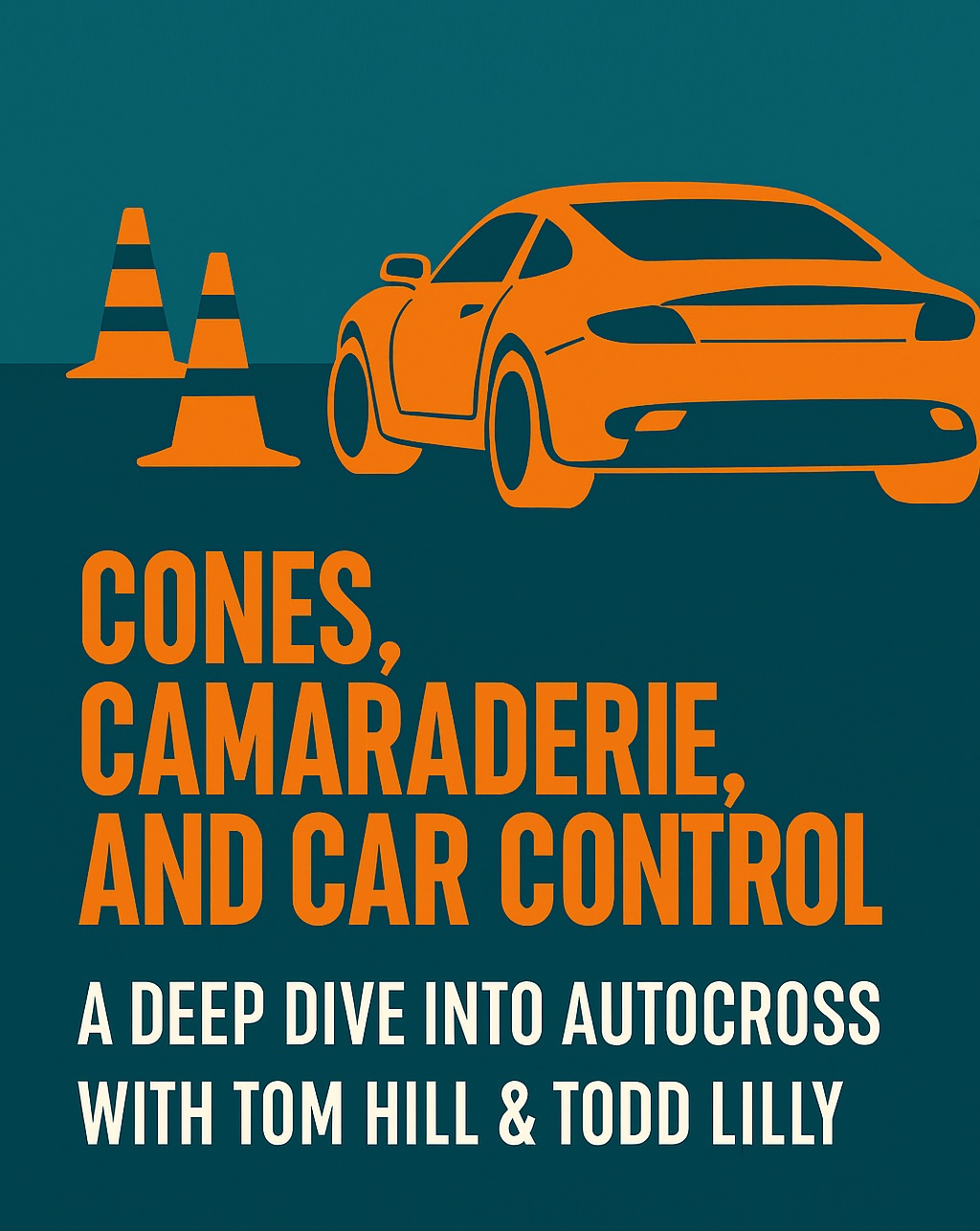
Autocross – or “solo” as it’s known in SCCA circles – might look like a sea of orange cones in a parking lot to the uninitiated. But for seasoned drivers like Tom Hill and Todd Lilly, it’s a gateway to precision driving, lifelong friendships, and a whole lot of tire smoke. In this episode of Break/Fix, we unpack the world of autocross: its history, its quirks, and why it continues to be one of the most accessible and addictive forms of motorsport.
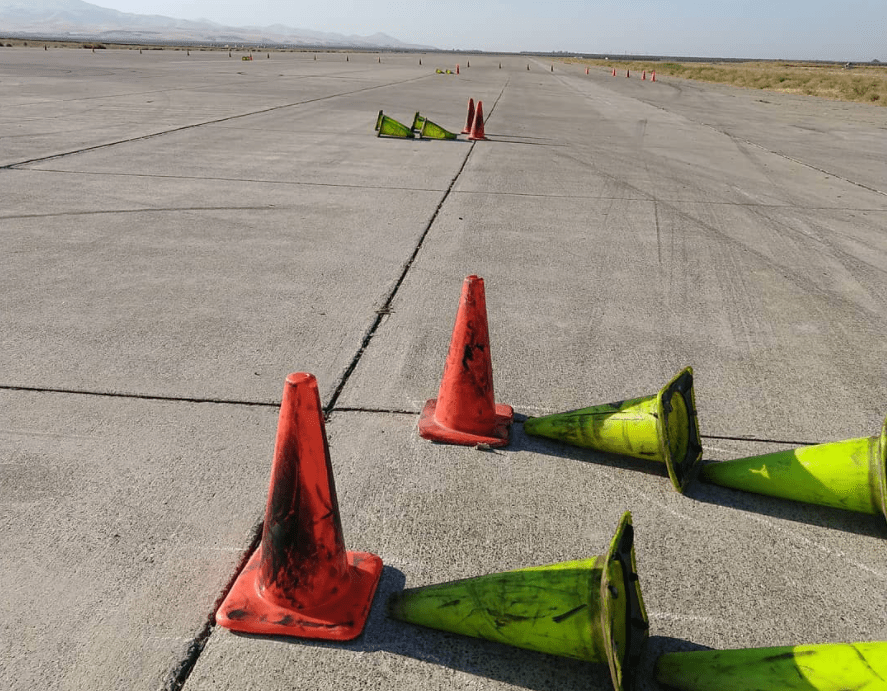
Autocross is a timed motorsport event where drivers navigate a tight, technical course defined by traffic cones. Speeds rarely exceed 65 mph, but don’t let that fool you — it’s a full-send experience that demands razor-sharp reflexes, vision, and car control. Unlike drifting or gymkhana, autocross emphasizes precision over style, and every thousandth of a second counts.
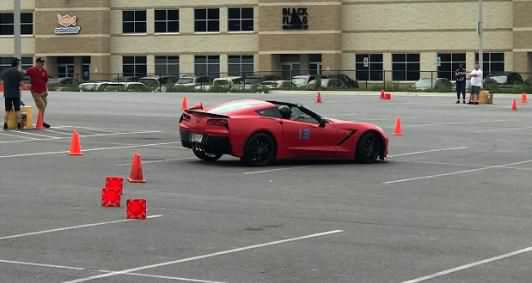
For many, autocross is the first step into motorsports. Todd transitioned from motorcycle racing after a few too many broken bones, while Tom returned to autocross after a hiatus, trading project cars for a C4 Corvette and later a Miata. Whether you’re coming from karting, rally, or just looking for a safer thrill, autocross offers a low-barrier entry point with high rewards. And here are some variants you might want to remember:
- Pro Solo: A drag-race-style autocross with mirrored courses and a Christmas tree start.
- Track Cross: Autocross on a racetrack, often with cones to modify layout and limit speed.
- Time Trials: A bridge between autocross and wheel-to-wheel racing, focused on consistent lap times and precision.
Each offers a unique flavor of competition, and many autocrossers eventually explore these disciplines.
Tune in everywhere you stream, download or listen!



Notes
This episode of Break/Fix features a detailed exploration of autocross, a motorsport event that often puzzles outsiders. Originating post-World War II as time trials within the Sports Car Club of America (SCCA), autocross involves navigating a car through a course marked by orange cones in a large parking lot, emphasizing handling over speed. The hosts discuss the sport’s history, key skills such as precision driving, and the importance of walking the course for successful navigation. Guests Tom Hill and Todd Lilly share their personal journeys into autocross, compare it to other motorsport disciplines like track racing, pro solo, and track cross, and discuss the preparation, classing, and scoring intricacies involved. They delve into technology and data usage in improving performance, safety measures, and the overall community and camaraderie surrounding autocross events. The episode also touches on the complexities of car preparation, the varying characteristics of different autocross venues, and advice for newcomers to the sport.
- For many folks AutoCross has been a gateway, or transition into Motorsports. For some, they went from Karting to AutoCross to Track and beyond. How do you get into AutoCrossing?
- When you see an AutoCross “course” it can be a bit intimidating, people often joke that it’s just “a sea of cones” but there is a reason/purpose for the layout.
- One of the most important things every AutoCrosser learns is to “visualize the track” and that oftentimes comes in the form of walking the course, why is this so important?
- When you really get into AutoCross, it can become really complex, from the Timing/Scoring, Classing and especially the car prep side, let’s explore this.
- Is AutoCross safe?
- There are other variants of AutoCross, like Pro-Solo and TrackCross – expand on the differences?
- Like in circuit racing (ie: Track) we have our favorite and least favorite “tracks” is the same true of AutoCross? Aren’t all Parking Lots the same?
Fun Fact: When the Sports Car Club of America (SCCA) was founded in 1944, some of the first events it held were local time trials, also known as Autocross. BUT – As we said in the intro… outsiders looking at an AutoCross for the first time might be thinking, “What are these cars doing driving around a parking lot with cones? Is this some sort of driver education program? Defensive driving clinic?” How would you explain AutoCross to someone that’s never seen it before?
Transcript
Crew Chief Brad: [00:00:00] Grand Touring Motorsport started as a social group of car enthusiasts, but we’ve expanded into all sorts of motor sports disciplines and we want to share our stories with you. Years of racing wrenching and motorsports experience brings together a topnotch collection of knowledge and information through our podcast.
Break Fix.
Crew Chief Eric: On this episode of Break Fix, we’re gonna chat about a discipline of motor sports where outsiders often ask What in the world is going on over there? You know, the one, that form of racing many of us started with, where you attempt to navigate your car through a defined course made up of orange traffic cones on a large parking lot composed of tight technical layouts.
These races put handling and driver ability above engine output and outright top speed. So if you haven’t guessed by now, we’re going to be exploring the world of autocross, also known as solo, with my guest, Tom Hill and Todd Lilly, both [00:01:00] seasoned SCCA, autocrossers here to help us really understand what is autocross.
So welcome to Break Fix, Tom and Todd.
Todd Lilly: Hello. Hi. Thanks.
Crew Chief Eric: Good to be here. Did you guys know that when SCCA started in the mid 1940s, you know, just at the tail end of World War ii, some of the first events they held were time trials known then as autocross.
Todd Lilly: No, I didn’t. Did not know that.
Crew Chief Eric: But as we said in the intro, outsiders looking at an autocross for the first time are thinking, what are these cars doing?
Driving around a parking lot with a bunch of cones? Is this some sort of driver education program, defensive driving clinic? How would you guys explain autocross to somebody that’s never seen it before?
Todd Lilly: First of all, you know, my mom, she, you know, it’s like, oh, you do autocross. I thought you drove your car on pavement.
Everything, everybody thinks motocross or something and they’re like, oh, you, it’s like dirt bikes, right? I mean, that’s the first one you gotta dispel.
Tom Hill: Absolutely. But the, uh, other items you mentioned, driver training, safety and all that, I was sort of classified as all the [00:02:00] above. The stuff we do out there teaches you skills that are actually useful in avoiding accidents and being a better driver on the road.
Plus it, you know, gets all of that driving excitement out of your system so you’re a more mellow, uh, driver on the road.
Crew Chief Eric: So when I was growing up, people always used to say autocross is all about precision driving. And nowadays if you say that, they go, wait, you mean drifting? They’re not the same thing.
Todd Lilly: The, and well, the precision part. I mean, you’re, you know, sometimes you’ll be classed or ranked the thousands of a second or even better, you know, so it, it’s absolutely a little wobble or a sneeze. And there goes first place. Some of my other friends, I say, Hey, you know, how fast can you do a u-turn? That’s pretty much all, you know, it’s like, how fast can you avoid a pedestrian?
Can you do a u-turn? Can you, can you do those? You know, ’cause they’re like, man, how fast do you go? Your car looks so fast and you’re like, well, it’s like 25 miles an hour in a, in a street car maybe.
Crew Chief Eric: And not to be confused with another discipline of motor sport, which actually falls under the rally category, partially drift, which is gym kana, which is also sometimes [00:03:00] done on large parking lots.
But those are larger defined courses with walls and barriers and as we refer to it in autocross, one cone turnarounds, like they’re going around a hay bale, things like that. So we wanna make sure that people understand what autocross is, is really about here.
Tom Hill: Like you mentioned, lots of traffic cones.
It’s a bit of a, uh. Mental exercise. I mean, if you’re on a track, you’ve got a fairly defined area, right? You’ve got the pavement and you’ve got the grass. Uh, you typically wanna stay off the grass. Well with autocross, the course is actually laid out in that big parking lot and, and it’s in the cones. The cones really don’t define the course per se, you know, they’re the limitations and all that sort of thing, but the course actually is in there.
You have to be able to go out there and walk the course. Understand, you know, what the path is gonna look like and be able to develop some vision there. And that’s one of the more challenging aspects of it, I think.
Crew Chief Eric: Absolutely. And we’ll explore that more as we get deeper into the conversation. Let’s kind of talk about beginnings.
You know, there’s always an origin story. In this case, we’re not gonna talk necessarily about the history of DER Cross. [00:04:00] Let’s talk about your guys’ history and CROs. So for many folks, autocross has been a gateway into other motor sports. I mean, Brad and I, and unfortunately Brad isn’t here with us on this episode.
I know he loves the autocross. We autocross through high school and college. You know, I grew up with my dad being a national pro solo champ, things like that. So I was always around the autocross course, but it led me to other things. It led me into time trials. It led me into track and HPDE and all these other kinds of things.
And for other folks, maybe they started in carting and found their way into autocross. How did you guys get into autocross? Let’s start with Todd.
Todd Lilly: Well, you know, I was in California and doing, uh, I. Pseudo motorcycle racing. I drive at about 110%, but I have about 89% skill. So you know, a separated shoulder and some other, other broken bones and stuff.
And they had a autocross club at where I worked that they set up in the parking lot. Same thing. What? What are you guys doing? You’re driving around some cones and then you know, I got outta motorcycles and in at a 97 Trans AM [00:05:00] V eight and took it out there and spun it around. Dig donuts. Slid all over the place and went really slow.
Right. And that, and that’s how, you know, and then it went to ESP. So then you had, you know, sticky tires and started throwing money at suspension and brakes and training. Of course, lots of training, lots of seat time. So it really was, wanted to save my skin going from motorcycles to some other sort of cheaper, you know, I, I looked at racing, but, you know, I couldn’t even afford, I was run, had a production class Ninja two 50, right?
Which is basic beginner motorcycle. And even just keeping that going, I was like, man, that I don’t know that I want to get into actual racing, going to the racetrack, putting that additional time into it. So, I mean, that, that’s how I got started.
Crew Chief Eric: Would you say that that’s what attracted you to the sport, is maybe getting out of motorcycles?
The risk had become too high and then it was like, Hey, I’m more protected. Four wheels, this seems safer, or was it something else? Well, you
Todd Lilly: know, and also in California, I, I’d gone to Thunder Hill quite a bit, Laguna Seka, and on the motorcycle. So it was, you know, big, long, [00:06:00] straight. You’re set up for the corner, you’re waiting, you’re waiting turn.
Set up for the next corner. You’re big, long, straight. You’re waiting, you’re waiting. You know, I really enjoyed the cornering and the G-forces. Autocross is just all corners. There’s any straight, you know, somebody messed up the course or it’s like a 4th of July course or something where, you know, they say, oh, you know, we’ll let you get up to 75 miles an hour or something.
But don’t tell anybody.
Crew Chief Eric: So Tom, how about you? How did you get into auto crossing?
Tom Hill: A long time ago, a friend of mine, uh, his dad was doing this auto cross bent and I had a, uh, a 1980 Honda Accord that I had, you know, worked on, put bigger tires on that sort of thing. So, you know, my initial auto crosses were, were back in those days, back in the, in the mid to late eighties.
And I, I ran some and then, uh, sort of gave it up later on. This was probably about 15 years ago. I was, uh, thinking about building some other, another car. But then I had sort of had this crisis of conscious where I was thinking. What am I gonna do with this car? Once I build it? It’s gonna be some kind of fast, hot rod.
Can’t [00:07:00] really rip up and down the uh, highways and byways anymore. There’s too much traffic, so I thought, well. Hey, what I’ll do is start autocrossing again. I actually got rid of the project cars that I had and I went out and bought a, a c four Corvette and started Autocrossing. The thing I like about it is I, I’ve done some track days, you know, those are fun.
Uh, but I’m, I’m with you, Todd. It’s kind of compared to autocross, it’s, I don’t wanna really say boring, but the autocross, like you say, is all turned all the time. I mean, you’re either setting up or you’re turning or you’re speeding up, you’re slowing down tracks. A lot of times, you know, you go to the turn, you turn in, you hit the apex, you accelerate.
I mean, it’s fun, but it’s just the pace is a little slower. Plus it seems to be harder on the car, on the track. Almost every time I would go to a track day and come back and have to replace brakes. Plus with autocross, I’m lucky we’ve got a good site here locally. I can go autocross and come home, mow the grass.
You can go get your uh, you know, motor sports on, but still be home in time for dinner.
Crew Chief Eric: Let’s settle A little debate between the track guys and the autocross guys. ’cause I know we’ve [00:08:00] all dabbled in both and you hear the arguments both ways. To your point, Tom, oh, it’s a little bit slow, it’s a little bit boring, this and that.
It’s repetitive being at the track, but then you hear the same thing about the track guys talking about auto costs. I gotta wait around all day for three runs that are gonna be a minute or less. And if you’re lucky to, to Todd’s point, some of these 4th of July courses that are a minute and a half long, oh my God, that, that’s a stretch for an autocross.
I don’t wanna say which is better. Which is right. Maybe they both are, maybe they, they both have their pluses and minuses, right?
Tom Hill: Oh yeah. I feel like any people that are involved in motor sports. That’s drag racing, drifting track stuff all across. I mean, they’re all part of the family and I think, like you said, they all have their pluses and minuses and certain things appeal to certain people.
I’m not saying track stuff’s boring. I’ve never actually done any wheel to wheel racing, so I would imagine that would be pretty exciting as well. You know, I was out doing the, the track days, so, you know, you’re just out there kind of goofing off when you get right down to it. You gotta like picking up cones if you [00:09:00] want to do all the stuff.
Todd Lilly: I like hitting them. Yeah,
Tom Hill: yeah. But, but I think that really, that working the course gives you an opportunity to stand out there and watch what other people are doing. You know, I find that that actually helps me do better when I’m driving the course. If I get to watch a bunch of cars go by, and especially if you’re on one of the tricky corners, you get to see what works and what doesn’t work.
I’m with you. I mean, all across hell, I, I went one time to an event in Georgia. I drove, uh, eight and a half hours to get down there. Like I say, I’m gonna get six runs. They’re 30 seconds, 40 seconds a pop. Well, my accelerator pedal broke on the first run, so I got about 30 seconds of driving for my, you know, 16 hours worth of transit time anecdote on that.
So a
Todd Lilly: regular, regular autocross then, huh?
Tom Hill: Yeah, no. Oh, that was so frustrating. But when I, the first time I went to nationals, we ran out of daylight when I was running my class. I burned a tank of diesel fuel for each run that I got on the course at National. Geez. So [00:10:00] it took me five tanks of diesel to get there and back.
So, yeah. You know, I, I understand, but I do feel like those 30 seconds, 45 seconds, 62nd runs, I mean, it is. Pure excitement the whole time.
Crew Chief Eric: It is full send, as we call it, around here. There is no room for error and you are pedal to the metal, that’s for sure.
Tom Hill: That’s what I like about, of course, I haven’t ever done wheel to wheel, so I’d like to,
Todd Lilly: I did some lemons and I, I, you know, it’s sort of like what you’re saying, that the autocross is continuous Absolutely.
At the edge of your seat. And I did, you know, lemons wheel to wheel sort of, you know, the difference between, uh, track days where you just set up, turn in apex and you know, gas on the way out, wheel to wheel. You’re like, oh, I need to get around this car and then still make the corner. So it’s like, okay, I’m gonna do a Chicago box around to that guy.
Oh, the car is sliding a little bit. I slide my car all the time in autocross so I know what’s going on. And then, you know, changing different lines and stuff. So I think the autocross experience really helps out all of your screw ups on the racetrack. Every time I’ve screwed up, [00:11:00] you know, it’s been like, oh, well I’m sliding, I know what happens next.
Right. You know, but if it was just racetrack experience, I’m like, oh, I do not wanna slide. I don’t wanna. Change lanes suddenly. I don’t wanna, whatever, where autocross gives you the chance to do all that stuff, reasonably safe, put ’em together and it’s pretty fun. Unless it, you know what I mean? But yeah,
Crew Chief Eric: I do, I do.
And, and it can be summarized in a small phrase, which is car control. Every discipline of motorsport brings something else to the table. And I always approach motor sports as this broad brush thing that you can learn something from every discipline and it makes you a more well-rounded driver. For instance, if you started in carts, what did they teach you?
Other than that, carts are really slow compared to anything else you’re ever gonna drive except for Miata. But we’ll get into that. I gotta take a pot shot at Tom a little bit. What I’m getting at here is. It teaches you Racecraft. That’s one of the best places to learn how to be in a pack of other cars like a Spec Miata race.
As you grow into motorsport, things like that, [00:12:00] autocross brings car control, which to your point, Todd, when you’re in a on a racetrack and the car suddenly breaks loose on you, it becomes instinctual how you’re gonna react to that, you know? And, and rally brings different things. They all bring something to the table.
So, like I said before, I don’t know if one is necessarily better than the other, so much as they’re all stepping stones to where we want to go. Eventually. I don’t know what everybody’s goal is gonna be different. Some people live in the world of autocross forever. So let’s kind of expand upon that and talk about.
How do you get started in autocross? What does it take to get going? What do you really need? Are there schools and how do you get better at this particular sport?
Tom Hill: What you need is a checkbook, a pulse, and a car with a good battery hold down and that right there will get you started in autocross.
Crew Chief Eric: Well, there’s about 50 of those at the Hertz rental lot.
So, uh, yeah,
Tom Hill: yeah, just make sure the battery’s tied down. That’s the, seems to be the number one thing that flunks people on tech inspection, but to me it’s all about showing up and doing it. There are plenty of stools. The group that I ought to [00:13:00] cross with is very good about helping people out, and that’s one thing I’ve noticed amongst the auto crossers is, you know, you’re fighting the clock when you get right down to it and people are just very willing to help out.
I mean, they’ll help their competitors out if their car breaks and they’re like, here’s the part you need, put it on. Let’s go a benevolent organization, if you will. They’re, they’re looking to help so the local people can help get you started. We have a driving class. Our, uh, club does the EVO schools that they do before most of the national event.
So there’s lots of ways to get training. The whole key is really just getting out there and getting behind the wheel and doing it to it.
Todd Lilly: The Evo schools, you know, you’re throwing a little bit of money at it, but like you said, autocross, I would jump into anybody’s car. Not that I’m, you know, know what I’m doing, but I mean, anybody that has an idea of where to go could jump into anybody’s passenger seat and just point and say, okay, left.
Well, you know, look to the right or whatever and give somebody directions, whereas. A track day, I’m probably not gonna jump in your car and, you know, and, and let you go full, you know, so autocross, you can have somebody sitting in the passenger seat telling you where to [00:14:00] go, what to do, and how to do it, basically.
Crew Chief Eric: So I gotta give a shout out though, the era that Tom came up in same era that my dad came up in and autocross, he went to the Dick Turner Autocross School. You could still find a lot of those classic eighties autocross training videos out there on YouTube and whatnot. We’re gonna link to that in the show notes, so shout out to them.
But to your point, there’s the Evo schools, a bunch of other ones. If you wanna learn really about autocross,
Todd Lilly: you show up, like you said, with 50 bucks or whatever it is, and a car with a battery that’s tied down. Really. You just gotta show up. You’ll show up and there’ll be somebody there with, you know, their mom’s Tercel or what you see kids bringing out their, whatever, you know, whatever their parents happen to have, and bring it out there and drive it and see what happens.
Crew Chief Eric: Autocross seems to be a little bit more open than say, track events where, you know, we have the broomstick test and this test and it can’t be a convertible and this other thing and up and down and PDQ and it can’t be an SUV, you know, all that kind of stuff. It’s more inviting. You got a card to your point and it’s got a battery tie down, let’s go.
Let’s have some fun. And even the coaching style isn’t [00:15:00] nearly as formal, right? I don’t ever hear about certified CROs, coaches like there are on the track side of the world, you know, everything’s so. Regimented and political when you go to the track world, right? It’s very different, but obviously the speeds are higher, safety’s a bigger concern, you know, things like that.
We’ll dive into the safety of Otter Cross as we go through the conversation, but that’s good to know, right? Just run what you brung as they used to say, right? Come out, have a good time, and learn something new. And that’s usually when you get bit by the Otter Cross bugged. It’s almost like, like I’ve said before, it’s like golf, right?
17 really crappy holes, and it’s that one run, that one hole that makes a difference and then it brings you back every time, right?
Tom Hill: I’ll echo it again. The first time you’re driving on the street, after you’ve been autocrossing for a while, if something happens. You put your autocross skills to use to avoid an accident, you’re like, Hey, you know, this is worth it from, uh, not just a fun perspective, but, you know, staying alive on the, uh, on the, on the streets, on the mean streets.
Right.
Todd Lilly: My wife also drives a GTO with me, co drives it and, you know, she had a [00:16:00] Jeep Cherokee daily driver, California, of course, all the best drivers out there. Not on the freeways though. So, you know, some sort of freeway snafu. You know, somebody parks their car in front of her and she, you know, does basically a Chicago box with a Jeep Cherokee.
And she says, man, that guy that, you know, he pulled out in front of me, you know, ’cause it was on a on ramp, right on ramp stuff going. She’s like, I noticed I was on the gas. As I was, you know? Right. So she ga gassed it out, you know, the Jeep started to lean a little bit. She just gassed it and you know, added steering input.
And she’s like, so I noticed I had my foot on the floor going around the on ramp. I’m like, well, that’s good. You didn’t run into anybody. You didn’t flip junkie old 200,000 mile.
Tom Hill: If she had not been autocrossing, that would’ve
Crew Chief Eric: likely been an accident.
Todd Lilly: Yeah, absolutely. I was happy she raced with me.
Crew Chief Eric: And I think the thread we could pull out of that is one of the things that Autocross teaches you, even though the speeds aren’t nearly as high as say like a track lap, is that you find the limit of your vehicle very [00:17:00] quickly and then you can work backwards from that.
And so even at that lower speed, you know, kinda limited, let’s say the second gear, third gear on, on some courses, on some lots. I mean, you can still get the car outta shape and then learn how to walk back from that, which is really, really good.
Todd Lilly: Definitely learn the limits of braking. I mean, you definitely learn the limits of braking and you know, braking and steering that they don’t normally go together.
Tom Hill: You mentioned that in Chicago Boxes side. I remember. I can remember. You know, it’s funny, maybe you had a similar experience, but I remember the day that the Auto Cross thing slowed down for me. I was charging into a Chicago box. I was breaking a hundred percent. I was turning a hundred percent. So that means I was basically going straight, I was heading towards the back of the box.
And you know, these things aren’t that big. And I remember having the thought, you know, Hey knucklehead, take your foot off the brake. And I did. And the car turned. But it, it was weird because normally I, by the time I would’ve had the thought about taking my foot off the brake, I would’ve been through the back of the Chicago box making the workers run.
It was literally like a, almost like a switch flip, where suddenly at that [00:18:00] point forward, the cones weren’t coming at me as quickly.
Crew Chief Eric: I mean, it just slowed down. But you guys mentioned something a couple times this Chicago box, and people were probably thinking, what is this? What is this box? What? There’s boxes on the parking lot now.
It’s a type of gate. And so autocross uses a series of gates, you know, um, decision cone gates, slaloms, increasing, decreasing, all these kinds of things. And so we outlined that as well. There’s a link in the show notes that to kind of better explain what our guests here are talking about tonight. But what I wanna kind of address is when you see an autocross course.
It’s really intimidating. People often joke that it’s just a sea of cones and there is a rhyme and reason to this layout, and that’s the point that I’m getting here too. When we’re talking about Chicago boxes and Slaloms and so on. Obviously the goal is to navigate the course any way you can as quickly as possible.
And Tom alluded to this, the cones kind of define the boundary, but not necessarily the path you need to take. What should someone expect to learn or get out of this discipline of autocross and how do you [00:19:00] reshape it based on driving style and car and things like that?
Todd Lilly: Some courses like, you know, I’ve done good guys and my company, they had a real small lot.
I mean, some courses are literally a sea of cones and the only line you can really drive is. Inside of those cones, but it’s really hard to tell where the corners are because there’s so many cones and you just, you get lost the, the cone in the front versus the cone in the back. And we’re gonna talk about walking the course, but I mean, sometimes you have so many cones that you know you really need to pay attention.
As far as your preparation for the course.
Tom Hill: The first field that you have to develop, you’re gonna succeed at autocross is making sure you’re in control of your eyes and where you’re looking. So, you know, when you look at that sea of cones, there may be 25 cones out there that are defining a couple of features you’re gonna have to go through.
But there’s probably gonna be like five or six of those cones that you really need to be paying attention to, separating the week from the chaff and just training your eyes to look ahead. All across speeds, say 30 miles an hour, [00:20:00] you’re going about 45 feet per second. So if you’re looking close to the front of the car, if you’re not looking 50 feet ahead.
You’re essentially looking at stuff that’s already happened. First primary skill thing I harp on when I’m talking to uh, uh, novices is make sure that you’re looking in the right place.
Crew Chief Eric: And to your point, Tom, you mentioned earlier about working the course and watching from that vantage point. When I would work the course, I would always laugh because I could always tell when somebody was driving what we call gate to gate, they could only see the gate that’s basically right in front of the car and they couldn’t see the path in front of ’em.
Somehow. They like a rat finding the cheese at the end of the maze. They made it to the end without going off course and, and all that kind of stuff. It’s just interesting how we all visualize the course differently. And I always felt, and I don’t know about you guys, if you ever done the events where they chalk the boundary of, of the course, I feel like that’s cheating.
Like it just makes it too easy.
Tom Hill: But it seems like when we do that, there’s always a few places where the chalk, it winds up going away because. That’s not really a [00:21:00] boundary on the course, it’s just sort of a guideline. That’s right. And, you know, you probably, uh, uh, need to go out a little bit to, uh, get around a particular cone.
So, uh, so I’m with you. Sometimes I feel like the chalking of it causes a problem ’cause people think that that is a boundary.
Todd Lilly: Sometimes, you know, they’ll throw in an extra cone just to create that boundary, or they’ll throw in a, a cone of 10 or 15 feet back from the alleged apex as opposed to on what would be a good apex.
So, I mean, sometimes the course designers, they’re not throwing out cones there to give you the nice, pleasant experience. You know, some of those guys are good at making you, uh, envision some sort of a magic cone or a, or your imaginary cone or whatever, and Chicago box, or a slalom or whatever you need to get from, you know, one element to the other and then tie ’em together in some sort of a fashion that is conducive to a good time.
Crew Chief Eric: And that’s actually a really good point that you bring up because I find myself doing that at track days as well, especially in time trials, which we’ll elaborate on a little bit [00:22:00] here, is that I almost visualize that there are cones on certain tracks. I mean, we could use Shenandoah Circuit at Summit Point as a prime example.
There’s parts of that track that you would ignore, just like if it was a slalom at an honor cross. And so you have to reshape the course sometimes that it’s not just about track in Apex and track out it’s, my car doesn’t wanna do this this way. I need to reshape the boundary, utilize the asphalt I have available and make, pretend that there’s one of these cone like obstacles there to kind of set up the car mentally.
So being able to visualize that is super important. Obviously, you know, we touch on the fact that autocross teaches you car control. The basics of under steer, over steer neutral, steer, all that kind of stuff. I think there’s more to it than that. It’s all about steering input more than anything. And there’s a bigger debate to be had, which is fixed.
Versus shuffle. So who wants to take that on with a chuckle? They both chuckled at this one.
Tom Hill: I like to set my cars up with fast steering so that, uh, I may be able to, uh, not, I can, you know, not have [00:23:00] to shuffle. I find that I, when I do have to shuffle, I tends to set up earlier in the turn. So I think I used kind of a hybrid approach of the two techniques.
Todd Lilly: I would have to agree that knowing where your hands are at all the time, you know, I’m not one of the guys that that will pretzel my arms over each other trying to do the turn, but having the race car steering wheel with the little red stripe, you know, this way up. Type deal. You know, it’s always good to know which way you’re going and that’s just your natural, you know, return to center point as far as how much turning you’re do doing.
But being a GTO Pontiac guy, you really gotta know how to shuffle because if you can’t do a donut and go and still put in a good time and autocross a good time on the clock, then you know you’re really not driving and that takes shuffle.
Crew Chief Eric: So I agree with both of you that I think there’s a hybrid approach to this and watch anybody’s in-car video, whether it’s an autocross or track event.
First thing they’re gonna comment on is your hand placement. And it’s like, well, first of all, did we get through there safely? Do we get through there [00:24:00] fast? Yes. So doesn’t really matter. I mean, I can sit here and watch pro racers. I, I’ve commented hundreds of times about Hurley Haywood and Hauck and Terry Neville, and they shuffle, but then they don’t, but then they do.
And to your point, I think it all depends on the situation, the corner, where the car is, if you’re trying to react to it, things like that. But I believe there’s a third option. And to your point, it’s about presetting your hands and then basically putting the steering wheel exactly where you want it and then bringing it back to center.
And so it’s a mix of both fixed and shuffle steering. And I’m sure we could do an entire episode on that by itself. But I wanted to bring it up because it’s important that CROs teaches you about hand placement. And then after that. Well first eyes hand placement and then it’s all throttle control at that point.
’cause some cars you are gonna throttle, steer. And Tom, that’s especially important in your little Miata.
Tom Hill: Absolutely. Well, I had a Corvette that was, uh, a big throttle steering car as well. There’s multiple facets that have to be sort of mastered, or at least you gotta get reasonably good at. You know, I think it’s a challenge that [00:25:00] goes on.
I mean, I’ve been doing this for, you know, like I said, 13 years now, and I still feel like I have plenty of improvement to go. I have firmly proven to myself, to my competitor that I’m a slightly above average driver.
Crew Chief Eric: I like the way you put that. That was very well done.
Tom Hill: So, uh, you know, I keep trying to get better.
I, I think I do. I get a little better every year. To me, that’s kind of what’s so interesting about it. And I see these people that come in and are naturals and just come in and go from novices to winning. A couple of seasons and, you know, most of those folks move on and do something different. I, I guess they feel like they’ve mastered it, they get bored.
Uh, I have not gotten bored yet. That’s a good thing. Yeah.
Todd Lilly: Being mediocre means you need to hang out longer to, your claim to fame is that you’ll be around long enough that all the people that beat you might die before you and then
Tom Hill: Well, and
Todd Lilly: I mean, I’m there with you. I’m waiting.
Tom Hill: So we, we have a guy un unfortunately he did pass away, uh, year before last, but he was well into his eighties.
He was, uh, still auto crossing [00:26:00] with us. He went as fast as he was. He had auto cross for a long time. But, you know, it was still kind of fun because, you know, young guys would come in and, and they’d race in his class and, you know, he’d beat him by two seconds and, which is an eon. And I always wanted to go over to him and say, Hey man, you realize that your granddad or maybe even your great-granddad just beat you at autocross.
So I thought it was kind of fun that this guy could come out. He would put his age as his number on the car, and then he stopped. He was worried people were gonna get, you know, kind of nervous when it was like 89 or 90 on the car. But you know, he did this for a lifetime, you know, and I think that’s pretty cool.
Crew Chief Eric: We’ve hinted at this earlier in the episode, one of the most important things every Autocrosser learns outside of the car control and things we just discussed, is how to visualize the course. Right? And that requires you to do something that Tom mentioned, which is walking the course. Why is walking the course so important?
Why should you not skip out on that?
Todd Lilly: First of all, I mean, it’s not a racetrack or a [00:27:00] drag strip. You’ll likely never see the same. Autocross course twice. So that means you got three runs at the least. So there’s your minute and a half total to throw down your, you know, your first place run. So you gotta go in with a plan because you know you’re never gonna see that exact same course, likely never see it again.
Definitely won’t be the same pavement temperatures, same tires, same whatever. So the, the walk is the very first part of trying to memorize that course and coming up with a plan that you try to execute on that fir very first run. You don’t have a warmup run, you don’t have a bunch of sighting laps.
There’s no time trials. You get three to five runs, six. I mean, it depends on the club, but you know, nationals is, is three runs. Right. So you get three to get it done.
Tom Hill: Yeah. If you get out and blow it on your first run, then the heat is on. You gotta get out there and eyeball the course. To me, it, it always seems, you know, most of the national stuff flows pretty good, but there’s always a couple places you’re gonna need to do something.
[00:28:00] I say is unnatural, and you gotta identify those places and have a plan to get through those features. And typically those are the ones where maybe there’s not a lot of points of reference, things like that. Those are the features that win or lose the event. And that’s something I still struggle with, is really coming up with a plan that, you know, survives first contact with the course.
Todd Lilly: Uh, you know, I’m, I’m always mooching off of the guys, find out who drives well and who will put up with me, right? That’s another, that’s a smaller group of people. And then start bugging those guys and walking the course walks with ’em, you know, and they normally walk right where they’re driving. Uh, you know, the guy I having to be hanging out with now, you know, I’ll be like, Hey, I, I don’t think you really know the course.
Maybe you can talk through it while you’re walking, which is fine. But then, you know, we’ll get back to the start and he’ll say, okay. Repeat the course back to me, right. And I’ll be like, I don’t, I think there’s a left somewhere, you know? And he’ll say, okay, you know, you’re, you know, and he goes through the whole course in his head without looking at the course, and he says it out loud to me what he’s gonna do late Apex, [00:29:00] early apex, when he is gonna break what, you know, what he is looking at, which corner he is gonna throw away.
And he, you know, just blurts it out. And he says, okay, let’s walk again. And then I’ll repeat about half the course and then we’ll walk again. I’m a slow learner. So then after maybe three times I can say my plan out loud. And then at least when I get in the car, I have a plan. It might not be the plan, but you, you gotta have a plan when you get in the seat.
Tom Hill: I’m with you. It’s, it is to me, it’s like you, uh, hopefully won’t make any huge mistakes. So you sort of chip away at the time, you know, that’s the thing, when, when I get data, compare it with people that drive faster than me, typically it’s not one huge mistake that I need to correct. They’re just a little bit faster.
Finally have realized that it’s all about chipping away. It’s about, you know, you save half a second by finding tents in the hundreds, literally of a second out there on the horse. And that’s what separates the winners from the losers.
Todd Lilly: They’re getting on the gas just a smidge earlier than you, which gives them a couple more miles per hour leaving the corner and a couple more coming into the corner and yeah.
Right. Placement for the right [00:30:00] speed. Yep.
Crew Chief Eric: So on average, how many times do you guys walk the course?
Todd Lilly: Well, depending on the course and length, and if they allow bicycles, I mean, the, the course I’m at now, I, you know, you can walk it three times pretty quick and easy. When I was racing on a, the, uh, backup for the shuttle landing airfield, they allowed bikes.
So you’d ride your bike maybe twice and you, you know, you’re, that’s enough exercise for the day. Right. So, I mean, if you can walk it two times, it’s my minimum. Mm-hmm. I don’t know about you, Tom.
Tom Hill: I walk it as many times as I could stand it. I went to an event in Bristol, Tennessee a while ago and had my, uh, you know, my handy Danny Apple watch on there.
And it was a pro solo, it was a four day event, and over those four days, I, I believe it was, I walked almost 30 miles. It was crazy because we walked and walked and walked the courses and we were in the situation where we could actually walk it sort of during the event once. So yeah, I, I will walk it as many times as I
Crew Chief Eric: can.
So, do you guys also use maps? Do you make notes? Anything like that?
Tom Hill: I don’t. I try to, just, [00:31:00] like I said, when I’m out there walking the course, I’m trying to figure out where I’m gonna be looking, and I find if I’m looking in the right place, the path sort of works itself out. I don’t have to be totally focused on that.
If I’m just looking in the right place, things tend to fall in place. But there are, like I mentioned, typically two or three, four places. That you’re gonna have to do something that might seem, you know, a little weird.
Crew Chief Eric: And I bring up the map and I don’t normally express my opinions when I’m at a track event, but I usually smirk when people are handed a map of the course.
I’m like, you can see that the turn goes left. I mean, I, I don’t know what you need a map for and I understand why it’s okay, but when you get to an autocross, I feel like you’re pelli looking for the fountain of youth. You need some sort of reference sometimes when you’re standing in the Chicago box and you turn around and go, where the heck am I in the sea of cones?
I just wanna express to people that there’s these other tools that you can use, right? Obviously there’s software you can use now on your, your smart watch to map out the course if you need to see it that way. Make notes, you know, there’s paper maps always available, but walking the course, [00:32:00] the more you repeat it to your guys’ point is the way it’s gonna cement it into your head.
But it also draws a very interesting parallel to another form of motorsport, which is rally. Right. If you look at World Rally to Todd’s point, they never see the same course twice, and they have a set of hieroglyphs for notes with a navigator telling them where to go. But CROs and Rally are very similar in that you get one sighting pass in a passenger car to figure out where the course goes, and then you’re supposed to, you know, do the whole thing in 130 miles an hour wide open.
It translates. It’s kind of interesting how, again, the, there’s crossover between autocross and other disciplines of, of Motorsport out there.
Todd Lilly: Tom uses some sort of data. I have some sort of data thing, you know, and I tried carrying that around once and then. Sort of looking at the map that distracted me. I, you know, I know a, a couple guys that are really good at it, they take a video around the course.
They’re just, as they’re walking, they take the video and it’s, it’s a really good time to interject funny stuff into their video and moon them or whatever. But one guy [00:33:00] I know does that has video. Another guy, you know, ’cause you’re going to the same place over and over. He’ll have, you know, like a Google photo or a Earth View photo or something and he just draws the map in real quick.
My former workplace, they would set up the course with a map. It’s a known course. You could just have the printed off copy of the map and, and what they actually laid out, I think, not nationals, but some events have maps of the course that you can at least take a note and say, oh, I wanna remember break here, or whatever.
You know, I’m trying to always try to keep things in my memory, but I don’t have time to look at ’em, write ’em down or watch video. But maybe that works for somebody else.
Tom Hill: I think an overhead map, you know, you don’t get the same sort of visual. Picture to do when you’re, when you’re driving or walking the course.
It can even be a little bit weird going from the walk to the drive too, depending on, you know, how low your car is, those sorts of things.
Todd Lilly: Like I said, I’m always mooching off of people that are driving better than me. And first guy that she, he’s like, okay, you’re like six, whatever, you know? How tall are you sitting in that Trans Am?
And I’m like, I’m about belly button height. He’s like, [00:34:00] okay, squat down, you know? And he’d point, he’d say, okay, see that dip in the road? And you see the, so yeah, def, it’s definitely different, different heights and different speeds and yeah,
Crew Chief Eric: all of this is very true, but I’m coming at this from behind the scenes because my dad was a big autocrosser.
He was also autocross chair for different regions and different clubs and things like that. I always got to see it from the Friday night after dinner as he sat down with an 11 by 17 sheet of paper and mapped out what the course. That he was gonna design. To your point, Todd, about follow the fast guys, here’s another top tip.
Go ask the course designer for the map and what he was thinking when he drew it on a piece of paper because he had something in mind when he laid the course out. So there’s another kind of like, Hey, look at it from that perspective too. Or maybe think about the course designer drives a Miata, I wonder if this course is geared for his car and not for the GTO or something like that.
I mean, they’re never geared for the GTO, but let’s face it, right? But just some top tips there. Something that’s [00:35:00] just like an CROs course. Think outside of the box a little bit in terms of strategy and how you might pick up a 10th or two by asking different questions and talking to different people. And that leads us into the next part, which is when you get down to it, autocross can be really complex from the classing to the scoring, to data, to the prep, all of that.
And actually I wanna ex. Expand upon Tom’s comment about data because we’re used to running data at the track with things like an AIM solo where we’re looking at, you know, individual corners and braking speeds and exit speeds and things like that. How does data work on the autocross side?
Tom Hill: If you’re on a
Crew Chief Eric: track,
Tom Hill: right, you could take data.
Analyzing that data might be useful for the next time you go to that track. ’cause if the track’s not gonna change with autocross doing sort of the postmortem I think helps you identify your mistakes, but it really doesn’t give you an opportunity to go correct that particular mistake. Getting the data consumable in between runs is a, a tricky thing.
I find it sometimes and it [00:36:00] can be sort of distracting in many cases. Just looking at my video and seeing where I messed up is the best thing during the event. But there’s some guys, and I’m trying to get better at this, that are really good. At comparing paths and, you know, really refining their technique during the event.
So to me that’s the, the big challenge with Auto Cross is it helps to look later, but you’re, you know, that’s, like I say, it’s sort of a postmortem you that, that data, you’ll have to learn what you did wrong and try not to make that mistake on the next course. But you’re not gonna be able to say, well I should have been two inches closer to that cone.
’cause the course is gonna be totally different the next, or at least different enough that the data’s not gonna be any good for the next event.
Todd Lilly: Yeah. As a mediocre drivers, Tom and I, you know, and then being overwhelmed with data, the thing I have, it can compare the two laps, you know, show you which element you got through faster.
Or maybe you come in and you have a really fast time and you have no idea. Like I didn’t change anything from the first lap, so maybe the data can pick out where I slowed [00:37:00] down or where I really picked up some time. You know, maybe I just chose just a slightly different path. And then, like Tom was saying, that you know, the postmortem looking at your videos, you can say, oh geez, look at how late I am getting on the gas.
Or, you know, I’m not looking ahead, or I’m way off the cones, or I’m turning too slow, or whatever. So, I mean, the data is kind of multifaceted, but sticking your head in into that iPad or laptop or whatever you got is, it’s really tough to do, especially if you’re co-driving, right? You’re busting just trying to get the tires cooled down, the pressure’s done, the seat belt’s done, and then there’s no time for data.
So, I mean, don’t count on it.
Tom Hill: You know, even a sunny day can make it difficult. You need to go find some shady area to, to even be able to really look and see the tablet appropriately.
Todd Lilly: I have looked at some people’s fast guy, right? Run over to his car. Push the buttons on the camera and watch his video real quick.
And I’ll say, oh, he’s using that imaginary cone where, you know, where I’m running through the chalk line or something. You know what I mean? [00:38:00] So you might be able to get something off of somebody I know at Nationals, first person out with the first video immediately puts that on YouTube or wherever, and people are watching that video trying to figure out what’s going on.
Crew Chief Eric: Did you say watch the video or delete his video? Which one was
Todd Lilly: it exactly? Delete the video at the time doesn’t count. Well,
Tom Hill: I wonder if you’re ever gonna really address this, because we’ve had some folks, ’cause you know you get to walk the course the day before. Well, there’s been some folks that have been taking advantage of some of these simulations capabilities.
So they can take videos and sort of recreate the course in their simulation and go run a hundred runs in that course the night before. And I’m not sure what they’re gonna do about that. There’s been some debate over, uh, how to either
Crew Chief Eric: embrace or, uh, prohibit that sort of technology move every cone six inches the next day.
And it’s all, you know.
Todd Lilly: Right. Well, so the, you know, one of the things we did, uh, I may maybe we’ll get into with classing and whatnot, but you know, there are some fairly strict rules about, you know, no, you’re running the same heat, the same time, the [00:39:00] same temperature as your competitors. You don’t have all day to get it done.
You know, you’re all running at the same time. You know, the same heat, you don’t get a extra look, you don’t get to be a passenger and, and you know, and see the course at real speed. Right? You know, all that stuff. Then you add into what Tom is saying, you know, you got a simulation of the course with video from the course.
You know, the guy holding the camera at belly button height walking. What he thinks is a good line. Yeah.
Crew Chief Eric: Or a drone. Or a drone, right. Or whatever. I mean, it could be anything. Right. So,
Todd Lilly: yeah. And you know, in some places they, you know, they don’t let you ride bicycles because they don’t want you to be able to get that momentum going and figure out, you know, what is a good line on a bicycle.
Crew Chief Eric: So Tom, you talked about data, and it sounded like from a software perspective, is there a package or a software, something you’re running on a phone or a tablet that you would recommend for somebody that wanted to try out recording their session?
Tom Hill: The reviews I’ve gotten from most of the phone-based apps have not been that great because, uh, normally the integrated GPS is really not fast enough.
So I’m actually using [00:40:00] a race capture system, which is a standalone data acquisition system. It’s got a fast GPS on it, it has a set of accelerometer. So I get some, uh, data about, you know, how the car’s moving, not just from the, uh, just from the GPS connected in with, um, it controls the camera. It’s connected via CAM bus to the ECU.
So, uh. So it’s a pretty comprehensive system and it’s, that’s another one that’s kind of interesting. ’cause you know, that system was probably five or 600 bucks, which is not chunk change, but it’s certainly not 10 years ago. That was probably a $20,000 setup. It’s, uh, it’s really kind of surprising how the technology, how, how accessible it is to us, uh, autocross and, and amateur race.
It’s educational too. It’s been very interesting to me. Not just from, you know, the racing perspective, but the whole, uh, analyzing data, gathering data, learning about sensors. I mean, it’s, that’s, that’s been a lot of fun for me.
Todd Lilly: Gonna add, so I’m, I’m using a, a low dollar tablet and an app solo storm, which you can run on, you know, you can run that on your phone, but if you buy the, you [00:41:00] know, the super duper package, it comes with a GPS device.
And like you’re saying, the, you know, just using your phone might be good enough if you want some data, you know, you’re gonna have to end up adding some sort of sensors. Now on the other end, one of my friends is a, you know, retired Ford engineer that ran their racing program, you know, and he’s got all sorts of data on his car, so he’ll change tire sizes or, you know, make any minuscule change.
And he’s looking at difference in, you know, G-Force for stopping and turning and, and what his wheel speeds are over time. And, you know, just all sorts of. Crazy stuff, you know? And he is looking at changes in ride height during braking and grip forces and brake temperatures, brake pressures. So you know, you can use the phone and it might be useful maybe, right?
Or you can go completely nuts. And you got, there’s your 10 grand full,
Crew Chief Eric: full race engineer. Yeah. Yeah. I mean it’s, it’s one end of the pendulum or the other. Something for our listeners to look into, and we did a previous episode on this and happens to be in your backyard, Tom. We had [00:42:00] Andrew Rains on Break Fixx to talk about the Apex Pro.
And as we compared that to other systems like the AIM and the Garmin and others, and he explained how the platform works, I found. Really good applicability for the Apex Pro in an autocross situation because it gives you that immediate feedback with the AI and the machine learning to tell you, you can go a little harder in this corner.
Granted, at Autocross, everything moves really, really fast, but if you’re able to record that and look at it the next time it’s telling you your tires can give you a little bit more. Now you have that feedback between the first run and the second run and the, and the subsequent runs after that. So maybe that’s something to look into as, as the bridge in the middle of these two ends of the spectrum.
As you guys can see, it’s pretty darn complicated, but it gets even more complex when we talk about. Classic. So who wants to explain how this all works within this kind of microcosm inside of autocross?
Todd Lilly: I, I’ll, I’ll go first. I’ll go first. I’ll go first for my car. 66 GTO. Classic [00:43:00] American Muscle, you have to have finished interior and it can’t be any bigger or smaller than factory dimensions for the, you know, overall width, height, size.
Tom Hill: Don’t you have to have a 200 tread wear tire as well,
Todd Lilly: right? Yes. 200 tread wear tire. Yeah, that’s actually a defining, you know, having that tread wear really is, you know what takes everything apart, right? If you had sticky tires, then you’d start worrying about a lot of other things. But yeah, so my class is pretty much run what you brung my first event, you know, I just got it on the road, no interior.
And the way the rules were written, I just took that sharpie and I wrote, finished interior on the floor pan, you know, and the judge said, Hey, where’s your finished interior? You know the rules say you have to have finished interior and I’m. It’s right there and he looks at it and he goes, yep, that’s finished interior.
Crew Chief Eric: So let me take a basic question to this, which is, what class do you run in Todd?
Todd Lilly: Classic American Muscle. Oh, okay. Traditional kmt. Yes, it’s kt. Okay.
Crew Chief Eric: There’s a [00:44:00] lot more classes now than in the old school days when it was showroom stock, stock street, prepared, prepared and modified. Those were the, let’s call those the top level domains of classes in R Cross.
Right? Yeah. Then you have all these splinter groups inside of there.
Todd Lilly: My class cam really started, because you know, now it’s up to year 2048 to 2000. Some of the classes kind of started getting less, uh, showings. ESP doesn’t even run anymore, I don’t think. You know, the CSP guys, all those guys with the sort of race car classic cars, and then there’s a lot of dudes with muscle cars that wanted to come and do something.
So they tried to get a set of rules that you could just bring that classic car, whether it’s 20 years old or 40 years old. Bring that out, you know, and have some fun with it in a class, right? So I mean, that was, you know, my class is a little bit different than, say, Tom’s mine is sort of like, Hey, we’re trying to get people that already have a car.
Here’s a car. Try to get those guys out here, the good guys, autocross, the racing birds, the optimal ultimate streetcar and stuff like that. I mean, [00:45:00] those guys want, you know, wanna play in SECA. So that’s what my class really came from, is trying to get that, that group in as opposed to Toms,
Tom Hill: the variety that you see in those classes is always interesting.
I mean, the limiting factor basically is the 200 tread wear tire. Uh, and you know, those few things, like you said, finish interior, a few other odds and ends, but it’s Katie, borrow the door. Otherwise, if you wanna put up. 9,000 horsepower engine in your car, have at it. You probably won’t be able to put it down with a 200 tread wear tire, but nobody’s gonna say you can’t run into class as far as classes go, just there’s a street class, a similar street class can use 200 tread wear tires as well.
There’s a whole crop of tires that really blossomed around this, uh, this sport and around that t wear rating. You know, you can make some changes. You can do some slight changes on the wheels. You can, you know, put a cat pack exhaust on it, you know, you can change your shock absorbers. You know, there’s, so there’s, it’s not just straight up as it rolled off the showroom floor.
That’s the street class and it goes all the way from Super Street all the way down to I think H [00:46:00] Street. The Super Street cars are the fastest ones. The H streets are the slowest to an extent. They try to group cars together that are. Similar in their performance capabilities. Then you move into, uh, like street prepared, which I’m in, and there’s really not a whole lot of street left in street prepared.
I mean, uh, I, I run a 15 by by 11 wheel on a 2 75 tire. I had to cut the fenders, the air conditioners out. You take the radio out. I, I replaced, uh, the seats with racing seats. I mean, it’s, it’s pretty, it’s not a very comfortable car to drive on the street. It’s got very stiff springs, crazy shock absorbers.
You know, you can do a lot of stuff. You really can’t get inside the engine and do very much. But at the stuff on the outside of the engine intake and exhaust, all that stuff is basically unlimited. Uh, my turbocharged you can’t fool around with the factory turbocharger, but you can fool around with the boost control.
So, uh, there are some advantages, there’s some opportunities to build a horsepower there, and I’m, I’m skipping over a few of the classes, but then you get into some of the mod [00:47:00] classes and that gets even crazier where you can chop the windshield off, you can get the interiors. You know, really get the cars very lightweight.
So, but there is a proliferation of classes and I think some of these attempts, like the um, CAM stuff, there’s some street touring classes. The idea there was to try to maybe have a class that more cars could run in, but they really haven’t eliminated
Crew Chief Eric: any
Tom Hill: classes
Crew Chief Eric: along the way.
Tom Hill: So, well, they also
Crew Chief Eric: didn’t know where to put all the WRX STIs either.
They had to build STX around those cars. ’cause where else were you gonna put an all-wheel drive, four cylinder turbo car? It just didn’t make sense.
Tom Hill: Well, they were in, uh, they were in my class for a while and, and the B Street prepared, they moved them up to a street prepared. And I was kind of glad to see that because, uh, at that point time I was driving a, uh, my big heady Corvette and I, it was hopeless.
Uh, yeah, it, it’s, it’s really kind of sad because, uh, the street prepared classes especially I think have, um, you know, and this is not a knock on cam, but, but a lot of the ones that had the Detroit iron in ’em, if you will, those classes really have suffered. ’cause people have moved over to cam. They, s’s not [00:48:00] the right word, but they’re less attended.
They’re really trying to do a similar thing with this SB and excess a, I believe they’re calling it now, which is gonna be essentially cam for imports. When you get right down to it, you know, my problem is I’m hooked on the purple crack, man. I got to have my Hoosiers, I mean, I wanna be running on any 200 trigger tires.
To me, that’s the detractor or the, the thing that keeps me out of the uh, CAM and or S-V-X-S-A.
Todd Lilly: I find that I see the limitations of the 200 tread wear tires. But as far as with an open CLA where you can do, like you’re saying, I have the low, I have 400 horsepower, right? So I’m probably the lowest horsepower car out there where I came from, you know, they had big blocks and, you know, six, 700 at the wheels.
That 200 tread wear, it’s okay. How well can you steer this car? Mm-hmm. We don’t care how much, how big, how good your engine builder is or your gear ratios and all that good stuff. It’s how well can you actually drive the car. So I think the 200 tread wear is a pretty good defining factor. And you missed one [00:49:00] class.
The what? The BRZ and the FRS class. They had that Snowflake S don’t t. Yeah. Right. So that’s another, that’s almost a spec class I think, Tom. It is.
Tom Hill: There’s a, uh, sort of package of mod you can do, and then you’re out there, you know, it’s, it’s a mono, a mono if you will. It’s driver on driver action. There’s not really a whole lot of, uh, you know, I guess around a line few things, but it does limit the, the prep to a formula.
Crew Chief Eric: Todd, I have to ask you a direct question. What are the width of your tires on your GTO?
Todd Lilly: Well, well the, you know, and if the, the tire wars, it’s either three 15 or 3 0 5, whoever has them. Oh. Oh,
Crew Chief Eric: okay. So it’s still slightly bigger than Toms Miata audience. You heard that right? Two 70 fives on a Miata. I believe they call those either square or box Miatas sometimes, because they are, they look like little roller skates with those lot of time, you know, 11 inch wheels on ’em.
It’s nuts.
Tom Hill: Yeah, it looks a little weird, but it sure does go around corners nicely.
Crew Chief Eric: You know, and it’s funny because you’re in one of the most highly contested classes, I think in all of SECA and it’s traditionally always [00:50:00] been C Street prepared. And even my dad fought for years in C Street prepared with an original CRX si.
And it was one of those deals where back then CCSP, the rules were so tight and so stringent and obviously they’ve allowed more things and it’s mind boggling every time they make a change to CSP. ’cause in the old days it was like you could run whatever, you know, with the wheel and tire so long as it fits.
Within the fenders. And then there were these weird exceptions, like, well, if you had a mark one GTI and had the factory fender extensions that was legal, so you could get a bigger tire, and then you put like nine degrees of camra in there so it would fit inside the fender and you still have like a 2 55.
It was, it was insane, you know. But now, I mean, I see these guys, you know, cutting the fenders of the Miatas, putting these big tires on there. And I’m just like, shouldn’t you be prepared? Like I, I don’t get it.
Tom Hill: And you can, you can cut the fenders, uh, in, in the plane of the wheel mounting surfing. You can
Crew Chief Eric: cut a pretty good bit off the Miata fender.
That’s insane. And so you’re running an [00:51:00] NB Mazda speed, or was this a modified Miata?
Tom Hill: It’s a Mazda speed, so it’s in B Street prepared. So I got S two thousands. And the, the funny thing is they put the, uh, the new Miata in that class as well, so. They have a pretty good weight advantage. And the big kicker is they’ve got a gearing advantage.
So my car, typically you’re gonna see some third gear action ’cause it’s geared so low. If it’s a course that doesn’t require the, uh, newer Miata to go to third gear, then I’m in a pretty good disadvantage. If it’s a course that requires them to go to third gear, then I, I’ve got a pretty good advantage ’cause I’ve got better acceleration in third gear so that, that’s part of the game.
You know, you build yourself a car, you know, and, and when you do a full build on a street prepared car, you know, it’s, it’s not a inexpensive kind of thing. And then they, you know, some class changes come along and it sort of, uh, may relegate your car to the, uh, the back marker place. So that’s exactly what happened with my, uh, Corvette that I had.
Todd, do you know the names? Uh, you know the Barry family? Yeah, the guy [00:52:00] Ankeny.
Todd Lilly: Yeah, yeah, yeah, yeah.
Tom Hill: This, this black Corvette that I had was Tom Berry’s car, been built by Guy Ankeny and it was National Champion back when the C four was a car to have in that class. And it was a, it was a barrel of monkeys to drive, but you know, it just was not gonna beat these newer, smaller, lighter cars.
Todd Lilly: Not in that class. It won’t, yeah. If you’re limited, those c fours won’t do it. But now some of the cam guys are building killer C fours. Mm-hmm. Right. But that’s to open the rule book and you can see what happens. But again, you’re just pouring in money.
Tom Hill: I wonder if those built c fours are gonna be able to hang with a built even C five with a transactional in the back, those sorts of things.
I hated to see that car go ’cause it was so much fun to drive. Guy Ankeny is a genius on the stuff that he does with regards to setup. When I was working on that car and, you know, maintaining it, I would come across these little touches and I was like, man, that’s clever and I won’t reveal into the secrets here.
It was a well set up car. It was fun to drive. I hate to see it go.
Crew Chief Eric: So do you guys feel like CROs sometimes is a little bit of keeping up with the [00:53:00] Joneses, or is it more trying to find new ways to work within the boundaries and the parameters that we’ve been given? It’s Todd’s point. We’re mediocre enough that we wait for everybody else to leave and then the class works for us.
’cause we’re the only ones left.
Todd Lilly: Let me, let me cut in before Tom starts talking. So he, he has a different class, different car, different idea. Right. When I got into, I had that TransAm, I bought a GTO and I built it because the TransAm was failing a California smog. So I just built this car for myself. I was gonna drive it to work, drive it to the racetrack, drive it wherever, air conditioning, cruise control, you know, automatic headlights, track control, A, b, s, all that stuff.
And I wanted, just wanted to. To drive it and then, hey, cam class started. So I mean, I didn’t necessarily build the car for the class. I built the car for me, then Cam happened. If I was gonna try to win cam, I would take a C five, you know, zero six, cut the top of it off. Put a Mustang on top of it or [00:54:00] something and you know, or a tube frame chassis, a Mustang and come in at 3001 pounds.
And if you’re building a cam car to win, you got a load of money. And a lot of dumb, because I got a load of money in it and a lot of dumb, and it’s not, you know, and it’s not really built for the class, you know, it was just something I built. So,
Crew Chief Eric: yeah, and, and I think that’s the other impasse that you hit, which is you can only go so far in a class till you realize you have to switch cars if you wanna be nationally ranked or a champion or, or whatever.
So I’ve seen that a lot where people are like, wait, when did you get this car? Well, I wanted to be competitive in this new class. That’s the hot thing to be in.
Todd Lilly: Yeah. Whereas, you know, whereas Tom’s class, any class basically that has a Miata in it, follow the flow chart. Miata is the answer. Right. So. So you build it to that class spec.
Crew Chief Eric: It used to be CRX, but you know, Miata has taken over. Yeah. At least for Otter Cross. At least for DER Cross. Oh yeah.
Todd Lilly: And I did own a Miata, so I mean, I still have one in the trunk of the GTO. I use it as ballast when I have to put a little extra weight on. But I, I [00:55:00] mean, it’s not a built Miata. So
Tom Hill: the Miata situation is nice ’cause there’s a lot of traffic in, uh, used parts and that sort of stuff as well.
That’s kind of a nice thing. I like my Miata. I’ve had a couple of Miatas, I think they’re cool cars. I have a sun in Alpine too, so I’m, I appreciate the little British car. And to me the, especially the first gen mi was like all the good stuff from the British cars. All the good stuff from the Italian sports cars mixed in with that was a short list, wasn’t it?
Yeah.
Todd Lilly: I dunno. It had a funny name.
Tom Hill: Yeah. Had 16 valve twin cam, high rev engines and the, you know, and the Italian mix, of course, they broke every 10 minutes. Most of the British cars were sort of hip on their styling, but. You know, they had voters out of tractors, that kind of thing. None of ’em were reliable.
So, you know, you mix all that together with some good Japanese reliability and that’s what all the, the, all those sports cars wanted to be back in the day. So I, I’ve enjoyed my Miata. I like the Corvette. Like I said, everybody that does this, in my mind is part of the family. I love ’em all, appreciate their cars.
I just want [00:56:00] everybody to come and have fun and enjoy their cars. I appreciate pretty much all makes and manufacturing.
Crew Chief Eric: So knowing what you know now, because you’re on the subject matter expert end of the pendulum for the folks that are starting out, right? This is kind of a double-edged question. If you had to start all over again with the cars that are available today, what would you buy?
Which segues into what are some great starter autocross cars that’s not your mom’s caravan or the Hertz rental car like we were joking about at the beginning. I
Tom Hill: think we’ve established that Miata is typically the answer for most Motorsport questions. So that’s an obvious choice. There’s lots of ’em out there.
Three series BMWs. Honda S two thousands, C five Corvettes, C six Corvettes. There’s a lot of cars out there. It’s just kind of depends on what you wanna do. I mean, there’s literally, in my, in my mind, there’s a car for almost every taste, if you will, that can be all across and do pretty well. No love for front wheel drive.
That’s what I heard out, right? Yeah,
Todd Lilly: I was just gonna say all there, there’s a common denominator there, which was river drive. Starting out [00:57:00] though, and trying to buy a car that’s gonna do well. I mean, you know, we got Mr. Purple Crack here and I’m 200 tread wear. Starting out, you have no idea if, do you want to have high horsepower or do you want to go with STS or whatever, you know, low horsepower.
But man, they can turn to buy a car. Starting out. I would show up at, I had a Acura Vigor or whatever, whoever made vigor or vigor or whatever. I like to call it vigor king Vigo, or, you know, made it anyhow. Yeah, right. The Viagra car, you know that five cylinder? So you show up with some turd and you kind of go from there and you see, you know, maybe you like the looks of a car.
I like the looks of a car and I build it. The Miatas are great fun. I mean, stock Miatas are fun to drive On the street, I don’t really fit and I got into an accident once, so I don’t want one. But to start out, yeah, I would take my mom’s car, my dad’s car, or any car, I’d get my rental car, you know, and go see what I like.
Tom Hill: Basically it just needs to be wider than it is tall [00:58:00] Auto cross and like I mentioned, uh, a, a sturdy battery hold down and, and then do it to it. But I do want to go back, you know, on the front wheel drive thing, it’s uh, we have a guy that runs with us. Who has a, uh, a neon and that’s a, you know, that’s an autocross car.
They had a great contingency program back in the day. They were very popular. Well, the funny thing was, apparently the guy that was like the manager of the neon program for Chrysler was
Crew Chief Eric: an autocrosser. Wally Swift. I knew him personally. Yes. So, you know,
Tom Hill: the car came with a little bit more suspension adjustment than you might have normally expected in a economy car.
But it’s a lot of fun because this guy’s got a, a first gen neon, a CR. He bought it off the lot, didn’t even know what it was. He was just looking for an economy car. But it’s always fun when, uh, you know, new people are show up and they’re like, well, yeah, can I get a ride with something? It’s like, yeah, just go ride that guy with his neon.
It’s, it’s just a neon. Then they come back with a bit of a terrified look on their face and say, I thought I was gonna die. Which is always a, a fun thing to do to
Crew Chief Eric: people. [00:59:00] Fun fact about Wally, he autocross forever, but he also was the owner of an alpine he auto to across a tiger. So, uh, there you have it.
Oh yeah, I remember that. He, I think well didn’t, yeah, he took that tiger quite a ways, as I recall, didn’t he? Yep. I mean, obviously he was in Detroit for a long time, but he resided in the BMV after he got out of all that, but awesome guy. Uh, unfortunately he passed away many, many years ago, but many of us here in our area knew Wally very, very well.
So, yeah. That’s, that’s funny how small the Otter Cross world can be, even though it’s a nationally recognized program.
Todd Lilly: I was enjoying your story about the neons. I almost bought one.
Crew Chief Eric: I’m sorry.
Tom Hill: Well, this guy’s running an FSP. We’re trying to get him to sort of take it to the next level. He is running the white tires and all that sort of stuff, but there are other things that he could do to, uh, kick it up a notch.
Crew Chief Eric: So this actually brings up a really good point about car prep. You can take this two ways. One, I’ve heard it said many times, autocross make terrible track drivers and track cars make terrible autocross cars, right? So [01:00:00] you can go either way. It, it’s vice versa. Track drivers going to autocross and, and, and, and so on and so forth.
The disciplines are so different and the driving styles are technically so different, grounded in the same foundational properties that they cannot. Used in both realms. Right? It’s like taking a bow and arrow to go shoot something you need a bazooka for, right? It just, it doesn’t, it doesn’t work. Do you guys think that that’s true or is there a compromised car that could do both
Todd Lilly: 66
Crew Chief Eric: GTOI I’ve ridden in your car?
Yes, it does.
Todd Lilly: It’s, you know. So, uh, sorry Tom. Lemme cut. So again, I had, you know, one, a friend of a friend, it was like a Mr. Actual track training type, like professionally paid to do this stuff for racing teams. So he helped us out at some event and he is like, what are you guys doing with your cars? And he is just goes through this whole list of stuff that we should be checking on our autocross cars.
We’re at a race track, track event. He’s like, you should be checking this, this, this, this. You know? And did you adjust [01:01:00] this? Since the track and all these adjustments he would’ve made, he knows Autocross and he knows track cars. He is like, did you guys make any of those adjustments? And I’m like, I put gas in it.
I think
Crew Chief Eric: I’d say chiropractor,
Todd Lilly: right? Yeah. You know, yeah. Check tire a couple pounds lower and we’re good to go. I mean, as far as one that does it both. I mean, I don’t change my stuff because it’s kind of hard to change from autocross to a road race configuration. And then I just drive around it knowing that if generally if it starts sliding, I know what’s gonna happen as opposed to trying to make it this track beast.
Which, I mean, you could pick up a couple tents, but if road race and tracks were any easier way it would be drag racing.
Tom Hill: Oh man.
Todd Lilly: Boom.
Tom Hill: My experience with the C four core events, the two of ’em that I had was. The big change that you needed to make was different tires, but I would, like I said, I typically would ruin a set of brakes.
That was the other thing too. You didn’t wanna run with your autocross bands on the track.
Todd Lilly: Not for two hot laps [01:02:00] in a row. You don’t.
Tom Hill: Nope. But I, you know, I always, I, I enjoyed those. We have a. Motorcycle track, little Talladega. It’s near the big Talladega, and that track was pretty cheap to rent. So I, I did a number of track days there.
It was, uh, you know, a hundred to 53 times in about a minute and a half for the lap. So it was, it was pretty brutal on brakes.
Crew Chief Eric: We talk about autocross and its complexity and this and that, but there’s one piece I think. That we’ve forgotten to address, which is the penalty side of autocross. I mean, in the track world, the penalty is, eh, I scrubbed the lap.
Or maybe you had the, uh, the unfortunate incident of mowing some grass or something like that. But at autocross, we have to remind people it’s a competitive event. It always is. There’s no like fun runs. It’s not like a de or there are fun runs, but it’s not like a de where you’re out there learning and it’s all about expanding your knowledge.
You’re competing against the clock, you’re competing against other cars in your class. You’re competing against everybody that’s there. So what’s penalty for screwing up? [01:03:00] Well, if you hit a C,
Tom Hill: it’s a, uh, time penalty. One second, I believe is what they’re, uh, putting on there. Is it two,
Todd Lilly: depends on where you’re racing.
Depends on where you race.
Tom Hill: So it depends thing. When we do two, I don’t hit cones that much, but, uh, it says modestly. Well, actually it’s a problem if you’re not hitting cones, at least on occasion, you’re not trying hard enough. Uh, yeah, two second penalty. I mean that, and in two seconds is like 10 years in autocross.
If you hit a cone, unless everybody else hits a cone, you’re probably done with that run. You’re heading towards a gate or a feature and you don’t go through that feature appropriately. You go around it or you miss it, which, uh, you know, if you’re not looking ahead, that’ll happen. Then it’s a DNF, so you don’t get a time at all.
They’ll, they’ll typically post what your scratch time is, but that run does effectively doesn’t count.
Crew Chief Eric: Also known as off course. Right, right. Because you did not stay within the boundaries of the course. There’s also another DNFI believe you can get, which is blowing through the stop garage when you run out of brake pads.
Isn’t that right, Todd?
Todd Lilly: Yes, exactly.
Crew Chief Eric: The other thing is, yeah, maybe you hit a cone. You know, a lot [01:04:00] of people worry, oh well it’s gonna mess up my car and this and that. Which kind of leads us into the question is autocross safe?
Tom Hill: Like I said, I’ve been doing this for a while. I have seen two cars essentially get towed, so it is not without risk, but I’ve also seen numerous cars.
We just had one a couple weeks ago, you know, the car, uh, we had one go in the ditch, the guy got it out, took it to the car wash, washed mud off and ran in the afternoon. Uh, he had a couple little minor problems with the car or you know, cosmetic issues, but you know, he is probably gonna fix it for less than 200 bucks.
So anytime you get out in the car and you fling it around, there is going to be a degree of risk. We endeavor and have safety rules, debates, and we’ll change the course if we think it’s dangerous. But you know, there’s only so much protection from an individual that can be done if you do something colossally stupid or perhaps have an equipment failure.
There is a risk of of hitting a solid object. Yeah. I’ve never seen anyone injured. I’ll put it to you that way.
Todd Lilly: We’ve had equipment failures that have had things, have a lot of people running off course. I do know one person [01:05:00] that had a stuck throttle on a, some sort of a kick, you know, 700 horsepower in a 1500 pound car, and that car went straight.
That was a mess. You know, that’s, uh, some sort of a failure on a home-built car, which is different than your, you know, driving your mom’s car. But, yeah, you know, I wasn’t kidding. I do not on purpose, but I generally, if there’s room, I’ll do a donut instead of, you know, if I, if the backend starts to come around, you end up doing a donut or spinning out or, or running over a whole pile of cones.
One time I was like, I was yelling at my wife. You just smashed into that cone. Well, I wanted to try going straight and see what happened. So you can do that, right? I mean, you can just go straight, hit a cone and say, oh, no big, you know, I gotta rub a little plastic off the paint. Generally speaking, you know, it’s a smoke and go, or a, you hit a couple cones or you get a red flag and you gotta stop or something like that.
But generally speaking, it’s way safer than track. But we’re not talking like good guys, autocross or Optima, ultimate streetcar, autocross, where they have concrete kras [01:06:00] all the way around the autocross course. So, I mean, that’s a different, some organizations wouldn’t allow the concrete caveras around, you know, they say it’s, you don’t have enough safety barrier.
The SCCA absolutely has a load of rules and they have a safety, uh, chief safety, you know, it’s a steward. Yeah. Actual position steward. Yeah. So I mean, they’re trying to make a safe course. If your top speed is. 50, that if you have a, a reasonable driver, a reasonable idiot, that you’re reasonably safe.
Crew Chief Eric: And some of that also comes down to the construction of a lot harder and harder these days to find lots like there are in California or maybe abandoned airports or even down south where Tom is, where there’s not a lot of islands and, and things in the middle of the lot for lighting.
And you know, the days of, you know, running at certain stadiums is still sort of a deal, but not really anymore, right? ’cause they’ve tightened down on what can be done and where auto crosses can be run and all that. So obviously you want a, a parking lot with the least amount of obstructions and those are the safest ones.
But then you have to keep in mind, hey, if there is some sort of [01:07:00] barrier in the center or whatever, where is that? You know, what’s the transition like? Are they using that part? How close is it to a gate? So these are things you have to kind of use your better judgment on your own. Are you gonna go 11 tenths into that corner?
Well, no. Maybe that’s to the point. You guys were talking earlier. That’s the throwaway corner. We’re gonna take it easy ’cause we don’t wanna do a donut six feet from a curb. Granted, they would probably never put the gate that close, but you never know, right? Physics will take us in interesting directions, but there’s another side of this, right?
We talk about all the time, and you guys mentioned it earlier, at least on the track side of the house, tech inspections, right? When you go to the track, because the car is under heavy duress, heavy stress, and lots of heat, things are prone to fail a lot more than, let’s say, they would be in an autocross.
So our tech inspections are very in depth, or we’re checking all these things. It’s like almost like a safety inspection for your state. What’s a tech inspection like for autocross? What are you looking for? What are you checking? Do you do it beforehand? Do you do it on site?
Tom Hill: That’s one of the things I do for, uh, our events is, uh, due to tech inspections, you know, we’re checking to see that [01:08:00] there’s not any sort of bad leaks.
I, I keep mentioning the battery. Hold down. That is the number one thing. It gets people in trouble in the tech inspection. You gotta have your battery batten down. Uh, I remember there was a guy there and a Lotus police, whatever. The battery’s in the front, the previous owner had left one of the hard to get to, clamps off, pull down.
Of course, it wasn’t really evident in the tech inspection. Battery came loose at the autocross trundled around under the hood. There did like 12 grand worth of damage. He had to have it taken on a tow truck. So, like I say, battery hold down’s, biggie. You wanna make sure that the steering wheel’s not loose.
We, we wiggle the tires to try to see if there’s any loose lu nuts. You know, you’re, you’re basically just doing a good visual inspection looking for anything that could cause problems in an autocross situation. It’s not terribly invasive, but you know, loose items outta the cockpit. Seat belt’s in good shape, no big cracks that obscure the vision on the windshield battery.
Hold down for the 11th time. You know, no missing lu nuts, things of that nature, but it’s, it’s as comprehensive as a, uh, five to seven minute inspection could be. [01:09:00]
Crew Chief Eric: Yeah. And that wheels shake is also for wheel bearings as well, to see if anything’s clicking or clacking CV joints, stuff like that. It’s a lot of suspension, heavy inspection.
I just outta curiosity, you guys still did the hands off brake test like in the old days. Uh,
Tom Hill: no.
Crew Chief Eric: So for those that don’t know what that is, I used to love that at the end of the tech inspection they would have you take off and then take your hands off the wheel and then slam on the brakes. And the idea was to see whether the car would track true, would track straight if there was an issue with the alignment.
So wasn’t sure if that had totally gone away. I always thought that was kind of fun and kind of just silly. ’cause you could drive with your knees if you were smart, but hey, you know, whatever.
Tom Hill: We do a walk around tech inspection, so we just, you know, stroll around a lot. And, uh, check cars out.
Todd Lilly: I also do tech inspection and yes, it’s always the battery hold down that you’re, you know, sending people away class and numbers sometimes sends people away.
The other thing is the lug nuts. You know, we had in California, one guy showed up and he is, and he was missing a lug nut. And the tech inspector, you know, he is like, come on man, I, you know, I’m [01:10:00] just missing one lug nut. And the guy’s like, okay, well, you know, go replace that lug nut and I’ll, you know, I’ll let it go.
So he checked the two wheels on the other side, were missing two lug nuts as well. Sometimes people are just asking, you know, it’s like, you know, that kind of person where you don’t inspect your car at all and autocross a track day, any of these things, this is not an arrive and drive. This is not come and show up and drive our supercars, drive our go-karts drive.
This is your car. You are responsible, right? So I mean, if your state has an inspection, basically it’s a state inspection would be good enough to, to do autocross.
Tom Hill: The other thing that is, uh. Become problematic as of late. We run sound at our events because that seems to be the number one complaints, and it’s such an inexact science, but we do have to run sound.
We, we we’re in a high school, uh, football stadium parking lot that’s right next to a big bunch of apartments. That’s one of the things that as of late, it’s been problematic.
Crew Chief Eric: It’s your guys’ sound limit, the same as the track guys. Is it 103 decibels? No, it’s like,
Todd Lilly: I think it’s 90 at something. Our, you had so many feet or something.
[01:11:00] 98 at
Tom Hill: 50 feet or something? Yeah, it’s like 97 or 98 that runs DNF. You get some warnings and stuff like that. Lower levels. Depending on the humidity and working with some of our guys. ’cause you know, huntsville’s just chalk a block with engineers. I’m thinking there’s gotta be a way to calibrate things.
Maybe you use one of those boat horns or something. It’s all about how it sounds to the people in the apartment. So maybe you go stand over near their place and blow the horn at the. Sound meter and ensure that it’s about the same every
Crew Chief Eric: time. I dunno, it sound sounds to me like super traps need to come back in style.
You guys remember those? Or you put the plates on the back to quiet the car down and whatnot? I, I have
Todd Lilly: one in my tool toolbox. Those, yeah. Yeah. I was just gonna say that, that’s a standard, uh, autocross item. It’s a plug in, you know, super trap type deal. I don’t know if yours, Tom, if yours is actually a super trap, but
Crew Chief Eric: he has a turbo.
That’s like a muffler. Anyway, so, you know,
Tom Hill: I was concerned about it being too loud, so I got thing that would fit over the, uh, exhaust, the tit. I loaned it to a guy one time at a, an event when he was blowing sound in his, uh, s 2000. It turned out to be so restrictive that his car wouldn’t even go [01:12:00] into Vita.
Crew Chief Eric: Wow. It’s like
Tom Hill: that
Crew Chief Eric: scene from Beverly Hills Cop where he shoves a potato, a banana tailpipe, right?
Todd Lilly: Oh, yeah. Uh, I mean on the sound thing. I, I get ya. There was, I was there with a guy some. Porsche, uh, at a track day event, and we were parked right next to each other. And I start my car and it’s pretty noisy, and he starts his car and we’re kind of screwing with each other before the event started.
You know, I revved it up a little bit and he revved it up and people were like, man, that GTO is loud. I’m like, okay. He ends up getting thrown off the track for sound violation, and I didn’t. It’s because my exhaust was pointed away from the sound meter or something. And, and to Tom’s point, you know, we’re not trying to get kicked off of these courses, these pads, right?
So I have, uh, you know, cutouts, I can close my cutouts if, if we’re in a, you know, some sort of a place where you wanna be a little bit, uh, less noisy, but you know, it’s really about what you hear, the DB where the meter. Is sitting is not necessarily what the person in the apartment complex is hearing, you know?
So I mean, as far as trying to keep your place happy, just [01:13:00] going by sound meter alone might not necessarily do it. One of the places we used to race, they would say, Hey, if you guys got cutouts or if you got super trap, put your Laguna Seka exhaust on because we’re trying to keep this lot. It just sort of depends,
Crew Chief Eric: and that’s also really important too, I guess, dovetails back into that safety conversation as well, is also to remember that you are a steward of the discipline.
So what you do coming and going from the lot. It’s representative of everybody that’s there. So, you know, kind of like the cars and coffee thing, if you screw around leaving, that has ramifications or repercussions for the people. And sometimes it has caused folks to, or organizations to lose lots. So, something else to keep in mind.
It’s not just about what’s going on when you’re there, it’s also in that surrounding area. And don’t be fooled if you don’t think the cops are hanging out either. Right. Waiting for everybody to tear out of there.
Tom Hill: It’s funny because almost without fail, we will have somebody drive by our event, not affiliated with the event.
They see a bunch of guys and guys out there driving around in their cars and they’re gonna have to do [01:14:00] a, you know, top speed run as they go past the site. Yep. Um, we’ve actually done some, uh, emergency service challenge races where we’ll have the cops and the ambulance drivers and such come and, and run.
We do what we can to, uh, maintain good relationships with those people. Uh, we’re, we’re sort of using this site at the pleasure of our local school system. So we do, um, the street survival schools, uh, that SECA puts on. And those are
Todd Lilly: excellent.
Tom Hill: And the other thing that’s kind of cool in hunt school, they’re doing this green power racing.
I don’t know if you guys have ever heard of it. Mm-hmm. It started in the uk it’s about electric cars. They got a class that, uh, they have elementary school, middle school, and high school kids. They have these kick cars. Basically they take ’em apart and put ’em back together as part of the class, learn about electricity, and they get out and race ’em.
Uh, and it’s like an endurance race. And the club does timing and, uh, race control, support for the schools along those lines as well. So we do what we can to make sure we’re giving back and being a valuable part of the
Crew Chief Eric: equation here. We’ve talked a lot about TER Cross, [01:15:00] but there’s. Other sort of sub variance of CROs.
I know of two others, pro solo, which we’ve mentioned, and then there’s Track Cross, which I know Todd does. Are there any others, and let’s expand upon the differences a little bit. Obviously we defined CROs, but what about the other two?
Todd Lilly: Track Cross is generally, and it depends on the the event, but generally it’s just a section of track that, you know, they’re timing it like autocross, so it’s one car at a time.
Same basic idea as autocross, but it’s on track. Occasionally they’ll throw out a cone or two to maybe slow down a corner, kind of change the speed. So, you know, like we were talking about Shenandoah, they use, you know, a section of the course that doesn’t have the straight, because they’re trying to keep, you know, the speeds in the seventies, you don’t, not into the hundreds depending on your car, of course.
Right. So that’s track cross where it’s, it’s actually on a road course track. So, you know, the cool thing is you can go learn the track and then go to this track cross, and then if they’re going the same direction [01:16:00] using the same sets of corners, you know, maybe they’ll use the emergency turnout or they’ll, you know, use some sort of a bypass or the infield or something like that.
That’s a little bit different. But you know, if you went back to 10 events, you would see the same course a couple of times and you’d have a chance to say, oh, I know these three or four corners, and you could throw something together.
Crew Chief Eric: And they’re still using cones to change the configuration of the track, even though the track is.
Static.
Todd Lilly: Some do like Shenandoah, not much of a need for additional cones. I, I did one in, uh, Las Vegas and they put, uh, those 55 gallon, you know, barriers in there that would mess up, you know, it was a, it was on purpose, you know, they’re like, if you hit that, you’re gonna destroy your car, so don’t drive through there.
So, I mean, it just depends on the event and who’s running it. There was one at Thunder Hill where they put, you know, a Chicago box in the, you know, in one of the straightaways, which wasn’t so good because there’s a wall there. And, you know, some people aren’t thinking about that. So that’s, you know, that’s another, you’re talking about where’s your throwaway corner, where are you gonna give it, you know, full go.
I think about if I lose control [01:17:00] of this car, where am I going? So in that straightaway, and then a Chicago box, maybe you want to take it easy on doing that lane change. A Chicago box is like avoiding a car in the middle of the road. You know, maybe you’re gonna take it easy on that. So it just sort of depends on the club.
Crew Chief Brad: So pro solo.
Todd Lilly: That’s all Tom. You know, I got the GTO and everybody’s like, oh man, wow, that’s so cool. The car’s so fast. What kind of times do you run? And I’m like, oh, you know, like 53, 54 seconds. It depends on the auto. They’re like, no, no drag race. I’ve never drag raced it. I’ve drag raced a motorcycle for fun, like at a track once.
But other than that, no drag racing terrible at the lights. Tom go.
Tom Hill: So pro solo is uh, kind of a blending, uh, somewhat of drag racing and autocross. There will be two courses. They endeavor to make them as equivalent and similar as possible. Mirror image, usually right, right. Mirror image, they try, depends on the site.
Regular autocross, when you come up to the start line, you get set and then they’ll tell you, okay, you can go. And [01:18:00] then the timing doesn’t start until you take off and break the beam. So you can sit there and, you know, scratch your head for a minute. With pro solo, it actually has a Christmas tree start, so that’s the sort of drag race angle.
The scoring on it gets kind of complicated. Normally the way it’ll work is you’ll have a day long session where you’ll do kind of standard dish kind of autocross thing, where you’ll come and get probably three runs. And that will be three runs on each side of the course and you do ’em kind of back to back.
So that’s kind of fun. And then you’ll come back and do an afternoon run and then the class winners and such will be selected then at that point to go into the tournament the next day. Normally they’ll have a last chance where you’ll come in and get two more runs of the course in the morning if you’re not already a class winner to kind of get in, you know, on that second chance sort of scenario.
But then you’ve got an index time that you ran the previous day, which is basically your fastest time. The objective is essentially to run as close to that time as as you can, and if you don’t, it does just reestablish your [01:19:00] index if you run faster. And then in that part of the show, the light timing is different.
So the what they want to do, they’re trying to make it so that both cars will finish at the same time. So if you’re in the 400 horsepower SSM and you got somebody that’s in the H Street Cobalt or whatever. You’re gonna have to sit there after they take off, which could be a little bit of a discipline problem.
So I’ve run pro solos. I think they’re fun. I’ve never really done very well at them. The, uh, other thing we haven’t talked about, the handicapping system called Pax comes into play and that’s a whole nother, uh, kettle of fish. So I think they’re fun, but I’ve never really had
Crew Chief Eric: much
Tom Hill: success at.
Crew Chief Eric: So do we wanna talk about Pax?
’cause every time it comes up there’s just this giant groan from everybody that knows what we’re talking about.
Todd Lilly: I, Hey, hey you. You know what, Tom? Sorry to cut in, but I, I can level this down. So I’m sitting at the stoplight, right? And there’s one of those sweet all-wheel drive Porsche, the brand new Corvette and me and my GTO, right?
And we see it’s on, okay. You know, engines are revving a little bit. [01:20:00] Light turns green. We take off tire smoke flying, just hauling ass to the next light. You know, we get to the next light. Porsche is first, Corvette second, and I come in last in between ’em, I rule down my windows and I yell pacs, I won.
Nobody cares about pacs. It’s not real. Okay? It’s like the race is the race. You gotta pax up kid.
Crew Chief Eric: It’s like the drag racer say it’s gonna give you 15 in the kick, right? And it’s like, seriously?
Todd Lilly: Yeah, something.
Tom Hill: It’s sort of funny ’cause there’s one dude that comes up with these PACS factors and the whole objective is.
Take the car outta the equation. Again, if you’re running hot Rod a GTO and I’m running into Volkswagen Golf, then what they wanna be able to do is multiply our times by a factor so that we could sort of run head to head. I’m, I’m with you. There’s nobody really likes pax.
Todd Lilly: Yeah,
Tom Hill: so
Todd Lilly: PAX is based off of a national driver in a national car that’s optimally set up for the class.
Right. So that’s where these PACS [01:21:00] numbers come from. So if your car is not necessarily optimally set up in your class, then the PACS might not, you know, because you put in a different seat in your car and now you’re in a some weird class. Well, that PACS isn’t really Yeah. Any good for you. But, but it is good.
So that way, you know, like maybe Tom and I are running at, AT events. He’s a better driver than me. I can see where my packs, if it’s getting closer to his packs or not, to determine if I’m getting better at driving, because we know Tom’s not getting any better. Right. You know, or you know, so, so you can at least see, you know, when you’re starting out, you’ll have changing seconds, you know, in your time, not tens or thousands.
Right. So you can see your improvement compared to maybe one of your friends that’s been doing it for a while that’s in a different class or something. That’s where I think it comes in handy. So you can take that guy that never changes, that’s always, you know, up there at the top of the heap and see how, how you’re comparing to him across these courses that it’s a different course every single time.
So, I mean, [01:22:00] that’s where I use pax.
Tom Hill: I mean, it’s a thing, the SECA uses it, it’s frustrating. I don’t, I mean, I’m, I, you know, like I said, one guy’s doing it, it’s not even a committee, so it’s imperfect to be sure, but I’m not sure it could be perfect. I, I really think that it’s not horrible,
Crew Chief Eric: but I, I
Tom Hill: haven’t had much
Crew Chief Eric: luck
Tom Hill: with
Crew Chief Eric: pacs.
I’m with you. The time should be the time, and the reason I say that is I got burned by the packs, not necessarily in autocross, but in time trials because SCCA decided, oh, we’re gonna carry the packs over to time trials, which makes no sense to me. And so a second place overall for the day, put me in eighth place by the end of the weekend because the pacs, and I’m like, my time is my time.
I should not get beat by a Miata with half my horsepower because the PACS said so it doesn’t work.
Tom Hill: You
Crew Chief Eric: know what I mean?
Tom Hill: Yeah. It’s kind of, to me it’s like, well, if you’re gonna have a ton of classes and you’re gonna have one or two people in classes, then you probably need something to try to be able to compare.
People outside their class.
Crew Chief Eric: I would not wanna be the guy doing it. I don’t disagree. And the [01:23:00] second worst job there is the guy that’s gotta come up with all the classing rules. ’cause that’s even worse than the pacs. Yeah.
Todd Lilly: So so’s they, they, they do have the what, the X class, which is a PACS based class, right?
So there’s a whole group of guys running on the PS class. I mean, those dudes are normally at the, their car is at the top of the prep. You know, their, their car is set up and ready to go and they’re the better drivers. So, I mean, they’re having fun in ps, you know, using it to their advantage.
Tom Hill: We run a, uh, pro class, which is, you know, whatever C you can run and they just use your PS again, it, it is funny to watch.
’cause if it rains at a certain time, you know, there’s so many things that can sort of derail it. Like I said, it’s, it’s an imperfect system, but it is a thing
Crew Chief Eric: makes it more interesting and it gives people a reason to come back and try again. Right. Like, or like we talked about at the beginning. So what comes next?
You graduate from CROs. Some people go to the track, some people go club racing, some people go Spec Miata, you know, spec E three six, things like that. But I think there’s a stop gap for those that aren’t a hundred percent [01:24:00] sure they wanna go to the track, but they don’t wanna leave. Autocross and I brought it up several times, and that’s time trials.
That’s where I found myself and join, because I’m still competing against cars in my class against the clock, but I’m doing it on the racetrack. So oftentimes, you know, people are like, ah, time trials. It’s just qualifying. But qualifying is what sets you up for the race, right? And so I think it’s a great blend between going to the track and just doing track stuff and going to autocross because you’re still competing.
You’re still trying to squeeze every little second out of the car, every little adjustment to gain back as much time as you can on that lap. And then to our point that we were just talking about, scoring is incredibly complicated. So is the class saying, but that’s what makes it fun and a reason to come back.
So something else to explore for the autocrossers that are listening to this, you know? Try time trials. It’s a fully sanctioned program with an SECA as well, and it’s an easy transition if you’re looking for something new and exciting that doesn’t have the same, let’s say, payload. As you know, club racing would have,
Todd Lilly: you know, the fastest [01:25:00] lap time is absolutely not the way you’re gonna be racing wheel to wheel.
I mean, unless you’re out in the front of the pack or by yourself or something. And even then fastest lap time, you’re, you’re leaving that door wide open for somebody to shove it in, into a corner, stuff it in there, and then that messes up your lap. Then you end up going off courses with what I did at Lemons once.
So I
Crew Chief Eric: That’s very true. And the other thing with time trials is, is you’re building your consistency. You want those laps to be within fractions of a second of each other lap after lap after lap. When you’re club racing, it’s all, well, I got stuck in this pack and now I had to make the pass and I’m holding ’em in a defending, so your lap time.
Pretty much goes completely out the window. But if you’re looking for precise track, driving time trials is definitely where it is. If you’re not doing track cross like you’re doing, which is also a nice little blend or hybrid there. Continuing that conversation of what other variants of autocross is there, obviously time trials being that ultimate blend of all those together.
Tom Hill: There are passing rules in time trials. ’cause you’re out there with other cars, you can be out there with slower cars and don’t you have to get a point [01:26:00] by or or at least it? It depends
Crew Chief Eric: on the, it depends on the organization. They all run them differently. So some are completely open passing and you just leave space and the guy goes by.
Sometimes you run door to door, other times it’s a staggered rally start. So they don’t want the cars on top of each other. They give everybody a certain amount of distance and then if you do end up catching, the other thing is they will stagger us by class. So you only qualify, let’s say all the BSP cars go out together and they should be running similar laptops.
So you, you all just eventually just spread out or give each other room. So there’s different strategies depending on what you’re doing. I happen to run, and it depends on the group. I would be an STU and SCCA. Ambrose’s got different rules than SCCA and BMW’s got theirs. They vary wildly other than the guiding principle that the fastest lap is what you’re scored on.
However you achieve that is, is kind of up to you. I’ve also been told, and I followed this rule religiously, if I can’t get it done in nine laps, I’m off the track, three warm, three hot, three cold, and I’m [01:27:00] gone. Because if you’re spending more time than that, you’re just destroying consumables. But we, that’s, that’s a conversation for another day.
So just like in circuit racing, we have our favorite and least favorite tracks, right? Some we go to because. We absolutely love them and others well, whatever, we’ll just kind of skip over ’em. But can the same be set of autocross? Is that true? Are there some that are great and some that are different? What makes a lot better than another one?
Tom Hill: The surface is the biggie. So, uh, concrete is king. There’s much more grip available on the concrete. I find, you know, I run on an asphalt course, uh, here locally, so when I go somewhere else that has concrete, there’s always a bit of an adjustment that has to take place, you know, take advantage of the additional grip.
Places like Bristol, the parking lot’s got a lot of bumps and elevation changes. There’s almost always a few cars that break some suspension parts on those, uh, at that lot. But it’s interesting because, you know, it’s, it’s a little different than a flat lot. So yeah, I definitely think there are different venues.
That have different characteristics that [01:28:00] make them more or less desirable.
Todd Lilly: The, like I said, the, that one airport that we run at at Crows Landing, the, you know, the backup runway for the shuttle, that’s a concrete, you know, striped concrete. So it’s like infinite traction. You’re setting your suspension as stiff as you can get it.
Picking up wheel. I was picking up wheels, you know, on the GTO. And so, you know, you have loads of traction, lots of runoff. If you run off the track, you’re running over weeds. And you’re talking about the asphalt course. Good guys, notorious, you know, they have that super smooth black asphalt that’s never used, you know, it’s off in some corner, so it’s sort of dirty and greasy and it’s like ice when you’re on it.
One of the lots we used to go to the asphalt was coming up so you’d get, uh, wagon wheels, you know, of debris, little pebbles and stuff. So if that was the line, there was no, choose your line, it’s stay out of, out of the stones. And then you’re talking about tom elevations or features in the parking lot, the American Autocross series, uh, that I ran in California, uh, one lot that they would use [01:29:00] had, you know, a big, like a drainage bump in the middle of.
They would use that as some sort of a banking curve, you know, so they’d do a banked curve, you know, and get you slowed down and then do a U-turn or something. Whereas other organizations that would use that lot, they would just go straight across that drainage dump, you know, and you’d be jumping your car, breaking suspension, you know, depending on what it was making an unsafe situation where, you know, one time it was, you know, go over that jump and then make a, a hard, right.
Well, you know, a lot of people just went straight because you know, you can’t break in the air. Right. So, yeah, absolutely different lots. And even, you know, that same, you know, I liked going to the events with, you know, that one club because they use the terrain, whereas other clubs didn’t necessarily pay attention to that.
So, I mean, it could be, try a different club, maybe that club uses. The lot more effectively. Even just where they set their trailer or where they have the staging or where they like to put the lights or they want to have the entrance on one side versus the [01:30:00] other. Try a different organization at the same lot and you might have a completely different experience.
Crew Chief Eric: And I think asphalt’s probably more variable than concrete in terms of its grip, let’s call it that, because it also depends on the composition of the asphalt itself. Right? I’ve been to some lots that just tend to bleed sand. It’s insane just because the asphalt’s so porous versus you’ve auto crossed the summit point on multiples of the tracks up there.
And the asphalt using a racetrack is completely different than that using a parking lot. So your grip factors are kind of all over the map. Concrete’s, uh, uh, to your point is way more consistent, right? It’s kind of, eh, there’s different mixtures there too, but not nearly as extreme as asphalt where you have different sealants and how old is it and you know how beaten by the sun and all this.
I think again, that brings back some replay value. To your point, Todd, about going to the same lot multiple times. You might not have had a great experience with that one club. The course layout didn’t work for that lot, but another course layout might have been awesome. And so that’s another bring it back.
Try it again. Keep going after it. You [01:31:00] know, don’t let your first or or second time ruin the experience. Try and try. You’re gonna become a better driver during that entire process.
Todd Lilly: And Tom said he went to nationals or has gone to nationals a couple times, and that the courses flowed together pretty well.
Well, I went to Nationals once. It seemed one of the courses was just horrendous. Didn’t flow at all for me and, and my driving style or the car I was in or whatever. Right. But, you know, you go back the next day and you’re like, oh, hey look, this, this is fun. So, I mean, absolutely. If you, you know, if you quit after just one bad event, right?
You’re gonna have a lot of bad events. You’re gonna have a lot of bad courses. You’re gonna have courses that you don’t like, courses that don’t fit your car, that don’t fit your driving style. It’s gonna be too hot, too cold, too wet, not enough traction. You got the purple crack guys that you know, you know that, that want ultimate traction.
You got the 200 tread wear guys that are like, Hey man, I’m trying to drive my car home. So you, you just never know what you’re gonna get. You gotta try a couple of them and, and see what shakes out. It’s not gonna be the perfect [01:32:00] experience
Crew Chief Eric: all time. I believe for Gump said it’s like a box of chocolates.
Right? Right. Just as a reminder for everybody that’s listening. I wanna summarize everything that we’ve captured here. We’ve gone off the deep end. We’ve talked, we’ve shared a lot of stories. We’ve talked about a lot of really interesting things. But if you’re trying to learn about autocross for the first time, I just wanna remind you that Autocross is a performance driving event and a safe way to learn how you can drive your car at its limits.
Events are run at speeds, usually between 40 and 65 miles an hour commonly in second gear. You not only learn how to handle your car at speeds that you drive daily, but you also gain confidence in your driving ability.
Todd Lilly: You learn the livings of your car’s brakes,
Tom Hill: you learn the correct seating, hand and feet positions.
Todd Lilly: And of course you learn the limits of your car’s, tire adhesion and do donuts.
Crew Chief Eric: And on top of all that, Otter Cross is a social gathering of new and old friends. And it’s a heck of a lot of fun if you couldn’t tell from all the stories that we shared on this episode.
Todd Lilly: Sure. And then, you know, the, one of [01:33:00] the events that I was going to was a two day event, you know, and it’s like car classing and all that stuff.
For the longest time I thought Cam was, who knew how to barbecue and tell the best lies, right? Because you’d hurry up, get the racing over with, and then, you know, the barbecue grills would come out and the bench racing. And you know, even here when we’re at Summit Point, I’ll throw out the barbecue grill, you know, at lunchtime.
And even if you’re just throwing hot dogs on, you say, Hey, did you have anything to eat? Here’s a wiener and you know, what car are you in? And so comradery, definitely a part of anything car related, right? Yeah. Does not just show up, do your thing, and leave. There’s a lot more, some of my best friends in California are my car racing buddies.
Right. My autocross buddies. Right. I still keep in touch with those, you know. They, they still know that I burn the food, so they’re gonna run the barbecue, right?
Tom Hill: I, I’ll say, uh, you know, it’s a great bunch of folks. My car, I was headed for, uh, nationals this year, but my car blew up on the Dino. My good friend [01:34:00] Eric Anderson from up in Knoxville, Tennessee, called me up and offered me a co drive and 400 horsepower SSM Miata, which was a lot of fun.
I, uh, was a tire warmer. Eric did win his class. And, uh, his usual co-driver, uh, Randall Wilcox won the, uh, XP class in that car as well. So that was a, a nice gesture on his part and I, uh, really appreciated him, uh, doing that. I was gonna be sitting at home with one for them.
Crew Chief Eric: So, to learn more about autocross, be sure to check out our website, gt motorsports.org, and search autocross or check out the show notes for links to additional tutorials and more things you can learn about this sport, even if you’re a veteran.
Maybe some top tips in there that you weren’t aware of, but you can also hop over to the Gospel of all things autocross scca.com and learn about Autocross Track Cross and Pro Solo, as well as reviewing all of their comprehensive rules about these disciplines of motorsport. And more [01:35:00] importantly, if you wanna follow Tom and his progress, you can follow him on The Little Race Shop of Horrors on YouTube.
And Todd
Todd Lilly: Day, tooth, goat, tiger. Uh, just about everything.
Crew Chief Eric: Instagram. Facebook. Instagram.
Todd Lilly: Yeah. Gmail, Facebook.
Crew Chief Eric: Well, guys, this has been a ton of fun. I really do appreciate you guys coming on the show and being able to share your passion and your stories about autocross and hopefully reaching out to some folks that might be on the fence about coming to their first event or reinvigorating folks for next season as we’re all turning wrenches here in the winter.
Getting ready for the 2022 autocross season. Well, gentlemen, again, I can’t thank you enough for coming on the show. This has been. Absolute blast and a lot of fun. So we look forward to seeing you both next season out on track somewhere, or maybe on a subsequent break fix episode. Absolutely.
Todd Lilly: Thanks.
Crew Chief Eric: That’s right, [01:36:00] listeners. If you enjoyed this episode, be sure to check out our Patreon for a follow on pitstop Mini. So check that out on www.patreon.com/gt motorsports and get access to all sorts of behind the scenes content from this episode and more.
Crew Chief Brad: If you like what you’ve heard and want to learn more about gtm, be sure to check us out on www.gt motorsports.org.
You can also find us on Instagram at Grand Tour Motorsports. Also, if you want to get involved or have suggestions for future shows, you can call or text us at (202) 630-1770 or send us an email at Crew chief@gtmotorsports.org. We’d love to hear from you.
Crew Chief Eric: Hey everybody, crew Chief Eric here. We really hope you enjoyed this episode of Break Fix, and we wanted to remind you that GTM remains a no annual fees organization, and our goal is to continue to bring you quality episodes like this one at no [01:37:00] charge.
As a loyal listener, please consider subscribing to our Patreon for bonus and behind the scenes content, extra goodies and GTM swag. For as little as $2 and 50 cents a month, you can keep our developers, writers, editors, casters, and other volunteers fed on their strict diet of fig Newton’s, gummy bears, and Monster.
Consider signing up for Patreon today at www.patreon.com/gt motorsports. And remember, without fans, supporters, and members like you, none of this would be possible.
Highlights
Skip ahead if you must… Here’s the highlights from this episode you might be most interested in and their corresponding time stamps.
- 00:00:00 What is Autocross?
- 00:01:10 History and Origins of Autocross
- 00:03:53 Personal Autocross Journeys
- 00:07:55 Autocross vs. Other Motorsports
- 00:12:29 Getting Started in Autocross
- 00:26:36 Course Walking and Preparation
- 00:33:04 Navigating the Course: Tips and Tricks
- 00:35:19 The Role of Data in Autocross
- 00:42:40 Classing and Scoring in Autocross
- 00:56:04 Choosing the Right Car for Autocross
- 01:02:21 Safety and Penalties in Autocross
- 01:04:58 Thrilling Autocross Stories
- 01:07:26 Safety Measures and Tech Inspections
- 01:10:32 Sound Limits and Noise Control
- 01:14:57 Exploring Autocross Variants
- 01:19:26 The Debate on PAX System
- 01:23:50 Transitioning to Time Trials
- 01:27:16 Choosing the Best Autocross Venues
- 01:32:05 The Social Side of Autocross
- 01:34:24 Final Thoughts and Resources
Bonus Content
There’s more to this story…

Some stories are just too good for the main episode… Check out this Behind the Scenes Pit Stop Minisode! Available exclusively on our Patreon.
Learn More
Want to learn more about Autocross?

Look no further than GTM’s comprehensive guide to learning AutoCross. If you’re interested in an even deeper dive, check out more information at NMSA.
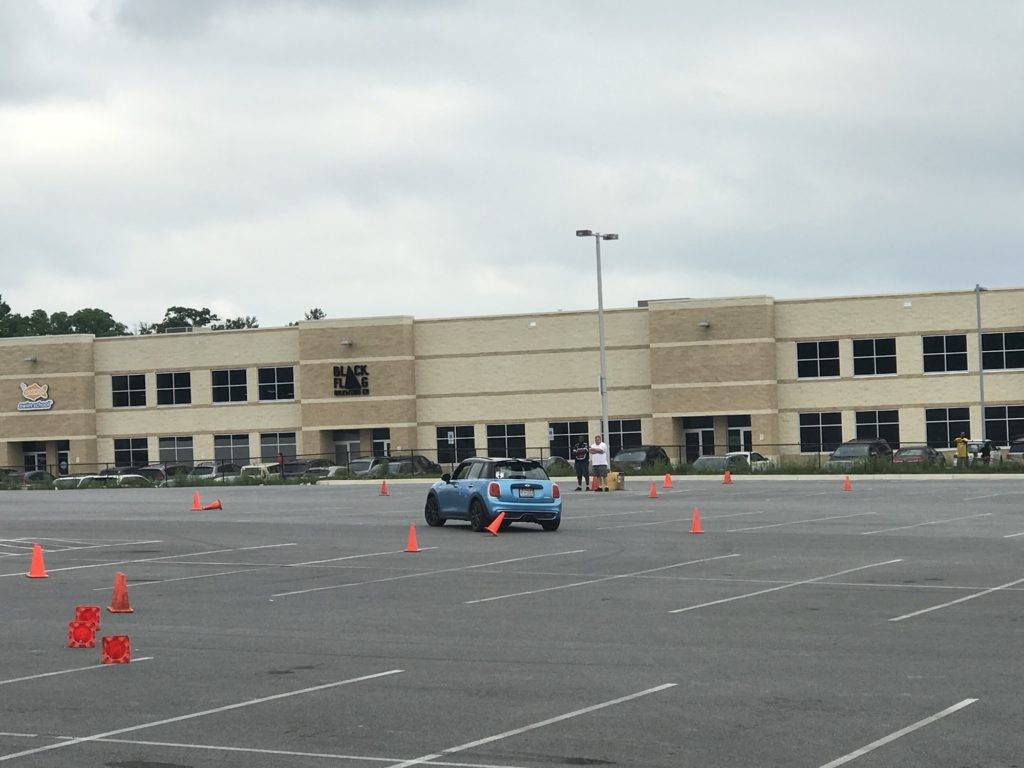
Local clubs and national organizations offer schools, coaching, and plenty of seat time. From Dick Turner’s classic VHS tapes to modern Evo schools, there’s no shortage of resources. And unlike track days, autocross allows for in-car coaching, making it ideal for beginners.
Getting Started: What You Need
- A car (any car — even a rental, as long as the battery is secured)
- A pulse
- A willingness to learn
Before the first run, drivers walk the course – sometimes multiple times – to visualize their line. It’s part reconnaissance, part meditation. Veteran autocrossers memorize cone placements, anticipate tricky transitions, and even squat to simulate their car’s ride height. Some use maps, videos, or even simulations to prep, but nothing beats boots on the ground.
1966 Pontiac GTO drifting autocross gooduys 3/2015, trying to make my sister pee her pants
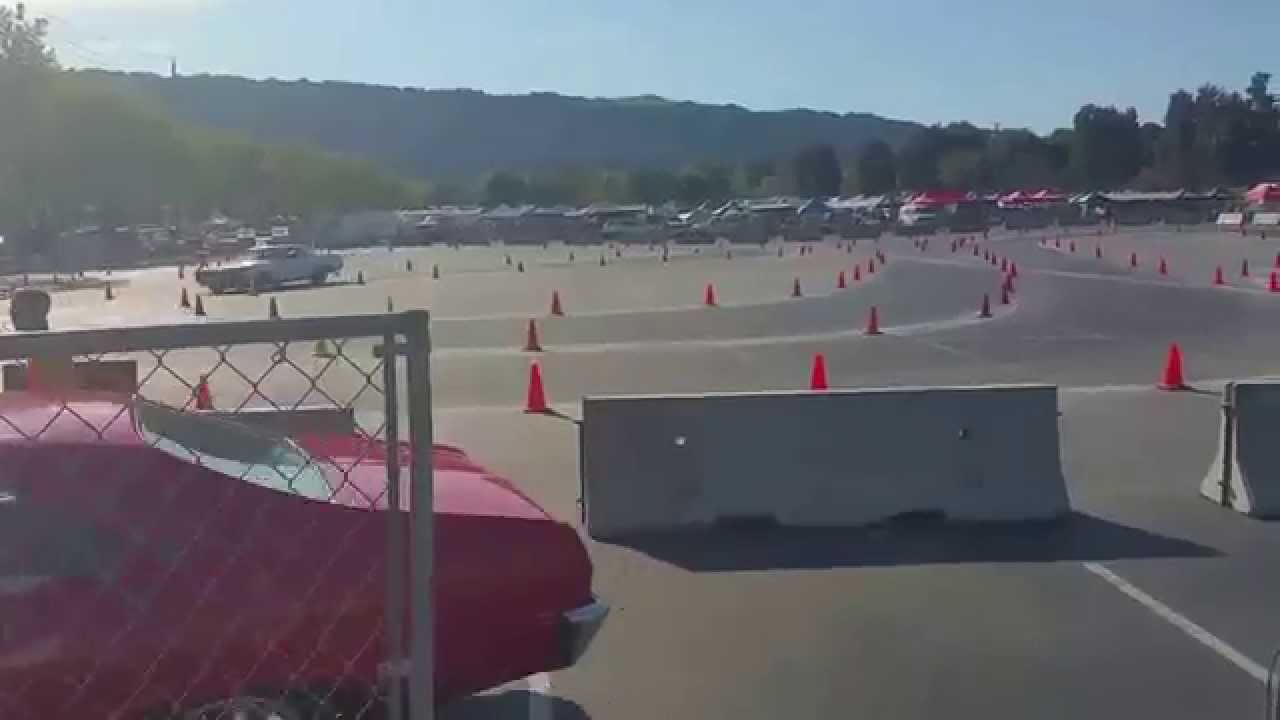


Data, Development, and Donuts
Autocross isn’t just about driving – it’s about learning. From GPS-based data systems like RaceCapture and SoloStorm to video analysis and telemetry, drivers dissect every run to find tenths of a second. And yes, sometimes you learn by spinning out or mowing down a cone or two. As Todd puts it, “If you’re not hitting cones occasionally, you’re not trying hard enough.”
Autocross classing is a labyrinth of acronyms: CAM, CSP, STX, BSP, and more. Each class has its own rules about tires, modifications, and car eligibility. CAM (Classic American Muscle) welcomes vintage iron like Todd’s GTO, while CSP is home to Tom’s turbocharged Miata. And then there’s Pax – a handicapping system that attempts to equalize performance across classes. Love it or loathe it, it’s part of the game.
Community, Camaraderie, and Cone Carnage
Autocross is remarkably safe. Most events are held in open lots with minimal obstacles, and tech inspections focus on basics like battery security, lug nuts, and fluid leaks. But safety isn’t just physical – it’s cultural. Drivers are stewards of the sport, responsible for respectful behavior on and off the course. That includes how you drive home.

Not all autocross venues are created equal. Concrete lots offer superior grip, while asphalt can be greasy, bumpy, or unpredictable. Elevation changes, drainage bumps, and surface composition all affect performance. Sometimes the same lot feels completely different depending on the club running the event.
Beyond the driving, autocross is a social sport. From shared tools and co-drives to post-run barbecues and bench racing, it’s a place where friendships form and stories are swapped. As Todd jokes, “CAM class is really about who knows how to barbecue and tell the best lies.”
Autocross is more than just cones in a parking lot – it’s a proving ground for drivers, a playground for car lovers, and a launchpad into the wider world of motorsports. Whether you’re chasing trophies or just trying to avoid curbs, there’s a place for you here.