
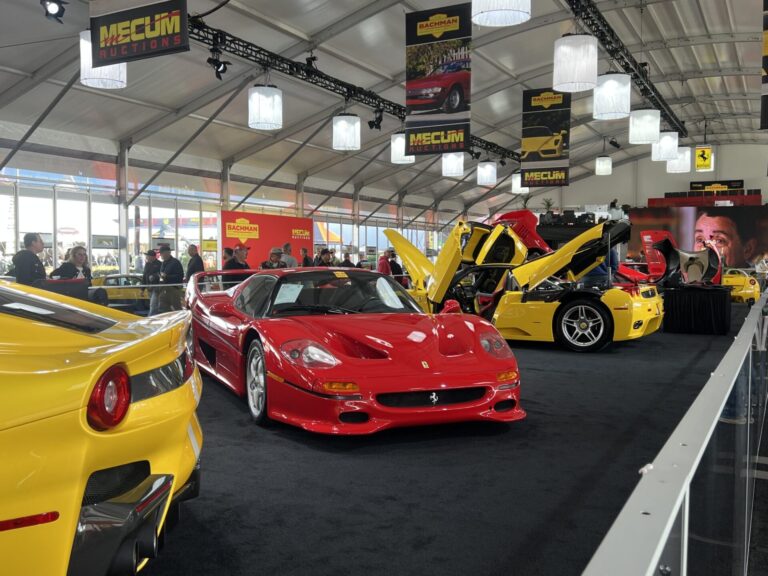
Our “Ferrari Fridays” reporting took on a whole new dimension this year as I reunited with Crew Chief Eric, Jon Summers (The Motoring Historian) and Motorcopia’s David Neyens for a special on‑site podcast episode at the 2026 Mecum Kissimmee Auction. Our team set up auctionside – figuratively and almost literally – to deliver a live, unscripted, deeply knowledgeable commentary on the Bachman Collection (as well as the Bianco Speciale), one of the most anticipated Ferrari groupings to cross the block in years.
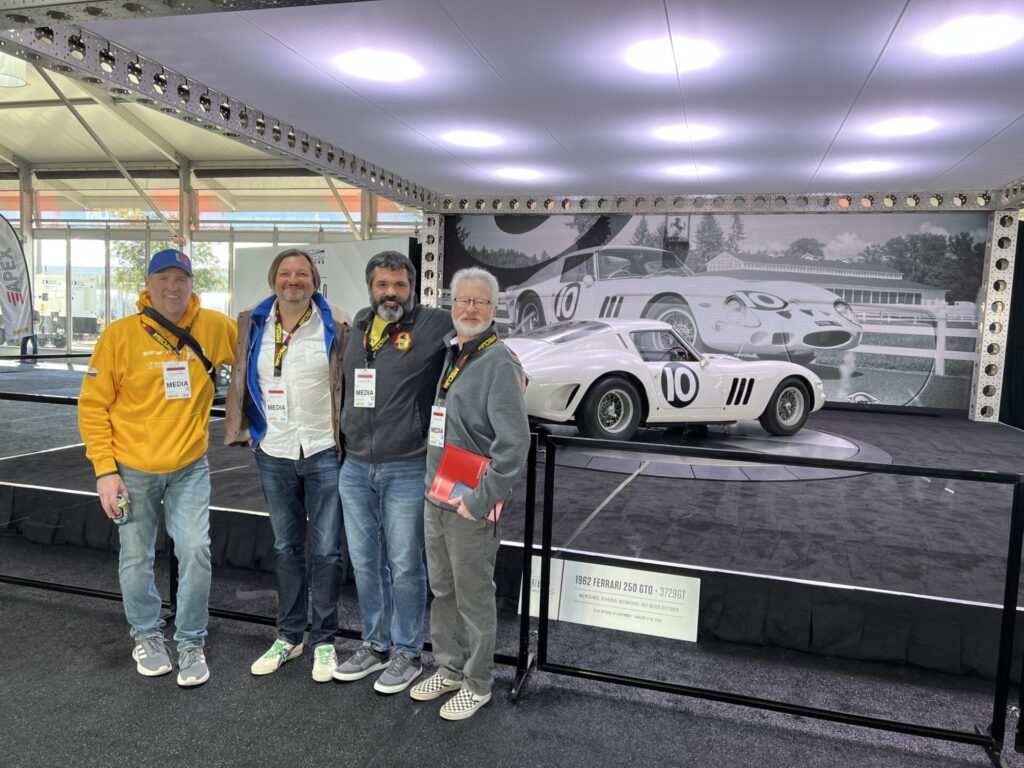
What unfolded was part auction analysis, part automotive anthropology, and part wide‑eyed enthusiasm as the market delivered surprise after surprise.
Tune in everywhere you stream, download or listen!



The first spark came from an 1987 Ferrari Testarossa, prompting a lively debate about “flying mirror” cars – those early single‑mirror, high‑mounted designs from 1985–1986 that were once dismissed and now coveted for their rarity. Add in the early center‑lock wheels and you have a configuration that has swung from unloved to highly desirable.

When the hammer fell at $260,000 (about $312,000 with fees), even David’s data models were caught off guard. The Testarossa market, long stable, suddenly felt like it had torque steer. “There’s a pop,” David noted. “It’s palpable.”
The team speculated on whether this was nostalgia, macro‑economics, or simply the return of deep‑pocketed buyers chasing the cars they once had on their bedroom walls. But there was more even more excitement to come as the auction drove on, with more than a dozen recording setting Ferrari’s crossing the block, including a green Ferrari 360 Challenge Stradale (seen below).
Synopsis
In this episode, William Ross from the Exotic Car Marketplace joins Crew Chief Eric from Break/Fix Podcast, Jon Summers (The Motoring Historian) and special guest David Neyens from Motorcopia.com to provide live commentary on the MECUM Kissimmee Auction 2026. The team focuses on the extensive and valuable Ferrari collection from the Bachman family, covering a range of classic and modern Ferrari models, including the rare Ferrari 250 GTO “Bianco Speciale.” They analyze the historical and cultural significance of several models, discuss market trends, and consider the factors influencing auction prices. Key highlights include record-breaking bids for unique and low-mileage Ferraris and the unexpected final hammer price for the Bianco Speciale, sparking debates on the evolving collector car market.
Transcript
[00:00:00] As part of Ferrari Fridays, William Ross from the Exotic Car Marketplace will be discussing all things Ferrari and interviewing people that live and breathe The Ferrari brand. Topics range from road cars to racing drivers to owners, as well as auctions, private sales and trends in the collector market.
Never, never.
As part of this week’s Ferra Fridays, you’ve just tuned into a very special episode where host William Ross gets together with me, crew Chief Eric John Summers, the motoring historian and special guest David Ions from Motor Copia as we reunited at the 2026 Mecu Kissimmee Auction to do a play-by-play commentary on all the Ferrari in the Bachman collection, which led up to the sale of the Bianco special.
So we invite you to sit back and enjoy the show. Welcome to the Fire Marketplace Grand [00:01:00] Jury Motor Motor Story Motor Copia. We got the whole crew here. We’re at Combs Kissy Sale and we are getting ready to start firing all at the bottom collection. But there’s a teaser. There is a, what year is this tester?
Uh, it is a 87 tester. 87 tester. Rosa is gonna kind of start the fireworks here. They’re trying to do commentary across the board, the whole collection, and then we’ll get to the PTO. But here we go. Tester coming up. Alright, so John, you brought up a really good question. You just said flying mirror and I’ve heard the single spec and all that kind stuff, which, that makes sense.
One mirror on one side of the car. What’s the flying mirror? Is that the two mirrors? It’s 85 86. First 87 when they went to the two mirrors. But it’s just a single high mirror on the driver’s side. That’s it. That’s modest speco. Every, you want pronounce it. He, so they call the flying mirror. For a long time those were poo-pooed.
No one liked them. Right. Then all of a sudden everyone wanted ’em. ’cause they were more rare [00:02:00] than the standard ones. I love it when people realize how cool or interesting or rare something is that was once unloved the redheaded stepchild. Right now it’s in the in flavor. It’s, it keeps things interesting.
The other thing with these test Ross, is the early ones had center lock wheels and then the late ones had traditional five luck. And that center lock thing was something that wasn’t desirable at first, but subsequently has become something that people really look for. Oh yeah. Every Porsche owner today wants center lock wheels.
Who wants to have five bolts to take off something? Yeah. On that wheel when they driving down the skate. 260 K for the tester. So 260 k Dave, that’s well above your algorithmic average for these cars. So are you thinking there’s a growth in the tester market right now? There’s a pop and it’s, it’s, that’s three 12,000 with fees.
It’s palpable because, and I, and I’d have to say we’ve been discussing this earlier, I think it’s because of all the capital. That’s floating around right now looking for a home, and people are [00:03:00] going back and looking at what they wanted back in the day. Now they might have the money and now they’re ready to roll and pull the trigger and, and get what they wanted on the, from the poster in the eighties.
Black power already done at 1600 models as well. So it needs everything is what you’re saying. It needs a full belt service. Yeah, yeah, of course. Hey David, what was the production numbers on Tester Rosas? Not TRS and m, just the tester itself. I think they were 7,100 and some odd. About 7,200. Okay. In all definitely a successful production model, if you can call that a production number for, for Ferrari, that’s significant.
But the cultural significance, I think maybe people are just going back and just saying, this is a great car. They’re easy to drive, they’re brilliant performers and I wanted one back when I was a kid and now I can get one. So Dave, when you go back to the office and you take a look at your test case of the Testa Rosa for motor copia, how are you gonna have to adjust?
Just going to have to plug in the latest sales results and these rung the bell. This is amazing. This car went for almost for a hundred thousand more than the [00:04:00] top estimate for that I had before based on sales data, based on the culture, based on the macro data for the economy and politics and all that.
These cars that I think they’ve always had joint strong demand, but I think that people are, now, they’ve got money again, that, that tells me there’s money. I don’t know where the money’s coming from or what country, but I’m, I’m, I’m wondering if there’s international demand for these cars or if it’s, if it’s domestic and, and people are just saying it’s time to have something fun that I’ve always wanted.
When we look back in the catalog of the Mecu cars that sold, there were a couple other tester Rosas that also hammered above 200,000. Yeah. Which is probably a good sign. As we look across the Bachman collection, there’s probably a high probability they’re all gonna be 200,000 and above. I think that’s reasonable coming from fastidious collectors that were in the Ferrari community, maybe that provenance, it’d be interesting to see if that provenance gives it an even further bump to the test.
You’re gonna have to look at the entire calendar year because here. In January at the beginning. So we need to see if it [00:05:00] carries through the entire rest of the auction season. Exactly. It’ll be interesting to see if this actually does carry through. It seems like there’s a lot of exuberance, positivity.
The stadium’s almost full. This seems to me like we’re back to, you know, record setting numbers again. It used to be that, sorry, pricing per for the year. Are we feeling like now maybe Mecu and Kissie are doing that? Yeah, I think, I think Mecu Kissimmee is displacing the traditional, uh, catalog type players and the other events like Scottsdale and Amelia.
But it’d be interesting to see, again, does this carry through to the next two events? And if so, then we’re gonna have a banger of a, of a Monterey barring any black swan situations, which are always out there. So do you think it’s gonna be buy low, sell high, let’s say this is the low, they’re buying ’em now in January, taking ’em to car week and trying to make more money there.
Is that a possible strategy? You know, there’s always a possibility of arbitrage and going to other events. I, I would love to be a fly on the [00:06:00] wall, uh, as to whoever takes this test OSA home to see whether or not it’s a cherished keepsake, something they’re going to enjoy and show. Or are they going to just be flipping the thing right there?
There’s never the VH one. Where are they now moment with these cars? It’s a, it’s a moment on the block and then they’re gone and you may never see them again. Exactly. That’s why I like to always copy down VIN numbers and, and chassis numbers, because I like to track them now. This 69 L 88 coup. I know the Roadsters and the 60 sevens are far more rare and and stuff like that, but 310,000 for an L 88, 1 of 116, that’s a bargain.
Well we are two Corvettes away from the Bachman collection, so we are just rounding out the end of what Muscle Car Alley here. Yeah, this is like the sixth Camaro Jenko Camaro we’ve seen and we, we just saw the proto like Jenko Camaro across the block for $1.7 million kind. Not me. Flat on my ass. [00:07:00] Yeah, absolutely insane.
Oh, the kos are having a record day today. This is 69, 4 50 already just when the calling started,
but before Don Yanko was putting four 20 sevens in Camaros, there was a dealership in LA called Dana Chevrolet who were doing exactly the same thing. And it’s always confusing to me why Yanko is the guy that’s got all the reputation and why Danish Chevrolet are kind of forgotten. I think it’s because Don Yanko is responsible for initiating the copal program at Chevrolet with their internal office in order to get these cars even built so that they could be updated and customized at the dealer level.
And I think that might be the heritage. Plus he’s an immensely successful SECA racer in the sixties. I’m wondering if it’s that sort of, that glow that that’s causing that bump in value. However, if you’re looking for something like that as potent and but more rare, [00:08:00] then one that came outta Dana or Berger in Detroit or any other dealer that was part of that program, like Nick, then you’ve got something even cooler as far as I’m concerned.
Yeah. With all that heritage, would a Berger or a Dana car make as much as we’ve seen these Yanks back? You know what, I’ve gotta take a look there. There’d be a lot fewer of them. You know what? That’s a possibility. Just due to rarity. They were all kind of developed the same way. And I think Dick. Had something to do with them early on.
There’s a sort of a commonality and then a little bit of a rarity differentiator. So it’d be interesting to see how those cars perform. So for the European enthusiast that know Yanko, the man, what does COPO stand for? Oh, um, corporate Office for production order. It’s like a arcane nerd level, uh, fleet ordering system that Chevrolet used.
Okay. Was it taxis? Police cars, emergency vehicles would’ve all been ordered through a fleet ordering system to streamline the process and then maximize efficiency. But [00:09:00] Vince Piggins was the brains behind the, the dominance of Hudson, uh, in NASCAR in the early fifties. And he was Chevy’s product promotion and an engineer that really worked the Copo program with don y to make it all happen and put Chevy back on top.
They were taking a beating in relation to the Hemi cars that Chrysler was building. They were building race cars before this, you know, that you couldn’t really buy them for the street, but what was considered street car like the 60 68 Hemi Dart. Sorry, that’s not a street car. Right. They even came with disclaimer cards all over them saying, but you know, the idea was make a streetable car that street legal, that Chevrolet could kick out the door and then they could be back in the lime lights.
So, well gentlemen, we are one car away from the beginning of the Bachman collection, which is kicking off with what looks like a his and hers Alfa Romeo eight C combination, both a spider and a cupe. So really curious to see what those hammer for. But then we will dive deep for what, 44 more [00:10:00] cars after that.
Love it. World of Ferrari. Yeah. This is, this is like, uh, being a kid in the candy store.
I remember being a kid and you couldn’t give a split window coop away, but now people are recognizing how cool they were. How one year only, and I will say the stands are filling in. When we got here earlier, it was a little bit thinner, but we are kind of at high tide at the moment. It’s exciting, you know, it’s, it.
It also shows how much interest there is in this market. It’s a show, it’s a, uh, an auction. It’s an experience. It certainly is an experience just walking around outside with the Floridian crowds, my words. You see some sight, not least, that dark wood Miss America eight boat. Yeah, that was pretty cool.
Miller V 16. Can you imagine building a boat? A beautiful woodhall, a speedboat back then and two custom built two [00:11:00] order V 16 Miller Engines. I mean, it’s, it’s music when it runs, it is peak hot rod. Absolutely. Garwood made his money inventing the hydraulic press, and the reason he made a lot of money was coal wagons didn’t have a hydraulic press.
You just have to shut. I did not know that. And what a industrial leap, imagine that just to reduce the workload required. To move that goal. It’s amazing. But that’s seeing an opportunity and making it work and then reaping the spoils. Alright. We have an interesting break in the flow of cars at the moment as we transition over to the Bachman collection.
They’ve been one after the other for hours now. Sort of like, where are the cars? Are they gonna do a special presentation? Oh, we’re doing a little bit of Automobilia signed photograph of Mario Andretti winning the 12 hours of Seaburn. Oh, that’s cool. There’s something for everybody here. [00:12:00] It’s like the last Foo Fighters concert I was at.
You go through waves and then you reach a crescendo near the end and then it goes two levels higher. So it’ll be interesting to see how the day progresses. That’s Bill Warner up there on stage. Oh, that’s, I think, I think you’re right. I think that’s really cool, bill.
Right? That’s a paradigm shift is what it was. And, and, and, and Emelia Island’s been considered the Pebble Beach of the East Coast. Right? Yeah. And I’ve, I’ve had the distinct privilege of meeting Bill several times. I’ve interviewed him on the show [00:13:00] before. He’s a wealth of information. He’s always a yes.
When you wanna, Hey Bill, can you tell me another story about this or what was it like doing that? He’s, he’s a fascinating gentleman and he’s got a couple books out too. He’s an author. I mean, he’s a, a noted author, great on, so great opportunity to look him up. I, I think a bunch of his books are on Amazon.
And not only that, the proceeds of the books go to the Spina Bifida Foundation in Jacksonville, which he’s a big part of. So, you know, great cause. Give back, especially if you want to add a coffee table book to your collection at home. Everything. One day Saturday talking about high end stuff. By the end of the conversation we were talking about.
Yep. He’s one of the reasons why, um, I, I’m building out my road and track collection because, uh, of his coverage and his photography, I can’t believe 60 grand for a photograph. From your vantage [00:14:00] point, Dave, can you see the cars or are we still dealing with memorabilia? We we’re still dealing memorabilia.
Sign now and then the cars.
It’s a great time window though to, to shift direction slightly and bring these great collectibles out too. But what do people do with these kind of collectibles guys? What do they actually do? Do you just put ’em up in your garage? Do you have them as an investment? Like they’re, they’re a peculiar thing to me.
I think there’s a whole market for, what are they, they call automobilia. But to your point, you have to have the space to be able to use it for decoration. Because if you’ve ever seen, let’s say a traffic signal in person, they look so small when you’re in the car, they’re massive. The reality. Yeah. Seen, right?
And so these dealership signs are absolutely just huge. They take up a ton of space. So you have to have the right garage, warehouse, airport hanger, or whatever it is to be able to put it. Now granted [00:15:00] that’s the premise behind Garage Style Magazine is how can you take this sort of stuff and then decorate your garage and make it your garage?
Mahal, let’s just call it that. So, but I think there’s a market for it. I sometimes, I wish I could have this kind of stuff. It’s almost more about interior design, correct. Than Automobility, isn’t it? Now they can be a little problematic. Dealers like, uh, brand signs like this, I know BMW, they actually litigated against a car dealer.
That wasn’t a BMW dealer, but had a illuminated BMW dealer sign. This is about 20 2004 and it was quite an interesting case, but I think if it’s for personal use, I don’t think anybody can quibble with that. Yeah, I mean, if we put it into perspective, I mean, look at those gentlemen that are standing by the Buick Neon dealership sign over there.
I mean, that, that guy’s probably, what, six foot tall? He comes up between the C and the K. That’s a big sign. You need a real building to put that on. Oh yeah.[00:16:00]
It’s a Ferrari sign. 28,000. The hammer. Oh, they turned the lights off. Okay. Changing Focus Bugman collection coming up. Oh, we’re gonna watch a movie. Okay. Gosh, I like this dramatic buildup, ladies. And
here we go. All cars in the Bachman collection. No reserve. Never seen do that before where they’re like, dim the light to do the intro. This is interesting. We’ve got two out from air, eight Cs here, a yellow one and a red one. It’s been interesting to me all the way through the event, how they’ve stacked the same cars alongside each other so you can, as a potential buyer, make comparison between them or buy the pair.
I like it. You’ve got the, uh, got the [00:17:00] convertible and the coop. Why not get both? I mean, we, I mean, we joked about these cars. Why are they here? This doesn’t make sense. And, and you know, the consensus is well underneath the skin. They’re really Ferrari, so it, it, it makes total sense that they’re here in the collection.
I mean, they’re more modern cars too. Probably some of the, the leader acquisitions that Phil and Martha made, but, you know, they’re a handsome car. I personally like ’em in a slightly darker tone. A blue or a dark gray or black, especially, I think it wears black really, really well. But you know, for the discerning buyer, yellow is interesting cost.
Who was the feeling of the tub? What would they like to draw? I would love to drive one. I think they’d probably be just amazing considering what they’re, how they’re powered and how they’re engineered. For my money though, I feel as though this is in the same realm as the Maserati Cupe, the Ferrari powered Maserati.
But also if you draw parallel to BMW, this is like the Z eight and for my money, I actually want the [00:18:00] four C, which is a little bit more like, you know, Z four territory than Z eight territory. You know what I mean? There’s some, there’s a bit of a mystique around these eight Cs that actually for me is a little bit off putting.
On the other hand, I think it represents the, the precise moment when, as I understand the corporate structure, FCA started really celebrating its heritage and branching out to cars like the eight C, bringing them to life, the four C, and then branching out to cars that are more production oriented.
Yeah, just like the thirties,
again, celebrating heritage, just like the eight c uh, cars of the thirties.[00:19:00]
Don’t you think the coop is worth more than the convertible? I would think the convertible, because it’s, uh, there were less built, fewer built. I mean, although I think the red is a much more appealing color than the yellow for me. Oh, it looks so right on that car, on that coop. The red was a far more common color.
When I think of an Alpha eight c, I think of it in red.
I think Eric, to your point about comparing with the four C, to me the four C is uh, something like a Porsche Boxster, whereas this is far more like a Ferrari five 50. This is a grand tour, front engine, grand tour, not a mid engine sports car.
So the open air premium holds in Florida
four. [00:20:00] Yeah. 94 Ferrari five 12 tr So five 12 TR and five 12 M. What is the difference between them? David, do you know? This is funny. I, I used to have this on the top of my head, but I, William probably knows what the difference between the TR and the m Uh, well, big day front headlights, just more fines. Got a little more power.
Uh, it’s a little wider and it’s kind of beefed it up for the last, the last go go around for it. So it looks, I’m a lover hate because it’s just some people don’t like those open headlights.
I’m in that camp. I prefer the, the, uh, TR five 12 m it sort of echoes the, the, uh, 3 48 a little bit too for a little family resemblance, doesn’t it? Yeah. Ley is the finally evolution of that fact 12 line that started way back in the early seventies with the [00:21:00] 3 6 5 and moved through the Berlin netter boxer cars.
And then finally we had these five twelves at, at, at the end. And my understanding is that these of the group were probably the best to drive Fabulous heritage. Yeah, that’s what I’ve heard.
As I understand, easy to use, easy to drive, good visibility, Mo at least out the front and the sides, and lots of performance. I think rarer than the tester Ross as well. That’s right. That is such a clean design and when you compare it to the 80 fours, the very first ones, it’s so much more refined. But you don’t lose the streaks.
The straights are the most important part and they’re very distinctive in in farina design. In that Pininfarina designs tend to be a couple of simple lines in contrast to uh, for example, vle tend to do very complicated, often quite challenging shapes or [00:22:00] zagato less so, but they have a similar kind of styling aesthetic.
Whereas Pininfarina a few simple clean lines, super elegant. That’s right. And the side strikes, I mean people kind of found them controversial, but I mean they were aerodynamic solution to venting the cool air into the radiators. I think that’s a little bit the same as the Cadillacs 59 Cadillac spins with the stability stabilizing at speed.
Yeah. And actually the Chrysler 300 F in 1960, they set a bunch of speed records at Bonneville with it and the fans did enhance lateral stability Well and need did on ejaculate type as well. Yes. So maybe there is something to it That’s right. More than double that Testa Rosser and that Testa Rosser did over its estimate.
I mean this is remarkable. Wow. Alright, here’s one of the Fab five. We [00:23:00] had a 2 88 GTO up on the block with a whopping 2000 kilometers. What’s that in Miles? Dave? You’re Canadian. Yeah, I think that’s 1600 or 50. Yep, that’s right. Slightly used just ever so slightly. But it, it is in this car significant because it’s the first of Ferrari drill halo cars that have led down the road to.
Ferrari. This is the first of those real supercars and although it looks like a 3 0 8 with extra spotlights and a body kit on it, in fact there was a lot more development work done. Was there not? There was. And more importantly, this is a longitudinal orientation for the motor, which is a step away from some of the other designs that they’ve used with the transverse engines.
But it also is the door that opened for the F 40. ’cause when you re-skin a 2 88, that’s what you end up with is basically a wide body, almost LAMA prototype [00:24:00] is where the F 40 lands.
Oh wow. 7 million. We’re already at 7 million seconds into the bidding. What have these been selling for four to six range? We’re double that. Yeah, I mean, again, one owner 27 2000 kilometers. I mean, come on. And that’s the power of a single owner. Long-term ownership provenance.
You love the air horn, don’t you? Got a soccer game? Anybody have a cowbell? You know, like they using scheme 75. What we might be witnessing here is somewhat of a paradigm shift in terms of what bidders, qualified bidders are willing to commit and are willing to step up. You know, it’s, [00:25:00] it’s kind of setting new marks for this year.
The uncertainty in the economy at the moment. It’s astonishing to me that, that we should be seeing a record price like this. And it’s uncertainty for some and not for all. There’s a, we’re we’re seeing a stratification right here, right here is physical manifestation of it. You, you were saying you thought the one owner thing was very important with this car.
That’s right. Do you, is it, it’s one owner and the backman provenance, because that’s gonna mean that your GTO, your two aa GTO always stands out from anybody else’s. Yeah, there could be, uh, there could be differences. Absolutely. And then go also depending on mileage condition, but I think a single owner grouping, there you go.
8 million
a car that saved Ferrari. Eric, the 3 0 8, you keep saying that they, this is the car that saved Ferrari. Why? Why was that? Because it’s the most mass produced Ferrari ever. And [00:26:00] it came at a time where Ferrari was in transition from, you know, the cars of the sixties and the, you know, the 360 fives and the five twelves and all these other things.
They were even being produced in the early seventies, but they weren’t selling well. Right? You had the Dino 2 46 that didn’t really sell that well. You had a lot of, were not doing well, and the economy wasn’t great in the seventies, and you had, you know, post-war Vietnam, a lot of things. Now granted, this car gained a ton of popularity thanks to the hit show with Tom Selleck Magnum pi.
But at the end, it forced fer, the 3 0 8 forced Ferrari to go into mass production, to not only fuel the, the racing program through the seventies, but to keep the company afloat. So, William, how many three oh eights did they build in? It’s like seven, eight year time span. You use that tens and tens of thousands of them.
30 to 40,000. It’s a lot. Something like that. And then that carries on into the three 20 eights, you know, a couple years later. So long life and a long purpose, but it’s a very popular car. Maybe [00:27:00] not the poster on the wall car like the tester is, but it’s the cheap version of the car you couldn’t really get at that time.
The body lines are supremely Yeah, they’re beautiful and, and that, you know what, the three liter VA mid engine, this looks like the car that the Dino could have been earlier on. Yes. Well it, the Dino’s, the precursor to it, right? Absolutely. I think the 3 0 8 appeared as at the, as early as 1969. I think the shape was penned very, very early, long before production.
And of course the early cars were fiberglass or racino is the Italian term for it. And absurdly the plastic fantastics are worth more than the steel ones. Yeah. Because the rarity, well also, I mean you consider the plastic ones or the fiberglass ones. Carbon Kevlar, whatever they were using back then.
They’re the lightweights. Right. Versus the steel cars are heavier. So if you’re going for performance and you want to eek out as much as you [00:28:00] can, you want the lightweight 3 0 8. Now granted the early cars are carbureted versus the four valve head later fuel injected cars, which would make more power. So in the end, is it a wash powered away ratio?
Probably yes. Fully. Because my understanding is, is that the QV head and the 3.2 only came in to offset the performance loss that was as a result of emissions in the 3 28. Yes, absolutely. And I got a chance to actually autocross the 3 28 again to drive it as well. And I’ve never been in a V eight that is so happy to live Its life at the top end of PM Band is absolutely brilliant.
Engine’s exciting. It must been for autocross because they feel like little sports cars. Yeah. Waits at the back a hundred percent. The Starling heritage that goes with TV production crew wanted to use a Porsche 9 2 8, but Porsche refused to cut the roof off, so they went to Ferrari instead. And the rest history, I mean, Tom Selleck barely fit in the 3 0 8.
I can’t imagine him fitting in a 9 28.[00:29:00]
So now we have a 365 John. So we were talking about this yesterday. In preparation, when you look at it from afar and you don’t know any better, you go, oh, that’s just another Berlin out of boxer. But it’s not a five 12 bb, it’s the precursor, right? Yes, absolutely. And, and the 3 6 5 designation is the cubic capacity of each one of the 12 cylinders.
This is the gray market delight of, uh, doctors, lawyers, uh, successful dental, uh, practitioners, academics, anybody that had a sporting event and, and available capital, and they weren’t afraid to wait for it to be federalized. And again, this is the car that gave way to something like the 2 88 GTO because you can see the body lines in its design.
Now, there’s a couple other cars that share similar design language. We could talk about the 2 37 and the launch of Beta Monte Carlo and things like that. They’re very, very similar, even though those are, I think they’re [00:30:00] Tony Designs, but you see that wedgie seventies Italian, they’re all kind of going in the same direction.
But what this car was the genesis of is pretty incredible. This was space age, I mean, yeah. And I think if you speak to Ferrari purists, they, although the later BBS may have had more power, these early ones were so light and, and delicate to drive without the safety or emission stuff that came through the seventies and into the eighties.
Well, it’s funny you that, because I had the opportunity a couple years back to interview John Warner iv, and one of his daily drivers was a five 12 bb. And I asked about it, you know, during a meetup one time. I said, John, what is it like to drive a Berlin Netta box star? And he’s like, it’s an absolute widow maker in an absolute nightmare in some respects, to drive.
They’re very twitchy, they’re very unpredictable, you know, and he’s owned all sorts of crazy cars, Paneras and all sorts of things. And, but he was like, the five 12 is one of those cars that puts the hair on your chest. Well, [00:31:00] isn’t there something weird about the engine bin on top of the Transaxle? So the handling somewhat compromised because of the height of the engine.
You know the thing about the, the early the, the Berlin in Boxer, I mean all flavor, all the iterations. It wasn’t so long ago those were 130 5K car. Now here is the car that was on my bedroom wall as a kid. This for me is still a gorgeous car. It’s an ultimate supercar. It’s beautiful from every, you’re in your forties, Eric.
That’s why if you were older than that, you wouldn’t feel like that about the F 40. But it is the up and coming car, isn’t it The F 40? But I don’t understand people that like the F 50. I’m just gonna come out and say it right now. Seconds into the bidding. We’re at 7,000 R 7 million. Excuse me. Add three zeros.
Six five.
Oh sorry, six five. My understanding was these were two or $3 [00:32:00] million cars. We are just a six and a half. Is this this one ownership thing? Is it the low mileage thing or, or are we just seeing, I mean 456 documented miles. Oh, the Buckman took factory delivery in 1992. I don’t think there’s, I don’t think there’s that forties in the Ferrari museum that have less miles than this.
On the one hand, that’s great. And on the other other hand, that’s a sad thing. It needs everything. That’s, I keep saying, but at the same time, I’m glad that there’s folk like Phil Backman preserving cars. ’cause there’s too folk like me who just drive the kaho and that one out. Yeah, but you’ve had a good time in the process and you reduced the cost per mile.
You have reduced the cost per mile. Yes. Let’s not forget that. You know what I would give for a black F 40? I’m just gonna say that right now. Well, there is that meat colored one isn’t there? Yeah, though, like the, which. Really [00:33:00] makes you stand out there. If you own that min color, 40, everyone knows it’s your car.
There was one recently reaped done. Or repainted. Or rehabbed. It’s a, it is a light blue like metallic. It is gorgeous in that color.
That has to be a market setting record throughout that.
Alright, so very early 3 0 8 GP here with fiberglass bodies. You guys the last for us one, right? One of the last, yeah. Now this 3G TB is a razina, is that correct? A fiberglas body? Yeah. It a is a only 9,931 miles. The eighth example produced, the thing that people always say about this is they need a belt service either every three years or 30,000 miles or whatever it is, and how that’s a bit of a pain, the bottom.
But of course the car was designed to have the engine lifted out [00:34:00] and have those belts done. So it’s not even that challenging. That’s my understanding. So the beginning of the line here, fiberglass body
clean, GTB body
see, but I’m sort of, of the opinion that if you offered me a 3 0 8, I would take it. Oh yeah. I would probably be happier if it was the one that had a hundred thousand miles on it. Because I knew it was driven. I knew it was loved and it had to be maintained in order to get there. No, you don’t think so?
Yes. For me, the, the living breathing car is far more appealing than the garage queen. Low mileage special. But you know, this is what Phil Backman used to say his there when people used to say to him, drive the cars dude. He would say, you enjoy the cars your way and I’ll enjoy them my way. The fees and stuff.[00:35:00]
I, I was outside and some people were chatting and like one older gentleman asked this younger gentleman, they was probably around our age, but the older gentleman’s probably in the seventies, he goes, what do you think the total thing worth? And the guy was like, oh, I don’t know, probably around 50 million.
And I turned around and said, you’re way off. Five of the cars total will go for that. Yeah, it should break a hundred million total. At least get close. Well we can add it up afterwards. Find out roughly taking a ballpark is say 12% total in fees. You know, maybe they negotiate a little better rate stuff.
Even just doing that, we get, you know, let’s still impressive. Yeah. So now we got another Testa Rosa for your books here. This is way out of the ballpark, isn’t it, Dave? Totally, totally. Why are we reach 257 miles? 257 miles. There you go. Interesting aside, Darrell Greenmeyer, the late ne Darrell Greenmeyer, former [00:36:00] SR 71 pilot holds the, uh, bought this car new, he holds the, uh, piston powered world record that has yet to be unbroken since it’s 19 69, 483 miles an hour in a Grum and Bearcat.
Wow. So this was his car new. So Dave, when you go back and do your analysis on the Testa Rosas, does this car suddenly become an outlier at $600,000? Absolutely. Absolutely. So it’s almost off the table is, is it the provenance? I mean, is it, you know, not only original owner provenance, but also Bachman provenance, low mileage.
It’s just ticking all the boxes. But Testa roses are, are entering a new paradigm right now. Yes. 6 25. It wasn’t that long ago at Monterey. I, I sat in a black car that was estimated to make 90 grand and thought, oh, I might even be able to get there. But six 50, I don’t think I can get there. It’ll remain to be seen at the next round of auctions, [00:37:00] uh, January, March.
And then Monterey, have we entered a new era for these cars or, or, uh, and a new expectation? Or is it just simply a function of a perfect alignment of the planet’s money, supply, exuberance, people appreciating these cars, and also the presentation of them as one single collection? I love the, uh, plexi nose on this Daytona that we’ve got on the block at the moment.
What’s the premium? Is there a significant premium for cars with the plexi nose? I think it’s rarity and early production status. There was a time they weren’t as much in vogue as they are now. If you’re collecting Ferrari’s and you like the Daytona, then an early one should be in your collection. Again, it’s money chasing rarity and first of the line status.
I mean, I’m gonna be the detractor here. I’ve said it before on our drive through news program when these cars just happen to come up every now and again. I am not a [00:38:00] fan of the shape of these cars. I mean, I get the whole Miami Vice thing. You know, they did use these on Miami Vice in the early seasons versus Tesla Rosa later.
But I just, I don’t get it. Well, a story about Miami Vice was the original. The, the Daytona in Miami Vice was a replica. It was a Corvette on a replica chassis. The Ferrari himself was a fan of the show, contacted the production company and said, I will give you a cup the next season. As long as that black replica meets a horrible end, what it does, it burns up.
Sonny Crockett fakes his own death in when episode. She’s the car and it burns, hence the white tester. Also to the Daytona. It was not intended as a race car, and yet I think it earned second. And the 24 hours of Daytona at 19 79, 6 25. That Daytona just paid, what, five 50 I think or something? I’ve got 6 25.
Oh, was this, so we’ve, uh, 79 3 0 8 on the block now. So [00:39:00] super rare color here. Never even seen this color on a Ferrari before. How much is that gonna add to value or to, to interest to a 3 0 8 fan like me? Dollar for dollar? I would love to have one that’s in, not in Rosso. What you’re not able to see when you’re watching this on television is the actual color of the car.
This is a very, very gray car with a green undertone, but on television it presents itself as very green. Now there is a green color for three oh eights, which is really, really nice. And there was actually, if you use a Magna Pi reference, there was an episode where they actually featured a green at 3 0 8 on there that Carol Burnett drove.
And the story goes that Tom Selleck was in the shop and they brought the green around all this kind of thing. This is not that color. This is a gray, uh, that you’re seeing here. You know what, you’d have to show me a bad color on the 3 0 8. I’m sorry. I just think [00:40:00] that that color they wear pretty much every color.
Well, that is just gorgeous and I love it’s that it’s apparently it’s the first 3 0 8 produced in that color combination.
So isn’t this a this, we, we now have a, uh, five 50 barta crossing, uh, crossing the block. Isn’t this a case of, uh, you give the punters less and charge ’em more? You cut the roof off and yeah, charge ’em more money for it. That’s the Porsche formula, right? Take something away and charge more for it. I love some 5 55 75.
Not a fan of the convertible. And I’m gonna say it on. Probably say it again during this broadcast, I don’t like yellow. It’s all in the eye of the beholder. Eric. I don’t think the five 50 wears yellow. Well that, that’s my point. Black is Corvettes wear yellow excellently. The nine 11 looks. That’s really good.
Yellowness. That’s Kyle light yellow. Yeah. This body shape does not lend itself well to yellow. Now sadly, it doesn’t roll off the tongue. Like [00:41:00] say uh, red Barta from uh, from Rush. Yeah, yeah, yeah. I wonder what Neil Pert would’ve done, but you know what? I’ll take a yellow Ferrari any day. I don’t care. We’re at 1.1 already for five 50.
These look really good in that gun metal gr. They do a lot of gun metal gray in that car and the dark blue that the four five sixes came in is really, really nice as well. And I worked at EMC in the.com boom. My boss was rookie of the year and with her bonus, just her bonus, she bought a new five 50 oh and sat it in the garage one time at her house.
You know, I love the observance of those days. As a bystander I was in banking and financial services and just hearing about the stories like that and then getting the inside baseball of the tech, uh, Silicon Valley scene from you, John. That’s fun. How many other grand tours did [00:42:00] we cut the roof off of Ferrari you think of?
No, design wise, not Ferrari in general, but like we talked about before, you wouldn’t cut the roof off on 9 28 because this is the sort of classic card that the five 50 is in. So can we think of any other, maybe some Astons where we cut the roof off? Thanks. Js Jaguars, yes. There’s not many in that class where you take a grand tour and make ’em a cabrio.
Le you’re making me think of that traditional British term that the Drop Drophead coop or drophead co a, that it’s almost that kind of, as opposed to a true Roadster drophead. Has like the folding roof so it can be a little more formal, right? So,
alright, here we go. Another halo car. So why want that vibe? I teach a class at a prominent west coast university [00:43:00] each year and I had a student a couple of years ago pull one of these cars up in a presentation he was doing as an illustration of design that’s 20 years old that has moved onward and and upward.
Now for me, I was really not sure about these enzos when they first came out. As the years have gone by, I’ve really begun to appreciate how they represent what Ferrari was doing in Formula One. At the time, the high nose, like the anhe nose that was on contemporary Formula one cars. But my question for you guys is how has the Enzo shape stood up over the decades?
I don’t think it’s aged well, John, it looks very early two thousands. It is to your point, mimicking the formula one cars of that era and it’s just sort of stuck in time versus a car like let’s say the Audi R eight or the third Gen RX seven or other more fluid designs, you can’t put a date on them. This car, in my opinion, is very dated, especially when you [00:44:00] compare it to things like the LA Ferrari and things that came after it.
But it is a step away if you keep it in the same lineage as the F 40 and the F 50 and the cars before it. It’s very different, right? It’s very much more the Batmobile. There goes yeah, definitely those top of the range Ferrari sort of hyper cars from the days of the 2 8 8 that basically they a Hot Rod 3 0 8.
This is something completely different in terms of order new by the bot messaging personalized at the factory for the Batmans who ordered at new 645. Miles. We’re already asking for 10, five, 10 million, 500,000.
None of these supercars do very high mileages. Unfortunately, no, it would be very hard to find at Canara or a Mustang with miles this low. But surely there are other F 50 out [00:45:00] there that have miles that are this low that might be able to command this kind of massive premium. Well, let’s, let’s, let’s put a ribbon around that, right?
Where do you drive an Enzo where you can actually enjoy it? There better not be any speed bumps in your neighborhood. We’ve broken through to the, the other side is Jim Morrison and the doors would sing. We’re asking for 12 million on this car now. This is a record, isn’t it? I, I believe it might be. I’d have to go, go back and check.
But this is exciting. We, we talked before we, we came on air about how there’s a momentum around auctions and, and how if one car early in the auction and performs that can lead to under performance in, in other cars. You seem to be experiencing the opposite effect here. There seems to be a flywheel effect of very high prices in a correction of [00:46:00] this size and magnitude.
Anybody who’s bidding probably has agents in the field that are doing the bidding for them. They’ve probably researched these cars thoroughly inspected them. Any bidding here would not be a surprise, and unless it comes down to who really wants the car at the end of it all. But I think, I think a lot of research has been done.
They’re pushing right now.
There’s this hush that has come over the audience as they’re pushing the number.
Yes. Everybody else
closing.[00:47:00]
Wow. Asking for 12 six now.
Wow. Asking 13 million. You know what they say? That there only needs to be two people in the audience who really want it. Yeah. Right. 13 million. 13 million
motivated seller and two willing bids. That’s all you need. I mean, we haven’t even gone to the Bianco special yet, and we’re seeing history being created right in front of us. Yeah. The whole pricing curve for all these cars is brand new.
Yesterday when we were walking round, we were talking about whether it really made sense for the [00:48:00] Backman collection to be at Mecca and whether or not it should be a standalone event, 19 million. Now, it should have been handled by perhaps one of the other, or auction companies. Well, I think we can confirm that this probably has to be the right environment for the Batman collection to be sold.
Yeah, for sure. This is. Turned out to be a great move to bring this collection here. The stadium’s full, there’s excitement everywhere. Positive atmosphere. The money is here. Yeah. Am we still grinding up 13, 2 50, asking now? Yeah. They’re not letting go of this 13 million. Any fear of speed on the auction block is, uh, is, uh, unfounded.
Well, and the hilarious part is right behind. This is also a super ultra rare FXX, so we’ve got two heavy hitters back to back. Love it. And they’re both [00:49:00] yellow, I’m not mistaken. Oh, there’s a lot of yellow This Dave. Love it. You know what, I find it refreshing and Florida’s the, uh, sunshine state and, uh, this looks like the color that we need here.
You know, if you like mustard more than ketchup, I get it. It is. Okay. I’m apt to put both on my hot dog. You know, I love both condiments. Absolutely. I’m with you. John’s more of a chili man, you know. Oh, that’s delicious too. We’re asking 14 million right now for, there’s no reserve for Ferrari. Enzo order New by the Bachmans customized at the factory to their specification.
So this is safe to say this is a singular example of the Ultra Air Enzo, and it is going into the stratosphere.
The, uh, the ink on my pen is gonna run dry before we [00:50:00] finalize this bit, I think. I think so. There’s still a little bit of juice to extract from this one. This is exciting. I, I didn’t come here to see, uh, see a doll auction and, uh, this is, this is actually, uh, this is better than caffeine. Yeah, this is really exciting.
We just said we felt that, I mean, the styling wasn’t that desirable. Agent battery, maybe the yellow would, would hurt the price of it. Well look at that. 15 million. My God, I’d have to say this is delicious in honor of your recent Schumacher episode. John, I am going to mention that Michael’s Enzo was black.
Just wanna point that out. Flying. If I could choose a color to have me and I’d have mine in black. I like a black Ferrari
asking 15 million. Now on the auction block,[00:51:00]
we’ve obviously got two motivated bidders at minimum, but I’d like to know where they are. Are they in the crowd? Are they up near the block on the phone?
14,
or is that into hundred thousand dollars increments there? Yeah,
I want to see somebody putting their paddle up.
Sold at 15 million.
They still bidding.
Okay, so we’ve [00:52:00] hit 15 million, now they’re going 15. Two 50,
got it. 15 two.
50.
Come on. 50 50. Wrote asking 15 million, $500,000 for this one family. One couple from new, we are in uncharted territory with right now.
Where are the dragons? Has as [00:53:00] black car. Lord knows what that would be worth.
That’s a before or after conversation, John, but we can’t have that yet.
Now asking 16 million at, they’ve got 15,000,500 asking 16 million. 15 million. Wow. 16 million. They have a bid for 16 million.
It’s not often. I struggle for words, but I’m sort of struggling for words at the moment. I, I was expecting this to make about a million and a half or two. Right?[00:54:00]
They’ve got $16 million in the room. In the room.
You know, John, it might have been cheaper to buy everybody a beer in this stadium.
I’m getting chills. I’m having. Anole moment today. There’s a bidder in the room that just made the last winning the last highest bid.
Okay. 16,000,500 is the, is the now[00:55:00]
$16,250,000. Wow. In the, I believe it’s in the room too. That’s what, 6 million over record, right? Yeah, 6 million over the, for the record previous record it, the classic car walk. It’s got some legs yet then. Yeah, it does that though. This is that Bitcoin money, John? Yeah. I wish I’d gotten some of that. My God.
It’s Nvidia Tech stock cash outs.
Now here’s a race car straight up. Oh, Ferrari xx. I mean Fxx talk about an evolution off of the Enzo. So wasn’t this similar to the Maserati mc 12? Correct. Was so which came first and I believe the mc 12 is older and then there was the mc 20 as well. [00:56:00] This is the only example in yellow. Are these Fxx, is street legal or is it one of these things where you would tow to The William would know more on these than we do, but I always thought Legend had it.
You couldn’t actually own an FX X. I thought it was one of the cars that Ferrari would bring to you when you wanted to drive it. And then they would take it back to Ello and keep it under lock and cube. Is that, did they actually sell Epic X? No. I mean obviously they sold this one. Yeah, after two years something or something after or were special, they let it out of the wild.
But Norm think the plan is or was that they kept it and maintained it? They would deliver Jack the whole nine yards, but then they kind of got a little more flexible with it. Yeah. How many FX sixes did they make? Not many, right? No, 25. Okay. 25 cars. And can you get it set? It’s all one in yellow. Can you get it serviced at your local Ferrari dealership or does it have to go right away?
Back to Marin [00:57:00] Will? Yeah, I was gonna say, will Silicon Valley Ferrari be able to look after mine when I buy it or you know, my guess would be they’d send it to a dealer or they’d buy someone older maybe. I mean that’s if you actually drive the thing. Now I can’t imagine an FXX would sell for less than an Enzo.
It’s way more rare. It’s way more capable. I could be wrong
if it does go for less than the Enzo, the Enzo guy’s gonna look as if he had overpaid. Yeah, it’s sort of stuck at 6 million right now. I mean it’s, it’s kind of funny to say that like, ah, it’s Monopoly money or something. But yeah, it’s, it’s just sitting there. I wonder if the difference in bidding boils down to whether or not this car is actually usable in the wild, in the real [00:58:00] world to some extent.
Listen to that exhaust. Oh my goodness. Pure race car. I’m glad they started it. So this is some unique and theater, isn’t it? We leave the engine off until the bidding stalls and when the bidding stall, we turn that and motor on. Well, and you also get a little high off the fum, so you might bid on it, you know, sold at.
6 million round. Is that right? 6 million flat. Interesting. The Ferrari 360. Now this example’s a challenge. Strada and I, for one, would love to have a go in one of these. ’cause the first Ferrari I ever drove was a, uh, 360 standard car at Thruxton ton the circuit in England. And it understood, oh my God, I got bush out a hundred miles an hour through church.
I was so disappointed. We do that and I wanna charge one of these challenge to make sure they don’t do that.[00:59:00]
William, would you be to tell me, is the FXX uh, actually road legal here? Yeah. Wow. Road legal race car. Just slap some plates on and yeah, it’s awesome car. Oh my gosh. John claims that he made a 360 motor, a under steer truck, and I, I’m wondering if there’s a pattern here. Yeah, I don’t know that it’s the car.
I, I believe it might be the driver. Understood. Can be fun. A good running joke in the studio, John and his under steer cars. Yeah, I, I should say we’ve, uh, offline we were talking about this and, and you think I turned into early, don’t you? I, I think you early apex my friend. You, you need to go a little later, a little deeper, a little later.
And that applies to a lot of things in life. But, you know, hey,
what do we make of the red accents on this challenge to the red tail panel and the red headlight inserts? What do we make of that? I, [01:00:00] I’m gonna say this. I am not a fan, but I am a fan of like tinted headlights. But then again, I do harken back to the days of the Amber French headlights. There’s some, I love the yellow headlights on something.
I think they just look super cool and I’ve done that on a couple race cars myself, where I’ll convert them over to have the French style headlights. I, the red is. It’s a contrast to the yellow, but to me it makes it feel a little bit too hot. Wheels. Yeah. I could be wrong, but I believe this example has all the kit that was supposed to come, uh, be installed for competition but never was.
It comes with the extra features. But this to my understanding, this car was never used in competition. So does it have the roll cage and so does it have the roll cage and everything? The all, all that does come with the car, to my understanding. And in the, the package of, uh, extras. Okay. It came with them and then there was a directive not to install them and the car was not to be [01:01:00] tracked.
So you have a real challenge, STLE, this is actually a, you know, not fully fitted out for competition. Yeah. You challenge cat that was truly full of Stle. Yeah, yeah, exactly. True to its name. Which is funny ’cause I learned through William. There’s actually a separate manual on how to put together the challenge package.
They walk you through how to install all those components to include how the roll cage should be welded and where it should be. It’s very, very intricate. So could you take a 360 and retro it into a challenge ada? Yeah, because it’s all boltons, it’s sort of a three series BMW morphed into an M three.
What’s the difference between the two? For a long time it was Boltons, right? So I think the same is very true of these three sixties. You can make them cup cars, but do you wanna make them authentic cup cars or do you wanna make them aftermarket? And that’s where you gotta make a decision today getting a hold of a Strada package that’s still in the boxes.
That’s as rare as the car [01:02:00] itself. Yeah, car just did a million dollars, which I’d never, I never would’ve imagined I would ever see a 360, make a million dollars. And that, I think that’s goes straight back to the fact that that kit was never, uh, the, the factory equipment was not put on for competition. And I think it makes this car even more interesting.
Right. And you know. And then, you know, the new owner does have a decision to make. And if it were me, I’d covet the equipment, but I would keep it the way it is. I just, I’m that kind of a guy. Yeah. Yes, absolutely. Because that yellow with the red light, so just distinctive. Everybody would know it was your car.
And I think for a lot of collectors that’s important. Exactly. And then I think you run into the problem where if that challenge strada kit is numbers matching to the car, if you are this discerning enthusiast that just bought this one, would you sell it to somebody that wants to do what you want to do, John, which is bolted into a regular 360 to make it a cup car.
Now we’ve got this weird dilemma because it’s a very specific buyer [01:03:00] who would want to get that kick, but I think it sort of just lives with the car in perpetuity. To me it’s similar to a, um, a Dodge Demon with the demon crate. And I’m always looking, if I, when I’m, when I’m, uh, looking at a car that’s considering a car that needs an auction description, does it come with the demon crate?
And is it, and then even at that, has it been opened even? And it’s sort of like I’d leave it alone. Like the Ark of the Covenant. Yeah, yeah. You know what I mean? Well, you know what happens when you open that you’ve seen the movie, so Oh yeah. Things that have been started in the motion cannot be reversed at from that point forward.
So we have this, uh, Daytona on the block, a million dollar mark. Looking at the provenance on this, it seems like it was a car that the Backmans very much used for showing purposes. It seems to have won a, a number of, of Concor in in the past there. Of course, this is a very large [01:04:00] part of the Ferrari community that going to shows the competition and, and if you’ve ever done any show field judging, you’ll know that the Ferrari Club has very high standards of judging.
I know some of the concourses I judge at out on the West coast. We let the Ferrari guys judge their own class, judge. Rest of it, 432 miles one of 19 produced in its color combination. You’ve just gotta respect this car regardless of color. The yellow’s interesting.
We’re at 1,150,000 is the ask, you know, you know what really stands out to me about the design of this car that I maybe don’t notice in some of the other colors? And I’ve said before, I’m not a big fan of this body style. I think it’s that front turn signal that really sort of turns me off in yellow.
It’s apparent, it’s like this punch up [01:05:00] in the eye. I think maybe it was less noticeable with the fiberglass front like we saw in the previous car. Interesting. My feeling around that is, can you see the, the side marker to towards the, the end there? Euro spec cars do not have those side markers. And for, for me, it’s a small thing, but those side markers are ugly.
I would certainly prefer a Euro spec car a lot, and especially during that time period, you know, in the early seventies when they were, hadn’t introduced the big safety bumpers, you know, all those kinds of things. A lot of that stuff would just bolted on, tacked on. It’s like, let’s go down to the local trailer supply store and grab some rectangle reflectors and glue ’em to the side of the car.
It looks, I don’t know, luckily, you know, with some dental floss and a heat gun, you could take a lot of that stuff off.
2 75 behind that one. That combat, that’s gonna be another big number. Oh yeah, [01:06:00] this 5 75 m 625 miles. The last example built for the US with the, uh, rev ahr co, uh, roof. I guess, uh, that changes. Its, uh, very, its opacity, it flips back. I’ve actually never seen this reef style before. I miss it. When we were walking around yesterday, I’ve never seen this before.
It’d be interesting to know, you know, how that roof mechanism functions. Uh, there was a factory patch or fix when owners were having difficulty with it. Great technological leap. Uh, these roof, uh, designs are being in use, uh, today with various manufacturers. It’s in yellow. Again, just a, just a super cool, interesting Ferrari, modern Ferrari supercar.
It kind of reminds me in a way of that Shelby series one that we saw yesterday in its body lines. I mean, again, the [01:07:00] five 50 and five 70 fives, they’re handsome grand tours, but once you cut the roof off of them, I, I I’m still trying to just put it together. You know, I’m trying. You are correct. Yeah. I think that certainly speaks to the era when these cars were, uh, designed, developed, and built.
Absolutely. It’s got that look definitely similarity to the series one. And so we dive deeper into this roof line. It’s not a convertible, it’s sort of a targa or what we would have called a targa in the seventies. Yeah. With a power operated variable, uh, opacity roof. There is a debate, isn’t the between five 50 and five seven fives because the five seven fives were only available with an automatic transmission, whereas the five fifties, the earlier cars were available with a stick.
So for me, the five 50 is always more desirable than a 5 7 5. ’cause of that third pedal, especially, uh, the, we’re going through the, the era when there’s that transition from the six speed [01:08:00] and the F1 automatic availability to the F1 automatic only. It would be interesting to see what both flavors of the car would, of the, of them would be like.
Well, and you know what’s really good about this 5 50, 5 75 conversation is that William devoted an entire episode to the nuances between the five 50, the 5 75, and which one you should or should. Not invested and opportunities you have to, let’s say, modify them, do the manual transmission swap. So if you’re wanna dive a little deeper, I would take one of those.
I would take one of those cars all day long because they won’t be worth the same as the original cars. I would love a, a manual converted one for me, A old fashioned, but this 2 7 5 GTB alloy four camp car that is crossing the block at the moment is my favorite of the Backman cars. Yeah. The best spec beautiful, from what I understand is am, am I correct or incorrect?
It’s one of the last of the really handbuilt Ferrari [01:09:00] bodies. I believe that to be true. So that would’ve been a scte body car, right? I believe so. There’s a great article in Car and Driver, I believe from 1967 where the rider sat on a, on a bar stool with a 2 75 GTB and just considered it visually for about a day and really could not find one body dimension that matched the one on the other side of the car.
Like the, the, the differences were minute, but what they came up with at the end was these are handbuilt creations and we’ll likely never see them again. And isn’t that great? And you know what? I don’t care if my right rear rocker panel is one millimeter off and if somebody was actually working over a form and, and beating panels, because that’s craftsmanship, right?
That’s craftsmanship. And and of course you’re gonna see that. Yeah, it’s the kind of [01:10:00] artisanal craftsmanship that, you know, we love craft bread and we are ready to pay a premium for handmade crafted stuff, stuff from before the machine age. And it cars like this absolutely symbolize that. I would say about it, about these 2 7, 5.
So I, uh, I asked Ed Gilbertson, who’s very well known in the Ferrari community, I asked him what, you know, he’s owned and driven Ferrari for the last six or seven decades. What’s his, you know, from a purely driver’s perspective, what’s the best Ferrari you’ve ever owned? And he said, A two cam, 2 7 5. ’cause the four cams did not make a lot more power than the two cams and were a lot more difficult to, to maintain.
So for him, the best driving Ferrari price, no object to two cam 2, 7, 5. No doubt with the steel body rate. ’cause those allied body ones too [01:11:00] expensive, too easy to paint the panels. Now I’m not as much a Ferrari historian as let’s say William is. These were Colombo motors right at this point, or had they already evolved past that point?
I believe, I believe they were. Yeah. Whole price on that. That’s a, the whole deal with Colombo and lamp Brady Motors is, is really interesting. If, if you look into the 2 75 GB four, um, the, the two V 12, both the Colombo and the lamp radio were available in increasing displacement. And, and literally when Ferrari was employing ano, it was the Colombo motor that was developed.
But when he fell out with Colombo, he was the motor that was developed. Then when Lamp Brady left, we went back to developing the Colombo. You can tell, looking under the hood by the spark plug position, whether it’s a Colombo or a lamb, I forget which one has the plugs high and which one has the plugs low.
[01:12:00] But that’s how you can tell. Now here’s a shape. Here’s a Ferrari that I really like. I think these are underappreciated. The Luso, this is a really pretty car. Now we’ve talked about Enzo’s daily driver, which is the three 30 Super America, right? 3 32 plus 3 32 plus two, right? With that. Weirdly Penta, you know, rear glass thing that it’s got going on.
I don’t like it ’cause it, it, it takes away from the sleek body shape that you see in the Berlin Luso because the cars are very similar in design, but this still re retains all that curvature, much like a 300 sl, right? To me it’s the Ferrari’s version of that. I, it’s a very pretty car. These are gorgeous cars and I love the way the, the frontal treatment looks almost like shark, like how it protrudes just a little ever so much the hood.
And it’s just a beautiful, beautiful car. And it’s glad I’m well, they’ve been getting their due for years now, but it’s, uh, good to see. And [01:13:00] we’re already at 2 million for the ask.
These are another Ferrari that presents very, very well in silver or black, right over the traditional red or yellow, dark blue as well. Yes. Extraordinarily well in dark blue. Is there an undesirable, uh, color on these cars? They’re just so beautiful. It’s not yellow.
You’re laying me the waist, but yeah, you know what, it’s nice to see that a different, a different hue, uh, a different color in the mix.
A rosso cor is amazing on any carb, on any Ferrari, but this just something more dignified about a color like this. Well, as we just clip past the $2.3 million [01:14:00] moment, I’m reminded of when I was at an auction back in, oh, would’ve been 2006, something like that, when Steve McQueen’s, Luso was sold and, and made 2.3 million, which at the time people will fall in off their chairs at the thought of Aus making 2.3.
Yeah, we’re back to that era again here. This is great. The stadium’s still full looking for bids. The ask is 2.6 million. I really love this. Just icy gray throws a little bit of blue under these neon lights. Obviously on tv it looks different than it does in person. It’s a absolutely gorgeous car. Yeah, it effect on tv, isn’t it?
It looks far more blue in the coverage that we can see in the studio here. I, I would have to say as Ferrari passenger cars go, [01:15:00] I mean, we, we can all sort of lean on the 3 0 8 and, and things like that. This is, in my opinion, one of the best. I really like it. There’s little doubt. This is one of the most elegant Ferraris.
This is not the right auctioneer to have doing the stars. The guy’s good, but he’s not the right person. Why are you saying that with him? ’cause I mean, he just, I keep, all I can think of is cattle her, not Drew, because it’s just, I’m thinking 67 to 72 Chevy C tens coming through and Blazers. I love ’em. You love ’em.
And, but there’s a lot of them,
and I know there’s a schedule and, uh, you know, you gotta push them dogies through. But, uh, these cars deserve to have, uh, I think a little more, uh, possibly a little more time and, well, I, I [01:16:00] feel like we’re, we have a little bit of a breathing space at the moment, but this is a car that’s, I also feel is stalled out at the moment.
And we’ve created a breathing space only because it’s not at the same level. Like maybe as the buying audience that just picked up that Enzo and picked up the, the FXX. Right. That’s a different, you know, breed of collector or buyer. Both these cars coming, UPO one six. Yeah. Different you, you’re right.
Different collector. And I’d love to know what the demographic, you know, metrics are for the bid profiles here. Obviously the company’s probably mining that and looking at it, but it’d be interesting to see how the market has shifted Who’s going for the classic, the rare, classic era Ferraris, who’s focused on the modern and who’s focused on the supercars.
And here we have the earliest car in the Backman collection, the 1953 or 1 66 mm body by vile. [01:17:00] Usually these one six sixes I think have, uh, touring or pin in for bodies on them. Noticeable to me, at least as a vile lover, as the, the cutaway spats under the headlights. They, the way the body’s been cut away.
And of course that mm, designation refers to the mille milia. And really, you can’t talk about Ferrari without thinking about the milia, that figure of eight road race around Italy that ran for so long. Because for, for Ferrari, this was the use case for his cars. Winning the mil mil was what it was all about.
It wasn’t about selling lots of cars. It wasn’t about even really about Formula One. It became about Formula One after the milli milia ended. But when the mil mil was running, that was what Ferrari was all about. And this car was built for that event. Yeah. You know what’s interesting about the Al Body though, when I look at it, if I wasn’t [01:18:00] in the know or didn’t, you know, appreciate these cars for their history and whatnot, I look at it and think British Roadster, I think like AC Bristol, I think in that direction in terms of the island.
’cause the, the AC ace was based on the Ferrari 1 66 and of course the AC ace was the car that Shelby took and became. The Cobra. So the Cobra styling wise is directly related to the Ferrari one six. What really excites me is how Vinali could craft an elemental competition. Roadster, like a spider body with events at the rear, et cetera, events at the side and a tight envelope body, and yet make it look elegant and beautiful.
This would be an amazing car on the road if you wanted to tour it. And I believe I see, uh, road rally stripes on the side. It looks like Colorado [01:19:00] brand possibly that the Bachmans might use this car on. And what a, what an amazing way to go through a long distance road tour slash rally than in, in this 1 66.
Uh mm. Beautiful and, and elegant. And yet at the same time, effective. Would you wear a helmet on the Colorado brand in this car? I’d wear a pilot’s World War II helmet and go aviator goggles. I’d go like, I’d be like this. I’d full, I’d Do you know, I’d want a full head because there’s no row bar. Yeah, there’s an easy car to turn.
Aren’t, I mean, look at this guy. He, he’s probably five foot something. He sticks way out over the top of that car. Well, the whole deal with the arrow screens were was that they were minted, the screen didn’t come up to your face. The screen was only designed to throw the air over, over your head. Yeah, like a deflector more.
That was low though. That guy, guy, that was a one five. That 1, 1 9. It installed at one five and then it went up to two. When did you last see, uh, fifties Ferrari with [01:20:00] competition history go for less than $2 million. Yeah, that, it’s the audience right now. This car 3 48, this was always one of my favorites. I felt like it was like the baby tester.
Yeah, it was the affordable one, right? It had the same layout. V eight powered instead of V 12 Powered. Same. Look and feel. Obviously the T. The later five 12 looks like a 3 48. They kind of copied that front end. I really like these. I actually think it wears yellow pretty well. So I feel like a hypocrite saying that, but you know, ’cause you know how I feel about yellow.
But we won’t hold that against you, Eric, the MO press. It’s fine. The mojo press at the time didn’t rate them. I mean, I’m not sure if I really believe what the Moin press say, but that’s what I remember in period, that they weren’t as sharp as they might have been. And it wasn’t until the 3 5 5 came along that they really became great cars drive.
What disillusioned me with the 3 5 5 was that F1 training with that little joystick thing. And I was like, you [01:21:00] got rid of the gated shifter. So immediately I was sort of turned off even as a young enthusiast, I was like, that should have a stick shift that shouldn’t have this weird flappy paddle thing.
And, and, and actually I feel as though, and maybe it’s true to, to engineering chronology Ferrari was the first to really start introducing the flappy paddle gearbox into production cards. Yes they were. Because it was, they, because when you were buying a Ferrari, you were wanting to get Formula One technology and the whole flappy paddle gearbox is like a double win, isn’t it?
I mean, I live in California and they say the best way to make sure you don’t get your car stolen in California is driver stick ship. Nobody can drive stick anymore. I have to say, you know, I, I know Ferrari is known probably primarily for its classic Enzo era, V 12 cars, but bless them for bifurcating into the mid engine V eight line and the heritage that they’ve had since the seventies with that and continuing in the V 12 [01:22:00] tradition.
Hi, I, I gotta interrupt you Dave. Coming up is William’s car? Yeah, we’re gonna see him playing a bid on this 400 high work in progress. So this foot, the four hundreds are unloved, aren’t they? This is a V 12. You can get five speed ones V 12 Ferrari. For what, under $50,000? You can get air condition for four.
I would not buy one in front of 50,000 because that means it’s gonna lead another about $50,000 worth of work mechanically. So a sweet spot would be about 80 to a hundred. ’cause then, you know it’s been gone through the whole nine yard service records. You can jive it for about three weeks, then you have to put another 20 grand for mechanical.
They have the best reliability. But I mean, just smooth. I mean that’s just a grand tour right there. Yeah. I just love it. PE people don’t like the three box shape. And I, I personally, I think these are really good looking cars. I like the Daytona [01:23:00] nose and I like the three box shape. And I like the fact that there is room in the backseat because at least that way it is easier to use a car that has a backseat, a two seat car, you tend not to use.
’cause there’s no room. I just love the crisp styling. The, the body. Look at it’s already, uh, the ask is a hundred thousand priced out right on the gate. There’s still, there’s still hope, there’s still time. So William, was it the 400 or the four 12? That was in Rain Man. 400 I believe for the movie nerds out there.
You know, one of these cars was a celebrity for 15 minutes. Yeah. Was that the beginning when they were in the import building? You had those, that’s what you drove them around in. Oh, that’s right. Wait, he’s counting as jelly beans. I haven’t seen that movie in 30 years. Alright, here we have that five 12 MI love it or hate it with these headlights.
What do you think, John? What do you think? You’re the design guy. I am not a big fan of, of these particular headlights. I don’t like it when on cows [01:24:00] like Mazda RX sevens, like FDRX sevens, they change the popup lights to being behind the plexi or they go the sleepy eye lights. The, I’m just not a fan of that.
I feel like I like the tester also having the popup lights. This isn’t a disaster for me, but I, I prefer that that straight, whole contr my friend. I would not throw that this car outta my. Rush fried crackers. I’ll tell you that much. Okay. But I will say in the defense of this design idea, yeah, the F 40 LM looks good with this style of headlight.
It just, I don’t know, there’s something about the shape of the five 12 that it doesn’t wear it well. Yeah. I’ll tell you what though. Those wheels are awesome with the curved spokes. That is just incredible. The classic Ferrari five spoke with a bit of a curve on it, love it. But they feel like an answer to Porsche’s turbo twist.
That’s what that wheel looks like to me. And actually because, well now you’ve said that they spoil is spoiling for me. You’re welcome. Now I can unsee it, but you can’t, what’s also, if you notice it’s [01:25:00] an optical illusion. The wheel is probably 17 inches, maybe 18 inches. But because of the rivets, to make it look multi-piece, the wheel still sort of looks like a 15 inch five star off of a 3 0 8.
And with its really high offset being outboard of the car, it looks a little strange. I would want something like a deep lipped fixie type of wheel. You know, I know that’s very German, but I think it would just look better. It would also maybe make the headlights look better. Now, we’ve not talked about the bachman’s relationship with the Ferrari special order programs, have we?
But this car’s very illustrative of these special order kind of programs that Ferrari did and the way that the Backmans worked with Ferrari and had a special relationship with Ferrari to have the cars customized and exactly the way that they wanted. So this guy yellow over yellow wheels with blue accents, [01:26:00] but then there is blue, I wanna say pinstriping, is that what we call it, around interiors and, and strikes?
You know, it’s, it’s what we might say in England, it’s, it’s a Marmite color. You either love it or hate it. Is this color combination though the frontal treatment with the blue cross the nose and then up the, the longitudinal stripe? Is that a nod to Belgian racing blue, like Jacque Swats team? Iie Beic and possibly, um, like the original GTO there, isn’t there one that had a blue nose treatment like that?
I’m not sure about about that, but I, I think you may be right, because looking at this car yesterday, I found myself thinking, you know, I, I’m not a fan of the color combo, but that stripe, I’ve never seen a stripe where the color is on the air dam and on the nose of the car, and then it goes to the stripe up over the top.
It looks to me like a Tour de France livery or, or a, a 62 to 64 GTO. But [01:27:00] I could be wrong. It just seems to me like Akii, uh, Frans, I think is what the name of s SWAT’s, uh, team was. I’m wondering if that might be the inspiration. Somewhat. It’s unique car, unique treatment. Well, judging by the $3 million that we’re at, at the moment, the unusual color accommodation has not put off becomes Florida bidders, and it’s different.
You’ll certainly not be the, uh, the same as anybody else at a concor or an event. You know what I like about this? The Bachman’s had a passion for Ferrari. They truly did. And, and, and also the hobby of showing at events. But to be able to go and spec out a brand new Ferrari the way you want it to fulfill your vision with the factory in collaboration, to me, one European delivery in one lifetime of any car would be a thrill.
And they did this several [01:28:00] times, had cars built to their spec by buying one of those cars. You are becoming part of that legacy, which is a really awesome thing. Absolutely. Right from the beginning. You’ve got that right Dave. I mean, I’m with you. Granted, the, the car that’s next in line is a contradiction because it’s a different color combination.
Right? We’re going with a yellow with a. Lime green accent over this yellow and blue. And when I was sort of thinking about it at first, I’m with John in the sense that maybe it’s not my cup of Earl Gray, but maybe there’s some cultural significance there. Maybe it’s the colors of one of the, the football clubs, or maybe it’s part of the logos of one of the polio horses of Sienna or something like that.
Like we’d have to dig in a little bit more to the Bachman story to understand why they chose these colors. And unfortunately maybe over time, much like the Bianca Spial that we’re going to see later this afternoon. It’s one of those we may never know. And sadly, and the thing is they obviously, the Bachman’s chose these [01:29:00] combinations and these options purposefully with intention.
And I’d love to know the significance of these colors and, and maybe it’s a conversation with somebody at the factory to really nail it down. And I would be open to that at any time. And that’s what makes Ferrari ownership and Ferrari culture so fascinating. There’s so many unanswered questions in a lot of respects that really somebody knows the answer to
this one compared to the blue and yellow one, for me is a challenge to want to have in my collection as I use the reference. Maybe it’s a little too hot Wheels it, it’s maybe beyond that. It feels like a basketball sneaker. [01:30:00] That’s funny. Yeah. Well you know what, this car is a product of its era too, and that’s certainly when things like basketball culture, sneakers, they became kind of couture items.
And when you’re in that league where you’re ordering and personalizing a Ferrari with the factory’s personalization department to make a one of one. A spoke car again, there’s gotta be some kind of a cultural significance, personal connection, something. This car is already, they’re at a $4 million. Ask again, these cars are all home runs out of the park.
I believe this one is again, part of the magic. They, they really are looking. Yesterday I looked at these two cars and I thought, just for the sake of the backmans, I hope these cars bring more than they would if they were just standard colors and standard whatever. But because it does kind of hurt the eyes a little bit, you know, the yellow and the green there [01:31:00] again, clearly the Florida audience is lapping up the rarity.
Absolutely. Absolutely. So let me put you in the mind of factory worker, Giovanni Ti of donuts that put this thing together. That’s Johnny bag of donuts. The American listeners out there that was putting this together, John, what do you think he was thinking when he was stitching together this green interior?
Bloody, the Americans would buy anything. Well, isn’t that, isn’t that the funny part of Ferrari history? Right. If they couldn’t sell it, take ’em to California. ’cause the Californians will buy anything. Right? Well that’s what they used to say when I worked at the Black Haw Black Hawk Museum in, in Danville in northern California.
We had a, uh, salmon over gray Ferrari 3 7 5. And I used to look at it and think it was the ugliest thing. Then I learned about the 3 7 5 mojo and then suddenly I began to think, oh, this is really cool. It looks like the love child of a [01:32:00] 57 Chevy and a proper Ferrari. But you know, it’s like, it’s a real proper Ferrari.
Yankee Netti apparently set about that car when it wouldn’t sell on the East Coast. You know, just put it out to California. They’ll buy anything out there. Well, somebody just bought this erta for four and a half million dollars. Can you. I’m gonna get my sneakers on. I’d love to tour this.
Well now we’ll see how the BBI, uh, Ferrari five 12 BBI performs against the 365, uh, bb. Phil and Martha were clearly real lovers of the bb Yeah. Having what shape the aesthetic. Yeah, absolutely. Now, as I understand it, they were large car dealers. Did they have, uh, a Ferrari dealership under their wing too?
Would you know? I don’t think so. Hi. Behind this. Okay, [01:33:00] good, reliable cars. And, um, so every CRX owner in the middle America contributed to this collection at some point in their life. Eric, you were asking about styling differences between the 3, 6, 5 and the five twelves. One fairly distinctive difference, which I should have mentioned earlier, is the early cars have six taillights.
The later ones only have four. So this BB has four. That yellow 3 6 5 has six. So the function was just kind of Tom, Don other. And the other thing is, those orange reflectors are those lights, fog lights. The, the flip up headlights are behind them. Yeah. So those are running lights, the orange up front turn signal, they’re turn signals.
Could you imagine seeing something this coming? The other, you know, in the other lane, uh, in oncoming traffic, uh, when you’re tooling around [01:34:00] somewhere, that would be a memorable event sold at 550,000. So in Ferrari speak, of course, GTB Grand Touring Berlinetta, the hard top GTS is the target model with the, uh, removable roof panel here.
Is for spider indeed
early 3 0 8 Carre. These later ones fuel injected. That’s where the eye comes into play. Eye for injected.
I cannot believe the breadth and depth and scope of this collection, and I’m not trying to chill for anybody. This is, this is thrilling. We’ve got 1, 2, 3, 3 more pages of Boman cars. This is fabulous. [01:35:00] Again, I just love sort of the modern thrust of this collection. They do pay tribute to some of the classics, but this is really unique, in my opinion, for a single family Ferrari collection.
Well, and isn’t it striking how the cars that have underperformed and there are a couple that look like they have underperformed, have all been offset by that crazy price for the Enzo? It’s interesting. I, I don’t know if it breaks down to the logic of the run order or is it the car itself? There’s more questions than answers.
When to, to your question, John. Now we lean into another beautiful shape. We’re talking Dino 2 46 is here. The Ferrari, that isn’t a Ferrari but is a Ferrari. Right? Because it doesn’t carry a Ferrari badge. It carries a Dino badge and it’s in commemoration of his dear departed Sun. And always impressed with how gorgeous these cars are and the precursor to the 3 0 8, and it’s really the genesis of this.
Yeah, I know. My understanding was, was that Dino as an engineering [01:36:00] student, was in, involved in designing the V six motor that went into the late fifties Formula One cars, and it was a derivation of that motor that went into this car, the Dino, and since it wasn’t a fourth B12 Ferrari, Ferrari thought he would name the car after his son, hence the the Dino badging.
Of course, nobody knew what a dino was. There was a bit of a challenge in the showroom. So in short order, they ditched the Dino badging and just put a straight prancing horse on the, on the road. That legacy is so poignant, but I like the idea that they called it Dino and tribute because it’s, it’s kind of like, it, it lends to my mind more exclusivity, even though it was an important production model, 1,274 maiden, all of the 2 46.
But it’s like Cher, you know, or, uh, prince or why not Liberace? It’s a singular given name and I, I really, I really kinda like that [01:37:00] legacy. We’re at 825,000 for the ask on the Dino. Fabulous. Now, the, there are various versions of these Dinos aren’t there? The early ones are two oh sixes. And although the performance is less, they are considered more desirable, I think, and certainly more valuable because of the rarity later models that they called the big chair models.
I think specifically for the US market, where the, the early cars were, where they narrower body on them, and I think the later ones had bigger seats in a slightly wider body to accommodate your bigger American. So was this a p Farina design or was this one of the other folks at Ferrari that came up with this body shape?
Because the reason I ask is it has that sort of bini feel. It also reminds me of a Porsche 9 0 4, which is around the same time period, but obviously the 3 0 8 was body p farina. So I’m guessing this is [01:38:00] two because it’s an evolution, right? Yeah, I, I, I’d have to check, but I think this is a p and farina style car.
I, I think at this time far, I was still not building the cars in house. Um, and I’m not sure in the fifties it was Scte. Scte would often build the cars that were styled by somebody else. Scte was the. The builder, the Dino never saw any sort of, let’s say, racing victories, not officially from the factory, but that motor lived onto victory in the large RAOs in the WRC base in that motor won.
The last was, was in the car, was the last front engine car to win a Formula one grand pri. It really is a significant engine and if you think about it, it’s a V six and that racing engine was developed just shortly after Launchy invented the V six. So now we’re looking at a F 12 TDF. I know William likes these quite a bit.
Well, in that TDF thing, it speaks to Ferrari naming cars [01:39:00] for races that they participated in. This is a road rally around France and TDF is two to fourth. Uh, it’s another car that also reminds me of a viper in that shape, and I wrong about that. I also see C seven Corvette in it a little bit. Yeah, it’s very much so, but it works.
I mean, I, I have no, no shade on it. Yeah. For, for me, this is one of the best looking modern Ferrari. I would agree with you that I love the, I love the cuts in the rear fender that make you think of the cuts in the fender behind the front wheel of an F 40. I’ll just add, too bad it’s yellow.
You know what, it’s all in the eye of the beholder. I actually think this guy looks pretty good in yellow. I think like, like a Corvette. It wears it. Well, yes. Now I will say it’s hard to visualize it on the TV because it’s doing this interesting reflection, but I would say it’s a little [01:40:00] bit more gold than just a straight fly yellow.
It looks like it has some metallic in it. It would almost a satin finish. Yeah, it does have a sort of satiny like magnolia kind of color to it, doesn’t it? I, I like it. And maybe because it’s not the regular yellow, it’s gluten spicy brown versus frenches yellow mustard.
It’s more Dee, isn’t it? Mm. You’re making me hungry. Where’s the guy with the beer and the hot dogs? Yeah, that’s what we need. It’d be appropriate. Actually, you know what? It would work inside the stadium. Do you remember that James Bond movie where the, the bond girl is named Zena on a Top and there’s that wonderful scene where Bond and her are racing down into Monaco on the winding road into Monaco.
And of course the car Zena on a top is driving is a Ferrari 3 5, 5 [01:41:00] convertible just like we have crossing the block. Now hers is red. This is a Batman cars. Of course it’s yellow. I’m more of a hard top guy than an open top guy. I agree with you. I agree with you. But this is a great looking car. Yeah, it is.
It is. You know it’s funny you went to that James Bond movie with the car chase scene headed down into Monaco. ’cause I thought you were actually gonna talk about Barbara Carrera as Fatima Blush driving a Reno R five Turbo being chased by James Bond on A BMW motorcycle That I remember. I don’t, there’s, there’s not a BMW motorcycle or a RiNo five turbo on crossing the block at the moment.
I
I think it’s
4 75 fer a Ferrari three five. Five. My god. John, this 360, you and I have talked about quite a bit. It’s another challenge. Rad. I don’t know the provenance on this one, whether or not the challenge [01:42:00] kid is in a box like the yellow one was, but the color, when was the last time you saw a green Ferrari? I, I can’t remember the last time I saw it.
It’s certainly a British racing green Ferrari and, and surely there cannot be very many challenge stradas in British racing Green. Oh, you looks pretty good in it. I Beautiful. You still got challenge Strada Stripe, hasn’t it? And this is that. Green. I was talking about with the magnum fill in 3 0 8 that they used, the 3 0 8 came into green like this and it wears it.
Well I, I wish more Ferrari came into color like this, but the green pairs very well with a tan interior that it has as well. I think it was absolutely stunning.
I mean, William normally three sixty’s clock in at, is it standard 360? Yeah, just standard 360 or even an, even a regular challenge Should, where are they coming in at pricewise, your standard 360 Depends. F1 train or a manual. If you got F1 trade, depending on miles, low, hundreds factory, six feet [01:43:00] high, hundreds, maybe even low two hundreds depending on mileage.
Everything. Like they have provenance. They challenge the dollars though. They’re going through the roof to all a million dollars. Well this one here is already a record, but it’s the color. But your standard challenge dollars are approaching a million dollars. Wow. And two years ago, two years ago, you probably could have got it for 300 grand, if not a little less.
He maybe even a year ago. Damn. Kept gone nuts. And the challenge for rally, other than all the bolt on race car stuff that they come with, obviously, was there actually a performance difference? Yes. Immensely. ’cause it’s got definitely tranny. They rework the ECU. So your shifts are faster, crisper like that.
It’s more solid. There’s not so much chassis flex. That’s basically the pinnacle of, of the 360 production. That’s how they all should have been built. That thing is phenomenal. You talked about chassis stiffness, all that, that comes from the fact of having the roll cage and all that. But if you have, let’s say like the yellow challenge tri that they had earlier that didn’t [01:44:00] have that, you basically just have a 360 with a chip.
Nah, I mean suspension everyth like that. I mean there’s more tweaks for the motor than just to, but wouldn’t the suspension be in the boxes? ’cause you have to convert it over, right? I mean, if you wanted to, yeah, you could technically, but by the time you purchased that. Everyth and did it all so that much as buy a real one.
Yeah, I mean the big thing that people do though is on Standard 360 is they’ll buy the challenge front and rear grills. So they’ll put the front end on it and the rear end on it, and then they buy the wheels for it and then they fiddle with the suspension and drop it to make it look like it’s challenge stroll because it looks beautiful like that.
So that’s what a lot of people do it out in the market. You’ll see that because everyone will market it or you’ll be able to see it. Clearly it’s got a challenge, front grill and rear grill and everything on it because it just finishes off really nice. We are back in the swing of grand touring cars.
We’ve got a 5 75 Super [01:45:00] America, this is like, they drove this from quite a bit, 1700 miles. Oh wow. I mean, when you have 46 cars, you gotta spread the love a little. You gotta drive all of them at least every once in a while, right? Yeah. Well, I was gonna say is if you have a larger number of vehicles, it’s actually hard to put a decent number of miles onto vehicle.
If, if, if the Backmans used their cars, they drove to and from a couple of show events that might justify the two, 300 miles that they put on the cars. They went to a show, they came back again. That was it. They only did one show with that car, three shows with that car. And that’s why it has, maybe they took it to a show and you know, went out to dinner in a couple of times and you, if you 40 cars, if you use one car every weekend for a year, you know, you’ve got enough cars to last you a whole year.
If I, I’ve not explained myself pretty well there, but I think you understand what I’m talking about, these British math skills, you know,
we’re using the metric system [01:46:00] today, John. Yeah, yeah. No, Pam Shillings and Pence here. Respect, I mean, I’ve gotta deal with that myself. A lot of conversions for our Canadian contingent over here. Yeah, absolutely. So a brown dino. Now, now we all know about the, uh, that green dino that was buried in the garden in LA for.
All those years, there’s a lot of value in the rare colored Ferrari, right? Is that that brown? Would you consider that brown? You have to have a creative name for it. Maroni. Is it, did I pronounce it properly? But you know, mar is actually chestnut, like, ah, interesting. I did not know Maroni. It’s like does, yeah.
So like the husk of a chestnut. Yeah. It’s interesting and different. And I’m liking it. It’s metallic too. It’s very interesting. But now it’s, it’s brown was really period appropriate in the early seventies. A lot of cars came. Shades of brown and earth tones. We’ll call them that. It’s got a very just sort of, I [01:47:00] don’t know, dignified, elegant look to it.
It does. Ken. I, I would not have put this, uh, if you’d have asked me before, if I hadn’t have looked at, you know, hacker’s price guide or whatever, I’d have suspected that, uh, Dino was worth half a million. And here we are. Well on the way to three quarters of a million for this one. Well, during the last financial crisis in 2009, I remember the finest Dino available on the market at auction.
At a high end auction. 175 to 190. That’s it. That was all the money I used to, I did a job one time selling area or photographs, door to door. I door knocked one house, got talking with the guy. He had a dino in the garage. We got it out. We sat in it. We had a little look at it. I didn’t sell him an hour or a photograph.
I did look at his Dino. He had paid 43,000 pounds for it. Now that’s the mid nineties, but, oh, that’s, is that most expensive Dino that you were talking about? Is that the one that Cher owned? Not that I’m aware of, no. Oh, I heard hers was [01:48:00] worth more because her butt cheeks were in the seat, you know,
to throw back. That’s a good one. Our drive through episodes here. Oh, that’s funny. Here comes the most gorgeous car. The whole lot. You know, if it wasn’t manual then okay, you might be able to tolerate it, but I don’t understand this kind of. Icing on top of the cake thinking the bachmans were colorblind.
Well, it kind of looks like icing on top of chocolate cake. I mean it’s, yeah. Or like a cinnamon roll. I mean, I’m trying to put a positive spin on this thing. It’s breakfast food. I mean that’s, yeah, this is gonna be a longer hate. I mean, I believe the colors though, where the product of the fact that it was a Asante, so one of 60 examples and there was something to do with the celebrations of Ferrari’s 60th anniversary.
And I think that was sort of the root of the, of the color combination, if I’m not mistaken. Can we call it cappuccino? I like it. Cappuccino’s delicious, right, Ryan? Yeah. Yeah. So it’s got, you got the [01:49:00] coffee and then you got the foam on top. You know what, I think I would, daily this is, it, is it more appealing now that I’ve framed it that way, if anything with caffeine, uh, that makes it work for me?
Well, we’re already at 400 and thousand, uh, 4 25 is the ask. So we’ll need to keep track of which YouTube influencer bought this car.
Well, the, the buyer can be assured that there’s no other example like this one of 66 12 scte ante, if I pronounce that properly. I just wanna confirm for the sheer sake of science, brown is not a color men or colorblind to Right. It’s blues and things.
You could be Right. So this was a conscious decision. Yep. It’s uh, it was border named by the Blands. So if you want [01:50:00] exclusivity, there’s no other one of the 60 that are like this.
I’m thinking this kind of look reminds me of a, of a mid seventies Barcelona edition, EMC Matador, and I liked it. Oh, wow. I liked it too. You went there? Oh yeah. I had to go there. Much fun. Though, can we put the not sure stripe of vinyl on it. I’m not sure if the Batmans would appreciate the a MC comparison.
Exactly. We do though. I, I very much appreciate that. That is a reach. I think the products of Kenosha, Wisconsin are criminally, criminally unrecognized. And by the way, I dig the gremlin. Oh, I’m not afraid to say it. You know, if you really wanted to go full lampoon this thing, you could turn the bottom part into a wood paneling.
Oh, the whole rule. 4, 6 5. That would be cool. That wood rule. That would be really cool. It did, but then you’d be joking aside, you would be hurt in the [01:51:00] backmans provenance to do that, would you? When well painted faux wood green paneling a car I knew 20 years ago is back. It’s a 96 Chevy Impala wagon Black.
And the, the, the owner’s daughter at the time, she put faux wood grain that terminated in flames on the rear quarter panels. And it’s delicious. It’s back for sale again. And I want it. So if you’re listening, I’m in the market. Well, we have yet another 3 0 8 on the block. Something we haven’t seen before.
And again, not so long ago, these were sub hundred thousand dollars cars. And here we are taking a cruise past 150. But look, it is a early car. It’s a Backman car, so low miles, easy to understand why the premium’s being paid. There’s a dealer down the street from me. It’s, I say a buyer pay here a lot, but sketchy say the least.
But you know, he gets decent stuff. But you know, you get those like high mileage stuff that it says no credit, it says no credit checks William. We get [01:52:00] it. Sorry. But he gets in his short store showroom, he gets some couple nice pieces of inventory. He’s had an 84, uh, he’s got a black on black 3 0 8 super, like 9,000 miles immaculate, gorgeous.
He’s had it for like two plus years now because he’s asking 95 grand. So the guy’s not out alone. Because what you’re getting, price your wises, I mean Randy’s have better provenance one owner, stuff like that. But, but surely really what you’re saying is the reason your guy can’t sell it for 95 and that one just sold for two 10.
A lot of that is to do with the atmosphere. Yeah. And the Buckman thing and the fact that all these cars have come along, boom, boom, boom, one after another. Well, here we have a special 1 20 17 Ferrari, LA Ferrari apta. This is a million dollar car to start with. What’s the premium on the APTA over the closed ones?
Is this the one, are they rare? Ra [01:53:00] 50%. Wow. 40 50. Yeah. It’s massive. Now the car that was formerly owned by Sammy Hagar, the cream colored one at Bear Jackson last year, was that an app Herta, do you know? Or if that was the coop? I doubt not. It’d be interesting to be able to tease out. Okay. Coop versus Aita.
Wow. Starting at 5 million in Oh yeah. We’re way past Sammy’s three and a half from last year. So obviously celebrity provenance doesn’t make that big a difference in this market. So a one of two 10 La Ferrari apta, they’re asking for 9 million now. I was gonna say driving a, uh, Ferrari, LA Ferrari now under Sammy Hager.
I can’t drive 55. Yeah. Yeah. You won’t be driving 55 in one of these
nine. [01:54:00] Well, we rushed up to nine and then it sat, hasn’t it? It stalled out. Nine. Nine. We popped a clutch early. That was that, that that Enzo is looking OTT, is it not? Yeah.
So the open air app, not celebrity provenance, but certainly well known and respected Ferrari ownership from New by the Bachmans. It’s interesting to see the gap. Is this new money looking for a home? Uh, is this market correct? Are we seeing a new trend? Yeah, absolutely. But you can definitely tell the money is flowing to the more modern cars.
Absolutely. Right. There seems to be a breaking point [01:55:00] at the five fifties and the 3 55 range. Anything older than that is kind of selling. Other than the tester Rosas, which seemed to be an anomaly. Everything else kinda seems to be selling where it should be. But these are just over the top, as John puts it.
Yeah. Sort like that one. Six six. They should have broken that out and sent that somewhere else. Yeah. Oh, well, 10 million.
I can’t help but feeling if I worked at Ferrari, certainly if I was in finance at Ferrari, I would look at these prices that the cars make just a few years. This is less than 10 years after this car’s sold and think, wow, we undersold those cars a hundred percent. Our price for selling new was too low in a, in a big component of that.
This is a 2017 model. And it’s very easy to find online how much things have inflated pri in terms of price and how much [01:56:00] money has deflated in a lot of currencies. I think it’s a function of that as well. And it, it’s, I don’t wanna be flipping and say it’s all relative, but on the other hand, there’s definitely macro issues that have affected the nominal prices, the numbers that people are willing to bid versus the true intrinsic value of the car.
But this is a, again, another paradigm shift. When you look at, again, the Sammy Hagar car, not to keep going harping on that, I think it was three to 4 million, three and a half, something like that is what the, the winning bid was. And you put that against where we are at right now with, uh, with 10 million.
There we go. Yes. Even with the Backman provenance, even with the premium for it being an erta that still makes this car look very highly priced in comparison to the Hagar car, it’s a significant premium, uh, we’re seeing here.
I, I would say, I, I think the celebrity provenance thing is interesting. I mean, there was a Ford [01:57:00] Escort that had been owned by Princess Diana that made a ridiculous price. I feel like the kind of person who’s buying a LA Ferrari is not the kind of person who would pay a premium for celebrity ownership.
If that celebrity ownership was a rock singer, they might pay a premium if that was a different kind of celebrity. But to pay a premium for a rock star owned car, you have to sort of be a rock fan. And my sense is a lot of the people buying these cars are not those kind of people. I think you’re right. I think these are people that are making, actually, despite the electric air here, they’re making quite sober decisions on what they’re willing to spend.
Do you think it’s individuals or do you think it’s groups? Do you think it’s an individual bid or do you think it’s like a investment group where three or four of us are gonna own the car together and share it and share. Highway. And if it’s an investment group, they’re very low profile and under the, under the radar.
I, that’s a great [01:58:00] question. I I do know that there’s a number of people that have tried to form limited partnerships or hedge funds or just pools, pools of money. You know, maybe that’s something that’s happening now too that could explain some of these dollars. I don’t think anybody’s really being flippant with their bids.
I think that they’re actually really, you know, there’s la clapping and crowds, but I think people are actually really digging in and doing their homework. So it’d be interesting to see the quarter 10 and a quarter for the, uh, perala Ferrari.
We got another heavy hitter here. We’re going with a La Ferrari coop instead of the erta. So, interesting contrast between the two. I’ve got pricing. Well you’re thinking 50% difference between, you’re saying 5 million for this one should between five to six, maybe seven. ’cause of one owner the low miles that then the question is, is it’s got the new [01:59:00] battery in it.
Has that been done? Uh, tell us about the new battery in the old battery. William. Better cooling, more, uh, efficient. You know, longer lasting and, and it, what they just did a new battery in the production life of the car, or It was a war. There’s like a retrofit thing that you can do that’s got a retrofit.
It was done on a warranty so that it didn’t cost the owner anything. Technology jumped so fast after this couple years, five, 10 years, you know, it was double the life of it. Everything. I mean, it just made sense. So Ferrari actually did the right thing and stepped up and replaced him. Now William, is that a warranty replacement or is that something that’s at an extra cost for the owner?
No, it was a warranty deal that Ferrari did for him. Oh, that’s, that is stepping up Absolutely. For the customer that’s been like hundred, $200. Wow. Probably not a simple procedure to do the change out either. No. We were sat at six for a little bit there now, but now it’s clicked [02:00:00] on to six and a half, which means we’re a good way beyond William’s estimate of uh, you know, the closed card being worth half what the open one is.
It’s only 15% over. It’s not that much of a jump. It’s an interesting contrast between the two. I mean, uh, just in terms of roof style, I would prefer the coop over the convertible, honestly. Yeah, I would too. That would be the world’s fastest hairdryer in open form, would it not?
I got six, 6 billion I should say. This is the last US delivered LaFerrari and this is a feature of the way that the backmans like to collect as they like to have as late a production car as they, uh, as they possibly could.
That’ll always be a selling feature if we’re down the road for [02:01:00] somebody. Ab absolutely provenance and uh, single ownership. And then here we are, 6.21, 6.1, 6.1 73 365.
William, you have another chance. There’s another work in progress car here for you.
So he should say that the official name of of the Daytona is 3 6 5 GTB stroke four, the four B and the four cam motor from the 2 7 5 GTB four Daytona being the Daytona 24 hours. And, and this being Ferrari’s way of, uh, reminding Ford that he could still win some motor races and, and won the Daytona 24 hours shortly before this car came into production.
Hence everybody knew it as the Daytona. That 1, 2, 3 photo finish though, uh, I know [02:02:00] obviously it’s intentional, but I’m wondering what Ford thought of that. Did they just kind of go, oh, whatever, or was that I would, I would love to have been a fly on the wall at, you know, Henry Ford the second in the offices in, in Dearborn to see what, what he thought of that.
I wonder if in the early seventies, if Henry Ford was focused on the sport in the way that he’d been focused on it before. I feel like with the fuel crisis and all of the general, you know, safety stuff, the big bumpers, all of that kind of stuff, I feel like Ford probably his mind wasn’t on the total performance as it had been in the sixties.
They were very, very concerned, ready at the top of Ford Motor Company, as I understand it, when they abruptly pulled the plug on Motorsport in 1970, and then a little bit trickled out after that. But I, I think they were really afraid of being sued by, uh, the Department of Transportation or the federal government at the time.
GM thought in 60, the early sixties that [02:03:00] they would be broken up, um, with, uh, antitrust or, uh, for being too big. So performance was a linchpin and all that, and, and it put a target on these manufacturers backs at the time in America. So, yeah, I think you, you’re onto something there. Now. I will walk back what I said earlier about not liking the design of the Daytona, because in race trim, like you’re talking about John in the photo finish and the cars that they took to the mall, they are beautiful as a race car.
They really are. Something about adding stickers to that body shape does make all the difference, at least for me, white, it’s the white pipe side off on the race cars. Yes. A thousand percent. Yeah. Yeah. That it really does, it, it really lends itself well to like competition preparation. Absolutely. And these, it, it, you know, like I said, it, uh, it was, uh, one came second that the.
79, uh, 24 hours a Daytona long after other competitors, uh, had retired.[02:04:00]
Well, for a car that needs a full restoration and probably another two or $300,000 spending on it, 430 seems a pretty good price. It does, it does. This time I saw a car with a primer colored body panel on it sell for more than a quarter of a million dollars. Yeah, right. Well there’s definitely value to unlock with this one perfect candidate for an LS swap.
I mean, there’s a white tester on my mind that I can’t forget about that needs an ls. No, this
scoot 16 m Ooh, this guy makes some big money. These have been going through the roof too.
So what’s so special about the 16 m? I don’t, it’s a four 30 scud just in convertible. So the 16 m is indicative of just being a convertible. Yeah, but it’s already called the [02:05:00] Spider Talk to Ferrari. I forget what the meaning behind the 16 m is. There’s something behind, I can’t remember what the heck it is.
It might be the 16 F1 championships. They had had that possibly. Oh, maybe So is this, uh, end of the line run out kind of model, William? Oh yeah. ’cause he had the four three squad that this came after that kind of as the last rod. And they’re incredible, incredible cars. Well, surely it’s the ref, the, the final iteration of the 360 4 30 kind of platform.
So if you get the very last one, aren’t you getting the very best one with all the refinements? Well, you know, you can’t really bundle a 360, 4 30 kind together. ’cause the four 30 is such a completely different car than the 360. But yeah, I mean it’s that point you just refined everything like that.
Because look what they came out with. Then the 4, 5, 8 came out, annihilated everything. I mean, absolutely brilliant car, you know, V eight [02:06:00] natural just screams, took everything they learned and just created an absolute masterpiece in the 4, 5, 8, especially when they got to the special out. In answer to, uh, what our speculation on the model designation, the 16 m refers to Ferrari’s 16 World Grand Prix manufacturers, champions, titles.
Yeah. Championships to the time, uh, to through two step seven. So William, you know, John’s question was really interesting because it made me think, does the four 30 share more lineage or more DNA with the 360 or with the 4, 5 8 that came after it? It’s hard to say. ’cause the 360 4 2 looks so much alike underpinning wise, it probably shares more to 4, 5, 8, whereas, you know, obviously a static’s gonna share more.
360, to me it’s sort of like, it’s like the Cayman boxer thing, right? When they went 9 86, 7 18, this and that and the other thing. And you’re sort of like, [02:07:00] you sort of look at them and go, I recognize that that’s the boxer in the Cayman. But it’s those subtle differences in those generations. This seems mighty strong money.
I may answer 1.8 Mighty strong money for a four 30.
All right, so now we just gotta run to the mill four 30. Scott. Same color though. There’s a lot of cars here, isn’t it? I, I wonder if we might do what they do in Italian movie theaters and have a break in the middle so you can get some ice cream and take a pee. I mean, it is relentless, isn’t it? And if a motorcycle rode by a Fellini film, it’d be great.
It’s definitely an attack of, uh, Ferrari. It’s, it’s amazing. I mean, I will say that. Crowd has thinned out since after the Enzo crossed the block because you know, maybe you got a little tired of [02:08:00] seeing Ferrari’s and Ferrari’s and Ferrari’s. I never thought I’d ever hear anybody say, you know, that that could be a reason you get it is like Ferrari fatigue.
Yeah, it’s interesting. The audience has definitely thinned and it’ll be interested to see if this second F 40 that we have coming up shortly, bing more or less than the previous one. I, I didn’t compare specifications to understand about value, but it is interesting that there was definitely more of a buzz earlier in the day.
Yeah. And the bidding has also seemed to have slowed quite a bit. So whatever money was in the room might have been spent. You know what I, we’ve seen a lot of big numbers today, but I think that bidders are, and their representatives obviously in this space are doing their research. They’re doing their homework.
They are willing to bid what it takes, but I don’t think that they’re willing to throw money at the market either. Right. This is selective, it’s [02:09:00] stratified. This is on a car by car basis as we’re seeing the results are great, but on the other hand it’s, it’s not something that, I’m just trying to pick out the trend here.
What I’m seeing is good numbers, strong numbers, we’re gonna have to gonna reflect on the rest of the market. That’s what you are asking. Well, the fact that these are all supermar, low mile cars that have awesome provenance and because of the yellow, it’s very distinctive. So that, that’s three factors that might really encourage bid to open the checkbooks a little bit wider.
Totally correct. Yeah. No stories, quality cars, single or limited ownership, low miles, they’ll always win the day as a complete amateur to my contemporary sitting here with me. I also feel like you’re saying there’s no desperate bidding. Like I must own a Ferrari from this collection. Silly money is just being thrown at something to own it.
It seems very deliberate what is being bought. And that’s just my completely unbiased third [02:10:00] party opinion here. You know, kind of viewing what I’m seeing unfold in front of me. I’m getting a very intentional feeling about how the bidding is shaping up here and how it’s continuing. Absolutely right. And you know, there’s dozens more Ferrari from this collection, but then there are pages of it in the catalog, but then we’ve got more collector cars and then the Bianco special.
So it’s interesting, you know, there’s gonna be some crescendos today for sure. Five today. I feel like we are trying to really push this car up right now. Yeah, I think you’re right. This is, I never thought I would see a, I mean I never thought I would see a million dollar, four 30. I’m astonished. Is it 1.3?
Is there a chance, David, that the professionals in the space, you, maybe some of the critics, maybe some of the, the subject matter experts are gonna take the [02:11:00] results from this and just, I don’t wanna say discard them, but push them to the side as an anomaly? These might be outlier results. Absolutely. And, and I’ll have to, when I, when I’m working on reports for motor copia is when I’m analyzing certain years makes and models, I’m going to have to be kind of measured as to how much weight I put on the, in these results.
I think they’re strong. I’d love to see, you know, I can’t wait to see again with upcoming auctions whether or not the trend continues. So we’ve mentioned it before. Some of the other place markers for the market are going to be the actions that follow this. So where do you think the breaking point is? Is it going to be Monterey Car Week, where that sort of settles, if these numbers stick for the year and for maybe next year?
Or is it gonna take something else to really solidify the numbers that we’re seeing? I think it’s gonna be, uh, an auction, uh, sort of week. I auction week thing, we’re gonna have to watch Monterey. Obviously everybody’s watching Amelia Island Scottsdale [02:12:00] and you know, Paris Retro Mobile. Let’s face it. Let, that’s more prevalent here than ever before in North America.
Monterey for sure. Monterey’s gonna show whether this extends and, and endures this trend or not. That’s going to be a big test. So let’s talk a little bit about buyer’s etiquette when it comes to these. I mean, obviously it’s anybody’s prerogative to do what they want with their cars. They could go drive them, they could go track them, they could put ’em in cold storage if they want to.
But let’s say this car shows up at Amelia in a couple of weeks and they’re trying to flip it. Like, is that frowned upon in the community or does it really matter? I, I think it is actually. I think that people can spot a cynical, commercially driven decision that if it’s, um, monetary as, uh, and that quick, I don’t think people appreciate the flippers as much.
I, I, I think there’s all kinds of room for arbitrage, buy low, sell high in this market. But if it’s that quick of a turn of an attempt to turnaround a, I don’t think it’ll happen because it a hammer because of [02:13:00] consignment, uh, and marketing deadlines and time windows for auctions. So if any of these cars do come back to market, I would suspect it, it would only happen in, uh, Monterey or beyond.
So this four 30 Scot, we were going up in $25,000 increments. I mean, it really slowed down. It was like the inside. There were two people in the room who really wanted it. Yeah. So what do you think is a grace period if you bought this car as an investment car, it’s sort of like a first date. You know, how long do you wait till you call?
So how long do you wait before you try to relist it in the market? Because obviously these cars are going to be followed. They’re very obvious which collection they came from. That’s right. That’s exactly right. I think maybe Monterey would probably be an appropriate window to start attempting to market any of these cars.
The prices here today and the bid interest. I think you’re seeing that there’s sufficient interest and [02:14:00] sufficient value. People will try. I hate it when people do try to sell, resell something so quickly. It’s a tough call. I’m hoping that enthusiasts and real collectors will pick up these cars and continue that legacy that the boman started and respect it.
I’m not saying not use your car the way you see fit, but what I’m saying is these aren’t just art to be hung on the wall. These are machines that were meant to either win races or establish dominance on the road and I’d like to see them used a little bit. Well, as we kind of transition here to another heavy hitter, which is gonna be the second F 40 in the collection, we do have a five 12 bbb, not A BBI, that just crossed the block at 400,000.
The importance of this car, John, we talked about it yesterday. This is a Carbureted five 12, which sort of sets it apart from the other three that are in the collection. The fuel injected one. So that’s the [02:15:00] importance of this car. I mean, aesthetically it’s the same as the other red one. Yeah, it’s a steady evolution and it’s more to do with American smog legislation than it is to do with, you know, basically smog legislation came in and, and Ferrari introduced modifications to offset that.
So first, the bigger motor from the 3 6 5 model to the five 12 and then fuel injection to just clean up what was going into the, uh, into the tailpipe. Of course, for the purist, that carretta raws quite an important thing for the purist. The lightness of the 3, 6 5 versus the five 12 is a significant factor.
So as we lean into this second F 40, let me recap for you guys the last one in the collection. The other one, it’s twin, sold for six point. Two 5 million. So will this clock in the same, or, well, we just passed [02:16:00] five, haven’t we? Or right at five now
at 865 miles as of today. And ordered new by the Bachmans. I mean, this is, it’d be interesting to see if this matches the, uh, the other example. Now, the other car had half as many miles at 456. What’s that amount to a hundred thousand dollars difference? I mean, I don’t know. Yeah, we’re gonna find out soon though.
They’re both sub 1000, uh, mile cars. I, I don’t think it’s about the miles. I think it’s that if you came in by an F 40, you’ve either got that F 40 or with the previous car, or you are wanting it now. I think that’s what, or you’re trying to build the Fab five, right? 2 88, F 40, F 50 Enzo and so on that line.
So it’ll be very interesting to see. The F 50 is not too far away either, but we are under where its twin was,[02:17:00]
I need to rev this car up a little bit though. Really get the sense of that flat plane crank V eight. I’ve just realized the three exhausts on civic type bars Yes. From the Air Force. Yes. Never realized that before. It was ahead of its time, John, I keep saying Huh.
And you have 40 sell for 5 million, $300, a bit of a gap, but hey, what’s a few hundred thousand dollars for Ferrari F [02:18:00] 40 buyers?
Oh wait, something I’ve never seen before. Uh, Ferrari five 12. Well, this one’s A PBI, isn’t it? Yeah. This is the fuel injected one.
I wonder what it was about bbs that the Buckman so liked. I wonder if it was the shape or if it was the way that they drove, or quite what it was that was the attraction, or it was a moment in time where it was a Ferrari that was easy to pick up because nobody really wanted them. Right. It, it could be a child of circumstance.
Yeah. There, there was a period, wasn’t that 15 years ago when these were 30, 40, $50,000 cars? You know, from what I’ve been seeing over the, over the years in the, in the business, there were a lot of, um, wealthier professionals. Again, academics and major universities. The Chicago [02:19:00] area especially. Uh, there seemed to be a group of professors that really liked the BBB and the BBI had a sense of adventure.
Uh, some of them were pilots too. Uh, just their lives were different. Inflation was different. Wealth was different. A a working professional could aspire to and achieve a BB if they had, you know, everything in order. And, uh, it just seems like, um, now they’ve become, after a price drop, you know, about 20 years ago.
Now they’re coming back into vogue. But when you’re talking about the eighties and working professionals, I mean this five 12 BB 1984 talking about hookers, it’s the eighties. I mean yes, of course, world, but I mean, you, you have a lot of choices. In 1984, would you buy a five 12 BB or buy a Lotus Espree?
Yeah. Or a. Sis, what are you talking about, Eric? Just because they’re both wedges. They’re not remotely the same car one’s got a epoxy little [02:20:00] cylinder engine. The other’s got a mighty V 12. It’s like, would you date a girl or a carport? Cutout?
Oh, John. I mean, I’m trying to draw parallel without having to be like, oh, well there were Porsches available at the time, or there was this, or there was the Corvette. The competition for the BB would’ve been older cars than you could have got at great prices. Imagine the price that you could have paid for, uh, fifties Ferrari tester Rossa for something like that at the top in the mid eighties.
These, at that time, you know, you could have picked up a Ferrari GTO for under a million pounds. Okay, so let’s take the debate to that end, which is 1984. Ferrari Testa Rosa versus 19 84 5 12 bb. Which would you choose the new hotness or the old guard that’s going out the door? Oh, I’m in the fifties. Tesa Rossa, not the eighties.
Tesa Rossa.
This is [02:21:00] very interesting. This far, 3 28 GTS is actually, I believe, selling for more than the five 12 bb. That just, this is the one to watch. Here we go. 4 58 special. Absolutely crazy in the market. So isn’t the deal with these that this is the last time Ferrari did a naturally aspirated high revving V eight, correct.
The four 80 eights were turbos and then the 2 96 we got a twin turbo, six cylinder. I’m predicting over 4 million. I mean, this will break record special. A, what does that mean, ER to again? And it’s getting more and more stated. You know, this is quite possibly one of the best Ferraris ever built or converter.
That’s why they’re getting obscene money for ’em. I really like the four 80. Very nice car. Yeah, no, they’re starting to game better trailer. So fresh from the, and they had, they had a great racing track record as well. They [02:22:00] did really. And oddly enough, when they transitioned there was a period where the, they’re working the bugs out of the 4 88 and the four 50 eights were running right alongside of ’em.
They’re just as quick. Yeah. But it’s getting used to the turbo and the spool and you know, the drivers are trying to acclimate to the new car. And actually funny enough, the same thing happened in 2 96 debuted. Yeah. The 4 88 was actually quicker than the 2 96 until they worked out the problems and then it, you know, obviously they sunset the 4 88, but it’s always that overlap when you see ’em in motor sport running together.
You’re like, is it really worth jumping to the new car yet? Yeah. Progress could be commitment financial wise, you know what I mean? Progress could be difficult sometimes, but yeah. The 4, 5, 8 saw a great, great track record across different racing bodies across the world. So the specialty, A designation that means aita, is that correct?[02:23:00]
I mean, I thought four maybe, but I thought at least three. I mean, what these things are doing, should it be colored? I don’t know. I mean, the last one produced how many miles? 58 miles. You know? Of course then that’s a sad situation is it’s such an incredible car to drive. In reality, you can’t drive it.
’cause then you, unless you just don’t care about the money factor right, or what the investment is, you wanna go enjoy it because they had the other one that sold, they had like aspect to 1.5, 1.8. I can’t remember what sold for. But this being one owner, low mile last produced everything.
Alright. Countdown. Two 2,900,000, sold[02:24:00]
2,000,008. Alright, we got the last three cars. So the 3, 2 8 is cost the evolution of the 3 0 8. Slightly bigger motor, slightly different grill chrome on, on the grill there, rather than black and bigger back bumpers. For my money, I prefer the earlier, smaller bumper cars. But of course you do get more creature comforts and, and generally a more just together vehicle.
If you buy a 3, 2, 8 rather than your 3 0 8, I would’ve agreed with you. If you had, we had this debate 20 years ago, I would’ve said 3 0 8 all day long. Forget the 3 28. It’s just bloated and big and heavy and you know, so be it. But now as I reintroduce myself to these cars with wiser and more mature eyes, I see the appeal of 3 28.
I really like them. I mean, I got the chance to drive one and it was fabulous. And now, you know, if I could’ve different from the 3 0 8. Hmm, [02:25:00] different from the 3 0 8 You auto crossed? Yeah. How so? How so quicker? More linear in terms of power. Also Rev happy, just like the 3 0 8, but it just, it just felt like it had more low end grunt in comparison because of the 3.2.
And it was a QV right away. Right. They never had a non four valve head on the, on those cars, that four valve head. It really helped the top end as well. It did. It did. And so I enjoyed it very much. And again, if I had the money to be able to pick one up today, I would love to have a 3 28. Well this one’s at, this one’s at five 50, but surely you can, you can pick him up for under a hundred count.
Oh yeah, yeah, yeah. I’ll call uh, I got Lance Stroll’s dad on speed dial. I’ll just call him, you know.
Here we go. F 50. So these F fifties, they are, I I wasn’t [02:26:00] into them when they were new. Now I really am. It is a Formula One car, which you can drive on the road. It truly is. I just wish it looked better. I’m sorry. Compared to the F 40, it’s quintessential nineties. It’s very blobby and round and soft. I mean, I’m not discounting its technology or its ability capabilities.
The V 12 is awesome, but it’s just I can’t get over the styling. Is it wrong for me to say that? It kind of reminds me of, um, those McLaren M eight styled, uh, kitty beds from the early seventies. Yes. Which I always wanted. So maybe I should aspire to one of these. Are you trying to say, it looks like the coyote from Castle and McCormick?
Yes. Yes. I might. You I would be more excited except Iron and McClaren M eight that I would’ve Ferrari F 50. Oh man, you’re tripping me back with starting at 9 million with Curry Castle. McCormick should look, we, we should, [02:27:00] you know, as we passed 10 million here, we, we should recognize that, you know, this was a card that was developed by Michael Schumacher when Michael Schumacher and Ferraro were at their most dominant in Formula One in the DNA of those turn of the Century Formula One cars with their normal aspiration and their super high revenue.
That is right there in this F 50, the F 48, and people always compare 40 and F 50. And I just think it’s an absurd comparison because the F 40 is a totally different car. This is a, the F 40 is like we talked about. What that is. This F 50 is a Formula one derived. It’s a different kind. It is, but the problem, you can’t compare them.
The problem I have is if you follow the legacy of Schumacher, like you recently did on episode, this is the beginning of his career versus the Enzo, which is at the end of his career. And everybody says the enzo’s a better car. So in in for my money, this car gets discounted and you fall back to the F [02:28:00] 40 because the F 40 put you it’s square in the rivalry with Porsche because the question always comes up 9 59 or F 40.
The F 50 doesn’t have a contemporary, what is that? The Diablo? The Diablo doesn’t hand stand the chance against this car and Porsche didn’t have anything. The nine 11 STRASSON version doesn’t really work as a comparison because that was a Homologated LMP one or GT one LAMA car. So it stands by itself with no competitor.
Yes. It sounds by we know competitor and hard to find a comparison as we cruise past 11 million here. There is one car I would put up against it and I know you’re gonna hate me for saying this, and that’s the XJ two 20. We’ve had this debate before, but I would choose that over the F 50. If the XJ two 20 had a V 12, I’d be with you on the comparison.
The F 50, [02:29:00] the ask is at 11 2 50. They’re counting down.
I don’t even like the wheels. I was just gonna throw it out there. Oh, I don’t know. As it’s rolled up there, I’ve looked at it and thought I like the proportions of that. They just, million 200 is the ask. I would definitely have an counting down 40.
Ready maybe when I’ve matured like you have, as is typical of some Ferrari Marketplace podcast episodes. There was a slight technical snafu and it looks like we ran out of battery, but that’s okay. We were one car away from the end and we cut to commercial break and we’ll be back after the break with the Bianco spec.
For everything from Ferrari and Porsche, Lamborghini and Konig seg, visit exotic car marketplace.com. If you’re into anything with wheels and a motor, log onto the Motoring Podcast network and check out our family of [02:30:00] podcasts@motoringpodcast.net. This is the place to find your favorite new show. Next up a shout out to David Beatie and his team at Slot Mods who custom build some of the coolest slot car tracks in the world@slotmods.com.
Let your imagination run wild and finally, grand touring motorsports covering all aspects of auto racing and motorsports history. Check out their ezine@gtmotorsports.org. All the links for our sponsors are in the description. All right, gentlemen, we are back. We are moments away, moments away from the Bianco special, the main attraction of Mecca’s, Kissimmee 2026 auction.
And we’ve continued to see really strong numbers in great sell through, haven’t we? We have, there’s been a few Ferrari that have crossed the block since the Bachman collection. A lot of, uh, Ferrari 365, GTSs, GTVs, all those Daytona cars. And then we have one final Ferrari in the mix, [02:31:00] 63 Ferrari, 400 Super America that’s coming up.
So looking forward to that. And then there’ll be two more cars, and then I’m sure Mecca’s gonna put together just a small break. And then we will get started with our main event, which is the Bianco Speciale that we’ve been leading up to. So any key points that we want to make about the car as we bring our listeners back up to speed if they haven’t listened to our previous episodes.
Well, I was just gonna talk a little bit about the Super America that we have coming up. First of all, these were, each was an individual car that was ordered from the factory, and I think in the sixties they were two or three times more than Ferrari’s standard offerings. So when we see these four 10 Super Americas come to market, we’re really looking at what at the time was Peak Ferrari?
Well, one of the most beautiful, uh, Ferraris ever built. And, and I believe I, I’ve lost count of how many individual [02:32:00] series of these cars, but they were all, like you said, built basically to order for all the great personalities of the era too. I think, uh, Peter Sellers might have, I believe he had either had and he did.
Yeah, yeah. A Man of a Thousand Faces. That’s right. And the Pink Panther and Dr. Strangelove. Oh, what a movie that was. Yeah. So it’s, uh, pebble Beach. Each year up the hill from where the Concor takes place, there’s Kaza Ferrari. Cars, a Ferrari. They always have a display of 40 or 50 Ferrari, and, and this last year there were a couple of Super Americas, and I could, you could make comparisons between them and look at how the styling evolves.
The wheels, the positioning of the chrome, the, the shape of the taillights, the shape of the headlights, the shape of the air intakes. You can really compare and mix and match and see how each individual styling element it was developed and was taken on some cars and taken off other cars. And that is very [02:33:00] relevant for us talking about the two 50 GTO because you can talk about, you know, numbers and there being enough GTOs that were 39 built, 36 survive.
The feeling is that because of the 36, there’s some kind of a, you know, there’s enough to make a market, but there’s not so many to create excess supply and drive prices down. So that’s certainly one of the reasons why they cite for the GTO being the Mona Lisa of, of automobiles. But let’s be real about this.
The GTO is the Mona Lisa of automobiles because of the way that it looks, because the GTO got all of those different styling cues that we see through Ferraris in the previous 15, 20 years. It had the best of those styling cues all in one place. The e type style nose, the three straights behind the rear wheels, the awesome cupe shape with a little ducktail spoiler.
All of those elements came [02:34:00] together on the two 50 GTO to really make it stand out. You know what, it didn’t have John, it didn’t have a trapezoidal passenger glass on a very curved car. That was one design feature that did not make it in two 50 GTO that you do see on the 400 Super America. I can’t get over that piece of glass.
For me, I, I see the evolution from the two 50 luso that we talked about earlier, but I just don’t get that piece of glass. But it’s the hough. I don’t like it. It doesn’t matter if the Pope invented it.
Do you know? For some reason that element doesn’t really come into my vision. It’s just, I just love the, just the, the way that body flows from a profile and that tail end on that car. It’s just, it’s just beautiful. I don’t know, for me, it’s a magnet for my eye. It’s the first thing I see because it, I don’t, maybe it’s my brain, but it feels out of place.
So the Hoffmeister kink, John, I, I kid you a little bit, [02:35:00] but why is that important? Why, why is, why do we need to know Hoffmeister and his kink? Well, because every modern car has it, because the way they break up the boring shape of these modern SUVs and crossovers is by doing the hofmeister kink. If you walk through any car park, you will see more cars with a hofmeister kink than not.
I’ve never, and I don’t like it on modern cars either. So now I have someone to blame. I see how this works, and now you cannot un see it. Alright. This car, I mean, a sign, the kink, call it what it is. It’s beautiful. It’s a beautiful car. The way it sits on the road is absolutely awesome. The, the interior designed for me is absolutely pink car interior, this area of sixties Ferrari with the, the five gauge package and the thin, the thin stick shift.
I, I, I really believe interior design has never been, I love that luxury back then was defined not by how many widgets and, [02:36:00] and, and doodads you, you had, or in the interior. It was conservatively, elegantly luxurious. And we’ll never see that kind of look again. We’ll never see that, that level of, of, of pre add-on optioned out interiors.
And these four hundreds were fast as well. Yeah, they were, I mean, they were 150 mile an hour plus cars and. That is pretty astonishing for their sixties technology. So, uh, the car’s just moved across the block here as we pass 2.3, the way the line comes off the top of the front wheel arch and extends along the fender above the bit in farina badge there.
Just so awesome. Does this car act as the precursor to the 400 and the four 12? Well, in basic concept it does. You know, the two plus two, [02:37:00] right? They were a replacement for this. Yeah. They took their design cues from the 365 GTV fours, right? Yeah, that’s right. Maybe an overall essence. I I, I will have to say though that the 400 to four 12, they’re the most criminally underrated Ferrari.
I think there is this generation or the newer ones, in all honesty. Absolutely. So what did that hammer at? It’s a 2.3 or so. Is that what we saw? Yeah, something like that, which to be honest seems a little low for, uh, 400 Super America Coach Bill Ferrari. That looks that, that nice. I mean, such a lovely car.
The blue, it, it’s a shame that that car didn’t cross the block earlier when maybe there was a little more buying enthusiasm in the room. I think so that’s that. It’s funny, you know, how you stage an auction and, and I wouldn’t even begin to comment on how an auction of this size and volume, what goes into the [02:38:00] decision making because, you know, there, there, and that’s what makes this market interesting though, is there’s, there’s a chance for actually someone to jump in, buy something and if they’re in it for a profit motive after a little while right.
You, you do have that opportunity to arbitrage a little bit. So John, we are two cars away from the Bianco. Speciale. Do you want to kind of bring everybody up to speed on its significance? Yeah, absolutely. I mean, we said 36 GTOs bill. This one, the only white one. The whole world of GTOs is, ’cause there’s only 36 people have got them any driving event that you are invited on.
This is an opportunity to rub shoulders with people who you would not normally be able to rub soldiers with. So it’s not just a car, it’s an introduction into a very, very exclusive club. The court, the court of owls, if you will. Yeah, yeah. This particular. Car was bought by a British Jaguar dealer, [02:39:00] and it was bought specifically in order to go racing with.
And, and the guys who he had raced it were names that were very well known to the British public and subsequently even became known internationally. Soy salvadori, but more famously, Graham Hill, who, you know, the only man to win the triple crown of motor racing. And really a, a very well known figure within, uh, international motorsport in the sixties and seventies.
So we are, you were talking about John Coombs as the original owner and order of this Bianca special. Yeah. John Coombs being the owner of the Jaguar dealership and being somebody who’s very much in Britain associated with racing. Mm-hmm. Jaguars and always in white. He was known for racing in white and, and he was clearly well enough regarded by the Ferrari factory that when, when Coombs requested the car be painted white, it was indeed painted white, which, uh, apparently at the time was a very difficult [02:40:00] thing to get Ferrari to do.
I dare say in those days you couldn’t just pick up the phone, call the factory and say, well, I wanted in white, kind of thing. It just wasn’t possible to do that. And one of the things that we walked backwards into during our research and the coverage that we did on this car a couple of months ago was that the significance of the Bianca isn’t necess.
About the significance of a Ferrari, but its influence on Jaguar’s racing history at that time. Well, absolutely. ’cause John Coons was so close with the Jaguar board of directors and the, the, there is a story that he had lunch with Bill Hayes one day when of Jaguar’s, uh, senior guys and, and said to them, you know, I can’t race your E types anymore ’cause they’re too slow.
I’m gonna have to race this Ferrari. And the long and short of that meeting was this car, the Bianco spec, spent the winter of 19 62 3 at the Jaguar factory [02:41:00] with the ideas being copied and incorporated into what became the lightweight E type. Okay. We’ll put air quotes on that, John. We’ll call it. It was.
Studied it was being studied. So as we’re getting that much closer to the car, crossing the block, Dave, you put together a meticulous analysis of where this car should fall. How are you feeling based on the energy in the room of where the car might hammer? Well, uh, as far as, uh, the room kind of thinning out a little bit, I’m not concerned about that because anybody that’s in the market for a car of this magnitude and significance will probably have representatives on hand a bid for them, or they’ll be on the telephone.
I believe there’s probably two to five, not only financially qualified bidders, but bidders that would want something like this as a crowning achievement of either the anchor or the crowning achievement of their collection. Here we go. They’re running a video of the car right [02:42:00] now. Get everybody hyped up.
What do you think the opening salvo will be in terms of the bid? I think, uh, based on where things have been of over the last five years, with the few GTOs that have come to market at auctions, I’m thinking they’re probably open up at about 40 or 50 million. Yeah. ’cause the range, we’ve, the range of purse prices we’ve seen is 35 for a car that was considered to have a bad history and the 75 for a car that’s been considered to have a, a good history.
And this car does have a good history. It’s never been totally restored. It’s never been wrecked. It’s never caused, uh, uh, been, uh, the subject of a, uh, racing accident, uh, of any magnitude and the only one in, in white. And it was run for three whole years. Uh, competitively in the uk. Here we come. Yeah, here we go.
Also,
the only fer.[02:43:00]
Look at that. Here it comes.
What a gorgeous car. That doesn’t matter what color the GTO is in. Oh my God. That’s, that’s art. That’s not even the car anymore. Yeah. We’re, this is an art auction right now. Yep. This is, this is pure art.
Starting. Starting at 50 million. 50. Wow. Making 40 million. So making 30 million. 30 million. Making 30.
The auctioneers looking for bids. Incre, we’re gonna go up in,
okay. They got 25, asking 30.[02:44:00]
We’re at 30.
So there’s an awful lot of people around the block, but it’s hard to see if any of the bidders are in the house. 35 million. The bid is at 30 million. Looking for 35 million.
30. 30 million dead. 32. 31 million. Dead. Seems to have stalled out here a little bit. It has. It really has. And it’s below the, the threshold of the lowest one ever sold. Well, the low is sold in in recent. This car has, yeah. Continuous. Great history.
Ownership of two fame collectors, [02:45:00] including Jack Sears, who drove this car. I feel like we’re playing the price. Right, exactly. Uh, $1 Bob. 33 million. 33 million. 32 million. 33 million. Oh gosh. We’ve been hanging for a while now. I haven’t we, my God. Is there anyone on the phone? Can we tell if there’s any international bidders or phone bidders?
30. Okay. 30 million, 32 million. You over here? 33 million. Well this will be, uh, could possibly become the bargain of the century in the, in the fer. A classic vintage Ferrari market. This is a solid car with solid history. 32 now. Alright. It’s not moved at all. And they’re trying to whip the audience up a little bit now.
Yeah. Let’s see if that achieves any movement. [02:46:00] I am literally on the edge of my seat. This is
33 million. Asking 34 million million while it’s moved now 34,000,030.
There’s always a chance this will not sell and then sell privately afterwards. Right. ’cause they have, their whole bid goes on process at Mecu where you can put in a bid later. Exactly. You know, and there’s a chance. An opportunity to engineer a private deal for sure. But with the presentation this has had and the history of this car being well known, okay, they have 33 5, [02:47:00] 34.
Well, it is creeping up. So does it seem like that’s too bitters to you? It’s hard to tell. It is really hard to tell. The likelihood of a bidder being on the phone is strong here. I mean, there is somebody on the phone with a guy in the hat that’s,
do we have an idea of what the most expensive car to cross the block at Mecu is? Is this it? Is this gonna set a record for them? I’d be very surprised if not. Yeah.
34 we’re holding it. 34, you know something. He’s gonna
take
35 million with all the, uh, all the [02:48:00] excess liquidity in the out there worldwide. This might look back like the deal of the century, or it might be a changing of the God. Yes. It might be a movement of the guard away from racing cars from the last century and towards hypercar of this century. Yeah. Because we saw them do very, very well earlier during the Bachman collections and Enzo and the Sac car that we saw.
So yes, the, the Sac 9 1 8 that we saw. Yes. They do what? Double Its two and a half million dollar estimate. I mean, this is the automotive equivalent of a Picasso, Rembrandt, a Van Gogh all roll into one. Well, and to walk away with this car at 35, this sets GTO price is significantly back, doesn’t it? I mean, yeah, the weather tech guy supposedly paid 70 or 75, just three or four years ago.
Yeah,[02:49:00]
this one’s at 35. And it’s never been wrecked. Nobody died in it. I mean, there’s a lot of positives. Yeah. Lesser examples with issues, uh, have sold for more. Well, yes. ’cause of course, that’s the story with the $35 million car. It wasn’t written so much that it had a bad history. It was that it, it was that it had virtually no history at all.
Right. In that when it was born new, it was wrecked shortly afterwards. It was wrecked shortly afterwards, and the family seemed likely that it seemed to have hung onto the car for many years until Bonhams brought it to auction and sold it in 2023.
Still sticking at 35, asking, we’re not moving from this part 35. We are not, I mean, unless we are not getting to 40, which puts even Williams’ projection pretty high.[02:50:00]
This was certainly a bold offering for Mecom Auctions. They’ve done amazing pre-sale marketing of this car, promotion, presentation, everything that an auction house should be doing to present a car of this magnitude. So hats off to them. They have been doing an awesome job of this. Could not agree more.
Absolutely fabulous. Yes. If you were in the market for the car, for a car like this, there’s no way you couldn’t know it was on sale. You would know this car was on sale. Everybody’s been watching this car, everybody’s been talking about this car. I haven’t bumped into anybody that doesn’t, doesn’t know that this car has been on the block.
It’s been up for sale for quite a while. So it seems clear then that the prices on these, it seems clear that this is a dip in price for these very high end fifties, sixties sports racing cars,[02:51:00]
racing tides don’t necessarily raise all boats. And I think that’s the market. There’s, it’s very selective. It’s very stratified. This, hopefully this. Uh, high, high, high of the high end, uh, offering Will, will, will work. Uh, we’ve seen a lot of surprises to the upside today.
Now they’re giving a history lesson to get everybody tuned in and hopefully we’ll see a nice, healthy bump and some aggressive bidding. A competitive bidding. Um, I’m wondering though, is it, could it be dangerous to advance market something like this as far ahead as it as it had been? Or is it good practice to do that?
Because you would think that the diligence that’s gone into this since about August, probably around Monterey, uh, last year. Yes. The car was at [02:52:00] Monterey last year. My son and I saw it. Yeah. And it’s. Beautiful. It’s just simply beautiful. And I think with the generational money that’s out there, the international money that’s out there again, do you think people are waiting for the bid goes on?
Is that what’s happening at the moment? I’d have to wonder. I’d have to wonder. I mean, try and buy it on the block. I mean, the, the, I don’t think that the bid goes on will provide a bargain. Right. It’ll probably provide, again, a starting point, a starting point for negotiation with a serious, motivated prospect.
But if I had to take a guess, I would guess the reserve is 50. Yeah. Yeah. I was gonna say, because at this point with some of the other cars we’ve seen cross the block, they would’ve been like, reserve is off and then people go crazy. So I guess everybody in the room kind of understands we’re not at that point yet.
Yeah, that’s right. The car’s not for sale. Yeah. It’s just kicking, stalking. Yeah. Well, if somebody’s out there with the money and the, and the [02:53:00] willingness, uh, or the readiness to buy something like this, they, uh, I think they’d be well advised to do it on the block. Yeah. The, the one sort of black market against the card that when we discussed this last night is.
The fact that it’s right hand drive, not left hand drive. Yeah. There’s like eight right hand drives, if I remember the stats correctly, and this is one of eight, however, but a right hand drive car in the States. I, to your point, John, it’s not that difficult to adapt, but for a lot of people, I think it might be a point at which you just don’t want to engage.
Yeah. I mean, I, I personally, I I hadn’t considered it as a factor until we were discussing it, but I just wonder if it is something that holds people back. Just because if you’ve not driven a car with, uh, you know, ears are weird back to front thing. It’s not just that you place the car on the other side of the road.
It’s that everything is, you know, the, the shift is on the other side. You’re using another hand to, to change gear and that’s perhaps offput. However, for up until [02:54:00] not terribly long ago, all ’em on 24 hour cars were all right. Right hand drive, were they not, or most of them racing cars tend to be Right hand drive.
That’s right. There’s more right hand so you can see to place the car better. That’s my understanding of why they That’s great. It it’s also for driver changes. We talked about this before. Oh, exactly. John is, I, John and I have debate this, but guys, we’re still at 35. Yeah. We, I dunno what the guys on the block are talking about whilst we’re talking about this stuff, but the car is not being bid up.
Yeah. And folks, we’re not, we’re not trying to fill air time. We’re just like wondering what’s going on. Yeah, exactly. Are they thinking that somebody’s gonna find $35 million down the back of their seat or, or something to bid on it? There’s a bag here. I don’t know what’s in it. Oh yeah. Where’s that guy?
Chat, GB t’s gonna bet on this. Oh, isn’t that amazing? Bitcoin’s up. I’m gonna make a bid. Yeah, yeah. What’s my Nvidia stock at?
It’s quiet in here. It’s thinned out quite a bit. I’m [02:55:00] surprised that a group of people didn’t form an investment LLC and and buy something like this. Oh, sorry. Yeah, that’s a, sorry to cut you off there. That’s a new thing though these days, right? Where they go in together and buy something like this. Yeah, yeah.
And run it, you know, as a, as a venture. But if, if we was slightly better healed, if we’d arrived there, each planet, each with 10 million that we were ready to spend, I have 50 bucks I could give you, I mean that Well, I mean, but, but if had we arrived you, we could have picked up a bargain. Yeah. Could you imagine a fractional offering of if.
For to qualified bidders of say, I think the, the threshold’s 200,000 to own, to, to play in that market. There we go. 35
reserve is off. That 35 reserve was at 35. The reserve was at 35.
I would’ve expected a far higher
35[02:56:00]
final call. Third and final call at 35. Five
going once
35 million.
5 million. 5 million. Anybody. Those the people that are in the audience. There are a good number of people standing and a great number of people filming. Yeah. How many are bidding? That’s exactly right. Need, need bidders
sold at 35 million [02:57:00] a car with this quality, that is the bargain of the century. Oh yeah. Somebody got a huge bargain. This is not gonna, sorry. So it has been a day full of anomalies. Right. We got outliers in both directions. Wow. On Unreal. This is. People will be talking about this for a long time to come.
Yeah. This is significantly, I I really feel this paradigm shift that we were discussing earlier. I, I really feel like the people in the audience with the big checkbooks are now in their forties and fifties, not old. Uh, yeah, they’re not, I hate to say baby, they’re not interested in sixties eras, Ferraris.
Like we saw some of the lower cars really not perform that well. And then if that’s the case, shifting tastes, how can a car like this, this is like lust on wheels, let alone it’s competitive history, who had their backside in the driver’s seat. [02:58:00] The, you know, the fact that it wasn’t never totally restored.
My mind is blown. Somebody’s got an entry to every event they ever should care to participate in. And maybe this is a reset of that end of the market. You know, we’d be, it’ll be amazing to see what happens next in the high ultra highend, uh, market. But it’s, it will be because the e and had coup seems a very, very long time ago now, doesn’t it?
That $143 million Mercedes-Benz, that seems like quite a long time ago now, way in the rear view mirror. Yeah. Well, for the sake of our listeners, what we’re gonna do is we’re gonna get back together under less chaotic circumstances and do a postmortem of Mecu Kissimmee and the Ferraris that crossed the block.
’cause there are a bunch of other Ferrari that we didn’t cover that we are able to capture numbers on. So you’ll go back to your maths there, Dave, and kind of come up with what things look like. And then we’ll reset and talk about what some of the patterns look like, what it might mean for the rest of the [02:59:00] auction season.
But I cannot thank you gentlemen, enough for sharing booth time with me to, for coverage here at Mecu Kissimmee, and, uh, look forward to doing it again. Thank you very much, much. Nobody sells more than Meum. Nobody. Mecom Auctions is the world’s leader of collector car vintage and antique motorcycle and road art sales hosting auctions throughout the United States.
The company had specialized in the sale of collector cars for more than 35 years now, offering more than 22,000 lots per year and averaging more than one auction per month. Mecom Auctions is headquartered in Walworth, Wisconsin, and since 2011 had been ranked number one in the world with the number of collective cars offered at auction, and is host to the world’s largest collective car auction held annually in Kissimmee, Florida, as well as the largest motorcycle auction held annually in Las Vegas, Nevada Mecca’s Road [03:00:00] Art and Mecca on Time.
Divisions offer a wide variety of collectibles for live and online auctions. You can learn more and follow mem and their upcoming events@www.meum.com, or you can follow them on social at Meum Auction on Facebook, at Meum Auctions, on Instagram, at Meum, on Twitter, and at Meum Auction on YouTube.
This episode has been brought to you by Grand Touring Motorsports as part of our Motoring Podcast network. For more episodes like this, tune in each week for more exciting and educational content from organizations like The Exotic Car Marketplace, the Motoring Historian, break Fix, and many others. If you’d like to support Grand Touring Motor Sports and the Motoring Podcast Network, sign up for one of our many sponsorship tiers at www.patreon.com/gt motorsports.
Please note that the content, [03:01:00] opinions and materials presented and expressed in this episode are those of its creator, and this episode has been published with their consent. If you have any inquiries about this program, please contact the creators of this episode via email or social media as mentioned in the episode.
Highlights
Skip ahead if you must… Here’s the highlights from this episode you might be most interested in and their corresponding time stamps.
- 00:00:00 Special Episode at MECUM Kissimmee Auction
- 00:01:29 Discussing the Ferrari Testarossa
- 00:02:44 Market Trends and Auction Insights
- 00:06:36 Exploring the Bachman Collection
- 00:11:49 Automobilia and Memorabilia
- 00:20:00 Diving into Ferrari’s Heritage
- 00:25:51 The Significance of the Ferrari 308
- 00:42:54 The Enzo and Modern Ferrari Design
- 00:45:35 Auction Dynamics and High Bids
- 00:47:36 Excitement and High Stakes Bidding
- 00:48:51 Rare Ferrari Models and Their Appeal
- 00:51:42 Unique Customizations and Collector Insights
- 00:55:39 Ferrari FXX and Its Exclusivity
- 00:58:27 Ferrari 360 and Challenge Stradale
- 01:03:46 Classic Ferrari Models and Their Legacy
- 01:22:02 Ferrari 400 and Its Market Perception
- 01:25:27 Special Order Ferraris and Unique Color Schemes
- 01:31:57 The Unique Ferrari Aesthetic
- 01:32:30 BBI vs. 365: A Ferrari Showdown
- 01:35:36 The Dino Legacy
- 01:38:51 Modern Ferrari Design: F12 TDF
- 01:41:51 The Green Ferrari 360
- 01:46:13 The Value of Rare Colored Ferraris
- 01:52:44 The LaFerrari Aperta: A Million Dollar Marvel
- 01:55:32 Ferrari Market Trends and Investment
- 02:14:38 The 512 BB: A Carbureted Classic
- 02:16:25 Discussing the F40 and F50
- 02:18:06 Ferrari 512 BB and Market Trends
- 02:21:09 Ferrari 458 Speciale and Market Predictions
- 02:25:55 The F50: A Formula One Car for the Road
- 02:30:31 The Bianco Speciale: A Unique Ferrari GTO
- 02:38:15 Auction Analysis and Market Trends
- 02:58:35 Concluding Thoughts and Future Auctions
Learn More
On Ferrari Friday’s, William Ross from the Exotic Car Marketplace will be discussing all things Ferrari and interviewing people that live and breathe the Ferrari brand. Topics range from road cars to racing; drivers to owners, as well as auctions, private sales and trends in the collector market.
With the arena lights lowered and a cinematic intro rolling, the Bachman Collection finally took center stage. First up: a pair of Alfa Romeo 8Cs – a Spider and a Coupe – modern exotics with Ferrari DNA under the skin.
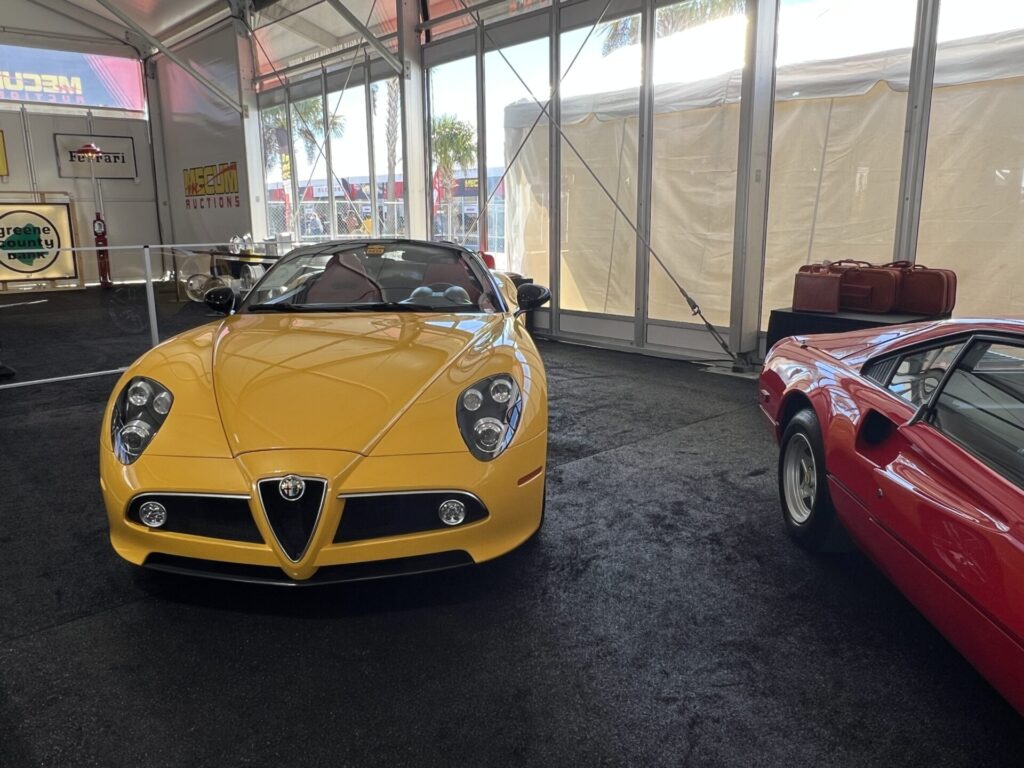
The group debated color, rarity, and driving character (of this car, and many others in the collection). The consensus: the 8C is a grand tourer with presence, heritage, and a design language that nods to Alfa’s 1930s glory.
Five‑Twelve Fever: TR vs. M
Next came the Ferrari 512 TR, prompting a comparison with the later 512 M. The M’s exposed headlights (seen below) and more aggressive styling divide enthusiasts, but both represent the final evolution of Ferrari’s flat‑12 lineage that began with the 365 GT4 BB in the early 1970s.
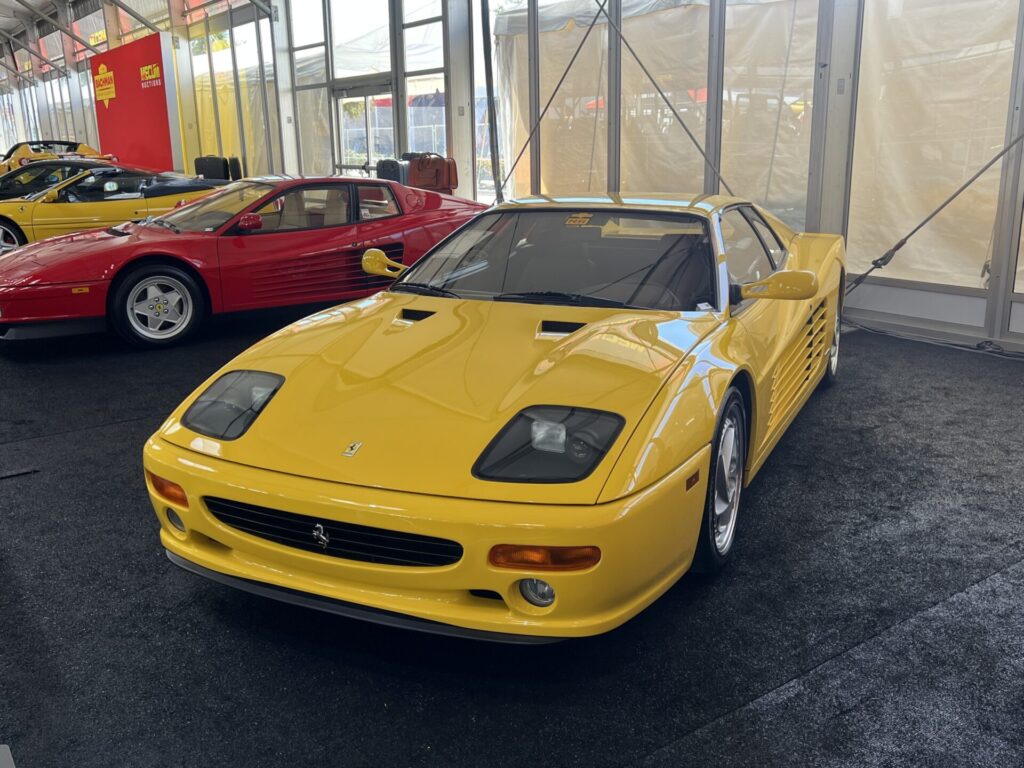
These cars are known for being surprisingly usable – good visibility, strong performance, and a refinement that early Berlinetta Boxers lacked.
The First Ferrari Supercar: 288 GTO Ignites the Room
Then came one of the day’s crown jewels: a Ferrari 288 GTO with just 2,000 km and single‑owner provenance. The bidding erupted instantly. Within seconds, the car soared past $7 million, eventually reaching $8 million – a staggering leap from the typical $4–6M range. The team was stunned. “We might be witnessing a paradigm shift,” David said. “This is the power of provenance,” I added.
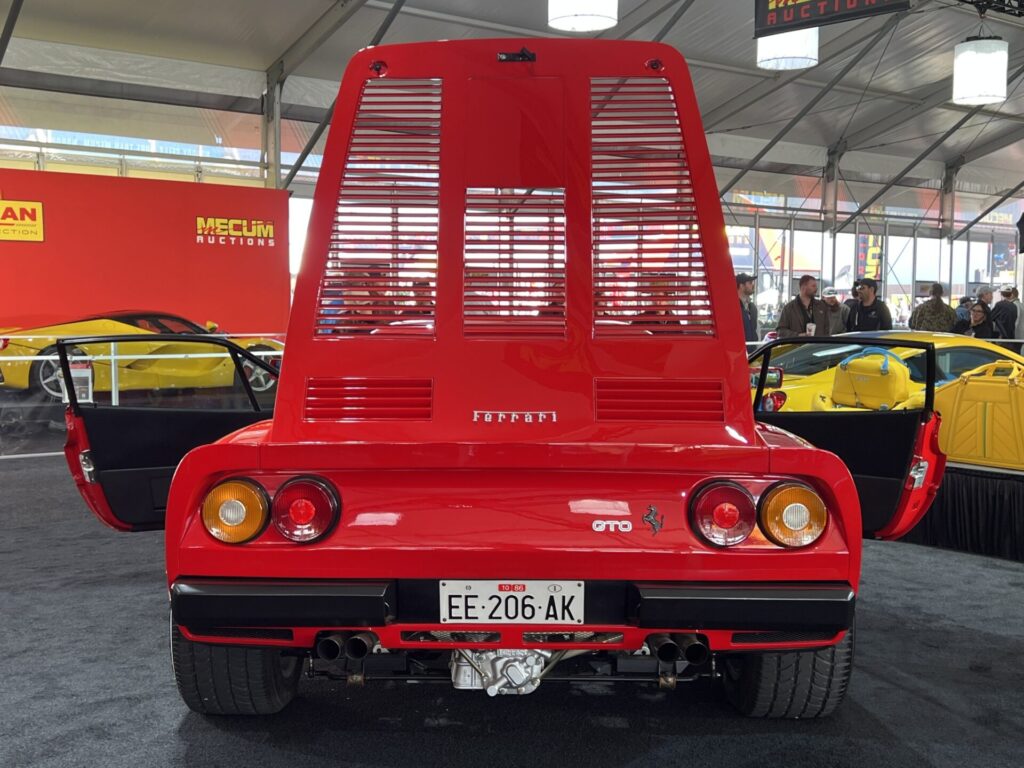
The GTO’s significance as Ferrari’s first true “halo” supercar – precursor to the F40, F50, Enzo, and LaFerrari (with offerings also crossing the block as part of the Bachman collection) – was on full display.
The Car That Saved Ferrari: 308 Reflections
The conversation shifted to the Ferrari 308, a car Eric passionately calls “the car that saved Ferrari.” Built in large numbers, made famous by Magnum P.I., and accessible compared to the Testarossa, the 308 kept Ferrari afloat during a turbulent era.
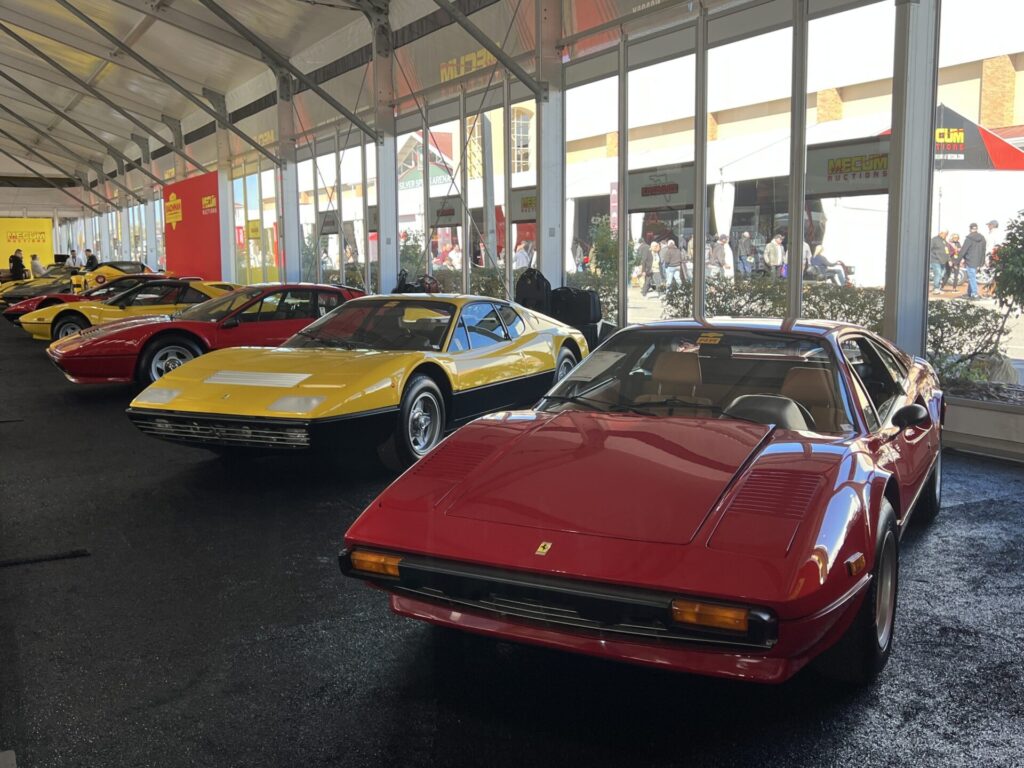
Fiberglass early cars (“vetroresina”) remain the lightweight unicorns of the lineup, while later QV and 328 (3.2-litre) models balanced emissions with performance.
Berlinetta Boxer: Beauty, Danger, and the Birth of a Lineage
A 365 GT4 BB followed, prompting stories of gray‑market imports, twitchy handling, and the car’s role as the progenitor of the entire flat‑12 Berlinetta Boxer family.
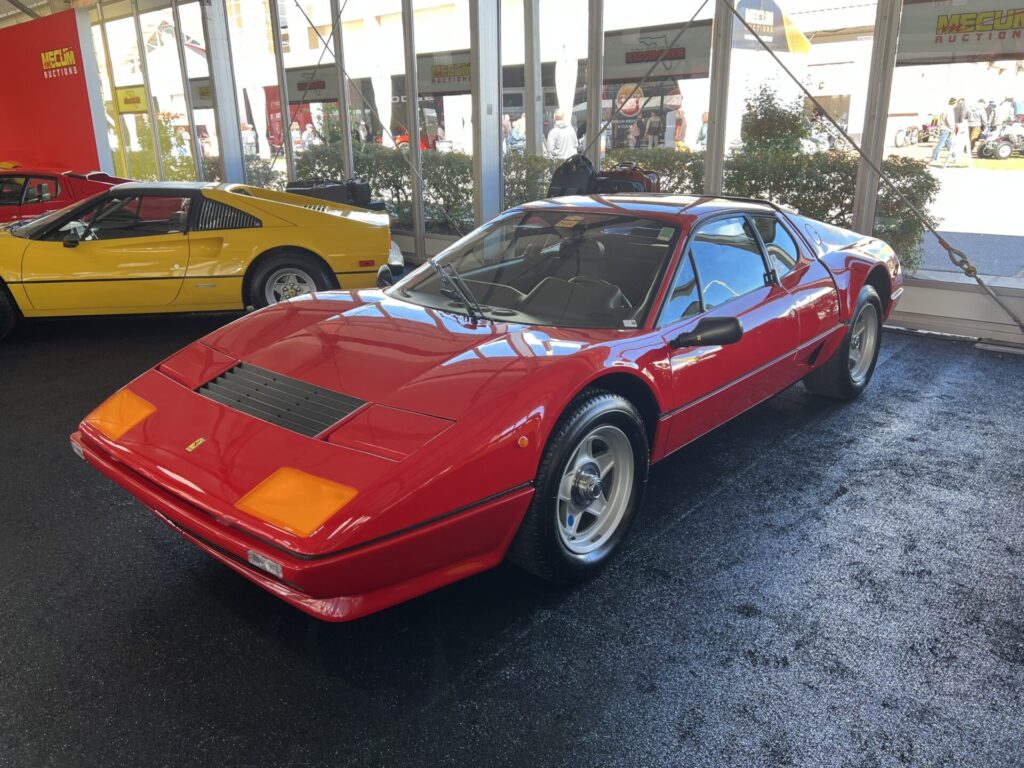
These early BBs, once $130k cars, now command serious attention for their purity and rarity.
The F40: A Poster Car Comes to Life
Finally, the team reached another one of the Fab Five: the Ferrari F40. With just 456 miles and factory delivery to the Bachmans, this example was essentially a time capsule.
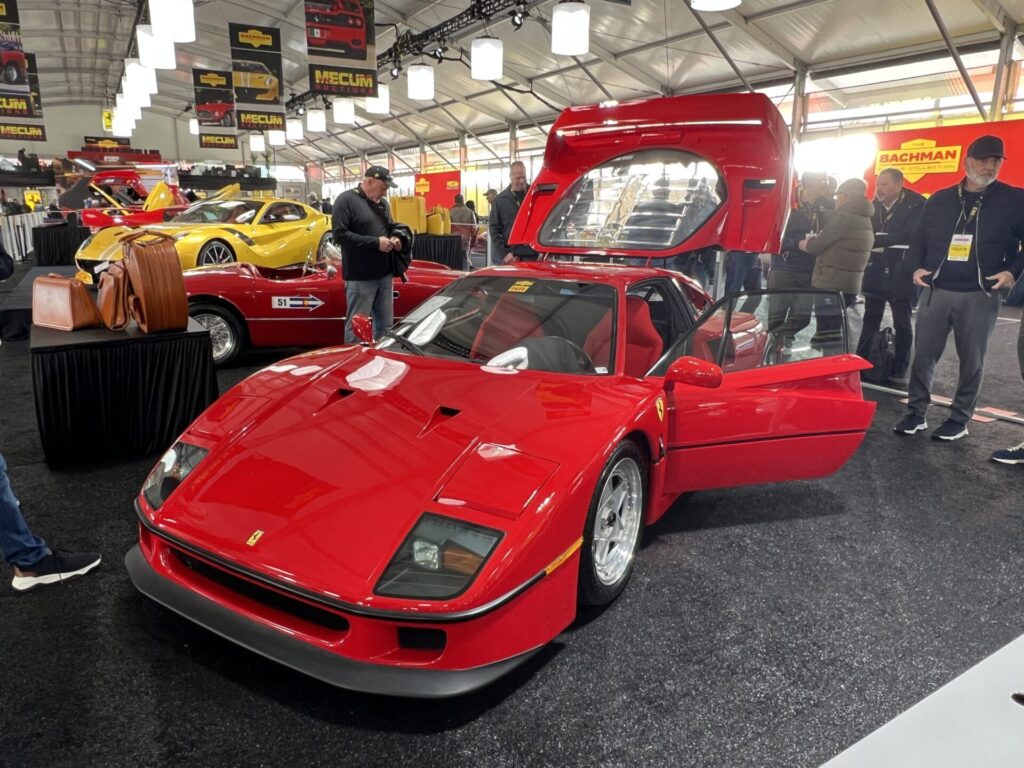
Bidding rocketed past $6.5 million, far beyond the $2–3M range many still associate with F40s. For Eric, this was the car of his childhood bedroom wall. For the market, it was another signal that 2026 might be a watershed year for blue‑chip Ferraris.
The Bianco Speciale: The Emotional Crescendo of the Collection
No discussion of the Bachman Collection would be complete without acknowledging the car that served as its emotional crescendo: the Ferrari 250 GTO (3792GT) “Bianco Speciale.”
More than just a rare specification, finished in a striking white rarely seen on Ferrari’s flagship models, the Bianco Speciale became the symbolic finale of the auction – the car everything else had been building toward. Its presence wasn’t just about rarity or value; it was about narrative. This was the car that tied together with a philosophy of preservation, curation, and passion.

When it finally crossed the block, the room shifted – not just in anticipation of the number it would bring ($35 million, before fees), but in recognition that a chapter in Ferrari collecting history was closing right in front of them.
A Day of Surprises, Stories, and Market Shifts
From Testarossas to GTOs, neon signs to Alfa 8Cs, and lets not forget the incredible provenance of the Bianco Speciale, the 2026 Mecum Kissimmee auction delivered spectacle, nostalgia, and a few market‑shaking surprises (like the record setting Ferrari Enzo below).
The Bachman Collection proved that provenance, condition, and timing can rewrite expectations in real time. And for our team, it was the perfect storm of expertise, enthusiasm, and live‑wire auction energy – captured in a single unforgettable “Super Saturday” (ahem… Friday Friday.)
Guest Co-Host: William Ross
In case you missed it... be sure to check out the Break/Fix episode with our co-host.Guest Co-Host: Jon Summers
In case you missed it... be sure to check out the Break/Fix episode with our co-host.Guest Co-Host: David Neyens
In case you missed it... be sure to check out the Break/Fix episode with our co-host.This content has been brought to you in-part by sponsorship through...