
spot_img
Home Blog Page 25

Holiday Shopping Guide, 2023

0

In this episode of GTM’s ‘The Drive Thru,’ the team presents their monthly news update and special holiday shopping guide, exploring a mix of general automotive, motorsport, and car-adjacent news. This episode is sponsored by a suite of organizations, including HPDEjunkie.com, AmericanMuscle.com, and Garage Style Magazine. The team reviews holiday gift ideas for petrol heads, including a whimsical discussion on racing liveries for robotic vacuums and lawnmowers, fashion accessories from Pilate Shoe Company, unique coffee blends, and even candles that smell like motor oil. They also delve into fun and practical gifts for car enthusiasts, ranging from motorsport-themed tumblers to collector’s items like model cars and books from various renowned authors. Notable mentions include works by Larry Jorgensen, Jeff Willis, and Randy Lanier. The episode also features insights into acquiring authentic automotive art, drawing attention to vintage automotive posters and renowned artists like Kelly Telfer. Sponsors and promotions from HPDE organizations and track day events are highlighted, along with recommendations for staying engaged in the motorsport community. As always, the team brings some laughs with their ‘Florida Man’ holiday stories and a focus on rich people’s unusual gifts, like extravagant Bugatti sunglasses and exo cars. The episode wraps up by encouraging listeners to get involved in motorsport and support various charitable organizations.

Tune in everywhere you stream, download or listen!

Listen on Apple
Listen on YouTube
Listen on Spotify

Showcase: Holiday Shopping Guide ’23

So what do you get for the enthusiast that already has all their toys?  – want to add to the list? Comment below! 

**All photos come from the original article; click on the image to be taken to the original article. GTM makes no claims to this material and is not responsible for any claims made by the original authors or their sponsoring organizations. All rights to original content remain with authors/publishers.

Guest Co-Host: Don Weberg

In case you missed it... be sure to check out the Break/Fix episode with our co-host.
Listen on Apple
Listen on YouTube
Listen on Spotify

Other Gift Ideas…

Special Promotions


20% off select Museum Memberships!
From today until Tuesday, November 28th, the Simeone Museum is excited to offer a 20% discount on select memberships. This is your chance to immerse yourself in a unique collection of automotive history and engineering marvels at a fantastic price. As a member, you'll enjoy exclusive benefits, including special access to exhibits and events. Whether you're an auto enthusiast or simply love exploring new dimensions of history and innovation, our membership is designed to enrich your experience. Join the Simeone Museum family now and take advantage of this limited-time offer! - Available on Simeone Foundation & Museum


Apex Performance
Dave Peters and the crew from HPDEJUNKIE.COM would like to extend some discounts to all their followers. Use code HPDEJUNKIE at checkout or call Linda and mention HPDEJUNKIE when buying from Apex Performance to receive 10% off. - Available on Apex Performance


Become part of the Legend
Join one of the oldest car/motorsports clubs in the world. Did you know the ACO has a USA region? Special benefits for USA members. - Available on Le Mans.org


Black Friday Bonus
AutoInterests will be running a Black Friday bonus value gift card special. Be sure to also check out their track packs, and other pre-season discounts at autointerests.com. - Available on AutoInterests.com


Consider supporting the IMRRC!
Enter the IMRRC sweepstakes and enter for a chance to win a 2020 C8 Corvette ZR1. Enter code: ERAYLAUNCH for bonus chances. - Available on The IMRRC


E2 Carbon Weave Wheel Discount
Order 4 ESE Carbon E2 Wheels in Carbon Weave finish and get $500 off your order through 12/31/2023 - Available on ESE Carbon Wheels - $1624


Give the Gift of Speed This Holiday Season - Available to Purchase until December 31, 2023!
Do you know someone who loves NJMP and all things happening at the track? Give them the gift they want and present the Gift of Speed to that special person on Christmas Day. This CREDIT Gift Card can be used toward 2024 NJMP Track Days, Karting, Drivers Club, or Riders Club! - Available on MotorsportsReg.com


GLOC Brakes Discount
Dave Peters and the crew from HPDEJUNKIE.COM would like to extend some discounts to all their followers. Save 10% with GLOC BRAKES by mentioning HPDEJUNKIE when you call 1-844-9-BRAKES on your next order. - Available on G-LOC Brakes


Hyper Drive Starter Package!
Available all season for $80 at Hyperfest & NASA events. Get your taste of the track. - Available on Hyperfest / NASA - $80


Shipwrecked & Rescued by Larry Jorgenson
Over two-hundred 1927 Chryslers are rescued from a Great Lakes Shipwreck! It's an amazing true story now revealed in the recently published book "Shipwrecked and Rescued". It's a special gift for the holidays and it includes over fifty historic photos showing how the cars and crew finally were rescued. It also explains what happened to the cars after the rescue and where one of the remaining cars can be seen today. This award winning book is available from the website: shipwreckedandrescued.com or by calling direct: 337-591-1937. The book price is only $20, and as a GTM special an additional book can be purchased for $12. (one for you, and one for a gift) Shipping is free and all books are signed by the author Larry Jorgensen - Available on Shipwrecked&Rescued.com - $12


The Motor Chain
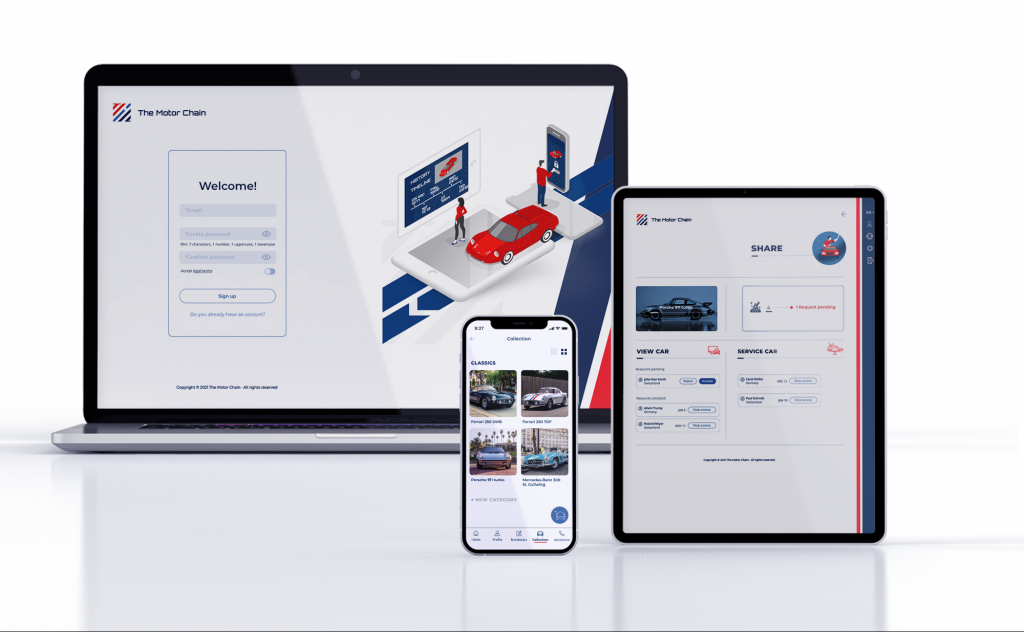
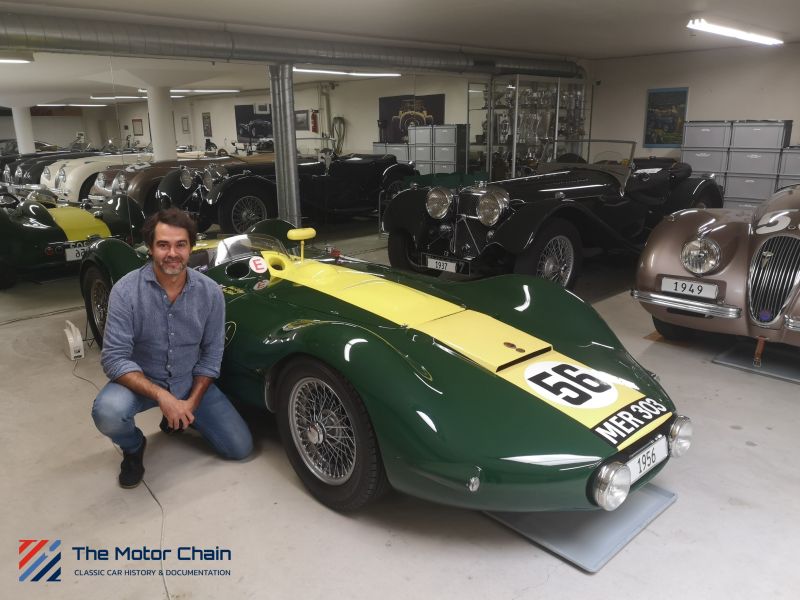
This is the 25% discount coupon for your listeners: Break/FixTMC - Available on The Motor Chain


The Other Side of the Fence by Bill Warner
Proceeds from the sale of this book go 100% to SPINA BIFIDA research and treatment, a cause near and dear to Bill Warner. - Available on Spina Bifida Jacksonville - $100


VIP Packages
HOD VIP packages and other discounts available! Learn more about how you can save up to 10% on all things HOD in this episode! Also shop the HOD Store for gift certificates and other merchandise. - Available on Hooked On Driving

For You!


2024 Corvette Racing History Desk Calendar
Its not too late to get my 2024 Corvette History desk calendar info and pix to you for any kind of holiday gift offering to your members. Please see the two attached: sample page and illustration of the 12 paintings. The price is $16 each plus $4 shipping. Each 5” x 5.75” desk calendar comes with a folding stand-up case. It features 9 Corvette paintings and 3 others by me. Each calendar is signed and numbered in an edition of 400. - Available on The IMRRC - $20


Flying Tiger Moto Candles
One day we asked ourselves, how can we create a product that will be appreciated by those close to us in the riding community? And can we accurately emote the essence of motorcycling in a pleasing and convenient device? Like a match struck in the dark, we had the answer: combine all the best parts of what we love into stylishly themed candles! Thus, the MotoCandle was born. - Available on Flying Tiger Motorcycles - $40


Personalized Aluminum Drinking Tumblers
Sheryl Taylor makes automotive and motorsports inspired thermoses - with and without built in speakers. Aircraft grade Aluminum, etc. $20 for basic, $45 with bluetooth; you can learn more by reaching out to her on FB @PrettyGingerCrafts or via email PrettyGingerCrafts@gmail.com - Available on Pretty Ginger Crafts - $20


Piloti Everyday Driving Shoes
Shop Piloti's signature performance-driven driving shoes and let us gear your adventure. It's our mission to combine performance with comfort, quality, and design. Roll Control 2.0™. 100% Italian Leather. - Available on Piloti Shoes

Hot off the Press

Friend of the show, former guest of Break/Fix podcast, and author J.K. Kelly reached out recently with some great news… Just in time to add one more thing to your Christmas list.

“The Deadly Driver sequel is titled Switchback and launches at Daytona in January. With any luck, we’ll have much to talk about again soon.”

The Lost Bird – New Crime Thriller

Philadelphia, Pennsylvania (November 30, 2023)  Novelist Jim “JK” Kelly today announced the launch of his latest book, The Lost Bird, a crime thriller novella about a World War II B-17 that’s been taken.

“From the first time I watched the film Memphis Belle, I was hooked,” said Kelly. “I love writing thrillers, and I chose to use a vintage B-17 as the centerpiece in this one to honor the brave souls who manned them and to introduce readers who might not know anything about them to what was a vital part of winning World War II.”


Tune in everywhere you stream, download or listen!

Listen on Apple
Listen on YouTube
Listen on Spotify

The Lost Bird is Kelly’s seventh work of fiction, and it is the story of two modern-day families, criminals without conscience, and an awkward partnership formed in an attempt to find the missing plane. Kelly’s past works include the Formula One/CIA spy thriller Deadly Driver, The Export Series, Found In Time, The Lost Pulse, and the autobiography Fuelin’ Around.

“I believe readers will get caught up in this story and its characters,” Kelly continued. “Even before today’s official release, two Hollywood film producers requested the screenplay we’ve developed.”

For more information, to request a review copy or an interview with the author, please write to Info@JKKelly.com. To order a print or Kindle version of THE LOST BIRD on Amazon click here.

Rich People Thangs!

TRANSCRIPT

Executive Producer Tania: [00:00:00] The Drive Thru is GTM’s monthly news episode and is sponsored in part by organizations like HPTEjunkie. com, Hooked on Driving, AmericanMuscle. com, CollectorCarGuide. net, Project Motoring, Garage Style Magazine, and many others. If you are interested in becoming a sponsor of the Drive Thru, look no further than www.

gtmotorsports. org. Click about, and then advertising. Thank you again to everyone that supports Grand Touring Motorsports, our podcast, Brake Fix, and all the other services we provide.

Don Weberg: Ho, ho, ho! Welcome to Drive Thru episode number 39. This is our monthly recap, where we put together a menu of automotive, motorsport, and random car adjacent news. Now let’s pull up to window number one for more automotive news.

Crew Chief Eric: Look at that. Don Wieberg has graced us with his presence for the first time on a drive thru, and it’s an extra special [00:01:00] one because this is our Holiday Shopping Guide.

Well, you know what, guys? We are going to be visited by three ghosts tonight. We’re going to be visited by the ghosts of drive thrus past, the ghost of Christmas presents. And the ghost of break fix guests yet to come. For our Patreons, we’re going to do a little show and tell on this episode. So this is some incentive for y’all to check out the behind the scenes video, all the craziness that happens on a drive thru episode.

So let’s kick it off. With some general gift ideas. You know, we’re having discussions around the writer’s room. What should be in the holiday guide? What do you buy for your petrolhead, your loved one in your life? Dire Gal that’s got all their toys. Well, this one from five years ago resurrected itself.

What about the Honda Type R lawnmower?

Executive Producer Tania: This could be a winner. This

Crew Chief Eric: is a contender right here.

Executive Producer Tania: Save yourself the heartburn and go to Honda, get some decal stickers, and strap it onto your existing lawnmower.

Crew Chief Eric: It sort of looks like a Roomba.

Executive Producer Tania: I think it is. I [00:02:00] think it’s one of those electric autonomous lawnmower things.

They have those, the robotic lawnmowers. I’ve seen them. They’re basically a Roomba with a blade underneath the

William Ross: mask. I would buy that lawnmower. That thing looks cool. I mean, you’d be the talk of the neighborhood.

Crew Chief Eric: I want the Porsche version of that. I want like the RS GT4, only charcoal gray.

William Ross: The Momo.

Crew Chief Eric: Oh, yeah, yeah.

Bigger weighing, fatter. You get the hippie 917 livery on that thing. That would look good going around your yard, yeah. Or the pink pig. The pink pig would work. Oh,

William Ross: that’d look cool. Oh, yeah.

Crew Chief Eric: That’s what we buy for the holidays. Racing livery kits for our robotic vacuums. And autonomous lawnmowers, somebody make that, somebody start marketing that.

William Ross: Oh, that would be awesome.

Crew Chief Eric: So Don, you and I, last year, we talked about the Pilate shoe company. And I said, I’m such a fan boy. I have a bunch of Pilates stuff. I love their shoes. My daughters have bought shoes for me over the years. And you mentioned to me that [00:03:00] they started making. Coffee last year and a last minute haste.

We actually ordered some. We have the V8, the V10 and the V12 coffees.

Don Weberg: Oh, you got all three of them.

Crew Chief Eric: Yeah, they’re excellent. And you know what? They’re not just a shoe company. They have tons of other accessories from phone cases made of DuPont blast resistant Kevlar to shirts, to hoodies, you know, the normal apparel, the coffees and other things.

But more importantly. They’ve done a deep discount on their shoes this year. I got a hold of a pair that I want to show off.

Don Weberg: You actually bought a pair?

Crew Chief Eric: Yeah, why wouldn’t I? Shoes? Come on. Oh my, the ultimate fashion statement. So they come in this delightful black box. It’s an unboxing. Yeah. The Dodge stripes on it, you know, the black over black.

Very cool. So you open this thing up, right? And you pull out the Le Mans driving shoes. Check these out. These were discounted at over 50 [00:04:00] percent off clocking in still under 100 after the discount. So these were a really, really good deal. Super comfortable. I love their everyday driving shoes. I think these are fantastic and tons of their styles of shoes are on sale right now from the Prototipo RS’s to more of like a Samba style driving shoe called the Midnight.

To include the LeMans shoes. So if you haven’t checked them out yet, visit www. piloti. com for shoes and other cool car inspired accessories.

Don Weberg: My wife and I would just, I need new shoes. We’re going to Vegas tomorrow. So she said, do you want to go get new shoes tonight? Or do you want me to pick you up some new shoes?

I said, no, that’s fine. I’ll just get them in Vegas. I think I’m going to go back to the New Balance brand.

Crew Chief Eric: Oh, you’re going to be a Corvette owner soon.

Don Weberg: Well, the sad thing about it was I was always a New Balance guy way back in the day. Like, here’s a weird thing. No kidding. At Motor Trend, everyone wore New Balance.

Really weird. It’s like the car guy’s shoe. We ought to be doing a plug for a New Balance cause we all wear them. [00:05:00] Your Corvette club membership has just been accepted, Don. That’s right. I know I’m a, I’m a closet Corvette guy, but you, you are a closet New Balance guy. You just haven’t

Crew Chief Eric: embraced it yet. Uh huh.

Uh huh. Yeah. Yeah. Yeah. I got something to show you guys. I thought this was super cool. I found this at Petit Le Mans. So you guys know what this is? Filter box.

Don Weberg: An oil filter.

Crew Chief Eric: And I said the same thing. It’s red and it has Motul written all over it. And you open it up and inside is this. A can of Motul 300V.

But not just any 300V. A 300V. The handle! Yeah. And it’s made from Motul 300V. Does

Executive Producer Tania: it smell like burnt oil?

Crew Chief Eric: It actually smells quite nice. If you like the smell of Motul 300V, it’s ester based. It’s kind of got that sickly sweet smell to it. They have other versions of this, and this is actually made by a company in St.

Louis called Flying Tiger Motorcycles in partnership with Motul. And I’ll let Adam and Ryan tell you more about this really unique. [00:06:00]

Adam Reed: And that’s kind of where this product lies is like in that blurred space between, Oh yeah, you know, my so and so rides a motorcycle, but I don’t, and I don’t really understand, or I love it, but I don’t have a motorcycle and, you know, you see this a lot at racetracks, you know, it’s the reason people buy the t shirt, they like that feeling of wonderment that they get from it, you know, everything that’s going on around them, and they want to take a piece of that home with them and, you know, an event t shirt is one thing, but this is something a little more.

Sure. interactive. Motul

Ryan Harrison: 300v candles. We made them so you can come inside from the garage and be with your family. Let them smell how you smell.

Adam Reed: Let them smell how you feel.

Ryan Harrison: Let them know where your mind’s at. Motul 800v for when you absolutely You just need to smell the racetrack.

Crew Chief Eric: So what do these candles cost if somebody does want to pick one up?

Ryan Harrison: Currently they are at 40.

Crew Chief Eric: That’s a bargain.

Ryan Harrison: Especially if your [00:07:00] significant other shops a Yankee candle.

Crew Chief Eric: And if you know how much a liter of 300V costs, it’s a good deal.

Ryan Harrison: Everybody listening that has one, if you could please light them. We’re getting ready to make more batches as winter comes, so we got to keep that money machine going.

Adam Reed: Yes, please burn your candles.

Don Weberg: I think that’d be kind of cool to have a candle that smells like motor oil. If for no other reason, but every now and then I get moody. So I want to burn something that really offends people to make them go away. I love going to tire shops. I think that’s the coolest smell in the world, but my wife can’t stand it.

So it’s one of those things where if you want to get rid of people, you just burn some tires and it’s good.

Crew Chief Eric: I mean, what’s wrong with the smell of castor oil in the morning? Right.

Don Weberg: Especially when it’s on fire.

Crew Chief Eric: And these are for the petrol head in your life. So if you’re interested in checking them out and seeing the other varieties of candles that they have available, hop on over to flying tiger, moto.

com. All right. I got another one for you guys. [00:08:00] This one’s a stocking stuffer and then some. These are made by a young lady in Pennsylvania named Cheryl Taylor. And she has a bunch of different motorsport and other inspired drinking tumblers. This one happens to be a can of WD 40. I’ve taken this to meetings.

I’ve actually forgotten it in the garage because it blends in with everything else. She’s got cans of Ford motor oil, Rust Oleum, other kinds of things. These are a lot of fun. They come in at 19 bucks. She does have them in different widths, heights. Diameters, et cetera, but you can also get them for an upcharge with a speaker built into them.

Don Weberg: That’s actually really awesome. You know, the first time I saw something like that was in the remake of Gone in 60 Seconds. Angelina Jolie. She is at the Ferrari dealership. Nicolas Cage comes to ask her to help him. And she’s just about to get off work. And she grabs this gas can, just starts tugging whatever’s in there.

And at first, it kind of shocked me. I thought, what the hell is she doing? It’s just water. You sounded so

Executive Producer Tania: disappointed.

Don Weberg: It was just [00:09:00] water. But remember, like she said, you gotta work twice as hard when it’s legal.

Crew Chief Eric: I think these are really, really cool. And you can check those out at Pretty Ginger Crafts on Facebook or email PrettyGingerCrafts.

com. Pretty ginger crafts at gmail. com and look at Cheryl’s catalog. She says she has over 400 different designs that she can make on these aluminum tumblers.

Lydia Fenet: Hi, I’m Lydia Finette, and I’m so excited to announce the launch of my first ever, the strike method necklace. Those of you who’ve seen me on stage at broad arrow know that I always come with a gavel.

I feel like it brings me confidence and power anywhere I go, and I want you to feel the same. So. You can pick up this limited edition gavel charm necklace at www. lydiafenet. com or on Instagram. And I hope that you will buy it for yourself, your daughter, your granddaughter, anyone who needs that little extra confidence boost.

The power is within us, but it never hurts to have a charm as well.[00:10:00]

Don Weberg: I think everybody ought to get out there and consider an auction. Now, as crazy as that might sound, yes, we all have eBay, and that’s a terrific resource, too. But for the motor enthusiasts, it’s a little bit vanilla. So, what I’m thinking is Mecham. Because Mecham has their new product, Mecham On Time. And that’s literally very much like eBay.

You get up there, it’s on a computer, it’s entirely computer. And you just… Start doing your bidding. That’s a nice thing. It’s entirely automotive. If I remember correctly, there’s 1200 items that are available on Meekum on time, including fine art, Dale Earnhardt collectibles, 60 micro cars, buddy L’s and gas and oil collectibles.

The registration is free. Bidding is easy. You can shop for your favorite road art gifts now at ontime. meekum. com. And receive the gift just in time for the holidays. Was that a pun? That’s right. So I think an auction might be fun. [00:11:00] It’s something different for people. And you never know what’s going to pop up.

Crew Chief Eric: Speaking of auctions and collectibles and memorabilia, near and dear to all of our hearts on this episode are things like model cars. Hot Wheels, Matchbox, and especially Legos. I have to say that maybe it’s somebody’s at Lego. Our generation is in charge at Lego. There is a lot of car stuff going on, as evidenced by the Speed Champions, the Technic stuff, all the things you can buy on the shelf here in the U.

S. There’s some really cool stuff. All petrolheads, we’re all just doing the church nod right now. Because the Speed Champions series has really been ramping up. We’ve mentioned it before. This year I found one that I especially liked. And it’s the Ferrari 330 P4, Le Mans edition. This thing is fantastic for the bargain price of like 20 bucks.

You can have this basically 1 18th scale size model on your shelf made of Legos. And I learned about a website maybe in more detail than I knew before. And that’s rebrickable. com. And that [00:12:00] allows you to take some Lego sets and turn them into some other really cool things without having to buy new parts.

And I mentioned before that, you know, under some rich people things, there was some kits that you could get from like the block zone to build different kinds of automotive models that are out. I found the best of the best, at least in my opinion, you take Dom Toretto’s charger from fast and furious. And did you know, you can turn it into the 1989 Batmobile, the Michael Keaton Batmobile.

It is the hotness. I have some pictures on doing the conversion. A lot of fun. It’s a good way to spend time with the kids. They’re interested in, you know, building their little towns, but also in the engineering side with the cars and stuff. So that’s been a lot of fun. So if you’re out there looking for maybe a different hobby, something new, don’t discount Lego.

Executive Producer Tania: If you’re a fan of Audi. And the late Ken Block, there is a Ken Block edition Audi e tron set that is available.

Crew Chief Eric: That is my number one pick. That’s actually on my Lego wishlist this year. I want that thing really bad. [00:13:00] It looks really cool. And interestingly enough, Lego has also started to incorporate remote control options and the Ken Block Audi e tron, which clocks in at about 179 bucks, comes with the RC option.

I think that’s super cool.

Executive Producer Tania: Did you know that there is a NASCAR Lego? You can get the next gen Chevy Camaro ZL1. Is

Crew Chief Eric: it the garage 56 one?

Executive Producer Tania: I don’t think so because it says number 75 on it.

Crew Chief Eric: That’s a missed opportunity.

Executive Producer Tania: Right. But it could be yours for the low, low price of 49. 99.

Crew Chief Eric: That’s not bad. Does it come with vroom vroom sounds or you got to make those yourself?

Executive Producer Tania: Sold separately.

Crew Chief Eric: Vroom vroom

Don Weberg: sounds sold separately.

Executive Producer Tania: Batteries not included.

Don Weberg: But I get the feeling, Eric, that you like to make your own vroom vroom sounds. Only with my Matchbox cars. Okay.

Crew Chief Eric: Yeah. Speaking of Don, you and I got to sit down with a lifelong enthusiast who turned his passions into a career in the model car business.

Your buddy, Patrick Strong.

Don Weberg: Yeah. We ought to do an unboxing. That car has never been out of [00:14:00] the box.

Patrick Strong: Oh

Don Weberg: yeah. I got that beautiful Kuntosh from him. I don’t know who made it. I forgot who made it, but

Patrick Strong: whether you are a veteran collector with very finally home taste or whether you are new to the hobby model, citizen diecast.

com is a. great place to find a very tightly focused selection of exquisite model cars. And if you are new to the hobby, my contact info is readily available there, and I’m always happy to answer any questions you might have. Honestly, I’d rather make a friend than a customer.

Don Weberg: The beautiful thing about Patrick Strong is he represents a whole bunch of different manufacturers.

If you have a dream of a dream car like I did with the Countach and then you woke up one day and realized you’re probably never going to be able to afford the real thing, so he hooked me up with as close as possible of the real thing as I could hope for.

Patrick Strong: I know that we have the holidays coming up. I typically do a kind of a low key Black Friday, Cyber Monday sale in that I just put a lot of stuff on markdown.

I [00:15:00] don’t do a special promotion with, you know, here’s your percentage discount or buy two get one free or anything like that. It’s just. Things get put into the sales section. So week after Thanksgiving, I’d be looking for that to happen. The best way to find out about deals like that is to get on our mailing list.

We’re not spamming. We only send emails out to let people know about new products or events where we’re going to be. Modelsitizendicast. com is a great place to start or continue your journey as a diecast model collector.

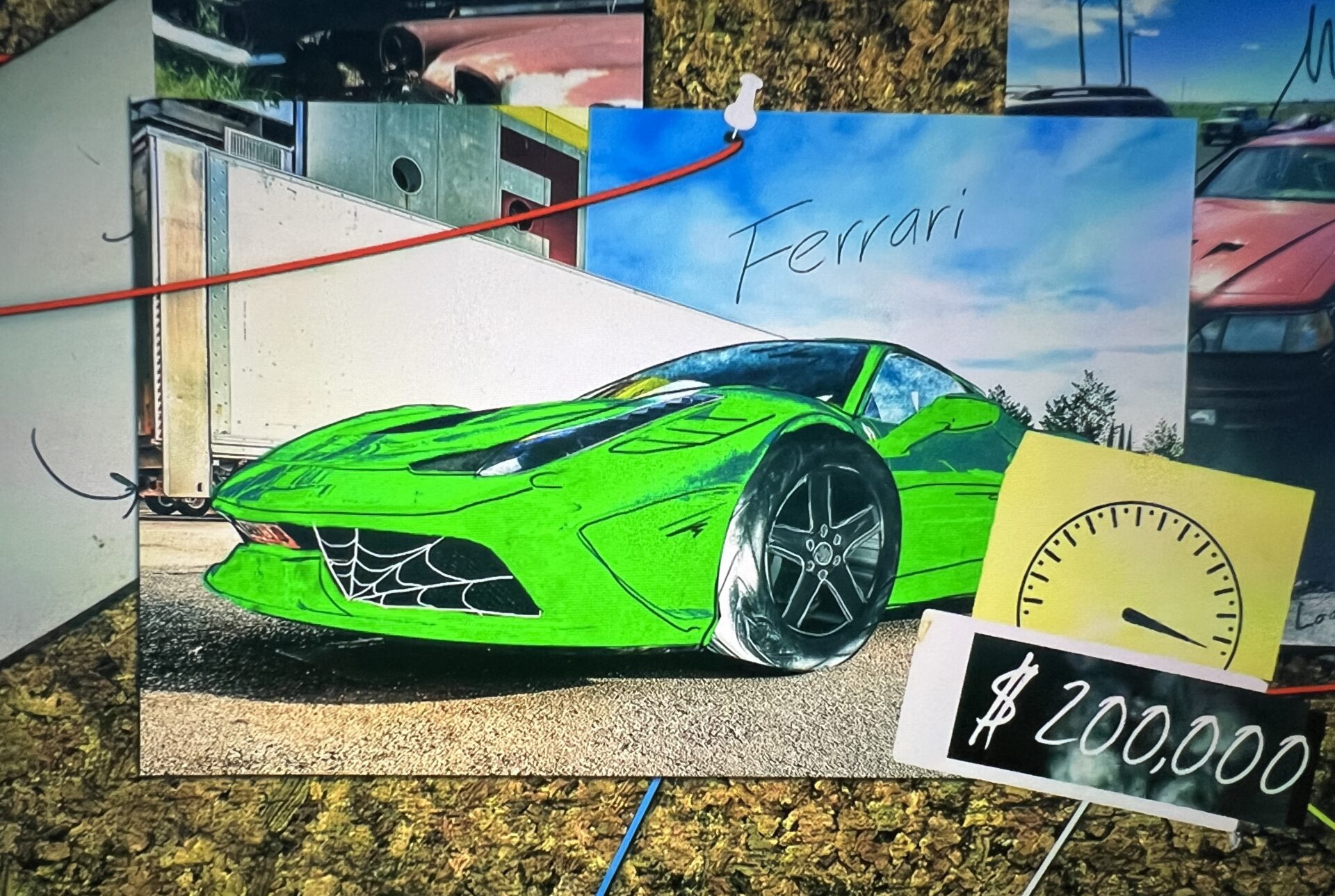
Crew Chief Eric: Well, since you mentioned that, Don. We found something in what we would normally showcase in our lost and found section. We found a Lamborghini that maybe you can afford. Have you seen that the Wolf of Wall Street Lamborghini Countach is now available and for sale?

Don Weberg: Yes, yes. And with a little bit of spit and polish, that car will come right back together.

That will buff right out. Absolutely. Yeah. Tell you how stupid we got when we had our meeting up in [00:16:00] Monterey with our Ferrari mechanic, and he basically talked me out of getting a 456 by telling me it was 35, 000 to service it. I got to thinking, you know, we can’t afford the Countach, so why don’t we just go get a 550?

That seems like the next logical step. You know, the Wolf of Wall Street car would be really cool because you’ve seen my house. I have a fairly large front yard and it’s on a corner and I can just imagine building like a nice concrete platform and just placing the Countach like sculpture right there. I think that’d be good.

I think the

Crew Chief Eric: neighbors would like that. So would you venture a guess as to how much you could get that new monument in your yard for? How much?

Executive Producer Tania: A hundred dollars. A

Crew Chief Eric: hundred? I wish for a wrecked Lamborghini. I mean, it’s a legit 25th anniversary Lamborghini.

Executive Producer Tania: How much could I get at the scrap mill yard? I turned it in

Crew Chief Eric: 500.

Executive Producer Tania: All right, Bob,

Crew Chief Eric: the low, low bargain price,

Executive Producer Tania: 100, 000

Crew Chief Eric: million and a half. Million and a half. Million and a half for a wreck to Lamborghini. Can you believe [00:17:00] that?

Don Weberg: No, no, no. That’s insane. Considering you can probably get a mint conditional one for 800. Yeah, but this is the Wolf of Wall Street’s car. The real deal.

Yeah. Well, you know, used as

Crew Chief Eric: a prop in the movie, but still the real deal.

Don Weberg: Yeah, yeah, yeah. Yeah. I have a friend way back when who was so excited he got his first Mercedes and he was so happy with himself and so proud of himself and he didn’t have it a week and it was run into by a big F 150 and he found out very quickly how easily your Mercedes bends.

Ah, that’s Christmas jokes right there.

Crew Chief Eric: Oh, let me

Don Weberg: tell you about the three elves that walked into a pub. No,

Crew Chief Eric: moving along. This year was a good year for authors. Yes, we have a lot of books to cover this year. So let’s start off with one of our guests from upstate Michigan, Larry Jorgensen. Remember when we interviewed Larry?

Don Weberg: I do. He was a very nice man. Very interesting guy. Lots and lots of stories.

Larry Jorgensen: I set out to do a shipwreck book, [00:18:00] okay. I thought it was fascinating. Do you know what’s happened? I’ve got as many people that are interested in vintage cars that have come to me. The book is for sale in numerous vintage car museum gift shops.

Blew me away when I realized that I had created two markets, not just people that like to read about the great lakes and shipwrecks, but all these people that are crazy about vintage cars. It’s amazing. Besides affecting an entire peninsula. It affects so many people in different ways.

Crew Chief Eric: His book Shipwrecked and Rescued is still for sale.

The book includes over 200 1927 Chryslers that are rescued from a Great Lake shipwreck. This is an amazing true story that has been recently revealed. It includes over 50 historic photos showing how the cars and the crew finally rescued all those Chryslers. It explains what happens to the cars after the rescue.

And where one of the remaining cars can still be seen today.

Larry Jorgensen: The [00:19:00] cover on the book, when we decided this is too good a story to not really put some real effort into it, the cover on the book, I hired a artist in the Keweenaw to create that artwork that’s on the cover. I wanted something that would show both the state of the boat and the cars.

And he was able to meld that together into one painting. It’s a fantastic painting.

Crew Chief Eric: This could be a special gift for the holidays. It’s an award-winning book. It’s available at shipwrecked

Larry Jorgensen: and rescued. Make sure you got past tense shipwrecked and rescued.com. If you go to the website, I’ll even sign it to you if you want me to.

Yes, it’s available on Amazon and fortunately it’s available in a lot of places. Michigan bookstores, White House museums that have gift stores. Like I said before, a lot of vintage auto museums have got the book in the gift stores. You never know where you may see it. You know, I’ve heard this and you walk into a [00:20:00] place and there it is.

You know.

Crew Chief Eric: You can also call Larry directly at 3 3 7 5 9 1 1 9 3 7. The book normally retails for 20, but as a special holiday promo, if you reach out to Larry or order it on the website and mention GTM, he will sell you the book for 12 bucks, shipping is free. And all the books are signed by Larry. That’s pretty cool.

Next up our friend and newest panelists on the what should I buy series. Jeff Willis has been on the show several times. Most people might not remember, or maybe you gotta jump back to his episode. He wrote a book called Human in the Machine.

Don Weberg: And there it is.

Crew Chief Eric: A very interesting book. It’s a compilation of different stories, people he’s interviewed, like the founders of Petrolicious, to people like Elspeth Beard, who was also on the show.

Full of pictures, full of interesting stuff. It’s really about car culture in the Pacific Northwest and upper California. Pretty well put together construction wise paper and everything. Yeah. And it’s got color [00:21:00] photos in it. And a lot of these photos were taken by Jeff because he is a photographer. He’s noted for doing events like velocity, Monterey car week, pebble beach, things like that.

So he included a lot of that in the book as well. So really, really great. Stuff in here. You can buy it on Amazon. It’s another 20 book. Great stocking stuffer. Great gift human in the machine by Jeffrey Willis. Speaking of Jeff, I mentioned he hooked us up with Elspeth Beard, who is featured in his book, Human in the Machine.

He actually co hosted that episode with me as we interviewed Elspeth. If you don’t know her story, she’s the first British woman to circumvent the world on a BMW motorcycle. She took this trip in the early eighties and it took her three years to complete. She tells the entire story in her book, Lone Rider, which is available in print or on Audible.

So you can listen to it if you don’t have time to read it. We have a lot of content on Elspeth on our website. Check out the episode, check out the live stream that we did from Bob’s BMW this year when we met her. Her book is absolutely [00:22:00] fantastic. This is a one of a kind story and is well worth reading.

Very inspiring, lots of ups and downs, lots to learn from Lone Rider. So it was an absolute pleasure and an honor to sit down and interview her. But if you haven’t listened to the episode, do so, but also pick up a copy of Lone Rider on Amazon or listen to it on Audible. Don, do you want to talk about parking limits and parking meters and county zoning again?

Don Weberg: It’s what I live for, you know. Paved Paradise, written by Henry Grabar. We had him on the show, what, about a month ago? Mm

Executive Producer Tania: hmm. They paved paradise and put up a parking lot?

Don Weberg: Exactly.

Crew Chief Eric: Joni Mitchell, right? Big yellow taxi.

Don Weberg: Yeah, very interesting guy. Very, very interesting.

Crew Chief Eric: Paved Paradise. is basically a study in how parking has changed the world.

It’s a fascinating book. You’d probably pass this over at your local Barnes and Nobles and not even think about it. Oh, that’s a really interesting cover. Flip it over and be like, wait, what? What is this about exactly? The premise of the book is really to explain [00:23:00] How parking plays such an amazing role in our daily lives in terms of zoning taxes, how they can build an architect, how they can change cities, how restaurants are built.

Like, there’s so many different things involved in just that side of the conversation

Don Weberg: really gives you a different look at parking. I mean, the funny thing is about parking, it’s so boring. I mean, who cares? You put your car in a space, you drop in a quarter, you walk away. But there’s so much more behind it, and you know, Henry really brings that to light, and who knew there was so much fascination about parking?

Crew Chief Eric: And then he talks about the darker side of parking, which I know, Don, you enjoyed, like, the stories about the mobs and the gangsters and how they’re laundering money through parking garages. And then it boils down into a study of economics. How much does parking really cost? You know, is there such thing as free parking?

And it clocks in at about 325 pages. It’s a quick read. So I highly recommend checking it out.

Henry Grabar: Hi there. I’m Henry Grabar. I’m a journalist at Slate. [00:24:00] a past guest and the author of Paved Paradise, How Parking Explains the World. It makes a great gift and you can pick it up at a bookstore near you or get the audio version from Audible.

Thanks for listening.

Crew Chief Eric: Another quick read. Another one I recommend. This is a carryover from last year because we didn’t talk about it due to timing with this episode survival of the fastest, which is Randy Lanier story, the whole thing about weed speed and the 1980s drug scandal that shocked the racing world. You know, as the joke goes, what does IMSA stand for?

The international marijuana smugglers association, not the international motor sports association. It’s Randy’s rise to fame and also his demise. And then what was really cool is we were actually able to sit down with Randy after the book came out. He’s been out of prison for quite a number of years now.

And we did a, where is he now? Talking about all the things that happened after he’s been out, what he’s into, how he’s working with the community, [00:25:00] how he’s giving back. You got to read Survival of the Fastest to understand where the story is. Granted, there’s a Netflix special. The book is awesome. It’s worth reading.

And then, you know, continue that journey with the Break Fix episode surrounding Randy Lanier. So a great stocking stuffer as well. All right. Yeah. Parking.

Adam Reed: There’s some wild

Crew Chief Eric: stuff there, man. Wild stuff, you

Don Weberg: know.

Crew Chief Eric: We gotta park somewhere, right? Well, what did we park in front of?

Don Weberg: The hydrant. That’s how we got that ticket, man.

Some restaurant,

Crew Chief Eric: silly.

Don Weberg: Oh, the restaurant, man. Yeah, the restaurant, man. Sorry, man. I’m looking at you with your little hat and your sweater and your beard. And, man, I’m getting all weird here, you know, man. I think I’m on like Cheech and Chong or something, man. Get the Impala. Let’s go, man. Up in Smole. Now, you know, you say up and smoke down here in Texas, they’re gonna think, Oh, where’s the barbecue?

Crew Chief Eric: Speaking of barbecue, talking about all that parking and pulling up in front of restaurants, we sat down with David Page, author of [00:26:00] Food Americana, who also happens to be the creator of Diners. Drive ins and dives.

Don Weberg: He was a cool guy. He had a lot to offer. He was very insightful. He knew a lot of crazy places that you knew, which I thought was interesting because he’s East Coast.

But then he finally hit this little dive down in, uh, Baker, California on the way to Las Vegas from Los Angeles. And it was a mad Greek. So that was kind of fun. We bonded over that. Let’s hear from David Page about how you can get his book.

David Page: Hi, I’m David Page, creator of Diners, Drive ins and Dives. And now an author.

I’ve written a book called Food Americana. It tells the great stories about the great people behind some of America’s favorite dishes. Please pick up a copy of my book. It’s a great gift for the holidays. It’s all about America’s favorite meals. At Amazon. com or your favorite bookstore.

Crew Chief Eric: Well, Don, you have some friends and authors in the business. What are some of your recommended [00:27:00] reads?

Don Weberg: I have no friends. None. That’s why I burn candles that smell like motor oil to offend them. No, you know, one of my favorite guys in the world is Matt Stone. He was my mentor when I was interning at Motor Trend Magazine and Truck Trend Magazine.

He was one of my many mentors. I had about 40 of them there. But Matt and I bonded over a lot of stuff. We liked a lot of the same cars. Very strange. We had a lot of the same history with cars. And so he’s written good Lord and over 40 books by now in his lifetime. He couldn’t join us on the show today because he’s working on a brand new book, should be out mid 2024, late 2024.

I would imagine. And he didn’t want to talk about that right now. So I’m going to throw him under the bus and talk about one of my favorites. 365 cars you must drive by Matt Stone in it. Matt has gathered a multitude of cars. that have to be experienced to be believed. From the gorgeous to the hideous, to the well built, to the not so well built, the list encourages readers to get out there and have [00:28:00] fun with cars.

It was written in conjunction with John Mattress, Dan Gurney, he wrote the foreword. It’s really, really a fun book because it covers everything from the Model T to the Porsche Carrera GT. So you’re going from one extreme to the other. And what’s really kind of fun about it. I don’t remember if he does it for every car, but he does have suggestions for the perfect passenger for this car and what soundtrack should be played in this car.

It’s really kind of fun. The perfect drive for whichever car you’re talking about. So. Tonya, if you had a Carrera GT, what would be the perfect drive? Where would you want to take it?

Executive Producer Tania: Anywhere where there’s nobody else on the road.

Don Weberg: Sounds like a motorcyclist. It’s actually a place called Baker, California.

You can go to the Mad Greek. There’s nobody else on the road. So you’d be good. There’s so many great roads,

Crew Chief Eric: even in the U S up to the summit of Pikes Peak, tail of the dragon. Somewhere along the Appalachian trail, even Shenandoah through like Skyline Drive would be [00:29:00] great places out West. As well, some of the ones like Angela’s Crest and some of those other places out in the canyons of like Malibu and Santa Monica and stuff.

I mean, there’s so many great roads to take a car like that.

Don Weberg: So yeah, that’s 365 cars you must drive by Matt Stone. Well, what else you got? Another buddy of mine, Lance Lambert. He was a columnist for Garagetown Magazine, so he was our first. And he stayed with us through the last printed edition. And we’re thinking about bringing him back for the digital edition.

So that might be interesting. He too has written a number of different books. One of the most fun ones is Fenders, Fins and Friends. Lance brings together a gaggle of stories from his days gone by in a way that only Lance can tell them. And if you know Lance, he is a consummate storyteller. The guy knows how to wind up a story and deliver it beautifully.

He really does got a real gift for that. And a lot of admissions, admissions of the wheel stands and police sirens and stalls are just a snowflake on the glacier of some of the stories. Lance tells us bringing laughter and tears, but [00:30:00] mostly understanding because car guys all have stories. So that’s Fender’s Fins and Friends by Lance Lambert.

Another one, another columnist I lassoed in for Garage Town Magazine was Phil Berg. Motoring heads will always remember Phil Berg as the godfather of the garage movement with his book Ultimate Garages. Ultimate Garages inspired many to make over their garages and enjoy their space. Having written two Ultimate Garages, the books take readers into a journey into places mere mortals are not allowed to tread.

So you can get inspired to make over your own garage by checking out Ultimate Garages or Ultimate Garages. Two, I feel bird. Both of them are hacked with incredible, incredible garages that we’ll probably never be able to afford, but it’s fun to dream, right?

Crew Chief Eric: Next up I see on your list, you have an author that I

Don Weberg: share

Crew Chief Eric: a

Don Weberg: book with.

Crew Chief Eric: I was at petite Lamont and I almost missed the opportunity. Cause I had it on my list of things to grab before I left. And I stopped by a vintage book stand that was [00:31:00] there and of all things sitting on the shelf, a bargain find the biography of Enzo Ferrari. As written by Brock Yates. Oh, I bought that.

And it was a whopping 10 bucks. 10 bucks, that’s it?

William Ross: With a deal. That’s a steal. Yeah, for 10, that’s big. So I think that mine was 20 something. I bought that one, Brock Yates. The first one I read was more of a love letter to Enzo, the person that wrote it. Kind of glossing over his other stuff. But the one from Brock is supposed to be just like, Hey, he doesn’t hold back.

And that was

Crew Chief Eric: his style. Yep.

William Ross: I’m finishing up that other book that was started on that thing. Cause I’m excited to read it. Cause Brock really, Hey, he tells it like it is. It’s supposed to be really, really good.

Crew Chief Eric: And I gotta give a shout out to Vintage Motor Books for having titles like this available for really cheap prices.

Not only did I pick up the biography of Enzo Ferrari by Brock Yates, I also picked up books like Fast Women, The Legendary Ladies of Racing by Tom McCarthy. I picked up some other Audi histories and chronology books and things like that. [00:32:00] Vintage motor books, you can go check them out online. They’re in Portland, Oregon.

They have a massive collection of books about cars, about racing, service manuals, owner’s manuals, sales brochures. You can reach out to them directly at vintage motor books at comcast. net, or you can call them at 5 0 3 7 0 4 2 9 2 4. Lots of great stuff at vintage motor books. If you want to check out some of these maybe long lost or forgotten stories that are out there.

Don Weberg: You know, one of my favorite books by Brock was Cannonball. Did you ever read that one? I did not, but he’s the founder of One Lap of America. Yeah, that was him. People say he had a little something to do with the Cannonball run too. And if you’re a car guy, you probably know what the Cannonball run is.

It’s not just a movie. It’s actually a real race. From coast to coast back in the 70s, Brock wrote a book called Cannonball to document the actual facts of what happened and what didn’t happen, quote unquote, to kind of break away from a lot of what was happening, which was people spinning a yarn as to this, that, and the other.

And they’re pulling from the movie [00:33:00] as reality when in reality. The movie was far from reality. Great book though. Cannonball by Brock Gates. It really is a terrific book.

Crew Chief Eric: We go back and forth, collector car, motorsport. We’re always debating it on what should I buy? And there’s a huge assortment of different books out there.

There are literally books for every discipline of racing and really every mark. Of manufacturer out there, if that’s what you’re interested in. In this case, I want to highlight Monaco motor racing by Edward Quinn. It focuses on formula one racing from the 1950s and sixties. It brings together portraits and images of the racing action from teams like Ferrari, Jaguar, and Porsche and other exciting brands from one of the most demanding courses in the F1 season.

That’s the Monaco Grand Prix. It’s over 270 illustrated pictures. It’s a fantastic book, a great coffee table addition, or in addition to your den or your garage collection. So I highly recommend Monaco Motor Racing. And you can pick that up on Amazon. Talking of ghosts of break fix guests yet to come, Bryce Kenney, pro [00:34:00] driver of the Great Clips Mohawk Warrior Monster Jam truck, visited us.

He talks about his new book called Geared for Life.

Bryce Kenny: Hey guys, this is Bryce Kenney, driver of the Great Clips Mohawk Warrior Monster Jam truck. And if you’re like me and ever get to that point where your head hits the pillow and you think, is this really all there is to life? Then maybe all you need to do is not be given some secret formula or some secret to success.

Maybe all you need to do is find your next gear. That’s what Geared for Life is all about. I would love and be honored if you would pick up a copy anywhere books are sold. Go on Amazon, pick up your copy, and I’ll see you down the road at Monster Jam. I’m a break fix fan, so let’s keep it rolling. Thanks, guys.

Crew Chief Eric: It’s a bit of a self help, inspirational book. It’s really life lessons from the track. He was a top thrilled dragster driver before he became a [00:35:00] Monster Jam driver. And a lot of tribal knowledge passed down by his grandfather, things that he captured along the way. Life lessons, you know, trials, errors, and failures, and then ultimately success, becoming a monster jam driver.

So he’s got this paradigm of shifting from one gear to another, and when do you have to downshift? And when do you upshift? And when life presents you with challenges, how do you get out of the way? And how do you take those evasive maneuvers and things like that? So it’s a really interesting book. It caters to the petrolhead, the car enthusiast, the motorsports enthusiast.

It’s really written for us. In talking to him, you learn very quickly that sometimes folks in our world, in our sport, we’re reluctant to ask for help. And this way he tries to translate what he’s learned, even from the mental health arena, so that we can digest it in a way that’s palatable. So I would definitely recommend checking out Geared for Life.

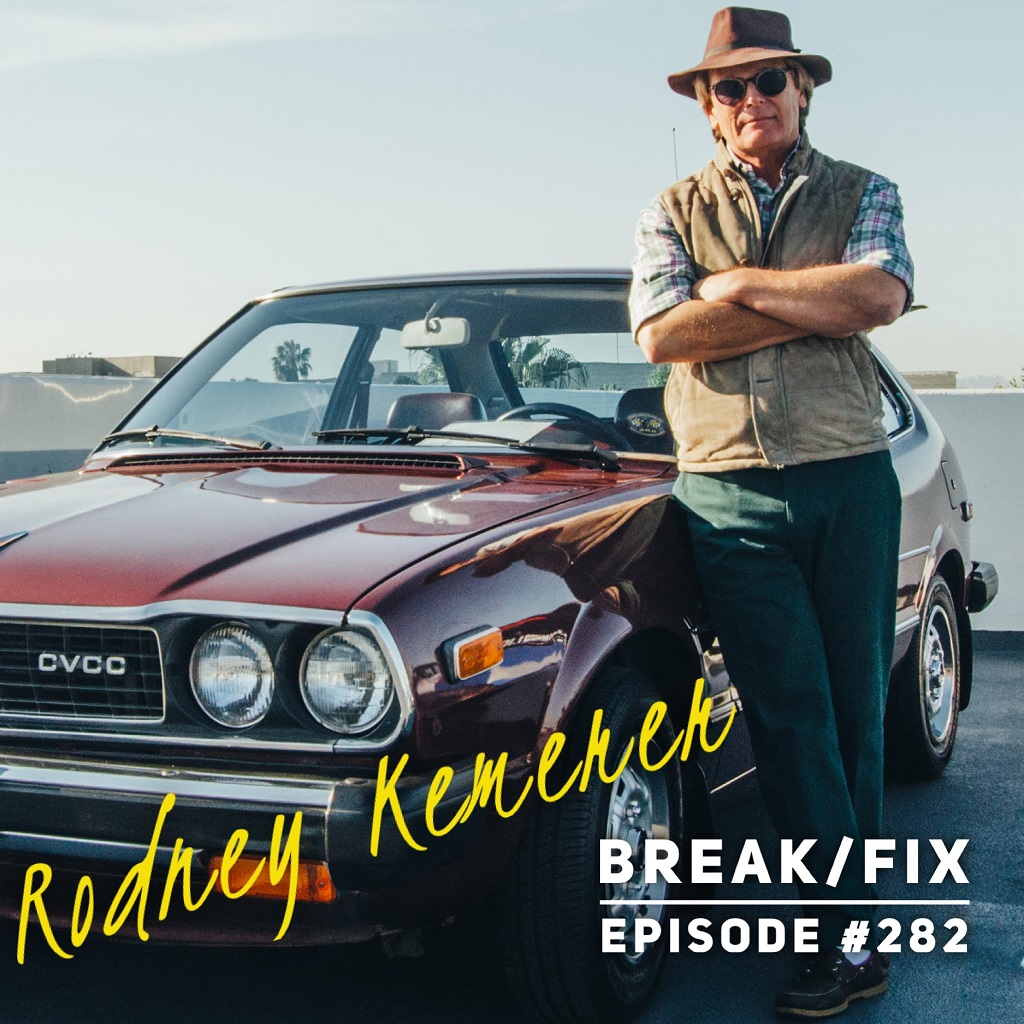
And it’s another book that’s available on Amazon, like a lot of these are. And that’s by Monster Jam driver, Bryce Kenney. That’s not a good one. So Don, let’s talk about one of your really close friends, Rodney [00:36:00] Kemmerer. He’s got a new book that just came out.

Don Weberg: Yeah, I brought it with me so you could see it.

I don’t know if you saw it, but I got my copy. So it’s a nice glossy cover and then he’s got some of the quotes from us plebeians in the back. And of course, Jay Leno, he’s up here at the top of the cover. He’s got a lot of terrific stories in here. So the graphics in this book are absolutely phenomenal.

They really are. They were taken from the Garage Style column. But for example, here’s one, one of my favorite stories called Full Serve. That is a picture of a beautiful boogie gas station in Beverly Hills. He did a story on how that gas station came to be, who it was designed by, why it’s so special, really, really bold artwork.

This one’s kind of a good one. It’s called Dorothy, and it’s all about a special Mercedes, which you see here in Rodney’s own garage. It is the Mercedes. I believe the number is one 70. It was one of the first Mercedes actually imported in North America. Then there’s, I mean, this silly little thing here, which when you read the story, what we’re looking at is a picture of a [00:37:00] Honda Accord hatchback special edition from 1978, and he wrote about it in one of his columns for garage style, uh, where he established.

The title of this book, Tales from the Garage, and he literally has a lot of his own original pictures of this Honda that he was writing about. And everybody says, well, why is he writing about a Honda? Well, really the story behind it is pretty fascinating. It is his Honda. He bought it brand new and how he secured the loan was pretty interesting because at the time he had not only the old Mercedes 190, he had some other Mercedes.

So he dressed up in a suit and tie. Went to the bank, applied for the loan, and they asked for what the collateral was, and he put down two Mercedes Benzes. Well, when you see two Mercedes Benzes, a guy in a tie and a suit, you think this guy’s got it going on. He’s a sure bet, you know. So they gave him the loan for the Honda.

He went running off and went to work. So he’s got a lot of really, really cool stories.

Rodney Kemerer: Thanks, Eric and Don, for having me on your BreakPix podcast to talk about my new book, Tales from a Garage. Everyone has a [00:38:00] car story, or two. These just happen to be mine. These are personal stories of mine, mixed with the stories of others.

Part memoir, and part the memory of other people. It’s not a narrative. Each story stands alone. Each chapter has its own graphic language that runs through each story, so that nothing is repeated. It is designed with the shape and the feel of an automotive owner’s book. So it fits into your glove box, so you can take it with you.

And I’m hoping you do take a look. It’s available at talesfromthegarage. com and it’s available on Amazon. Perfect Christmas.

Don Weberg: So really, Tales from the Garage, it is all about tales that guys might tell each other in the garage about things that happen to them. The beautiful thing about this book is how it relates to Anyone, anybody can read this book and enjoy it. They’ll get some nugget of information out of it. So you can find this on Amazon as well.

Tales from the Garage. If you’re

Crew Chief Eric: interested in all the books that we talked [00:39:00] about, be sure to check out our Goodreads list, which is included in the show notes with this episode. We gotta select another gear, and we gotta talk about artwork.

Steve & Izzy: Artwork is good! Hey everybody, are you looking for the perfect stocking stuffer for the holidays?

Do you like supporting the arts? Well then you need to check out UntidyVenus. etsy. com The top one stop shop that always pops her top! Ah!

That’s a wrap!

Steve & Izzy: Are you a fan of dinosaurs? Snacks? Dinosaurs made out of snacks? Movie monsters? Unicorns? Cats? Dogs? Rats? Shrimp? Pokemon? Tie dye? Paracord bracelets, paracord dog leashes, enamel pins, coloring books, block prints, watercolor, pet portraits, buttons, magnets, stickers, bottle openers, artist trading cards, or really anything else that’s awesome?

Then stop on by UntidyVenus. etsy. com. That’s a goddess who’s bad at housekeeping. Etsy. com. New items are popping up all the time, so be sure to follow her on Instagram, Twitter, Facebook, or Patreon at UntidyVenus. Or visit her website at izzycreates. com for the [00:40:00] latest. Did I mention the Snackasaurs? How about Gary the Unicorns?

On TidyVenus. etsy. com, the goddess who’s bad at housekeeping. Check it out now.

Crew Chief Eric: Friend of the show and former guest, Bob Gillespie. If you reach back into the catalog and look at the Green Grand Prix episode, he talks about his past in the motorsport world. He’s a renowned artist based out of the Watkins Glen area of New York.

He’s known for putting together, during the holidays, A beautiful calendar. He self publishes these. They’re all his artwork. And this year he’s featuring Corvettes because it is the 70th birthday of Corvette, which coincides with the 75th birthday of Watkins Glenn. But let’s hear from Bob on how you can get one of these.

Bob Gillespie: Hi everybody. My name is Bob Gillespie. I’m a motor sports artist, 12 lithograph prints of my racing history paintings. illustrate my 2024 desk calendar. This year, there are nine famous Corvettes plus three others. It comes in a [00:41:00] clear plastic CD case together with an artist introduction page. I’m proud to say that I’ve been self publishing this desk calendar for 18 years, featuring different paintings of mine.

The price is 16 each plus 4 shipping. If you’re in the Watkins Glen area, you could stop by the IMRRC and pick up a copy there. You can order by emailing me or calling me at 315 694 2812. And I would like to wish everybody a happy holiday.

Don Weberg: One of the other favorite places to go is a great website called vintageautoposters. com. Now vintageautoposters. com is a wonderful place if you’re interested in getting original artwork from back in the day. These are posters, these are advertising. Pieces. These are some very colorful stuff from way back in the turn of the century.

One piece I was interested in acquiring was an original point of [00:42:00] sale. Weber carburetor counter piece, probably only five inches tall by three inches wide. It’s more like a card, absolutely stunning graphics. One thing you got to remember about this classic vintage art is it’s not like today where we just put it on the computer, fire up a printer and boom, in 30 seconds, it’s done.

Back then they literally had to hand draw this stuff. And then they had to come up with, in some cases, lithographs to put it on the can, to put it on the metal, to put it on wherever there was a lot of work involved, a lot of artistic artisan skills that are lost today. And that is what vintageautoposters.

com will bring to you. And it’s all guaranteed original investment grade. So I think that might be something special for one of those gearheads in your life who really appreciates fine art.

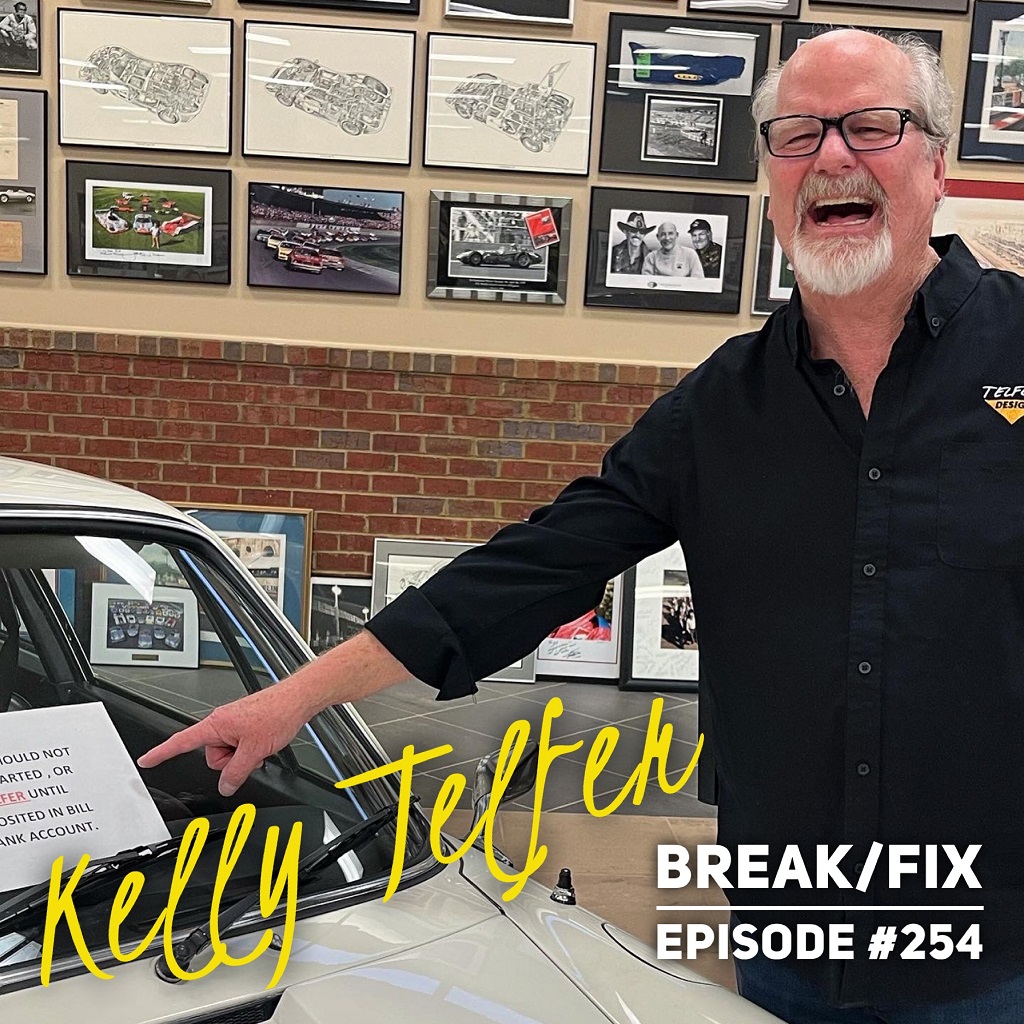
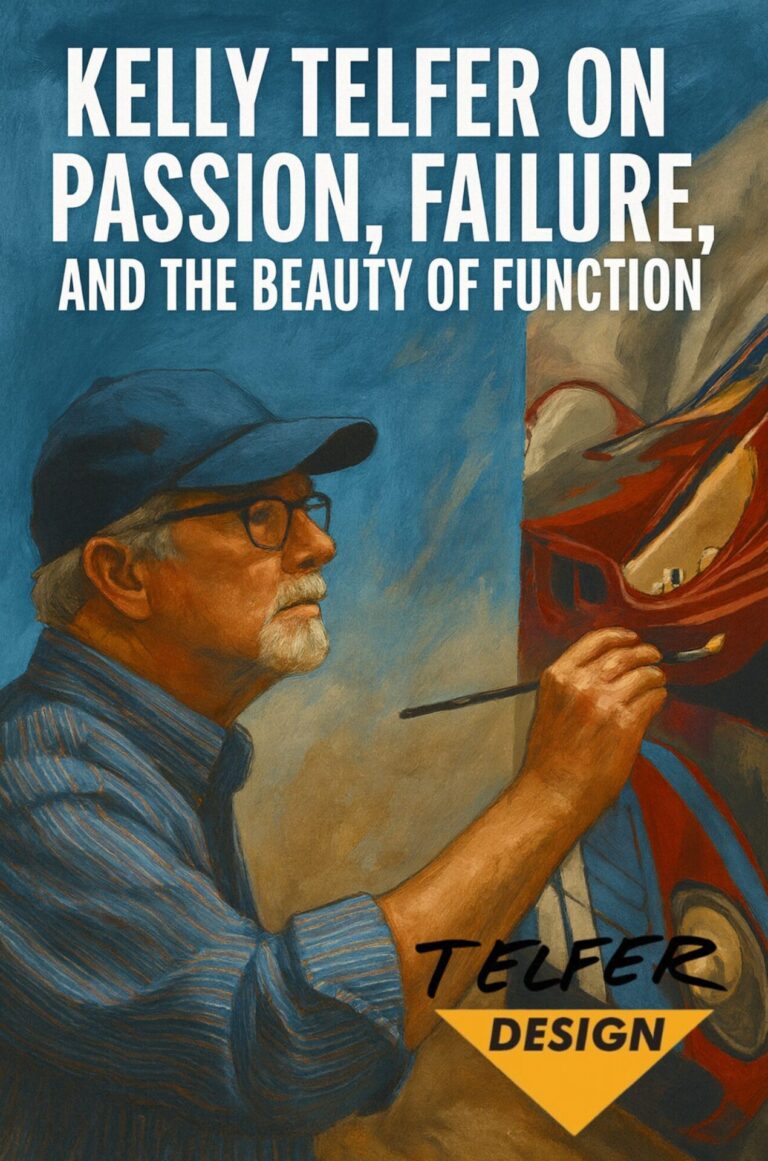
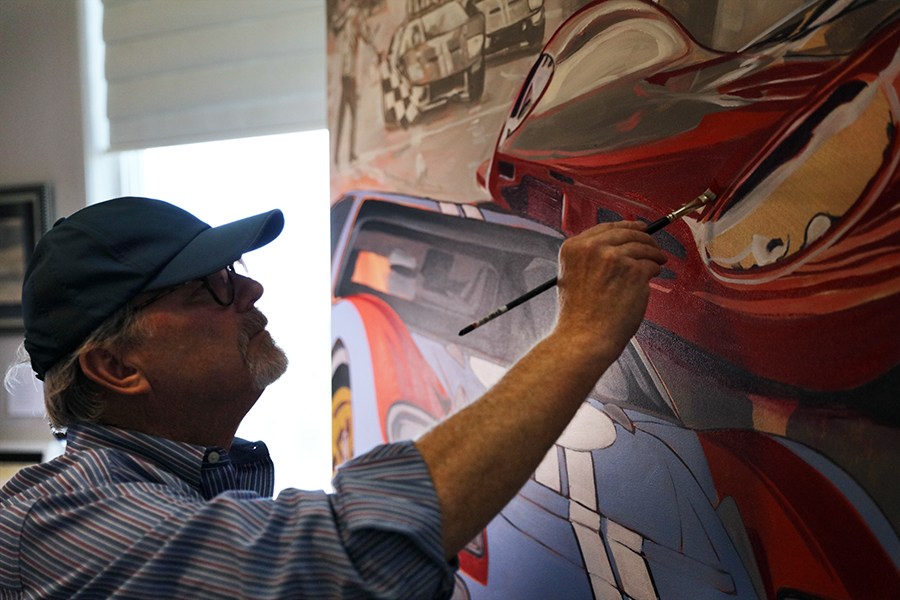
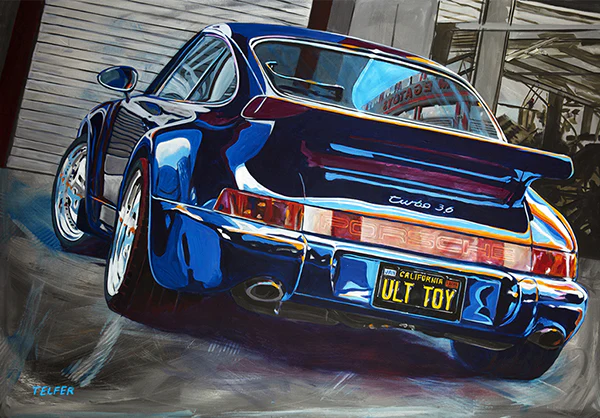
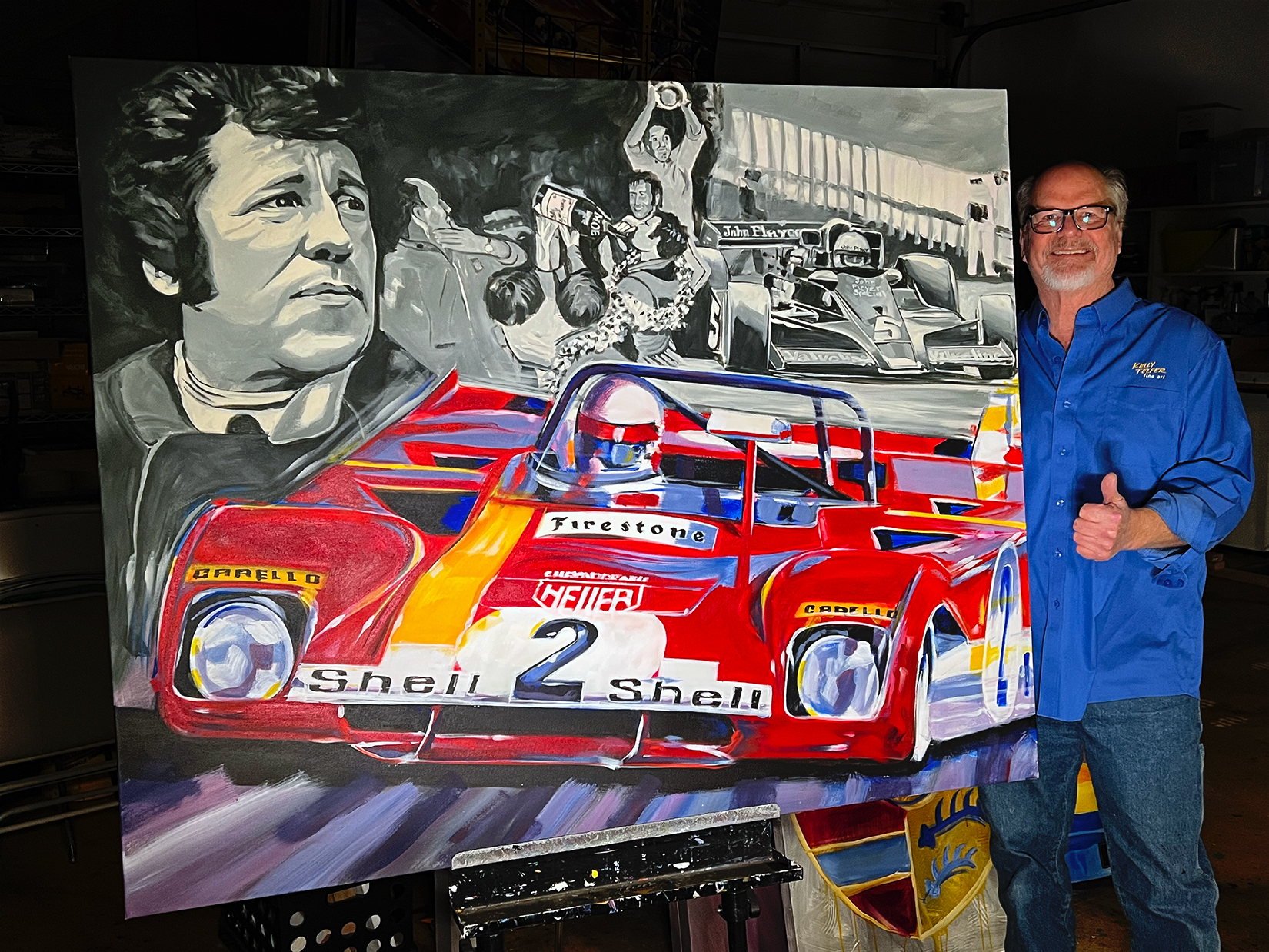
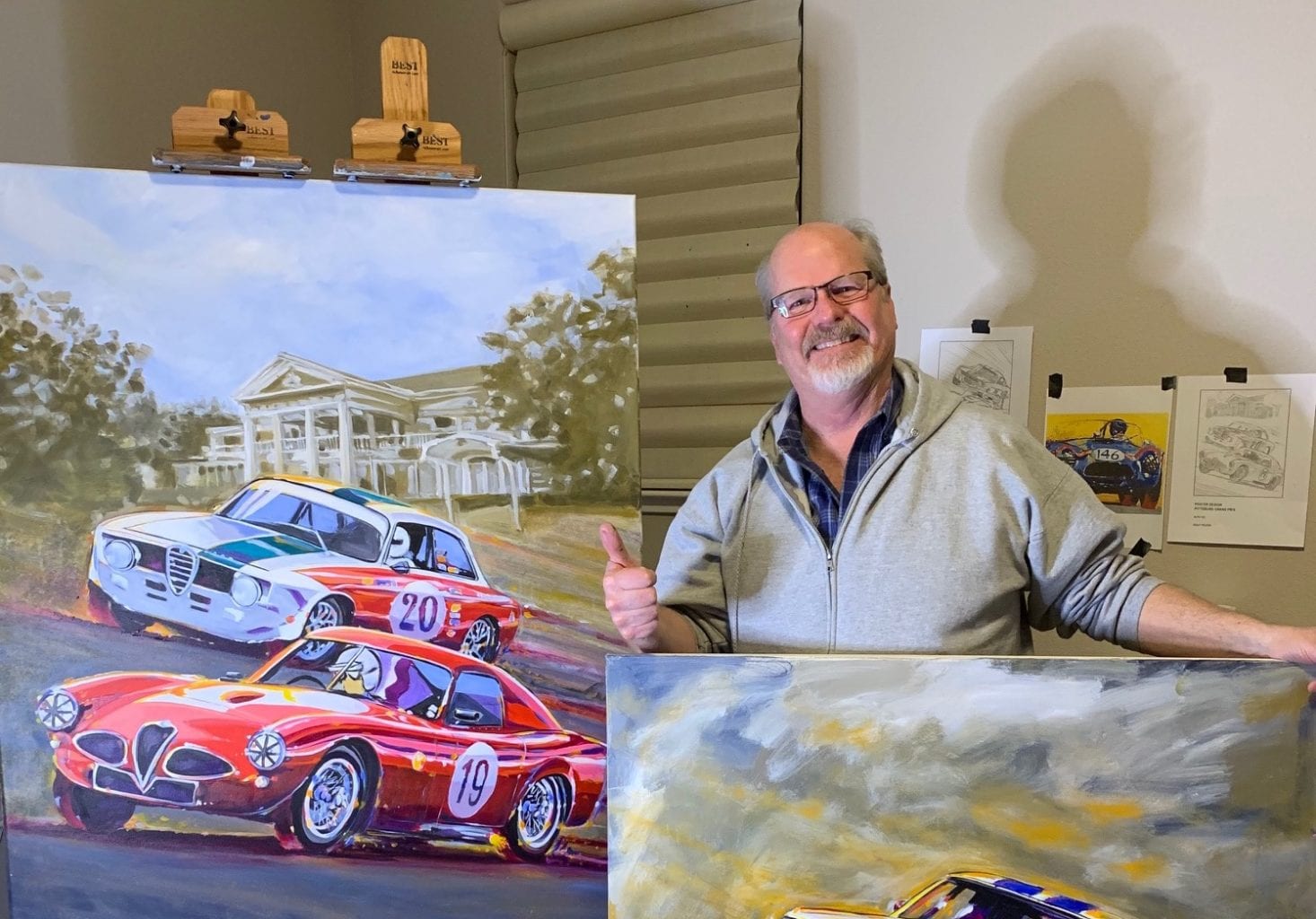
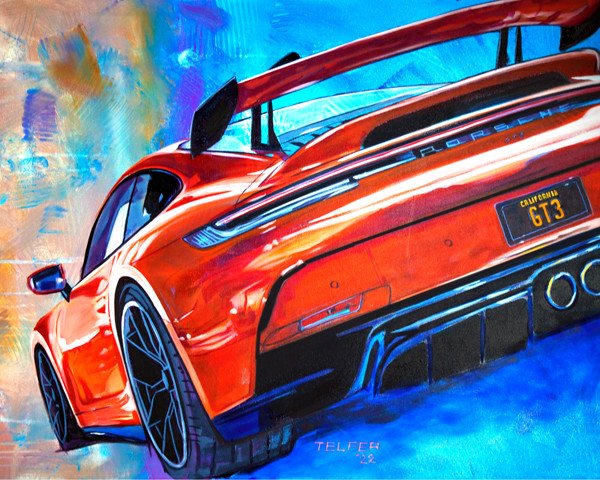
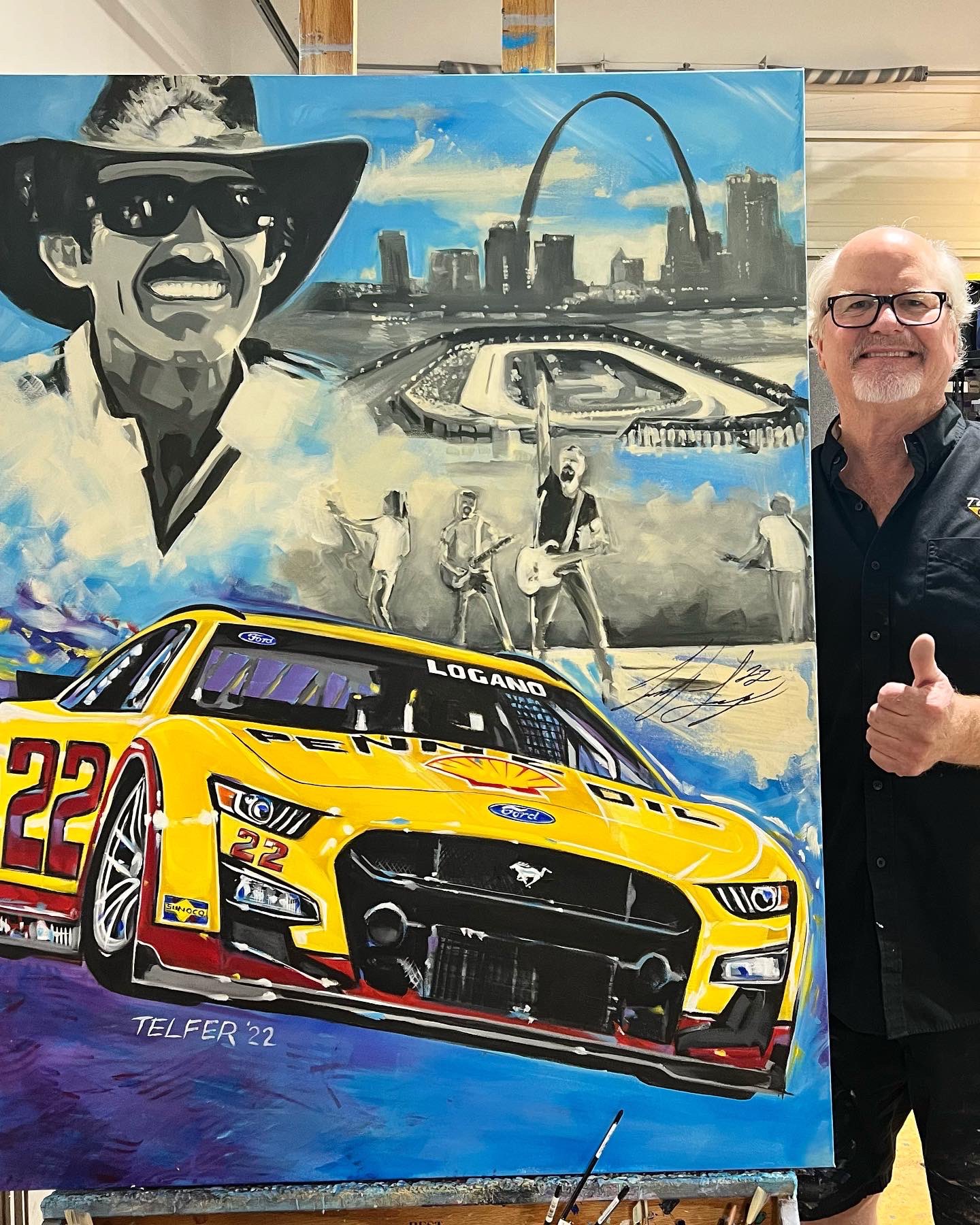
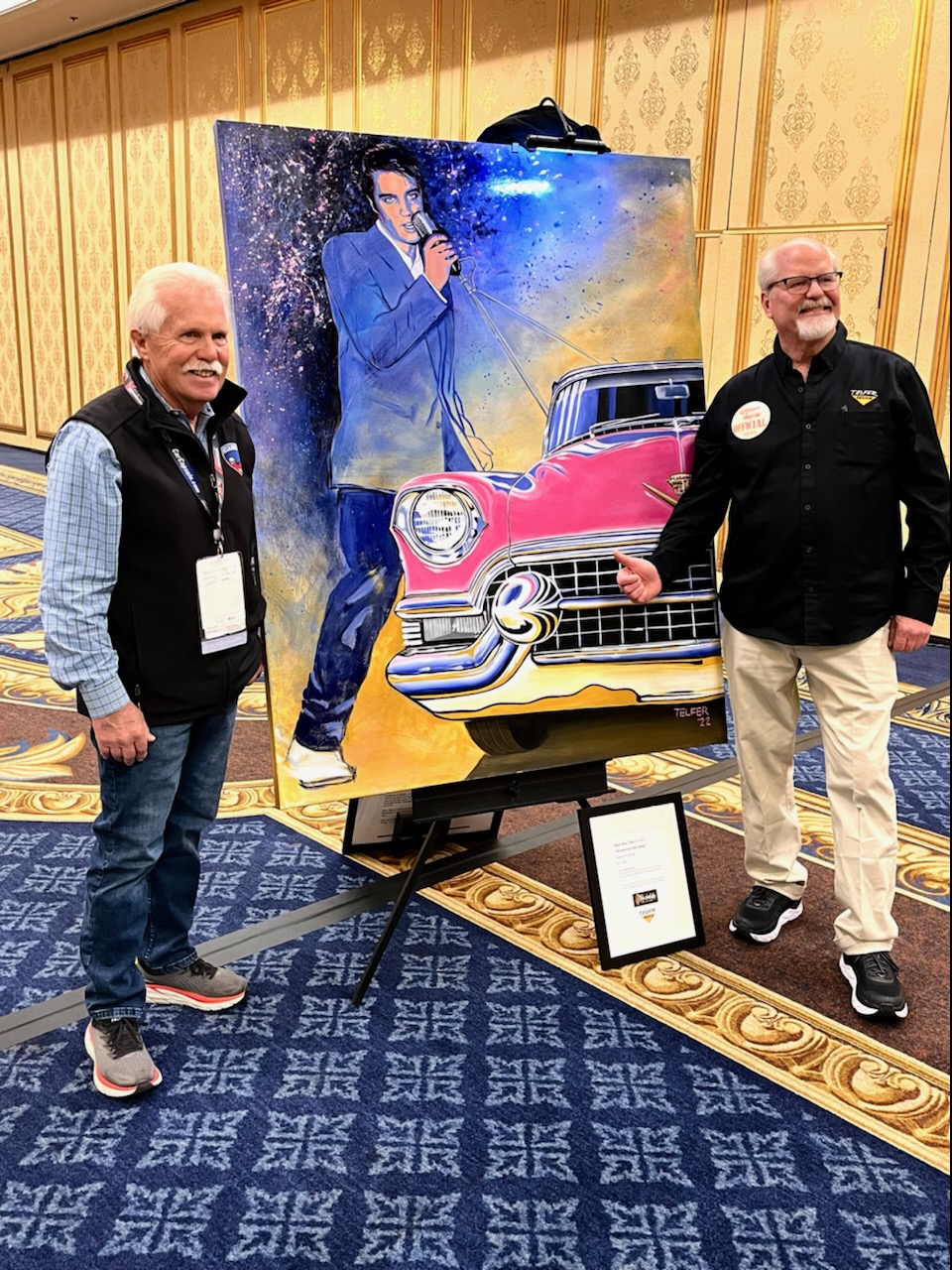
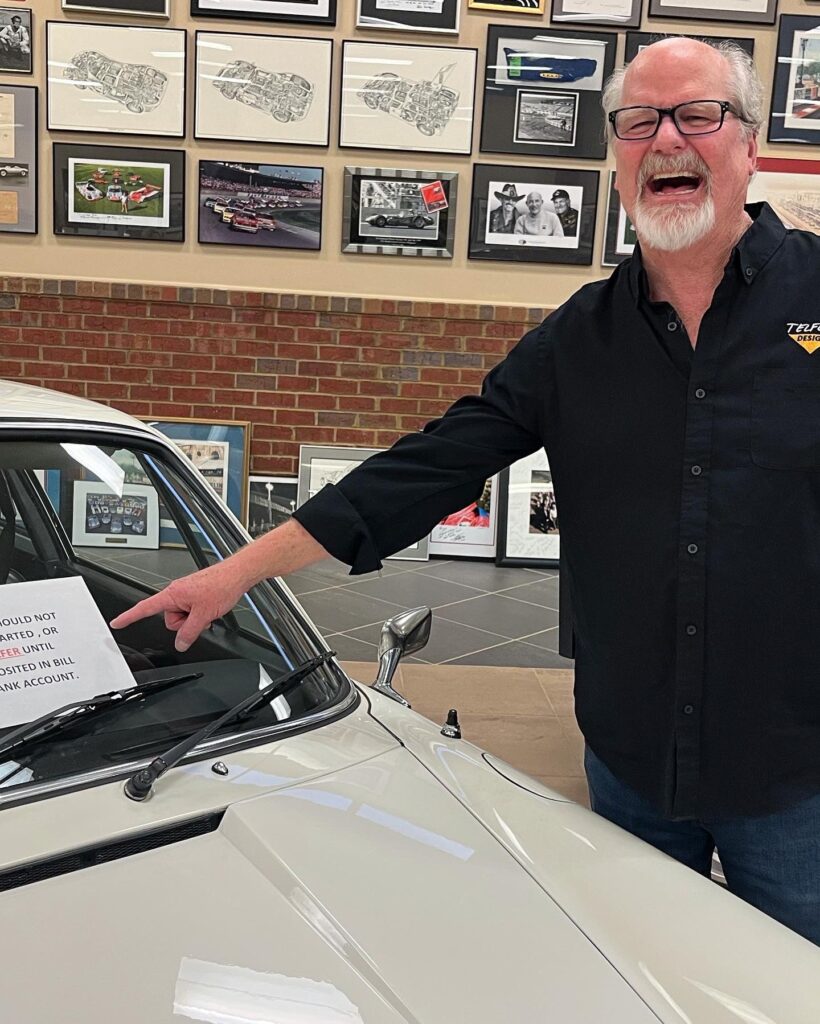
Crew Chief Eric: Speaking of artists, you know who else stopped by the studio? Renowned Porsche artist Kelly Telfer.

Kelly Telfer: Eric just asked me, what are we doing for holiday promotions and sales?

I’m going to double my retail price and give you 50 [00:43:00] percent off everything, including freight. Let’s show a little love to FedEx and the UPS. Those guys don’t mean to lose the packages or drop kick them through the goalposts of life. They don’t do it on purpose. They don’t ever drop an original painting or run over it.

I’m sorry I didn’t say that back up the track. Oh my God. So yes, the week of November 15th, I’m going to put one of my original 000. Every day I’m going to lower the price by 500 until someone buys it. You might get a good painting for 500 bucks. Well, it’s an okay painting. And then the other thing I’m going to do in the week of November 29th, I’m going to offer 25 percent off my entire website, everything, except few things.

I don’t know. You can’t see all the stuff I have. You want artifacts? Come here. I’ll give you a bunch of junk. That’s really cool. But 25 percent off everything. Shipping, packaging, and the artwork as well. Sorry, UPS, FedEx. Love you guys, man. You’ve saved me a million times. You’re the best. Go Raiders. Out.[00:44:00]

Don Weberg: Ah, good old Kelly Telford. Speaking of fine art, another great place to go to. is carartinc. us. Again, we’re dealing with fine art here. Some of the great artists in the automotive industry. It is run by Peter Aylett and Peter is himself a great artist. He used to design for Mazda, Ford, and even DeLorean at one point.

Great guy. He will help you find a commission if you want to put yourself or your loved one or a special car in a. Piece of art that’s very original. He can help you find the artist who can make that happen. Or maybe you just want to find something that puts a certain scene or a certain mood, maybe you’ve got a loved one from New York and there just happened to be a great picture of an old Cadillac at Christmas time, driving down fifth Avenue.

In the snow with old New York in the background. Really cool. Or maybe you have a friend from Malibu and the thing is surfing. Well, there it is. Malibu picture with a beautiful [00:45:00] surf scene. And of course, some sort of Woody in the foreground or maybe some sort of sports convertible

Danny Pilling: fun, fun stuff. Hey, this is Danny P the host of the podcast, Danny P on cars.

I’ve just founded a new company, 077 Media. So if you’re an automotive customer looking for help with things like strategic planning, marketing support, or partnership management, please reach out to my website, www. 077. media. Wishing you and your loved ones a happy holidays from me. There’s so

Executive Producer Tania: many podcasts out there.

Crew Chief Eric: How do I find the one for me?

Steve & Izzy: For so long, I’ve searched for podcasts all over, but none of them seem to fit my needs. Where’s my Nick Cage pissing fire podcast? Where’s my monkey tickling? I couldn’t find it anywhere. Until, I found everything I learned from Louie’s podcast with Steve and Izzy. And now I get to hear about all the monkey tickling I want, baby.[00:46:00]

So many podcasts out there are all talk and no congo. That’s why I listen to everything I learn from movies. Greatest Living Actor? Nicolas Cage, of course. That’s why I listen to everything I learn from movies.

Executive Producer Tania: One liners, plot holes, virtuitous boobies? Fun fact, that’s why I listen to everything I learn from movies.

Steve & Izzy: See if everything I learn from movies is right for you at EILFmovies. com Everything I learned from movies on Twitter, Facebook, or Patreon. Free on all the major podcatchers.

Crew Chief Eric: So since we’re still thinking about the holidays, you know, maybe we’ll flat pack ship some cars to people as a gift this year. We also have some rich people things to talk about.

And William, I specifically pulled this one out for you knowing kind of cars you deal with, the people you deal with. And I want to know about these Bugatti. Sunglasses.

William Ross: I buy my sunglasses at Speedway. Ha ha ha

Crew Chief Eric: ha ha! There you go. That’s the American way. Bought my sunglasses at Buc ee’s.

William Ross: Yeah,

Crew Chief Eric: [00:47:00] exactly. What you’re telling me is, these Bugatti sunglasses are not on your Christmas list.

William Ross: God, no. Some of these things are tacky as hell. I mean, you gotta have just stupid money. Cause I mean, the cost, everything. I mean, I don’t know.

Executive Producer Tania: These have mother of pearl inlays. 18 karat gold, black palladium accents, grade 5 titanium, carbon fiber, macassar ebony wood. Why wouldn’t you want this for 2, 000?

Yes. For you to accidentally sit on and break.

William Ross: Yeah, these things look like glasses that, you know, you’re sitting down at a deli getting yourself a bowl of matzo soup.

Crew Chief Eric: Or you’re in like a lecture hall and your professor flips up as he came in from outside. I mean, they’re just bizarre Oh my god

William Ross: And just imagine what the knockoffs will look like because you know, those are coming right behind it Someone’s gonna change them just a little bit so they don’t get in trouble It’s like

Crew Chief Eric: the rounded corners on the Samsung, right?[00:48:00]

William Ross: Exactly.

Don Weberg: Geez. See the yellow glasses. I’m sorry to say this. They remind me of, you’re going to pick up a rifle and take aim at me. Oh my Lord. Now you’ve got yellow lens glasses too. Oh boy, I’m in trouble. I’m at a Smith and Wesson convention here.

Crew Chief Eric: Yeah, right. But we need to talk about watches. And Don, this is your area of fine expertise.

So what have you brought us to sample and look at?

Don Weberg: Well, starting at number one, YEMA. Y E M A. Not to be confused with the city in Arizona, Yuma. But YEMA has been in business since 1948. And they built watches in France using Swiss made manufactured calibers. However, recently they turned to crowdfunding to finance their own manufacturing of manufactured calibers.

Now, if you don’t know what that is, literally it’s the mechanicals in the watch. It’s the little gears, the little springs, the little tickers that make the watch. Oh, [00:49:00] and once you wind up now, the nice thing about Yema, what I like about them, they have a watch seemingly for every interest. They’ve got a watches for the boating guy to get watches for the airplane guy to get watches for the car guys, et cetera, et cetera, et cetera.

One of my favorites is the Rallygraph line, which is R A L L Y G R A F. Very, very racy looking. Looks like it might be on a movie in the sixties. Being worn by Steve McQueen or somebody like that. Very, very cool

Crew Chief Eric: stuff. Don, don’t discount this watch. This was done in partnership with Alpine. That’s

Don Weberg: right.

Crew Chief Eric: It was.

They are a formula one team. They are in Le Mans. This is not just any rally graph watch. This is the Alpine rally graph watch. This thing is really cool. And if you’re into French sports cars, if you’re into racing. I think this is a great get.

Don Weberg: It really is a cool watch. The way it’s styled, the way it’s designed, the heritage of it with Alpine really does look like it stepped right out of the sixties racing scene.

Paul Newman could be wearing this thing and it’d be right there. Gmail watches are not all that [00:50:00] much money for what you’re getting. They’re really fantastic watches. I really like them. So I hope somebody will check them out. Maybe use them for a stocking stuffer. If for whatever reason, those. Do not pet your fancy another great company that I really like.

And I’m actually holding one of their time pieces is Fero and company F E R R O and company founded in 2014 by two brothers. The question was. Why do watches with exceptional mechanicals and design need to cost so much? That was literally what those two brothers were talking about one day. To that end, they set out to produce affordable watches that celebrate aviation, fine dress, business, and, of course, motorsport.

With a multitude of chronographs and single hand watches, there seems to be something for Everyone, the one that I’m holding here is kind of interesting because you’ll notice on the top, there is three, five, six, which of course is Porsche 356. It looks like a three 56 speedometer. Yeah, exactly. That was what they designed it for.

And you can look in [00:51:00] the back and you can see the clear casing. So you can see all the mechanicals. Working back there, really a fun watch comes with a perforated strap with either green or red detailing. I have the green one and I really like it. Every one of them is numbered. These were limited edition.

I want to say they made a thousand of them. There are still a few of them that are for sale. Terrific watch again, Pharaoh and Company. Another fun one, a little more serious, called Ernst Benz. Ernst Benz is a real person, or was a real person, if they sold the company ultimately, but what began as a quest to produce the most accurate and legible timepieces in aviation, Ernst Benz has grown into a watchmaker with a multitude of styles, all based off of the original concept.

While flying is in their heart, It is in the art of watchmaking that drives them to produce watches that anyone can appreciate. The reason I bring them up is yes, they have the big pilot watches, which everybody has been into, but they also have a couple of motorsport time pieces that dribble in. [00:52:00] To the mix

Crew Chief Eric: specifically, they have a limited edition 50th anniversary Camaro watch, which is very, very handsome.

So if you’re a General Motors fan, you’re a little off of the Corvette Club and more interested in Camaros. This is a really, really nice piece to commemorate 50 years of the Camaro.

Don Weberg: Now the next one is C-V-S-E-O-S. Vetos, founded by saso S at just 21 years old. CVS TOS watches brings a unique style and flair to the world of watchmaking.

The racing lineup catches the spirit of motorsports through bold design and color usage. One thing that’ll catch your eye about these watches is the shape of them. They’re not your standard issue circle. They’re not your standard issue rectangle oblong

Crew Chief Eric: oblong.

Don Weberg: Yeah. I want to call them coffin shape, but I know that’s a little bit morbid.

You know, if you look at them, they’re very, very, I call it busy design, but you can see you’re through a lot of the [00:53:00] watches, you know, workings of them. Their straps are absolutely fabulous and they do have motorsports

Crew Chief Eric: styling. Your point body wise, they have all very similar design. There are quite a large watch clocking at 41 millimeters.

They’re going to take up a lot of wrist space. Even though they’re a little busy, they’re going to be easier to see at that larger scale. But yeah, I really do like the look of the bronze over gun metal of the Nardo, but there’s some other ones here that are really, really cool as well.

Don Weberg: Yeah. It seems like there’s a little something for everyone.

The next one I like is Tag Heuer or Howard, depending on where you’re from, how you want to say that. Might be impossible to make a list of cool motorsport watches without including the granddaddy of them all, the Monaco. The Monaco was made famous by Steve McQueen in the film Le Mans. The square watch is largely the I Ching of any car guy watches.

I mean, it seems like any time you talk about car guy watches, the Monaco is. Bam. It’s right there at the top of the list for the line. It’s, it is the watch [00:54:00] to gravitate to now. Nicely. You know, if you remember that movie, Steve’s was in Gulf colors. I believe it had a blue strap. Even today you can buy the Monaco in any multitude of different colors.

The Gulf is still available, but you can buy this thing in black. You can buy it in silver. You can buy it in red. You can buy it in all kinds of different things. Really, really a cool watch. And I guess the official name is the Tag Heuer Monaco. Oh, your, Oh, two automatic.

Crew Chief Eric: What I like about this watch, the gulf liveried watch specifically, not just because it’s a throwback to Steve McQueen is how they modernized it for 2023.

Because if you look at it, it’s got little extra touches that wouldn’t have existed on Steve McQueen’s watch. Like the Indiglo for the night stuff, but also the watch band itself. Is dual color, it’s blue leather on top with an burnt orange on the bottom. I’m like, that’s a lot of detail in something that it’s movement, the way it lays out, the way it looks, it is a Swiss made watch, it’s beautiful.

And for the [00:55:00] money, if you want a modernized version of what Steve McQueen had, and you’re that type of collector, I couldn’t see why you shouldn’t have something like this.

Don Weberg: Yeah, they really are a cool watch and you’re right. There’s a lot of details that go into a TAG, especially the Monaco. I may be wrong, but it’s probably the most expensive watch we’ve got on the list here.

But I think as you’re pointing out, it is probably well worth it to a lot of people just for all the details that’s involved in that. Now, the nice thing about TAG, they have a very, very rich history in motors. Or, and one of my favorites is called the Carrera. It’s another classic it’s named for the Carrera Panamericana race of the 1950s.

Another race that’s close to my heart. It was one of my father’s favorite races. And of course, Lincoln dominated it for a long time, but anyway, they developed the Carrera. It’s a terrific watch. It’s a lot more classically styled. It has more of a circular pace to it, but you can have it with chronograph.

You can have it with non chronograph. You can custom tailor this watch pretty much however you want it to. There’s a lot of [00:56:00] motorsport heritage in this watch from Tag Heuer to De Pencel. Depencel is probably the newest company we’re bringing to the program, but it was launched just in 2018. Depencel is the result of one man’s interest in how watches work and blending their unique mechanisms with designs inspired by motorsport.

Unlike so many others, Depencel is rooted literally in motor racing. As such, the company now produces a nice number of racing inspired watches, including one called the CERI R. Which looks shockingly like the TAG Monaco that costs infinitely less. Now, not to go knocking on the TAG, but there is something to be said about for those of us on a budget who would like something similar to the Monaco but can’t quite afford that coin.

One thing I like about Depencel, they come to the market and in typical racing spirit, they are all about competition. They have a very rebellious spirit. If you like cars, and especially if you love [00:57:00] motorsport and racing, you’re probably going to really appreciate that streak in a Depencel.

Crew Chief Eric: Their version of the Steve McQueen is.

Quite nice as well. I like the fact that it comes down in powers of 10. I was jokingly thinking to myself, where’s the fossil version of this so I can knock another 10s place off of the price tag, but for the money, they’re not bad. I actually really liked the series are eighties edition that has that stainless steel with sort of the elastic stretchy band and like that orange over black with almost the interlaced background.

It looks like louvers on the back of a DeLorean or on the back of a Mustang that draws me in. And it almost feels like some Something that Jujaro would have designed. Right. I’ve seen Jujaro’s watches too. They’re quite nice. It has that appeal to me. So that’s really, really interesting. Now it clocks in a little bit more expensive than their version of the Steve McQueen watch and some of the others.

They’re all really pretty cool.

Don Weberg: Yeah. I like the pen cell. I discovered them on Facebook and they were just promoting their watches and I just kind of kept after them. I really liked them. So the [00:58:00] next item on the list is probably the. Youngest watch that we’ve got, which is De Tomaso.

Crew Chief Eric: Wait, wait. Are you talking about De Tomaso like the Pantera?

Don Weberg: Yes. In fact, the watch line was inspired by the De Tomaso

Crew Chief Eric: Pantera. Is it an Italian body with an American innards? Is that how this watch works?

Don Weberg: We gotta have this guy on your show so we can crack that open literally. But yeah, the manufacturing behind them and the man himself is Alejandro de Tomaso. Very, very interesting there.

It said the design of the car is reflected by the watch. So I’m unsure, honestly, looking at some of them. I really don’t see much Pantera in these watches. These watches are very modern, very sharp, very

Crew Chief Eric: clean. I think it might go along with the new De Tomaso supercar that they were building, which we talked about last year on the drive through.

So maybe this isn’t a nod to the seventies Pantera. This is a nod to the new cars that are coming out.

Don Weberg: That could very well be. Yeah, I, I hate to say it, but I [00:59:00] totally forgot about that car regardless. So talk about a watch that is rooted in not so much motor racing, but motor design. Bargain price too. My goodness.

Crew Chief Eric: They’re on sale right now at a 40 percent discount. You can grab one of these. De Tomazo watches, they MSRP at about two 30. They’re coming in at 1 37. Yeah. If you want something a little nicer than a fossil that you can pick up at your local kiosk in the mall, these are really cool. I like the Repaso, the blue watch.

I like that navy blue with the orange. Something draws me in about these pumpkin colored watches for some reason. But the D 10. With the copper over that charcoal, that is a really good looking watch.

Don Weberg: Yeah, they are beautiful. In fact, if you look at some of the outer edges of the cases have little hash marks on some of them and some of them are clean, it’s such a fine, small detail, you either have the hash marks or you don’t have the hash marks.

And I think that’s kind of a cool thing that as a customer, I can decide, do I want more [01:00:00] detail, more eye candy, more visual pop, or do I want it cleaner? Very interesting the way they allowed customers to kind of do that. So fun stuff.

Crew Chief Eric: Well, he also seems to be a big fan of the color yellow because there’s about three or four different designs that feature that old school Pantera yellow.

So that may be a drawback to the old cars, but very, very cool. Really cool. Fine. These are some really interesting pieces.

Don Weberg: Thank you. I try, baby. I try.

Crew Chief Eric: Dude, this is exciting. As we get closer to the holidays, where we’ll probably see more and more rich people, things popping up, Dan, what’s going to be on your holiday shopping list here very soon,

Danny Pilling: but you know what, when I go camping, I want to get away from everything, you know, when I enjoy the wild outside, but LG have made it much more easy for me to catch up with the latest Netflix show, they’ve developed a suitcase.

Which is a 27 inch screen TV that supports airplay, supports screen monitoring. So just when you thought you’ve escaped it all, LG are there to make sure that you stay connected to the real [01:01:00] world.

Crew Chief Eric: What’s the low, low bargain Best Buy price of this particular suitcase television?

Danny Pilling: To you, sir. Just shy of a thousand dollars.

Executive Producer Tania: You know, that’s not unreasonable. That’s expensive for 27 inch.

Danny Pilling: Yeah, but how many 27 inches can you tuck away in a Pelican

Crew Chief Eric: case and carry with you to your next campsite?

Executive Producer Tania: I like the concept of being able to transport the TV, but I wouldn’t be bringing it on my wilderness excursion. I also don’t know where I would need to transport it to in general.

Danny Pilling: It goes landscape and portrait, so I don’t know why you would want, maybe Instagram. I want to watch Instagram at scale. If

Crew Chief Eric: it doubled as a computer monitor, then I could see it being advantageous for like motorsports events, maybe at an autocross, a great way to like tuck it away, have it stored in a trailer.

Executive Producer Tania: Tailgating, tailgating. Yes. It would be useful. Tailgating, you’re in the parking lot of the game and you’re watching pre game coverage in the parking lot.

Crew Chief Eric: How many of these new big SUVs have TVs in them that you could just jack your [01:02:00] Roku into and do

Danny Pilling: the same thing though? They should do a Westphalia edition.

Yes!

Crew Chief Eric: Oh, then it’s okay.

Danny Pilling: Does that justify

Crew Chief Eric: that? 100%, it’s done. If it comes in the Westphalia, I’m all for it. It’s all good.

Executive Producer Tania: That wouldn’t be a bad idea because if you’re taking your Westphalia on a road trip and in some nights you’re not really where you need to be, you would have some form of entertainment.

Crew Chief Eric: You know who’s not going to be able to use this folding suitcase LG television? The gentleman that purchased a Bugatti Bolide. And stripped it down to its carbon fiber monocoque and turned it into an exo car. What compels people to do stuff like this? You spend four and a half million bucks and then you strip your car down?

Danny Pilling: Maybe he wasn’t allowed Hot Wheels as a kid.

Executive Producer Tania: So this thing is stripped down. It weighs 2, 700

Danny Pilling: pounds.

Executive Producer Tania: A full bodied bully day. weighs 3200 pounds, all of that stripping and you only save 500 pounds.

Crew Chief Eric: And you know what else you lost in the process? Aerodynamics.

Executive Producer Tania: Yeah,

Crew Chief Eric: all of that

Executive Producer Tania: is gone. Ground effects.

Danny Pilling: He should have [01:03:00] bought a Lucid Sapphire.

That’s the ticket right there. There we go. Well, you know what they might be buying?

Executive Producer Tania: For their children.

Crew Chief Brad: Oh, tell me there’s a baby three. We talked before about the Bugatti baby twos.

Executive Producer Tania: It was the Chiron. There was a minute. Oh, yes.

Crew Chief Brad: The Bugatti Chiron. Yes. It

Executive Producer Tania: also had the speed key. I think.

Crew Chief Brad: Yes. There is a company called Group Harrington that apparently makes a whole bunch of these cars.

There’s the GB Spirit. There’s the Ferrari Spyder. The Ferris Bueller Ferrari.

Executive Producer Tania: Eric, pick the Ferrari. What would you pick?

Crew Chief Brad: You got to go with the Cobra. The 289 Cobra.

Executive Producer Tania: I’m doing the 300.

Crew Chief Brad: You’re going to go with the 300. Aye. Figured you would’ve went with the F 1 race car.

Executive Producer Tania: Nah, I’m gonna go with the Merc.

Crew Chief Eric: She’s a Benz girl.

Crew Chief Brad: And I probably would’ve, should’ve went with the Jeep. Let’s see how much, let’s see how much is…

Executive Producer Tania: They’re so expensive, they don’t list the price.

Crew Chief Eric: You might as well buy the real thing at that point. Yeah.

Crew Chief Brad: You can design your car. Look at this shit.

Crew Chief Eric: It’s funny, you guys, bring this up. I saw some of these. At some of the auctions in car week, they’re really, really cool.

These are the nicest [01:04:00] go karts you have ever seen.

Executive Producer Tania: I believe it. If only we could afford them, we could each get one and then go.

Crew Chief Eric: We talked about this before the go karts need to look like the race cars, and then you can do a proper Petit Le Mans. Or Petit Le Mans classic, there’ll be

Executive Producer Tania: amazing. Petit Petit Le

Crew Chief Brad: Mans.

Petit Petit. You should be able to get the pricing.

Executive Producer Tania: It says to email for a quote.

Crew Chief Brad: You can add things to your shopping cart.

Executive Producer Tania: I don’t know because when I went into the 300 it says request for quotation, leave your details and request quotation for the car and options you have selected above.

Crew Chief Eric: Yeah, I see that.

When they say that. You can’t afford it

Crew Chief Brad: more than you can afford, pal.

Executive Producer Tania: I can go buy a real one of these,

Crew Chief Brad: maybe two

Executive Producer Tania: or probably less than this mini one costs.

Crew Chief Brad: I do like the little Ferrari, California though. That’s pretty sweet. I’m going to get one for Henry.

Crew Chief Eric: Well, that’s why we call it rich people. Thanks.

Now to

Don Weberg: have the rich people things.

Crew Chief Eric: So Don you’re the garage mahal specialist, and it wouldn’t be fair if we didn’t talk about cool things and tools and other items for your garage. So what have [01:05:00] you got for us?

Don Weberg: Yes, Eric, there’s a lot of tools and other garage items that are very exciting. One of my favorites is a wax product and all of us garagephiles know we love to get out there and just polish on the fenders for a little bit.

Zymal, been one of my favorite waxes for a long time. Anybody who’s read Garage Style Magazine has seen it cover to cover on some occasion. Is

Chuck Bennett: car wax the perfect holiday gift? I’ve been asked that many, many times, many years. Somebody wants to give something to someone who loves cars and you don’t know what to give them.

Most holiday gifts say you bought something sophisticated or cool. But do they say, hey, I know what you love and I love that about you. Where cars are concerned, there’s a passion involved. There’s fun, there’s thrills, but we need to remember that loving a car is a big job. So, you’re right, giving somebody a 16 can of everyday chemicals for the holiday can be hard to understand.

Sometimes it’s not the car that you need, it’s the [01:06:00] car that needs you. So let’s talk about a real gift. Scimall was created 44 years ago because of a love for cars and the exciting people who share a passion for them. We strive to make the best products based upon what kind of fresh ingredients we can find available in nature.

This brings to the top of the market the highest quality and absolute best products that any collector or enthusiast could want. We want people to understand that we’re part of that love for the automobile. And it doesn’t matter whether it’s a brass buggy or a brand new Ferrari. It’s the love of the automobile and the reason why we’re here.

So when you think about the holidays, Think about that person that really loves that car. What would bring a smile to their face? It could be something as simple as a card, or it could be some Zymal. So when you go to Zymal. com, enjoy a little gift from us. You’re going to have 35 percent off using the coupon [01:07:00] code HAPPYHOLIDAYS.

We want to wish a happy holiday to everyone from Zymal.

Don Weberg: If you’re looking for a great gift, my personal favorite, they literally have the starter kit. You get a little sampler of whatever wax you want, plus their polish, plus their one particular product from Zymal is literally designed to… feed that flex agent and feed that paint to keep it flexible, keep it rich in color, keep it deep.

Really, really cool stuff. Another one, a newcomer to the block is called Root66. Now Root66 is interesting. They are a one wax pony. They have one type of wax. It’s a spray wax. But the cool thing about it is, at least last time I looked on the website, they were offering customers the opportunity to send in a photograph of their favorite car, and it would be printed on the box and the bottle that the Route 66 wax was delivered in.

[01:08:00] So that’s kind of fun. So if you’ve got a friend or relative out there that’s got a special car, if you can somehow get a picture of it and send it to Route 66. They’ll pop it on that box in that bottle. That’s pretty cool.

Crew Chief Eric: That’s available at root66wax. com.

Don Weberg: Yep, absolutely. And of course, the xymol. com.

Okay. Another good one that you might want to look into, and it’s a little bit more expensive, but it is something maybe you buy for that special someone, that special gearhead in your life who, Oh, I don’t know, they need a little bit of garage organization and let’s face it. Who doesn’t need a little help in that department.

Company out there called C Tech Cabinets. It’s C T E C H Cabinets. C Tech Cabinets, they are all about garage organization. Literally the workbenches, the cabinets, the overheads, beautiful maple workbenches. And they’re all configurable. They’re all completely modular. So you can go on their website, you can design how long you want it, how wide you want it, how thick.

You want to how deep you want it and pick your colors. They literally have hundreds of [01:09:00] color to choose from. I personally like the bright yellow with that silver chim. I think that looks pretty sharp. Again, it’s a bit more expensive for Christmas, but let’s say you’re buying it for a spouse, chances are you both have a house.

This is only really going to enhance not only the value of the house at the end of the day. But it is also going to enhance both of your ability to enjoy that garage, organize that garage, figure out where you keep your tools, where you keep your Zymal. It’s all good stuff. If you’re interested in hitting up the auctions, Mecham has Mecham on time, which is a great place to find different antiques and road art, etc.

Small items, but there’s always a bunch of other auctions.

Crew Chief Eric: You know what, Don? There’s so many things that we could investigate in this category. And I’ve been accused of in previous holiday specials of basically going through my Amazon list from the year prior, pointing out really cool things that I’ve bought or people have inspired me to buy, but we did something even more special this year.

If you visit our show notes, we [01:10:00] have put together a kit sponsored by kit. co. And you can actually see all of our picks and there’s direct links to where you can buy these items for your garage or your collection, et cetera. And by going. through our kit, you can get a discount on those items. Check that out on the show notes that follow this.

You can learn about all sorts of other really cool garage items. They call it the season of giving for a reason. And we have some charities that we want to talk about.

Don Weberg: Yes, you’re right, Eric. There are a lot of charities and tis the season for giving back and supporting those who are looking for a little bit extra love this year and who isn’t.

One of our favorites come from Deb Pollack. She established Drive for a Cure, which is raising lots and lots of money for Parkinson’s research, a disease near and dear to her heart. If you go to her website, she explains all about it. So you can always make a nice donation there, help her and her cause, even get a little tax write off if you want to.

Bill Warner’s book, On the Other [01:11:00] Side of the Fence, it’s a wonderful pictorial of his history running around literally the United States taking pictures at different motorsports events.

Bill Warner: Hi, this is Bill Warner in Jacksonville, Florida, and I want to wish everybody a very Merry Christmas and a Happy New Year.

And I’m also here to promote a book that I did on six decades of motorsports photography from my first race at Sebring, Florida in 1960 to the present. So if you like photo books, this is it. Each one’s got a little story behind it. To be honest with you, it’s my life. From the time I was 16 years old to today.

This includes a story from when I did a story with Andy Gibb on a Gimbala Avalanche Porsche down at West Palm Beach. Funny story. I have to thank my friends Jokin Moss, David Hobbs, Brian Redman, Hurley Haywood, Roger Pinsky, Mario Andretti, Derek Bell, Peter Brock for the lovely liner notes they did for the book.

They were great to support it and they’re in the book too. Each photo has a story behind it. It’s more than just a photo book. So if you’re interested in me, a nice [01:12:00] Christmas present for anybody who’s into auto racing and into photography, the book is available through Spina Bifida Jacksonville, or you can send an email to me at Bill Warner at bwracing.

net. And I’ll vector it over to them and we can get this book to you by Christmas. The price is a 100 donation to Spina Bifida Jacksonville, so it’s completely tax deductible. All proceeds for the book go to Spina Bifida Jacksonville to take care of those people born with a terrible birth defect called Spina Bifida.

Drop me a note. Have a Merry Christmas, and thank you so much.

Don Weberg: Interesting thing about Bill’s book, he put this all together himself, he got it published himself. 100 percent of the proceeds go for Spina Bifida research and support. Near and dear to Bill’s heart.

Crew Chief Eric: Well, we’ve reached that point of the episode where it’s time to go up north and talk about eggnog and reindeer.[01:13:00]

The

Executive Producer Tania: North is feeling more like beer cans and alligators.

Crew Chief Eric: Is this Holiday Man? Is that what we’re going to talk about?

Executive Producer Tania: Wouldn’t be a drive thru episode unless we went down south to our southern neighbors. The holidays have not happened yet, so we do not have fresh out of the oven holiday stories for you. So we are going to go back in time.

Crew Chief Eric: Hold on, I got to add more rum to my eggnog before we get into this.

Executive Producer Tania: So we’ll start Christmas time and we’ll work our way back to Thanksgiving. So headline alone, like to start with those because they’re always good. Florida woman charged with assaulting sister with Christmas decoration. And I got really excited because I’m thinking there’s lots of kinds of Christmas decorations here.

Are we talking about like the big pieces outside outdoor? I was a [01:14:00] little disappointed when it’s merely. a beaded cone tree. So I guess it’s like a Christmas cone, like a little mini Christmas tree that’s shaped like an ice cream cone. It’s a stabbing device. And she stabbed essentially her sister in the left side of the torso with the Christmas cone due to some sort of altercation that they had.

And there was that, but then further reading through the article, apparently there was another incident in Florida. Fights at Christmas time using Christmas decorations is a big thing. This one’s even better. I think they said a similar incident

Crew Chief Eric: similar. Okay.

Executive Producer Tania: Well, and similar in that it’s a Christmas decoration, but this is the kind of decoration I was looking for.

Florida woman hit her boyfriend with sections of her family’s artificial Christmas tree. It was sections of the Christmas tree. The woman’s last name is Graham told the police the [01:15:00] couple began arguing because her boyfriend had set quote the TV volume on too high while she was sleeping in response. She had quote.

squared up to the victim and was screaming in his face. She admitted to the police that she, quote, took apart an artificial Christmas tree and threw three sections of the tree at the victim.

Crew Chief Eric: Apparently, in Florida, you could weaponize anything.

Executive Producer Tania: I mean, that takes… You had nothing else to go for? I mean, what was that guy

Crew Chief Eric: doing while she’s disassembling the Christmas tree?

Or was it like rapid fire, like the Tasmanian devil? Was he just standing here and he’s watching her take apart the Christmas tree and then he gets chucked in his face? I mean, how much of a dunce can you be?

Executive Producer Tania: I don’t know because regardless of a pre lit tree or not, I’m going to go out on a limb. You have lights strung around it.

And if they’re not pre lit, Well, even if they are, you got to disconnect the strands. If not, the whole tree is still like kind of together by virtue of the lights. And then you got [01:16:00] the balls flying everywhere or whatever other hanging ornaments you have. I mean, what was that dude doing?

Crew Chief Eric: He was, I don’t understand.

Please folks. Don’t let your Christmas turn into this disaster. That’s for sure.

Executive Producer Tania: Please don’t get a misdemeanor jail time on your record for throwing Christmas tree parts at your boyfriend or girlfriend. How does that 9

Crew Chief Eric: 1 1 call

Executive Producer Tania: go?

Crew Chief Eric: Excuse me, Operator Batman, I’ve been assaulted by a Christmas tree. Like, seriously?

Oh, who did it, Santa? Right? I mean, how do they even keep a straight face? Were you

Executive Producer Tania: naughty

Crew Chief Eric: this year?

Patrick Strong: It’s ridiculous.

Executive Producer Tania: But here we go. Also saving the best for last. Let’s move to Thanksgiving. You don’t even need to read the rest of it. There’s not even anything else to the article, honestly, because it’s summed up in its entirety by the title.

Florida man defrosts Thanksgiving turkey in swimming pool.

Steve & Izzy: What?

Executive Producer Tania: Y’all be worried [01:17:00] about, Oh, snap. I haven’t taken my turkey out of the freezer yet. Thanksgiving’s in two days. How will it ever defrost? No. You got a swimming pool in Florida. Throw that sucker in there. It takes just a few hours. Apparently

Crew Chief Eric: the salmonella only takes a couple hours to, I

Executive Producer Tania: mean, add that little extra something, something

Crew Chief Eric: really in the hot tub, but then you’d end up cooking it

Executive Producer Tania: quote.

Turkey in the pool. That’s how you do it. When you live in Florida, I didn’t know that I’ve also never

Crew Chief Eric: lived in Florida. We learned something new every month,

Executive Producer Tania: every year, a different family member throws the turkey into the pool. I mean, that’s tradition. I mean, that’s almost slam dunk. Most people wonder, doesn’t the chlorine get into your Turkey?

Crew Chief Eric: That’s just keeps it moist.

Executive Producer Tania: He says, these bags are sealed by the factories. We’ve never had a leakage yet. Yeah. And no chlorine is in our turkey. All right.

Crew Chief Eric: I mean,

Executive Producer Tania: those turkey bags are pretty thick.

Crew Chief Eric: So is the skull of the person doing this, [01:18:00] but you know, hey, whatever.

Executive Producer Tania: And please, people, before you get any ideas, the United States Department of Agriculture does recommend that there are three ways to safely thaw your turkey.

One, in the refrigerator. Two, in cold water. Or three, apparently in the microwave. That sounds like a lot of work. All right.

Crew Chief Eric: Well, thank goodness I don’t like turkey. Well, now that we’ve spread a little holiday cheer. We wish Florida A very merry and safe holiday season this year. Absolutely. Keep it classy, Florida.

Well, it’s that time we go behind the pit wall and talk about motorsports news, but we’re really not going to. We’re going to talk about motorsports gifts, and we’ve kind of been doing that throughout the episode, but we [01:19:00] forgot. Something special for our younger listeners, for our younger audience. You know what came out just in time for the holidays?

Hopefully you’ve already bought your latest Xbox or upgraded your PC because Forza Motorsport number eight hit the shelves.

Executive Producer Tania: It’s just called Forza Motorsport. I

Crew Chief Eric: know, but it’s still the eighth

Executive Producer Tania: one. Yes,

Crew Chief Eric: it is the latest in the Forza Motorsport series packed with 650 cars, all sorts of new tracks. It has a new kind of career mode, which has more of an RPG style progression system.

Whether you like that or not, I’m a Forza fan. I’m ride or die. I’m getting a copy of it and I’m going to play it. I highly recommend checking it out. And I think it may be the jumping off. point for a GTM virtual racing league coming back. So if you’re interested in partnering up with us or racing with us, give us a shout, but you got to get your copy of Forza Motorsport first, and at least get your licenses and get through, you know, the basic training in the game.

So now that that’s out, check it out. There’s tons of other motors. Sports games out there, especially if you’re in to sim [01:20:00] racing, something else to consider upgrading your gear. What are you using for your pedal set? What do you have for steering wheels? I will say this. We have an upcoming episode where Brock Packard returns to co host with me, where we talked to Trevor Marks.

From K53, who’s partnering with Torque Motorsports in Atlanta to talk about their new sim racing program, what they have to offer and what K53 is doing to revolutionize the e sports world. So look forward to that in the future. Lots of stuff out there going on right now. Lots of great sales in the IT world, checking out websites like Amazon, like Newegg, like Best Buy.

Now’s the time to get your gear upgraded so that you can play and support the latest version of Forza. And don’t forget, if you’re looking to give someone the gift, a gift that will continue to give, think about club memberships. And how about a membership to one of the oldest car clubs in the world? For a whopping 50 euros, you could have become a member of the Automobile Club of the West.

The ACO has started their own U. S. region. [01:21:00] Pretty awesome. You get a 40 percent discount on schwag and other things. And let’s listen to what David Lowe, president of the ACO USA, has to say about their membership package.

David Lowe: You definitely want to. Take advantage of what the members club has to offer. Got a lot to offer.

Like you talked about the, uh, ACO Tribune, 1718. That’s my go to Tribune. Purchase access to La Chapelle, which is incredible, uh, hospitality facility located there, uh, just beyond the Dunlop bridge, which is an incredible, uh, Viewing of Tetra Rouge, you know, cars coming through the Dunlop. It’s a great place to view as well as the hospitality tents area.

Honestly, the big screen TVs give you the best view. They’re just these huge screens and you hear the sound right there and you see them right now on the big screen. So it’s a, it’s a wonderful place. Plan to go for a week. If you only go for the day of the race, you’re going to miss a lot. You need to.

Kind of watch the race come alive. The pits get built out and you want to get a paddock pass. Might cost you a few [01:22:00] extra dollars. You want to do that with the club. So you’ve got access to La Chapelle and the members areas there at T17. So, but in the meantime, throughout the year, as we build up, you’ve got these events that we’re putting together around the country.

Got the zoom meetings each month, evening with a legend, which. Absolutely are incredible. We’re open to suggestions. A lot of the ideas we get come from volunteers that actually set it up for us. We have a lot of past presidents from other car clubs that are members that provide good sound wisdom and guidance for us as we grow our wings, if you will.

Crew Chief Eric: So Reuben, not only are you right hand man to David, part of the board, you know, making all this stuff happen at the ACO USA, you’re also in charge of social media marketing, all that you run the ACO USA Facebook group, which is for members only. And then you have the night with the legends. Do you want to expand upon that and explain to people like what all those different pieces are really about?

Ruben Sanchez: The Facebook group was my idea to get to people that don’t read the newsletter, because a lot of times you get an email, don’t open it, we get so much spam, you know, [01:23:00] just another Avenue, we get the message out, whatever we put in the newsletter, I’ll put on, on the Facebook group, whatever comes from Lamont as well, I’ll put there so we can have a daily reminder of something it keeps.

Lamont’s whack in the people’s mind. I’ll come up with stuff, you know, that I’ll pull up from all over, you know, before the hundred, there was so many events, you know, a chocolate event at Lamont’s that did chocolate, that track and all kinds of unique things. So I’ll put that in there to bring that flavor because our vision is for the people that can never get to Lamont, we want to bring Lamont to them and bring it to them on a daily or weekly basis, you know, and the monthly zoom, you know, again.

Access to a legend. Some of these legends, you know, their days are numbered the ones in the seventies and so forth, you know, the, the bells, the Redmonds and so, you know, dreadies, I mean, they’re in their eighties plus, so it’s building that connection with them. Then, you know, they may like me when I was there, I saw them, but I didn’t get to talk to them, you know, now, later on, I’m, I’m catching up, I guess.

By doing this, and I love it, you know, chasing them [01:24:00] down to do the zoom and really get into their story, how they felt in the car, you know, good or bad because Lamont, you know, you don’t win Lamont, Lamont chooses you. So everybody’s got a story there for sure. And, you know, and I just want to get that out to people that want to hear it from our legends.

So those are the things that we’re planning. You know, bringing people in, access to some of these legends. There might be heroes for them. They know their story, but they never met in person because in a race track, it’s probably won’t ever meet them. So it has to be some of these social events, meetups, and this is what we’re bringing to people.

You know, whatever we can put together.

Mike Carr: That’s good to know. I’ll definitely be getting on board. It sounds like a great. Group of people.

Crew Chief Eric: And they’re still actually running clearance sales on selected sizes and stuff that’s left over from Le Mans. You can actually save a boatload, especially if you’re an ACO member on any of the schwag.

Do we have any Christmas wishes this year? Pipe dream wishes? Yeah, wishes for the world. Puppies, 100 grand. Oh, wishes for

Executive Producer Tania: the world. Oh, yes. Okay. Yes, many. For people to be good. World [01:25:00] peace.

Crew Chief Eric: The world, yeah. You know what I wish for though? This is my Christmas wish. I hope that by the new year. Michael Andretti will be allowed to have his Formula One team.

Executive Producer Tania: You’ve heard that Cadillac is going to be an engine manufacturer in 2028, supposedly the latest rumor or the latest late breaking news. Cadillac Andretti with Cadillac providing motors.

Crew Chief Eric: A wish come true. I wish the best for the Andretti family, and I hope they make their F1 dreams come true. Our motorsports news is brought to us always in partnership with the International Motor Racing Research Center in Watkins Glen.

And what better gift than the opportunity to win a brand new 2024 Corvette E Ray. The sweepstakes for the Corvette are still happening. They’re continuing through April when the drawing will happen. You can win the Corvette or take home a 50, 000 cash prize. Any proceeds go to help continue supporting the IMRRC and keeping it going.

Thank you for https: otter. ai The archives, everything that goes on, [01:26:00] they’re an invaluable resource in the motorsports community. And they’re heralded for many different things to include their annual art singer symposium in the fall and lots of other events that they put on. But not only do they have all this available for folks.

But the IMRC is a great place to also shop for gifts. They have a lot of stuff in their gift shop, autograph things by professional drivers, memorabilia. They’ve got a couple auction items going on right now, like a Daytona Coop one 18 scale model, a Maserati, a Williams Formula car. A lot of this stuff. We have those listed on garage style magazine’s, auction listing page right now.

You can also check out racing archives for that. You can pick up Bob Gillespie’s art calendar. You can pick up DVDs of earlier center conversations, which are great talks that were given at the center. Again, these are like five, six, seven bucks a piece. Some of them are two parters and you can relive the history, relive the magic of some of these presentations and money goes to support the IMRC.

But more importantly, [01:27:00] one of the. honorary members of the Society of Automotive Historians who partners with the IMRRC, Joe Freeman, who we showcased one of his episodes on the show earlier this year around Indy 500 Time called Second to One All But for Indy. He’s the owner of Racemaker Press. He’s a long time participant and presenter at the Argett Singer Symposium, and he just recently made a donation of books to the IMRRC, 150 new copies of Joel Flynn’s Racing history books that were published from 1995 to 2007.

I have a couple copies myself. One of them is American Road Racing from 1948 to 1950. This is a 425 page book full of black and white color photographs, memorabilia, advertisements from back in the day surrounding sports car from a two year period. I mean, this is a Tome, if there ever was one, an incredible book, beautiful book.

Another one has to do with the history of Bridgehampton. That’s very specific if [01:28:00] you’re from the Northeast. But another one is American Road Racing in the 1930s. Some of the pictures in this have been digitally remastered and recolored. So you can see them as if they were taken in color and not in black and white.

Another gorgeous book, another pictorial book, but lots of history, lots of great stories in here. Again, advertisements and things you just won’t find anywhere else. And a lot of this. Material comes through research and organizations like the SAH and the IMRRC. You can pick up any of these books today.

You’ll reach out to Kip Zeider, so kip at racingarchives. org, and they’re for sale for 20 each. Proceeds of the books go to help support the IMRRC, but what a bargain. These would retail for much, much more if you were to buy them at any other time, but 20 for a book like this, even if you just leave it on your coffee table and somebody thumbs through it, what an amazing, amazing gift to give.

A beautiful looking book. Well, it looks like we have some upcoming holiday events still on the calendar.

Executive Producer Tania: Our upcoming local news and events is brought to us by [01:29:00] collectorcarguide. net, the ultimate reference for car enthusiasts. So let’s see what’s coming up for the holidays. We’ve got Street Survivors of Maryland Christmas Show and Auction, December 17th, Glen Burnie Elks Lodge.

The Simeone Foundation and Museum in Philadelphia is celebrating their 40 years of ATCO racing. It promises to be a drag on December 2nd through the 17th. The East Coast Indoor Nationals returns to the Maryland State Fairgrounds on December 2nd and 3rd. And lastly, Dragfest 2024 will be January 6th and 7th at the Lebanon Valley Expo Center.

Tons more of events like this and all of their details are available over at collectorcarguide. net.

Crew Chief Eric: Well, you would think as we head into the holidays that there wouldn’t be anything to talk about on the HPDE Junkie. com trackside report. But you know what? You’d be wrong. Because Dave Peters and the crew from HPDE Junkie.

com would like to extend some discounts to all their followers. You can use code [01:30:00] HPDEJUNKIE at checkout or call Linda and mention HPDE JUNKIE when you’re buying from Apex Performance to receive 10 percent off your purchase. And you can also save 10 percent with Glock Breaks by mentioning HPD Junkie when you call 1 844 9 BREAKS on your next order.

Bear in mind that there is still a road closure on route 340 to Summit Point that extends through the middle of December. They’re doing a rock slide repair project. So if you are headed out to the famous Turkey Bowl at Summit Point here in the months of December. Be sure to check out us three 40 Harper’s ferry.

com. So you can plan an alternate route, check up on any road openings. Just make sure to stay safe. If you’re going out there. Meanwhile, New Jersey motor sports park is giving away the gift of speed. They have an exclusive gift for the holiday season. They are credit gift cards to be used towards any 2024 NJMP track day, carding event, driver’s club.

Or riders club. So you can purchase the gift of speed now [01:31:00] through motorsports reg they’re available through the 31st of December. So if you’re planning to go to NJMP next year, especially after the new repave of Thunderbolt, you got to get out there, set some new track records, whether it’s in your car or on your bike.

Get those gift cards, get that advanced access to NJMP now. And here are some other promos from some leading high performance driver’s education providers.

Mike Arrigo: Every year for a week in December, this year it’ll be the 9th through the 16th. And one week in January, we have our frequent driver program where you can buy a hooked on driving credit that adds.

A good percentage to what you’re purchasing on that never expires. So if you have money left over in your budget from work and you need that advertising money, put it towards the end of the day. If you want to spend it at the beginning of the year, buy it in January. We’re all good

Jason Kennedy: with that. Thank you.

Every year Auto Interest sells promotional value gift cards for Black Friday. So if you check out our website in the weeks… Leading up to and right through Black Friday, you can buy a gift card and pay less [01:32:00] than face value for it. So that’s our annual promotion to check out for the holidays and that’s auto interest with the nas.

com.

Chris Cobetto: Well, the other thing from NAS is I would say that at Hyper Fest, if you want to come out, if you’re not exactly sure whether you want to get on track, it’s something that you just want to try. We have something called. Hyperdrives, which is basically a single session HPD E because we start with HPD one right from the very beginning and have a ladder up through time trials and racing.

And if you just not sure if you want to get out, but you want to try out for a low impact time, but with one of our certified instructors. For 80 bucks, you can get on the track and do a 20 minute session. And it’s a taste test of what we do. And it’s very low impact. So if somebody wanted to check that out, they would just need to come to any one of the NASA events, actually in mid Atlantic run hyperdrive sessions, but we have a lot of them at hyperfest May 17th, the 19th at VIR.

Executive Producer Tania: In case you missed out, check out the other podcast episodes that aired this month. Race to the sky in a semi with [01:33:00] Carrie Weishar from Trophy Girl Designs, and learn about her epic journey to the top of Pike’s Peak. We go deep into the auction world with the voice of Mecham, John Kramen, along with pro buying tips for upcoming On Time and Road Art auctions this holiday season and beyond.

We serve up a delicious episode of Food Americana with David Page, the creator of Diners, Drive Ins, and Dives, as we discuss the influence of food on the automotive industry. Ever gone somewhere and asked, what’s the parking situation like? We discuss how parking has changed the way we look at the world with Henry Grabar, author of Paved Paradise.

And then we triple down with history of motorsports episodes from our friends at the IMRRC, with Caesar Palace Grand Prix by Randy Cannon, Pursuing Excellence in Racing by Dr. Mario Tecce, and a panel discussion about the environmental impact of motorsports and its future by three members of the SAH.

This is the last official drive thru of 2023. This month showcases our [01:34:00] holiday shopping guide, December brings us our best of episode, and we’ll catch back up with all of the industry news starting again in January. Thank you to all the guests that came on the show this month. We have some really exciting episodes lined up for the rest of season four.

Don’t forget, this season ends at the end of February. Right before the racing season kicks off, tons of episodes still to come. So stay tuned throughout those holiday months.

Crew Chief Eric: And don’t forget for everything we talked about on this episode and more, be sure to check the follow on notes on gtmotorsports.

org. We’d like to give a shout out. To our Patreon supporters. And if you are interested in giving the gift this year and helping to continue break fix to grow and bring you quality content, please sign up at patreon. com forward slash GT motor sports, but we do want to recognize all of our supporters on Patreon.

So thank you to Bob Barr,

Executive Producer Tania: Chris Waite.

Crew Chief Eric: Marissa Cannon,

Executive Producer Tania: Mark Shank,

Crew Chief Eric: Mark

Executive Producer Tania: Hewitt, Jason Seymour,

Crew Chief Eric: The Green Grand Prix Corporation,

Executive Producer Tania: Romano Conti,

Crew Chief Eric: Nicholas Matthews, [01:35:00]

Executive Producer Tania: Janet and Brian Warstel,

Crew Chief Eric: Andrew Mulrean,

Executive Producer Tania: Michael Brett, and Max Sonderby,

Crew Chief Eric: AmericanMuscle. com,

Executive Producer Tania: Brian Young,

Crew Chief Eric: David Scherf,

Executive Producer Tania: Mike and Mona Arrigo,

Crew Chief Eric: John Caffeese,

Executive Producer Tania: BJ Harrington,

Crew Chief Eric: Sean Roberts,

Executive Producer Tania: Harry Brill,

Crew Chief Eric: Rebecca Griffith,

Executive Producer Tania: Ryan Compton,

Crew Chief Eric: Leonardo Jambi,

Executive Producer Tania: John Richter,

Crew Chief Eric: Dr.

Gordon Bell,

Executive Producer Tania: Brad Novak,

Crew Chief Eric: Ron Shuri,

Executive Producer Tania: Mike and Chrissy Crutchfield,

Crew Chief Eric: and the one and only Kerwin Webb.

Executive Producer Tania: Was good.

Crew Chief Eric: Was good, baby. So if you’d like to support GTM and BrakeFix. be sure to check out www. patreon. com forward slash GT Motorsports. Additionally, we’d like to thank all of our sponsors who helped us this season.

AmericanMuscle.

Executive Producer Tania: com.

Crew Chief Eric: A nod to Don over at Garage Dial Magazine.

Executive Producer Tania: CollectorCarGuide. net.

Crew Chief Eric: HPDEJunkie. com.

Executive Producer Tania: The International Motor Racing Research Center.

Crew Chief Eric: Hooked on Driving Northeast.

Executive Producer Tania: Project Motoring.

Crew Chief Eric: SRO World Challenge and GT America.

Executive Producer Tania: With special thanks to. Garage Riot.

Crew Chief Eric: Collector Part Exchange.

Executive Producer Tania: Late Model Mafia.

Crew Chief Eric: A Girl’s Guide [01:36:00] to Cars.

Executive Producer Tania: The Exotic Car Marketplace.

Crew Chief Eric: And many, many others. So if you’d like to learn how to become a sponsor of Brake Fix, GTM, or The Drive Thru, look no further than gtmotorsports. org under About and then Advertise to look at our Plans and our rates. We’d like to thank everyone that has supported us throughout the year.

This is not possible without you guys, the love and support of friends, family, fans, and everybody in between. And to Tanya for putting up with all this nonsense that we call the drive thru every month. Don, thank you so much for stopping by and helping us with our holiday special, contributing some awesome gifts and filling in for Brad while he’s out this month.

Absolutely. So we wish you the best.

Don Weberg: Wishing you the best too. Thanks very much for having me. It’s always fun to be here. I always enjoy a little break from garage style to come up here. And play around with you guys on the break, fix podcast, especially the holiday one. This is a really fun one. This is a lot of fun putting all this stuff together and learning about what’s out there.

And of course, you know, warming up my credit card [01:37:00] and making sure it’ll max out. Well, with that, happy holidays, Don. Happy holidays. Merry Christmas. All y’all. Bye. The following episode is brought to us in part by Garage Style Magazine. Since 2007, garage Style Magazine has been the definitive source for car collectors, continually delivering information about Automobilia Petroliana events and more.

To learn more about the annual publication and its new website, be sure to follow them on social media at Garage Style Magazine or log onto www.garagestylemagazine.com because after all. What doesn’t belong in your garage? Oh, all

Crew Chief Eric: right. Do we forget anything, anything else? Are we

Don Weberg: out?

I

Don Weberg: love this little warning that this thing sends up.

Meeting is being recorded. Got it. Leave meeting. You have two choices.

Crew Chief Eric: That’s it. Bail now. Get out. If nothing

Don Weberg: else,

Crew Chief Eric: you know. It was shorter than a regular drive thru episode. Thank goodness.

Mike Carr: I was worried.

Don Weberg: Merry Christmas, ya [01:38:00] filthy animal. Ya filthy animal. That sits like right… Ya filthy animal. Ya filthy animal.

Yeah, he did have kind of a twist to his voice, didn’t he? Ya filthy animal. It’s almost like a John Wayne thing with a grit. Thank you so very much for joining us today, folks.

Bob Gillespie: Merry Christmas, ya filthy animal! And a Happy New Year!

Here we are

in front of us, cars in back of us, all just waiting to order. There’s some idiot in a Volvo with his bright son behind me. I lean out the window and scream, hey, whatcha tryna do, blind me? My wife says maybe we should…

Crew Chief Eric: We hope you enjoyed another awesome episode of Brake Fix Podcast brought to you by Grand Touring Motorsports. If you’d like to be a guest on the show or get involved, be sure to follow us on all social media [01:39:00] platforms at GrandTouringMotorsports. And if you’d like to learn more about the content of this episode, be sure to check out the follow on article at GTMotorsports.

org. We remain a commercial free and no annual fees organization through our sponsors, but also through the generous support of our fans, families, and friends through Patreon. For as little as 2. 50 a month, you can get access to more behind the scenes action, additional Pit Stop minisodes, and other VIP goodies, as well as keeping our team of creators Fed on their strict diet of Fig Newtons, Gumby Bears, and Monster.

So consider signing up for Patreon today at www. patreon. com forward slash GT Motorsports. And remember, without you, none of this would be possible.

Highlights

Skip ahead if you must… Here’s the highlights from this episode you might be most interested in and their corresponding time stamps.

  • 00:00 Introduction and Sponsors
  • 00:52 Holiday Shopping Guide
  • 02:47 Piloti Shoes and Accessories
  • 05:11 Motul 300V Candles
  • 07:58 Creative Drinking Tumblers
  • 09:23 Lydia Fenet’s Gavel Charm Necklace
  • 10:13 Mecham On Time Auctions
  • 11:03 Lego Car Models
  • 13:47 Model Car Collecting
  • 17:40 Books for Car Enthusiasts
  • 29:43 Lance Lambert’s Storytelling Mastery
  • 30:06 Phil Berg and the Ultimate Garages
  • 30:47 Bargain Find: Enzo Ferrari Biography
  • 31:39 Vintage Motor Books: A Treasure Trove
  • 32:25 Brock Yates and the Cannonball Run
  • 33:22 Monaco Motor Racing by Edward Quinn
  • 33:54 Bryce Kenney’s Geared for Life
  • 35:56 Rodney Kemmerer’s Tales from the Garage
  • 39:11 Supporting the Arts: UntidyVenus and Bob Gillespie
  • 41:34 Vintage Auto Posters and Kelly Telfer
  • 48:17 Exploring Motorsport Watches
  • 01:00:26 Luxury Gadgets and Exo Cars
  • 01:03:14 Exploring Iconic Cars
  • 01:03:42 Luxury Go-Karts and Their Prices
  • 01:04:50 Garage Essentials and Holiday Gifts
  • 01:10:23 Charity and Holiday Spirit
  • 01:12:47 Hilarious Holiday Stories from Florida
  • 01:18:50 Motorsports Gifts and Forza Motorsport 8
  • 01:20:39 Exclusive Car Club Memberships
  • 01:25:28 Supporting Motorsports Research and History
  • 01:28:51 Upcoming Events and Discounts
  • 01:33:55 Holiday Wishes and Final Thoughts

Ghosts of Holiday Specials past

Check out even more items and promotions over at Garage Style Magazine!

Garage Style Magazine (GSM) is what’s been missing. A publication devoted entirely to garages and collections – we cover collectibles such as automobilia, petroliana, neon, porcelain, and more; we also bring to you the ideas that make a garage work, such as tools, cabinets and storage solutions, car covers, lifts, and doors to name a few; and, of course, we work in a few lifestyle bits – electronics such as stereos, televisions, and other entertainment must haves, and some luxury products such as watches, briefcases, handbags, travel ideas and personal items.

Other Recommended Reads

Reading List

Don't miss out on great book like this one, or other titles we've read and covered as part of the GTM Bookclub on Break/Fix Podcast.
My Travels On Racer Road: Can-Am and Formula 1 in their golden age
DeLorean: The Rise, Fall and Second Acts of the DeLorean Motor Company
A French Kiss with Death
Driving to the Future: Living life following Formula One racing
Tales From the Garage
Geared for Life: Making the Shift Into Your Full Potential
Ultimate Garages
Fenders, Fins & Friends: Confessions of a Car Guy
Racing While Black: How an African-American Stock Car Team Made Its Mark on NASCAR
The Last Lap: The Mysterious Demise of Pete Kreis at The Indianapolis 500
James Dean: On The Road To Salinas
Performance Thinking: Mental Skills for the Competitive World...and for Life!
The Other Side of the Fence: Six Decades of Motorsport Photography
Racing with Rich Energy
Little Anton: A Historical Novel Complete Series
Lone Rider: The First British Woman to Motorcycle Around the World
Iacocca: An Autobiography
Colin Chapman: The Man and His Cars: The Authorized Biography by Gerard Crombac
Paved Paradise: How Parking Explains the World
Shipwrecked and Rescued: Cars and Crew: The


Gran Touring Motorsports's favorite books »

Goodreads

Gran Touring's book recommendations, liked quotes, book clubs, book lists (read shelf)

Other episodes that aired this month…


This content has been brought to you in-part by sponsorship through...

Motoring Podcast Network

Racing Toward the Good: Dr. Mario Tecce on Driving as a Moral Paradigm

0

What if race car driving wasn’t just a sport—but a metaphor for life itself?

In a compelling lecture delivered remotely from Naples, Italy, Dr. Mario Felice Tecce, professor of biochemistry at the University of Salerno, explored the idea that motorsports – particularly Formula One – can serve as a powerful paradigm for pursuing goodness, free will, and moral excellence.

Photo courtesy Dr. Mario Felice Tecce

Dr. Tecce’s academic background lies in cancer research, but his passion for racing runs deep. He teaches in a building labeled “F1” – a serendipitous nod to his lifelong enthusiasm for Formula One.

Tune in everywhere you stream, download or listen!

Listen on Apple
Listen on YouTube
Listen on Spotify

Tecce posed three central questions:

  1. What is race car driving?
  2. Is driving becoming obsolete?
  3. Is driving inherently good or bad?

He argued that driving – especially racing – is a human activity rooted in choice and action. Like any moral decision, it can be good or bad depending on intent and execution. Racing, he suggested, is not merely about speed or danger, but about striving for excellence in the presence of others. True competition, he reminded us, comes from the Latin “cum petere” – to seek together.

Spotlight

Dr. Tecce received his M.D. and PhD. at the University of Naples, Italy, and is currently full profession of biochemistry at University of Salerno. Besides his molecular research about cancer mechanisms, he explored race car driving as a major reference paradigm of pursuing the best and of free will exercise.

Synopsis

This episode The Logbook, our History of Motorsports series, features Dr. Mario Felice Tecce, a professor of biochemistry with a passion for motorsports. Tecce discusses race car driving as an example of striving for excellence and making positive life choices. He explores the philosophical and ethical dimensions of racing, covering topics such as the inherent challenges, the evolution of driving technology, the ethical considerations of competition, and the virtues exemplified by notable drivers like Gilles Villeneuve and Bruce McLaren. Tecce encapsulates race car driving as not just a sport, but a paradigm that reflects the broader human endeavor to do good and be the best version of oneself.

Follow along using the video version of the Slide Deck from this Presentation

Transcript

[00:00:00] Break/Fix’s History of Motorsports series is brought to you in part by the International Motor Racing Research Center, as well as the Society of Automotive Historians, the Watkins Glen Area Chamber of Commerce, and the Argettsinger family. Racing is a paradigm for pursuing the best. By Mario Felice Tecce, Dr.

Tecce received his M. D. and Ph. D. at the University of Naples in Italy, and is currently full professor of biochemistry at the University of Salerno. Besides his molecular research about cancer mechanisms, he explored race car driving as a major reference paradigm of pursuing the best end of free will exercise.

Having a strong interest and deep passion for car racing, he analyzed Formula One seasons of the last 50 years and suggests that race car driving can be a major example of general life choices between good and bad in a joint competition to pursue the best possible. Ladies and gentlemen, the next presentation that [00:01:00] is up is Mario Tecchi from Naples, Italy, joining us remotely from Naples.

And his presentation is Racing as a Paradigm for Pursuing the Best. Mario, it’s all yours. Thank you very much. Thank you, Bob. And actually, I have to say that good morning to everybody. That is very, very nice for me to be here, even if in a remote connection. And I want to thank you, Bob, and Duke, uh, Geta Singer, and, uh, Paul Baxter, but also all other organizers for allowing me to be here.

I’m going to talk to you about race car driving and how this activity can be an example of doing good. But before starting, I would just like to show a picture of where I work, and here is my teaching building at my university, and I’m proud to show you that the name of the building is F1. So you can see I’m very, very happy to work in a place which is called F1, even if it is just a [00:02:00] numbering of our building.

But they like to think that it’s because I’m a Formula One NTSS. Now coming to the team, I’m going to try to analyze, we do race car driving, mostly race car driving and driving. Race car driving is something which is made of two things, car development and driving. Obviously during a race, the most important thing is driving.

But before that, even the human action of car development is important. The point is, uh, to talk about driving and try to demonstrate that this is a positive activity. To do that, I will try to answer essentially three different questions. First of all, what is race driving? Is driving getting obsolete? And finally, if driving is something good or bad.

Starting from that, I like to use this image. You see this image, it’s racing in the 60s. Actually, it’s a picture taken from a movie, Grand Prix. Looking at this [00:03:00] image, I also like to remember the last driver which used leather clothes. And this, this was… Francois Savert, and actually I like to remember him even because he won in Watkins Glen in 1971.

Also, we have to remember that he died in the same track two years later. So even this example. Give us the idea that racing is something that should be, can be very nice when you think about winning over the driver, but also something which is connected to the debt. So this is something which sometime there was question about the value of racing.

Racing was something good or bad, but let’s go to the first question. What is driving? We can say that driving generally, even beyond car driving, is An effort achieve a particular objective, and when it’s done implies making choices [00:04:00] before. While it is car driving will be steering, braking, accelerating, but when has to decide when and how to steer, when and how to break.

So it’s making a choice and then acting. In general, human activities is done of choices and action, and they can be good or bad. The same can be for driving. I would like to say that driving is just an occasion within our life to be good and to do good. And then we have to evaluate if this, uh, is like that, if it is good or if it is not.

Now comparing what it is race car driving versus usual car driving, which is what most of us, most of us are passionate, are enthusiastic about car racing, but most of us just look at car racing. What is the relationship between race car driving and usual car driving? I think it’s just a [00:05:00] quantitative relation.

I mean, the differences are just quantitative. I have a question, which is still from this movie, which I like a lot, I think it’s very, very important in the history of racing. It is Grand Prix from John Frankenheimer, a movie from 1966, which I think influenced what was the perception of racing. Even in the following years, probably even today, there is this character of this movie which, uh, why is it so marvelous to go very fast?

It’s a simple question. It was a character which didn’t know anything about racing. Joe was just plainly asking that. Is it because speed is associated with hazard and violence? And this is something which is often brings the bad judgment about racing, the violence, the danger, the deaths. It is really the goal of racing, what it comes from speed.

Or another possible answer is Speed is marvelous because it can give us a [00:06:00] special feeling of achievement, of doing at best, even if this brings some violence. But this is not the goal. It’s just something which has to be taken, has to be accepted, try to get this special achievement. Race car driving is competition.

Competition obviously is something which you can find in many other aspects of life, but it is. Race is competition. What is competition? Competition is trying to do the best possible using as reference other participants. At competition, I need other racers. I cannot race alone. I need the other racers as reference.

And if we want to remember the origin of this word, the origin is from two Latin words, which are cum eter, which is Searching together for the best. So competition is something which is not doing against others, but together you cannot [00:07:00] do competition. You can race without other racers. Next question, is car driving and also then race car driving become obsolete here?

We will see autonomous vehicles substituting traditional cars. We will likely use cars like now we use elevators. We’re just saying where we want to go and they will do everything for us. What about driving then? Not obsolete, it will be uncommon. Comparison can be made with horse riding. I mean, 100 years ago, every, I mean, most people was riding horses.

Now there are still races about people riding horses, but it is very uncommon to find a person able to ride a horse. So what would happen to race car driving? Probably race car driving will continue, but the difference will be there will not be normal drivers. We will not drive our car. So it will be [00:08:00] difficult to identify ourselves with drivers.

But driving a race car driving will still be an occasion to do something good or bad. So this is our major question. Is race car driving something good or something bad? In the past, especially when big accidents, big, uh, amount of deaths were seen in the races. Now it is more rare because, uh, there is more safety in racing, thanks to all that is more safety.

Some, in the past, race car death was considered very bad. I think, I mean, should finally, I hope to convince you finally that. Driving and race car driving can be good or bad as most human action. There is not a general answer, but everything can be good or bad. And then we go back, I mean, to a major question.

What makes human actions good or bad? Including also racing. [00:09:00] Maybe it’s my hypothesis that doing good is what we do according to our nature. Maybe that we are naturally aimed to do good. To convince you about that, I will try to look to some examples in car racing. The first example from which I want to start is about Gilles Villeneuve, a big racer, champion.

I think it was a very important example of, uh, living to be good and to do good. Always trying to do the best, even exceeding. I have these two images about him. This is a famous picture from a Greek Italian photographer, which is Ercole Colombo. And you see her driving a race in 1981, even trying to to do maybe more than there is possible, always trying to do the best.

He was not a crazy man, like somebody was saying. He was just always trying to do the best, even if it was very difficult, even if [00:10:00] his car was not adequate. And then on the right, you see his fatal accident in 1982. His life, his way of living, his way of racing. His personality is an example of somebody believing that the goal of life is firstly to do good.

And I think this, this is an example of faith. Faith in the goal of life, which is an example of faith and remembering, talking to an audience in Watkins, I cannot skip to remember, is a special win in 1979 in Watkins. He was first, he won, more importantly, he did an incredible driving that weekend, on the Friday of that weekend, of the race weekend.

He was nine seconds faster than anyone else, and this is, it was an awful day, very bad weather, but he still tried and he did the best. He was nine seconds faster is something, even on that three [00:11:00] times, very special. This was obviously including his, uh, teammate George Sch, who just won the, the championship in that tier, and might be a way to show that possibly he deserved more than him the championship, but it was, uh, a special nine and didn’t challenge his teammate, uh, on the, on the tier.

And now, looking to this Ferrari of 1979, I cannot forget Enzo Ferrari. He is the man who was able to build chassis and engines from the beginning of 60 for almost 30 years. A very, very special man. who left us, but is still with us. I mean, in our thoughts, looking to do good, be good. I want to remember what allows us to do good.

And these are the fundamental virtues. First of all, virtues can be defined as usual and stable disposition. I will show you that we can [00:12:00] easily, often recognize them in race car driving. There are seven. They are the three major virtues, which are faith, Hope and love, which are the most important, allowing to select the goals of life, which are the first to be used in the stream.

But then, to realize our goals, we need these cardinal virtues, which are four. Prudence. justice, fortitude, and temperance. Let’s start from faith, hope, and love. The first example I want to show you is a very special man, Bruce McLaren, a very special driver, but also one driver who was also able to win with a car built from his factory.

He was both a car constructor and a special driver. And I want to show you the Which he pronounced in this ology of the steam. We [00:13:00] died in May in 1964. Who is to say that he had not seen more, done more and learned more in his 26 years than many people do in a lifetime. I feel that life is measured in achievement, not in years alone.

I like this way to celebrate. He was losing a friend, a teammate, but he was not questioning racing. And I think this is an example of determination to win, even taking every risks. Even of dying, but this doesn’t mean to be, to have a complete unawareness of life values. I don’t consider people like him very because he died a few years later.

He was not a crazy man because he was taking risks. It doesn’t mean that he didn’t realize that he would die or didn’t give value to his life. It was just that he was looking to this major goal, to do good. This is the [00:14:00] starting read in, in 1994, he was going to die a few minutes after the start. And, uh, it was a very sad weekend.

The day before another driver, Roland Lux Arzenberger, died in the same track. He was there and he was, uh, still determined to race, uh, determination to win. Together with this image, I like to show this other image of 1993, the day before in Donington, where he did, uh, probably the most important first lap of race, an incredible lap.

He overtook a lot of other cars, won races, and his car was not, absolutely not the best car. He was a special driver, and he had faith in the idea that he had to do good, to do the best. Switching to hope, the first example I want to give you is very recently, a special and recent driver, Lewis Hamilton.

Still choosing to go do anyway. I, I like to [00:15:00] remember still in the United States, 2015, US pre Prix in Austin, actually it won the race, but this was the final rat session. The, the, the weather was whole food that day. It was very, very difficult and it was still. The fastest and much more than any other trying to do the best and not having any fear and doing it way to talk about hope, but more than that, the major example of hope that they want to show you is this, this other Formula One driver Gunnar Nilsson, a Swedish driver, he was driving for Lotus team in 1976 and 1977.

He was a very good driver. He was able to win a Grand Prix in 1977 and probably was going to have a very good career. But sadly, his career was stopped from cancer. Very, very active in starting a Cancer Research [00:16:00] Foundation, which is still acting now. He wasn’t able to drive. He wasn’t able to win. Actually, he was, uh, Supposedly drive.

In 1978, Lotus 78 was uh, winning Lotus. Actually, this was the, which Mario Andre won the championship. Instead, he dedicated this 1978 to start this Cancer Research Foundation. Uh, somebody say even avoiding therapies to be able to work more on this project. I think this is an example of hope about the major vir.

Now the third one to talk about is love, and now I want to talk about Jackie Stewart. Jackie Stewart is, uh, three times World Championship and uh, there is no, not that much to say about him. He is a very famous, very well-known very well special driver. I just want to remember year, the year 1973 where he won his third championship with Hero and there is in months and was an incredible day for him.

He was supposed to [00:17:00] easily win his championship because he needed just a few points, but he had a puncture. He had a puncture and at that time this was not a usual thing to stop or tire change. He exited from the pits as last. And then did an incredible driving and was finally making a lot of overtakes driving in a very incredible way, he was able to finish fourth and win the championship was an incredible still remember that day.

This is 73. Now another picture of him is, uh, many, many years later in the 2019 is still here. Another blue car. This is not the theater, this is the MA track by which he won the championship in 1969. There are two other cars with the songs following him, which are the two cars by which we won the other two championship you see here, stops in the surf with festival.

He stop the scar. Two images, which are. related to the same person. [00:18:00] They’re very similar. They’re very related. In both occasions, he’s doing his best to do good, to be good and to do good. Finally, now I want to talk of the other four Virtues still in racing and to talk about these four other cardinal virtues to get the fastest possible lap time in Monza.

This is the track of Monza and it is the start finish line. Let’s start look just to get to this start finish and start a good lap. We have to make the best possible way, the curva parabolica, the parabolic turn, it’s also called the alboreto turn, to remember the other big driver. To do the best parabolica, we need prudence.

What is prudence? It is the virtue to distinguish true good in every situation of making the right choices. It is not fear. It is not [00:19:00] diffidence. How can you use prudence here? To choose the best measure of braking and accelerating. This is a term which opens gradually. So, it has to be started, obviously, braking before the turn, but then gradually accelerating.

So, it has to be continually, potentially adjusted, the right braking and the right acceleration. So, to do this at best, we need prudence. Then, going to the start finish straight, and then we are now getting to the start finish line, we need justice. This is a portion of the track where the driving ability is not very important, only the power of the engine is giving you the highest speed, but now it is important to prevent any risk.

I mean, there are a lot of rules to can overtake, especially in these days, but before any rule, there [00:20:00] is the justice to be used. What is justice? It is the determination to respect the rights of those that have relationship with us. So, a driver in this point of the track has to consider either overtaking or defending the position to prevent any risk, and this is the need for just justice.

Then we reach the first chicane. First chicane is a point where there is a very big braking to be done from about 340 km per hour, which is 210 miles, to about 80, which is about 50 miles per hour. So a very big braking obviously has to be done correctly because getting through this chicane there is this curva grande, which is done essentially as a straight, and so it is important to make it at the best, at the highest possible speed.

Then to do this braking at the [00:21:00] best we need fortitude, which is the virtue that guarantees determination in difficulties. Trying to do good. We lose that to wait the right moment to break are very, very hard to change the spin. And then going over again, the next two important points of the track, do we get to this variant of the La Roja and then to the Lesmo cars again, going through the variant of La Roja, we need fortitude again to properly break and then get to the Lesmo course in the.

best possible time. Again, Lesmo tires need cadence, because they are very fast, these two brands, these two Lesmo tires, and only moderate braking is necessary to get at the fastest possible speed to the next straight, which is bringing us to the Variante Ascari. Here, the [00:22:00] virtue which is important is temperance.

What is temperance? It is the virtue that moderates wishes and provides an appropriate balance using goods. Here, it is important to moderate the impulse of overspeeding. Why? Because, uh, I mean, this is a very fast track. Old, old Munza track is a very fast track, but at this point, the risk is to enter at a too high speed.

Entering at a too high speed in this, uh, Varianta Scala essentially have three different turns, left and right and left turns, and then entering at a too high speed makes you exit too slow. So it is necessary to moderate wishes, I mean, to moderate the impulse of overspeeding to get again to the next state, which brings again to the parabolica to complete our lab.

So, during the, uh, Monza lap, we needed [00:23:00] all the four cardinal virtues. Concluding our, my speech, I hope to have given you some ideas, uh, about, uh, the fact that driving in the fastest way, driving in, uh, racing, is a possible way to live to be good and to good, at best. And then this means also properly targeting the future, but the point is, uh, living to be good and to do good is the goal of life.

I mean, the goal of our life is this, I, this is my idea. Obviously, this is a personal, I can just give you some other examples of this way of thinking and they will use the words of, uh. In his given comedy. When Alexis ask his fellows not to miss the chance to explore the unknown world to go over and, uh, I read the words where are original Italian words, but they, I will read you [00:24:00] English translation and this are considered the seed that gave you birth.

You are not made to live as but to be followers of. And knowledge. So, knowledge. Knowledge is something which comes from the study, from the experience, which allows us, which drives us in our choices. As a last image, again, I would like to indicate you this driver, which is in my heart, is Gilles Villeneuve as an example.

I mean, one of the major examples in tracing of living to do good and to be good. And, uh, giving you a citation which is from St. Paul, a citation which is aimed to everybody but seems particularly fit for racers. And that is, uh, do you not know that the runners in the stadium all run in race, but only one wins the prize?[00:25:00]

Thank you very much for your attention. Thank you, Mario. Thank you very much. This episode is brought to you in part by the International Motor Racing Research Center. Its charter is to collect, share, and preserve the history of motorsports, spanning continents, eras, and race series. The center’s collection embodies the speed, drama, and camaraderie of amateur and professional motor racing throughout the world.

The Center welcomes serious researchers and casual fans alike to share stories of race drivers, race series, and race cars captured on their shelves and walls and brought to life through a regular calendar of public lectures and special events. To learn more about the Center, visit www. racingarchives.

org. This episode is also brought to you by the Society of Automotive Historians. They encourage research into any aspect of automotive history. The SAH actively supports the compilation and preservation of papers. Organizational records, print ephemera and images to safeguard as well as to broaden and deepen the understanding of motorized [00:26:00] wheeled land transportation through the modern age and into the future for more information about the SAH, visit www.

autohistory. org.

We hope you enjoyed another awesome episode of Brake Fix Podcast brought to you by Gran Touring Motorsports. If you’d like to be a guest on the show or get involved, be sure to follow us on all social media platforms at GrandTouringMotorsports. And if you’d like to learn more about the content of this episode, be sure to check out the follow on article at GTMotorsports.

org. We remain a commercial free and no annual fees organization through our sponsors, but also through the generous support of our fans, families, and friends through Patreon. For as little as 2. 50 a month, you can get access to more behind the scenes action, additional Pit Stop minisodes, and other VIP goodies, as well as keeping our team of creators Fed on their strict diet of fig mutants, [00:27:00] gummy bears, and monster.

So consider signing up for Patreon today at www. patreon. com forward slash GT motorsports, and remember without you, none of this would be possible.

Livestream

Learn More

If you enjoyed this History of Motorsports Series episode, please go to Apple Podcasts and leave us a review. That would help us beat the algorithms and help spread the enthusiasm to others. Subscribe to Break/Fix using your favorite Podcast App:
Listen on Apple
Listen on YouTube
Listen on Spotify

Consider becoming a Patreon VIP and get behind the scenes content and schwag from the Motoring Podcast Network

Do you like what you've seen, heard and read? - Don't forget, GTM is fueled by volunteers and remains a no-annual-fee organization, but we still need help to pay to keep the lights on... For as little as $2.50/month you can help us keep the momentum going so we can continue to record, write, edit and broadcast your favorite content. Support GTM today! or make a One Time Donation.

As autonomous vehicles become more common, Tecce predicted that driving may become rare, much like horseback riding today. Yet race car driving will persist as a symbolic and practical arena for human excellence, even if fewer people drive in daily life.

Tecce’s most profound insight came through his application of classical virtues to motorsports. He divided them into two categories:

Theological Virtues:

  • Faith: Embodied by Gilles Villeneuve, whose fearless pursuit of excellence—even in subpar machinery – reflected a belief in doing good through racing.
  • Hope: Seen in Gunnar Nilsson, who, after a cancer diagnosis, devoted his final year to founding a cancer research foundation.
  • Love: Exemplified by Jackie Stewart, whose career and post-racing advocacy for safety and legacy preservation reflect deep care for the sport and its people.

Cardinal Virtues:

  • Prudence: Choosing the right braking and acceleration in Monza’s Parabolica.
  • Justice: Respecting fellow drivers’ rights during overtakes on the main straight.
  • Fortitude: Braking hard into the first chicane, facing difficulty with resolve.
  • Temperance: Moderating speed into Variante Ascari to avoid compromising exit velocity.

Racing Toward the Good Life

Tecce concluded with a philosophical flourish, quoting Dante’s “Divine Comedy” and St. Paul’s letter to the Corinthians. Racing, he argued, is a metaphor for life’s moral journey – a pursuit of excellence, knowledge, and goodness.

And in the heart of that metaphor stands Gilles Villeneuve, a driver Tecce reveres as the embodiment of living to do good.

This episode is sponsored in part by: The International Motor Racing Research Center (IMRRC), The Society of Automotive Historians (SAH), The Watkins Glen Area Chamber of Commerce, and the Argetsinger Family – and was recorded in front of a live studio audience.


Other episodes you might enjoy

Michael R. Argetsinger Symposium on International Motor Racing History

The International Motor Racing Research Center (IMRRC), partnering with the Society of Automotive Historians (SAH), presents the annual Michael R. Argetsinger Symposium on International Motor Racing History. The Symposium established itself as a unique and respected scholarly forum and has gained a growing audience of students and enthusiasts. It provides an opportunity for scholars, researchers and writers to present their work related to the history of automotive competition and the cultural impact of motor racing. Papers are presented by faculty members, graduate students and independent researchers.The history of international automotive competition falls within several realms, all of which are welcomed as topics for presentations, including, but not limited to: sports history, cultural studies, public history, political history, the history of technology, sports geography and gender studies, as well as archival studies.

The symposium is named in honor of Michael R. Argetsinger (1944-2015), an award-winning motorsports author and longtime member of the Center's Governing Council. Michael's work on motorsports includes:
  • Walt Hansgen: His Life and the History of Post-war American Road Racing (2006)
  • Mark Donohue: Technical Excellence at Speed (2009)
  • Formula One at Watkins Glen: 20 Years of the United States Grand Prix, 1961-1980 (2011)
  • An American Racer: Bobby Marshman and the Indianapolis 500 (2019)

This content has been brought to you in-part by support through...

Motoring Podcast Network

Racing & Racketeers – The History of F1 in Las Vegas

0

In the glittering heart of Las Vegas, where fortunes are won and lost beneath neon lights, a curious chapter of motorsports history unfolded – one that fused Formula One, organized crime, and the relentless ambition of a city built on spectacle. At the sixth Michael R. Argetsinger Symposium for International Motor Racing History, author Randy Cannon peeled back the layers of this story, drawn from his book Caesars Palace Grand Prix: Las Vegas, Organized Crime, and the Pinnacle of Motorsport.

Photo courtesy Randy Cannon

Cannon’s research began with personal memories – he attended the 1981 and 1982 Formula One races and the 1983 CART IndyCar event at Caesars Palace. But nostalgia quickly gave way to a deeper investigation into the power players behind the scenes. Cliff Perlman and Harry Wald, both executives at Caesars Palace, had alleged ties to organized crime figures like Meyer Lansky and Alvin Malnik. These connections weren’t just whispers -they were documented in FBI files and surfaced in the infamous Abscam investigations of the late 1970s.

Tune in everywhere you stream, download or listen!

Listen on Apple
Listen on YouTube
Listen on Spotify

Among the cast of characters was Chris Pook, founder of the Long Beach Grand Prix, who served as a consultant for the Caesars Palace events. Even more bizarrely, convicted murderer Dr. Jeffrey MacDonald was listed as the Grand Prix’s medical consultant.

The podium of the 1981 Caesars Palace Grand Prix was a snapshot of this strange convergence: Alan Jones, the departing F1 World Champion, stood alongside Perlman and Wald. Behind the scenes, Bernie Ecclestone inked the race deal in Caesars’ infamous underground “bunker boardroom,” a space built atop Teamsters-funded foundations.

Spotlight

Randy Cannon is a freelance journalist and author. His first book, Stardust International Raceway, explored the convergence of organized crime influences and motorsports interests in the international capital of legalized gambling, Las Vegas.

Synopsis

This episode of The Logbook, our History of Motorsports series, features Randy Cannon discussing his book, ‘Caesar’s Palace Grand Prix,’ which investigates the intersection of motorsports and organized crime in Las Vegas. Cannon details the research approach, historical events, and key figures involved in the Formula One events held at Caesar’s Palace during the early 1980s. The presentation covers the involvement of notable personalities from the racing and criminal worlds, such as Meyer Lansky, Alvin Melnick, and Bernie Ecclestone. The script also touches on the potential return of Formula One to Las Vegas for the 2023 Grand Prix and how historical contexts influenced modern developments. Randy Cannon’s presentation concludes with a Q&A session and information on purchasing his book.

Follow along using the video version of the Slide Deck from this Presentation

Transcript

[00:00:00] Break/Fix’s History of Motorsports series is brought to you in part by the International Motor Racing Research Center, as well as the Society of Automotive Historians, the Watkins Glen Area Chamber of Commerce, and the Argettsinger family. The Caesar’s Palace Grand Prix by Randy Cannon. Randall Cannon is a freelance journalist and author.

His first book, Stardust International Raceway, explored the convergence of organized crime and influences and motorsports interests in the international capital of legalized gambling, Las Vegas, Nevada. Cannon’s current offering, Caesar’s Palace Grand Prix, drills even more deeply into that nexus while also tracing the threads of history that culminated in the only Formula One events to date in that unique city.

Mr. Cannon will present from that research as well as the incremental steps forward from Caesar’s Palace that will result in the return of Formula One to the destination mecca of gambling in the 2023 Las Vegas Grand Prix. [00:01:00] All right, we’re starting off with Caesar’s Palace Grand Prix by Randy Cannon, who’s joining us.

via zoom from Reno, Nevada. Good morning attendees. It’s my honor to be here for the sixth Michael R. R. Getzinger symposium for international motor racing history. I’m going to talk to you this morning about my current book, Caesar’s palace Grand Prix, as Bob introduced the subtitle is Las Vegas organized crime and the pinnacle of motor sport.

I’m going to walk you through my approach to the research, some of the threads of history that culminated in the Caesar’s palace Grand Prix. And then we’ll connect a few dots forward to the return of Formula One to Las Vegas next year after a 40 year absence for the 2023 Las Vegas Grand Prix. I jumped into this project by going back to my original programs.

I did get to attend the 81 82 Formula One events and the 1983 HART IndyCar event. I kind of wanted to see what players, what actors I had to work with for the thesis as I wanted to develop it. I started with Cliff Perlman. I [00:02:00] remember him from my youth in Las Vegas. He certainly had alleged organized crime connections, most notably to the, uh, financial kingpin of the organized crime syndicate at the time, Meyer Lansky and alleged heir apparent to Meyer Lansky, a fellow named Alvin Melnick, who was actually still with us.

He was mentioned on the infamous Abscam reportings of the late 70s, as were Lansky and Melnick and Caesars Palace. He was the chairman of the board of Caesars Palace at the time of the 1981 Formula One event, and was the CEO of the parent corporation Caesars World. Next I saw Harry World. He was an original 1966 investor in the development and setup of the Caesars Palace Resort, a gambling licensee, a very shadowy background.

At the time of the first Formula One event, he was the CEO of Caesars Palace. He was a fixture on the Caesars Palace campus for nearly two decades. This one caught me off guard. I had no recollection of this from the time period, but Chris Pook is there in the program, the founder of the Long Beach Grand Prix Association and the Long Beach Grand Prix itself.

[00:03:00] He was the Grand Prix consultant for the Caesars Palace events, first three at least, and was very involved in the development of the program and the operations of the event. Now at the bottom here, really an interesting aside, Dr. Jeffrey MacDonald, convicted fatal vision murderer for those who remember the book and movie of the same name.

He was the Caesars Palace Grand Prix medical consultant. He had the same role for the Long Reef Shroud Creek. I had a chance to meet William D. Weinberger, Bill Weinberger, the son of William S. Weinberger, a very prominent Cleveland family, came out to Las Vegas to work at Gambling Operations. I got to meet Bill, interviewed him extensively, and he was extremely generous, sharing his recollections of the events, including his interactions with Bernie Egglestone, just a very nice, honorable man.

He was the vice president of casino marketing. The Formula One Grand Prix events were organized by Bill and flowed completely from his desk. I kind of focused on Cliff Perlman and Harry Walden. I wanted to see just how visible they were at the, uh, Formula One events. And they were [00:04:00] very visible right there on the podium.

Cliff Perlman kind of front and center along with his Meyer Lansky and Alvin Malinick connections. And there’s Harry Walden with his shadowy background up there. Along with Alan Jones, the winner of the 1981 Cedars Palace Grand Prix. He was the departing Formula One World Champion, driving for the Frank Williams team.

Alain Prost was second for Romeau. Bruno Giacomelli kind of tucked back in there. I enjoyed researching Bruno. He finished third, the only podium of his Formula One career. He was strided for the Alfa Romeo team alongside Mario Andretti in 1981. And Mario’s Wimbledon kind of forms his own thread of history.

True. As Formula One travels through America and on to the Caesar’s Palace Grand Prix. From there, I kind of took three overlapping circles, Venn diagram approach to the research. I knew I had a Las Vegas story. I did not yet know what the national and international connections of this story would be, but there were many.

I knew I was dealing with aspects of organized crime. Certainly in the Backstory of the development of the Caesars Palace property, but there were [00:05:00] many and they ran all the way through to the writing of the events by way of Click Perlman and his connections. And ultimately I knew I had an F1 story, the pinnacle of motorsport, and so at the sweet spot, the overlap of the circles, that’s where I developed the story of the Caesars Palace Grand Prix.

Both the organized crime thread and the Formula One thread start in the immediate post World War II period. This photo should be somewhat familiar to this audience, certainly the symposium organizers. The October 1948 American Grand Prix at Watkins Glen. I call it the American Grand Prix because the press called it the American Grand Prix.

Also known as the Watkins Glen Grand Prix, the history of Formula One blows forward from this day, the history of Formula One in America, and I thank the IMRRC for the use of this image as well as several others throughout the book. On the organized crimes side of the show, the story starts out similarly in the immediate post World War II period.

This is Meyer Lansky. He was roughly number three in the strata of the National Organized Crime Syndicate after Charles Lucky Mucciano and Don Vito Genovese. His alleged heir apparent was [00:06:00] Alvin Melnick, who we will visit a little bit later. Very close alleged connections to Cliff Perlman. It was the foot soldiers of Meyer Lansky and of Don Vito Genovese that developed and financed Caesar’s Palace.

The quote here is instructive. I took it to further my research into gambling operations around the world, including where Bernie Ecclestone applied his gambling pensions, at Crockford’s in the major gambling district of London, and indeed Meyer Lansky had his hands in all of them. I really enjoyed following the path of Formula One through America and the early influencers.

Alec Holman was the organizer of the 1959 1960 Formula One Grand Prix in America, here at Sebring the 1st, 1959, a very young where Bruce McLaren, Jack Brabham, was the world champion. Moving on to 1960 in Riverside, Alec Ullman was once again the organizer, Jack Brabham in the lead here. A bet was won by Sterling Moss.

I started to find organized crime connections in places I did not think I would find them. The then owner of [00:07:00] Riverside Raceway owner, President Roy Jean Lewis, prominent Mercedes dealer in the Southland. He had organized crime connections and got involved in Teamsters, financed property development, brought in that property development, sent him to prison.

He also had gambling connections in Nevada. Connections that would lead directly to Caesar’s Palace. Pretty fascinating bit of research for me there. Alan Goldman organized the first two Formula One Grands Prix in America. The next 20 were organized and presented by the Watkins Glen Grand Prix Corporation.

I really enjoyed this body of research. This is the 1961 event won by Ennis Ireland. I believe it was his only one of his Formula One career. Here we see Sterling Moss in the number seven vehicle, the Lotus Climax and beyond him. We see Bruce McLaren in the number two Cooper Climax. A long time honored run of Formula One, but the 20 year run of Formula One at Watkins Glen also spelled the transition to Caesars Palace, which is an integral part[00:08:00]

of the early safety and security director Charles Kress, that turned into an organized crime thread if you will. In 1957 there was a very famous, infamous I should say, mafia gathering at Appalachian, at the home of Joseph Barbera. And Charles Kress, the safety director for the Watkins Glouros Precorporation, had investigated Joseph Barbera for murder back in Kress’s law enforcement career.

And at the time of that 1957 Mafia gathering in Appalachian, he became extremely vocal about the rise of Mafia in the eastern states. Very vocal in his concerns to Governor Ehrman at the time. Formula 1 at Watkins Glen came to an end in 1980. Here’s Mario Andretti, his last year with the Lotus team. Just beyond him is the eccentric and somewhat criminal himself, David Thieme, the Essex sponsor of the Lotus team, cheering Mario Andretti on.

And beyond him, you can see Colin Chapman. Again, Mario Andretti kind of forms his own thread throughout the story. And I’ll talk about him a little bit later. Part of my research, I dug deeply into the files of the [00:09:00] Federal Bureau of Investigation, Securities and Exchange Commission. Every organized crime commission I could get my hands on.

This was a really instructive document here. The FBI documents, one of the Meyer Lansky foot soldiers, Jerome Zerowitz, and his positioning in the development of Caesar’s palace. He mentions a couple of other fellows, Vincent, Jimmy blue eyes, Aloe, and Anthony fat, Tony Solero. Of the Don Vito Genovese crime family.

One of the five New York families, they are entrenched in the financing of Caesar’s palace, buying hidden concealed ownership points in Caesar’s palace. Very instructive document. And the essential rub here is that they’re all complaining that the public development fronts, Jay Saru and Nate Jacobson have not put in any money yet.

Yet they are being credited publicly with bringing everything together at Caesar’s palace. Interesting farewell from probably late 1965, the underground construction, the foundation construction of Caesars Palace. There’s our friend Harry Wald, who we saw 15 years later on the podium of the Caesars Palace Grand Prix.

Harry is joined by Nate Jacobson and [00:10:00] Jay Sarno. Jacobson and Sarno had a vast series of organized crime connections and were both very prolific borrowers from the Teamsters Central States Pension Fund. Basement construction that we see there also contained the somewhat infamous bunker board room of Caesar’s Palace where Bernie Ecclestone signed the contract for the 81 Formula One event with Clippard Perlman and Bill Weinberger.

Caesars was unabashed and were teased to their resort. An orgy of excitement. This is advertising the grand opening of Caesars on August 5th, 1966. Here we see Nate Jacobson, and he asked for this photo with none other than Jimmy Hoffa, the president of the Teamsters Union. By now, Jimmy Hoffa had been convicted in his federal fraud trial and was about four months away from reporting to prison after the discharge of prison.

We all know how that turned out for Jimmy Hoffa, but he was front and center at the table of honor at the Caesars Palace Resort. I shouldn’t say it’s a very telling image of just what Caesar was made of. The book includes some period picture postcard views of the Las Vegas Valley for anyone who has been there of late.

All of this [00:11:00] property has been developed over the dunes that we see here, demolished in the 1990s to make way for Steve Wynn’s Bellagio. Bellagio stands there now. That’ll be one of the fixture resorts at the 2023 Las Vegas Grand Prix. They’re one of the promotional partners. Just beyond that dune sign is where Caesar’s Palace was developed.

The Caesars Palace Grau Pre Consultant, he had a fair and mere deal. He was terminated prior to the 84 cart IndyCar event at Caesars. The quote at the bottom was telling. It was from his early run at Long Beach when he was still promoting Formula One there. As he rubbed the opinion makers of Long Beach somewhere between dynamic and brilliant, conman and thief.

That’s kind of what he left town with. As the uh, Long Beach Grau Pre Association transitioned to Jim McAlee and very controversial individual. I was able to touch base with Chris about some aspects of the book. Very interesting thread there. I want to mention that as Chris Pook, in the very week that Chris Pook was seeking approval from the Long Beach City Council for the Grand Prix concept, Caesars Palace influencers were also in town [00:12:00] seeking leases aboard the retail properties on the Queen Mary.

Both of those overtures in Long Beach invited the attention of the Department of Justice Order as crime task force, both the Grand Prix and the Caesars Palace influencers. Back to Mario, I enjoyed putting as much Mario in the book as I could, this is the 1975, Formula 5000 event, the first, Long Beach Grand Prix, and the, preamble event to the, first Formula 1 Long Beach Grand Prix, I enjoyed, following Formula 1 through America, It was interesting to see the rud between Long Beach and Watkins Glen and how Borty Ecclestone leveraged both the bills off of each other.

Mario Andretti won the 1977 Long Beach Grand Prix, here he is leading Nicky Lauda in the Ferrari. I believe they finished about that close. Mario Andretti’s win, believe it to this date, is still the only win by an American in a Formula One event on American soil, I believe that to be true, and it completely entrenched the presence, the awareness of Formula One in the American consciousness.

I found it interesting that as the Caesars Palace Grand Prix transitioned between 82 [00:13:00] and 83 from Formula 1 to IndyCar, a year later so did Long Beach transitioned from Formula 1 to IndyCar. These were big stories of the time. And they also pointed out the splits between USAC and CART and also FOCA and FISA on the Formula 1 side.

And also pointed out the influence of Bernie Ecclesfield. In driving the licensing fees, the promotional fees for Formula One event at the time is fees were about three times the fee of a kart IndyCar event. Whereas the kart IndyCar drivers became much more well known. They were much easier to advertise on TV than most of the F1 drivers.

This is the groundbreaking ceremony at the Caesars Palace Grand Prix. We’re now into 81, and once again, the white haired gentleman in the center of the image, none other than Harry Wald and his deep shadowy background, just left of Harry is Bill Weinberger, who I got to interview extensively again. Very interesting image.

Image of construction. This is probably July of 1981 temperatures to probably 110 to 115 degrees. This is taken from the 27 [00:14:00] story fantasy tower of Caesar’s palace, which was built about 1979, 1980. It still stands today as the Caesar’s palace boring tower. Contrary to popular belief, Formula One cars did not race on parking lot asphalt.

As you can see, the construction crews excavated a section of FIA spec base and asphalt. All of the turns were profiled FIA specifications. It was constructed through the parking lot. The dirt property beyond was actually owned by the former Howard Hughes Tool Company and was leased to Caesars Palace for the running of the Grand Prix events.

This is an image looking east, pretty much opposite from where we were. This is also taken from the Fantasy Tower. The hairpin turn left center of the image is turn 1 of the Formula 1 circuit. It was also turn 1 of the IndyCar circuit as the twisting Formula 1 circuit was converted to a 5 turn oval for IndyCars.

Got some interesting period reserve properties here at the right of the image. It’s the left end of the Flamingo Hilton, originally opened as the Fabulous Flamingo by Bugsy Siegel in [00:15:00] 1948. It transitioned through a few owners including, uh, a bit of Meyer Lansky along the way, but those are the retail shops of the then Flamingo Hilton.

Next is the Imperial Palace developed by the very controversial Ralph Engelstad. The Holiday Inn, going vertical, it later became a Harrah’s. Over at the left side of the image is the round tower of the world famous Sands Hotel Casino. That is the Sands as it appeared during the 1950s, 1960s Rat Pack era, where Frank, Dean, Sammy, and the boys played in the Copa showroom.

Beyond that is the, uh, Las Vegas Hilton, originally developed by Kirk Kerkorian as the international that contained the showroom where Elvis used to play. The Caesars Palace Grand Prix was a star studded event, much as the 2023 Las Vegas Grand Prix will be. This is actor Morgan Fairchild visiting with Leroy Neiman, the great American impressionist.

Mr. Neiman painted the program art and poster art for the first three Caesars Palace Grand Prix events. In the mid 1970s, Caesars World, the parent corporation, sold some honeymoon resorts in the Poconos [00:16:00] to none other than Alvin Melnick, the alleged heir apparent to the mob financial kingpin Meyer Lansky.

Caesars sold the resorts to Melnick, retained the Caesars branding, and then leased them back from Melnick. As Bill Weinberger explained it to me many times, Caesars needed the liquidity of the sale at the time, and needed to protract operating costs of the resorts. It was very instructive to me that Alvin Malick got a 100 percent Teamsters mortgage for those resorts.

So, once again, Caesars was paying down a Teamsters mortgage just as they had on the original resort. Here’s Alvin Malick’s Caesars owned properties. This signage ran through the four years of the Caesars Palace Grand Prix. At the left of the images and signage of the Caesars Palace Boardwalk Regency in Atlantic City, Le Perlman got in deep with the New Jersey Casino Control Commission for his dalliances with Malnick and his alleged association with Meyer Lansky.

The New Jersey Casino Control Commission eventually led to his removal from Caesars World and his Las Vegas position at Caesars Palace. It was quite the story of the time. The events themselves, [00:17:00] I enjoyed reliving them as I got to attend them. This is Alan Jones, the winner of the 1981 Caesars Palace Grand Prix, driving for the Frank Williams team.

Again, he was the departing Formula One World Champion. The Saudi sponsorships on the Williams team are noteworthy. These were the companies of the Saudi royal family and their proxies and thus began a four year walk through the desert from this point in history to the emergence of the Saudi Arabian ground tree in 2021.

Thanks so much to start a research project on that 40 year run right there. The 1982 event, the last of the Formula One events, Caesar’s Palace, was very popularly won by a very young Michele Alboreto driving for Ken Tyrrell’s squad. First Formula One win by a Tyrrell in quite some time, a few years. In 83, the Caesars Palace Grand Prix transitioned from Formula 1 to IndyCar.

Mario Andretti was DNF’d at the Formula 1 events. Not a fan of that twisting circuit. I believe he said the turbo Ferrari he drove in 82 was pushing a thousand horsepower. He suffered a driveline [00:18:00] failure in almost the same spot in both those events. But in 83, Mario won the Kart IndyCar event. He was a big fan of the IndyCar roval at Caesar’s Palace, as one might imagine.

In this image we see Tao Fabi at the front, the late John Paul Jr. in second place, Derek Daly third, and there’s Mario in his Newman Haas Lola in fourth. This was the first year of the Neumann Haas team, and as Mario described it to me, he’s the one who brought the parties together. It was a match made in heaven, and history certainly supports that.

In 84, last of the run, another kart IndyCar event. In this one, Mario finished second. Tom Seneva won the event. Mario claimed his first IndyCar championship in 15 years, since 1969, the year that he also won the Indy 500. In this image we see Mario Andretti on the point, Danny Sullivan, Bobby Rahal, Emerson Fittipaldi, Tom Sneva at the back there in the red and white, or Millercore, I’m sorry, that’s Allenser Jr.

There are, uh, nine Indy 500 victories and three Formula One World Championships captured in this image. Quite an image. And that was the end of the [00:19:00] run. I then moved on in the last chapter of the book to ponder the many overtures to bring Formula One back to Las Vegas in the, over the last 40 years. This one appeared in the 1995 Indy 500 program.

It pitched a Formula One season finale for 96, racing down the Las Vegas strip. The host property would have been the MGM Grand. The starting grid is right there in the foreground of the photo on Cobalt Lane. The 2023 Las Vegas Grand Prix will race down the Las Vegas Strip and Cobalt Lane, kind of off to the right of where this is pictured.

This event obviously did not happen. In the last chapter, I also identified this fellow, Fouad Shafar. This photo is the only one of the photos up to this point that’s not in the book. In the early 2010s, he was alleged to have a contract with Bernie Ecclestone to return Formula One to Las Vegas. He did sign a Non disclosure agreement with the Las Vegas Convention and Visitors Authority and their ad agency and basically locked down Formula One in Las Vegas.

It went nowhere. Obviously, no Formula One events happened in that time frame, but it did produce a lawsuit. This lawsuit was somewhat [00:20:00] famously filed in March of last year and the plaintiff was Formula One. Liberty Media of America of the U. 2017. They wanted badly to return Formula One to Las Vegas. And they sued for a chip bar at his P2M Motorsports Company to break through their non disclosure agreements with the Las Vegas Convention of Visitors Authority and their ad agency and wound up holding Harless the LVCBA and then LVCBA joined the lawsuit.

One of the gems from the lawsuit was this piece of writing. This was in the discovery between Bernie Ecclestone and Borat Shapur, which does everything but sign a contract. Bernie Ecclestone dangles out the prospect of a contract, and as Bill Weinberger explained to me, Bernie did that many, many, many times throughout history.

He would let anyone think that they were the would be promoter of a Formula One event, unless and until it was time to come up with the money, and then he would be gone in a flash. It’s a very interesting piece of writing, and here in 2013, Bernie Ecclestone Badly wants Formula 1 to return to Las Vegas and he [00:21:00] definitely wants it to run down the Las Vegas strip.

The lawsuit was settled in July of 2022. An interesting Las Vegas story arose. Las Vegas investigative journalist Jeff German wrote for the largest alien town Broke in July of 2022 that the lawsuit had settled. One month later, Jeff German is stabbed to death in front of his home in Las Vegas. The prime suspect is a local politician.

Just one of many, many such Las Vegas stories in the lore of Las Vegas. And here’s one added to it. It becomes part of the lead into the 2023 Las Vegas Grand Prix. We’ll see how it goes a year before the event, they’re thrown around big, huge numbers, ticket prices are tenfold over the most expensive ticket at the Caesars Palace Grand Prix.

It will be interesting to see if the event moves the needle in the casino. Uh, the Caesars Palace Grand Prix did not. It’s a nice image that was put together by track designer Herman Tilke. The current Caesars Palace campus is in the kind of in the beyond there. And at the left of the images, the Bellagio, they’re both sponsorship [00:22:00] partners for the 2023 Las Vegas Grand Prix.

I’m going to do a quick read from Chapter 8. After I’d submitted the manuscript to the publisher, I sent Chapter 8 to Duke Argettsinger. I wanted to get his read on it. He and J. C. turned it into a very nice editorial review that made it on the back of the book. Chapter 8 is roughly the events of 1980.

And there was supposed to be a Caesar’s Palace Grand Prix in 1980. It did not happen. The title’s Tropitzin Tribunals, the Caesars Palace Grand Prix that wasn’t the final U. S. Grand Prix at Watkins Glen, and many stains upon Caesar. The announcement by the Shaw of Formula One racing Bernard Ecclestone that Watkins Glen should be replaced by Las Vegas, Ranger reports, has raised quite a storm of protest in the colonies.

Indeed, international efforts to scuttle the U. S. Grand Prix at Watkins Glen in favor of an event at Las Vegas dominated the Formula One winter break headed into 1980. The global gambit also pointed up the futility of the ACUS delegation to FISA, certainly with respect to the fortunes of the U. S. Grand Prix.

Further, the potential loss of Watkins Glen as the East Coast outpost [00:23:00] to Formula One incited one of the most acerbic voices in the annals of American automotive journalism. This pathetic urge for approval by our European peers has reached the point of absurdity, wrote Brock Yates. We seem prepared to flagellate ourselves with a lunatic frenzy in order to receive the benediction from a chin hoard like Ecclestone.

At the same time, Yates, the incendiary editor of Car and Driver, saves some flame for the split state of affairs in Homeland Open Wheel Racing. In our so called ruling authority, the ACUS, continued Yates, stands back in helpless disregard while USAC and CART render out the most prestigious form of domestic motorsport into small bits.

An armada of stateside support that rallied the Watkins Glen cause. The gathering impetus also included the considerable influence of Mario Andretti. I’d like to see both Watkins Glen and Las Vegas happen, reckoned the Formula 1 champion. But not one at the expense of the other. That shouldn’t be.

Andretti was also tasked to consider a boycott of the emerging Las Vegas event and exercise the Lotus contract the drivers simply could not entertain. [00:24:00] An American delegation of Mario Andretti, Tom Binford of Alcas, and Malcolm Currie of the Watkins Bland Grand Prix Corporation then traveled to Paris on December 13, 1979 for a rear audience with the Executive Committee of PISA.

There, the American emissaries awaited the final decree of the International Motorsport body on the fate of the U. S. Grand Prix and the bucolic idol of upstate New York. Clifford Perlman, William McElnay, and William D. Weinberg of Caesar’s Palace also awaited worse from Paris on their own Formula One ambitions, while Perlman also awaited his fate with the New Jersey Casino Control Commission.

Caesars World then closed the year trading above 18 per share, an 80 percent increase in 18 months. Investors, perhaps trafficking on whispers of aging mob kingpin Meyer Lansky, alleged share apparent Alden Malenik, and the Caesars Palace Grand Prix. Thank you very much for the opportunity to present. Bob, I will turn it back over to you.

Thank you, Randy. Thank you. Do we have any questions? Am I assuming now that you’ve got a third book on the way? Add to your, your chapters on the Stardust and now the, uh, Caesar’s Palace [00:25:00] and the upcoming race as well? I have a third and a fourth that I’m working on. Yeah. I’m not as surprised. Very good presentation.

Appreciate it. Thank you. Randy, where can we purchase a copy of this book? The book is available from the publisher McFarlandbooks. com. I always like to mention autobooks, aerobooks. com. Out in Burbank, Tina and Chuck there have a, just a wonderful automotive and aerospace mom and pop bookstore. Their collection is amazing.

It’s available at Amazon, Barnes and Noble, most online booksellers. Some people have had some nice thing to say about it. Appreciate that very much. It won a nifty little award. So it’s out there and it’s available. To what extent do you think organized crime has played a role in Formula One globally over the years?

Wherever there is tax free liquidity to be gathered, I think organized crime probably has their hooks in it. Wherever there is organized gambling, whether it’s legal or illegal, I found a few

convergences of the subject matter along the way. Bernie Ecclestone was and is an inveterate gambler, and [00:26:00] so organized crime could have played Followed him by way of wherever he, uh, placed his bets. One of the quotes that I found pretty early on was, when casinos became owned by publicly traded companies, people assumed that organized crime actors just had proxies placed their stakes in the casino companies.

And they got their scum out of, from the, uh, casino count rooms the same way they always did. Yes, it’s digital now. Yes, there’s online gambling now. I don’t think organized crime has ever left the subject to the extent that Formula One is a sport churning billions of dollars around the globe. I believe that wherever organized crime can find a tap into a liquidity, they are prone to do so.

Again, I thank you very much for the opportunity to present. I appreciate your time very much. All right. Thank you, Randy. My pleasure. Thanks, Randy. This episode is brought to you in part by the International Motor Racing Research Center. Its charter is to collect, share, and preserve the history of motorsports spanning continents, eras, and race series.

The center’s collection embodies the speed, drama, and camaraderie of amateur and professional motor [00:27:00] racing throughout the world. The Center welcomes serious researchers and casual fans alike to share stories of race drivers, race series, and race cars captured on their shelves and walls and brought to life through a regular calendar of public lectures and special events.

To learn more about the Center, visit www. racingarchives. org. This episode is also brought to you by the Society of Automotive Historians. They encourage research into any aspect of automotive history. The SAH actively supports the compilation and preservation of papers. Organizational records, print ephemera and images to safeguard as well as to broaden and deepen the understanding of motorized wheeled land transportation through the modern age and into the future.

For more information about the SAH, visit www. autohistory. org.

We hope you enjoyed another awesome episode of Brake Fix Podcast brought to you by Gran Touring Motorsports. If you’d like to be a guest on the show or get involved, [00:28:00] be sure to follow us on all social media platforms at GrandTouringMotorsports. And if you’d like to learn more about the content of this episode, be sure to check out the follow on article at GTMotorsports.

org. We remain a commercial free and no annual fees organization through our sponsors, but also through the generous support of our fans, families, and friends through Patreon. For as little as 2. 50 a month, you can get access to more behind the scenes action, additional Pit Stop minisodes, and other VIP goodies, as well as keeping our team of creators Fed on their strict diet of fig Newtons, gumby bears, and monster.

So consider signing up for Patreon today at www. patreon. com forward slash GT motorsports, and remember without you, none of this would be possible.[00:29:00]

Livestream

Bonus Content

If you enjoyed this History of Motorsports Series episode, please go to Apple Podcasts and leave us a review. That would help us beat the algorithms and help spread the enthusiasm to others. Subscribe to Break/Fix using your favorite Podcast App:
Listen on Apple
Listen on YouTube
Listen on Spotify

Consider becoming a Patreon VIP and get behind the scenes content and schwag from the Motoring Podcast Network

Do you like what you've seen, heard and read? - Don't forget, GTM is fueled by volunteers and remains a no-annual-fee organization, but we still need help to pay to keep the lights on... For as little as $2.50/month you can help us keep the momentum going so we can continue to record, write, edit and broadcast your favorite content. Support GTM today! or make a One Time Donation.

Learn More

The path of Grand Prix racing in America wound through raceways at Sebring, Riverside, Watkins Glen, Long Beach, and finally Caesars Palace in Las Vegas. At each stop, the influence of organized crime seemed no more than a handshake away. But at Caesars the vast crime syndicate appeared deeply involved in the operations of the luxury-branded resort. The Caesars Palace Grand Prix then culminated in an unholy alliance of the world capital of gambling, the mob, and the international czar of Formula One.

During its four-year run of successive Formula One and CART IndyCar events, the race hosted the biggest names in motorsport–Mario Andretti, Bernie Ecclestone, Roger Penske, Chris Pook, Alan Jones, Nelson Piquet, Niki Lauda, Danny Sullivan, Bobby Rahal and Al Unser among them. The podium celebration of the inaugural Grand Prix put the convergence of alleged organized crime influences and auto racing on public display, while the years that followed provided their own curiosities. This book traces the intertwined threads through decades of accounts, extensive interviews, and the files of the FBI.


Don’t forget to pick up a copy of Caesars Palace Grand Prix at your local book store or on Amazon today! 

Cannon’s Venn diagram approach – Las Vegas, organized crime, and Formula One – revealed overlapping circles of influence. From the 1948 Watkins Glen Grand Prix to the mob-financed development of Caesars Palace, the threads ran deep. FBI documents detailed concealed ownership stakes by Genovese crime family members, while promotional materials boasted of “orgies of excitement” and featured convicted Teamsters boss Jimmy Hoffa at the table of honor.


Formula One’s American Odyssey

Cannon traced F1’s journey through America: Sebring in 1959, Riverside in 1960, and a 20-year run at Watkins Glen. Each venue had its own brush with underworld influence. Even Riverside’s owner, Roy Jean Lewis, had Teamsters-backed property deals that led to prison.

Watkins Glen’s safety director, Charles Kress, had investigated mob figures and later became a vocal critic of Mafia expansion in New York. The end of F1 at Watkins Glen in 1980 marked a turning point, as Bernie Ecclestone pushed for Las Vegas to take its place – prompting fierce backlash from journalists like Brock Yates and racing legends like Mario Andretti.


The Caesars Palace Grand Prix: A Star-Studded Mirage

The 1981–1984 Caesars Palace races were built on excavated FIA-spec asphalt, not mere parking lot pavement. The events drew celebrities like Morgan Fairchild and artist LeRoy Neiman, who painted the official posters. But the glitz masked deeper tensions.

Mario Andretti, a central figure throughout, disliked the F1 layout but thrived in the IndyCar format, winning in 1983 and clinching a championship in 1984. The transition from F1 to IndyCar mirrored Long Beach’s own shift, reflecting broader splits in global motorsport governance.


Lawsuits, NDAs, and a Murder Mystery

Efforts to revive F1 in Vegas continued for decades. In the 2010s, businessman Fouad Shafar allegedly secured a contract with Ecclestone, only for the deal to collapse into a lawsuit. That suit, filed by Liberty Media in 2022, revealed tantalizing correspondence from Ecclestone – offering everything but a signed contract.

Then came a chilling twist: investigative journalist Jeff German, who reported on the lawsuit’s settlement, was murdered outside his Las Vegas home. The prime suspect? A local politician. It was a grim reminder that Vegas stories often end in shadows.


Full Circle: The 2023 Las Vegas Grand Prix

As Formula One returned to Las Vegas in 2023, the ghosts of Caesars Palace lingered. The Bellagio and Caesars Palace were now official sponsors, and the race would finally run down the Strip – just as Ecclestone had envisioned decades earlier.

Ticket prices soared, casino executives watched for impact, and Cannon’s research offered a sobering lens: wherever there’s tax-free liquidity and high-stakes gambling, organized crime may never be far behind.

This episode is sponsored in part by: The International Motor Racing Research Center (IMRRC), The Society of Automotive Historians (SAH), The Watkins Glen Area Chamber of Commerce, and the Argetsinger Family – and was recorded in front of a live studio audience.


Other episodes you might enjoy

Other Recommended Reads

Reading List

Don't miss out on great book like this one, or other titles we've read and covered as part of the GTM Bookclub on Break/Fix Podcast.
My Travels On Racer Road: Can-Am and Formula 1 in their golden age
DeLorean: The Rise, Fall and Second Acts of the DeLorean Motor Company
A French Kiss with Death
Driving to the Future: Living life following Formula One racing
Tales From the Garage
Geared for Life: Making the Shift Into Your Full Potential
Ultimate Garages
Fenders, Fins & Friends: Confessions of a Car Guy
Racing While Black: How an African-American Stock Car Team Made Its Mark on NASCAR
The Last Lap: The Mysterious Demise of Pete Kreis at The Indianapolis 500
James Dean: On The Road To Salinas
Performance Thinking: Mental Skills for the Competitive World...and for Life!
The Other Side of the Fence: Six Decades of Motorsport Photography
Racing with Rich Energy
Little Anton: A Historical Novel Complete Series
Lone Rider: The First British Woman to Motorcycle Around the World
Iacocca: An Autobiography
Colin Chapman: The Man and His Cars: The Authorized Biography by Gerard Crombac
Paved Paradise: How Parking Explains the World
Shipwrecked and Rescued: Cars and Crew: The


Gran Touring Motorsports's favorite books »

Goodreads

Gran Touring's book recommendations, liked quotes, book clubs, book lists (read shelf)

Michael R. Argetsinger Symposium on International Motor Racing History

The International Motor Racing Research Center (IMRRC), partnering with the Society of Automotive Historians (SAH), presents the annual Michael R. Argetsinger Symposium on International Motor Racing History. The Symposium established itself as a unique and respected scholarly forum and has gained a growing audience of students and enthusiasts. It provides an opportunity for scholars, researchers and writers to present their work related to the history of automotive competition and the cultural impact of motor racing. Papers are presented by faculty members, graduate students and independent researchers.The history of international automotive competition falls within several realms, all of which are welcomed as topics for presentations, including, but not limited to: sports history, cultural studies, public history, political history, the history of technology, sports geography and gender studies, as well as archival studies.

The symposium is named in honor of Michael R. Argetsinger (1944-2015), an award-winning motorsports author and longtime member of the Center's Governing Council. Michael's work on motorsports includes:
  • Walt Hansgen: His Life and the History of Post-war American Road Racing (2006)
  • Mark Donohue: Technical Excellence at Speed (2009)
  • Formula One at Watkins Glen: 20 Years of the United States Grand Prix, 1961-1980 (2011)
  • An American Racer: Bobby Marshman and the Indianapolis 500 (2019)

This content has been brought to you in-part by support through...

Motoring Podcast Network

Paved Paradise: How Parking Explains the World Around Us

On this episode of the Break/Fix Podcast, we dig into a topic that touches every driver, commuter, and city dweller—parking. It’s something we all think about, gripe about, and plan our lives around. But what if parking is more than just a daily nuisance? What if it’s a lens through which we can understand the evolution of our cities, our climate goals, and even our sense of personal space?

To unpack this, we welcomed journalist and author Henry Grabar, whose book Paved Paradise explores the hidden world of parking and how it shapes our lives in ways we rarely consider.

Grabar’s journey began with a simple observation: why are our downtowns – supposedly the most valuable real estate in any city – so often dominated by low-value parking lots? As a journalist covering architecture, housing, and transportation, he found that parking kept surfacing in every story. Eventually, it demanded a story of its own.

From the horse rails of 1923 to the EV chargers of today, parking has always been a battleground between progress and practicality. And as Grabar points out, we’re now at a pivotal moment: the rise of electric vehicles (EVs) is forcing us to rethink not just where we park, but how we power our cars.

Tune in everywhere you stream, download or listen!

Listen on Apple
Listen on YouTube
Listen on Spotify

One of the most pressing issues in the EV transition is infrastructure. According to the American Community Survey, one in three American households lacks access to a private garage. That means millions of people rely on street parking or shared lots – places where installing EV chargers is expensive, logistically complex, and politically fraught.

Grabar notes that while some cities are experimenting with curbside chargers, lamppost retrofits, and even wireless charging pads, the economics often don’t add up without public subsidies. And with technology evolving rapidly, cities are hesitant to invest in infrastructure that might be obsolete in a decade.

Spotlight

Synopsis

On this episode of the Break/Fix, we engage in a stimulating conversation with Henry Grabar, a writer from Slate Magazine and author of ‘Paved Paradise’. The discussion revolves around the influence of parking on daily life and urban planning. Grabar explains his motivation behind writing the book, stemming from his observations of excessive parking lots in American cities and his work as a journalist covering architecture and transportation. Key points include the history and evolution of parking, the impact of parking requirements on affordable housing, the challenges posed by the transition to electric vehicles, and comparisons between American and European approaches to parking. The conversation also highlights how parking policies exacerbate housing costs and how charging for parking could create more efficiency. The episode concludes with considerations on making parking greener and Grabar’s future plans.

  • We like that you explicitly don’t blame the car or the drivers; but the architects; but also a plea for more mass transit – but wouldn’t that also be a shift? Bus depots and train stations would need more parking if they were more popular – more like the expansion of airports?
  • We recently had David Page from Food Network on the show, he’s the creator of Diners/Drive-Ins/Dives; and we realized that one impact that wasn’t covered in the book was food’s impact on parking? 
  • What we particularly enjoyed was how you humanized parking through the characters, their stories and the impact – sometimes for worse, sometimes for the better to illustrate some truly illuminating facts!
  • You talked alot about Solana Beach in CA; more extreme was Car Week in Monterey Bay / Carmel Valley – so many people descending on an area already hamstrung for parking – it was insane; how could we fix that?
  • People often forget that parking for events isn’t always subject to the parking rules talked about in the book- lots of gouging and profit during events where parking is already stressed. Why should we pay $20 to park in a grass field?
  • Thoughts on apps like Parking Panda, where you can reserve spots ahead of time? Is that better or worse? Park Mobile too?
  • Parking in Europe is very different from the US; why?
  • Can parking lots be made greener?
  • What’s next for Henry Grabar, where do you take the conversation surrounding parking next? Do you have another book in the works? #spoilers

Transcript

Crew Chief Brad: [00:00:00] BreakFix podcast is all about capturing the living history of people from all over the autosphere, from wrench turners and racers to artists, authors, designers, and everything in between. Our goal is to inspire a new generation of petrolheads that wonder. How did they get that job? Or become that person?

The road to success is paved by all of us. Because everyone has a story.

Crew Chief Eric: All of us, at some point, when asked by our friends, family, or significant others to venture to a new place have uttered the words What’s the parking situation like? But have you ever stopped to wonder why we ask that? Tonight’s guest unlocks the secrets of how parking has influenced our daily lives in a profound way, and chronicles them in his new book, Paved Paradise.

We welcome writer and author Henry Grabar from Slate Magazine to Break Fix to talk about how parking Explains the world around us.

Henry Grabar: Happy to be here.

Crew Chief Eric: Joining me tonight as co hosts are [00:01:00] Don Wieberg from Garagetown Magazine and Tom Newman, who you might remember from the Randy Lanier episode earlier this year.

So, welcome. Thank you.

Tom Newman: Henry,

Crew Chief Eric: it’s great to meet you finally. Likewise.

Don Weberg: Hi, Henry, I’m Don.

Crew Chief Eric: Hi, Don. This is such a divisive topic. So many people actually wanted to be on this episode. They all have something to say about parking and it’s not lost on the non drivers either. Funny enough, just the other day, my daughters were arguing about how much parking they needed to add to their ever growing Lego city.

And that brings us right to Henry’s book. And not just a book, but a study. In parking. So Henry, tell us about the who, the what, the when, the where, the why of how this all came to be. What inspired the book and what pushed you over the edge to write it?

Henry Grabar: One of my inspirations was traveling around to American cities, going downtown and just seeing how much space had been dedicated to parking lots and garages and feeling like this is such a weird way to organize what is supposed to be the [00:02:00] economic center of this place.

Why is there so much? Low value land use concentrated at what’s supposed to be the most valuable place in the city. I think that’s a mystery that’s been with me for years now on a more specific answer would be to say that I work as a journalist and I write these stories about architecture and transportation and housing and at a certain point.

Parking just kept coming up in story after story. And that may not surprise your listeners. I’ve since obviously talked to many people who have affirmed for me that parking is at the heart of what they do and their work and their concern in their daily life and all that. At the time, I felt like, wow, this is a subject that’s absolutely everywhere.

And I felt like hadn’t really been explained in that way.

Crew Chief Eric: It continues to come up and I don’t think it’s ever not going to end. Even just the other day, I was watching an episode of the hit series 1923, which is part of the Yellowstone Trilogy. Harrison Ford makes a comment as he rolls into town. He’s like, where did the rails go for the horses?

And the guy goes, I had to put in space for parking. He goes, well, [00:03:00] where am I going to park my horse? It’s a story as old as time, but what’s interesting about that, taking us back to 1923, I feel that we’re at a point where history is repeating itself a hundred years later, going back to the 1920s. You make reference of this in the book where cities were changing, parking was taking over as it was expressed in that Yellowstone episode.

But nowadays we have to consider the change in the automotive landscape. Where are we going to park? All of these EVs, how are we going to make charging available to electric vehicles? We’ve reached 7 percent market saturation. They obviously that number is going to increase. They wanted to increase, but parking is extremely limited.

So now the ice powered cars are sort of like that horse that need to make space for the EVs. So you didn’t really cover that too much in paved parking, but I wanted to explore that idea with you.

Henry Grabar: It’s something that I’ve been thinking about a lot lately. One of the leading indicators of whether somebody will buy an electric vehicle is whether they have reliable access to charging [00:04:00] for a lot of people.

That’s not a problem because they live in a detached single family home with its own garage. And so you can, at the very worst, just plug it in the wall, need slightly more reliability, maybe spend a little bit of money to install a level 2 charger or something like that. According to the American Community Survey, 1 in 3 American households do not have a private home garage.

And that means they either depend on some kind of multifamily parking situation, like a shared lot or garage, or they park on the street for either of those two groups. Transition to EVs is going to be really fraught because it’s not clear exactly how we’re going to be able to provide chargers at scale, especially for people who park on the street and.

Obviously, if meeting our climate goals depends on decarbonizing the automobile fleet, and that in turn depends on installing all these EV chargers, and that depends on sharing parking and being cooperative in how we think about street space and all that. Boy, I don’t know. It’s a tall order.

Tom Newman: One of the things that I think our [00:05:00] listeners would be really interested in is the origin of the garage.

A very sacred space to petrolheads and gearheads like myself and Eric and Don. I know it’s particularly important to Don. Can you talk a little bit about the origin of the garage and where that came from?

Henry Grabar: Rumor has it that Frank Lloyd Wright built the first. Enclosed domestic garage in Chicago and the Robey house and you can still go see that it’s a bulky concrete walled structure, which is typical of those early garages because they thought cars might explode.

And so you need to be protected. And they also had, you know, like, uh, trenches in the floors. You could get down and work under there and garages were originally at least as far as cars are concerned where spaces. To work on cars, they weren’t necessarily primarily intended to store cars, but to work on them.

That is the origin story of the garage. And it’s funny, even Wright recognized pretty early on, he started building carports instead of enclosed garages at a certain point. And I think he said, because he was afraid garages would fill up with stuff if he built them as part of the [00:06:00] house. And indeed that did end up happening.

Don Weberg: Henry, what you’re saying is spot on. I’ve heard this too. From my perspective, it came from the carriage house, but where we split here a little bit, the carriage house was obviously something more wealthier people had, and that was kind of where the transition came from. The wealthy person goes from having a horse drawn carriage to just a car.

But I’ve heard Henry’s story too, and I have heard that Frank Lloyd Wright was the first one to think, Hmm, where do we put a car?

Crew Chief Eric: Well, 1 of the things that stuck out in the book, there’s a whole set of chapters there where you talk about paid parking and metered parking and the advent of the meters and how that came to be in their history.

And it’s important to this discussion. And I think it plays into the conversation as well because I sort of gave it some thought. What wasn’t mentioned was. The transition from the mechanical meter to the electric meters and every electric paid parking meter that exists, whether now they’re park mobile enabled or otherwise means there’s electricity at that parking spot.

Granted might not be level three, 400 [00:07:00] watt might be one 20 might be two 20, whatever. That’s an opportunity for the parking capitalists to jump on that and say, let’s consolidate a parking meter and a charging station all in one.

Henry Grabar: I haven’t heard about the idea of parking meters. I like that idea a lot. I have heard from people saying potentially lampposts could be used like streetlights, obviously, are another source of power that’s coming into the street.

And those could be used potentially to install level one trickle chargers. The problem with that is. You have to have your car plugged in for a long, long time to get enough juice to drive 300 miles. The other issue is if you’re going to install something that’s a little higher touch, it’s going to provide more power.

It’s expensive. And I talked to the charging companies about this and they said, basically, it needs to be subsidized by cities. It doesn’t really pencil out for them to install chargers at the curb because they’re never going to make enough money. Charging people for that power to recoup the cost of installation and maintenance.

And the maintenance is a big issue here because these are public things. People will vandalize them. [00:08:00] People will drive into them. They’ll just break. There’s the weather, obviously. To have these things installed on the curb, they need to be subsidized. By the city or maybe by federal grants or something like that.

And then again, you’re looking at how much money are we going to spend to ensure that charging is electric. That’s a complicated political decision.

Crew Chief Eric: So then does it push it back to something you talked about in the book where now we have to relegate. EVs to a special parking lot or garage that has all the facilities and ability to charge those cars rapidly.

Henry Grabar: One potential future here is that charging technology gets fast enough that actually charging in the future comes to resemble filling up at the tank and you’re able to charge fast enough that it stops being such a concern. We don’t need to think about electrifying every single parking space. Another one that I heard is that building codes will actually contribute more chargers than the Infrastructure Act.

Will in terms of its commitment to charger installation, because a lot of progressive jurisdictions are now saying, if you’re building [00:09:00] parking, a certain amount of it needs to be electrified or needs to have the infrastructure in place to install electrification in the future. So the wires running under the concrete or whatever it is.

So people I’ve talked to have said pretty soon at the rate of new construction, it’s so much easier to build these things in new buildings than it is to install them in older buildings. Of course. Pretty soon new buildings are going to be contributing more EV chargers than retrofits.

Tom Newman: Or who knows, it could be like Mario Brothers.

We just drive over a strip in the road. Boom! Fully charged.

Crew Chief Eric: Don has actually talked about that before, where there’s some concepts, almost like mag chargers you have on your phone, you can drive over them. Even Rolls Royce, I believe, Don, developed something that would slide out underneath of the car?

Don Weberg: Yeah, it was Rolls Royce.

They have developed their electric car, but back in the day before they had one, they were feeling out their market and they were literally running around the world with this electric car showing their better customers the technology. You know, when asked, how do we charge it? They thought they were so slick because it was [00:10:00] literally a slab that goes in your garage floor and the car just rolls right over it.

The slab starts charging the battery. You’re done. You don’t plug anything in. You don’t touch anything. The car and the slab do everything for you. Well, it was considered very gimmicky and it was very cute and very cool. But of course, back then all the customers were still fairly older. People who didn’t really see a benefit or advantage to electric cars.

So Rolls Royce, they just shelved the whole idea. And now I understand it’s making a comeback because there’s a younger buying circle. That technology has been discussed in several municipalities about if you stop at a stoplight, you have a magnet there and that magnet senses all the cars. And when it hits a certain number, then it clicks over the lights.

Well, if we could do that with. Chargers, you would be charging your car while you sit at a red light. So red light to red light, you’re charging all these electric cars. It was pretty cool. But to Henry’s point, that requires a huge municipality investment, the city, the state, the [00:11:00] County, whatever, they’ve all got to get in on this, or they’ve got to start getting the people to vote in a bond to cover the whole thing.

Which again, it is a big political discussion.

Henry Grabar: I love hearing about that kind of technology. And again, that may not be ready to go to market right this second, but it feels like more evidence that the whole scene is evolving. And so we’re in this weird place where we are trying to obviously get the fleet to be electric as soon as possible.

But at the same time, we don’t want to commit billions of dollars to ripping up every city curb to install a technology that might be obsolete in 10 years.

Don Weberg: Exactly. That’s a big part of the problem too. Everybody’s worried about obsolescism. I mean, look at it, Tesla, arguably they were the first ones to market with a car that was acceptable as an electric vehicle while you’re still plugging them in, in your house, they haven’t adopted the drive over platform yet.

Why is that? It’s very interesting why Tesla has not gravitated to what Rolls Royce has been proposing. Why is that? I don’t know how [00:12:00] you feel about Tesla, but I’ve noticed it seems like what Tesla does. For the electric movement, the world follows it. Does every municipality want to invest in breaking up all the corners and installing these charges?

It’s a lot of work and a ton of money.

Crew Chief Eric: And why we’re talking about EVs first is because it’s top of mind for everybody. And again, parking is even more important in some ways. And all of this is evolving together. And one of the things I really liked about your book, Henry, is that you didn’t explicitly blame car owners, drivers, or otherwise, but the architects.

And it felt like there was a plea for more mass transit in there. When I boiled that down, it made me think a lot about How it parallels this discussion about EVs. There’s arguments to be made about how we’re displacing the carbon emissions. We’re moving it from the city centers back to the power stations by moving away from ice powered cars and people roaming around aimlessly looking for parking spots.

And then now we have these EV chargers and the coal power [00:13:00] plants are working harder than ever to power them. So it made me wonder. If we could switch to more mass transit, which the United States is so large, people oftentimes don’t really understand its grandeur as compared to Europe and Asia and other places that have more robust mass transit.

If we did ride more trains and buses, wouldn’t then we be offsetting the parking and forcing the bus depots and the train stations to have to accommodate more people that are driving to them to then use their services?

Henry Grabar: Yeah, I suppose that would happen. I mean, I think in places that do have higher rates of mass transit usage, carbon use per capita is lower full stop.

So yeah, there’s like some driving that needs to happen around those systems. But on the whole, it’s definitely a more sustainable way to get from A to B. There are pros and cons in the US context. I try not to make this book a call for mass transit investment, because I think unfortunately, in a lot of places in this country, The land use is simply not conducive to mass transit.

There’s never going to be a sufficient density in some of these places to [00:14:00] enable people to get to and from work reliably on an efficient mass transit system. That’s self sustaining or like moderately subsidized. There are places in this country, obviously where mass transit absolutely should be invested in where we definitely could be getting around without our cars.

But I think what’s appealing about parking as a subject is. Even if you live in a place that’s entirely car dependent, like one of the developers I talked to in my book is in Plano, Texas, north of Dallas. Totally car dependent environment, and even in a place like that, there is so much low hanging fruit in terms of the reforms that can be done around the way we treat parking to make a more pleasant and walkable environment.

Even if everybody has to drive there and drive away.

Tom Newman: After reading the first few parts of your book, I sat back and thought to myself, we are a horrible species. I mean, that is truly. And before any of our listeners think I’m crazy, you describe terrible things like fights and property damage and even murder inspired by parking disputes.[00:15:00]

Even small things like when we’ve walked out of a store, get in our car. and notice somebody waiting for the parking space that we are about to vacate, we might adjust the mirrors, fiddle with the radio, adjust a package on the seat, you know, whatever, knowing that the person who is waiting is growing increasingly frustrated and even angry.

And I think it’s fair to say that all of us have experienced the latter circumstances. And if you haven’t done that, I think you’re just a big fat liar. So what do you believe is the source of this sense of entitlement and ownership with public parking spaces when here in the United States, we’ve been taught that property is kind of a pinnacle of our society.

So why do we act this way when we don’t actually own the parking space?

Henry Grabar: That’s a million dollar question. I just want to say, you make a fair point about the opening chapters of the book. However, the narrative structure of the book [00:16:00] is sort of to set the stage with the problem and then emerge with some ideas for making it better.

So, the human race, or at least the American people, are not all bad in general terms and also in terms of their approach to parking. There’s definitely some reasons for optimism out there. With respect to our fixation on parking, part of it, and this gets back to the idea that this book is not supposed to hold drivers accountable for the parking situation, part of it is that we live in a society where we all have to drive to do.

anything. We have to drive our kids to school, we have to drive to the supermarket, we have to drive to go vote, we have to drive to work, we have to drive to the ball game, we have to drive to the park. That’s not our fault. The environment is constructed in a way that makes it impossible to do anything else and places in this country where driving is optional.

Are so scarce that they’ve become some of the most expensive real estate around. It actually is perversely a privilege to be able to live in a place where you’re able to walk, which is insane, but that’s sort of where we’ve ended up. And that goes back, I [00:17:00] think, to the fierce attachment we have for parking, because parking is literally the link between driving and whatever else you wanted to do in the first place.

And so I think, of course, people get attached to parking spaces. There are also circumstances in which parking is scarce. And in those situations, I think people also get. Territorial, right? Like if you go to a cold weather city where people shovel out public spots, there is a sense of ownership that creeps in and that happens everywhere.

Honestly, people park in front of their house. They often begin to think that space belongs to them just out of force of habit.

Tom Newman: I found that to be a particularly fascinating part of the book is the psyche. There was an academic that you referenced in the book that did a study that just to kind of paraphrase that said that.

When somebody drives to a certain place and they have to park, there has to be X amount of time between the destination and where they park. I thought that was just truly amazing because, you know, I had this conversation with my father and I’ll come back to that in a minute, but I think contributes one [00:18:00] to the ownership piece of it, and two.

This perception that there is never enough parking.

Henry Grabar: Yeah, that’s absolutely right. That’s a very important part of this, right, is that we have this expectation of parking, which is that we have very high expectations and particularly with respect to location. Now, I don’t think this is a fixed figure.

Actually, I don’t think there is some golden rule that says an American will only walk 200 feet from a parking space to get to where they’re going. If you look at a mall, for example, people will park at a mall. and they will walk five, six, seven, eight minutes to get from their parking space to a store inside the mall that is their actual destination.

That’s because malls are really nice to walk around in, and I think in cities that offer a pleasant pedestrian environment, you see that same kind of flexibility about parking. I’m from Manhattan. In Manhattan, when you’re driving someplace and you see an open parking spot, even if you’re five minutes away from where you’re going, you take it.

Because who knows what you might find when you actually get where you’re going. So I have this kind of [00:19:00] risk aversion. I like to park as soon as possible in case I don’t find another spot. Right. But obviously if you’re in an environment where the streets are pretty hostile to pedestrians, there’s no trees, there’s lots of cars going really fast, cutting in and out of driveways, well.

Then you probably do want to park directly in front of the restaurant. You came to eat at, and it’s probably not that interesting to you to park five blocks away and walk under the highway to get where you’re going.

Tom Newman: Can you talk a little bit about how parking has a direct impact on things like affordable housing?

And when I say affordable housing, I’m going to. borrow your explanation from the book, that’s not necessarily a home or an apartment that requires a lottery ticket from the city for you to become eligible to rent that property at a reasonable rate, but how parking in general just drives up the cost of housing, property values, taxes.

I don’t think a lot of people realize just how much parking affects what we keep in our pocket.

Henry Grabar: I don’t like to think too much about. Affordable housing, which is to say, like, [00:20:00] it’s actually subsidized by the government, requires a lottery ticket, et cetera. I prefer to think about naturally occurring affordable housing, which is to say, workforce housing that’s built by for profit developers, but at a low price point, doesn’t have a pool hall or a dog park on the roof or anything like that, but it’s just a place to live.

And for Okay. Most of the history of this country, those types of apartments have been the backbone of our housing infrastructure, and they have in recent decades disappeared. One of the reasons they have disappeared is that we’ve made it really, really challenging to build things, and one of the primary ways in which we’ve done that is to require all this parking with every project.

There’s just certain infill lots in cities where If you’re going to require every project to include two parking spaces with every unit, you are severely constraining the types of structures that can be built both geometrically and architecturally, but also financially, because building a spot in a structured parking garage to say nothing of underground is really, really expensive.

So even if you make [00:21:00] the project pencil, you find yourself entering this sort of cycle of escalating costs and rents. And I’ve talked to developers about this, and one of the things they say is, Once you’ve built all that parking in, you’re no longer at that bare bones tier of affordable rental unit.

You’re starting to add in perks and amenities, and then you say to yourself, Well, maybe actually this project ought to be targeted at a higher income level. And so then you install granite countertops, and then you install that dog park, and then there’s a Japanese rock garden in the back. And so, these things tend to build, and you get in this arms race, where everything’s getting nicer and more luxurious, and before you know it, you have very few people actually building the type of Basic work a day, but perfectly satisfactory housing that is so desperately needed.

Don Weberg: I’m from Los Angeles. You’re from Manhattan. Both of us are from big cities. And I think arguably Los Angeles is really the city that led the way they saw the cars, the future way back when. And so they started developing in that regard of, we have to create [00:22:00] spaces for all these cars that we’re going to park.

We have to create. Basis for people. We have to create roads that these cars can go down and not hit a horse on the way. You know, when you bring up the low income housing, it’s kind of interesting because when you go back to Los Angeles and you look at a lot of older, what used to be low income housing, even though they didn’t call it back then, it was just where the poor people lived.

The parking was basically the street. Because there weren’t very many cars and yet, isn’t it ironic that LA grew into this massive metroplex where you can’t get around without a car. I mean, you have got to have a car. Yeah, yeah, yeah. There’s a bus and whatever, but you had to have a car. So it was always interesting to me how those developers back then, how are we going to build something for lower income people yet still accommodate the car?

And like you say, well, the minute you start accommodating the car, well, God, they’ve got a car. They must have some disposable income. So yeah, let’s. Put a rock garden, let’s make it a little nicer. Seems to be more of the human DNA. We want better, better, better, better, better. We want [00:23:00] to aspire to build the best, to be the best, et cetera.

And I think even for our poor people, if you’ll just forgive that term for a minute, we want them to be the best poor people in the world. We have granite countertops. We have electric vehicles for our poor people, if that makes any sense. It is interesting to listen to you talk about how one pulls at the other, which pulls back.

It’s a very interesting pendulum.

Henry Grabar: This is a longstanding debate in the regulation of housing in the United States, right? Like you can go back to the late 19th century, early 20th century, progressive reformers visiting tenement buildings and saying these conditions are unacceptable and every bedroom needs a window.

And every apartment needs a fire escape, those kinds of regulations. I think today we would all basically say, yeah, that should be a basic condition of having an apartment in this country. We don’t want people building windowless apartments just because we have a housing shortage. And I can think you could see parking on that spectrum to the original desire with the zoning for parking.

Was not to entirely eliminate the [00:24:00] construction of apartments, although some people later used zoning for parking to accomplish that goal, but it was really to ensure that we solve the spillover parking problem on the street. There are unintended consequences to putting requirements on the creation of housing.

You have to make choices. And I think if you’re interested in an automobile society, everybody drives everywhere. And you could certainly make the argument that it would be great if everybody had a parking spot at their house. But I think one thing we’ve realized over the last few decades is that that requirement, however, noble in name, and I don’t even think it was that noble in name, but that’s another conversation.

It has severe externalities in terms of the look of the architecture, the cost of the housing, the walkability of the neighborhoods, like there’s all kinds of negative effects that go along with that.

Don Weberg: I live now in Dallas. I’m getting all this news from all over the place. And it’s the darndest thing.

We’ve got one developer here in Dallas and he’s huge. He literally gone from homeless. To he’s almost a billionaire. So obviously property and parking minimums is a huge part of the conversation. Now, when I moved here, I thought the [00:25:00] last thing in the world I was ever going to hear about again, we’re parking minimums.

Maybe in Houston, you’d hear about this, but everywhere else in Texas. Are you kidding me? We have more land than we know what to do with out here. So I don’t think anybody, nope. Nope, there’s a lot of cities out there who want to be sophisticated and big city and have parking minimums. Well, of course, all the businesses are up in arms over this because all that does is curtail business.

So it’s interesting in a conversation with him, he told me about Fayetteville, Arkansas. And in Fayetteville, he sent me a video, real nice video that this guy put together. And it was how the entrepreneurs, the business owners, etc. got together and essentially ganged up. On City Hall and said, we want these gone.

Well, of course, City Hall said, well, where’s everyone going to park? Have to have our parking? No, no, no, no, no. Get rid of them. And this is what’s going to happen. You’re going to see success downtown. You’re going to see revitalization. They had buildings in Fayetteville that Hadn’t been used in 30 years because they [00:26:00] didn’t meet the parking minimums.

It was really kind of crazy instead of being grandfathered in where, okay, this building was built during the civil war. It has five parking spaces, but it can service, you know, 300 people in a day. The city said, no, we got to shut that down until you can build parking minimums.

Henry Grabar: I talked to a bunch of architects who described the situation with historic buildings in particular as the parking padlock.

You may not be able to see it, but like across the front door, these old buildings is a parking padlock. Unless you provide enough parking, you can’t unlock the door and do something with the building that still affects structures today. But if you go back and you rewind 70 years of our urban history, how many buildings have we lost?

To this requirement, how many formerly walkable, formerly dense neighborhoods full of like great old loft buildings with 14 foot ceilings have been torn down to satisfy this requirement.

Don Weberg: Back in Los Angeles, we had a restaurant tour. He had a beautiful, beautiful building at the corner first in [00:27:00] Maine. I mean, how do you forget that?

And it was derelict. Well, why can’t we use it? parking. There’s no parking for it. Okay. So if I buy this building and turn it into a restaurant, let’s say, what do I have to do? Well, you have to provide all this parking. Essentially what it meant was, you know, here’s the block and here’s the little piece of property with the building.

Our guy had to buy basically this whole three quarters of a block, leaving whatever businesses are leading up to his building. So he had to buy all the houses. Tear him down, pave it, and turn it into a parking lot for his now restaurant. Is this still there? Did it happen? Did he tear down the block? He tore down the block.

First in Maine, it’s a place called Original Mike’s. You can look it up on the internet. And yes, Big Mike, as is known, he’s six foot eight. He bought every single house one by one by one. He literally had to go door to door, make offers to all these people.

Henry Grabar: That was insane.

Don Weberg: And all the people accepted because they were good offers.

So he bought the entire block. And then, of course, the city realizing, hey. We’ve got a nutcase on our hand. What can we built him for [00:28:00] now? The whole point was he hadn’t even set foot in that building yet that he wanted to turn into a restaurant slash nightclub. He hadn’t even touched that thing yet because he wasn’t sure he was going to be able to.

He had to secure all those houses, you know? So yeah, the restaurant is still there. He no longer owns it, but it is still there. It’s very popular. So Fayetteville takes a chance. They get rid of the parking minimums. And the next thing you know, that Civil War building gets leased by a company who wants to open a wine bar restaurant situation.

It is the cutest thing on the face of the planet. And people are parking blocks away because they want to go to this experience. They want to go see the wine cellar. They want to go eat the food. They want to do this. Well, of course, next door you got a shop. Next door you got this. The next thing you know, Fayetteville, Arkansas is lifting all of its parking restriction.

Now, it’s been an incredible transformation. To lift these, and it kind of goes with what you’re saying, let’s build a nice little area where people will walk five to ten minutes to get to their destination. Well, why are they doing that? Because it’s a nice [00:29:00] area.

Henry Grabar: It’s exactly what you say with Fayetteville, right?

The distance people are willing to walk is fungible. It does fluctuate. Based on the quality of the urban environment. And if you create an environment, that’s exclusively parking lots, you are going to create the expectation of easy parking. And it’s a negative cycle in that sense.

Don Weberg: I kind of blame Los Angeles for it in a way I go right back to it.

And that was the city of the future. They were the ones who embraced the car and they realized this is the future. We have to welcome the cars. Part of how they did it was. You have an avenue, and on either side of the avenue you have shops and restaurants, and what they did was they built alleyways behind them, and behind that were parking lots.

And that, for Los Angeles at least, that’s where the parking minimums started, was they realized, oh my gosh, we’ve got all these businesses entertaining all these people, they’re bringing their cars, they’re not able to park them, so now we have to impose these parking minimums on them. It was an understandable decision by the city, but at the same token it’s a double edged sword because it drove business away.

Crew Chief Eric: Don has [00:30:00] inadvertently reached back to another episode that we did where we had David Page from Food Network on, and we talked about his new book Food Americana and the influence that food has had on the automotive industry. Sort of the undertone here is, especially in these city centers where they’re trying to change things over and even the urban and suburban areas.

A lot of these decisions revolve around food and our ability to get it, whether we’re getting it, take out, dine in or grocery stores, people need to eat. We need our own personal fuel. And so it’s really funny how we don’t talk about it. It’s almost like food is sacred in this sense where we don’t recognize how it even influences this discussion about parking.

Henry Grabar: Yeah, I think that’s true. I think restaurants have suffered the most from this policy. We talked a lot about housing is obviously more important in a fundamental way to our society than restaurants are. But the thing about restaurants is that the requirements for restaurants are super, super high. And a lot of cities, it’s one space for every 100 square feet of interior [00:31:00] space and a parking space with an ingress and egress is about 300 square feet.

Maybe 250. So you’re talking just at a basic level, 2 to 3 times as much real estate devoted to parking as to restaurant, 100 square feet, a restaurant, 250, 300 square feet of parking. And so, yeah, you do end up by requiring. A kind of land use that is mostly parking and I think you look at a fast food restaurant in the suburban strip mall and that is kind of corporate architecture that comes from standards that have been established by Chick fil a or Taco Bell or whoever it is.

That’s also very much in tune and a form that has evolved with those local parking requirements that say that for every parking. Number of stools at the counter or whatever. You need this many parking spots.

Tom Newman: That’s an interesting point too, because you’re talking about the size square footage of the parking space.

While absolutely pertinent to food in restaurants and so forth and so on, I was really struck by that same [00:32:00] kind of logic being applied to housing in terms of, okay, you’re building an apartment complex or a townhouse unit or set of units, maybe there’s 10. Because of zoning laws or somebody’s arbitrary decision for these 10 units, we now suddenly need 40 parking spaces.

And I know that’s a little bit hyperbolic, but based on the research that you’ve done and what I’ve read, it doesn’t quite seem that far fetched.

Henry Grabar: I got my attention drawn recently to a project in Venice, California, where the project was opening on an old public parking lot. And so in addition to all the parking spaces required for the units, They had to rebuild all the spaces in the parking lot, and that can really push your parking ratios really high.

And I think, again, it makes sense intuitively to a lot of people. They say, you’re building something in a dense neighborhood, you have to provide parking, because otherwise it won’t be enough. I think what those people don’t realize is, in addition to the fact that, obviously, more parking creates more car ownership, which creates more traffic, [00:33:00] you’re building yourself into a big congestion problem, but there’s also the fact that Parking is so expensive to build.

And this is one of the things that shocked me most when I started working on this book, because you think of parking as being the land use of last resort, the thing that happens when the building’s been torn down and there’s nothing else that anybody wants to do with it. But the average cost of a stall in a structured garage in 2023 was 28, 000 nationally in LA, it’s much higher.

Underground, it’s much higher. Think about that. At the typical fee that people are willing to pay for parking, it takes so long to make a 28, 000 parking space pay off if it ever pays off, considering the cost of maintenance and depreciation and all that. So it’s a real difficult situation.

Tom Newman: I shared a story that kind of illustrates this challenge, if you will.

I hesitate to call it problem because I’m sure that there are people that are smarter than me that, you know, have quote unquote planned ahead, but still, it just kind of seems a little bit off. A couple months ago, [00:34:00] unfortunately, my mother wound up being diagnosed with a condition that had her in the hospital.

Prior to that, I was over at my parents house, and we were talking about what books we’re reading. And I looked at my dad, and I said, you need to read this book, Pave Paradise. And he said, what? Parking? Are you kidding me? And I said, well, let me ask you a fundamental question. Is parking a problem? And he goes, oh, yeah.

There is never enough parking, and kind of what Eric alluded to at the beginning of the show, whenever we set out, the first question a lot of people ask is, what’s the parking situation? Like I said, he was convinced that there’s never enough parking. Mom has her procedure. She has to be admitted overnight.

I happened to look out the window of her hospital room and it overlooked the parking lot. My eyes kind of got a little wide there for a second because perspective is everything, right? And I said, hey, Pop, come here and take a look at this. You know, he looked up and he goes, yeah. And I said, do you remember that conversation we had about never enough parking?

Probably the first third of the hospital parking lot. [00:35:00] Was packed, not an empty space anywhere. But then you looked out beyond and the remaining 60 to 70%, you know, whatever was just a sea of empty asphalt. And I said, do you still think we have a parking problem? His jaw literally hit the floor. You know, when we talk about the problem with parking is it’s a perception issue, right?

We have an excess of parking that nobody wants to use. It’s all about the parking we want,

Henry Grabar: right? That’s an opportunity to talk about. I think 1 of the most. Counterintuitive ideas in the book, which is the idea that paying for parking creates more parking spaces. And what you describe in that hospital parking lot is often true on a local Main Street where the very best spots will be taken first thing in the morning by people who more often than not work at the businesses or the offices on that block.

And they will [00:36:00] park there at 7 30 or 8 in the morning and they will park there all day. And so people will arrive at midday and they’ll say, there’s no parking available here. They’ll be correct that there is no parking directly in front of the place they want to go. But often that available parking is just one block, two blocks away.

And what’s happening here is that it’s sort of poorly organized. If you charge even a little bit for those prime parking spots, those all day parkers will find that over the course of 12 hours. You know, that dollar an hour starts to add up, especially if they’re parking there every day. And so they’ll park two blocks away, and that means that when you show up for lunch, you’ll have a spot directly in front of the restaurant that’s available to you, and it will cost you one, two, three dollars, something like that.

And for the people who park further away, maybe it’s free parking, maybe it’s cheaper parking, but in any case, the walk that they make to and from work, to and from their car, Is amortized over the course of that 12 hour workday. I think that’s an important thing to think about walking distance as well.

Nobody wants to walk 10 minutes to spend 30 seconds in a store picking up [00:37:00] their dry cleaning. But if you’re working for 12 hours and 10 minute walk isn’t so bad.

Don Weberg: What you 2 have brought up here. It kind of sounds like the segue to where cities start to slide back into that parking minimums.

Conversation because you’re bringing up people who they arrive at 7730 in the morning, they get the prime space in front of their work. The car sits there all day. And then they come out, they go home because they leave their car there all day. But other people are arriving. They got to park 23 blocks away.

I think this is where city council, etc. Start to wake up and say, Hey. We need parking minimums. And I wonder, do you see that too? Am I on the right track? I think

Henry Grabar: that’s, I think that’s the history of parking minimums in a nutshell is you have these overcrowded city blocks, merchants fearful that their customers are going to leave and go to a suburban shopping mall and parking minimums are the result to try and constrain new businesses from opening and putting more pressure on the parking picture.

There is obviously another way, right? I mean, the other way is. charging for that parking. There’s often this fear, if we charge for our [00:38:00] parking, no one will come here anymore. If that’s true, you have bigger problems. If the whole attraction potential of your central business district, your retail strip, if what you’re offering is only good enough for free parking, if it’s not worth a dollar an hour to someone who’s driving down there, then frankly, it’s obviously just not that good.

I’m not trying to be mean, but this gets borne out when you start charging for parking. People continue to come, they continue to patronize the restaurants and shops, they find the parking situation is easier than it was before, and that’s worth something to them, right? Because there is a cost of free parking, and it’s time.

It’s the time you spend getting to the main street, finding there’s no available parking, circling the block, etc., etc. You know, Don Shoup, who’s the godfather of parking studies, would say, you should price the parking. So that there’s always an available space on every block and if that price is so high that nobody drives there anymore.

Well, then you lower the price. I mean, that’s kind of the magic of parking meters is that it is a [00:39:00] wonderfully flexible policy as opposed to, for example, tearing down a row of houses to build a parking lot. That is hard to reverse.

Tom Newman: Yeah, and that’s a fantastic thing, and I’m going to give a quick shout out to my friend Mike Carr.

He’s actually a land use attorney, and when I told him about this podcast that we were going to do, he was very enthusiastic because he deals with it. He described a brewpub investment company that purchased an industrial area, a former plant of some kind just north of Philadelphia. And they turned it into this brew pub, shops, so forth and so on, made a parking lot based on the usable space that they own.

The township that it resides in, they basically told the owners that you don’t have enough parking. They said, what are you talking about? We have enough parking. Our lot’s never full, but we’re profitable. We’re doing well. And they said, well, you know, maybe if you installed meters, we could share the profits and increase the parking that will attract more people to you.

And they [00:40:00] said, no, I think we’re good, but you could do it if you cut down the trees. And their response was, we like the trees. And basically told them to go pound sand. And they won. I

Crew Chief Eric: don’t know that some of the studies really capture the end user, what all of us may be thinking. Some of it is reactionary.

Some of it is, based on behaviors that have been observed. But in this conversation, I begin to think about how I choose my parking. There’s often times where I want to pay more for a particular type of parking. So I’ll give you a prime example. I hate driving in the district of Columbia. So I will take any Metro and station because I can park there all day for five bucks.

And when I’m in the city, I don’t need my car anyway, but because I’m a car guy. I’m more worried about my car and what state it’s going to be in when I get back and, you know, not having to drive through potholed, ridden streets of DC. And the same is true at the airport. I pay more for covered parking because I don’t want my car out in the elements.

When I come home from a trip as a car enthusiast, I think about parking in [00:41:00] a totally different way. That whole situation is yes. What is the parking situation? But what’s that premium parking that I’m going to get? Not because I’m trying to show off, but because I’m trying to protect my personal investment.

So there’s a lot of other factors here. And I think that plays in maybe to the discussion and it’s sometimes overlooked.

Henry Grabar: Yeah. I think also we should acknowledge too, that there is a gender element at play here too. I’ve talked to women drivers who will say they also will value a premium parking space because they don’t want to walk 15 minutes through an urban street at night or through like a sketchy ass parking garage or something like that.

So like, that’s another group. I mean, it’s kind of another question about whether this is fair or not, but let’s just say there is definitely a market out there of people who would like to be able to ensure that they’re going to have a great and safe parking spot that’s close to where they’re going.

Crew Chief Eric: And I think that’s where the mobile apps come into play. And my wife has brought up more than once an app called parking Panda, which was not referenced in the book. You get references to park mobile and some other apps like that, where you can [00:42:00] do metering digitally and things, but parking Panda is actually a reservation.

System. So think about that. You’re a single female. You don’t want to walk through that parking lot at night, but you could reserve a spot at a certain time near a store. So you’re closer. I think that parking Panda, that more concierge white glove approach to parking is really interesting. I ask her frequently how it really works and she says it works great.

I’ve always gotten the spot that I reserved. There’s nobody else sitting in it and things like that. And so something else to look at. There’s a lot of technology now that can help the parking situation.

Henry Grabar: Yeah, I couldn’t agree more. One of the things I’ve been wondering about lately is like. What if we thought about parking meters away?

We think about tolls. Now there’s a lot of places where you drive around New York and you get told automatically via license plate recognition

Crew Chief Eric: or easy pass.

Henry Grabar: Yeah. Or easy pass. But like now you don’t even need easy pass. They’ll just take a photo of your license plate and send you a bill in the mail.

It’s made this process very seamless and people generally no longer think about it. Like. Oh, I’m about to pay again for this service. It’s just become kind of a [00:43:00] fixed item on your monthly budget. Oh, you got to account for insurance, registration, tolls, etc. One of the advantages of doing this with parking would be you could get rid of this whole.

Rigmarole we go through with the parking meters and the fines, like there’s really no need for anybody to be fined for overstaying a meter and there’s no need for anybody also to have to pay more money than they need to pay if they leave a spot early. That whole system is so primitive and it doesn’t need to exist anymore because we have cars.

The drive around and read license plates and could just say, you were foreseen in this spot at this hour, you were no longer in the spot at this hour and you get billed according to that. And that’s that.

Crew Chief Eric: Same is true now at a lot of airports, they have those scanners that look down to see if a car is sitting in the spot.

Not only does it help you find an available spot quickly, but that technology can be used to say, okay, that car was there at that moment and no longer there to be super accurate, because even when somebody is coming by on a little scooter or something like that and taking those pictures. That’s based on a cycle, right?

How many times are they going by in an [00:44:00] hour or whatever it is? So the accuracy is better than, okay, I put in a quarter in the meter and I only use 10 cents worth of that quarter, that sort of thing. So Henry, in the book, you talked a lot about Solana beach, which is a very particular area in California.

Lots of things going on there with respect to parking and housing and architecture and things like that. But I thought it was funny. That this past summer, Don and I experienced what could be considered parking hell in a way, especially for car enthusiasts, bigger than the Solana beach problem encapsulated in 10 days is car week, which happens in the Carmel Monterey area.

And not only is parking stressed in that area in general, now you have car enthusiasts with multiple cars and trucks, and they’re going to pebble beach and the quail and all these shows and all this. Extra is descending upon that area and it takes an already stressed parking situation and makes it tenfold.

So I wonder if Car Week, Carmel, Carmel Valley, Monterey could be used in maybe a future study to look at how they [00:45:00] handle that situation because Car Week has been around for many, many years and it’s not going away anytime soon.

Henry Grabar: I mean, Car Week is a particularly funny example because it’s like a very vivid illustration of the old axiom, you’re not in traffic, you are traffic.

You’re not having trouble finding parking, you are creating a parking shortage. It’s tough because I think for a lot of big events, the obvious answer is cars have never been good at getting a lot of people to one place at one time because of simple geometric constraints. But obviously if driving is a precondition, that’s definitely a tough one, but it would be a fun experiment to run, right?

Like you got a lot of, a lot of people who think about this stuff like you guys do, surely they could come up with a system or an experiment or something like that to figure out the parking situation. Of course, a lot of the time, what you have in those situations, you get all of a sudden a very vibrant black market for parking spaces.

You go to like, uh, near a college football stadium or like near Churchill downs on the day of the Kentucky Derby,

Tom Newman: Indianapolis 500.

Henry Grabar: Yeah. Like, you know, 25 bucks to park in my driveway for a [00:46:00] couple of hours. Yeah.

Crew Chief Eric: Or 25 bucks to park in the grass. Like that’s not even a parking spot, right? It’s not officially sanctioned.

Everything’s

Henry Grabar: a parking spot, uh, on the day of the big game.

Crew Chief Eric: In our last segment here, let’s talk about. Us versus them. That’s the U. S. versus other parts of the world, especially Europe and Asia, which are also car dense as well. You spent some time in Europe this summer, so did I, and I noticed a stark contrast in the way Europe handles its parking situation versus the U.

S. Obviously, they are more compressed, we have a lot more land, but I don’t see oceans of asphalt. A lot of times, cars are Hidden from plain sight in these underground garages or garages are built into buildings. They’re integrated. Denmark has a big policy of no single use buildings. So every building they construct has to have a multifaceted approach to it and can be used for something in the future if it is abandoned.

So I wanted to talk about some of the differences there between Paris, Copenhagen, even Montreal, you know, Canada handles [00:47:00] things differently than we do. And some of your thoughts on what you’ve seen in your travels.

Henry Grabar: Yeah, let’s just get one thing out of the way right off the bat. The car ownership rate in Europe, and especially in Canada, is not that much lower than it is in the United States, especially Western Europe.

It’s easy to look at some of these European cities and just say, well, that’s Just a totally different paradigm. We’re never going to be like that, et cetera. And there are definitely fundamental differences, but these remain societies where lots and lots of people drive. And I think one of the fundamental changes that they’ve made that distinguish their urban environments from ours is to think about parking in a different way.

One thing I noticed in a lot of European cities and in particularly smaller cities and even towns is that they have what they would call a park once strategy. The idea is instead of an American city where like every sandwich shop and dentist office and movie theater is required to have its own parking lot, a lot of European cities will have a public parking garage, paid parking usually, that’s sort of on the edge of town or maybe even at the center of town, but they’ll have a few of them and there’ll be [00:48:00] really big signs when you drive into the city that will say, here’s where to park.

Here’s how many spaces are left. And you’ll go there and you’ll park, and then you will spend several hours on foot. You will go from store to store, to restaurant, to movie theater, or see a play, see a concert, or whatever. And then when you’re done, you’ll go back and find your way to your car and leave town.

But that is a way to ensure that there may still be lots of people that are driving to and from the city, but they’re not driving to and from the various establishments inside the city. And that permits that parking to be shared between all the uses in the city, and also sort of kept off the main drag and out of sight.

Crew Chief Eric: And Don and I commiserated over an experience that we shared, but separately in Venice, where you’re not allowed to be in the ancient city of Venice. You have to park in Padova and take the train in and everything is walkable. There are no cars allowed in Venice. You either do everything by boat. Gondola, and then you have the option of bike, scooter, Vespa, all that kind of stuff.

And Italian cities, Venice is not alone in that sense. Florence is very similar. You park on the outskirts of the city and you [00:49:00] walk into the city. Granted, they got to make deliveries and sometimes they have special exceptions for things like that, but they try to push the cars out of the cities and make them more walkable.

Now, you were just back from Paris, totally different situation there.

Henry Grabar: Yeah, Paris is really interesting. First of all, it’s a big city, right? We’re talking a metro area of 10 million people. So it’s not some little, no offense to Venice, but like it is a different scale. They’ve decided basically that if you’re going to drive a car in Paris, you need to have a garage to park it in.

They’re really trying to cut down on street parking and people who use street parking. The idea now is that’s for deliveries, that’s for ambulances, that’s for pickup and drop off and taxis. It’s not for long term car storage, long term car storage has to happen off the street because that street space is too valuable in a city.

That’s as dense as Paris is in the last couple of years, they’ve converted all these free parking spaces to all kinds of new uses. And my favorite, one of these is they’ll take blocks in front of schools and turn them into play streets. And this has happened all over the city, but like, they’ll just get rid of the cars and the [00:50:00] blocks in front of the schools and on these blocks, they used to have these big fences along the sidewalks.

To prevent the kids from playing and wandering into traffic and getting hit by a car. And since they closed the blocks of traffic and got rid of the parking spaces, they’ve been able to tear down those fences. And so you end up with this much more open and pleasant environment. And it’s pretty low touch, right?

It’s not like they’ve done a ton of work, spent a ton of money. Just the presence of these kids coming in and out of school all day creates a kind of automatic social life in the street. There’s soccer games, there’s hopscotch, there’s kids on scooters, bikes, parents picking up, dropping off their kids, and then other people from the neighborhood too who will just come and they’ll take that block if they’re bringing their cart to or from the market because it’s easier than walking on some narrow sidewalk and cafe terraces spreading out because it’s quieter because you don’t have the motorcycles going by, etc.

All that’s possible when you begin to look again at Parking spaces.

Crew Chief Eric: If we go over to Asia, we talk about Tokyo and other parts of Japan. As an example, they actually feed the size of the vehicles accordingly, and they [00:51:00] have minimums and things like that, where even the width of the car is important because that also dictates how many cars they can fit.

In a parking area versus some of the larger vehicles we have in the States. This is why they don’t have things like a Yukon or a Tahoe or an expedition or something like that. It just wouldn’t physically fit in places that you could park, let’s say in downtown Tokyo. So they have a whole different approach that it affects the automobile industry in such a way that they have to physically make the car smaller.

And I think that’s really interesting too. So Henry, how can we make parking lots greener? There’s these oceans of asphalt out there and we see them being overutilized and sometimes underutilized. Like paddocks at a racetrack are completely empty if nobody’s there for a race, right? And so it makes me wonder, especially in thinking about conversations about us versus them and how Europe does things differently, why aren’t we seeing more solar panels?

Going up to provide shade for vehicles, keeping them cooler. That way we don’t have to run ACs as hard, which is a positive thing for the [00:52:00] environment as well. And I bring it up because I’ve only noticed it in one place in the United States and it has a European influence. And that’s at Ikea where they provide the shaded solar paneled areas that you can park under.

So what are your thoughts on making parking lots greener in the future?

Henry Grabar: The economics are just not in favor of building those solar panels over parking lots, which is unfortunate, but I agree. It’s a great place for them. France actually has a law now that parking lots over a certain size, I think, have to be half covered in solar panels.

So a city or state could do that and decide to try that out. I think it’d be pretty interesting to see what happened. The other thing about parking lots and making them greener is obviously the impervious surface. One of the issues we see every summer in the United States is these increasingly intense rainstorms that Overwhelm our sewer system and flood businesses, basements, people’s houses, et cetera.

One of the ways we can deal with that is to try and address all this concrete and asphalt that makes up our cities. Parking lots are not the only or even the primary source of impervious surface. That’s probably [00:53:00] buildings. But the buildings are challenging to work with and parking lots are right there.

What could we do to make, maintain their parking function, but transform them so that they permitted water to go into the ground and replenish our aquifers instead of running right into our sewer systems. And I think that’s a big challenge, but it’s not a very difficult one. Somebody’s going to figure out a way to do that.

And we ought to make it obligatory for new parking lots to conform to those rules.

Crew Chief Eric: What’s next for Henry Grabar? Where do you take this parking conversation next? Do you have another book in the works? Any spoilers you can share?

Henry Grabar: So far I’m on a, uh, parking policy road show. I’ve got a couple trips scheduled to Orlando, to Denver, Santa Fe, Boston.

Gonna be talking parking. More broadly, I’m a Loeb Fellow at the Harvard Graduate School of Design. And so I’m taking classes and taking a break from writing and trying to learn some stuff.

Crew Chief Eric: Well, Henry, we’ve reached that part of the episode where I get to ask you any shoutouts, promotions, or anything else you’d like to share that we haven’t covered thus far.

Henry Grabar: This was a really thorough conversation. Gotta [00:54:00] give a shout out to Don Shoup, the Godfather of Parking Studies. His book, The High Cost of Free Parking, is the Bible of parking. It’s a big book. It’s not for everybody, but it is the Bible. And also to the Parking Reform Network, which is A really interesting group of local activists who are trying to change parking laws for all the reasons we’ve just discussed.

So if you’re interested in this that might be a good place to get started

Don Weberg: Everyone that says life is all about the journey and not the destination has obviously never had to search for parking To learn more be sure to check out henry’s new book paved paradise available on amazon and audible Depending on your reading style.

You can reach out to henry at henry dot grab bar at slate dot com, or follow him on social media via linkedin.

Tom Newman: Henry, I could talk to you for hours on this, and I know that sounds kind of geeky, but that’s just the hard truth of it. Candidly, I never really considered or even thought about how parking can be so impactful, [00:55:00] not just within car culture, but across many different echelons of everyone’s life, not just the people who own cars.

Crew Chief Eric: Henry, I can’t thank you enough for coming on Brake Fix and sharing this extremely interesting study on one thing that I think all of us, whether you’re a car enthusiast, motorsports enthusiast, just a person in general, have a vested interest in, which is parking. And I don’t think any of us have really…

Sat down and thought about how much it affects our lives in a profound way. And I think I can speak for my co hosts in this. We appreciate you bringing this to light, bringing this to the surface and making us take a deeper look, internalizing what parking really means to all of us.

Henry Grabar: Well, I, uh, I really appreciate you all giving us such a close read.

So fun to talk to people about this subject and especially to people who have been thinking for so long about cars and how they work. Thank you so much, Henry. Oh, this was so fun. Anytime.

Don Weberg: Good to meet you, Henry

Paradise

Pink. A [00:56:00] and a hot

that you, you.

Crew Chief Eric: We hope you enjoyed another awesome episode of Brake Fix Podcast brought to you by Grand Touring Motorsports. If you’d like to be a guest on the show or get involved, be sure to follow us on all social media platforms at GrandTouringMotorsports. And if you’d like to learn more about the content of this episode, be sure to check out the follow on article at GTMotorsports.

org. We remain a commercial free and no annual fees organization through our sponsors, but also through the generous support of our fans, families, and friends through Patreon. For as little as 2. 50 a month, you can get access to more behind the scenes action, additional Pit Stop minisodes, and other VIP [00:57:00] goodies, as well as keeping our team of creators Fed on their strict diet of fig Newtons, gumby bears, and monster.

So consider signing up for Patreon today at www. patreon. com forward slash GT motorsports, and remember without you, none of this would be possible.

Highlights

Skip ahead if you must… Here’s the highlights from this episode you might be most interested in and their corresponding time stamps.

  • 00:00 Introduction to BreakFix Podcast
  • 00:39 Meet Henry Grabar: Author of Paved Paradise
  • 01:45 The Inspiration Behind Paved Paradise
  • 03:25 The Future of Parking and Electric Vehicles
  • 04:58 The Origin of the Garage
  • 06:27 The Evolution of Parking Meters
  • 19:21 Parking and Affordable Housing
  • 28:16 Fayetteville’s Transformation: From Parking Minimums to Vibrant Community
  • 29:15 The Origins of Parking Minimums: A Look at Los Angeles
  • 29:58 Food and Parking: An Unexpected Connection
  • 30:41 The High Cost of Parking Requirements for Restaurants
  • 32:53 The Real Cost of Parking: Financial and Spatial Implications
  • 33:58 Personal Stories: Parking Perceptions and Realities
  • 35:36 The Case for Paid Parking: Efficiency and Availability
  • 37:35 Parking Minimums: History and Impact on Urban Development
  • 41:48 Innovative Parking Solutions: Technology and Policy
  • 46:12 Global Perspectives: How Other Countries Handle Parking
  • 51:29 Making Parking Lots Greener: Challenges and Opportunities
  • 53:23 Conclusion: The Future of Parking and Final Thoughts

Bonus Content

There's more to this story!

Be sure to check out the behind the scenes for this episode, filled with extras, bloopers, and other great moments not found in the final version. Become a Break/Fix VIP today by joining our Patreon.

All of our BEHIND THE SCENES (BTS) Break/Fix episodes are raw and unedited, and expressly shared with the permission and consent of our guests.

Learn More

Want to learn more?

Henry Grabar is a staff writer at Slate who writes about housing, transportation, and urban policy. He has contributed to The AtlanticThe Guardian, and The Wall Street Journal, and was the editor of the book The Future of Transportation. He received the Richard Rogers Fellowship from Harvard University’s Graduate School of Design and was a finalist for the Livingston Award for excellence in national reporting by journalists under thirty-five.

Don’t forget to pick up a copy of Paved Paradise at your local book store or on Amazon today! 

Everyone that says life is all about the journey, and not the destination, has obviously never had to search for parking. To learn more, be sure to check out Henry’s new book “Paved Paradise” available on Amazon and Audible depending on your reading style. You can reach out to Henry at henry.grabar@slate.com or follow him on social media via LinkedIn. 

For gearheads and petrolheads, the garage is more than a place to park – it’s a sanctuary. Grabar traces its origins to Frank Lloyd Wright’s Robie House in Chicago, where the first enclosed domestic garage was built. Initially designed as a place to work on cars, the garage has since morphed into a catch-all storage space, often filled with everything but vehicles.

This evolution mirrors our shifting relationship with cars and space. As Don Weberg of Garage Style Magazine pointed out, the garage’s lineage can also be traced to the carriage house – a symbol of wealth and status that transitioned into the automotive age.


Parking Meters, Power, and Possibility

One of the more intriguing ideas discussed was the potential to repurpose existing infrastructure – like electric parking meters and streetlights – as EV charging stations. While the power output might be modest, it’s a tantalizing glimpse into how we might retrofit our cities for a greener future.

But as Grabar cautions, the economics are tricky. Charging companies often can’t recoup the costs of installation and maintenance without subsidies. And vandalism, weather, and wear-and-tear make curbside chargers a risky investment.


The Psychology of Parking

Why do we get so territorial about parking spaces we don’t even own? Grabar explores the psychology behind our obsession with parking, from the passive-aggressive rituals of mirror-adjusting and radio-fiddling to full-blown disputes that escalate into violence.

In a society where driving is often the only way to access basic services, parking becomes the final link in the chain. It’s no wonder we treat it like a birthright.


Parking and the Price of Housing

Perhaps the most surprising revelation is how parking requirements drive up the cost of housing. In many cities, zoning laws mandate a minimum number of parking spaces per unit, making it nearly impossible to build affordable housing without also building expensive garages.

Grabar argues that these mandates often lead developers to abandon low-cost projects in favor of luxury units with granite countertops and rooftop dog parks. The result? A housing market that’s increasingly out of reach for the people who need it most.

Photo courtesy Henry Grabar

While Grabar doesn’t frame his book as a call for mass transit, he acknowledges that better public transportation could alleviate some of the pressure on parking. Still, he’s realistic about the limitations – many American cities simply aren’t dense enough to support robust transit systems.

Instead, he advocates for smarter parking policies: eliminating minimums, encouraging shared parking, and designing walkable environments that reduce our reliance on cars in the first place.

As the episode wrapped, the conversation turned hopeful. Whether it’s wireless charging pads, zoning reform, or just a better understanding of how parking shapes our world, there’s a growing awareness that the status quo isn’t sustainable.

And maybe, just maybe, the next time someone asks, “What’s the parking situation like?” we’ll have a better answer.


Other Recommended Reads

Reading List

Don't miss out on great book like this one, or other titles we've read and covered as part of the GTM Bookclub on Break/Fix Podcast.
My Travels On Racer Road: Can-Am and Formula 1 in their golden age
DeLorean: The Rise, Fall and Second Acts of the DeLorean Motor Company
A French Kiss with Death
Driving to the Future: Living life following Formula One racing
Tales From the Garage
Geared for Life: Making the Shift Into Your Full Potential
Ultimate Garages
Fenders, Fins & Friends: Confessions of a Car Guy
Racing While Black: How an African-American Stock Car Team Made Its Mark on NASCAR
The Last Lap: The Mysterious Demise of Pete Kreis at The Indianapolis 500
James Dean: On The Road To Salinas
Performance Thinking: Mental Skills for the Competitive World...and for Life!
The Other Side of the Fence: Six Decades of Motorsport Photography
Racing with Rich Energy
Little Anton: A Historical Novel Complete Series
Lone Rider: The First British Woman to Motorcycle Around the World
Iacocca: An Autobiography
Colin Chapman: The Man and His Cars: The Authorized Biography by Gerard Crombac
Paved Paradise: How Parking Explains the World
Shipwrecked and Rescued: Cars and Crew: The


Gran Touring Motorsports's favorite books »

Goodreads

Gran Touring's book recommendations, liked quotes, book clubs, book lists (read shelf)

Guest Co-Host: Don Weberg

In case you missed it... be sure to check out the Break/Fix episode with our co-host.
Listen on Apple
Listen on YouTube
Listen on Spotify

This content has been brought to you in-part by sponsorship through...

Motoring Podcast Network

Where Cars Meet Cuisine: A Delectable Drive Through American Food Culture

What do Camaros and cupholders have to do with clam strips and drive-thrus? On this episode of the Break/Fix podcast, we take a joyride through the intertwined evolution of American car culture and culinary innovation with two-time Emmy Award winner David Page – the creator of the iconic show Diners, Drive-Ins, and Dives and author of Food Americana.

Photo courtesy David Page

David Page didn’t set out to revolutionize food television. After a storied career in network news, he found himself pitching ideas to the Food Network – until one fateful call led him to invent a show on the spot. “Don’t you have anything about diners?” the exec asked. Page replied, “Oh yeah, I’m developing a show called Diners, Drive-Ins, and Dives.” He wasn’t. But by Monday, he had a pitch – and soon, a series.

Tune in everywhere you stream, download or listen!

Listen on Apple
Listen on YouTube
Listen on Spotify

Despite early skepticism from network brass (“There just aren’t enough restaurants,” they said), the show exploded. Page produced the first 11 seasons; it’s now in its 40-somethingth. And Guy Fieri? Page admits he was unsure at first – “a cartoon in flip-flops” – but quickly saw his natural talent. “He didn’t know jack when we started, but he picks it up quickly.”

Don Weberg of Garage Style Magazine joined the episode to share his own Guy Fieri story. After a chance email from Fieri’s team, Don featured Guy’s garage – and his beloved Camaro – in the magazine. That car, a ’67 originally purchased by Page, became a visual staple of the show. Later, production swapped it for a ’68, but the connection between cars and culinary storytelling was already cemented.

Spotlight

Synopsis

This Break/Fix episode explores the intersection of the American automobile industry and culinary culture with guest David Page, a two-time Emmy Award winner and creator of Diners, Drive-Ins, and Dives. The discussion highlights how post-WWII car culture influenced fast food and drive-thrus, the rise of convenience stores like Sheetz and Wawa as food destinations, and the potential impact of electric vehicles on food delivery and road trips. David also discusses his book, ‘Food Americana,’ which delves into the Americanization of various cuisines. The podcast underscores the evolving dynamics between food and travel in American society.

  • How the car industry influenced the Food Industry and Vice-Versa
  • How much time do we spend eating in/around/with our vehicles?
  • What’s the difference between a Diner, Drive-In and a Dive?
  • Cars also gave rise to Delivery (were Pizza Hut & Dominos the first?) how has the EVolution changed this?
  • Has anyone ever studied the environmental impact that food delivery has? 
  • Is there a best car to eat food in?
  • With EV charging taking considerably longer; places like Sheetz, Rofo and Wawa are poised to become “eateries” and not just convenience 7-11 style locations.
  • On the show (Triple D) Guy Fieri is always seen with the Camaro; why that car? Is it the “most American” – why not a mustang?

Transcript

Crew Chief Brad: [00:00:00] BreakFix podcast is all about capturing the living history of people from all over the autosphere, from wrench turners and racers to artists, authors, designers, and everything in between. Our goal is to inspire a new generation of petrolheads that wonder. How did they get that job or become that person?

The road to success is paved by all of us because everyone has a story.

Crew Chief Eric: Have you ever thought about where cars and culinary delights might collide or maybe how both the automotive and food industries have had a direct effect on one another? With the help of tonight’s guest, we take a delectable journey through time and taste while exploring how the American automobile industry and the tantalizing world of food have intertwined and evolved over the decades.

Don Weberg: Two time Emmy Award winner David Page. Change the world of food television by creating, developing, and executive producing the [00:01:00] groundbreaking show Diners, Drive Ins, and Dives. So get ready to indulge your appetite as we dish out stories behind the iconic cars, the birth of fast food, drive thrus, and the fusion of culinary culture with car culture, all while exploring how these two American passions have shaped each other in surprising and delicious ways.

Crew Chief Eric: With that, let’s welcome David to BreakFix.

Don Weberg: Welcome, David.

David Page: Well, thanks for having me. It’s good to be here.

Crew Chief Eric: And joining me is one of our regular co hosts on BreakFix, Don Wieberg from GarageDom Magazine. Welcome back.

Don Weberg: Thank you. Thank you. I know. Thank you. You’re beautiful.

Crew Chief Eric: Normally on a BreakFix episode, we’d be investigating the hidden lives of pro drivers or automotive designers asking them the who, what, when, where of their automotive past.

But in this case, it’s sort of like one of Don’s jokes. Two car guys in a restaurant tour walk into a dive bar. Hey. So why are we here? Tell us how we got here. Tell us about how you [00:02:00] created Diners, Drive Ins, and Dives. By accident,

David Page: I’d had a long network news career, been all over the world, show produced at both ABC and NBC, came back to the States, and then I left to open my own production company, which for a while was a license to starve.

I couldn’t sell a show to save my life. There was a programming executive at the Food Network who was at least willing to talk to me. And I’d call her and pitch stuff and she’d politely say no. One day I’m pitching and she’s obviously feeling sorry for this pitiful guy. And she says to me, don’t you have anything about diners?

And I said, oh yeah, I’m developing a show called Diners, Drive ins and Dives. And I told her all about it. And she said, you know, that sounds pretty good. This was like late on a Thursday or late on a Friday. She said, we have a development meeting Tuesday. So get me a write up for a one hour special on Monday.

Hung up the phone. I was pleased that she was interested, but I had a problem because I was not developing a show [00:03:00] called diners, drive ins and dives. I had just pulled the phrase out of thin air and then mumbled for a while about what would be in the show. Fake it till you make it. I guess I spent the weekend calling around the country, talking to restaurateurs, food writers, chefs.

Put together a writeup, sent it in, and pretty quickly they picked up a special. Not that long after they picked it up as a series. Now they weren’t tremendously enthusiastic about it. I mean, after the first few episodes scored well on the ratings, an executive went out of his way to tell me that, look, this looks great and enjoy it, but we don’t figure this has more than a couple of seasons in it because there just aren’t enough restaurants.

Don Weberg: Did you really think you would actually run out of restaurants?

David Page: No, I didn’t. They did. Okay. Understand one of the rules of television is that executives don’t know shit. So it’s like getting notes from an executive. They have to send you [00:04:00] stuff telling you what’s wrong with your piece. Mel Brooks famously said all of the notes he got on blazing saddles.

He said, absolutely, absolutely. Absolutely. And then ignored the ball. Because if he had done what they wanted, the movie would be eight minutes long. I did the first 11 seasons, they’re now in season 40 something, so I guess there are enough restaurants.

Don Weberg: That’s how you invented the show. How was your first meeting with Guy?

Tell me about how he came along.

David Page: First of all, I didn’t meet him until we were shooting. When they picked up the special, I said, well, should we talk about a host? And they said, no, we got Guy Fieri. I said, who the hell’s that? And they said he won the second Food Network Star Contest. I said, what the hell is that?

Cause I didn’t watch food TV. So I Googled him. My first thought was I’m screwed. I mean, here’s this cartoon in flip flops, shorts, and spiky hair. Now our first phone conversation was useful because I was at our beach house, which turned into our full time residence on the Jersey shore, and I was cooking [00:05:00] something that required.

Fennel. I don’t remember what it was. It might’ve been, uh, trepino. Anyway, I got him on the phone, or he called me back while I was out shopping, and I said, I can’t find any fennel. And the first thing he said to me was, use sambuca. Same flavor. So we started off kind of in a foodie conversation. When we first met, it was when we started shooting.

And we began at a small diner in Jersey, across from a refinery in Linden. And the crowd there is, shall we say, homegrown. First of all, I’ve worked with all of them. Brokaw, Diane Sawyer. I gotta tell you, Guy was green as grass, but had, and to this day probably still has, more natural TV talent than anyone I’ve ever worked with.

There’s just something there. He didn’t know Jack when we started, but he picks it up quickly. For example, at the Bayway, he had jumped behind the counter to start serving [00:06:00] food and joking around with the customers, and he kept joking that if he screwed up an order, the Mafia would get him and we’d find his body somewhere.

I finally pulled him outside and said, Dude, You’re in a tough part of Jersey, I wouldn’t make those jokes. And by the way, there’s a guy at the counter who’s packing. So he gave up on those jokes. And I say that as a proud resident of Jersey, those jokes went away and off we went. And it was a great experience.

Don Weberg: I run Garage Style Magazine. And here’s an old, old cover. A hundred years ago when this issue came out, we got an email from a man. He was some sort of producer, handler, something of Guy Fieri, saying he’d come across the magazine. Guy is a good car guy. Can we get his garage in the magazine? It looks pretty good.

So they sent me some snapshots. Really loved what I saw. I said, yeah, let’s put it together. Now the B. Perfectly frank, I’d only seen Guy Fieri on commercials, whatever. I never really watched the show. So my sister calls and she says, uh, what are you up to [00:07:00] the next couple of weeks? I said, well, I’m going up to Santa Rosa, Santa Rosa.

What’s up in Santa Rosa? And I say, well, you ever hear of Guy Fieri? Oh yeah, yeah. I know Guy Fieri. We went to school together. Wait, what? Yeah, we went to school together. You and I’ll be no kidding. So we get up there and yeah, we had a great photo shoot. We put him in the magazine and I’ll put it to you this way.

Very interestingly, he is one of the very, very, very few. In fact, if we go through the issues, we might find he is the only. Human being that I allowed to be in the garage while we shot it. Cause he wanted that photograph of himself with that Camaro. Who’s Camaro is that? The one that’s on the TV show. Is that his?

Well, the

David Page: one that’s on the TV show now is a 68 that right. The production company that followed. After I left the show, they bought that the one that we were using originally I purchased for a stupidly large amount of money because I was in a rush and it was available and it was a 67 although [00:08:00] there wasn’t a single.

Numbers match component anywhere on that car,

Crew Chief Eric: David. We didn’t bring you here to recount all the trials and tribulations of triple D. What we really want to get to crosses the line into your new book, Food Americana and where the automotive industry and the food industry have collided many times over the years.

So let’s kind of switch into second gear now. And talk about how the car industry has influenced food and vice versa. In your book, you talk a lot about how much time we spend eating in and around our vehicles. I can’t get a number for that.

David Page: You know, it’s funny. NHTSA has everything. I did specifically because we were going to chat.

I chased down some stats and what I find fascinating is that my generation, the boomers, Spend the most time eating in cars and quite counterintuitively, Millennials and Gen Z spend less. I would have assumed that [00:09:00] especially coming out of the pandemic, the number would be up. There’s a difference between getting food with a car and eating in a car because an analyst was telling me just a couple of days ago that if you add up quick service restaurants, Takeout, drive thru, all forms of obtaining food.

82 percent of restaurant meals are now takeout one way or another, which is a stunning number when you think about it. There’s another statistic. Half of the time that people leave their house or hotel or wherever they’re staying, 50 percent of the time, they anticipate that food will be part of the journey.

So, the ability to drive to food has been with us for a long time. I mean, look, when cars first came out, there was no thought of driving and eating at the same time because These did not have Rolls Royce like suspensions, but there was an assumption that the car [00:10:00] and the opportunity to eat would be intertwined.

Early cars came with picnic baskets or other similar extras, if you will, that made it possible to pack your food and take it with you. In maybe the forties or fifties, you started to see rudimentary forms of cup holders. I wouldn’t go flying down the highway with them because they were mostly small indentations in the glove box cover.

When it was open, it was in the eighties that. We went bananas, the Chrysler Corporation brought out the first minivan and it had cupholders. And suddenly we were into this era of, I don’t mean this to sound sexist, but it was a term that was used, soccer moms. And everybody’s family having a van, and it became essential to have a cupholder.

At one point, there was a van that had 19 of them, and incredibly, there is a Subaru out [00:11:00] today that has 19 of them.

Crew Chief Eric: It’s funny you bring that up because on the other side of the pond it took the Germans forever to adopt cupholders in their vehicles because of the restrictive rules of the Autobahn. Those

David Page: rules simply mirrored public taste.

I lived in Germany for several years. While I was there, I owned a Maserati B Turbo, which is derided by many these days as a crappy car, but God knows I loved it on the Autobahn. And they just have a different view toward the civilian professionalism required of driving. First of all, it’s much harder to get a license there.

Many American military parents actually send their kids home to get a license in the U. S. that is then recognized in Germany. But they’re serious about, you don’t mess around on the road. That includes first aid, all sorts of stuff. To get licensed. I know when I was working for NBC and the Frankfurt Bureau, we had a couple of regular drivers when we were doing stories in Germany, and these guys had the biggest Mercedes [00:12:00] possible and they drove it at 9, 000 miles an hour, but it was with both hands on the wheel.

And this was taken seriously even today. I mean, I have a Mercedes SUV and it has real cupholders, but the car I had before this was a SLK 55 AMG. And the cupholders in that kind of spit in your face and said, you Americans want to drink in your cars, try using this, and you had to pull this thing out in front of the central air conditioning vents, and then a.

Thing dropped down and you could put your cup in it, but it was like a reminder that if you’re gonna do this, you’re a moron. So no, I felt a very Germanic sense of disrespect when I was driving that car, which was a great car, real fast, no brakes. Now, let me back up one second to talk about why we ended up with cup holders in cars or why we ended up eating in cars.

That was [00:13:00] thanks to the changes in American society that followed World War II. After World War II, for white Americans, this did not apply to minorities. I mean, blacks were not included in the benefits of the GI Bill. But for white Americans after World War II, this was Katy bar the door. Everyone seemed to have a ton of money.

We had won. We were great. Everything was possible. Science was the future. Among other things, under Eisenhower, we started to build interstate highways, and that facilitated something called a suburb. People started leaving The urban areas because they could afford cars and the American dream was now outside of the center city, which resulted in people commuting to and from work, and that fostered a growing dependence on the drive in or the drive through, and it all escalated from there.

[00:14:00] But it was the move to suburbia. That put us in our cars for all of those hours and while you’re in a car you might as well eat.

Crew Chief Eric: As the interstate highways increased and parking is also part of this equation too, how that’s changed and evolved. Cities versus urban sprawl versus suburbia and things like that.

In the older days, the cities, people would walk to restaurants. Like you can still see a lot of those old downtowns where you walk up to a diner or dive or whatever. My

David Page: daughter lives in New York City. We walk to restaurants.

Crew Chief Eric: Exactly. Would you say the turning point was really the real estate game that Ray Kroc was playing with McDonald’s and how that introduced these larger parking lots, people driving through, driving in, as you were describing?

David Page: To some extent, I mean, look, Ray Kroc didn’t invent fast food. That was done by the folks at White Castle back in the late mid twenties. But yes, Ray Kroc figured out how to take the concept broad. And what it took to get [00:15:00] there, and you’re right in referring to it as real estate because McDonald’s makes, as I understand it, most of their money from renting the land they bought to the operator of the restaurant.

And yes, the ability to park, the ability to drive through, although it’s interesting because initially drive in was not a drive through. It was a place you drove to and then sat in your car with a tray on the window, eating and drinking, sort of like American graffiti. The concept of driving through took a while to catch on, and it continues to grow every year.

The pandemic had a lot to do with increasing the degree to which we are comfortable doing that. And broadening the restaurants from which we get our food that are now willing to fulfill that need. But yeah, I mean, it was Ray Kroc. I’ll give you that.

Don Weberg: I live in Texas now. I was born and raised in Los Angeles.

You talk about urban sprawl and the [00:16:00] highway system. That all started right there in California. There’s a town in New Mexico, and it still has its original McDonald’s. They were the first drive through in at least all of New Mexico. I don’t think the U. S. Relevant. Yeah. And the whole reason for it was they were losing sales.

And how were they losing sales? Well, the town is supported by a military base. And the rules of the military base are you can leave the base in your car, but you can’t get out of your car if you’re in uniform. So if you want to eat. You can’t go into McDonald’s. So McDonald’s responded to that by building the drive thru.

That way the men and women in uniform, they could go through a drive thru, pick up some food, and they’re on their way.

David Page: You know, it’s interesting. Texas arguably had the first drive in.

Don Weberg: Is that right?

David Page: Yeah, the pig stand barbecue and hamburger restaurant of which I think maybe I’m wrong. I don’t know if there are any left.

It was generally credited as the first drive in, I believe.

Crew Chief Eric: We’ve talked already throwing out a lot more than [00:17:00] just the triple D’s. There’s other ones out there too, but for the audience, what’s the difference between a diner, a drive in and a dive?

David Page: Well, I kind of have to retroactively define it. Cause as I said, I pulled the name out of my, you know, what being serious about it, a diner historically is a privately owned restaurant with a massive menu that does legit home cooking quickly.

and cheaply. A drive in is McDonald’s, the pig stand, any bunch of places that are in anyone’s town growing up where you drive the car there and you can eat sitting in the car in front of the restaurant. A dive is where you go when you’re drunk and you need grease. So that’s the definitional difference.

Crew Chief Eric: Let’s switch into another section I’m going to call delivery Or

David Page: DiGiorno, so

Crew Chief Eric: as cars changed, got bigger, evolved, added things [00:18:00] like cup holders, other amenities, probably even changed the design of their door cards and their door frames to accommodate for the drive ins and things like that. They also gave rise, thanks to two big fast food chains, which were Pizza Hut and Domino’s to this concept of delivery.

Now we have things like DoorDash and whatever. But we can also begin to talk about the evolution, as we like to call this, the introduction of EV cars into this whole concept of delivery.

David Page: First of all, delivery was not invented by Pizza Hut and Domino’s. They’re the ones who took it. And I’m trying to remember who was first.

I think it was Domino’s. But. There were independent pizzerias doing delivery. It was whichever of these chains came up with it first and then the other followed that turned it into a nationwide expectation. From there it grew. Chinese food being deliverable, although that actually started in urban settings where a car wasn’t involved.

It was more likely a bicycle. But yeah, we [00:19:00] came to expect delivery, although we associated it for the longest time with second rate food. With all due respect to people who’ll tell you that Domino’s or Pizza Hut are food, they’re not. They’re some sort of polymer from Mars. Increasingly, as the need arose specifically around the pandemic, the concept of good food being delivered kind of invented itself.

And nothing happens overnight. There were delivery options throughout the years. I guess DoorDash and Uber Eats and such may have existed before the pandemic. Probably not Uber Eats, but probably DoorDash. Anyway, it was the pandemic that basically… took higher end food and made it deliverable. Is that good?

I guess. If you’re going to eat good food and you don’t want to cook it, I guess that’s fine. I mean, you pay a price for delivery. It doesn’t appear to be going [00:20:00] down, but we are as a society, especially after the pandemic, into a sense of affordable luxury. It’s like, I can’t redo the kitchen, so I’ll get a granite countertop on the island.

People want a sense of pampering themselves. Uh, I’m preparing a speech to the. Regional Convention of the International Council of Shopping Centers. Hey, they booked me. So I’ve been looking into some of the statistics around delivery and food. And one thing I found in my research is analysts are now saying that when it comes to retail, food is the new apparel.

Consumers are cutting back on things like clothing, but want to pamper themselves with a feeling that they’re enjoying elevated food.

Don Weberg: There’s a Richard Gere movie out there, and I’ll be darned if I can remember what the title is.

David Page: I’m sure the title was, I’m really good looking and women love me.

Don Weberg: Don’t forget, I’ve never met a mirror I didn’t love.[00:21:00]

David Page: Well, there’s that too.

Don Weberg: He’s a better

David Page: actor than you give him credit for, but anyway, you were mentioning a Richard Gere movie.

Don Weberg: The quote that he used in the movie, and it’s always stuck with me, was, food is the only art that nourishes. And I’ve always loved that quote, food is the only art that nourishes.

And if you think about that, it’s kind of true. And it goes a little bit hand in hand with what you’re saying that people want to treat themselves these days to me. And maybe I’m wrong. I just kind of want to get your thoughts on this COVID really turbocharged. Those food delivery services. Yes. And I think in a way because we couldn’t go out We couldn’t go to a restaurant.

We couldn’t go wherever so we had to have it brought in It’s become one of those luxuries that is now Much more of a necessity

David Page: it allows you to perceive it as luxury and by the way The same is true of cars for people who like cars Sliding into a Porsche, or when I had that much dried Maserati, given the change in exchange rates I bought [00:22:00] used and sold used for the same 12, 000 American,

Don Weberg: it felt

David Page: good.

There was some real wood, there was some leather. Unlike EVs, when I stepped on the gas, I heard a roar. It made me feel good. And again, I spent 12 grand on that car. I didn’t spend a hundred and whatever. There are things that nurture the soul. Now, not everybody gives a damn about cars. There are people who just couldn’t care less and that’s okay.

But look, my first car was, no, my second, my first car was a 67 Comet convertible. My second car was a Camaro. And when I smashed it up, my third car was a Camaro. I’ve always been a Camaro guy, not a Mustang guy, because Mustangs were Comets, and Camaros at least had something going for them. But they made me happy.

It’s what do you want to be surrounded by? What can you add to your life at a reasonable price that makes it… In your view, [00:23:00] better food does a lot of that cars do it. For some people, it’s interior design. For some people, it’s a hike in the woods. It’s whatever generates some dopamine.

Crew Chief Eric: We sometimes make light of the progress that’s being made on this new technology of cars and how it’s going to become like Johnny cab, and they’re going to be faceless, nameless personless vehicles.

Companies like Amazon and others have already experimented with drone delivery and things like that. And now you’re seeing that Domino’s, they’re publicly commercializing the fact that they have EVs in their fleet. They’ve got their own cars. It’s no longer, you know, a high school kid with his mom’s Honda Civic delivering your pizza.

They’re in a Chevy Bolt. How is that going to change the restaurant business as they get deeper into EVs, self driving cars, maybe even potentially autonomous vehicles? Do you see that having an impact on the restaurant business?

David Page: I don’t believe many restaurant owners operating on a 5 percent margin are going to risk the [00:24:00] insurance payments for autonomous delivery.

It’s going to be 20 years at least before America trusts autonomous cars. As for EVs, it’s just the next step. The thing that’s holding that back from broad acceptance nationally is lack of charging stations. I guess if I’m a restaurant, I can afford my own charging station for my own fleet. That’ll continue to grow, especially given the fact that delivery is, you know, you’re not going 400 miles, but I assume you could charge an EV, give your delivery driver the keys.

He’s out for the entire evening. He comes back, puts it back on charge, and it’s ready to go tomorrow morning. That seems to me, one of the most reasonable applications for electric vehicles. It’s going to be harder that on the way from here to visit some friends in Michigan, until I’m comfortable that I can really recharge the battery and that I don’t lose an hour of travel time.

When I do, I’d love [00:25:00] to have an electric car, but I’m not ready yet. It’s not consumer friendly enough in my view.

Crew Chief Eric: Well, we’re going to put a pin in that thought and unpack it as we move along here. I don’t remember which restaurant chain it is, but they’re also positioning, you know, be a superhero, come and do takeout again, come pick up your own foods.

We’ll pay you to not have to deliver it. Right. But we’re still putting cars on the road one way or the other. Oh yeah.

David Page: No, that’s not going to change. Look. The carbon footprint of pickup and delivery, I haven’t seen a number for it, but I’m sure it’s pretty big. Then again, just to be contrarian, nobody has told me what the carbon footprint of making batteries for electric cars is or generating the electricity that those batteries hold.

So I’m not convinced that the savings are as great as anyone claims them to be. Theoretically, I guess electric cars are better. And since that’s where we’re going, that’s where we’re going.

Crew Chief Eric: And I’m glad you brought that up because it’s been something that was top of mind even after reading your book, which was the environmental [00:26:00] impact of takeout and delivery.

And it’s part of the equation that we really haven’t looked at. And we talk about the environmental impact of a lot of other things and how we should be doing more mass transit, but when it comes to food, there just seems to be this exception to the rule. Well, yeah, but there’s also an exception to the rule going to work.

David Page: I mean, there are certain parts of life where. In the public mind, the downsides are put in the closet because that’s just how we do things. With all due respect to the governments of Southern California, you’re not going to get in the short term a whole lot of Angelitos. To try taking the bus. It’s just not in their DNA and the city isn’t set up for it.

There are similar problems in the New York area. Robert Moses, who was in charge of building virtually everything for a very long time, was a noted racist. And built the center medians on the [00:27:00] suburban New York parkways to be too narrow to fit mass transit because he didn’t want minority populations finding an easy way to commute from the suburbs.

It’s always something.

Crew Chief Eric: So you touched on this before how the interstate highway system post World War II, the Eisenhower network of roads changed food, right? It opened us up. We could go to other cities and other towns and other places to experience the culinary diversity that’s out there. You could take barbecue as you talk about a lot in the book, and it’s just geographically different depending on where you are, what the taste is going to be like, things like that.

So the interstate highway system opened that up. If you’re going to take a road trip, what are the top five places to drive through and have a fantastic meal?

David Page: Those are not necessarily the same thing. I’m going to tell you places you want to go. You got to go to Maine for lobster as it should be consumed.

On the way back down the coast, you have to go to [00:28:00] Massachusetts to Ipswich for whole bellied fried clams, which are not clam strips. When you continue south, you need to go to the Carolinas for whole hog barbecue. You then need to go to New Orleans for every single damn thing that they sell. Then you’ve gotta head way north to Chicago for Italian beef.

And Polish sausages served at a place called Mr. Beef, which was the restaurant that they ripped off for the show, the bear. And which used to be just down the street from the merchandise Mart. It’s still there. NBC left the Mart, but when I was at the NBC bureau there, the bureau lunch every now and then it’d be to walk down the street to Mr.

Beef, sit on the pigeon shit covered tables outside and chow down. Let’s see. How far have I gotten? I’ve gotten to Chicago. I would zigzag back down to New Mexico [00:29:00] for anything involving green chilies, probably a green chili cheeseburger, into Texas for Central Texas brisket barbecue, over to L. A. for Mexican American street food, And then up to Seattle for anything involving salmon, and then I’d rest.

That’s David’s one

Crew Chief Eric: lap of America right there, you like that?

David Page: What the hell, why not? And I’ve missed, you know, 90 percent of all the good places, but…

Crew Chief Eric: True, and there’s a lot of them, and there’s plenty of awesome drives and foods to experience out there, and it’s kind of funny… Don and I were recently out in Monterey for car week and talk about an area of the world where food is everywhere.

And the drives are amazing. The same can be said up in the canyons of LA and Malibu and Santa Monica.

David Page: If you’re going to drive a Pacific coast highway, then get yourself up to Santa Barbara for some tri tip barbecuing. The only other place that I know of that uses that particular cut of [00:30:00] meat is Argentina.

Of course, in Santa Barbara, they put it on this. Wood fired barbecue where they literally they have a wheel and they control the temperature by moving the food up and down in terms of its proximity to the fire. It’s not barbecue. Barbecue is not grilling. They call it barbecue. It’s grilling. Barbecue is really low and slow over indirect heat.

Except when it’s not like at the rendezvous in Memphis, where they cook their celebrated ribs directly over the heat in a converted coal chute. Every rule is meant to be broken, but there you go.

Crew Chief Eric: And I’m glad you brought up tri tip because that was one of the things we were talking about while we were out there.

And I was telling Don, I’m so excited to go to the track for the Monterey Historics. And he’s like, oh yeah, you just want to see old race cars. It’s like, no, you don’t understand. I can get one of the best tri tip sandwiches at the racetrack. And I’m looking forward to that probably more than anything. And he was just kind of put his head in his hands in disbelief.

Yeah, no, it’s a cut that doesn’t [00:31:00] exist in the rest of the country. Getting back to our discussion about cars and food and how cars have changed in this and that. And, you know, we were talking about drive thrus earlier, and I’ve noticed as the drive thrus have been remodeled. Dimensionally, they have changed to accommodate the fact that the best selling vehicle in North America is the Ford F 150 and me and my lowly Volkswagen have to reach up through the window to get my takeout.

David Page: Yeah. You’ll also notice that the newer architectural models of quick service restaurants include many more drive thru lanes. And many of these companies have now come out with models that only have drive thrus and convenience stores. Which are making a big play to beat the QSRs at their own game are now starting drive thrus.

Wawa, the famous chain here in, in Jersey, apparently is planning to open a place in Florida, not that far from Tampa, that is drive thru only for food. May not be only, but it’s intended to sell food and they will have a [00:32:00] drive thru. What they will not have.

Crew Chief Eric: There was something very entertaining in the book.

David Page: Well, thank you.

Crew Chief Eric: Well, there were many things entertaining in the book. At least one. That one part. There was something I picked up in the book, and it’s on page 111 for anybody that’s reading it. And you talk about…

David Page: Hold on. Page 111, you said?

Crew Chief Eric: You referenced foods that are ideal for eating in the car, and you made reference to the bagel being one of the best grab and go foods for a car because it has no crumble.

So is that the only food that really doesn’t make a mess while you’re eating, or are there other things that you would consider eating in your car?

David Page: There’s extremes. The food that is ostensibly eaten in the car… That, in my view, is impossible to eat in the car, is In N Out burger, double double animal style.

It’s a double cheeseburger, two patties, two slices of cheese, covered with [00:33:00] basically chopped lettuce and some version of Russian dressing, in an insane amount. And there is no way to bite into that without wearing it. On the other hand, it may be on a given day, the greatest single food item on earth. When I was last out in California shooting, we went to In N Out Burger four nights in a row and ate sitting on the hood of the car.

And we didn’t mind sitting on the hood cause it was a rental car. And if we dented it, you know, the hardest one to eat is in terms of quick services, Taco Bell. Cause that garbage just falls all over the place. The bagels good, a donut’s good. Anything substantial is fine. The bacon, egg, and cheese that is a staple here in Jersey.

I mean, in New York, it’s a staple, but you eat it walking down the street. The bacon, egg, and cheese is perfect for a car. If you get up with a good, strong Kaiser roll, you need something to hold onto that won’t fall [00:34:00] apart. And you have to be careful with how much ketchup you put on a bacon, egg, and cheese, because that’s where you nail yourself.

You can’t eat something like a scone. Cause it’s just all over the place. You can’t eat something that involves chili cause it’s all over the place. Now you can do what I do, which is to drive with my wife and the other seat. And she’s in charge of like taking the bacon, egg and cheese out and taking a half of it and putting the wax paper around it and giving it to me.

At which point. I immediately discard the wax paper and the ketchup falls on my shirt, but an attempt was made.

Don Weberg: So she’s the pro when it comes to eating in the car, sounds like.

David Page: My wife is the pro in terms of everything.

Don Weberg: Ah, just ask her.

David Page: I’ve been married for 30 years and she’s in the kitchen listening to this, so.

Oh, she just said it, I am not. Okay.

Crew Chief Eric: Well, the inverse of that question. Let’s look at the best car to eat food in. It probably isn’t the Maserati B Turbo. It’s probably not a 911, but it [00:35:00] also can’t be a van or a limousine. So in your opinion, are there cars you’re like, man, this is a great place to eat a sandwich.

David Page: The great car for eating in is we have a Mercedes GLE 350. It’s the larger two seat, two bench SUV. It’s a perfect road trip car. It’s fast, it’s comfortable, it’s got good cup holders and the console in the middle is big enough that if you’re on your own, you know, it’s got the two doors that open on top of the console.

You can actually put like fries in there and the burger next to the gear shift on the console. And you got a pretty self sufficient eating environment.

Crew Chief Eric: Is there a favorite road trip car that isn’t the Mercedes? Something you really like.

David Page: I hate to say this, but I’m in love with that Mercedes. I mean, we bought it off lease.

It was the first year that they came out with the supposed one piece big infotainment screen. It’s a great car. When I had the AMG. That was a great car for making time and it was comfortable, but [00:36:00] now for me, a road trip, if it involves other people, you need room, you need to be able to keep supplies in the back, you know, extra water and stuff.

Crew Chief Eric: And napkins.

David Page: No napkins go in the console and in the, uh, well actually in the, to the left in the door pocket, you can keep napkins and hand sanitizer for when it’s all a little too much. The best car for a road trip is anything you rented, because every wrapper goes in the back seat. If you really want to do an Animal House style road trip, you go to Wawa, you buy all this garbage, and then, you know, you just unload it behind you as you go.

In fact, for the next book, I spoke to the guy who owns a company that manufactures packaging. For products sold at convenience stores, the package is a plastic cup shaped item that fits in the cup holder. And you can fill it with nuts or M& Ms, different companies do different [00:37:00] things. But he makes packaging specifically for non liquids to go in the cup holder.

Crew Chief Eric: See, Don, David hit on it. I’ve been saying forever, no one aspires to own a rental car. Oh, God, no. I’ve always wondered who buys a car from Hertz. Well, David, you mentioned something earlier that I wanted to expand upon, and I said we were going to put a pin in it. Now it’s time to pull that pin out of the corkboard and talk about places like Wawa, Royal Farms, and Sheetz.

You made mention about these convenience stores kind of becoming restaurants, destinations to be, and this actually ties back into the conversation of EVs as well, because to your overarching point, if I got to sit around for an hour, I need to find something to do for that hour. So why not go to what used to be a service station, hang out there, get a meal.

Let’s talk about how those locations, which weren’t originally associated with Hey, let’s go to Sheetz for dinner. Now are these sort of meccas, these places you do want to spend more time and how they’ve changed the [00:38:00] quality of their foods.

David Page: I think you mentioned in an email that Sheetz has seating. Most of the convenience stores still do not.

I don’t know about Casey’s, which is famous for their pizza. In the Midwest, they may have seating, but that is the next step that is still not really being discussed by most of the convenience stores. They’re busy right now trying to convince you that their food is as good or better than McDonald’s. And they’re doing a pretty good job of it.

I mean, while you get mashed potatoes, if you want mashed potatoes, they just announced a big pizza program. They’re retrofitting 900 locations to start with pizza ovens. So yeah, they are vastly expanding their place. In the food convenience universe, and they are taking potential sales from grocery stores who are also at this point becoming more and more what’s called a gross salon, where [00:39:00] they’re selling prepared food.

And in some cases you can eat it there. I can’t predict. I’ve read nothing about competitors to sheets adding seating, but it would not surprise me. I mean, it’s obviously the next place to go.

Crew Chief Eric: And I pick on them only because where I live, I’m very fortunate that I have all three within close proximity of one another.

So it’s very easy to do a case study and compare. Well, all three, you

David Page: have sheets and who else?

Crew Chief Eric: ROFO and Wawa within a couple of miles of each other. Okay. And who’s got better food? There’s the dilemma. You go to ROFO because you want the chicken. And you go to Wawa because you want that breakfast sandwich or that sub or whatever you’re looking for because Wawa’s got that delicatessen almost style to it sometimes.

Or you want that, you know, turkey dinner wrapped in bread they serve. But Sheetz is sort of like, to your point, it’s like a grocery. I go in there. It’s got the cold case. It’s got shelf stable stuff. It’s got non perishables. It’s got a little like mini ice cream parlor. It’s got almost like a mini Starbucks in it.

It’s got all these [00:40:00] options. And as my kids like to joke, it’s the place I can fill up my car and fill up my belly on a whim. And I’m not locked into, well, I only serve chicken. I got all these options. If I want a chicken sandwich or I want sliders or I want a salad, I just go to the touch screen and it’s MTO, right?

Made to order.

David Page: Yeah, it’s made to order to the extent that a bunch of pre prepared ingredients are put together. I mean, there’s a lot of microwave usage at all these places. Oh yeah.

Crew Chief Eric: Oh yeah.

David Page: But you know, it’s like Casey’s famous for their pizza. It’s not like they’re making the dough on side.

Don Weberg: No, but David, they warmed it up just for you.

David Page: Well, let’s say, hey, listen, the big thing in the bagel world is something called par baked bagels. Go into your local bagel shop and you smell the wonderful smell of fresh baked bagels coming out of the oven. Well, they were 90 percent baked. At a manufacturer and then they were frozen and sent to Bob’s store and Bob put him in his [00:41:00] normal oven.

You know, he didn’t have to boil the bagels. He just heats them up and you have them. They’re not bad. They’re better than lenders, which owns much of the retail bagel market. Although the number one seller of bagels in America is still Dunkin Donuts.

Crew Chief Eric: Surprisingly enough.

David Page: Well, hey.

Crew Chief Eric: But where I’m going with all this is.

I feel that sheets is taking a step in a direction that maybe others will follow. And you’re to your point, it’s not McDonald’s or Wendy’s chick fil a or whatever, it’s somewhere in the middle between your fast casuals, your Panera’s and your blaze pizzas and stuff like that. And I’m not sure there’s a category for what they are yet, but I do like the grosser on kind of idea you’ve got going on there.

David Page: However, understand something from a financial standpoint, the ability to sell food attracts customers. And increases sales per square foot. When you start dealing with additional real estate costs for what is in essence, dead space for people to sit there [00:42:00] and eat when let’s face it, you’re not offering them the most conducive environment.

I’m not smart enough to know where the graph lines cross there.

Crew Chief Eric: Having visited European countries and you spent some time over there yourself. They have these concepts of these rest stops. Like we do on the New Jersey turnpike is famous for all the rest.

David Page: No, you’re the, the auto strata restaurants in Italy are the best.

Exactly.

Crew Chief Eric: The outdoor grills on the auto strata are fantastic. Go in there and chefs. And it’s like a restaurant and you sit down, you bring up your tray. I’m not worried that my Tesla is outside charging for the next hour because I’m having a home cooked meal while I’m at the gas station, right? So I’m wondering if we’re going to eventually catch up, somebody will step out from a Sheetz or a Rofo or a Wawa and say, we’re going to do what the Autogrill does.

And I saw those even this year, when I went over for Le Mans, a lot more of those types of things were popping up in France and in Denmark and other places in Europe, modeling that Italian style of that roadside turnpike [00:43:00] side restaurant.

David Page: And I guess you’re predicating this on having to recharge your EV.

So, this isn’t going to matter until there are enough EVs that you’re going to get enough of a customer base from those recharging them to justify the expense. Secondarily, unlike Europeans, we constantly want to get where we’re going. I don’t know how many people on a road trip, if you’re me, you’re calculating how many of the 12 hours you can do in 10.

How many of those people are going to say, well, I got good momentum here. Let’s just sit down and have a leisurely meal when you can drive through and then throw the wrappers at your kid in the back. And again, so much of this is predicated on guessing human behavior. I don’t know again, at what point those two lines cross, if I have to recharge my Tesla.

Crew Chief Eric: We could maybe agree that it’s going to change. The [00:44:00] way we think about food because our travel is going to change. If the market saturation of EVs continues to climb the way it’s been doing.

David Page: Call me when that happens. No, I, you know, I don’t want to be negative, but I don’t know as someone who’s been immersed in the food world for quite a while.

How important that quality of food is going to be to folks on a road trip, for the most part, throughout the American population?

Crew Chief Eric: Well, I guess we’ll have to find out. Nobody knows the answer. I guess we will. I would personally like to see it elevate itself, because if I am going to sit there for an hour, I want more than just a burger, maybe, to choose from, right?

David Page: Yeah, but I don’t want to sit there for an hour, so by the time I get an EV, it’s going to have the kind of range I need. That’s true. And I can get where I’m going. Without having to sit for an hour, because until I don’t have to sit for an hour, the EV is not for the average American. They’re forcing us there in terms of legislation.

And I do see more and more charging stations popping up. What I would [00:45:00] not be comfortable on a long road trip having to worry about where the next charging station is.

Don Weberg: Now, interestingly, you guys are both talking about how great Europe is. Because they’ve got all these wonderful restaurants on the side of the road.

They have Chef Pierre over there going to create you a croissant. He’s going to do something wonderful. And yet, flip side of the coin, both of you are lamenting on, I don’t think I want to spend an hour waiting for this. So are the European places quicker? Are they more efficient than we are here in America?

I’ve only been to restaurants on the auto

David Page: strata for some reason. I don’t recall restaurants on the autobahn. They were like cafeterias in that they were still quick serve restaurants. You could get in and out in 20 minutes if you wanted to scarf it down, but it was a higher quality of food unquestionably.

Don Weberg: What you’re kind of describing is interesting to me because living in LA. Family in Las Vegas. We were hitting that 15, four to five times a year. At one point, [00:46:00] one day we’re driving along up there and we noticed a new place being built. No wonder what that is. Two months later, we’re driving back to Vegas and there it is.

It’s built. So we got to stop. We got to see what this is all about. Giant, huge ice cream is standing off the side of the road. And it says. Eddie world. Have you heard of this place? No, Eddie world within what is this? We got to go see this place. So we pull off the road and there they are bank upon bank upon bank of car chargers right to the side of them.

Of course is fuel fill up stations. Not only do they have that, but they have the spray bottles so you can clean your windows properly. They have the lavender scent. They have the orange scent. You can spray those in your car to get rid of the scent of road trip that we all love. You go inside. There are seven or eight different eateries in there, and each one of them is independent.

It’s not like they’re all owned by Eddie World, they are independently operated. And what’s interesting is what you guys are saying about the Europeans. I’m sitting here thinking that’s what Eddie World is doing. They have these different little eateries where you [00:47:00] can go. The food is not bad. Granted, it’s not the best, but it’s not bad.

Where their hook is. And I think anybody listening will appreciate this. Cleanest bathrooms on Highway 15. Cleaner than Bucky’s? Ah, let me get to that. Okay, so Eddie World literally has a staff. And this staff, the whole job is bathroom attendant. They literally switch from side to side. You have two men’s room, two women’s room.

They’re cleaning one, then they’re cleaning the other, cleaning one, cleaning the other. And they go back and forth. It’s like painting the Golden Gate Bridge. You go down one side, You flip over, you go down the other, you come back, you go, you just keep doing it and you keep it clean. It works really, really well.

Now, Eric brought up Bucky’s. So we have that here in Texas. It was the first time I’d ever seen it was when we moved here. It was a really, really similar concept, except. I don’t think they have the dedicated bathroom staff and that just turns me off. But what you have is a huge shopping section there for all kinds of touristy stuff.

A big selection of barbecue or [00:48:00] what you were referring to earlier as kind of frozen foods that become edible later on, thanks to a microwave. And it’s really, really interesting to me to watch this. All of it’s revolving around, boy, my Tesla. My maki, it’s out of juice. I got to plug it in. That’s going to take a little while.

So it goes to your point of, I see a clash coming up. Americans have always prided themselves as being efficient.

David Page: No, we like to say we’re efficient, but it takes us 40 hours a week plus bring and work home to do what the French do in 36 hours.

Don Weberg: This is true, but in serving the world, we’re also serving the motorists of the world, aren’t we?

So it’s interesting to me to listen to you guys, talk about the European way of doing it and thinking to myself, isn’t that wawa isn’t that what they’re kind of doing, it’s just, I guess it’s a quality of food. That’s a little, it’s a quality

David Page: of food issue. The place on the auto Strada is closer to an American diner in that the food is actually cooked there.

That’s all now you can pull off an American highway and go to a diner. And [00:49:00] enjoy the same thing. And you can also be out in 20 minutes. So those places exist and they’re great. Or if you’re going to Vegas, you can pull off 15 at, uh, I think it’s Death Valley and go to the Mad Greek. Oh yeah. That’s an extraordinary restaurant.

They make their gyros from scratch. Yes. It’s not that stupid cone of junk. It’s actual food. We did a piece on them on diners. Now, does the Mad Greek have EV charging stations? I would hope so, because in its day, it was the only tourist attraction on that stretch of desert.

Don Weberg: Yeah, that town is called Baker.

David Page: That’s right. Yeah. And then they have that big thermometer, right?

Don Weberg: Yeah, that’s their big draw. In fact, I don’t know if it’s still for sale or not, but just a few years ago, you could have bought the Baker prison. Damn. I know. You missed your chance, man. You

Crew Chief Eric: know, time is everything.

Don Weberg: It is. It is

Crew Chief Eric: David. You hit on something really important there.

You could go [00:50:00] to that Greek restaurant and kind of go off the beaten path.

David Page: It’s right at an exit,

Crew Chief Eric: but you said, well, maybe they have a charger for me there. And if they don’t, then there’s the dilemma. I want the really good Euro, but I still got to charge my Tesla. No, they’re going to, they’re going to need a charger.

Where I’m going with this is. We are now creating a new type of competition between the restaurant tours and let’s say a sheets or a rofo or a Bucky’s or whatever, where it didn’t really exist before everybody knew their place in the pecking order. You went to the gas station to get gas and you went to the restaurant to go eat, but now when the gas station becomes the restaurant, how much business in turn are these restaurants going to lose?

And when do they start becoming filling stations?

David Page: It’s a massive battle and it’s underway at a very high level right now. I mean, the pressure that convenience stores are putting on traditional quick service restaurants is immense and the restaurants are pushing back saying they have dishes you can’t get elsewhere, but no, it’s the pressure on QSRs is [00:51:00] substantial.

Crew Chief Eric: And there’s also another battle in there, which always goes back to something we talked about earlier, parking. Yes. Because the service stations are designed to handle more people at a quicker rate of time, all those kinds of things, versus the restaurant that parking is designed by occupancy, right? The number of people they can seat and feed and all that kind of stuff.

So now you’ve got a Buc ee’s that they look like a Home Depot. I mean, they’re just huge. They can replace and accommodate a lot of the truck stops. They can replace and accommodate a lot of other locations you go to. It’s sort of one stop shopping, the Home Depot of service and food in that respect. So how does the restaurant compete?

How do they adapt? How do they adjust to this, as you said, forcible change in the automotive industry?

David Page: There’s only two ways to compete. One, unique offerings and two, price. It’s a tight vice to be squeezed in the good news is the degree to which we like to drive through stuff. That’s not going to go away where they’re really hurting.

These days is the number of people working from home [00:52:00] because that’s killing their breakfast business, which is one analyst pointed out to me whenever a quick service restaurant chain. Is in trouble, they improve breakfast and they make a big deal about breakfast because that was pretty easy to pick folks off.

You know, you’re going to travel in the morning. Anyway, you’re going to want a cup of coffee. Now we’re giving you this breakfast sandwich filled with gold. Come get that. They’ve lost that. Frankly, it’s tough. In some respects, the future belongs to the convenience stores. They’ve got the opportunity because they’re kind of bare bones versions of what they can be.

And they have just started to be that. But again, it comes down to something I’m not qualified to assess, which is the cost of real estate versus the income you’re going to get from your food selections.

Crew Chief Eric: Well, either way, this is actually a great segue into talking about your book, Food Americana, where you don’t, you don’t talk about gas stations and this type of stuff that we’re expanding upon [00:53:00] here, but let’s tell the listeners what Food Americana is about, why you wrote it and where they can get it.

It’s

David Page: my attempt to answer the question, is there an American cuisine? I spent a long time living in Europe, working in Europe, Africa, and the Middle East. The perception of American cuisine is to a great extent what we’ve exported, which is fast food. In fact, we have created a cuisine of our own, much as many of us like to think of the country as an ethnic melting pot.

We have taken from various immigrant groups who came to the country, we have absorbed some of their cuisine and modified it. A, because ingredients are not available or, or technology is different, pizza ovens here were different than pizza ovens in Naples. And also because of our own tastes, Mexican American food was downspiced from its original so that more Americans would [00:54:00] eat it.

We’ve gotten to the point now where certain Cuisines are as American as could be, despite their origin. For example, I posit that sushi is now an American food. Is it the same sushi as is served for the most part in Japan? Of course not. It’s our version of it. And, you know, people want to say, well, I ate at that Chinese restaurant, it’s not authentic.

Well, it may not be what they’re serving in China today, which, by the way, one of the most popular dishes in China today is scrambled eggs and tomatoes. But even if it’s not authentic to what’s served in China today, it is authentic Chinese American food that evolved from the dishes first brought here by Chinese men in Canton who came here to pan for gold during the California gold rush.

And we’re accompanied by restaurateurs who pretty quickly figured out that Americans were not fond of entrails. So [00:55:00] chop suey ended up being made, not with awful, but with pork, chicken, or beef, to that extent, I don’t think Thai food is part of American cuisine. Cause it’s not something available everywhere that on a given day, it’s absolutely one of the things you consider having when you go to lunch.

I don’t think Vietnamese food is, despite great attempts to make Americans fall in love with it. Peruvian food is not. Chinese is. Mexican is. Pizza certainly is. And of course, hamburgers, which were German when they first came over here. It’s what we take and then what we do with it. And by the way, when I say Absorbing the cuisines of other countries and cultures, that includes Native Americans, who taught the settlers, among other things, what to do with shellfish.

No Brit who had just arrived here by boat wanted to eat a lobster. But when there’s nothing else available, you eat a lobster. Once the Native Americans taught you to dig a hole, start a fire, when [00:56:00] you’ve got embers, throw the lobster in, cover it up, and then come back, which is the same technique used in a New England clam bake to this day.

Crew Chief Eric: I read the book. I thoroughly enjoyed it.

David Page: Well, thank you.

Crew Chief Eric: It’s full of fascinating facts, details, anecdotes, and it’s a good one lap of America, especially when it comes to just like you described earlier. So I can’t recommend it enough to people to pick up a copy of Food Americana and read it for themselves.

And you hinted there’s a second, I have

David Page: another book in the works that is tentatively titled Eating While Standing. It’s all the ways we eat. Including convenience stores, and food trucks, and hot dog carts, and the state fair, and the amusement park. I’ve been working on that for a while, and, uh, that’s next in the shoot.

Crew Chief Eric: Well, I am looking forward to reading that when it comes out.

David Page: Let me get a plug in for Food Americana. The best place to get it is Amazon. I mean, you can get it pretty 12 or 15 copies, since I’m still paying for my daughter’s MFA. Um… [00:57:00] Ha, ha, ha.

Crew Chief Eric: Well, David, we have reached that part of the episode where I get to ask you our final question, which is any shout outs, promotions, or anything else you’d like to share that we haven’t covered thus far.

David Page: Yeah. You got to check your local radio stations, but I do a syndicated radio show called martini music, which is all about the music of the thirties, forties, and into the fifties. You got to see if it’s carried in your market, but I’m very proud of that. And number two, did I mention, I just. Paid for seven years of my daughter to get an MFA that I mentioned, it was at Columbia University cause I didn’t want to die with any money.

So go to Amazon and buy 30 or 40 copies of Food Americana.

Don Weberg: So about that Maserati, huh?

David Page had pursued his passion both personally and professionally, creating diners, drive ins, and dives, and hands on [00:58:00] producing, its first 11 seasons took him deep into the world of American food. Its vast variations, its history, its evolution, and especially the dedicated cooks and chefs It’s those experiences, that education and the discovery of little known stories and facts that led David to dig even deeper and tie the strands together in his new book, Food Americana.

To learn more about David Page, you can follow him on Facebook at David. Page. 1840.

On Twitter, At page prod on Instagram at Food Americana. And don’t forget to pick up a copy of Food Americana at your local bookstore or on Amazon today.

Crew Chief Eric: Well, David, I can’t thank you enough for coming on break fix. I love how your book reflects your speaking and for the listeners that have been through this ride with us, just like this episode, the book is knowledgeable, it’s [00:59:00] humorous, and often with this touch of sarcasm.

This has really been an entertaining and delightful and enlightening episode. So thank you for spending your evening with us and discussing food and cars.

David Page: Well, you guys are great. It was a pleasure to be here. You actually know what questions to ask and you actually read the book. So there you go.

Crew Chief Brad: If you like what you’ve heard and want to learn more about GTM, be sure to check us out on www. gtmotorsports. org. You can also find us on Instagram Also, if you want to get involved or have suggestions for future shows, you can call or text us at 202 630 1770 or send us an email at crewchief at gtmotorsports.

org. We’d love to hear from you.

Crew Chief Eric: Hey everybody, Crew Chief Eric here. We really hope you enjoyed this episode of BreakFix, and we wanted to remind you that GTM remains a no annual fees organization, and our goal is to continue to bring you quality [01:00:00] episodes like this one at no charge. As a loyal listener, please consider subscribing to our Patreon for bonus and behind the scenes content, extra goodies, and GTM swag.

For as little as 2 and 50 cents a month, you can keep our developers, writers, editors, casters, and other volunteers fed on their strict diet of fig Newtons, gummy bears, and monster. Consider signing up for Patreon today at www. patreon. com forward slash GT motorsports, and remember without fans, supporters, and members like you.

None of this would be possible.

Highlights

Skip ahead if you must… Here’s the highlights from this episode you might be most interested in and their corresponding time stamps.

  • 00:00 Guest Introduction: David Page
  • 01:58 Creating Diners, Drive-Ins, and Dives
  • 04:21 Meeting Guy Fieri
  • 08:05 Food Americana and the Automotive Industry
  • 17:50 Evolution of Food Delivery
  • 25:52 Environmental Impact of Food and Cars
  • 27:39 Top Road Trip Food Destinations
  • 31:31 Drive-Thru Revolution
  • 32:20 Eating in the Car: Best and Worst Foods
  • 34:52 Ideal Cars for Road Trips and Eating
  • 37:20 Convenience Stores as Dining Destinations
  • 43:01 The Future of Roadside Dining with EVs
  • 52:49 Exploring American Cuisine
  • 57:03 Final Thoughts and Promotions

Bonus Content

There's more to this story!

Be sure to check out the behind the scenes for this episode, filled with extras, bloopers, and other great moments not found in the final version. Become a Break/Fix VIP today by joining our Patreon.

All of our BEHIND THE SCENES (BTS) Break/Fix episodes are raw and unedited, and expressly shared with the permission and consent of our guests.

Some stories are just too good for the main episode… Check out this Behind the Scenes Pit Stop Minisode! Available exclusively on our Patreon.

Learn More

Food Americana: The Remarkable People and Incredible Stories behind America’s Favorite Dishes (Humor, Entertainment, and Pop Culture)

We love how this book reflects David’s story-telling, like in this episode, it’s knowledgeable, humorous and often with a touch of sarcasm!

To learn more about David Page you can follow him on social media @david.page.1840 on facebook, @pageprod on Twitter and @foodamericana on instagram – and don’t forget to pick up a copy of Food Americana at your local book store or on Amazon today! 

Page’s book Food Americana dives deep into how cars changed the way Americans eat. Post-WWII suburban expansion, fueled by the interstate highway system and the rise of the “soccer mom” minivan, made cupholders a cultural necessity. Chrysler’s first minivan had them; today, Subaru offers models with 19.

Interestingly, Baby Boomers spend the most time eating in cars – more than Millennials or Gen Z. But while in-car dining may be down, takeout is booming: 82% of restaurant meals are now consumed outside the restaurant, thanks to drive-thrus, delivery apps, and pandemic-era habits.


Fast Food, Real Estate, and the Rise of Drive-Thrus

Ray Kroc didn’t invent fast food (White Castle beat him to it), but he perfected the model – especially the real estate game. McDonald’s profits often come from leasing land to franchisees. Drive-ins evolved into drive-thrus, and necessity drove innovation: one New Mexico McDonald’s built its first drive-thru to serve military personnel who couldn’t leave their cars while in uniform.

Texas, meanwhile, claims the first drive-in: the Pig Stand. And as Page explains, the diner, drive-in, and dive each serve a distinct purpose:

  • Diner: Privately owned, massive menu, fast and affordable home cooking.
  • Drive-In: Park and eat in your car.
  • Dive: Where you go when you’re drunk and need grease.

EVs, Delivery, and the Future of Food on Wheels

The pandemic turbocharged food delivery, turning it from a convenience into a perceived luxury. Domino’s now touts its EV fleet, replacing the high school kid in a Civic with a Chevy Bolt. But Page is skeptical about autonomous delivery: “It’s going to be 20 years at least before America trusts autonomous cars.”

EVs make sense for short-range delivery, but infrastructure lags behind. And while delivery may feel indulgent, Page reminds us to consider the environmental impact – not just of driving, but of battery production and electricity generation.


Road Trip Eats: David Page’s Culinary Map of America

If you’re planning a food-fueled road trip, Page offers a mouthwatering itinerary:

  1. Maine – Lobster, as it should be.
  2. Ipswich, MA – Whole-bellied fried clams.
  3. Carolinas – Whole hog barbecue.
  4. New Orleans – Everything.
  5. Chicago – Italian beef and Polish sausage at Mr. Beef.
  6. New Mexico – Green chili cheeseburgers.
  7. Central Texas – Brisket barbecue.
  8. Los Angeles – Mexican-American street food.
  9. Seattle – Salmon, any way you like it.

And don’t forget Santa Barbara’s tri-tip grilling – though Page insists it’s grilling, not barbecue. “Barbecue is low and slow over indirect heat. Except when it’s not.”

Photo courtesy Dave Page

“Food is the only art that nourishes,” Page quotes from a Richard Gere film. And for car lovers, sliding into a well-worn Camaro or hearing the roar of a Maserati is its own kind of nourishment. Whether it’s a drive-thru burger or a trackside tri-tip sandwich, the fusion of food and cars is a uniquely American joyride.


Other Recommended Reads

Reading List

Don't miss out on great book like this one, or other titles we've read and covered as part of the GTM Bookclub on Break/Fix Podcast.
My Travels On Racer Road: Can-Am and Formula 1 in their golden age
DeLorean: The Rise, Fall and Second Acts of the DeLorean Motor Company
A French Kiss with Death
Driving to the Future: Living life following Formula One racing
Tales From the Garage
Geared for Life: Making the Shift Into Your Full Potential
Ultimate Garages
Fenders, Fins & Friends: Confessions of a Car Guy
Racing While Black: How an African-American Stock Car Team Made Its Mark on NASCAR
The Last Lap: The Mysterious Demise of Pete Kreis at The Indianapolis 500
James Dean: On The Road To Salinas
Performance Thinking: Mental Skills for the Competitive World...and for Life!
The Other Side of the Fence: Six Decades of Motorsport Photography
Racing with Rich Energy
Little Anton: A Historical Novel Complete Series
Lone Rider: The First British Woman to Motorcycle Around the World
Iacocca: An Autobiography
Colin Chapman: The Man and His Cars: The Authorized Biography by Gerard Crombac
Paved Paradise: How Parking Explains the World
Shipwrecked and Rescued: Cars and Crew: The


Gran Touring Motorsports's favorite books »

Goodreads

Gran Touring's book recommendations, liked quotes, book clubs, book lists (read shelf)

Guest Co-Host: Don Weberg

In case you missed it... be sure to check out the Break/Fix episode with our co-host.
Listen on Apple
Listen on YouTube
Listen on Spotify

This content has been brought to you in-part by sponsorship through...

Motoring Podcast Network

From Dealership Floors to Auction Blocks: The Journey of John Kraman

In the latest episode of the Break/Fix Podcast, we dive into the life and legacy of John Kraman – an automotive enthusiast whose journey from dealership kid to the voice of Mecum Auctions is as compelling as the cars he reveres.

Photo courtesy John Kraman

John’s story begins in 1960s Los Angeles, where his father worked at the legendary Harry Maher Pontiac dealership in North Hollywood. Nestled near the heart of the entertainment industry, the dealership supplied cars to movie and TV productions – including the iconic used car scene in Hitchcock’s Psycho. For young John, it was a playground of chrome and horsepower. “I used to hang out at the dealership, talk to customers, read brochures,” he recalls. “It was my happy place.”

His early exposure to the muscle car boom – especially the debut of the Pontiac GTO—left a lasting impression. So much so that in 1976, at just 19, he bought a 1964 GTO in Cameo Ivory with tri-power and a four-speed. He still owns it today.

Tune in everywhere you stream, download or listen!

Listen on Apple
Listen on YouTube
Listen on Spotify

Beyond the GTO, John’s formative years were shaped by other automotive icons:

  • The 1963 Corvette Stingray, which he calls “a game changer” for its futuristic design.
  • The fastback Ford Mustang 2+2, which inspired him to buy a 2014 GT with a Coyote V8.
  • The 1966 Oldsmobile Toronado, a front-wheel-drive marvel that still ranks among his favorites.

And while he’s quick to celebrate the greats, he’s not shy about calling out the flops – like the 1972 Chevy Vega, the car he took his driver’s test in. “Terrible engine,” he laughs. “I’ve got a love-hate relationship with that car.”

Kraman enjoys spending time with his wife Christine, four grown children and five grandchildren as well as connecting with his rock ‘n’ roll roots playing guitar and singing in a classic rock trio called “Redline 7000.”; photo courtesy John Kraman

Spotlight

Synopsis

This episode of the Break/Fix features John Kraman, the voice of Mecum Auctions, who shares his fascinating journey in the world of classic cars and broadcasting. Raised in Los Angeles during the 1960s and 70s, Kraman’s early exposure to automobiles at his father’s dealership cultivated a lifelong passion for cars. He discusses his career evolution from a car sales manager to an aircraft mechanic and ultimately joining Mecum Auctions in 2006. John has been a commentator on Mecum Auctions broadcast since 2008 and provides insights into the dynamics of auctioning classic cars, the transitions in his career, and the growth of Mecum Auctions into a leading entity in the collector car industry. Throughout the episode, he reflects on significant cars from his personal collection and provides anecdotes about his experiences in the auction world.

  • Growing up a California native and spending your formative years there, you have to have been exposed to a number of spectacular cars – what are some that you’ve owned, what are some favorites from that era? what are some of the dream cars, and why those cars?  Tell us about the worst cars?  What do you think the ugliest car ever built might be? 
  • Working with Frank Mecum, you were DoS, what did that job entail? How did that transition come from DoS to voice of Mecum?  That sounds like a very drastic shift in roles.
  • When you’re at an auction cars are coming on and off the blocks, and if you watch the MECUM broadcasts, it’s almost like watching a baseball or basketball game and you are the sportscaster… You must have encyclopedic knowledge on all these cars? How can you speak to each one that goes by in detail? How do you do it?
  • Let’s focus on some of the different Auctions you cover. You’re traveling all over the country going to these events. How do you make them unique or emphasize them when you’re there? How do you differentiate (or highlight) them.
  • Evolution of Auctions? (John has been there nearly 20 years); what has he seen change? What has shaken up the auction world? Was it mostly the introduction of online sales?

Transcript

Crew Chief Brad: [00:00:00] Break Fix Podcast is all about capturing the living history of people from all over the autos sphere, from wrench, turners, and racers to artists, authors, designers, and everything in between. Our goal is to inspire a new generation of Petrolhead that wonder how did they get that job or become that person.

The road to success is paved by all of us because everyone has a story.

Crew Chief Eric: Raised an auto obsessed Los Angeles during the 1960s and seventies. Our guests spent his youth hanging around the dealerships where his dad sold cars. This experience bred a lifelong interest in both the cars and the business of selling them, and he’s enjoyed a long and successful career. First as a sales manager for retail autos, and later shifting gears to work in aircraft.

Don Weberg: Joining the Mecu team in 2006, John Kramon served as the co-director of Consignments for Mecu Auctions alongside Frank Mecu, beginning in [00:01:00] 2008 and continuing today, Kramon has been the commentator of Mecu Auctions broadcast on N B C Sports Network, MotorTrend TV, and others, and he is here to tell us about his fascinating career journey in the world of classic cars and broadcasting.

Crew Chief Eric: Thanks Don. And with that, let’s welcome John Reman to break fix.

John Kraman: Hey guys. Matt, I just wanna say thank you so much for taking some time to have me on your show. Always a pleasure.

Crew Chief Eric: My illustrious co-host tonight is Don Webert from Garage Style Magazine. So welcome back Don.

John Kraman: Thank you for

Don Weberg: having

John Kraman: me. One of my favorite magazines, by the way, Don Love the publication

Don Weberg: Me Coming Garage Style.

I’ve been together for a long, long time. It’s interesting, Eric and I were talking about, my God, has it been that long? You know, which is really kind of interesting.

Crew Chief Eric: Let’s get to it then. Gentlemen, like, all good break, fix stories. Everybody has a superhero origin. So let’s talk about young John Reman, the Petrolhead growing up in la growing up a California native spending.

Your formative years there, you’ve been exposed to so many spectacular cars, [00:02:00] and what led up to your involvement at Mecu?

John Kraman: You know, I was lucky. I. Like a lot of people, like a lot of classic boomers, always just fascinated with cars. But I had a big advantage growing up in Southern California during the time period where the Corvette was starting to come on its own, the invention of the muscle car.

And I was right there as a little kid just soaking up and absorbing all the nuance of that in real time when it was happening. My dad worked for a very well-known Pontiac dealership in North Hollywood, California in Lankershim called Harry Maher Pontiac. I mean, a legendary dealership supplying a lot of vehicles to the movie TV industry as they were right down the street there from all the studios and that auto dealership.

By the way, that was the used car scene. We all remember the movie Psycho and the famous used car scene. Well that was filmed right there, Harry Hart Cadillac, 1960, a few years before my dad started working there. But that dealership still exists today. Wouldn’t you know it? And that building shown in Psycho is still there.

It is now Universal. B m W Mini isn’t [00:03:00] that typical of how things evolve and how things happen? So anyway, as a little kid growing up there, I used to literally hang out at the dealership, talk to customers, look at the cars, read the brochures. I became fascinated with the whole culture of cars, selling cars, servicing cars, being in the automobile dealership.

It was kind of my happy place as a kid, never thinking that all these years later, that that enthusiasm and a little bit of that knowledge. Would be useful for my role at Mecu. Never planned on that. Just a little kid. Loving cars

Crew Chief Eric: running between the aisles of cars at the Pontiac dealership. Yeah. Here you are, young John in the mid sixties and the G T O hits the showroom floor.

What is your first impression?

John Kraman: Totally blown away. That car left Such an impression on me as a youngster. In July of 1976, when I was attended 19 years old, I bought a 1964 Pontiac g t o, and I still own that exact car today.

Don Weberg: Oh, wow.

John Kraman: Yeah, almost 50 years later. Nice. What color? Cameo [00:04:00] Ivory, which is white with a dark aqua interior, and it’s a two door hard top body south.

Three nine, tri power four speed. Just like the song. Wow. Yeah. So anyway, that set the stage for my obsession with cars. And I remember my dad actually having me talk to customers and explain, of course, cars were a lot simpler then various features, options. I had the options list memorized, the different engines, the transmissions, the gear ratios, what it all meant.

And there were actually several times that I can recall. My dad tells a story. Completely differently that I did all the work. But I remember adding my 2 cents on several of the deals that my dad actually got put together, and he always said that they kind of took pity on a guy with a young kid there that was hanging out the dealership.

But the reality is no place outside. I would rather be, my dad continued to sell cars. He eventually went and sold those mobiles right down the street at Pioneer Oldsmobile. Now that’s North Hollywood. Toyota, one of the biggest Toyota dealerships in the San Fernando Valley. Maybe the biggest in the valley, one of the biggest in LA I think.

So [00:05:00] that kind of goes without saying as well that the evolution of the new world has occurred. Pontiac and Oldsmobile both gone now replaced by very popular imports. It’s fun for me. Every once in a while, I get back out there and I go around my own stomping grounds and go past the old Barris Custom City.

George Barris, of course, king of the Customizers, had his shop there, saw the Batmobile go together within a matter of a couple weeks and saw it on the TV show and got to know George later. And I’m still friends with Joji, his daughter to this day. I still continue to tap into the influence and all of the really cool stuff that was going on back in that time period.

You know, music, fashion cars, there were civil rights that were changing as well, that were much needed. All the press of the Vietnam War, I tried to kind of discount that that was a little bit over my head and stay focused on the cars and then all the pop culture stuff as well, and it was a heck of a decade to be this wide-eyed kid really just picking up on all the nuance of it.

Our bottom line, of course of that is it set me up to do what I do and it’s. Go on TV and talk about cars and kind of what was happening back in the era, [00:06:00] the fifties and the sixties and the seventies.

Crew Chief Eric: Pontiac and Oldsmobile, two brands that are no longer with us. And you said they were replaced by more popular imports.

That begs the question, were there other cars outside of the Pontiac and Oldsmobile dealership that got you attention? Is there something. More beautiful than the G T O?

John Kraman: Well, actually there’s a couple and like a lot of youngsters and even those folks that aren’t so young, the first time that they got a glimpse of the all new Chevrolet Stingray in 1963 was a game changer for me.

And I remember it vividly. It was a saddle tan coop with a matching interior. And I remember looking inside it and. Thinking it had a manual transmission. And it dawned on me that, no, wait a minute, it looks like a manual transmission shifter, but it was actually an automatic and always point that out on our TV show from time to time when I see one.

But that 63 Corvette to this day continues just to captivate me with its design and style, the futuristic look. And I’m not the only one. And while I’ve owned three Corvettes at 72, a 2010, and a. Mid-engine cars, it’s 2020. That 63 Corvette has always just been a little bit out of my reach. It just every year [00:07:00] they go up and up.

Maybe I’ll have one someday, but I’ve got a nice collection of plastic replicas and for right now, that’s gonna have to do, but another car or two that really made a huge impact on me was the Ford Mustang coming out about the same time that the G G O did. But interestingly, it wasn’t the convertible in the coop that first came out in April, 1964 that left a memory is when I saw the first.

Fastback two plus two, which came out about six months later. And that car means so much to me that eventually I succumbed to the blue oval. Bought one of the retro style modern era Mustangs. The uh, SS 1 97 platform 2014, the last year coop ordered it. Black with the coyote, five liter and a six speeds a gt.

And that car’s got 25,000 miles on it and I love it. And that will always be a part of my collection as well. And the fact that it kind of looks vintage esque in a lot of the different clues helps me kind of connect the dot from the modern era back to the vintage day, but yet with all the performance and reliability and serviceability of a modern car.

And then the final car I wanna mention, I’m gonna do a shout out thanks to the folks at. Pioneer Oldsmobile. Long gone now was the very first [00:08:00] 1966 Oldsmobile tornado that I saw. The landmark front wheel drive car that debuted, of course in late 1965. I remember seeing the first one at the dealership. It was turquoise.

The wheel arches, the long hood, the short deck, the rotating drum speedometer, the flat floor and the front, because it’s front wheel drive, no transmission hump or drive shaft. To this day. I consider that to be one of the most beautiful cars ever. It did win MotorTrend car, the car of the year, by the way.

I don’t own a tornado, but that would be one I would probably have on my short list. If I could get some space in my six car garage, which is currently full.

Don Weberg: You’d need quite a bit of space for the tornado. Yeah,

John Kraman: it’s a big car.

Crew Chief Eric: They’re not all winners. John, I think we can all agree on that. Is there a car that sort of gets under your skin?

Something you just, you can’t stand, you don’t like?

John Kraman: Well, how about the car that my dad brought home for me to go take my driver’s license test in? All right. Being a car salesman. Back in those days, they had demos and they could drive a car off a lot. I don’t think that they do that much anymore. Maybe some of the higher ranking sales managers who get to drive a vehicle.

But I think the rank and [00:09:00] file salespeople, I think that perk is long gone. So my dad, he brings home for me off of the used car lot, 1972 Chevrolet. Vega, oh, sedan beige with a three speed, not a four speed with a three speed manual transmission on the floor. And I only had a limited amount of time driving a manual shift car.

Bottom line is I took that car and I got my driver’s license and I passed my test. Thank goodness I. To this date, I’ve got kind of a love-hate relationship with the Chevy Vega. It was the car I got my license in, but on the other hand, it’s turned out to be one of the worst cars ever built. Certainly the powertrain was pretty poor.

The aluminum block with a cast iron cylinder head with the dissimilar metal of those two completely different materials and that heavy head. Caused a tremendous amount of head gasket problems, and then you didn’t have any cylinder liners, so the rings would wear into that aluminum boar almost instantly.

Terrible engine. I’m gonna vote for the Chevy Vega as my car that I don’t miss [00:10:00]

Crew Chief Eric: growing up amidst. The deep seated car culture in Southern California. Everywhere you turn. Yeah. Every block you walk down, every street corner there’s something different, something unique. And movie stars driving this, regular guy’s driving that the doctor just bought a Ferrari.

You know, all these kinds of things. Yeah. If you didn’t grow up on one of the two coasts, you kind of missed out. Right. It was basically Chevy Ford or Mopar. What you gonna order this week? Mm-hmm. You know, kind of thing. But at some point all of us have to grow up. We’re gonna get deep into your mecu career as well, but you said you worked in sales, you worked with your dad and things, but what did you go to school to do and how did that lend itself towards your future?

John Kraman: Well, I was one of those guys that was fortunate enough to realize that one way or another I was gonna have something to do with cars. By the time that I got into high school, I took every auto shop class that I could possibly take. I just wanna say in the public school system now, those are really hard to find, but back in the day, this would’ve been the early seventies.

Pretty much every school had them, and I took full advantage of that in my senior year. I was able to actually go to, we called it VO-tech. [00:11:00] I went, and that was three hours a day. I went to auto shop, and I mean, we did literally everything from A to Z. The only thing that I didn’t do, It was body work, but from a mechanical standpoint, everything from A to Z engines, transmissions, you know, rear ends.

And we would work on other people’s cars, students, cars, teachers, cars, outside cars. While I was doing that, I worked for a very prominent high performance speed shop called Sterling Speed Engineering. Now this time, In my junior high school, we’d actually moved from California, two of all places, Rockford, Illinois, which is actually where I was born, but we moved to California when I was five, so we moved back to the Midwest and I worked at a speed shop that’s still very well known today and cut my teeth on working in the machine shop on the high performance engines of that time period.

Everything from Hemis and big block Chevys, small block Chevys, you know, pretty much everything across the board. The Ford FE engines, a lot of 4 27 Ford engines. And being able to be hands-on with that. Also, over the years has given me a lot of insight, a lot of background, a lot of experience to be able to talk about all of this.

We’re talking 50 years later now. [00:12:00] All of that worked to make me this, obviously this pretty well versed car kid, but at age 19, My career took a different path. I became an aircraft mechanic because a friend of mine that lived behind me worked at an engine overhaul shop that overhauled aircraft engines, and he said, we’re hiring people like crazy.

And I, when I talked to his boss, he hired me immediately. So I had a really good career. Eventually, I got my pilot’s license and I learned to fly, and then I transitioned, took my sales enthusiasm and sold airplanes. And I did that actually for 20 years. From 1986 to 2 0 0 6, I sold airplanes. And worked on ’em as a mechanic, as an instructor, as a pilot, and an aviation enthusiast.

Again, being very mechanically oriented, that helped. Being a pilot obviously helped, and understanding the sales process helped as well. And that’s where my background with Mecu started. 2 0 0 6, a fellow pilot, David Burroughs, who’s the founder of Bloomington Gold. Very well known guy, both in the Corvette world and then of course in the aviation world.

He is a steerman where we’re two trainer enthusiasts, and he’s an instructor [00:13:00] pilot and a formation pilot. In that group and still does that to this day. Anyway, long story short, he put Dana and I together. He knew I was his car geek and an airplane geek, and I spent about 15 minutes talking to Dana and boom, he said, John, I’m looking to expand this business, looking to get some people that can help me.

He said, we’re a big auction company now. We’ll do about $80 million in sales this year. This was 2 0 0 6. He said, I’d like to build this business up to be 125. So fast forward to 2022. I’m proud to say that Mecom Auctions generated ready for this guys $785 million in the sale collector vehicles calendar year 2022.

That’s not that far off of our target now of $1 billion. It’s been one wild, crazy ride, guys, I can tell you that.

Don Weberg: Wow. Almost a billion. Unbelievable.

John Kraman: Yeah, that’s a lot of Corvettes. Corvettes are the number one most popular single model of the entire Mecca Auction block. Corvettes are number one representing roughly about [00:14:00] 10% of the total inventory.

So man, you’re right. A lot of Corvettes.

Don Weberg: I always make that joke ’cause you probably know I write some of the descriptions for me. Yes, you do. Yep. And I come from a blue oval family, so I’m much more comfortable with blue oval stuff. It’s funny how many Chevys I’ve written working for Mecu, and it’s funny, it’s gotten to a point now.

I think I know more now about Chevys than I do Fords, which is really, really interesting. But I was just telling Eric the other day, he and I were bantering it back and forth, you know, nine 11 versus Corvette, and I found myself in the corner of the Corvette and this and this and this, and this. In the back of my mind, I’m sitting there.

Why do I know so much about cor? Oh, MECU, of course. You know, it’s really kind of funny the way it just all rubbed off. So yeah, when you go back through and you look at all the Corvettes, MECU is sold, it’s insanity. How many Corvettes go through Mecu?

Crew Chief Eric: You know how we settled that debate, John?

John Kraman: Huh? It’ll never be settled.

So I’m really anxious to hear how you guys resolved it.

Crew Chief Eric: The answer was Dodge Viper, a c r 2016.

John Kraman: Oh. Pivot. [00:15:00] Love it. We need a tie killer. You know, I love that. I mean, that’s a classic battle man. Since the nine 11 came out in 1965, what a sensation that car has been, and I love both cars. Biggest advantage the Corvette has over the nine 11 typically is value.

It’s a less expensive car,

Don Weberg: right?

John Kraman: So if you’re looking, you know, bang for the buck, Corvette’s got the edge, arguably. But if you’re looking for, obviously world-class distinctive car with a rich history, It’s pretty hard to go wrong with a nine 11, and I think the resale value of those things prove that point.

In a perfect world, you’d have one or multiples of each. That 63 Corvette I mentioned earlier that kind of drove home the point for me that I wanted Corvettes to be a part of my life. And I’ll tell you, I, I just adore ’em. They’re just something about being behind the wheel of those cars, three different distinct generations.

I love them all equally, and they all take me to a different place when I’m behind the wheel. All of them are equally the place that I wanna be just at different times. Very fun.

Don Weberg: They all are amazing. Nine 11 Corvette, any of them. And it’s funny, we can argue till Kingdom come and [00:16:00] literally still not have a winner because both of us are Right.

Right. You know, and then, yeah, have the viper guy step in and what the heck? We’ll have a three for all. None of us are gonna be exactly wrong. We just have different, you know, it’s amazing. It really, really is. But you know, if you really want to talk great cars, John. And I think Eric will agree with me here on this.

You know, it really comes down to it. Chryslers TC by Maserati. It gets no better. Am I right?

Crew Chief Eric: Here we go again.

John Kraman: I’ve got a good story about one of those I knew you would. We do about 35,000 cars a year. We are of course, the Indisputed World’s largest collector car auction company by far. So yes, we’ve had the Maserati tcs, and this goes back probably at least a dozen years ago.

It was on TV and it brought like $6,000. Which, depending on the condition, it’s still a $6,000 car. The guy that bought the car was next to his buddy, and I don’t know why the camera, the microphone was on these guys, but his buddy says, Hey man. He said, I didn’t know you wanted that car. Did you really want that car?

And he looked over to his buddy, clears a bell and [00:17:00] said, no, not really. I just wanted the hat. Back in that time period, you’d buy a car and you’d sign the bid sheet and the gals would give you a mecu hat. It was hysterical, and to this day we still talk about that and make jokes about that. One of the great moments in Mecu history, we’ll never forget, it’s kind of like the scene from Caddy Shack, then the pro shop buying supplies, the judge has got, you know, that real ugly, corny hat on, and Rodney Dangerfield looks over and says, Hey, look at that hat.

I bet you get a free bowl of soup with that hat. Same kind of a deal. Same kind of a deal.

Don Weberg: Looks good on you though, you know?

John Kraman: Right. That’s the scene.

Don Weberg: Yeah. You know, one thing we’ve had on our mind, John, is how on earth do you go from the director of Sales to the voice of Mecu? How do you transition from signing people up to sell their cars?

Which I, I assume that’s what Director of Sales does

John Kraman: Exactly. To

Don Weberg: now you’re gonna be the voice of Mecu.

John Kraman: How’d you do that? You know, I have to give all the credit to Dana Mecu. Dana Mecu is the company [00:18:00] founder. He started Mecu Auctions. In 1988, so we’re celebrating 36 years of Mecu auctions. This year it was him and his wife Patty Boys were little.

In fact, all four sons heavily involved in the business right now. He had a dream that he wanted to do this auction company, and it started to get some good momentum going. I got started with the company in 2 0 0 6 and in 2 0 0 8 we went on television and Danny came to me and goes, Hey John. He said, Just put together a deal for a TV show and I thought, oh, that’s good.

That’ll really increase our business. Our visibility will go way up. I said, smart move. Smart move. Never dreaming or thinking about it for even one second, guys, that I would be on this TV show. I don’t have any experience. I never did tv. I had no idea what it entailed. And he said to me, and I think you would be a good guy to be on the show.

I kind of had this panic just sort of overwhelm me because I don’t wanna disappoint the boss. But I also don’t know anything about being on tv. He says, I’ve talked to the producer, his name is Terry Langner. He is a well-known automotive producer by the way. And he said, I talked to Terry and he wants you to come to his studio in Indianapolis, do a little kind [00:19:00] of a mock screen test.

And I said, alright. So I went down there. At the time, this was 2008, Terry Langner was the producer and his company was producing Bear Jackson. It just so happened that he had hours and hours and hours of footage, both audio and video footage. So he put video up on his screen, slapped a headphone on me, and took the audio out and said, as these cars come up, just talk about the cars.

I think three cars popped up and I remember two of them. The first one that came up was a 68 road runner. We can talk three hours on a six eight road runner, right? The second car that comes up was a 67 Corvette and it had a big block hood, and I didn’t know which engine it had, of course, but I knew it was a 67 Corvette convertible with the big block hood.

Again, an easy car to talk about and I, I’d correctly, the cars gave a little bit of background in the significance of both cars, and Terry was talking to me on the headset and he goes, man, he said, wow. He said, You know these cars. And I said, well, I am a car guy. And he goes, but here’s the deal. To be on tv, you have to be able to listen and take [00:20:00] timing commands for commercial breaks and all these other things and feature ets and we’re gonna, let’s listen in all these different things.

But yet you have to continue your thought and not stop talking. When somebody’s talking in your ear, can you do that? And I said, well, I don’t know. And he goes, well, let’s try it. So another car rolls up, I forget what it was, and I’m talking about it. And he says, okay, well we have to go to commercial break in 30 seconds.

And. All I can think of was somebody’s talking to me, stop talking. I didn’t want to talk all over him. So he goes, no, no, no, John. He said, you can’t do that. You gotta finish your thought. You got time to finish your thought. And we struggled with it for about 20 minutes. He goes, you think you could do it?

And I said, Terry, I don’t know. He said, let’s give it a try on the show. Fast forward to the first show. I can’t tell you when it kind of crossed over, but he told me before I went there, he said, John, you need to keep one thing in mind. You’re the car guy. All the other people you’re gonna be working with, they’re experienced television talking heads.

You’re the car guy. All you need to do is sit back and talk cars. And that’s when it hit me, guys, that, well, I’ve been spending my whole life talking cars. One of the only things I know how to do. [00:21:00] Anyway, we gave it a shot and here we are now, guys, 16 years later, hit TV show or second year with MotorTrend.

I’m the lead TV commentator, analyst. I’ve transitioned away starting in 2017, away from being, uh, director of Consignments along with Frank Comb. Into director of company relations, being the company spokesperson, attending a lot of car shows and events and speaking, a lot of interviews, podcasts, which takes up almost all of my time.

I don’t know how I had time to handle consignments, but the bottom line is the company has grown radically over the years, and certainly our exposure on television has. Been a huge part of that obviously, but for me personally, imagine this car guy growing up in California and the stars aligning perfectly to the point where I’m the guy representing the rank and file car guy.

Guys like you maybe that are not on tv. You just gotta know, man, I’ve got your back. Two things, I wanna make sure that the dialogue is accurate and I wanna make sure that the dialogue is relevant and sometimes I steer the show a little bit if the other guys start getting off into [00:22:00] a different direction that may not be either accurate or relevant.

I gently and quietly come in and kind of reel the conversation back in all these years later, we’re very respected as not only being a great auction company, a great company to do business with, but also real true enthusiasts and real true car guys. And I think that resonates with a lot of the folks out there that are car guys that sometimes get disappointed with how cars and how car people and all that stuff are portrayed on television, especially when there’s inaccurate information being portrayed.

Not on my watch.

Don Weberg: You know when you’re out there commentating, you’re doing your thing on the tv, you’re talking about that Roadrunner, the vet, the Viper, whatever it is, how much of that is Kramon and how much of that is Google? Do you have computer assistant there? Do you have that? How does that

John Kraman: work?

Remember what I said earlier that Terry Lingerer, the first producer who ended up producing, I don’t know, maybe the first three, four seasons of us, Jerry Lingerer told me, John, all you gotta do, sit back and talk cars. No, I don’t have a computer. I don’t have one there up at our announce booth. I [00:23:00] do have the description of the car that’s as supplied by the consignor that everybody else has access to.

The public has access to that. It’s up on the website. It’s up on the bid screen. I do have that in front of me when there’s information on it. Sometimes a wife might consign a car that morning and her husband passed away the week before and she needs to sell the car, and she doesn’t know anything about it.

It’s a sad tale. We don’t talk about that on the show. That happens. And then sometimes the information as it’s relayed isn’t always accurate, so I have to kind of check it on the fly. But all the other tidbits, all the historical background and the facts and the figures and the production numbers and colors and engine sizes and options and why this is an important car.

All of that’s 100%. Sit back, relax, talk cars. Now keep in mind you think, oh, that’s impressive. Cars on the auction block less than two minutes, and we have a lot of ground to cover on that car, including some of the bidding action. It’s not like I have to do a half hour documentary on the car. I would probably do some research if I was going to do that on a specific car.

We wanted to make it feel like it’s car guys sitting around talking cars, [00:24:00] not reading off the script, which we’re not, not reading off a computer screen, which we’re not, and I don’t even have access to Google. Now, I do typically have my cell phone up there with me, but I will tell you the cards come up in the auction block and leave so quickly.

As we’re doing about 350 cars a day, there’s no time even to input and put it in. If I don’t know something, I just won’t say it. I will stay within my knowledge box. Fortunately, there’s enough there to cover what I need to cover.

Don Weberg: Given what you’ve just said, I’m assuming you’re relying a lot on that camera.

The camera that’s down, looking at the car going over hundred percent. You’re probably looking at what the camera’s looking at. You’re seeing certain details and you’re saying, okay, it has this, it has this, it has this, and you’re talking about those pieces,

John Kraman: right? Exactly, and you know, I’m not sure a lot of people have even thought of.

It’s interesting that you say that because in the early days I would be actually looking at the car. It was instinctive to look at the car and not what we call our program monitor. Our program monitor is a screen, just like this computer screen is right in front of me. That’s actually showing what’s going out to the viewer.

It’s what the production truck [00:25:00] is choosing for images to go out there. And I’m looking at that, not the car. I could do it. At home on my computer looking at the program monitor. Right. So that’s exactly what I’m doing. So if the camera is looking at the taillights and I’ve got a tidbit about taillights, I’ll talk about it.

I’m not gonna talk about taillights if we’re looking at the steering wheel or the shifter. Right. Or in the engine department or at a wheel and tire. So you’re exactly right. And over years, I’ve learned just to sit back. Be conversational and anticipate how long the camera’s gonna be there and where it probably is gonna head next.

Don Weberg: Could you ask the camera guy go back to a certain area or go to this area if you wanted to see something? Very

John Kraman: rarely that will happen, and they’ll typically be one of the floor reporters, not me in the booth. I won’t do that, but sometimes they’ll do it themselves. If they leave the interior, and I’m still talking about the console and the shifter and the shift knob, they’re listening.

They can’t talk to me because there’s a limited amount of people that have [00:26:00] access to the announced team that can actually talk to ’em because of distraction purposes. But I’ll see the camera then start to pan back in while I finish out my thoughts, and that’s a pretty common trick. So obviously heads up to our total 100% Pro TV crew.

It’s about 45 people. To put on the TV show, even though there’s six announcers, I always say we could do the easy part. I sit back and talk cars. It’s all those guys lugging cameras and dealing with sound and camera angles, and it looks seamless and it looks nonstop, and it is to the viewers. But I will tell you, there’s a lot of moving parts not only to the TV production aspect.

Also in conjunction with the actual auction itself. The execution of the auction is a major, major operation and it’s gotta blend well with tv. And over the years we’ve learned really to work together. Everybody gets along, there’s no tension, there’s no egos. We just get out there and we do it and we pack it up and a couple weeks later we’re doing the same thing somewhere else and it’s just nonstop.

Crew Chief Eric: So what’s fun about this, John, is watching the Mecca Auctions on television when you can’t be there and [00:27:00] listening to the banter that you have with the other announcers, it’s on par with watching a basketball game or a baseball game. But even for those of us in the racing community, it’s not too different.

Even then listening to like IMSA TV where John Hind Hoff is constantly going on all this data about the cars and the drivers and all that kinda stuff. So, For me as a newcomer to the auction scene, watching the Mecu programs on MotorTrend has been beneficial because it helps me augment knowledge that I have.

You guys are picking on certain things that maybe I wouldn’t notice even if I was there. I still don’t know how you retain all this stuff. Yeah. But let’s talk a little bit more about Mecu M itself and the different auctions. You as a commentator, as you mentioned earlier, have to travel all over the country to different events.

Obviously mecham’s, biggest event of Year being Kissimmee, and there’s lots of others. Monterey Harris. Burg Las Vegas for with the motorcycles only, things like that. How do you as a commentator, make them all feel different, make them unique? There’s always the variables. You never know what kind of car is gonna show up, sort [00:28:00] of like a box of chocolates,

John Kraman: right?

Fortunately for us, it takes care of itself because each of our own individual auctions has its own personality. Let’s take two extremes that you mentioned. We’ll take our Kissimmee Florida auction. Now we’re, keep in mind we’re in Kissimmee twice. We were there in July for what we call our summer special, but that’s a fraction of the size of our big auction, world’s largest collector car auction.

It’s in January, Kissimmee, Florida, which is Orlando by the way. That’s a monster. That is an event that is a bucket list item for so many car enthusiasts. Just to be able to go to that and experienced 4,000 cars crossing the auction block. Over a period of almost two weeks. It’s just incredible. It is so big and so much fun, and it’s continuing to grow and grow and grow each year.

Then let’s transition over to talk about our Monterey California auction. That’s our traditional auction during Monterey Car Week. That’s obviously mid-August every year. It’s our smallest individual auction guys, only 600 cars, but of that 600 cars over three days. We will have the [00:29:00] highest per car average of any Mecu auction.

And I tell you this contrast of these two, because each of our auctions has their own distinctive personality and purpose, and part of what we do in setting up a day’s lineup of cars. Keep in mind, typically our shows are six hours long. We’ll explain at the top of the show. I will. Okay. Here’s what we’re gonna see today.

Based on our experience, this is what we can look forward to.

Don Weberg: You’ve been in the auction world for quite a little while. Is there any one thing or any two things, any events that have happened or any changes that have occurred that have really made the auction world the oh wow moment?

John Kraman: Honestly, I think that it’s the visibility.

It’s the fact that lector car auctions and even other automotive shows, the build it shows and all that that are so popular right now. Car collecting auctions, all of that. It’s put that into the public mainstream. I think it’s really helped not only make ’em auction other auctions as well. And I think it’s helped the collector car [00:30:00] industry in general as it began kind of as entertainment.

And now it’s a way to sort of chronicle and document and promote what happens at a collector car auction. And as we all know, it’s exciting, it’s stimulating. There’s the X factor there. Some people say it’s the cars or it’s the sound, or it’s the auctioneer banter, it’s the pricing. The bottom line is, is it’s all of that.

It’s this cocktail that’s just magical. Now, not everybody can pull it off, whether it be on television or not. The way that Mecca does, I hate to be bragging, but we’ve got the best auctioneers, the best auction team, I think the best TV crew in the business, and I’m not talking about me by the way, and it all conspires to make people say.

Man, this is fun. This is cool. I wanna be a part of it.

Crew Chief Eric: You’ve mentioned several times, John, having been with Mecu for nearly 20 years. You’ve seen cars come and go in the tens of thousands at this point. But what else have you seen in the evolution of auctions, and let’s talk a little bit about road art and on [00:31:00] time and things like that.

John Kraman: Yes. Let’s talk about the transition. Or the addition of what we call absentee bidding, which would either be telephone bidding or internet bidding, or another way, which is actually called proxy bidding, where you can in advance let us know what your maximum bid would be on a particular lot. And I’ll have to say that we’re coming out of what I call the pandemic era.

Now we have learned and we have transitioned as a company. Being known as a very exciting live auction company, but we have improved our hardware and software over a period of time to be able to accommodate all types of this absentee bidding. And it’s been huge. It has added a tremendous amount to the accessibility about what we do.

Covering the action on the TV show. You see it, we talk about it. We put the camera at the internet bidder, we put the camera at the phone, bidders. We even have got microphones where you can even hear what they’re saying to the potential buyer on the other end of the line. And we try to cover that and bring everybody into the experience.

That has been a huge part of, of our growth and our [00:32:00] accessibility. And the other part of it is what you mentioned, it’s not all about collector cars, it’s about tractors, it’s about motorcycles, it’s about road art, which that’s our trademark name for. Anything that might be automotive related from oil cans, dealer displays, gas pumps, vintage toolboxes, neon signs, vintage porcelain signs.

I mean, the list is massive. Automotive memorabilia is a phenomenon right now. The prices are, Wild on that stuff. And Becom Auctions being an auction company that specializes in the sale of collector vehicles, but is wide open for anything that might fit in with that, that might go hand in hand. It’s gotten to the point where we’ll have memorabilia at our auctions.

We’ll have. Memorabilia specific days, sometimes at our auctions, our Kissimmee auction and our Indianapolis auction, or two in particular that do. And then we’ve got what we call Mecca on time, where we’re [00:33:00] always running an auction nonstop. There’s one, one running right now where it might be smaller items, and I also wanna stress that it’s really easy to get signed up as a bidder for any of the stuff, whether you want to come to an auction.

Or whether you want to just bid online or bid on the telephone. It’s very simple and straightforward and once again, you can do it online or you can call our office, talk to somebody there and get all your questions answered. We have

Crew Chief Eric: reached that part of the episode where I get to ask any shout outs, promotions, or anything else you’d like to share that we haven’t covered thus far.

John Kraman: So much of the credit for what we do, for those of us that are visible in the company, the auctioneers, the auction staff, which would include our bidders assistants, those of us on the TV crew, my post Scott Hoke and Bill Stevens, Steven Cox, Katie Osborne, Chris Jacobs. Everybody knows him from overhauling, but it goes way beyond that.

It goes to the entire crew, man. It takes about 350 people to run Acum auction. These people are brought in from literally around the country. We have a full-time office staff of about 150 people at our headquarters up [00:34:00] in Walworth, Wisconsin that are right now as we’re speaking, they’ve got their head down working future auctions on top of each other.

That’s not our road crew, that’s our office crew that stays home, and then there’s those of us on the other end that will leave the office and go out on the road. And we’re bringing in, like I said, about 350 people to run these auctions. There’s a lot of moving parts, but everybody works hard to make sure this thing operates like a well-oiled machine.

Gotta give a shout to them. And then of course, you know, Dodge the brotherhood of muscle. They’re our exclusive automobile manufacturer. A lot of changes going on in the auto automotive world right now. But Dodge telling us they’re gonna maintain that brotherhood of muscle image, they’re gonna keep pushing forward with cars that are fun and exciting to drive.

John

Don Weberg: Reman is the man with a real passion for classic and collector cars. He holds his personal collection near and dear with some of his favorites being a 1964 Pontiac G T O a 2014 Mustang gt, and a 2010 Corvette C six. Outside of his work with Meko and Cars, Kreon enjoys spending some time with his wife, Christine, [00:35:00] his four grown children and five grandchildren, as well as connecting with his rock and roll roots, playing guitar and singing in a classic rock trio known as.

Redline 7,000. To learn more about John, you can connect with him@mecom.com or on social media at Carr kramon, on Twitter or on LinkedIn. And don’t forget, you can tune in every two weeks for a new episode of Meum On the Move Podcast hosted by John.

Crew Chief Eric: Well, John, I can’t thank you enough for coming on Break Fix and sharing your life story with us and how you have become the voice of the number one auction in the world.

And I look forward to seeing you in person at future Mecom Auctions, but also catching up with you on TV and learning from your encyclopedic knowledge. It’s fantastic and just keep up the good work.

John Kraman: You got it. Eric, thanks to you guys for having me on. We’ve had a great conversation. Anytime you guys wanna talk cars, talk mecu talk trends, I’m on board to do [00:36:00] it with you guys.

Don, thank you brother for everything that you do out there. Love the magazine. Never miss a chance to look at it. And that’s another important element of the collector car world as well, where we display and how we display our pride and joy. Maybe more about that on the next episode. That’d be great.

Nobody sells more than.

Don Weberg: Nobody. Mecom Auctions is the world’s leader of collector car vintage and antique motorcycle and road art sales hosting auctions throughout the United States. The company had specialized in the sale of collector cars for more than 35 years now, offering more than 22,000 lots per year and averaging more than one auction per month.

Mecom Auctions is headquartered in Walworth, Wisconsin, and since 2011 has been ranked number one in the world with the number of collector cars offered at auction, and is host to the world’s largest collector car auction held annually in Kissimmee, Florida, [00:37:00] as well as the largest motorcycle auction held annually in Las Vegas, Nevada.

Mems Road A and Mecca on Time. Divisions offer a wide variety of collectibles for live and online auctions. You can learn more and follow Mecu and their upcoming events@www.mecu.com, or you can follow them on social at Mecca Auction on Facebook. At Meum Auctions on Instagram, at mecom, on Twitter, and at Mecu Auction on YouTube.

Crew Chief Brad: If you like what you’ve heard and want to learn more about gtm, be sure to check us out on www.gt motorsports.org. You can also find us on Instagram at Grand Tour Motorsports. Also, if you want to get involved or have suggestions for future shows, you can call or text us at (202) 630-1770 or send us an email at crew chief@gtmotorsports.org.

We’d love to [00:38:00] hear from you.

Crew Chief Eric: Hey everybody, crew Chief Eric here. We really hope you enjoyed this episode of Break Fix, and we wanted to remind you that G T M remains a no annual fees organization, and our goal is to continue to bring you quality episodes like this one at no charge. As a loyal listener, please consider subscribing to our Patreon for bonus and behind the scenes content, extra goodies and G T M swag.

For as little as $2 and 50 cents a month, you can keep our developers, writers, editors, casters, and other volunteers fed on their strict diet of fig Newton’s, gummy bears, and monster. Consider signing up for Patreon today at www.patreon.com/gt motorsports. And remember, without fans, supporters, and members like you, None of this would be [00:39:00] possible.

Highlights

Skip ahead if you must… Here’s the highlights from this episode you might be most interested in and their corresponding time stamps.

  • 00:00 Introduction to Break/Fix Podcast
  • 00:27 Meet John Kraman: From Dealerships to Mecum Auctions
  • 01:49 John’s Early Car Influences
  • 03:33 Iconic Cars of the 60s and 70s
  • 04:45 The Evolution of Car Dealerships
  • 06:16 Memorable Car Models and Personal Stories
  • 11:59 John’s Career Shift to Aircraft
  • 12:46 Joining Mecum Auctions
  • 14:24 The Corvette vs. 911 Debate
  • 16:25 Funny Auction Stories
  • 17:37 Transitioning to the Voice of Mecum
  • 17:52 Becoming the Voice of Mecum
  • 18:15 First TV Experience
  • 19:57 Challenges of Live TV
  • 20:37 Transition to Lead TV Commentator
  • 22:45 Behind the Scenes of Mecum Auctions
  • 27:35 Unique Auctions Across the Country
  • 29:37 Impact of TV and Technology on Auctions
  • 32:00 Expanding Beyond Cars
  • 33:20 Shoutouts and Acknowledgements
  • 34:38 Conclusion and Future Prospects

Bonus Content

There’s more to this story…

In this special edition of Break/Fix (Part-2 of “The Voice of MECUM with John Kraman episode), John takes us behind the scenes of MECUM Auctions and shares his pro tips and an inside scoop for auction goers as the former co-Director of consignments and now a commentator for the MECUM TV series on MotorTrend.

Some stories are just too good for the main episode… Check out this Behind the Scenes Pit Stop Minisode! Available exclusively on our Patreon.

Tune in everywhere you stream, download or listen!

Listen on Apple
Listen on YouTube
Listen on Spotify

Learn More

This episode has been brought to you by MECUM Auctions the world leader of collector car, vintage and antique motorcycle, and Road Art sales, hosting auctions throughout the United States. The company has specialized in the sale of collector cars for more than 35 years, now offering more than 22,000 lots per year and averaging more than one auction each month. Mecum Auctions is headquartered in Walworth, Wisconsin, and since 2011 has been ranked No. 1 in the world with the number of collector cars offered at auction and is host to the world’s largest collector car auction held annually in Kissimmee, Florida, as well as the largest motorcycle auction held annually in Las Vegas. Mecum’s Road Art and Mecum On Time divisions offer a wide-variety of collectibles for live and online auctions.

This episode is sponsored in part by Garage Style Magazine. Since 2007, GSM has been the definitive source for car collectors, continually delivering information about Automobilia, Petroliana, Events and more… because after all, what doesn’t belong in your garage?

To learn more about John, you can connect with him at www.mecum.com or on social media @carkraman on Twitter, or on LinkedIn; and don’t forget you can tune in every 2 weeks for a new episode of MECUM on the MovePodcast hosted by John. 

John’s career path wasn’t a straight line. After high school, he immersed himself in auto shop classes and worked at Sterling Speed Engineering in Rockford, Illinois. But at 19, a chance opportunity led him into aviation. He became an aircraft mechanic, earned his pilot’s license, and eventually sold airplanes for two decades.

That blend of mechanical expertise and sales savvy set the stage for his next chapter.


Becoming the Voice of Mecum

In 2006, fellow pilot and Corvette legend David Burroughs introduced John to Dana Mecum. At the time, Mecum Auctions was doing $80 million in annual sales. By 2022, that number had skyrocketed to $785 million.

John started as co-director of consignments, but in 2008, Dana tapped him for a new role – TV commentator. With no prior experience, John took a screen test and nailed it. “All you need to do is sit back and talk cars,” the producer told him. And that’s exactly what he’s done for 16 seasons.

Today, John is Mecum’s lead TV analyst and director of company relations. He’s the voice behind the scenes, guiding viewers through the nuances of collector cars with encyclopedic knowledge and genuine enthusiasm.

Photo courtesy John Kraman

What makes John’s commentary so compelling? It’s all real. No teleprompters. No Google. Just decades of lived experience and a deep love for the hobby.

“I don’t have a computer up there,” he explains. “If I don’t know something, I just won’t say it. I stay within my knowledge box.”

He watches the program monitor, reacts to what the camera sees, and shares insights that connect viewers to the car’s story. Whether it’s a Road Runner, a Corvette, or even a Chrysler TC by Maserati (yes, there’s a hilarious MECUM story about that one), John brings authenticity to every moment.

One of the episode’s funniest anecdotes involves a bidder who bought a car for $6,000 – not because he wanted the car, but because he wanted the MECUM hat. “To this day, we still talk about that,” John chuckles.

The episode wraps with a spirited debate: Corvette or Porsche 911? John loves both, but acknowledges the Corvette’s bang-for-buck advantage. Still, the hosts agree – sometimes you need a tie-breaker. Enter the Dodge Viper ACR.

The MPN team was shocked to hear about the passing of Break/Fix Guest John “the Voice of MECUM” Kraman from our friends at MECUM Auctions … we were fortunate to work with John on several occasions and featured his story on Break/Fix podcast – John was a legend with encyclopedic knowledge of classic cars and will be severely missed! Please take a moment to relive his story, in his own voice, above. RIP John.

John Kraman’s story is more than a career arc – it’s a tribute to the car culture that shaped him. From dealership floors to auction blocks, he’s become a trusted voice for enthusiasts everywhere. “I’ve got your back,” he says. “I want the dialogue to be accurate and relevant. Not on my watch will misinformation go out.”

And that’s why we love him.


Guest Co-Host: Don Weberg

In case you missed it... be sure to check out the Break/Fix episode with our co-host.
Listen on Apple
Listen on YouTube
Listen on Spotify

This content has been brought to you in-part by sponsorship through...

Motoring Podcast Network

From PACCAR to Pikes Peak: Keri Weishaar’s race to the sky in a Semi!

When Keri Weishaar first dreamed of driving big rigs, she wasn’t imagining fame or fanfare – just the chip trucks rolling in and out of the mill where her dad, grandpa, and brother worked. But her path would take her far beyond her small-town roots, through snow-covered mountain passes, onto proving grounds, and even up Pikes Peak with a Hollywood stunt driver.

Photo courtesy Keri Weishaar

Keri’s story is one of dual mastery: she holds a mechanical engineering degree and a Class A Commercial Driver’s License (CDL). Her career began in 2007 in the automotive industry, and by 2008, she was delivering trucks to proving grounds in Indiana. But she wasn’t just dropping off vehicles – she was intercepting broken parts, diagnosing failures, and challenging design engineers to do better.

Her hands-on experience gave her a unique edge. “I’d say, ‘This is how poorly your part performed. Can you fix it?’” she recalls. That blend of technical insight and real-world grit became her signature.

Tune in everywhere you stream, download or listen!

Listen on Apple
Listen on YouTube
Listen on Spotify

Driving a semi isn’t just about horsepower – it’s about awareness, patience, and respect. Keri describes the road as “a trucker’s world,” where situational awareness is paramount. “It’s like being a teacher looking after toddlers,” she jokes, referring to smaller vehicles darting unpredictably around her rig.

Photo courtesy Keri Weishaar

Her early years behind the wheel were marked by white-knuckle intensity. “I would sweat and have a death grip on the steering wheel,” she admits. But over time, the nerves gave way to confidence, and she learned to navigate the road with calm precision.

Spotlight

Synopsis

In this episode of Break/Fix, we interview Keri Weishaar, a seasoned truck driver and mechanical engineer with a Class A CDL. Keri shares her journey from growing up aspiring to be a truck driver in a small community to achieving her goals. She discusses her experiences driving across the country, including challenging routes like Montana’s snow-covered passes, and her role at Bosch Automotive proving grounds and the PACCAR Technical Center. Keri also details her thrilling co-drive with Hollywood stunt driver Mike Ryan at the 2010 Pikes Peak International Hill Climb. Beyond trucking, Keri’s passion for motorsports led her to various forms of racing, including desert racing with Best in the Desert series, short course racing, and even a tryout with Monster Jam. She also founded Trophy Girl Designs, creating custom safety equipment and other products. Throughout her story, Keri emphasizes the importance of perseverance, community support, and pursuing one’s passions, inspiring a new generation of petrol heads.

  • Let’s talk about The who/what/where/when/how of Keri? What’s your petrol-head origin story… How did you get into Big-Rigs? Did you come from a trucking family?  
  • So there’s more than meets the eye here, you actually have a degree in Mechanical Engineering… What drove you (pun intended) to get a CDL? Why? 
  • What’s it like to drive a semi? To be a trucker? The life of a trucker?
  • Best/Worst Moments in trucking?
  • Have you used any of the new SEMI-TRUCK simulators that many of us are seeing on social media? Is that good training? A good aid, or nothing substitutes real life experience? 
  • In some of the photos on your website, I see evidence of semi-truck (super truck) racing; how did you get into that? It’s really popular in Europe, what’s it like to race a semi? 
  • Trucking was made more popular in the last 10 years by shows like “Ice Road Truckers” and “World’s Most Dangerous” roads and other programs on History channel. How “real” is that? What do you think of those programs?
  • Let’s talk about what you’re doing at Trophy Girls Design, with respect to safety – what types of gear or products are you manufacturing? 

Transcript

Crew Chief Brad: [00:00:00] Break Fix podcast is all about capturing the living history of people from all over the autos sphere, from wrench, turners, and racers to artists, authors, designers, and everything in between. Our goal is to inspire a new generation of Petrolhead that wonder, a. How did they get that job or become that person?

The road to success is paved by all of us because everyone has a story.

Crew Chief Eric: Our guest has had her class A commercial driver’s license, also known as A C D L since 2008. She has logged thousands of highway miles driving across the country. Some of those include the snow covered passes of Montana with a loaded 52 foot trailer during winter testing. She has also been trained and qualified to drive on the durability test track at the Bosch Automotive proving grounds, as well as the track at Paccar Technical Center.

Mountain Man Dan: In addition to training Keri Wise, co drove with Hollywood Stunt Driver and [00:01:00] then 16 year Pikes Peak International Hill Climb competitor Mike Ryan at the 2010 Pikes Peak International Hill Climb and today finds herself designing safety equipment for trophy roll designs. She’s here to tell us more about her automotive journey.

With that, let’s welcome Keri to break fix.

Crew Chief Eric: That’s right, and my co-host tonight is the one and only Mountain man, Dan. So Keri, welcome to the show. Why don’t we get started like all good break fix stories. Tell us the who, what. Where and when of carry. How did you get into big rigs of all things? Did you come from a trucking family?

Keri Weishaar: Yeah, I get that question a lot. I had three generations back home. It was either logging or the hospital where the two industries, very small community, and I did grow up wanting to be a chip truck driver, just like all the trucks I saw drive in and out of the mill that my dad and my grandpa and my brother worked at.

Luckily, I’m not. I’m a little bit better. I’ve achieved a few more things.

Crew Chief Eric: Speaking of which, [00:02:00] on your resume it says you got a degree in mechanical engineering, you also have a C D L, so you’re sort of dual hatted here a little bit more than meets the eye. Why?

Keri Weishaar: So my goal was to enter into the automotive industry as a career.

With my engineering degree, and I was able to do that in 2007. And in 2008, the position I entered into required that I have a C D L and I delivered trucks to the proving grounds in Indiana, and then I’d fly back home. I would leave them there to die. They would die on the durability track. I would go back home and manage all the failures that happened, and I was housed at the headquarters where the design engineers were.

So I’d intercept these broken parts and say, This is how poorly your part performed. Can you fix it for. I did that a few times, got a lot of miles under my belt, and then I switched to a different company.

Crew Chief Eric: I’ve only ridden in a semi [00:03:00] one time, and it was actually pretty recently and it, it was an interesting experience, but for those of us that have only had the privilege to drive regular passenger vehicles, What’s it like to drive something so big and how did you learn and how different is it to learn to drive a semi than a passenger vehicle?

Keri Weishaar: It can be really intimidating because of the size of it. You’re in charge of this massive machine. It can be a little scary that if you don’t do the right thing, it could do a lot more damage than a regular car. The first couple times I went cross country out on the road in a truck, I realized the road really does belong to truckers.

The rest of us just commingle in between them. But really it’s a trucker’s world out there, and it really doesn’t seem like it until you do it yourself. I mean, you have to fit in around them. They can’t stop as quickly. Not everyone drives carefully around truckers, but you should. If you don’t, they’ll get you every time.

They’ll win every time.

Crew Chief Eric: So I wonder if it’s more like when we’re on the racetrack, they say all the [00:04:00] time, we have to be situationally aware. We have to look way ahead. Our heads are on a swivel, as they say, right? We’re constantly looking around. Is that the same for being a trucker or do you get a moment where you can actually relax when you’re behind the wheel?

Keri Weishaar: It’s constantly watching. The side mirrors can’t really see out the back unless you’re like in a day with no trailer. So constantly watching the mirrors, even looking out your driver’s window. When there’s nobody nearby, you can yeah, relax a little bit. Honestly, over the first five years that I got in a truck and drove, I would sweat and I would have white knuckle grip on the steering wheel.

I was a good driver, but I was able to control the nerves. It’s not easy, and now it’s just like driving anything else

Mountain Man Dan: because I’ve driven some larger trucks in my years as well. For me, the biggest thing out on the road is it’s not so much you are driving, you have to pay attention to everyone else’s driving.

Almost like you’re a teacher looking after a bunch of toddlers and all the small cars are the toddlers. ’cause you don’t know if they’re gonna just turn in front of you. [00:05:00] Did you find it difficult trying to deal with other drivers on the road that are not respectful of the big trucks?

Keri Weishaar: It gets irritating.

You know, I’d say most people are aware and respectful of the size of us and the space that we have to do the maneuvers that we need to do. Then yes, sometimes there’s people that kind of make your heart skip a beat, like. You just got in front of me. You better keep going. I really hope you don’t suddenly slam on the brakes because that was a bad move.

Mountain Man Dan: One thing, when I was getting my license, when I was younger driver coach that I had when I was getting my regular license, one of the best lessons that he told me, and I’ve taught it to all the young drivers, I teach Drive on the road. He was like, there’s right of way. There’s right of weight. You might have right of way coming down to a open.

He’s like, there’s a semi or something coming. They’ve got right of weight. They can’t stop as fast as you let them go.

Crew Chief Eric: And for the listeners out there, that’s wait, W E I G H T, not w a i t. Just wanted to clarify the right of weight. I like that though, the right of weight. I [00:06:00] do feel that I have grown a newfound respect for.

Truckers in the trucking industry, especially towing the race cars and trailers and enclosed trailers and things like that. It doesn’t compare. It’s apples and chainsaws. I get that. But there are things that irritate me and it’s like, do you not realize that I’m, I’m towing something. I got something behind me.

Right. It’s not that easy. Even if you’re in a pickup or an SS u V. So I definitely get it and, and it’s amplified on that larger scale plus when you’re loaded down, but there’s a lot of training involved in that. Kind of walk us through what you had to do, what the exercises were like. I mean, you knew how to drive a car, you drove yourself to the training center to become a semi driver, but what was the rest of it like?

Keri Weishaar: My situation was a little bit unique. It was normal for people to go through training within my company. We didn’t have like a third party person train us, or I didn’t go to like specifically a truck driving school. But in my position at the time, I was required to be potentially decking a [00:07:00] bobtail truck.

So that means without a trailer. Onto the back of another bobtail truck, so it’s not bobtail anymore, it’s got another truck up on the fifth wheel of it and taking that to Indiana. So that was more than a Class B requirement. That was a Class A at that point.

Mountain Man Dan: In fact. Did you have your A Class CDLs? And for our listeners that aren’t aware of it, there’s a class and B class, as you were saying, when you’re going down the road and see a dump truck.

That’s a B class ’cause it doesn’t have trailer behind it. But if the dump truck has a trailer behind it with air brakes and stuff, then sometimes you’re

Keri Weishaar: required to have the A, because you can drive a heavy duty truck bobtail with a Class B license on the road. Normally employees would get trained. To drive with a Class B, get some miles under their belt and then go for the Class A.

But I went for the class A right away, planned for three weeks, but we only used two and he assigned me off. Normally he would train with 45, 47 foot trailer, but those weren’t available, so we used a 52 foot. And this was in [00:08:00] the Portland area, so that included some mountain driving. He just said I was one of his best students.

And I think a lot of that has to do with being a female, which I’ve heard repeated over and over again. Same thing with my forklift training. I got a hundred percent, I was like the best student he’d ever had in like 15 years because we don’t have an ego. We just listen, do what we’re told. And if they’re a good trainer, then we’ll come out ahead.

Mountain Man Dan: So you said you went, started getting your B’S first and going to your raise. You went straight to getting your A’s. Did you also get additional endorsements? Because I know there’s hazmat endorsements, there’s passenger, there’s all kinds of endorsements that go along with the CDLs.

Keri Weishaar: I didn’t do studying for everything, but I took the test for everything and I didn’t pass.

Makes sense. I didn’t study. But I do have my air brake restriction removed, so it’s not necessarily an endorsement. It’s more of a restriction that’s removed. And then I have any combination, but that does not mean doubles or triples. I don’t [00:09:00] have my passenger endorsement to where I could like drive a school bus.

Didn’t wanna do hazmat because you have to keep up on it. I felt like the chances of me using it were low and I like, I could have got it the one time, but I felt like I wasn’t gonna put in the effort to keep up on it

Mountain Man Dan: because there’s so many different things hauled and the endorsements factor into what you’re hauling and what your thing is.

So that made sense that you didn’t pursue the hazmat.

Keri Weishaar: Yeah.

Mountain Man Dan: So that, are there any endorsements that you don’t have that you would like to obtain?

Keri Weishaar: Not at this point. I think one of the big things I still wanna drive in my lifetime is a limo, and I’m already qualified for.

Crew Chief Eric: Nice. So is the training more like aviation school where it’s all about hours behind the wheel and it’s nothing like the driving test we take to get our standard driver’s license?

Right.

Keri Weishaar: There’s just extra stuff. It’s still just like a half hour to hour driving test with someone that will sign you off to go to the Department of Licensing and get your license. But yeah, there’s extra things you have to perform, especially [00:10:00] like a pre-trip. There’s a bunch of things on the truck you have to physically walk around, look at and touch and talk about, so they know that you understand that you’re checking on the mechanics of this vehicle, which is not required of a regular car,

Crew Chief Eric: which is more like a pre-flight check for an airplane, right?

You have to do all that and submit your plans and all those kinds of things. So that’s really interesting where it’s a blend of kind of those two worlds. What would you say is the hardest thing or the most challenging thing to learn? Or maybe it’s the hardest thing to do when you’re driving a big rig?

Still,

Keri Weishaar: road signs are hard for me. It’s hard for me to pay attention and read every single one because I’m used to driving my regular car and a lot of the signs don’t apply. Right. But when you’re a truck, they all are important. Yeah, I miss the speed limit. Sometimes

Crew Chief Eric: I thought you were gonna tell me it was, you know, parking or, or some sort of maneuver or something like that.

Right. I would’ve never guessed roadside.

Keri Weishaar: No. I can actually parallel park, truck and trailer. [00:11:00] Wow, that’s awesome.

Crew Chief Eric: So since we’re still talking about training, There’s been a big push in the racing world to use more and more simulators to train drivers, to get them accustomed to different race tracks that they’ve never been to and things like that so they can learn their breaking points and their apexes and track out points and things like that.

But I’ve also noticed on social media, there’s a lot of folks posting about semi-truck simulators and they look fascinating ’cause they’re very detailed, they look almost very realistic. The windshields are screens, you know, those kinds of things. Do you see that being more prevalent in the teaching side, or do you think it actually helps or there is no substitute for just being out on the road?

Keri Weishaar: Yeah, I’m not really exposed to that because I’m not in the industry of creating truckers. I’m in the industry of creating trucks. I’m more on the manufacturing and service side, but as far as video games and simulating the road, my brain cannot make it work. I have to feel those G-force. It’s [00:12:00] a completely different learning concept.

I may become good at a video game. I don’t really care for them too much, but does that really translate to being good in the car with certain suspension and power and tires traction and contact patch and all that? It’s totally different. So that’s just something that my brain can’t get to correlate.

Crew Chief Eric: You know, you mentioned, let’s call it the pre-flight check or the pre-travel check. How much survivalist training is also involved? How much do you need to be able to do on your own, especially if you’re on a long haul from let’s say, Northern California to the middle of the country and you get a flat or something breaks, you’re kind of on your own, or is there a network of folks that you can rely on to help you in an emergency situation?

Keri Weishaar: There are big rig tow companies. So just like any other driver, if you are not mechanically inclined and you’re not really sure what’s going on with your car, but you feel it’s unsafe for you or others on the road, you pull over and you call for [00:13:00] help. Truckers can do that as well. They don’t have to be mechanics.

However, they do have to go through the way stations follow extra rules on the road. You know, you can’t go over certain bridges. You have to put on chains sometimes before regular passenger cars, sometimes not. Just depends on the state and how they run their policies. Yeah, there is some extra responsibilities and then you are required to check your load after the first 150 miles of your trip.

Certain companies may have safety checks that you have to do, submit electronically or on paper at the end of your shift that are more strict than what like the local state laws require.

Crew Chief Eric: You mentioned the way stations, if you’ve ever driven for any sort of distance, especially across the country, you see trucks just lined up waiting, or there’s signs that say trucks must exit now for wait station, things like that.

What is that all about?

Keri Weishaar: Each axle has a maximum weight that you can be. You drive over about three miles an hour [00:14:00] on the scale, and they see each of those axles as they go by possible. A load shifted and you were really close to the max on axle, and now you’re over, which means you’re under somewhere else, so they’re gonna have you pull into the lot and you have to make an adjustment or offload before you can continue again, and it’s also a chance to pull you in randomly for an inspection to make sure all your equipment is up to par.

Mountain Man Dan: As she was saying there, d o t does that for the purpose of helping prevent issues with the roads where too much weight loss actually calls. Because if you pull up certain stoplights where a lot of truck traffic is, you’ll notice there’s major crown in the center of the road from where the wheels of the semis sink the asphalt in.

Yeah. That hit the stuff loaded properly. So if you have it not loaded property and you’re gonna across a bridge or something like that, it can cause damage to the bridges. So they try to make sure that’s done. And when you’re talking about load shifting, that is not uncommon to where if a load shifts bad enough, it can actually cause a trailer to flip onto to its side.

Wow. Because I’ve seen that a couple times here with [00:15:00] the trucks near my house when they’re hauling equipment out. There’s been three of ’em in the amount of time I’ve lived here that have wound up on their side. ’cause they took the turn onto the on ramp a little too fast and the load shifted and the box trail just fell onto its side.

Crew Chief Eric: Dan segues into a great point. So let’s take a sort of pit stop here in in the realm of trucking and talk about your best and worst moments in trucking.

Keri Weishaar: So there’s one very anxious moment that I had. I was leaving a break check area. My partner had just done some programming on my truck for some reason.

Not something that I’d ever experienced before or really even heard of before, or it’s not something that we’re required to check, but I took off down a grade that’s usually where you find a brake check areas before a downhill grade, and I had no engine brakes, which were absolutely necessary to complete this decline in a safe manner.

So I had to do an emergency stop and smoke the brakes a [00:16:00] little bit. But luckily I found a shoulder to do that right before I hit a guardrail. And fixed everything, and I left myself enough room to check the engine brakes before I entered back onto the road. I was still on the shoulder and they returned, and so we were able to continue our truck.

But yeah, that was a very scary moment for me. I was very upset. I did not like that at all.

Mountain Man Dan: Our listeners might not be aware of it, but a lot of the layman, like guys will call it a Jake break, but what it does is it actually uses it. Exhaust pressure to help keep compression on the engine, to help slow it down, alleviate it to where you don’t overheat your brakes going down a steep grade, because one of those things coming down through the mountains, it’s not too difficult to overheat your brakes.

And then you’re just rolling.

Keri Weishaar: Yeah, the brakes are not enough. And then another more funny time was actually the very first time I set out on a solo trek. I was gonna leave from home because it would save me time. Not going to work the next morning just to get the truck. So let me take it home so I could leave [00:17:00] from there in the morning.

So I got my fuel the night before. I go to the fueling station, and it’s not like you just put in a credit card like you do at the regular pump. You go in and of course, because it’s for business, I gotta collect all my receipts and whatnot. I go and have them turn the pump on. They authorize it for a certain amount, attach it to your truck, serial number, your company, whatever, go back out.

I pump the fuel. I come back in to get the receipt. Well, there’s a different clerk there. He is like looking for this receipt on these different printers or machines and he is like, are they getting like oil or truck wash or anything? I’m not sure what he is talking about. They, but I’m like, no. So he is kind of frantically looking around, well, are they getting any services?

Is anyone out there helping them? I’m like, who’s they? He’s like the driver. I’m like, I’m the driver. I was like 25 years old, 26 years old. This really young girl asking for a receipt for a truck. There was no way he was gonna guess that I was the driver. And he [00:18:00] apologized profusely. He’s like, I am so sorry.

But eventually we sorted it out that my company would automatically get the documentation. I didn’t need a paper receipt, but that was quite an embarrassing moment for him and really funny for me. Even a little bit more of an interesting story, which is the trip that the, uh, no engine brakes happened on.

There was a team of two trucks traveling together. I was one driver, and then there was medium duty truck with a flatbed. So it’s a truck configuration with straight rails in the back, no fifth wheel for towing a trailer. So it would accept some kind of body, like a mixer or a garbage or dump. The others that tow a trailer are referred to as tractors.

So I had a truck with me and I was in heavy duty tractor with a sleeper and a long band trailer. We are in Wyoming and we are trying to get to Silverthorne in Colorado, and there was a road closure [00:19:00] on the way that we would normally take. So we took a lunch break and had to improvise. One team went ahead.

They left about 20 minutes before me because I work in testing for a truck manufacturer. Sometimes our trucks are heavily instrumented, so that means we have string gauges on certain parts on the truck with wires coming off of them to a data collection point. So I happen to have strain gauges on my airbags, so the air suspension.

This road that they spent 20 minutes on was just gravel and was heavy with potholes. They said, don’t come down here. You’re gonna tear all the instrumentation off. So we had to improvise a plan B or plan C. At this point, co-driver and I decide we’re gonna head east along the Wyoming, Colorado border and then head south.

And so, We climbed up over eight, nine, 10,000 feet. A couple times. We [00:20:00] crossed the border eight times. This particular road does that we’re up in a national forest for hours. It was foggy, it was sunny. It snowed. It rained. We had hail, we had everything. A lot like my Pikes Peak experience. And then finally we are committed into Colorado and we’re headed south.

That continental divide and the Rockies, I crossed it like five times. I just really didn’t know that was possible, and especially not in a semi-truck. So I mentioned that first trip that I took where the clerk mistook me for someone else, not a truck driver. I think I was in maybe South Dakota or something.

I had gone in to have the pump activated. So she recognizes that. I’m out on the commercial aisle. I’m not on the regular car aisle, and she’s like, are you one of those truckers? What’s that show? Ice Road Truckers? It just kind of blew my mind, like you see hundreds of truckers a day. I’m like one young female, and you decide to ask me if I’m [00:21:00] my ice road trucker.

I mean, I thought it was kind of cool. Unfortunately, I had to say no, but eventually, seven years later, I would become the closest thing to an ice road trucker that I was gonna become, which I mean, I wouldn’t say I necessarily pursued becoming an ice road trucker. If it happened, it would be awesome. Right?

So winter test with my current employer, they go to Yellowknife in the Northwest Territories of Canada. It’s on the Great Slave Lake. It takes four days to get there. Four days to get back. Didn’t have a lot of snow that year. It was 2020. The first Covid patient died in Washington while I was gone. Spent about a week and a half there.

Came back and they weren’t the same for quite a while. I saw the Northern Lights for the first time. You know, I spent the longest stint on the road in some of the craziest remote places. You know, not seeing cars for a really long time, never had to chain up. Like I said, we got pretty lucky with the weather, which was a huge blessing [00:22:00] ’cause it just, you know, it’s less stress and less cause for issue that creates delays and whatnot.

I did get within about a mile and a half of the entrance to the Ice Road where the first episode of Ice Road Truckers was filmed and it was just super exciting for me.

Crew Chief Eric: Well, I’m glad you brought that up. Shows like Ice Road Truckers and World’s Most Dangerous Roads and other programs like that that you see on History Channel have made trucking more popular in the last decade.

And so how real is that?

Keri Weishaar: I think they really are embellished and add drama. No doubt. It’s definitely dangerous. I just feel in today’s world you can’t be that dangerous and keep your job. It’s kind of stylized for tv.

Mountain Man Dan: So I’ve noticed over the past decade or so, a lot more females getting into driving, being in industry, have you noticed it being more approachable of a job for females to pursue?

I

Keri Weishaar: have not necessarily noticed more women on the [00:23:00] road. I still feel like it’s pretty rare.

Mountain Man Dan: Here on the East coast, I see it quite often. There’s a lot more than what I used to see like a decade ago, and I know quite a few women who have done it as well. So it’s, maybe it’s starting here and it’ll filter its way out your way and

Crew Chief Eric: yeah, I gotta agree with Dan on this one.

When I look up at a trucker’s cabin, when I’m on the highways here in the D M V, I’m always like, ah, it’s another lady trucker that’s. Cool. Like it, it’s awesome. But at the same time you’re like, wow. Like it used to be like once in a blue moon and it, it is kind of more often than not, and maybe it’s because we do a lot more commercial trucking in the sense that there’s a lot more Amazon trucks and a lot more u p s trucks ’cause everybody’s ordering everything nowadays.

And so you see a lot more of those in our area where they’re moving people’s stuff around, you know, the brown boxes that need to be delivered to your house. So maybe it still hasn’t reached the west coast yet,

Keri Weishaar: maybe. But more and more, you’re seeing a lot of corporations. So you mentioned Amazon or U P s, they’re pretty big.

They’re all about inclusivity [00:24:00] and being diverse. So could be that they’re really pursuing alternate genders besides males and races and all that,

Crew Chief Eric: the way the country’s built. We still need truckers that we have not found a way to replace that yet, although we do have these things called trains. But that’s a conversation for another day.

Right. But let’s talk a little bit more about. The trucks themselves. So just like cars, not all the trucks are the same. I kind of wanna ask another almost pit stop style question. Do you have a favorite or least favorite? Is there such thing as the prettiest or ugliest semi-truck?

Keri Weishaar: Well, I really like my peterbilts Western star is not that great looking.

Mountain Man Dan: I’m with you on that.

Keri Weishaar: I, uh, started my career managing the very first six Cascadia. And tested on us roads. So I do kind of have a strong connection and love for the Cascadia, although I don’t work for Freightliner anymore.

Crew Chief Eric: So what makes one, let’s say [00:25:00] better looking than another with cars? It’s, I don’t wanna say it’s a lot easier if you like the style of a Porsche, you like it, versus a Ferrari versus a Corvette.

But with the trucks, for those of us that aren’t in the business, it’s hard to tell ’em apart.

Keri Weishaar: Oh yeah, absolutely. I completely agree with you. It wasn’t until I got into the industry that I started to realize, okay, I can really recognize some differences before it’s just a truck. To me, they look all the same, right?

People definitely have their preferences for different reasons. There’s some people that can’t stand the look of new trucks. They like the old boxy ones that are lowered frames are stretched, painted, all fancy colors. Monochrome everywhere and,

Mountain Man Dan: and I’m not familiar with many manufacturers putting out any cab overs anymore or flat nose trucks.

What are your thoughts in comparison to the traditional cabs to the older cab overlooking flat nose trucks?

Keri Weishaar: I never drove a cab over. They still have those. Exclusively, pretty much in Europe because of length [00:26:00] restrictions. They just can’t have that extra space in the truck. Taking away from space hauling freight.

Crew Chief Eric: Mercedes makes a lot of those still.

Keri Weishaar: Yeah. My company owns a company in Europe that makes those as well. So we’re all partnered together. Yeah, I don’t care for the way they look, not my specialty. Just I really love new trucks. You know, they’ve come a long way. I like the comfort of them. Not that I want them to be more like a car, but there are definitely

Crew Chief Eric: some creature

Keri Weishaar: comforts and some fancy things about them that.

I really enjoy

Mountain Man Dan: the amenities on a lot of the newer ones are way better than the ones from like 20 years ago. Yeah, like simple things. I remember my introduction to semis was my stepfather’s dad was a truck driver from the day he started driving to the day he stopped driving. He always ran Mack trucks.

Every truck he ever got rid of, he pulled the emblem off the front of it and kept it where he had probably 30 of these Mack truck dogs, you know, on display in his house. And I remember riding in one of those when I was a kid and it was a rigid [00:27:00] seat going from that one to front of the family. Had one that had the air rights suspension seat in it.

I was like, this is so much smoother and it’s just continually progressed. Where compared to how rigid, where you would feel every bump in the road to nowadays. It’s like riding a Cadillac compared to the old ones.

Crew Chief Eric: And Dan was reading my mind because you know, there is that old saying, nothing drives like a Cadillac.

So I wonder, is that true of the trucks too? You have your favorite from, let’s say an aesthetics perspective. Have you gotten behind the wheel of a semi and said, man, this really drives. Nicely.

Keri Weishaar: Okay, so this is hard to say because I’ve never worked for this manufacturer. I worked for two others, but I did appreciate driving a Volvo because semi-truck have four suspensions.

Regular cars have two is what I like to say. So the tires are a little bit of suspension, and then you have, you know, the leaf spring and shocks and all that. Well, semi-trucks also have CAD suspension. And then they have seat suspension too. So the way this Volvo [00:28:00] performed on the road, including taking off from a stop and coming to a stop, it just was super smooth and really nice.

Crew Chief Eric: As I walk up and down the paddocks at racetracks, a lot of the team haulers are Volvos. Is it because they’re so comfortable? Is there something about them that makes them maybe more desirable to race teams to use?

Keri Weishaar: They’re a premium truck and they’re gonna last longer. I know that Freightliner has a reputation of being called a freight shaker, and they’re a lot cheaper truck.

You’ll see ’em all over for a long haul because you can get one for 80,000. The Kenworth and Peterbilt are more premium brands. They’re gonna be at least 150,000, summer over 300,000.

Mountain Man Dan: A big thing that’s come to change in recent years is a lot of the semis are starting to have automatic transmissions put in ’em.

What is your thought on automatic transmissions compared to the manual transmissions?

Keri Weishaar: I mean, it’s too bad. Manuals are a lot of fun. You get a lot of choice with them. But [00:29:00] yeah, automatics are more fuel efficient. Fleet owners are gonna choose them and they can have a lot more variety of drivers because they’re easier.

Mountain Man Dan: So I’m surprised you said that. Fuel efficient, I would’ve imagined because in normal automotive vehicles, the automatics tend to have less fuel economy than the manuals. I’d be interested in seeing how the automatics and the semis are making them

Keri Weishaar: more economical. I do believe with all the different.

Calibrations that they have, they can be more fuel efficient. Yeah. There’s other mechanisms on the truck they can drop to neutral while you’re traveling down the road. So consumer cars, they’ll shut off the engine when your foot’s on the brake. But we do have a neutral coast feature. There’s things like driver reward where there’s signals on the dash that guide you how to break and accelerate to be more fuel efficient.

Sometimes it’s just an overall effect of the whole system. I do believe the automatics can be more fuel [00:30:00] efficient

Crew Chief Eric: programming, and the automatics have gotten a lot better too. And if they’re borrowing any technology from the passenger car world or even the racing world where there’s more of a continuously variable transmission type of setup, or what would be the equivalent to a flappy paddle gearbox.

In our world where the gear ratios are quick and fast, it’s hard to beat that. Having written in the one semi, yes, you can shift gears without a clutch and rev match and all that kind of stuff, but it’s very slow and it’s very deliberate versus the automatic. It’s always thinking about the optimal rev range and where you are and all these other kinds of things.

The computer, in this case, I. Can outbeat the driver versus in a passenger car. It’s a lot more nuanced in the difference between the automatic and the manual.

Mountain Man Dan: Yeah. Race car, we’ll call ’em nannies that they have on for the computers doing a lot of stuff. So it sounds like they’ve started to put a lot of technology into these trucks to make them to where they are more efficient.

And if anything, they just. The to be more efficient

Keri Weishaar: and safety too. Safety is really big. We are implementing a lot [00:31:00] of safety features. We have cameras on the external of the truck, looking at the side, the front detecting objects, checking, following distance, and alerting you if. You’re approaching too quickly, and in fact, I have been what I call a crash test dummy at work, exercising these features and making sure that the warnings are responding at the appropriate time with the appropriate warning on the dash, because you can’t push a semi with the cruise control set to a collision.

Behind another vehicle, you have to trick it so you go really fast. You hit cruise at the last second to get that most dire warning. And so I’ve done that a lot on the test track. At work, I have to have an engineer ride with me so they can verify some of the warnings and some of the things that are happening on the computer when they’re plugged in because I’m busy driving.

I’ve slammed a few people into the dash, I’m sorry. And I’m also scared a few people, but they always get [00:32:00] back in.

Crew Chief Eric: Have the trucks adopted adaptive cruise control now? Yes, absolutely. And that’s good that the trucks are continuing to evolve, incorporate new technologies, things that we take for granted in the passenger cars.

But you start to think about the trucking industry and go, well, trucks are trucks or trucks. There’s not a huge disruptor in that industry. But then there’s this one name that sticks out kind of everywhere you turn around these days. And that’s Tesla. So what do you think about the introduction of the quote unquote EV semi,

Keri Weishaar: all the manufacturers are working, well, I guess maybe not all the big ones are working on that right now, and you’re gonna see a lot coming up.

The company I work for is a little bit more conservative. We’re not first to the game, but we’re gonna come up behind with a better product. Overall, it doesn’t take too much Googling on semi EV trucks to see kind of where we’re at and where we’re headed. I think it’s controversial, and I’m not sure if there’s a net gain for [00:33:00] the environment or the consumer.

Crew Chief Eric: So I’ve always argued the way to do it was to adopt. The train technology, which is diesel electric hybrid in the sense that the diesel is used as a generator to build electricity for the rest of the system without divulging too much information. Is that something that’s being looked into in the trucking industry to go that route versus.

Just a straight ev.

Keri Weishaar: Yeah, it’s been tested. We had two alternate configurations built and tested at Los Angeles ports. That was actually partially managed by my department directly. Everything everyone is wondering about is happening. We’re just not ready to come out with it.

Mountain Man Dan: So other than the like hybrid or the EV aspect.

Cummins was doing the hydrogen diesel engine. What are your thoughts on concepts like that?

Keri Weishaar: That’s under development too. It’s in the universities, it’s in the manufacturers. I’m not directly [00:34:00] involved, but I know that things are happening.

Crew Chief Eric: Well, we’ll just have to wait and see Dan. Well, like we say in the intro of the show, We’re always fixing to get into something motors sports related, and you fit that category as well.

As we look through the photos on your website, there is evidence of super truck racing. There is evidence of Monster Jam, king of Hammers, Pikes Peak, and more. So let’s dive into that a little bit. How did you go from working at the test center and doing all these other things in research and everything you’ve been talking about?

Into the world of racing these trucks.

Keri Weishaar: Racing was my first love, and that’s what really led me to my college education and then my career choice. My father was a volunteer for Sports Car Club of America Racing. He took me a lot of weekends. From Northern California, and when I say Northern California, I mean about an hour and a half south of Oregon, so this is still four [00:35:00] hours north of San Francisco.

He would take me all the way down to what I consider Southern California Laguna Seca at the time in Monterey Sea Point, miss Sonoma area. We were basically course marshals. The tire crew, every volunteer group on the track had t-shirts. There was the fire guys, their t-shirts said, you smoke it, we soak it.

We had responsibility for restocking the tires at the wall. So you whack it, we stack it. There was another one. You blow it, we tow it. Every kind of volunteer group had these funny shirts and I really thought that was a lot of fun. And the noise and the power and the speed and the sunny days I thought was really awesome.

So at one of the races we volunteered at, I found out that my high school had. A racing team where I knew we had Auto shop, but I wasn’t to the point of taking electives and exploring what those were. So as soon as I got into electives my junior and senior year, I [00:36:00] took auto shop, joined the auto club, ended up being nominated for Homecoming Queen by the Auto Club.

There was a parade. The auto shop teacher had his own tow home and towed me on top of the race car in town in the parade, and I thought that was the coolest thing ever out of all racing. I had always really admired the long distance desert truck racers. I saw a documentary where, They had spare transmissions and motors out in the desert and they could replace that in the pits and keep going.

And I thought that was the coolest, biggest commitment and effort and so much fun. So I always just kind of had my sights set on maybe getting into that kind of rum someday. I eventually was able to do that. I spent the whole season with a team. Racing in the best in the Desert Series in Nevada in 2008, and I got a pre-runner, mid travel suspension truck shortly after that.

One thing led to another. I did end up [00:37:00] racing it, and then the whole Pikes Peak thing was somewhat accidental. So Pikes Peak, I just decided I needed to go. It was an event I needed to attend. I was working for Freightliner at the time, and Freightliner had a team in the past and then ended up giving Mike Ryan a, a newer Cascadia cab to go on his.

Old Starling chassis. So it was still a Starling truck, but it had this Cascadia cab. I ended up telling one of my coworkers who was on the team originally and supported Mike that I was gonna go. He is like, Hey, you know, Mike always sends a personal invite. Would you like to be hooked up with him? I’m not gonna go.

I said, yeah, that sounds great. So I got to hang out with Mike’s team now. The way Pikes Peak works is during the week before race day, which is Sunday, every year, last Sunday in June, they practice the mountain Wednesday, Thursday, Friday, Saturday is a day off, and then Sunday’s race day. So the whole fleet of race [00:38:00] vehicles gets split up into three groups.

They stick together each of the three days and practice one third of the mountain. So they have cones at an inline and then a little bit further up. They have a new start line, and then they’ll an inline and then a new start line. So over the three days, he usually committed to getting all of his crew and support people in a fire suit in the passenger seat to do these practice runs.

But no one had ever rode on race day, so it was the last and final day, and it was supposed to be my turn coming up. Of course, I was the newbie. Everyone else got to write first, which I was totally cool with. But he started having a slipping issue that he thought was the transmission, and so he called it for the day and it was third day, so my heart was a little broken.

I didn’t get a ride, but there was always another year, right? On Saturday, he had like a team barbecue at his hotel and I was there. He started kind of asking me, you know, how was it that I was there? You know, what was I doing there? I said, well, you know, I’ve just. Always been into motor [00:39:00] sports. This is a race I need to attend in my lifetime, and so I decided this was the year, and here I am.

He’s like, wow, that’s really interesting. He’s like, you know, since he didn’t get to ride during practice, I wonder if you want to, if they’d let you ride on race day. I was like, well, heck yeah. I do that. And so he is like, all right, I’ll talk to the officials in the team. It’s. Midnight 3:00 AM deal. You get up on the mountain, set up your pit, and other spectators are getting on the mountain at that time as well.

He comes back with a waiver on a clipboard, says, all right, just sign your name here and you’re in. So I got in the truck with Mike and he even, you know, mentioned it in his interview at the start line. This was the first time he’d ever had a co-driver. The thing that scared me the most outta the whole thing was he is like, you know, I won’t even let my son ride with me.

I was like, well, what does that mean? Honestly, it was one of the most incredible experiences of my life. I was just elated and brought [00:40:00] to tears over it, literally to tears for a few different reasons, and I really couldn’t spill the beans or elaborate about it for several days. I did eventually tell my parents within like a day that what I had done, I didn’t tell them beforehand and they weren’t on the trip with me, you know, so they weren’t too surprised.

I, I would usually call and tell them about crazy things I had just done, I was on a Jeep Forum before the Facebook group days. I just had mentioned and posted a few pictures and about like the fifth response down, someone just said something as simple as, That must have been really awesome. The thoughts and emotions came back and the words started flowing and I wrote like three paragraphs about it.

This particular forum online had regular participation by, at the time, John Herrick and Larry Nickol, owners of Crawl Magazine. So John Harrick sent me a message. He said, Hey, we have a series in the magazine right now called Women in the Dirt. Would you like to submit an [00:41:00] article about your experience?

And I was like, yeah, that’d be great. So like, how long should it be? He’s like, oh, just do whatever. We’ll pare it down. So single space and word. I wrote out seven pages, but you know, it’s my story. I own it. It’ll always be mine. If you want the whole thing. It’s on my website. But he paired it down to about three pages of print and then a full page graphic.

For the beginning of the article. And so that was the first time I was really published, and that was a lot of fun. I hung out with them a lot, appeared in photos, on trail rides and whatnot. And then with trophy girl designs, I’ve had two of my products appear in the magazine as well. So yeah, you know, I felt like sitting in that passenger seat.

I wasn’t writing for myself, I was writing for every single person that had ever been a fan. That would ever dream of being in that seat. I dedicated it to everyone that would ever want to be in that seat. My feet didn’t even touch any kind of platform or the floor. My heels were just banging underneath [00:42:00] the seat.

I felt like a little tiny kid just having a joy ride of my life. We had all kinds of weather. It started out sunny. We had sleet, we had rain, we had snow, we had hail, and this is the end of June. So, All summer long in Colorado Springs, which the mountain is about 45 minutes outside of that town, thunderstorms roll in about 1:00 PM You’ll get some rain, you’ll get lot of thunderstorms.

We’re climbing from about eight to 9,000 feet up just over 14,000 feet to the finish line. And so I’m looking out at the horizon and above and so. As we’re climbing the mountain, we’re climbing to the bottom of these thunderstorm clouds. I’ve been watching lightning, literally go down to earth is what it feels like.

’cause you’re so high up. The slope of the mountain just goes away so quickly down into the valley, like Colorado Springs, you really feel like you’re just kind of flying in the [00:43:00] thunderstorms. And I could watch the lightning and I could see rain in different spots falling and. It was just so surreal and it brought me to tears.

So you get to the finish line and then everyone comes down as a group ’cause they don’t let any competitors down in between. Everyone just goes up, up, up all day long and then all the fans come out onto the road and they’re cheering you on and it’s raining in spots, it’s snowing in spots. They literally have their children over their heads to keep them dry.

And get their children higher above the crowds so they can cheer you on and wave at you. And a couple times Mike lost complete electrical power, which means he had to drive his back of his shoulders into his seat, and both his feet as hard as he could on the brake pedal to stop that giant machine around some of those tight turns coming down the hill.

I wasn’t scared because I go into things for the first time with no expectations. Yeah, everything’s gravy. It’s not till the next time that I start to get nervous ’cause I’ve experienced this [00:44:00] thing or that thing, and I know a little bit more what to expect. So I was cool as a cucumber, but man, he was kind of freaking out a couple times and luckily everything turned out okay.

Years later, he went off course during practice and ended up 20 feet in a tree just because the mountain gave way so quickly. But he was by himself at that time. And yeah, really, really, really good first and probably last experience.

Crew Chief Eric: How different was his racing truck versus the trucks you were used to?

Like how much power was he making? How was it decked out, the safety? Like tell us a little bit more about the truck itself.

Keri Weishaar: So he had an old, old series 60 Detroit diesel series 60 marine engine with two turbos over 2000 horsepower. He had just a single rear axle, single tire on each side. I think three and a half inch king shocks back there.

An amazing machine. It sounds amazing. So I knew that they put like GoPros on the truck, but it wasn’t till like a year [00:45:00] later, I happened to cross a video of our run on YouTube. I think it was published by his son. I watched that and that’s when I got scared, seeing how close we were to the edge of the road where there’s no guardrail.

That was before the paved. Saliva. It was gravel. I was amazed how much steering wheel movement there was while seemingly going straight. He did let me flip one switch one time, which was pretty cool. And then I watched the speedometer a few times. At one point we were going over 90 miles an hour,

Crew Chief Eric: which for a vehicle that big is fast.

Keri Weishaar: Yeah, a diesel truck, 90 miles an hour.

Mountain Man Dan: I watched the video you have on your website. That’s the one. It’s an awesome video. And to any of the listeners, Go to our website, check it out. It is worth the watch. I had my daughter watch it and one thing that she noticed is like you’re saying, the wheel turning a lot to keep it straight.

There’s one corner. You guys are going around and a guy like steps out onto the course a little bit to get closer to get like a better video of you guys as you go by. [00:46:00] She’s like, what is that guy doing?

Crew Chief Eric: That’s the world of rally baby. It’s like the wild west. I love it.

Mountain Man Dan: So, and that’s like, I told her, I was like, Eric loves this kind of stuff.

With you having ridden on that before they paved the whole thing out there, do you think would be different? Riding now with a fully paved,

Keri Weishaar: the drifting would be a lot different. Right. Still just as exhilarating and just as infamous, but yeah, it’d be a different ride.

Crew Chief Eric: Question is where did he get slicks that big?

That’s what I wanna know.

Keri Weishaar: Yeah. Well, they’re called. Super singles, they have some traction.

Crew Chief Eric: No, that’s awesome. And, and obviously you’ve had experience with other disciplines of motorsport, always involving trucks, like we mentioned, monster jam, king of Hammers, things like that.

Keri Weishaar: Now that I’ve conquered to a certain point of satisfaction, long distance truck desert racing, I would love to go to a Hill Climb event and be involved in that.

Crew Chief Eric: So tell us about your time in the desert.

Keri Weishaar: So I spent that one season invest in the desert with Roma goat racing. They were stock mini with a Ford [00:47:00] Ranger, excellent group of guys. Just an excellent time, and that’s really where I fell in love with the sport. So I had watched that documentary, but that was my first exposure to it.

That’s what led to me getting my pre-runner style track, which I ended up racing short course, and I was the 2012 series winner at a somewhat local track. Just a little track.

Crew Chief Eric: Very nice. Congratulations.

Keri Weishaar: Well, two of the crew guys with Mike Ryan are James Smith. He is a Hollywood stunt driver as well. And then Sam I got in touch with to be my first co-driver for short course, and he did a great job.

I didn’t have anybody holding my hand or giving me tips. Everything was just observation at this point. So he really taught me a few things, and I think he kind of had low expectations. The very first jump, he was really holding onto his seat and kind of nervous that I was going so fast. We launch off this jump and have a really soft landing.

He’s like, wow, that wasn’t bad at all. By the time we got done with our race, [00:48:00] I had probably been hyperventilating. It was a crazy race. I ended up getting past a couple guys that had sandbagged during qualifying so that they would get placed in the front and I had to pass ’em all. Gave me a lot of, lot more work.

But we got around and we got first place. I felt like I had ran a marathon. We were just hitting and hollering and screaming the whole time, and it was just a blast. So making connections at races has really led to a lot more personal satisfaction in my life and a lot more opportunities that sometimes my eyes were open too, but a lot of times it brought me outta my comfort zone so I could initiate a lot of networking or.

Seek out opportunities to participate in things that I was interested in, and really ultimately led to a lot of these really unique experiences that a lot of people won’t have unless they are a real go-getter and get out there and get involved. I also made a personal contact with the late Jesse Combs, and she was the [00:49:00] one that emailed me and referred me to Monster Jam.

So I got to try out for three days in a grave digger. I won’t tell you how many there are, but there’s more than one. During that three days of training, I broke my tailbone, which you can’t really break it, but essentially like breaking a bone. Couldn’t sit straight for six months. But I also got to see the very first trial of the Forward Flip by Tom Mince, which is now done in stadium shows.

That was also super awesome experience once in a Lifetime. Dwayne the Rock Johnson, he openly talks about. How devastated he was over not making it into the N F L. I can relate to that a little bit. Not near the same kind of athletic level or anything, but for a year I was heartbroken and had nightmares and good dreams and bad dreams about.

Never being called by Monster Jam and being placed in my own truck, but I’m over it now and just [00:50:00] like everyone says, at least I got to do that. At least I gotta try. I’m just grateful for that. Now,

Crew Chief Eric: with all your Motorsport experience, always again around trucks. Is that what inspired you to break out and found and start trophy girls design?

Is that where all your safety gear and your products are coming from or was there some other inspiration?

Keri Weishaar: Yeah. When I bought my ranger pre-runner, my mid travel truck that I ended up racing, I needed stuff for it. I would find products online. I was like, oh, well I could make that for cheaper. And so it all started with the fire extinguisher mount.

I made one for myself. I used a local laser cutting shop with my own CAD designs. ’cause I have CAD at home. Posted it on that Jeep form where John Harris saw me talk about Pikes Peak and offered space in the magazine. I had like nine orders overnight. I was like, oh, well maybe there’s something to this.

I’ve sold probably three to [00:51:00] 400 now. It’s not something I advertise, it’s really just word of mouth. If you Google the right terms, you can come across me or you can see me on social media a little bit. I’ve been focusing on my family. I have two kids. I’ve been married almost 10 years now, so. Things have definitely slowed down in the motor sports world.

But yeah, I still exist and I can do any custom laser cutting too.

Crew Chief Eric: Anything else you’re designing or manufacturing or have been commissioned to make?

Keri Weishaar: Yeah, on my Facebook business page, I have posted a lot of past projects. A lot of them are automotive, just because I participate in those online discussions, I’m present in that world online.

But you know, there’s kind of arts and craftsy stuff too, like yard signs for your garden or whatever. But another one of my main products is a plane of bend bracket for when you’re bending tubing on more than one plane,

Crew Chief Eric: all the welders are now suddenly just church nodding. They’re like, yep, that, yep, we need that.

Exactly. Yep. [00:52:00]

Mountain Man Dan: As your children get older, are you planning to hopefully accelerate the motor sports side of stuff?

Keri Weishaar: Definitely more of a hobby type thing. Now, every day is kind of a new day. I’m known to not really do the same thing more than once too often, so I have been to Pikes Peak three times. I don’t know if I’ll go again, but I’m always looking for the next new adventure, something new, something bigger.

I’m not sure what’s next. I’m doing some off-road recovery training, which I’ve never done before. I’ve experienced lots of recovery operations, but I would have no idea what I’m doing.

Crew Chief Eric: Well, that’s why you go to learn, right? Yeah. It segues into a great question, which is if a young lady came up to you and said, Keri, why?

Why trucks? Why motorsport? Why engineering? What would you say to them?

Keri Weishaar: In high school, I just decided that my passions were. Art and auto shop class. I remember my parents were always super supportive. I [00:53:00] was raised a little bit of a tomboy. We were a hunting family. I didn’t do team sports. I tried, didn’t care for it.

So hunting’s a sport too. I’ve done competitive shooting in the range before as well. I. So automotive was new to me at some point, but not foreign as a girl. But yeah, I was just encouraged to explore all things and do whatever interested me. And for whatever reason, I always had a brain that wanted to know why something was designed the way it was.

I didn’t necessarily take things apart to see how they worked, but it was more of like from a design perspective and like functionality. Analyzing the requirements and meeting those requirements, solving a problem. So the artwork, the drawing class and the auto shop class was really what drove me to mechanical engineering and wanting to be in the automotive industry.

But that racing certainly helped. Getting involved with volunteering at the track definitely had some adversity along the [00:54:00] way, and it’s hard being a female in engineering. It’s hard to be a female in racing, but. You’ll always find somebody that’s gonna cheer you on and you just kind of have to have the mentality to keep an eye out for that.

Keep your ears open and accept the love that you’re gonna get from the good people.

Crew Chief Eric: We’ve reached that point of the episode where I get to ask you if you have any shout outs, promotions, or anything else you’d like to share that we haven’t covered thus far.

Keri Weishaar: I just wanna thank my tribe, my. People, my family, that’s always been there and supported me.

Thank you, Carl Magazine. You know we’ve had a lot of fun times over the years. Jeff, thanks for my connection. Love you.

Mountain Man Dan: As a talented mechanical engineer racer and a professional in the semi-truck world, Keris a true trailblazer breaking down barriers and aspiring others, especially women and young ladies to pursue their passions no matter how unconventional they may be.

If you want to keep up with Keri’s journey and stay tuned on her latest projects, be sure to check out [00:55:00] the website, trophy girl designs.com. You can find her at Trophy Girl Designs.

Crew Chief Eric: Harry, I cannot thank you enough for coming on Break Fix for our previous guest and friend of the show, Jeff Willis, for introducing us.

You know, this is a really interesting look into the automotive industry, especially from the world of. Big trucks. It’s exciting to see more women behind the wheel of big trucks, but also for you being involved in the mechanical side of this, in the testing of this, in the production, the manufacturer, and I’m really excited to see where the future of big trucks goes, especially in the next couple of years here.

So thank you for sharing your knowledge with us, sharing your story with us, and it’s been an absolute pleasure.

Keri Weishaar: Well, I was happy to do it and really grateful for the experience, so thank you too. I feel like it’s an interesting story and unique. Hopefully everyone else thinks so too.

Mountain Man Dan: It a pleasure to meet you and talk to you.

Keri Weishaar: Bye guys.

Mountain Man Dan: Have a good night.

Crew Chief Brad: If you like what you’ve heard and [00:56:00] want to learn more about G T M, be sure to check us out on www.gt motorsports.org. You can also find us on Instagram at Grand Tour Motorsports. Also, if you want to get involved or have suggestions for future shows, you can call or text us at (202) 630-1770 or send us an email at Crew chief@gtmotorsports.org.

We’d love to hear from you.

Crew Chief Eric: Hey everybody, crew Chief Eric here. We really hope you enjoyed this episode of Break Fix, and we wanted to remind you that G T M remains a no annual fees organization, and our goal is to continue to bring you quality episodes like this one at no charge. As a loyal listener, please consider subscribing to our Patreon for bonus and behind the scenes content, extra goodies and G T M swag.

For as little as $2 and 50 cents a month, you can keep our developers, writers, editors, casters, and other volunteers fed on their strict diet of fig Newton’s, gummy bears, and monster. Consider [00:57:00] signing up for Patreon today at www.patreon.com/gt motorsports. And remember, without fans, supporters, and members like you, none of this would be possible.

Highlights

Skip ahead if you must… Here’s the highlights from this episode you might be most interested in and their corresponding time stamps.

  • 00:00 Meet Keri: A Journey in Trucking
  • 02:57 Life on the Road: Challenges and Experiences
  • 06:29 Training and Endorsements
  • 15:14 Best and Worst Moments in Trucking
  • 22:46 Women in Trucking
  • 24:16 Favorite Trucks and Driving Experiences
  • 28:07 The Popularity of Volvo Haulers
  • 28:42 Manual vs. Automatic Transmissions in Semis
  • 29:11 Fuel Efficiency Innovations
  • 30:55 Safety Features in Modern Trucks
  • 32:25 The Rise of EV Semis
  • 34:05 Keri’s Journey into Truck Racing
  • 37:04 The Pikes Peak Experience
  • 46:50 Desert Racing Adventures
  • 50:10 Founding Trophy Girl Designs
  • 52:40 Advice for Aspiring Female Engineers
  • 54:18 Final Thoughts and Acknowledgements

Bonus Content

There's more to this story!

Be sure to check out the behind the scenes for this episode, filled with extras, bloopers, and other great moments not found in the final version. Become a Break/Fix VIP today by joining our Patreon.

All of our BEHIND THE SCENES (BTS) Break/Fix episodes are raw and unedited, and expressly shared with the permission and consent of our guests.

Learn More

Impressive Motorsports Resume!

  • SCCA Laguna Seca
  • Sears Point
  • Nasport high school team
  • Auto shop
  • Homecoming
  • Mechanical engineering degree 2005
  • Mini Baja
  • Kinetic sculpture 2005
  • Daimler 2007 CDL, winter test, cross country
  • CRAWL Easter Jeep Safari 2008
  • Rumblegoat Racing BITD 2009
  • Porsche 1
  • First Las Vegas Barrett Jackson SEMA
  • Ranger 2010
  • Trophy Girl Designs
  • Porsche 2
  • Pikes Peak 2010
  • NHRA
  • Central Oregon Off-road Race Park
  • PACCAR 2012
  • Ultra4 2011, 2012, 2013
  • Monster Jam
  • King of the hammers 2014
  • Pikes Peak 2015
  • VORRA
  • Yellowknife 2019
  • Pikes Peak 2022
  • Bendix, J turns and collision avoidance, and GVFs on site
  • Ram Runner pace truck
  • Fass Racing
  • Parasailing 
  • Power wagon x2 
  • Parallel park semi
  • Loveland pass and I70 highest roads in US
  • Crossed the continental divide like 5 times in one day, over 10k feet
  • Trailer backing training 

If you want to keep up with Keri’s journey and stay updated on her latest projects be sure to check out her website www.trophygirldesigns.com  – You can find her on @TrophyGirlDesigns where she shares behind-the-scenes glimpses into her life on and off the track.

Keri’s CDL training was rigorous – mountain driving with a 52-foot trailer, mastering pre-trip inspections, and learning to parallel park a truck and trailer. She skipped the usual Class B stepping stone and went straight for Class A, impressing her trainer with her focus and humility. “I’ve heard it over and over again—women make great students because we don’t have an ego. We just listen and do what we’re told,” she says. Her forklift instructor echoed the sentiment, calling her the best student in 15 years.

Ice Roads and Northern Lights

One of Keri’s most memorable adventures came in 2020, during winter testing in Yellowknife, Northwest Territories. Driving across the Great Slave Lake, she experienced fog, sun, snow, hail, and even saw the Northern Lights. “I got within a mile and a half of the entrance to the Ice Road where the first episode of Ice Road Truckers was filmed,” she beams.

Though she never pursued reality TV fame, Keri became the closest thing to an Ice Road Trucker in real life – logging thousands of miles in extreme conditions, all while collecting data for vehicle development.


Truck Talk: Favorites, Features, and Flat-Nose Nostalgia

Her worst moment? Losing engine brakes on a steep grade after a co-driver’s programming error. “I had to do an emergency stop and smoke the brakes a little bit,” she says. Her best? The first time she fueled up solo and the clerk couldn’t believe she was the driver. “He kept asking, ‘Are they getting oil or a truck wash?’ I said, ‘I’m the driver.’”

Keri’s favorite trucks? Peterbilts and the Freightliner Cascadia, which she helped test early in her career. She’s not a fan of cab-over designs, though she acknowledges their necessity in Europe due to length restrictions.

She appreciates modern trucks for their comfort and suspension. “Semi-trucks have four suspensions,” she explains – tire, chassis, cab, and seat. Her favorite to drive? A Volvo, for its smooth ride and premium feel.


Women in Trucking: A Growing Presence

While Keri hasn’t seen a dramatic increase in female truckers on the West Coast, her co-hosts note a rise in the East. She credits companies like Amazon and UPS for promoting inclusivity and diversity in the industry. “We still need truckers,” she says. “We haven’t found a way to replace that yet.”

Keri’s journey also includes co-driving with stuntman Mike Ryan at the Pikes Peak International Hill Climb. Today, she designs safety equipment for trophy roll cages  – bringing her full circle from engineering to endurance. Her story is a testament to grit, growth, and the power of listening – on the road and in life.

As a talented mechanical engineer, racer and a professional in the semi-truck world, Keri is a true trailblazer breaking down barriers and inspiring others – especially women and young ladies- to pursue their passions, no matter how unconventional they may be.


Guest Co-Host: Daniel Stauffer

In case you missed it... be sure to check out the Break/Fix episode with our co-host.
Listen on Apple
Listen on YouTube
Listen on Spotify

This content has been brought to you in-part by sponsorship through...

Motoring Podcast Network

B/F: The Drive Thru #38

0

This episode of GTM’s Drive Thru, Episode 38, features a wide range of automotive news and discussions. The episode is sponsored by various automotive-related organizations such as HPDEjunkie.com, AmericanMuscle.com, and others. Highlights include a detailed discussion on Ferrari’s vintage and modern cars, including the upcoming auction of a rare Ferrari 250 GTO and trends in Ferrari auction sales. Other topics include the significant price drop of the Audi E-Tron GT, trends in Jeep pricing, and the relevance of EVs in the current market. The episode also touches on legal issues with Tesla, innovative automotive technologies, and unique automotive news from around the world, including an abandoned Ford dealership in Germany and a stunt involving a Dodge Challenger in a canal. Special guest William Ross joins the episode, bringing his expertise from Exotic Car Marketplace.

Tune in everywhere you stream, download or listen!

Listen on Apple
Listen on YouTube
Listen on Spotify

Showcase: Forza Ferrari!

1962 FERRARI 250GTO HEADS FOR SALE WITH $60M ESTIMATE

The world’s only factory-owned Ferrari 250GTO Series 1 race car is heading for the auction block in RM Sotheby’s Modern and Contemporary Art sale in New York on November 13, 2023. ... [READ MORE]

F430 6 Speed Conversion

Everything you ever wanted in a Ferrari. ... [READ MORE]

The Factory That Built The Ferrari Testarossa Is Sitting Abandoned In Italy

Walk through Pininfarina's intact but abandoned factory in San Giorgio ... [READ MORE]

A 1997 Ferrari F50 Heads to Auction

One of 31 models in Giallo Modena.  ... [READ MORE]

Remember When Entourage Predicted the Ferrari Movie?

Entourage has had premonitions of the future before: Aquaman, Narcos, The Great Gatsby. Now, a little-remembered plotline involving Vince as Enzo Ferrari is shaping up to be one of winter’s biggest movies.  ... [READ MORE]

Ferrari by Michael Mann

 ... [READ MORE]

Ferrari takes Manhattan

Ferraris flood the West Side to promote the brand, the movie and raise money for charity  ... [READ MORE]

Ferrari and Carlos Sainz Halt Verstappen’s F1 Streak in Singapore

Sainz’s brilliant driving kept him in the lead even as his tires were failing him.  ... [READ MORE]

**All photos and articles are dynamically aggregated from the source; click on the image or link to be taken to the original article. GTM makes no claims to this material and is not responsible for any claims made by the original authors, publishers or their sponsoring organizations. All rights to original content remain with authors/publishers.

Guest Co-Host: William Ross

In case you missed it... be sure to check out the Break/Fix episode with our co-host.
Listen on Apple
Listen on YouTube
Listen on Spotify

The Exotic Car Marketplace founded by William Ross provides private client services to the discreet Ferrari and Porsche buyer and seller.  We provide our clients with the discretion that they desire.  With our experience and access to the most desired vehicles in the marketplace we can source that specific vehicle you require or sell your vehicle to one of our existing clients that is looking for that specific model.


Automotive, EV & Car-Adjacent News

For a list of all the articles and events referenced on this episode check out the show notes below.

Domestics

EVs & Concepts

Formula One

Japanese & JDM

Lost & Found

Lower Saxony

Lowered Expectations

News

Rich People Thangs!

Stellantis

Tesla

VAG & Porsche

TRANSCRIPT

Executive Producer Tania: [00:00:00] The Drive Thru is GTM’s monthly news episode and is sponsored in part by organizations like HPTEjunkie. com, Hooked on Driving, AmericanMuscle. com, CollectorCarGuide. net, Project Motoring, Garage Style Magazine, and many others. If you are interested in becoming a sponsor of the Drive Thru, look no further than www.

gtmotorsports. org. Click about, and then advertising. Thank you again to everyone that supports Grand Touring Motorsports, our podcast, Brake Fix, and all the other services we provide.

William Ross: Hi guys, welcome to drive thru episode number 38. This is our monthly recap where we put together a menu of automotive, motorsport, and random car adjacent news. So now let’s pull up to the window number one for some automotive news.

Crew Chief Eric: William, you are doing a great job with this Halloween costume looking like Brad.

Look at you.

William Ross: Doing my best. Doing my best.

Crew Chief Eric: Well, I gotta thank you right up front for filling in Brad’s size [00:01:00] 14 loafers for him this month as he’s away on paternity leave. So many of you might recognize William Ross from Exotic Car Marketplace, one of our veteran panelists on our What Should I Buy series here on break fixing.

He’s been on several other episodes as a co host. So I’m glad you’ve elevated your status and now you’ve come on to the drive thru. So I hope you’re prepared. Yeah.

William Ross: I’m working my way up the ladder, so to speak, right?

Crew Chief Eric: In honor of William Big Money Ross, we’re going to talk Ferraris as our showcase this month.

And I know that’s your specialty and I hate to paint you in the corner here. But what’s going on in the world of Ferrari?

William Ross: Well, the big thing that’s everyone’s all the scuttlebutt is this 250 GTO that Sotheby’s is going to be auctioning off in December. Obviously everyone knows these are rare bird as it is anyways.

And one coming up for auction, you know, is even rarer because usually they always trade hands privately off market. Then the last one was the 2018 that went for 48 million. Everyone’s kind of curious to see because this car’s got a bit more of a [00:02:00] pedigree than that other one did. People are paying around 60 million, 80 million, someone oh 100 million, which ain’t gonna happen.

So it’s gonna be interesting to see where that thing ends up at because like I said it was a factory race car. It was actually upgraded to 330 LMs. Back, back in period, but then after that, it went back to the two 50 GTO specs, so to speak, you know, obviously with engine size and whatnot, differentiating between those two aesthetic wise with the hood bulge and everything like that.

So the key thing is that was owned and raced by the factory. So that’s going to add some value to it. Going to closely watch that. Cause not only is that dictating where the market will be after those, but there’s always something out there looking for one, but right now, anyone that’s got one, they thought about selling their wait until after that thing sells because they’re going to think.

Oh, that one’s sold for this. So that means mine’s worth that, which as we all know, that is not the case because each one of those has a different story, different histories. We shall see. So it’s going to be great to watch, but my guess is the server will crash and no one’s going to be able to watch it.

Crew Chief Eric: So will this be a record setting car [00:03:00] or. Is it getting close to the record for this type of classic Ferrari?

William Ross: It’ll be a record for auction. It won’t be a record price because as we all know, Mr. McNeil there from WeatherTech paid his 80 million for his car back 2016, 2015, something like that. That car’s pedigree was off the chart.

Le Mans, the whole nine yards. That thing had it where it was worth it, but that thing was spectacular. And he paid up for it. That’s what he wanted. Private hand changing that 80 million mark is there, but that was leaked. That was let out. Who knows? Maybe one sold for more. No one just said anything. That’s that billionaires boy club mentality.

As far as anyone knows, 80 million is the max so far as paid for a GTO public knowledge wise.

Crew Chief Eric: So what’s really interesting. About this is a lot more Ferraris are coming to auction, whether it’s at Broad Arrow, whether it’s at Mecum, whether it’s at Sotheby’s, you’re just really starting to see them almost everywhere now.

And as we’ve talked to auction houses throughout this year on break fix, people are like, yeah, we’re listing a lot more of them. More of them are coming on market. And what I noticed is ever since car week. F [00:04:00] fifties have been climbing up into the auction scene more often than not, you know, they’re pretty rare to begin with, but you hear about the F forties that are selling an auction and what they’re bringing in.

So what’s going on with the F fifties?

William Ross: I would say, you know, I mean, that’s basically the last analog six speed manual V12 Ferrari. The Enzo that came after that was a very big technological leap in regards to the vehicle itself. You know, it’s that edge, you know, what you have on your wall as a kid.

Purchasers, that age range creeping into, now that’s the car they have. Wasn’t the F40, it’s the F50 that they all kind of lusted after. Especially being on the total build on those was 349, whereas your F40s, there was over 1300. If you go to buy an original U. S. market car, but you’re gonna be paying probably 5 million, plain and simple.

European one, you might be down to, you know, 4 million in that range. The demand’s there and it was, it’s a rare bird. Gorgeous car. It’s, it’s not crazy hard to drive. You know, it’s pretty easy. I would say easy. It’s not anything nuts to try and drive on the [00:05:00] street, drive on the road. You know, it’s a lot of fun.

Just going to keep going up in value. So it’s one of those deals where, Hey, they didn’t make that many and a lot of people want it. So supply and demand.

Crew Chief Eric: And this one that we’re talking about here is also at Sotheby’s and there’s a high probability it’s going to be eclipsed by the two 50 that we were just talking about.

But in terms of rarity, Out of the 349 that were built, this one is one of 30 in yellow, making it even more special, if you will, if you like the mustard over the ketchup shade of paint for the fifties.

William Ross: That’s that unique barrette yellow. You wasn’t all that hot of a color. He had the person that wants something different besides red.

Few high profile collectors out there. I won’t name one, but he deals a lot in watches and jewelry out there in the west coast. You can probably figure out what I’m talking about. Created his yellow collection. All of a sudden he did that. Everyone else wanted to have a yellow collection. They started going through the roof too, in regards to desirability, because you know, everyone’s just plays follow the leader, but I think it looks great in yellow, would I pay a premium?

Eh, not really. I mean, you can always get [00:06:00] a car painted, get it wrapped in that color. You know, it’s all personal preference.

Crew Chief Eric: Well, since we’re still talking about older classic and vintage Ferraris, you actually recently started a new segment on exotic car marketplace called provenance. And so I wanted to give you an opportunity to tell people what that series is about and what you’re trying to convey about Ferraris.

William Ross: Depending on what your level of knowledge is on the older Enzo era Ferraris. If you go back and look, they were making thousands and thousands. They made 50 of this, 80 of that, a hundred of this. They had a lot of different models, but not only the models, but they also had different manufacturers doing the bodies for them.

Pininfarina, Bowano. So you had all these little nuances to each car that made them just that much different depending on who built it. All of a sudden you have the main car, then you got a subset and a subset going through these. Trying to educate everyone in regards to, Hey, you have a two 50 GTE got the coupe, but Hey, they made so many variations of that car, body style, engine style, everything like that.

There’s all these [00:07:00] variations to it and all these little nuances. You really got to do a deep dive. If you really want to get into it. But it’s just trying to make people aware that, Hey, you know, they didn’t just make that one, Hey, it was a two 50 GT. That’s it. And there was subset ones, five, six different sub models and manufacturers of the body and just little things here and there.

Then you got your special versions of it that, Hey, people with deep pockets had built that they, they liked that. So they built a couple more. So it’s just trying to get people to realize that that’s a beautiful thing about Ferrari is it was artesian. He built those cars. To support his racing. He wasn’t like saying, Oh, I got to mass produce this thing and make 10, 000 of these.

So we got to make it so production and everything like that’s, Hey, we’re down to the final penny, all this stuff. No. Yeah, they made their money on it, but they were doing it more for just the beauty of the car and getting it out there. And to this day, it’s the same mindset. He chose who he wanted to buy his cars.

It wasn’t just, you went down and, Hey, I’ll buy it. It’s like, Hey, did you meet the qualifications? Especially in the earlier days, you know, he was basically on the [00:08:00] phone calling. Hey, I’m going to let you buy a car from me. It wasn’t someone come to you. Hey, I want to buy a car. You know, he’s all the way around.

I’ll let you buy a car for me. Imagine having that kind of power, owning a car company, saying I’ll pick and choose. You got some of them do it. I’ll let you have Koenigsegg, Pagani, those guys, you know, they can pretty much kind of pick and choose who they want to have own their cars. They hold on to them for two months and they resell them.

And then it’s just like, no holds barred, but you do a deep dive on it. I’m reading a book now. It should have grass. We show it to that really kind of goes through all the cars from the beginning to about mid seventies. I mean, it really, really gets into it pretty in depth in regards to all the models and different stuff.

And if you’re a nerd or a geek guy, like we are in regards to reading it. A layman would probably look at it and get bored after reading three pages. But you know, you get into it, man. It’s just all the nooks and crannies. And it’s just, it’s a fabulous book.

Crew Chief Eric: Well, what I like about what you’re doing with the provenance series, and I want to give a little nod and maybe some credit and a spoiler alert to an upcoming, [00:09:00] what should I buy episode that you were on where we sort of went far field and started geeking out about.

Replicas versus the real thing and Ferrari Californias, aka the Ferris Bueller Ferrari. And then you were talking about the big headlight, the little headlight, the caged headlight, the covered headlight. You’re like, there’s all these variations. Which California are you talking about? And so I kind of found it funny timing wise that provenance came out soon after that.

And I definitely understand where you’re going because there are those little nuances and it is kind of fun. To dig deeper into the Ferraris because, you know, some people say I saw one Ferrari, I’ve seen them all. And really that’s not true.

William Ross: No, not a hundred percent. Right. It’s when you really start digging into it, you start realizing each one’s different.

You’re like, I was just down in Tennessee the other weekend, similar. Hey, it was that model, but there was all those little differences. And it’s fun when you have other people stand around that realize they aren’t into Ferrari, but you know, they love the car because they love what it is. But then you start talking to them about the little things like, Oh, wow.

Oh, really? Oh, wow. Oh, so that’s the, you know, you really start teaching and you can just [00:10:00] see their eyes light up because it creates that interest level where, you know, they’re going to go back and start looking at it more and you really start diving deep into the brand itself, which is fantastic.

Crew Chief Eric: When we turn the page.

And start talking about modern Ferraris, like the 296 and the Puro Sangue, and some of the other concepts that have come out in the last couple of years. Are they as bespoke as they used to be? And what are your thoughts on some of the new cars?

William Ross: Bespoke to the point of, Hey, I’ll pick my colors.

Crew Chief Eric: Paint the sample like Porsche, right?

William Ross: Yeah, exactly. I mean, that’s about it. I mean, yeah, obviously you have that crazy ass options list to go nuts on where you could spend it on, you know, just as much on the cars as you can on options, but bespoke is kind of a broad term in regards to it. You know, you get some people that just do some stupid, stupid things with colors and whatnot, because they want to have one on one and green interior, pink exterior, doing something really crazy like that.

I mean, they’ll let you do it. Cause if you got the checkbook, they don’t care, but like getting like true bespoke, it’s just not there. I mean, all it is is just an options list. Is what it boils down to.

Crew Chief Eric: [00:11:00] There was a lot of talk about the Purosaga, which is the Ferrari SUV, and then it sort of got quiet. Is that thing going into production?

Has it gone into production? Or are we just supposed to forget about it?

William Ross: No, no, it’s into production. I think they’re starting to do the deliveries in Europe, not until end of 2024 for the United States. I think there’s a couple on the ground. You’re not going to see them because all those restrictions they put on it in regards to reselling and everything like that, because if you were on the list and you got picked and you were able to buy one and order one, they’re going to have all the restrictions in regards to what you can and can’t do with it in regards to reselling and all that, because if you get blacklisted, then forget it, you’re never going to be able to get another special car like that.

You know, everything you read about it. I mean, I’d love to drive it. I think it looks great. It’s kind of separates itself apart. Now you say SUV, but I mean, really it’s just a tall station wagon is all it really is, you know, they cleaned it up from say the FF, what that wasn’t the GT for Lusa, which is just butt ugly.

It’s a nice car, man. I like to drive it. Kudos to them for coming out with the [00:12:00] V12 right out of the gate and says, Hey, we’re going to stuff the 296 motor in there with the V6 twin turbo, which, which I mean, you’re still going to get obscene horsepower, but no, Hey, let’s go true V12, put that in there. That could be one thing that’s slowing things down a bit, but supposedly.

They’re limiting how many they’re going to build because that’s what everyone’s talking about. Oh, this is going to take him to over 15, 000 cars a year or 20, 000 cars. Yeah. They’ll sell as many as they can build. Like Porsche with the Cayenne got that blue with their sales numbers out of the water.

They’re like limiting how many they’re going to build. So it’ll be interesting to see because stakeholders and money talk more than say, tradition and say, limiting that. So, you know, they’re going to get on the board and say, wait a minute. I can get $8 million instead of $4 million if we just triple production.

Triple production money talks.

Crew Chief Eric: Now the 2 96, on the other hand, a lot of us were privy to it in race trim before seeing the actual street card. This year it’s showing at the Rolex 24 hours wasn’t as great as people expected. People were thinking that the 2, 9 6 was gonna come out of the box. [00:13:00] And be faster than the 488 GT3, which it really wasn’t.

Unlike the 499X, which just blew everybody away. The 296 was sort of like a want want, but they’ve been refining it throughout the year. I got the opportunity to see the street version at Car Week this year. And I tell you what, at first glance, I wasn’t sure what I was looking at. Because it shares some similar qualities to, let’s say, the NSX.

To the Ford GT, the one that just exited a couple of years ago, but then you look at it and you’re like, I can see the Dino. I can see the three Oh eight. I can see the heritage in it. It’s nice to not be that evolved three 60, four 30 look that’s been going on for quite a long time. I like how they kind of went backwards a little bit.

And I want to see more of those cars on the road. And I want to see it succeed in racing. And we’ll talk about that here in a second too. So I wanted to get your thoughts, your pulse on the market with respect to the two 96.

William Ross: I think it’s a gorgeous car. Of course, I mean, our entry level cars, 400, 000. I think it’s great.

You know, smaller, more nimble. That motor’s [00:14:00] phenomenal for what they’re getting out of it. No lag, no nut. And I, you know, I have yet to have the opportunity to drive one, but yeah, I think it’s an outstanding car. I mean, to hit it out of the park with it. They’re selling like crazy. And a lot of people thought, well, it’s the baby Ferrari or just, Hey, it’s like how the Dino was, was a real Ferrari, that kind of stuff.

But no, I think they did a phenomenal job with it, you know, because you race is on that rare occasion, they’re going to come out of the gate and that car is going to just nail it and be balls quick, but it takes a long time to develop a car and get it going where it needs to be.

Crew Chief Eric: Well, and not only that, the balance of performance, the way they figured that out, we were seeing just this huge discrepancy where it seemed almost unfair, like as an example, the iron dame’s Lamborghini Huracan couldn’t come out of the pocket or keep up with a 911.

I’m like, even in real life, the Lamborghini is quicker than the 911. What is going on? Like did they disconnect? Four of the cylinders didn’t make any sense. . So if they were carrying over BOP rules from last season onto a new car, or the BOP rules that [00:15:00] apply to the 4 88, to the 2 9 6, well, you went from AV eight to a twin turbo six, none of this stuff equates out.

So it’s been a rebuilding year for Ferrari. I just went to Petit Le Mans, I gotta say, I was happy to not see the 488 still out in the field because earlier this year, they were campaigning both cars at the same time. And you’re like, the 296 is losing to the 488. This is ridiculous. Overall, they actually did really well, surprisingly well in GTLM, whatever class you want to call it now, because they keep changing their mind.

It took third overall in the championship with Reesey competizione and fifth with AF Corsa. That’s not bad in the production based GT car classes. And even at petite, which this year was exciting. There was a lot of drama, breakdowns, wrecks within the last 10 minutes of the race, things like that. They placed sixth and ninth and I’m like.

That’s not terrible for a brand new car.

William Ross: That’s very respectable. Very respectable. The one big thing is we all know is they won a Le Mans overall. [00:16:00] So everything else subsequently that’s coming after that is, Hey, yeah, they’ll figure it out. What now? Hey, we still, we won Le Mans. So, I mean, I say they’re getting a pass.

That was very respectable showing on their part. It takes time, development dollars. Luckily, they have multiple teams running the cars. You have all that input going and it’ll get there. So it’s interesting to see Tom. Daytona in January, how it all plays out. They have all winter to work on it.

Crew Chief Eric: For sure.

And the classing between WEC and IMSA is getting tighter as well. So there’s going to be room for the 499 to participate in more of the IMSA series throughout next season. So I’m hoping to see the 499 at Rolex, not just Sebring, right? Where they chose to come out. After the first race and crush everybody and then disappear for the rest of the season, but also see them go to petite, maybe go to the Glen, maybe go to VIR, some of the bigger tracks and stretch the legs of the 499 here.

Stateside.

Executive Producer Tania: Yeah.

Crew Chief Eric: And I know Audi had a propensity to do the same thing in the early days with the R8. They come here, [00:17:00] use petite as like a test race or they do something else. So they were preparing for Lamont, but it would have been nice to see the 499 at the season finale and just come out and add even more drama to that race.

But yeah. There’s next year too. So switching gears a little bit, I want to talk about something you and Mark have mentioned several times on previous, what should I buy episodes? And that’s six speed swapping some of the four series, like the four, five, eight, four thirties and so on Ferraris. And that’s becoming more popular.

And there’s some conversion kits out there. Is that right?

William Ross: Your main one to get it done. If you want it done correctly, cause they spent, I don’t know how many years it was reverse engineering, engineering. It is EAG down in Texas. You know, they sell the kit, but I mean, if you really want it done yet, you send it to your car there, but you know, it’s about a year, year and a half wait list, obviously they’ve made a lot more manuals in three 60, but like in a four 30, it was a lot less.

But that transmission that was in there, they just hooked up the hydraulic stuff to be able to do it. So it’s not that big of an ask [00:18:00] to revert it back to a manual.

Crew Chief Eric: That’s similar to the SMG BMWs.

William Ross: Correct. Exactly. That was good. Yeah. If I can bring it up because you’re seeing that. A bit more too now because cost savings and whatnot, you know, trying to find a factory manual E46 M3 wise, depending on mileage.

I mean, you could be mid thirties up to mid 60s, 70s, you know, depending on mileage and whatnot on it. But no, you look at a factory manual for 30 right now with decent, say low miles. You’re 300, 000, 350, 000. I was looking at one the other day and it was oddly enough, yellow, 50, 000 miles. F430 factory manual asking 250, 000, 50, 000 miles on it.

So, I mean, that tells you where they’re going value wise. Now you look at a 360 factory manual, you’re about 150 to 175. I mean, those are creeping up, but you got such a performance jump. Between the 360 to 430 hundred horsepower torque, everything. I mean, it’s just, it’s a big leap in, especially in going from belts to chains and [00:19:00] everything in the motor.

So your service thing’s a lot different and everything like that. Say you find a 430 with F1 training, 50, 000 miles, you might be at a hundred, 110 grand. So what you can do EAG cost you 40, 000, bam, for 150 grand, you got yourself a manual 430 that a factory one was going to cost you 200, 000 more. If you’re going into it to buy it as an investment, yeah, you want to buy the factory one because it’s just going to go up in value, but I haven’t driven a swap one yet.

But they say it’s actually almost better than the factory. It’s tighter. It’s just engineered better and how they did it. Because again, no, you’re taking technology that was done 2006, 2009. It did the last factory manual for 30. I think they only did four or three or something like that that year. But you have all that time to better componentry, better materials, everything that to engineer and get it in there.

So they say it actually, the feel and that’s a lot tighter and better. I would say investment wise, Hey, yeah, you’re going to buy a factory one, but if you want to drive your car, why not? It shouldn’t matter. And if it’s going to be the same, if not [00:20:00] better performance wise, get a swap one and do it. Because even though a swap, when you get out there, buy one high mileage, you get it done, you go out and buy when it’s already done, you know, Hey, you’re still one 60 to 200, obviously depending on mileage, colors, that kind of stuff, so you’re still way, way cheaper than buying a factory manual car.

Makes sense to me. It’s a car you want to drive and enjoy it. I’d love to be in the position where I got so much money, where, okay, I’m going to buy that car and let it sit in the corner because it’s just going to appreciate in value. I’ll drive it once a year, drive it two miles. I get something like that, I’m driving the thing.

What’s interesting is you don’t see it hardly, is with Lamborghini.

Executive Producer Tania: That’s true. Their e

William Ross: gear transmission is horrendous. But, you know, I’m amazed that you don’t really hear more about someone swapping Lamborghini ones, because it shouldn’t be too difficult. I mean, cause shit, you could probably just go buy a wrecked R8 tranny and dump it in there.

It shouldn’t be that difficult to engineer that to redo it. Cause it’s the same thing as a Ferrari. It’s a single clutch. They rigged it up to be able to use it. It wasn’t a full [00:21:00] blown double clutch, everything like that. But I think it’s going to be a lot more prevalent, especially in the Ferraris. They did the 360, then they went to the 430 because obviously those are the most, I guess, say abundant, but you’re starting to see the 612s.

The other one is the 599. They only built 20 factory manual 599s. And right now you’re probably getting close to probably easing 800 to a million dollars. I think the last one was earlier this year, one sold for 700 something at auction. Obviously they’re not out there. And again, it’s going to be a situation.

You spend that kind of money, you buy it, they ain’t going to drive it. They’re parked it in a corner. But hey, you do that swap through EAG, you got yourself a manual. You see quite a few of them out there and become more prevalent. You know, and I don’t know, people watching Hoobie’s Garage, like he just bought his, you know, hey, that thing’s fantastic.

And you’ve seen a few other ones. That car itself is gorgeous. You know, driving it’s phenomenal. You got your 550s. More factory manuals, but 575s again not top of my head, but there were very few 575 factory manuals built So they’re doing swaps because again, that’s a phenomenal car to drive for [00:22:00] an engine v12 great tour.

It’s a great great car It’s just baffling thinking about it that they started reducing the manuals and everyone’s oh, I want this I want you to let me pedal box, but now it wants the manual and I’m waiting for Ferrari to do a limited production of, say, 25 cars of actually building a factory manual, whatever.

Build a new car, put a six speed, seven speed in it, or whatever. I’m waiting for that day because that demand’s there and someone just will have to give them a blank check and then Ferrari will fill out the amount. Because I would think that the demand there is so high, the opportunity to make gobs of money is just too enticing.

Crew Chief Eric: Not to take us down another… Bucatini hole. But I wonder how many of these swaps are really challengers that have been wrecked after cars and coffee, right? How many of those Tremec six speeds bolt up to Ferraris, right? It’s all Stellantis now. It’s all one big happy family since 2013. So really curious how much of that’s going on without being said and things like that.

But we’ll put a pin in that and maybe talk about it another time. [00:23:00] So another section on the show, and we’ll give a little teaser here, is to Lost and Found. I recently came across something I think you would appreciate, William. I was at Petit Le Mans, and I almost missed the opportunity, because I had it on my list of things to grab before I left, and I stopped by a vintage book stand that was there, and of all things sitting on the shelf, a bargain find!

The biography of Enzo Ferrari. As written by Brock Yates. Oh, I bought that. And it was a whopping 10 bucks. 10 bucks? That’s it? That’s it. It was awesome. The deal. That’s a

William Ross: steal. Yeah, for 10, that’s big. I think that mine was 20 something. I bought that one, Brock. The first one I read. It was more of a love letter to Enzo, the person that wrote it, kind of glossing over his other stuff.

But the one from Brock is supposed to be just like, hey, he doesn’t hold back and he really tells it was

Crew Chief Eric: his style. Yep.

William Ross: I’m finishing up that other book, then I’m gonna start on that thing, because I’m excited to read it. Because Brock really, hey, he tells it like it is, it’s supposed to be really, really good.

Crew Chief Eric: Well, talking of other things that were recently found, what about [00:24:00] the original Abandoned? Testarossa factory that still remains in place. Complete time capsule.

William Ross: Watching that video. I don’t know if it’s an Italian thing or what. It must be a European thing because it’s like, they stop production and just, hey, they lock the door and just walk away.

Because you look at what’s in there. I mean, shit. I mean, it looks like, hey. 20, 30 million, you get that thing operating back as a top notch factor again, you would think some of these companies out there, especially the history behind what was built there, gorgeous building, great location. I mean, it wouldn’t take all that much to get it back up and going, but it’s just baffling.

That’s like, they basically end of the shift. Everyone walked out, they locked the door and said, see ya, didn’t come back.

Crew Chief Eric: And we talked about that a little bit on the what should I buy Italian cars episode, where it’s sort of like, well we built three of them, we’re good, we achieved what we needed to, and then we’ll move on to the next thing, right?

William Ross: You know, back in the early 1900s and whatnot, you know, hey man, they refurbished it, they used it, they kept those things for a hundred years, but to your point, hey, we’re going to spend a hundred million dollars. Hey, [00:25:00] we’ve built five, 10 cars. We’re good. Close the doors. We’ll go build another one down the road.

And it’s just, I’ve seen the amount of money spent on us. Build it, then leave it. It’s just baffling. You think someone would repurpose it for something automotive related, especially because Of who it was owned by, by Pininfarina. I mean, come on. And you’re seeing it too, like, with car dealerships are going the same route in regards to just going to build a new one and leaving the old one there.

Crew Chief Eric: And we’re going to talk about that in a little bit too. So, it’s kind of funny, we look back over time to talk about Ferrari. If you were a fan of HBO’s Entourage, almost as a joke, They foreshadowed the coming of the Enzo movie, since we’re talking about Enzo and his biography, we all kind of laughed it off.

Oh, you know, he’s doing his, you know, Aquaman thing and this and that. It’s really not about this Ferrari movie, but they kept talking about it. And here we are. Geez, on the precipice of maybe 20 years later, right? That entourage has been on the air. And they’re actually going to do it. Michael Mann is putting together the Ferrari movie and the official trailer is out, right?

Adam [00:26:00] Driver is going to play Enzo. We joked about that in the past too, sort of like, is he now the token old Italian guy after doing House of Gucci and all the rest of these movies? But watching that trailer, I’m kind of excited. I haven’t been to the movie theater in a while to go out. At Christmas and check it out.

William Ross: If they do an IMAX, that’d be awesome, just to hear those cars. Following it while they’re doing the filming of it, because like Patrick Dempsey did some driving. You know, they got Justin Bell. I’m trying to remember who else they got, but they got some decent guys to drive, you know, and they got their hands on some legit machinery.

Michael Mann’s a phenomenal director, you know, and they did it right. And they didn’t try and do it where it was like over a 20, 30 year span. It’s basically over a course of 1957 of the summer of 57, when like a lot of shit happened, you know, regarding deaths that one summer where it’s kind of just that main focus.

So it’s got that storyline to it. So you’re not trying to stretch 20 years into two hours, which is great.

Crew Chief Eric: Like they did with the Lamborghini movie, which was. Terrible.

William Ross: Oh god. Yeah, that was horrible. I don’t think [00:27:00] people realize it either because when you first think because adam driver’s a tall guy But I don’t think people realize enzo ferrari was six two

Crew Chief Eric: and for an italian.

He was a giant

William Ross: Yes, he was you think back then most of them were like five eight five nine eight, man He’s a giant but he was six two. He’s a big dude watching the preview and everything like that You know adam driver does a great job I don’t think Penelope Cruz was the best thing because Enzo’s wife was, I hate to say it, sorry, but she was not a looker.

That’s for sure. She was a bit loony. I think they did right with his mistress. So it is pretty interesting to see how the whole thing plays out, but the racing thing looks phenomenal. That would definitely be the one, hey, you go to the theater to watch it, and you’re definitely gonna be watching a bunch of times at home.

You know, it’s like Ford versus Ferrari. You know what it was going in, it’s not gonna be authentic like that, but a great movie, especially if you’re a car lover, you’ll watch it, hey, it’s on, you’re gonna put it on. It’s just one of those things, so I’m excited for it. I think it’s gonna be pretty good.

Crew Chief Eric: Another piece of news coming out of New York City, Ferrari took on [00:28:00] Manhattan with a gala to show off the brand. And I wondered to myself, Is that really necessary?

William Ross: Yeah, exactly. I mean, that was just basically like, Hey, yeah, we’re Ferrari. We’re going to spend all this money. And just that was not cheap.

Look who they brought. I mean, they had the drivers because it coincided with the Austin, you know, F1 race, you know, Adam drivers there. But I mean, earlier they took over and all the cars. There really was no reason for it. Other than just to say, Hey, look at us. Hey, we’re Ferrari. It’s taking things to a different level in regards to doing that stuff.

Look at Porsches. Porsche does the rent sport. Hey, everything’s on the track. You know, Ferrari does it and we’re going to do it in New York City, right? Downtown. We’re going to take over a whole block and by the museum, which is everything and just over the top.

Crew Chief Eric: And that’s why we call it rich people. Fangs.

So Tanya has [00:29:00] been waiting patiently in the background and I want to turn the microphone over to her and let you guys talk about one of her favorite disciplines of motor sport, Ferrari. Yes, Formula One.

Executive Producer Tania: Old news, like three races ago, Singapore. Finally, Ferrari gets a win, thanks to their number two driver, who really should probably at this point be their number one driver.

I

William Ross: agree. Charles Leclerc ain’t gonna, he’ll never win a championship. He’s a brat. He doesn’t have the mental toughness to do it. When he gets under stress, he crashes.

Executive Producer Tania: There seemed to be such promise, but Carlos… Started out slow, but he’s developed far further, I think, and he’s not given enough credit. Oh, I agree.

Especially his strategy on track, because it was a brilliant move at the end.

William Ross: Oh, gotcha. If you watch it, you know, and especially listen to the radio conversation, Carlos is very level headed.

Executive Producer Tania: Yes.

William Ross: He’s very calm in his approach in that, and his strategy, everything like that, where, you know, LeClair gets very flustered, can stare at the radio and stuff like that, but.[00:30:00]

Carlos is like his dad, very calculated, thinks through it and just really kind of just dissects it. He goes, okay, this is what we need to do instead of just making these quick judgments and, you know, going at it. So, I mean, I’m a huge fan of Carlos.

Crew Chief Eric: It’s funny you bring up his dad. You ever seen the video of the two of them on the test track in the Ferrari?

William Ross: Oh, yeah.

Crew Chief Eric: It’s like watching a HPDE video. Like it’s the instructor’s board. The driver’s just doing this thing. Like you know, 150 mile an hour. Like it’s no big deal.

William Ross: Yeah. Like, Oh, look at that. Oh yeah. Hey, did you find out what, yeah. Oh God. That was hilarious. Two peas in a pod. Definitely.

Crew Chief Eric: You know, we haven’t talked much about Ferrari and Formula One because it’s been overshadowed by Max Verstappen’s 48 second leads at every race.

It feels like the 1960s all over again when Jack Brabham would win the race by a minute and a half. You’re like, how?

William Ross: That’s been changing. Here’s the argument though. I mean, everyone’s kind of bitching about it, but look. Lewis Hamilton was doing it for eight seasons, and yeah, there was some tight stuff with Nico, and hey, you know, Bodas, you know, [00:31:00] give him a little run for his money, but look, he was there.

He had Schumacher era. I mean, he was blowing people away for all those straight seasons. You know, so it’s just how it goes because, you know, the way the rules are, someone’s gonna nail it. But everyone else can be kind of close and you got your also right. You know, that’s what was cool about some of those series, you know, they used to do back in the day, like doing, you know, IRA.

You know, I had the M1s and doing those, putting everyone in the same type of car. Let’s see who’s the best driver because everyone’s got the same car. That proves it right there. It’s awesome to see McLaren getting back going like they are. I’m a big fan of Lando Norris. He’s a very personal person. If you ever watch his stuff off the track, you know, it just seems very real.

Doesn’t go to his head in regards to the stuff, but it’s great to see that, you know, and it just after you’re watching Austin couple more laps, Lewis would have caught for stopping him more. I don’t know if he would have passed them, but you know, he was getting pretty close to catch them eventually to see this weekend in Mexico.

Cause with the elevation and that stuff, things kind of have a tendency to level out a little bit. As I’m sure you guys are, and everyone here that’s an F1[00:32:00]

fan of the spectacle.

Executive Producer Tania: Eric’s not interested. It’s his least favorite form of motorsport.

Crew Chief Eric: WRC. Yeah, I know. WRC, okay. There’s no Ferraris! In world rally, although there have been some entered in the past, like off road three Oh eights and stuff. Don’t make any sense to me, but you know, Hey, whatever, not since the days of the launch of Stratos, but they weren’t all one big happy family back then either,

William Ross: but the question is, thoughts on the Vegas F1 race, the amount of money they’re pouring into it, whatnot, I mean, it’s.

The race isn’t till it wasn’t 1 a. m.

Yeah.

Crew Chief Eric: Super late because of the European audiences and everything else. And, you know, trying to get it televised correctly, but I think the track layout’s boring. It’s going to be like any other street race, whether it’s St. Petersburg or long beach or any of those where it’s like, go down, turn around, make a left, come back the other way, the way you came.

I mean, you can only do so much with. city square blocks. There are some good street races from back in the day that [00:33:00] just don’t exist anymore either. I would like to see Ferrari and Formula One return to places like Watkins Glen, which used to be the American Grand Prix for many, many years, or maybe back to most sport in Canada that remote Trump Blanc, you know, some of the other tracks that exist in North America that.

Have had F1 in the past, but Vegas, you know, it’s the first time since like Andretti was still running in formula one. So we’re talking like the early eighties that there was a race in Vegas. So it’s been dark for about 40 years. So it’s cool that it’s going back, but time will tell and it’s next month.

So let’s, let’s wait and see.

William Ross: Caesar’s palace parking lot.

Crew Chief Eric: I heard they turned the McCarran airport rental car area into the paddock. That’s where they’re doing all the like pit boxes and everything.

William Ross: Some of it’s permanent, but a lot of that is just temporary, just baffling. Cause F1 itself is putting it on as the promoter, not some outside entry with that, and I think they’re saying they poured like 500 million because of everything they had to do.

[00:34:00] And question B is, you know, they’re repaving all this part for the track. I mean, is that, how long is that going to hold up in that heat and all the traffic getting driven on a regular basis every year, they’re going to have to come in and spend. 40 million on fixing it.

Crew Chief Eric: Well, there’s been a plan to close the strip to traffic, to make it pedestrian only.

So maybe this is a way of using the formula one race as a catalyst to get to that end goal that they wanted anyway, which was to only have foot traffic on the famous Las Vegas strip.

William Ross: Gives those drunkards a little more space to kind of just stumble around.

Crew Chief Eric: Well, going back to talking about Ferrari and Formula One, I thought it was interesting that they made a change to their floor design at the Japanese Grand Prix.

Not

Executive Producer Tania: that interesting. All the teams have been making changes every race. But what

Crew Chief Eric: I’m asking is, did it help them? And I guess not, because they’ve only had one win so far, right?

William Ross: No, it didn’t do much. I mean, she was asked if Martin did it, and Alonzo reverted back to the old one. You know, because it didn’t do shit.

It actually seemed like it was worse. But, you know, everyone seems to be [00:35:00] making those changes. Haas made massive changes to everything on their car and didn’t do crap. They thought maybe they’re going to step up. And again, though, I mean, you’re talking tenths of a second. You’re not gaining a second, two seconds or anything.

You’re talking all this development to try to gain a tenth, two tenths. So minute. In regards to what you’re getting pace wise to someone from the outside, you try to explain that just doesn’t make sense, but man, it just, it’s unbelievable. The amount of development and time and money, especially now it’s cost cap and going in there, you have to be so methodical and so like who’s making that decision, where are we exactly going to try and make an improvement because we’re limited by what we can spend.

So say it’s a make or break situation, you know, back in the day when they’re spending four or 500 million, it didn’t matter. Hey, you do that. We’ll try it or whatever, just throw everything at the wall. It’s like, cross your fingers, hope it’ll work, and, you know, I know, hey, you have all these simulators, you have all the computer, all that kind of stuff, to kind of simulate what’s going on, but until you put it on the car, and go on that track, you don’t know.

Crew Chief Eric: Well, [00:36:00] what we do know was foretold to us by a guest of Break Fix, our 200th episode, so if you haven’t tuned in, you need to go back. William was my co host when we had the one and only, the legendary Mario Andretti on the show, and he said, very matter of factly, That the name Andretti would be returning to Formula One.

And so it has been written. And so it has come true. In the news!

Executive Producer Tania: It’s still not 100 percent confirmed. Just because they’ve gotten approval as an entry, it still doesn’t mean they actually can get on the grid.

Crew Chief Eric: But they’re that much closer.

William Ross: Yeah, they still got to go through the teams. But, you know, my thought, and I don’t think they want to go that route.

But if it comes down to it, he takes him to court, he’ll win. I mean, everything’s written in contracts. Everything’s agreed upon legally. They met the criteria, you know, and it kills me, it makes me laugh, it’s okay, their delusion fee, everything was, alright, the 200 million, he had it. Then they all said, no, I think we’ll make it 600.

Well, wait a minute, it’s written here amongst all your contracts, amongst all of you that you agreed [00:37:00] upon, that they did this, they paid that, they’re in. So now why can’t you change it? And I know there’s a big thing this past weekend in Austin in regards to Hey, it’s personal. The talk was F1 actually went to Cadillac and said, you sure you don’t want to go with someone else besides Andretti?

Basically saying, hey, if you went with someone else besides Andretti, we’ll let you in. No questions asked. And Michael trying to actually ambush Stefano Domenicali. Because to my colleagues, ghosting them, hunting them down in Austin to confront them. Hey, what’s going on? It’s just sad because you ask anyone, 99 percent of the people say, yes, we want him in there.

It would be fabulous to have that name back in. He’s already said he wants Colton Hurd as his driver, which would be phenomenal. You know, having an American here, awesome. If he got a second American driver, it’d be great, but you can’t do that. You’re going to have to have a European guy in there because someone’s going to have to bring some cash to the table.

Being so difficult. I just don’t get it. I mean, I know it basically boils down to money. There’s more to it. And I think that is not being [00:38:00] said in regards to trying to create such a road block for them to get on the grid. He already bought a facility to start building the car. He’s moving forward and spending the money.

Come hell or high water. We’re going to be on that grid. If it’s not 2025, it will be 2026. Ideally, you want them on in 2025 to work out all the bugs, get the team together, and everyone be able to sort things out and how everything works and logistics, all that crap. So that way, 2026, with the new regs, everything like that, you hit the ground running.

They’d have to decide on it by, it’s got to be by February or March

Executive Producer Tania: of next year, it’d have to be like either in or out, right? They’re trying to get on the grid by 25. It definitely has to happen at some point next year, early next year, I would assume. I haven’t seen a

William Ross: date. Yeah, I would think that it’s got to be done beginning of next year to be able to green light this so they can get everything put together and get stuff going.

It’ll be interesting to see, but yeah, they need to be just awesome. One. The Andretti name, but to see a Mario strutting [00:39:00] on the, you know, he’ll have a big role in it. Just having them back on there just would do wonders. Also for the American audience, it would bring back a lot of the ones that they seem to be losing just because of what’s going on for stopping.

I think that would just also not only bring those people back. But bring back more, just build that momentum back up and justify having these three races in the United States.

Crew Chief Eric: Like we mentioned before, you can’t really talk about Ferrari without talking about Formula One and vice versa. So we sort of doubled down on this showcase and we have one last bit of Formula One news to cover.

What’s up with this disqualification, which includes Ferrari’s number one man?

William Ross: These wood planks from 1952, whatever they have on these cars. You know, everyone says, Oh, it’s a good barometer or whatnot to kind of keep an eye and be sure everyone’s legit. But I’m like, come on, you got wood planks on these cars underneath it.

If they would have pulled all the cars, probably disqualified almost all of them, probably 18 out of the 20, just because the [00:40:00] strategy. You know, anyone that was, did a long first stint was going to be disqualified just because the weight of the car, full tanks, everything, it just happened to be those four and look, the two got yanked, but those two were out of strategy.

They did a long first stint. The other two people didn’t, there would have been a lot of people getting disqualified. And that’s it to me is just a little weird as they still have that on the cars as a technical aspect of it. To monitor the stuff. It’s kind of weird.

Crew Chief Eric: So Tanya, what is William talking about here?

These things pirate ships

Executive Producer Tania: They walk the plank underneath the cars

Crew Chief Eric: Well, there’s more home depot stuff, right? Well, since we combined our ferrari and motorsports news I want to remind everybody that our motorsports news is brought to us in partnership by the international motor racing research center I just want to let you know that you are still able to enter the sweepstakes for the 2024 corvette e ray that they’re giving away And you can sign up for that through April of 2024.

There’s only two more events left on [00:41:00] the IMRRC schedule. Both of them coincide with each other. On November the 2nd, they’re doing the International Real Wheel Fim Festival, celebrating historical racing at 5 p. m. at the Downtown Watkins Glen Movie Theater. They’re going to be showing four or five different films from 5 to 8 p.

m., which will ring in the beginning of the Seventh annual Argettsinger symposium of motor sports history and racing. And that’ll be held at Watkins Glen international on November the third, which is a Friday and then November the fourth, the Saturdays. I have the schedule in front of me. We’re looking at 18 different presenters over those two days, and you’ll be able to.

Catch all of that via our live stream on Twitch, and that’ll be available at twitch. tv forward slash grand touring motor sports, and we’ll be running that all day and there’ll be other great IMRC things going on throughout those three days. So if you can’t make it in person, you can catch it all on the live stream.

So tune in for that. It’s time we switch and talk about Volkswagen, Audi, and Porsche news. I saw an e tron GT the other day on the road. Even my wife commented [00:42:00] and said, wow, that’s a really, really good looking car. And I said, yeah, you know, I’m not a huge fan yet of some of these EVs cause they look like spaceship and the Taycan.

Is it Taycan or Taycan? Depends on the day of the week, right? Porsche, Porsche. Exactly tomato, tomato, but I do respect the take in. And I understand that the e tron GT is similar underneath, you know, they share the A8 and some of the other cars in the VAG family and whatnot, but then only maybe because big brother is always listening to our conversations.

Do I get this article that slides across my desk and says prices of EVs are falling across the board, but. Audi has dropped a record setting 50, 000 off the price of which car? The e tron GT. And that made me give it not a second look, but a third.

William Ross: Oh God, it’s a gorgeous car. Even in the comparisons and whatnot, everyone’s like, if you have your Drellas, why would you spend the extra money on the Porsche?

Get the Audi. It’s just aesthetic. It’s nicer. It’s just everything about [00:43:00] it. The Porsche’s driving dynamics are a little bit above it. For what you’re going to do 99. the time in that car, The audience is better by and then doing that just makes it that much more attractive. The only problem is it’s still an electric car.

Crew Chief Eric: My only counter argument to the e tron GT is the RS6 Avant because I am a long roof guy. I love station wagons. Love

William Ross: that car.

Crew Chief Eric: The RS6 is aggressive. It’s beautiful. It is still gas. But there’s just something about that card, that it’s a hard decision between the two. Tanya, if you had to make the decision, what would it be?

Executive Producer Tania: How much is our six?

Crew Chief Eric: Let’s take the money off the table. We’re talking with big money Ross, come on. Money is no question now.

Executive Producer Tania: Yeah, but you’re talking to not big money Tanya.

Crew Chief Eric: Just aesthetically.

Executive Producer Tania: I guess the e tron maybe.

Crew Chief Eric: You like that low slung roof, almost two door look to it, right? Reminiscent of the old Audis. Yeah. I like that.

Executive Producer Tania: Got some haunches

William Ross: on it. RS6 all day long. That [00:44:00] thing is just gorgeous. If I could talk my wife into driving a wagon as a daily, I’d have one of those in the garage for her at Sliver Benz.

I just think that thing’s, it’s just absolutely stunning. Obviously I think that RS6 is going to hold his value a lot better than the e tron. You start going down that rabbit hole, regardless of the battery replacement, all that kind of crap. And the other thing that scares me about those, especially getting that is man, just the electronics, everything on that car, I mean.

Even on an RS6, but it’s not to that extent what those pure electric cars are, but man, it’s unknown territory what happens in 10 years with that car.

Crew Chief Eric: And not only that, looking at it from your perspective, the production numbers on the e tron GT are going to be higher than the station wagon and traditionally the Avant models in the Audi lineup, they are usually limited runs.

So there’s going to be more scarcity, especially in an RS6. Avant, then there will be in the e tron GT, which is going to raise its value over the longterm. So it’d be interesting to see how that plays out.

William Ross: You look, the ones that are a couple of years old that have, you know, 10, 000 miles on there’s still basically almost at sticker is what people are [00:45:00] getting them for.

It’s just holding its value all day long. I’m just. Yeah, I’m a big wagon fan myself, too. That’s why I’m curious to see what happens here. Supposedly, they haven’t announced that they are going to bring it, but they’re bringing, you know, the M5 wagon. Of course, it’s going to be, obviously, hybrid, gas, and electric combined.

But supposedly, they’re going to bring it to the states, but we shall see.

Crew Chief Eric: Uh huh, I’ve heard that fairy tale before.

William Ross: Exactly. 35.

Crew Chief Eric: Three drive thrus ago, which was our Le Mans showcase episode, where we talked about the big automotive manufacturers switching over their connection ports on their EVs to be compatible with Tesla. And there’s been an update in this and where are we at Tanya? Who has adopted the technology, and who hasn’t?

Executive Producer Tania: Apparently only two people have yet to join the NACs, which I think that’s what Tesla is considered North American charging standard, and that is Volkswagen and Stellantis. Stellantis.[00:46:00]

Crew Chief Eric: I wonder what’s going on there, right? I’ve always suspected, and I’ve heard rumors, that Tesla was never really interested in making cars, although They’ve been making cars for a while now. It’s always been about the battery technology and the charging network and the charging technology and this and that Apple versus Android.

Here we go. Now everybody’s switching over to Tesla network because why is it more prolific than electrify America? Is it more available? How is this going to work? Am I going to be able to sign up for the Tesla network without? Being a Tesla owner?

William Ross: From my understanding too, manufacturing cars was just a vehicle for them for the battery technology to take that down a different path and really sell the battery technology and do that and make money.

So they had to build the cars, but I don’t want to say they were forced to, but they basically had to do the cars to prove out the battery technologies to do it. Look at the value of something. Where would you rather be as when you have all these charges, you can make money off of every manufactured car as compared to just the built, do the [00:47:00] numbers.

Hey, there you go. How long has the Model S been out? 10 years now? 12 years? Barely has changed. They haven’t really done much. Yeah, now they’re going to come out with a Cybertruck like that. But yeah, it’s great to see that Ford wised up in regards to joining forces. Obviously, everyone saw Farley’s little journey he had with the F 150 Lightning.

How eye opening that was for him. And Secretary of Energy, well, she did it too. And blocking fast charging stuff with the gas cars because she could charge in the… People are calling the cops, saying, Hey, you can’t block this. And blah, blah, blah. It’s just really brought to the forefront in regards to how far behind all these be able to have a network to be able to charge a card and Tesla nailed it right out of the gate.

Normally in these situations, these companies come out and they copy the best. It doesn’t seem like they did because Electrify America and all that, they all suck. Their things always break. They’re fast chargers never work. I mean, you see it, you know, you go on YouTube, you read about it, you know, people do it as none of this stuff works.

It can’t get it. Or you’re sitting there because there’s six [00:48:00] chargers to work and there’s 10 cars waiting. It’s not like a gas pump where every five minutes someone else can pull up, you know, you’re talking. An hour, hour and a half, you know, these people sitting there and it’s so far off why Volkswagen and Stellantis wouldn’t want to jump on board.

I mean, if you look at it on paper, it makes sense to do it. Just make one unified charging adapter. Every single gas pump in the United States has it. Same nozzle, everything. We got the diesel, it’s a little bigger, so it doesn’t go in the gas one. Everyone’s got the same size gas pump. Why wouldn’t you have the same size charging port?

So to piggyback off that

Executive Producer Tania: announced earlier today, actually, is that Tesla and BP are kind of joining forces in a way Tesla selling their charging technology, whatever, to BP, they bought it for like over 100 million. So basically BP It’s going to have branded charging stations. They’ll have their name on the outside of it.

And underneath the plastic covering is going to be a Tesla charging station. So they’re going to be able to [00:49:00] distribute more across their network. Think of all like the BP stations or Amoco stations or whatever else that they have. So this is. Something new in a sense, meaning like even more of these Tesla chargers are going to get out there in the world.

Cause BP is going to have the ability to push them more than some of the other deals Tesla’s already made that they’ve, I think sold their technology to smaller people who just haven’t been able to really stretch that infrastructure out.

Crew Chief Eric: What’s interesting about that model though, is new to maybe the automotive world, but not new to the software and it world that’s known as white boxing or white labeling, where you sell them the ready to go turnkey same solution that your brand has, and they slap their logo on it and they call it their own.

So that’s been going on in the computer world for a long time. And we’ve said before, and Tesla has openly admitted sometimes that they’ve modeled themselves after it companies and software factories and things like that. So. They’re just employing principles that come from that industry, rather than the traditional ones of the automotive and petroleum industry, which is kind of interesting.

William Ross: You’ve [00:50:00] seen them over in Europe. I think they’ve done one or two shell or something that, you know, they’ve opened up a true 100 percent EV station. Looks like a traditional gas station. You got your charge, whatnot, and you got your store. Curious to see how they go about doing those. I don’t know if any of you ever been to a Bucky’s.

I was at my first one when it went down to Tennessee. 264 gas pumps and 90, 95 percent of them, they had a car at it, you know, they had a massive store and you went in there and the parking lot was full people just going in there to shop and whatnot. Cause that’s basically what you’re going to have to have to be able to service when you have this many electric vehicles, because they’re going to be sitting there so long.

You’re going to have to have charging station, whatever, in the hundreds. And then you’re going to have to have something for people to do while they’re sitting there for an hour, hour and a half. The restaurant, shopping, whatever, putt putt, I don’t know.

Executive Producer Tania: The American tradition. And just like Bucky’s, you need to be able to advertise [00:51:00] that you have the cleanest bathrooms at any gas stations.

Exactly. You

William Ross: got to have that. It’s the American way. It’ll be interesting to see how that comes about too. Do you keep it and make these things like a traditional gas station, or do you take it a completely different route in regards to how it’s presented and marketed and branded out there to the consumer?

Crew Chief Eric: We have to switch to Lower Saxony and talk about our friends at BMW and Mercedes. I have to tip my hat to one of our dearly departed. One of our writers that’s no longer with us. He wrote a piece a couple of years ago called The Demise of the M Badge. And everybody looked at him and said, What are you, an old man screaming at the clouds?

What are you talking about, the proliferation of the M Badge? And the watering down and the badge engineering. I mean, he would get on his soap box and talk about this. BMW is at it again, making all the right moves because they put an end badge on anything. And there’s probably an I3M out there if you paid for the extra sticker to be put on the car.

[00:52:00] But now what they’re saying is if you want a true. M package, you got to get the competition badge again. It’s just more watered down badge engineering. Yay. BMW. Everything’s going to be an M or a competition at the end of the day.

William Ross: Yeah. I was having this conversation with someone a few weeks back. About that.

They made the comment. Oh, it’s an M card. It’s that I said, I’m sorry to burst your bubble Yeah, no, it’s just a package you can buy and they’ll slap that M sticker on there for 2, 800 as part of this package

Crew Chief Eric: There’s a huge difference between the M 240i And the M2, so I’m just going to leave that in right there, but much to your point, William.

Another thing that came across my desk and I thought was really interesting. I’ve made the joke in the past that no one aspires to own a rental car. Well, guess what? There’s a few Mercedes dealerships out there saying that owners. Are not interested and do not aspire to own [00:53:00] the EQS that traditional Mercedes luxury car owner is not interested in the all electric Mercedes.

Executive Producer Tania: They are saying that nobody wants the EQS, but they’re not saying that nobody doesn’t want an electric Mercedes. The EQS is $130,000 electric sedan, but I think people are buying the half that price, $60,000 EQB, which is an SUV.

Crew Chief Eric: That’s a fair point because SUVs do sell better than sedans. Now, I rode in the eq.

E

Executive Producer Tania: is the crossover, right?

Crew Chief Eric: The EQE, basically the electric A class. And I wrote in that in Denmark and I’ve said it before, if you had blindfolded me and threw me in the trunk, because Mercedes are so smooth and so quiet, even the gas powered ones, if they’re not an AMG, I couldn’t tell you the difference. I would say some of the interior componentry was a little maybe cheaper, but I don’t know.

What it’s like in a standard a class to compare it to, to say maybe they’re just on par and the only difference is the drive train in terms of [00:54:00] looks, the car was really good looking, all those kinds of things. I’m not a fan of the styling of the EQS. So maybe that’s a drawback, especially in my demographic or in William’s demographic, kind of looking at thing going, it doesn’t look like the S class.

It doesn’t have that level of sophistication and you put it next to a Lexus or an Acura or one of the big BMWs. You’re sort of like, it doesn’t really do it for me. To your point, Tanya, the trend has moved to SUVs, so maybe Mercedes is wasting their time building the EQS and they should devote more time to making the EQB better.

William Ross: According to Mercedes though, I had bought an EQS. I did a test drive, God, it was in the summer or whatnot. Do they have that thing you show up? Four weeks ago, I get a phone call and I didn’t answer cause I didn’t recognize the number. It says, Oh, Mr. Ross. Hey, I just congratulate you on your new purchase of your EQS and, you know, want you to download the app, your concierge, you know, this So I just like, whatever.

And then they call back again, like, I did not buy an EQS and they’re like, Oh, well, they must’ve just marked it down wrong on the computer. I’m like, I sure as [00:55:00] hope that’s the issue. Cause I don’t want someone else out there to use my name. I went and bought 140, 000 car. Geez. Are you trying to skew your sales numbers this way?

Trying to say, Oh, wait, we sold him a car.

Crew Chief Eric: Well, now we’ve got to switch gears and talk about. Stellantis. A little bit more. The rest of the Stellantis family, not Ferrari. And there’s been some news in the Jeep camp, a little bit of rattling of coffee mugs and whatnot out there in the great outdoors.

They’re also following the Volkswagen trend and dropping the prices of their vehicles, but not necessarily the ones that everybody’s clamoring after. They made an announcement that they’re dropping the price of the Gladiator to the tune of 20, 000. But on the same hand, the Jeep Wrangler is coming in at 59, 995 as the base MSRP, which is pricing out the people that would generally go buy a new Wrangler.

So there’s this weird imbalance in the Jeep world right now. And it’s like, what are they doing?

William Ross: You know, that used to [00:56:00] be, you know, 20, 25 grand, you got a decent Jeep, but Hey, built like a brick, you know, what beat the heck out. But now it’s obscene, but I didn’t do anything gearing it and selling it to their consumer.

Like it’s like, how many people can afford a 70, 000 Jeep. It’s just crazy. And then. Is it really a Jeep then? These people aren’t going off road. These people aren’t doing what that car is supposed to be meant to do. And now it’s biting them in the ass. Cause now they got to start discounting stuff to move them off the lot.

It’ll interestingly see. Cause when they do that, the next step is in, Hey, 0 percent financing. Hey, all this stuff. And

Crew Chief Eric: I understand, you know, inflation has jumped things dramatically, especially from COVID and whatnot, but you rewind the clock 10 years and 70, 000. In the Jeep catalog, got you a grand Cherokee.

William Ross: Yep,

Crew Chief Eric: loaded. Yes, exactly. Now you can barely get into a Wrangler, let alone some of the Wrangler packages that they’re out there. And so I’m kind of looking at this going, is this Stellantis, Fiat, Chrysler trying to [00:57:00] upmarket the Jeep to say, we want to come off as big and badder and more luxurious than Ford because of the Bronco?

Because the way I look at it from a sales perspective is lower the price of the Wrangler. So you stop. People from buying Broncos. Yeah. The Wrangler is already good. It’s been proven it’s gotten better. Fiat did a great job of making those Wranglers a better place to be in, especially from an interior perspective.

I mean, across the board, they made stuff better. If you’re worried about Ford, raising the price is not the answer.

William Ross: No, no, it isn’t. They’re losing their focus in regards to who that vehicle’s built for. When you go after. They’re more focusing on, okay, we’re competing against Ford instead of, okay, we’re selling and building a car for this person.

They’re not doing it for the customer, they’re doing it to compete. And it’s like, you’re losing your focus in regards to what these things are for and who your target is.

Crew Chief Eric: Well, we’re going to continue our conversation about domestic vehicles sponsored by AmericanMuscle. com, your source for OEM performance and replacement parts for your Mopar, Chevy, or Ford [00:58:00] vehicle.

SEMA is happening right now through November. There’s a lot of stuff going on. Brad, Tanya, and I joked about the possibility with respect to, you know, color changing cars and what if they did this and what if they did that? And then comes along, that’ll be the part of another Florida Man story here in the future.

Executive Producer Tania: A digitized license plate?

Crew Chief Eric: Okay, I’m going to ask you very matter of factly, why?

Executive Producer Tania: Yeah, why? That’s, I mean, why? And that’s asked, why would you want one? I’ve been trying to find the answer to that in the article, and I don’t see a good answer. The biggest reason is most likely aesthetics. Really? Why do I care?

But also, am I really willing to pay like 700 for this plate plus a yearly subscription fee to have it? My metal plate’s not costing me anything.

William Ross: What happens when that digital plate shorts out and a [00:59:00] couple of digits are missing and you get pulled over?

Crew Chief Eric: You get a waiver for that, right? And you got to take it to an electrical engineer.

Executive Producer Tania: Can someone hack into it? Like, how is that working? Is it like Bluetooth, Wi Fi? Although, the benefit of that would be like, your car gets stolen and you change it to say, Stolen! Until somebody rips the tag off, but you know. Help me!

Crew Chief Eric: Anybody remember the transporter movie? The first one, he goes into the locker and he’s got this revolving thing, metal license plates.

What did it take? Two screws. Change the license plate. Good to go.

Executive Producer Tania: Yes, I know. I know. I know you can rip it off with your hand,

Crew Chief Eric: but here’s the thing from an aesthetics perspective, this falls right in line with the completely LED. Programmable dashboards, like we’ve seen in the Mustang, like we’ve seen in the Volkswagens and some of the other cars where they’re like, you want it to look like a 1938 Beetle?

You can have the stereo look like that, or you can have the dash look like that.

Executive Producer Tania: But if it’s e ink screen, isn’t it just going to look like a Kindle?

Crew Chief Eric: But for the pictures, [01:00:00] it looked like it was actually color.

Executive Producer Tania: It was black and white in the picture. It’s

Crew Chief Eric: a Texas mode. But think about this. You could use this digital plate to bring back retro plates that don’t exist anymore, like the old Maryland plate or the old Delaware plates or the old California plates or even some of the specialty plates.

Granted, if you’re going to be able to change it like a watch face, you know, from your Apple iPhone.

Executive Producer Tania: They’re not going to do that, or how can they do that, right? Is that still going to be subscription based? Because the whole point of those specialty tags was, allegedly, the funds that you’re paying a year.

Because if you get those tags today as a metal plate, you have to pay for them yearly. But that money is supposed to, I don’t know what proportion of it, is supposed to go to whatever the fund is. So like, save the bay plates. Your money is going to go. To save the bay, allegedly agriculture tags. Those are, I think, supposed to go to whatever agriculture industry is taking those funds.

I don’t know. So how do you do that? If you’re able [01:01:00] to switch your, it makes, it almost makes that obsolete.

Crew Chief Eric: It does, but also super easy for you to change the style of your plate.

Executive Producer Tania: Because this is what we need. We need some twit. In their basement to make a dick butt license plate and then have that.

Crew Chief Eric: But we know a few people that would actually put those on their car.

So there’s an ask for every seat. Daddy,

Executive Producer Tania: what’s that?

Crew Chief Eric: Yeah. It ends poorly for everybody. There’s another piece of American muscle here that we have to talk about. And I felt that this was so appropriate from a previous, what should I buy episode that William was on as a former Fiero owner. What do you think of this Tesla swapped Fiera that came up for sale?

William Ross: Awesome. I mean, I’d be more for the V8 one that was just on bring a trailer. I saw and whatnot. Why not? Of course, putting all that weight in that little car. I mean, hey, you can battery swap whatever, but I mean, just make it that much more fun to be. Anyone knows doesn’t research. [01:02:00] As they were refining that car when the last iteration that car, you know, obviously didn’t have all this horsepower, but they got the chassis down everything.

It was a great little car. They were ready to take that next step, but then they just axed it would have been awesome to see. Where that could have went in the second generation and what they could have done with it. They were onto something with that car.

Crew Chief Eric: The two Fieros that we have up for sale, the yellow V8 and then the red EV.

You know, you made mention of the weight that gets added with the EVs. And if I learned anything from watching Downey’s Dream Cars, the work that like Rich Benoit and those guys at Electrified Garage are doing, even EV West that’s been doing the Porsches and the Volkswagen’s forever is the upside to the electric conversion.

Is they can corner balance the car and hide the batteries in different places and weight shift. When you jam an LS2 in the back of a Fiero, you got a big honking piece of metal back there that you’re not able to distribute the weight. It’s [01:03:00] still in the same place. Granted, the Fiero is mid engine. It’s a lot in one spot versus the EV where.

Yes, it’s heavy, but you could disperse the weight and make that thing really a little go kart at the end of the day.

William Ross: Definitely. You know, that’s, I guess to say, a nice engineering beauty of battery is like motor wise, too. I mean, they’re small, whatnot. I mean, you can put it, it’s in the wheel, axle, whatnot, you know, and to your point, you know, you’re balancing out the weight to make everything, it’s your, like, little go kart.

You know, let’s face it, you have that car is electric, you know, you don’t need batteries where you want to think they have a 400 mile range that car, you can get a hundred miles. Hey, you’re happy now making road trips in that car. You’re just going out for some fun for a few hours here and there and come back home or go into a car show with it.

Crew Chief Eric: You’re going to the Fiero club meeting to get made fun of. Cause you have exactly, you know,

William Ross: we’re in all your Fiero gear. We’re in that Chrome jackets. Let’s be a row on the side of the arm. So you don’t have to worry about having range anxiety. So, I mean, you don’t have to load that thing down with a ton of battery.

But that LS in there though, yeah, there’s no way around it. You got 600 [01:04:00] pounds, whatever it is, big hunk of metal sitting right behind you. It’s mid engine, but still it’s a lot of extra weight that you’re putting in that car compared to what that four banger was in there, or even the six cylinder that was in there.

Crew Chief Eric: So this next one had me scratching my head going, okay, it’s still a thing. So apparently Chevy. Is still selling the tracks, which has to use your words, William, a provenance of the geo tracker and some other just, oh, amazing vehicles with it, which just awesome pedigree at all the geo

William Ross: tracker convertibles.

That’s the car for the Florida hairstylist.

Crew Chief Eric: A hundred percent right. To compete with the Suzuki Samurai and the Azusi Rodeo and the ViaCross and all those, but they’re still selling the tracks and I look at it. And. And maybe I don’t recognize them on the road because they’re hard to distinguish from some of the other CUVs that are out.

It looks a lot like the new Blazer, but I thought the article title was funny because you don’t have to dig too deep. And it’s like the Chevy tracks outsold every Cadillac [01:05:00] combined in Q3. And I’m like, what? I mean, this is automotive journalism at its finest. So that’s all you really need to know. The Chevy Trax is still for sale and it’s outselling Cadillacs.

Executive Producer Tania: Pretty sure I had one as a rental once several years ago. How

Crew Chief Eric: terrible was it?

Executive Producer Tania: You know, it got me to point A to point B.

William Ross: That’s it right there because it’s at a price point, the person that A, they’re not making a lot of money, but they own an SUV, four wheel drive, you know, America is all about the SUV and no one wants to feel left out.

So, hey, how can I be part of the party? Hey, I can go buy a Chevy Trax for 25 grand and I’m in the party. It was a ski

Executive Producer Tania: trip. It fit my skis in the back. So there you go.

Crew Chief Eric: Last month, Danny Pilling was on from Danny P on cars, and we featured British cars. And then we, you know, talked about a lot of different things.

And we landed upon this topic about Honda and Acura jailbreaking the new Integra and how they could unlock all this power and unleash the beast and how it was [01:06:00] going to be quicker than the type are and all these kinds of things. And I’m like, okay, great. But this, this next car, I saw this and I said, Tanya, this is all you

Executive Producer Tania: so that jail broke this 1.

Crew Chief Eric: Oh, yeah. Oh, yeah.

Executive Producer Tania: Okay. I’m on board

Crew Chief Eric: our fans. They’re anxious to know because this car is right up your alley.

Executive Producer Tania: Apparently it’s a GR yaris that has been jail broke. It’s a 740 horsepower

Crew Chief Eric: three cylinder, three cylinder,

Executive Producer Tania: three cylinder. Wow,

Crew Chief Eric: exactly. Wow. That’s what I said when I read that I was like, that is unbelievable.

Three cylinder turbo and the stock bottom end,

Executive Producer Tania: bigger turbo cams and a sequential gearbox,

Crew Chief Eric: dude. That thing is a rocket ship. They’re quick to begin with.

William Ross: That’d be what? 10, 15 minutes fun until the thing blows up. But I mean, Hey, you had a good time for 10, 15 minutes.

Crew Chief Eric: Sometimes it’s all you need.

William Ross: I’m sticking with that’s what I always say. You don’t need any more than that.

Crew Chief Eric: 10 [01:07:00] 740 horsepower in a motor that small. That’s impressive.

William Ross: Yes, it is.

Crew Chief Eric: That’s super car power per volume. If you think about it, like that’s up there.

William Ross: To your point, even standard, how that thing is, that’s an awesome little car. It sucks they didn’t bring the two door and everything they have over in Europe over here.

It’s gotta be the four door, but hey, it’s still a lot of fun.

Crew Chief Eric: And like we’ve said before, Toyota is hot right now. Like if you’re gonna pick a Japanese brand, definitely look at Toyota and run her up to that as Hyundai with the N Series, because they’re doing all sorts of cool stuff with the N Line, even though the Veloster is gone.

I mean, you can get an N. Nero now and the, and the Elantra and they’re like bargains and they’re fast. And they’re a lot of fun. I’ve been in some on track and I’m like, these are great cars. They’ve picked up where the Germans left off, especially Volkswagen’s

William Ross: and 10 year, a hundred thousand mile powertrain.

I mean, all

Crew Chief Eric: day long,

William Ross: you can’t beat it. And, uh, what’s his name? Bankel, Hork, Burke, whatever his name is. You know, the stylist, you know, they got. What they’re coming up with [01:08:00] is phenomenal. It’s just great. As a fact is, is that it just keeps improving. You have a lot of instances where they hit a home run or they’re doing great.

Then all of a sudden they do something stupid. Like, cause they have all this momentum. So you think, Oh, we’re going to go this completely different route. No, why would you do that? So, I mean, they’re doing it right. They’re coming out with great stuff. I mean, look what they’re doing with the Genesis line to boot too.

That’s getting more and more accolades and just impressive in regards to what they’re building there. So it’s like, they’re just going. Going like Toyota, hey Toyota, Lexus, or like that. So I mean, they’re following that pattern, they’re just doing a great job.

Crew Chief Eric: And I think for the enthusiast market right now, if it has a GR, Gazoo Racing, or N Line badge on it, it is a license to print money.

Oh yeah. All those cars are hot. Unfortunately, Honda is still trying to catch up. They’re still hanging on this Type R, Type S. I don’t know if the Civic’s in a court or what, just, uh, whatever. I mean, I, I respect them all. I love being in them, especially coaching in these cars. Cause you get to learn a lot about them, but some of these [01:09:00] legacy and hero cars, like the GTI and the Civic and others, they just, they don’t do it for me anymore.

And some of these newer cars like a Veloster and like the Yaris and the GR Corolla and whatnot, they are really. Peak in my interest are really, really good cars.

William Ross: Uh, well, it’s unfortunate with the GTI stuff like this, again, it’s becomes where the accountants are driving the engineering, what they’re coming up because, Hey, we need to make this car more desirable across a broader range.

So we need to do this and water it down or something like that. Instead of how it used to be a, here’s our market. Here’s who’s we’re going after build a car to that. And we know we’re only going to sell X. Well, Count, no, we need to sell. Why? Because we need to make it justifiable, so we need to do this. It kills the car.

It loses its soul for what it was when it originally came out, and what it targets. It’s unfortunate.

Crew Chief Eric: It’s funny you mention the accountants running the ship, because over at Nissan… I’m really confused. It feels like a rudderless ship with no captain going around in circles. Their marketing has been a struggle for a while.

Coming up with cars. [01:10:00] Is the car out? Is it not? They’re teasing us, you know, and then they do these shootouts with the new 400Z against, and it’s not what everybody thought it was going to be. And then I just read that there’s a Nismo version of the 400. I’m like, Have people even taken delivery of the base model yet?

Now we’re talking about a Nismo version that you can’t get or you can’t find. I mean, this is unbelievable. If you’re going to come to the table with a proper sports car, something that’s going to compete with the Supra. Which is already a GR badge car from the get go. You’re going to come to the table to try and compete with, let’s say, Porsche on the bottom end against the Cayman.

You’re going to come in and try to go against the Camaro, some of the other offerings that are out there. And you’re going to build this dual tier system. I get that it works for Corvette. You can buy the Z51 and you can buy the Z06. Okay, great. They got two models. But Nissan, struggling the way it is.

Should have come out the gate with the Nismo version from day one and said, we’re here to crush the Supra. But instead they gave us a 928. [01:11:00] It’s like, yeah, what are we doing here, guys? I don’t have a lot of hope or a lot of faith that I’m going to see a Nismo 400z on the road, because I have seen one regular base model 400z on the road so far, and I’m just like, I don’t know guys.

William Ross: And it sucks

Crew Chief Eric: because

William Ross: what Nissan can do

Crew Chief Eric: is amazing.

William Ross: Yeah. You know what they’re capable of. Again, it goes back who’s steering the ship over there and who’s dictating what you can and can’t do because you’re such a small niche manufacturer It is so what you need to do is you really need to focus and narrow in that market that target not try and cover all bases Not only we want to get it for the 20 year old and three years But we also want to get it for the 50 year old guy.

It’s like come on stick to what you know

Crew Chief Eric: I mean if I were king for a day, I would tell the parent company reneau Pack it up And just bring Alpine over and sell the cool stuff that everybody wants and let’s just move on with it.

William Ross: Exactly. Uh, they would love to see that Alpine over here. God, that, uh…

Crew Chief Eric: If I could buy an A110 [01:12:00] right now, end of story.

Take my money. Just take it.

William Ross: Exactly. But yeah, it would be nice if they could just bring that over. Why aren’t you doing the Alpine with the 400? Come on, people! It’s like, we can figure this out. Why can’t you?

Crew Chief Eric: You know what we need to figure out? We need to figure out new EVs and concept cars. So Tanya, take us through what’s going on, what’s changing in this new world order of automobiles.

Executive Producer Tania: There is more news on solar SUVs. And there was a company that we reported on already a year or two ago. I think it was also a group of Dutch people that were creating the solar powered vehicle. Well, the Dutch are at it again. A group of students from the Eindhoven University of Technology, which is in the Netherlands, have developed a off road solar powered vehicle that they tested across the Moroccan desert on a 621 mile journey, at which point they never had to stop to recharge because it was charging itself on its solar panels.

[01:13:00] Estimated to get around 441 miles of range on a good sunny day and 50 less if it was cloudy.

Crew Chief Eric: How fast were they going?

Executive Producer Tania: So the car can only reach a top speed of 90 miles an hour.

Crew Chief Eric: That’s not bad.

Executive Producer Tania: And actually weighs only 2, 600 pounds.

Crew Chief Eric: That’s even better.

Executive Producer Tania: And they have this camper van kind of mindset with it.

So the solar panels can actually pull them out and unfurl them, if you will. And they could be used sort of as an awning, and then you get extra like, Solar square inch capacity to absorb and charge with. So when you’re taking a break, you can kind of unfold your panels, take some shade underneath them and charge up even more.

I

Crew Chief Eric: mean, that’s a new way of thinking about being off grid. So I wonder if you were using it to live off grid, what’s the residual charge? Like how long could you run off of the vehicle itself? Like if you were living out of it.

Executive Producer Tania: Oh, if you were trying to like power small electronics or something like that?

Crew Chief Eric: Yeah. [01:14:00]

Executive Producer Tania: I don’t know. They didn’t get into that. So I don’t have those details, but that’s an interesting question. Are we going to see this anytime soon? Probably not. Is it really cool that a group of students, you know, develop this vehicle that’s able to actually cross the desert reliably? Apparently, that’s pretty cool, and maybe this technology can trickle down somewhere, or maybe eventually we will see solar cars.

Crew Chief Eric: Tesla promised us the solar roof. Let’s not forget. Okay. So what else is going on in the world of EVs and concept cars?

Executive Producer Tania: I don’t know about this Jaguar. It’s not really an EV, but it’s the last combustion engine sports car allegedly from Jaguar. It kind of looks like, I don’t know, every other Jaguar at this point.

Crew Chief Eric: As we spoke about with Danny P, the JLR badge, because Jaguar is not going to be a thing anymore. It’s Jaguar Land Rover altogether, just going to be known as JLR. You’re right. It looks like every other F type. That’s come out before it. It’s nothing really to write home about, but I love [01:15:00] how in the writing, in this marketing spin that they give it, the exclusive edition set to release pays homage to its 1960s racing.

I was like, this doesn’t look like an E type. What are you talking about? I mean, I get it. It has those familiar lines. It has that Jaguar shape, that baby Aston look that they’ve been playing off of for the last 15 years. Okay. I mean, if it’s not. Coming to the table with a screaming V12, you know, like Aston did is their swan song where it’s like, you remember Jeremy Clarkson, this is the last of the vanquishes.

This is the end of the line and all this, you know, drama that they put around it. Want, want, want affordably priced, I guess, compared to some other cars of its stature at 165, 000. But for 165 grand, I hate to say, I’m going to go buy a convertible 911. Right. William.

William Ross: Exactly. If you’re going to come out with your last true gasoline powered car, make that thing a balls to the wall, just…

Crew Chief Eric: Monster.

William Ross: Yes. Take that thing to the nth [01:16:00] degree in regards to performance, everything like that. Build a limited amount of them. But make that thing just so different. Everyone’s clamoring to have one because they know, Hey, there’s nothing else like it gonna come after it, and there was nothing like it before it.

I’m a fan of the F Type. I like that car. They could do a lot with it. But yeah, that was just… What’s the point? It’s just another F Type, you know, with some badging on it and stuff. I just, I don’t get it. A missed opportunity for them. They could have done something special with that car. They had the opportunity, not only with the coupe, but they have a convertible.

Great thing with that. Hey, the all wheel drive, rear wheel drive. I mean, there’s so many things they could have went with and just huge missed opportunity.

Executive Producer Tania: The last bit of random EV news here, I guess, is that there’s some reporting saying that the cost of EVs might be coming down soon. And that is due to lithium ion battery prices.

declining over the last year and a half or so. Okay, I can believe that maybe the battery prices have come down and yes, in theory that should [01:17:00] translate to less cost, but in practice, the manufacturer is just going to be like, yay, we have lower cost of goods, but we’re going to charge the same amount and have higher margins.

And they might throw a bone and lower it a little bit. There is precedent, right? Like. solar panels, however many years ago, nobody’s ever going to afford solar panels on their house because the price are ridiculous. And it’s like, yes, the price is ridiculous because the supply is low and there’s adoption of the technology.

And now we’re seeing, you know, a decade later or whatever. Oh, suddenly they’re much more affordable and the prices keep coming down. Is the same thing going to translate into the automotive world? Probably not. Are we seeing it translated into anything else these days? No.

William Ross: I don’t know. I mean, look how expensive it is just to get the material it is now to make these batteries.

It’s a finite amount of stuff. I mean, it’s going to get more and more expensive.

Executive Producer Tania: There’s still the raw material cost versus the production cost. Maybe the production cost is coming down, but your raw material costs are probably only going to go up if your supply is [01:18:00] going down.

Yep.

Crew Chief Eric: There’s an article that dovetails with the sentiment where they’re talking about The cost of vehicles and we’ve been sort of hinting at it throughout this episode, where, you know, Audi’s dropping the price, Jeep has to drop the price, but then the price, the Wrangler’s up, you know, all these kinds of, there’s all this crazy stuff.

And we know the used car market has been insane for a number of years now, but reports are coming out that 80 percent of Americans can’t afford new cars. And I read this. The other week in preparation for this episode. And I was on a recent drive in the DC metro area. And I started to notice like the age of the cars, I’m not seeing as many bright and shiny new things.

You know, you’d always like, Oh, it’s a new Tesla. It was kind of like in the old days, like in the eighties, you’re like, Oh my God, that guy’s got a Porsche, you know, it’s like so rare compared to everything else. But I’m looking at the age of cars on the road and there’s a lot of stuff. That’s still 10 and 12 years old, which is like the new average for a lot of people are keeping their cars that long.

I mean, I’m guilty of this myself. And I do look at the. Price of cars. And I go, I can’t afford to buy a new car. I was having this discussion with a friend and it’s [01:19:00] like, man, what if the motor in your Jeep blows up, I’m going to get another motor, I’m going to replace it because it’s cheaper than taking on a note for a 60, 000 Wrangler that I don’t like, you know,

William Ross: especially now at seven, 8 percent interest.

Exactly. That’s only two. Call me. You’re too good. I wasn’t, Hey, 0%, 1%, Hey, all right. At least you’re not getting killed on interest, but. I mean, you’re at 8 percent interest rate now on that stuff too. It’s like, it just will kill you.

Executive Producer Tania: Yeah, but those mental gymnastics only work for people like yourself. Okay, the motor in your car blows up and you’re just going to put a new motor in.

You’re going to put the new motor in. You’re not going to go to the dealer who, or somebody else Going to charge you 20 grand to put a motor in or something ridiculous. Right. And then suddenly your mental gymnastics are going well. My car is X years old and now I’m spending this much, all these other things are still going to break blah, blah, blah.

I don’t want to deal with this headache and nightmare, but I’m going to buy a new car.

William Ross: And the other thing too, is just unbelievable is 84 months financing. 92 months. [01:20:00] Let’s stress that sucker out. Eight, nine years. Like a

Crew Chief Eric: mortgage.

William Ross: Yeah. You’re upside down at five, six, seven years in the car. I mean, you’re stuck with it.

Or then you hear the average, Oh, we’ll pay off your old car. Well, no, we’re just rolling over all your negative equity into that thing. So not only are you paying for that, you’re still paying for the old car. It’s all, it’s like, how do people get suckered into this? I just don’t get it.

Crew Chief Eric: I’ll tell you a real life example.

My wife sat down one time at a Volkswagen dealership. This was pre diesel gate. She had actually been in a car accident with her previous one, which is why we were buying a new car. Not her fault, but she sat down and she was doing numbers. She’s scratching stuff out. And the guy’s looking at it and the sales guy’s looking at her.

What are you doing? She’s like, you know, your 0 percent financing thing is actually going to cost me more money over the long haul. Cause you’re Front ending the cost of the car to make up the fact that you’re not charging me interest and she’s sitting there running all these numbers. She goes, and I’ll take this plan right here.

And even the finance here was like, nobody sits and runs the numbers like this. And I’m like, I just sat there and smiled and like. [01:21:00] Yeah, you don’t mess with her, but that’s the kind of thing to Tanya’s point that people need to do is sit down and maybe do the arithmetic and say, what is the total cost of ownership?

What is this looking like? What is the negative equity? You know, some people are like, ah, whatever, you know, blah, blah, blah, you know, that kind of thing. But you got to nowadays because they’re so freaking expensive when you’re looking at Honda civic and you want to outfit it. More than just roll up windows and whatever.

And it’s 40, 000. It’s like Honda Civic, 40 grit. What time warp are we in? This is insane. Mid level cars that are now 50, 60, 70, 000, which 10 years ago they were 25. It makes no sense. That’s tough. And EVs have driven up the price and there’s not a parity when you’re buying an ICE car to an EV either. And I think the manufacturers have slowly just said, well, everything’s going to be this new price.

And to Tanya’s point, if they figure out how to make it. Bigger battered cheaper. They’re going to keep that margin and never goes down. It’s it’s just it’s nuts

William Ross: No, they’re living fat and happy. Yeah [01:22:00] We’ll never give that back and that’s like the argument that’s going on now like with you know, the strike going on with the Auto workers in that they’re making all this money, but they were sharing some of it Yeah, they were getting a some nice bonus checks, but that ain’t long term.

They don’t want to give that up They’re making that argument. Well, if we did their turns whatnot, we’d be bankrupt blah blah blah It’s like no, I don’t think so.

Crew Chief Eric: No, I don’t think so either We’re due for a market correction in a lot of different verticals, but I think in the car industry it’ll probably happen quicker than some others because as soon as units Sit even longer than they’ve been sitting because people just can’t and the market is saturated.

And like we talked about last time, the adoption rate on EVs is plateaued. The manufacturers are going to have to move all these cars and they can’t make excuses anymore because chips and all this kind of thing, because we’re sort of on the other side of that tunnel now. And I don’t know, something’s got to give, and it can’t be the consumer all the time, just giving over their hard earned money at the end of the day.

We’ll put a pin in that and probably talk about that at another point. [01:23:00] But you know, the carbon wheels keep going round and round. And so, you know, we introduced a couple months back our world of wheels section here in the drive thru and we’re looking for new articles, new technology, new things in the wheel industry.

And I want to highlight. And events that our friends and sponsors over at ESC Carbon went to recently where they had AJ Campo, who is well known in the Audi community. ESC Carbon was there sponsoring the Audi Nationals and she was running around the mountains with a set of E2s on her RS3 looking pretty cool.

Lots of really neat pictures and an article to go along with that on ESCCarbon. com. So if you want to check that out and follow AJ on her Instagram and check out the article on ESC. But more importantly than that, there is a group of automotive enthusiasts that have started 3D printing turbofan add ons for their wheels.

And I tell you what, this might be the hottest new accessory in the wheel market right now. Is Try to make your ugly wheel look like something else, [01:24:00] especially if you can bolt on something that looks like it came off of a race car. So I appreciate their enthusiasm, their ingenuity. I thought these were super cool.

They come in different colors, obviously because the 3d printed material. But I like this idea. I like the idea of a basic wheel and let’s dress it up a little bit. Let’s make it look like something else. Maybe that could be made out of carbon. Maybe that could be made out of some other materials. So. I think this is interesting.

I want to keep a finger on the pulse of where these types of accessories are going. Now, I’m not saying we need to bring back spinners, turbo fans. I’m okay with all

William Ross: that. I like to your point is cover up them ugly wheels, slap them on. And while the car stands, everything’s right, man. Those things are cool on a car.

Next step is you’ll put your sponsor stickers on there. You got that all that nice space, all that

Crew Chief Eric: real estate. Exactly. Yeah.

William Ross: You got all those things you can do with that. Or you can put a picture of your girlfriend on there and let it spin around.

Crew Chief Eric: Well, in honor of Brad, we need to switch to his favorite section, which is lost and found, where he scours the internet looking for the newest old car available on dealership lots.

I didn’t spend the time, Brad. I’m sorry if you’re listening to this, [01:25:00] looking at cars. com or, but I did find something that you might be interested in. It’s a wonderful cherry mint condition, 2008 Dodge Avenger. I see.

Executive Producer Tania: Oh

Crew Chief Eric: yeah. Right. Again, no one aspires to own a rental car except for whoever bid on this. It is super clean.

I mean, I can’t fault this car. I guess if you follow the letter of the law and bring a trailer, which the rules are, you have to take 957 pictures of the car and, you know, fill out all their forms and stuff. You can list just about anything on there. I didn’t find this as particularly weird considering we found things like Geo Metro convertibles and other things for sale on Bring a Trailer.

Good on whoever’s been preserving this low mileage 2008 Dodge Avenger.

William Ross: Yeah. Good for them, but it’s sad that cause they’re owned by a corporate entity. BAT has gotten away from what they used to be and they used to be a lot more picky about what cars they’d put on there and

Crew Chief Eric: gotta make that commission somehow.

Right? Well,

William Ross: yeah, exactly. Because yeah, I, I could see, you know, back in the day [01:26:00] them putting that car on there because Hey, cool. Hey, low mileage, whatnot, something unique. It’s something quirky that, Hey, you wouldn’t normally think it’s going to have low mileage, but necessarily put on her. But. You know, some of the other stuff that just shows up on that site now is just like, why I know why, because they need the money.

I don’t know if you ever go through and look at their Sales figures that they post and how many they got to and I mean you start calculating now Just do an average payout in regards to what they’re getting. They’re making a crap load of money You can see why what’s his name got a nice Fat check when he sold that to a cash cow because it’s very simplistic.

Crew Chief Eric: Well, you mentioned earlier when we were talking about the abandoned Testarossa facility that Europeans just love to throw a padlock on a building and walk away. Well, how about a Ford dealership in Germany that’s been abandoned for 37 years?

William Ross: Yeah, I’ve got mentioned stuff because there’s one that’s in North Carolina that was a, um, it was an AMC.

Same thing. You know, they just locked the door one day and walked away, left the cars in there, everything like that, and antique archeology. But [01:27:00] the guys with the show, you know, they bought a couple, was it Thete Bank where it was sitting out back, you know, they dug it outta there. But there’s a few of those hidden gems around the world.

There’s nothing special what the cars were left in there. But it’s neat to see that time capsule and two, you know, we’ll have the access and film it and share it with the world. Of course, the problem is, is once the cat’s out of the bag. You got everybody under the sun going out there trying to check it out and see it.

So then how much longer does it actually stay that way? It sat like that for 30 some years, but then it take one year for it to basically, well, okay, now we got to really close it up and get rid of everything. Cause it’s just become a nuisance.

Crew Chief Eric: If you look at the cars in. The dealership window, like they’re nothing to write home about.

It was a period in Ford Germany’s history where everything was sort of blah. It’s all like these super boring Ford Sierras, you know, just awful stuff. Like nothing fun. It’s not like there’s an Escort RS in there or a Qazi or something like that. It’s just like, okay, whatever. But you kind of wonder after [01:28:00] 37 years and it’s been kept clean, is it still a dealership to your point, or is it now a museum where you can step back in time?

37 years from where they put the padlock on the door and say, here it is. I mean, I kind of feel like they should just do like retro parties there and be like, let’s travel back to the eighties. And here we are.

William Ross: I think there’s an opportunity because I think, you know, Reddit was, you know, the husband died rather young.

And so that’s when they closed it up. And then the wife. Just kept paying the taxes, paying to keep it clean, everything like that. But then she died recently. Like that’s when I went to, you know, start, let’s say go with the shit. Cause they started going, cause no one’s taking care of it. Yeah. I mean, that would be cool.

Retro party. Why not have that 80s bash? I mean, I think you’d do pretty well with it. You know, it got the cars there. You don’t need to have RSS queries like that. So they’re cool. You got this 40 year old car that’s got two miles on it. You know, it’s nice and clean and just do something fun with it.

Crew Chief Eric: Well, I think this next one is borderline Florida Man story and it should probably read Georgia Man.[01:29:00]

Right, Tanya?

Executive Producer Tania: Carvana sells another stolen car.

Crew Chief Eric: Here we go again.

Executive Producer Tania: So somebody dials in their cell phone. I have a car to sell to you, Carvana.

Crew Chief Eric: Come pick it up.

Executive Producer Tania: Ram 1500. Never been in an accident. Gray color. Oh, we’ll offer you this much for it. Cool. We’ll stop by and pick it up. And in fact, that’s not even your car.

Brilliant.

Crew Chief Eric: And this is not the first time this has happened. I was wondering about this, like how many stolen cars are going to end up on something like Carvana where it is like touchless. We have an article on our website. One of our members wrote about buying a car off Carvana from the giant car vending machine and how easy it was.

And you know, they didn’t need to go see anything or do anything. And then they just showed up. But imagine that. They showed up and that Ram 1500 belonged to somebody else, and the police show up right behind it.

William Ross: Those guys that were stealing the cars up in Detroit, off of the manufacturer’s storage lots, and then they were taking ’em like to Arizona, way out west and selling ’em.[01:30:00]

Forging documents, what have you, the person thought they bought a legitimate car. And then a couple months later, knock at the door, we’re taking that car. Cause it’s still, then they’re out that money. It’s like, well, wait, how do I get my cap? Sorry. You’re shit out of luck. It’s like, well, wait a minute. I gave this dude 80 grand for this car.

And what are you telling me? I can’t, I mean, how’s that right? They titled it, everything through the state. Should the state be at fault here because they didn’t catch it. It’s like, how is it my fault? You know, everything looked legit. The state didn’t catch it. The government did not catch it where it’s set up to supposedly catch this kind of stuff.

Now I’m out that money.

Crew Chief Eric: That guy’s owed a car at the end of the day. That’s what he is.

William Ross: I’d be delivered. And here’s the other thing on a side notice. I don’t care where the car’s at and I’m buying something. I’m going to go look at the thing before I turn over my money. I’m gonna put my hands on a fucking thing.

Crew Chief Eric: It’s as sketchy as those. I hate to equate them to the Nigerian prince emails, you know, spam that we used to get. But you do get those like offers. And we had a guy sell a Porsche from someone that emailed him, I’m in Germany and I’m gonna arrange for [01:31:00] the pickup. And I’m like, oh my God, you fell for that scam like you did it.

And he goes, man, I went through the, I got paid, I got cash, the card disappeared. I’m like, wow. I mean, all I could say was just, wow, like you did it because those to me have always been super sketchy and super scammy. And I kind of view in a way that Carvana is the same thing because you’re so disconnected from the process.

Not that I enjoy going to a used car lot or going to a dealership and going through that rigmarole. So there’s got to be a happy medium between the two, but to be totally disconnected like this.

Executive Producer Tania: Yeah, but it’s fraud on the part of the thieves, because they actually circumvented the VIN number. They had fake VIN number that they replaced on the car.

So, you know, you have to supply the VIN number and the title that gets checked through the DMV system. If you provided fraudulent information that does match some Ram somewhere, who’s catching that, even if you rolled up to the dealer, they’re going to go, Oh, unless they’re astute enough to go, let me cross check.

Another place on the vehicle where the VIN is and then realize, oh, [01:32:00] these don’t match. There’s something wrong here, right?

Crew Chief Eric: That’s why BMW puts a VIN on everything. Every panel on the car has a VIN number on it.

William Ross: Well, again, it boils down to just doing due diligence in regards to checking everything and just cannot taking someone’s word for it.

Crew Chief Eric: We would be remiss. If we didn’t talk about

Executive Producer Tania: Teslagate. Poor Tesla. I guess we’ll start off with the long overdue drag racing video. Oh

Crew Chief Eric: my god, again.

Executive Producer Tania: Model S Plaid Edition, this time versus Bugatti Chiron.

Crew Chief Eric: I keep asking the same. Thing every time these why, why does it matter? How do we care? I

Executive Producer Tania: mean, it’s

Crew Chief Eric: apples and oranges

Executive Producer Tania: in a way

Crew Chief Eric: Apples and or it’s apples and chainsaws.

I mean, no

Executive Producer Tania: It’s like usain bolt race a horse. It’s like who won.

William Ross: I

Executive Producer Tania: don’t know

William Ross: When’s a tesla driver gonna come across a chiron to go drag race or vice versa? When’s the guy driving chiron is gonna? Come across. Oh, hey, there’s a Tesla, guys. Good job. I mean, who gives a shit?

Crew Chief Eric: Not only that, the Chiron’s got [01:33:00] like 16 turbos and like all this stuff, so it’s quick in its own right.

It was. Yes, but in these stupid drag races, why don’t we extend the drag race a little bit past, oh, I don’t know, 100 miles an hour? We’re something with a V10 or a V12 will just destroy no Tesla’s doing 200 miles an hour. And it’s funny. I literally had this almost what should I buy discussion the other night with a colleague at work.

And he was like, man, I really love the Tesla’s. I like that idea of like three seconds, zero to 60. And I asked him flat out, he’s a younger guy. And I said, why do you care? Why do you need to go zero to 60 to go to the grocery store to go to work? He couldn’t answer the question, but he’s like, dude, but it’s so cool.

And I’m like, No, but it’s

Executive Producer Tania: not. Yeah, so you can be a jackass and forget that the person in front of you in their Toyota Corolla can’t do 0 to 60 in three seconds than what you rear end them.

Crew Chief Eric: You know, I’ve seen some wild stuff on the roads with people in Teslas and I’m like, I’m fearful because of the way they handle.

And I’m not saying they handle poorly, but I’ve been in them on track. [01:34:00] And they begin to show their weight very quickly. And you start to do some dodgy stuff with them. It’s not a sports car. So that’s the fallacy. It’s so fast. It’s like a Porsche. It’s like a Corvette. And they do these drag races. And then people start to equate.

Tesla’s like a Corvette. And it’s like, I got news for you, bro. Your Tesla is like a Corolla. It’s not like a Corvette.

William Ross: Maybe a 1954 Corvette. Yeah,

Crew Chief Eric: 100%, right? I mean. Whatever, there’s a reason and a season for all of it, but let’s not hang our hat on zero to sixty times. Like, these drag races are just dumb.

William Ross: And here’s the thing, though, these Tesla people, you know, they’re not our people. You know, it wasn’t like they were, you know, had a Corvette or had something along those lines prior to getting that Tesla. You know, these were someone that, nerdy or whatnot, all of a sudden… They thought they got the coolest car in the world.

Now, as I think they got the best car in the world just because it’s, oh, it’s a Tesla, you know? Oh, it’s fast. Yeah, it’s fast. But to your point, yeah, it’s not a Corvette. It doesn’t handle this thing. And they don’t have a reference for it because they’ve never [01:35:00] actually had or owned an actual sports car.

Crew Chief Eric: Funny you say that because I have met a lot of Tesla owners whose previous vehicle was some sort of mid level. Luxury car like an E class or something like that. But they would always say it was cheaper to buy the Tesla because the maintenance on the Benz was killing them, compromise the luxury for the speed.

And they were being green, big gas guzzling V8 and the Mercedes and stuff like that. And I’m like, okay. Makes sense. I get that. Like you justified that purchase and when you’re comparing it to that or like the big Lexus or something, you want to get out of something like that. But I think you begin to miss those creature comforts.

The more time you spend in those Ikea showrooms that they called like the Tesla interior, but there’s a compromise there, right? It goes back to that conversation about the EQS. Is that what you really want at the end of the day? But then there’s a price tag that comes with it. So how do you compromise again?

You can rationalize it six ways from Sunday, but these performance shootouts just don’t make sense.

William Ross: No, it’s not real [01:36:00] world as it boils down. It’s just not real world. That’s what sells the magazine or that what’s gets the clicks and whatever. People want to see it, but it just really doesn’t equate to the real world.

Executive Producer Tania: In more exciting news, Brad, if you’re listening, get ready your Cybertruck deposit. Is still years out from being transferred to, to anything. In fact, allegedly, apparently, the Cybertruck is finally coming at the end of November. However, it is unclear how much it will cost or how many vehicles will actually roll off the assembly line.

But at least one will. So someone out there is going to get a Cybertruck in just… A little over a month,

Crew Chief Eric: but then there’s an article about one of these pre launch candidate. What did they call them? They had a special term for these like dozen or so that they put out there, right?

Executive Producer Tania: Yeah.

Crew Chief Eric: But there’s an article showing yet another cyber truck fail broken [01:37:00] down, spotted on the side of the road.

Executive Producer Tania: Yeah. And broken down. It wasn’t accepting charge at the charging stations.

Crew Chief Eric: Isn’t that an important fact of a electric vehicle?

Executive Producer Tania: Yeah. You know, like. If you can’t charge it,

Crew Chief Eric: I’ve never been able to not pour gasoline in my gas tank because even a Brad story, you know, one time his gas flapper door got stuck on his GTI. He just put a fist in there and it popped open magically. So I’m saying you can always get the gas in the car.

William Ross: And you can always bring gas to the car, too, if you happen to run out.

Crew Chief Eric: Yeah, how do you carry electrons? Like, is there a special container for that? Like, how does that work?

Executive Producer Tania: The fairies come with electron dust and sprinkle it over the car. No, it’s like that guy. What

Crew Chief Eric: was that guy that drove with an e golf and he had a gas generator in the back? So it was between stations. He would charge you with like this little Honda.

[01:38:00] Unbelievable.

William Ross: You’re kind of beating the purpose here of why you have a car. It’s like, Oh, what was it on Shark Tank? They had it. The guys they pitched for stranded electric vehicle owners is they would go around. They’re towing around an electric thing to charge it, but it’s all it’s gas generator, charging, electric, basically portable recharging station.

To take to people it’s like, wait a minute. You’re pulling us through the gas car with the gas generator It’s like

Crew Chief Eric: same thing on downy’s dream cars Like I wanted to run headfirst into a wall when they’re talking about the new electric stripped down gmc colorado thing They’re building and what are they towing behind it an industrial diesel generator?

William Ross: Guys, seriously,

Crew Chief Eric: it’s like,

Executive Producer Tania: don’t look back there. Just don’t look back there. Pay

Crew Chief Eric: no attention to the man behind the curtain.

Executive Producer Tania: No, but circling back in a recent, I think it was like maybe part of an earnings call or something like Elon Musk is literally quoted saying that. They dug a grave for themselves with this truck.[01:39:00]

And it’s like, okay, so it should have been here years ago already. Delay, delay, delay. Allegedly, November 30th. It’s coming, but they can’t tell you how much it’s going to cost, other than it will cost more than what they were saying it was going to cost. Ugh. And they can’t predict how many they can run off the production line because they have so many issues with like scale up and like building the thing that they don’t think they’re going to be cash positive on it for like another year and a half or two years or something like that.

You’re not even relevant anymore. When Lightning has come out, the Rivians have come out, whoever the heck is coming out next, Ram’s gonna have theirs, whatever. It’s like, does anyone even care anymore in another two years?

Crew Chief Eric: And it’s fugly. It’s fugly.

Executive Producer Tania: And yeah, it’s like some things… Dude, that was a great concept quote car.

It should have been left as one. Yeah.

Crew Chief Eric: So is this one of those instances where you’ve told so many lies, you don’t remember the lie that you told, so you just keep [01:40:00] lying?

William Ross: Yeah, just keep building on

Crew Chief Eric: it.

Executive Producer Tania: He needed to fund everything, right? Because two million reservations at a hundred dollars each. So that was a nice 200 million dollar cash revenue that they could spend somewhere else.

Are any Tesla’s cash positive? You know, I mean, they tell you. Yes. I think that they have their best earning like every quarter. It’s the most sale.

Crew Chief Eric: That’s because they’re doing buy one, get one sales on the model three. Have you heard about this? This is insane. Like one minute, they keep changing the price.

2023 alone? And now they’re talking about buy one, get one free. On a Tesla three,

Executive Producer Tania: it’s a referral program that if you referred someone and they bought it within like a two week window in September, then you were put into like a raffle. They were giving away a Tesla.

Crew Chief Eric: See lies upon lies. And you know what?

It looks like that poop emoji when it’s all done

William Ross: and you curl up to the [01:41:00] Wizard of Oz.

Crew Chief Eric: Oh, it gets better though, right? Because now we got to talk about Elon.

Executive Producer Tania: We already knew this was coming because this was brought up already months ago, both. The driving range claims that a lot of people were reporting that sticker ranges they aren’t actually getting and they were putting in basically claims with the service center and they’ve created like apparently a department or a little organization to handle all these claims and basically they just cancel them all out.

Don’t even service the vehicles like the ones that do come in. They’re like, Oh, no, the battery is fine. Go away. Like all is good. So it’s like, well, what’s the problem here then? Because if the battery is good and everything’s running correctly, but I’m not getting the mileage you reported, your mileage is a lie that you said I should be getting.

Right? So that’s like false advertising. So now they’re under scrutiny with just justice department to figure out if they have been, I guess, lying about or inflating their, um, Driving range claims, da da da, on top of the whole, Oh, I don’t need to live in a [01:42:00] house. I’m perfectly fine in a one bedroom shanty shack with an outhouse toilet.

And then, lo and behold, there’s money funneling into some like, glass mansion that he’s building himself. Even though he doesn’t need a house and he can just live off the land.

Crew Chief Eric: And you scoff every time I say Teslagate. This takes Watergate, Dieselgate, Deflategate, all of it to a whole. I

Executive Producer Tania: don’t know. I don’t even know why we’re giving him more airtime than he deserves.

Honestly, whatever.

Crew Chief Eric: You can’t not cover the Tesla news because it’s probably the most exciting thing in the car world sometimes. I know Brad’s not here to sink for us, but we do have a couple of things to talk about under lowered expectations.

Executive Producer Tania: Lowered

Crew Chief Eric: expectations.

We have done some, what should I buy? Specials We have debated for quite a long time. The ugliest cars on the road. In typical listicle [01:43:00] style, modern journalism, we gotta put another top 20 lists together. And this time it’s the ugliest cars you can buy. Right now.

Executive Producer Tania: And like half of them are BMWs. Thank

Crew Chief Eric: you.

Thank you. Thank you. That is not an exaggeration. Over 50 percent of the cars on this list are BMWs.

Executive Producer Tania: I didn’t count it, but it felt like it was. Oh yeah.

Crew Chief Eric: If you look at them, I mean, the cyber trucks on this list, that’s a given, but then they have things like the grand Wagoneer. And I mean, I’m not a huge fan of it, but I wouldn’t call it ugly.

And it’s like every other car is a BMW. So good for calling them to carpet bid for calling it a task. We’ve been saying for quite a long time that the new BMWs are not good looking. They are not pretty. Beauty is in the eye of the beholder, but I am really, really nostalgic for the Bengal period at this point because those were hideous and they’re starting to look really, really good.

Executive Producer Tania: Yeah, .

Crew Chief Eric: Well, this next one was [01:44:00] too good for lost and found. It went straight to the barrel of lowered expectations, and this is the. Chrysler PT Cruiser Turbo. Oh, but this one goes unbelievably hard. Like it is so stanced. It’s on Bentley wheels. It’s electric blue.

Executive Producer Tania: Nah, it’s only stance if the wheels are bent in and they’re not.

It’s got some stance. It’s just lowered and I will say lowered is better.

Crew Chief Eric: I don’t think I,

Executive Producer Tania: I,

Crew Chief Eric: it’s hard to get it out. I never thought I would utter these words ever, ever. This is the best looking BT Cruiser I’ve ever seen. I might actually drive this. I might not be caught dead in it. It’s actually kind of cool.

Why didn’t they come this week to begin with like an SRT version with big wheels. And I even liked the roof rack. It’s cool. How is this possible?

Executive Producer Tania: I don’t know that I could [01:45:00] go that far, but with bigger wheels, lowered low profile tire, it does add a little something with a little bit of lipstick, if you will.

Crew Chief Eric: It’s got side skirts and I mean, it’s got all sorts. It’s got a Wang. They put a Wang on it. It’s cool. The exhaust. I don’t like the downturn tips. I’ve never liked that on any car, but

Executive Producer Tania: I didn’t.

Crew Chief Eric: For some reason I look at it and I’m not instantly ready to vomit like I am the rest of the PT cruisers. Like there’s, I’m drawn to it.

I’m like, this car is cool. It’s different.

Oh,

Crew Chief Eric: I’m not going to live that one down.

You know, we’re in preparation for our holiday episode. Like I said, Big Brother is always listening. We’re having discussions around the writer’s room. What should be in the holiday guide? What do you buy for your petrol head, your loved one in your life? Dire Gal, it’s got all their toys. Well, this one from five years ago resurrected itself.

What about the [01:46:00] Honda Type R lawnmower?

Executive Producer Tania: This could be a winner. This

Crew Chief Eric: is a contender right here.

Executive Producer Tania: Save yourself the heartburn and go to Honda, get some decal stickers and strap it onto your existing lawnmower.

Crew Chief Eric: It sort of looks like a Roomba.

Executive Producer Tania: I think it is. I think it’s one of those electric autonomous lawnmower things.

They have those, the robotic lawnmowers. I’ve seen them. They’re basically a Roomba with a blade underneath them.

Crew Chief Eric: So I’m glad we went there and this ties back into Tesla things that we’ve talked about in the past. I think I’m on to something. You know how the Teslas have an issue with the flashing lights and at night and you know, the autonomous self driving.

I’ve been watching my robot vacuum cleaner and how it operates. And I thought to myself, if it shares the same software with a Tesla in any way in terms of its autonomy and how it drives around, it makes sense why the Teslas are attracted to the flashing lights. Cause it does some crazy stuff.

William Ross: I’m picturing you sitting in your living room, just studying your robotic vacuum cleaner, but the [01:47:00] notepad.

Oh, you, you joke. No, that is for real. That’s how I can picture it. I can just see your head and your wife walking and go, what are you doing? I’m just watching the vacuum cleaner. That makes sense. It’s a

Crew Chief Eric: behavioral study, okay? But some of the things it does, I’m like, Huh, makes sense now. Yeah, I get it.

William Ross: I would buy that lawnmower.

That thing looks cool. I mean, you’d be the talk of the neighborhood.

Crew Chief Eric: I want the Porsche version of that. I want like the RS GT4. Only charcoal gray.

William Ross: No, you need

Crew Chief Eric: the

William Ross: Momo.

Crew Chief Eric: Oh yeah. Yeah. Bigger. Weighing. Fatter. You get the hippie nine 17 livery on that thing that look good going around your yard. Go. Yeah. Or the pink pig.

The pink pig would work. Oh, that looked

William Ross: cool. Oh yeah. ,

Crew Chief Eric: that’s what we buy for the holidays. Racing livery kits for our robotic vacuum. And autonomous lawnmowers, somebody make that, somebody start marketing that.

William Ross: Oh, that would be

Executive Producer Tania: awesome.

Crew Chief Eric: Meanwhile, I think [01:48:00] Ikea is getting in the car business, right, Tanya?

Executive Producer Tania: So there was an article that a Swedish company is making flat pack cars.

Crew Chief Eric: What does that mean?

Executive Producer Tania: However, it is not Ikea.

Crew Chief Eric: Lies.

Executive Producer Tania: Probably a subsidiary of Ikea. No. What I could gather is. The, yes, much like Ikea furniture that comes flat pack, the car is flat packed, I think maybe to reduce transportation costs or something to that effect, because it says that you still have to go to like an authorized service center to assemble the car.

So it’s not like, Oh, I got this flat pack car and I’m DIYing it in my basement or something like that. So I can only imagine it must be some effort to reduce transportation costs.

William Ross: In the 40s, I think it was Land Rover. Did that with the original, whatchamacallit, exported to different countries to get around taxation, regulation, whatever it is.

They were flat, I mean, cause those things were just square pieces anyways. It wasn’t anything crazy. They were basically almost [01:49:00] a flat pack car. They would ship it out. It was Spain. I think South American stuff were very prevalent in this. Then they got assembled there and somehow it got around the taxation regulations away, how it would work, whatever.

And I think they did it with many. I’m going to

Crew Chief Eric: have a Brad moment with you. None of that matters. Okay. Let’s boil this back for a second for everybody here and everybody listening at home. All of us at some point in our lives have put something together from Ikea. We all know how infuriating the instructions can be.

And you imagine putting together a car. You aren’t the

Executive Producer Tania: one who has to follow those instructions because the certified Auto center is the one that has to follow those instructions.

Crew Chief Eric: You’re kidding me, right?

Executive Producer Tania: I told you that. We’re not listening when I spoke. It’s not that you receive this flatback car on your doorstep like an Amazon delivery.

It’s that these arrive wherever and the mechanic shop are the ones that put them together. I want [01:50:00] to put

William Ross: it together.

Executive Producer Tania: That’d

Crew Chief Eric: be the whole point. And it’s not that I wasn’t listening. I wanted you to say it again because I thought you were lying to me. Now you’re telling me Joe Blow at Pep Boys making whatever an hour is putting together my Ikea car?

Like, come on, man. Like, let’s get real here.

William Ross: Guys making 50 an hour and just had an edible, I’ll put it together. Does it make you

Executive Producer Tania: feel better that they’re not crash testing you?

Crew Chief Eric: Okay, I’m out. That’s even better. Oh geez, you can keep it. Oh, well, so since we’re still thinking about the holidays, you know, maybe we’ll flat pack ship some cars to people as a gift this year.

We also have some rich people things to talk about. And William, I specifically pulled this one out for you, knowing the kind of cars you deal with, the people you deal with. And I want to know about these Bugatti. Sunglasses.

William Ross: I buy my sunglasses at Speedway.

Crew Chief Eric: Ha ha ha ha ha! There you go. That’s the American way.

Bought my [01:51:00] sunglasses at Buc ee’s.

William Ross: Yeah,

Crew Chief Eric: exactly. What you’re telling me is, these Bugatti sunglasses are not on your Christmas list.

William Ross: God, no. Some of these things are tacky as hell. I mean, you gotta have just stupid money. Cause I mean, the cost, everything. I mean, I don’t know.

Executive Producer Tania: These have mother of pearl inlays.

18 karat gold, black palladium accents, grade 5 titanium, carbon fiber, macassar ebony wood. Why wouldn’t you want this for 2, 000? Yes. For you to accidentally sit on and break. Yeah.

Crew Chief Eric: But when I’m in a foot race against the Tesla owner, do I beat them? Are they more aerodynamic?

Executive Producer Tania: Are they wearing Tesla sunglasses?

Crew Chief Eric: It doesn’t matter.

William Ross: These things look like glasses that, you know, you’re sitting down at a deli getting yourself a bowl of matzo soup.

Crew Chief Eric: That or you’re in like a lecture hall and your professor flips up as he came in from outside. I mean, they’re just bizarre.

Oh my [01:52:00] God.

William Ross: People are buying and whatnot. And just imagine what the knockoffs will look like. Cause you know, those are coming right behind it. Someone’s can change them just a little bit. So they don’t get in trouble. God, those things look like

Crew Chief Eric: the rounded corners on the Samsung, right?

William Ross: Oh, geez.

Crew Chief Eric: Well, it’s that time we go down south and talk about alligators and beer.

Executive Producer Tania: You know, it’s a light month this month. It was hard to find anything that was car adjacent or even mildly appropriate out of Florida. So it really wasn’t a light month for Florida, but it’s a light month for us on Florida news, but they never completely fail to deliver. As one gentleman recently delivered his car.

Not only delivered, launched his Dodge [01:53:00] Challenger into a canal.

William Ross: Yeah, he got some good air.

Executive Producer Tania: The initial little graphic that’s circling, little video clip at the beginning doesn’t do it justice because there’s the balcony that we’re seeing this off of is some lady’s security camera, bless her heart, captured the whole thing.

And there’s like three minutes of recording and you actually see what instigated this. Because in the background you see that Mercedes slowly creeping by. These two MFers were actually racing through the neighborhood. The Challenger didn’t make the turn, the Mercedes did, and then really slowed down to watch the ensuing calamity.

But dude didn’t make the turn, went up on the curb, got airborne, basically shot off and down into the canal, and he’s sitting there like floating. I don’t know, he wouldn’t get out of the car, I don’t know why, and eventually he turned the windshield wipers on. And all these people are like coming out of the woodworks to like help.

And then eventually one dude just finally jumps in to like drag him out of the car. Don’t know why he wouldn’t get [01:54:00] out. And then like literally right as he does that, like the whole thing, like starts like going down.

William Ross: That was impressive how long it floated for.

Executive Producer Tania: Surprising. Yeah.

Crew Chief Eric: And what’s hilarious about the race part, he didn’t make the turn, but he’s on the same Paleozoic era Mercedes chassis that the Mercedes is on.

So you would think. They would be equally matched in that respect. But it does look like something straight out of Dukes of Hazzard. I mean, wow.

William Ross: Gotta love Florida. It’s always good for something.

Executive Producer Tania: I’ll make a nice alligator home now in the canal.

William Ross: And how do you explain that one to your insurance company?

Executive Producer Tania: I swerved to avoid an alligator and I ended up going from the curb and into the canal.

Crew Chief Eric: Well at first I thought maybe he listened to last month about the guy in the Corolla that launched his car into the second floor of a Pennsylvania home. Maybe he was trying to re enact that. More than you can afford, pal. Geez, Louise.

Executive Producer Tania: And now for some upcoming local news and events brought to us by CollectorCarGuide.

net, the ultimate reference for car enthusiasts. The Simeone Foundation Museum in Philadelphia is celebrating their [01:55:00] Spirit of Competition Award, honoring pro driver Scott Pruitt. Simeone will also be celebrating 40 years of ATCO Racing. It promises to be a drag on December 2nd through the 17th. There are still a few more runs of Tale of the Dragon going on this fall, sponsored by ESE Carbon Wheels.

And the East Coast Indoor National returns to the Maryland State Fairgrounds on December 2nd and December 3rd. If you’re interested in tons more events like these and all their details, go on over to collectorcardguide. net.

Crew Chief Eric: That’s right, and it’s time for the HBDEJunkie. com Trackside Report. So what’s coming up in the fall?

Not a whole heck of a lot on the east coast, unless you live in the southeast, places like Rhode, Atlanta, or down in Texas, like Coda and other racetracks, or even California. There’s still plenty of track events that you can attend, but as things are starting to shut down and get colder, and those of us that have completed our seasons are going into hibernation and repair mode, that’s okay.

But there are still some other events you can catch up on. Even out here, but an important notice for folks headed to summit point, [01:56:00] especially for the annual turkey bowl. There’s a reminder that route 340 heading through Harper’s Ferry from points east of that in Maryland, Virginia, the road is closed and it closed down starting on September the 12th and will be continued to be closed through December the 11th due to some rock slide repair projects going on.

You can learn more about that. And if they open the road early. at us340harpersferry. com. So if you are headed to summit point for the turkey bowl or some of the remaining SCCA events, remember to plan an alternate route before you head out there. In addition to that, HOD got a new feature on their website, something that you might be familiar with on other platforms like motorsport reg, they have this new thing called the show drivers feature.

Many of the drivers asked and HOD responded. This new feature allows you to see who else is registered for the event that you’re attending. So that way you can make sure that your buddy registered or you can guilt trip them into going with you to the next NJMP Watkins Glen VIR event on the HOD [01:57:00] schedule.

That is an opt in optional feature. You have to enable it during checkout, but if you do, other people can see if you’re going to that event. So it’s kind of a nice feature to know who’s going to be there. In the meantime, we got news from the SCDA, the Sports Car Driving Association, based out of New England.

They have released their fall schedule, which starts now and includes events all the way through December. It’s a mix of high performance driver’s clinics and half day HBDEs at Lime Rock with a season ender at NJMP Lightning. NJMP Thunderbolt is undergoing renovations and has been officially closed down for the season.

We have updates on its progress through their media team on our Clubhouse website, so be sure to visit club. gtmotorsports. org for more information on all the upcoming changes to NJMP. By the way, you’re still in time for the annual fall finale at Virginia International Raceway with the Audi Club.

That’s going to happen on November 4 or 5 weekend, same time as the International Motor Racing Research Center Symposium. So if you want to go to the [01:58:00] track, sign up today on Motorsport Reg. Also, For ACO members or folks thinking about signing up for the Automobile Club of the West, there is an early access to the 2024 Le Mans 101st event starting on November the 7th at 10 AM and discounts will apply accordingly.

So check out the website for more details or check out our website for how you can learn more about the ACO and its new features for members in the United States.

Executive Producer Tania: In case you missed out, check out the other podcast episodes that aired this month. We kicked off September with the former editor in chief of Motor Trend and Motor Trend Classic, the one and only Matt Stone.

More than just a journalist, learn about all the cars he’s test driven during his career. We did a two part episode chronicling famed entrepreneur Malcolm Bricklin’s journey from Labretta Scooters to founding Subaru of America, to the Yugo, to the Bricklin SV1, and now his latest endeavor, Visionary Vehicles.

We return to Brock Packard’s episode with part two titled, Is [01:59:00] iRacing Still the King? with an in depth look at the world of esports. Want to get away from it all? How about a custom tailored experience from Boulder Campervans? We sit down with founder Brian Kreider and learn about all your options on and off grid.

We take and unpack the definition of sports cars with Skip McGowan from the Society of Automotive Historians. And in a special Halloween crossover with returning guest Caroline Ford and her co host Tracy Bannon from Tech Transforms Podcast, we open the coffin and exhume the scary intersection between cybersecurity and your daily driver.

Thanks again to everyone that came on the show. Reminder, this is the last official drive thru for the season, and be sure to tune in to our upcoming holiday special and best of the drive thru, and we’ll be back after the winter break.

Crew Chief Eric: New Patreons for October, we want to give a shout out and welcome back to Chris Waite from the DMV region of GTM.

He rejoins the team and he has also become a Patreon VIP. The current Society of [02:00:00] Automotive Historians President Bob Barr renewed his GTM membership and also became a Patreon VIP. So we want to thank both of you and salute you for your ongoing support and contribution to keeping BrakeFix and all of the services GTM provides going.

In addition to that, we have a couple of anniversaries to celebrate. Doug Turner and Ben Scherf are celebrating eight years with GTM and Mike Ruber and Nate Burton clock in at three along with Greg Bell celebrating two years with Gran Torre Motorsports. If you’d like to become a member of the GTM Clubhouse, be sure to check out the website club.

gtmotorsports. org and sign up today for free. With that, I’d like to thank our special guest host, William Ross, for filling in for Brad this month and sharing a ton of Ferrari news along with commentary along the way throughout our busy fall schedule here. But William, like any good Brake Fix episode, I want to give you the opportunity to shout out, promote, or mention anything that we haven’t covered thus far.

William Ross: We covered a lot of bases, you know, going into this winter [02:01:00] break here. We had a lot of fun with this, you know, just want to keep everyone in mind to pay attention to not only the Ferrari marketplace. com, the Porsche marketplace. com, but our umbrella site, exotic car marketplace. com. We have a lot of good stuff coming, a lot of collaborations and partnerships that are going to be coming up here in the near future that we’re going to be putting a lot of things together.

It’s going to be a lot of exciting stuff and. We’re going to have a lot more stuff going on on the site itself in regards to not only cars available, but events pay attention to some vehicles we have, or I should say I have coming up that are going to be available. So it’s going to be a lot of exciting stuff because we’re going to really try and push it out in regards to not just written word, but also our YouTube channel, getting those things going as well.

But we got a lot of exciting things coming your way, I should say. So just keep a track, just keep on checking the site and checking back. And a lot of the new things we got coming out, cause it’s going to be a lot of fun. We’re going to see a lot of cool stuff.

Crew Chief Eric: Not only that, it’s not going to be the last time we see William in the halls of break, fix podcast.

That’s for sure. We’re going to have you back on subsequent. What should I buy as [02:02:00] an other episode. So it’s always a pleasure to work with you, William. And thank you again for stepping up and filling in for Brad.

William Ross: Yeah, no, it’s been a blast. And Hey, I’m Brad. If you’re listening, I hope that baby’s not keeping me up too much.

And congrats.

Crew Chief Eric: Folks, remember for everything we talked about on this episode and more, be sure to check out the follow along articles and show notes available at gtmotorsports. org. And you know what, folks, we met our goal. We have surpassed the number of followers on Twitter. We now have more than that on threads.

But you know what I’m kind of thinking, since we did that so quickly, we should try to double and triple that number. Before we get rid of our Twitter. So if you haven’t followed us on threads yet, do so we’re on Instagram or on Facebook, we’re on everywhere, except for Twitter at grand touring motor sports.

Remember there’s no D in that G R a N touring motor sports. So remember to follow us, smash that like button, subscribe, support, whatever you can do to keep this going. And we really appreciate it. And of course, Tanya, thank you for everything you do with the drive through putting in all the hours, the late time, you know, putting [02:03:00] all this together.

Really do appreciate it. So thank you. And to all the members who support GTM, families and friends and fans, without you, none of this would be possible.

William Ross: Outstanding.

Crew Chief Eric: And we’re out.

We hope you enjoyed another awesome episode of BreakFix Podcast, brought to you by Grand Touring Motorsports. If you’d like to be a guest on the show or get involved, be sure to follow us on all social media platforms at GrandTouringMotorsports. And if you’d like to learn more about the content of this episode, be sure to check out the follow on article at [02:04:00] GTMotorsports.

org. We remain a commercial free and no annual fees organization through our sponsors, but also through the generous support of our fans, families, and friends through Patreon. For as little as 2. 50 a month, you can get access to more behind the scenes action, additional Pit Stop minisodes, and other VIP goodies, as well as keeping our team of creators Fed on their strict diet of fig Newtons, gumby bears, and monster.

So consider signing up for Patreon today at www. patreon. com forward slash GT motorsports, and remember without you, none of this would be possible.

Highlights

Skip ahead if you must… Here’s the highlights from this episode you might be most interested in and their corresponding time stamps.

  • 00:00 Introduction and Sponsors
  • 00:34 Welcome to Episode 38
  • 01:24 Ferrari Market Insights
  • 03:38 Ferrari F50 and Auction Trends
  • 06:03 Ferrari Provenance Series
  • 10:10 Modern Ferraris: 296 and Purosangue
  • 12:44 Ferrari in Racing: 296 GT3 and IMSA
  • 17:12 Manual Transmission Swaps in Ferraris
  • 22:59 Lost and Found: Ferrari Discoveries
  • 25:27 Ferrari Movie and NYC Gala
  • 29:09 Formula One: Ferrari’s Performance
  • 35:59 Andretti’s Return to Formula One
  • 41:51 Volkswagen, Audi, and Porsche News
  • 42:19 Audi e-tron GT vs. RS6 Avant: A Tough Choice
  • 45:22 Tesla’s Charging Network Dominance
  • 55:15 Jeep’s Pricing Dilemma
  • 01:12:14 The Future of EVs and Concept Cars
  • 01:23:00 3D Printed Turbofan Wheel Accessories
  • 01:24:14 Exploring Car Accessories
  • 01:24:47 Lost and Found: Hidden Car Gems
  • 01:28:53 Carvana’s Stolen Car Scandal
  • 01:32:17 Tesla’s Drag Race Dilemma
  • 01:36:09 Cybertruck Delays and Issues
  • 01:42:38 Ugliest Cars on the Market
  • 01:45:41 Holiday Gift Ideas for Car Enthusiasts
  • 01:47:58 Flat Pack Cars: The Future?
  • 01:54:49 Upcoming Events and Announcements
  • 02:02:11 Thank You and Farewell

Would you like fries with that?


There's more to this story!

Be sure to check out the behind the scenes for this episode, filled with extras, bloopers, and other great moments not found in the final version. Become a Break/Fix VIP today by joining our Patreon.

All of our BEHIND THE SCENES (BTS) Break/Fix episodes are raw and unedited, and expressly shared with the permission and consent of our guests.


Other episodes that aired this month…

This content has been brought to you in-part by sponsorship through...

Motoring Podcast Network

Haunted Highways: Cybersecurity, Car Hacking, and the Ghosts in Our Machines

Welcome to the final installment of our spooky season crossover between Tech Transforms and Break/Fix. In this chilling episode, hosts Carolyn Ford, Tracy Bannon, and GTM’s own Crew Chief Eric dive deep into the eerie intersection of cybersecurity and modern automobiles. If you thought your car was just a trusty companion on the road, think again – there may be ghosts in the machine.

Special Guest Tracy Bannon; photo courtesy of Tracy!

Modern cars are no longer just mechanical marvels—they’re rolling data centers. With over 100 embedded computers, millions of lines of code, and constant connectivity, today’s vehicles offer convenience at a cost. As Eric explains, the shift from analog to digital—from hydraulic brakes to electronic steering—has opened up new attack vectors that hackers are eager to exploit.

Tune in everywhere you stream, download or listen!

Listen on Apple
Listen on YouTube
Listen on Spotify

Whether it’s over-the-air updates, infotainment systems, or Bluetooth connections, each digital feature introduces potential vulnerabilities. And as Tracy points out, the more interconnected the systems, the more complex—and dangerous—the threat landscape becomes.

Special Guest

About Tracy “Trac” /trās/ Bannon

Mentor, Speaker, Author, Real Technologist, Tech Evangelist, Change Agent, Human-Focused Software Architect, Ambassador, Engineer

She is a real technologist, tech evangelist, and passionate architect. Her focus is the human side of software architecture. With over 15 years of experience designing, delivering, and continuously improving to deliver value. Some consider her an accomplished software architect, engineer, and DevSecOps advisor having worked across commercial and government clients. She spends a ton of time with decoupled architectures and especially cloud native!

Helping organization on their journey to be digital first means helping them to adopt modern softare practices like #DevSecOps#DataOps, and #ContinuousEverything. Community building and knowledge sharing it a TOP priority including mentoring, training, and building out “guidance as code” as a contributor and maintainer for MinimumCD.org.

She is a long-time advocate for diversity in technology, helping to narrow the gaps as a mentor, sponsor, volunteer, and friend.

As a Senior Principal with The MITRE Corporation’s Advanced Software Innovation Center, Tracy truly spend her days solving problems for a safer world. In addition to being a member of the Value Stream Management Consortium, she’s also an ambassador with the DevOps Institute continuing to share experiences and connect humans together!

And just for fun, She’s a featured industry speaker, blogger, author, and accomplished podcaster including Real Technologies and It’s 505! Daily Podcast (part of Sourced Network Production).

When she has free time, she loves writing technical blog posts, reading, biking, gardening, learning, and traveling. Feel free to connect with Tracy at Github and Linkedin, leave your thoughts on her blog or share your ideas by writing an email.

Spotlight

Synopsis

This crossover episode between the ‘Tech Transforms’ and Break/Fix podcasts, focusing on the crucial issue of cybersecurity in modern vehicles. Hosts Carolyn Ford, Tracy Bannon, and Crew Chief Eric, delve into the alarming vulnerabilities in today’s cars, especially with the rise of electric vehicles (EVs) and interconnected systems. They discuss various cyber threats, from malicious hackers turning off vehicles remotely to the risks associated with connecting personal devices to car systems. The conversation touches on historical car hacks, like the Jeep hack from DEF CON, and explores modern dangers, including data collection by manufacturers and insurance companies. Practical advice is offered to listeners on how to protect their data and vehicles from cyber threats. The episode is packed with insights and real-world examples, making it a Halloween special aimed at raising awareness about the spooky side of automotive technology.

  • So WHAT? – That’s the Tech Transforms segment; so why are we here?
  • Let’s talk cyber security and cars!
  • I attended a conference years ago where a woman cyber expert was preaching to deaf ears about syncing/connecting mobile devices to rental cars, and how folks can gain access to that, even after the car has been sent to the junk yard.
  • The Jeep/Chrysler hack via the cell system, but it’s now a great conversation about “security through obscurity”
  • Food for thought –  what about all the new EV and the gadgets, gizmos, autonomous driving… aka Johnny Cabs. Are we making this worse for ourselves? 

Transcript

Crew Chief Brad: [00:00:00] Grand Touring Motorsports started as a social group of car enthusiasts, but we’ve expanded into all sorts of motorsports disciplines, and we want to share our stories with you. Years of racing, wrenching, and motorsports experience brings together a top notch collection of knowledge and information through our podcast, Brake Fix.

Crew Chief Eric: Many people will agree that moving public services to general availability is a good idea and creates mass convenience. But it also opens up new attack and data collection vectors in places we had never expected. Data systems that we take for granted each day as we move more and more connected services and devices to the cloud.

This means as cybersecurity professionals, we must remain vigilant about how we protect these tools, services, and even our automobiles. Which have a direct correlation on protecting individuals, families, and their privacy. Did your Bluetooth earbud connected to your phone just make your car open to an [00:01:00] attack?

Carolyn Ford: Welcome listeners to a spine chilling episode of the Tech Transforms and Brake Fix podcast. So what crossover. This is the third and final episode in our three part series, where we’re exploring some of the spookier, creepier, and crazier sides of technology. If you missed our previous episodes, we have linked to them in the show notes, so be sure to check them out.

Today, we have a hauntingly important topic to discuss. The intersection of cybersecurity, car hacking, And the Ghostbusters mission. I’m Carolyn Ford, your host, and with me are the spook busting co host Tracy Bannon. Hi, Trace. And we’ve got the one and only crew chief, Eric.

Crew Chief Eric: Hi, Carolyn. It’s good to be back on Tech Transforms.

Last time we saw you, we were talking EVs. This is a great opportunity to continue that conversation.

Carolyn Ford: Yeah, it is. And have a better understanding of why cybersecurity is important, why data [00:02:00] protection is crucial to our everyday success. That’s what we’re going to chat about on this special crossover episode.

So let’s get going. Eric, I’m going to kick off with the first question to you.

Crew Chief Brad: Sure.

Carolyn Ford: Let’s talk about ghosts in our cars. What, if any, are the cyber security challenges in today’s cars? Are there any that you find particularly frightening?

Crew Chief Eric: So when you look at an automobile, everybody kind of thinks of it as if it was an appliance, right?

It’s like, well, I put my clothes in the washing machine. I hit a button and they pop out and they’re washed. I get in my car, I turn the key. It drives me the places I want to go. But cars have been an evolution in engineering since the early 1900s, even the late 1800s for that matter. And up until the 2000s when computing technology got more powerful, like we talked about on our first crossover episode in both of our season ones, where there’s these ML and AI computers inside, they’re making decisions about how the engine should run and this and that and how systems interact with one another.

As we brought in [00:03:00] more creature comforts and made things more complicated, we’ve actually opened vehicles up to being susceptible to vulnerabilities and attack. As we get closer and closer to EVs having more and more market saturation. We’ve introduced even more problems because we’re even more dependent on electrical systems and digital systems and over the air updates and all these kinds of things that older cars just don’t have.

And they’re not susceptible to, for me, that’s a scary reality. And it actually has shied me away from buying the newest of the new cars, even though there are some really exciting things out there, because what am I opening myself up to if I buy a Ford Mach E or a Tesla model three or something else?

Tracy Bannon: Well, it depends if you are buying a U S made car from a traditional manufacturer. They have come out and said, I think it was about six weeks ago. They came out with a report that said, we’re not Tesla. We have components from hundreds of different distributors from hundreds of different providers, and they were not created to go with one another.

Or if they were, they were not created under one [00:04:00] umbrella. So you’re buying piece a knitting together with piece B, PC, PC. The problem with that and the differentiation from Tesla is that Tesla has created everything under an umbrella and told anybody who’s providing any part for them, what are the requirements and how are you going to align to exactly what we need?

So there’s a holistic aspect to a Tesla that I would assert. Would make it more secure as opposed to less secure. If I’m cobbling together or piecing together lots of pieces from different organizations, I’m going to be able to get after many more holes.

Crew Chief Eric: That’s a fair point, but disparate systems talking over a common bus over a common language sharing information is a little bit different than a proprietary system that someone has full access to over the air.

So when you compare a Tesla to a Porsche, yes. Porsche’s in bed through Volkswagen Audi group with Bosch and Bosch supplies a lot of the, let’s say, electromechanical parts that run the system in general from engine sensors to the MFI, the multifunction interface that’s running your radio and all those kinds of things.

They [00:05:00] talk over what’s known as a CAN bus. It’s a backend electrical system that lets those disparate systems talk to one another. But Tesla, there’s been reports and there’s been investigations showing that. They can turn on the cameras inside the car and see what you’re doing. They’ve been spying on people.

There’s been all sorts of allegations that have been thrown out there. So it’s a closed system that’s completely open because I can touch every sensor, every camera, every piece of it versus in a Porsche. It’s harder to hack the motor than it is to hack the radio, right? Because they aren’t necessarily talking to one another.

So there’s good and bad on both sides.

Tracy Bannon: There are almost different attack issues or different threat models that we’re talking about. If you have a holistic system and a nefarious actor gain access to that, do they suddenly get access to everything? Versus I believe what is a much more difficult to detect vector that comes in through one of those components.

Yes. We’re talking about there’s the over the air aspect to it. Although other cars now, it’s not just Tesla that has updates over the air. There are other cars that are making updates over the air. I would ask about whether you’re serious on [00:06:00] star, all of the other areas where they can gain access to your car.

We have to think about many, many, many different attack vectors. So I don’t know if we can say that. One is better than the other. I think that the attack surfaces, the attack vectors are very, very different. And so we have to start to think about as the end user, how do I protect the owner of the car? How do I protect them first and foremost from privacy invasions and from nefarious actions?

So I want to protect them first and then figure out is over the air, a good thing, a bad thing. I always need to go into a mechanic. Are they going to send me now a module that I plug in myself? Like, what are those other alternatives? If we were to isolate them from over the air updates,

Carolyn Ford: I want to jump in our DeLorean and go back in time about eight years ago.

It was at either black hat or DEF CON. They hacked the Jeep. So you remember this. Can one of you like talk us through exactly what happened? Cause this is where I was like, Oh, this isn’t just abstract. Oh, we might be able to do this. We might maybe this or that, like they hacked the Jeep. They took it over.

So [00:07:00] Eric, you want to walk us through exactly what happened?

Crew Chief Eric: I can speak intimately to this because I own one of these vehicles. In today’s day and age, you’re talking eight years ago. That was 3G wireless technology or cellular technology. Now it’s secure by obscurity. So I don’t have to worry about it as much.

But yes, they were able to hijack The cellular signal coming out of the Jeep, which was used for over the air updates and a primitive system that Chrysler had put together, and they were able to basically turn the car off. It couldn’t do too much as you weren’t going in there and reprogramming or remapping the engine or any of its fuel parameters or anything like that.

Those systems are protected. That’s a Bosch system in the Jeep. So they weren’t able to hack that, but because you’ve got the remote key fobs and the remote start and the, you know, this and that, and all these wonderful creature comforts that we’ve become used to, those things are susceptible. So. over the air, got in and were able to turn the Jeep off while it was running.

It’s like, holy cow, you know, the equivalent of me hitting the ignition button while going down the road.

Carolyn Ford: So while they’re driving down the road, the Jeep just got shut off, just dead in the [00:08:00] water.

Crew Chief Eric: Correct. Which has its own ramifications, right?

Carolyn Ford: Yeah. So let’s get back in the DeLorean and come back to the future.

They were able to just turn it off. You said they couldn’t do too much. Theoretically, what can they do now?

Crew Chief Eric: Not too much. And part of that is because, especially in the case of Chrysler, which at that time was owned by Fiat, now part of the Stellantis Group, a mega merger that’s occurred over the last couple of years.

Luckily, unlike a Volkswagen system where the ECU that runs the engine is unencrypted, the Chrysler systems are Fully disc encrypted. So you can’t actually hack into the transmission module, power train module, or the ECU that controls the engine. And that’s why the hackers could only get so far, but that ignition button being digital, not a physical key, they were able to circumvent that.

And turn the system off. Yeah. You could go in and mess with other settings through the Uconnect, which is the MFI or multifunction interface that runs a radio, things like that, because that’s basically, let’s call it an Android based system that’s running in the vehicle. So there’s ways to get into that.

You have to remember [00:09:00] platforms like that were designed. Not eight years ago, three years prior to that, because it takes three to four years to get a car to market. So what technology were they leveraging in 2013? Well, it was 2010 technology. So maybe not patched as we would be patching them today, or maybe not even as sophisticated as they are today.

Although. They’re not designed to the same level as a smartphone. They’re designed to operate for 10 years without any trouble to be trouble free and to be reliable. So they’re very simple embedded systems, which again, people aren’t thinking about how can I hack that?

Tracy Bannon: Looking at some information, just throwing some data points out right now, the average new car has over a hundred computers, a hundred little modules, embedded pieces in it.

So a hundred of those things, millions of line of software code, and they’re all networked together. But it falls into a couple of different categories. So just putting this out there to help people wrap their brains around it. Cause we are hopping over so many different nefarious areas. You’ve got the things that you’ve talked about, the drive train, controlling the fuel, the battery monitoring emissions.

So like one group, [00:10:00] it’s another category, which is about providing safety. So this is the thing that’s outside the car. Automatic braking can be a part of that backup monitoring. The third gets into the cool stuff, which is the fun stuff, the infotainment. And I would say that this is probably an area that would be.

Highly hackable because this is getting into cellular services and wifi connectivity and wifi hotspots being provided by the car itself, you know? And another is getting after the need to communicate between all of those. So there’s kind of that fourth area of having that network inside the car as a data center, right?

With all of the connectivity between it. So there’s just so many opportunities to hack into it. Well, it’s a nefarious actors dream world, right? To your point, even if we think about things that are not related to the car, if we think about simple things like that button remote, whatever that button remote is too, you remember about eight or 10 years ago, people were driving around and they were searching out, you know, other people’s wifi so they could get to their wifi or searching out their RFI, searching out whatever they could, searching out their [00:11:00] Bluetooth.

That’s still happening, but now we’re not driving by a house or going into an apartment building to try and get signal right to hijack somebody signal and ride piggyback. Now we’re thinking about what can we do nefariously with that car. If you think about the bad actors who want to hack into a car.

They’re not doing that simply to steal your data. We’re talking about life and limb when it comes to hacking into a car.

Crew Chief Eric: You’re 100 percent right because of what could be done, especially on these newer interconnected platforms in EVs where everything is controlled by, even though there’s individual subprocessors doing things, it’s one mega mainframe inside of that Tesla or that Mach E or that Porsche Taycan or whatever it is.

It’s not like the old days where, say circa mid 2000s. Engines were still separate from infotainment. Infotainment was still separate from what they called the convenience or comfort package, which was the alarm system and a lot of other features of the car. Now they’re all fully integrated because you joke about even cars in the nineties.

It had eight different computers in that Cadillac to [00:12:00] run these different components. Now it’s one mega computer that can do all of it. By consolidating, you’ve made it easier to interact with those systems like we’ve been talking about here, but more importantly, I am so happy you brought up these additional attack vectors.

We have to stretch people’s understanding a little bit here, and it’s not something that we’re imagining. We’re trying to put FUD into the universe. It’s real. And I’m so happy that General Motors and Ford through their Lincoln division stopped it. Putting in wireless hubs in their cars because adding internet access, so you can plug in your laptop on the go and your passengers can do all this kind of stuff.

Oh my goodness. Talk about opening the floodgates at that point. I mean, low E Bluetooth is bad enough, let alone the wifi that they were adding in these cars. So you don’t see that feature

Tracy Bannon: anymore. No, but it was fun a couple of years ago to be driving down the highway. And it’s usually my husband driving and me tapping away at the light and connecting to wait, Oh, can I connect?

Can I connect?

Carolyn Ford: I don’t know why [00:13:00] that’s so bad. Sorry. It sounds good to me.

Crew Chief Eric: It’s sort of like turning up the wick on your home internet and then broadcasting to everybody on the planet that your Wi Fi is wide open with no password.

Tracy Bannon: Right, drive down the highway and I connect to you. And you’re in the car beside me and I’m connecting to your car.

I’m not connecting to my car. That’s great, but I can get that to my hotspot. So I don’t need my car to do it for me.

Carolyn Ford: So you’re using my internet. What do I care? If

Crew Chief Eric: your home was infiltrated, it’s the same way. Your house has just been hacked. Somebody’s using your internet. But think about this. Now, if the cars are talking to one another, or you’ve got a nefarious person in the passenger seat of that Uber, he just downloads a virus onto your car, and you’re a brick in the middle of the beltway.

Carolyn Ford: There we go. Now we’re getting spooky. Eric, I read an article that you wrote. To be honest, I didn’t follow it entirely, but the gist of it was… Don’t connect your iPhone to rental cars. Tracy’s like, yes, why would you do that?

Tracy Bannon: I get a rental car every week, every week. I get a different rental car because for [00:14:00] one day a week, I traveled either to DC or to New York, get a car.

When I get in, I can see all of those other passengers who have synced and allowed their contacts to be downloaded. So when you connect your phone, wonderful to Apple play, let’s say I’m now opening the door. For it to use all, now I love to use Apple play so I can get a bigger display of what I’m doing.

Yeah. I don’t allow it to touch my contacts. I don’t allow it to sync any of my prior calls.

Carolyn Ford: So can you do that? Like when you connect, you can say only do my nav system.

Tracy Bannon: Well, depending on the version of Apple play. Yes.

Carolyn Ford: And I also only use the cable. Most of us aren’t that sophisticated. I mean, we need to be able to just say, yep, connect.

But we have to be.

Crew Chief Eric: So I like what Tracy said, that she only uses a cable. I’m old school like that too. Turn off that Bluetooth. You’re less susceptible, even if it’s low E Bluetooth, all that kind of stuff. But there’s another piece to this. Not only is it contacts, it’s your GPS history. And one of the things that will pick up is that simple little word home.[00:15:00]

And think about this, a rental car is not designed differently than your passenger vehicle. It starts life as a passenger vehicle. So the way General Motors or Volkswagen or Toyota is building them is. For the convenience of that lone driver or that family to say, yeah, I’m going to sync up my phone. I’m going to use the nav system.

I’m going to use all these creature comforts that are specific to you, but in a rental car, it’s public information. So now how many homes are listed in there? And if I was somebody nefarious and go, well, let me go to the last person that’s closest to me. That’s home. Now I can figure out where you live.

Case your house. I’m in a rental car, which is nondescript doesn’t belong to me. Anyways, if you trace my tag, it goes back to Hertz or enterprise or whoever. Like you can really snowball this stuff. If you’re not careful.

Carolyn Ford: What if I delete my phone? When I turn the car back in, like I say, disconnect. It still has my data.

Crew Chief Eric: Disconnect is one thing, but you have to purge the system. And so that data is cached there from the last time it synced with your phone. So you have to be very careful of that. But there’s another [00:16:00] piece that people forget. Oh, I got rid of my car. I traded it at a dealership or I gave it to, you know, Salvation Army and it went to the junk.

That one’s a good one. The junkyard. Well, guess what people that are pulling head units, whether it’s me, that I need a spare one for my Jeep, because I got to replace it, or if it’s the junkyard, that wants to resell it, that data is still written on the device. If it hasn’t been purged. So the minute that simple system fires up, I now have access to all your contacts and where you live and everything else that was added to the vehicle.

Tracy Bannon: This is the reason that my husband is ops to my dev. This is why he doesn’t throw away hard drives. After they’re demagnetized and degausses them, then there are some things that he does to take pieces apart so that people cannot capitalize on it. Because if you even think that you have erased your hard drive and throw a hard drive out, you put it out in the curb for the trashman to take away if your district does that, or if you take it to the local collection, people can get after the data that is there, the things that have been saved.

So it’s the same mental model. Don’t leave an electronic trace [00:17:00] behind. Yep. And if you are going to have anything that is made a public, how can you reduce that and anonymize it? Don’t click home. You could type in your address, but never in a rental car, go into your apps, go into your navigation app and click home because you have now to your point just broadcast.

Exactly where you live

Crew Chief Eric: short of the fact that we don’t use hard drives and cars anymore. There are still some disk space systems out there, some legacy stuff floating around. Everything’s on chips. We know that forensics has gotten very sophisticated these days, and the data can be reconstructed with careful consideration and tooling.

So short of hitting the car with an EMP to basically wipe out every chip that’s on it, you have to be very, very careful. I would say this. If I was going to get rid of a car, I would probably have none. I’m not going to say a burner phone, but a dummy phone that I would re sync, purge, re sync, try to do a multiple rewrite because I can’t zeroize the system.

That’s on my personal vehicle. But [00:18:00] on a rental car, my recommendation to everybody is do not sync your phone to the car, especially over Bluetooth.

Carolyn Ford: But okay to use the cable.

Crew Chief Eric: Use a cable. Now, here’s the other thing. I’m probably even more old school than Tracy in this case. I travel with a physical GPS. I have my own private Garmin.

I have all my stuff saved on there. Plug it into the cigarette lighter. The car doesn’t know anything about anything. Not only that, I don’t want to pay the money that Hertz charges, you know, the rental fee for a GPS. I like being offline because those systems are designed to work without cellular.

They’re designed to communicate one way with the satellites in the sky and say, here’s where I am, here’s where you’re looking to go. End of story. And they work here, they work in Europe, they work everywhere. And I don’t have to be tied to my phone and making all that work. Now I know people are going, Oh, well, I want to get my music and I want to get my podcast.

And I can’t listen to you if I’m not connected to the car within reason, right?

Tracy Bannon: So you can, you just made me think that I need to get down to our basement as a full size of our house. And it is filled with way too much hardware, but I know that [00:19:00] there’s a box that has our tampons and our garments. I hadn’t thought about that one.

I really liked that idea of simply taking that because. I just need to know where to turn in a city that I haven’t been in before. For me, that’s all that I need to know. Now I’m not going back to MapQuest and printing it out though.

Carolyn Ford: Most of us aren’t going to do that. Like you’re just making me tired all over.

Just hearing this, I’m going to give you the same argument. You guys have heard this a million times. It makes me cringe. Well, I have nothing to hide. Nobody’s gonna. Who would care where I’ve been or my data or blah, blah, blah. I’m hearing this from my family because we’re just ordinary people. Like who cares?

Crew Chief Eric: Okay, I’ll give you a prime example here. I wrote another article a couple of years ago, specifically for my mother in law, who we had this exact argument. And I said, I’m going to take something as simple as your license plate number. Show you, I can get all sorts of information about you, even though the D M V is supposed to protect us and all this kind of stuff.

So I reverse engineered through an ad. I actually saw in TrueCar using their system as an automated evaluator for selling the car and trading in and what should I [00:20:00] get, like Kelley Blue Book value for the vehicle And I worked backwards from there and the information it gave me about the vehicle, then I was able to take that and reverse engineer it into another public access database.

And finally end up in places of public record saying, Well, this is where you live and this is that, and this is other information and blah, blah, blah. And here you go, here’s a full report on you. And it took me maybe an hour to figure all that stuff out. I’m not doing that every day. It’s not my job to be that ethical hacker, but there’s people out there that are doing this and it’s something as simple as that six or eight digit license plate number can give you access to all sorts of.

Okay. So to

Tracy Bannon: Carolyn’s point, because we are doing like this wonderful whack a mole firing across the universe of all of these nefarious things that can happen with a car. What you’re talking about, Eric, is another kind of social engineering, leveraging a license plate to be able to find out more about somebody.

But Carolyn, it depends on what the goal of the nefarious actor is. What if I had a crush on a beautiful woman that I met at the Dubliner in DC? I might want to find out more about her. I may want to find out where she lives, where she’s been [00:21:00] traveling, follow her habits. I probably might do that through a car.

It’s going to be less traceable than trying to follow your phone. So what, what am I after? Maybe I am after getting into some of your financial information and I want a social engineer to get there. How much can I get from your contacts? Maybe you have saved your bank information as a phone contact. A lot of people do that.

It depends on what that nefarious actor The thing I’m most scared about is actually the bad guys want to take control of the physical car, you know, accelerate it or stop it. Right. As opposed to damaging my privacy. We’re not seeing a lot of that yet. We’re not seeing a lot of that yet. Are we seeing it at all?

I believe we’re going to see bits of that on the horizon. Wait, wait, wait. Have we

Carolyn Ford: actually seen this in real life?

Crew Chief Eric: As we go deeper into what’s known as fly by wire, where you have electronic throttle control, electronic braking, electronic steering assist, all these kinds of things, where you add the word electronic as a convenience rather than mechanical or hydraulic, you suddenly open the world up to more issues.

So you know which car [00:22:00] isn’t hackable? The car with hydraulic power steering, hydraulic brakes, and you run the throttle by a cable. You can’t hack that.

Tracy Bannon: So what you’ve just said is, I need a 1967 Mustang convertible. Yep, that’s what you just said. Or a

Crew Chief Eric: 1985 Fox Body Mustang is still going to be in that same boat.

Tracy Bannon: I have to look. I actually have an 88 Mercedes and that was right at the cusp when they started to add in a lot of electronics. So I have to look and see. I have never bothered to check because it’s just a summer ice cream car.

Crew Chief Eric: Luckily your Mercedes is pre OBD2. So it’ll be an OBD 1 car. OBD 2 was introduced in 1993, and that’s where the floodgates really opened up.

That’s where they realized the potential of systems. They could integrate the CAN bus system. All that OBD 1 is still sort of like pins in the old computer boards, where you lose one pin and nothing works, but you can easily trace that electrical gremlin, the systems are still way more electromechanical.

Then they are digital, like in the later cars in the, in the mid [00:23:00] nineties and beyond. This is also why when you go to admissions these days, any car older than 1993, doesn’t go to admissions anymore because they don’t have a way to test it. There’s no way to read it with a computer. That’s another thing you plug in your car, at least in the DC area, every two years into a government computer system that they’re reading all sorts of data.

You don’t know what they’re even pulling down. And I don’t want to get into that, but it’s a real thing that’s happening. But

Tracy Bannon: let’s add another tangent on this just to scare the bejesus out of Carolyn. Now there are insurance companies and that are offering to you a little plug and you put it in. And it’s a way that they’re capturing your driving information, not saying that ways or Google maps or other things are not capturing how fast you’re going and where you’re going to.

But it’s capturing your driving and what they’re doing is you are actually approving them. You’re giving them access to that data so that they will lower your rate because you prove to them that you’re driving under a certain, you know, under certain thresholds. I’m always at the speed [00:24:00] limit or below. I haven’t been in any kind of fender benders.

The car hasn’t had any jolts. So in those cases. You’re actually approving somebody to get into your Wheaties and to know all your business.

Crew Chief Eric: Yes. So Allstate and Progressive were doing that for a while. It was a dongle you actually plugged into the OBD2 port that would then transmit data back. And I was always like, yeah, I’ll pass.

Thank you

Tracy Bannon: very much. Correct. That’s where I was. And I didn’t even want it for my kids. I’m like, I want to know how fast they’re driving, but I really don’t want anybody. And our family’s Wheaties. So everybody out of my data pool.

Crew Chief Eric: And one of the funniest stories, and this will be included in our show notes, actually comes from a racetrack experience with one of our previous guests, Andy Pilgrim, and it’s hilarious.

He’s test driving for a magazine, one of the brand new Corvettes and he’s on track. And OnStar keeps calling him saying, sir, we see that you’ve been in an accident. And he’s like, no, I’m fine. I’m, you know, I’m on a racetrack and he’ll hang up on him and then they’ll call back and they keep calling back.

And they’re like, sir, it says the car is upside down. He’s like, no, I’m on a racetrack. And you can see all the GoPros that he’s [00:25:00] out there testing this new Corvette. And he’s so funny about it. And so nice about it, but they’re like, just stop calling me for the next hour, because the car is. Fine, right? But all the G sensors, all the motions, all the suspension information was being sent to OnStar and they were getting a false positive that this car had been in a wreck.

Think about that. Then suddenly the cops show up or they’re chasing you or, you know, again, somebody is being dispatched.

Carolyn Ford: What if we get to a place where Big Brother’s like, no, you’re going too fast. We’re going to shut you down.

Crew Chief Eric: It’s on the horizon. And think about that. He was on track at 150 miles an hour testing this Corvette and they shut him down.

And now he loses brakes. He loses everything because the car is off. That’s a dangerous situation to be in. But nowadays, to your point, Tracy, they’ve integrated a lot of that stuff into the cars directly from the factory. And there was a report. I mean, it’s hot within the last couple of weeks. They came from all places in Mozilla that I didn’t expect from.

It’s not one of my normal venues to grab automotive information, but they approached it from the cybersecurity perspective to talk about all the data that’s being collected in the car that [00:26:00] you’re unaware of, your braking points, how long you’re braking, you know, how you’re steering, how fast you’re going.

All those kinds of things are now being recorded in the more modern vehicles, especially these EVs, but the part that got scary, and I’m going to read this right from the article. It says they can collect deep personal data, such as sexual activity. What? Immigration status, race, facial expressions, weight, health, and genetic information while you’re driving.

Carolyn Ford: Wait, how? Do you guys believe that?

Crew Chief Eric: I do. Yeah.

Carolyn Ford: Yeah. How? I believe

Crew Chief Eric: it. Well, every time you put a camera somewhere, you have the optical facial recognition software that can be manipulated. Immediately. Even if you’re streaming it. Remotely back to a data center somewhere in the cloud, you know, that data can be processed.

The weight and the health and that information is as simple as the digital wristwatches that everybody’s wearing. They can put those sensors in the seats. Think about it when you got in a car and if you put a heavy grocery bag on the passenger seat and it starts barking at you that you need to plug the seatbelt in and all that because of the

Tracy Bannon: airbag system, those [00:27:00] sensors are already there.

I was driving a car last week and I thought I was paying pretty good attention. But I had on all of the collision avoidance,

Crew Chief Eric: we call those nannies.

Tracy Bannon: Yeah, well, you need to pull over, you need to get a cup of coffee. You need to pull over driver alert signal. So that type of thing, how is that being captured?

How is that going to be used? Right? There’s a lot of information that’s being captured about your. Behaviors by that car and we need to understand what the manufacturers are doing with it. Does it stay within the car or is there a possibility of that data being propagated out? Is

Crew Chief Eric: it reporting that data

Tracy Bannon: back to Hertz

Crew Chief Eric: or Enterprise?

Carolyn Ford: So why do they want all this data? I have ideas. You tell me Tracy, why do they want it?

Tracy Bannon: Well, the optimist says, looking for trends to help keep us healthy,

Crew Chief Eric: the pessimist says control. And the engineer in the room wants to collect data to build a better mousetrap, because if I think about it from a motorsports perspective, Control.

Well, it’s not necessarily control, it’s evolution. I don’t want to control the vehicle. What I want to know [00:28:00] is stopping distances. For an example, how much pressure is being applied? How fast is the car slowing down? Looking at the driving habits. This is no different than analyzing a race car’s driver’s performance.

They’re getting real world data from the car.

Carolyn Ford: So to Tracy’s point, to make things better for us. So where my mind went was. Data is the new oil, all that data is just building more advanced. It’s used to feed the AI engine that we can, there’s all kinds of scary that we can talk about on another episode.

That’s where I think, and probably one of the prime reasons that they want this data. And

Tracy Bannon: that’s where I track it back to. I just use the word control, Eric. Yeah. As an engineer, I want to collect everything that I can at all times. And. As somebody who’s been around the block for a while, I also know that data privacy is of utmost importance, especially the work that I do with government.

So that has allowed me personally to be a little bit more balanced about what I collect. I’m going to send us down a different avenue for a minute and just get your thoughts on the infrastructure bill that [00:29:00] includes a little bit of breathalyzer on the horizon for the U. S. Have you been following this?

Crew Chief Eric: Yeah, I’ve actually met different companies that have engineered those systems, how they’re integrated into the computers, how they work. We’re actually supposed to have one of them on the show to take a deeper dive into how that technology really works. And to your point, it’s going to be integrated into the HVAC systems, almost stealthily on a lot of cars.

I know GM is a big proponent and bringing those systems into their vehicles in the future, but it’s going to become standard issue. Like. Power windows and remote locks and things like that, where you’re not even going to be able to drive and operate a vehicle if it senses that you’re in any way inebriated or under the influence,

Carolyn Ford: I’m kind of okay with that.

And it really just. Works for alcohol

Crew Chief Eric: until, and this is an extreme, it becomes an issue of maybe violence or a theft or a desperation where you’re like, I have to get home. So now I stole my neighbor’s car because it’s older, you know, even, you know, those kinds of things. Like, you [00:30:00] could extrapolate all sorts of use cases from this, but the immediate reaction is if you can’t drive home, you’re going to get angry.

And does that become violent? Does it become physical? Does it just become Call an Uber.

Carolyn Ford: Well, yeah, but you put someone behind the, in a car drunk. Now, all of a sudden, I mean, that car is a, ultimately a weapon.

Crew Chief Eric: Oh, a hundred percent, but here’s where it ends up going. So it calls an Uber for you and you have to wait for the Uber to show up.

That same technology was proposed by Tesla for automatic maintenance refreshes. So it senses that your tires are getting lower, that you need brakes and it calls home to the dealership.

Carolyn Ford: Like right on the cost of a pair and a height for 51. I kid you not. Like that’s what we

Tracy Bannon: are. Oh my gosh. We are, we are the pessimist among me says, yes, we are.

The optimist among me says this is amazing advances for humanity. So

Crew Chief Eric: don’t get me wrong. I love cars. I’ve been around cars since I was a kid and their evolution is amazing. They are just pieces of art. They’re pieces of complex engineering. There’s a lot that goes into a car and a [00:31:00] lot of people that make a car successful, whether it’s the most fabulous hyper car, or the most.

Economical small car on the road. There’s a lot of thought engineering and time and effort that goes into that. So I don’t want to shun people. It’s like, Oh, we should go back to horses and buggies. That’s what you’re really saying. Cause that’s the safest thing. No, it’s not true. The point is like anything else, whether it’s a laptop or a tablet or a smartphone or any other digital device is to just.

Do your due diligence, be aware, be vigilant of what you’re connecting to, how you’re connecting to and how you’re interacting with these platforms. And in the old days, cars were not at the forefront of the attack surface. And now as we become more and more digital, we are introducing them into a very complex and open world.

Carolyn Ford: To that point, you guys, with all the data that these cars are collecting. What kind of security is in place in the cars? Like, is it kind of an afterthought? We can do all this advanced stuff with the cars. Why can’t we bake some security into to protect people like me?

Crew Chief Eric: And Tracy, correct me if I’m wrong, cars are not considered right now, an end point device.

[00:32:00] It’s not like you’re going to throw a normal antivirus on there or something like that. Some sort of tenable or even something like Dynatrace. You’re not doing application performance monitoring on a vehicle. Yet. So what we have to do is focus back on the data centers, making sure that they’re secure, making sure that the lines of communication are encrypted from end to end, making sure that good development practices are put in place when a software patch is put out.

We don’t wanna render a car useless, obviously, they goes through strenuous q and a on cars compared to a lot of other software. We voice stuff on people as beta. Tying up the loose ends at the control center, making sure that Toyota and General Motors and Tesla, they’re doing their due diligence to keep not only their customers, but the passengers, the fallout of the customer, whether it’s family, friends, the Uber driver, whatever it is.

Making sure that they’re safe, they’re doing everything they can to ensure that that end point device is secure.

Tracy Bannon: They have been hyper focused on keeping us safe from a physical perspective. Now we’re talking about extending that into the cyber realm. And [00:33:00] that is a change, right? They have been creating good software and they have strong software practices that were not necessarily focused on the cybersecurity of the software.

It was the efficiency and effectiveness and reliability of the software. Those are important things, but we have to add in that additional domain now. And so to your point, doesn’t matter who it is, they need to be thinking about this. It opens up a world though, of older cars, just like people have older routers and there are patches that people are not thinking about it.

They’ve stopped being updated. And 2018 was last time that particular wireless router was supported. Those things are still hackable. So we’re going to have some interesting in between times where we’ve got decades of technology. We’re going to have years of different kinds of automobiles that are going to have different types of susceptibility.

The most important thing for us as the end user, right? As the car owner or the rider in a car, the passenger in a car is thinking about. What you’re giving the car permission to do. What are [00:34:00] ways that that car is getting data about you without your permission? So if you’re thinking about those two things, what am I giving it permission for?

Am I syncing my phone over the air? Am I providing codes? Am I doing anything else? Or is it collecting information about me? Multiple different cars to Eric’s point, collect information about you in a host of different ways and the newer the car, the more you see that the car is a little data center.

That oftentimes is connected to a big data center. And what does that communication look like? And how is that data being leveraged? It’s as almost almost as though we need a. Mm. A car data Bill of Rights.

Crew Chief Eric: I like that. That’s really good. So again, we could go down so many different rabbit holes on this.

There’s more to explore on this particular topic, but I think basically at the end of this is just be careful what you do and what you sync with.

Carolyn Ford: Let’s leave our listeners with some just basic tips. So number one tip is if you’re going to hook up to a rental car, use a cable. Which I always carry a cable with me anyway, because I’m [00:35:00] too technically inept most of the time to make the connection.

So I always know that the cable is going to work. I’m glad to know I’ve been doing like safe hygiene there. What else?

Tracy Bannon: Whether you’re synced or not, don’t hit the home capability within your phone.

Carolyn Ford: I do that almost every day.

Tracy Bannon: So don’t tell it to take you home. Put in your address, especially if it’s your own car.

That’s one thing. But if it’s especially if it’s a rental, don’t do it there.

Carolyn Ford: Google prompted me to do that. Like, they want you to like, what are your favorites? And what do you want to name them? You know, so it’s convenient.

Tracy Bannon: It is it is, as we said before, take just a moment. It doesn’t have to be a science fair project.

Take a moment to understand your car. What are the capabilities of your car? Do you have an old school CD player, right? Six stack CD player, or do you have a digital display? That’s going to give you a little bit of an indicator of where you are on the automation scale, where you are in the computerization scale.

I’m sure that Eric has resources that he can share with us to kind of help us [00:36:00] figure out. I’ve got a, a 1998. I’ve got a 1988, I’ve got a 2008. I’ve got a 2018. Where are you on that growth spectrum of connectivity. At the end of the day, don’t approve the sending of your data without thinking about it first.

Just don’t allow it to be taken from you without you approving it.

Crew Chief Eric: Eric, what do you think? The best place to start is by reading your vehicle’s owner’s manual because there are steps in there on how to sync, how to unsync, how to purge, how to clear data, and it’s gonna be different for every vehicle.

Families of vehicles will share similar setups and configurations because like Tracy talked about, they’re getting components from certain manufacturers. All these radios and Toyotas are made by Pioneer. Well, Pioneer is going to have a certain way to purge the data. Read that owner’s manual because we’re not going to be able to answer, well, I have a 19, whatever Porsche, how do I do it?

Read the owner’s manual. That’s going to be your gospel in terms of how to take those steps. You might learn something else along the way, but start with And if you Are getting a rental car and you find that I need to connect or pull data, [00:37:00] pull the owner’s manual out of the glove box. It’s still there and learn the quick steps.

It should only take about 20 seconds to go in and purge your phone. Don’t worry about everybody else’s at least purge yours.

Carolyn Ford: I just got a rental car and there was no owner’s manual.

Crew Chief Eric: You can look them up online. You can look them up online. That’s true.

Carolyn Ford: You can, if you’re in a place where there’s connectivity, it just so happens that I was kind of, I was in a dead zone.

I was in the middle of a national park and there was no, like, I couldn’t search engine anything. I couldn’t ask some generative AI for help.

Crew Chief Eric: If you’re in a jam like that, when you return it to Hertz or Enterprise or Alamo or wherever you borrowed it from, talk to one of the clerks there before you hand over the keys.

Hopefully you have some extra time. If you’re pressed to go to the airport or something like that, it might be a little challenging, but say, Hey, can you help me remove this data from the car, can you help me purge it or make sure that they take care of it? Again, we’ve all picked up rental cars before going, wow, there’s a lot of data on this system.

Tracy Bannon: We’ve got to continue this conversation another day, because we’re just going to keep going at it. I hope that [00:38:00] we have served our Halloween purpose in scaring the bejesus out of people. Eric, I got to ask you this question. Wouldn’t it be fun to have this conversation and have two additional guests if they were still around Tom and Ray Mariazzi, Dip and Tap, the Tackle Brothers.

Can you imagine having this with the Car Talk guys?

Carolyn Ford: I loved that show. You guys loved it. They were so funny.

Tracy Bannon: And honest and authentic and entertaining. That’s right.

Carolyn Ford: Yeah.

Tracy Bannon: And hopefully we have hit maybe five to 10 percent of their amazingness with today’s podcast.

Crew Chief Eric: If you want some more of that amazingness, you can always hop over to break fix podcast, where our goal is to capture the living history of Folks throughout the autosphere, whether it’s engineers, designers, pro drivers, and everything in between, you can learn about deep dives in technology, like we’re talking about today, or you can get some inspiring stories about how you could find a job in the automotive industry as well.

So our catalog is huge, it’s deep, and you will find something interesting, whether you’re interested in cars or not.

Carolyn Ford: Thank you, Eric, for taking time to share [00:39:00] your insights with us to give us a truly scary. Halloween episode, you and Tracy both did a great job of just making me tired and scared and just like, Ugh, I just want everything done for me.

I need people is what I need, but thank you listeners for joining tech transforms, break, fix crossover today, happy Halloween, and we will talk to you next week on tech transforms. Bye. Thanks guys. And we’re out.

Crew Chief Eric: We hope you enjoyed another awesome episode of Brake Fix Podcast brought to you by Grand Touring Motorsports. If you’d like to be a guest on the show or get involved, be sure to follow us on all social media platforms at Grand Touring Motorsports. And if you’d like to learn more about the content of this episode, be sure to check out the follow on article at gtmotorsports.

org. We remain a commercial free and no annual fees organization through our sponsors, but [00:40:00] also through the generous support of our fans, families, and friends through Patreon. For as little as 2. 50 a month, you can get access to more behind the scenes action, additional Pit Stop minisodes, and other VIP goodies, as well as keeping our team of creators Fed on their strict diet of fig Newtons, gummy bears, and monster.

So consider signing up for Patreon today at www. patreon. com forward slash GT motorsports, and remember without you, none of this would be possible.

Highlights

Skip ahead if you must… Here’s the highlights from this episode you might be most interested in and their corresponding time stamps.

  • 00:00 Introduction to Grand Touring Motorsports
  • 00:22 The Rise of Cybersecurity Concerns
  • 01:00 Welcome to the Crossover Episode
  • 01:28 Exploring Car Hacking and Cybersecurity
  • 02:22 The Evolution of Automotive Technology
  • 03:36 Tesla vs Traditional Manufacturers
  • 06:41 The Jeep Hack Incident
  • 13:41 Rental Car Risks and Data Privacy
  • 16:26 Protecting Your Personal Data
  • 20:51 The Pursuit of Personal Information
  • 21:21 The Threat of Car Hacking
  • 21:42 Old vs. New Car Technology
  • 23:28 Insurance Companies and Data Collection
  • 24:32 OnStar and False Positives
  • 25:48 The Future of Car Data Collection
  • 31:55 Security Measures and Concerns
  • 34:48 Practical Tips for Car Data Privacy
  • 37:58 Conclusion and Final Thoughts

Bonus Content

There's more to this story!

Be sure to check out the behind the scenes for this episode, filled with extras, bloopers, and other great moments not found in the final version. Become a Break/Fix VIP today by joining our Patreon.

All of our BEHIND THE SCENES (BTS) Break/Fix episodes are raw and unedited, and expressly shared with the permission and consent of our guests.

Learn More

Other Cyber Security articles you might find interesting…

For more information about Tech Transforms Podcast be sure to follow them on Twitter and LinkedIn @techtransforms and tune into more Tech Transforms podcast episodes where they talk to some of the most prominent influencers shaping the information technology landscape to understand how they are leveraging technology to solve complex challenges while also meeting the needs of today’s modern world.

The crew debates the relative security of Tesla’s holistic, proprietary architecture versus traditional automakers who cobble together components from hundreds of suppliers. While Tesla’s unified system may offer tighter integration, it also means a single breach could expose everything. In contrast, legacy systems like Porsche’s CAN bus architecture may be harder to infiltrate – but not immune.

Eric raises concerns about Tesla’s ability to remotely access cameras and sensors, while Tracy counters with the risks of patchwork systems that lack centralized oversight. The verdict? Both approaches have unique vulnerabilities, and neither is truly safe.

Real-Life Horror: The Jeep Hack

Remember the infamous Jeep hack from DEF CON? Eric does – he owns one of the affected models. Hackers remotely disabled the vehicle via its cellular connection, proving that these threats aren’t theoretical. While Chrysler’s encrypted systems prevented deeper intrusion, the attack still demonstrated how remote access could compromise driver safety.


Rental Cars, Data Trails, and Digital Breadcrumbs

Think twice before syncing your phone to a rental car. Tracy and Eric warn that doing so can expose your contacts, GPS history, and even your home address. And if you forget to purge the system before returning the vehicle, that data may live on – accessible to the next renter or anyone who salvages the head unit.

Eric recommends using a physical GPS device and avoiding Bluetooth connections altogether. Tracy agrees, noting that even insurance dongles and onboard Wi-Fi can be exploited. The lesson? Convenience should never come at the expense of privacy.


The Rise of Remote Control

As cars become more software-driven, the possibility of remote manipulation grows. From disabling brakes to hijacking steering, the risks are no longer limited to data theft – they extend to life and limb. Eric explains that older vehicles with mechanical systems are far less susceptible to these threats, making them ironically more secure than their high-tech successors.


Protecting Yourself in a Connected World

Whether you’re driving a Tesla, a Jeep, or a 1988 Mercedes, the key takeaway is vigilance. Understand what your car is capable of, what data it collects, and how it connects to the outside world. Avoid syncing personal devices unnecessarily, be cautious with over-the-air updates, and consider analog alternatives when possible.

As Tracy puts it, “Don’t leave an electronic trace behind.” And as Eric reminds us, even something as simple as a license plate can be reverse-engineered to reveal personal information.

So this Halloween season, as you buckle up and hit the road, remember: the scariest thing in your car might not be the check engine light – it could be the code behind it.


Guest Co-Host: Carolyn Ford

In case you missed it... be sure to check out the Break/Fix episode with our co-host.
Listen on Apple
Listen on YouTube
Listen on Spotify

This content has been brought to you in-part by sponsorship through...
Motoring Podcast Network

From Beltway Builds to Boulder Dreams: Brian Crider’s Journey into Van Life Mastery

What happens when a Fast & Furious-era car modder from Maryland discovers the off-grid magic of Colorado’s camper van culture? You get Boulder Camper Vans – a custom van conversion company that blends artistry, adventure, and engineering into every build. Founder Brian Crider joined the Break/Fix podcast to share his origin story, his philosophy on van life, and what makes Boulder Camper Vans one of the top builders in the country.

Photo courtesy Boulder Camper Vans

Brian’s journey began in the woods and driveways of Annapolis, Maryland. As a kid, he was always outdoors – climbing trees, skiing, and exploring. But his passion for vehicles started with customizing cars in true early-2000s style: neon lights, booming sound systems, and tricked-out dashboards. “That was our era,” Brian recalls. “Fast and the Furious was the vibe.”

Tune in everywhere you stream, download or listen!

Listen on Apple
Listen on YouTube
Listen on Spotify

His first van – a Ford E350 – was a modest setup with a bed and cooler, but it sparked something deeper. “I realized I could modify vehicles to get me deeper into the woods and still feel at home,” he says. Helping a friend build out a similar van planted the seed for what would become Boulder Camper Vans.

Photo courtesy Boulder Camper Vans

When Brian moved to Colorado in 2013, he quickly noticed a cultural shift. “Fast and Furious isn’t out here,” he jokes. “The camper van is the Ferrari of Colorado.” With his modding skills and a newfound appreciation for off-grid living, he saw an opportunity to build something special.

Camper vans weren’t just about sleeping in a vehicle anymore – they were about creating mobile sanctuaries with heaters, solar panels, and battery systems that could keep you off-grid for weeks. “It’s like comparing a Mazda Miata to a Porsche 911 Turbo,” Brian says. “We’ve come a long way from foot-pump faucets.”

Spotlight

Synopsis

In this episode of the Break/Fix, we interview Brian Crider, co-founder of Boulder Camper Vans, an expert custom camper van conversion company based in Boulder, Colorado. The discussion covers Brian’s journey from a childhood fascination with modifying vehicles to founding Boulder Camper Vans. Brian emphasizes the importance of creativity, innovation, and the use of cutting-edge technology in their van builds. He shares insights into their detailed build process, which includes an initial consultation, CAD drawings, and customer involvement throughout the build. The conversation also explores the importance of having a four-wheel-drive vehicle for adventurous travels, the integration of advanced electrical systems for off-grid living, and the benefits of using high-quality components. Brian touches on catering to customers with unique requirements, such as mobile tattoo studios and disability accommodations. The episode wraps up with a look at Boulder Camper Vans’ future projects and tips for those interested in #VanLife.

  • The who/what/where/when/how of Boulder Camper Vans. As a co-founder, let’s dig into your history Brian!
  • Let’s talk about the Build Process – what does that entail?
  • Is it BYOV (Bring your own Van?) 
  • Explain the “EV upgrades” or ideas especially for off-grid living.
  • We had Joey Jordan IV on a previous episode, and he talked about living out of a Toyota Hi-Ace he imported from Japan and took on a 35k mile journey from LA to Patagonia – How would you prep your vans for a journey like that? Recommendations? Suspension/Tire mods, etc? 
  • Tips/Tricks to living in your van long term?
  • Climate – how are they prepped for extreme hot/cold conditions
  • Sleeping arrangements? How many people, how does it work?
  • Is there a market for used Vans? Do you act as a reseller or broker? What does the market look like?
  • What’s next for Boulder Camp Vans? 

Transcript

Crew Chief Brad: [00:00:00] Break Fix podcast is all about capturing the living history of people from all over the autos sphere, from wrench, turners, and racers to artists, authors, designers, and everything in between. Our goal is to inspire a new generation of Petrolhead that wonder, a. How did they get that job or become that person?

The road to success is paved by all of us because everyone has a story.

Crew Chief Eric: Unwavering creativity, innovation, and the artistry are at the forefront of every build they can conceive. Their team uses leading edge technology to construct a durable and truly unique vehicle. They work in a highly competitive field, constantly investing in technology and research to make sure that they stay ahead of the curve.

And tonight, Brian Crider joins us from Boulder Camper Vans, and he’s part of a team of artists, adventurers, innovators, and perfectionists whose passion is to create a one of a kind hamper van for you. So with that, let’s welcome [00:01:00] Brian to break Fix. Hello. Hello. Thanks for having me and my co-host Tonight is the one and only mountain man.

Dan,

Mountain Man Dan: glad to have you here.

Crew Chief Eric: Like all good break fix stories. Everybody’s got a superhero origin, but yours is a special one because it’s kind of rare that we have folks who originated from the D M V, that’s the DC, Maryland, Virginia area On this show, let’s kind of dig into your past. Let’s talk about the who, what, when and where of you Brian, and how you founded Boulder Camper Vans.

Brian Crider: Yeah, what a story. You know, I grew up adventuring the blood. As a young kid. I was out in the yard or out in the woods climbing trees and climbing mountains and going skiing, and just as much outdoors as I possibly could have. I was trying to grab as much as I possibly could. Leading into the camper van business is, I’ve always been into automobiles and modifying automobiles and grew up in the East coast, it was more of like a pimp my ride kind of vibe where you’re doing the subwoofers and the exhaust.

You know, I could be driving at night and look behind me and know what [00:02:00] kind of headlights of that vehicle were much like. I’m sure that you guys could, so you understand where I’m coming from. That’s the beltway game. Exactly. So, ’cause camper vans really weren’t a thing back when I was growing up, but, Of my first vehicles that I had was a regular E three 50 van and decked it out in the most basic way where it just had a little bed in the back, a little cooler and a little hangout zone for me and my friends.

Whenever we would go camping, they’d be pitching their tents and I would just have a little comfortable space to sleep in in the camper van. So, Really, I started from modifying vehicles to modifying vehicles that could get me deep into the woods. Have some of those amenities that I felt comfortable as if I were at home.

Nice comfort above bed to sleep on a little heater that was in there. Next thing you know, I’m helping one of my good friends back in Maryland where I grew up in Annapolis, helping him kind of do the same thing for his van. So that’s really where the inception started.

Mountain Man Dan: You’d started to modify your own van and then one of your.[00:03:00]

Friends, had you help him modify his, was that one of the first times you’re like, Hey, this is something that people would be interested in? Or did you think prior to that that it was something people would be interested in?

Brian Crider: Van Life word didn’t even exist, so I was one of the first people to have the van in the East coast.

I feel like, I mean, there wasn’t, I didn’t know anybody and I had a big, big friend group growing up on the East Coast. But all of my friends and the people I would hang out with knew that I was the person to come to if you wanted to do something to your car. And as we all know, putting the neon lights underneath the subwoofers in the back, painting little pieces of the dash and putting a head unit in and doing all these things, that was our era.

You know, I’m 39 years old now. I just think back that was where it was at the Fast and the Furious. You know what I mean? That was the time. And so when I moved to Colorado back in 2013, 14, I realized that. Hey, fast and Furious isn’t out here. The camper van is the Ferrari of Colorado. Something that I quickly recognized that I could feel [00:04:00] comfortable modifying these vehicles and starting a business out here that would be successful.

But I think when my friend first asked me, when I built my first camper van and he asked me to help him, it was definitely a spark, but I had no idea on the East Coast because. It just wasn’t a thing back when I was up. We’re talking about, you know, mid nineties, late nineties, early two thousands when I was doing this, and it just gave me the confidence to be able to help people do the type of work that I’m doing today.

But I wouldn’t say that anything to do with camper vans had sparked when I was really, really younger. It was more just the confidence of helping people modify their vehicles, which is in the general sense of what I’m doing now, no matter what vehicle it is. People come to me because they put the trust and the confidence in me that I’m gonna be able to make their dreams come true.

Crew Chief Eric: You were just talking about getting closer to 40, being a petrolhead of a certain age as we all are here and coming from the east coast. I remember in the late eighties, early nineties that. It Camper van, if that was even a term in those [00:05:00] times, was the VW van again, or the early Euro vans, the Westie, the West Flia.

Those are the kinds of vans that we looked up to. And if you had a unicorn, you could get the synchro with a manual transmission, right? Ooh, ah. You know, that kinda deal. But they were super rare, like nobody really had them. I only know of like a handful of people that had them. So I’m wondering, is that what you’ve been striving to bring back or bring to the masses?

Is those Van Agans that West Flia, the things that we craved as kids that was the pinnacle of these camper vans?

Brian Crider: I’ve spent time in those. I’ve rented those. I’ve been around those. And you know, just to kind of be blunt, my only issue with that was. You couldn’t stand up in those. I think the idea of those were that you could drive out into the woods and sleep in a pop top and have a nice little couch in the back, have a little bit of running water.

So I think that was really the foundation that brought these more sophisticated, more tech forward style of van that I build today.

Mountain Man Dan: So when you were growing up, [00:06:00] did any of the. Older Dodge or Chevy or Ford, like conversion vans that had the seats that could turn around, had a little table and like little 13 inch TV in ’em.

Were any of those like inspirations for getting to where you’re at now?

Brian Crider: Totally. The Ford E three 50 that I had, it was four wheel drive. I had a four inch lift on it. It was, I. Super capable of getting me out there. And you know, I definitely came across a bunch of different, more RV manufactured vehicles that were, in my opinion, put together poorly.

And I traveled with my grandparents when I was younger in their 40 foot rv, and I’m sitting in a van right now that doesn’t have a generator, that doesn’t have a black tank, more of a all electric vehicle when it comes to running the ac. Running the water pump, you don’t gotta be plugged into campsite.

It was a stepping stone for most, and I just think that it was a great iteration into the camping world as far as being in a van. But compared to where we are fast forwarding, like with most vehicles that we look at today, [00:07:00] it pales in comparison to where the technology is. And because when I think about the ultimate vehicle, and I owe homage to the West Philia, but I’m gonna be off.

Right. I want to be for season, I don’t want my water to be freezing. I wanna have a big enough battery system to be out there for weeks on end. I wanna have solar panels and, and they didn’t have those kind of concepts back when they created that, right? It was just, Hey, here’s a vehicle that you can sleep in and.

Have a foot pump that shoots water out of the faucet, but it still wasn’t there. And so like me, and there’s a couple other companies out there that have really kind of pushed it as far as electronics go, but a functional standpoint, stuff not rattling, going down the road, not having to have a gasoline generator running off the back and annoying everybody else in the campground.

So, Definitely homage to the West Felia, but at this point, like comparing a Mazda Miata versus a Porsche nine 11 turbo. You know what I mean? Yeah. So much [00:08:00] different world now, and I’m excited with all of the technology that has come out today because until I. 10 years ago, there was never a battery that could keep you off grid for, you know, a week or two.

There wasn’t the solar capacity that you could put on top of a camper van that could, you know, recharge your batteries the way that you wanted to. So there is finally now a foundation to where you can actually really get out there for the real people that like to travel and be on the road for extended periods of time.

Everything exists in order to do that. You know, I think all of this experience that I went through from the pit, my ride kind of exhaust, subwoofers, rims, tires, suspensions, all this really led up to the confidence of me being able to start my own company and being able to modify a brand new, at the time, 2016 Sprinter and cutting holes in the side of it and so on and so forth.

Yeah, so I, I think all of it played an inspiration of where I’m at today, the love that I have. For taking something like a Ford or [00:09:00] a Dodge or a Mercedes from the stock, not very exciting vehicle to turning it into something that is much more capable of whatever it is that you’re trying to do. But when you make modifications to it, it makes it unique to the person that you’re working for or unique to who you are.

All of it was an inspiration. My life ever since I first started driving when I was 16, my first job again was for, you know, an auto manufacturer that kind. I made modifications to vehicles and that’s always been a love of mine. So there’s not one specific point in my life where I can say, oh, that was the inspiration, but it’s really been a multiple event that’s led me to where I’m at today, and it gave me the confidence to be one of the top five builders in the country.

Crew Chief Eric: You mentioned in the early days, you know, there’s a lot of D I y, a lot of figuring it out. Probably a lot of trial and error, but then you hooked up with this automotive manufacturer. Did you find yourself becoming a fabricator? Did you go formally through training or schooling to do this kind of stuff, or did you sort of just figure it [00:10:00] out over time?

Brian Crider: You know, I’ve always been torn between schooling and street smarts. The short answer is I figured it out on my own. I. Laying down beads of welding or hooking up electrical systems and learning my lessons on where I went wrong. So I’m really a self-taught person that was able to quickly learn from my mistakes and become a really well-versed jack of all trades, where I know how to be a fine woodworker.

I know how to be a master electrician, um, as they would say a master of none, but really good at just about everything. I really pride myself on the kind of knowledge that I’ve taken in over the course that I’ve been ever since I was young of just being able to do what I do. Never went to a formal school.

I went to a community college for a while. Did a year or two at University of Maryland, but it wasn’t for me. I just wanted to kind of be out. In the thick of it, just learning on the streets and actually putting down my foot to what I specifically wanted to learn. And for [00:11:00] me, school was almost a diversion, kind of just being where I wanted to be

Crew Chief Eric: already.

You mentioned growing up in Annapolis, which is the capital of our fine state of Maryland. So I gotta ask a very Maryland centric question. What high school did you go to?

Brian Crider: I went to Srna Park High School. There you go. There you go. Yeah. Yep. Srna Park. Grew up in Annapolis for a long time. That’s where all my family’s at, and I spent 28 years in Maryland and never, ever left.

So that’s where a lot of my roots have been put down. Being a van guy, what’s the best van in your opinion? Well, you know, there’s really only three vans on the market that could really, in my opinion, ever be considered. It’s the. Mercedes Sprinter, the Ford Transit and the Dodge Pro Master, and really the Dodge Pro Master, I don’t even offer to build on because it just strictly doesn’t have four wheel drive or all wheel drive.

So it’s like building on a foundation that just can’t handle. The adventure that I seek and our clients seek. So really it [00:12:00] narrows it down to two, which is the Mercedes Sprinter and the Ford Transit, because both of these vehicles, just like a home, have a very solid foundation in, in terms of solid foundation, I mean a really good chassis, but a chassis that offers the ability to be able to get you out there into those dispersed campgrounds to get deep to where nobody’s at, because.

I don’t want to be at the KOAs. I’m not a blacktop type of guy, so my ultimate favorite and what I’m in now and what I had a choice to choose from is the Mercedes Sprinter. When I think about the vehicle that I chose, I think about ground clearance. I think about aftermarket accessibility. I think about all these different factors that go into getting ready to spend 50 to a hundred thousand dollars on converting this vehicle.

And in my opinion, German engineering has been a really solid foundation to build on. And so the Mercedes-Benz Sprinter is definitely my favorite. My guys that I work with, favorite and a fan favorite of most of the clients that we [00:13:00] get.

Crew Chief Eric: This is actually a really great segue into talking about your build process.

And what that entails for folks that are interested in getting into quote unquote Camper Van Life or Van Life. You know, we all know that this exploded during Covid. You know, you couldn’t get an RV or an Airstream or anything. It’s very, very difficult and the prices went through the roof. Looking at what you guys do at Boulder Camper Vans, is this what I like to call B Y O V, which is bring your own van, in this case, a sprinter, pro master, or so on down the line.

How does it all work? So yeah, it’s

Brian Crider: definitely a B Y O V. For sure. Since the beginning of our company, we’ve never supplied the van. There’s so many different options out there when it comes to just the two chassis that I’m really talking about, which is the Ford and the Mercedes. There’s low roof, medium roof, high roof in both versions of the Mercedes Sprinter and the.

Ford Transit. There’s the 1 44, which is the shortest Mercedes, the one 70 and the one 70 extended. Then there’s 15 different colors and there’s leather [00:14:00] seats versus having navigation and different safety features. So it really doesn’t make sense for us as a company to have 10 random vans sitting on the lot that we’re not gonna know if it fits the person’s build.

Mountain Man Dan: So do you guys have any like preferences for like gas or diesel chassis or two-wheel or all-wheel drive chassis, or is it whatever the customer decides and brings to you?

Brian Crider: Out of all the vans that I’ve ever done, I’ve only built on one two-wheel drive vehicle. It just doesn’t make any sense to me, especially being out in the state of Colorado to build a van.

On a two-wheel drive, you’re very limited on what you can do when you’ve got two-wheel drive. Got a lot of clients that want to go skiing, they want to go deep offroading, and between the ground clearance of a two-wheel drive vehicle and the drivetrain, it just doesn’t make sense. So I stay super hyperfocused and 99% of our stuff is four-wheel drive or all wheel drive and the Mercedes Sprinter and the Ford Transit just because.

Our company believes in [00:15:00] building on a solid foundation, and really that comes from the drive train of the vehicle and the Ford Transit and the Mercedes sprinters are the only ones that offer all-wheel drive or four-wheel drive. I think that our clients have a sense for that, and that’s what we’re geared towards.

Yes, I would build it on a two-wheel drive vehicle. I’ve done it very rarely. I wouldn’t turn somebody away, but I think that after the initial conversation, they understand the importance of having all-wheel drive or four-wheel drive, especially being out here in the state of Colorado.

Mountain Man Dan: Say one of our listeners here’s this and is like, you know what?

This is something I’d be interesting, but they have no clue about the different vans. Do you guys offer like a consultation call where you would get input from them of what they’re looking to do and give recommendations of what chassis

Brian Crider: to go by? Absolutely. So yeah, a lot of the initial conversations, people haven’t even researched the vans yet.

They don’t have a van, they don’t know about the vans, and so most certainly go through a spec sheet of some of the things that we find as qualities and pros in vans to [00:16:00] build on that foundation and then send them out and make recommendations on where they could go to find these chassis. We ask them to obtain the chassis, whatever chassis they want, and they can deal with the dealership at that point in regards to what chassis they want.

And then they either have the van shipped to us or they will buy it locally and we’ll just go pick it up from, you know, a dealership that’s 20 minutes away. They obtain the cha and that obviously can be done with cash or just financing the vehicle like a regular vehicle. They come in with the initial conversation and asking us some questions, and if they like us, we ask ’em to put that on deposit of five grand and that five grand goes towards their invoice when we start.

But we keep a super tight schedule, right? We’re currently booked out right now until April of next year with custom builds specifically to each client. So we’ll have a design meeting, we’ll do CAD drawings. We have our engineer there. We have me there. We have our ordering specialist there so they can put all these things together after we talk to them.

It usually takes anywhere [00:17:00] from about hour and a half to two and a half hours of talking about, Hey, where do you want your kitchen galley, or What exterior components are you looking for? What type of floor? And so we choose all these different materials. Then at that point, once we know what. We’re looking for, we’ll put it into a very high-end CAD drawing that almost look very realistic.

So we have a proprietary software that we use that allows us to give them very good visuals to make sure that we’re all on the same page, they’re getting ready to spend a decent amount of money, and they wanna make sure that the person that they’re building with has a really good understanding and ideal on what they’re wanting.

Not only between the visuals down to you can see the wood grain and the wood, and the faucets, and the knobs and the floor and the rims, and you know, we also provide them with blueprints, more of your flat page blueprints that you’d see when you’re building a house that shows, hey, here’s how big this room is, here’s how big this cabinet is, here’s the space between the hallway.

And so they have a really good. Understanding that we understand what they want down to the [00:18:00] eighth. So after we have their design meeting, we get their blueprints to them, they sign off on their blueprints, then that’s when we make the invoice. And because we’re a custom company and not a model-based company, that’s when that happens, right?

We don’t understand everything you want. Until we’re done with that design meeting, now we can make your invoice and you know, most of our invoices fall in between the a hundred k to 180 range as far as the work that we do. There’s three different places that a camper van company could put themselves.

Really low end build, middle end, and then high end. And I’ve just always been an automotive guy and really appreciate good quality components, good engineering behind the components that I pick, and in, in most cases, that costs more money in order to get that quality. We are definitely in the high end, not always necessarily financially, but just in the high end of.

Of the way and the style and the components and the craftsmanship that we do behind our vans. So the client will then [00:19:00] make a 75% deposit on their invoice three months prior to us starting, because we don’t just keep inventory, right? For the more basic stuff we do. But we’ve gotta order all those things specifically for the client three months in advance, because some things take eight to 12 weeks to get.

So we wanna make sure everything that’s landed before we start the van, so we’re not waiting for things that disrupts the delivery date of the van.

Mountain Man Dan: Now, when you guys are doing the buildout process, do you guys offer the option of like, say some pictures and stuff of the process for the owners to see the progress as it goes?

Or is it a surprise when they show up to see it all done?

Brian Crider: It takes us about anywhere from two to three months to build a van. A lot of our clients are all over the country and sometimes outta the country, and so client comes and they get photos or they come into the shop and they see every entire process, which we’re proud of between the, the wiring or the insulation or the floor or the wall panels or the furniture being built so they can really feel confident about every layer.

We [00:20:00] understand that this client wants to see the process, so every two weeks. We take snapshots and videos or FaceTime and keeping them highly involved. So you know, if we’re midway through the build and they’re seeing something that they might wanna change, we’re able to do that. And that’s because we’re not taking on too much, we’re not growing too fast to, we’re able to concentrate on satisfying that client.

That’s been our MO and the reason why we’ve got the reviews that we have and. The reason why we crank out the vans that we do is because we stay super concentrated on quality our client and what they want, and giving them the capability of, you know, it’s not always fun, but making changes midway through.

But that’s why we work with those type of clients, and that’s why the clients work with us is because just like there’s plenty of people that want to build custom homes out there. We’re the very last builder out there that builds to the quality that we do that would be willing to give it to you the exactly the way that you want it to be given to you.

Very nice. Then they come pick [00:21:00] up their van and there’s obviously a tour of that and a lot of excitement and manuals that are handed over, and obviously the rest of the 25% payment that they owe. And

Mountain Man Dan: when you’re meeting with a customer and everything after they buy one, do you give them like a list of recommended maintenance and things like that for them to do to help keep the van in good quality

Brian Crider: as far as what we do?

Yes. But most of that maintenance comes from Mercedes or Ford Oil changes and rotating your tires and luing up the transmission. All that comes from Ford or Mercedes. But as in regards to winterization and maintaining your batteries and. Maintaining the things that we do in the house portion of the vehicle.

Yeah, we give them a ton of education when it comes to that so they can make sure the thing is all tuned and lubed and ready to go.

Crew Chief Eric: So Dan brings up a really good and interesting point. If you’re buying a new van, it’s gonna be under factory warranty. Does any of the work you do in any way void the factory warranty?

Or does Mercedes and Ford accept what’s being done to the van and say, you know what, we’re not really [00:22:00] messing with the drivetrain. We’re not messing with the engine. So the warranty is still in place.

Brian Crider: 99.9% of the time, we don’t mess with any of the factory components of the vehicle just because most of the vehicles that we get are pretty much fresh off the lot.

You know, there’s still that factory warranty and we don’t wanna mess with that. And if there’s any issues that arise throughout the process, we handle it very professionally. Know we’ve got a one year warranty. Like most RVs do, but we offer a three year upgrade warranty for seven grand that you can put down that will cover your, everything that we do for another three years on top of what you have, just to make the client feel confident that they’ve got that coverage and if anything happens, but our service bays are very slow just because we don’t have a ton of issues, just because we take the time to do everything right, so we can avoid having anything coming back to us

Mountain Man Dan: after an individual buys it.

You guys also are basically tech support as well, it seems like.

Brian Crider: Oh yeah, absolutely. You know, think about all these different manufacturers. They got service base for a reason. Even these [00:23:00] high quality manufacturers, there are things that go wrong and people that need things done, and so no different for us.

Every van that we put out there, Is potential for that person needing assistance on something. So yeah, we most certainly offer tech support and I really think that’s where people appreciate us. You know, I had some clients come in today, we’ve had their van for over a year now, and we only offer a one year warranty, but they left water in their water lines throughout the winter.

They didn’t winterize their van properly and they kind of fully admitted to that. And some of these water lines had busted. Took me about 45 minutes to replace some of these water lines. Like, oh, what do we owe you? And I’m like, man, don’t worry about it. As it stands right now and been operating for, how is I long?

That goes a really long way by not saying, oh, well that costs you three or 400 bucks. You know? It’s all about putting a good taste in your mouth, creating a good quality van, and understanding and dealing with that person on an individual basis like they made a mistake.

Mountain Man Dan: [00:24:00] Definitely because that’s something they’re gonna tell all their friends and people they know about and every place they go camping.

Positive work like that is huge and customer service is a huge thing.

Brian Crider: Yeah. Yeah. And, and you know, not necessarily my intention when I do that, but just because that’s how I’d want it done for me. So I operate this company based on how I’d want to be treated and how I’d want to be understood. So do I understand that that comes full circle?

Absolutely. I don’t do it with the intent of anything coming back to me, but I understand that. It feels good when somebody takes care of you that way, and hopefully again, it comes full circle to just him. Yeah, them telling a friend about it and then next thing you know, we could be getting a build out of it, which would be tenfold, but that’s just how it goes.

Crew Chief Eric: So let’s switch gears a little bit. We’ve talked about how the vans are put together and how that process works, but let’s talk a little bit more about some of the options that are available for these camper vans.

Mountain Man Dan: When you guys do your builds, are there any modular items or removable items? Or I’ve seen some newer [00:25:00] campers where they even have like grilling stations you can hook up outside and they like, do you guys offer that sort of stuff with your builds as well?

Brian Crider: There’s really nothing we can’t do. Right. We’ve had people do, we’ve got these black boxes on the back doors that are about two to three feet wide by three feet tall. That where when you open it up, it drops down a shelf and there’s a propane grill in the back. So yes, the capability of us being who we are, there’s something, a new idea that a client has.

That’s where we get excited, right? Like we come across a guy like you that wants a little mini barbecue pit off the back, or a rooftop a. Deck with a sun umbrella, take a kitchen, get out and put extra heat in. Have we done a smoker barbecue to pit off the back of the van? No. But next month, for the first time, we’re doing a mobile tattoo studio in a van where it’s got a shower where clients can clean up before their tattoo and it’s got massage table that folds up against the wall or comes down so their clients can lay on and get their [00:26:00] tattoo.

Twos, it’s got a ton of power in it so they can run their tattoo equipment and cool toolboxes that pull out with all of their inks and their different needles. So not everything that we do is strictly for living in, we’re working with different businesses, we’re working with retailers. We’ve done all different sort of things where I can tell you from my perspective and my team’s perspective, it makes us really excited to be challenged with something new.

So if somebody came to us, And they wanted a mobile coffee shop or a mobile smokehouse, I’d be all in on that. ’cause it’s exciting to be challenged with different things and that’s how we grow as a company and get the confidence to be able to take on anything is doing new things and new adventures and new vans.

Mountain Man Dan: Like what sort of stuff is a common setup for like a bathroom and water and sinks and things like that within your builds?

Brian Crider: You know, from a water standpoint, we put all the water tanks. Inside the vehicle, which takes up just a little bit of space. But you know, I’m coming from a place to where it can get down in the [00:27:00] single digits, and we offer up to 36 gallons of water on demand hot water systems, to where it’s just constant hot water heating pads on everything.

As far as the bathrooms go, we do outdoor showers off the back of the vehicle with a magnetic shower curtain when the back doors are open. But for those that like a little bit more privacy, we weld up a fully stainless steel aluminum enclosure. That goes into the van and, and it’s got a nice teak floor in it, a toilet in it, a quick connect for the shower hose, a mixing valve, fan lights, and so it’s a full wet bath.

One of the biggest things that a builder has to be concerned with is any water getting out and ruining any, any, any of the stuff. Outside of the shower. So, and something that doesn’t make noise. So when you get these kind of RV shower doors, they tend to rattle going down the road a lot. So this is why we kind of do this roll-up shower door that then comes down with waterproof zippers, and it’s a pretty thick canvas type of [00:28:00] material.

We’ve definitely dialed in the indoor bathroom. As far as camper vans

Mountain Man Dan: go, you mentioned like instant heat. I’m assuming you guys are using some sort of like inline tankless heaters.

Brian Crider: Yeah, because anything that holds water, like a water tank that’s in your house, it’s just gonna freeze and and bust open. So yeah, tankless is the way to go.

I agree with that. Even in houses too,

Crew Chief Eric: vans aren’t well known for being, let’s say, insulated. How do you guys protect people from the elements when they’re not just using this for the weekend and they, you know, park somewhere, you know, like you said, at a K O A or an asphalt, they pull out their tent and they’re on the ground, that kind of thing.

When you’re really living out of it, how do you deal with extreme hot and extreme cold conditions? How are you modifying the van to take into account the weather?

Brian Crider: One of the biggest things that we tackle in really every van that we do, so it really starts with. The insulation, and we use all wool insulation, and it’s stuffed in every little nook and [00:29:00] cranny inside the van.

Every little hole, every little opening, it’s stuffed. And wool’s got a really great R-value. So that’s one of the first things that we do. Even when we put our wall panels on, there’s foam, there’s fabric, there’s a vapor barrier that we put on the back of every wall panel that kind of keeps. All that temperature change within the wall and not allowing it to come in the van, but then it comes to the components that we use.

We use a rooftop AC unit, kind of like you see on some of the bigger RVs and stuff. We work with a really great company called Nomadic, which offers a 12 volt air conditioner that draws very low power. You can set the temperature on it and it just like in your home, it comes on and off when it’s supposed to in order to keep that temperature in the van.

One of the big issues with an air conditioner is that when the sun is beating on it, if you’re in Moab, it just, it itself is getting very hot, which it’s trying to battle. Its. Itself before it can even put cold air out. We mount solar panels above the [00:30:00] ac, almost like an umbrella, which not only gives you an extra 200 watts of solar power, but also provides that shade for the air conditioner so it’s not overworking.

So AC that can run off of the batteries for eight to 10 hours. Constant. And then when you wake up the next morning, the sun comes out. You take a little couple hour drive to your next location. The batteries are fully recharged, and then you can run it again. And then when it comes to wintertime, we use a system that is tied into the diesel or the gasoline tank of the factory vehicle that pulls fuel from that gas tank and then goes to about a football size combustion engine that heats up radiator fluid glycol.

And then goes over into a radiator that a fan blows over and blows out super hot air. Depending upon the size of the vehicle, we’ll put four or five vents in the vehicle that can easily keep it at 80 or 90 degrees in single digits. You know, we have the option of electric [00:31:00] heater, but electric heat.

Really draws a lot of power and this radiating style of heat draws very low power, but it’s just about cycling that hot glycol through the radiator and having a small fan blow over it, which draws very low power, which is what our goal is in order to create that really warm van.

Mountain Man Dan: What about individuals that have like disabilities?

Do you guys have ways to cater to them to help them out?

Brian Crider: We just got done building a van for a gentleman that his wife had ms, and she really just couldn’t move whatsoever. Had a really nice wheelchair lift that we put in very specific, even to cutting some of the dash and the Mercedes sprinter so she could get in there properly.

But yes, we’re more than happy and capable of helping people with disabilities. Not to be cheesy, but just because you have a disability doesn’t mean that a van can’t be built for you to still enjoy the outdoors. We’ve [00:32:00] crossed that bridge a couple of times, not many, but the times that we have done it, our clients have been ecstatic and they are.

Fully stoked on their van. They’ve been traveling, sending us pictures all the time, left us a really good review and it feels good to be able to even tackle for a person like that.

Mountain Man Dan: With us being track rats and staying at the track is becoming more and more common because some tracks don’t have hotels and stuff close by, and then guys who are like myself, don’t like to pay for a hotel and waste of time going to a hotel and coming back to track following morning, something like your guys’ build is ideal.

Deal first us with your vehicles. Do you know what sort of like towing capacity they have to where they can pull a race car behind them?

Brian Crider: They can pull wake boarding boats, which are about 10,000 pounds, 12,000 pounds and most certainly can pull a race car. If you’re gonna be considering towing something, I would definitely go with a dually, which as you guys know, is the four wheels in the back because they have a stouter chassis and more towing capacity.

So you know, if you guys or anybody is considering wanting to. Tow [00:33:00] something. I would definitely look at the 3,500 XD Mercedes Sprinter. It’s just a much more stout suspension, much more beefier tires, and more capability of towing power as well. So yeah, there’s no doubt, especially how light a race cars usually are that it could pull a trailer in a race car.

Mountain Man Dan: There’s a lot of dirt bikes and stuff out your way. Do you guys have a lot of motocross type guys buying vans and stuff or going out to the tracks with those?

Brian Crider: We’ve built a couple of vans for some motocross people where, you know, a lot of these guys like to have a garage in the back of the van with all their moto equipment, their helmets hanging up, all their tools, extra tires, and so on and so forth.

Not being a big part of our business building for motocross, but there’s no doubt in my mind that we couldn’t handle that. Just talking to the right person and going through their mind and what they see as a design, I’m confident that we have the skillset to build exactly what they want.

Mountain Man Dan: That’s awesome.

So it seems like you guys are, anything a customer comes to you with, you guys are trying to definitely make a way to make it [00:34:00] happen, which is an awesome thing to hear.

Brian Crider: Yeah, I mean, well said, and we do make it happen. There’s very few things that I’m not willing to do, but 99% of the time, let’s just. Have a design meeting around what you’re looking for.

You know, like I said, show you those blueprints and if it’s on par with what you think that you like, I wouldn’t put into blueprints or CAD drawings to what I didn’t think I couldn’t design. So if they are happy with the blueprints and the CAD drawings that come back to them, It’s within my wheelhouse.

Not to be cocky or overconfident, but when I think of the skillset that I have and the people that I have on what we can do, there’s really nothing we can’t do. That’s awesome.

Crew Chief Eric: Now we gotta switch gears a little bit. Talk a little bit more about hashtag van Life. On a previous episode of Break Fix, we had former touring car racer Joey Jordan iv, talk about his Epic 35,000 mile journey from Los Angeles to Patagonia, which he did in a van.

It wasn’t a sprinter and it wasn’t a [00:35:00] ProMaster and it wasn’t a transit, it wasn’t a Westie or anything like that. He actually imported a Toyota High Ace. From Japan sight unseen after doing some research because he realized, especially going to South America, that the high ace was one of these vehicles.

That parts were plentiful pretty much everywhere, but in North America. He talked about the trials and tribulations that he went through on this journey, how the terrain was, how rough it was, you know, ending up in. You know, jungles to deserts and all, everything in between as you made this journey. And so when you really prep these builds for, let’s say more extreme adventures, the people are really getting out in the middle of nowhere.

What are you doing? What are some of the recommendations? What about suspension mods, tire mods, things like that. How do you take the van, especially the sprinter, to the next level?

Brian Crider: The first and foremost is. All-wheel drive or four-wheel drive, that’s the first thing. So get a van that has that capability.

The second thing is, is that we have a partnership with Fox Shocks, where there’s not ever [00:36:00] been a van that has left our shop without a suspension upgrade. Not only to be able to. Really ride good going down the road with all the weight that we put in it, but still being able to have that capability of handling some really gnarly terrain suspension, most certainly, and suspension means for us.

You know, you’ve got your factory shocks up front. We switch those out, but then we add a secondary shock up front. So if you look at. Any of our vehicles, you’ve got two shocks on the front, wheels on each side, so we up that dampening on both the front and the rear. We upgrade the rear with fox shocks and all of these are adjustable, so they have like mode one, two, and three right on the shock itself for hard.

Medium soft, and then in the rear we upgrade the leaf springs, and I’m sure you guys know what those are. Also controlling some of the dampening and being able to hold the vehicle, depending upon the [00:37:00] weight that you put in the vehicle is the weight of the leaf springs and how many leaf springs that you put in that vehicle.

And it also gives it about a two, two and a half inch lift. As well. So the sprinter typically sits about 16 inches off the ground, up to almost 20 inches off the ground, just depending upon what you’re doing. But then on top of that, we’ve used BF Goodrich all-terrain tires, which have just been really godsend for us as far as no road noise, really good traction and snow mud, really, whatever situation you throw at them.

So we’ve been putting those on since the very beginning. That’s what I’ve got on my vehicle. I’ve never been stuck. You know, I’ve got the winch just in case that happens, which is another part of recovery process is having a winch on the front of the vehicles. Because if you’re out in the middle of nowhere and you gotta get towed out, that could cost you a grand getting towed outta the woods.

But you know, a winch could easily save you that money for sure. There’s not really much more than you could do other than changing the entire drive train, but that’s just not something you [00:38:00] mess with.

Crew Chief Eric: And in this particular instance, if you’re really gonna go extreme, Is this where you would say diesel is really the way to go?

Being able to go longer distances between Phillips

Brian Crider: diesel versus gas is 300 miles to 300 miles, whatever you’re getting in your gas tank. For some people diesel can be a little bit more scarce actually, right when you’re traveling in the middle of nowhere. You might not be able to find diesel. I personally have had diesel.

My entire van, life, for the most part, have had not many issues because most of my travel has been within the US personally. Why I like diesel, and maybe what you mean is that there’s this preconceived notion that diesel operated engines, you can push those into 300, 400, 500,000 miles. That’s why I’m a big fan of it, because unfortunately, at the end of the day, you’re making an investment onto something that will eventually not be working anymore.

Like at some point you’re gonna have to replace the [00:39:00] entire engine. So I think if you want to get the most longevity out of. Your investment and your investment is only as good as the engine is on the vehicle, then diesel is the way to go

Mountain Man Dan: for the build. You guys have done like the EV upgrades for the off grid living.

What sort of stuff have to install ’em?

Brian Crider: You know, so we use a company called viron. Viron is really the Apple iPhone of battery systems, not only from a visual standpoint. That’s very little to do with it, but I’ll start with that, is everything’s this really cool blue color. Really nicely designed.

Everything’s Bluetooth and communicates really well together. Some really proprietary stuff like, you know, when you go to plug your iPhone in, you’ve gotta use an iPhone cord. And some might find that annoying. But Tron is the company again, and they offer the batteries, they offer the solar panels, they offer the solar charge controllers, they offer the alternator charging.

So when you’re driving it charges the batteries in the back, or god forbid, You can’t start your car. You can hit a button on the side of [00:40:00] the seat and it’ll take power from the batteries in the back and jump your battery up front. You can be looking at their system and say, Hey, you know, I’ve got my starlink running.

I got my fridge running, I got my laptop plugged in, and it’s to the, the watt of. Hey, depending upon your usage, you can survive like this for 10 days, six hours, six minutes, and six seconds. It’s a very intuitive system that I think is very tech forward. They’re sending out updates every week just to make sure that everything is up to snuff when it comes to coexisting together between all of the equipment.

So as far as EV goes, Viron, in my opinion, is the best. I have got it in my van right now, but you know, as far as what I’m looking forward to, the future is an all electric van and you’re seeing these different Amazon vans go around that are all electric, but the only issue currently right now is they’re around town.

Right. Right. Screening, they can go from point A to point B and just kind of do small little circuits around town, but they don’t have the capability of being able to do a [00:41:00] 3, 4, 5, 600 mile trip. You know, because they’re carrying around boxes and packages. We’re talking about in our vans, 36 gallons of water, big battery systems, furniture, fridges, and so on and so forth.

So they would die out even faster. So the technology is really not there yet as far as electronic fans go, or electric fans go. Mercedes really has the leading edge as far as technology, safety, equipment aftermarket stability, so Mercedes-Benz definitely takes the cake.

Mountain Man Dan: You mentioned how the technology advancements have helped out tremendously.

What sort of batteries are you guys running in?

Brian Crider: So all lithium ion batteries and. Rarely, rarely have any issues with my batteries. I’ve had them in here for almost three years now. The same batteries, and I’ve got a ton of stuff. I never turn off my fridge In the wintertime, I’ve always got my heater running.

I’ve got an induction cooktop, I got a coffee maker, got my laptop plugged in. I’ve got starlink running and I have never been to a campsite to where I’ve had to be plugged in or having a generator [00:42:00] running, so, or their size. They’re probably 10 inches wide by. Six inches in depth by 10 inches in height, and they’re packing 200 amp hours in each battery, which is massive.

And we’re typically putting three or four of those in each camper van. They’re all Bluetooth capable, so you can log into every piece of equipment. In this battery system, okay, how are my batteries doing? What are the temperatures of my batteries? Well, how much solar am I getting? How many watts of power am I using with all the stuff that I have on in my van?

So for people that are techie, much like myself, they kind of like to dive into this data and look at that, but it’s also for the average consumer to where they make it really easy to understand and look at. Not only is there a five inch touchscreen in the van that kind of gives you all this information, but you can also do it from your phone, from their app that they’ve designed.

To me, the personal experience of using this equipment has really given me the confidence to be able to consistently put this in the vans that I’m building.

Crew Chief Eric: There’s other things you [00:43:00] have to think about when you’re living in a van long-term, like you’re doing yourself. So are there any tips and tricks that you can share with folks?

Things that maybe they haven’t thought about or maybe you’re constantly reminding a new buyer that they should be thinking about or adding? Just like you said, like having a winch on the front, some recovery gear, things like that that they may have not considered when they’re stepping. Into this van life.

Brian Crider: When I think about van life, I think about understanding the limitations of what the van can do. Don’t use a ton of water quickly. Wash your hands. Use paper plates that you can burn a fire so you don’t have to use water to wash all your silverware. Use Biodegraded silverware. Think about your, your waste.

You’re having to clean stuff so you’re not wasting your water. Think about using low voltage equipment so you’re not pulling a ton of power. It really comes with your off grid capability and being able to limit your consumption of both battery power and water. ’cause there’s no really tips and tricks when it comes to [00:44:00] furniture.

Right? And even though, The technology has gotten much more forward than what it was back in the day. You still have to be very self-consciously aware of where your batteries are at, how much power you’re pulling, and so other than the simple fact of just living in a small space and downsizing the things that you own, which my wife and I have done a very good job of.

Understanding the limitations of what a van has to offer, but appreciating those limitations at the same time. So when it comes to a WeCh, I most certainly recommend that when it comes to having a suspension and making an all electric vehicle versus having propane that could leak and kill you in your sleep.

Yeah, I, I most certainly recommend that. But personally, I don’t like an indoor shower because it takes up a ton of space to something. I’m only using 10 minutes every other day, so I’d rather have a little mini pullout toilet, which I have right here sitting underneath me. You can’t see it. It looks like [00:45:00] it’s a drawer, but a toilet pulls out.

I use it in front of my girl if I have to. Not a big deal. I’d rather shower off the back in nature if it’s freezing cold out. So what? I’m under hot water. I’ll hop back in the van real quick. The water’s going onto the ground. I’m not filling up any grade tanks or anything like that. Everybody’s a little different in regards to their capability of being in a small space.

It can be a challenge for a lot of people, right? I’ve had a ton of people that have come to me like, oh man, if I spent. A week with my wife in a van, we’d be done. Or I’ve had also people come to me and say, man, you know, if I could get out on the road with my wife and travel for weeks, we would thrive.

Crew Chief Eric: You bring up a really valid point.

The Sprinter in this case becomes basically a rolling tiny house as you’re describing what’s in there with you. It does take up a lot of room, you know. And you guys carefully measure everything out to maximize the amount of storage and, and all those things and the people space. And it makes me wonder though, if you [00:46:00] are living out of the van itself, how does sleeping work?

How are those arrangements? How many people can you sleep in the van and how comfortable is it?

Brian Crider: So I’m in the smallest they make. I’ve got a bed in the rear sideways sleeping my head on the driver’s side, feet going towards the passenger side, and that can sleep up to somebody that’s about six five in height.

Also work with a company called Luno, L U N O. That makes a really cool inflatable mattress that goes up in the front cab where the driver and passenger seat are. I can sleep up to three in my van, legit. Of course, there’s a hallway. There’s a space in the garage underneath the bed where somebody could sleep.

I mean, I’ve had a rack of people in here, but legitimately three most of the time, just two. And the bigger vans, because they get six and seven feet longer in the sprinter van than what I have. You can sleep up to five because there’s pop tops that where you can crawl through the ceiling, like the West Felia [00:47:00] pop top camper on the top of the van.

So there’s two up there, two in the bed in the back, and then the one bed that goes up in the front, up in the cab where you drive at. You can sleep up to a family of five seat, five sleep, five, have a kitchen galley, have a bathroom, and some of these bigger vans that we’ve done.

Mountain Man Dan: When you guys do that and deal with a customer, does it have to be a brand new van they bring to you or are you guys willing to convert older vans as well?

Brian Crider: 75% of our business has been new vans, but the other 25%, somebody will have something that’s already built out or they bought from another builder, or they’ve bought from some d i wire backyard Billy that’s built this van and we’ll most certainly help ’em out. Silly to not capitalize on people that want a la carte work done or to not work on other vans.

It doesn’t really change the mentality that we have just because it’s an older van. Right? The sprinter in Ford chassis hasn’t changed for almost 15 years. It doesn’t really bother us at all. We’re most certainly willing to work [00:48:00] on older vans or vans that have already been converted and having to do some demo to make it more up to snuff.

Like we just had a client come in last week. That had a 2015 Mercedes Sprinter that was built out and he just wasn’t happy. Stuff was rattling, going down the road and we came up with a game plan to remove some old things and put some new tech in and some new furniture in and kind of updated.

Mountain Man Dan: Is there a market out there for used vans?

Brian Crider: Yeah, there most certainly is. Absolutely. You know, if you go on RV Trader or Van Life Trader or even check out our website, we do consignment vans. There most certainly is to the people that kind of want to get into this first line of experience to see how they enjoy it. And then, you know, we typically get those people that have already had the experience of RV our van life that now know what they want.

And they know exactly how they want it to be built.

Mountain Man Dan: How does the market look right now for used vans and everything?

Brian Crider: I think it’s [00:49:00] pretty strong. Kind of stepping back a couple years ago when Covid was hitting and everybody was kind of diving into Van Life and all these people that were used to kind of traveling and doing all that first class stuff.

They bought something and now that Covid has settled down, they’re kind of coming into the market and selling some of those things. But I think the used camper van market, there’s plenty to choose from out there.

Mountain Man Dan: Like with the old Chevy and Ford conversion vans of like the eighties and nineties, that after a couple years, like lost their value.

Do you think the new camper vans are maintaining

Brian Crider: value better? Back in the day, those Chevys and those old Ford vans, They’ve gone up in value. I just sold a old Chevy van that the guy paid 30 grand, 40, got $90,000 for it. I think it’s the idea of having a converted van that draws the value up. Most of our clientele that have built a van that’ve actually sold it for more than what they’ve paid for it.

Not only can you get what you put into it, [00:50:00] but in some cases, depending upon the quality of the build, you could get more than what you paid for it. So I think that the market’s really strong still in regards to not depreciating like other vehicles. Your regular vehicles go.

Crew Chief Eric: We’ve talked a lot about your past.

We covered the present van life, but now let’s take a moment and talk about. What’s next for Boulder Camper Vans? Brian, you got any spoilers? Anything you can tell us? What’s on the horizon? Some new projects, something exciting that our audience should know that Boulder Camper Vans is embarking on.

Brian Crider: If I told you I’d have to kill you, but I’ll tell you no.

So. You know, a lot of our focus has been on just van chassis, but there has been some play and some ideas and some CAD drawings and some interest on box style vans where you buy a van that’s got no rear on it and you do a box style of camper van, which gives you much more space to build [00:51:00] within. Also, there has been some talks of competing with.

Or creating a Ford seven 50 and six 50 chassis into more of a extreme off-road rv. So yeah, I would definitely kind of be on the horizon in the next year or two of some of these bigger expedition vehicles coming out from us.

Crew Chief Eric: Well with that, Brian, we’ve reached that part of the episode where we get to wrap up with any shout outs, promotions, or anything else you’d like to share that we didn’t cover thus far.

Brian Crider: Automobiles and automobile engineering and automotive engineering have really been in my blood ever since I was a little kid, and so combining that with the adventure that I was super steeped in, it really just all came together in the inception of Boulder Camper vans. I wouldn’t be where I’m at today without the team that I’ve got.

So I really want to give a really big shout out to Reese, Mitch, Christian, Austin, Brooke, Maddie. You know, [00:52:00] I’m only one guy. I am only one brain. So, you know, I think as a collective, we’re a massive brain that makes everything happen the way that we do. Massive shout out to the team that I have. ’cause I wouldn’t be where I’m at today without the people and the love and the vibration that we have in the shop without them.

We’ve got an event coming up where every month we do a vans and coffee. So for the local community set of cars and coffee, which I’m sure that you guys are very familiar with, we do a vans and coffee, we’re doing donuts and coffee and. D i y builds come out, other van builders come out, and it’s just nothing but love for the van community.

We work with a bunch of really other good companies, Dometic, which we’ve got a giveaway coming out for one of their really cool 12 volt coolers to where you could travel in your vehicle or travel in your camper van. So Dometic a really big partner of ours, and we’re giving a giveaway to about a $1,200 cooler.

Check out our Instagram profile for that. Agile [00:53:00] offroad, Cali Bamboo, isotherm fridges. We’re hiring now, so if there’s anybody out there that’s in the Boulder area or Denver area, or somebody that wants to create some really badass fans, we’re hiring. We’re looking for woodworkers, electricians, plumbers, all these different kind of people.

You’re into a job. Yeah. Come check us out.

Mountain Man Dan: Boulder Camper Vans is a completely custom, highly detailed camper van conversion company, probably based in Boulder, Colorado since 2016. Interested in learning more about how to convert your van and take hashtag Van life to the next level. Be sure to check out their website, boulder camper vans.com or follow them on social media at Boulder Camper Vans on Instagram and Facebook, and some awesome videos on our YouTube channel.

Venture awaits.

Crew Chief Eric: Well, Dan’s absolutely right a venture awaits. All of this is super exciting. And Brian, I can’t thank you enough for coming on. Break Fix. This has been a topic that we’ve wanted to cover for such a long time, and a subject matter expert like yourself. I mean, the community of Van Lifers is huge, but [00:54:00] folks like yourself that.

Are passionate about these builds, these mods, this type of setup is pretty amazing and getting inside your head, even for an hour or so has been an absolute tremendous wealth of information. So I appreciate everything you’re doing for the community. Hopefully one day we’ll be pulling some of our race cars around with a boulder camper van.

This is super cool and, and thank you for coming on.

Brian Crider: Yeah, thanks for having us and appreciate your guys’ time as well and putting the word out about us and couldn’t appreciate you guys more. Yeah, I mean, just nothing but love for all the people that we work with.

Crew Chief Brad: If you like what you’ve heard and want to learn more about gtm, be sure to check us out on www.gt motorsports.org. You can also find us on Instagram at grantor motorsports. Also, if you want to get involved or have suggestions for future shows, you can call or text us at (202) 630-1770 or send us an email at crew [00:55:00] chief@gtmotorsports.org.

We’d love to hear from you.

Crew Chief Eric: Hey everybody, crew Chief Eric here. We really hope you enjoyed this episode of Break Fix, and we wanted to remind you that G T M remains a no annual fees organization, and our goal is to continue to bring you quality episodes like this one at no charge. As a loyal listener, please consider subscribing to our Patreon for bonus and behind the scenes content, extra goodies and G T M swag.

For as little as $2 and 50 cents a month, you can keep our developers, writers, editors, casters, and other volunteers fed on their strict diet of fig Newton’s, gummy bears, and monster. Consider signing up for Patreon today at www.patreon.com/gt motorsports. And remember, without fans, supporters, and members like you, none of this would be [00:56:00] possible.

Highlights

Skip ahead if you must… Here’s the highlights from this episode you might be most interested in and their corresponding time stamps.

  • 00:00 Introduction to Break Fix Podcast
  • 00:46 Meet Brian Crider from Boulder Camper Vans
  • 01:08 Brian’s Early Adventures and Love for Automobiles
  • 02:48 The Birth of Boulder Camper Vans
  • 03:10 Van Life and the Evolution of Camper Vans
  • 03:43 Moving to Colorado and Starting a Business
  • 04:54 Building Custom Camper Vans
  • 11:27 The Best Vans for Camper Conversions
  • 13:00 The Build Process at Boulder Camper Vans
  • 19:24 Customization and Client Interaction
  • 24:43 Innovative and Unique Camper Van Features
  • 28:47 Insulating and Modifying Vans for Extreme Weather
  • 29:24 Air Conditioning and Solar Solutions
  • 30:24 Heating Systems for Winter
  • 31:22 Accommodating Individuals with Disabilities
  • 32:34 Towing Capacity and Recommendations
  • 33:21 Motocross and Custom Builds
  • 34:10 Design Meetings and Customization
  • 34:43 Van Life Adventures and Extreme Builds
  • 35:45 Suspension and Tire Upgrades
  • 38:00 Diesel vs. Gas for Long-Distance Travel
  • 39:12 Electric Vehicle Upgrades
  • 43:03 Living in a Van: Tips and Tricks
  • 45:58 Sleeping Arrangements in Vans
  • 47:17 Converting Older Vans
  • 48:23 Market for Used Vans
  • 50:16 Future Projects at Boulder Camper Vans
  • 51:22 Shout Outs and Promotions
  • 54:38 Conclusion and Contact Information

Bonus Content

There's more to this story!

Be sure to check out the behind the scenes for this episode, filled with extras, bloopers, and other great moments not found in the final version. Become a Break/Fix VIP today by joining our Patreon.

All of our BEHIND THE SCENES (BTS) Break/Fix episodes are raw and unedited, and expressly shared with the permission and consent of our guests.

Learn More

Limitless combinations with the help of CAD!

If you’re looking to build a fully custom van conversion, Boulder Camper Vans has something for you! From fabric color, exterior features, and countertops, to flooring, windows, and cabinetry, our custom camper van builds allow you to tailor your van to your wants and needs. 

Boulder Campervans is a completely custom, highly detailed camper van conversion company proudly based in Boulder, Colorado since 2016. If you’re interested in learning more about how to convert your van, and take #vanlife to the next level, be sure to check out their website bouldercampervans.com or follow them on social @bouldercampervans on IG and FB, and some awesome videos over on their YT channel. ADVENTURE AWAITS! 

Brian didn’t go to trade school or study engineering formally. He learned by doing—welding, wiring, woodworking, and making mistakes. “I’m a jack-of-all-trades,” he says. “Master of none, but really good at just about everything.” That hands-on experience gave him the confidence to start cutting into brand-new Sprinters and building custom vans from the ground up.


Choosing the Right Chassis: Sprinter vs. Transit

When it comes to van builds, Boulder Camper Vans focuses on two platforms: the Mercedes-Benz Sprinter and the Ford Transit. “We don’t even offer builds on the Dodge ProMaster,” Brian explains. “It doesn’t have four-wheel or all-wheel drive, and that’s a dealbreaker for adventure seekers.”

Clients bring their own vans (BYOV), and Boulder Camper Vans takes it from there. Whether it’s a high-roof Sprinter or an all-wheel-drive Transit, the team ensures the foundation is solid before diving into the custom build.

Photo courtesy Boulder Camper Vans

Each build starts with a deep-dive design meeting. Clients work with engineers, ordering specialists, and Brian himself to map out every detail – from kitchen layout to flooring materials. Boulder Camper Vans uses proprietary CAD software to create realistic renderings and blueprints, ensuring every inch is accounted for.

Once the design is finalized, clients make a deposit and the team begins ordering parts. Builds typically take 2–3 months, and clients receive regular updates, photos, and even FaceTime calls to stay involved. “We keep it super concentrated on quality and client satisfaction,” Brian says.

While most builds are geared toward van life, Boulder Camper Vans also takes on unique projects. “We’re doing a mobile tattoo studio next month,” Brian shares. “It’ll have a shower, massage table, and power for all the equipment.” The team thrives on creative challenges, whether it’s a rooftop deck or a backdoor barbecue station.

Modern camper vans aren’t just cozy – they’re high-tech. Boulder Camper Vans installs up to 36-gallon water tanks, on-demand hot water systems, and heating pads to prevent freezing. Outdoor showers, magnetic curtains, and all-electric setups mean you don’t need a noisy generator or a campground hookup.

Photo courtesy Boulder Camper Vans

Customer service doesn’t end at delivery. Boulder Camper Vans offers a one-year warranty on all builds, with an optional three-year upgrade. They also provide tech support, maintenance education, and even free repairs when clients make honest mistakes. “I treat people how I’d want to be treated,” Brian says. “That goes a long way.”

Whether you’re dreaming of a weekend escape or a full-time mobile lifestyle, Boulder Camper Vans proves that van life is more than a trend – it’s a craft. And with Brian Crider at the helm, it’s a craft built on passion, precision, and a whole lot of heart.

Want to learn more or start your own build? Visit www.bouldercampervans.com to begin your journey.


Guest Co-Host: Daniel Stauffer

In case you missed it... be sure to check out the Break/Fix episode with our co-host.
Listen on Apple
Listen on YouTube
Listen on Spotify

This content has been brought to you in-part by sponsorship through...

Motoring Podcast Network