

When The Logbook (our “History of Motorsports” series) turned its attention to IMSA, it did more than revisit a racing organization — it tapped into the memory of someone who lived its evolution from the inside. As the transcript opens, we’re reminded that few figures have shaped, documented, and safeguarded IMSA’s legacy quite like Mark Raffauf, a man who has spent over five decades inside the heartbeat of American sports car racing.
Raffauf’s keynote — delivered as the Jean S. Argetsinger Address — is part personal memoir, part technical chronicle, and part love letter to the people who built IMSA from a bold idea into a global motorsports force. His stories span eras, rule books, rivalries, and revolutions. What follows is a curated journey through that history, retold as a cohesive narrative for readers who want to understand how IMSA became what it is today.



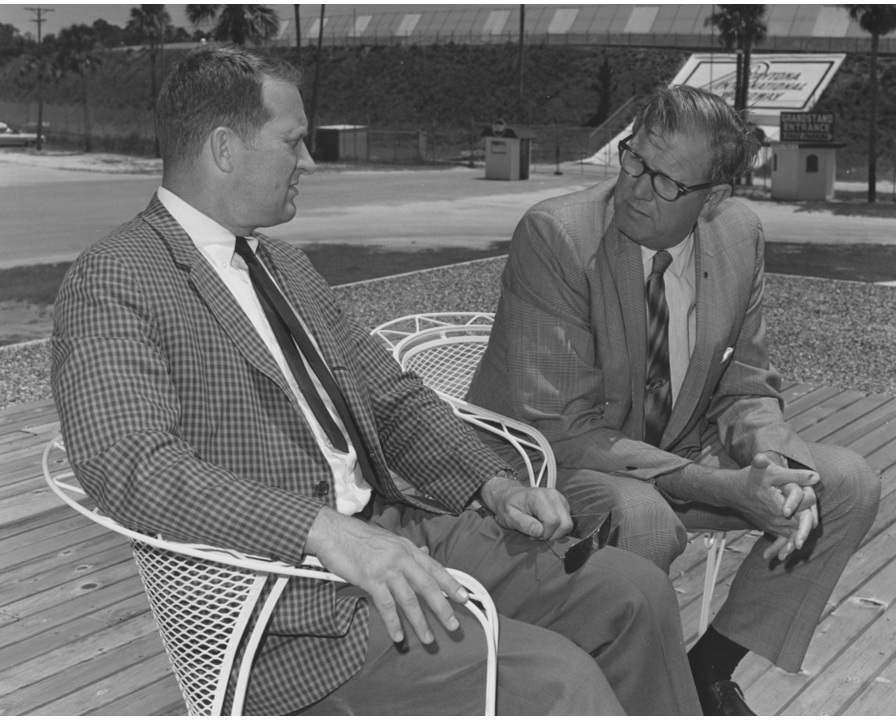
IMSA’s origin story begins not with a boardroom meeting, but with a conversation outside the Turn 4 tunnel at Daytona. As Raffauf recounts, it all started with a call from NASCAR’s Bill France to John Bishop — the man who would become IMSA’s founding architect. France’s pitch was simple: “We need to do a road racing program with a NASCAR business mindset behind it.”
That partnership, along with support from Cameron and Jean Argetsinger and the SCCA lineage Bishop brought with him, set the stage for a new era of American road racing.
Bio
Mark Raffauf’s career in motorsports embodies the ideal combination of a successful motorsports professional who has embraced the writing of history. Mark is both a fine historian and has been a key player in the success of the IMSA series from its inception to the current day. His early career coincided with the extraordinary accomplishments of John Bishop, founder of IMSA, former President of SCCA and one of the key founders of the IMRRC in Watkins Glen. Mark’s keynote address, laced with engaging anecdotal tales and an accurate, factual description of the series, covers his own colorful career in motorsports and the emergence and remarkable success story of IMSA racing over the course of more than forty years.
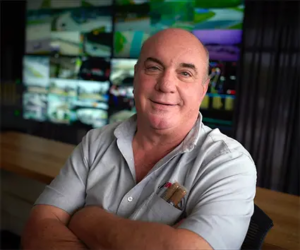
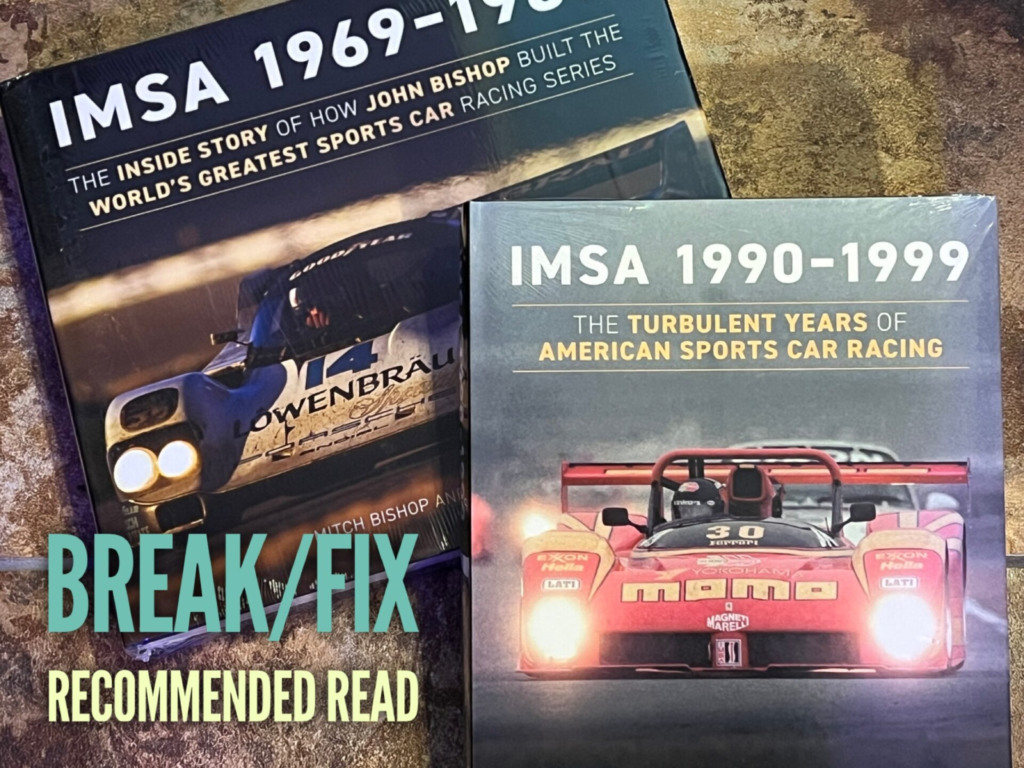
Mark Raffauf, currently IMSA's Senior Director of Competition, has held IMSA positions through many iterations of IMSA and Grand-Am, including being the second president, in overall management, technical and car regulation development, as well as event, circuit, starting, and racing operations. He is the author, with Mitch Bishop, of IMSA 1969-1989: The Inside Story of How John Bishop Built the World's Greatest Sports Car Racing Series and IMSA 1990-1999: The Turbulent Years of American Sports Car Racing.
Synopsis
In this episode of The Logbook, our History of Motorsports Series, Mark Raffauf traces IMSA’s nearly 60-year evolution from John Bishop and Bill France’s founding phone call to today’s hybrid era. Raffauf recounts IMSA’s early experiments with Formula Fords/Vees, the shift to closed-wheel GT racing, the creation of Camel GT, RS/“little car” series on street tires, and All American GT, plus innovations like road-racing stock cars, Group 5, and GTP prototypes developed with the ACO to keep cars available to private teams. He highlights major manufacturers and iconic cars (Porsche 935/962, BMW CSL, Greenwood Corvette, Mazda rotary, Audi 90 GTO, Jaguar, Nissan, Toyota, Ferrari 333 SP), the growth of street races and Firestone Firehawk, rising speeds and safety limits, ownership turmoil, the IMSA split into ALMS and Grand-Am, and the eventual merger leading to today’s booming IMSA with strong OEM support and advanced hybrid prototypes.
Follow along using the Slide Deck from this PresentationTranscript
[00:00:00] Break Fix’s History of Motorsports Series is brought to you in part by the International Motor Racing Research Center, as well as the Society of Automotive Historians, the Watkins Glen Area Chamber of Commerce and the Arge Singer family.
On this episode of the Logbook, we opened with a figure whose career doesn’t just intersect with American sports car racing history. He’s documented it. Mark Raffauf has spent more than five decades inside the heartbeat of the International Motor Sports Association, better known to us as imsa. Shaping its rule book, guiding its evolution and preserving its stories with the clarity of someone who lived every chapter from the inside, from his earliest days.
Working alongside John Bishop, IMSA’s, founder and former SECA President and a driving force behind the I-M-R-R-C at Watkins Glen Mark witnessed the organization’s rise from a bold idea to one of the most influential forces in global motor sport. His path through technical leadership, car regulation, development, and event [00:01:00] operations, places him among the few who truly understand how the sport grew, fractured, reinvented itself and ultimately thrived.
In his Gene S Ainger keynote address, mark weaves together vivid anecdotes and precise historical detail tracing both his own colorful career and the remarkable 60 year arc of IMSA racing. It’s a story of innovation, resilience, and personalities told by someone who helped write the rule book and later wrote the history itself.
Mark is now IMSA’s senior director of competition and co-author with Mitch Bishop of two definitive volumes on the series. IMSA 1969 to 1989, the inside story of how John Bishop built the world’s greatest sports car racing series and imsa, 1990 to 99, the turbulent years of American sports car racing.
Together, they formed the written counterpart to the perspective he brings on the stage tonight. So without further ado, here is Mark Raffauf giving us a guided tour through 60 years of IMSA’s influence, evolution, and enduring legacy. [00:02:00] So please welcome Mark Raffauf. Thank you.
So I’m gonna try and give you 56 years of history in about 45 minutes. It’s all visual. You don’t have to read anything other than that logo. Which I was inspired last night at the theater watching the film about Cameron and Gene Ainger starting the racing here, and wanted to say that John and Peg Bishop, who are given the credit for founding IMSA with help from people like Cameron and Gene Bill France at nascar.
They’re from Cortland, jc, and Duke’s father was the one that convinced John Bishop to become the executive director of the SCCA in the sixties, which under his oversight created the Canam. TransAm and Formula 5,000. The schism that was brought up earlier or in that film about pro racing drivers versus amateur racing drivers, and the attitude of the SCCA at that time is what had John resign.
And shortly after that, he got a call from Bill France in Daytona. [00:03:00] Bill, John Cameron all knew each other from Sebring, 24 hours of Daytona, SCCA, sort of sanctioning other major events. And I wanted to start with that because kind of it all started right here along with a lot of other things. And what I’m gonna try and talk about is the people, not just the individuals, but they had groups of people they surrounded themselves with really smart people, really enthusiastic, and a passionate people for five decades through various ownerships and so on.
So I start with this. This is actually resides in the I-M-R-R-C. It is John Bishop’s original artwork of the logo of IMSA from day one. It has a little water spot on the eye up there, so he was a little sloppy with his watercolors. Anyway, it all started with a phone call between these two guys, both France on the right, John Bishop on the left.
They’re sitting outside the turn four tunnel at Daytona. Bill called him up and said, we need to do a road racing program with a NASCAR business mindset behind it. Away they went. So what was first Pocono International Raceway? This is actually the cover [00:04:00] of the program of the very first IMSA race at Pocono, which is on the little, I think it’s an eighth mile oval on the Tri Oval area.
And, uh, I don’t know that John designed it, but I bet he had something to do with it. So we started with Formula Fords. Initially there were small ovals that worked out pretty good. So Bill Fran said, well, let’s go to Talladega in Daytona with 50 formula Fords. That didn’t necessarily work as well because they ran around in big packs and had huge accidents.
So we said, okay, we’re not doing that anymore. The same time they started a Formula V program. So IMSA’s legacy and throughout its careers of five decades always had open wheel elements. John and the little staff at the time tried that. It was great racing until they crashed into each other, which all you needed was one guy to sneeze in the middle of the pack, and you had a 20 car pile up.
So we decided that wasn’t a good idea. You could see how it sort of generates into pack racing with these guys. Great stuff, but kind of scary. So what was the next idea? We need closed wheel cars. John decided he would take his background in TransAm. We’ll take those Camaros Mustangs [00:05:00] Javelins. We’ll mix it up with F-I-A-G-T cars.
Porsche nine elevens in this case. That’s I think Peter, Greg being chased by Juan Montalvo and a two liter escort from Europe. These were little GT cars and we mixed ’em up with the big GT cars. And next thing you know, in 1972, there was the Camel gt, which RJ Reynolds Tobacco came in, recognized it as a good product and away that went.
The other thing we did was we created a series for what was then the new little cars. So in this you got a Fiat, a Gremlin, a Mazda, a Pinto, and I think that’s a Volvo in the back. But John was astute enough and IMSA was a student enough to realize all these manufacturers had no place to race their new product.
So we created this and that’s when little cars, but I think the first Honda to ever race in the United States was a civic and imsa. Most of these brands, BMW and others just grew from this into gt cars and bigger cars. The American manufacturers, we had the Pinto, the Gremlin, and other similar cars. And what was great about this, they were running on street tires.
They took BFGs [00:06:00] initially, good years, shaved them down to three 30 seconds so they wouldn’t fall apart. And you could run around Daytona as an example. Tom Wall, in about 1975, did a closed course record at Talladega at over 150 miles an hour. And an A MC Hornet on street tires. Street tires on race cars, not new, but running a whole series on ’em was a relatively new idea.
So this grew great. It also provided the cars that could fill the back of the GT fields as that grew in 72 and 73, raced in the daytime, raced at night, and then we got into the mid seventies. By that point, people like Porsche, BMW Ford with their Capris. Most of the European manufacturers would build a limited run of customer race cars, Porsche Carreras or whatever.
Back then, I think Porsche made about 5,009 elevens a year. I think GM made about 300,000 Camaros. So to equate a Camaro with a Porsche was a technical. Problem. So John, and this is his original artwork, decided to apply what the [00:07:00] FIA applied to the European cars, to American cars. And he created more or less by himself all American gt.
This happens to be a Vega, which was replaced rapidly by the Chevy Mazda. And that became the mainstay, along with John Greenwood’s, big Corvettes to compete against the European brands. And that’s really where IMSA’s growth started in production car racing, which was GT cars. So that was the first A A GT car, which of course is a Vega.
Looks a little bit like the drawing, but that didn’t last long. And as back to more RS cars, this is a typical RS race at Daytona. In this same timeframe, car and driver Pinto is up there. Nick crawl, president of the SECA in the BMW in second, George Alderman who drove in the first formula forward race at Pocono is in the lead in turn one in the wet.
Lebanza Al Holbert doing an engine change during the 24 hour race, a planned engine change, which wasn’t really the best way to go about a 24 hour race, but they did it anyway. We did Formula Atlantic. We co sanctioned the Formula [00:08:00] Atlantic Series in the era of Vinu and Ray Hall and Elliot Forbes Robinson.
The Canadians did the Canadian races. IMSA did the US races. 1976. This is I think, the ski rule car that’s Vinu in the back. So this is 1976 Road Atlanta. Those of you who know the track will be stunned at what the place looked like in 1976, but you see Camaros, Porsches, la Manza. This was the Manza that first all around A A GT victory, Al Holbert in the car.
There’s four or five of these little two minute clips of video. And this wasn’t video. This was film because video hadn’t been invented yet. And just to show you what the tracks were like, what the cars looked like, and not just still pictures, but this car was the first mass produced tube frame race car before nascar, before anybody else.
14 of those were built. By Decon and three or four other constructors built cars to the same rules, but they had six liter Chevys in the front of a Chevy Mazda in a tube frame [00:09:00] chassis. But the car captured the look of the road car just as the CSL and the Corvette, which was the intent. Marketing wise.
The cars had to look like what they were supposed to look like. But you can see here the front straightaway at Atlanta, there’s no pit lane on the right as there is now. There actually was a stream over there where people would be periodically pulled out of the water and there we have it on. Al Holbert winning the first All American GT overall victory at Road Atlanta in 1976.
Those were the two main antagonists. That’s Michael Kaiser on the right with Milt Minner a lot of times, and Al Holbert who used Doc Bundy, a whole bunch of other drivers, but I didn’t want to talk too much about that, but beautiful car people remember them today and still go, you know what? For something from the mid seventies, it’s still kind of a current looking piece of hardware.
That was the antagonist for everybody, which is the Porsche, RSR. This is Mike Kaiser before he got the Mazda. But this car was sold in 1974. Brand new three liter Porsche, RSR was $23,000. Of course there’s inflation, but it still was a pretty good deal. The other great car, the air was the [00:10:00] C-S-L-B-M-W. This came about.
In 1975, the factory decided IMSA in the US was the place to race. So they gave up their touring car program in Europe and brought the whole mess. Ronnie Peterson, Brian Redmond, Zi, Alan Moffitt, they brought the whole factory deal over here. They came to Daytona, didn’t do too well. Moved into Bobby Allison shops in Hueytown, Alabama, and converted the cars from European touring cars to NASCAR stock cars with triple door bars and stiffened them all up, and then became the cars to beat because of that.
That’s a typical, let’s turn one at at Laguna in that same era, but Monza, Monza, BMW, Carl Schaeffer’s, big Block. Camaro. Porsche. Porsche, Porsche, Porsche, Porsche, Charlie, Kemp’s, Mustang, at the very top on the right, which was also an All American GT car. And then we decided we’d go stock car racing. So we invented American Challenge.
This is Gene Felton in a Buick Skylark. We didn’t know what we were gonna do with them, but we basically created a class, and I want to emphasize all of this stuff you see here, John Bishop and the staff at the time, we’d sit around and say, what do we need? To have for our product. Our [00:11:00] product is entertainment.
We’re not here to set the world on fire. We’re here to entertain people. Go to places like Road Atlanta and Road America and have people come and watch. This is all before television as well. So we created this, we ran ’em with our GT cars for a couple years, and then Kelly came along and we ran 10 years of.
Of American stock cars, which NASCAR tried to do at the same time. Didn’t court work out as well as ours did, but road racing stock cars was a new idea. Again, sat around one day and decided what do we need to do? We need something like that. We need these kind of cars to be on the racetrack in some way.
Again, this is Riverside BMW’s, out front Ford Capri behind Gaggle of Porsche’s. Great shot of Bert’s car. Beautiful cars, beautifully turned out. And then we got into group five. So now you see the beginning of the big wings and things, and the extended front splitters car in the back is Chris Cord’s Mazda.
The car in the front is David Hobbes and the McLaren BMW three 20. I turbo. Also a factory deal, but run out of McLaren in, in Detroit. Group five came along, and again, it was the same situation. The OE in Europe made nine [00:12:00] 30 fives, a few of these BMWs, and then they became the dominant cars. John Bishop always wanted a product that the little guy private team could win the big races in.
So Daytona Sebring, there had to be something that you were not dependent on a car company to have to have a car because after a year or two, those guys quit making ’em. So every generational shift technically in IMSA GT racing has been due to coming up with something new that would take the place of OE Manufacture built purpose race cars, and have it available to anybody who wanted to buy it.
And that was an underlying theme for five decades. That’s the other big monsters, the big Greenwood Corvettes. This particular car at Daytona in 1974 did 212 miles an hour. It pit in at Daytona. It’s the size of a small house that has a 494 cubic inch cross ram Can-Am engine in it. It’s got tires on the back big enough for a semi, but it was fast.
How did that work against the Porsches? Technically everybody got 32 gallons of gas. So 250 miles [00:13:00] at Daytona. This car was two to three seconds, a lap faster than most of the other cars, but had to make two more pit stops to get the fuel and what happened In the end, they converged, and the racing was really quite excellent because of that.
Another great shot at BMW at Sebring in the old days where you could see between the car and the big airplanes, there’s nothing. But that’s the way it was. Gives you an idea. That’s the winning car from 1975. But yeah, these constellations, DC sixes, DC sevens lined up there, they’re basically cutting them up for scrap, but there’s a little vestige of a snow fence there in front of the windscreen.
But there’s nothing between parked airplanes and the race cars. There’s a shot from Daytona same year where. There’s actually trees there, which of course have been long chopped up by spectators for firewood or whatever, but there’s no more trees in Daytona. Another good shot of Chris k Manza, mid Ohio.
Again, beautiful cars. This is now 1978 and this is a pretty important year technically. Two front row cars are factory 9 35 Porsches. One’s a customer car, which is Kramer, and the other one [00:14:00] is the martini factory car. Behind them are the two in all Terra GTP cars. GTP came about through a collaboration with the A CO and the Lamar people to develop a prototype car that a number of private constructors could build and powered by engines that anybody could buy.
So those two cars are powered by Cosworth, three Liter Cosworth, kind of a dune Formula one engine. They actually did pretty well, but a lot of people don’t understand that that was a collaboration with the A CO. It then led to bigger political issues in a few years with the FIA. But we’ll get to that. So every time we came out with new cars, Daytona’s the first race, it’s the Super Bowl race.
At no time did any new car. Beat the old cars at Daytona when they first came out until the DPI cars in the mid 20 teens. The car that won is a little 43 Hurley Haywood up there in the upper right Porsche Carre, RSR. It’s been in the game since 1974. It’s been four years and it’s still a competitive, big race winning car.
All this other stuff broke or crashed. So that’s part of it. Again, another shot [00:15:00] showing you. The first prototype of the turbo car is the Zero zero Car, which Interscope had, which was driven by Dan and Guy is Factory car, Kramer car, one of the GTP. In Alters. We talked about consequential racetracks, a couple shots from Lime Rock.
This is before the Chica. When you have 850 horsepower going up a hill. Wish was, I hate to say, kind of normal. There’s even a more dramatic one. These cars were, uh. Absolutely terrible to drive. You had to really be on your game. Very difficult to drive huge amount of power based on a standard nine 11 shell, kind of a flexible flyer until they got here and everybody stiffened them up.
Huge rear tires, tiny, small front tires. Aerodynamically, eh, not that good either. In those days you could run a twin turbo set up, or a single turbo set up with two different specifications of weight because of lag. No electronics existed yet to control turbo lag. So two small turbos. Worked a little better, but the big one made more power.
So this is a rare photograph of Peter Greg’s two cars, that road Atlanta, trying to decide which one he would race. One’s a single, one’s [00:16:00] a double. Then they morphed into, this is JLP three. They began to get Kramer body work, body work design in California. And I would say by 19 79 80, we’d have 15,930 fives on the grid.
One BMW, one or two Ford Mustang Z speed cars. But of the 15,930 fives, no, two of ’em the same. Every team got the cars hot, rotted ’em, changed them. The rules then philosophically were, if it didn’t say you couldn’t, you could, they had dry ice in the inner coolers. They had fon sprays in the intercos for qualifying, and everybody said they were cheating and we’re going, well, no, it doesn’t say you can’t do that.
So they’re just being a little more innovative than you are. Try it, see if it works for you. So it generated a lot of diversity. Hot rods. This is, uh, lagoon Deka. It’s Ray Hall on the Nine and Fitzpatrick. Whittington Brothers Ford, Zach. Speed Mustang pretty evenly matched in speed. Down the back straightaway at Daytona.
Little lock up there. Yo. But you could see Porsche, Porsche, Porsche, Porsche, Porsche, Porsche, [00:17:00] Porsche, Porsche, Paul Newman, and a Nissan Ford. Somebody crashing the end all car. But again, we got to another point where if you didn’t have a Porsche 9 35, which you could no longer get, you had to build one out of a wreck street car or something like that.
And that’s what they did. But we got to the point where it was all the same car with one or two exceptions. So we needed this GTP concept to generate. Something new, and that was the Lola T 600. Also, the first customer, GTP car built about 15 of those. That’s J, that’s the ultimate form of the the 9 35, which by then in 82, 83 was running full ground effects.
Still a rear engine car, but the only thing left that was a nine 11 would be the front windshield cow, and side windows. The rest of it, as you can see, is heavily different from a nine 11. Again, all allowed. Shot from Daytona. These cars were great. They had mechanical waste gates. They made all kinds of weird noises.
Spectators love them. They burned a lot of excess fuel through the turbo, so every time you got off the [00:18:00] engine, you got a big flame out the back. So it was kind of spectacular to watch these cars and hear them. They were not just a visual thing, they were a great sensory overload in every regard. RS cars.
They’re still around, running around on street tires. Now you see Dotson’s Gremlins still Gremlins Mazda in the back, BMW 2002. This series created an entire industry of people that IMSA tried to establish early on who then made their entire lives their business in racing. Roger Mandeville with Mazda’s, Amos Johnson, a number of people built their entire life and business.
Starting with these cars, we always had a place or always wanted a place. And this series in particular, along later with the Firestone Fire Hawk series, provided a place for the average guy to go racing. You didn’t have to be elite, you didn’t have to have a lot of money, but you could go out, you could have a great time.
And I wanna say up till this point, one of the things IMSA did was we paid everybody something. You might have won 50 bucks back then. [00:19:00] 50 bucks was two nights in a hotel room, so you could go to registration on Sunday afternoon and get paid in cash to get home. But we did that for a decade. It was a completely novel thought process that you would actually get paid to do this even if you were last.
But that was the philosophy. We paid everybody and it was appreciated. You also got an apple at registration. When you went to get your credentials. You got Peggy Bishop would give you an apple. So that was kind of cool too. So this is a typical RS race at Daytona. Mob racing. The only thing that made it better than Formula Fours is they had fenders and the wheels didn’t come off.
So there was a lot, a lot of stuff about that, but there’s probably 10 different kinds of cars in that picture. But that was what it was all about. You know, little guys racing who then became big guys later on, and that was really important to us to make that possible. Road America First Race. Road America 500 took us a while to crack the Cliff Tufty wall as well.
But finally they realized that if they wanted to do this, they had to have a bigger race than what they had at the time. But this is the Road America 501st year. See the crowd’s [00:20:00] great. The little BMW won that race 500 miles. It’s the longest it ever ran and its entire career, which is pretty good. The pit lane, no speed limit.
A lot of brave people in my opinion, but that’s what it looks like. That’s Fitzpatrick, leaving him from a fuel stop. But that’s the old pagoda, which when, uh, Lee Hall, who was the president at the time, said they were gonna take it down, I volunteered to fly to Wisconsin so that I could light the fire on one end that would burn it to the ground, which was the easiest way to get rid of it.
Mazdas were huge technical innovations with rotary engines. They provided a 330 horsepower car for virtually nothing in money compared to piston engines, and we had lots of ’em that’s cant racing. Uh, Lee Mueller, Kathy Rud, another weird great car, the R five Turbo by Patrick, Chuck Mart. Unfortunately, he.
Was killed in it at Midio testing, but this was one of the other interesting cars that Im SA fostered sometimes writing special rules for special manufacturers to enable them to be there. The Zak speed Mustangs, again, blowing a lot of [00:21:00] unused gas out the exhaust pipe. Klaus Ludwig, Ray Hall, Kevin Cogan, great Cars, two liter turbos.
It’s gotten kind of complicated at this point. Some of the other fun things that happened. This is testing Fitzpatrick’s nine 30 5K three the week before Lama on the highway in German. So the crews would go over and build up these cars at Kramer and then take ’em right to Lama, but you had to run ’em a little bit.
So took it out on the Audubon, gave it a little stroll down the highway, right? With a Volkswagen next to it. So if you read the sign, let’s see, Doman, yeah, calm, they were, weren’t calm, basically. A lot of that stuff went on all the time. Sometimes here, but in Europe it was routine to get a cake plate, which is a Kramer plate.
It was a dealer plate, but they just stuck it on the race car and took it out on the highway. So at this point, 82, we have three series. We have Camel GT Champion, spark Plug was the RS Cars. We had a 15 year relationship with that company. 12 years with Kelly Kelly Services with the Kelly American Challenge.
And at this point we started working with Skip Barber on this Barber Sob series Open Wheel Cars, which generated people like Diego [00:22:00] Montoya, Juan Montoya, Brian hurt a lot of IndyCar people. Paul Tracy ran in Skip Barber’s beginning Pro series, but that was just starting and we were just contemplating another shot of Road America.
Crowds were starting to get quite large at this time. Late eighties, early nineties. The 9 35 kept morphing into more bizarre high speed. This is a Moby Dick version actually. It’s the end dial car done in Preston Hens colors at Road America, which you could see it’s quite a long way from a nine 11. It’s flatter, wider.
And then came this piece. This is the Lola T 600, which was the first production series built GTP car. Eric broadly told Brian Redmond, I need two orders. These cars cost $75,000 in 1981. Get me two orders and we’ll build them. And they ended up building about 15 of them. This was run by Garson Enterprises who had run Porsches and basically Brian Redmond won the first race as a true ground effects car with tunnels, which was fairly new concept at that time.
How differently the [00:23:00] car could use the racetrack over a conventional car. The downforce and aerodynamic development, two biggest changes in this kind of racing in 40 years are tire development and aero development. The engines made 800 horsepower 45 years ago that no big deal. Cheaper to make that power these days.
But arrow and tires is what move these kind of cars. And in some cases you’ll see outside the boundaries of what the race tracks could handle. John and Bill France always had a theory that the car needed to be bigger than the track, and that worked until something. Bad happened and then you had to kinda rethink that philosophy.
So by the late eighties, these kind of cars had morphed into going to every racetrack We went, for instance here before the bus stop, the end of the back strait away was about 210 Laguna Seca before they made the inner loop turned two up the hill at the bridge, 205. Mid Ohio, two 10. Every track we went to the cars were faster than Indy cars, and at the tracks we shared, like at Road America and Portland Cars actually did faster lap times in an [00:24:00] Indy car.
We were pushing that envelope by the late eighties. But again, some views very simple. This is kind of, those are familiar with Lola’s. It’s kind of like a Lola T 70 from the sixties tub with a six liter Chevy V eight. This is a Franz Lease Chaparral engine car. 75 grand. The engines were like 35, 40 grand.
So Porsche 9 35 when you could last buy one was well over $200,000 from Porsche. And this was a much more cost effective. Most of the teams that got these were not OE manufacturer related, but they were race teams. And when the business of racing and we were trying to create an environment where they could be successful as teams with sponsors and everything else.
So we kept morphing to new cars and everybody says, well, how did you think of this? Pretty simple. We needed a car that was half the price that could perform as good or better than what already existed. And then we figured out moving backwards from that end point of how to get there techniques. And what was frightening is none of us were engineers, but there were simple pieces of this, which were, the engine had [00:25:00] to be made available to anybody who wanted to buy it.
Car had to have two distinct things. It had to carry 32 gallons of gas. The driver’s feet had to be behind the center line of the front axles when the pedals were depressed. This was the era where India and F1 guys all had broken feet and legs ’cause they stuck out and they were the first thing to hit the fence.
And when they went into it. But you can watch this video from Laguna of how this car could just kind of drive around people. That’s Danny and guys in a Porsche. He just drove by him like he was tied to a tree. That’s John Paul. Same thing. He’s taking an outside line and turn 10 that you don’t normally do.
You’re in the inside and he just drove by and it’s all because of the ground. There’s another good shot of watch how it’s squares off these corners compared to the Porsche. It just was an amazing revelation because people didn’t realize what the impact of that technology would be until they saw it and went, oh.
We need to get one of these. So that was sort of the end of the 9 35. This is the first race that the car raced in and it won. It started fifth. Brian Redmond worked his way through the field, not by going any faster, but the speed the car could run. You [00:26:00] could run the whole race at, well, the nine 30 fives, the Fords, all those other cars had tire degradation.
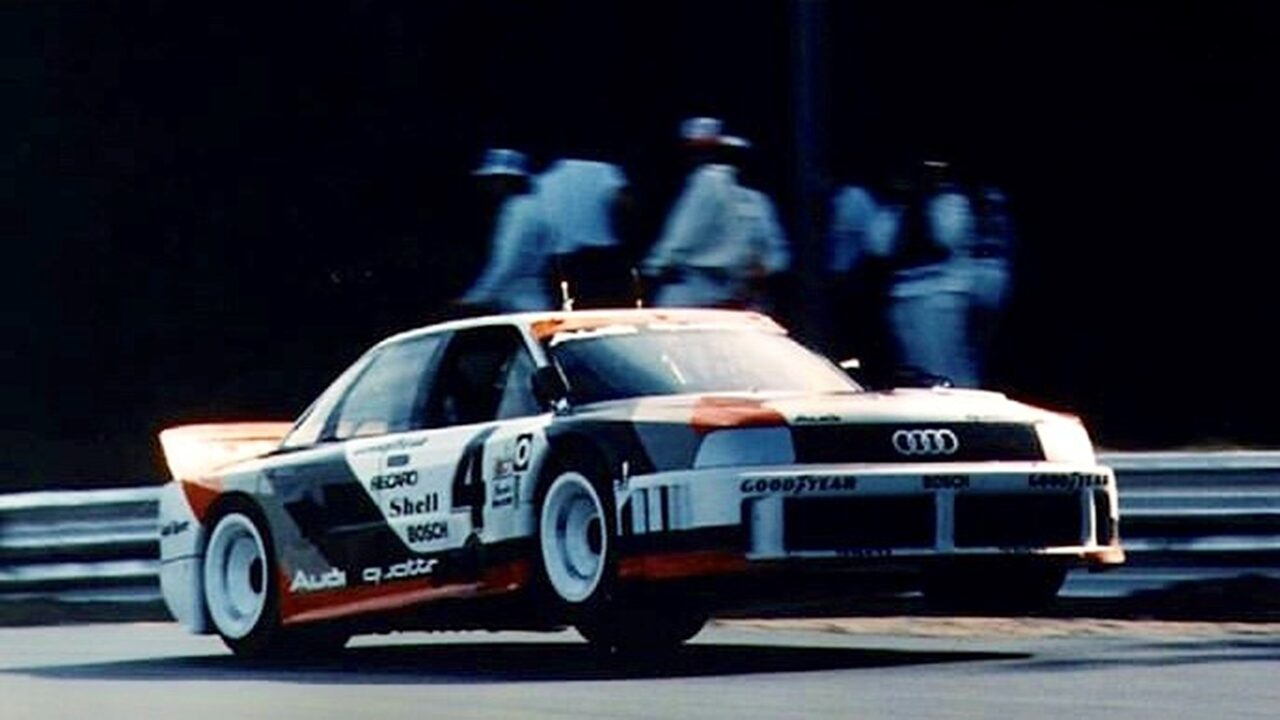
They had too much power on two back wheels. These cars have the right amount of power, the right weight and the arrow package just made ’em really good. Another limerock shot. This is, uh, one of the coolest cars we ever developed with Audi, which also became the biggest pain in the butt for us. But this is, uh, the Audi 90 GTO car, full tube frame, five cylinder inline turbo hunch Stook, Hurley Haywood, and occasionally Walter Royal, the rally driver, who even people like hunch Stook said when he showed up.
I raced for second. The man was amazing. So this is Lime Rock again, doing wheelies up the hill. The intriguing thing was constant all-wheel drive car, which meant it applied the drive you wanted on each wheel based on the grip level that the car was sensing that it needed. It wasn’t 20% front, 80% back, it was applying that drive to the wheels as it saw it needed.
So the hard part of it was we started it out. Goodyear made ’em special tires. 14 inches wide. We realized after a couple [00:27:00] races, they didn’t go to Daytona and Sebring because they didn’t think they could finish. So. They started on 14th. We summed down two, three races, changed that to 12 and then changed it to 10, a couple races later, and the end result was, it made no difference.
The 10 inch wide tires work just as good as the 14 inch tire. Part of the reasons and the learning experience for us was technically what’s going on with a car like this is the tire degradation is way better. The load of slowing down is spread over all four wheels. The braking was much better. And the acceleration was phenomenal.
And there’s some video of people like Ook would just pass people in the dirt or the grass because the car could do that. So the rest of the guys are like, what’s he doing? He just drove me around me on the dirt. So it was an amazing car. It is probably, in my opinion, one of the coolest, most technically advanced things that IMSA created.
We did some other stuff, but this one was sort of a challenge for them and us to do this. They won the TransAm the year before with a car, an Audi 100. Made out of a real production shell. [00:28:00] This has nothing to do with that other than the greenhouse silhouette and so on, so forth. But spectacular Car two remain.
One is here in USA and one is in Germany. And the significance to Audi is when they just showed their first concept Formula One car, the car that’s behind the Formula one car in their display is that car, not the R eight prototype. That’s off to the side, but that car is right there. That embodies Audi’s performance thing, and it’s 1989.
Pretty amazing what they were able to do and how they did it. So more pictures. Here’s the L is now taken the front all the time. And then Bob Tulia showed up with Jaguars with Big V 12 engines. One of the only teams in history whose people were always dressed in white and never got dirty. Not sure how they did that, but I think they had enough uniforms in the truck that if you did, you had to go change right away.
But yeah. How many people have white crew guys, you know, beautiful car. Lee Drester design actually originated by Mike Dale, who was the head of uh, Jaguar, USA, had nothing to do with England. They didn’t want anything to do with it, so they did it here themselves [00:29:00] again. One of IMSA’s goals was to provide the industry designers constructors, the opportunity to make a living and a business in this kind of race.
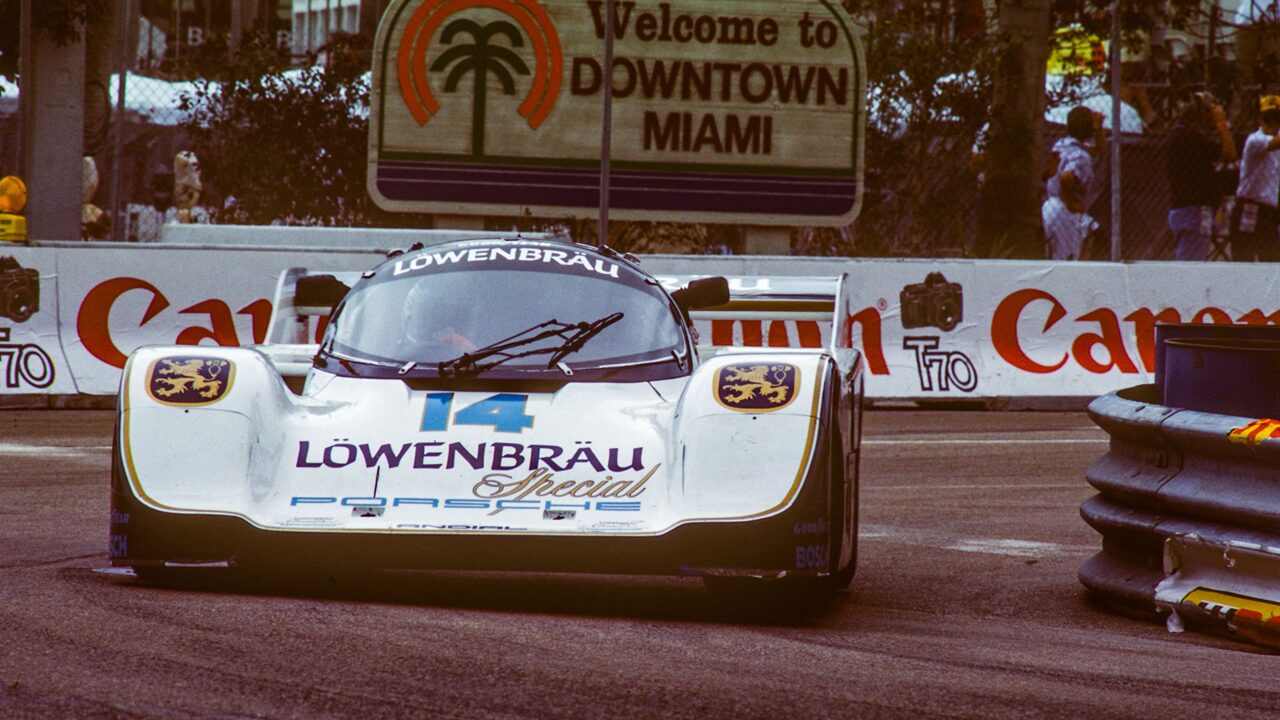
So another example of that beautiful car. This is the hairpin at Miami. In the first treat races, which is the next sort of episode where we talked about racing on roads. Well, it came back with a vengeance in the eighties. At one point we had five downtown street races. Different concept, which was we’re gonna bring this show to people.
In their face, which is gonna mess up their town for at least a month so they’ll know it’s happening. Okay? The buses didn’t run. It was, we messed everything up. But when all said and done, we turned on a lot of people to the game that would not have otherwise ever seen it, and it was spectacular to watch another innovation.
The first plastic engine, it was tour on two liter. Most of the internal components are carbon or plastic, sponsored by Amaco. It actually got two podium finishes in Camel Lights. This is also early eighties. So we had a lot of innovative stuff going on and welcomed it. You know, we looked at what [00:30:00] we did as a place for people to try new things.
Some of ’em worked, some of ’em didn’t. But I threw this in here only because a lot of people don’t know about it, but. It actually scored two third places in a pretty competitive category in an engine made outta plastic. This is interesting. This is John Bishop’s original drawing, which he drew in the meeting when we started arguing with Porsche between the 9 5 6 group C car and our desire for a different kind of car.
So what’s different? We put out our GTP rules with the A CO in 1980. It required that engine to be available, no aluminum roll cages, which the FIA insisted was okay, which never was. Everyone we ever saw failed and the driver had to be behind the front axle. John actually sketched this in the boardroom at Porsche Stuttgart and showed it to him and says, here, you can lengthen it in the back or you can lengthen it in the front, but you gotta make it longer to get the driver moved.
And you can’t have aluminum roll cages, and you gotta have an engine that everybody can get. So the group C formula, for those who don’t know, was a fuel formula, more [00:31:00] endurance championship Lama took kind of the same thing, the 56 version, the group C car, which was shorter driver out front, the one that Stefan Beov was killed in its spa.
And it probably, I don’t wanna say it would be avoidable, but the way he was positioned in the car and what happened to the car was tragic. Should not have been that bad, but it did. They lasted about two years. And then finally after some bad accidents in Group C, they adopted IMSA’s GTP rules because it made sense.
And again, none of us are engineers, but we just looked at this thing and said. This can’t be right. There is a better way to do this, and we just did what we thought was correct. 9 56 is probably the least successful Porsche car in that regard. In the 62, I think they built 145 of them. So you think about that 145 race cars that started at about 300 grand and at the end a decade later were 700 grand, but they still built 145 of ’em and sold them.
So that’s what the fields kind of look like. You got a Porsche Buick, March Jaguars. We had a lot of diversity. We had nine OE manufacturers in [00:32:00] GTP in the eighties, as well as, I think five or six more in Camel Light, which was a lower division using normally aspirated engines, which is kind of where the gentleman guys went ’cause it was an easier car.
These things started getting really fast. Miami, this is what street racing was like in the early eighties. Biscayne Boulevard. On the right pit lanes to the left. You could see cars coming around. Turn one. It was amazing to do this. I remember the first race had Sterling Moss as the color commentator on tv, and he was just fascinated because street racing at that point was pretty much Monaco.
That was it. So we did this, then we did West Palm, then we did San Antonio, then we did Columbus, then we did New Orleans, and we just kept going. And the economic benefit was huge. The pushback from people whose businesses got messed up and couldn’t get on the bus and everything else was equally great.
Noise wasn’t that big of an issue because everybody knew it was gonna be noisy. Just to give you an example, race control, the high rise building on the left was a new building and we were like 20 stories up and had a commanding [00:33:00] view of the entire area. This is right along Biscayne Bay. The cruise ship port is to the left.
It was just spectacular. Great idea. Firestone Fire Hawk. All right, other great idea. We took street cars. Told everybody to take the carpets out, put a bolt-in, roll cage in it that you could take out. If we ask you to take out, in other words, it could not be firmly affixed to the car. It had to be bolted in steel fire bottle.
That was it. Belts and a seat. Go race it. So those were street cars, which everybody said there’s no fuel cells, there’s none of this, none of that. The standard of construction of these cars in that day was such that they were. Five layers of steel around the fuel tank already. It was past the Ford Pinto I explode experiences of a decade earlier.
They were pretty solid cars. We’d roll these things up and what was cool is you could wreck it on a test day, go down a dealership, buy another one, and build it overnight and go race the next day. How bad was that? But you could see there’s Dodge Chargers, BMWs, Camaros, Mustangs, just about everything you could.
Now, what happened over time? We had three or four categories. [00:34:00] Each category, we listed a group of cars, and out of that group, maybe three or four were really in that configuration, competitive with each other. Some of them were just hopeless. You didn’t wanna run eos, they were terrible, but people tried.
Picture of a Jaguar V 12, six and a half and seven liter engines based on the production Jaguar engine. Beautiful sound, very competitive. Another great picture from Sebring where you can see this Porsche is going down hangar straight at about 180. And there are people sitting in the grass to the left, and then there’s a chain link fence, and then there’s more people.
And somehow we didn’t manage to kill anybody, though. We certainly had all the parts to do that. No big accidents, but not what we do today. But this is about mid eighties. Bruce Levin’s car, Daytona at night. Just a cool shot. That’s a Nissan GTP car in the last one. And an interesting thing is the what shown this week.
Of course, with endurance racing, we got the moniker of Racing with a Difference. We race at night and we race in the rain, and sometimes we race at night in the rain, which makes it really nasty. What I’m [00:35:00] trying to illustrate here is just how people have adapted these cars to take on different race lengths, different kinds of racetrack, angling the lights out so that you could see where the wall was, was essential.
This is pre-live tv. During the races, so now it’s lit somewhat better. You can actually drive Daytona at night without headlights. People can’t see you coming, but you could see where you’re going. But back then you had to have lights and they had to work and they had to work this way. And places like Sebring, the old 5.2 mile track, part of which was that 86 Havelin car.
If you lost your headlights or your alternate or your battery went dead, there were times where guys just stopped and had to wait till the end of a session ’cause they couldn’t find their way back to the pits. That dark, certainly at speed, you wouldn’t even try to pretty, uh, heroic if you won there in those conditions.
As a driver, it was not just consequential, it was heroically consequential. Okay. Castrol Jag. These are the English cars from Walkinshaw. They replaced Jaguar finally adopted the GTP concept for Group C as well, so they were able to build new cars. Came in a variety of forms, V [00:36:00] twelves at seven liters, twin turbo v sixes.
The XJR 14, which comes up later was the Ross Bra Design Formula One designers version of a car powered by a Cosworth. But really super big program. Castrol, yours truly at the Ferrari Museum. I throw this in there for my own benefit, but I was the guy that had to go over there and homologate this car, Ferrari F 40, which is 1989 to run in GT racing, both in the US and Europe.
So whenever I go back there, they always remind me I did two cars with Ferrari. That one in the 3 3 3 SP prototype, which will come up in a bit. So this one sits in the Ferrari museum. Hurley Haywood actually drove it. People don’t realize that Hurley Haywood drove Audis. He drove Porsches, he drove Ferraris, he drove Jaguars.
He drove a lot of stuff, but he lives and breathes Porsches great guy. Daytona Castro, banking early in the morning. They won in 90 and in 88. Another beautiful piece. The ni Nissans hard to miss these cars. This is the second generation GTP car. Okay? This has got some nasty, uh, accident stuff in it. This is where I talk about how the cars exceeded the racetrack.[00:37:00]
What’s going on here is Road. Atlanta has not got a chicane. It is a flat out turn seven to turn, what is now 12, run 210. There’s a dip in the middle, the dip and the downforce. At this point, these cars were running 7,500 to 8,000 pounds rear springs. They needed springs like that to keep the car from grinding into the road.
That plus the weight of the car. You go down to a in a dip at 200 miles an hour, what’s gonna happen? The tires are gonna explode. It’s a little gruesome, but nobody got seriously hurt. Same race, both cars. There was a third one with the Toyota, which managed to get back to the pits ’cause it landed right side up.
These guys didn’t Pretty destructive. So this is when we started thinking about, okay, this stuff is simply going too fast. We don’t need to go that fast to put on a quality show. To put on good entertainment. We’re not in the business of wrecking this stuff this way. After that particular race, Goodyear refused to supply tires to these teams until they told them actually what the downforce potential would be.
’cause the cars just [00:38:00] exceeded what they could possibly do. So some other footage from this era, Holbert was the dominant car, the eighties followed by the Nissans in the late eighties. One of IMSA’s most iconic car, low and brow car. John Lamers put that one in the fence when he went out of the pits with cold tires and new brake pads.
Oops. Which is still happening today at Daytona Sebring. Again, that’s turn one. Before there was the change in the track, the original Nissan GTP car. So at this point we had five or six major factory teams. We, once again, were struggling with a private tier, could not get the hardware to be able to compete with these people.
Starting to think about what’s next when this goes. We also were made aware at the time that RJ Reynolds, because of federal law, would have to stop their sponsorship in 1993. So we had a number of things going on into the next decade. The bishops and the original stockholders, the Francis and two other groups of stockholders sold IMSA to a businessman in Tampa, who was also the promoter of the St.
Pete Grand Prix race. Mike Cohen and Jeff Parker. It wasn’t the best idea. Neither one of ’em were [00:39:00] racers. If you wanna read the gory details, I wrote a book about it with George Silverman, Mike Compatriot with this, they would do stuff like Mike was a construction guy, so he would take the purse for the 24 hours a Daytona, and he would use that to bond jobs for the state of Florida.
I could say this now because when he finally got caught up, he did 15 years state and 15 years federal, non concurrent. Just got outta jail about two years ago. It was strange days, but basically he lasted three years and then basically sold to another guy who actually was a great guy, Charlie Slater, but the guy who talked Charlie Slater into buying it.
It was the same guy that talked Mike Cone into buying it. He was the promoter at Tampa and St. Pete, both of which were temporary circuit events that failed mid nineties. In spite of all these underlying bad things going on, we exported our GT stuff first to Japan and we took, uh, anywhere from six to eight cars and helped the JAF develop what is now super gt super GT cars are essentially derivatives of the car on the right, which [00:40:00] is a 300 ZX Cunningham car built in California.
Just to show them this Nissan set this up at Fuji. There’s the road car, there’s the race car. The whole idea was to capture the spirit of the streetcar, but make it a real race car that makes it cheaper to run. We brought six or seven cars at their request. We ran two years at Fuji, one year at auto topless, I think.
So three races where they started running, uh, Nismo Skylines. A modified group A cars and started developing a tube frame structured car, which then grew into what they do now, which is very similar to this, even beyond that, without much help from us, other than bringing a variety of GTO and GTU cars and American iron and opening them up and letting all the, their mo OE manufacturers just come and look at the cars and ask questions, how they made, what do you use, and so on and so forth.
It too developed their own industry of parts and component manufacturers for their own cars, which is great. That was one of the big goals of IMSA was always to focus on that. Chevy Intrepid, Wayne Taylor, 1991. [00:41:00] 1991, was the most successful GTP year because every OE manufacturer won at least one race, which rarely happened.
The last nine 60 twos. This is Rob Dyson’s. Quite a bit different than the earlier Holbrook pictures, A lot more arrow stuff on it. Triple element wing on the back, which originally was one element. The car won races in 1984, and it won its final race in 1993. And the reason I bring that up is the original layout of A GTP car.
John Bishop drew on a piece of paper in his office in front of myself, Roger Bailey and Charlie Rainville, and that drawing remained in the IMSA Rule book for a decade. Unchanged. So when people talk about stability, people like Rob Dyson invested in these cars and he raced them for 10 years. Modified ’em, but it’s the American hot rod mentality.
You gotta fix it somehow. There’s the XJR 14 brilliant car. Look at the size of the arrow device. On the back of that. The spray gives you some idea what’s going on, but the air going under the car. This car, Davey Jones said many times, 73 to 7,500 pound rear springs on it. But it’s basically a Formula One car with a three and a half liter engine.[00:42:00]
Widen tub holding 32 gallons of gas. Great little car, super quick. Davey Jones was one of our really good drivers, but the best company I ever heard was Tony Dow, who managed the British cars, said uh, Davey Jones has wrecked every model of GTP and Group C car we’ve ever made at least once. So you know, you got guys that are really fast, but you gotta expect them to damage the hardware occasionally or total it as he did a few times.
Then came the Toyota’s. This is gurney’s effort. These cars were culmination of three generations of previous designs that became the dominant cars. What’s really unique about this car is if you notice, there’s no holes in it other than the hole in the front. All of the air going through the car created, added down force inside the car on a second floor, all the air for the radiators, intercos, and the only thing sticking out of those two little black things, which are brake ducts for the rear brake, but everything else went through the car.
The tall scoop on the side was an intake for the turbo, just because it needed the cleaner air, because at the time the air got from the front to the engine bay for the turbo was [00:43:00] pretty agitated. These cars also ran 7,500 pound springs. It was a 2.1 liter engine running 125 inches of boost and could make if they wanted a thousand horsepower out, a two liter.
They didn’t run that long that way, but it was there if you wanted it. Great cars having gurney in the series from GTU to GTO to GTP for close to a decade was a treat. Wonderful man. That was the year they won 24 hours, 93. We had carbon breaks by then, as you can see. So Japan, here’s the group of cars we took to our topless.
Seven of them, the whole group. That was a lot of fun. The Japanese were great hosts, but they also, you know, you see some of them, we had Exxon at that time instead of Camel. So because it was international, half the cars had so on it because they were still using Theso name overseas and not here, but Exxon was the US that’s pouring rain at Fuji Lightener, GTU car and the two Cunningham, GTO cars in the.
This is another weird car. This is the most successful Porsche car ever raced. This is the [00:44:00] Jaguar Bud Light car that you saw earlier. With the rain coming out the back, they cut the roof off of it. Well, first what they did was they sold that car to Mazda, who ran it in Group C with a Mazda badged Cosworth engine, same car, but they changed it from a Jag to a Mazda just by putting Mazda covers on the engine.
And they did that for about three, four months and decided that wasn’t worth it. So Val Perez, Indiana, they had two or three of these chassis and. Tony Dow Max Welty, who was the Porsche head of Motorsport at Allen Springer in California, go. We need to do something with these. What’d they do? They drop the 9 62 spec engine in the back of one of these things, which cut the roof off.
Reinforced the roll cage structures you could see with forward and rear braces. This is Mario Andrei testing it at Charlotte and it’s the most successful car because in 1995 with the beginning of world sports cars, which side story? We knew in 93 no more GTP cars. So we had a new sponsor, which was Exxon.
They had two requests, make the cars look different because we don’t want to be viewed as taking over someone else’s old stuff. And [00:45:00] two, we need more of ’em. So the whole idea, again, was another technical shift to develop a car that private teams could buy and run. And so the World Sports Car was born. I bring this one up because it’s so unique.
It only raced in our races once after the roar. The test at Daytona in the beginning of January. Kramer had a CK five, which was a similar car made out of a 9 62 chassis. He brought one. Porsche brought two of these and we changed the rules on ’em between then and the race because we recognized that we really didn’t set up world sports cars for turbos.
We were trying to extend an arm to Lamar to go, you need to get rid of what you were now running, which are GT one cars and McLaren F ones. Porsche GT one cars, which at the time cost about $1.5 million a piece unavailable to everybody. Factory made so many and that was it done. So you’re limiting your field.
You’re not looking forward about how you’re gonna sustain this. So we needed cars like this that customer cars could be made out of existing stuff. So it never raced at Daytona that [00:46:00] year. However, the Kramer CK five, the older version, won the race under the rules that Porsche didn’t like with the same engine.
I say it’s the most successful. It ran Lama twice, won both times. Finish second. A third time, and then no finish. Second at Petite Lamont. 19 98, 3 years later, we also extended a series to, um, central and South America, the NA Cam, Marlboro GT series. Again, IMSA Cars, IMSA Rules, IMSA teams, a place for them to sell their cars.
Another good view of the World Sports Car taking the roof off. That’s, uh, Andy Wallace, or might be Derek. And you could kind of see who was driving the car and what he was driving it with. So it was kind of a good view. James Weaver and Rob Dyson’s Spice with a Ferrari engine in it. Again, all that stuff was generally available.
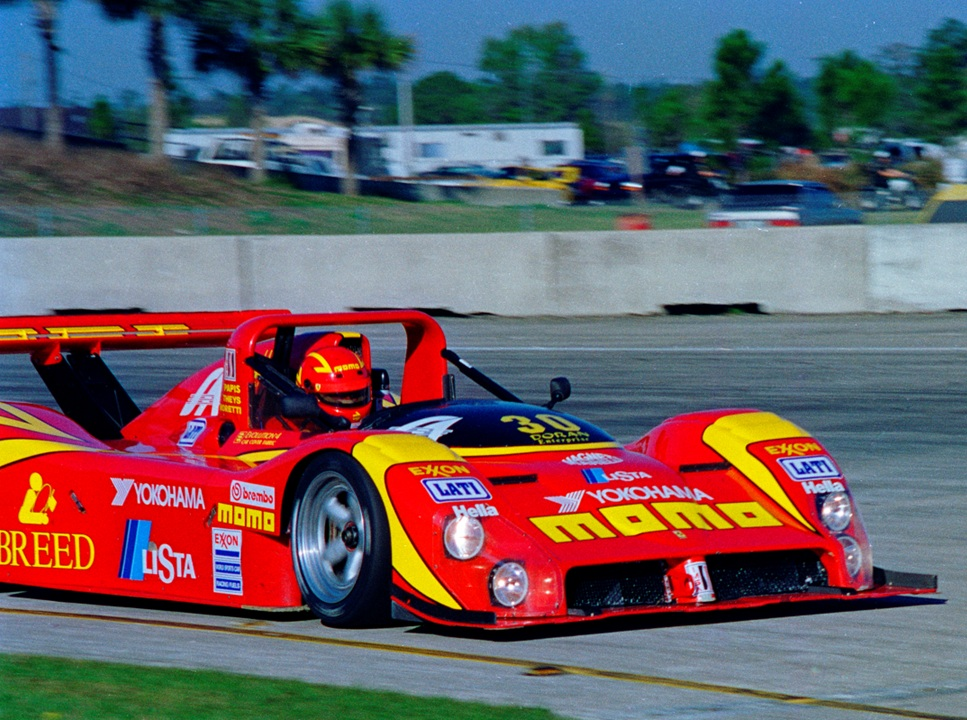
Wayne Taylor won the first championship in a rotary powered car by not winning a race, but finishing in the top five, I think, 12 times. The car of the decade is clearly the 3, 3, 3 sp. This car again, I went to Ferrari with Jumpier. Met with Montezemolo and Pirro Ferrari and said, we need a customer car. So they committed to making this car solely [00:47:00] for customers.
Ferrari never ran one themselves. Pure customer car is exactly what we wanted. It wasn’t that expensive as Pirro Ferrari said. The little badge on the front end, that’s $25,000 just to get the little badge on it ’cause it’s a Ferrari badge. So there was a little inflation to that. But you bought a car, you got an engine.
Four corners, and a full body and a transmission. For about three quarters of a million dollars and that was most of the parts you needed to run a whole season, including the car. It’s a great deal. Rob Dyson. The other great car was the Riley. Many engine combinations in it. Great shot of the Ferrari. They spit flames out the back and made great noises with a V 12 turning 12,500 RPM.
It’s magic spectators loved them. GT cars still the mainstay. 99 Audi and BMW showed up at this point. The A CO and the FIA adopted IMSS W World Sports Car Rules, but then had to put their mark on it so they put bigger engines in it and put aerodynamic diffusers on ’em on cars that weren’t designed to have ’em, which immediately obsoleted all the Ferrari and made the Audi and the BM BMW cars.
That’s a six liter V 12, the car to [00:48:00] have. As you can see here, all the old cars are in the back. The two Panos is the two BMWs. The Lowell is a new car, but then you got the Ferrari’s and the Riley’s in the back, and they could no longer compete with the cars at the front. Grand Dam comes along 19 99, 19 97.
George Silverman and I left when Andy Evans acquired imsa, which was the fifth owner in seven years, and decided we didn’t like to work under his ethics. So IMSA got split in half. Half of the people, the management and. Director type level people ended up in NASCAR Daytona, the rank and file people, part-time.
People that ran the races as race staff ended up getting the contract to run the A LMS with Don Panos program. Again, new car. We had to get rid of the old world sports cars again. Grand Dam did Daytona prototypes. Interesting design Ford. Lexus. Lexus. Ford. That’s Adorn, which became a Dara Riley. So what happened there was the benefit Grand Am had was at the time International Speedway Corporation.
We had Daytona, we had Watkins Glen, we had [00:49:00] Phoenix, we had Fontana, we had racetracks that we owned that let us race there reasonably. The A LMS had Sebring in Atlanta, and we both would pick up mid Ohio or Three Rivers or some other events to build out a schedule. We used to go to the Glen twice. We used to go to Daytona twice, but basically for about six or seven years, these two things ran in parallel with opposite philosophies.
One was cost effective, lots of cars, all prototypes in that shot, there’s no GT cars. A LMS had OE Manufacturers spending a lot of marketing dollars. But they didn’t have very big fields or lots of cars. They had a connection with LAMA and eventually, by the early teens, I don’t wanna say one was better than the other, they were two different philosophies.
But Grand Am had pretty much caught up and passed TV viewership on the car count, and on the spectator attendance at events. And then the smarter people got involved and said, why don’t we combine these two things and make something better? And that’s where we are today. We also did some cool stuff. This is Mike Shank, breaking the World Close Course Speed [00:50:00] record at Daytona, which was held for 20 something years by the Mercedes C one 11 done at Nardo in Italy, which I think is a seven mile or nine mile oval.
He beat it with a three liter eco-boost turbo production engine. You could see the line. You could see the four decimal points, pretty high tech stuff when we would do stuff like that along the lines of Bonneville. Then DP version three. These are the Corvettes. The final version, there were three generations of DP cars and A LMS.
You have the Audi, the Corvettes. They were definitely the A LMS cars. Panos. This is a classic end of race. This is Yorg Burmeister, and I forget who’s driving the Corvette. It’s not very friendly at all, as you can about to see. Oh yeah. See that? That’s a wall that was to the flag. So the Porsche won the race.
The Corvette was second, but crossed the line backwards shedding parts, but luckily I didn’t have to have anything to do with that. Vipers another Corvette. Beautiful cars. Now we’re getting near the end. This is D-P-I-D-P-I [00:51:00] followed the merger between two years of running A LMS and Grand Am Cars together, and then creating a new car.
This is very similar to the car we have now without the hybrids. So at this point, IMSA is starting to really boom. When I say boom, record crowds great TV numbers, social media is, is exploding and it just grew from this point to where we are today. This was last lap at Petite Lamar. Diehard passed, but he’s going so slow.
The car he is trying to pass past them going down the hill and he still finished second. We don’t push for that, but it’s so competitive and so close. People talk about BOP and all the rule stuff. We’re working margins of 0.03%. Where some of the teams, the two drivers cannot drive the same car on the same day within that number, and yet the manufacturers want us to fix that.
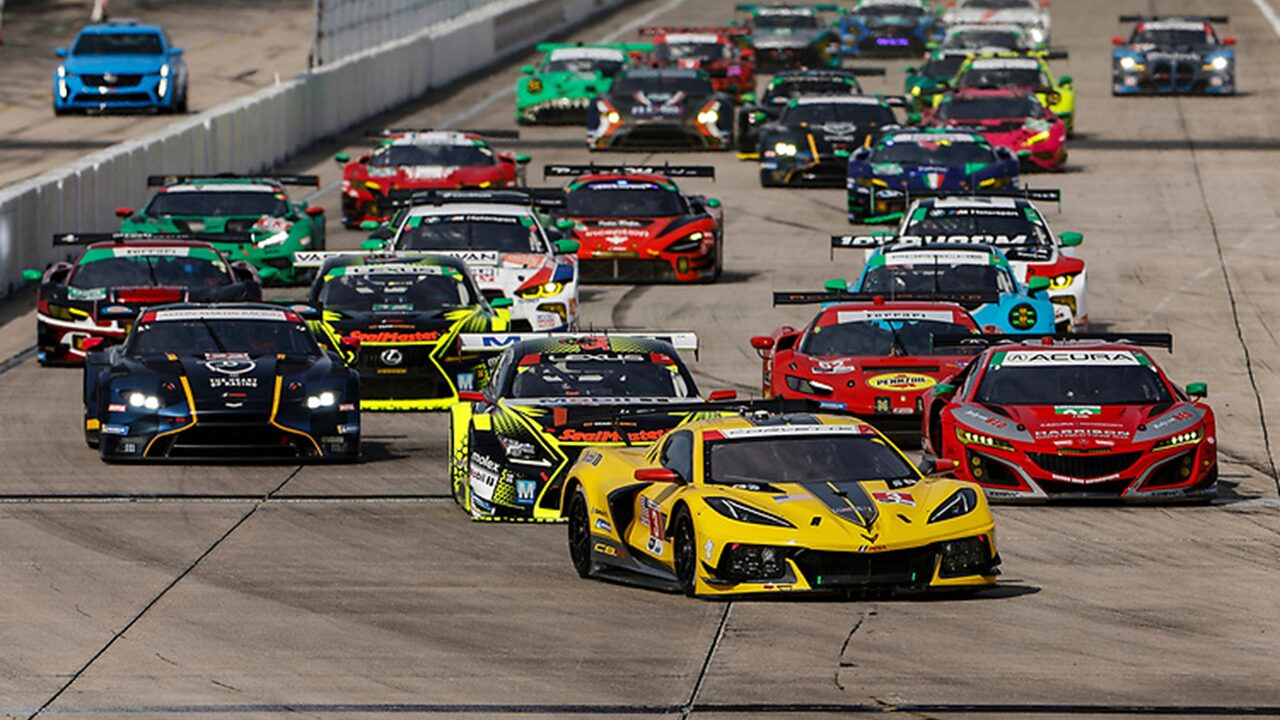
It’s like, no, some ending ones. We do this now every year at Daytona. That’s the field for the Rolex 24, probably two years ago. Turn one SE bring just GT cars this time. Huge. We have 18 OEM [00:52:00] partnership agreements with car manufacturers. Most of anyone in the world right now, Penske’s, Porsches, Roger Penske, said when they first tested this car in Barcelona, these are the most technically advanced race cars on the planet, including Formula One, IndyCar.
Anything else? They are made with stuff that was not off the shelf. Everything in these cars, hybrid wise, battery wise, MGU Wise was developed specifically for this. Again, in order to have a life until now, 2030. So we’ll be using this componentry and it has scalability for another five years. Easy. Cars are really cool.
They do really great things. They leave the pits on the electric, they have no alternator, and they just hit the ignition button and the car starts itself from the electric. It’s got an 800 volt battery in it. The 800 volt battery can give it 150 more horsepower, not on demand, but over a period of time.
It regenerates itself when you’re on the brakes and when you disengage the clutch, the input shaft, that’s where the MGU works is the input shaft BMWs. They just debuted [00:53:00] their second generation of the car at Daytona last weekend. Here you have Aston Martin, and again, off we go. So Daytona tells us the Rolex 24 now is the second most profitable event at the racetrack after the Daytona 500.
So road racing and sporty car stuff has come a long way, but you can see how quick these things are at Daytona. Now they’re slightly over 200. I threw this in just to give some idea of IMSA and the Corvette from the third car from the top. It is all IMSA, A LMS, grand Am. Corvettes first two? No, the third one is a Greenwood, so that’s where it starts, but it’s kind of a neat photo to show how GM is used.
Motorsports and Corvette, final picture, that’s the Bishop France trophy. Every champion of every class. In the overall division, G-T-O-G-T-U-G-T-X-G-T-P, on the front straightaway in front of the new tower building at Road Atlanta with the Michelin man on it. And uh, I’m done. Thank you.[00:54:00]
Where all the pictures came from. I am sure there’s some questions, mark. That was absolutely fabulous and I don’t know if we wanna open it up for questions. How old were you when you started, uh, with John Bishop? I was, had just turned 16 in the spring of 1974 and I did my 50th 24 hour race this year of only two years.
One year I was actually kind of helping John Cooper at the Speedway after Andy Evans took over. George and I went over there at their request and then by 99 I was over there regularly beginning to make Grand Am for. Bill Junior and Jim Franz been a great run. I think the most important thing, which I could talk to, you know, the cars are cool and the events are cool and I took a lot of notes, but the people.
Do you have the opportunity to work with your parents, John and Peg Bishop? Priceless. You know, I’ve been given great guidance, great teachings was told. Day one, you can make every mistake you want. Once, second time we’re gonna start thinking you’re stupid. And I said, okay, I don’t wanna be stupid. That was direct quote.[00:55:00]
This episode is brought to you in part by the International Motor Racing Research Center. Its charter is to collect, share, and preserve the history of motor sports spanning continents, eras, and race series. The Center’s collection embodies the speed, drama and camaraderie of amateur and professional motor racing throughout the world.
The Center welcomes serious researchers and casual fans alike to share stories of race drivers race series, and race cars captured on their shelves and walls, and brought to life through a regular calendar of public lectures and special events. To learn more about the center, visit www.racing archives.org.
This episode is also brought to you by the Society of Automotive Historians. They encourage research into any [00:56:00] aspect of automotive history. The SAH actively supports the compilation and preservation of papers, organizational records, print ephemera, and images to safeguard, as well as to broaden and deepen the understanding of motorized wheeled land transportation.
Through the modern age and into the future. For more information about the SAH, visit www.auto history.org. We hope you enjoyed another awesome episode of Break Fix Podcasts, brought to you by Grand Tour Motorsports. If you’d like to be a guest on the show or get involved, be sure to follow us on all social media platforms at Grand Touring Motorsports.
And if you’d like to learn more about the content of this episode, be sure to check out the follow on article@gtmotorsports.org. We remain a commercial free and no annual fees organization through our sponsors, but also through the generous [00:57:00] support of our fans, families, and friends through Patreon. For as little as $2 and 50 cents a month, you can get access to more behind the scenes action, additional pit stop, minisodes and other VIP goodies, as well as keeping our team of creators.
Fed on their strict diet of fig Newton’s, Gumby bears, and monster. So consider signing up for Patreon today at www.patreon.com/gt motorsports. And remember, without you, none of this would be possible.
Highlights
Skip ahead if you must… Here’s the highlights from this episode you might be most interested in and their corresponding time stamps.
- 00:00 Meet Mark Raffauf
- 02:14 IMSA Origins Bishop & Bill France
- 03:55 First Races Open Wheel
- 04:53 Closed Wheel Camel GT, Small Cars w/ Street Tires
- 06:32 All American GT Era
- 10:42 American Challenge Stock Cars
- 11:39 Group 5 Turbo Monsters
- 13:48 GTP Arrives Daytona 1978
- 15:20 935 Evolution And Innovation
- 18:11 Privateers Payout Philosophy and the Road America Breakthrough
- 22:29 Lola T600 Ground Effects
- 26:14 Audi 90 GTO Quattro
- 28:28 Jaguars Take Over
- 29:11 Street Races: Miami and the Downtown street racing boom!
- 29:42 Wild tech experiments
- 30:13 GTP rules vs Group C
- 33:06 Firehawk showroom racers
- 34:47 Night racing survival
- 36:54 When speed got dangerous
- 38:46 Ownership turmoil and exports
- 40:57 GTP peak and aero wars
- 44:49 World Sports Car era
- 46:46 Ferrari 333SP dominance
- 48:11 Split into Grand Am and ALMS
- 50:57 Merger to modern IMSA
- 51:49 Hybrids and today’s grid
- 53:53 Closing remarks and sponsors
Livestream
In case you missed it, please enjoy the original recording of: The International Motor Sports Association: 55 Years of Motorsports Influence and History by Mark Raffauf
This episode is sponsored in part by: The International Motor Racing Research Center (IMRRC), The Society of Automotive Historians (SAH), The Watkins Glen Area Chamber of Commerce, and the Argetsinger Family – and was recorded in front of a live studio audience.
Learn More
Michael R. Argetsinger Symposium on International Motor Racing History
 The International Motor Racing Research Center (IMRRC), partnering with the Society of Automotive Historians (SAH), presents the annual Michael R. Argetsinger Symposium on International Motor Racing History. The Symposium established itself as a unique and respected scholarly forum and has gained a growing audience of students and enthusiasts. It provides an opportunity for scholars, researchers and writers to present their work related to the history of automotive competition and the cultural impact of motor racing. Papers are presented by faculty members, graduate students and independent researchers.The history of international automotive competition falls within several realms, all of which are welcomed as topics for presentations, including, but not limited to: sports history, cultural studies, public history, political history, the history of technology, sports geography and gender studies, as well as archival studies.
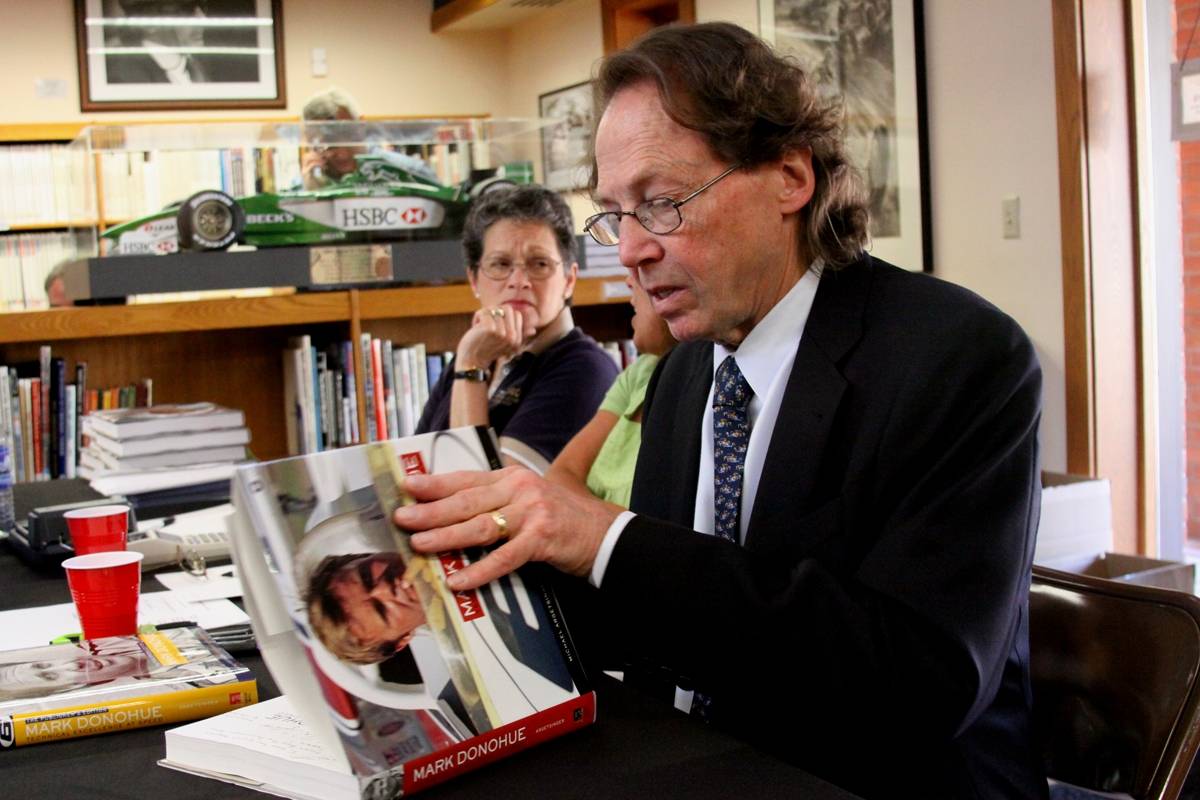 The symposium is named in honor of Michael R. Argetsinger (1944-2015), an award-winning motorsports author and longtime member of the Center's Governing Council. Michael's work on motorsports includes:
- Walt Hansgen: His Life and the History of Post-war American Road Racing (2006)
- Mark Donohue: Technical Excellence at Speed (2009)
- Formula One at Watkins Glen: 20 Years of the United States Grand Prix, 1961-1980 (2011)
- An American Racer: Bobby Marshman and the Indianapolis 500 (2019)

Consider becoming a Patreon VIP and get behind the scenes content and schwag from the Motoring Podcast Network
Do you like what you've seen, heard and read? - Don't forget, GTM is fueled by volunteers and remains a no-annual-fee organization, but we still need help to pay to keep the lights on... For as little as $2.50/month you can help us keep the momentum going so we can continue to record, write, edit and broadcast your favorite content. Support GTM today! or make a One Time Donation.
IMSA’s first races were held at Pocono, where Formula Fords circled a small oval. The concept worked — until it didn’t. Pack racing led to massive accidents, and the organization quickly pivoted.
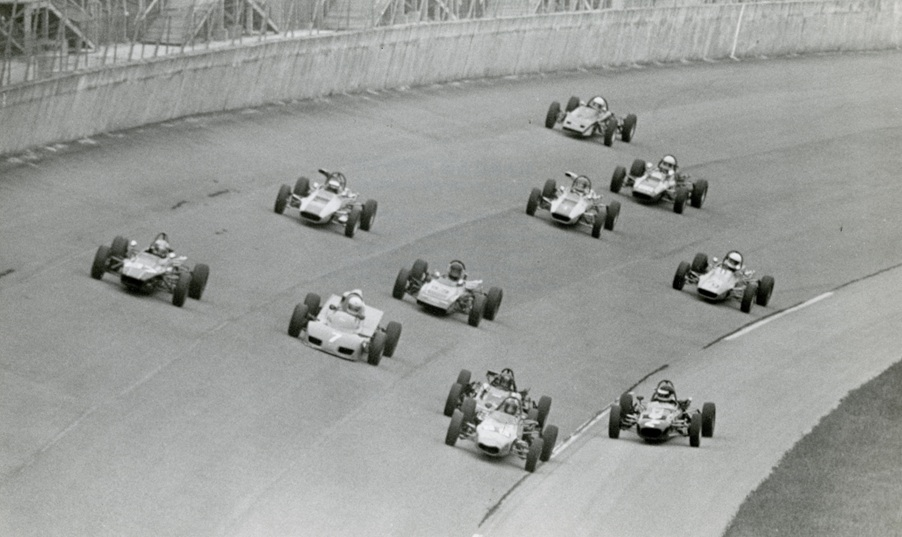
From there, IMSA began experimenting with:
- Formula Vee
- Closed‑wheel GT racing
- Mixed‑class fields featuring Camaros, Mustangs, Javelins, and Porsche 911s
- Small‑bore “RS” cars like Pintos, Gremlins, Fiats, and early Honda Civics
This willingness to adapt became a defining IMSA trait. As Raffauf puts it, the goal was always to create “a product that the little guy private team could win the big races in.”
The Rise of GT Racing and the All‑American GT Concept
By the mid‑1970s, European manufacturers were producing limited‑run customer race cars — Porsche Carreras, BMW CSLs, Ford Capris. American cars, built in vastly larger numbers, couldn’t compete under the same rules.
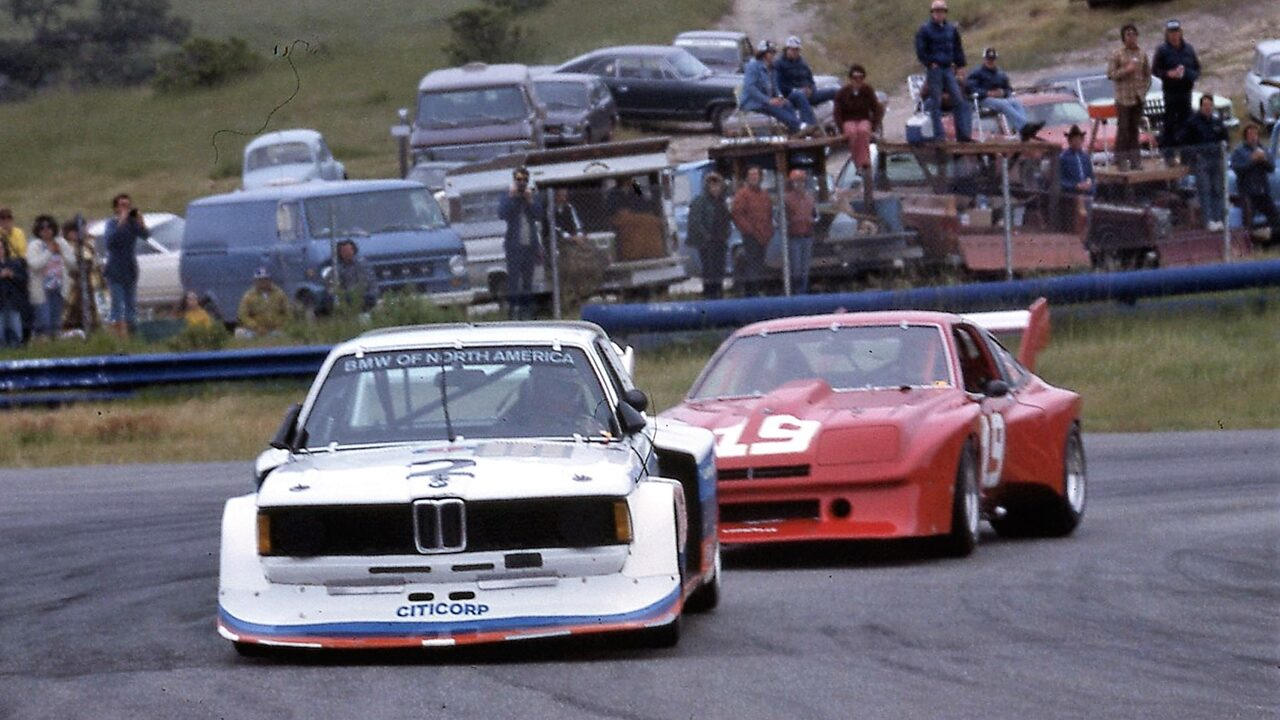
So Bishop drew a new path forward.
Literally.
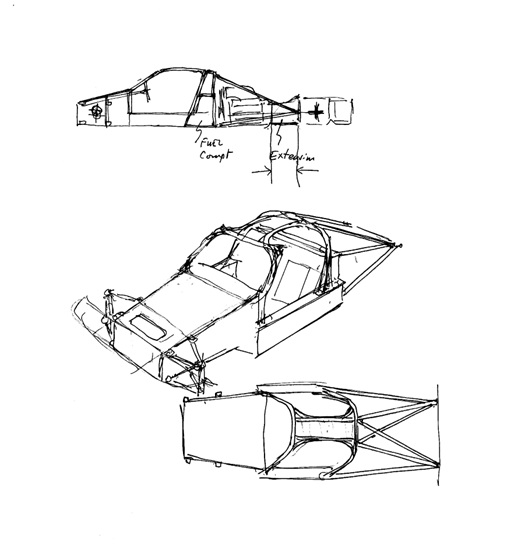
Raffauf shows Bishop’s original hand‑drawn artwork for the All‑American GT (AAGT) concept — a rulebook designed to let American iron compete fairly with European machinery. The Chevy Monza, Greenwood Corvettes, and other tube‑frame monsters became IMSA icons.
The Era of Wings, Turbos, and Ground Effects
As the 1970s gave way to the 1980s, IMSA entered its wildest period:
- Group 5 “wings and things”
- Porsche 935 dominance
- BMW’s factory CSL and 320i Turbo programs
- The birth of GTP prototypes
Raffauf describes the 935 era vividly — cars with huge power, tiny front tires, and “flexible flyer” chassis that demanded absolute precision. Teams innovated aggressively because the rules allowed it: “If it didn’t say you couldn’t, you could.”
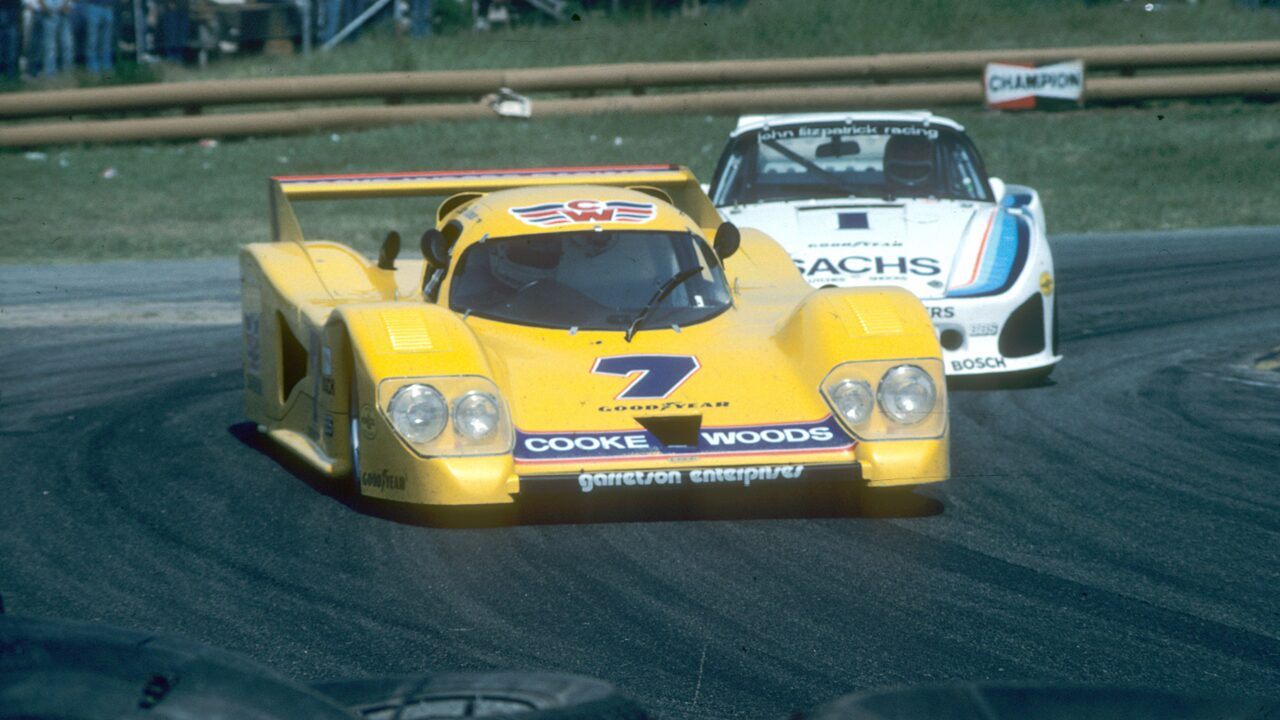
But the arrival of the Lola T600 changed everything. With true ground‑effects tunnels, it could simply drive around the old GT cars. It was the first customer‑built GTP car, and it set the template for the next decade.
Street Racing, Stock Cars, and the Expanding IMSA Universe
IMSA wasn’t afraid to take risks — literally. The organization brought racing into downtown Miami, West Palm Beach, San Antonio, Columbus, and New Orleans. Raffauf recalls how the series “messed up the town for a month,” but also brought motorsports to people who’d never seen it before.
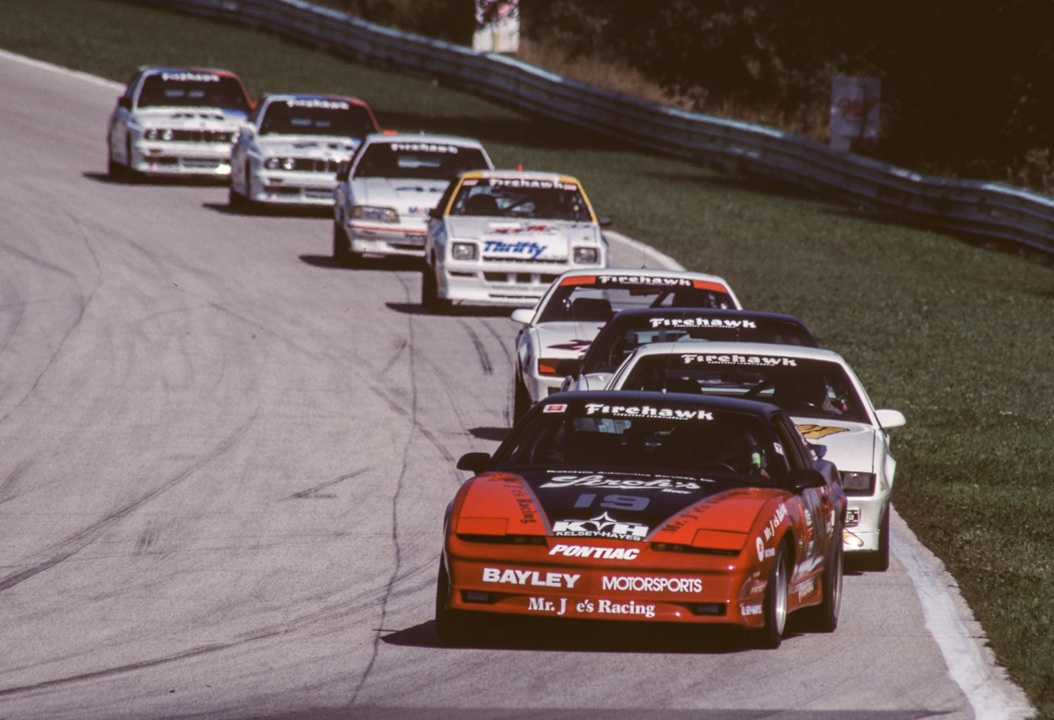
Meanwhile, IMSA also experimented with:
- American Challenge stock cars
- Firestone Firehawk street‑car racing
- Skip Barber open‑wheel development series
These programs created opportunities for grassroots racers and future stars alike.
The Audi 90 GTO: A Technical Marvel
One of the most fascinating chapters in Raffauf’s talk centers on the Audi 90 GTO, a full tube‑frame, all‑wheel‑drive monster that defied expectations. Despite IMSA narrowing its tires from 14 inches to 10, the car remained dominant thanks to its ability to distribute power dynamically across all four wheels. Raffauf calls it “one of the coolest, most technically advanced things that IMSA created.”
The GTP Arms Race and Its Consequences
By the late 1980s, GTP cars were exceeding the limits of the tracks themselves. Raffauf recounts violent tire failures at Road Atlanta caused by extreme downforce and 200+ mph speeds over dips the circuits were never designed for. This era produced legendary machines — Nissans, Jaguars, Toyotas, Porsches — but also forced IMSA to rethink safety and sustainability.
Ownership Turbulence and Reinvention
The 1990s brought financial and organizational upheaval. Raffauf describes owners who mismanaged funds, temporary circuits that failed, and the eventual split that led to:
- Grand-Am (under NASCAR/ISC)
- The American Le Mans Series (under Don Panoz)
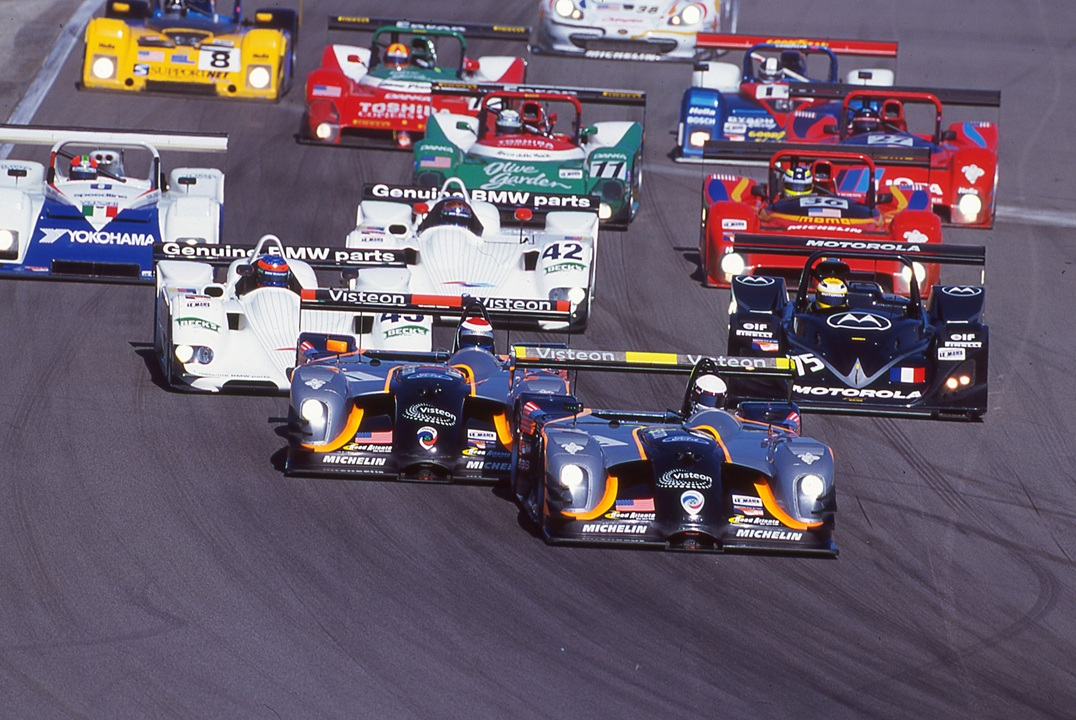
Despite the chaos, IMSA continued innovating, exporting its GT concepts to Japan and South America, and helping shape what would become Super GT.
World Sports Cars, Ferrari 333 SP, and the Road to Modern IMSA
With GTP ending, IMSA introduced the World Sports Car formula — open‑cockpit prototypes designed for private teams. The standout was the Ferrari 333 SP, a pure customer car that became one of the most beloved prototypes of the era.
This period also saw:
- Daytona Prototypes (DP); and the Birth of DPi
- The eventual ALMS/Grand-Am merger
- The rise of hybrid racing machinery
By the 2020s, IMSA had become a global powerhouse with 18 OEM partners and some of the most advanced race cars on the planet.
A Legacy Written in People
Mark Raffauf’s keynote isn’t just a recounting of motorsports history — it’s a firsthand account from someone who shaped the rulebook, lived through the politics, and helped guide IMSA through five decades of reinvention. His stories remind us that racing is as much about people and ideas as it is about machines.
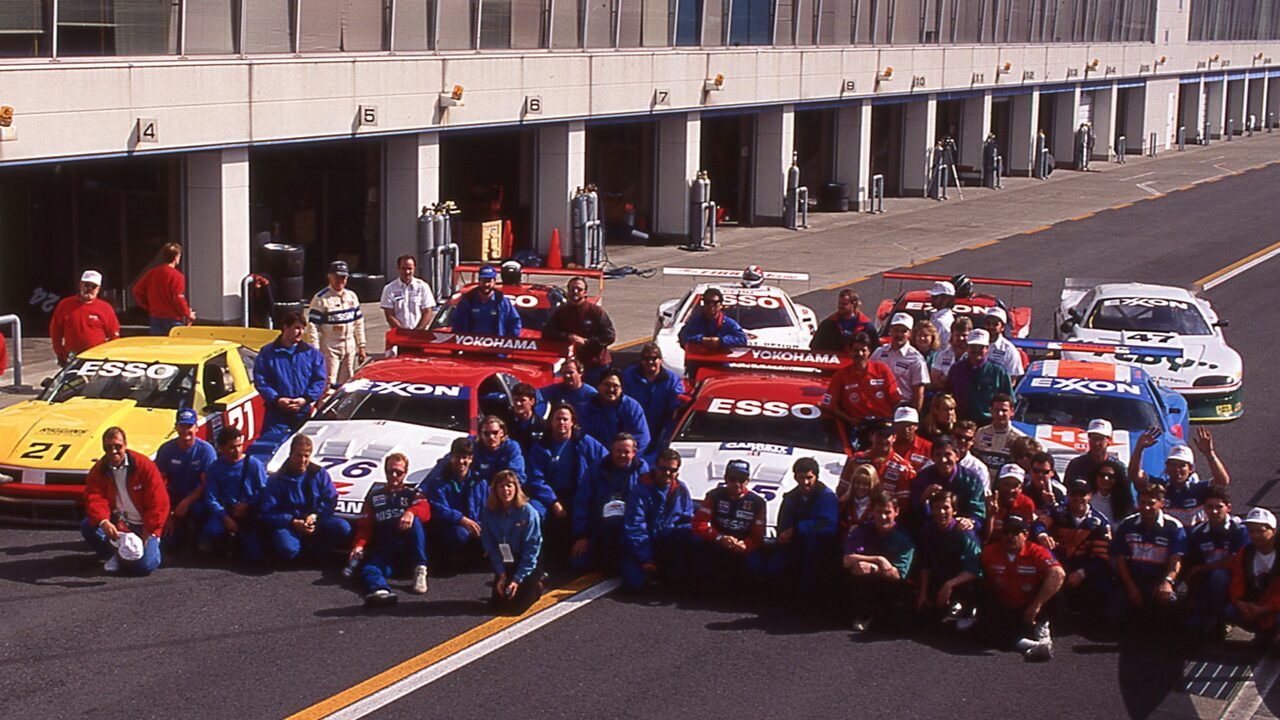
Raffauf reflects on working with John and Peg Bishop, the France family, and the countless passionate people who built IMSA’s culture.
One line from his keynote captures his philosophy perfectly: “You can make every mistake you want — once. Second time we’re going to start thinking you’re stupid.” – It’s blunt, funny, and deeply human, much like IMSA’s history itself.
Other episodes you might enjoy
If you enjoyed this History of Motorsports Series episode, please go to Apple Podcasts and leave us a review. That would help us beat the algorithms and help spread motorsports enthusiasm to others.Remember to subscribe to Break/Fix using your favorite Podcast App.
Support our Creators!
 For as little as $2.50 cents a month, you can get access to more behind the scenes action, additional Pit Stop mini-sodes and other VIP goodies, as well as keeping our team of creators fed on their strict diet of Fig Newton's, Gummy Bears, and Monster. Consider signing up for Patreon today. And remember, without *YOU*, none of this would be possible!
This content has been brought to you in-part by support through...