

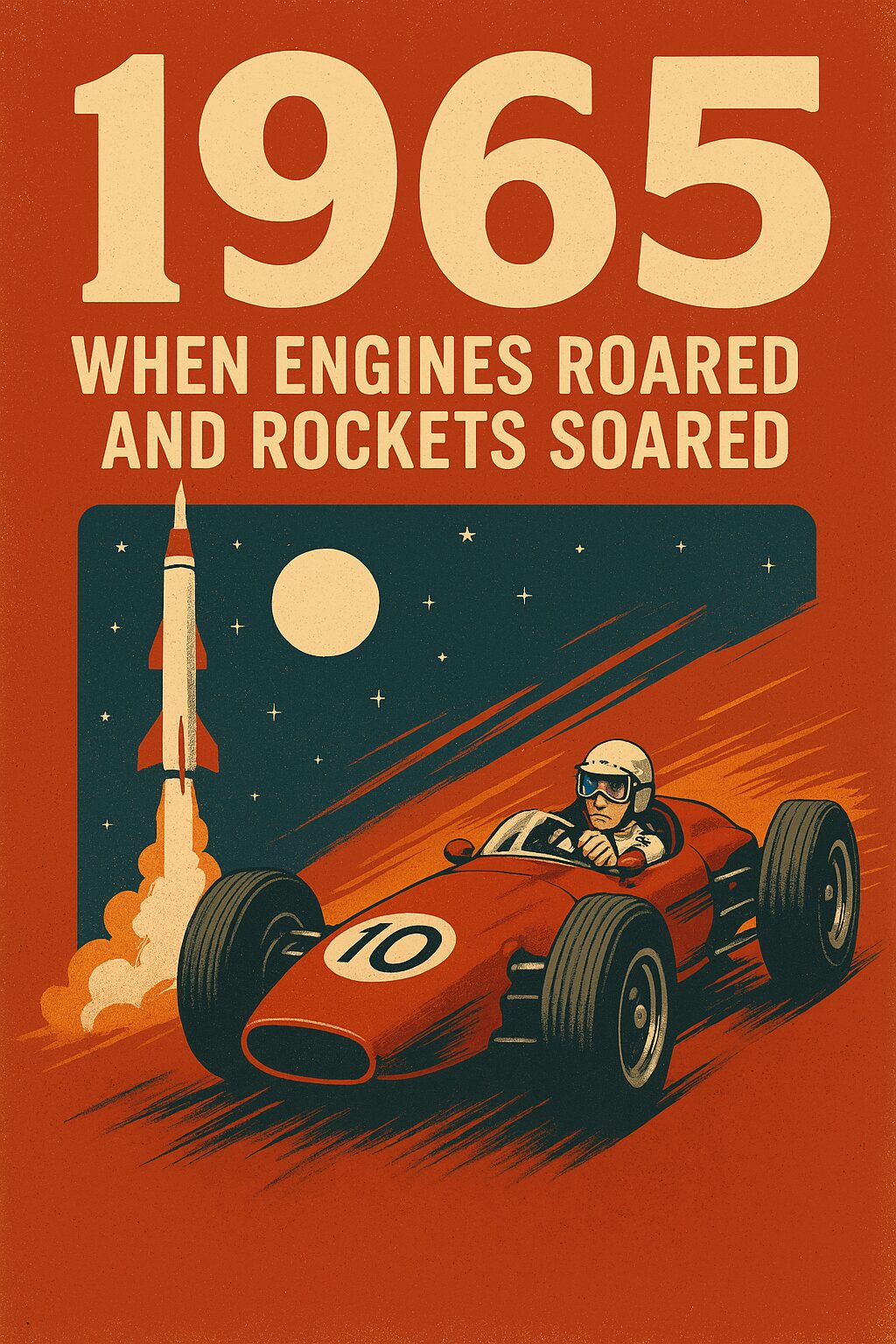
In the grand tapestry of history, few years shine as brightly as 1965 – a year when the roar of engines on the racetrack echoed the thunder of rockets piercing the skies. It was a time when motorsports and space exploration, seemingly worlds apart, converged in spirit, ambition, and innovation.
Guiding us through this pivotal moment is Dr. Mark D. Howell, motorsports scholar and cultural historian, who reminds us that 1965 was more than a calendar of milestones. It was a cultural touchstone, a year when technology, competition, and national purpose intertwined to redefine what humanity could achieve.



Bio

Dr. Mark D. Howell has been involved with motorsports his entire life (thus far). He earned a BA in English in 1987 and an MA in American Studies in 1990 from Penn State, then earned a Ph.D. in American Culture Studies from Bowling Green State University in 1995. His dissertation evolved into From Moonshine to Madison Avenue: A Cultural History of the NASCAR Winston Cup Series, published in 1997. In 2014, Howell co-edited (with Dr. John Miller of Longwood University) Motorsports and American Culture: From Demolition Derbies to NASCAR.
Howell’s full-time job since August of 1997 has been as a Professor of Communications at Northwestern Michigan College in Traverse City. He spent two years before NMC as a Visiting Assistant Professor in the Department of American Thought and Language at Michigan State University. Mark has also taught advanced courses for Tiffin University, Oakland University, Ferris State University, and Davenport University. Dr. Howell is on the Board of Directors of the Society of Automotive Historians, and is editor of the SAH’s Automotive History Review.
Synopsis
This episode of the Logbook, our History of Motorsports Series, discusses the intertwining advancements in motorsports and space exploration in 1965. Dr. Mark D. Howell, a cultural historian, explores the parallels between pioneering figures in motorsports, like Richard Petty and Jim Clark, and space exploration heroes, such as Frank Borman and Jim Lovell. Dr. Howell draws connections between technological innovations and national ambitions that shaped historical milestones in both fields. The narrative highlights Formula One’s 75th anniversary, NASA’s Project Gemini, and competitive advancements in NASCAR, Indy 500, and land speed records at Bonneville Salt Flats. Additionally, the influence of societal and cultural memory in shaping historical understanding is examined. The episode underscores how the accomplishments of 1965 have continued to impact racing, space exploration, and collective cultural identity.
Follow along using the Slide Deck from this PresentationTranscript
[00:00:00] Break Fix’s History of Motorsports Series is brought to you in part by the International Motor Racing Research Center, as well as the Society of Automotive Historians, the Watkins Glen Area Chamber of Commerce, and the Argo Singer family.
On this episode of the Logbook, we stepped back into 1965 a year when engines roared rocket soared, and history was written across two frontiers, motorsports, and space exploration. It was the time of bold technologies, ambitious plans, and unforgettable achievements on the racetrack. Legends like Richard Petty, Jim Clark and Dan Gurney redefined competition in orbit and beyond.
Pioneers, such as Frank Borman, Jim Lovell, and Ed White carried humanities aspirations to the stars. Together, their innovation set benchmarks that continue to shape both racing and exploration six decades later. Guiding us through this pivotal year is Dr. Mark D. Howell, a lifelong motorsports scholar and cultural historian with a PhD in American Culture Studies and a career spanning decades [00:01:00] of teaching, writing, and leadership in the Society of Automotive Historians.
Dr. Howell brings unmatched insight into how 1965 became a turning point in both speed and space. His work connects the roar of engines to the silence of space, showing how one extraordinary year continues to influence the way we race, explore, and dream. Join us as we uncover the sociocultural significance of 1965 a year that proved innovation, knows no boundaries, whether on the track or among the stars.
Thank you. It’s good to be here. I’m working on a book manuscript right now that is juxtaposing, as Kip was saying, kind of the connection between motor sports and space exploration because there is a connection and as a kid who grew up wanting to both be a race car driver and an astronaut, and couldn’t quite determine which of the two was going to win.
To my surprise, I noticed as I got older and became a cultural historian and started in academia that there was a connection between the two. So today this is an ongoing part of that research, [00:02:00] and the reason I selected 1965 in part is because this year is significant. I mean, if you think about it, this is the 75th anniversary of what we know as Formula One.
It’s the 75th anniversary of the Wood Brothers getting into racing. So you’ve got these different kinds of anniversaries that kind of pop up around this year and 60 years ago, it seemed like there was a lot going on both in space exploration and motor sports, things that were going on that ended up setting the course for the future of both occupations and both endeavors.
So that’s where this comes from. The year 1965 stands out as a turning point in American technological and cultural history in both space exploration and in motor sports. Two fields that are often seen as unrelated, but they are connected. You had engineers, astronauts, drivers, and institutions that were simultaneously.
Pushing the boundaries of speed, endurance, and human capability. It was a moment when advances in [00:03:00] materials design and engineering converged with national ambition. It was also the year I was born and I haven’t changed much. I still lean forward and I’m still kind of round in the face. So that’s me.
While these events meant nothing to me at the time, they have become meaningful through what was recorded, remembered, and retold. Looking back across six decades, I propose we understand 1965, not merely as a collection of milestones, but as a year whose significance is shaped by collective memory using the frameworks of societal logics and cultural identity.
I submit that the narrative constructed around 1965 stories of innovation. Competition and national purpose continue to shape how we understand the relationship between technology and culture when examined through this lens, 1965 becomes more than a year of achievements. It becomes a cultural [00:04:00] touchstone that reveals how societies make meaning from historic, competitive, and technological triumphs.
As 1965 began, the United States was in the midst of the space race running second to the Soviet Union in placing satellites and animals in low Earth orbit. America was also chasing the technological and ideological target set by President John F. Kennedy in 1961. Of landing a man on the moon. By the end of the decade, NASA was caught off guard.
When on April 12th, 1961, Yuri Guerin made a 108 minute flight aboard his VO stock won spacecraft scoring. Two monumental firsts for the Soviet Union. The first human in space and the first human to orbit the earth. In 1963, Russia’s Valentina Ter Cova made 48 orbits over three days to become the first woman in space.
And as a point of comparison, the [00:05:00] first American woman in space was Sally Ride. 20 years later, in June of 1983, in 1965, project Gemini tightened the space race by demonstrating the versatility and technology needed to reach the moon, not that Gemini got off to a rousing start. An article in the Bulletin of the Atomic scientists highlighted a rift between the US military and nasa.
Because the agency, according to some people, was more interested in landing on the moon than developing America’s military capability in space. Some believed, and this was precisely the case, this is what the Soviet Union was doing with their vehicles. So the rift was actually pretty well meaning. We weren’t spying like the Soviet Union was using their technology to do.
Now, that said, astronauts had been photographing the earth since. John Glenn took a store-bought Minolta point and shoot camera into orbit on [00:06:00] Friendship seven In 1962, while American Space flight was seen as more scientific than spying, there were some in the federal government who thought manned missions were missed opportunities to observe America’s enemies.
From afar, the United States Air Force was in fact working with McDonald Aircraft, adapting Gemini hardware to develop a manned orbital laboratory that would conduct essential research as long as that essential research meant spying on other countries. The project stalled in 1966 as satellite technology was improving and funds were needed to fund the war in Vietnam.
All the while the Soviet Union fully believed it was capable of beating NASA to the cratered lunar finish line. The Soviets upped the lunar ante in March with Alexi Land’s Surprise 13 minute extra vehicular activity. A move that forced NASA to fast track an [00:07:00] American response. The first American EVA was scheduled for Gemini five later in the year, but Russia’s awkward, yet successful, and I say awkward because when Leon F got out in the vacuum of space, his pressure suit inflated, and for a while they weren’t sure how to deflate it enough to get ’em back through the hatch.
Period of time when they thought they would just have to cut him loose because he was essentially the Michelin man in space and they had to figure out a way to get him back. They did. But anyway, his early spacewalk led the agency to assign America’s first EVA to Gemini for only the second man flight of the program.
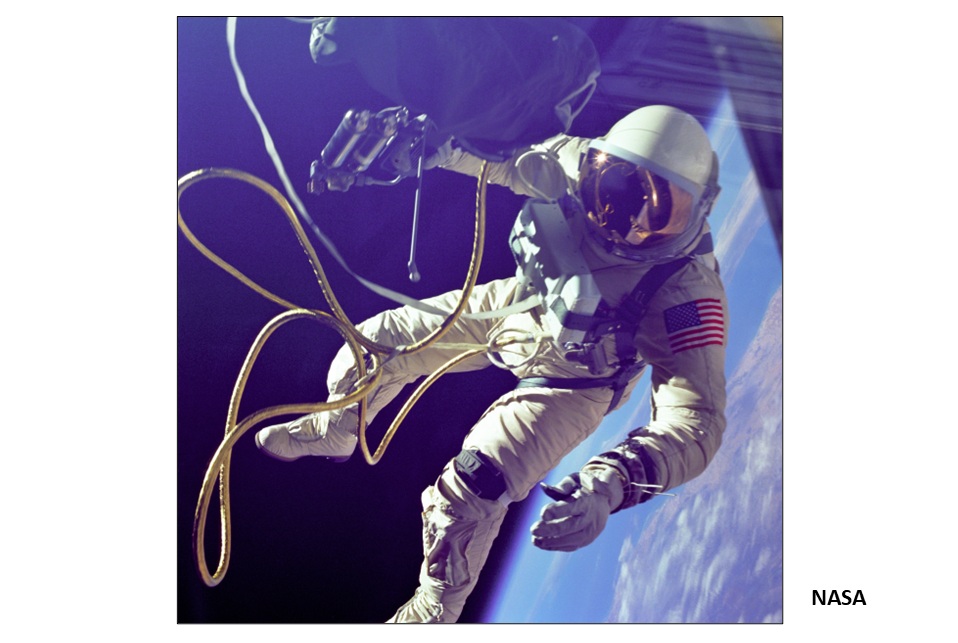
Astronaut Edward White was assigned to conduct the spacewalk in early June. On the second orbit of Gemini Four’s 66 orbit flight Commander James McDivitt assisted white in opening his hatch, allowing white to float free of his spacecraft, tethered by a 15 foot umbilical cord that provided communications and [00:08:00] life support.
White spent 23 minutes in space taking photographs and creating optics that unlike Leonardo’s, EVA would promote Gemini Four’s accomplishment throughout the world. More than a technical demonstration, ed White’s EVA quickly became a cultural moment. The image of an American astronaut floating freely against the blackness of space, tethered only by a lifeline offered the nation a powerful symbol.
At a moment when Cold War anxieties were high, this is the first mission where astronauts wore the American flag on their spacesuits, and that was actually at the bequest of McDivitt and white. They kind of knew that this was going to be a big moment for the United States, and so they went ahead and said, Hey, can you put the American flag on our space suits?
NASA didn’t stay with that, but if you look at the majority of space suits from this point on, you see an American flag, Gemini five flown in August by Gordon Cooper and Charles Pete Conrad, who were, by the way. [00:09:00] Recognized outside the space program as both being competitive. Racers in their own right Cooper raced sports cars and hydroplane boats.
Pete Conrad raced sports cars with the SCCA and he actually raced at Watkins Glen at least one time back in the early seventies. But their mission, Gemini five was to be the first spacecraft to use fuel cells instead of batteries as a source of internal power. Cooper and Conrad described their mission as eight days in a garbage can.
Since their sole purpose was to live in Earth orbit and demonstrate that fuel cells could generate enough energy for a minimum duration lunar mission, they also had the EVA. Taken away from them. So they were kind of frustrated at that. They would also test a new radar technology that enabled vehicles to rendezvous in orbit with great precision, which was another critical aspect of going to the Moon.
Cooper and Conrad being racers in their own right, [00:10:00] commented on how loud and fast the Titan two launch vehicle was. Which was understandable given that Gemini crews went into space atop and ICBM designed to carry nuclear weapons Astronauts compared the Titan two to a sports car, maybe a Corvette Stingray.
That’s what they were driving. Given its quick and steady acceleration, which interestingly enough led to a sharp change in trajectory at a particular altitude that aimed the vehicle toward Russia. So what the astronauts had to learn to do was to counter that change in trajectory because that wasn’t their intent.
At least in the Gemini program. Gemini five ultimately earned the United States a new flight duration record of 7.96 days in orbit exceeding cosmina. Valerie Bukowski’s record by 72 hours. The flight duration record of Gemini five was shattered four months later in December by Jim Lovell and Frank Borman on Gemini seven when they spent [00:11:00] 13.77 days in orbit.
This mission was the most ambitious of 1965 and probably of the entire Gemini. Program. It included a pretty big to-do list. The astronauts were gonna spend two weeks in space. They were gonna try new extra lightweight space suits, which you can see here. Their helmets are like, almost like big bags.
They’re wearing over their heads and executing a controlled reentry near their recovery location. Borman and Lovell were also tasked, and this is a direct quote from NASA three Scientific. Four technical, four spacecraft, and eight medical experiments. The medical experiments involved Frank Borman going into space with electrodes stuck in his skull under his helmet to get physiological data on their condition.
Gemini seven became part of an unplanned exercise when Gemini six, an unmanned rendezvous target vehicle. Was lost after liftoff, which delayed the launch of Gemini six A, which was going [00:12:00] to meet up with the target vehicle, Gemini six A, which was going to carry astronauts Tom Stafford and Wally Shirah.
NASA planners suggested that Gemini seven liftoff before Gemini six A, so the two vehicles could attempt a manned rendezvous, which would be necessary for a lunar mission. In December, 1965, NASA achieved the incredible two Gemini spacecraft, one piloted by indie team car owner Wally Shara. He was a silent partner with AJ Foyt actually in 1967.
Their car finished second at Indianapolis with Joe Leonard behind the wheel. But Wally Shara got the spacecraft together. They did kind of a side drafting sort of a thing. They got to within three feet to actually, at one point they got to within one foot of each other. At 17,500 miles an hour for five and a half hours at an altitude of 160 nautical miles, the astronauts could see each other.
They could read [00:13:00] signs held up to windows, and they were able to visually inspect the condition of both spacecraft. It was a technological achievement that gave 1965, added historical significance just as NASA rushed to match Soviet achievements through technical improvisation. Motorsports organizations in 1965 faced parallel pressures, organizational, cultural, and technological that shaped their own collective narratives.
Take nascar for example. By 1965, American automakers were focused on engine development and horsepower. Nascar, on the other hand, stuck to its 1949 notion of showroom stock, stock cars, and the slogan, win on Sunday, sell on Monday. Another factor was the sanctioning body’s homologation rules requiring manufacturers to produce a specific number of high powered creations for commercial sale.
Many of these specialty engines like the 4 26 Hemi, which you see here, Ford’s 4 [00:14:00] 27 camera and GM’s 4 27 mark two. Were simply not available in showrooms. In October of 1964, NASCAR founder Bill France announced that in 1965, all engines used in competition had to meet strict guidelines limiting their displacement.
Among other restrictive measures meant to govern on track performance. While manufacturers wanted to park their big engines in Victory Lane, big Bill France wanted stock cars to carry stock motors available to consumers. During the 1964 NASCAR season, Chrysler and Ford repeatedly criticized each other’s creative engineering efforts while addressing NASCAR rule changes meant to level the high banked playing field.
It was Chrysler’s 4 26 Hemi that received the most public attention. Hemispherical combustion chambers were nothing new in 1964 and 1965. They were actually developed by Chrysler [00:15:00] for the P 47 Thunderbolt. In World War ii, but World War II ended before the design could be put into production. This technology led to the development of the 4 26 Hemi, which big Bill France banned from competition in late 1964.
Chrysler’s Hemi allowed Richard Petty to dominate the Grand National Division earlier in 1964, winning his first Daytona 500 and his first grand National title with nine victories and 43 top tens. For 61 starts in a Plymouth Belvedere, powered by the Now Outlawed in 1965 by NASCAR 4 26 Hemi Engine. As such, the Chrysler Corporation took extreme measures after Chrysler announced it would boycott the 1965 NASCAR season.
Richard Petty went racing with the National Hot Rod Association driving a petty enterprises prepared Hemi powered Plymouth Barracuda, given Petty’s national fame and competitive [00:16:00] dominance. In 1964, he was usually matched against a full-time drag racer. He ran against such NHRA regulars as. Don Nicholson and Ronnie Sox, and they were pretty much more like celebrity shootouts than elimination heats that you would see in competition.
Petty’s 1965 drag racing sabbatical was marred tragically in late February. When a component in the left front of his Plymouth failed during a race at Southeastern International Dragway near Dallas, Georgia, the car careened through a chain link fence. Went into the crowd, injured seven spectators, and took the life of 6-year-old Wayne Edward die Petty enterprises.
Then built a second Hemi powered Barracuda, which carried Richard to an NHRA Spring Nationals win at Bristol Motor Speedway in 1965. Chrysler’s Boycott of the 1965 NASCAR grand national season worked to the Ford [00:17:00] Motor Company’s advantage. Illinois native Fred Lorenzen led 25 of 133 laps to win the rain, shortened Daytona 500 in a top 11 sweep by Ford products.
Lorenzen also won both grand National races at Charlotte in 1965, the day of my birth. By the way, was well timed and conveniently sandwiched between Fred Lorenzen win at Martinsville on 4 25, April 25th. That’s the day before I was born, and then Tiny Lund drove a Ford to victory at Columbia. South Carolina on April 28th, and in the middle was me.
Chrysler’s. NASCAR boycott ended in late July of 1965 when the company met those homologation guidelines. Chrysler’s first 1965 Grand National win came when Richard Petty won at Nashville in a 1965 Plymouth. The damage, however, had already been done. [00:18:00] Ned Jarrett won the 1965 Grand National Championship with 13 wins in 54 starts in a Ford while Fred Lorenzen ended the year 13th in points with four wins in only 17 starts.
Ford easily won the 1965 manufacturers championship with 50 victories in 55 races. One of the 50 wins, interestingly enough, was by Curtis Turner, who returned from his four year NASCAR induced suspension. He was suspended by Bill France for trying to bring organized labor, bring the Teamsters into organized nascar, NASCAR drivers at least.
And so he returned from his sabbatical, shall we say. To win the very first grand national race held at Rockingham Speedway, and that was, uh, on October 31st in 1965. No discussion about the Ford Motor Company and 1965 would be complete without mention of that year’s [00:19:00] Indianapolis 500. The 1965 Indy 500 was a perfect storm as Scotsman Jim Clark dominated the race in his Lotus 38, a streamlined, lightweight Monaco chassis.
Designed by Colin Chapman, who was an aviation engineer at one point and Len Terry. The car was engineered with an offset suspension and powered by a mid mounted 4.2 liter double overhead cam Ford V eight. The Lotus 38 was based on the Lotus 29 that finished second at Indy with Jim Clark in 1963 and the Lotus 34 that finished 17th at Indy with Dan Gurney in 1964, Jim Clark and his Lotus 38 averaged 150.686 miles an hour to win at the Brickyard.
Breaking the 150 mile an hour barrier, as well as a J FO’s 1964 record of 1 47 0.35 in the final Indy [00:20:00] 500 won by a front engine car. By the way, 64 was the last front engine win. Only six front engine cars were on the grid in 1965, making it the first Indianapolis 500 to feature mostly rear engine.
Entrance teams at Indianapolis in 1965 face new rules in response to the tragic events of 1964. If you remember, that’s when Dave McDonald and Eddie Sacks died in that fiery wreck right near the start of the race. These new rules included a new minimum weight restriction and new guidelines for fuel management guidelines that required cars to have a 75 gallon onboard capacity fuel tanks with rubber bladders.
And no crossover tubes located in front of the driver teams at India in 1965 were encouraged to run methanol, which made more horsepower even though gasoline provided better mileage. That said, teams were now required by the roll to pit at least [00:21:00] twice and to connect to their newly required. Another new rule, gravity fed fueling rigs, which eliminated any advantage to be had by running gasoline.
The 1965 Indy 500 featured one of the largest and most impressive rookie classes in the events history. A roster that included Mario Andretti, Gordon Johncock, Joe Leonard, and Al Unser. The front row was comprised of a J Foyt who qualified with a new track record. Jim Clark was second and Dan Gurney on the outside of row one.
Andretti was the fastest rookie starting fourth on the grid. When it comes to the 1965 Indy 500 and the influence of collective memory, the story of the Wood Brothers comes to mind. Popular meaning comes from our memories of the famous NASCAR pit crew servicing Jim Clark’s Lotus and Route to Victory at the Brickyard.
Despite such memories. Fact over fiction suggests the wood [00:22:00] brothers were more of a Ford public relations stunt than a competitive necessity. Teams at Indy knew the wood brothers and their reputation in nascar, yet the crew was new to USAC competition. So any advantage they brought. To Team Lotus was unproven.
Both time and history have suggested that the Wood brothers were not as much of a secret weapon, quote unquote. As our recollection of the 1965 Indy 500 leads us to believe the Wood Brothers turned 41.9 total seconds on Pit Road into team Lotus’s dominating win. But the truth is. The Lotus 30 eights potent blend of aerodynamics, chassis design, and horsepower when put in the hands of an incredibly talented driver, enabled Ford to win.
The Wood Brothers notable contribution at Indianapolis, which led to the Venturi tube that the Wood Brothers added to the gravity Fed fuel rig that was now required. The [00:23:00] idea that Venturi tube made the fuel flow smoother and faster. But anyway, after getting through USAC inspection. Leonard Wood then devoted several hours to polishing and fitting, making sure all the connections and nozzles worked right to ensure maximum efficiency come race day.
Jim Clark had to stop precisely in his box to maximize his refueling strategy. Leonard Wood quoted Clark as saying, you tell me where to stop and I’ll stop. Wood showed Clark the exact location the crew needed and the world driving champion. According to wood, squatted the Lotus 38 down on the exact spot every time.
Stops were simpler for the wood brothers because Clark went the entire 500 miles on a single set of tires. The first stop took only 17 seconds, which is an amazing time given that pit stops during the era. Typically ran about a minute or so. Colin Chapman was taken aback by the efficiency of the wood brothers after their first record [00:24:00] breaking stop.
Chapman apparently looked over at Glen Wood and asked, I say, did you fill it up? Wood assured him the car was full, and Chapman simply turned away and said, jolly good. In a way, they went. Even the wood brothers themselves downplayed the significance of their role at Indianapolis in 1965, giving credit not only to Team Lotus and Jim Clark, but to the powerful 4.2 liter double overhead cam Ford motor that took them to Victory Lane.
As Leonard Woods said many years later, it was their engine, so it was all about Ford and what they brought. The Ford Motor Company wanted to gain a stronghold in European style endurance racing, so they turned to racer. Turned innovator. Carol Shelby for guidance. Not only did Shelby oversee production of the 4 27 Cobra in 1965, finding a practical use for the high performance motor, but he also assumed control of the company’s GT 40 [00:25:00] program that it struggled mightily at LA Mall in 1964.
At Daytona in February, 1965, Carol Shelby brought a roster of competitive cars and drivers to open the FIA World Sports Car Championship season. Shelby went to Florida with four Cobra Daytona coops and a pair of brand new GT forties. When the checkered flag fell, Ken Miles and Lloyd Ruby went to Victory Lane earning Ford’s GT program.
Its First World Sports Car Championship win. Taking first place with a five lap advantage and setting the stage for the GT Forty’s future success. All in all, Shelby entries that day took five of the top six finishing positions, the global presence of Shelby and his GT forties, and his Cobra Daytona coops turned forward from a pretender into a contender.
While Daytona Coops performed well in World Sports Car Competition and won the CCAs United States GT [00:26:00] title in 1964, the cars did even better in 1965, winning not only at Daytona, but also at Sebring Monza, the Berg Ring and Ream. To take the International Championship for GT manufacturers in November of 1965, Carol Shelby received a call from Goodyear with an offer.
The company had four days available to run at the Bonneville Salt Flats, but no viable car. The forecast for weather wasn’t good and the clock was ticking. Art Arfons was preparing to make a record attempt using Firestone Tires, and the rules at Bonneville dictated that cars not ready to run, had to yield to other competitors.
Shelby sent a Daytona Coop that competed at Lima in June to the Salt Flats with a new motor. New Goodyear tires and the same rear axle ratio used in France. The Shelby entry traveled the 700 miles from California to [00:27:00] Utah overnight, and upon getting there, the car wound up setting 25 FIA records. One of the records was when Bobby Tero and Craig Breedlove teamed up to run 1,931 miles on the 12 mile Bonneville loop, and they reached an average speed of 150 miles an hour.
No review of motor sports during 1965 would be complete without the Bonneville salt flats. The dry lake bed in Utah was a hemi friendly environment, uh, where the big engine was enthusiastically welcomed in November, California and Bob Summers set a world land speed record for wheel driven vehicles achieving a two pass average of 4 0 9 0.277 in his revolutionary golden rod car measuring 32 feet long by 48 inches wide.
Its frontal area was calculated to be 8.53 square feet with a drag coefficient of [00:28:00] 0.1165 making the vehicle literally more aerodynamic than a bullet. Goldenrod was designed by Bill Summers. Bob’s brother using four Hemi Motors borrowed from Chrysler. The hemis ran in line two-faced front, two-faced rear with a five speed truck transmission mounted at each end.
The entire powertrain linked by custom built drive shafts. Bill and Bob Summers handcrafted the car’s entire chassis roll cage and body in a converted vegetable stand in Ontario, California, creating a vehicle that set a land speed record that stood until 2010. In addition to the record, Craig Breedlove.
Set in Carol Shelby’s Daytona Coop, he and Art Aons, they took turns breaking speed barriers in their renowned battle of the jet cars. The rivalry between breed love and Aons actually began in late 1964 when breed love’s [00:29:00] Spirit of America reached 526.28 miles an hour before his parachute failed and the car was wrecked.
Art Aons set a new record about a year later in his green monster, only to lose it to Breedlove the following week. The one upsmanship came to a head when Breedlove hit 5 55 0.485 on November 2nd, only to be outrun by Aons on November 7th at 5 76 0.55. Three breed love made yet another. Record attempt on November 15th in his Spirit of America, Sonic One, and this time, the third time was the charm as Breedlove’s fighter jet shaped race car broke the 600 mile an hour barrier.
He hit 600.601 miles an hour, and Craig Breedlove was instantly labeled by the media as America’s quote. Astronaut on Wheels Breed Loves 1965. Records stood until Gary Gli ran [00:30:00] 6 22 in October of 1970. 1965 was populated with an incredible assortment of motorsports talent. Mario Andretti won the 1965 USAC National Championship, taking the title by 610 points over a j Foyt in 1965.
Andretti drove Roadsters. Rear engine cars, dirt cars, and was named Rookie of the Year at the Indianapolis 500. An example of the young driver’s tenacity at the Trenton one 50 in July, Andretti wrecked his Dean Van Lines entry and failed to qualify for the race. Even after missing Trenton and including back-to-back DNFs at Milwaukee and Decoin, Mario Andretti took the 1965 U Sac title with one win.
12 top fives, 13 top tens and three poll positions across the Atlantic. A young Scotsman named Jackie Stewart Advanced from Formula two to Formula [00:31:00] One, making his first championship start in South Africa and finishing sixth for BRM. His first World Championship victory came in the Italian Grand Prix at Manza, where he finished ahead of his teammate Graham Hill.
Stewart’s rookie season in 1965 was an impressive one as he scored one win three seconds, a third, a fifth, and a sixth performances that put him third for the World Drivers Championship that year behind Jim Clark. And Graham Hill. No review of 1965 would be complete without considering the historic accomplishments of a sheep farmer from Fife named Jim Clark.
Jim Clark’s modesty was only overshadowed by his immense driving talent. His racing career began in 1958 with road rallies and hill climbs eventually leading to Formula two, and then a quick promotion to Formula One partway through the 1960 season. Jim Clark won seven F1 races in 1963 to claim his first world [00:32:00] driving title.
In addition to finishing second at Indianapolis. At India, 1964, Jim Clark started from the pole but finished 24th. The we, Scott also came parly close to winning another world driving championship that same year. He won the most races in 1964, but struggled with late season engine problems and finished second behind John Certes.
It was in 1965 that Jim Clark experienced a season that remains 60 years later. Unmatched Clark not only won the Indy 500, but also his second world driving championship with five consecutive victories. Jim Clark spent the 1965 Formula One. Off season racing against other F1 and regional drivers to win the Tasman series in Australia and New Zealand taking the title with one race to go on the schedule.
Clark also won the British and the French Formula Two championships in 1965, making him [00:33:00] the first and so far the only driver to win multiple championships in a single year. To his legendary credit, Jim Clark still holds the Formula One record for the most Grand Slams with eight, his closest competition being Max Tappin and Louis Hamilton who were tied with six.
It is highly unlikely we will ever see another driver who exceeds the success that Jim Clark experienced in 1965. Now a conceptual foundation that lies beneath the historically significant events of 1965 can help us understand the many levels of meaning we commonly apply to such narratives from our past as Aca o Mossoff, and Steele suggest in their 2016 article in the Academy of Management Review.
Quote, societal logic serve as the organizing principles for distinct domains of social activity. The authors theorize that there are at least seven societal logics, [00:34:00] including the family, religion, the state, the market professions, community. And the corporation. Now, they continued to explain their idea, and it’s one that’s actually rooted in organizational studies.
They said, and this is a quote, collective memory making is not just a cognitive process, but a social one generated through communication and dynamic patterns of interaction and stored in material artifacts and collective consciousness. Each of these societal logics related to motor sports and space exploration, especially with regard to the events of 1965.
That year highlighted our shared understanding of family via the Petties, the woods, and the summers, while showcasing the almost religious nature of an event like the Indianapolis 500. The man space program in 1965 identified the state as in the United States through our acknowledgement of professions like astronauts and engineers as managed by the [00:35:00] corporation as in like, say nasa.
For every player in the market, whether it be Ford or Firestone or Goodyear, there is a community of fans, competitors that supports their cause. What makes this history relevant to historians is the fact that societal logics are established through collective memory. Collective memory creates resources we use to better understand and navigate societal logics, which in turn, shape cultural identity and institutional legitimacy.
Through the lens of collective memory, 1965 emerges not just as a year of remarkable accomplishments, but as a moment when Americans organized their understanding of technology, identity and ambition. The stories that endure from Ed White. Floating Above the earth to Jim Clark dominating Indianapolis to the summers brothers.
Engineering Marvels at Bonneville reflect the interplay of societal logics that shape our [00:36:00] shared narratives. What we remember of 1965 reveals how technological power becomes cultural power, rockets, engines, chassis, and speed records gain, meaning only when filtered through the stories we tell and retell stories that craft identities, legitimize institutions, and shape our understanding of history.
Over time, these events have been distilled not simply into facts, but into symbols that express national purpose, corporate competition, and human ambition. I was only an infant in 1965, unaware of the significance unfolding around me. Yet the records, the recollections, and the narratives passed down through family, community, and institutions have shaped my understanding of that year.
History gains meaning because we give it and ourselves, meaning the human experience, whether on a racetrack in orbit, or in everyday life, becomes more powerful when [00:37:00] it is shared. And with that, I thank you for your time and your attention.
That was terrific. Mark questions? I think Eric has a question. Alright, mark. Ben writes, this is a fascinating talk. You mentioned the collective memories influence on how we recall the 1965 Indy 500. Do you think there’s similar influence on our memory of the space race? It’s such a great story of triumph over adversity.
I wonder how much is clouded by our desire for everything to fit into that narrative? That’s a great question because that’s something that I’m wrestling with in this manuscript. When the space race started. We, pardon my language, sucked. The United States couldn’t do anything right. The Soviets put Sputnik into space, into orbit.
We tried to counter with putting our own satellites in space. Most of them blew up on the launchpad to the point where the national media started to wonder if maybe we were doing the wrong thing in the wrong sort of prioritization [00:38:00] that we should be thinking about. Other ways to put our technology because we just couldn’t get a satellite in orbit.
It took a couple years. We missed out on the first man in space. Gagarin went up first. He went up and orbited went up for 108 minutes and orbited the earth. We scrambled. About three weeks later, Alan Shepherd went up and his time in space. Was five minutes. If you remember Shepherd’s flight. It was a suborbital hop.
He went up and then came down. The whole flight lasted 15 minutes from lift off to splash down. It’s a swing and a miss. The Russians are still ahead. Second flight, Gus Grissom, same thing up down in his case. The hatch blows off the spacecraft while it’s in the ocean. Fills with water, spacecraft sinks. He gets accused of making a mistake and it’s a whole big kerfluffle.
Again, swinging a Ms. John Glenn goes up, okay, we’re gonna orbit the earth. John Glenn goes up, gets the go ahead for seven orbits on orbit. Number two, there’s a problem with, they think the heat shield, meaning that they’re gonna have to stop the mission [00:39:00] quickly instead of doing seven orbits. They’ve got what they think is a defective spacecraft, they cut it down to three and they bring ’em back.
So right off the bat, I mean, we were struggling and it seemed like everything we did, the Russians could do a little, is that whole thing, you know, whatever I could do, you could do better. It was really the space race was not really going our way at first. But that said, we immortalized Alan Shepherd. We immortalized John Glenn.
I didn’t talk about 1966. That’s a whole nother speech, but in 1966, Neil Armstrong and Dave Scott on Gemini eight Dock with one of those Gina Target vehicles. They dock as soon as they get there. It’s about half hour after they’re docked one of the thrusters on the Gemini spacecraft. It’s a steering rocket, activates short circuits and puts the thing into a spin to the point where they almost lose consciousness.
It’s only after they get rid of the Gina. Well, that actually makes it worse. They get rid of the Gina and the Gemini spun even faster, and they had to cut that mission short because otherwise they would’ve passed [00:40:00] out and probably died. So right off the bat, we are compartmentalizing a lot of these events and making them collective memory and making them significant history.
When if you match what we did versus what the Soviets did, we weren’t that great, but we got better. And finally we won the space race, Gemini seven. That puts us ahead, you know, we could do things that nobody else could do. And then in December of 68, Apollo eight goes around the moon, orbits the moon, and that’s the end of the space race.
We got to the moon first. We didn’t land first, but it was a matter of semantics. Who could get there first? And actually the Russians were in the process of sending a cosmonaut to the moon to orbit. So NASA hurried up and scrambled and said, okay, we’re gonna change the whole flight routine here. We’re gonna move this flight up, move this crew back.
Apollo eight went with an untested Saturn five rocket. No human had ever ridden on a Saturn five rocket, the biggest, most powerful vehicle ever built. But Frank Borman, Jim [00:41:00] Lovell and Bill Anders got on top of the thing and. Went into space because they had to do it. We had to beat the Soviet Union. So I hope that answers Ben’s question.
It’s a whole nother tangent there. Sorry. Hey, mark. Yes, mark A. Okay there. You’re over there. Good to see you. So I think actually my question is maybe even a development on that. So in talking about the societal logics, these collective memories that play together, I’m sort of a historian. I work at a museum.
I interpret objects. I interpret material culture from history, and yes, I can observe the. Collective memory and societal logics and just put the objects in a place that people understand because hey, it plays into the story you already have as a culture. But actually, how much of my job is bursting that bubble?
So for example, most people come in, look at our GT forties and think Ford versus Ferrari. How much is my job talking about Roy? And Don Frey, how much of it is actually saying it’s not just one guy in a cowboy hat. It was a huge organization, the equivalent of billions dollars today. That’s a [00:42:00] great point.
You know, one thing that doesn’t play into this is popular culture and that adds a whole new wrinkle to it because so much of our collective memory is shaped by not historical fact. You know, we kind of know history a little bit, but we know movies. TV shows books, and that’s what we often use as sort of the guidepost for artifacts and personalities and things like.
Yeah, I mean, Ford versus Ferrari totally changed our narrative of the GT 40 program because it was a hit movie. And it was, it was a fun movie. People went to see it. I remember when the movie came out, the first weekend it came out, I came back to my office. People started coming to my office to say, Hey, did you see forward versus Ferrari?
You must have seen Ford versus Ferrari. I saw Ford versus Ferrari. Now tell me all about it. Was that real? You tell me. What did you think was real? What did you get from that? That was real? Because popular culture often takes it upon itself to sort of recreate fact, you know, this [00:43:00] idea of based on a true story, all these movies that are based on a true story.
Well, how do you define that? Is it a true biographical depiction or is. 5% based on fact and artifacts work that way. You know, especially cars, race cars are amazing museum exhibits because when you get a race car, as anyone in this room could attest, what car are you getting? Race cars are in constant states of change.
So when somebody comes up and says. Here’s a car that won such and such an event on this day. It’s like, what’s the provenance on that? If I’m the archivist or the historian who’s gonna bring that car into a collection? I wanna know, are those the same shocks? Are they the same brakes? Are they the same tires?
What has happened to that car from that victory? To this point when it’s being donated, you know, and I think NASCAR kind of got the jump on that. The whole Daytona USA thing, you know, the car wins the Daytona 500. It’s immediately impounded, even with the confetti and all the stuff on it. The next morning it goes into Daytona USA, and it [00:44:00] stays there for a year, and it’s what you run is what you brung to the museum.
So in that case, there’s a sense of authenticity. And that’s kind of like real history. So much of this other stuff, we just play fast and loose with it and we make it what we want it to be, and that’s what a lot of these societal logics do. We can kind of compartmentalize and subdivide what we know and what we experience into these neat packages that we can then share.
They help us understand these complex events. They also help us understand ourselves and where we fit in. This may be a topic for another discussion, but uh, I was just thinking about the amazing influence that the Space Age had on automotive styling and even. Industrial products like toasters and things.
Yeah. I mean, if the whole Fins concept, as soon as the jet age rolls around, you start seeing that sort of absorbed by the auto industry and you start to see concept cars that look more and more like aircraft and the, yeah, the space age was the same way. Anybody drink Tang? When they were a kid, [00:45:00] you know, there’s like no history at all that astronauts drank Tang, but that’s how they marketed that for years it was, this is the drink of the astronauts.
The astronauts who did drink it just as like a sample kind of thing, didn’t like it. They didn’t want to take it on missions, but. General Mills or whoever it was, that’s the way they sold it. Astronaut ice cream. Go to a museum and see, you’ll see freeze dried ice cream. That’s what the astronauts eat on the Space Station.
No, it’s not. There’s no such thing on the Space Station. Even though what the space station’s involved with Gemini seven and Gemini six, what happened when those spacecraft were able to fly in formation for that length of time? That’s what led to. The International Space Station, we could not have an international Space station if it weren’t for the ability for two vehicles at that speed, at that altitude to come together and do stuff.
And so we forget that. My quick question is about the uh, Lotus at one in 65. I’m so used to seeing it appear at events in the UK year after year, after year. I was [00:46:00] surprised to see it listed as resident at the Henry Ford Museum. You know, the, the Henry Ford has that whole big section that’s devoted to racing and that’s where the car actually has been kept.
But that raises a good question. What’s the car that’s going around Europe? What’s the car that they’ve got? That’s my, yeah. What’s the car that they’re taking to Goodwood and places like that and saying, here, here’s Jim Clark’s, you know, Lotus 38. Really? Prove it, you know, is that the one, and I dunno if you noticed too, in the car in the background, that was the Wood Brothers car from this year in honor of Jim Clark’s Indie win.
They took their stock car for this year for one of the races for, uh, Darlington, and they painted it to look like. The Lotus and they put the number just the way it was. And so it even said on the side it said, you know, wood Brothers powered by Ford. You know, it had all the same kind of nomenclature and it was a slick looking car.
They should have run it more than just at Darlington, but that’s on display with Jim Clark’s car as kind of a, this was then here’s now. And interestingly enough, it’s the wood brothers, it’s their car mark. That was [00:47:00] terrific as always. Thanks everybody for the questions. Um, thank you. Thank you very much.
This episode is brought to you in part by the International Motor Racing Research Center. Its charter is to collect, share, and preserve the history of motor sports. Spanning Continents, eras, and race series. The Center’s collection embodies the speed, drama and camaraderie of amateur and professional motor racing throughout the world.
The center welcomes serious researchers and casual fans alike. To share stories of race drivers race series, and race cars captured on their shelves and walls, and brought to life through a regular calendar of public lectures and special events. To learn more about the center, visit www.racing [00:48:00] archives.org.
This episode is also brought to you by the Society of Automotive Historians. They encourage research into any aspect of automotive history. The SAH actively supports the compilation and preservation of papers, organizational records, print ephemera, and images to safeguard, as well as to broaden and deepen the understanding of motorized wheeled land transportation through the modern age and into the future.
For more information about the SAH, visit www.auto history.org. We hope you enjoyed another awesome episode of Break Fix Podcasts, brought to you by Grand Tour Motorsports. If you’d like to be a guest on the show or get involved, be sure to follow us on all social media platforms at Grand Touring Motorsports.
And if you’d like to learn more about the content of this episode, be sure to check out the follow on [00:49:00] article@gtmotorsports.org. We remain a commercial free and no annual fees organization through our sponsors, but also through the generous support of our fans, families, and friends through Patreon. For as little as $2 and 50 cents a month, you can get access to more behind the scenes action, additional pit stop, mini SOS and other VIP goodies, as well as keeping our team of creators.
Fed on their strict diet of fig Newton’s, Gumby bears, and monster. So consider signing up for Patreon today at www.patreon.com/gt motorsports. And remember, without you, none of this would be possible.
Highlights
Skip ahead if you must… Here’s the highlights from this episode you might be most interested in and their corresponding time stamps.
- 00:00 Setting the Stage: 1965 in Motorsports and Space Exploration
- 00:50 The Significance of 1965
- 04:07 The Space Race: Achievements and Challenges
- 05:03 Gemini Missions and American EVAs
- 13:27 NASCAR’s Evolution and Controversies
- 18:52 The 1965 Indianapolis 500
- 24:37 Ford’s Global Racing Ambitions
- 27:21 Bonneville Salt Flats and Land Speed Records
- 30:03 Motorsports Legends of 1965
- 33:25 Societal Logics and Collective Memory
- 37:12 Q&A Session
- 47:13 Closing Remarks and Credits
Livestream
In case you missed it, please enjoy the original recording of: Memorable Motorsports Moments: Meaning and the Year 1965 by Mark Howell
This episode is sponsored in part by: The International Motor Racing Research Center (IMRRC), The Society of Automotive Historians (SAH), The Watkins Glen Area Chamber of Commerce, and the Argetsinger Family – and was recorded in front of a live studio audience.
Learn More
Michael R. Argetsinger Symposium on International Motor Racing History
 The International Motor Racing Research Center (IMRRC), partnering with the Society of Automotive Historians (SAH), presents the annual Michael R. Argetsinger Symposium on International Motor Racing History. The Symposium established itself as a unique and respected scholarly forum and has gained a growing audience of students and enthusiasts. It provides an opportunity for scholars, researchers and writers to present their work related to the history of automotive competition and the cultural impact of motor racing. Papers are presented by faculty members, graduate students and independent researchers.The history of international automotive competition falls within several realms, all of which are welcomed as topics for presentations, including, but not limited to: sports history, cultural studies, public history, political history, the history of technology, sports geography and gender studies, as well as archival studies.
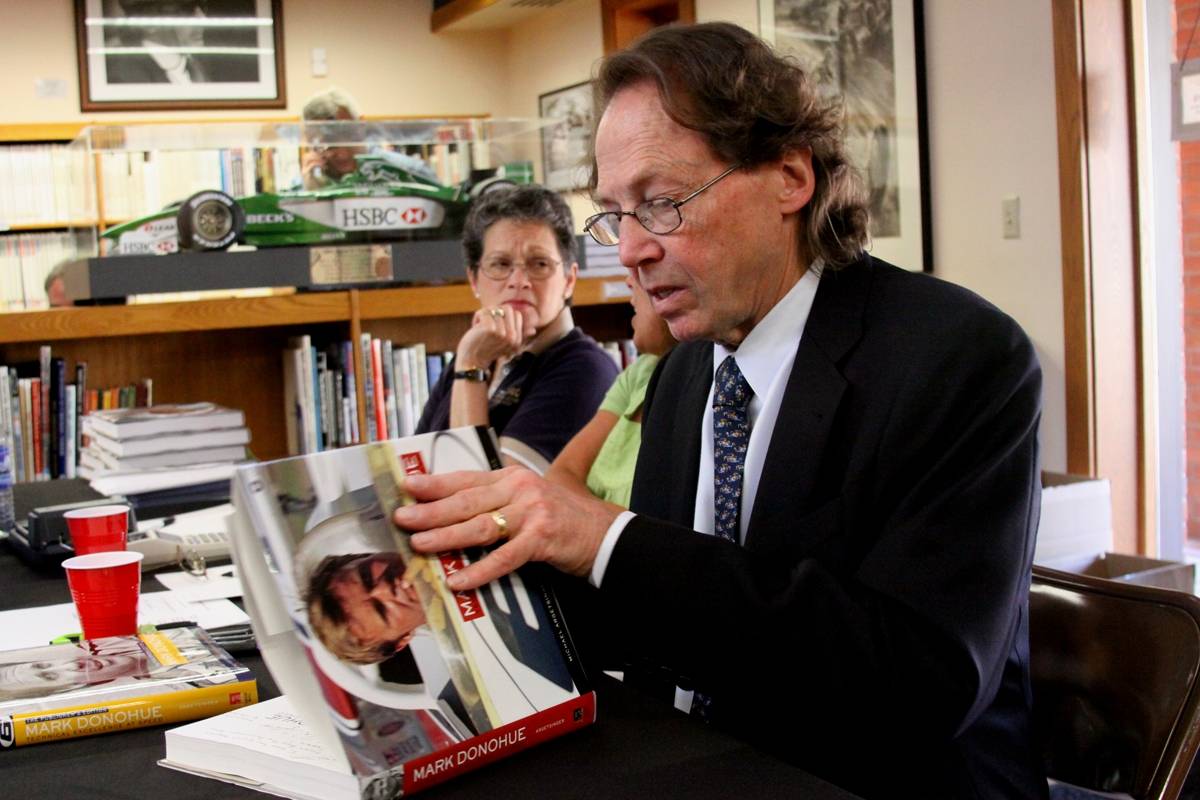 The symposium is named in honor of Michael R. Argetsinger (1944-2015), an award-winning motorsports author and longtime member of the Center's Governing Council. Michael's work on motorsports includes:
- Walt Hansgen: His Life and the History of Post-war American Road Racing (2006)
- Mark Donohue: Technical Excellence at Speed (2009)
- Formula One at Watkins Glen: 20 Years of the United States Grand Prix, 1961-1980 (2011)
- An American Racer: Bobby Marshman and the Indianapolis 500 (2019)
Consider becoming a Patreon VIP and get behind the scenes content and schwag from the Motoring Podcast Network
Do you like what you've seen, heard and read? - Don't forget, GTM is fueled by volunteers and remains a no-annual-fee organization, but we still need help to pay to keep the lights on... For as little as $2.50/month you can help us keep the momentum going so we can continue to record, write, edit and broadcast your favorite content. Support GTM today! or make a One Time Donation.
The United States entered 1965 trailing the Soviet Union in the space race. Russia had already claimed firsts with Yuri Gagarin’s orbital flight and Valentina Tereshkova’s groundbreaking mission as the first woman in space. America’s response came through Project Gemini, a program that tested the endurance, engineering, and improvisation needed to reach the Moon.
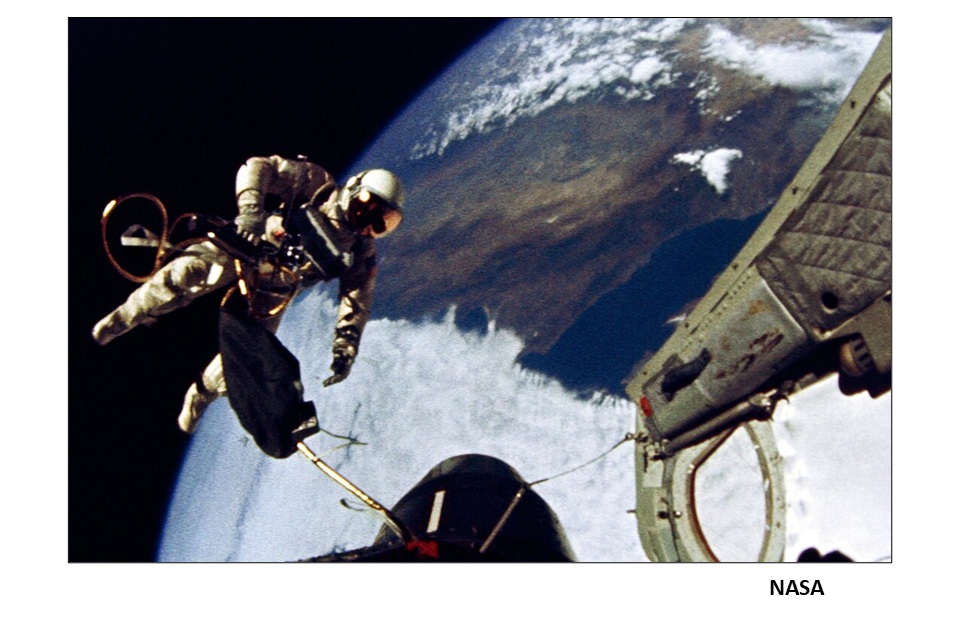
- Ed White’s EVA (spacewalk) became a cultural symbol, his tethered silhouette against the void embodying both vulnerability and triumph.
- Gemini 5 and Gemini 7 pushed flight duration records, proving astronauts could survive long enough for lunar missions.
- Rendezvous maneuvers between Gemini spacecraft demonstrated precision at 17,500 mph – an achievement as daring as any motorsport duel.
Astronauts themselves often drew parallels between rockets and race cars. Gordon Cooper compared the Titan II launch vehicle to a Corvette Stingray, underscoring how speed and control defined both frontiers.
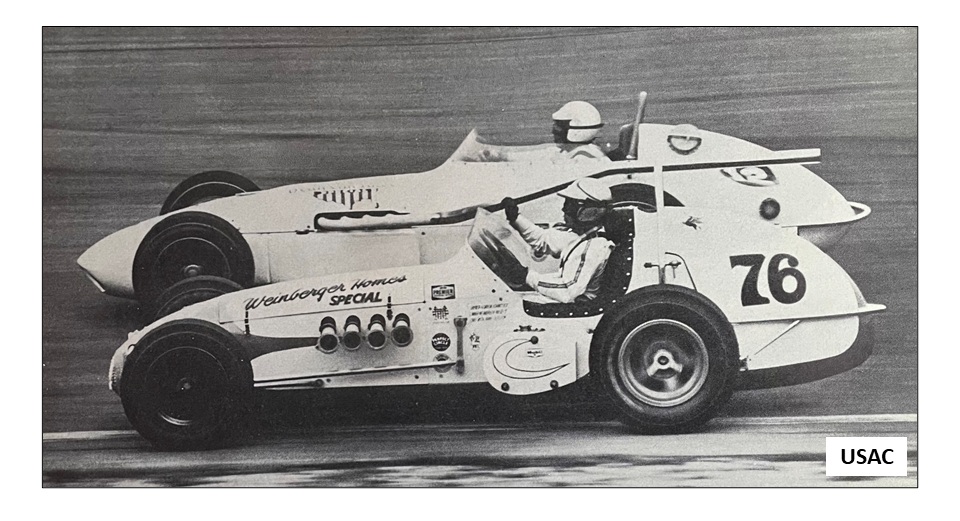
Motorsports in 1965 mirrored the pressures of space exploration. NASCAR, Formula One, and endurance racing all faced technological upheaval and cultural shifts.
- NASCAR’s Engine Wars: Chrysler’s 426 Hemi dominated early, only to be banned by Bill France, sparking boycotts and reshaping competition. Richard Petty’s detour into drag racing highlighted both the risks and resilience of the sport.
- Indy 500 Revolution: Jim Clark’s victory in the Lotus 38 marked the end of front-engine dominance and the dawn of rear-engine supremacy. The Wood Brothers’ famed pit crew added efficiency and spectacle, though history suggests their role was more symbolic than decisive.
- Ford vs. Ferrari: Carroll Shelby’s stewardship of the GT40 program transformed Ford from pretender to contender, with Daytona and Le Mans victories laying the groundwork for endurance racing glory.
Meanwhile, Bonneville Salt Flats became the proving ground for speed itself. Bob Summers’ Goldenrod shattered land speed records with four Chrysler Hemis, while Craig Breedlove and Art Arfons pushed jet cars past 600 mph, earning Breedlove the moniker “Astronaut on Wheels.”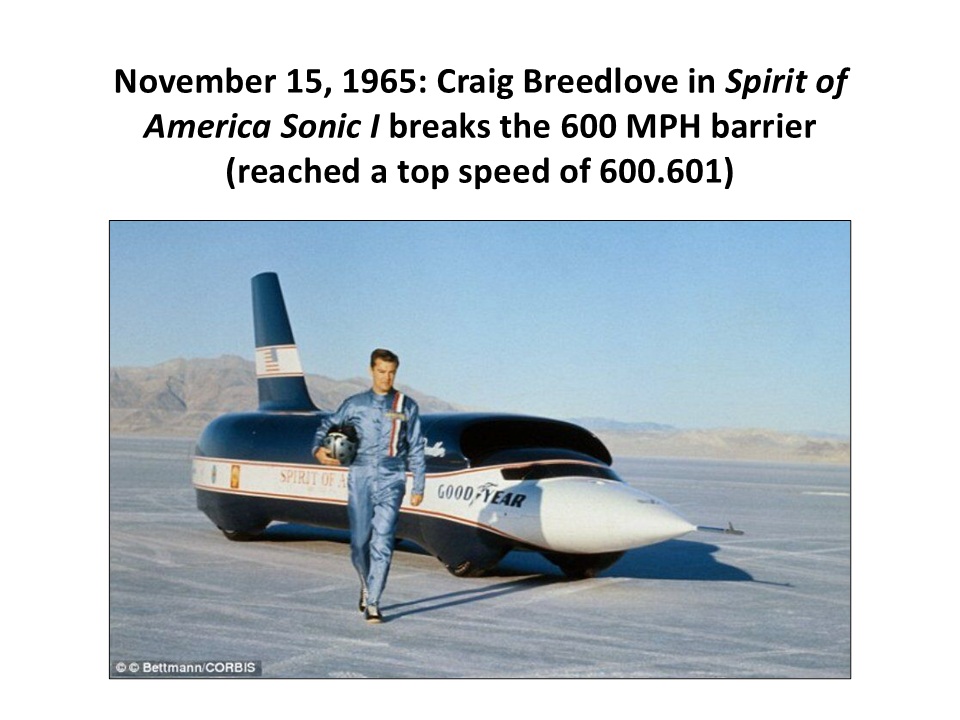
The year also introduced names that would define motorsport for decades:
- Mario Andretti, Rookie of the Year at Indy, claimed the USAC National Championship.
- Jackie Stewart debuted in Formula One, quickly proving himself among the elite.
- Jim Clark, already a champion, achieved an unmatched season—winning the Indy 500, the F1 World Championship, and multiple Formula Two titles. His modesty and mastery cemented him as one of the greatest drivers in history.
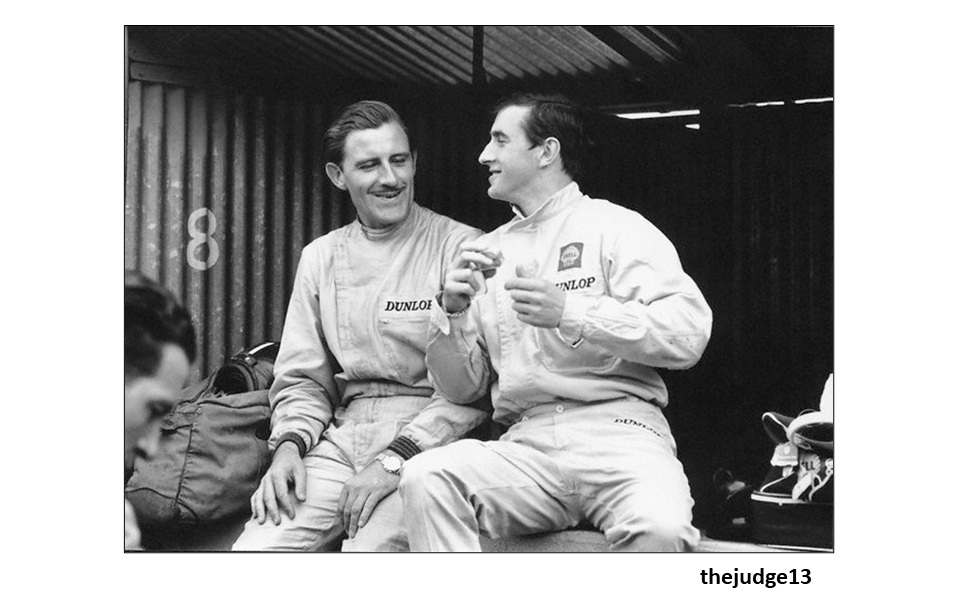
Dr. Howell emphasizes that 1965’s significance lies not only in its achievements but in how societies remember them. The year’s stories—of innovation, competition, and national ambition – continue to shape our understanding of technology and culture.
Motorsports and space exploration may seem like separate pursuits, but in 1965 they shared a common ethos: pushing boundaries, embracing risk, and redefining human capability. Whether on the track or among the stars, the spirit of that year reminds us that innovation knows no limits.
1965 was not just a year—it was a turning point. Engines roared, rockets soared, and humanity learned to dream bigger than ever before.
Other episodes you might enjoy
If you enjoyed this History of Motorsports Series episode, please go to Apple Podcasts and leave us a review. That would help us beat the algorithms and help spread motorsports enthusiasm to others.Remember to subscribe to Break/Fix using your favorite Podcast App.
Support our Creators!
 For as little as $2.50 cents a month, you can get access to more behind the scenes action, additional Pit Stop mini-sodes and other VIP goodies, as well as keeping our team of creators fed on their strict diet of Fig Newton's, Gummy Bears, and Monster. Consider signing up for Patreon today. And remember, without *YOU*, none of this would be possible!
This content has been brought to you in-part by support through...