

The future of automotive history isn’t just about preserving old photographs, rare documents, and iconic race cars — it’s about transforming how we discover them. In a recent episode of Break/Fix’s History of Motorsports Series, Arthur Carlson, Director of Archives and Research Operations at the Revs Institute in Naples, Florida, revealed how cutting‑edge technology is reshaping the world of automotive scholarship.



From AI‑powered metadata to hurricane‑proof archival vaults, Carlson’s team is building one of the most ambitious automotive research ecosystems in the world.
Bio
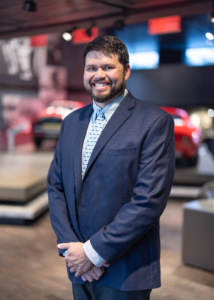
Arthur Carlson is the Director of Archives and Research Center Operations at Revs Institute, in Naples, Florida. He is committed to utilizing emerging technologies to enhance access and discovery of archival resources. He recently presented on digital archival repositories at the 2024 International Dickens Symposium in Birmingham, UK.
Synopsis
This episode of The Logbook, our History of Motorsports Series features Arthur Carlson, Director of Archives and Research Operations at the Revs Institute, outlining a major expansion in automotive archival preservation and access. He describes Revs’ new, highly secure Archives and Research Center in Naples, Florida; the scale of its holdings (including the Revs Digital Library’s ~724,000 photos, plus extensive books, periodicals, film, audio, art, and automobilia); and plans for a high-end digitization lab and modular researcher workspace. Carlson explains partnerships using AI and machine learning for car and facial recognition to generate richer metadata across hundreds of thousands of images, plus an oral history initiative with the University of Kentucky leveraging transcription, translation, and linked data. He also details renewed digitization uploads, new acquisitions, returning internships, and a proposed consortium (“G.A.R.A.G.E.”) to create shared discovery and digitization standards across institutions.
Follow along using the Slide Deck from this PresentationTranscript
Crew Chief Brad: [00:00:00] Break Fix’s History of Motorsports Series is brought to you in part by the International Motor Racing Research Center, as well as the Society of Automotive Historians, the Watkins Glen Area Chamber of Commerce, and the Arge Singer family.
Crew Chief Eric: On today’s episode of The Logbook, our History of Motorsports series, we’re diving into the future of automotive history and the man leading one of the most ambitious archival transformations in the field. Arthur Carlson, director of Archives and Research operations at the renowned Revs Institute in Naples, Florida joins us to share how innovation is reshaping the way we preserve and explore the story of the automobile.
Arthur will take us behind the scenes of Revs new archives and research center and reveal how emerging technologies from artificial intelligence to machine learning are unlocking richer metadata, smarter discovery tools, and more meaningful access to the culture and history of cars and motor sports.
With a career rooted in expanding access to archival resources [00:01:00] and fresh off, presenting his work on digital repositories at the International Dickens Symposium in Birmingham, England. Arthur brings a unique perspective on how the past and future meets in the stacks. So buckle up. We’re about to explore how cutting edge tech is driving innovation in automotive archives.
Arthur Carlson: Good morning everybody. Thank you for, uh, having me here today. My name is Arthur Carlson and I oversee the operations of the new Archives and Research Center at Revs Institute. So I’m here to share some of the exciting news, talk about what the center represents and the opportunities we hope it can provide for those here in attendance joining us online.
And anyone else that may be interested in furthering the field of scholarship in his historic and significant automobiles. So I guess to really back up and understand momentous achievement, let’s start talking initially about the library program at Revs, which many of you are likely familiar with owing to our Revs digital library, which has approximately 724,000 photographs online.
So originally the library room started as a, a supporting [00:02:00] element of the Miles Collier automobile collection. So most of the material was related to supporting the maintenance care and curation of the collection, or understanding the historical significance of the automobiles that he had collected.
Eventually as they added other things like the Briggs Cunningham archives, the archival collections of several photographers, and then other printed material, including now more than 28,000 Monographic books and over 100,000 magazines and journals. We have created what we think is one of the most extensive research resources for this field.
We’ve also added art and automobilia and film and audio. Eventually we filled our space and as demand for other offerings, including the new gallery that Lauren will be overseeing at Res Institute. They kicked us out, so they took me and all the archivists and they packed us up and they shipped us 20 miles north of Fort Myers.
And they stuck us in the archives and research center. So it’s actually a, a brand new facility and two facilities technically, because it is actually a building inside of another building. So we built a archival storage [00:03:00] facility to Amazon data center specifications. So it’s got zero vertical penetrations, a full Siemens latex.
It is category five, hurricane rated. It’s a fluoro K fire suppression system, which is a state-of-art fire suppression system, and we were so happy with that. We just slapped another building over the top of that, built to the same specifications. So it is probably the most environmentally secure building in southwest Florida because our major threat is sea level rise and water.
Uh, we tower above the local population at approximately 30 feet above sea level. So, uh, we, we, we will be the last place to flood. So when the hurricane, the next hurricane hit. Uh, you can see where I’ll be hanging out with, with the dogs. So it’s a full compact storage system, 14 feet high in both the standard stacks and the cold storage room, which is where we’ll keep nitrate film and other materials.
That are at risk for vinegar syndrome and things like that, we’re gonna implement a full digitization lab that can support up to FAUJI four standards. So for those of you familiar with sort of digitization standards, that is essentially the highest level of [00:04:00] professional digitization. So it would allow our materials and resources to be utilized in any sort of new media.
Virtual augmented reality purposes, 4K, eight k, high, definite, whatever you want. So we’re really looking at that, trying to be conscious of future planning for our presentations and things like that. Creating a visiting researcher area, we’re about 25 minutes from RSW, which is the region’s largest airport.
Between Miami and Orlando. So convenient for those of you coming down. Now we understand the expectation of 21st century researcher behavior is initially digital born. So that is actually what we’re working to do, is that we’re working to create access pathways so that we can really open up to a global audience.
So we’ll talk a little bit more about that. And also, if you’ll notice, the bottom shot there is actually our, our workspace. So it’s a fully modular workspace. Every single thing in that room can be moved, customized, put together, spread apart, broken together. So it allows us to handle a variety of things, oversized materials, print art.
As a matter of fact, Lauren has commandeered a few of our tables. She’s got the, uh, print of noted photographer and [00:05:00] fine arts, Jesse Alexander spread out all over the place. So that’ll be a exhibit debuting in 2026. So we’re very excited for those opportunities it represents, but it, it, it is a really wonderful space.
So, uh, we encourage you, if, if you’re ever down southwest Florida, please reach out. Come down, visit us or check us out online. One of the exciting things that we talk about the center representing is it really is a foundational platform in which we can scaffold up our resources. One of the ones that we’re most excited about is our AI and machine learning metadata generation tool.
So we partnered with the consortium of Metro ai, which is a service of the New York Public Library. And what we are doing is we’re implementing a car recognition model, facial recognition model that uses insight face, which is the same technology that powers Apple iOS sort of face unlocked. So how the system works, so if we start with the machine learning for the cars, is that essentially we take cars, we upload them with our known metadata, and then we create clusters around them.
So for instance, we’ll use the example of Porsche, so we can upload Porsches and then we [00:06:00] can upload every single model they make. And then we can make a giant cluster that’s Porsche, and then we can take the individual models, 9 11, 9 17, 5 fifties, whatever we want. We can make those individual models and we can make them to that, and then we can do ’em through generations.
Phase one, phase two specific races. You can make the clusters as broad or as tightly granular as you want. Once you do that, we feed them into our machine learning system, which goes and it begins to identify those clusters and create relational patterns through the metadata. So if it recognizes that every car in the cluster, a Porsche, it starts to create these relational polygons.
So it creates polygons that overlays over the images to create scaled relationships. What’s the measure of the tire? What’s the angles of the headlights? What’s the angles of the cars and things like that. So it’s a pretty interesting thing. And then what it does is it generates a confidence score that these are the images based on similar relational polygons.
So we’re using four different AI models. We’re actually using three. One we run in a grayscale and a monochrome ’cause we’ve actually found that the machine learning gets tricked by certain [00:07:00] things. The association with red and the marked Ferrari is so strong that any red car gets tagged as a Ferrari. So there, there are little quirks.
So that’s why we ran the grayscale programs to see if by eliminating that RGB element, could we kind of reduce that bias in the AI and machine learning tool. So it’s a pretty interesting thing to understand. The other thing that we’re finding is that we have a limited sample source. So as we know with automobile photography and advertising, they take it from what, three angles.
You see the front, you might see the side, you may see the back, depending, right? Same thing with motorsport. The photographers stand in certain areas of the track. The cars are depicted from the same angles, and of course it’s motor sports. The cars tend to be heavily modified, so they, they kind of make bad samples.
But as I mentioned earlier, as I keep stressing, we use relational polygons. Relational polygons scale. We happen to have over a hundred thousand scale model cars. So one of the interesting things that we’re now doing is we’re starting to 3D image, all of our scale model cars. To [00:08:00] use them as a controlled variable group to better train the AI machine learning element.
What we will do is once the machine learning reaches a confident score of 90% on images, we deploy it to retroactively apply enhanced metadata to the more than 725,000 images we have on our public display and the 1.6 million awaiting full scale digitization. So what that will do is enhance access and discovery, and increase use of our materials and create a better resource.
For our entire industry and field, similar to the car recognition model, we’re actually employing the, uh, same technology that I mentioned, apple uses to better recognize faces, humans, characters, and things like that depicted in the images. Sharing the example last night that we have an image in our collection and it says Laguna Seka.
All
Don Capps: right,
Arthur Carlson: cool. Says Laguna. It’s got a year. It’s not a car in the, it’s picture. Paul Newman, you know, but nowhere does his name. Nowhere does that metadata index. So unless you stumbled across that picture of Paul Newman, you’d never find it. But the AI found [00:09:00] it for me because we ran Paul Newman’s face through the insight thing.
I sent it into the sample store and I said, find me anyone that looks like him. And it brought back a lot. So this is actually actually an example of how it works. So it overlays a box over the search. So that’s when we did a Ricardo Rodriguez. I said, find me everything you can of him. And you’ll see over on the right hand side that this is actually, I, I cropped out a little bit of it.
You actually notice it’s got two relevance confidence scores. The top one is the face thinks with about approximately 85% confident score that that image is Ricardo Rodriguez. You’ll notice the relevant score that’s related to other metadata. The relevant score is lower than the confidence score because we had a lack of relevant metadata.
So because we didn’t apply a lot of metadata to the field, it can’t ascertain it if that’s actually him. Funny enough, that things so good, it picks up his brother Pedro. Sometimes we’re actually farther ahead with training the image learning model. Then the car recognition model, mostly owing to the limitations I mentioned, plus it, it’s a sample size issue, [00:10:00] is that, you know, if you think of every car made, every car that’s raced over the last 140 years, it, it’s really just a scale issue.
So what we’re finding is that reducing the sample size, limiting the scope of the project is achieving deeper results. So we look forward to working more with that. One of our other things that we’re working on is an oral history program. So we’ve partnered with the non-oral history center at the University of Kentucky, this nation’s premier oral history academic outfit.
And what we’re doing with them is we’re employing two new technologies they created. Aviary and Whisper. Those are both AI related tools that enhance access through live language translation, full text, transcription, and linked data. The live language translation is pretty interesting. What it can do is take the interviews that are recorded in the interviewee’s native language.
In our case, primarily English, but it can convert it to most of the major languages supported by Google AI’s translation app. So it makes it rarely accessible. The other thing it does is it runs a full scale transcription. That is [00:11:00] timestamped and that it also creates, if it identifies a link data agent.
So link data is a concept that really is championed by the Library of Congress. And it’s this idea that certain elements and fields have a controlled vocabulary list, controlled elements. If we can add those controlled elements in, it can talk to other organizations, institutions, or records within our own collections that have that same agent or name authority and tie them together.
So for instance, this is actually, um, ours are uploaded jets. So this is one that I stole from the University of Kentucky. That’s Steve Za talking about bourbon. Interestingly enough. But in using that example, so when he mentions like bourbon and you stop the transcription, you pause the tape and you pull up the text, anything that has a link data will be hyperlinked.
So then you can click on that and it’ll basically tie to all of our other resources. So if you’re doing something with Ricardo Rodriguez and you click on that history where somebody talks about. His death, it’ll pull up anything related to that element. It’ll pull up his biography, it’ll pull up news stories, it’ll pull up images, it’ll pull up anything we have, not only in our [00:12:00] collections, but anybody tied to our discovery system.
So what we hope to do with the, uh, oral history collection is to really go out over the next year and to kind of try to identify folks, partners that can help us identify, as we were mentioned, that tacit knowledge, that at risk data, that at risk material. Yesterday, uh, they let me ride around Bill Green, which was so interesting and we, we were stopping just, you know, all through the old road course pathway and he was just saying things like, oh, you see that green ball up in the tree there?
You know, in 19, and it’s just, who else but him is really gonna know that? Who else but him is gonna understand that, that knowledge up things, those things that really talk about the history, the culture of those strong experiences that tie us together. What we hope to do by announcing basically the program here at this to this audience today, is to have each of you kind of engage, help send in suggestions, and please understand that it is not simply about most important or well-recognized names.
It’s at risk knowledge, so particularly people that represent regional events, local shows, local [00:13:00] races, even failed attempts at implementing car culture, supporting it. So please reach out, share your things, and these can be as formal as academic soft conversations. We really just want to create a resource.
That shares and preserves that knowledge. So I hope that you all can help us with that. Finally, talking about some other, uh, exciting things. We’re actually resuming our digitization program. Some of you that are frequent users are RDL and probably noticed that sometime during the, the pandemic that we kind of stopped uploading new images.
So we’re actually reviving that. So we just sent out the Andre Von Beaver Collection, who is the noted Belgian photographer to have over a hundred thousand new images coming online. Soon. Following that we’ll send out Jesse Alexander and some of the other collections and things like that. So we’re very excited about that.
Begun the migration to integrated online collection guides. So for those of you that have been using some of our archival collections, those old PDFs, I got rid of ’em all. So now we have archive space implemented online collection guides. So what you would normally find at a traditional academic institution, that same resource, that same [00:14:00] value, and again, opening up to the public.
That is the great thing, is we’re trying to remove any barriers to access to use our materials that we can identify. And eliminate. Another thing is we just required a couple of new collections, so we’re working to get those online. The most recent collection that we obtained was the Stru McMinn collection, so we picked that up at auction.
Stru McMinn is widely regarded as the most influential and important American automotive designer. It’s a really interesting collection as we’ve kind of gone through it. There’s concept cars, there’s correspondence, and more than anything it reveals the vast alumni network of his students that have become major executives, major influencers and entrepreneurs in the field of automotives.
So it, it’s a pretty interesting collection. As I mentioned, the Jesse Alexander collection, fine art print will go on display. We’ll also add the other collections up to our materials as well. Jack Bullard, which is a really interesting collection for more than 40 years, Jack Bullard responded to car accidents.
He was a a tow truck operator, so it’s a really interesting thing. We think material scientists, [00:15:00] vehicle safety studies, really just trying to open up new and exciting things. We’re actually expanding our, uh, digital library. So right now the Revs digital library is primarily photographs, so we’re looking to add manuscript collections, digitized material that has out of copyright.
So some of those early journals, some of those things like that. Like I said, just trying to enhance access to our resources. And then finally, and this is probably most exciting, we’re actually working to create a, basically a consortium of anyone that is interested in kind of helping create standards of discovery, standards of digitization.
Link data resources and things like that, so that’s very exciting. The articles incorporation were just drawn up by our lawyer, so it’ll actually be a 5 0 1 C six incorporated in the state of Florida, which is essentially a chamber of commerce. What we hope to do is create a shared discovery catalog and a shared digital repository.
So the idea being that each individual institution that joins the consortium. Can keep their individual identities, can keep all their processes, but upload their materials into a shared discovery layer. As we mentioned earlier, the [00:16:00] 21st century researcher behavior does not want to go to 30 places to look for information.
They wanna go to one source. It’s the ification of American Discovery. All right? It’s that one source concept, and it’s something that you find increasing in academia. It’s one source, wonderful. You know, even if you look at, you know, databases now, databases don’t get searched individually. They get searched through crawlers.
We really want to implement that same idea, is that if you can go to a consortium website, that you can search the collections of every one of our members. So we hope for those of you that might be interested right now, there’s no obligations, expressions of interest. We’ve got about 25 organizations across the United States and two now in Western Europe, which is really exciting.
That are interested in following along, you know, if that’s something that you or your organization might be interested in, at least following along with, please see me or Lauren and we’ll make sure we get added to the listserv. So it’s really exciting. As I mentioned, we’re incorporating the state of Florida as the group for archival research and global exchange.
Which spells out garage. I thought of that all myself. So you’re, you’re welcome [00:17:00] for my contributions to automotive history already. So that’s a really exciting thing, but that’s something that we really want to talk to folks about and to really share and, and, and elevate the field so that, that’s something I think that’s really exciting and something that I hope that we can work with each of you.
And as I mentioned, this is something that we see as building a resource so it’s something open to conversation. In no way do I want to drive what happens with this thing. What I really want to do is understand what are the research needs of our audience? What are the research needs? You know, what can we do to expand our offerings?
You know, so many of you here have already said. What can we do to increase support for scholarship in this field? And so I thought this would be the perfect opportunity to sort of soft launch that program. I’m really excited to talk about that, to share that, to build networked interest and things like that.
So very, very exciting stuff. As I mentioned, I, I thought that this would be more opportunities for free exchange, so I left a little extra time for q and a because I’m sure you have a lot of questions and I thought that seeing as we couldn’t give a live demo, that I might have the opportunity to explain in more [00:18:00] detail for any questions that you might have.
Yeah. Thank you so much.
Lauren Goodman: Yes. Thank you everybody. Thank you. What, what I’m really hearing is that you’re making my life easier. That’s what I’m hearing and that’s what I, I’m looking forward to.
Arthur Carlson: That’s exactly what we’re here to do. I am not an expert in this field, but if I understand what is the information needs that the field requires, we can build those systems in conjunction with our partners, collaborators, friends and and supporters across the world.
Lauren Goodman: So I think now we’re open up for, um, a q and a.
Audience Q&A: If, uh, someone has historical documents to, uh, you know, donate, how would you decide where to send it? You have the A a CA, the SAH, and the Res Institute. Are you looking for specific types of documents?
Arthur Carlson: I think a lot of that depends on the donor and a lot of cases, donors really have a, a wish.
You know, there’s usually a place that either is their home track, their home region, maybe a, an association that they have a stronger affiliation with than others. You know, they may have a natural place in [00:19:00] mind. Now, what we aim to do with that consortium is to make sure that if you come to any one of us.
That we understand what are the collecting specialties? What are sort of the talent support of each of the organizations in our field to help donors find the best home. We don’t view this as a competition amongst organizations in any way. What we see this as, as a way to really build in that collegiality.
That you see in like academic consortiums, academic conferences and things like that, where they help you understand, this is super great, this definitely needs to preserve, but hey, maybe you should go see my friend Joe at Watkins Glen, because they have all the SECA stuff and this is more closely aligned with that.
And, and it really, it depends on the capacity, you know, if they’re out of room, what, what do we find? So I think it’s, it’s really just trying to foster better communication amongst our institutions and organizations. And then the other advantage I see, and, and this is probably leaning a little over my.
Skis is one of the reasons that they plucked me down to Revs is I used to sit on the Eastern Academic Scholars Trust Consortium that is a, um, an organization of academic institutions from the University of Maine down to the University of Florida and all up and [00:20:00] down the Mid-Atlantic. And what it was, was they were the first ones to get into the idea of special collections and archival research sharing.
So how can you share these things that traditionally have been so guarded and so maintained that you had to ask permission, then get access to look at ’em, and then while you’re looking at ’em, somebody was looking at you, looking at ’em. So really how can we dispel those barriers and create, like I said, better agreement, better thing.
But that’s a great question and one that I’m glad that somebody asked because I think that’s an important point to make is that it’s all about building collaboration.
Paul Baxa: Thank you for, for that. Um, I’m very fortunate that I live close to the Revs and I’ve used it many times and it’s been really important to.
So just a couple of very quick questions. Number one, are you now open for research? Is the facility open?
Arthur Carlson: Yes. So we are by appointment only, but if you wanna reach out to, as I mentioned, library@reinstitute.org, we can support research and things like that. We moved during three weeks in the middle of hurricane season in Florida and didn’t get rained on once.
We were just smart and avoided the daily 2:33 PM 15 minute, yeah. Deluge.
Paul Baxa: And so [00:21:00] secondly, uh, my institution, we used to have, uh, interns working there before the pandemic. Yeah. So are you gonna start that up again, or,
Arthur Carlson: I’m glad that you asked that as well. So, uh, one of the main tasks I was engaged with by Mr.
Collier was re-engaging the academy. So I’ve actually been in consultation with Florida Gulf Coast University in Florida, Southwest College. So we’ll actually have service learning students from Florida Gulf Coast University that’ll begin working with us in the spring. So they’ll be us with about 80 hours each working on basically their pickup projects, Florida Southwest College.
We’re also hoping to implement the same thing. They have a more formal internship program, so I’ll have a few of those interns and excitingly, we’re also hosting a library fellow, so we’ll have one of the, uh, archivists in training from Florida Southwest College that’ll be embedded with us for 20 hours a week for about eight weeks to kind of help learn digital preservation and things like that.
At my prior institutions, I used to host library science information graduate students from the University of Rhode Island, Simmons University, Florida State. We’re actually, uh, in talks with those individuals. We actually have a graduate student for Simmons that’s an intern now. We had a student intern from, um, McPherson [00:22:00] College in Kansas over the summer.
And I’m trying to convince him to move back to Florida when he graduates and work for us. So that’s actually engaging. The academy is actually one of the, literally it says that on Mr. Collier’s vision board. That is something that we are, um, tasked with doing specifically,
Lauren Goodman: I think, I think Paul wants to know if his people at Alpha Maria could come down Yes.
And maybe do a little.
Arthur Carlson: Absolutely, we’d love to have ’em. Our founder sees it as important that re institute is not something that supports just the automotive community, but raises educational opportunities for Southwest Florida.
Paul Baxa: And one last question. Uh, are you gonna open the full Joel Finn archive? I know you have a lot
Arthur Carlson: that’s actually on the list for 26 processing.
So I mentioned we have a graduate student from Simmons University, which is a major library and information science. School in Boston, so we’re actually moving her to full time as soon as she gets done on the Pete Biro collection. Joel Fins up next.
Don Capps: Alright, Arthur, I’m probably one of the few people who actually understood what you talked about.
I’m a models and simulation person. That’s been my background story of technology. I’m really excited about this. I think a lot of people here, this is [00:23:00] quite right over their heads, but this is where those who behind us, those old folks. This is what’s gonna make what we have strived for. I know Mark and I can go around the room.
Paul, all of us who’ve been laboring in the vineyards to make motor sports history relevant, this colostrum, which will I think it developed. Allison’s another one I’m looking at. This is called open doors. I really think so. God. George said something to me years and years ago that he had all kinds of plans and got, you know, things going on.
And I’ve talked with a number of people that I love revs just like I like the research center, but this is a step forward. And anything that I think those of us in the room can do something to support, think we’re on board.
Arthur Carlson: That that’s, that’s exactly what we hope to hear. As everyone has made a point, this has not been a traditional academic field, so it’s been one that’s been [00:24:00] cared for by fans, collectors, enthusiasts, hobbyists, people that have a real love for it.
And that’s probably what I’ve noticed more than anything making the transition from academia over into this field is the enthusiasm I feel. Just how. Sighted. Everyone gets about this stuff and you know, and I think that that’s that passion. If we can harness that passion and really just implement these tools and resources that already exist in other fields and put them onto ours, you know, I think we can just open up so many opportunities to really elevate everything.
Kip Zeiter: Lauren Arthur, thank you very much. Even though the, uh, the research center in Revs is separated physically by, I don’t know, 12, 1500 miles, I’ve always thought we had a bit of a spiritual connection with you folks, and I think with Margaret’s recent visit down there, I’m hoping it becomes more than that, but you folks are at the forefront of all of this, and as you can tell, we’re all very excited about it.
So thank you very much for coming up here and doing the presentation. We appreciate
Arthur Carlson: it. Thank you so much. We really appreciate it.[00:25:00]
IMRRC/SAH PROMO: This episode is brought to you in part by the International Motor Racing Research Center. Its charter is to collect, share, and preserve the history of motor sports spanning continents, eras, and race series. The Center’s collection embodies the speed, drama and camaraderie of amateur and professional motor racing throughout the world.
The Center welcomes serious researchers and casual fans alike to share stories of race drivers race series, and race cars captured on their shelves and walls, and brought to life through a regular calendar of public lectures. And special events. To learn more about the center, visit www.racing archives.org.
This episode is also brought to you by the Society of Automotive Historians. They encourage research into any aspect of automotive history. [00:26:00] The SAH actively supports the compilation and preservation of papers, organizational records. Print ephemera and images to safeguard as well as to broaden and deepen the understanding of motorized wheeled land transportation through the modern age and into the future.
For more information about the SAH, visit www.auto history.org.
Crew Chief Eric: We hope you enjoyed another awesome episode of Break Fix Podcasts, brought to you by Grand Tour Motorsports. If you’d like to be a guest on the show or get involved, be sure to follow us on all social media platforms at Grand Touring Motorsports.
And if you’d like to learn more about the content of this episode, be sure to check out the follow on article@gtmotorsports.org. We remain a commercial free and no annual fees organization through our sponsors, but also through the generous support of our fans, families, [00:27:00] and friends through Patreon. For as little as $2 and 50 cents a month, you can get access to more behind the scenes action, additional pit stop, minisodes and other VIP goodies, as well as keeping our team of creators.
Fed on their strict diet of fig Newton’s, Gumby bears, and monster. So consider signing up for Patreon today at www.patreon.com/gt motorsports. And remember, without you, none of this would be possible.
Highlights
Skip ahead if you must… Here’s the highlights from this episode you might be most interested in and their corresponding time stamps.
- 00:00 Arthur Carlson, Introduction
- 01:43 Revs Library Origins
- 02:49 New Archives Facility
- 04:24 Digitization and Access
- 05:23 AI Car Recognition
- 08:26 Face Recognition Finds
- 10:15 Oral History Initiative
- 13:17 New Collections
- 15:19 “G.A.R.A.G.E.” Consortium Vision
- 18:07 Audience Q&A
- 25:02 Closing Thanks and Sponsors
Livestream
This episode is sponsored in part by: The International Motor Racing Research Center (IMRRC), The Society of Automotive Historians (SAH), The Watkins Glen Area Chamber of Commerce, and the Argetsinger Family – and was recorded in front of a live studio audience.
Learn More
Michael R. Argetsinger Symposium on International Motor Racing History
 The International Motor Racing Research Center (IMRRC), partnering with the Society of Automotive Historians (SAH), presents the annual Michael R. Argetsinger Symposium on International Motor Racing History. The Symposium established itself as a unique and respected scholarly forum and has gained a growing audience of students and enthusiasts. It provides an opportunity for scholars, researchers and writers to present their work related to the history of automotive competition and the cultural impact of motor racing. Papers are presented by faculty members, graduate students and independent researchers.The history of international automotive competition falls within several realms, all of which are welcomed as topics for presentations, including, but not limited to: sports history, cultural studies, public history, political history, the history of technology, sports geography and gender studies, as well as archival studies.
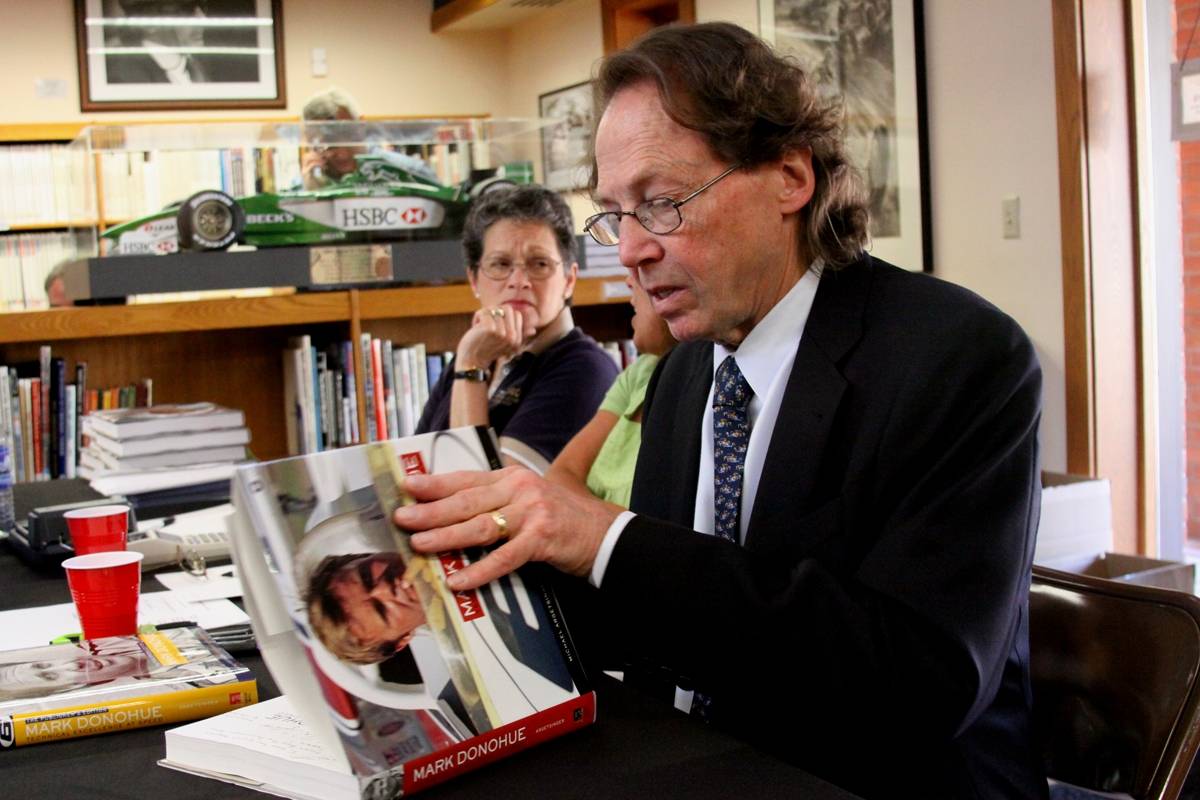 The symposium is named in honor of Michael R. Argetsinger (1944-2015), an award-winning motorsports author and longtime member of the Center's Governing Council. Michael's work on motorsports includes:
- Walt Hansgen: His Life and the History of Post-war American Road Racing (2006)
- Mark Donohue: Technical Excellence at Speed (2009)
- Formula One at Watkins Glen: 20 Years of the United States Grand Prix, 1961-1980 (2011)
- An American Racer: Bobby Marshman and the Indianapolis 500 (2019)
Consider becoming a Patreon VIP and get behind the scenes content and schwag from the Motoring Podcast Network
Do you like what you've seen, heard and read? - Don't forget, GTM is fueled by volunteers and remains a no-annual-fee organization, but we still need help to pay to keep the lights on... For as little as $2.50/month you can help us keep the momentum going so we can continue to record, write, edit and broadcast your favorite content. Support GTM today! or make a One Time Donation.
Revs Institute’s new Archives and Research Center is more than a storage facility — it’s a purpose‑built fortress for automotive culture.
- Constructed to Amazon data‑center specifications
- Category‑5 hurricane‑rated
- Zero vertical penetrations
- Fluoro‑K fire suppression
- 14‑foot‑high compact storage systems
- Dedicated cold‑storage for nitrate film and fragile media
Inside this secure shell sits a fully modular workspace, a visiting researcher area, and a digitization lab capable of FADGI‑4 standards — meaning Revs can produce archival‑quality digital assets suitable for VR, AR, and ultra‑high‑resolution media. “We built a building inside another building,” Carlson joked, emphasizing the center’s environmental resilience.
One of the most groundbreaking initiatives at Revs is its partnership with Metro AI, a service of the New York Public Library. Together, Revs is training AI to identify cars across generations, models, and racing variants using “relational polygons” — geometric overlays that measure angles, proportions, and shapes. This allows the system to:
- Identify cars even when heavily modified
- Distinguish between similar models
- Reduce color‑based bias (e.g., “every red car is a Ferrari”)
- Retroactively tag 725,000+ public images and 1.6 million awaiting digitization
To improve accuracy, Revs is even 3D‑imaging its 100,000+ scale model cars to create controlled training samples.
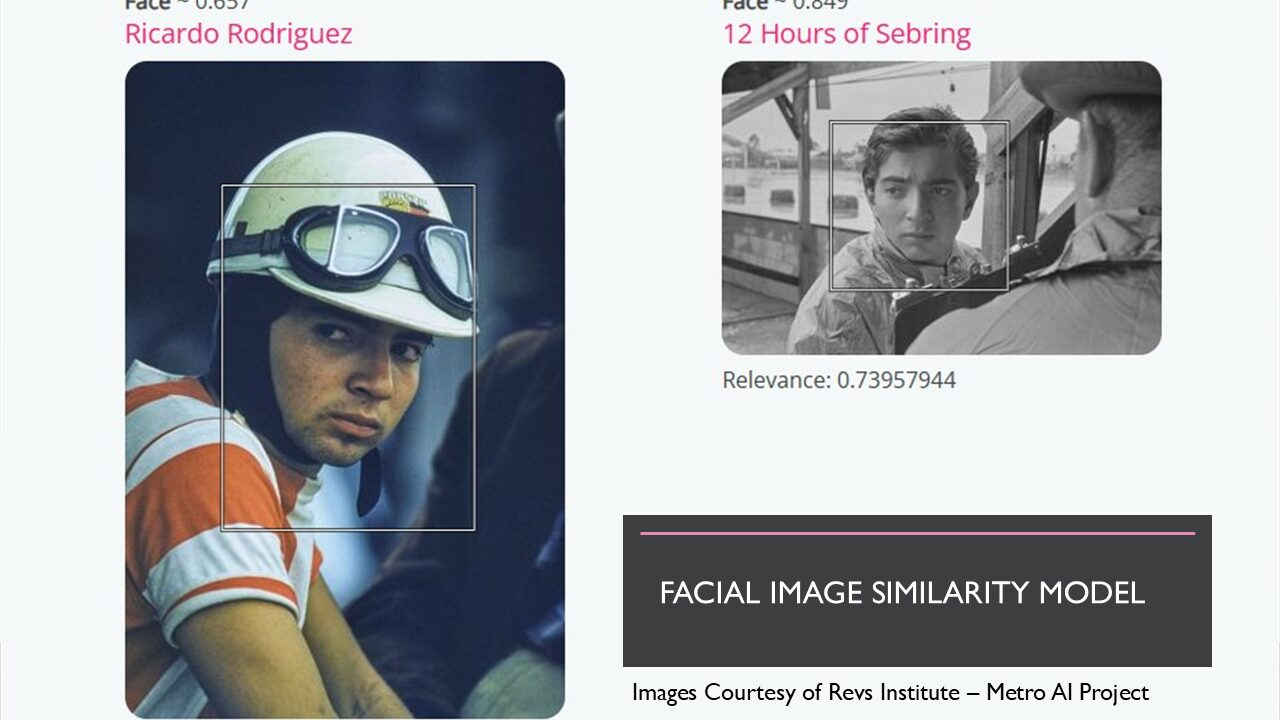
Using the same technology behind Apple’s Face ID, Revs can now identify drivers, crew members, and personalities across its photo archive. Carlson shared a striking example: “A photo labeled only “Laguna Seca” was automatically flagged as containing Paul Newman — a detail missing from the original metadata.”
This opens the door to rediscovering forgotten faces and moments buried in decades of motorsports photography.
Oral Histories: Capturing At‑Risk Knowledge
Revs is also partnering with the Louie B. Nunn Center for Oral History at the University of Kentucky to preserve stories that exist only in memory — the kind of “tacit knowledge” that disappears when a generation of enthusiasts passes on. Using AI tools Aviary and Whisper, Revs can:
- Provide live language translation
- Generate full transcripts
- Link interview content to related archival materials
- Create a web of connected historical data
Carlson emphasized the urgency of capturing local, regional, and personal stories — not just those of famous drivers
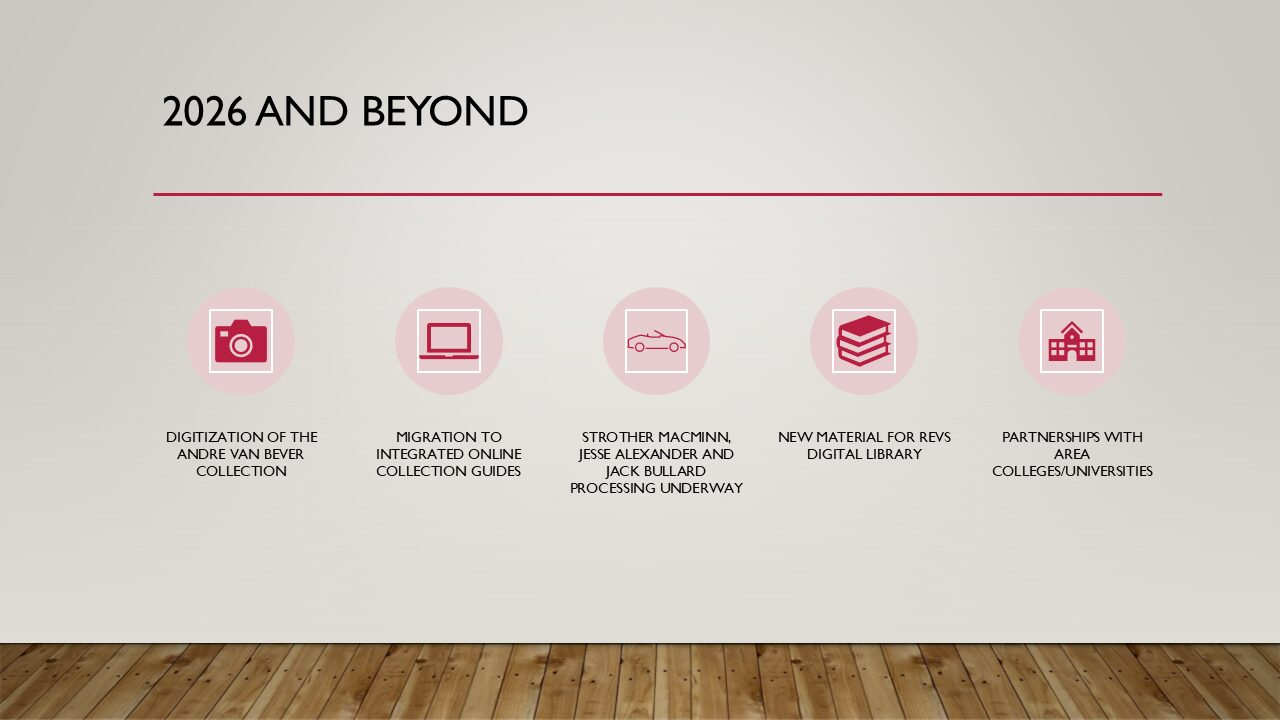
After a pandemic‑era pause, Revs is restarting large‑scale digitization:
- 100,000+ images from Belgian photographer André Van Bever
- Fine‑art prints from Jesse Alexander
- The Stru McMinn Collection (concept cars, correspondence, design archives)
- The Jack Bullard Collection (40 years of accident‑response photography)
They’re also migrating to ArchiveSpace, replacing outdated PDFs with modern, searchable online collection guides. But, perhaps the most ambitious initiative is the creation of a new consortium: Group for Archival Research and Global Exchange — cleverly abbreviated as GARAGE.
This 501(c)(6) organization aims to unite museums, archives, clubs, and institutions into a shared discovery platform. Each member keeps its identity and collections, but researchers gain a single search interface — the “Spotify of automotive archives.”
More than 25 organizations across the U.S. and Europe have already expressed interest. Carlson’s presentation made one thing clear: automotive history is entering a new era.
- AI will uncover forgotten stories
- Digitization will democratize access
- Oral histories will preserve human experience
- Shared discovery will unify a fragmented field
Revs Institute isn’t just preserving automotive history — it’s reinventing how we interact with it.
Other episodes you might enjoy
If you enjoyed this History of Motorsports Series episode, please go to Apple Podcasts and leave us a review. That would help us beat the algorithms and help spread motorsports enthusiasm to others.Remember to subscribe to Break/Fix using your favorite Podcast App.
Support our Creators!
 For as little as $2.50 cents a month, you can get access to more behind the scenes action, additional Pit Stop mini-sodes and other VIP goodies, as well as keeping our team of creators fed on their strict diet of Fig Newton's, Gummy Bears, and Monster. Consider signing up for Patreon today. And remember, without *YOU*, none of this would be possible!
This content has been brought to you in-part by support through...