

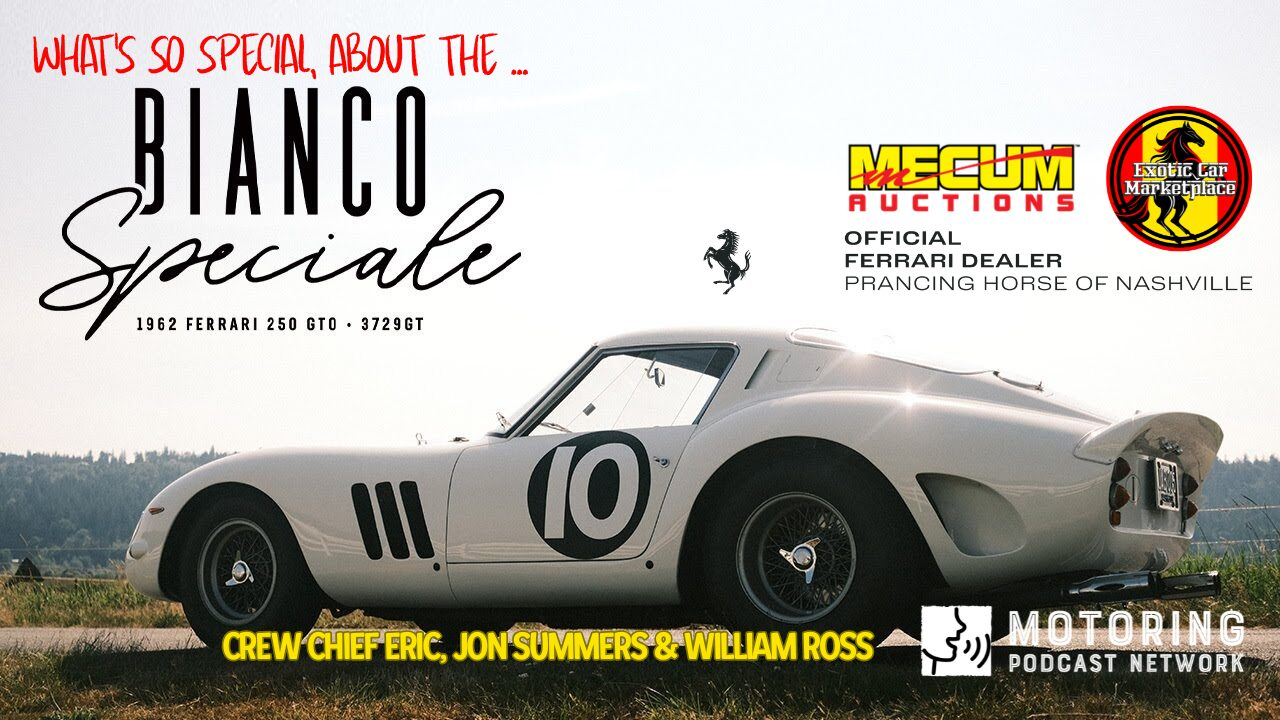
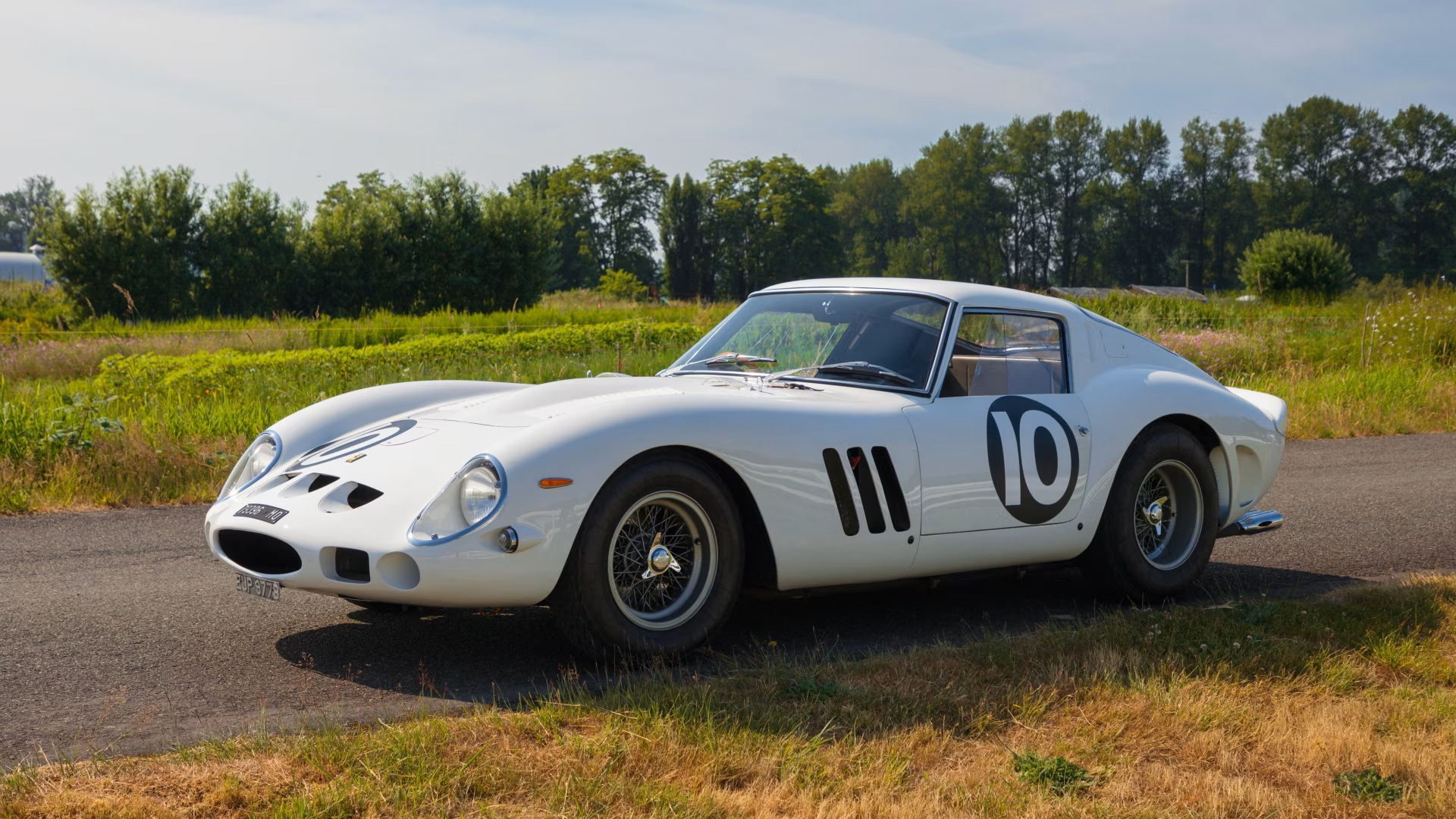
Few cars in the world command the reverence, curiosity, and mythos of the Ferrari 250 GTO. Among the 36 (plus or minus a few) examples built, one stands alone — the Bianco Speciale, chassis 3729 GT — the only factory white GTO ever produced. Its story is not just about rarity; it’s about innovation, rivalry, engineering evolution, and the colorful personalities who shaped motorsport in the 1960s.
During a special live session of Automotive History Live, the Motoring Podcast Network team — Crew Chief Eric, William Ross, and motoring historian Jon Summers — unpacked the full saga of this extraordinary machine. What follows is the distilled narrative of that conversation, tracing the Bianco Speciale from its origins in British club racing to its modern status as one of the most culturally significant Ferraris ever built.



The story begins with British racer and Jaguar dealer John Coombs, a man deeply embedded in post-war motorsport culture. As Jon Summers explained, racing in Britain after WWII offered a familiar sense of adventure and competition: “You built the machine, you put the guy in the machine… sometimes it came back, sometimes it didn’t.”
Coombs was a capable Formula 3 driver, but he found his true calling as a Jaguar dealer and team owner. His cars were famously painted in a distinctive off-white/gray — a livery that stood out among the sea of British Racing Green competitors.
But Coombs had a problem: Jaguars were getting beaten. Badly. And as William put it bluntly: “The Jags were slow, and he was getting beat by Ferraris.” So Coombs did what any competitive racer would do — he ordered the fastest thing available: a Ferrari 250 GTO.
Bio
What’s So Special About the Bianco Speciale brings together insights from across multiple automotive history and marketplace podcasts to tell the full, multidimensional story of one of the most fascinating Ferraris ever built: the lone factory‑white 1962 Ferrari 250 GTO, chassis 3729GT.
Drawing on conversations with auction specialists, historians, and legendary racers, this presentation traces the car’s journey from its origins in the hands of influential British dealer‑tuner John Coombs to its modern status as one of the most coveted automobiles in the world. The narrative explores why Coombs specified the car in right‑hand drive, the racing modifications he commissioned, and how the GTO became intertwined with the culture of 1960s British motorsport. Figures such as Graham Hill, Roy Salvadori, Mike Hawthorn, Jack Sears, and Lofty England appear throughout the story, illustrating the era’s competitive landscape and the personalities who shaped it.
The presentation also incorporates firsthand reflections from David Hobbs, whose early racing career intersected with the same club‑racing world that produced the Bianco Speciale. His anecdotes illuminate the transition from amateur to professional racing and the evolution of race‑car engineering—context that deepens the significance of this particular GTO’s development and use.
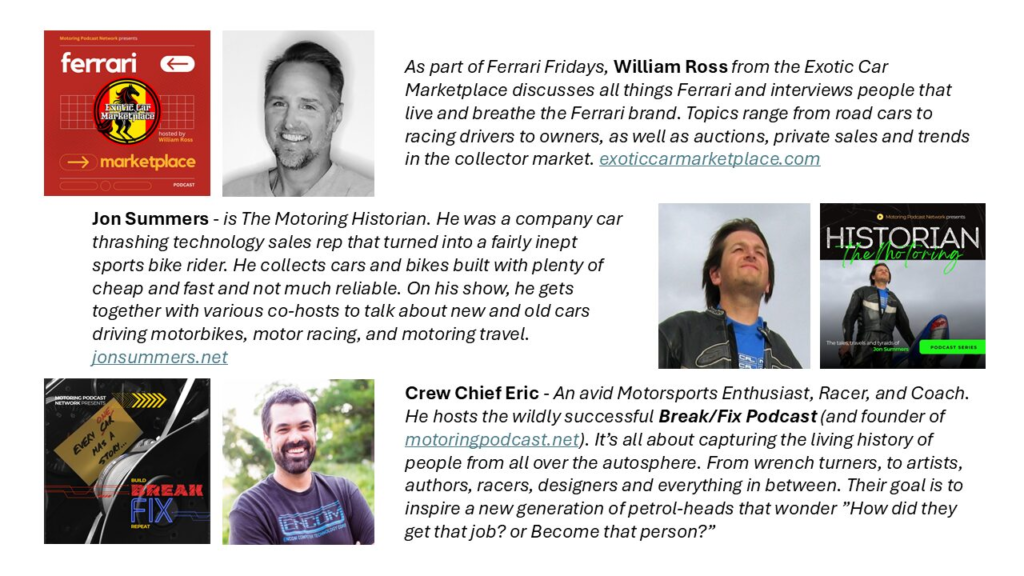
From a modern perspective, the talk examines the car’s meticulously documented provenance, its rarity as one of only eight right‑hand‑drive GTOs, and its singular status as the only example finished in white. Market analysts and auction experts—including voices from Mecum Auctions, Motorcopia, and the Exotic Car Marketplace—provide insight into the car’s escalating valuation, the mindset of today’s high‑net‑worth collectors, and the logistical and historical weight of presenting such a machine at a major auction. Estimates have placed its potential sale price well into record‑setting territory, underscoring its cultural and economic importance.
Together, these perspectives form a comprehensive portrait of why the Bianco Speciale stands apart—not only as a mechanical masterpiece, but as a touchstone in racing history, collector culture, and the evolving narrative of the Ferrari 250 GTO.
Slides
Transcript
Crew Chief Brad: [00:00:00] Welcome to Automotive History Live, where the stories drive us. From the grand lawns of Concours to the icons that shape the road ahead, we celebrate the machines, the makers, and the moments that define automotive history
Matt Anderson: All right, folks. Well, we’ll gather again here to move on to our next presentation. We have a special panel called What’s So Special About the Bianco Specials? It will pr- be presented by Crew Chief Eric, William Ross, and John Summers. And I want to mention, hopefully all of you got a, uh, tire gauge.
Appreciate you bringing those. That’s- More to come … a gesture that does not fall flat, so to speak. They also have swag bag- Yeah, sorry. They also have, uh, swag bags on the way out, too, folks, if you’d like to grab one, filled with some car care products and other goodies as well. Without further ado, Eric, I’ll turn it over to you to, uh, lead the session.
Crew Chief Eric: Thank you, Matt. Folks, we’re gonna have a little fun with this. This is gonna be a live version of one of our Motoring Podcast Network podcast episodes, so we’re gonna put the final [00:01:00] chapter on the Bianco Speciale. So today, we’re diving into the remarkable story of the Bianco Speciale, the only factory white Ferrari 250 GTO ever built, Chassis Number 3729 GT.
Featured across multiple of our MPN shows, we tapped experts, historians, and even legendary racers to help us trace this car’s journey from John Coombs’ right hand drive ’60s British club racer to its modern status in a class containing the most valuable and culturally significant Ferraris in existence.
Its provenance, its drivers, its engineering, and its impact on the collector market all converge in this presentation to show why this singular GTO stands apart from all the others. That said, as Matt introduced us, I’m Crew Chief Eric from the Motoring Podcast Network, and joining me is William Ross from the Exotic Car Marketplace, and John Summers, the motoring historian.
So gentlemen, let’s explore what truly makes the Bianco Speciale special. So William, it’s [00:02:00] not very often that we get called to do a project of this caliber, to a car so special as this, but more importantly, cars of this status do not come into the public eye very often, especially at auction. Can you tell us about how this story kind of fell into our laps?
William Ross: Well, it was a great opportunity for all of us to be involved with Mecum at the get-go when they had the opportunity to auction this car off. Chris Mealy, who is the vice president at Prancing Horse Nashville, was actually driving to the airport after Amelia Island, and he was driving with John Shirley, who was the previous owner of the car, and this gentleman just casually mentions it.
Chris says, “Hey, you know anyone that might want to buy John’s car?” And Chris was rather like, “Oh, that’s kind of a, a significant statement and question to ask.” Their actual first thought was, “Let’s call Dana.” Chris is very good friends with Dana Mecum. I don’t know if you’re aware, you know, Dana’s got an unbelievable collection of cars of all brands, makes, models, everything like that, but he does have some really good Ferraris.
But it wasn’t something that he felt fit in his, and it just wasn’t gonna work, so [00:03:00] after some meetings and that, they felt it was probably best to bring it to Mecum Kissimmee. Due to the fact is the Bachman collection was coming there as well, ’cause Chris was very familiar and friends with the Bachman family themselves.
All their cars got serviced at Prancing Horse Nashville, so it just coincided very well. That seemed to work as the best opportunity then for selling. That got them to Mecum, and that got us involved in regards to promoting and building up the hype for the car and getting eyes on it.
Crew Chief Eric: And I got a quick shout-out to Don at Garage Style for also hooking us up with the Mecum folks as well and getting us involved in this project.
But let’s move on to what makes the Bianco Speciale special. John, you’re our resident Brit, so it’s appropriate that you talk about the original owner of this vehicle, the infamous John Coombs. So let’s talk about the who, the what, the where, and most importantly, the why of this Ferrari. Why this 250 GTO?
Jon Summers: Let’s, uh, let’s sort of position up John Coombs a little bit first of all. In the immediate post-war period, [00:04:00] there was a big motivation in Britain to do some kind of motor racing, because motor racing made people feel a bit like the war. You know, you built the machine, you put the guy in the machine, the machine went off, it did great things.
Sometimes it came back, sometimes it didn’t. There was a sense of adventure. There was a sense of winning and losing. So motor racing took the place, I think, for a lot of people that were involved in the RAF and in preparing tanks and that kind of thing. It sort of took the place of the war. So John Coombs was one of those.
Formula 3 at the time was Fiat 500 engines in the back of, I guess what we’d call, like, go-karts now But fundamentally, Coombs was involved in this, was quite good, was a handy Formula Three racer, but realized he wasn’t gonna be the same, in the same league as somebody like Mike Hawthorn or Stirling Moss.
So he becomes a Jaguar dealer, and he’s a Jaguar dealer in the southeast of England, in a town called Guildford, just near London. Because [00:05:00] he’s involved in selling Jaguars, he races Jaguars, win on Sunday, sell on Monday. So the car that we’ve got pictured behind us is a car that was extremely well-known to the British public in the late 1950s.
Really, it’s pretty unusual for a British manufacturer, you know, for a British guy to advertise as aggressively as Coombs is advertising here with that number plate, “Buy one.” Buy one. You see the car race, it’s got the plate on it, buy one. Now, the car’s not in British racing green, is it? That’s because most Jaguars were in British racing green.
So Coombs decides he will have his own livery and will paint the car… It’s not quite white. It’s sort of gray, isn’t it? Did that answer your question, Eric? I’m anxious that I don’t talk on too much- … and, uh, and spoil the information later in the presentation.
Crew Chief Eric: It did, and I think it sets the stage for our audience to understand John Coombs’ motivation.
But the one thing you missed, John, is why did he buy a Ferrari?
Jon Summers: Well, ’cause it was the fastest thing out there.
Crew Chief Eric: There, and he was getting beat. The Jags were slow. Yeah, the Jags were slow, and he was [00:06:00] getting beat by Ferraris, which actually segues into where we took this next. And William, during our research, you stumbled across something really interesting about this particular 250 GTO that John Coombs owned, and I can’t do air quotes with a microphone in my hand, but it might have been studied at Jaguar, hence reverse engineered, for the benefit of the lightweight E-Type Jag, at which point, John, you asserted that this story about this particular Ferrari might be more important to the history of Jaguar than it is to Ferrari.
Jon Summers: Yeah, I th- I think it very much is more important to the history of Jaguar than it is to the history of Ferrari, and I think this is why Mecum didn’t really seem that clear on, on how to tell this element of the story of the car’s life. Because Coombs used the car, raced it, made modifications to it, and then, because he had this close relationship with Jaguar, you know, as part of, uh, regular, you know, meetings up at Browns Lane, the Jaguar factory, he had lunch [00:07:00] with Bill Heynes, Jaguar’s chief engineer, and said to Bill Heynes, “Look, unless you do something about the E-Type, I’m gonna have to carry on racing the Ferrari.”
And Heynes was like, “No, no, you know, you represent us.” Combs was like, “No, I’m gonna need to race the Ferrari in order to win. The E-Type’s just not up to it.” So the outcome of that lunch was our GTO, the Bianco Speciale, spending the winter of, I think it was 1962 or 1963, but spending that winter at Jaguar’s factory in Browns Lane in Coventry being studied by Jaguar engineers.
So it seems quite likely The lightweight E-Type which emerged the following year and was more competitive with the GTOs, it wasn’t actually faster, it was, uh, better than, than they had been before. It seems very likely that that lightweight E-Type was a direct result of looking at not just [00:08:00] Ferrari GTOs, but specifically the Coombs GTO.
William Ross: Coombs never actually said, “Yes, that happened.” He denied it, but it’s very, very well known that that’s what happened. So he’s gonna say, “No, I didn’t do that, no,” but everyone knows that that’s what they did. Everyone besides Coombs knows that that’s what happened. So I think it’s a great honor for that car, ’cause look, taking someone else’s car, let’s, “Hey, let’s make it like that and make it go faster.”
So it kinda showcased what that car was right out of the gate.
Crew Chief Eric: Yeah, it’s a very valid point, and we’re gonna put a pin in that because we’re gonna come back to another special tangent of this particular research that we did. There’s someone else in the mix. As we know, history is not linear. It is links in a chain.
That’s how I like to look at things. There’s a lot of other things happening at the same time. There happened to be some other now famous people at Jaguar at the same time that this car may or may not have been there, and this car may or may not have been on track. So we’re gonna get to that as we go along, but William, let’s talk about the so what.
What makes this 250 GTO stand out from all the 35, 36 plus or minus 3 others that exist in the world?
William Ross: Being the only white one [00:09:00] produced from the factory is the big one. One of only eight right-hand drive cars also makes it stand out as a little more special than, I guess, the other ones, I guess you could say.
Everyone understands these were race cars. Yes, you could put a number plate on them, drive them on the street, but they were built to race. It wasn’t like they were cranking these things out one every week or one every day. This was built over a couple year span. You’re only talking 36 cars, so they were spaced out pretty well.
Isserini designed the car, but then after the pals revolt happened, he’s gone. But Scaglietti, who did the bodies for it, followed along the lines of what everyone else was doing subsequently down the line. But now Coombs, obviously, this being a race car, modified it pretty quickly. It wasn’t like it’s something over a long period of time, is adding vents to the hood and adding another side vent to the car.
As you can see here, when it first raced, it had two on the side. But then as, I believe it was its second race, when it showed up a couple months later at Brands Hatch, it had three vents on the side and it had a louvered hood. Now, the three vents became standard on all the Scaglietti cars ’cause they were following the whole progress, said, “Well, we might as well just put them on there [00:10:00] ’cause everyone’s doing it.”
Not so much with the vents on the hood, ’cause then you’re getting into aesthetics, but that’s how it changed, I guess separating itself from some of the other cars, but it, it really helped with cooling. If you look at other GTOs, the nose, the front end changed. On a majority of them, there’s the three portholes that you can remove those You had to take them off by hand.
That’s gonna give you better airflow, but on later models, the nose on the front changed, the air intakes and the, your marker lights that were on the front also changed in style, design, and function in regards to brake duct cooling and what have you. So this car came out, I wouldn’t say different out of the gate, but what set it apart was after it was built, manufactured, and started being raced by Coombs, you know, they realized, “Hey, we gotta do some tweaks and adjustments to this car to make it even better.”
Far followed, so Galletti saw that and said, “Well, we might as well just do that right out of the gate for everyone else ’cause they’re gonna end up having to do it anyways.” So I guess you’d say it proves it out. Yep. So it was, uh, a, a nice progression of it. I guess that’s one way it helps, too, when you have a car that’s got a gestation period of several [00:11:00] years instead of something that’s just done, “Here’s a design.
Let’s crank out thousands of them.” You can tweak it as it goes ’cause there’s several things on those cars as they got later produced. They incorporated it permanently, like the rear wing on it. Like, on earlier cars, it’s bolted on. Later cars, it’s actually built into the body work. So there’s a few little tweaks like that you look at, and that’s what’s neat about these cars is you kind of see them grow in regards to style, design, and function because you’re gonna have issues with lift, especially Le Mans, down Mulsanne.
So that’s where these cars were basically designed to really go fast at, so they tweaked them to fit that parameter.
Crew Chief Eric: William, you mentioned there’s really 36 plus or minus three ’cause there’s some series two stuff that gets things confusing in there, but it’s over a span of years. But this car in particular, if I remember correctly, ’cause there’s copious amounts of data on this car, there’s like records, just boxes and boxes of them that we went through that w- with help from Chris and things like that.
This car was in the first 12 that were built, so its influence on the rest of the 24 plus or minus three that exist is huge because [00:12:00] it set the standard for GTOs that followed after it.
William Ross: Correct. You know, laid the groundwork for all the subsequent ones after. So then it becomes for collectability wise.
It’s like, do you want an early car because that’s the one where they were fine-tuning stuff and just bolting stuff on? Do you want a later car where it was actually then formed into the body? So and especially being right-hand drive as well in the earlier cars, then demand changed, so hey, we need to start making the rest in left-hand drive ’cause that’s where the market’s at and that’s how they went.
You know, so i- it’s, it’s really neat to follow that and see it. You can pull this up on the internet. You just look at all the serial numbers for all the cars. You can see how they progress and just pull up photos. You can kind of really look at this stuff and diagnosis it and kind of see the tweaks. I was just telling John a few minutes ago about looking at photos this morning, like I was, on GTOs and just seeing the changes on it.
It was really neat. I don’t know, maybe it’s just me ’cause I’m, I’m a fanatic about them but it’s really cool s- looking at that stuff, just the engineering. And one thing I always, I love and, and mesmerized me is, you know, that was all done by hand. It wasn’t like you had stamping machines. You weren’t creating dyes.
It was all done, and I guess that helps you with tweaking the [00:13:00] cars because, hey, you just changed a buck a little bit here, shaved this off on the wood buck there. Let’s, hey, let’s do this. Hey, let’s just bolt it on. Oh, then we can put it on later.
Crew Chief Eric: In reference to tweaking, this car constantly evolved through its lifetime, unlike a lot of other GTOs that became static or became status symbols and some that were still raced even to this day.
This car continually evolved over its lifespan. So when it went to auction in January, it was not technically in its original configuration. It’s not necessarily a resto-mod either. Right. So can you talk about multiple engines and other things that this car actually sold with when it went to auction in January?
William Ross: Due to the value of the car and that Colombo V12, the value comes into that motor, and you’re not gonna get another one. But the beauty of this was is, especially Ferrari Classiche, is they have the ability to remanufacture pretty much anything. When John Shirley sent it back to Ferrari, the one thing was is the motor.
They actually recast a whole new motor for this car. So technically you could say it, it, I mean, it’s matched to the car and that. It wasn’t like they pulled it from another [00:14:00] car, which happens quite a bit with Ferraris. They’ll just take it from a different chassis number and throw it into another one.
Usually people can trace it down and bring it back to its original car. But again, how does that affect value? Hard to say, but you still had the original motor with it. But the beauty of that is, is you can enjoy that car, take it to events, race it in historic stuff, and not worry about damaging the original motor- Mm-hmm
which is fantastic to be able to do. ‘Cause then they get to share it, which is great to see, too. John was very good about doing that, and the new owner, David Lee, he’s really, really good about taking this car out. In the short period of time he’s owned it, he’s already been sharing it immensely, which is great to see, ’cause that’s where these cars need to be.
I mean, any car, any of these historic cars like that need to be shared, seen, driven, put out in public, ’cause, you know, these things are pieces of art, no matter what it is. Look at a Pinno. A Pinno is a piece of art. Just look at it. I mean, I think it is. I, I just appreciate it.
Crew Chief Eric: Well, speaking of art, let’s hyper-focus on the color a little bit more.
John, you and I debated this ad nauseam about this particular white. Is this Coombs white? Is this [00:15:00] Alpine white? Was the car originally white when it left the factory? Both of you mentioned how Coombs’s cars left Jaguar in that particular white to stand out from the rest of the racing crowd. This car’s been repainted a bunch of times.
It’s been repainted yet again even this year. We’ll talk about that a little bit more as we talk about the future of this car. But my big conjecture was that because of the body work changes, which were not done by Ferrari, adding the third vent, adding those hood louvers that you saw, that’s custom body work.
The front half of that car had to be painted at some point. Whether that matched Ferrari’s paint, I don’t know if they sent buckets of spaghetti and paint along with it, with the car, when it showed up in England. But let’s talk a little bit more about this Coombs white and the legend behind it. I
Jon Summers: think that is quite an interesting point, Eric, because y- William mentioned this is one of the first dozen GTOs made.
I think it speaks to how much respect Ferrari held Coombs in that Coombs was able to order a car- Yeah … at all, that he was able to get hold of a car at all. I think that’s pretty significant. So clearly he’s got it [00:16:00] in his workshop, and as Eric just said, you know, he’s gonna have painted the car. Would it have come from
I mean, was it Fantuzzi who built the car, William, or was it Scaglietti who designed it? And then I, I wasn’t sure- Well, Pininfarina
William Ross: designed it, and it was designed off of the 250 GT- Short wheelbase. In essence, what the design was for was for Le Mans And that’s kinda how Enzo was trying to skirt the rules, ’cause for homologation purposes you had to build X amount.
Bizzarrini is like, it’s the same chassis, same wheel base, it’s just the body’s tweaked a little bit. It was Scaglietti that built the bodywork, but Bizzarrini was basically the designer. Scaglietti did a lot of the changes upstream down the line.
Jon Summers: So I guess it was my thought, is whether it left the factory in Italy in, in red, how it got to Coombs’ place in Guildford, and did it have the modifications then?
Probably not. I’ve got a feel like Coombs and his guys went out and thrashed it- Mm-hmm … and it overheated, so they cut the louvers. And then in order to get it ready for racing, I mean, you saw how perfectly prepared that Salvadori Jaguar Mark 2 was in the slide [00:17:00] earlier. I don’t think it’s a coincidence that Coombs’ place is only about 15 or 20 miles from where McLaren are based now, and we all know the kind of McLaren standard, that you win the race by being better prepared, by everything being cleaner and more precisely made than what the other guys are doing.
So Eric, I think the white paint’s really important, because I think the, the car, you know, whether it came from Italy in red or white is not relevant, but by the time Coombs had it and had raced it, it was in that white. And I think Mecom were right to make a big deal out of the fact that it was white. At the time I wasn’t sure about that, but after we did the research, I was like, you know what?
They were right to make a big deal- Yeah … out of it being white.
William Ross: Well, it took a little… John ordered the car through Maranello Concessionaires in, uh, England. So, you know, when you ordered your car you went to the dealer. There was a gentleman, though, in Italy at Ferrari, Alfredo Reali. I don’t know if I’m pronouncing his last name right.
I’m not Italian, so my apologies. But this is, like, basically the precursor to the tailor-made programs they have now where, you know, if you’re a very [00:18:00] well, high-place customer, you can order whatever you want. So there was internal negotiations in Maranello by Alfredo on John’s part, or Maranello Concessionaires’ part, to get that car in white.
So, but again, did it leave there? We don’t know. There’s, there’s no confirmation of that. But there was some negotiating going on internally to allow that car to be white.
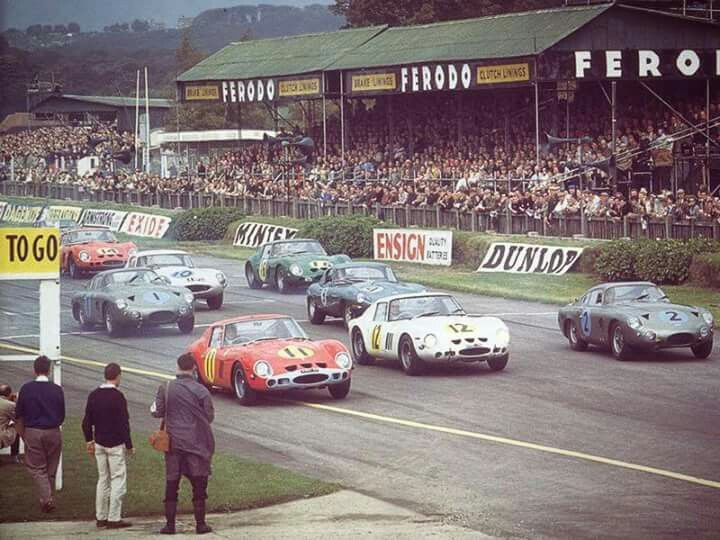
Crew Chief Eric: John unearthed this picture from somewhere. I’m sorry if it’s a little grainy, it just happens to be the quality of it. But I, I absolutely adore this picture because it exemplifies why the white was so important.
Just looking at this, you realize it stands out from the crowd, regardless of what is with it. And there are other 250 GTOs in this picture with the bianco speciale. You have the red, the green, there’s some Jaguar E-Types, there’s another red one in the back. That white, it’s grainy here, but it just pops when you see this picture in real life.
Jon Summers: I was gonna say, Eric, guys, just look at the grid. This is the 1961 or 1962, I think it’s ’62-
Crew Chief Eric: Yeah …
Jon Summers: Silverstone International Trophy race. Those two Aston Martins are one-offs, aren’t they? It’s the [00:19:00] Aston Martin Project 212 and 214. I, I think you’re looking at probably half a billion dollars in terms of current value on, on those racing cars.
So that’s a freak of the moment. But yeah, look how many green cars there are, look how many red ones there are, and they just kind of fade into the background, but the white stands out. And I feel like Coombs was aware of that. It wasn’t just the Mark II that was white, it wasn’t just the GTO that was white.
The E-types he raced were in that- Yeah … were in that white as well. Sort of dove gray, I think that was the Jaguar- I think … brand name for the color.
Crew Chief Eric: So John, again, thank you for bringing this up, but this segues us into a deeper conversation about its racing pedigree, especially in the British club racing scene.
So let’s talk about some of the famous drivers who drove this car or, and/or owned this car.
Jon Summers: Okay. These, uh, these chaps that we’ve got driving it here. No names. All of them are no names. I’m, I’m, I’m straining. So we, we talked about Coombs already. Graham Hill, you must know that name. I mean, the guy won Le Mans, he won Indianapolis 500.
He’s, he was Formula One motor racing [00:20:00] champion a couple of times, and also a great representative for our sport, right? A funny bloke and a great storyteller, and a real tragedy that he went in the, in, in the way that he did. Coombs hired him to drive the car, right? And the stories of the early tests where he drives the car and is unhappy with it, and demands Coombs makes all these changes.
And Coombs says yes, and doesn’t make the changes, and Hill comes back and drives the car and says, “It’s much better now. Thank you for making those changes,” right? And I mean, look at his face, right? You can see the kind of bloke that he is. Salvadori. Salvadori won Le Mans with Carrol Shelby. He actually died, when Shelby died, Salvadori died just a few days later.
He did participate in Formula One. He was a back marker in Formula One, I think for Aston Martin. I think alongside Shelby when he, when at Aston Martin at that time. But, you know, for Salvadori, this is somebody who would’ve done all right in NASCAR. He didn’t mind. Rubbing was racing. And he said about after Mike Hawthorn died, “If I ever met Mike on the road,” ’cause the two of them lived in Southern England, “If I [00:21:00] ever was driving on the road and I met Mike, I knew we were gonna have a hell of a dice.”
In other words, these were two guys who would race like Curtis Turner and Joe Weatherly on the road. Not quite as bad as Turner and Weatherly, I’ve gotta say, but you know, the British version of Turner and Weatherly on the public highway. Rose, you’re also fantastic for that. They are indeed. And the third owner, Jack Sears, now Mecom’s material didn’t make a big deal out of him, ’cause I guess, you know, Hill and Salvadori were, were the big names.
But Jack Sears was a big name in, in British touring car racing. I guess the big thing about Sears was that he had the foresight to buy a Holman-Moody Galaxie when they were racing in NASCAR, so it had this honking 500 horse 427 motor on it. So you imagine when you went to a circuit like Silverstone or something, I mean, the story Jack Sears tells in this Galaxie is he was on pole.
Away from the start he didn’t try that hard, a few of the Jaguars passed him, but by the time he’d got down to Becket’s, which isn’t even the main straight, [00:22:00] he’d just blown all the Jaguars off without even trying. Like, on part-throttle he’d blown them off. So British saloon car racing, when we think of the early ’60s, and as an Englishman, you think of Galaxie’s and Jaguars, and Jack Sears is the driver of…
So what happens? How come Sears owns the GTO? He’s around the British club racing scene. Coombs can’t get rid of the car, and it ends up with a guy called J.A. Pearce, who’s based in a town called Slough, that’s just west of London. Now, if you’ve been to Windsor Castle, if you’ve taken a trip to England, you’ve been to London, you’ve gone out to Windsor Castle, Slough’s just the other side of the freeway.
Slough’s horrible, Windsor’s really nice. Windsor’s where the royals go to school. Slough is where they built the Ford GT40. Slough is also where J.A. Pearce was, and J.A. Pearce took the engine out of our GTO and put it in the back of a Cooper single seater and raced it pretty successfully in, in the ’60s.
What happened to the [00:23:00] body we’re not really sure about. It just sort of sat around with Pearce’s for a little bit, and eventually a sale is made of the body, the roller, to Sears. Sears puts a normal 250 GTO motor in it, paints the car red, and for most of its life, this is how it lives. Right up until the John Shirley period, it’s in this red, it’s carrying the wrong motor.
The real change was where in the early ’90s when there was the first classic car boom and when the 250 GTO became established as, quote, ‘The most valuable car in the world,’ close quote.
Crew Chief Eric: All right. Well, there is a driver missing from this list that we’re gonna get to in a little bit. He didn’t necessarily drive the 250 GTO that we’re talking about, but he was there in the paddock with some of these most favorite drivers.
But I want to take a minute to highlight some of the racing shots that we were able to get from the various archives of the car in action. William, is there anything you want to add about this while I kind of flip through these?
William Ross: You can see evolution, changes in the car in regards how it just evolved over [00:24:00] its life.
These are great, great photos. I don’t know about you guys, I spend hours online or on my phone just looking at old stuff like this, ’cause there’s so many resources you have to be able to access them. Definitely check out Revs Institute’s site. That is phenomenal. But you can see how things change by seeing the three portholes.
Like I was talking about before, see the opening here on the nose, in subsequent older cars, that got elongated. Those were actually lights, but then you can see they removed the lights and then turned them into cooling ducts. Later built cars, that design all got changed and tweaked. Again, for cooling. I don’t know if it was too much for aerodynamics and front end lift to get a little more aero onto the front end to keep it down.
Even then, you know, you’re reaching, you know, almost 200 miles an hour on the Mulsanne. So Aerodynamics, I guess you would say, in its infancy. Wasn’t like they had all these computers and fluid dynamics and stuff like that to study it. It was kind of more along the lines of just eyeballing it, or the old school ways, they put the tape on the strands- Yeah
and just watch it drive around and see where the wind flow was going and stuff like that. So they knew it was there, but you know, trying to [00:25:00] understand it, it’s a black art as they say, and Adrian Newey seems to have it down to a science.
Crew Chief Eric: Not this year.
William Ross: Not this year, no. But, you know, I mean, they’re just gorgeous cars.
Why they get to the value they are, I mean, yes, there are so few built, but then you start really getting down in the nitty-gritty, it’s like, well, why is that one worth more than this one? And, you know, a lot has to do with history and everything like that, but this car was raced extensively throughout its life, so it wasn’t like it was put away and hid anywhere, so, which is also great to see.
And there’s copious, copious notes and just history and everything on this car itself, on this specific chassis, that you can follow through and just see its life. And it’s kinda interesting to see, because it’s a race car. I mean, yes, you can drive it on the street, but you know, just see how it was utilized.
And like John was saying, “Hey, Jack Sears bought it, then he just stuck it in a corner to pull the motor out of it.” I mean, at that point in time, it was worth a couple thousand dollars. I mean, you hear the stories. You know, the one that got donated to the school for high school kids to work on and everything like that.
That’s the one that Ralph Lauren owns now. Uh-huh. These stories are great, you know, and that’s what’s fabulous about institutes like this, Revs, to keep that [00:26:00] alive and give you that opportunity to be able to study this stuff and just follow its history because these, these stories are great. Eric’s got some great podcasts that he does in regards to, like, an Evening With a Legend and that, you know, talking to these guys.
It’s great that we’re able to document that and record this for subsequent generations and hear it because they pass on, those stories die with them. They’re not told and kept alive. They’re just awesome to see.
Crew Chief Eric: I love it when my colleagues do my job for me. It’s great. As William mentioned, you know, we wanna segue into this hidden driver, this mysterious person we’ve been talking about.
So to William’s point, once we started connecting the dots and looking at how all the evidence that we had lined up, the time period, where this car was, who was in the car, who was racing, the teams, who they were competing against, it dawned on me when I was sitting down with David Hobbs for an episode of Evening With the Legends, some of you are very familiar with that program.
Yeah. Nobody famous in the racing world at all. So I’m sitting there talking to Hobbo and he’s telling his, you know, after dinner spiel, as John likes to call it. He’s very good at [00:27:00] that. He’s recounting his life story and starting in the early days in the ’60s and racing in British Club Racing and racing for his dad and prototype transmissions.
And, and he mentions Graham Hill and seeing these people, blah, blah, blah. And at the time, it didn’t all come together because we had talked to Hobbo before we started this project, but when we got midway through, I do what all good hosts do, and I called him up and I said- “David, I am working on this project.
It involves this car, and these places, and these people. I would like to have a conversation about your experience.” Because as we thought about it, there’s nobody really left to tell stories about this car. And for us, it is to William’s point about capturing the living history. So it m- felt right to call up David, and he was very, very cool about it.
He’s like, “Absolutely. Let’s get on and let’s have a conversation. You know, let me tell you about my experience club racing there with Graham Hill, Roy Salvadori, and seeing this car in person at the track.” I think this next slide, hopefully the video plays. The era of
David Hobbs: racing, club racing, obviously it was a feeder system of sorts for young drivers.
Obviously there were, uh, some older drivers. Not [00:28:00] many, but I mean… And a lot of people that did club racing had no interest in going any further. The people like me, and Jack Sears, and Graham Hill, and Jimmy Clark they had designs on, on going into, into professional racing, even though there wasn’t much money in it really, very little money at the time.
That was my, of course, obviously John Coombs was there at that meeting as well because Graham Hill was driving his, uh, John Coombs’ E-Type. This is before the Ferrari came along. Coombs was very successful. Graham Hill drove for him in the, uh, in the 3.8 Mark II, which was also white. He drove for him in the E-Type, which was white, and then of course they got the, the 250 GTO, which of course was a hell of a car.
Jon Summers: What we’re thinking about is can you look at this Ferrari and say, well, the guys at Jaguar obviously looked at this Ferrari and then made these changes to the Jaguar as a result, and therefore we need a early lightweight E as a comparison.
David Hobbs: I, I think really that the Jaguar were trying to, uh, I don’t know about crib, but to [00:29:00] try and actually improve the E-Type by following the Ferrari, some of the Ferrari practices, uh, rather than the other way around.
I mean, I think the Ferrari was always the quicker of the two cars.
Crew Chief Eric: All right. The clip speaks for itself. The most important part, the reason we left the question in from John, that middle break, so he talks a little bit about the club racing experience, seeing Graham Hill, all that kind of stuff. That other part, the missing link here, is that at the same time all of this is happening, David Hobbs is working at Jaguar.
So he’s in the research and development department, and he’s one of their factory test drivers at that point. Very young in his career, very early on. So that’s what kind of brought all this together, and so that’s, if you wanna see the rest of that interview, you can actually scan the QR code or I can send you the link later, but it’s very, very interesting to see it from a racer’s perspective who lived it and was there looking from the outside in.
So William, we need to get on to why is this so special today in 2026? I think that conversation starts off with the exclusive GTO Owners Club.
William Ross: Yeah, I mean, obviously more recent owners, say in the past 20 years, [00:30:00] you know, have obviously spent millions of dollars acquiring it, but you still have several that have owned their cars for many, many decades.
But you got some great people that own them, and it’s great to see a good portion of them share their car with the world. Lord Bamford’s got actually two, so he’s in that very unique club. He’s a JCB guy. Yeah. He’s like earth moving. Yeah, so I should say, yeah, Lord Bamford. But I always love telling the story about Nick Mason.
I mean, I’m sure everyone here is familiar with the band Pink Floyd and who he is. Well, in the ’80s when they were doing, I say, a comeback tour, relaunching their tour, they needed money to get things going. They needed about a million bucks. So I mean, you’re talking about ’80s, what’s that? Maybe like 10 million today, and you look at numbers.
Nick had the car. So what do they do? Put it up for collateral, got the loan against the GTO to pay for that tour. Obviously, it was rather successful, so he got to keep the car. They didn’t repossess it. But I always thought that was a great story regarding Nick and his car. But again, he’s one too that absolutely loves and enjoys car racing.
I mean, he’s, he’s a racer at heart. His wife drives the car immensely, his kids do. His son-in-law [00:31:00] is Dario Franchitti’s brother, Mario Franchitti. Yes. So I mean, there’s racing through and through in that family. But, you know, there’s some very, very famous people. Like I said before, you know, Ralph Lauren’s got the car that was donated to the high school for high school kids to work on and learn the car.
It kind of would blow your mind today, but again, back then, you know, I wouldn’t say it was just a car, but it was just a race car. It was old. Yeah, it was worth a few dollars, but it wasn’t what it’s worth today. I would say it’s either unfortunate or however you wanna view it You know, maybe that’s what drives the value today is because individuals like that set the precedent that I have more than you, so they’re willing to pay more because they have the money to do it, so it drives up the price.
Yeah. But fortunately, there’s several individuals that do own them, that do share it with everybody. They drive them. I know every couple years it’s kept secret because they don’t want people knowing where all these cars are gonna be at once, but they have a, a GTO Owners Club and they do, I dunno, every two, three, four years, something like that, they put together a driving tour.
They meet somewhere. I know they’ve done it in the United States several times. They’ll just pick a nice area and get an [00:32:00] itinerary set up. They’ll stay at Motel 6, stuff like that. You know, eat McDonald’s. Stuff like that, but anyways, they’re real nice people. I mean, a couple of them you can approach and talk to.
They’re more than happy to talk to you about the car. Yeah. Other ones, you’re never gonna get near them, but you always have the respect and appreciate- Yeah … the individuals that they understand and want to share the car. It’s very impressive, that list of owners.
Crew Chief Eric: Yeah. Two important things about this as we transition in, into the next slide here is that David McNeil has the world record setting Ferrari 250 GTO, and we’re gonna talk about that as the high end of the value of these cars.
But more importantly, as you sort of alluded to there, it’s longtime ownership. They don’t change hands very often. That’s something we want to hone in on, we want to reiterate. And our GTO, as John likes to call it, has only changed hands five times in 60 plus years. And the first two owners were very, very short.
The guy with the used car lot- Yeah … and John Coombs only had it for a couple of racing seasons. But then Jack Sears and, um- John Shirley … John Shirley, over 30 years?
William Ross: Yeah. Yeah.
Crew Chief Eric: Yeah,
William Ross: so they, it, it was in long-term ownership.
Crew Chief Eric: Yeah.
William Ross: I [00:33:00] said a lot of these individual, like Nick’s owned his car since ’77.
Crew Chief Eric: Long time, yeah.
William Ross: Yeah, so I mean, there, there’s quite a few that have had, like Lord Bamford. He’s had his for ages too- Forever … as well, so. Coming to market in the past 10, 15 years, we’ve seen a couple pop up at an auction. You know, and obviously all the scuttlebutt starts, “All right, what’s it gonna go for, this and that?”
But majority of these cars, when they do change hands, they’re gonna change hands privately. Individuals in that tax bracket usually like to keep all their stuff private. They just work through individuals that have the means or knowhow and contacts. Someone knows someone that wants another, wants one. So it’s usually not too difficult to find someone to purchase the car, but you really don’t hear about it a lot because they change hands privately.
Crew Chief Eric: And if you’re interested, that’s what he does for a living, so. Talk to him after. That being said, the range for these cars is a noted $35 to $75 million. So David Mc- McNeil’s being on the high end of that, $75 million, that number was leaked out because that was a private sale.
Jon Summers: Well, and that, and the McNeil car was considered a great car- Yep
because it’s the only silver [00:34:00] one, and it’s one that won at the Tour de France one year. Correct. So it has a, it has a good race history, and it’s a very distinctive looking car. And, and as William said, if the transactions are private, how do we know what Dave McNeil paid? The answer is we don’t really know what Dave McNeil paid.
There’s just gossip in the space- Yeah … and that number has always been 70 or 75 million. I’ve heard both of those numbers various times. I just want to touch on, on the range here, and it reflects on, on the white car. The $35 million car was a car that Bonhams had probably about 10 years ago now, if you look back at their records, and this car was considered as having a poor history.
Yeah. And its poor history was because when it was bought new, it was bought by a wealthy French guy. Early in its career, it may have been at a motor racing event or it may have just been on the road, but the guy wrecked it and was killed in it. Now, I’ve not dug into the provenance. I’m sure the people at Bonhams would know, but it seems very likely, often in these kind of [00:35:00] situations, the family just keep the car.
So you’re probably waiting for a significant person, maybe a wife or a mother, to pass on before the car can come back to market. So that’s what happened with that car. But so that’s had no history at all, and what history there has been has been poor. So that car was clearly going to be the bottom of the range.
So when we approached the Mecum auction, the feeling was, if 35 is the
bottom and 75 is the top, but just last year we saw that Mercedes make 140, well, gosh, could this, the white one, great provenance, pretty original, could this be the first $100 million Ferrari? Could it even do more than the Uhlenhaut Coupe? That’s what- Right … we were wondering up at Mecum, weren’t we?
Crew Chief Eric: Yeah, that’s right.
Yeah. They had some ideas floating around. So what we did is we called in our Canadian buddy, David Nyens, who runs Motorcopia, and he has a fantastic analysis program that he’s written, and he came up with a valuation [00:36:00] based on provenance, based on all this other information about the car, and he came up with a number of $63 million.
That was what we went in for. That’s what we were thinking. But let’s talk about what actually happened. Mecum was the chosen auction. William, briefly, how did it end up at Mecum? There’s a story there, too.
William Ross: There was crickets. I, you know, Chris Beale from Prancing Horse was, you know, an individual stated earlier bringing this to Mecum and bringing this to Dana, and getting everything set up and agreeing to all the terms and all that kind of stuff.
So it was obviously very much hyped, and Mecum was obviously ecstatic to have this car, ’cause that is a feather in an auction house’s cap to have a GTO cross their block. You know, obviously they put a lot behind it. As John was stating, you know, Mecum had very high hopes and people were throwing around some very large numbers.
People say, “Well, it’s only one of eight right-hand drive,” this and that, you know. I sa- I had my thing, I was at 40 to 45. A few other people were on kind of my thought process too. I feel being right-hand drive diminishes value because when an [00:37:00] individual that can afford that car, they want the car they want.
They won’t just, “Well, we have one’s available. It’s only one of the 36, so I better grab it.” That’s not how they think. They’re gonna get what they want. So stepping up to it, and I believe where it hammered at- was at a price point that the buyer, David Lee, was comfortable paying for it and wanting a GTO.
Would he probably have preferred a left-hand drive? I’m sure, but then he was probably gonna pay 15, 20 million more. But you never know what something’s worth, what some- what someone’s willing to pay for it. Yeah. That’s where auction process and going in front of an auction like that, it can skew numbers, it can throw numbers off.
It can also set market values. Those cars, it’s when someone wants that specific car, ’cause of provenance, history, someone will step up and pay for it. The numbers were kind of getting way up there- Yeah … in regards to what some people thought it was gonna bring.
Crew Chief Eric: And unfortunately, there’s a lot of what if, there’s a lot of speculation, there’s a lot of had it gone to Sotheby’s, had it gone to Bonhams, had it gone here, had it gone there, would it have hammered at different numbers?
[00:38:00] Honestly, it’s irrelevant, because the type of person that’s going to buy that car is going to be in a very slim margin of people that can afford that car, and we know the window of opportunity in terms of its value, so 35 million to 75 million. So y- you funneled everybody down, and I don’t think it matters where it lands, because if you’re willing to pay what it’s worth, which is different than its value, then that is extremely important.
So that’s why, in the end, what makes David Lee’s purchase of the 250 Special is that somebody still wants to buy one of these in 2026. And more importantly, some people might say, “Well, if you compare it to Nick Mason or you compare it to Lord Bamford, you know, how many gray hairs do they have versus David Lee?”
But you have to also think back, how young was Nick Mason when he bought his 250 GTO? So now the clock is sort of resetting. Are we going to see a new breed of 250 GTO owners going forward? Which brings us really, John, to a conversation about the future of the 250 GTO, and maybe ours in particular.
Jon Summers: Yes. I thought we were gonna talk about the modern [00:39:00] supercars now.
Crew Chief Eric: We are. There’s one more slide, though.
Jon Summers: Oh, okay.
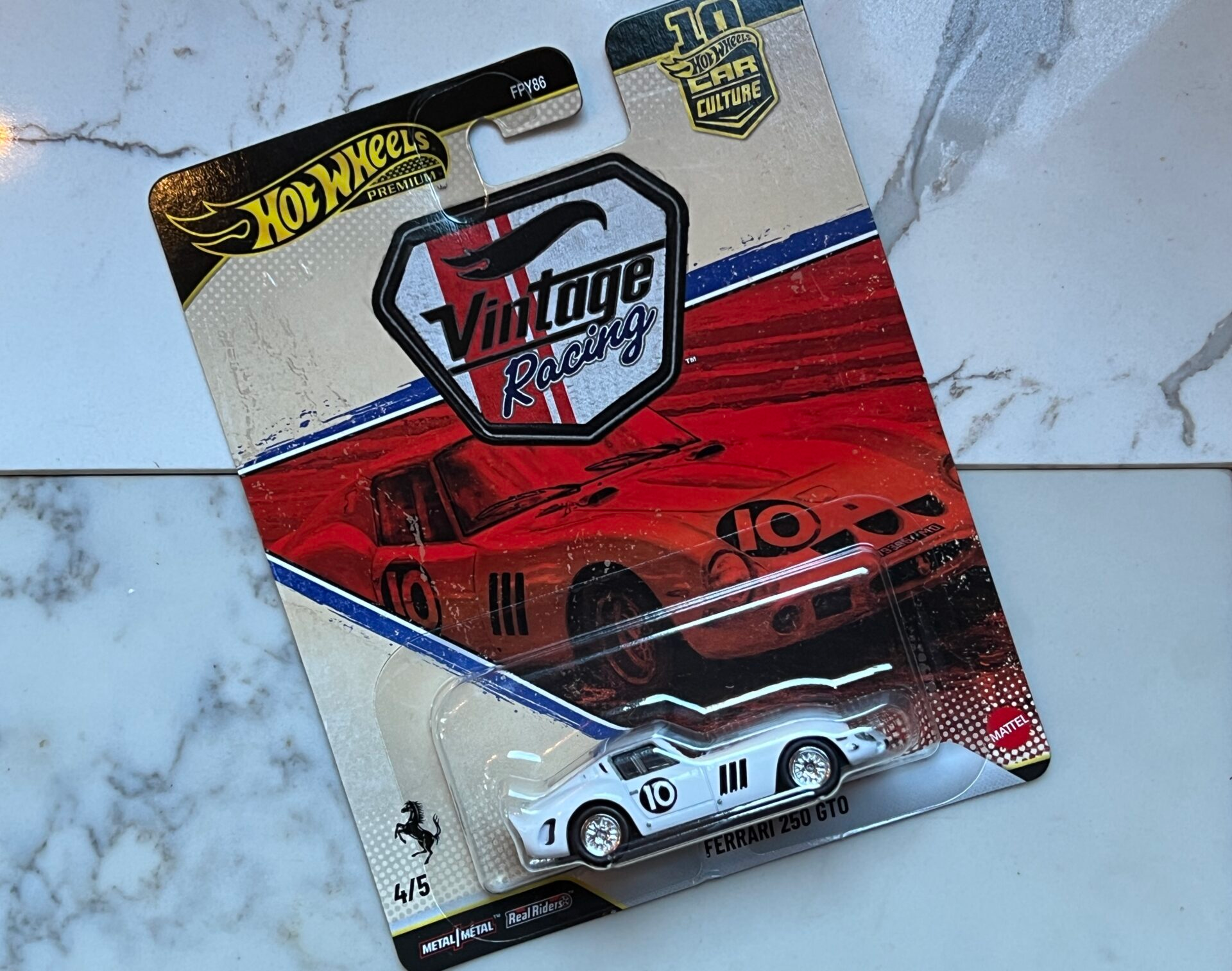
Crew Chief Eric: Because the future, the future of this car is really interesting. Serendipitous, in a way, because right after the auction, of all people, Mattel decided to cast it and immortalize it in their Vintage Racing Highline series of cars, right? What
William Ross: an incidence.
Crew Chief Eric: Or maybe something more.
William Ross: I don’t know how fast Hot Wheels can bring out a car, but it was
Crew Chief Eric: I mean, down to the very triple gill side vents and the number 10 every… It looks a lot like David’s car.
William Ross: You never know, maybe one of you guys could be walking home with a car.
Crew Chief Eric: Yeah. That being said, there is a special treat in this bin up here.
If you are interested in owning your own Bianco Speciale white 250 GTO, they are in that bin for you to take home with you.
William Ross: Not all of them have one in it, so have, you gotta be aware of that. I said
Crew Chief Eric: so. Look for the green dot.
William Ross: It’s gonna, it’s a, it’s a random pick.
Crew Chief Eric: All right, John, you wanted to talk about this, the future of these cars.
Jon Summers: I kind of did wanna talk about this, just because when we left Mecum, I was left feeling a little bit like, oh, ’cause that, the white car made 36, so [00:40:00] that seemed low to me. I felt like it was worth more than that, and I was very surprised by that because this orange Porsche 918 that you see at the top of the screen there, it strolled across the block just before, and the estimate on it was three to five, and it made that six.
And we also watched this Enzo here. The estimate was definitely under 10. I think the estimate was, like, three to five, and then it went ahead and made 15. Now, further to this, I’ve a neighbor who has a couple of Ferrari 308s. He was telling me, I was, I was saying to him, “Oh, I listened to a podcast last night, and they were saying 360 Challenge Stradale,” so this is the Ferrari 360, but the street race version of it, Challenge Stradale.
360s now, they used to be a 250 or $300,000 car. I had read that one had sold for 600, and he said, “What? I heard about one that went for 800 last week.” So we’re in a very, very strange place with [00:41:00] values for certain collector cars. Now, the question, who’s buying these cars? We spent a long time talking about that at Mecum, but as we were walking back to the car, I found myself thinking This is a passing of the baton, isn’t it?
That those of us who have been around the space a little bit will remember when the most valuable cars were Duesenbergs, the Olympian stuff of the interwar period. And then all of a sudden, the post-war racing cars driven by the Nick Mason generation buying cars, those cars went up in value. And I still know people at Pebble Beach who look at a Packard and look at a Ferrari and, like, roll their eyes.
They’re like, “How can you even compare one with the other?” Well, I’m feeling like that at the moment as the Bianco Speciale underperforms and the orange 918 does nearly double the estimate. Now, I don’t know, maybe if you like orange. I don’t know. I mean, there are some teams- There are some, there are some football teams that play in [00:42:00] orange, aren’t there?
You’ve got a- It’s
Crew Chief Eric: papaya.
Jon Summers: That’s what I keep saying … maybe, maybe if you, maybe if you love the orange, you know. But I just gotta believe that the person who bought that car bought it so that when you go to an event, everyone knows, you know, you’re there because you’ve got the only orange, the paint to sample, the only orange 918 that there is.
So I think that’s how the hobby’s changing. I think you can see it in the price, and I think this is the inflection point.
Crew Chief Brad: Yeah.
William Ross: People are getting more about status and being able to say, “Oh, this is one of one,” and that instead of actually, hey, you know, just about what the car is. And it’s unfortunate ’cause it’s pricing many and many people out of getting even, I’d say, an entry level collector car.
It’s not affordable. Instead of something, you know, what was two years ago was, say, 150. And again, that’s not, you know, money to sneeze at, but it’s definitely in the realm of possibility for a lot of people. Now, all of a sudden, it’s worth $400,000. Like, well, I can’t do that.
Crew Chief Eric: Yeah.
William Ross: You know, it just, it’s unfortunate.
Crew Chief Eric: Well, folks, I know we [00:43:00] went over time. We could probably talk the rest of lunch and the afternoon on this particular topic. So we don’t have room for questions, but we will take them during lunch if you want, or during the break. But if you are interested in learning more about what we do, the things we talk about, each of us have our own shows on the Motoring Podcast Network, or you can go back into the archive and learn all about the Bianco Speciale and all the different things that we researched along the way.
So with that, I appreciate everybody’s time, patience, and appreciate you guys listening to us.
William Ross: And if you guys want a swag bag, just raise your hand, and these two young ladies right here will- And they shall pass them out … bring them out.
PROMO: This episode is made possible by the Studebaker National Museum, the home of South Bend, Indiana’s automotive and industrial heritage. The museum preserves and interprets the legacy of Studebaker through its world-class collection of vehicles, [00:44:00] artifacts, and archival materials, including several nationally designated treasures.
As a center for history, design, and innovation, the museum inspires enthusiasts and the community alike through its exhibits, programming, and commitment to safeguarding the stories that shaped American transportation. To learn more or plan your visit, check out www.studebakermuseum.org. This episode is also brought to you by the Society of Automotive Historians.
They encourage research into any aspect of automotive history. The SAH actively supports the compilation and preservation of papers, organizational records, print ephemera, and images to safeguard as well as to broaden and deepen the understanding of motorized wheeled land transportation through the modern age and into the future.
For more [00:45:00] information about the SAH, visit www.autohistory.org.
Crew Chief Eric: I hope you enjoyed another awesome episode of Brake Fix Podcast, brought to you by Grand Touring Motorsports. If you’d like to be a guest on the show or get involved, be sure to follow us on all social media platforms at GrandTouringMotorsports. And if you’d like to learn more about the content of this episode, be sure to check out the follow-on article at GTMotorsports.org.
We remain a commercial-free and no annual fees organization through our sponsors, but also through the generous support of our fans, families, and friends through Patreon. For as little as $2.50 a month, you can get access to more behind-the-scenes action, additional Pit Stop minisodes, and other VIP goodies, as well as keeping our team of creators fed on their strict diet of Fig Newtons, Gummi Bears, and Monster.
So consider signing up for [00:46:00] Patreon today at www.patreon.com/gtmotorsports. And remember, without you, none of this would be possible.
Highlights
Skip ahead if you must… Here’s the highlights from this episode you might be most interested in and their corresponding time stamps.
- 00:00 Panel Introductions
- 00:52 Bianco Speciale Overview
- 01:58 How the Auction Happened
- 03:37 John Coombs Backstory
- 06:04 Jaguar Reverse Engineering
- 08:46 What Makes It Unique
- 14:50 The Mystery of Coombs White
- 19:31 Racing Pedigree and Drivers
- 23:36 Archival Racing Photos: Spotting GTO Evolution
- 26:26 The Hidden Driver Revealed: David Hobbs and Jaguar Link
- 29:50 Exclusive Owners Club and Famous Names
- 33:09 Private Sales And Price Range
- 36:10 Mecum Auction Outcome
- 39:05 Hot Wheels Immortalization
- 39:51 Modern Values Inflection Point
- 42:58 Wrap Up And Sponsors
Live Stream
This episode is sponsored in part by: The Studebaker National Museum, The Society of Automotive Historians (SAH) and was filmed on location in South Bend, Indiana – Recorded in front of a live studio audience.
Learn More
 If you enjoyed this Automotive History Live! Series episode, please go to Apple Podcasts and leave us a review. That would help us beat the algorithms and help spread the enthusiasm to others.
Subscribe to Break/Fix using your favorite Podcast App:
If you enjoyed this Automotive History Live! Series episode, please go to Apple Podcasts and leave us a review. That would help us beat the algorithms and help spread the enthusiasm to others.
Subscribe to Break/Fix using your favorite Podcast App:Consider becoming a Patreon VIP and get behind the scenes content and schwag from the Motoring Podcast Network
Do you like what you've seen, heard and read? - Don't forget, GTM is fueled by volunteers and remains a no-annual-fee organization, but we still need help to pay to keep the lights on... For as little as $2.50/month you can help us keep the momentum going so we can continue to record, write, edit and broadcast your favorite content. Support GTM today! or make a One Time Donation.
One of the most fascinating revelations from the team’s research is that Coombs’ GTO may have directly influenced Jaguar’s engineering.
Coombs had a close relationship with Jaguar’s chief engineer, Bill Heynes. During a lunch meeting, Coombs reportedly told Heynes he would have to keep racing the Ferrari unless Jaguar improved the E-Type. The result? The Bianco Speciale spent the winter of 1962–63 at Jaguar’s Browns Lane factory, where engineers studied it closely.
Jon Summers noted: “It seems very likely that the lightweight E-Type was a direct result of looking at… specifically the Coombs GTO.” Coombs denied this ever happened — but everyone else knew the truth.
Engineering Evolution: How the Bianco Speciale Shaped Later GTOs
The Bianco Speciale wasn’t just raced — it was developed. Coombs modified the car early and often:
- Added hood louvers
- Added a third side vent
- Tweaked cooling and airflow
- Adjusted bodywork for better performance
These changes were so effective that Ferrari’s coachbuilder Scaglietti incorporated them into later GTOs. William explained: “It set the standard for GTOs that followed after it.” Being one of the first 12 GTOs built, its influence on the remaining production run was enormous.
The Mystery of the White Paint
The car’s color is central to its identity. Was it painted white at the factory? Was it repainted by Coombs? The truth is murky. What is known:
- Coombs ordered the car through Maranello Concessionaires.
- Internal negotiations at Ferrari allowed the car to be delivered in white.
- Coombs’ team likely repainted parts of the car after modifying the bodywork.
Jon Summers emphasized why the color mattered: “By the time Coombs had it and had raced it, it was in that white… and Mecum were right to make a big deal out of it.” Historic photos show the car glowing against a grid of red Ferraris and green Jaguars — unmistakable, intentional, iconic.
The Bianco Speciale’s racing pedigree is astonishing. Among its drivers:
- Graham Hill — Formula One champion, Indy 500 winner, Le Mans winner #TripleCrown
- Roy Salvadori — Le Mans winner with Carroll Shelby
- Jack Sears — British Touring Car champion
Hill famously demanded changes to the car during testing. Coombs pretended to make them — and Hill returned saying the car felt much better. Later, the car’s engine was removed and raced in a Cooper single-seater. The GTO body sat dormant until Sears reunited it with a proper V12 and repainted it red, where it remained for decades.
There's more to this story!
Be sure to check out the behind the scenes for this episode, filled with extras, bloopers, and other great moments not found in the final version. Become a Break/Fix VIP today by joining our Patreon.
All of our BEHIND THE SCENES (BTS) Break/Fix episodes are raw and unedited, and expressly shared with the permission and consent of our guests.
One of the most compelling modern insights came from racer David Hobbs, who was working at Jaguar during the same period the GTO was being studied. Hobbs confirmed the competitive tension between Ferrari and Jaguar, and the likelihood that Jaguar engineers were learning from the GTO’s design.
His firsthand account tied together the timeline, the personalities, and the engineering rivalry — a rare living testimony from someone who was there.
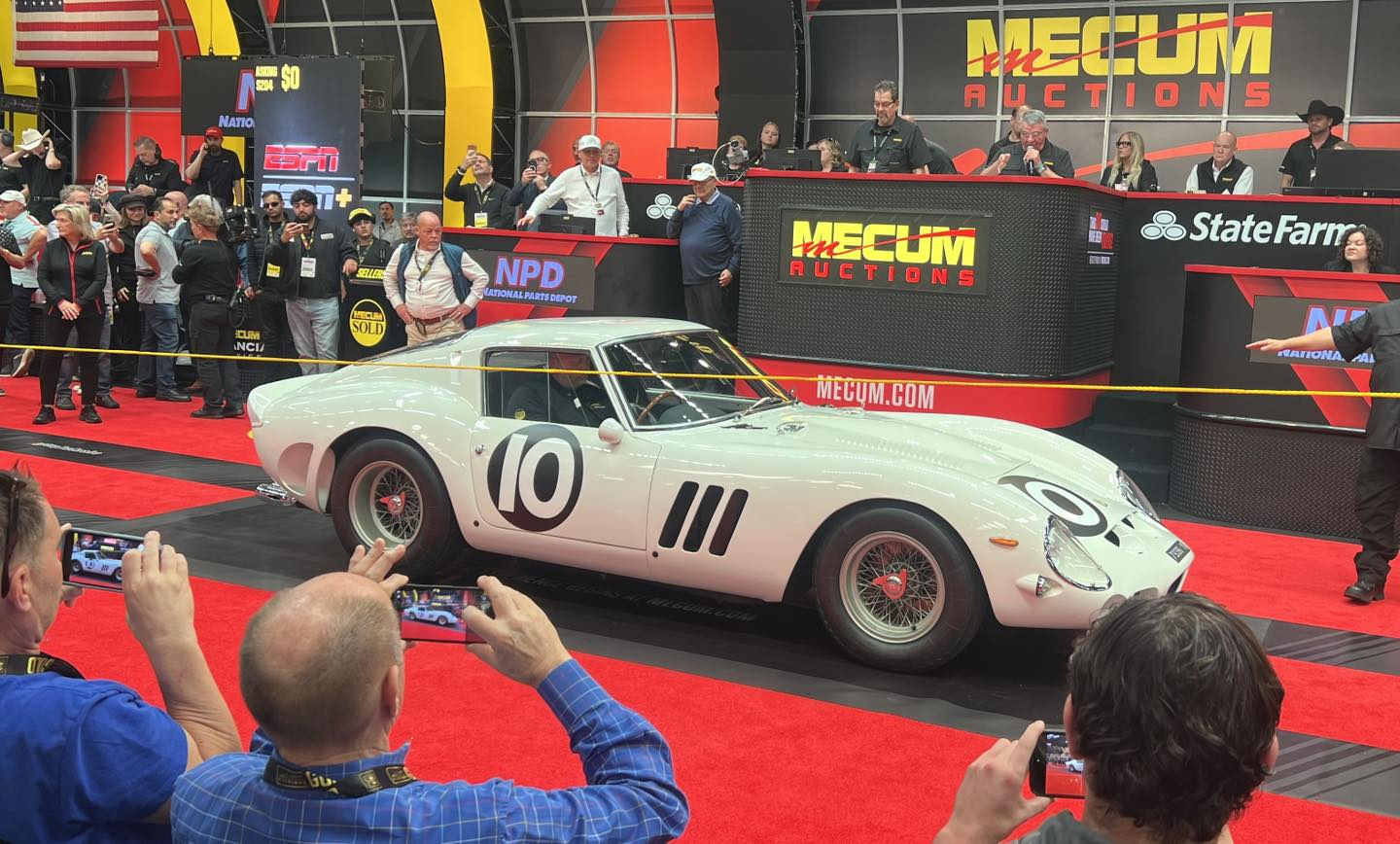
Today, Ferrari 250 GTOs are the crown jewels of the collector car world. Values range from $35 million to $75 million, with private sales rumored even higher.
The Bianco Speciale has changed hands only five times in 60+ years, including long-term ownership by Jack Sears and later John Shirley. In 2024, it crossed the Mecum Kissimmee auction block, selling to enthusiast David Lee.
While some expected it to break records, the final hammer price reflected a complex market where rarity, provenance, and buyer preference intersect.
The Future of the Bianco Speciale
Shortly after the auction, Mattel immortalized the car in its Hot Wheels Vintage Racing Highline series — a sign of its cultural impact. The casting includes the triple side vents and racing number 10, mirroring the real car’s details.
As Summers noted, the collector market is shifting. Modern supercars are skyrocketing in value, sometimes outpacing historic icons. But the GTO remains a symbol of motorsport heritage, craftsmanship, and exclusivity.
And with younger collectors like David Lee (below) entering the GTO Owners Club, a new generation of stewardship is beginning.
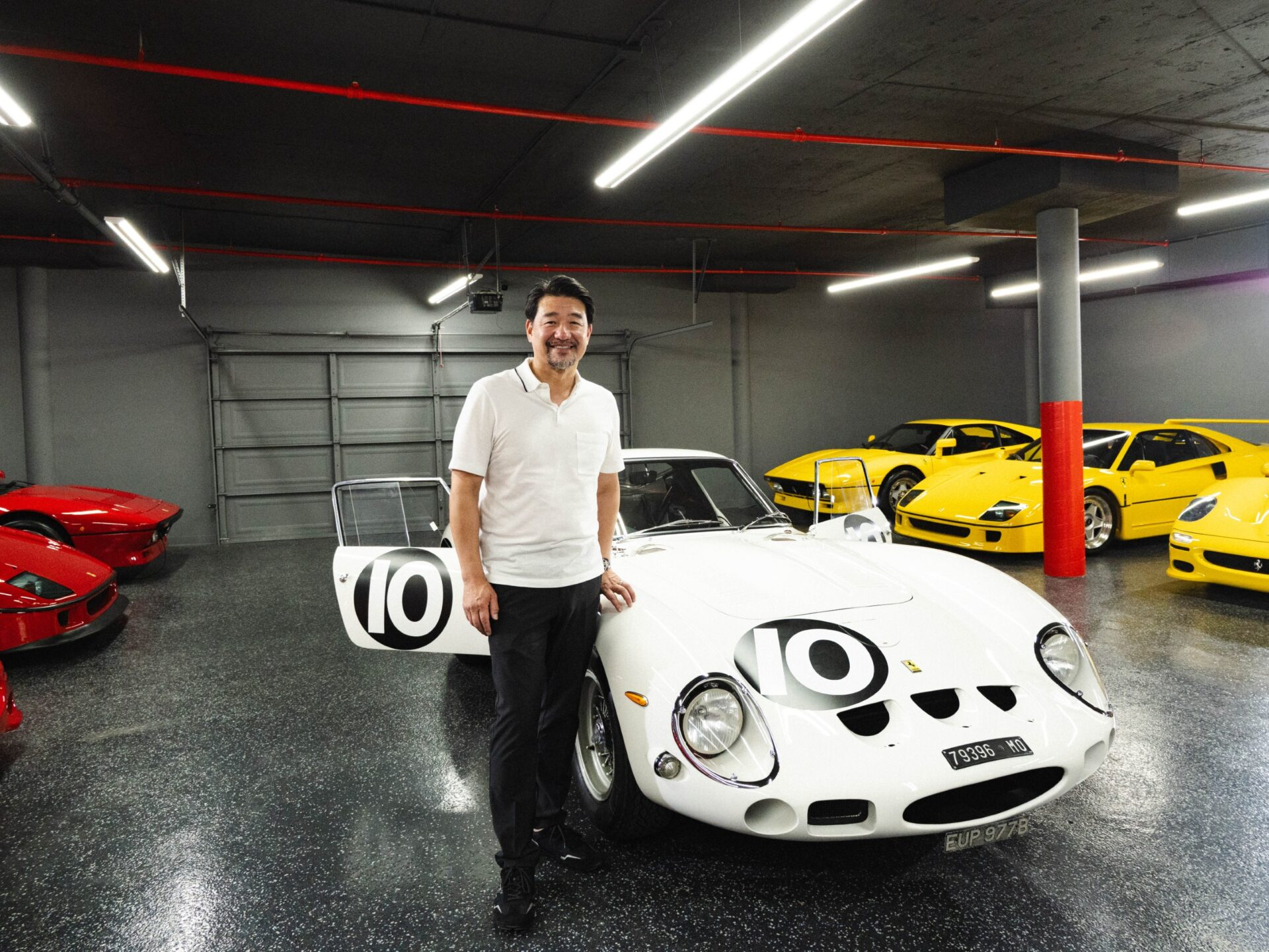
The Bianco Speciale is more than a rare Ferrari. It’s a bridge between eras:
- From British club racing to global collector culture
- From Jaguar’s engineering labs to Ferrari’s racing dominance
- From the hands of legends to the garages of modern enthusiasts
Its story continues to evolve — and thanks to historians, racers, and storytellers, it remains alive for future generations.
Automotive History Live! at the Copshaholm Concours d'Elegance
 The Studebaker National Museum, partnering with the Society of Automotive Historians (SAH), presents Automotive History Live! The Symposium established itself as a unique and respected scholarly forum and has gained a growing audience of students and enthusiasts. It provides an opportunity for scholars, researchers and writers to present their work related to the history of the automobile and the cultural impact of motorsports. Papers are presented by faculty members, graduate students and independent researchers.
Other episodes you might enjoy
Where the stories… Drive Us. From the grand lawns of Concours, to the icons that shaped the road ahead, We celebrate the machines, the makers, and the moments that defined automotive history.Remember to subscribe to Break/Fix using your favorite Podcast App.
Support our Creators!
 For as little as $2.50 cents a month, you can get access to more behind the scenes action, additional Pit Stop mini-sodes and other VIP goodies, as well as keeping our team of creators fed on their strict diet of Fig Newton's, Gummy Bears, and Monster. Consider signing up for Patreon today. And remember, without *YOU*, none of this would be possible!
This content has been brought to you in-part by support through...