


As the decades went by (I started in the ’60s with a Brownie camera so that gives you an idea of how long it’s been…) my goal in going to car shows has changed, I now go with several objectives.
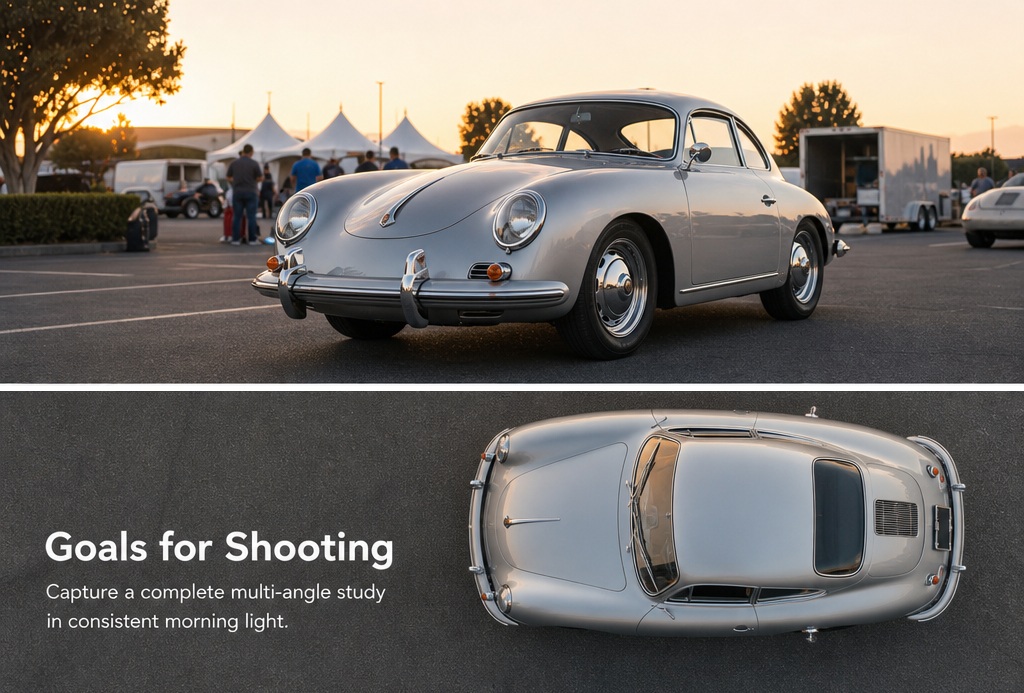
For art: trying to find one angle on one car that captures the zeitgeist (ambiance) of the event or of that group of owners, like a low rider Cadillac convertible being driven by a middle aged man that you know always wanted that ’40s car SINCE the ’40s and finally got it. If I found the one car where one picture tells the story, I am satisfied.
For factual reference: This is a tough one, if I am writing a historical story about a particular car I need the car to be 100% stock so it doesn’t throw readers new to that car on what the car should look like. For instance there’s one guy that owns probably the best DeTomaso Mangusta existent, but his car has no rear 3/4 window trim, like all the others had. So pictures of his car can’t be used for a historical story or else I have a lot of ‘splainin’ to do..
To recognize new Trends: Sometimes there will be a group of owners who decided, say, their 356 Porsche looks good lowered, and then a whole group of them will lower their cars. I’m not saying I like a new trend or not but if a trend is coming, I hope I notice.
To capture the angle that defines the Form. I want my photo to show the shape of the car, maybe augmented by a contrasting background that doesn’t distract from the shape. Some cars, alas, have no form, no defining shape, they are just a hopeless hodge-podge. I wouldn’t even bother on some cars like a ’59 Chevrolet sedan. Not a form worth remembering. Lately my best example is the Ferrari SP-1, a single seater, because I shot one on a rainy gloomy day, a white car, and I captured a shape that stands out mostly because of the pure form dominates the painting. Sure it was a rainy day but dammit, that body sings!
Get the car shot even if background sucks. Unfortunately sometimes I find the right car, the right angle, and the right lighting but the background is distracting, irrelevant, or would spoil this photo’s chances of becoming a subject for my oil painting. I say shoot the car anyway because, in the art world’s there is a legitimate category called “mixed media” (combining art from more than one source) so you can legitimately re-portray a person, a car or other main subject against a background that more suits your needs, as I do in some paintings. Which is why some of my car paintings are not representative of the event they were shot at because I hated the background I caught the car in, shot it anyway, and decided it would look better in a painting against a background which more suits the car’s raison d’etre.
Capitsch?
At most car shows, I shoot at least fifty pictures, hoping that one, just one, please Lord, will be interesting enough to make a painting of. In oil, on canvas.
Back in the days of film, I had Hasselblads with 500 mm lenses, but got kind of tired schlepping those big heavy cameras and lenses around. Then I went to Leica, smaller but more expensive.
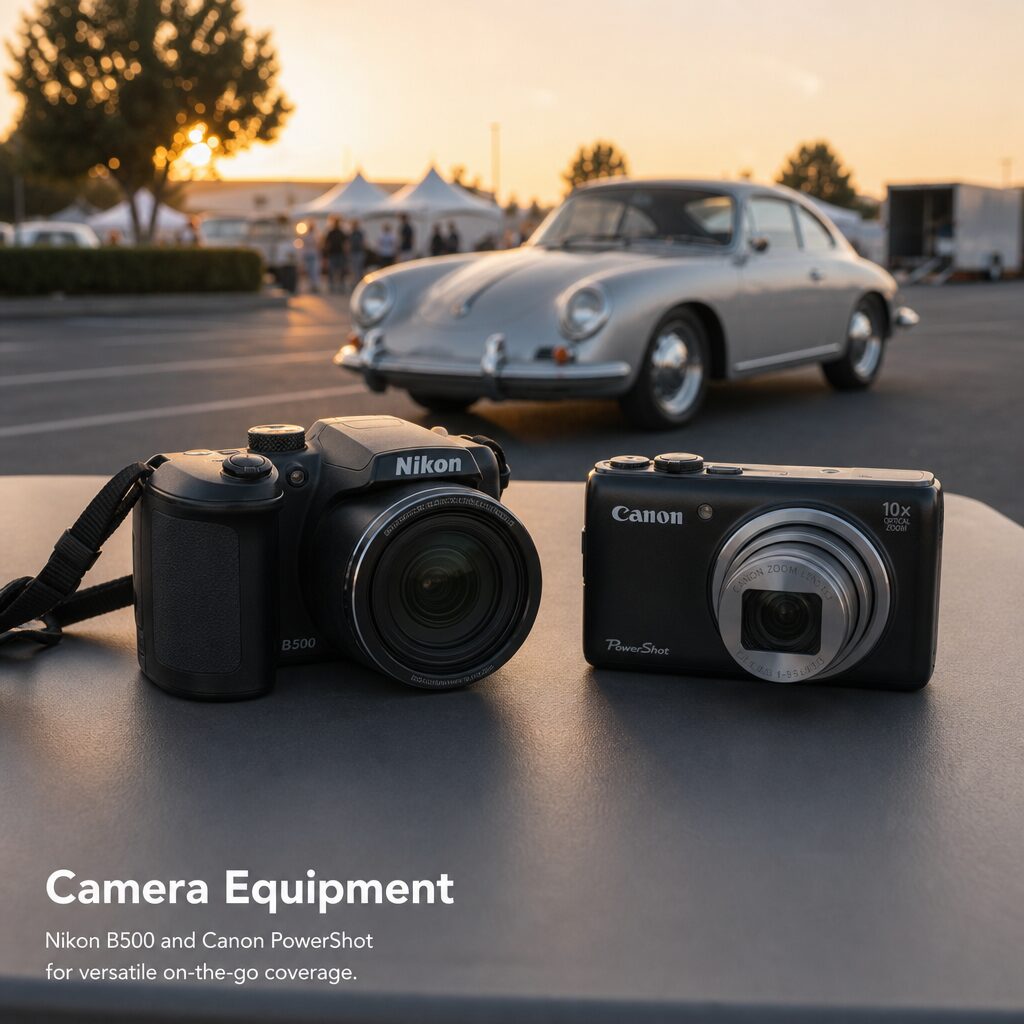
Now flash forward 50 years. I use a pawn shop-bought Nikon B500. It’s a weird camera in that it has a telephoto as its only lens. You can’t remove it. But that one lens goes from wide angle to an intermediate long lens. It even has a video function I haven’t tried yet. It cost me $100 but I don’t trust it entirely to function through a whole show so my backup is a used and abused Canon that cost as little as $50 at a swap meet. The Nikon surprisingly uses old fashioned batteries , but at least you can find them at any drug store. The Canons require a flat battery made to fit that camera, not so easy to find in a hurry on location. And you have to charge the battery, not so easy if there’s no place outside to plug it in.
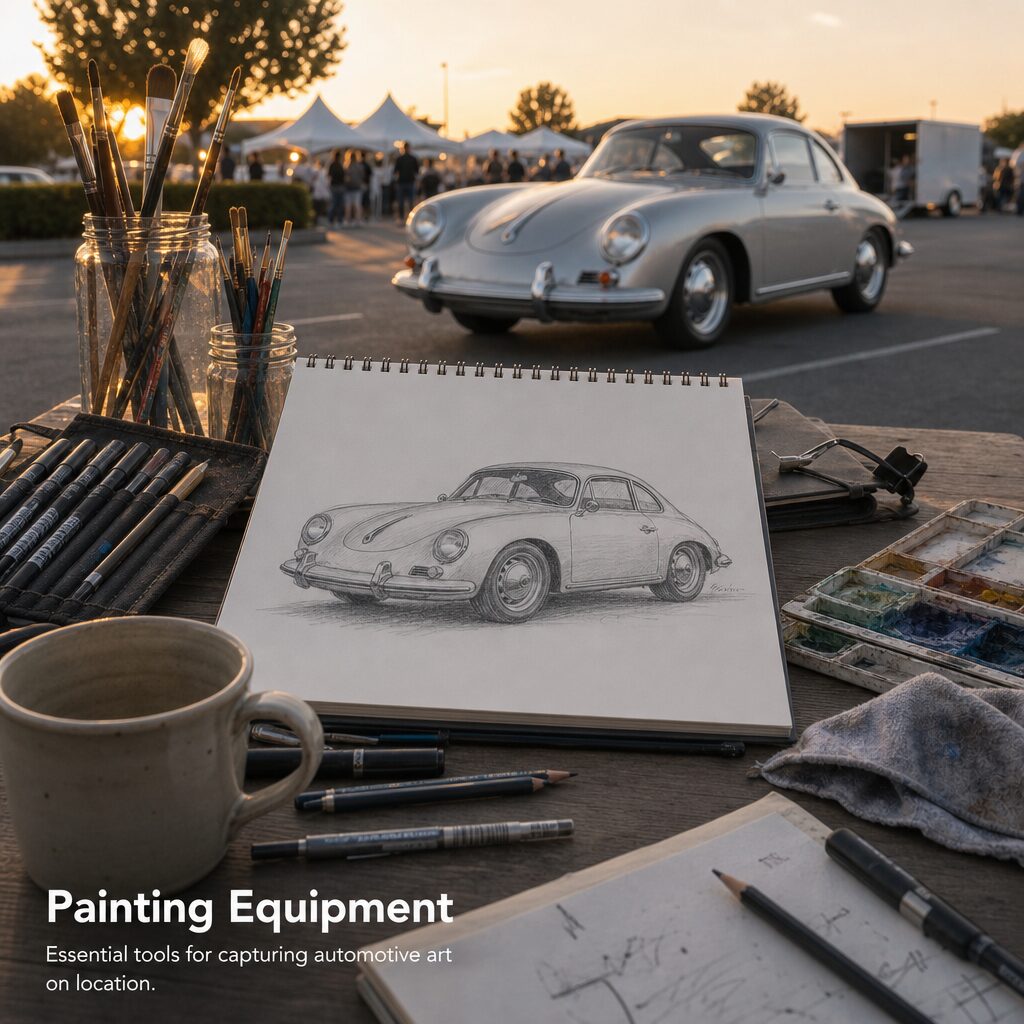
The painting equipment is a bag of tubed acrylic paint and the surface I paint on a rough hewn heavyweight paper, usually 11″ x 17″. If I like the result or have a customer wanting it, I upsize to a giclee canvas print. Sometimes I feel the finished print still needs something so I lay on new paint, altering the original painting, so some might mistake it for an original painting.
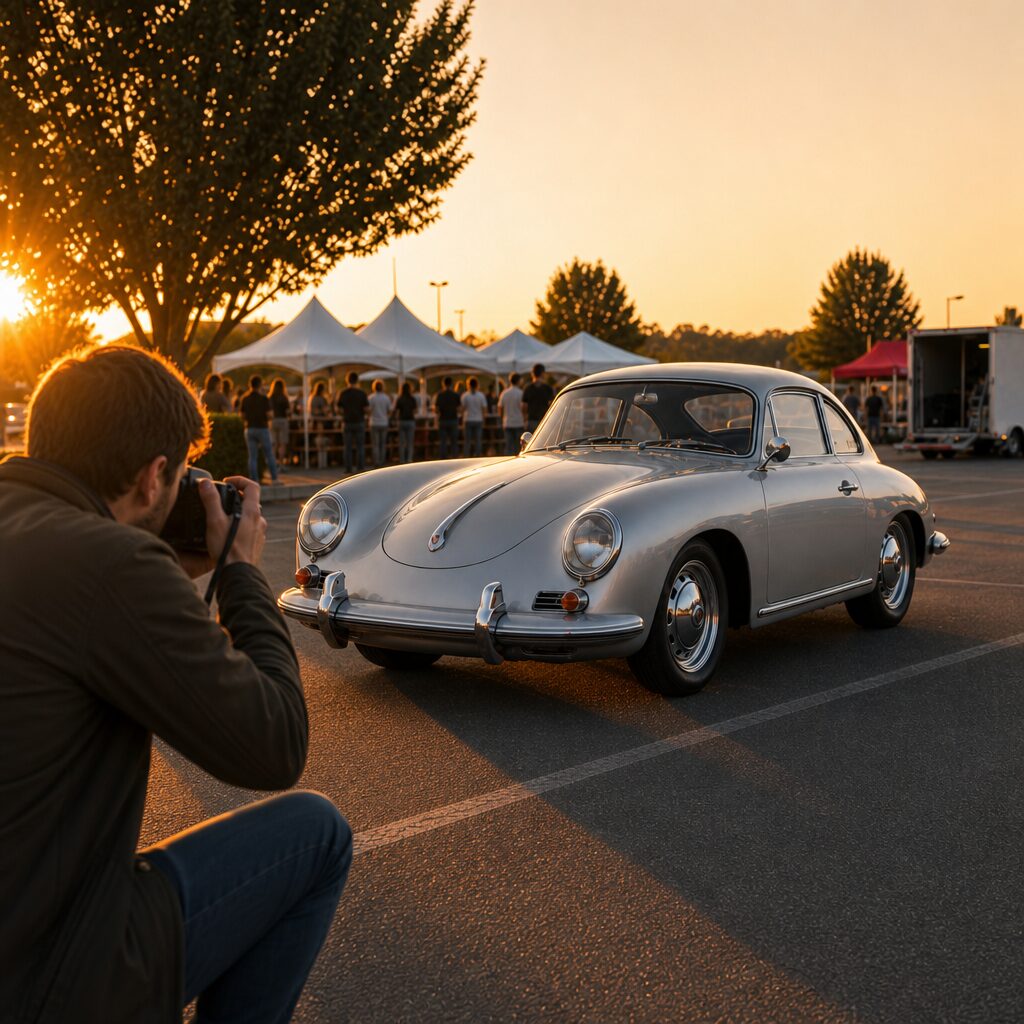
This is probably the most important bit of advice because at most car shows, the cars come and sit. As their owners come and sit. But if you are early, you might get the cars still moving, and those might be the most dramatic shots. At Pebble Beach, they even have a tour of many of the cars that will be in the concours the day before, so you get to see the cars underway, pretty exciting when it’s a rare race car that you never never thought you would see on the road like say a Mercedes 300SLR.
I hate the mid-day light, say from 11 am to 4 pm. Too harsh a light, but sunset shots can be very exciting – golden light of the sun defining the curves of the car, yet parts in dark shadow.
Ideal is to get in a show before it opens to the public. Now some shows are dead set against that but if it’s a show you go to often, what I would do is immediately send them pictures after your last attendance and say “these pictures free for media” and they will use them and next time remember you are a supplier and maybe grant you a press pass to come in at sparrow’s fart.
IN SUM: All this time, a half century at least, I’m admittedly still learning. Photography has changed mightily (do you even remember film, or color slides?) And there’s loads of ways to doctor pictures with a computer (I’m a babe in the woods there…) I am not trying to be known as The Great Photographer. Everybody with a cell phone is potentially that now.
But a painter of classic cars… much rarer occupation. Sign me up.
EDITORS NOTE: Author Wallace Wyss, once a automotive historian, has now segued to being a fine art portrait artist, exclusively of classic cars. He invites galleries to write if they want to try out a sample of his automotive artwork on their walls Wyss can be reached at photojournalistpro2@gmail.com














 my goal in going to car shows has changed, I now go with several objectives.)